FM 4-90.7
STRYKER BRIGADE
COMBAT TEAM
LOGISTICS
September 2007
HEADQUARTERS, DEPARTMENT OF THE ARMY
This publication is available at Army
Knowledge Online <
www.us.army.mil
>
and the General Dennis J. Reimer Training and
Doctrine Digital Library at <
www.train.army.mil
>.
Contents
Field Manual No. FM 4-90.7
Headquarters Department of the Army Washington, DC, 10 September 2007
Stryker Brigade Combat Team Logistics
Contents
Page PREFACE ...iv Chapter 1 Fundamentals of SBCT Logistics ... 1-1
The SBCT... 1-1 The BSB ... 1-1 SBCT Logistics ... 1-2 Concept of Support... 1-3 Distribution Operations to the SBCT ... 1-4 Support Methods ... 1-11
Chapter 2 SBCT Organization and Logistics Functions ... 2-1
Operational Framework... 2-1 Brigade Staff Roles and Organization... 2-2 Sustainment Provided by Elements Other Than the BSB... 2-11 Force Health Protection... 2-16 Legal Support ... 2-20 Financial Management ... 2-23 Contracted Support ... 2-24
Chapter 3 Brigade Support Battalion HHC ... 3-1
Missions and Organization ... 3-1 BSB Headquarters Staff ... 3-2
Chapter 4 The Field Maintenance Company ... 4-1
Organization ... 4-1 Maintenance Control Platoon ... 4-2 Wheeled Vehicle Repair Platoon... 4-5 Maintenance Support Platoon ... 4-5 Maintenance Operations ... 4-6
Chapter 5 The Brigade Support Medical Company ... 5-1
Mission and Organization... 5-1 Company Headquarters Organization and Function... 5-2 Medical Maintenance ... 5-3 Blood Management ... 5-4
Contents
ii FM 4-90.7 10 September 2007
Employment of the Medical Company... 5-4 Preventive Medicine Section ... 5-4 Mental Health Section ... 5-5 The Treatment Platoon... 5-6 The Evacuation Platoon ... 5-8 Medical Logistics ... 5-9
Chapter 6 The Distribution Company... 6-1
Organization ... 6-1 Supply Platoon... 6-4 Fuel and Water Platoon... 6-5 Transportation Platoon ... 6-6 Distribution Operations ... 6-6 Munitions Support... 6-10 Mortuary Affairs ... 6-13 Force Provider ... 6-14
Appendix A Echelons Above Brigade Logistic Support ...A-1 Appendix B Logistics Report ...B-1 Appendix C Logistics Enablers and Digitized Technology...C-1 Appendix D Protection ...D-1 Glossary ...Glossary-1 References ...References-1 Index ...Index-1
Figures
Figure 1-1. The brigade support battalion ...1-2 Figure 1-2. Intermediate staging base...1-3 Figure 1-3. Distribution example ...1-7 Figure 2-1. SBCT units ...2-1 Figure 2-2. Brigade staff by functional area ...2-3 Figure 3-1. A typical brigade support area configuration ...3-1 Figure 3-2. BSB headquarters staff organization ...3-3 Figure 4-1. BSB field maintenance company ...4-1 Figure 4-2. Typical company level maintenance workflow...4-7 Figure 5-1. Brigade support medical company ...5-2 Figure 5-2. Overview of Class VIII requisitions and supply flow ...5-11 Figure 6-1. Distribution company ...6-1 Figure D-1. Proper placement of sandbags in the cab... D-27 Figure D-2. Placing sandbags under the windshield of a truck... D-29 Figure D-3. Support structure for the bed of the truck–end view ... D-29 Figure D-4. Support structure for the bed of the truck–top view ... D-30 Figure D-5. Level II – HQDA-approved add-on armor kits ... D-31
Contents
Tables
Table 6-1. Classes of supply ...6-5 Table D-1. Protection levels ... D-32
Preface
iv FM 4-90.7 10 September 2007
PREFACE
This field manual gives the commander and staff of the Stryker brigade combat team (SBCT) and subordinate units doctrinal guidance for logistics operations. This manual describes how the SBCT optimizes logistics organizational effectiveness while balancing the needs of customer units with rapid strategic deployability. It also serves as an authoritative reference for personnel who develop doctrine, force structure, training, and standing operating procedures for SBCT operations.
The SBCT is manned and equipped primarily to conduct operations in a small scale contingency but may be augmented to participate in major combat operations. Its mobility and organic intelligence, surveillance, and reconnaissance assets make it invaluable to a division or corps commander in a major combat operation.
This manual describes the functions of the SBCT’s brigade support battalion (BSB), which includes a headquarters company, a distribution company, a field maintenance company, and a brigade support medical company. The SBCT headquarters and the BSB are capable of planning for and absorbing augmenting units/sections that provide mission specific logistic support capabilities not organic to the SBCT such as financial management or mortuary affairs. This manual is focused on logistics functions and is not meant to be an overarching document for combat service support unit operations.
This publication applies to the Active Army, the Army National Guard/Army National Guard of the United States, and the United States Army Reserve unless otherwise stated.
The proponent for this publication is the United States Training and Doctrine Command. The preparing agency is the United States Army Combined Arms Support Command (CASCOM). Send comments and recommendations on Department of Army (DA) Form 2028, Recommended Changes to Publications and Blank
Forms, to Commanding General, USACASCOM, ATTN: ATCL-FC-DA, 3901 A Avenue, Ft. Lee, Virginia
Fundamentals of SBCT Logistics
Chapter 1
Fundamentals of SBCT Logistics
1-1. Incorporating logistics functions into the SBCT presents some unique challenges. It is an early entry force, designed for deployability, and is mission capable to small scale contingencies (SSCs). The SBCT consists of three Stryker infantry battalions; a reconnaissance, surveillance, and target acquisition (RSTA) squadron; a field artillery battalion; a brigade support battalion; an antitank company; an engineer company; a network support company; a military intelligence company; a brigade headquarters and headquarters company (HHC).. In addition, the SBCT is designed to allow increased capabilities through scalability or augmentation. This structure makes the SBCT ideally suited for early entry operations where support infrastructure is limited or absent but where a relatively powerful, lethal, and flexible combat force is required. (For more information on the SBCT and its operations and subordinate unit capabilities, see FM 3-90.6.)
The Role of the SBCT
“We must provide early entry forces that can operate jointly, without access to fixed forward bases, but we still need the power to slug it out and win decisively. Today, our heavy forces are too heavy and our light forces lack staying power. We will address those mismatches.” (General Shinseki, 1999.)
THE SBCT
1-2. The SBCT brigade headquarters, including command and staff personnel, executes sustainment, deployment, movement, and maneuver, intelligence, fire support, command and control (C2), and protection functions to enable the command to plan and execute its assigned mission. The brigade headquarters provides administrative support to the brigade headquarters staff. The brigade headquarters receives additional services and support from the BSB.
1-3. The SBCT may be augmented with any type of unit (engineers, mechanized, armor, and so forth) based on mission, enemy, terrain and weather, troops and support available, time available, and civil considerations (METT-TC).
THE BSB
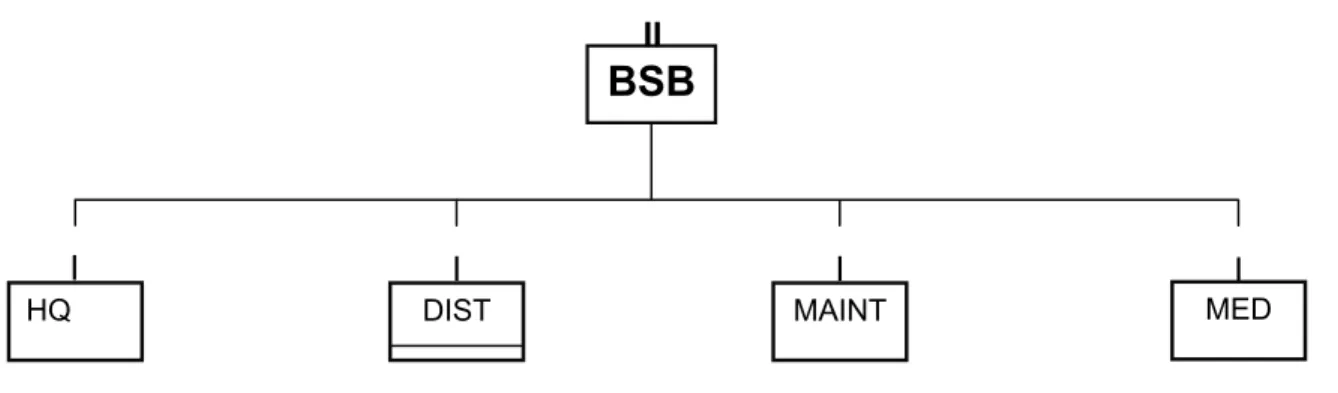
1-4. The BSB (figure 1-1) consists of four companies: the battalion HHC, the distribution company, the field maintenance company (FMC), and the brigade support medical company (BSMC). Functions of these units are defined in detail in subsequent chapters.
1-5. The BSB is designed to perform centralized C2 of all logistics operations, including Army Health System (AHS) support under the C2 of the BSB headquarters. The BSB staff executes logistics operations through a C2 system complemented with an array of digital information systems. In addition, the BSB has the capability to integrate into BSB operations the logistics assets required to support units or personnel augmenting the SBCT. (See appendix A for further information regarding support provided at echelons above the SBCT.)
Chapter 1
1-2 FM 4-90.7 10 September 2007
Figure 1-1. The brigade support battalion
SBCT LOGISTICS
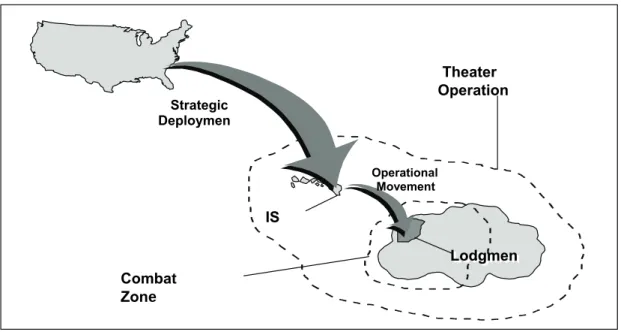
1-6. Based on METT-TC factors, Joint and/or Army forces commanders determine requirements and capabilities. Logistics elements provide a secure line of communications (LOC) and may use an intermediate staging base (ISB) en route to a joint operation. See figure 1-2. Logistics elements, such as the sustainment brigade or Army field support brigade (AFSB), provide the following:
All classes of supply and services. Transportation and evacuation. Maintenance and recovery.
Medical evacuation, hospitalization, and medical regulating. Distribution support.
Contractor and host-nation (HN) support. Automation network support.
1-7. A support element may establish an ISB to serve as a secure transportation node that allows the switch from strategic to intratheater modes of transportation. The ISB takes advantage of existing capabilities, serving as a transfer point from high volume commercial carriers to a range of tactical, intratheater transport means that may serve smaller, austere ports and enhances the strategic responsiveness of the deploying force. An ISB may be used as part of the joint plan to pre-position selected logistics capabilities for rapid deployment into the area of operations (AO). Once established, the ISB has two basic roles:
First is the traditional role as a staging base for deploying units in transit to an AO. The ISB may be the initial theater reception and staging facility. Deploying forces debark from strategic lift, reassemble, and prepare for missions in the AO.
The second role is as a support base.
1-8. Ideally, secure bases are available within the AO for reception, staging, onward movement, and integration (RSOI) operations and continued support of the deployed force. However, ISBs may be located in the theater or outside the theater. As a rule, the closer the ISB is to the AO and supported forces the better. Using existing air facilities and seaports should be leveraged. ISBs are not necessarily in a consolidated location. They may include satellite facilities in dispersed locations.
I
DISTI
MAINTI
MED HQI
BSB
II
Fundamentals of SBCT Logistics
Figure 1-2. Intermediate staging base
1-9. In the initial stages of an operation, the SBCT is supported by a tailored force provided by the Army service component commander (ASCC). This force is often built on task-organized personnel from the Theater Sustainment Command (TSC). The force supporting the SBCT in the initial stages of an operation is METT-TC dependent. Such factors as the availability of HN and contracted support, LOC distances, the type of operation, and many other factors help determine the supporting force structure. There is not a standard structure that fits all operations. As the theater matures and more of the supporting elements arrive, a more traditional support structure may develop. The SBCT obtains support from multiple sources and may not be tied to traditional linear support chains.
CONCEPT OF SUPPORT
1-10. The SBCT is manned and equipped primarily to conduct operations in an SSC. However, conditions may develop that require added capabilities not resident within the SBCT. When the SBCT participates in a major combat operation (MCO), it does so as a subordinate element of a division or corps. Its mobility and organic intelligence, surveillance, and reconnaissance (ISR) assets make it invaluable to a division or corps commander in an MCO. As with any brigade, adjustments to task organization might be required.
O
PERATIONALC
APABILITIES1-11. The SBCT’s operational capabilities include—
Three infantry battalions for maneuver versus only two in the heavy brigade combat team (HBCT) and infantry brigade combat team ( IBCT).
Infantry battalions contain organic armor in their Mobile Gun System (MGS) platoons. In-theater mobility.
Lower usage rate of Class III supplies than the HBCT, with nearly the same mobility. Greater survivability than an IBCT.
Ability to conduct forced entry or early entry operations. RSTA with organic human intelligence (HUMINT) Soldiers.
Theater Operation IS Combat Zone Lodgmen Lodgmen Strategic Deploymen Operational Movement
Chapter 1
1-4 FM 4-90.7 10 September 2007
L
IMITATIONS1-12. The SBCT has the following limitations:
The SBCT does not have the firepower or inherent protection of HBCTs.
The SBCT does not have a brigade special troops battalion for C2 of brigade troops. The SBCT does not have forward support companies (FSCs) for each maneuver battalion.
The SBCT does not possess organic gap-crossing capability. The SBCT requires more aircraft to deploy than an IBCT. The SBCT must receive distribution from higher headquarters.
F
ORCEA
GILITY1-13. An agile logistics force is—
Planned and executed within a Joint/multinational/interagency context. Seamless in the way it communicates and operates.
Small, flexible, and does not encumber the maneuver commander with large stockpiles of supplies or large numbers of logistics personnel on the ground.
1-14. To be agile, the logistics force uses—
Reach capabilities to help maximize the robustness of the support network. Tailored logistics forces and places in the AO only those logistics assets needed.
Optimal mix of active Army, reserve component (RC), Department of the Army (DA) civilians, HN, and contractors. (For more information, see FM 3-100.21.)
DISTRIBUTION OPERATIONS TO THE SBCT
1-15. Designated distribution managers coordinate and synchronize logistics flow according to the commander’s priorities and maximize throughput to units using all tools available to them. Distribution managers have asset and in-transit visibility (ITV) to optimize the distribution system within their areas of responsibility. Advanced information systems such as Movement Tracking System (MTS), Battle Command Sustainment Support System (BCS3), and advanced planning and optimization (APO) decision support tools provide this capability. ITV and communication packages allow distribution managers to direct or divert assets en route and shift assets quickly to meet changing distribution requirements. (JP 4-01 discusses distribution operations further.)
S
URGEC
APABILITY1-16. Surge capability is the ability to mass logistics resources at a point and time on the battlefield to affect the battle by maximizing combat power at the decisive point as determined by the supported commander. Surge capability is enabled by flexible, modular organizational capabilities and combined logistics and operational information. Surge capability may often be employed through tailored logistics resources.
T
HROUGHPUT1-17. Throughput allows supplies to bypass one or more echelons in the distribution system to minimize handling and speed up delivery. The SBCT distribution system uses pure palleting, containerization, packaging, ITV, information systems, technological enablers, and C2 relationships to improve the support within the AO by passing unnecessary echelons and reducing handling to move personnel, supplies, and equipment as far forward as possible to support brigade operations.
Fundamentals of SBCT Logistics
P
UREP
ALLETING1-18. Pure palleting is a process that collects Classes II, III(P), IV, and IX supply requisitions for a given Department of Defense Activity Address Code (DODAAC) into a single load and then throughputs them to their destination. Packages that do not fill a whole pallet may be combined with other packages to produce mixed loads, destined for multiple DODAACs or supply support activities (SSAs). Mixed loads are broken down in theater, combined with other partial loads, and then throughput to the servicing SSAs.
1-19. Class V is packaged into strategic configured loads (SCLs) and mission configured loads (MCLs). Successful implementation of SCLs and MCLs requires situational understanding and the ability to make appropriate forecasts at various points on the planning/time continuum. The intent is—
To increase throughput.
To minimize handling, particularly in the theater of operations (TOPN) To reduce the amount of supplies and equipment.
To hasten the flow of supplies to the consumer.
1-20. SCLs are a group of supplies built in the continental United States (CONUS) and identified by a single National Stock Number (NSN). SCLs may be ordered by a unit through the standard supply system.
1-21. MCLs are built in the theater based on requirements for a specific mission.
D
ELIVERY1-22. Delivery is one of the most important aspects of an effective distribution system. Generally, two types of deliveries are used—scheduled and time definite delivery (TDD).
Scheduled Delivery
1-23. Scheduled delivery occurs at agreed upon time intervals for routine replenishment. Generally, this includes items such as bulk fuel, ammunition, and operational rations and is conducted for each echelon with the distribution manager one level above the receiving unit coordinating requirements and delivery.
Time Definite Delivery
1-24. TDD is a commitment between the logistics manager and the supported commander specifying average customer wait time (ACWT). ACWT is the time the supported unit must wait to receive a particular commodity. The commander responsible for both the supporting and supported organizations establishes TDD as part of the distribution plan. TDD parameters are normally expressed in terms of hours or days for each major commodity. If the supported unit requires a delivery other than its normal scheduled delivery, the commander knows that they can expect delivery in a set amount of time based on the product and can plan accordingly. The TDD is directly linked to both situational understanding (SU) and an agile logistics force structure.
S
ITUATIONALU
NDERSTANDING1-25. SU enables the logistician to meet the needs of the operational commander. SU is the complete understanding of the friendly situation, the enemy situation (as described by current intelligence), and the logistics situation using advanced, seamless information technology. Key elements of SU are—
A common operating picture (COP) allows maneuver and logistics commanders to view the same data in near real time, enabling unity of command and unity of effort.
An integrated, seamless information network bringing together ITV, unit requirements, and COP in near real time and sharing the information across logistics functions and
Chapter 1
1-6 FM 4-90.7 10 September 2007
infrastructure while allowing the exchange of large volumes of information across platforms.
Timely and accurate asset visibility information allows the distribution of assets on time maintaining the critical confidence in the distribution system. Visibility begins at the point where resources start their movement to the AO. ITV uses advanced automation, information, and communications capabilities to track cargo and personnel while en route.
In addition to COP, liaison officers (LNOs) are often embedded at the maneuver brigade staff to pass current commander intent and mission changes to logistics elements.
F
USION OFL
OGISTICS ANDM
ANEUVERS
ITUATIONALU
NDERSTANDING1-26. Effective logistics operations by the BSB depend on a high level of SU and shared COP. SU enables the BSB commander and staff to maintain visibility of current and projected requirements, to synchronize movement and materiel management, and to maintain integrated visibility of transportation and supplies. BCS3, MTS, and Force XXI Battle Command Brigade and Below (FBCB2) are some of the fielded systems that the BSB uses to ensure effective SU and logistic support. These systems enable logistics commanders and battle staffs to exercise centralized C2, anticipate support requirements, and maximize battlefield distribution.
V
ISIBILITY1-27. Visibility is a tenet of distribution. Distribution managers dedicate most of their work to gaining and maintaining visibility of the various assets, processes, and capabilities throughout the distribution system. As summarized in FM 100-10-1, visibility ensures that the distribution system is responsive to customer needs. Experience has shown that Army leaders must be confident in the logistician’s ability to support them. Timely and accurate visibility information provides logisticians with necessary information to distribute assets on time thus maintaining high confidence levels. Visibility begins when the requirement is entered into the system and passed to the source of support. The information must be digitized and subsequently entered into the necessary logistics information systems. The key to digitizing information and ensuring that it is accurately entered into the automated system is automating the process through bar coding and automated data entry. The next critical element to visibility is the capability to update the transport, storage, maintenance, or supply status of that particular item/shipment until it is received by the consumer. The information must be accessible to all users regardless of the service or the command requiring the data.
M
ISSIONT
AILORING OFL
OGISTICSA
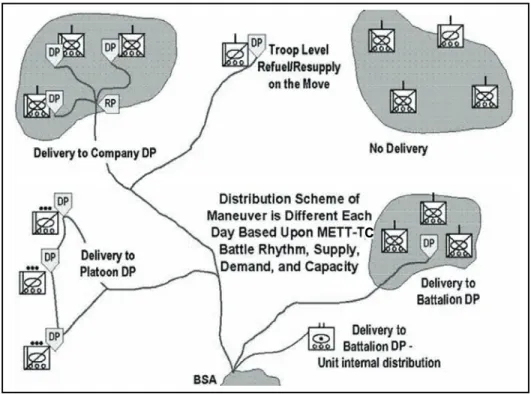
SSETS1-28. Logistics operations can be tailored in response to changes in tactical requirements. In most cases, the BSB will provide the supplies and services required by the supported unit at a specific point in time (scheduled delivery). For example, a typical day may include distribution to a battalion level distribution point for one customer cluster, to company/battery level for another customer cluster, and all the way to platoon/team level for a third cluster, while the fourth cluster receives no delivery (due to low/no requirements) that particular day. Such an example is shown in figure 1-3.
Fundamentals of SBCT Logistics
Figure 1-3. Distribution example
1-29. Supported unit commanders coordinate through their S3 and S4 staffs according to current unit battle rhythm to fix the time and place for replenishment operations at a temporarily established point. Assets can be retasked if the situation demands. This approach, executed according to centralized management, optimizes the employment of personnel.
S
YNCHRONIZATION OFB
ATTLER
HYTHM ANDL
OGISTICSO
PERATIONS1-30. Support operations are fully integrated with the SBCT battle rhythm through integrated planning and oversight of ongoing operations. Logistics and operational planning occurs simultaneously rather than sequentially. Incremental adjustments to either the maneuver or logistics plan during its execution must be visible to all SBCT elements. The logistics synchronization matrix and logistics report are both used to initiate and maintain synchronization between operations and logistics functions.
L
OGISTICSR
EPORTING1-31. The logistics report is the internal status report that identifies logistics requirements, provides visibility on critical shortages, projects mission capability, and provides input to the COP. To provide the support, unit commanders must coordinate closely with supporting and supported units using the logistics report. The report is forwarded from a unit to its higher headquarters and its supporting logistics headquarters. The logistics report will enable the higher command and support units to make timely decisions, prioritize, cross-level, and synchronize the distribution of supplies to sustain units at their authorized levels.
1-32. The logistics report is the primary product used throughout the brigade and at higher levels of command to provide a logistics snapshot of current stock status, on-hand quantities, and future requirements. The logistics report gives the logistician the information and flexibility to manage requirements internally at the lowest level to ensure mission accomplishment.
1-33. The logistics report incorporates the organizational and direct support (DS) supplies starting at company level. The intent is to identify the shortages at the lowest level first and then project the
C
C
C
Chapter 1
1-8 FM 4-90.7 10 September 2007
requirement to the next higher command and the support unit. The format for a modular force should incorporate organizational and direct support data on the same report to enable logisticians to fix issues at the lowest levels. While the format of the logistics report has been controlled by standing operating procedure (SOP) in the past, a new standardized spreadsheet based logistics report is under development. Data will be input and accessed locally through nonsecure internet protocol router network (NIPRNET) or BCS3. (See appendix B for an example of the logistics report spreadsheets.)
1-34. The logistics report is not intended as a means of gathering the same information available in a logistics Standard Army Management Information System (STAMIS) or to serve as the primary means of requisitioning commodities managed by a logistics STAMIS. The logistics report format is based upon METT-TC factors and should not overwhelm subordinate units with data submission requirements. A report that grows too cumbersome will overwhelm staffs and fail in high operating tempo (OPTEMPO) operations. It is important that this report is standardized and that units always provide input, regardless of their level of support.
1-35. Additional reports such as the materiel readiness report (MRR), munitions report (MUREP), and petroleum report (REPOL) should not be added to reporting requirements to subordinate units below division level when STAMIS and logistics report information satisfy information requirements.
Company Level
1-36. At company level, the first sergeant (1SG) or designated representative is responsible for gathering the information from the platoon sergeants and submitting a consolidated report to the battalion S4. The 1SG can direct cross-leveling between platoons and forecast requirements based on current balances and upcoming mission requirements. Some possible details to include in the logistics report are systems with an operational readiness rate below 60 percent, changes to anticipated expenditure rates, Class V status, and significant incidents. The primary means of gathering this information and submitting it to the battalion S4 is through the logistics report in FBCB2.
Battalion Level
1-37. The battalion S4 is responsible for collecting reports from all companies and ensuring reports are complete, timely, and accurate. The battalion S4, with the support operations officer (SPO) and executive officer’s (XO’s) concurrence, determines which units receive which supplies. That decision is based on mission priority and the battalion commander’s guidance. Upon receiving the logistics report, the company then validates external supplies to fulfill its requirements (where capable) and provides input to the logistics report on the adjusted balance of external supplies. The adjusted balances of external supplies are added to the logistics report and returned to the battalion S4. The company also provides a coordination copy to the BSB’s SPO. The battalion may include information such as STAMIS connectivity status, route and transportation node status, and distribution platform capabilities. The battalion S4 now has the complete logistics report and forwards this report to the brigade S4.
Brigade Level
1-38. The brigade S4 is responsible for collecting reports from all battalions, including the BSB logistics report on internal supplies. The brigade S4 ensures that reports are complete, timely, and accurate. Prior to the brigade S4 forwarding a consolidated report to the BSB SPO, the brigade S4, with brigade executive officer’s concurrence, determines which units receive which supplies. Their decision is based upon mission priority and the brigade commander’s guidance. Upon receiving the logistics report, the BSB SPO conducts a brigade logistics synchronization meeting. The BSB SPO then disseminates the external supplies to fulfill battalion requirements (where capable), synchronizes distribution, and provides input to the logistics report. The BSB SPO’s input to the logistics report focuses on the adjusted balance of external supplies owned by the BSB and
Fundamentals of SBCT Logistics
forecasting resupply requirements into the brigade. Some other possible information to include would be stockage levels, inventory on hand and in bound, and supply performance statistics. The adjusted balances of external supplies and forecasted requirements are added to the logistics report and returned to the brigade S4. The BSB SPO also provides a courtesy copy to the supporting sustainment brigade SPO. The brigade S4 now has the complete logistics report and forwards this report to the division G4. Once validated, the logistics report is used to update the synchronization matrix. The result should be a refined logistics report containing an accurate forecast of logistics requirements for use by operational level support organizations. The updated logistics report and logistics synchronization matrix complement paragraph 4 and annex I of the operations order (OPORD) or fragmentary order (FRAGO).
Division/Corps Level
1-39. The division/corps G4 is responsible for collecting reports from all task-organized brigades and ensuring reports are complete, timely, and accurate. The division/corps may add information such as changes to theater opening and changes to anticipated expenditure rates. The division/corps G4 has a complete logistics report and forwards this report to the next higher level of command and then forwards a logistics report for coordination to the supporting TSC/Expeditionary Sustainment Command (ESC) SPO.
L
OGISTICSR
EACHO
PERATIONS1-40. The BSB is organized to be reinforced by echelons above brigade (EAB) logistics reach operations. Logistics reach operations are using and positioning all-available logistics assets and capabilities from the national sustainment base through the Soldier in the field to support full spectrum operations. The goal of logistics reach is to reduce the amount of supplies and equipment in the AO to sustain combat power more quickly and fully exploit all available sources of support. Reach operations include, but are not limited to, external sources of information and intelligence, logistics planning and analysis conducted outside the AO, telemedicine, and other temporarily required capabilities. The BSB exploits regionally available resources through joint, multinational, HN, or contract sources for certain bulk supplies and services. (Contracted support, a potentially critical part of logistics reach operations, is discussed in detail in FM 3-100.21 and FM 100-10-2.) A key logistics reach organization responsible for coordinating contracted support and for providing other national strategic logistics capabilities is the AFSB. The AFSBs are part of Army Sustainment Command (ASC), a major subordinate command of the United States Army Materiel Command (USAMC).
1-41. Logistics reach operations are crucial for the SBCT because the SBCT is designed and optimized primarily for employment in SSC operations. To gain mobility and flexibility for the SBCT, the size and capability of the BSB has been reduced and reliance upon EAB logistics assets is thereby increased. The BSB is designed to perform centralized logistics functions. The BSB relies on logistics reach operations and pre-positioned stocks, augmentation, HN, contracted, joint, and multinational support to meet the needs of the brigade. The BSB has a limited capability to distribute resources to brigade elements, so the SBCT must make the best use of commercial support (contracted or HN), joint support, and intratheater airlift assets (such as locally available trucks and C-130s). The BSB’s distribution manager synchronizes delivery schedules with brigade units to minimize the offload and upload times. With FBCB2, BCS3, Transportation Coordinator’s Automated Information for Movements System II (TC-AIMS II), and the MTS control station to manage long-haul transport, the distribution manager can give specific coordinating instructions to vehicle operators while en route without having to rely on manned control points.
1-42. The SPO is the principal staff officer for coordinating logistics reach operations for supported forces. The support operations section is the key interface between the supported units and the source of support. The SPO advises the commander on support requirements versus support assets available. Logistics reach operations involve risk analysis, and the commander ultimately decides which support capabilities must be located within the AO and which must be provided by a reach
Chapter 1
1-10 FM 4-90.7 10 September 2007
capability. This ratio is based on METT-TC factors and command judgment. The SPO also determines which reach resources can be directly coordinated and which must be passed to the next higher support level for coordination. If resources must be contracted, the SPO passes the requirements to the supporting contracting officer (KO) who works within the context of the Army/joint contracting framework for the operation.
1-43. The SPO continually updates logistics reach requirements based on the logistics plan. Planning is the process of gathering data against pertinent battlefield components, analyzing their impact on the logistics estimate, and integrating them into tactical planning so that support actions are synchronized with maneuver. It is a conscious effort to identify and assess those factors that facilitate, inhibit, or deny support to combat forces. Using logistics planning, the BSB commander chooses from among a number of alternatives and recommends those that best support the maneuver commander’s priorities and missions.
1-44. Host-nation support (HNS) is one of the more commonly used sources of logistics reach support. HNS is provided to Army forces and organizations located in or transiting through host-nation territory, and includes both civil and military assistance. This support can include assistance in almost every aspect required to support military operations within the AO. Planners must consider that HNS meets local, not necessarily U.S. standards. Commanders must consider additional support requirements generated by using HNS; for example, HNS provision of potable water may mean bulk water from a desalinization plant, not bottled water, which increases requirements for tankers and a distribution system. Using HNS should not degrade required U.S. unilateral capability. The TSC SPO section includes a HNS directorate, which exercises staff supervision over ARMY FORCES HNS functions and recommends allocation of resources to support EAB support requirements.
1-45. When planning logistics reach operations, commanders must conduct a thorough risk analysis of the mission. Reach operations are vulnerable and highly susceptible to many factors including: U.S. Army commanders’ distrust of non-U.S. support, changes to the political situation, direct or indirect terrorist activity, local labor union activities, language differences, quality assurance/quality control (QA/QC) challenges, compatibility issues, and legal issues. Since reach operations involve Department of Defense (DOD) civilians, contractors, and joint and multinational forces, force protection operations become paramount to mission accomplishment. Single individuals within an agency can carry out terrorist operations. For example, an employee working for a contractor could contaminate food and water sources with small amounts of a biological agent. This could be even more deadly than a truck packed with explosives. Commanders must implement countermeasures to prevent reach operations from becoming an opportunity for terrorist action against U.S. forces. 1-46. The benefits of reach operations must be carefully weighed against force protection requirements, especially when using reach assets that are not U.S. military forces. The ability and tendency of our adversaries to use asymmetrical force against U.S. forces increases the inherent risks of some reach operations. If local hostilities escalate, support provided by civilians or contractors may also be disrupted. Commanders must consider potential risks and develop detailed plans for compensating for sudden variances in reach support. The limited size and capability of the BSB is further stressed by force protection requirements of the forward operating base (when positioned as a stand-alone base, vice a part of a base cluster) and during convoy operations.
1-47. Protecting contractors and government civilians on the battlefield is the commander’s responsibility. When contractors are expected to perform in potentially hostile areas, the supported military forces must protect their operations and personnel. Contractors are subject to the same threat as Soldiers, but they cannot be required to perform force protection functions. Contracted personnel do retain the inherent right to self-defense. Commanders should assess whether or not contractor support is vital enough to warrant a diversion of forces to contractor security duties. 1-48. Units or activities requiring support in high-risk contingencies must carefully list the required services and specify the working conditions so the contractors know what they are expected to deliver. The cost of the contract may increase substantially if the contractor is asked to perform under dangerous conditions. Additionally, contractors may be willing to accept more risk if the
Fundamentals of SBCT Logistics
Army meets specified security requirements such as escorting, training, or providing site security to ensure their safety. Commanders must accept responsibility for the security of contractor personnel when they use contracted support.
S
UPPORT FORA
TTACHMENTS1-49. Because of the SBCT’s austere logistics capabilities, attachments to the SBCT should arrive with appropriate support augmentation. When a company, team, or detachment is attached to the SBCT, the SBCT S4 integrates required augmentation into the SBCT support systems. The SBCT S4 must clearly state who will provide medical, maintenance, and recovery services, and provide support for Classes III, V, and IX. When the SBCT receives attachments, the S1 orients those units to processes that maintain personnel accountability and arranges for the necessary administrative support for those units. Logistics planners require some basic information from the sending unit’s S4 to anticipate how to develop a synchronized concept of support. Some considerations are—
z Number and type of supplies, personnel, and equipment.
z Current status and/or strength.
z When attachment is effective and for how long.
z What support assets will accompany the attached element. z When and where linkup will occur, and who is responsible.
SUPPORT METHODS
1-50. The SBCT uses a number of support methods. Some of these methods are discussed in the following paragraphs.
U
NIT(B
ATTALION/C
OMPANY/P
LATOON)
D
ISTRIBUTION1-51. In unit distribution, supplies are configured in unit sets (battalion/company/platoon, depending on the level of distribution) and delivered to one or more central locations. Heavy Expandable Mobility Tactical Truck-Load Handling System (HEMTT-LHS) fuel rack systems remain at the site to refuel unit vehicles as they cycle through the supply point. This technique makes maximum use of the capacity of SBCT truck assets by minimizing delivery and turnaround time.
S
UPPLYP
OINTD
ISTRIBUTION1-52. Supply point distribution requires unit representatives to move to a supply point to pick up their supplies. Supply point distribution is most commonly executed by means of a logistics release point (LRP). The LRP may be any place on the ground where unit vehicles return to pick up supplies and then take them forward to their unit. Occasionally, the LRP is the brigade support area (BSA) itself.
R
EFUEL/R
ESUPPLY ON THEM
OVE1-53. The refuel/resupply on the move (ROM) method of replenishment is conducted by having supported unit S3 and S4 staffs coordinate with the SBCT S4 and BSB support operations section to fix the time and place to conduct the ROM operations according to current unit battle rhythm. As a rule, a ROM operation is established and conducted as part of a unit movement. A ROM point is typically built to support several types of units passing through a point sequentially and provides for most classes of supply, including Class V and water. For additional information on ROM, see FM 10-67-1.
A
ERIALR
ESUPPLY(D
ELIBERATE,
F
IXEDW
ING,
ANDR
OTARYW
ING)
1-54. Aerial delivery is a viable option for distributing dry cargo to limited access or far forward areas or when delivery time is crucial. Aerial delivery is normally via containerized delivery system
Chapter 1
1-12 FM 4-90.7 10 September 2007
(CDS) or platform (463L pallet) airdrop. It may be a vital link in supporting RSTA units or other small dispersed units throughout the operation. Aerial delivery is an intensively coordinated endeavor due to requirements for drop zones and coordination lead time. The normal drop zone size for aerial delivery is 600 by 600 yards. Rigging of delivery platforms or containers usually occurs outside the brigade AO and is done by an aerial delivery unit. Flexibility is limited due to the physical nature of the drop zone and surrounding terrain and vegetation. Aerial resupply using rotary wing aviation is also an option for distributing limited quantities of supplies to remote or forward locations. Sling loading supplies is labor intensive but may be appropriate for some situations, such as Class IX delivery to combat repair teams (CRTs). This method provides ample flexibility for delivery locations as long as there is a clear area to hover the aircraft. The limiting factor is the availability of aircraft supporting the SBCT. Sling load operations require aviation augmentation early in the operation. Deliberate aerial resupply may be conducted with either fixed-wing or rotary-fixed-wing aircraft.
I
MMEDIATER
ESUPPLY1-55. Immediate resupply, also referred to as emergency resupply, is the least preferred method of distributing supplies. While some emergency resupply may be required when combat losses occur, requests for immediate resupply not related to combat loss indicate a breakdown in coordination and collaboration between the logistician and customer. If immediate resupply is necessary, all possible means, including options not covered above, may be used. The battalion/squadron S4s, the SBCT S4, and the BSB SPO must constantly and thoroughly collaborate to minimize the need for immediate resupply. Emergency resupply that extends beyond BSB capabilities requires immediate intervention of the next higher command capable of executing the mission. In such a case, the SBCT S4 and BSB SPO immediately coordinate with the next higher echelon of support for the SBCT.
M
ANAGEMENT OFL
OGISTICSA
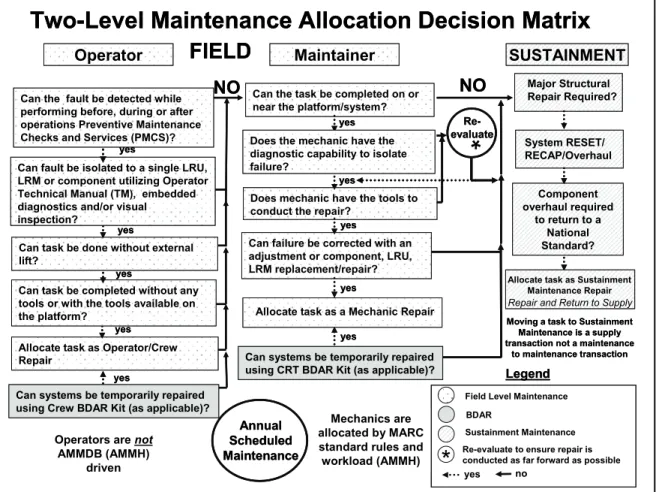
SSETS1-56. To provide necessary agility and flexibility, the BSB may use temporary task-organized logistic support teams (LSTs) allocated to maneuver units. LSTs are METT-TC dependant and used to support the commander’s intent, to reduce the amount of supplies and equipment in the BSA, and to provide maneuver units with logistics assets to support battalion-level operations. As a rule, LSTs are allocated to maneuver units to perform supply distribution, transportation, and food service to support that unit. If one unit has priority for support over another based on METT-TC factors and the SBCT commander’s intent, it may be necessary to mix, combine, or shift assets from the BSB, LST, or CRT to another to support mission requirement. The preferred solution is to provide backup or surge maintenance capability from within the assets of the BSB, but in some cases that may not be the most efficient or effective way to support the task force.
T
EMPORARYT
ASKO
RGANIZATION OFC
OMBATR
EPAIRT
EAMS1-57. As a rule, CRTs are allocated to maneuver units to perform field maintenance to support that unit. Sometimes one unit will have priority for maintenance over another based on METT-TC factors and the SBCT commander’s intent. In such cases, it may be necessary to combine or shift assets from one CRT to another to support maintenance requirements. The preferred solution is usually to provide backup or surge maintenance capability from within the assets of the FMC, but in some cases that may not be the most efficient or effective way to support the task force. Given the METT-TC situation, there may be a requirement to temporarily task organize a CRT or portions thereof.
S
UPPORT TOS
EPARATEC
OMPANIES1-58. The SBCT has an engineer company, a military intelligence company, an antitank company, and a network support company that do not operate under a battalion. These companies, like the brigade HHC, are supported by the BSB regardless of where they are located on the battlefield. If one of these companies, or part of the company, is task organized to a maneuver battalion, it will
Fundamentals of SBCT Logistics
remain under the support of the BSB. The company commander must coordinate with the maneuver battalion’s S4, the BSB SPO, the distribution and maintenance company commanders, and the supporting CRT chief. Based upon the local situation and conditions, they may decide to integrate the company’s logistics requirements into the battalion’s logistic support structure.
P
LANNINGC
ONSIDERATIONS1-59. The support concept for the SBCT is based on a number of assumptions that must be considered as part of the any military decisionmaking process (MDMP) process:
Availability of HN and/or theater support contracts in areas such as transportation, life support, facilities support, and so forth, if needed.
Food supply consists of meals, ready to eat (MREs) until food service capability arrives. Units attached or operational control (OPCON) to the brigade must be accompanied by organic support elements. These elements will augment like elements in the BSB to provide required support. This must always be coordinated with the BSB SPO.
Sustainment stocks continue to flow during the initial, early entry buildup. However, resupply operations occur on an “as needed” basis, rather than according to a fixed, cyclic schedule; delivery requirements may dictate less-than-truck loads.
The Defense Logistics Agency (DLA) will provide bulk fuel, water, and food—either through pre-positioned stocks or DLA theater support contracts (such as into plane contracts, into bag contracts, into truck contracts)—after sources are inspected and approved by veterinary and preventive medicine (PVNTMED) personnel.
Refueling operations are planned and executed when SBCT fuel status falls below a command specified level (for example, 75 percent for RSTA elements and 50 percent for all other units).
When the situation warrants, Logistics Civil Augmentation Program (LOGCAP) may be used to meet internal support requirements. LOGCAP is coordinated through the BSB SPO and the AFSB.
SBCT Organization and Logistics Functions
Chapter 2
SBCT Organization and Logistics Functions
OPERATIONAL FRAMEWORK
2-1. To achieve collaborated and coordinated operations, it is important to understand the operational framework of roles and responsibilities throughout the SBCT. This chapter outlines SBCT units and staff elements and details personnel, force health protection, legal, and contracting functions that are performed by SBCT elements outside the BSB. The BSB provides all logistic support to the SBCT. (Chapters 3 through 6 detail how the BSB performs its functions.)
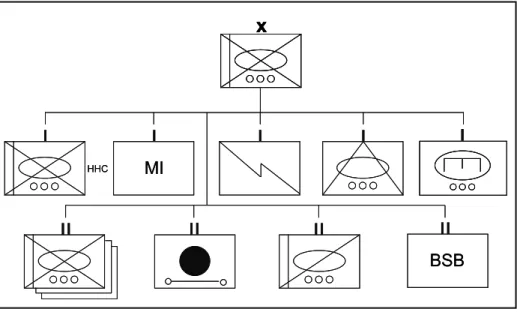
Figure 2-1. SBCT units
S
TRYKERI
NFANTRYB
ATTALIONS2-2. The SBCT has three infantry battalions consisting of three rifle companies, each with three rifle platoons. Each rifle company has a section of organic 60-mm and 120-mm mortars, an MGS platoon with three MGS vehicles, and a sniper team. See figure 2-1. The HHC also has a mortar section (81-mm and 120-mm mortars), a reconnaissance platoon, and two sniper teams.
R
ECONNAISSANCE,
S
URVEILLANCE,
T
ARGETA
CQUISITIONS
QUADRON2-3. The RSTA squadron of the SBCT is extremely mobile and can cover a very large AO. The RSTA is composed of five troops—one headquarters, three reconnaissance troops equipped with Stryker reconnaissance vehicles, and a surveillance troop.
2-4. Each of the reconnaissance troops includes three reconnaissance platoons and a mortar section. The three reconnaissance platoons are organized with four reconnaissance vehicles (RV), each with a crew and a scout team for dismounted reconnaissance. The mortar section consists of two 120-mm self-propelled mortars and a fire direction center.
2-5. The surveillance troop provides the squadron commander with a mix of specialized capabilities built around aerial and ground sensors. The UAS platoon launches, flies, recovers, and maintains the squadron’s aerial reconnaissance platforms. The multisensor platoon consists of ground-based radio
x
○○○
○○○
HHC○○○
○○○
○○○
BSB
MI
○○○x
○○○
x
○○○
○○○
HHC○○○
○○○
○○○
BSB
MI
○○○ ○○○Chapter 2
2-2 FM 4-90.7 10 September 2007
signals interception and direction-finding teams (for example, Prophet teams); it also has a dedicated communications terminal that transmits, reports, and receives voice, data, digital, and imagery feeds from intelligence sources at every echelon from RSTA through national level. The ground sensor platoon provides remotely emplaced unmanned monitoring capabilities. The chemical, biological, radiological, nuclear, and high-yield explosives (CBRNE) reconnaissance platoon has three M93A1 vehicles (Fox) to determine the presence and extent of CBRNE contamination.
F
IRESB
ATTALION2-6. The fires, or field artillery, battalion consists of three field artillery batteries with the mission of destroying, neutralizing, or suppressing the enemy with cannon fire.The battalion headquarters battery operates as a tactical and administrative headquarters and provides target acquisition for the battalion by weapons locating radars.
B
RIGADES
UPPORTB
ATTALION2-7. The BSB is the organic logistics unit of the SBCT. It has four subordinate companies—a distribution company, a forward maintenance company, a BSMC, and an HHC. This BSB does not have forward support companies, like in other BCTs, and must task organize to provide support to each maneuver unit in the SBCT. (The BSB is described in detail in chapters 3 through 6.)
E
NGINEERC
OMPANY2-8. The engineer company provides the SBCT with mobility support. It consists of three mobility platoons and one mobility support platoon and has limited organic gap crossing capability.
A
NTITANKC
OMPANY2-9. The antitank company is the primary antiarmor force in the SBCT. The company consists of three platoons, each with three Stryker anti-tank guided missile (ATGM) vehicles.
N
ETWORKS
UPPORTC
OMPANY(NSC)
2-10. The NSC is organic to the SBCT and connects the unit to the global information grid (GIG). Each NSC has three platoons—a tactical operations center (TOC) nodal platoon, a BSB nodal platoon, and a signal support platoon. The vehicles supported by the SBCT NSC use FBCB2-terrestial.
M
ILITARYI
NTELLIGENCE(MI)
C
OMPANY2-11. The MI company consists of a small headquarters section; an intelligence, surveillance, and reconnaissance (ISR) integration platoon; an ISR analysis platoon; and a tactical HUMINT platoon. The ISR analysis and ISR integration platoons are OPCON by the SBCT S2; they also provide support to the development of the SBCT COP, targeting effects, situation development, and intelligence preparation of the battlefield (IPB). They integrate and analyze across the other war fighting functions (WFFs) reconnaissance and surveillance reporting to develop intelligence products in response to priority intelligence requirements (PIR). The tactical HUMINT platoon provides the SBCT with an organic capability to conduct HUMINT collection and counterintelligence activities.
BRIGADE STAFF ROLES AND ORGANIZATION
2-12. The mission of the SBCT staff is to—
Plan, direct, control, and coordinate operations.
Provide information management and communications.
2-13. The staff officers of the SBCT are organic to the SBCT HHC, and are not assigned to, or function as part of, subordinate units. They are equipped with many information systems and digital
SBCT Organization and Logistics Functions
communications to assist them in providing the commander with a timely and accurate synopsis of the COP. Therefore, they are always available to assist the commander to make and implement decisions. 2-14. The SBCT commander uses his/her professional knowledge, experience, and leadership style to organize the SBCT staff. The staff organization in garrison might not work in a combat environment. At the SBCT level, the distinctions between personal, coordinating, and special staffs are evolving. For example, although AR 27-1 requires the Staff Judge Advocate (SJA) to be a member of the commander’s personal staff, the BJA also provides operational law support to the operations section and administrative law support to the personnel section.
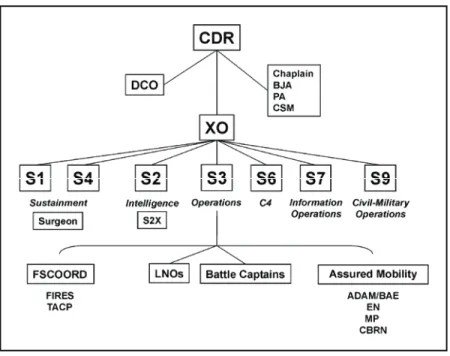
2-15. Brigade staffs are often organized by functional area. FM 3-90.6 suggests arranging the staff section into the following cells:
Operations. Intelligence.
Information operations (IO). Civil-military operations. Sustainment.
Command, control, communications, and computers (C4OPS).
2-16. See figure 2-2, below, for an example of how the SBCT staff can organize by functional area.
Figure 2-2. Brigade staff by functional area
2-17. The commander, assisted by the XO, organizes the various SBCT staff elements into functional cells. This organization varies according to the mission assigned to the SBCT. For example, during a civil support operation in CONUS, the operations and civil-military operations cells could merge. 2-18. At various times during the operations process, the XO organizes working groups to deal with certain issues. Generally, the SBCT has three standing working groups:
ISR . Targeting.
Chapter 2
2-4 FM 4-90.7 10 September 2007
O
PERATIONSC
ELLOperations Officer
2-19. The S3 is generally the chief of the operations cell, which includes fires, operations, and engineer staff sections. The S3 is the coordinating staff officer for all matters concerning tactical operations of the SBCT. The S3 provides technical guidance to SBCT units in the areas of training, operations and plans, and force development and modernization. The S3 may be in the line of succession after the deputy commanding officer (DCO), battalion commanders, or the XO per the commander’s guidance. The responsibilities of the S3 include—
Preparing, coordinating, publishing, and distributing SBCT orders, plans, and SOPs.
Synchronizing the effects of SBCT combat units according to the SBCT commander’s intent.
Developing the SBCT ISR plan.
Focusing on current operations if the DCO assists with planning future operations.
Identifying training requirements, recommending allocation of training resources, and preparing the commander’s training guidance.
Participating in the targeting and IO process.
Reviewing orders, plans, and SOPs from subordinate units. Planning SBCT unit movements, to include deployments. Managing A2C2 and terrain in the SBCT AO.
Coordinating and integrating joint, interagency, and multinational (JIM assets into SBCT operations.
Planning for dislocated civilians (DCs), civilian internees, and detainee operations.
Representing Army aviation in MDMP and other staff planning processes (such as IPB, ISR, and targeting).
Assisting the S3 in the development of airspace control measures. Maintaining the aerial portion of the COP.
Assisting the fires section in analysis of airspace control orders (ACOs) and air tasking orders (ATOs).
Engineer Coordinator
2-20. The engineer coordinator (ENCOORD) is a special staff officer responsible for coordinating the use of engineer and other organic or augmenting assets to conduct combat (mobility, countermobility, and survivability) and general and geospatial engineering support to the SBCT. Since SBCTs do not have an engineer battalion, the staff ENCOORD provides the senior technical insight to engineer functions. The duties of the ENCOORD include—
Advising the commander on necessary augmentation to be requested.
Recommending the engineer priorities of effort and support, essential mobility/survivability tasks (EMST), and acceptable mission risks to the commander.
Advising the commander on obstacle construction and destruction. Participating in targeting meetings.
Providing a terrain visualization mission folder on the effects of terrain on friendly and enemy operations.
Producing specialized maps and maintenance of the digital terrain database (in coordination with [ICW] the S2).
Monitoring the status of engineer units and the engineer capabilities of other SBCT units and providing that status to appropriate SBCT staff sections.
SBCT Organization and Logistics Functions
Planning and coordinating the use of the scatterable mines (SCATMINEs) with the fires section.
Planning and supervising construction and maintenance of camps and facilities for SBCT units.
Synchronizing environmental considerations for the SBCT staff. Provost Marshal
2-21. The provost marshal (PM) is a special staff officer responsible for planning and coordinating military police (MP) operations. The PM provides staff supervision for the five MP functions— maneuver and mobility support (MMS) operations, area security, law enforcement, internment resettlement, and police intelligence operations. The duties of the PM include—
Planning and coordinating MP support to mobility/countermobility/survivability operations. Supervising operations at the SBCT detainee collection point (DCP).
Advising the SBCT commander on the conduct of law and order operations. Assisting the S2 with physical security.
Conducting liaison with local civilian law enforcement authorities. Chemical Officer
2-22. The chemical officer (CHEMO) is a special staff officer responsible for CBRNE hazards and smoke operations. The duties of the CHEMO include—
Recommending operational exposure guidance (OEG), biological warfare defense measures, and appropriate mission-oriented protective posture (MOPP) levels to the SBCT commander.
Providing technical advice and recommendations on CBRNE reconnaissance and smoke operations.
Assessing the effect of enemy CBRNE-related attacks on current and future operations. Assessing the effect of toxic industrial chemicals (TICs) and toxic industrial materials (TIMs) on Soldiers, and the effects of SBCT operations on civilian TIC/TIM facilities. Planning and coordinating CBRNE decontamination (except patient decontamination) operations.
Operating the SBCT CBRNE warning and reporting system. Battle Captains
2-23. Battle captains assist the command group in controlling the SBCT. Battle captains remain in the command post (CP), keeping focused on the current operation, and continuously assisting the SBCT (and battalion) commanders in the C2 of their fight. The duties of battle captains can be divided into two major areas: information management (IM) and CP operations. The responsibilities of battle captains include—
Monitoring the status of commander’s critical information requirements CCIR. Supervising the battle staff NCOs conducting battle tracking by—
Monitoring current location of friendly and enemy units, and groups of civilians. Assessing the activities and combat power of friendly and enemy units.
Monitoring the status of adjacent and supporting units.
Monitoring and synchronizing the COP displays in the SBCT CP. Ensuring the proper integration of SBCT ABCS.
Supervising the flow of information among staff cells within the SBCT CPs. Providing current status to assist with MDMP and planning future SBCT operations. Enforcing CP policies according to unit SOP and current OPORD.
Chapter 2
2-6 FM 4-90.7 10 September 2007
Liaison Officers
2-24. The SBCT commander has LNOs that represent him at the headquarters of another command to coordinate and promote cooperation between the two commands. SBCT LNOs are usually captains. The duties of an LNO include—
Acquiring and maintaining a full understanding of the SBCT commander’s intent. (The LNO must be able to understand and explain SBCT actions to the gaining command.) Maintaining an awareness of SBCT and subordinate unit situations, planned ISR and combat operations, and status.
Maintaining an awareness of the gaining command’s status and planned operations.
I
NTELLIGENCEC
ELLIntelligence Officer
2-25. The S2 is the coordinating staff officer for all matters concerning the enemy and/or threat, the environment as it affects the enemy, and counterintelligence. In addition, the S2 works with the SBCT PM to plan and execute physical security programs. The S2 is responsible for intelligence readiness, intelligence tasks, intelligence synchronization, and other intelligence support. The duties of the S2 include—
Managing the SBCT intelligence process.
Managing IPB, including integration of input from other staff sections.
Providing situation development, to include updating the enemy/threat, terrain and weather, and civil considerations portions of the COP.
Providing intelligence support to the targeting process—including participating in the targeting meetings, developing high-value targets (HVTs), and tracking high-payoff targets (HPTs).
Providing intelligence support to IO by integrating intelligence products into IO planning and integrating IO considerations into the other intelligence tasks.
Synchronizing intelligence support with combat and ISR operations through close coordination with the commander, DCO, XO, and S3.
Analyzing CCIR. This includes PIR, friendly forces information requirements (FFIR), and other information requirements (IR) to develop collection tasks and requests from higher and adjacent units.
Integrating ISR.
Recommending adjustments to the ISR plan to facilitate ISR integration. Supervising collection operations.
Coordinating technical oversight and support for MI assets and units. Counterintelligence (CI) and HUMINT
2-26. The Staff Officer, Intelligence (S2X) is the staff officer responsible for CI and HUMINT associated matters. The S2X ensures that source-sensitive information is not inadvertently released, and that HUMINT sources are not compromised. The responsibilities of the S2 include—
Developing the HUMINT collection plan to support the SBCT ISR collection plan.
Coordinating and deconflicting HUMINT and CI activities in the SBCT AO with national agencies.
Authorizing release of HUMINT reporting and products.
Disseminating combat information and intelligence products to commanders and other users in a format that supports their SU.
SBCT Organization and Logistics Functions
Providing operational guidance (not operational control) to HUMINT collectors and CI agents.
Maintaining the SBCT HUMINT database.
Identifying enemy intelligence collection capabilities, including efforts targeted against the SBCT.
Evaluating enemy intelligence capabilities, including those that affect operations security (OPSEC), countersurveillance, signals security (SIGSEC), and psychological operations (PSYOP).
I
NFORMATIONO
PERATIONSC
ELL2-27. The S7 (information operations officer) is a coordinating staff officer responsible for integration of nonlethal effects to destroy or disrupt the information flow of threat forces. The S7 also oversees the protection of friendly information from threat forces. Duties of the S7 include—
Coordinating with the S6 to protect the SBCT C4 Ops network. Coordinating with the S2 on OPSEC.
Integrating IO into the targeting process.
Coordinating with the S3 and fires support coordinator (FSCOORD) for military deception, PSYOP, and electronic warfare (EW).
Coordinating with the public affairs officer (PAO) to disseminate information.
C
IVIL-M
ILITARYO
PERATIONSC
ELL2-28. The S9 (civil-military operations officer) serves as the coordinating staff officer responsible for advising the commander on the relationship between the civilian population and military operations. The S9 advises the commander on how to best minimize civilian interference with military operations. The S9 serves as the SBCT’s primary staff link to the civil-military operations center (CMOC), to maintain liaison with other U.S. government agencies, indigenous population and institutions (IPI), non-governmental organizations (NGOs), and international organizations in the AO. The responsibilities of the S9 include—
Advising the commander on the effects of the civilian population on SBCT operations. Assisting a civil affairs (CA) company in the operation of a CMOC.
Assisting the S3 to integrate attached CA units into the SBCT.
Assisting in the development of plans to deconflict civilian activities with military operations.
Planning community relations programs to gain and maintain public understanding and support of military operations.
Coordinating with the brigade judge advocate (BJA) and chaplain to advise the SBCT commander on legal and moral obligations incurred from the effects of military operations on civilian populations.
Coordinating with the PAO on supervising public information media under civil control. Coordinating with the FSCOORD on culturally sensitive sites and protected targets.
Coordinating with the CA units on the preparation and integration of area assessments in support of civil-military operations (CMO).
S
USTAINMENTC
ELLLogistics Officer
2-29. The S4 (logistics officer) is usually the chief of the sustainment cell. The S4 is the coordinating staff officer for logistics operations and plans. The S4 provides staff oversight to SBCT units in the areas of supply, maintenance, transportation, and field services. The S4 is the SBCT staff integrator for the