The Potential Impact of United States Tourists on the Cuban Market
if Travel Sanctions are Lifted; as well as the Identification of their Push-PullTravel Motivational Factors Lehi M. Dowell
School Of Hospitality Management Florida International University
ABSTRACT
This investigative study will focus on the potential impact on Cuba’s tourism industry by United States citizens if travel sanctions are lifted. The research will also aid in understanding the push and pull (push-pull) travel motivational factors that United States (U.S.) citizens exhibit towards booking a vacation to Cuba. Through this study, collected data will assist in future marketing endeavors so that when the travel sanction is lifted, U.S. travel agencies will be able to prioritize the push-pull travel motivational factors and translate them into captivating
promotional packages for this new market segment. Although current travel is prohibited by U.S. citizens to Cuba unless they have a government issued visa, debating the topic of lifting the travel sanction is a high priority for the current administration.
KEYWORDS: Cuba, United States, Travel Sanctions, Push-Pull Motivational Factors, Marketing, Promotional Packages
INTRODUCTION
There is little debate: Cuba has the spotlight with regard to small island nations and big future economic potential. Unlike several decades ago, issues relating to Cuba are openly discussed; in fact, Cuba is a front runner in the current administration’s legislative actions. In an article by Howard Schneider (2010) of the Washington Post, a bill in July 2010 was approved by the House Agriculture Committee to lift part of the 1962 trade sanction which would result in allowing free travel by U.S. citizens to Cuba.
PURPOSE
This investigative study will focus on the potential impact on Cuba’s tourism industry by United States citizens if travel sanctions are lifted. The research will also aid in understanding the push and pull (push-pull) travel motivational factors that United States (U.S.) citizens exhibit towards booking a vacation to Cuba.
PRACTICAL SIGNIFICANCE
Through this study, collected data will assist in future marketing endeavors so that when the travel sanction is lifted, U.S. travel agencies will be able to prioritize the push-pull travel motivational factors and translate them into captivating promotional packages for this new market segment.
CONCEPTUAL FRAMEWORK
Crompton (1979) led the way in the discovery of the push (factors causing someone to leave a home setting) motivational factors for the tourism industry. The nine push factors he identified were: escape from a perceived mundane environment; explorations and evaluation of self; relaxation; prestige; regression to a childhood state; enhancement of kinship relationships;
facilitation of social interaction; novelty; and education. Erik Cohen (1984) was able to identify pull (attractive attributes of a location) travel motivational factors in his research. These were: recreational (relieve stress); diversionary (escape from general boredom); experiential (modern curiosity); experimental (to learn about other lifestyles); and existential (spiritual draw). The push-pull travel motivational theory is important to academic research because it examines the underlying reasons why a tourist is traveling to a specific destination.
LITERATURE REVIEW
CURRENT TRENDS IN CARIBBEAN TRAVEL & CUBA’S IMPORTANCE
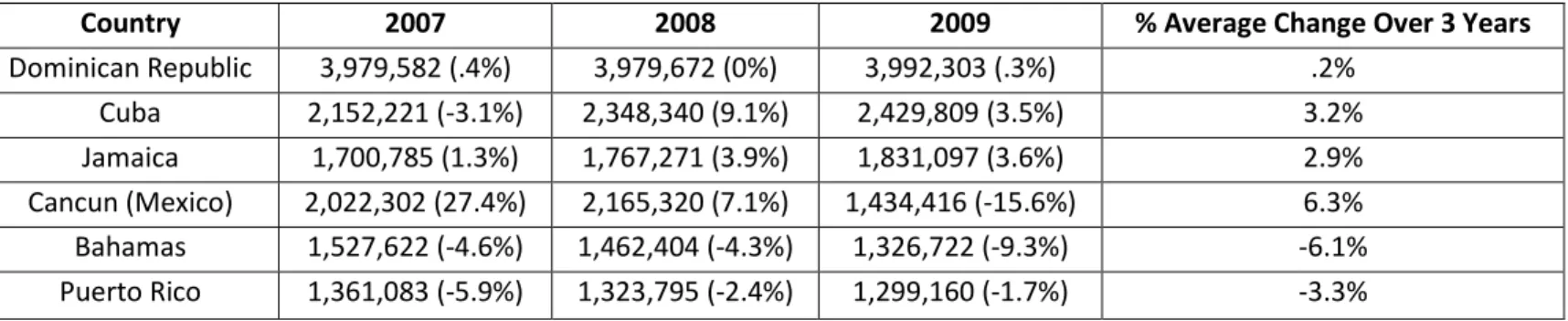
Figure 1 below was created using statistics from the Caribbean Tourism Organization (2010) website. The data shows the most popular ranking islands in the Caribbean, and the percentage of change from year to year is identified in parenthesis. The raw data below reveals the top six travel destinations for 2009 in the Caribbean to be: Dominican Republic, Cuba, Jamaica, Cancun (Mexico), Bahamas, and Puerto Rico.
Figure 1 Tourist (Stop Over) Arrivals 2007-2009. Graph is organized to show highest ranking and percentage of change from previous year.
IMPLICATIONS OF LIFTING THE TRAVEL BAN
In the 1930s while America was fighting with the ideology of alcohol prohibition and conservative mindsets, Cuba began its accent to popularity in American culture. (Khrushchlev, Henthorne, Latour, 2007) Villalba (1993) notes that in the 1950s it is estimated that over 20% of US travel to the Caribbean was to Cuba, which accounted for 85% of the visitors to the island in that time. The U.S. International Trade Commission (2008) estimated that if travel restrictions to Cuba were lifted, the number of U.S. travelers to the island would be between 1.1 million to 2.8 million per year. It also states how the U.S. segment demand for Cuba would cause an “elastic substitution” from other islands, such as the Dominican Republic and Puerto Rico, causing a drop in tourism rates to those islands. Philip Peters (2002) who was the Vice President of the Lexington Institute did a study titled International Tourism: The New Engine of the Cuban Economy. He states that American Travel analysts predict that once the sanction on Cuba is lifted; within the first year around one million Americans will visit Cuba.
Figure 2 below follows the projected yearly average increase in tourism (.2% for the Dominican Republic and 3.2% for Cuba), and accounts for the additional 1,000,000 US visitors to Cuba in 2011 (hypothetically assuming that the travel sanction is lifted in 2011). For the use of this study the 1,000,000 figure is conservative and does not reflect the “elastic substitution” drop in tourism for the Dominican Republic. Using this chart it is clear that Cuba will become the number one travel destination in the Caribbean by 2015.
Country 2007 2008 2009 % Average Change Over 3 Years
Dominican Republic 3,979,582 (.4%) 3,979,672 (0%) 3,992,303 (.3%) .2% Cuba 2,152,221 (-3.1%) 2,348,340 (9.1%) 2,429,809 (3.5%) 3.2% Jamaica 1,700,785 (1.3%) 1,767,271 (3.9%) 1,831,097 (3.6%) 2.9% Cancun (Mexico) 2,022,302 (27.4%) 2,165,320 (7.1%) 1,434,416 (-15.6%) 6.3% Bahamas 1,527,622 (-4.6%) 1,462,404 (-4.3%) 1,326,722 (-9.3%) -6.1% Puerto Rico 1,361,083 (-5.9%) 1,323,795 (-2.4%) 1,299,160 (-1.7%) -3.3%
Figure 2 Projected Tourism Rates if Travel Sanction is Lifted
2009 2010 2011 2012 2013 2014 2015
Dominican Republic 3,992,303 4,000,288 4,008,288 4,016,305 4,024,337 4,032,386 4,040,451
Cuba 2,429,809 2,507,563 3,587,805 3,702,615 3,821,098 3,943,373 4,069,561
PUSH-PULL TRAVEL MOTIVATIONAL FACTORS: CASE STUDIES
To better market a specific destination, it is imperative to understand the motivational factors which lead to a tourists’ travel decision and consumption behavior. As will be demonstrated, motivational factors vary by age groups, geographic locations, sexes, peer group influence, and the manner in which the information was received.
The case study by Kim, Noh, and Jogaratnam (2006) conducted an examination of push-pull travel motivational factors for American students going on vacation. Of the total 2,482 responses collected only 1,488 were used for the research evaluation. Highlights of the data collected show: 48% would travel alone or with one other person; 59% would stay three to six nights; the top four push motivational factors in order of importance were to “escape and relax”, “leisure and adventure”, “seeing and learning”, and “travel bragging”; the top four pull motivational factors in order of importance were “accessibility”, “sun and beach”, “recreation”, and “attractions.” To further delineate the results the top individual sub-categorical push motivational factors were “escaping from ordinary/responsibilities”, “experiencing new or different life-style”, “seeing many attractions”, and “going places my friends have not visited.” The top individual sub-categorical pull motivational factors were “easy accessibility”, “sea and beaches”, “to participate in sport events”, and “cultural and historic attractions.” Given this research data travel agencies for University students should now consider gearing travel promotions for this market segment with emphasis towards “escaping and relaxing” and “easy accessibility.” They would want to refrain from travel promotions which feature “visiting family and relatives” and “nature”, as those two factors were ranked lowest.
The case study by Wu, Xu, and Ekiz (2009) investigated travel patterns, behaviors, and motivations of Chinese domestic travelers. They compared the means-end theory with the push-pull travel motivational factors identified in their research. This is a relative study because like China, Cuba will be experiencing phenomenal tourism growth in the near future. China had not
had in depth investigations as to the understanding of the motivation of Chinese domestic travelers before this study. The top push motivational travel factors were “to relax”, “to make trips possible”, and “personal values.” The top pull motivational travel factors were “cultural/historical attractions”, “novelty/uniqueness”, and “trip cost/convenience”. Given this research data travel marketing agencies in China should now consider gearing travel promotions for this market segment with emphasis towards “escaping and relaxing” and “cultural/historical attractions.”
The case study by Jonsson and Devonish (2008) examined the difference of motivation between specific groups traveling to the island of Barbados. The study explored the similarities and differences in travel patterns and attitudes towards a specific destination between multiple groups (Canadian tourists, U.S. tourists, and British tourists) which is relative to my proposed study in which three U.S. geographical locations will be examined. The top two motivations identified for all three segments were “to relax”, and “to be emotionally and physically refreshed.” However, with regard to “visiting cultural attractions” those tourists from Canada were most motivated; with regard to “pleasure seeking and fantasy experiences” those from Britain were most motivated; and with regard to “getting physical and visiting a natural environment” those from the U.S. were most motivated. In addition the study identified those tourists in the oldest age category (55 and older) were most likely to travel to Barbados based on the need to “increase their knowledge of local places”, whereas, those in the youngest category (18-54) were most motivated to travel to Barbados for “pleasure seeking and fantasy
experiences.” Given this research data travel agencies in Barbados should now consider gearing individual travel promotions for each geographical market segment with emphasis towards the highest rated motivational factors for age groups.
Reference groups play a critical role in how a traveler chooses a final leisure destination. Burch (1965) researched peer influence and found there was an affirmative impact between peer persuasion and having colleagues take a leisure excursion such as camping. In addition, Ajzen and Driver (1991) demonstrated a positive relationship between an individual choosing a leisure travel location based upon past experiences and storytelling of their peers. The case study by Currie, Wesley, and Sutherland (2008), explored the travel decision-making process and the role that peer reference groups play in influencing that decision, specifically, with regard to the sex of the traveler. They evaluated 73 questionnaires from students at one university campus.
Highlights of the findings: for the male participants more than double went to a specific leisure location based upon the recommendation of their peers than those that did not; 85% of
respondents were motivated to have the same experience as their peers after hearing about their travels; 100% of the students all expressed emotional responses of some kind after hearing a peer discuss their travel, in which males identified with the emotion of jealously while females
identified with the emotion of excitement; and, that 99% of the respondents felt information gathered from peers is more influential than travel agencies and books. These are relative case studies because Cuba has not been visited by many American tourists, and means that they must capitalize on making the best first impression so that travel to Cuba gets communicated back to peer reference groups in a positive light.
The case study by Rittichainuwat (2006) investigated tourism in Thailand after the 2004 Tsunami focusing on the visitors’ decision making process and where tourists obtained reference information for booking their trip. She received a total of 668 completed questionnaires, for a
68% response rate. The top three travel motivations for visitors after a natural disaster were: relating to nature (the area’s beauty), the people (the resident’s welcoming attitude), and value for the money. It was also identified that positive marketing and reputation of “service-minded people”, “image of the Thais helping foreigners during the Tsunami” and “high quality of hotels/resorts” were ranked highly. The top three sources of travel reference information for visitors were: the internet, talking to family/friends/relatives, and advice from travel agencies. Although Cuba has not experienced a natural disaster, there are many similarities in the fact that Cuba is underdeveloped and not easily accessible to the general American population. This study suggests that promotions would be cost effective through hotels’ online reservation engines and Web sites focusing on the relaxing atmosphere, friendliness of the people, and good value for the money. In addition it would be of the utmost importance that travel agencies have first-hand knowledge and experiences of Cuba. This can be accomplished through complimentary “getting to know you” visits to Cuba for meeting planners, travel agents, and known opinion leaders who belong to an aspiration or reference group.
MEHTODOLOGY INSTRUMENT
The push-pull travel motivational factor questions this research project is using have been developed from several surveys. There will be a list of 10 push and 10 pull motivational questions based upon the Likert scale. In addition there will be demographic questions to help answer the research questions. The survey will be completed online (www.surveymonkey.com) by 125 randomly selected participants in each of the three selected cities: Miami, New York, and Los Angeles. These surveys will provide a generalized synopsis of the U.S. population in three different geographical locations, thus providing the ability to deduce a broad-spectrum assumption for travel agencies.
RESEARCH QUESTIONS
Based upon the literature reviews completed, academic research gaps were identified, particularly in relation to push-pull travel motivational factors for American tourism to Cuba. Hence, some of the questions this quantitative study is designed to examine are:
1. What are the top three push-pull motivational travel factors for US tourists planning a trip to Cuba?
2. Is there a significant difference with regard to geographical location, genders, and age groups?
DATA ANALYSIS
The SPSS Data Collection software program and ANOVA will be utilized in order to collect, sort, and format the data into statistically compatible variances.
REFERENCE LIST
1. Ajzen, I; Driver, L.B. (1991). “Prediction of leisure participation from behavioral, normative, and control beliefs: an application of the theory of planned behavior”, eisure Sciences, Vol. 13, pp. 185-204.
2. Burch, W.R. (1965). “The play world of camping”, The American Journal of Sociology, Vol. 70 No. 1, pp. 604-12.
3. Caribbean Tourism Organization (2010). Retrieved 07/31/10: http://www.onecaribbean.org/statistics/
4. Cohen, Erik. (1984) The sociology of tourism: approaches, issues, and finding. Annual Review of Sociology, Vol. 10: 373-392
5. Crompton, J. (1979). Motivation of pleasure Vacation. Annals of Tourism Research, (VI)(4), 408-424.
6. Currie, Russell; Wesley, Franz; and Sutherland, Paul. (2008) “Going where the Joneses go: understanding how others influence travel decision-making”, International Journal Of Culture, Tourism and Hospitality Research, Vol. 2 Iss: 1, pp. 12-24.
7. Jonsson, C; and Devonish, Dwayne. (2008) “Do Nationality, Gender, and Age affect Travel Motivation?”, Journal of Travel and Tourism Marketing, Vol. 25, no. 3-4, pp. 398-408.
8. Khrushchev, Sergei; Henthorne, Tony L; and Latour, Michael S. (2007) Cuba at the Crossroads: The Role of the US Hospitality Industry in Cuban Tourism Initiatives. Cornell Hotel and Restaurant Administration Quarterly, 48, 4; 402-415.
9. Kim, Kakyom; Noh, Jeonghee; Jogaratnam, Giri. (2006). Journal of Travel & Tourism Marketing, Vol 21 (2/3). Multi-Destination Segmentation Based on Push and Pull Motives: Pleasure Trips of Students at a US University.
10.Peters, Philip. (2002) Lexington Institute. International tourism: The New Engine of the Cuban Economy. Pages 1-16.
11.Rittichainuwat, Bongkosh Ngamson (2006, November). “Tsunami Recovery: A Case Study of Thailand’s Tourism.” Cornell Hotel and Restaurant Administration Quarterly, 390-404.
12.Schneider, Howard. (2010) Retrieved 07/31/10: http://www.washingtonpost.com/wp-dyn/content/article/2010/07/06/AR2010070605164.html
13.United States International Trade Commission, (2008). Retrieved 11/05/10: http://www.usitc.gov/publications/332/pub3932.pdf
14.Villalba, G. 1993. Cuba y el Turism. Havana, Cuba: Editorial de Ciencias Sociales 15.Wu, Jiajia; Xu, Jing; Ekiz, Erdogan. (2009). Investigating the Push and Pull Motivation
of Visiting Domestic Destination in China: A Means-End Approach. Journal of China Tourism Research, 5, 287-315