Estimation of a nonparametric regression
spectrum for multivariate time series
Jan Beran
and
Mark A. Heiler
Department of Mathematics and Statistics
University of Konstanz
December 2007
Abstract
Estimation of a nonparametric regression spectrum based on the periodogram is considered. Neither trend estimation nor smoothing of the periodogram are required. Alternatively, for cases where spec-tral estimation of phase shifts fails and the shift does not depend on frequency, a time domain estimator of the lag-shift is defined. Asymp-totic properties of the frequency and time domain estimators are de-rived. Simulations and a data example illustrate the methods.
Key words: Periodogram, cross spectrum, regression spectrum, phase,
wavelets.
1
Introduction
Consider a multivariate time series Y(i) = (Y1(i), ..., Yp(i))T of the form
Y(i) =f(ti) +(i), (1) where ti = i/n (i = 1, . . . , n), f(t) = (f1(t), ..., fp(t))T ∈ Cp (t ∈ R) is a
mean stationary process. In this model, dependence between two components
YrandYscan occur due to two reasons: 1. dependence betweenrands, and
2. dependence due to similarities in the underlying deterministic components
fr and fs. In the first case, linear dependence is characterized by
cross-correlations, the cross-spectrum, coherency and phase-shift betweenr ands
(see e.g. standard books such as Priestley 1981, Brockwell and Davis 1987). For the second case, Beran and Heiler (2007) introduced a nonparametric regression cross spectrum. In the present paper, we consider estimation of the regression cross spectrum based on the periodogram, and frequency and time domain estimation of possible phase-shifts. Figure 5 shows a typical example where the nonparametric regression spectrum leads to interesting insights. The bivariate series consists of the Southern Oscillation Index (figure 5a) and recruitment of new fish in the central Pacific Ocean (figure 5b), ranging
from 1950 to 1987 over a period of n = 453 months (Shumway and Stoffer
2000). Both series have strong deterministic components that are related to each other. The analysis in section 5.2 shows that there are two levels of
dependencies, namely between the long-term trends (El Ni˜no effect) of both
series, and between the deterministic seasonal components respectively. The paper is organized as follows. Basic definitions from Beran and Heiler (2007) are summarized briefly in section 2. An estimator of the regression spectrum, its modulus and the phase spectrum, based on the periodogram, is discussed in section 3, together with asymptotic properties. The asymptotic results imply in particular that phase estimates can be highly unreliable for frequencies with low amplitude spectrum. In fact, examples in section 5 illustrate that estimation of time-delays from the raw plot of the (estimated) regression phase spectrum is virtually impossible. The problem is resolved by applying an algorithm that downweighs or eliminates unreliable frequencies. For cases where the number of relevant frequencies is too small, an alternative procedure for estimating time shifts between trend functions is presented in section 4. Simulations and a data example in section 5 illustrate the methods. Proofs are given in the appendix.
2
Definition of the regression cross
covari-ance and spectrum
Under suitable regularity assumptions on f, Beran and Heiler (2007) define
the regression (cross-)covariance function Γ(u) = [γrs(u)]r,s=1,...,p and the
regression (cross-)correlation function R(u) = [ρrs(u)]r,s=1,...,p of f(t) by
γrs(u) =< fr(·+u), fs>= 1 0 fr(t+u)fs(t)dt and ρrs(u) = γrs(u) γr(0)γs(0) (2) where1
o f(x)dxis assumed to be zero andf(1 +u) =f(u) (0< u≤1). Note
that here, trend components that cannot be extended periodically beyond
t = 1 are assumed to have been removed, or to be negligible. For t ∈ [0,1]
and fr ∈L2[0,1], we have f(t) = ∞ j=−∞ a(j)ei2πjt,
where a(j) = (a1(j), a2(j), ..., ap(j))T ∈Cp are given by
ar(j) =< fr, ei2πj·>= 1
0
fr(t)e−i2πjtdt.
Hence, the regression spectrum at frequency j is defined as the sequence of
p×p matrices H(j) = [hrs(j)]r,s=1,...,p (j ∈Z) with
H(j) =a(j)aT(j).
The regression spectrum and covariance function are closely linked by
Γ(u) = ∞ j=−∞ H(j)ei2πju and H(j) = 1 2 −1 2 e−i2πjuΓ(u)du.
Using polar representation of H(j), ˜ hrs(j) = hrs(j) γrr(0)·γss(0) = |ar(j)as(j)| γrr(0)·γss(0)exp(iφrs(j))
is called the standardized regression spectrum of f,
κrs(j) = |hrs(j)| γrr(0)·γss(0) = |hrs(j)| ||fr|| · ||fs|| = |ar(j)as(j)| l|ar(l)|2 m|as(m)|2
is the relative spectral modulus andφrs(j) the phase shift at frequencyj. The
relative spectral modulus (or coherence)κrs(j) defined above can assume any
number between 0 and 1, thus giving a relative measure of the contribution
of frequency j to the cross-covariance.
Remark 1 If two components fr and fs are shifted versions of each other, i.e.
fs(t) =c·fr(t+ Δ)
for someΔ, c∈R, then
κrs(j) = |ar(j)|
2
l|ar(l)|2
(3)
and the phase-shift
φrs(j) =−2πΔj
is a linear function of the shift parameter Δ.
3
Estimation in the spectral domain
3.1
The periodogram
In practice, the trend component f is usually unknown. Beran and Heiler
(2007) propose an estimator of the cross-spectrum based on a trend estimator
ˆf obtained by wavelet thresholding. In this section, we consider a direct
estimator of the regression spectrum based on he periodogram. This has two main advantages. First of all, the estimator is simple and does not require
nonparametric estimation of the trend function f. The second advantage is that estimated values at different frequencies are asymptotically independent.
Given n observations of a multivariate vector Y(i) (i = 1, . . . , n), the
periodogram of Y(i) at frequency ωj = 2πj/n, ωj ∈[−π, π], is defined by
I(ωj) = 1 n n s=1 Y(s) exp(−iωjs) n t=1 Y(t) exp(iωjt) T . Moreover, let A(ωj) =f(tk) exp(−iωjk) and B(ωj) =(k) exp(−iωjk), respectively. Then I(ωj) = [I;rs(ωj)]1≤r,s≤p = 1 nB(ωj)B(ωj) T ,
is the periodogram of the multivariate stationary series(i) = (1(i), . . . , p(i))T. The deterministic counterpart,
If(ωj) = [If;rs(ωj)]1≤r,s≤p = 1
nA(ωj)A(ωj)
T
will be called regression periodogram of f. It can be seen by straightforward
calculations that under model (1) with non-constant f the diagonal elements
of the periodogramI(ωj) are of the orderO(n) and are dominated byIf(ωj).
This is the essential reason why the regression spectrum can be estimated di-rectly from the periodogram. Specific results on the asymptotic distribution are given in the following two theorems.
Theorem 1 Denote by H = [hrs]r,s=1,...,p the regression spectrum of f, and
suppose that (i) are independent, identically zero mean random vectors with
non-singular covariance matrix Σ = (Σrs)1≤r,s≤p, and existing fourth
mo-ments. Then, for each pair (r, s), and Fourier frequencies 0 ≤ ωj1 < · · · <
ωjk ≤π, (k ∈N), the following holds.
(i) n−1Irs(ωj)−hrs(j) =Op(n−1/2),
(iii) √
n[n−1Irs(ωj1)−hrs(j1), . . . , n−1Irs(ωjk)−hrs(jk)]T
converges in distribution to a k-dimesional normal random vector with
mean 0 and covariances
lim n→∞ncov(n −1I rs(ωj), n−1Irs(ωj)) = 0, for ωj =ωj, and lim n→∞nvar(n −1I rs(ωj)) = Σrr|as(j)|2+ Σss|ar(j)|2. (4)
Remark 2 More specifically, the proof of the theorem implies
ncov(n−1Irs(ωj), n−1Irs(ωj)) =O(n−2),
for ωj =ωj, and
nvar(n−1Irs(ωj)) = Σrr|as(j)|2+ Σss|ar(j)|2+Rn (5)
with Σrs denoting the (r, s)th entry of the matrix Σ and
Rn=n−1ΣrrΣss+O(n−2)
for 0< ωj < π, and
Rn =n−1(ΣrrΣss+ ΣrsΣsr) +O(n−2)
for ωj ∈ {0, π}.
Remark 3 The periodogram I(ω) contains a stochastic and a
determinis-tic part. This carries over to the asymptodeterminis-tic variance at frequency j. The
main component is given by a product of the variance of the stationary part
and the regression spectrum. The variance in theorem 1 is of order O(n−1)
so that n−1Irs(ωj) is an asymptotically consistent estimator of hrs(j). This
is in contrast to spectral estimation for stationary processes where the pe-riodogram needs to be smoothed. Note also that, in contrast to the wavelet
estimator in Beran and Heiler (2007), the estimatorsˆf(ω) =n−1I(ω)at
dif-ferent frequencies are asymptotically independent. This facilitates estimation of the coherence and phase spectrum (see results below).
Theorem 1 can now be extended to linear error processes. Thus, assume (i) = ∞ j=−∞ A(j)Z(i−j),
where A(j) = (Alk(j))1≤l,k≤p are p×p-matrices such that for all pairs (l, k),
j∈Z
|Alk(j)||j|12 <∞,
and Z(i) are independent identically distributed with zero mean and
non-singular covariance matrix Σ. Also, denote by
h= [h;r,s]r,s=1,2,...,p
the cross-spectral density of (i). Theorem 1 can be generalized to
Theorem 2 Let (i) be a linear process as defined above. Then, with the same notation as in theorem 1,
(i) n−1Irs(ωj)−hrs(j) =Op(n−1/2);
(ii) E[n−1Irs(ωj)]−hrs(j) =O(n−1);
(iii) √
n[n−1Irs(ωj1)−hrs(j1), . . . , n−1Irs(ωjk)−hrs(jk)]T
converges in distribution to a k-dimensional normal random variable
with mean zero,
lim n→∞ncov(n −1I rs(ωj), n−1Irs(ωj)) = 0 for ωj =ωj, and lim n→∞nvar(n −1I rs(ωj)) = 2πh;rr(ωj)|as(j)|2+ 2πh;ss(ωj)|ar(j)|2.
Remark 4 More specifically, the proof of the theorem implies
for ωj =ωj, and nvar(n−1Irs(ωj)) = 2πh;rr(ωj)|as(j)|2+ 2πh;ss(ωj)|ar(j)|2+Rn (6) with Rn=n−1(2π)2h;rr(ωj)h;ss(ωj) +O(n−2) for 0< ωj < π, and Rn=n−1(2π)2[h;rr(ωj)h;ss(ωj) +h;rs(ωj)h;sr(ωj)] for ωj ∈ {0, π}.
Remark 5 Recalling that hrs(j) = ar(j)as(j), we see that the asymptotic
variance of Irs(ωj)is equal to 2π times the product of the regression and the
stationary spectrum.
Remark 6 The result in theorem 2 can be generalized to pairs (r, s) and (r, s), 1≤r, s, r, s ≤p. For Fourier frequencies ωj, ωj we have
lim n→∞ncov(n −1I rs(ωj), n−1Irs(ωj)) =O(n−2) for j =j and lim n→∞ncov(n −1I rs(ωj), n−1Irs(ωj)) = 2πhss(j)h;rr(ωj)+2πhrr(j)h;ss(ωj)+O(n−1) for j =j.
3.2
Estimation of modulus, phase spectrum and phase
shift
We now consider estimation of the modulus and the phase spectrum. As a special case, the asymptotic results will be applied to the estimation of a constant phase shift. Denote by
crs(j) =Re{hrs(j)} and
the real part and the imaginary part with reversed sign ofhrs(j) =ar(j)as(j) respectively. Thus,
hrs(j) =crs(j)−iqrs(j).
Similarily, we define for the cross spectral density of ε(i) the quantities
cε;rs(j) =Re{hε;rs(j)} and
qε;rs(j) =−Im{hε;rs(j)}.
The joint asymptotic distribution of ˆcrs(j),qˆrs(j) follows directly from theo-rem 1 and theo-remark 6.
Lemma 1 Define the estimators
ˆ crs(j) = 1 2n Irs(ωj) +Irs(ωj) and ˆ qrs(j) =− 1 2ni Irs(ωj)−Irs(ωj) . Then, ζn=√n[ˆcrs(j)−crs(j),qˆrs(j)−qrs(j)]T
converges in distribution to a bivariate normal zero mean random variable
with asymptotic covariance matrix M(j) = [Mij(j)]i,j=1,2 given by
M11(j) = lim n→∞nvar(ˆcrs(j)) =π[hss(j)h;rr(ωj) +hrr(j)h;ss(ωj)] + 2π[crs(j)c;rs(ωj)−qrs(j)q;rs(ωj)], M22(j) = lim n→∞nvar(ˆqrs(j)) =π[hss(j)h;rr(ωj) +hrr(j)h;ss(ωj)]−2π[crs(j)c;rs(ωj)−qrs(j)q;rs(ωj)], and M12(j) = lim n→∞ncov(ˆcrs(j),qˆrs(j)) = 2π[qrs(j)c;rs(ωj) +crs(j)q;rs(ωj)].
Based on lemma 1 we may now construct consistent estimators of the spectral modulus and the phase shift. Using the notation
hrs(j) =κ∗rs(j) exp(iφrs(j))
estimators of the spectral modulus and phase shift respectively are defined by ˆ κ∗rs(j) = ˆcrs2 (j) + ˆqrs2 (j) (7) and by ˆ φrs(j) = argIrs(ωj) = arctan −qˆrs(j) ˆ crs(j) . (8)
The asymptotic distribution of ˆκ∗rs(j) and ˆφrs(j) is given in the following
corollaries.
Corollary 1 Let κ∗rs(j)>0 and let the assumptions of theorem 2 hold, then
ˆ
κ∗rs(j)−κ∗rs(j) =Op(n−1/2)
uniformly for all j ∈Z. Furthermore,
√ n[ˆκ∗rs(j)−κ∗rs(j)]→ Nd (0, σκ2;rs(j)), where σ2κ;rs(j) = c 2 rs(j)M11(j) +qrs2 (j)M22(j) + 2crs(j)qrs(j)M12(j) [κ∗rs(j)]2 . (9) Moreover, lim n→∞ncov(ˆκ ∗ rs(j),ˆκ∗rs(j)) =O(n−2) (j =j).
Corollary 2 Let κ∗rs(j) > 0 with φrs(j) = arghrs(j) and φˆrs(j) as above. Then,
ˆ
φrs(j)−φrs(j) =Op(n−1/2)
uniformly for all j ∈Z. Furthermore,
√
n φˆrs(j)−φrs(j)
d
where σφ2;rs(j) = q 2 rs(j)M11(j) +c2rs(j)M22(j)−2crs(j)qrs(j)M12(j) [κ∗rs(j)]4 . Moreover, lim n→∞ncov( ˆφrs(j), ˆ φrs(j)) = O(n−2) (j =j).
Note that the variance of the phase spectrum is small whenever the
mod-ulusκ∗rs(j) is large and vice versa. Accurate estimation of the phase spectrum
may therefore only be expected for frequencies j where the amplitude
spec-trum is large. Examples in section 5 illustrate that often most frequencies have to be omitted in the estimation of phase shifts. For instance, in the
case of a simple shift between fr and fs, i.e.
fr(t) =cfs(t+ Δ) and hence
φrs(j) = −2πjΔ,
the following algorithm can be applied: 1. Calculateˆf(ωj) =n−1I(ωj); 2. Define
J∗ ={j : ˆκ∗rs(j)> c·
σκ2;rs(j)}
for a suitably chosen c∈R;
3. Estimate the phase shift by applying a local robust regression to the
points{(j, φrs(j)) :j ∈J∗}, taking into account possible jumps modulo
2π.
4
Lag Estimation in the time domain
In the previous sections we considered estimation of the regression cross spectrum based on the periodogram and derived a method for estimating lead-lag effects in the trend components. The proposed algorithm is based on a set of significant common frequencies that can be used for estimating the slope of the phase line. Problems with this algorithm are expected if
the set of common frequencies is too small to identify a slope in the phase plot. This is the case, for instance, if the deterministic components have a Fourier series representation with a small number of harmonic components. Phase-shifts may then have to be identified by examining regression cross correlations instead of the phase spectrum. In the case of a simple shift that does not depend on frequency, the time delay between two trend components can be estimated by identifying the maximum of the cross correlation.
Thus, for each pair (r, s), 1≤r, s≤p, denote the set of local maxima by
M={u∈[−1,1] :γrs (u) = 0, γrs(u)<0} and
umaxrs = argmax{γrs(u) :u∈ M}
where γrs is the cross autocorrelation defined in section 1. An estimator of
umax rs is then defined by ˆ umaxrs = argmax{γˆrs(u) :u∈M}ˆ where ˆ M={u∈[−1,1] : ˆγrs (u) = 0, ˆγrs(u)<0}
and ˆγrs is a suitable consistent estimator of γrs(u).
More specifically, here ˆγrs will be defined using a wavelet estimator of
the trend function f ∈ Rp in the definition of γ
rs. Thus, given a father and
mother wavelet φ(·),ψ(·)∈L2(R) and the corresponding wavelet basis
φl,k(x) = 22lφ(2lx−k) and ψj,k(x) = 2j2ψ(2jx−k), k, j∈Z, we define ˆ γrs(u) = 1 0 ˆ fr(t+u) ˆfs(t)dt with ˆ fr(t) := k ˆ α(l,kr)φl,k(t) + Jn j≥l k ˆ wj,k(r)βˆj,k(r)ψj,k(t), (10) where ˆ α(l,kr) = 1 n n u=1 φl,k(tu)Yr(u), (11)
and ˆ βj,k(r)= 1 n n u=1 ψj,k(tu)Y(u), (12)
for some Jn → ∞, and ˆwj,k(r) := 1{|βˆj,k(r)| ≥
var( ˆβj,k(r))λj}. For the choice of
the threshold λj see e.g. Brillinger (1994, 1996) and Donoho and Johnston
(1995), among others. Denote by α(r) = {α(r)
l,k : l, k ∈ Z, α (r) l,k = 0} and β(r) = {β(r) j,k : j ≥ l, k ∈ Z, β (r)
j,k = 0} (r = 1, . . . , p) the coefficients in the
wavelet representation of the components of f, i.e.
fr(t) := k α(l,kr)φl,k(t) + Jn j≥l k βj,k(r)ψj,k(t). (13)
As in Brillinger (1995), we assume that for each r, the number of non-zero
coefficients α(l,kr) and βj,k(r) is finite. Letr, s∈ {1,2, ..., p}be fixed. Defining
θ0 = (α(r),β(r),α(s),β(s)) we may then write
γrs(u) = γrs(u, θ0)
where γrs depends continuously onθo,
M=M(θ0) ={u∈[−1,1] : γrs (u, θ0) = 0, γrs(u, θ0)<0} and
umaxrs = argmax{|γrs(u, θ0)|:u∈ M(θ0)}. (14)
The estimator of umaxrs is then defined by
ˆ
umaxrs = argmax{γrs(u,θˆ):u∈ M(ˆθ)}. (15)
To ensure existence, uniqueness and consistency of estimator the following assumptions will be used.
(A1) φ, ψ have compact support and are of finite variation;
(A3) The cumulants
cm;r(u1, ..., um−1) = cum{εr(i+u1), ..., εr(i+um−1), εr(i)}
of εr(i) exist, are absolutely summable, i.e.
Cm;r=
u1,...,um−1
|cm;r(u1, ..., um−1)|<∞.
Moreover, εr has covariances γεr(k) such that
∞
k=−∞
|kγεr(k)|<∞; (A4) dim(θo)<∞;
(A5) For z in a small neighborhood of 0,
m Cmzm <∞; (A6) As n → ∞, we have Jn → ∞, n2−Jn/2 → ∞, 2j/2λ j = o(n1/2) (j = l, l+ 1, ..., Jn) and Jn j>l 2j/2exp(−2λ2j/(1 +η)) =o(1) for some η >0;
(A7) γrs(u, θ) is twice continously differentiable with respect to u and θ;
(A8) |γrs(u, θ0)| has a unique maximum atumax
rs .
Asymptotic properties of ˆumaxrs are given in the following theorem.
Theorem 3 Under assumptions (A1)-(A8) we have, for 1≤r, s≤p,
ˆ
umaxrs −umaxrs =Op(n−1/2)
and √
n(ˆumaxrs −ursmax)−→ Nd (0, τu,rs),
with τu,rs(θ0) = 1 (γrs(umax rs , θ0))2 ∂ ∂θγ rs(umaxrs , θ0) T var(ˆθ) ∂ ∂θγ rs(umaxrs , θ0) .
5
Examples
5.1
Simulations
Consider model (1) with f1(x) a piecewise constant function as displayed
in figure 1c, f2(x) = f1(x + Δ) with Δ = .0625, 1(i), 2(i) independent
and identically distributed N(0, σ2), σ2 = 9 and corr(1(i), 2(j)) = 0. A
simulated sample path of Y(i) = (Y1, Y2)T (i = 1,2, ...,2048) with Y
j(i) =
fj(ti) + j(i) (j = 1,2) is displayed in figures 1a and b. The regression
amplitude and phase spectrum for these trend components are shown in figure 1e and f. Estimates of the regression amplitude and phase spectrum
obtained from n−1I are shown in figures 1g and h respectively. Figures 1g,h
illustrate that the common frequencies can be identified quite accurately in the amplitude spectrum, whereas the phase spectrum is heavily disturbed by
the random noise components 1, 2. This is expected in view of corollary 1
and 2. It is therefore essential to use important common frequencies only, when estimating the regression phase spectrum.
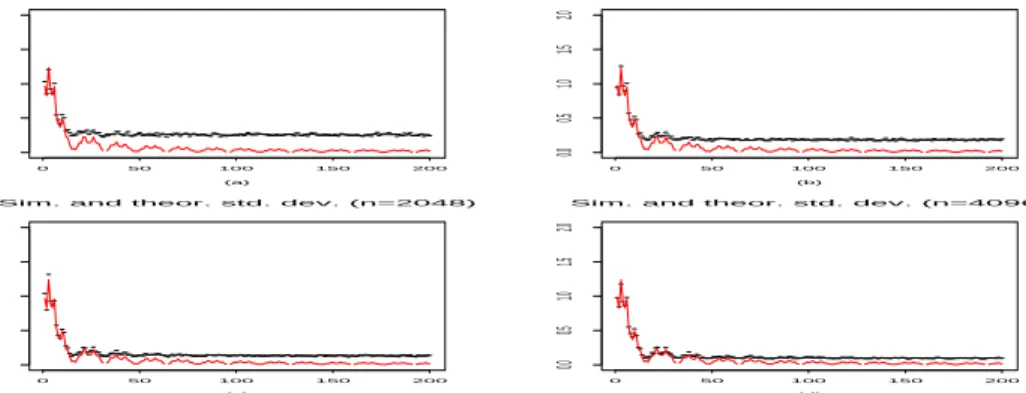
Figure 2a through d display results of a small simulation study where the simulated and true variance of the amplitude spectrum according to
(9) are compared for different sample sizes. At each frequency N =200
simulations are carried out and the amplitude spectrum was estimated. The
empirical standard deviations multiplied by √n are plotted in figures 2a
through d (black line) together with their asymptotic counterparts (red line). Convergence to the asymptotic standard deviation is apparently faster for frequencies where the amplitude spectrum is large. These are exactly that are used for estimating time shifts.
n 512 1024 2048 4096
true value 0.0625 0.0625 0.0625 0.0625
median 0.06012 0.06073 0.06322 0.06300
mean 0.05856 0.05838 0.06306 0.06262
std.dev. 0.03816 0.02275 0.00918 0.005528
Table 1: Summary statistics of lag estimates. For each sample size, 200 simulations were carried out.
Figure 3a shows the amplitude spectrum and the phase estimate for one simulated series. Frequencies where the estimated amplitude spectrum is
above four times its standard deviation are highlighted by black squares in figures 3a and b. The resulting estimated phase line in figure 3b is obtained by linear regression using these points only, taking into account jumps modulo
2π. The red lines indicate 99% confidence intervals for the regression slope.
The regression line in figure 3b, with slope around 0.39, is obviously very
similar to the true phase spectrum (figure 1f) with slope 0.30. For a more
systematic illustration of finite sample properties of ˆΔ, a small simulation
study was carried out, with sample sizes n = 512,1024,2048 and n = 4096.
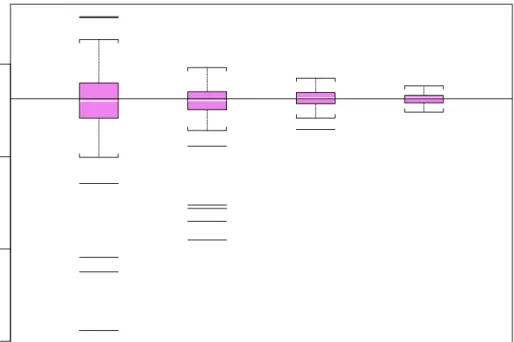
In each case we ran 200 simulations. Boxplots of ˆΔ (figure 4) based on 200
simulations (for each n) illustrate that estimation of Δ is very difficult for
n = 512. The accuracy of ˆΔ improves fast, however, with increasing sample
size. A detailed summary of this simulation study is given in table 1.
Finally, we examine in how far confidence intervals for Δ, based on
weighted linear regression of (j,φˆ) (with weights and residual variances
ob-tained from corollary 2) have the desired coverage probability. For each simulated series, the six frequencies with largest cross-spectral modulus were used in the regression, and 95%-confidence intervals were calculated using
es-timated variances of ˆφ at these frequencies. The coverage percentages, based
on 1000 simulations, turned out to be close the desired values, namely 93.9%,
93.5%, 94.8% and 94.8% for n = 512, 1024, 2048 and 4096 respectively.
5.2
El Ni˜
no and recruitment of new fish
Figures 5a and b display the components of the bivariate time series con-sisting of the Southern Oscillation Index (SOI) and recruitment (amount) of new fish in the central Pacific Ocean (figures 5a and b), ranging from
1950 to 1987 over a period of n = 453 months. The SOI relates changes
in air pressure to the temperature of the ocean at the surface. The data set can be found in Shumway and Stoffer (2000). Both time series exhibit cyclic components. The dominating periodic component in the SOI has a period of 12 months. The second series oscillates with a lower frequency, but a 12-months cycle is visible as well, at least in parts of the series. This is most obvious when looking at the amplitude of the estimated regression
cross spectrum in figure 5c which shows a dominating frequency at j = 38
indicating a period of 453/38≈12 months. In addition, a certain number of
moderate contributions are present at low frequencies. The slight influence of low frequency components is also visible directly in the SOI series, in that the mean and variability seem to be changing slowly. This feature is often
refered to in the literature as the El Ni˜no effect. We now proceed as in the simulated example. The estimated phase line in figure 5f is based on frequen-cies where the amplitude spectrum is large. The corresponding points are marked by black squares in figure 5e,f. Focussing on these points only, one can detect a linear structure. We may thus assume that there is a
frequency-independent shift Δ. Linear regression yields a slope estimate of about 0.1,
and thus ˆΔ = 0.1/(2π) ≈ 0.016 which corresponds to 453·0.1/(2π) ≈ 7.2
months. This indicates that the SOI signal leads the recruitment of new fish by about seven to eight months.
However, in view of figure 5c, better insight may be gained by separating high and low frequency components in the second series. We therefore carry out the analysis at separate levels of resolution. Figures 6a and b show trend
estimates ˆf1 (SOI) and ˆf2 (fish recruitment) obtained by wavelet
threshold-ing with s20-wavelets. The second trend function is decomposed further by separating the three coarsest resolution levels (figure 6c) from the fourth level (figure 6d). The fourth level represents the 12-month cycle, whereas the coarser parts (levels one to three, D4-S6) represent four to five year cy-cles that may be associated with corresponding cycy-cles in the warming of the Pacific Ocean. The estimated amplitude cross spectrum with significant fre-quencies marked by black squares are displayed in figure 6e and the resulting phase line with corresponding confidence intervals is presented in figure 6f. One notices again the distinct linear structure over this particular set of fre-quencies. The slope of this line is given by 0.17 indicating a lead of SOI of
453·0.17/(2π)≈ 12 months.
Because annual seasonality is the only common periodic oscillation be-tween SOI and the component D3 (figure 6g), time delays bebe-tween these two series are estimated in the time domain. The regression correlations between
the SOI trendf1 and the component D3 is displayed in figure 6h. The annual
seasonality of the number of fish turns out to lag behind the SOI by about one month, indicating that an increased water temperature induces an increased
number of fish about one month later. This effect interferes with the El Ni˜no
effect which has periods of abnormal warming of the sea every four to five years. These results confirm similar findings on the interplay between water temperature and fish recruitment by a number of authors such as Murawski (1993), Victor et al. (2001), Shumway and Stoffer (2000), Rosen and Stoffer (2007), among others.
6
Final remarks
Analyzing multivariate dependence using the nonparametric regression spec-trum is particularily useful when the observed series have strong deterministic components. In this article we defined a simple estimator of the regression spectrum based on the periodogram. In contrast to the method in Beran and Heiler (2007) no trend estimation is required. Also, in contrast to the stationary case, no smoothing of the periodogram is needed. In addition, lag estimation in the time domain was considered in order to be able to deal with cases where dependence between two series occurs for a small number of frequencies only. The regression spectrum approach can be particular-ily powerful when used in combination with multiresolution analysis. Often, the strength, type and interpretation of dependencies differ at different levels. The SOI/fish recruitment data is a typical example of multilevel dependence. In future research, more formal methods should be developed for combining regression spectrum estimation and wavelet decomposition.
7
Acknowledgements
This research was supported in part by a grant of the German Research Foundation (DFG).
8
Appendix: Proofs
Proof 1 (of theorem 1) We have hrs(j) =ar(j)as(j), and
1 n2Ar(ωj)As(ωj)−hrs(j) =O(n −1). (16) Then 1 nIrs(ωj)−hrs(j) = 1 n2[Br(ωj)As(ωj) +Ar(ωj)Bs(ωj)] +Op(n −1) +O(n−1) =Op(n−1/2).
For the second part consider
E(n−1Irs(ωj)) = 1
n2[Ar(ωj)As(ωj) +E(Br(ωj)Bs(ωj))],
=hrs(j) +O(n−1)+n−1E(I;rs(ωj)).
Results from traditional spectral analysis show that E(I;rs(ωj)) converges to
2πh;rs(ωj) uniformly for all frequenciesωj so that 2) follows.
Note furthermore that
1 √ n ar(j)Bs(ωj) +Br(ωj)as(j) =:α(j) +iβ(j), (17) where α(j) = √1 n cos(ωjt)[ar(j)s(t) +as(j)r(t)], (18) β(j) = √1 n sin(ωjt)[ar(j)s(t)−as(j)r(t)]. (19)
Consider now the variance of the adjusted periodogram (the result for covari-ances follows similarly):
var(n−1Irs(ωj)) =n−1E[|α(j) +iβ(j)|2] (20)
+cov(n−1I;rs(ωj), α(j) +iβ(j)) (21) +cov(α(j) +iβ(j), n−1I;rs(ωj)) (22)
+var(n−1I;rs(ωj)). (23)
Using standard results from Brockwell and Davis (p.429) yields
cov(I;rs(ωj), I;rs(ωj)) = ⎧ ⎨ ⎩ ΣrrΣss+O(n−1); 0< ωj =ωj < π, ΣrrΣss+ ΣrsΣsr+O(n−1); ωj =ωj ∈ {0, π}, O(n−1); ωj =ωj,
where the remainders contain the fourth order cumulants between r(i) and
s(i). The covariances in (21) and (22) consist of terms of the form
cov(I;rs(ωj), Br(ωj)) = 1 n t,u,v exp(−iωj(t−u+v))E(r(t)s(u)r(v)) = E(r(1) 2 s(1)) n n t=1 exp(iωjt) = 0,
where E(r(t)2s(t))is independent of t. Simple considerations show that the
2p-dimensional real valued random vector
Un(ωj) =n−1/2 (t) cos(ωjt)
(t) sin(ωjt)
(24)
is asymptotically normal with mean 0 and covariance matrix
E(Un(ωj)Un(ωj)T) = 1 2 Σ 0 0 Σ .
Furthermore, for all Fourier frequencies ωj =ωj,
E(Un(ωj)Un(ωj)T) = 0. (25)
Therefore,
n−1E(Br(ωj)Bs(ωj))
=n−1cov(r(t)(cos(ωjt)−isin(ωjt)),s(t)(cos(ωjt)−isin(ωjt)))
= 1
2(Σrs+ Σsr) = Σrs.
Similarly, for all pairs (r, s), 1≤r=s≤p,
var(n−1/2Br(ωj)) = Σrr and cov(Br(ωj), Bs(ωj)) =cov(Bs(ωj), Br(ωj)) = 0. Noting that n t=1 cos2(ωjt) = n 2,
the variance in (20) follows from
τα2(j) :=var(α(j)) = 1 n n t=1 cos2(ωjt)[Σrr|as(j)|2+ Σss|ar(j)|2 +as(j)ar(j)cov(r(t), s(t)) +ar(j)as(j)cov(s(t), r(t))] = 1 2(Σrr|as(j)| 2+ Σ ss|ar(j)|2) + ΣrsRe{as(j)ar(j)}.
Similarily, τβ2(j) :=var(β(j)) = 1 2(Σrr|as(j)| 2+ Σ ss|ar(j)|2)−ΣrsRe{as(j)ar(j)} and τα,β(j) :=cov(α(j), β(j)) = 1 n n t=1
cos(ωjt) sin(ωjt)cov(as(j)r(t) +ar(j)s(t), ar(j)s(t)−as(j)r(t)),
where the covariance is independent of t. Using the orthogonality relations
for trigonometric functions we get that τα,β(j) = 0.
For the asymptotic distribution, write
√
n(1
nI(ωj)−hrs(j)) =α(j) +iβ(j) +Op(n −1/2).
According to (24) the asymptotic distribution of the real and the imaginary
part are both univariate normal. Moreover, α(j) and β(j) are uncorrelated
and hence asymptotically independent. Hence,
α(j) β(j) d → N 0, τα2(j) 0 0 τβ2(j) ,
andα(j)+iβ(j)converges in distribution to a complex valued normal random
variable with mean 0 and variance
τα2+iβ(j) = τα2(j) +τβ2(j) = Σrr|as(j)|2+ Σss|ar(j)|2. (26) This implies √ n(1 nIrs(ωj)−hrs(j)) d → Nc(0,Σrr|as(j)|2+ Σss|ar(j)|2). (27)
The result for finite samples (ωj1, . . . , ωjk) follows as usually by applying the
Cramer-Wold device.
Proof 2 (of theorem 2)
Lemma 2 Assume that the sequence {(i)}, i= 1, . . . , n, is of the form (i) = ∞ j=−∞ A(j)Z(i−j), (28)
where A(j) = (Alk(j))1≤l,k≤p arep×p-matrices such that for all pairs (l, k),
j∈Z
|Alk(j)||j|12 <∞,
and the sequence Z(i) is independent and identically distributed with mean 0
and non-singular covariance matrix Σ.
Then, g(ωj) =n−1/2 (t) cos(ωjt) (t) sin(ωjt) = g1(ωj) g2(ωj)
with gl(ωj) = (gl1(ωj), . . . , glp(ωj))T, l ∈ {1,2}, converges in distribution to
a 2p-dimensional random variable with mean 0 and asymptotic covariance
matrix π C(ωj) Q(ωj) −Q(ωj) C(ωj) ,
whereh(ωj) = 12(C(ωj)−iQ(ωj))withC(ωj) = [c;rs(ωj)]1≤r,s≤pandQ(ωj) =
[q;rs(ωj)]1≤r,s≤p is the spectral density matrix of (i) at Fourier frequency
ωj = 2πj/n. Furthermore g(ωj) and g(ωj) are asymptotically independent
for ωj =ωj.
We now turn to the proof of theorem 2. The first two parts of the proof are similar to those of theorem 1. For the asymptotic distribution and variance consider equations (20)-(23). Refer again to Brockwell and Davis (p. 431) to get cov(I;rs(ωj), I;rs(ωj)) = ⎧ ⎪ ⎪ ⎪ ⎪ ⎨ ⎪ ⎪ ⎪ ⎪ ⎩ (2π)2h;rr(ωj)h;ss(ωj) +O(n−1/2); 0< ωj =ωj < π, (2π)2(h;rr(ωj)h;ss(ωj) +h;rs(ωj)h;sr(ωj)) +O(n−1/2); ωj =ωj ∈ {0, π}, O(n−1); ωj =ωj.
Using the results of lemma 2,
var(√1
nBr(ωj)) = 2πh;rr(ωj) (1≤r≤p), (29)
and use the notation
h;rr(ωj) =c;rs(ωj)−iq;rs(ωj). Then, cov(√1 nBr(ωj), 1 √ nBs(ωj)) =cov(g1r(ωj)−ig2r(ωj), g1s(ωj) +ig2s(ωj)) =c;rs(ωj) +iq;rs(ωj)−iq;rs(ωj)−c;rs(ωj) = 0. (30)
Due to lemma 2 and equations (29) and (30),
α(j) +iβ(j)→ Nd c(0,(2π|as(j)|2h;rr(ωj) + 2π|ar(j)|2h;ss(ωj))),
where α(j) +iβ(j) is defined in (17). The remaining parts (21) and (22)
consist of terms of the form
cov(I;rs(ωj), Br(ωj)) = t,u,v exp(−iωj(t−u+v))E(r(t)s(u)r(v)), with E(r(t)s(u)r(v)) = p r1,r2,r3=1 E(Zr1(1)Zr2(1)Zr3(1)) j Ar,r1(j)As,r2(j+u−t)Ar,r3(j+v−t),
whereArr1(j)is the(r, r1)th entry of the matrixA(j)andE(Zr1(t)Zr2(t)Zr3(t))
is the third order cumulant between the components Zr1(t), Zr2(t) andZr3(t)
of Z(t). Because (i) is of the form (28),
|cov(I;rs(ωj), Br(ωj))| ≤
t,u,v
|E(r(t)s(u)r(v))|<∞,
Proof 3 (of Theorem 3)
1. Results of Brillinger (1996) prove wavelet thresholding estimators to
be consistent of order Op(n−1/2). The regression cross covariance is a
continuous function of θ, the vector of wavelet coefficient of fr and fs,
so that the estimator uˆmaxrs is a continuous function of θˆ. Consistency
of θˆthen implies consistency of umax
rs . 2. Due to (14) and (15),
γrs (ˆumaxrs ,θˆ) = 0 and γrs (umaxrs , θ0) = 0.
Applying the mean value theorem gives
γrs (ˆumaxrs ,θˆ)−γrs(umaxrs ,θˆ) =γrs(˜urs,θˆ)(ˆumaxrs −umaxrs ),
where u˜ lies on a line connecting uˆmaxrs and umaxrs . Therefore,
ˆ umaxrs −umaxrs =−γ rs(umaxrs ,θˆ) γrs(˜urs,θˆ) . Furthermore, γrs (umaxrs ,θˆ) =γrs(umaxrs , θ0) =0 + ∂ ∂θγ rs(umaxrs , θ) θ=˜θ T ·(ˆθ−θ0)
for suitably chosen θ˜, and
ˆ umaxrs −umaxrs =− 1 γrs(˜urs,θˆ) ∂ ∂θγ rs(umaxrs , θ) θ=˜θ T (ˆθ−θ0).
Due to consistency of θˆand uˆmaxrs ,
γrs(˜urs,θˆ) = γrs(umaxrs , θ0) + (γrs(˜urs,θˆ)−γrs(umaxrs ,θˆ)) + (γrs(umaxrs ,θˆ)−γrs(umaxrs , θ0)) =γrs(umaxrs , θ0) +Op(n−1/2), and ∂ ∂θγ rs(umaxrs , θ) θ=˜θ = ∂ ∂θγ rs(umaxrs , θ) θ=θ0 +Op(n−1/2).
Then, ˆ umaxrs −umaxrs =− 1 γrs(umax rs , θ0) ∂ ∂θγ rs(umaxrs , θ0) T (ˆθ−θ0)(1 +Op(n−1/2)).
The central limit theorem for √n(ˆθ−θ0)implies that √n(ˆumax
rs −umaxrs ) is asymptotically normal with mean 0 and covariance
var(ˆumaxrs ) = ∂ ∂θγrs (umaxrs , θ)θ=θ0 T var(ˆθ) ∂ ∂θγrs (umaxrs , θ)θ=θ0 γrs(umax rs , θ0)2 .
References
[1] Beran, J. and Ghosh, S. (2000). Estimation of the dominating frequency for stationary and nonstationary fractional autoregressive models. Jour-nal of Time Series AJour-nalysis, Vol. 21, No. 5, 517-533.
[2] Beran, J. and Heiler, M. (2007). A Nonparametric Regression Spectrum for Analyzing Multivariaten Time Series. Journal of Multivariate Analy-sis, in press.
[3] Brillinger, D. (1994). Uses of Cumulants in Wavelet Analysis. Proc. SPIE, Advanced Signal Processing, Vol. 2296, 2-18.
[4] Brillinger, D.R. (1996). Some Uses of Cumulants in Wavelet Analysis. Nonparametric Statistics, Vol. 6, 93-114.
[5] Brockwell, P.J, and Davis, R.A. (1987). Time Series: Theory and Meth-ods. Springer, New York.
[6] Daubechies, I. (1999). Ten Lectures on Wavelets. Society for Industrial and Applied Mathematics, Philadelphia.
[7] Donoho, D.L. and Johnstone, I.M. (1994). Ideal Spatial Adaption by Wavelet Shrinkage. Biometrika, Vol. 81, No.3.
[8] Donoho, D.L. and Johnstone, I.M. (1995). Adapting to Unknown Smooth-ness Via Wavelet Shrinkage. Journal of the American Statistical Associ-ation, Vol. 90.
[9] Grenander, U. and Rosenblatt, M. (1957). Statistical analysis of station-ary time series, Wiley, New York.
[10] Hannan, E.J. (1970). Multiple time series. Wiley, New York.
[11] Heiler, M. (2007). A Nonparametric Regression Spectrum: Estimation, Asymptotic Properties and Data Analysis. Dissertation, University of Konstanz, Konstanz, 2007.
[12] Johnstone, I.M. and Silverman, B.W. (1997). Wavelet Threshold Esti-mators for Data with Correlated Noise. Journal of the Royal Statistical Society, Series B, Vol. 59, No. 2, 319-351.
[13] Murawski, S.A. (1993). Climate change and marine fish distributions: forecasting from analogy. Transactions of the American Fisheries Society, Vol. 122, 647-658.
[14] Percival, D.P. and Walden, A.T. (2000). Wavelet methods for time series analysis. Cambridge University Press, Cambridge.
[15] Pollard, D. (1984). Convergence of Stochastic Processes. 2nd Edition,
Springer, New York.
[16] Polya G. and Szeg¨o G. (1964). Aufgaben und Lehrs¨atze aus der Analysis,
Erster Band, 3. Auflage. Springer, Berlin.
[17] Priestley, M.B. (1989). Spectral Analysis and Time Series, 6th Edition,
Academic Press, London.
[18] Rosen, O. and Stoffer, D.S. (2007). Automatic estimation of multivariate spectra via smoothing splines. Biometrika, 94, No. 2, 335-345.
[19] Shumway, R.H. and Stoffer, D.S. (2000). Time series analysis and its
applications, 2nd Edition. Springer, New York.
[20] Victor, B.C., Wellington, G.M., Robertson, D.R. and Ruttenberg, B.I.
(2001). The effect of the EL Ni˜no-Southern Oscillation event on the
dis-tribution of reef-associated labrid fishes in the eastern Pacific Ocean. Bulletin of Marine Science, Vol. 69, No. 1, 280-288.
simulated f1+eps1 (a) 0.0 0.2 0.4 0.6 0.8 1.0 −10 −5 0 5 10 simulated f2+eps2 (b) 0.0 0.2 0.4 0.6 0.8 1.0 −5 0 5 10 15 true f1 (c) 0.0 0.2 0.4 0.6 0.8 1.0 123 45 true f2 (d) 0.0 0.2 0.4 0.6 0.8 1.0 123 45 • • • • • • • •••• ••••••••••••••••••••••••••••••••••••••••••••••••••••••••••••••••••••••••••••••••••••••••
true spectral modulus
(e) 0 20 40 60 80 100 0.0 0.05 0.10 0.15 •• •• •• •• •• •• •• •• •• •• •• •• •• •• •• •• •• •• •• •• •• •• •• •• •• •• •• •• •• •• •• •• •• •• •• •• •• •• •• •• •• •• •• •• •• •• •• •• •• •
true phase spectrum
(f) 0 20 40 60 80 100 −2 −1 0 1 2 3 • • • •• • • • •• • ••• •••••••••••••••••••••••••••••••••••••••••••••••••••••••••••••••••••••••••••••••••••••• modulus of cross−spectrum (g) 0 20 40 60 80 100 0.0 0.05 0.10 0.15 • •• • • •• • • •• • •• • • • • • • • • • • • •• • • • • • • • • • • • • • • • • •• • •• • • • • • • • • • • • • • • • • • • •• •• • • • • • • •• • • • • • • • • • • • • • • • • • •• • • •
estimated phase spectrum
(h) phase 0 20 40 60 80 100 −3 −2 −1 0123
Figure 1: Simulated series of length n = 2048 (figures 1a,b), as defined in
section 5.1, trend components (figures 1c,d), and amplitude and phase of the true regression spectrum (figures 1e,f). Estimates of the amplitude and phase spectrum based on the periodogram are given figures 1g and h.
• • • • • • • •• •• ••••••••••••••••••••••••••••••••••••••••••••••••••••••••••••••••••••••••••••••••••••••••••••••••••••••••••••••••••••••••••••••••••••••••••••••••••••••••••••••••••••••••••••••••••••••••••••• Sim. and theor. std. dev. (n=512)
(a) 0 50 100 150 200 0.0 0.5 1.0 1.5 2.0 • • • ••• • •• •• ••••••••••••••••••••••••••••••••••••••••••••••••••••••••••••••••••••••••••••••••••••••••••••••••••••••••••••••••••••••••••••••••••••••••••••••••••••••••••••••••••••••••••••••••••••••••••••• Sim. and theor. std. dev. (n=1024)
(b) 0 50 100 150 200 0.0 0.5 1.0 1.5 2.0 • • • ••• • •• •• •• ••••••••••••••••••••••••••••••••••••••••••••••••••••••••••••••••••••••••••••••••••••••••••••••••••••••••••••••••••••••••••••••••••••••••••••••••••••••••••••••••••••••••••••••••••••••••••• Sim. and theor. std. dev. (n=2048)
(c) 0 50 100 150 200 0.0 0.5 1.0 1.5 2.0 • • • ••• • •• • • •• ••••••••• •••••••••••••••••••••••••••••••••••••••••••••••••••••••••••••••••••••••••••••••••••••••••••••••••••••••••••••••••••••••••••••••••••••••••••••••••••••••••••••••••••••••••••••••••• Sim. and theor. std. dev. (n=4096)
(d) 0 50 100 150 200 0.0 0.5 1.0 1.5 2.0
Figure 2: Simulated and theoretical (red line) standard deviations for the
am-plitude spectrum for various sample sizes n = 512,1024,2048 and n= 4096.
For each sample size, 200 simulations were carried out at each individual frequency. • • • • • • • • • • • • • • •• •• ••• • •••••••••• •• • •••• • •• ••• ••• •• modulus of cross−spectrum (a) 0 10 20 30 40 50 0.0 0.05 0.10 0.15 • • • • • •• • • • • • •• • • • • • • • • • • • • • • • • • • • • • • • • • • • • • • • • •• • • estimated phase line with c.i.
(b) phase 0 10 20 30 40 50 −3 −2 −1 0123
Figure 3: Estimates of the amplitude and phase spectrum based on the
periodogram for frequencies j = 1, . . . ,50. Important common frequencies
are marked by black squares. The estimated phase line (solid line) is based on these frequencies. The red lines represent 99% confidence intervals.
−0.2
−0.1
0.0
0.1
n.512 n.1024 n.2048 n.4096
Figure 4: Boxplots of simulated lag estimates for n = 512,1024,2048 and
n = 4096. For each sample size, 200 simulations were carried out. The true