University of Kentucky
UKnowledge
Information Science Faculty Publications
Information Science
5-9-2017
Lightweight Data Aggregation Scheme Against
Internal Attackers in Smart Grid Using Elliptic
Curve Cryptography
Debiao He
Wuhan University, China
Sherali Zeadally
University of Kentucky, [email protected]
Huaqun Wang
Nanjing University of Posts and Telecommunications, China
Qin Liu
Wuhan University, China
Right click to open a feedback form in a new tab to let us know how this document benefits you.
Follow this and additional works at:
https://uknowledge.uky.edu/slis_facpub
Part of the
Databases and Information Systems Commons
,
Digital Communications and
Networking Commons
,
Information Security Commons
, and the
OS and Networks Commons
This Article is brought to you for free and open access by the Information Science at UKnowledge. It has been accepted for inclusion in Information Science Faculty Publications by an authorized administrator of UKnowledge. For more information, please [email protected].
Repository Citation
He, Debiao; Zeadally, Sherali; Wang, Huaqun; and Liu, Qin, "Lightweight Data Aggregation Scheme Against Internal Attackers in Smart Grid Using Elliptic Curve Cryptography" (2017).Information Science Faculty Publications. 39.
Cryptography
Notes/Citation Information
Published in
Wireless Communications and Mobile Computing
, v. 2017, article ID 3194845, p. 1-11.
Copyright © 2017 Debiao He et al.
This is an open access article distributed under the
Creative Commons Attribution License
, which permits
unrestricted use, distribution, and reproduction in any medium, provided the original work is properly cited.
Digital Object Identifier (DOI)
https://doi.org/10.1155/2017/3194845
Research Article
Lightweight Data Aggregation Scheme against Internal Attackers
in Smart Grid Using Elliptic Curve Cryptography
Debiao He,
1,2Sherali Zeadally,
3Huaqun Wang,
4and Qin Liu
11State Key Lab of Software Engineering, Computer School, Wuhan University, Wuhan, China
2Co-Innovation Center for Information Supply & Assurance Technology, Anhui University, Hefei, China 3College of Communication and Information, University of Kentucky, Lexington, KY, USA
4Jiangsu Key Laboratory of Big Data Security & Intelligent Processing, Nanjing University of Posts and Telecommunications,
Nanjing, China
Correspondence should be addressed to Qin Liu; [email protected]
Received 17 February 2017; Accepted 30 March 2017; Published 9 May 2017
Academic Editor: Jaime Lloret
Copyright © 2017 Debiao He et al. This is an open access article distributed under the Creative Commons Attribution License, which permits unrestricted use, distribution, and reproduction in any medium, provided the original work is properly cited.
Recent advances of Internet and microelectronics technologies have led to the concept of smart grid which has been a widespread concern for industry, governments, and academia. The openness of communications in the smart grid environment makes the system vulnerable to different types of attacks. The implementation of secure communication and the protection of consumers’ privacy have become challenging issues. The data aggregation scheme is an important technique for preserving consumers’ privacy because it can stop the leakage of a specific consumer’s data. To satisfy the security requirements of practical applications, a lot of data aggregation schemes were presented over the last several years. However, most of them suffer from security weaknesses or have poor performances. To reduce computation cost and achieve better security, we construct a lightweight data aggregation scheme against internal attackers in the smart grid environment using Elliptic Curve Cryptography (ECC). Security analysis of our proposed approach shows that it is provably secure and can provide confidentiality, authentication, and integrity. Performance analysis of the proposed scheme demonstrates that both computation and communication costs of the proposed scheme are much lower than the three previous schemes. As a result of these aforementioned benefits, the proposed lightweight data aggregation scheme is more practical for deployment in the smart grid environment.
1. Introduction
By providing bidirectional communications of electricity and information, the smart grid performs real-time monitoring of power usage [1]. Based on the real-time information, the providers can monitor the power generation and consump-tion and get immediate power demand of each area. Then, they can take prompt action to optimize the power supply. The consumer can also get the current power price and adjust his/her behavior to lower expenses. Therefore, the smart grid can achieve efficient, economical, and reliable power services. Due to such advantages, the smart grid was a widespread concern for governments, industry, and academia in the last decade and is considered as the most promising candidate of the next generation power system [2].
The National Institute of Standards and Technology (NIST) presents a model and describes seven important domains of the smart gird [3]. As shown in Figure 1 [4], a smart gird consists of seven important domains, that is, the power generation (PG) domain, the power transmission (PT) domain, the power distribution (PD) domain, the power cus-tomer (PC) domain, the power operation (PO) domain, the power market (PM) domain, and the power service provider (PSP) domain [5, 6]. After being generated, transmitted, and distributed in the PG domain, the PT domain, and the PD domain, respectively, the customers in the PC domain can enjoy wonderful life based on the power. The PO domain, the PM domain, and the PSP domain manage the power flow, the participants, and all third-party operations, respectively [7, 8].
Hindawi
Wireless Communications and Mobile Computing Volume 2017, Article ID 3194845, 11 pages https://doi.org/10.1155/2017/3194845
Non-renewable
Renewable
Bulk Generation Transmission Distribution
Substation BAN
HAN
IAN Customers
Operations
Markets providersService
Electrical flow Secure communication flow
Figure 1: The model of the smart grid.
The smart meters in the smart grid collect the consumers’ power consumption data and other information and send them to the remote control center. Generally speaking, the smart meter is installed outside the door of a consumer and an attacker is in charge of the communication channel easily due to its openness. The attacker may maliciously modify the power consumption data to increase/decrease the consumer’s power expense. He/she also can get the daily routine of the consumer in order to commit crimes. For example, he/she knows that the consumer goes out when there is no power consumption and sneaks into the house to steal expensive things.
To address the above problems, how to achieve secure communications in the smart grid becomes an issue that needs to be addressed. In particular, ensuring the data’s integrity and confidentiality is even more important. Several cryptographic schemes can be applied for secure communi-cations in the smart grid. Many key management schemes [9–11], key distribution schemes [12–14], and key agreement schemes [15–17] were presented in recent years. However, many of these schemes cannot implement the integrity and confidentiality simultaneously. To address this challenge, data aggregation schemes have been proposed by several researchers and applied in the smart grid. However, most of them are vulnerable to attacks from internal attackers. Although several data aggregation schemes against internal attackers were proposed to enhance security, their compu-tation or communication costs are too high for practical smart grid applications. In addition, the smart meter has very limited computation and communication capabilities. It is therefore necessary to design lightweight data aggregation schemes for practical deployment.
1.1. Our Contributions. To reduce both computation and
communication costs, we propose a lightweight data aggrega-tion scheme based on the Elliptic Curve Cryptography (ECC) [18, 19], which can obtain the same security level but with a much shorter key size. The main contributions of our paper are demonstrated as follows:
(i) First, we propose a lightweight data aggregation scheme based on Schnorr’s signature scheme [18]. (ii) Second, we prove that the proposed lightweight data
aggregation scheme is secure and is able to satisfy security requirements.
(iii) Finally, we analyze the performance of the proposed lightweight data aggregation scheme to demonstrate its high performance.
1.2. Organization of the Paper. In Section 2, we briefly
review related papers about data aggregation schemes. In Section 3, we give some preliminaries, including backgrounds of ECC, network model, and security requirements of the data aggregation scheme. In Section 4, we present our lightweight data aggregation scheme based on ECC. In Section 5, we describe a security model for the data aggregation scheme and present the security analyses of our scheme. In Section 6, we present the computation and communication analyses of our data aggregation scheme.
2. Related Works
To guarantee secure communication in open environments, a lot of authentication schemes [20–22], encryption schemes [23–26], and secure outsourcing schemes [25, 27, 28] have
Wireless Communications and Mobile Computing 3 been constructed in last several years. Li et al. [29] and Garcia
and Jacobs [30] designed two data aggregation schemes using Paillier’s encryption scheme [31]. To improve performance, Lu et al. [32] designed an improved data aggregation scheme using Paillier’s encryption scheme and the super-increasing sequence. However, the above three schemes [29, 30, 32] cannot protect consumers’ privacy because none of them can provide anonymity. To protect consumers’ privacy, Zhang et al. [33] designed a security-enhanced data aggregation scheme based on the Chinese Remainder Theorem and Paillier’s encryption scheme. Chen et al. [34] also designed a security-enhanced data aggregation scheme with fault tolerance based on Paillier’s encryption scheme.
Unfortunately, internal attacks are not considered in the above data aggregation schemes [29, 30, 32–34] thereby allowing internal attackers to access the consumers smart grid data. To address this weakness, Fan et al. [35] designed the first data aggregation scheme that can withstand attacks from internal attackers by using blinding technology. Unfor-tunately, Bao and Lu [36] demonstrated that Fan et al.’s data aggregation scheme cannot guarantee the integrity of transmitted data. To enhance security, He et al. [4] designed an improved data aggregation scheme based on Boneh et al.’s encryption scheme [37]. The performance of Fan et al.’s data aggregation scheme [35] and He et al.’s data aggregation scheme [4] is not good enough because they use bilinear pairing operations.
3. Preliminaries
3.1. Elliptic Curve. Given a prime number𝑝, we say that the
equation𝑦2 = 𝑥3+ 𝑎 ⋅ 𝑥 + 𝑏mod𝑝defines an elliptic curve
𝐸(𝐹𝑝), where𝑎, 𝑏 ∈ 𝐹𝑝andΔ = 4𝑎3+ 27𝑏2 ̸= 0mod𝑝[38]. It
is well known that all points on𝐸(𝐹𝑝)and the infinite point
Omake an additive groupG. Given a generator point𝑃with a prime order𝑞, the scale multiplication operation is defined
as𝑛 ⋅ 𝑃 = 𝑃 + 𝑃 + ⋅ ⋅ ⋅ + 𝑃𝑛times, where𝑛is a positive integer.
Previous researches have showed that the following prob-lems in the group G are suitable for the design of public key cryptography because no probabilistic polynomial time algorithm can solve them efficiently [38].
Discrete Logarithm (𝐷𝐿) Problem. Given an element𝑄 ∈G,
the DL problem is to extract an element𝑥 ∈ 𝑍∗𝑞 such that
𝑄 = 𝑥 ⋅ 𝑃.
Computational Diffie-Hellman (𝐶𝐷𝐻) Problem. Given two
elements𝑥 ⋅ 𝑃, 𝑦 ⋅ 𝑃 ∈Gwith two unknown elements𝑥, 𝑦 ∈
𝑍∗
𝑞, the CDH problem is to extract the element𝑄 = 𝑥 ⋅ 𝑦 ⋅ 𝑃.
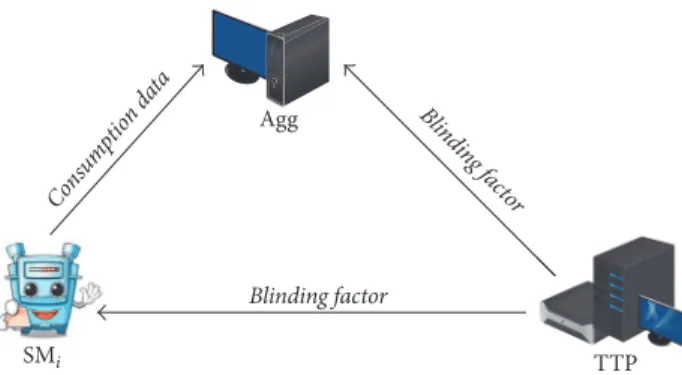
3.2. Network Model. As shown in Figure 2 [4], there are
three participants in the system of a data aggregation scheme, namely, a trusted third party (TTP), an aggregator (Agg), and a smart meter (SM𝑖) [4, 35]. The functions of the above three participants are presented as below.
(i) TTP: it is a trusted third party and its function is to generate blinding factors to withstand the internal attackers. Blinding factor Cons um ptio n da ta Blin ding fa ctor Agg TTP SMi
Figure 2: The registration phase.
(ii) Agg: it is the manager of the smart grid and its function is to generate the system parameters and the private keys of smart meters.
(iii) SM𝑖: it is a smart meter and its function is to collect consumers’ electricity consumption data and send it to Agg.
The workflow of the system is presented as follows. (1) Agg produces the system parameters and the mast private key; (2) SM𝑖 registers in Agg and gets its private key; (3) TTP generates the blinding factors for Agg and SM𝑖; (4) SM𝑖 collects the electricity consumption, produces a ciphertext, and sends it to Agg; (5) after collecting all ciphertexts, Agg checks their validity and extracts the sum of all electricity consumption data.
3.3. Security Requirements. Based on recently works, we
know that a data aggregation scheme for the smart grid should meet the below security requirements [4, 35].
(i) Confidentiality. The consumer’s power consumption data
indicates his/her habit and its leakage may be used by an attacker to commit a crime. To ensure the consumer’s safety, a data aggregation scheme should provide confidentiality; that is, both the external attackers and the internal attackers can-not extract the electricity consumption data from intercepted messages.
(ii) Authentication. The malicious attacker may forge a
mes-sage and impersonate the consumer. To ensure if the received message is transmitted by a legal SM𝑖, a data aggregation scheme should provide authentication; that is, Agg can check the legality of the received message.
(iii) Integrity. All messages are transmitted over open
com-munication channels and the malicious attacker may modify them to break regular transactions. To protect the rights and interests of all participants in the smart grid, a data aggregation scheme should provide integrity; that is, Agg can detect any modification of the received data.
(iv) Resistance against Attacks. Due to the openness of
communication channels in the smart grid, the system is vulnerable to many types of attacks. To obtain secure commu-nications in the smart grid, a data aggregation scheme should
supply resistance against attacks; that is, it can withstand the replay attack, the modification attack, the man-in-the-middle attack, and the impersonation attack.
4. The Proposed Data Scheme
We describe our proposed lightweight data aggregation scheme, which consists of three phases, namely, the initializa-tion phase, the registrainitializa-tion phase, and the aggregainitializa-tion phase.
Initialization Phase. In this phase, Agg executes some steps
to produce the system parameters. TTP and Agg execute some other steps to produce the blind factors against internal attackers.
Agg runs the following steps to produce the system parameters.
(1) Agg selects an elliptic curve𝐸(𝐹𝑝)determined by the equation𝑦2= 𝑥3+ 𝑎 ⋅ 𝑥 + 𝑏mod𝑝, where𝑝is a prime
and𝑎, 𝑏 ∈ 𝑍𝑞.
(2) Agg selects an element𝑃with the order𝑞existing on
𝐸(𝐹𝑝), where𝑞is a prime.
(3) Agg selects an element𝑠 ∈ 𝑍∗𝑞 and calculates𝑃pub =
𝑠 ⋅ 𝑃.
(4) Agg selects three cryptographic hash functionsℎ𝑖 :
{0, 1}∗ → 𝑍∗
𝑞 (𝑖 = 1, 2, 3).
(5) Agg publishes params = {𝑝, 𝑎, 𝑏, 𝑞, 𝑃, 𝑃pub, ℎ1, ℎ2, ℎ3} and saves𝑠secretly.
TTP and Agg execute the following steps to produce the blinding factors.
(1) TTP randomly selects a group of elements 𝜃1, 𝜃2,
. . . , 𝜃𝑛 ∈ 𝑍∗
𝑞and computes𝜃 = ∑𝑛𝑖=1𝜃𝑖mod𝑞. At last,
TTP sends𝜃to Agg and also sends𝜃𝑖to SM𝑖, where
𝑖 = 1, 2, . . . , 𝑛.
(2) Agg computes𝜃0= −𝜃mod𝑞and keeps it secretly.
Registration Phase. In this phase, SM𝑖registers in Agg. After
registration, SM𝑖receives its private key and becomes a legal smart meter. As demonstrated in Table 1, SM𝑖and Agg run the following processes to finish the registration.
(1) SM𝑖randomly chooses an element𝑥𝑖 ∈ 𝑍∗̂𝑞, computes
𝑋
𝑖 = 𝑥𝑖⋅ 𝑃, and transmits{id𝑖, 𝑋𝑖}to Agg secretly.
(2) Agg randomly chooses an element 𝑥𝑖 ∈ 𝑍∗̂𝑞 and computes𝑋𝑖 = 𝑥𝑖⋅𝑃, 𝑋𝑖= 𝑋𝑖+𝑋𝑖 , 𝛼𝑖= ℎ1(id𝑖, 𝑋𝑖),
and𝑠𝑖 = 𝑠 + 𝛼𝑖⋅ 𝑥𝑖 mod𝑞. At last, Agg sends{𝑠𝑖, 𝑋𝑖}
to SM𝑖secretly.
(3) SM𝑖computes𝑋𝑖 = 𝑋𝑖 + 𝑋𝑖, 𝛼𝑖 = ℎ1(id𝑖, 𝑋𝑖), 𝑠𝑖 =
𝑠
𝑖 + 𝑥𝑖 ⋅ 𝛼𝑖mod𝑞 and checks if the equation 𝑠𝑖 ⋅
𝑃 = 𝑃pub + 𝛼𝑖⋅ 𝑋𝑖holds. If not, SM𝑖rejects the
ses-sion; otherwise, SM𝑖 stores{𝑠𝑖, 𝑋𝑖} and finishes the registration.
Table 1: The registration phase of our scheme.
SM𝑖 Agg Generate𝑥𝑖∈ 𝑍∗𝑞; 𝑋 𝑖= 𝑥𝑖⋅ 𝑃 {id𝑖,𝑋𝑖} → Generate𝑥𝑖 ∈ 𝑍∗𝑞; 𝑋 𝑖 = 𝑥𝑖 ⋅ 𝑃; 𝑋𝑖= 𝑋 𝑖 + 𝑋𝑖; 𝛼𝑖= ℎ1(id𝑖, 𝑋𝑖); 𝑠 𝑖 = 𝑠 + 𝛼𝑖⋅ 𝑥𝑖 mod𝑞 {𝑠𝑖,𝑋𝑖} ← 𝑋𝑖= 𝑋𝑖 + 𝑋𝑖; 𝛼𝑖= ℎ1(id𝑖, 𝑋𝑖); 𝑠𝑖= 𝑠 𝑖 + 𝛼𝑖⋅ 𝑥𝑖mod𝑞; check𝑠𝑖⋅ 𝑃= 𝑃? pub+ 𝛼𝑖⋅ 𝑋𝑖; store{𝑠𝑖, 𝑋𝑖}
Due to the fact that𝑋𝑖 = 𝑥𝑖 ⋅ 𝑃,𝑋𝑖 = 𝑥𝑖 ⋅ 𝑃, 𝑋𝑖 =
𝑋
𝑖+ 𝑋𝑖, 𝑠𝑖 = 𝑠 + 𝛼𝑖⋅ 𝑥𝑖 mod𝑞, and𝑠𝑖= 𝑠𝑖 + 𝑥𝑖⋅ 𝛼𝑖mod𝑞,
then we have 𝑠𝑖⋅ 𝑃 = ( 𝑠𝑖 + 𝑥𝑖⋅ 𝛼𝑖) ⋅ 𝑃 = ( 𝑠 + 𝛼𝑖⋅ 𝑥𝑖 + 𝛼𝑖⋅ 𝑥𝑖) ⋅ 𝑃 = ( 𝑠 + 𝛼𝑖⋅ ( 𝑥𝑖+ 𝑥𝑖)) ⋅ 𝑃 = 𝑠 ⋅ 𝑃 + 𝛼𝑖⋅ ( 𝑥𝑖+ 𝑥𝑖) ⋅ 𝑃 = 𝑃pub+ 𝛼𝑖⋅ ( 𝑥𝑖⋅ 𝑃 + 𝑥⋅ 𝑃) = 𝑃pub+ 𝛼𝑖⋅ ( 𝑋𝑖+ 𝑋𝑖) = 𝑃pub+ 𝛼𝑖⋅ 𝑋𝑖. (1)
Therefore, the correctness of the registration phase is demonstrated.
Aggregation Phase. In this phase, SM𝑖 extracts the power
consumption data and sends it to Agg. Agg checks the validity of the received messages and aggregates all the received data. As demonstrated in Table 1, the steps below are executed by SM𝑖and Agg.
(1) SM𝑖gets the power consumption data𝑚𝑖, randomly chooses an element𝑦𝑖 ∈ 𝑍∗̂𝑞, and computes𝑌𝑖 = 𝑦𝑖⋅
𝑃, ̂𝑌𝑖 = 𝑦𝑖⋅ 𝑃pub, 𝑐𝑖 = 𝑚𝑖+ 𝜃𝑖+ ℎ2(̂𝑅𝑖)mod𝑞, 𝛽𝑖 =
ℎ3(id𝑖, 𝑋𝑖, 𝑌𝑖, 𝑐𝑖, 𝑡), and𝑑𝑖= 𝑠𝑖+ 𝛽𝑖⋅ 𝑦𝑖mod𝑞. At last, SM𝑖transmits{𝑋𝑖, 𝑌𝑖, 𝑐𝑖, 𝑑𝑖, 𝑡}to Agg.
(2) Agg checks if 𝑑𝑖 ⋅ 𝑃 = 𝑃pub + 𝛼𝑖 ⋅ 𝑋𝑖 + 𝛽𝑖 ⋅ 𝑌𝑖, where𝛼𝑖= ℎ1(id𝑖, 𝑋𝑖)and𝛽𝑖= ℎ3(id𝑖, 𝑋𝑖, 𝑌𝑖, 𝑐𝑖, 𝑡). To improve performance, we use the small exponent test technology [39] to achieve the batch verification. Agg randomly chooses a group of integers𝑧1, 𝑧2, . . . , 𝑧𝑛 ∈
[1, 2𝑤]and checks if the equation(∑𝑛𝑖=1𝑧𝑖⋅ 𝑑𝑖) ⋅ 𝑃 =
(∑𝑛𝑖=1𝑧𝑖)𝑃pub + ∑𝑛𝑖=1(𝑧𝑖 ⋅ 𝛼𝑖 ⋅ 𝑋𝑖 + 𝑧𝑖⋅ 𝛽𝑖 ⋅ 𝑌𝑖)holds.
Agg computes𝑐 = ∑𝑛𝑖=1(𝑐𝑖− ℎ2(𝑠 ⋅ 𝑌𝑖))and extracts the sum of the power consumption data by computing
Wireless Communications and Mobile Computing 5 Due to the fact that𝑠𝑖⋅ 𝑃 = 𝑃pub+ 𝛼𝑖⋅ 𝑋𝑖, 𝑌𝑖= 𝑦𝑖⋅ 𝑃, ̂𝑌𝑖=
𝑦𝑖⋅𝑃pub, 𝑐𝑖= 𝑚𝑖+𝜃𝑖+ℎ2(̂𝑌𝑖)mod𝑞and𝑑𝑖= 𝑠𝑖+𝛽𝑖⋅𝑦𝑖mod𝑞,
we can derive 𝑑𝑖⋅ 𝑃 = (𝑠𝑖+ 𝛽𝑖⋅ 𝑦𝑖) ⋅ 𝑃 = 𝑠𝑖⋅ 𝑃 + 𝛽𝑖⋅ 𝑦𝑖⋅ 𝑃 = 𝑃pub+ 𝛼𝑖⋅ 𝑋𝑖+ 𝛽𝑖⋅ 𝑌𝑖 (∑𝑛 𝑖=1 𝑧𝑖⋅ 𝑑𝑖) ⋅ 𝑃 = (∑𝑛 𝑖=1 𝑧𝑖⋅ (𝑠𝑖+ 𝛽𝑖⋅ 𝑦𝑖)) ⋅ 𝑃 = (∑𝑛 𝑖=1 𝑧𝑖⋅ (𝑠𝑖+ 𝛽𝑖⋅ 𝑦𝑖)) ⋅ 𝑃 =∑𝑛 𝑖=1 (𝑧𝑖⋅ 𝑠𝑖⋅ 𝑃 + 𝑧𝑖⋅ 𝛽𝑖⋅ 𝑦𝑖⋅ 𝑃) =∑𝑛 𝑖=1 (𝑧𝑖⋅ ( 𝑃pub+ 𝛼𝑖⋅ 𝑋𝑖) + 𝑧𝑖⋅ 𝛽𝑖⋅ 𝑌𝑖) = (∑𝑛 𝑖=1𝑧𝑖) ⋅ 𝑃pub+ 𝑛 ∑ 𝑖=1(𝑧𝑖⋅ 𝛼𝑖⋅ 𝑋𝑖+ 𝑧𝑖⋅ 𝛽𝑖⋅ 𝑌𝑖) , (2) 𝑐 + 𝜃0=∑𝑛 𝑖=1 (𝑐𝑖− ℎ2(𝑠 ⋅ 𝑌𝑖)) + 𝜃0 =∑𝑛 𝑖=1 (𝑚𝑖+ 𝜃𝑖+ ℎ2(̂𝑅𝑖) − ℎ2(𝑠 ⋅ 𝑦𝑖⋅ 𝑃)) − 𝜃 =∑𝑛 𝑖=1 (𝑚𝑖+ 𝜃𝑖+ ℎ2(̂𝑅𝑖) − ℎ2(𝑦𝑖⋅ 𝑠 ⋅ 𝑃)) − 𝜃 =∑𝑛 𝑖=1 (𝑚𝑖+ 𝜃𝑖+ ℎ2(̂𝑅𝑖) − ℎ2(𝑦𝑖⋅ 𝑃pub)) − 𝜃 =∑𝑛 𝑖=1 (𝑚𝑖+ 𝜃𝑖+ ℎ2(̂𝑅𝑖) − ℎ2(̂𝑅𝑖)) − 𝜃 =∑𝑛 𝑖=1 𝑚𝑖+ 𝑛 ∑ 𝑖=1 𝜃𝑖− 𝑛 ∑ 𝑖=1 𝜃𝑖= 𝑛 ∑ 𝑖=1 𝑚𝑖. (3)
According to the above equations, the correctness of the aggregation phase of our scheme is demonstrated.
5. Security Analysis
The security of the proposed lightweight data aggregation scheme is analyzed in this section. First, we present a security model for the data aggregation scheme. Second, we demonstrate that the proposed lightweight data aggregation scheme is provably secure in the security model. Finally, we demonstrate that the proposed lightweight data aggregation scheme can meet the security requirements presented in Section 3.
5.1. Security Model. Based on security models [40] for
sign-cryption schemes, we presented a security model for data
aggregation schemes. The security of confidentiality and unforgeability is formally defined by two games executed by an attackerAand a challengerC.Ais allowed to make the following queries.
(i)ℎ𝑖(𝑚): for such a query made by A, C randomly selects𝑟 ∈ 𝑍∗𝑞, sends𝑟toA, and stores(𝑚, 𝑟)in the table𝐿ℎ𝑖, where𝑖 = 1, 2, 3.
(ii) CreateSM(id𝑖): for such a query made by A, C generates SM𝑖’s secret key and blinding factor and stores them in the table𝐿SM.
(iii) CorruptSM(id𝑖): for such a query made byA,Csends SM𝑖’s private key and blinding factor toA.
(iv) Signcrypt(id𝑖, 𝑚𝑖): for such a query made byA, C generates a ciphertext{𝑋𝑖, 𝑌𝑖, 𝑐𝑖, 𝑑𝑖, 𝑡}corresponding to the message𝑚𝑖.
(v) Designcrypt(id𝑖, 𝑋𝑖, 𝑌𝑖, 𝑐𝑖, 𝑑𝑖, 𝑡): for the query made by A, C checks the validity of the ciphertext and decrypts it to get the plaintext.
Definition 1. A data aggregation scheme is able to provide
confidentiality [indistinguishability against adaptive chosen ciphertext attacks (IND−CCA)] if no attacker can win the following game with a nonnegligible advantage.
Setup.Cproduces system parameters and transmits them to
A.
Phase 1. A is able to adaptively make ℎ𝑖, CreateSM,
Cor-ruptSM, Signcrypt, and Designcrypt queries.
Challenge. Apicks a challenging identity id∗𝑖, chooses two
messages 𝑚0 and 𝑚1, and sends them to C. C picks a random element𝑏 ∈ {0, 1}, produces a signcrypted ciphertext
{𝑋𝑖, 𝑌𝑖, 𝑐𝑖, 𝑑𝑖, 𝑡}, and sends it toA.
Phase 2. In this phase,Acan adaptively makeℎ𝑖, CreateSM,
CorruptSM, and Signcrypt queries except that it cannot make a CorruptSM query with id∗𝑖 or a Designcrypt query with
{𝑋𝑖, 𝑌𝑖, 𝑐𝑖, 𝑑𝑖, 𝑡}.
Finally,Agives its guess𝑏 ∈ {0, 1}about the value of𝑏 selected byC.
The advantage of A is defined by the equation
AdvIND−CCAA = |2 ⋅Pr[𝑏= 𝑏] − 1|.Awins in the above game
if it guesses the value of𝑏correctly.
Definition 2. A data aggregation scheme is able to provide
unforgeability [existential unforgeability against adaptive chosen messages attacks (EUFCMA)] if no attacker wins the following game with a nonnegligible advantage.
Setup.Cproduces the system parameters and sends them to
A.
Qurey. In this phase, A picks a challenging identity id∗𝑖
and is able to adaptively make ℎ𝑖, CreateSM, CorruptSM, Signcrypt, and Designcrypt queries except that it cannot make a CorruptSM query with id∗𝑖.
Forgery. In this phase,Aoutputs a ciphertext{𝑋𝑖, 𝑌𝑖, 𝑐𝑖, 𝑑𝑖, 𝑡} corresponding to the challenging identity id∗𝑖.
We sayAwins in the above game if{𝑋𝑖, 𝑌𝑖, 𝑐𝑖, 𝑑𝑖, 𝑡}is valid and it is not generated by executing a Signcrypt query.
5.2. Security Analysis
Theorem 3. The proposed data aggregation scheme is able to provide confidentiality if the CDH problem is hard.
Proof. Assume that an attackerAwins the game defined in
Definition 1 with a nonnegligible advantage𝜖. Based onA’s capability, we can construct a challenger to solve the CDH problem with a nonnegligible advantage. Given an instance
(𝑃, 𝑄1= 𝑎⋅𝑃, 𝑄2= 𝑏⋅𝑃) of the CDH problem,Csets𝑃pub ←
𝑎⋅𝑃and sends params= {𝑝, 𝑎, 𝑏, 𝑞, 𝑃, 𝑃pub, ℎ1, ℎ2, ℎ3}toA.C
randomly picks up an identity id𝐼as the challenging identity and answers queries fromAaccording to the rules below.
(i)ℎ𝑖(𝑚):Ckeeps a table𝐿ℎ𝑖 of the form(𝑚, 𝑟), where
𝑖 ∈ {1, 2, 3}. Upon receiving such a query,Cchecks
if𝐿ℎ𝑖 contains a tuple(𝑚, 𝑟). If so,Csends 𝑟toA; otherwise,Crandomly selects an element𝑟 ∈ 𝑍∗𝑞, stores(𝑚, 𝑟)into𝐿ℎ𝑖, and sends𝑟toA.
(ii) CreateSM(id𝑖): C keeps a table 𝐿SM of the form
(id𝑖, 𝜃𝑖, 𝑠𝑖, 𝑋𝑖). Upon receiving such a query,Cchecks if𝐿SM contains a tuple(id𝑖, 𝜃𝑖, 𝑠𝑖, 𝑋𝑖). If so,Csends
𝑋𝑖toA; otherwise,Crandomly selects three integers
𝜃𝑖, 𝛼𝑖, 𝑠𝑖∈ 𝑍∗
𝑞and sets𝑋𝑖← 𝛼−1𝑖 ⋅(𝑠𝑖⋅𝑃−𝑃pub).Cstores
(id𝑖, 𝑋𝑖, 𝛼𝑖) and (id𝑖, 𝜃𝑖, 𝑠𝑖, 𝑋𝑖) into𝐿SM, respectively.
(iii) CorruptSM(id𝑖): C checks if 𝐿SM contains a tuple (id𝑖, 𝜃𝑖, 𝑠𝑖, 𝑋𝑖). If not,Cmakes CreateSM-query with the identity id𝑖. After that,Creturns (id𝑖, 𝜃𝑖, 𝑠𝑖, 𝑋𝑖) to
C.
(iv) Signcrypt(id𝑖, 𝑚𝑖):Cchecks if𝐿SM contains a tuple (id𝑖, 𝜃𝑖, 𝑠𝑖, 𝑋𝑖). If not,Cmakes CreateSM-query with the identity id𝑖. After that,C gets the tuple (id𝑖, 𝜃𝑖,
𝑠𝑖, 𝑋𝑖) from𝐿SM and uses it to produce a ciphertext
{𝑋𝑖, 𝑌𝑖, 𝑐𝑖, 𝑑𝑖, 𝑡}. At last,Csends{𝑋𝑖, 𝑌𝑖, 𝑐𝑖, 𝑑𝑖, 𝑡}toA. Given the power consumption data𝑚0and𝑚1,Cextracts (id𝐼, 𝜃𝐼, 𝑠𝐼, 𝑋𝐼) from𝐿SM and selects a random element𝑏 ∈
{0, 1}. Csets𝑌𝐼 ← 𝑏 ⋅ 𝑃, randomly selects three elements
𝛽𝐼, 𝑐𝐼, 𝑑𝐼∈ 𝑍∗
𝑞, stores (id𝐼, 𝑋𝐼, 𝑌𝐼, 𝑐𝐼, 𝑡, 𝛽𝐼) into𝐿ℎ3, and sends
{𝑋𝐼, 𝑌𝐼, 𝑐𝐼, 𝑑𝐼, 𝑡}toA.
After that,Acan makeℎ𝑖, CreateSM, CorruptSM, and Signcrypt queries and get the corresponding responses. Then,
Aoutputs𝑏 as his/her guess against the confidentiality.C selects a random tuple (𝑅, 𝑟) from𝐿ℎ2 and outputs𝑅as the solution of the given CDH problem.
Let 𝑞ℎ2 denote the number ofℎ2-query involved in the game. The probability thatCcan solve the given CDH prob-lem is𝜂 = 𝜖/𝑞ℎ2. Because of the nonnegligibility of𝜖, we know that 𝜂 is nonnegligible. This contradicts with the hardness of the CDH problem. Thus, the proposed data aggregation scheme is able to provide confidentiality.
Theorem 4. The proposed data aggregation scheme is able to provide unforgeability if the DL problem is hard.
Proof. Assume that an attacker A wins the game defined
in Definition 1 with a nonnegligible advantage𝜖. Based on
A’s capability, we can construct a challenger to solve the DL problem with a nonnegligible advantage. Given an instance
(𝑃, 𝑄1 = 𝑎 ⋅ 𝑃) of the DL problem,Cpicks a random integer
𝑠 ∈ 𝑍∗
𝑞, computes𝑃pub = 𝑠 ⋅ 𝑃, and sends params = {𝑝, 𝑎, 𝑏,
𝑞, 𝑃, 𝑃pub, ℎ1, ℎ2, ℎ3} to A. C randomly selects an identity
id𝐼as the challenging identity and answers queries fromA according to the rules below.
(i)ℎ𝑖(𝑚):Ckeeps a table𝐿ℎ𝑖 of the form(𝑚, 𝑟), where
𝑖 ∈ {1, 2, 3}. Upon receiving such a query,Cchecks
if𝐿ℎ𝑖 contains a tuple(𝑚, 𝑟). If so,Csends𝑟toA; otherwise,Crandomly picks up an element𝑟 ∈ 𝑍𝑞∗, stores(𝑚, 𝑟)into𝐿ℎ𝑖, and sends𝑟toA.
(ii) CreateSM(id𝑖): C keeps a table 𝐿SM of the form
(id𝑖, 𝜃𝑖, 𝑠𝑖, 𝑋𝑖). Upon receiving such a query,Cchecks if𝐿SM contains a tuple(id𝑖, 𝜃𝑖, 𝑠𝑖, 𝑋𝑖). If so,Csends
𝑋𝑖toA; otherwise,Canswers the query through the rules below:
(1) If id𝑖 = id𝐼, C randomly picks two integers
𝜃𝑖, 𝛼𝑖 ∈ 𝑍∗
𝑞 and sets𝑋𝑖 ← 𝑎 ⋅ 𝑃.Cstores (id𝑖, 𝑋𝑖, 𝛼𝑖) and (id𝑖, 𝜃𝑖, ⊥, 𝑋𝑖) into𝐿SM, respectively. (2) Otherwise (id𝑖 ̸=id𝐼),Crandomly selects three integers𝜃𝑖, 𝛼𝑖, 𝑠𝑖 ∈ 𝑍𝑞∗and sets𝑋𝑖 ← 𝛼𝑖−1⋅ (𝑠𝑖⋅
𝑃 − 𝑃pub).Cstores (id𝑖, 𝑋𝑖, 𝛼𝑖) and (id𝑖, 𝜃𝑖, 𝑠𝑖, 𝑋𝑖)
into𝐿SM, respectively.
(iii) CorruptSM(id𝑖): C checks if 𝐿SM contains a tuple (id𝑖, 𝜃𝑖, 𝑠𝑖, 𝑋𝑖). If not,Cmakes CreateSM-query with the identity id𝑖. After that,Creturns (id𝑖, 𝜃𝑖, 𝑠𝑖, 𝑋𝑖) to
A.
(iv) Signcrypt(id𝑖, 𝑚𝑖):Cchecks if id𝑖and id𝐼are equal. If they are not,Cextracts the tuple (id𝑖, 𝜃𝑖, 𝑠𝑖, 𝑋𝑖) from
𝐿SMand uses it to produce a ciphertext{𝑋𝑖, 𝑌𝑖, 𝑐𝑖, 𝑑𝑖, 𝑡}
according to the description of the proposed data aggregation; otherwise,Crandomly selects two inte-gers𝑑𝑖, 𝛽𝑖 ∈ 𝑍∗𝑞 and computes𝑌𝑖 = 𝛽𝑖−1⋅ (𝑑𝑖⋅ 𝑃 −
𝑃pub − 𝛼𝑖⋅ 𝑋𝑖)and𝑐𝑖 = 𝑚𝑖+ 𝜃𝑖+ ℎ2(𝑠 ⋅ 𝑌𝑖).Cstores
(id𝑖, 𝑋𝑖, 𝑌𝑖, 𝑐𝑖, 𝑡) into𝐿ℎ2and sends{𝑋𝑖, 𝑌𝑖, 𝑐𝑖, 𝑑𝑖, 𝑡}to
A.
(v) Designcrypt(id𝑖, 𝑋𝑖, 𝑌𝑖, 𝑐𝑖, 𝑑𝑖, 𝑡): for the query made by A, C checks the validity of the ciphertext and decrypts it to get the plaintext using the systems secret key𝑠.
At last,Aoutputs a forged ciphertext (id𝑖, 𝑋𝑖, 𝑌𝑖, 𝑐𝑖, 𝑑𝑖, 𝑡).
Cstops the game if the equation id𝑖=id𝐼holds. Based on the forking lemma [41],Ccan output another valid ciphertext (id𝑖, 𝑋𝑖, 𝑌𝑖, 𝑐𝑖, 𝑑𝑖, 𝑡) by choosing a different hash functionℎ1. Since both ciphertexts are valid, we can derive the following two equation:
𝑑𝑖⋅ 𝑃 = 𝑃pub+ 𝛼𝑖⋅ 𝑋𝑖+ 𝛽𝑖⋅ 𝑌𝑖,
𝑑𝑖⋅ 𝑃 = 𝑃pub+ 𝛼𝑖⋅ 𝑋𝑖+ 𝛽𝑖⋅ 𝑌𝑖.
Wireless Communications and Mobile Computing 7 Based on the above two equations, we can derive the
equation below: (𝑑𝑖− 𝑑𝑖) ⋅ 𝑃 = 𝑑𝑖⋅ 𝑃 − 𝑑𝑖⋅ 𝑃 = ( 𝑃pub+ 𝛼𝑖⋅ 𝑋𝑖+ 𝛽𝑖⋅ 𝑌𝑖) − ( 𝑃pub+ 𝛼𝑖⋅ 𝑋𝑖+ 𝛽𝑖⋅ 𝑌𝑖) = ( 𝛼𝑖− 𝛼𝑖) ⋅ 𝑋𝑖= ( 𝛼𝑖− 𝛼𝑖) ⋅ 𝑎 ⋅ 𝑃. (5)
Coutputs(𝑑𝑖−𝑑𝑖)⋅(𝛼𝑖−𝛼𝑖)−1as the solution of the given DL problem. To compute the probability thatCsolves the DL problem, three related events are listed below.
(i)𝐸1: id𝑖equals id𝐼.
(ii)𝐸2:Cis able to forge a legal ciphertext.
Let𝑞ℎ1denote the number ofℎ1involved in the game. It is easy to get that Pr[𝐸1] = 1/𝑞ℎ1and Pr[𝐸2|𝐸1] = 𝜖. Then, the probability thatCsolves the DL problem is𝜂 =Pr[𝐸1∧𝐸2] =
Pr[𝐸2|𝐸1] ⋅Pr[𝐸1] = 𝜖/𝑞ℎ1. Because of the nonnegligibility
of𝜖, we know that𝜂is nonnegligible. This is in contradiction with the hardness of the DL problem. Thus, the proposed data aggregation scheme is able to provide unforgeability.
5.3. Analysis of Security Requirements. We will show that the
proposed lightweight data aggregation scheme is able to meet security requirements presented in Section 3.
(i) Confidentiality. The internal attacker against the proposed
data aggregation scheme can compute𝑐 = ∑𝑛𝑖=1(𝑐𝑖 − ℎ2(𝑠 ⋅
𝑌𝑖)). Without the blinding factor 𝑐, he/she cannot extract
the sum of the power consumption data by computing𝑚 =
𝑐 + 𝜃0mod𝑞. Besides, Theorem 4 shows that the proposed
lightweight data aggregation scheme can supply confidential-ity against any external attacker. Thus, our lightweight data aggregation scheme can supply confidentiality.
(ii) Authentication. Theorem 3 shows that any attacker cannot
forge a legal ciphertext. Then, Agg can verify the legality of received messages by verifying if the equation(∑𝑛𝑖=1𝑧𝑖⋅ 𝑑𝑖) ⋅
𝑃 = (∑𝑛𝑖=1𝑧𝑖)𝑃pub + ∑𝑛𝑖=1(𝑧𝑖 ⋅ 𝛼𝑖 ⋅ 𝑋𝑖 + 𝑧𝑖 ⋅ 𝛽𝑖 ⋅ 𝑌𝑖) holds.
Therefore, the proposed data aggregation scheme can provide authentication.
(iii) Integrity. Theorem 3 demonstrates that any attacker
against the proposed data aggregation scheme cannot forge a legal ciphertext. Agg can detect any modification of the received data by verifying if the equation(∑𝑛𝑖=1𝑧𝑖⋅ 𝑑𝑖) ⋅ 𝑃 =
(∑𝑛𝑖=1𝑧𝑖)𝑃pub+ ∑𝑛𝑖=1(𝑧𝑖⋅ 𝛼𝑖⋅ 𝑋𝑖+ 𝑧𝑖⋅ 𝛽𝑖⋅ 𝑌𝑖)holds. Therefore, the proposed data aggregation scheme can provide integrity.
(iv) Resistance against Attacks. The proposed lightweight
data aggregation scheme can resist the replay attack, the modification attack, the man-in-the-middle attack, and the impersonation attack. The reason is analyzed below.
(1) Replay Attack. The timestamp𝑡is involved in the
cipher-text. Agg can find any reply of previous message by verifying
𝑡’s freshness. Thus, the proposed lightweight data aggregation scheme can resist the replay attack.
(2) Modification Attack. Theorem 3 demonstrates that any
attacker against the proposed data aggregation scheme can-not forge a legal ciphertext. Agg can detect any modification of the received data by verifying if (∑𝑛𝑖=1𝑧𝑖 ⋅ 𝑑𝑖) ⋅ 𝑃 =
(∑𝑛𝑖=1𝑧𝑖)𝑃pub+ ∑𝑛𝑖=1(𝑧𝑖⋅ 𝛼𝑖⋅ 𝑋𝑖+ 𝑧𝑖⋅ 𝛽𝑖⋅ 𝑌𝑖)holds. Thus, the proposed lightweight data aggregation scheme can resist the modification attack.
(3) Man-in-the-Middle Attack. The above analysis
demon-strates that the proposed lightweight data aggregation scheme can supply authentication; that is, Agg can authenticate SM𝑖 by checking if𝑑𝑖⋅ 𝑃 = 𝑃pub+ 𝛼𝑖⋅ 𝑋𝑖+ 𝛽𝑖⋅ 𝑌𝑖holds. Thus, the proposed lightweight data aggregation scheme can resist the man-in-the-middle attack.
(4) Impersonation Attack. Theorem 4 shows that any attacker
cannot forge a legal ciphertext without SM𝑖’s secret key. Then, Agg can detect any impersonation by verifying the validity of the received ciphertext. Therefore, the proposed lightweight data aggregation scheme can resist the impersonation attack.
6. Performance Analysis
We analyze both computation and communication costs of our lightweight data aggregation scheme in this section. We also compare its performance with two of the most recently proposed data aggregation schemes to show its lightweight costs.
To achieve a fair comparison, we compare recently pro-posed aggregation schemes under the same security level. In the BGN encryption scheme [37], two 512-bit prime numbers
𝑝 = 2 ⋅ 𝑝+ 1and𝑞 = 2 ⋅ 𝑞+ 1are applied in our experiments,
where𝑝 and𝑞 are also large prime numbers. In schemes based on bilinear pairing, a Tate pairing based on a Type A elliptic curve ̂𝐸 : 𝑦2 = 𝑥3+ 1mod̂𝑝with a prime order ̂𝑞is applied in our experiments, where the lengths of ̂𝑝and̂𝑞are 512 bits and 160 bits, respectively. In schemes based on ECC, an elliptic curve𝐸 : 𝑦2 = 𝑥3+ 𝑎 ⋅ 𝑥 + 𝑏mod𝑝with a prime order𝑞is applied in our experiments, where the lengths of̂𝑝 and̂𝑞are 160 bits.
6.1. Analysis of Computation Costs. Based on the well-known
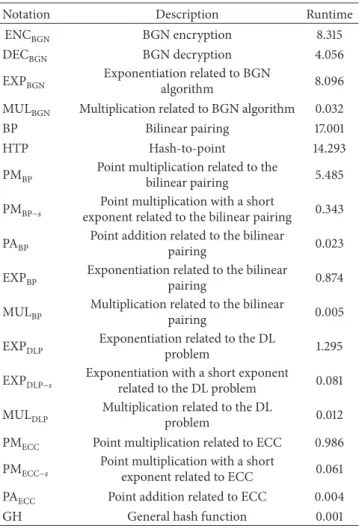
cryptographic library MIRACL [42], we have implemented all related operations on a personal computer with an Intel I5-3210M 2.50 GHz Center Processor Unit (CPU), an 8 Gbyte Random Access Memory (RAM), and the Windows 7 operation system. Table 3 presents the operations’ notations and runtime results.
Each SM𝑖in the Fan et al.’s scheme [35] runs one BGN encryption operation, one exponentiation in BGN algorithm, two multiplications related to BGN algorithm, one HTP𝐺1 operation, one PM𝐺1 operation, and one general hash func-tion. Therefore, SM𝑖’s runtime is 𝑇ENCBGN + 𝑇EXPBGN + 2 ×
𝑇MULBGN + 𝑇HTPBP + 𝑇PMBP + 𝑇GH =8.315 + 8.096 + 2 ×
0.032 + 14.293 + 5.485 + 0.001= 36.254 ms. Agg in Fan et al.’s
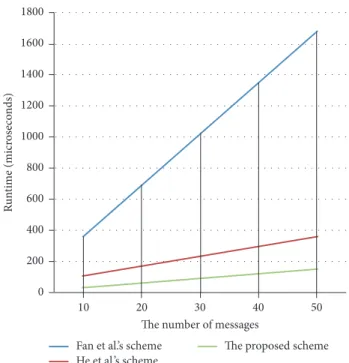
0 200 400 600 800 1000 1200 1400 1600 1800 R un time (micr os eco n ds) 30 10 20 40 50
The number of messages He et al.’s scheme
Fan et al.’s scheme The proposed scheme
Figure 3: Runtime comparisons of related schemes.
related to the BGN algorithm,𝑛 − 1multiplication related to BGN algorithm,𝑛hash-to-point,𝑛 + 1bilinear pairing,2𝑛 point multiplication related to the bilinear pairing,𝑛−1point multiplication with a short exponent related to the bilinear pairing,𝑛 − 1exponentiation related to the bilinear pairing, and one general hash function. Therefore, Agg’s runtime is
𝑇DECBNG+ 𝑇exp−BNG+ (𝑛 − 1) ⋅ 𝑇MULBNG +𝑛 ⋅ 𝑇HTPBP+ (𝑛 + 1) ⋅
𝑇BP+ (2𝑛) ⋅ 𝑇PMBP−𝑠 +(𝑛 − 1) ⋅ 𝑇PABP+ (𝑛 − 1) ⋅ 𝑇EXPBP+ 𝑇GH
=4.056 + 8.096 + (𝑛 − 1) × 0.032 + 𝑛 × 14.293 + (𝑛 + 1) ×
17.001+(2𝑛)×0.343+(𝑛−1)×0.023+(𝑛−1)×0.874+0.001
=(32.909 ⋅ 𝑛 + 28.225) microseconds.
Each SM𝑖 in the proposed scheme executes two point multiplication operations related to ECC and two general hash functions. Therefore, SM𝑖’s runtime is2 × 𝑇PMECC + 2 ×
𝑇GH = 2 × 0.986 + 2 × 0.001 = 1.974microseconds. Agg in
the proposed scheme executes3 × 𝑛 + 2point multiplication related to ECC, 2 × 𝑛point addition related to ECC, and
3 × 𝑛 general hash functions. Therefore, Agg’s runtime is
(3 × 𝑛 + 2) × 𝑇PMECC + 2 × 𝑛 × 𝑇PAECC +3 × 𝑛 × 𝑇GH=(3 ×
𝑛 + 2) × 0.986 + 2 × 𝑛 × 0.004+3 × 𝑛 × 0.001 = 2.969 ⋅ 𝑛
+1.972.
Table 4 and Figure 3 show the runtime comparisons among Fan et al.’s data aggregation scheme [35], He et al.’s scheme [4], and the proposed scheme. From Tables 4 and 2, the proposed scheme incurs a lower computation cost as compared to Fan et al.’s scheme and He et al.’s scheme at both sides of SM𝑖and Agg.
6.2. Analysis of Communication Costs. Since the sizes of𝑝1,
𝑞1,𝑝,𝑞, ̂𝑝, and̂𝑞are 512 bits, 512 bits, 512 bits, 160 bits, 1024 bits, and 160 bits, respectively, we can determine that the sizes of elements in𝑍∗𝑛,𝐺1,𝐺2,𝑍∗𝑞,𝑍∗̂𝑝, and𝑍∗̂𝑞are 1024 bits, 1024
bits, 1024 bits, 160 bits, 1024 bits, and 160 bits, respectively. We assume that the size of both the timestamp and the identity
are each 32 bits. The communication costs of the related data aggregation schemes are shown below.
In Fan et al.’s data aggregation scheme [35] SM𝑖sends the message(𝛿𝑖,CT𝑖, 𝑡)to Agg, where𝛿𝑖∈ 𝐺1, CT𝑖∈ 𝑍∗𝑛, and𝑡is the timestamp. Therefore, the communication cost of Fan et al.’s data aggregation scheme is 1024 + 1024 + 32 = 2080 bits. In He et al.’s data aggregation scheme [4] SM𝑖sends the message
(ID𝑖, 𝑅𝑖, 𝛿𝑖,CT𝑖, 𝑡)to Agg, where𝑅𝑖∈ 𝐺1,𝛿𝑖∈ 𝑍∗𝑞, CT𝑖∈ 𝐺1,
ID𝑖 is SM𝑖’s identity, and𝑡is the timestamp. Therefore, the communication cost of He et al.’s data aggregation scheme is 32 + 1024 + 160 + 1024 + 32 = 2272 bits. In the proposed data aggregation scheme, SM𝑖 sends the message (𝑐𝑖, 𝑑𝑖, 𝑒𝑖, 𝑡) to Agg, where𝑐𝑖∈ 𝑍𝑛∗,𝑑𝑖∈ 𝑍∗̂𝑝,𝑒𝑖∈ 𝑍∗̂𝑞, and𝑡is the timestamp. Therefore, the communication cost of the proposed data aggregation scheme is 1024 + 1024 + 160 + 32 = 2240 bits.
Based on the above evaluation, we note that the proposed data aggregation scheme incurs lower communication cost than He et al.’s data aggregation scheme. The proposed data aggregation scheme incurs a higher communication cost than Fan et al.’s data aggregation scheme. Security is most important for a data aggregation scheme. Therefore, it is reasonable to address serious security weaknesses in Fan et al.’s data aggregation scheme at the cost of increasing the communication cost slightly.
7. Conclusion
To ensure security and protect privacy in the smart grid environment, several data aggregation schemes have been proposed in recent years. However, most of them are not secure against internal attackers. To address the problem, Fan et al. [35] proposed a data aggregation scheme to mitigate internal attacks. Unfortunately, their data aggregation scheme suffers from serious security weaknesses. To enhance secu-rity, He et al. [4] proposed an improved data aggregation scheme using bilinear pairing. However, the performance of He et al.’s scheme is not very suitable for the smart grid environment because the smart meter has limited computa-tion capability. In this paper, we have proposed a novel data aggregation scheme that can thwart internal attacks for the smart grid environment. The security analysis shows that the proposed scheme is provably secure and can meet the security requirements. Besides, performance evaluation results show that the proposed scheme incurs lower communication costs. The stronger security and better performance of the pro-posed scheme demonstrate that it is more suitable for smart grids.
With the fast development of quantum computing, the traditional mathematical problems (such as the DL problem and the CDH problem) are likely to be solved in polynomial time by quantum computers. Subsequently, all the above data aggregation schemes for the smart grid will not be secure at all. The lattice has been widely used to construct many cryptographic schemes that can provide resistance against the strong capabilities of quantum computers. However, no data aggregation scheme based on the lattice has been proposed yet. To improve security, it is worthwhile to consider the design of a data aggregation scheme for the smart grid based on the lattice approach.
Wireless Communications and Mobile Computing 9
Table 2: The aggregation phase.
SM𝑖 Agg Extract𝑚𝑖; generate𝑦𝑖∈ 𝑍𝑞∗; 𝑌𝑖= 𝑦𝑖⋅ 𝑃; ̂𝑌𝑖= 𝑦𝑖⋅ 𝑃pub; 𝑐𝑖= 𝑚𝑖+ 𝜃𝑖+ ℎ2(̂𝑌𝑖)mod𝑞; 𝛽𝑖= ℎ3(id𝑖, 𝑋𝑖, 𝑌𝑖, 𝑐𝑖, 𝑡); 𝑑𝑖= 𝑠𝑖+ 𝛽𝑖⋅ 𝑦𝑖mod𝑞 {𝑋𝑖,𝑌𝑖,𝑐𝑖,𝑑𝑖,𝑡} → 𝛼𝑖= ℎ1(id𝑖, 𝑋𝑖); 𝛽𝑖= ℎ3(id𝑖, 𝑋𝑖, 𝑌𝑖, 𝑐𝑖, 𝑡); generate𝑧1, . . . , 𝑧𝑛∈ [1, 2𝑤]; check( 𝑛 ∑ 𝑖=1 𝑧𝑖⋅ 𝑑𝑖) ⋅ 𝑃= (? ∑𝑛 𝑖=1 𝑧𝑖) ⋅ 𝑃pub+ 𝑛 ∑ 𝑖=1 (𝑧𝑖⋅ 𝛼𝑖⋅ 𝑋𝑖+ 𝑧𝑖⋅ 𝛽𝑖⋅ 𝑌𝑖); 𝑐 =∑𝑛 𝑖=1 (𝑐𝑖− ℎ2(𝑠 ⋅ 𝑌𝑖)); 𝑚 = 𝑐 − 𝜃0
Table 3: Notations about related operations and runtime results (microseconds).
Notation Description Runtime
ENCBGN BGN encryption 8.315
DECBGN BGN decryption 4.056
EXPBGN Exponentiation related to BGN
algorithm 8.096
MULBGN Multiplication related to BGN algorithm 0.032
BP Bilinear pairing 17.001
HTP Hash-to-point 14.293
PMBP Point multiplication related to the
bilinear pairing 5.485 PMBP−𝑠 Point multiplication with a short
exponent related to the bilinear pairing 0.343
PABP Point addition related to the bilinear
pairing 0.023
EXPBP Exponentiation related to the bilinear
pairing 0.874
MULBP Multiplication related to the bilinearpairing 0.005
EXPDLP Exponentiation related to the DL
problem 1.295
EXPDLP−𝑠 Exponentiation with a short exponent
related to the DL problem 0.081
MULDLP Multiplication related to the DL
problem 0.012
PMECC Point multiplication related to ECC 0.986
PMECC−𝑠 Point multiplication with a short
exponent related to ECC 0.061 PAECC Point addition related to ECC 0.004
GH General hash function 0.001
Table 4: Runtime comparisons (microseconds).
Fan et al.’s scheme He et al.’s scheme The proposed scheme
SM𝑖 36.254 20.145 17.751
Agg 32.909𝑛 + 28.225 6.264𝑛 + 48.249 2.969n+1.972
Conflicts of Interest
The authors declare that they have no conflicts of interest.
Acknowledgments
The work was supported by the National Natural Science Foundation of China (nos. 61572370, 61501333, 61572379, and U1536204), the National High-Tech Research and Develop-ment Program of China (863 Program) (no. 2015AA016004), and the Natural Science Foundation of Hubei Province of China (no. 2015CFB257). Sherali Zeadally’s work has been supported by a University Research Professorship Award from the University of Kentucky.
References
[1] Z. M. Fadlullah, M. M. Fouda, N. Kato, A. Takeuchi, N. Iwasaki, and Y. Nozaki, “Toward intelligent machine-to-machine com-munications in smart grid,”IEEE Communications Magazine, vol. 49, no. 4, pp. 60–65, 2011.
[2] Y. Zhang, R. Yu, M. Nekovee, Y. Liu, S. Xie, and S. Gjessing, “Cognitive machine-to-machine communications: visions and potentials for the smart grid,”IEEE Network, vol. 26, no. 3, pp. 6–13, 2012.
[3] C. Greer, D. A. Wollman, D. E. Prochaska et al., “Nist framework and roadmap for smart grid interoperability standards, release 3.0”.
[4] D. He, N. Kumar, and J.-H. Lee, “Privacy-preserving data aggre-gation scheme against internal attackers in smart grids,”Wireless Networks, vol. 22, no. 2, pp. 491–502, 2016.
[5] J. Gao, Y. Xiao, J. Liu, W. Liang, and C. L. P. Chen, “A survey of communication/networking in smart grids,”Future Generation Computer Systems, vol. 28, no. 2, pp. 391–404, 2012.
[6] N. Saputro, K. Akkaya, and S. Uludag, “A survey of routing protocols for smart grid communications,”Computer Networks, vol. 56, no. 11, pp. 2741–2771, 2012.
[7] V. C. G¨ung¨or, D. Sahin, T. Kocak et al., “Smart grid technologies: communication technologies and standards,”IEEE Transactions on Industrial Informatics, vol. 7, no. 4, pp. 529–539, 2011. [8] W. Su, H. Eichi, W. Zeng, and M.-Y. Chow, “A survey on the
electrification of transportation in a smart grid environment,” IEEE Transactions on Industrial Informatics, vol. 8, no. 1, pp. 1– 10, 2012.
[9] D. Wu and C. Zhou, “Fault-tolerant and scalable key manage-ment for smart grid,”IEEE Transactions on Smart Grid, vol. 2, no. 2, pp. 375–381, 2011.
[10] Z. Wan, G. Wang, Y. Yang, and S. Shi, “SKM: scalable key management for advanced metering infrastructure in smart grids,”IEEE Transactions on Industrial Electronics, vol. 61, no. 12, pp. 7055–7066, 2014.
[11] K. Yu, M. Arifuzzaman, Z. Wen, D. Zhang, and T. Sato, “A key management scheme for secure communications of informa-tion centric advanced metering infrastructure in smart grid,” IEEE Transactions on Instrumentation and Measurement, vol. 64, no. 8, pp. 2072–2085, 2015.
[12] J. H. Park, M. Kim, and D. Kwon, “Security weakness in the smart grid key distribution scheme proposed by xia and wang,” IEEE Transactions on Smart Grid, vol. 4, no. 3, pp. 1613–1614, 2013.
[13] J.-L. Tsai and N.-W. Lo, “Secure Anonymous Key Distribution Scheme for Smart Grid,”IEEE Transactions on Smart Grid, vol. 7, no. 2, pp. 906–914, 2016.
[14] D. He, H. Wang, M. K. Khan, and L. Wang, “Lightweight anony-mous key distribution scheme for smart grid using elliptic curve cryptography,”IET Communications, vol. 10, no. 14, pp. 1795– 1802, 2016.
[15] H. Liu, H. Ning, Y. Zhang, and M. Guizani, “Battery status-aware authentication scheme for V2G networks in smart grid,” IEEE Transactions on Smart Grid, vol. 4, no. 1, pp. 99–110, 2013. [16] H. Li, R. Lu, L. Zhou, B. Yang, and X. Shen, “An efficient Merkle-tree-based authentication scheme for smart grid,”IEEE Systems Journal, vol. 8, no. 2, pp. 655–663, 2014.
[17] N. Saxena, B. J. Choi, and R. Lu, “Authentication and Authoriza-tion Scheme for Various User Roles and Devices in Smart Grid,” IEEE Transactions on Information Forensics and Security, vol. 11, no. 5, pp. 907–921, 2016.
[18] N. Koblitz, “Elliptic curve cryptosystems,” Mathematics of Computation, vol. 48, no. 177, pp. 203–209, 1987.
[19] V. S. Miller, “Use of elliptic curves in cryptography,” in Pro-ceedings of the Conference on the Theory and Application of Cryptographic Techniques, pp. 417–426, Springer, 1985. [20] X. Huang, Y. Xiang, E. Bertino, J. Zhou, and L. Xu, “Robust
multi-factor authentication for fragile communications,”IEEE Transactions on Dependable and Secure Computing, vol. 11, no. 6, pp. 568–581, 2014.
[21] X. Huang, Y. Xiang, A. Chonka, J. Zhou, and R. H. Deng, “A generic framework for three-factor authentication: Preserving security and privacy in distributed systems,”IEEE Transactions
on Parallel and Distributed Systems, vol. 22, no. 8, pp. 1390–1397, 2011.
[22] D. He, S. Zeadally, N. Kumar, and J.-H. Lee, “Anonymous authentication for wireless body area networks with provable security,”IEEE Systems Journal, 2016.
[23] Z. Fu, X. Sun, Q. Liu, L. Zhou, and J. Shu, “Achieving effi-cient cloud search services: multi-keyword ranked search over encrypted cloud data supporting parallel computing,” IEICE Transactions on Communications, vol. E98B, no. 1, pp. 190–200, 2015.
[24] Z. Fu, X. Wu, C. Guan, X. Sun, and K. Ren, “Toward efficient multi-keyword fuzzy search over encrypted outsourced data with accuracy improvement,”IEEE Transactions on Information Forensics and Security, vol. 11, no. 12, pp. 2706–2716, 2016. [25] Z. Fu, K. Ren, J. Shu, X. Sun, and F. Huang, “Enabling
person-alized search over encrypted outsourced data with efficiency improvement,”IEEE Transactions on Parallel and Distributed Systems, vol. 9, no. 27, pp. 2546–2559, 2015.
[26] Z. Xia, X. Wang, X. Sun, Q. Liu, and Q. Wang, “A secure and dynamic multi-keyword ranked search scheme over encrypted cloud data,” IEEE Transactions on Parallel and Distributed Systems, vol. 2, no. 27, pp. 340–352, 2015.
[27] X. F. Chen, J. Li, J. Ma, Q. Tang, and W. Lou, “New algorithms for secure outsourcing of modular exponentiations,” IEEE Transactions On Parallel And Distributed Systems, vol. 25, no. 9, pp. 2386–2396, 2014.
[28] X. Chen, J. Li, X. Huang, J. Ma, and W. Lou, “New Publicly Verifiable Databases with Efficient Updates,”IEEE Transactions on Dependable and Secure Computing, vol. 12, no. 5, pp. 546– 556, 2015.
[29] F. Li, B. Luo, and P. Liu, “Secure information aggregation for smart grids using homomorphic encryption,,” inProceedings of the 1st IEEE International Conference on Smart Grid Communi-cations (SmartGridComm ’10), pp. 327–332, 2010.
[30] F. D. Garcia and B. Jacobs, “Privacy-friendly energy-metering via homomorphic encryption,” inPreceedings of the Interna-tional Workshop on Security and Trust Management, pp. 226– 238, Springer, 2010.
[31] P. Paillier, “Public-key cryptosystems based on composite degree residuosity classes,” vol. 1592, pp. 223–238, Springer, Berlin, Germany, Proceedings of the International Conference on the Theory and Applications of Cryptographic Techniques. [32] R. Lu, X. Liang, X. Li, X. Lin, and X. Shen, “EPPA: an
effi-cient and privacy-preserving aggregation scheme for secure smart grid communications,”IEEE Transactions on Parallel and Distributed Systems, vol. 23, no. 9, pp. 1621–1632, 2012. [33] J. Zhang, L. Liu, Y. Cui, and Z. Chen, “SP2DAS: self-certified
PKC-based privacy-preserving data aggregation scheme in smart grid,” International Journal of Distributed Sensor Net-works, vol. 2013, Article ID 457325, 11 pages, 2013.
[34] L. Chen, R. Lu, and Z. Cao, “PDAFT: a privacy-preserving data aggregation scheme with fault tolerance for smart grid com-munications,”Peer-to-Peer Networking and Applications, vol. 8, no. 6, pp. 1122–1132, 2014.
[35] C.-I. Fan, S.-Y. Huang, and Y.-L. Lai, “Privacy-enhanced data aggregation scheme against internal attackers in smart grid,” IEEE Transactions on Industrial Informatics, vol. 10, no. 1, pp. 666–675, 2014.
[36] H. Bao and R. Lu, “Comment on ’Privacy-Enhanced Data Aggregation Scheme Against Internal Attackers in Smart Grid’,” IEEE Transactions on Industrial Informatics, vol. 12, no. 1, pp. 2–5, 2016.
Wireless Communications and Mobile Computing 11
[37] D. Boneh, E.-J. Goh, and K. Nissim, “Evaluating 2-dnf formulas on ciphertexts,” inProceedings of the Theory of Cryptography Conference, vol. 3378 ofLecture Notes in Comput. Sci., pp. 325– 341, Springer, Berlin, Gremany, 2005.
[38] H. Cohen, G. Frey, R. Avanzi et al.,Handbook of Elliptic and Hyperelliptic Curve Cryptography, CRC Press, 2005.
[39] J. K. Liu, T. H. Yuen, M. H. Au, and W. Susilo, “Improvements on an authentication scheme for vehicular sensor networks,” Expert Systems with Applications, vol. 41, no. 5, pp. 2559–2564, 2014.
[40] M. Barbosa and P. Farshim, “Certificateless signcryption,” in Proceedings of the ACM Symposium on Information, Computer and Communications Security (ASIACCS ’08), pp. 369–372, ACM, March 2008.
[41] D. Pointcheval and J. Stern, “Security arguments for digital signatures and blind signatures,”Journal of Cryptology, vol. 13, no. 3, pp. 361–396, 2000.
,QWHUQDWLRQDO-RXUQDORI
$HURVSDFH
(QJLQHHULQJ
+LQGDZL3XEOLVKLQJ&RUSRUDWLRQ KWWSZZZKLQGDZLFRP 9ROXPHRobotics
Journal ofHindawi Publishing Corporation
http://www.hindawi.com Volume 2014
Hindawi Publishing Corporation
http://www.hindawi.com Volume 2014
Active and Passive Electronic Components
Control Science and Engineering
Journal of
Hindawi Publishing Corporation
http://www.hindawi.com Volume 2014
Machinery
Hindawi Publishing Corporation
http://www.hindawi.com Volume 2014
Hindawi Publishing Corporation http://www.hindawi.com
Journal of
(QJLQHHULQJ
Volume 201Submit your manuscripts at
https://www.hindawi.com
VLSI Design
Hindawi Publishing Corporation
http://www.hindawi.com Volume
201-Hindawi Publishing Corporation
http://www.hindawi.com Volume 2014
Shock and Vibration
Hindawi Publishing Corporation
http://www.hindawi.com Volume 2014
Civil Engineering
Advances inAcoustics and VibrationAdvances in Hindawi Publishing Corporation
http://www.hindawi.com Volume 2014
Hindawi Publishing Corporation
http://www.hindawi.com Volume 2014
Electrical and Computer Engineering
Journal of
Advances in OptoElectronics
Hindawi Publishing Corporation
http://www.hindawi.com Volume 2014
The Scientific
World Journal
Hindawi Publishing Corporation
http://www.hindawi.com Volume 2014
Sensors
Journal ofHindawi Publishing Corporation
http://www.hindawi.com Volume 2014
Modelling & Simulation in Engineering
Hindawi Publishing Corporation
http://www.hindawi.com Volume 2014
Hindawi Publishing Corporation
http://www.hindawi.com Volume 2014 Chemical Engineering
International Journal of Antennas and
Propagation
International Journal of
Hindawi Publishing Corporation
http://www.hindawi.com Volume 2014
Hindawi Publishing Corporation
http://www.hindawi.com Volume 2014
Navigation and Observation
International Journal of
Hindawi Publishing Corporation
http://www.hindawi.com Volume 2014