Antimicrobial Activity of Clinically Used
Antiseptics and Wound Irrigating Agents in
Combination with Wound Dressings
Tobias Hirsch, M.D. Simin Limoochi-Deli, M.S. Armin Lahmer, M.D. Frank Jacobsen, Ph.D. Ole Goertz, M.D. Hans-Ulrich Steinau, M.D. Hans-Martin Seipp, M.D., Ph.D. Lars Steinstraesser, M.D.
Bochum and Giessen, Germany
Background: A primary strategy for preventing and treating wound infection in chronic wounds is the use of topical antiseptics and wound irrigating agents. However, their interaction with commonly used wound dressings has not yet been investigated. In this study, the authors analyzed the antimicrobial activity of antiseptics and wound irrigating agents used with commercially available wound dressings.
Methods: Five clinically used antiseptics and wound irrigating agents (Pron-tosan, Lavasept, Braunol, Octenisept, and Betaisodona) were tested in the presence or absence of 42 wound dressings againstStaphylococcus aureus. The determination of antibacterial activity was performed by disk diffusion assay. Results: Povidone-iodine– based products showed sufficient antimicrobial ac-tivity in 64 to 78 percent of the combinations assessed (p⬎0.01). The octenidine derivate Octenisept showed sufficient antimicrobial activity in 54 percent of combinations. Polyhexamethylene biguanide derivatives demonstrated suffi-cient antimicrobial activity in 32 percent of the combinations.
Conclusion: This study revealed that commonly used wound dressings dramat-ically reduce antibacterial activity of clindramat-ically used antiseptics and wound irri-gating agents in vitro. (Plast. Reconstr. Surg.127: 1539, 2011.)
W
ound healing is a complex process with many potential factors that can delay healing.1Chronic wounds are a critically important global health care issue, with treatment costs of at least $7.2 billion per year, according to the Frost & Sullivan Market Research Report 2007. Wound infection is a major reason for delayed and complicated wound healing: open wounds, par-ticularly in diabetic and immunosuppressed pa-tients, present an attractive environment for bac-terial infection, and over 80 percent of leg ulcers are colonized by bacteria.2,3Staphylococcus aureusis the most common cause of skin and soft-tissue infections, in addition to invasive infections ac-quired within the hospital environment.4 – 6S.au-reus is the most common single isolate (76 per-cent) in both diabetic and chronic wounds.4 Treatment of severe S. aureus infections is still challenging.7–11The progressive reduction of
ther-apeutic efficacies of the available antibiotics em-phasizes the need for the development of new therapeutic strategies for the treatment of in-fected wounds.9 Optimal management of wound infections is essential not only to promote a good healing response, but also because of the signifi-cant morbidity and mortality associated with wound infections. The search for the optimal treatment for chronic and infected wounds is an ongoing challenge for health care professionals because of the lack of evidence-based studies.
Health care professionals often use wound ir-rigating agents and/or antiseptics for wound ther-apy. Antiseptics are agents that destroy or inhibit the growth and development of microorganisms in or on living tissue. Antiseptics have long and commonly been used on wounds to prevent or treat infection.12–14 Local antiseptics can reduce local infection without inducing systemic negative side effects of antibiotics. In contrast to antibiotics that act selectively on a specific target, antiseptics From the Department of Plastic Surgery, Ruhr-University
Bochum, and the Department of Environmental Engineering and Biotechnology, Fachhochschule Giessen-Friedberg. Received for publication June 1, 2010; accepted October 26, 2010.
Copyright ©2011 by the American Society of Plastic Surgeons
DOI: 10.1097/PRS.0b013e318208d00f
Disclosure: This study was funded in part by B. Braun Melsungen AG, Melsungen, Germany.
have multiple targets and a broader spectrum of activity that includes bacteria, fungi, viruses, pro-tozoa, and even prions.15
The selection and duration of appropriate therapy is still performed on empirical grounds in many cases, and further work is required to ensure such drugs are used efficiently and effectively. The ideal antiseptic should have broad antimicrobial efficacy against a wide range of Gram-positive and Gram-negative bacteria, no development of bac-terial resistance, no protein error, minimal toxic-ity toward host tissue, and rapid onset; be long acting; and have minimal interference with mate-rials and products used for wound coverage.
Optimal therapy may involve the combined application of local antiseptics, wound irrigating agents, and wound dressings. There are no data yet available on the antimicrobial activity of anti-septics and wound irrigating agents used in com-bination with wound dressings. Therefore, the aim of this study is to investigate the antimicrobial activity of clinically used, commercially available wound dressings with local antiseptics and wound irrigating agents.
MATERIALS AND METHODS
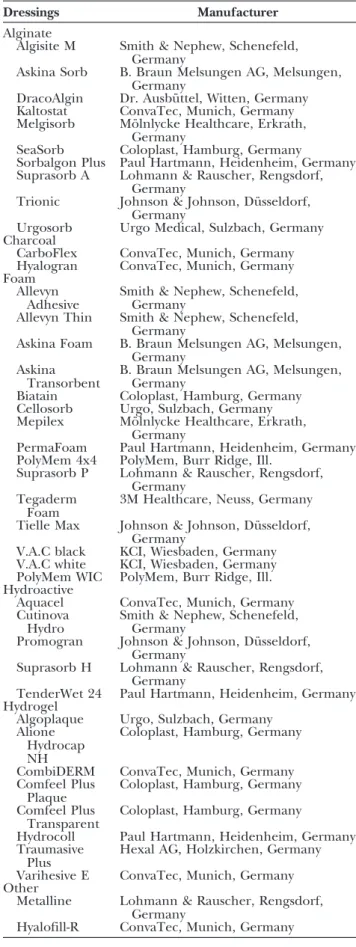
Antiseptics and Wound Irrigating AgentsFive commonly used antiseptics and wound irrigating agents that are commercially available to health care providers were analyzed in combina-tion with different commercially available wound dressings and tested for their antimicrobial activ-ity: the octenidine product Octenisept (0.1 g of octenidine dihydrochloride and 2 g of phe-noxyethanol in aqueous solution; Schuelke & Mayr, Norderstedt, Germany), the polyhexameth-ylene biguanide solutions Lavasept (200 mg/ml polyhexanidium and 10 mg/ml macrogol 4000 in aqueous solution; B. Braun Melsungen AG, Mel-sungen, Germany) and Protosan (0.1% unde-cylenamidopropyl-betaine and 0.1% poly-hexanide in aqueous solution; B. Braun Melsungen), and the povidone-iodine solutions Braunol (7.5 g of povidone-iodine/100 ml in aqueous solution; Ratiopharm, Ulm, Germany) and Betaisodona (10 g povidone-iodine/100 ml in aqueous solution; Mundipharma, Limburg/ Lahn, Germany). The antiseptic solutions were analyzed in undiluted concentrations (Table 1).
Assessment of Antibacterial Activity by Standardized Bacterial Disk Diffusion Assay
Determination of bacterial inhibition was per-formed by a standardized disk diffusion assay. The
Table 1. Commercially Available and Clinically Used Wound Dressings Assessed in This Study
Dressings Manufacturer
Alginate
Algisite M Smith & Nephew, Schenefeld, Germany
Askina Sorb B. Braun Melsungen AG, Melsungen, Germany
DracoAlgin Dr. Ausbu¨ ttel, Witten, Germany Kaltostat ConvaTec, Munich, Germany Melgisorb Mo¨lnlycke Healthcare, Erkrath,
Germany
SeaSorb Coloplast, Hamburg, Germany
Sorbalgon Plus Paul Hartmann, Heidenheim, Germany Suprasorb A Lohmann & Rauscher, Rengsdorf,
Germany
Trionic Johnson & Johnson, Du¨ sseldorf, Germany
Urgosorb Urgo Medical, Sulzbach, Germany Charcoal
CarboFlex ConvaTec, Munich, Germany Hyalogran ConvaTec, Munich, Germany Foam
Allevyn
Adhesive Smith & Nephew, Schenefeld,Germany Allevyn Thin Smith & Nephew, Schenefeld,
Germany
Askina Foam B. Braun Melsungen AG, Melsungen, Germany
Askina
Transorbent B. Braun Melsungen AG, Melsungen,Germany Biatain Coloplast, Hamburg, Germany Cellosorb Urgo, Sulzbach, Germany Mepilex Mo¨lnlycke Healthcare, Erkrath,
Germany
PermaFoam Paul Hartmann, Heidenheim, Germany PolyMem 4x4 PolyMem, Burr Ridge, Ill.
Suprasorb P Lohmann & Rauscher, Rengsdorf, Germany
Tegaderm Foam
3M Healthcare, Neuss, Germany
Tielle Max Johnson & Johnson, Du¨ sseldorf, Germany
V.A.C black KCI, Wiesbaden, Germany V.A.C white KCI, Wiesbaden, Germany PolyMem WIC PolyMem, Burr Ridge, Ill. Hydroactive
Aquacel ConvaTec, Munich, Germany Cutinova
Hydro Smith & Nephew, Schenefeld,Germany Promogran Johnson & Johnson, Du¨ sseldorf,
Germany
Suprasorb H Lohmann & Rauscher, Rengsdorf, Germany
TenderWet 24 Paul Hartmann, Heidenheim, Germany Hydrogel
Algoplaque Urgo, Sulzbach, Germany Alione
Hydrocap NH
Coloplast, Hamburg, Germany
CombiDERM ConvaTec, Munich, Germany Comfeel Plus
Plaque
Coloplast, Hamburg, Germany Comfeel Plus
Transparent
Coloplast, Hamburg, Germany
Hydrocoll Paul Hartmann, Heidenheim, Germany Traumasive
Plus
Hexal AG, Holzkirchen, Germany
Varihesive E ConvaTec, Munich, Germany Other
Metalline Lohmann & Rauscher, Rengsdorf, Germany
solutions, in the presence or absence of wound dressings, were tested againstS. aureus(American Type Culture Collection 6538). Bacterial inhibi-tion testing was performed according to Clinical and Laboratory Standards, National Committee for Clinical Laboratory Standards, and Deutsches Institut fuer Normung (58940 Part 3) as described elsewhere.16 –18 Sixty microliters of the antiseptic solutions was added to each well. The plates were incubated at 37°C and read at 24 hours. Zone diameters were read at the point where growth abruptly decreased. In a first setup, undiluted so-lutions were evaluated for their antibacterial effi-cacy in a standardized bacterial inhibition assay.
In a second procedure, 75 percent by weight (4.75 g) of each solution was incubated with dress-ings at 37°C on a roll mixer (RM5-40; Zipperer GmbH, Staufen, Germany). After 24 hours, 60l of the incubated solutions was added to each well, and the disk diffusion assay was performed as de-scribed above.
The resulting inhibition of bacterial growth expressed as zone diameter was correlated with the results from the solutions in the absence of wound dressings and expressed as percentage of deviation. All experiments were repeated on at least four occasions on different dates. Analysis was performed in a blinded fashion.
Statistical Analysis
Results are presented as mean ⫾SEM. A sig-nificant difference ofp⬍0.01 was determined as severe loss in antibacterial activity of the solutions in combination with the wound dressings assessed. The Levene test was used for determination of equal or unequal variance. Thettest for equal or unequal variance was used to detect significance.
RESULTS
Povidone-Iodine SolutionsBetaisodona was tested in combination with a total of 42 wound dressings. Twenty-seven (64.28 percent) of the combinations assessed showed suf-ficient antimicrobial activity (Table 2). However, 14 (33 percent) of the combinations with wound dressings showed significant loss of antimicrobial activity, starting with Suprasorb P with 89.63⫾2.3 percent antibacterial efficacy compared with Be-taisodona alone (p ⫽ 0.005). Hyalogran showed the weakest performance, with 49.83⫾6 percent (p⬍0.0001).
To confirm these findings, a second broadly used povidone-iodine product was assessed, Braunol, was tested against 14 wound dressings.
This study showed a result of sufficient antimicro-bial activity in 78.5 percent of wound dressings (11 of 14) (Table 3). All wound dressing tested above
p⬍0.01 were also evaluated positively in the Be-taisodona study, except for Suprasorb H, which showed a value of p⫽0.01 when combined with Braunol (93.11 ⫾ 6.1 percent). Incubated with Betaisodona, a reduction to 74.3 ⫾ 2.2 percent
Table 2. Povidone-Iodine Detergent Betaisodona Incubated with 42 Different Wound Dressings and Analyzed for Their Antibacterial Activity Compared with the Genuine Antibacterial Efficacy*
Wound Dressing Antibacterial Efficacy (%) p† Sufficient antibacterial activity DracoAlgin 119.33⫾3.3 ⬍0.0001 Kaltostat 116.45⫾6 0.008 Prisma 114.71⫾4.5 ⬍0.0001 Alione Hydrocap HN 114.7⫾9.6 0.1 Aquacel 112.15⫾4.1 0.04 TenderWet 24 111.4⫾6 0.1 Sorbalgon Plus 109.7⫾2.2 0.03 Trionic 109.09⫾2.2 0.007 SeaSorb 106.4⫾3.8 0.1 Urgosorb 105.93⫾6.3 0.4 CombiDERM 102.08⫾5.7 0.6 V.A.C. white 99.55⫾4.7 0.9 Comfeel Plus Transparent 97.5⫾7.8 0.6 Varihesive 96.66⫾7.8 0.5 Metalline 96.35⫾4.7 0.3 Hydrocoll 95.34⫾2 0.03 Comfeel Plus Plaque 95.24⫾4.5 0.4 Physiotulle 95.17⫾9.9 0.4 PolyMem 4x4 94.93⫾9.2 0.1 Mepilex 94.09⫾6.8 0.06 Hyalofill R TAMP 05 93.82⫾0 0.3 PlyMem WIC 92.59⫾7.4 0.1 Allevyn Non-Adhesive 89.47⫾4.6 0.02 Allevyn Adhesive 88.15⫾5 0.05 Cutinova Hydro 87.91⫾2.2 0.01 Biatain Foam 84.61⫾7.7 0.01 Melgisorb 83.33⫾4.4 0.1 Significant reduction of antibacterial efficacy Suprasorb P 89.63⫾2.3 0.005 Tielle Max 86.32⫾0 ⬍0.0001 Cellosorb 83.98⫾2.2 ⬍0.0001 Tielle 80.42⫾9.4 0.002 Allevyn Thin 77.92⫾2.2 ⬍0.0001 V.A.C. black 77.47⫾5.7 0.002 Perma Foam 76.79⫾7.9 ⬍0.0001 Traumasive Plus 76.32⫾4.6 ⬍0.0001 Foam 74.90⫾3.7 ⬍0.0001 Suprasorb H 74.03⫾2.2 ⬍0.0001 Algoplaque 73.75⫾5.7 ⬍0.0001 CarboFlex 71.51⫾7.7 ⬍0.0001 Algisite 70.99⫾8.1 ⬍0.0001 Suprasorb A 68.31⫾7.7 0.005 Hyalogran 49.83⫾6 ⬍0.0001 *Sixty-four percent of the combinations assessed showed sufficient antibacterial activity. Significant reduction of antibacterial efficacy was determined asp⬍0.01 versus Betaisodona or Braunol in the absence of wound covers.
occurred (p⬍0.0001). All three antiseptics with significant antibacterial reduction in the Braunol study (Suprasorb P, Tielle, and V.A.C. black) were also significantly hampered when incubated with Betaisodona. Thus, both agents showed similar results.
Octenidine
Octenisept showed sufficient antimicrobial ac-tivity in a total of 23 of 42 of wound dressings (54.76 percent) ranging from Suprasorb P and Mepilex (134.7 ⫾ 8.4 percent, p ⫽ 0.06; and 112.78 ⫾5.2 percent,p⫽0.017, respectively) to Aquacel (62.18 ⫾ 14.4 percent, p ⫽ 0.01). All other wound dressings tested showed significant loss of antibacterial activity [19 of 42 (45.2 per-cent)]. The lowest performer in this group (Cu-tinova Hydro) showed only 34.89⫾11.8 percent of the initial antibacterial efficacy of Octenisept (p⬍0.0001) (Table 4).
Polyhexamethylene Biguanide Derivatives
Prontosan, a wound irrigation solution, was incubated with a total of 42 wound dressings. These combinations showed sufficient antimicro-bial activity in 13 of 42 of combinations assessed (32.5 percent): Suprasorb P, V.A.C. black, and V.A.C. white foam, Allevyn Non-Adhesive showed no reduction of antibacterial efficacy (100
per-cent, p⬎0.01) followed by Mepilex, Tielle, Met-alline, Allevyn Adhesive, Perma Foam, Varihesive, Cellosorb, Algoplaque, and Physiotulle (between 97.6 and 87.8 percent,p⬎0.01) (Table 5). Thirty-two combinations assessed showed a significant reduction of antibacterial efficacy. Twelve wound dressings tested even reduced antibacterial effi-cacy of Prontosan by more than 50 percent of its initial efficacy (Table 5).
Table 3. Antimicrobial Activity of Braunol Combined with 14 Different Wound Dressings Previously Analyzed with Betaisodona*
Wound Dressing AntibacterialEfficacy (%) p†
Sufficient antibacterial activity
Comfeel Plus Plaque 100.9⫾6.8 0.8 Kaltostat 98.06⫾4.3 0.7 CombiDERM 98⫾10.3 0.7 V.A.C. white 97.35⫾9.5 0.5 Comfeel Plus Transparent 94.81⫾7.7 0.1 Urgosorb 94.60⫾9.2 0.3 Varihesive 93.89⫾2.4 0.05 Suprasorb H 93.11⫾6.1 0.01 Mepilex 89.89⫾4.5 0.01 PolyMem 4x4 86.47⫾7.5 0.02 Prisma 83.82⫾9.2 0.01 Significant reduction of antibacterial efficacy Suprasorb P 79.6⫾11.3 0.009 Tielle 78.78⫾4.5 0.001 V.A.C. black 67.69⫾7.1 ⬍0.0001 *Braunol combined with 14 different wound dressings, previously analyzed with Betaisodona, showed sufficient antimicrobial activity in 78.5 percent or 11 wound dressings. Significant reduction of anti-bacterial efficacy was determined asp⬍0.01 versus Betaisodona or Braunol in the absence of wound covers.
†Two-tailed.
Table 4. Efficacy of Octenidine Alone and in Combination with Wound Dressings*
Wound Dressing Antibacterial Efficacy (%) p† Sufficient antibacterial activity Suprasorb P 134.74⫾8.4 0.06 Mepilex 112.78⫾5.2 0.017 Tielle 110.37⫾6.7 0.043 Suprasorb A 108.49⫾10.2 0.3 V.A.C. black 103.20⫾12 0.5 Metalline 101.21⫾22 0.9 Biatain Foam 99.01⫾9.6 0.8 Perma Foam 95.83⫾3.1 0.4 PolyMem 4x4 94.23⫾8.8 0.1 Hyalogran 90.74⫾24.2 0.5 Traumasive Plus 90.66⫾9.2 0.1 Suprasorb H 90.47⫾12.4 0.3 Comfeel Plus Plaque 88.05⫾11.8 0.05 Hyalofill R TAMP 05 87.87⫾25.2 0.07 CombiDERM 87.61⫾19 0.3 V.A.C. white 87.58⫾5.9 0.03 Alione Hydrocap HN 85.41⫾12.5 0.01 Cellosorb 83.92⫾21.2 0.2 PolyMem WIC 83.63⫾22 0.2 Trionic 82.22⫾11.1 0.3 SeaSorb 72.66⫾6.9 0.01 Foam 70.13⫾10.8 0.03 Aquacel 62.18⫾14.4 0.01 Significant reduction of antibacterial efficacy Algisite 94.11⫾0 0.008 Physiotulle 90.37⫾0 0.001 Comfeel Plus Transparent 83.66⫾5.9 0.005 Allevyn Non-Adhesive 83.01⫾3.3 0.002 Varihesive 81.33⫾9.2 0.0005 Algoplaque 79.31⫾3 ⬍0.0001 Allevyn Adhesive 78.68⫾2.8 ⬍0.0001 Hydrocoll 78.14⫾12.4 ⬍0.0001 Sorbalgon Plus 74.66⫾3.5 ⬍0.0001 Tielle Max 69.33⫾9.2 ⬍0.0001 Dracoalgin 67.34⫾3.5 ⬍0.0001 Melgisorb 65.40⫾11.8 ⬍0.0001 Urgosorb 64.66⫾3.5 ⬍0.0001 Kaltostat 59.06⫾15.8 ⬍0.0001 Promogran 56.96⫾19.2 ⬍0.0001 Carboflex 55.55⫾6.3 ⬍0.0001 Allevyn Thin 49.38⫾11.1 ⬍0.0001 TenderWet 24 46.66⫾6.9 ⬍0.0001 Cutinova Hydro 34.89⫾11.8 ⬍0.0001 *Octenidine (Octenisept) showed comparable antibacterial efficacy compared with Octenisept alone (54 percent of the wound dressings assessed in this group) in 23 of 42 wound dressings. The cut-off line was determined to bep⬍0.01 versus octenidine in the absence of wound covers.
In the Lavasept group, 41.6 percent (five of 12) of the wound dressings allowed antibacterial efficacy above a value of p⬎0.01 compared with Lavasept alone (Table 6): Metalline, V.A.C. black and V.A.C. white, Hydrocoll, and Suprasorb P (be-tween 96.08 and 81.37 percent,pⱖ0.01). These findings confirmed the results for the Prontosan study: all combinations being not significant in the
Lavasept study were found to be not significant in the Prontosan study as well. Furthermore, we de-tected the same results for the significantly differ-ent combinations.
DISCUSSION
This study demonstrated that many broadly used wound dressings significantly decreased an-tibacterial activity of local wound antiseptics. Other studies have shown that modern wound dressings show no significant improvement in wound healing. A Cochrane meta-analysis analyz-ing the topical treatment of wounds with silver as the antimicrobial agent identified three random-ized controlled clinical trials comprising a total of 847 participants. One trial compared silver-con-taining foam (Contreet) with hydrocellular foam (Allevyn) in patients with leg ulcers, the second trial compared a silver-containing alginate (Silver-cel) with an alginate alone (Algosteril), and the third trial compared the silver-containing foam Contreet with best local practice in patients with chronic wounds. The data from these three trials demonstrated that silver-containing foam dress-ings did not significantly increase complete ulcer healing as compared with standard foam dressings or best local practice after up to 4 weeks of follow-up, although a greater reduction of ulcer size was observed with the silver-containing foam. The au-thors stated that there is insufficient evidence to recommend the use of silver-containing dressings for the treatment of infected or contaminated
Table 5. Antibacterial Efficacy of the Polyhexamethylene Biguanide Detergent Prontosan*
Wound Dressing AntibacterialEfficacy (%) p†
Sufficient antibacterial activity
Suprasorb P 100.0⫾4.7 1.0 V.A.C. black 100.0⫾0.0 0.5 Allevyn Non-Adhesive 100.0⫾0.0 0.5 V.A.C. white 100.0⫾3.4 0.3 Mepilex 97.6⫾4.9 0.5 Tielle 97.5⫾3.5 0.3 Metalline 96.5⫾5.5 0.1 Allevyn Adhesive 96.2⫾5.2 0.2 Perma Foam 95.3⫾4.9 0.1 Varihesive 93.8⫾5.3 0.09 Cellosorb 91.1⫾9.3 0.1 Algoplaque 88.7⫾3.4 0.1 Physiotulle 87.8⫾0.0 0.03 Significant reduction of antibacterial efficacy Biatain foam 92.2⫾3.1 0.005 Hydrocoll 88.8⫾4.0 ⬍0.0001 Comfeel Plus plaque 87.3⫾3.4 ⬍0.0001 Traumasive Plus 86.9⫾4.8 0.0012 Comfeel Plus Transparent 86.5⫾2.6 ⬍0.0001 Suprasorb H 85.7⫾3.9 ⬍0.0001 Hyalogran 82.9⫾7.3 0.0012 Tielle Max 70.6⫾5.7 ⬍0.0001 Melgisorb 69.1⫾4.5 ⬍0.0001 SeaSorb 68.6⫾10.6 ⬍0.0001 PolyMem 4s4 67.4⫾6.8 ⬍0.0001 PolyMem WIC 64.2⫾6.6 ⬍0.0001 Sorbalgon Plus 62.6⫾7.2 ⬍0.0001 Aquacel 59.5⫾8.0 ⬍0.0001 Dracoalgin 57.1⫾0.0 ⬍0.0001 Hyalofill R TAMP 05 50.0⫾0.0 ⬍0.0001 Promogran 50.0⫾0.0 ⬍0.0001 TenderWet 24 48.6⫾0.0 0.0028 Prisma 45.2⫾5.1 ⬍0.0001 Trionic 45.0⫾0.0 0.0021 Suprasorb A 45.0⫾0.0 0.0021 Algisite 45.0⫾0.0 0.0021 Urgosorb 44.6⫾6.9 ⬍0.0001 Carboflex 44.4⫾0.0 0.0015 Kaltostat 43.9⫾0.0 0.0019 Allevyn Thin 43.3⫾0.0 0.0004 Foam 42.8⫾0.0 ⬍0.0001 Alione Hydrocap HN 42.8⫾0.0 ⬍0.0001 CombiDERM 41.8⫾0.0 0.0015 *Significant reduction of antibacterial efficacy was determined asp
⬍0.01 versus Lavasept or Prontosan in the absence of wound covers. The polyhexamethylene biguanide detergent Prontosan proved to have sufficient antimicrobial activity with wound dressings in terms of maintained antibacterial efficacy in 32.5 percent (13 of 42 wound dressings).
†Two-tailed.
Table 6. Antibacterial Efficacy of Lavasept When Incubated with Wound Dressings
Wound Dressing Antibacterial Efficacy (%) p† Sufficient antibacterial activity Metallmine 96.08⫾7.2 0.3 V.A.C. black 93.33⫾9.9 0.3 V.A.C. white 92.38⫾4.9 0.2 Hydrocoll 85.71⫾4.9 0.03 Suprasorb P 81.37⫾5.1 0.01 Significant reduction of antibacterial efficacy Trionic 87.5⫾5.4 0.003 Suprasorb H 84.31⫾5.1 0.003 Kaltostat 75.49⫾5.1 0.0005 Algisite M 63.77⫾4.3 ⬍0.0001 Promogran 60⫾0 ⬍0.0001 CarboFlex 52.94⫾5.1 0.004 Tenderwet 24 51.43⫾4.9 0.004 *Lavasept was severely hampered in its antibacterial efficacy when incubated with seven of 12 wound dressings. Significant reduction of antibacterial efficacy was determined asp⬍0.01 versus Lavasept or Prontosan in the absence of wound covers.
chronic wounds.19 In a meta-analysis by Nelson and Bradley investigating dressings and topical agents for arterial leg ulcers to determine whether topical agents and wound dressings affect the rate of healing in arterial ulcers, only one trial met the inclusion criteria. This small trial compared ket-anserin ointment with vehicle alone. The trial was too small and far too short a follow-up period to be able to determine whether there was any dif-ference in healing rates.20
In another Cochrane review, the authors per-formed an extensive literature search in the field of dressings for healing venous leg ulcers. Forty-two randomized controlled studies were identified that met the inclusion criteria. The main dressing types that were evaluated were hydrocolloids (n⫽
23), foams (n ⫽ 6), alginates (n ⫽ 4), hydrogel dressings (n ⫽6), and a group of miscellaneous dressings (n⫽3). There was no evidence that any particular dressing type was better than any others in terms of number of ulcers healed. At present, the evidence base does not suggest that hydrocol-loids are more effective than simple low adherent dressings used beneath compression. For other comparisons, there was insufficient evidence.
In our study, different wound dressings incu-bated with a povidone-iodine detergent (Betai-sodona) showed sufficient antimicrobial activity in 64 percent of the combinations assessed (27 of 42). These findings were confirmed by a second povidone-iodine derivative, Braunol, which was not significantly impaired by 78 percent of the wound dressings assessed (11 of 14).
The antibacterial effect of the octenidine so-lution Octenisept was significantly reduced when incubated with the wound dressings analyzed in this study: only 23 of 42 of the wound dressings assessed (54 percent) allowed for sufficient anti-bacterial activity of octenidine. Thus, the antibac-terial activity was reduced to 35 percent when in-cubated with a wound dressing consisting of a polyurethane matrix with embedded superabsorb-ers (Cutinova Hydro, p⬍0.0001).
The third group (polyhexamethylene bigua-nide solutions) revealed the lowest number of suf-ficient antimicrobial activity for Prontosan: incu-bated with 42 different wound covers, this combination showed sufficient antimicrobial ac-tivity in only 13 combinations assessed (32.5 per-cent). Twelve wound dressings even reduced the antibacterial efficacy of more than 50 percent. Thus, to confirm this finding, a second polyhex-amethylene biguanide derivative, Lavasept, was analyzed: 41.6 percent of the wound dressings (five of 12) had sufficient antibacterial efficacy.
The weaker results obtained with octenidine and polyhexamethylene biguanide– containing agents may be explained by taking into account that both ingredients show strong cationic character and therefore immanently have limited compatibility with anionic matrices that can be present in certain wound dressing materials. These data show that commonly used, commercially available wound dressing products reduce the antibacterial efficacy of clinically used local antiseptics in vitro. In a previously published study, we investi-gated the potential cytotoxicity of the antiseptics and wound irrigation solution used in this study. Interestingly, this study showed that polyhexam-ethylene biguanide detergents are the least toxic to skin cells, whereas octenidine showed signifi-cant toxicity to keratinocytes and fibroblasts and povidone-iodine– based agents showed severe tox-icity even at low concentrations.21
In daily health care routine, antiseptic solu-tions are often used in advance of the respective wound dressing, overlapping with the wound cov-erage, and are used at the same time. Further-more, companies have recently developed vacuum wound dressing systems that are designed to rinse the foams applied to the wound with antiseptics during vacuum application. Other manufacturers are currently advertising wound dressings com-bined with polyhexamethylene biguanide–releas-ing products. The data from this study show sig-nificant reduction of antimicrobial activity of certain antiseptics in combination with clinically used wound dressings. These findings clearly dem-onstrate that health care professionals need to be prudent in choosing the appropriate material for wound treatment, with special regard to potential interference and toxicity in the wound environ-ment. Furthermore, commercial suppliers need to analyze product interactions and ensure that products and patients will not suffer chemical in-teractions and negative side effects. Further re-search is warranted to observe and optimize the innovative but confusing wound product market. Several limitations of this study should be dis-cussed. First, all agents were tested against S. au-reusonly. However, for testing of the antimicrobial activity, the most prevalent Gram-positive bacteria strain S. aureus was chosen. Second, important factors of the wound environment, such as wound fluid, proteins, proteases, and debriding effects of the agents, were excluded from this in vitro study. Furthermore, not all of the solutions used are antiseptics. Prontosan is used as a wound irrigating agent, and whether the results obtained have an influence on the wound cleansing activity as well
was not investigated. Finally and most importantly, it is difficult to estimate how the results of bacterial inhibition testing reflect clinical practice.
Evidence-based medicine has had an increas-ing impact on patient care over the past few years, and these results give cause for concern and in-dicate a need to review management of these wounds. The selection and duration of therapy is empirical in many cases, and further research by both manufacturers and health care professionals is required to ensure the effective and efficient combined use of antiseptics and dressings. Wound dressings present a huge and fast-growing market. Furthermore, products change frequently in in-gredients and brand names. Thus, there is an urgent need for routine compatibility testing of wound care products. Further research is needed to assess the antibacterial activity of wound antiseptics and wound irrigating solu-tions in combination with wound dressings in the clinical setting with a variety of potentially pathogenic microorganisms.
Lars Steinstraesser, M.D. Department of Plastic Surgery Burn Center BG University Hospital Bergmannsheil Ruhr University Bochum Buerkle-de-la Camp Platz 1 44789 Bochum, Germany [email protected]
REFERENCES
1. Hirsch T, Spielmann M, Zuhaili B, et al. Enhanced suscep-tibility to infections in a diabetic wound healing model.BMC Surg.2008;8:5.
2. Brook I, Frazier EH. Aerobic and anaerobic microbiology of infection after trauma.Am J Emerg Med.1998;16:585–591. 3. Harker J. The effect of bacteria on leg ulcer healing.Br
J Community Nurs.2001;6:126–134.
4. Goldstein EJ, Citron DM, Nesbit CA. Diabetic foot infections: Bacteriology and activity of 10 oral antimicrobial agents against bacteria isolated from consecutive cases.Diabetes Care 1996;19:638–641.
5. Diekema DJ, Pfaller MA, Schmitz FJ, et al. Survey of infections due toStaphylococcusspecies: Frequency of occurrence and antimicrobial susceptibility of isolates collected in the United States, Canada, Latin America, Europe, and the Western Pacific region for the SENTRY Antimicrobial Surveillance
Program, 1997-1999.Clin Infect Dis.2001;32(Suppl 2):S114– S132.
6. Fridkin SK, Hageman JC, Morrison M, et al. Methicillin-resistantStaphylococcus aureusdisease in three communities. N Engl J Med.2005;352: 1436–1444.
7. Archer GL.Staphylococcus aureus: A well-armed pathogen.Clin Infect Dis.1998;26:1179–1181.
8. Clark NC, Weigel LM, Patel JB, Tenover FC. Comparison of Tn1546-like elements in vancomycin-resistantStaphylococcus aureusisolates from Michigan and Pennsylvania.Antimicrob Agents Chemother.2005;49:470–472.
9. Hirsch T, Jacobsen F, Steinau HU, Steinstraesser L. Host defense peptides and the new line of defence against mul-tiresistant infections.Protein Pept Lett.2008;15:238–243. 10. Cosgrove SE, Sakoulas G, Perencevich EN, Schwaber MJ,
Karchmer AW, Carmeli Y. Comparison of mortality associ-ated with methicillin-resistant and methicillin-susceptible Staphylococcus aureusbacteremia: A meta-analysis.Clin Infect Dis.2003;36:53–59.
11. Chambers HF. The changing epidemiology ofStaphylococcus aureus?Emerg Infect Dis.2001;7:178–182.
12. Whitney J, Phillips L, Aslam R, et al. Guidelines for the treatment of pressure ulcers.Wound Repair Regen.2006;14: 663–679.
13. Steed DL, Attinger C, Colaizzi T, et al. Guidelines for the treatment of diabetic ulcers.Wound Repair Regen.2006;14: 680–692.
14. Hopf HW, Ueno C, Aslam R, et al. Guidelines for the treat-ment of arterial insufficiency ulcers. Wound Repair Regen. 2006;14:693–710.
15. McDonnell G, Russell AD. Antiseptics and disinfectants: Activity, action, and resistance.Clin Microbiol Rev.1999; 12:147–179.
16. Cotter G, Adley CC. Comparison and evaluation of antimi-crobial susceptibility testing of enterococci performed in accordance with six national committee standardized disk diffusion procedures.J Clin Microbiol.2001;39:3753–3756. 17. National Committee for Clinical Laboratory Standards.
Per-formance Standards for Antimicrobial Disk Susceptibility Tests. Ap-proved standard M2-A6. Wayne, Pa: National Committee for Clinical Laboratory Standards; 1997.
18. National Committee for Clinical Laboratory Standards. Meth-ods for Dilution Antimicrobial Susceptibility Tests for Bacteria That Grow Aerobically. Document M7-A4.4th ed. Wayne, Pa: National Committee for Clinical Laboratory Standards; 1997. 19. Vermeulen H, van Hattem JM, Storm-Versloot MN, Ubbink
DT. Topical silver for treating infected wounds. Cochrane Database Syst Rev.2007;(1):CD005486.
20. Nelson EA, Bradley MD. Dressings and topical agents for arterial leg ulcers. Cochrane Database Syst Rev. 2007;(1): CD001836.
21. Hirsch T, Koerber A, Jacobsen F, et al. Evaluation of toxic side effects of clinically used skin antiseptics in vitro.J Surg Res.2010;164:344–350.