Survey of the use and outcome of confrontational and
non-confrontational training methods in client-owned dogs
showing undesired behaviors
Meghan E. Herron
*
, Frances S. Shofer, Ilana R. Reisner
Department of Clinical Studies, School of Veterinary Medicine, University of Pennsylvania, 3900 Delancey Street, Philadelphia, PA 19104-6010, USA
1. Introduction
Dog owners presenting their pets to veterinarians for behavior problems have often attempted a variety of training methods prior to their visit. Because many owners
do not initially seek advice from veterinarians with regard to their pets’ behavior problems (Lord et al., 2008), they are likely to have relied on ‘‘lay’’ resources for information and advice on behavior modification techniques. Many inter-ventions involve confrontational, ‘positive punishment’ i.e., punishment using an aversive stimulus, such as pain, to decrease unwanted behavior, which can be threatening and fear-provoking in animals, sometimes leading to defensively aggressive behavior and putting owners who
A R T I C L E I N F O Article history:
Accepted 22 December 2008 Available online 24 January 2009 Keywords:
Aggression
Behavior modification Dog
A B S T R A C T
Prior to seeking the counsel of a veterinary behaviorist many dog owners have attempted behavior modification techniques suggested by a variety of sources. Recommendations often include aversive training techniques which may provoke fearful or defensively aggressive behavior. The purpose of this study was to assess the behavioral effects and safety risks of techniques used historically by owners of dogs with behavior problems.
A 30-item survey of previous interventions was included in a behavioral questionnaire distributed to all dog owners making appointments at a referral behavior service over a 1-year period. For each intervention applied, owners were asked to indicate whether there was a positive, negative, or lack of effect on the dog’s behavior, and whether aggressive behavior was seen in association with the method used. Owners were also asked to indicate the source of each recommendation. One-hundred-and-forty surveys were completed. The most frequently listed recommendation sources were ‘‘self’’ and ‘‘trainers’’. Several confrontational methods such as ‘‘hit or kick dog for undesirable behavior’’ (43%), ‘‘growl at dog’’ (41%), ‘‘physically force the release of an item from a dog’s mouth’’ (39%), ‘‘alpha roll’’ (31%), ‘‘stare at or stare [dog] down’’ (30%), ‘‘dominance down’’ (29%), and ‘‘grab dog by jowls and shake’’ (26%) elicited an aggressive response from at least a quarter of the dogs on which they were attempted. Dogs presenting for aggression to familiar people were more likely to respond aggressively to the confrontational techniques ‘‘alpha roll’’ and yelling ‘‘no’’ compared to dogs with other presenting complaints (P<0.001). In conclusion, confrontational methods applied by dog owners before their pets were presented for a behavior consultation were associated with aggressive responses in many cases. It is thus important for primary care veterinarians to advise owners about risks associated with such training methods and provide guidance and resources for safe management of behavior problems.
ß2008 Elsevier B.V. All rights reserved.
* Corresponding author. Tel.: +1 215 898 3083; fax: +1 215 573 7041. E-mail address:[email protected](M.E. Herron).
Contents lists available atScienceDirect
Applied Animal Behaviour Science
j o u r n a l h o m e p a g e : w w w . e l s e v i e r . c o m / l o c a t e / a p p l a n i m
0168-1591/$ – see front matterß2008 Elsevier B.V. All rights reserved. doi:10.1016/j.applanim.2008.12.011
use them at risk of injury (Mertens, 2002; Mills, 2002). Owner safety is, thus, an important consideration in the management of canine behavior problems.
Previous studies have evaluated dogs’ responses to different obedience training methods. In one report, dogs that were trained using rewards (‘positive reinforcement’) for desirable behavior had a significantly better response to obedience tasks compared to dogs trained primarily with punishment (Hiby et al., 2004). Another found that dogs that were trained using only positive reinforcement were less likely to develop future behavior problems, while others that had been trained using punishment were more likely to develop fear-related responses (Blackwell et al., 2007). While these studies have compared the effectiveness of and stress response resulting from different training techniques, no study has evaluated owner safety in using such methods or reported the recommending source.
The purpose of this study was to describe the frequency of use, the recommending source, and the owner-reported effect on canine behavior of interventions that owners of dogs with undesired behaviors had used on their dogs. This study also aimed to report aggressive responses from the dogs subsequent to the use of aversive and non-aversive interventions.
2. Methods
Owners of dogs scheduled for an appointment with the Behavior Service at the Matthew J. Ryan Veterinary Hospital of the University of Pennsylvania, Philadelphia, Pennsylvania, USA, were sent a survey via email, fax, or postal mail designed to identify and briefly note the behavioral outcome of a variety of treatment interventions. Between April 1 and July 31, 2007, the survey was sent as an optional supplement to an extensive behavior questionnaire required for appointments. The survey instrument was an expanded version of an existing page within the behavior questionnaire. This survey was pre-tested for clarity by 10 dog-owning hospital employees. Each survey was assigned a unique number with no identifying information. A master list linked this number with the owner’s name, and the (canine) patient’s breed, age, sex, neuter status, and presenting complaint. Presenting complaints were obtained from the first two pages of the behavior questionnaire, in which owners indicated the primary behavior problems leading to the appointment. These complaints were then categorized as follows: ‘‘aggression to famil-iar people,’’ targeted to household members or people with whom the dog spent significant time, ‘‘aggression to unfamiliar people’’ targeted to non-household members, ‘‘aggression to dogs’’ if owners described their dogs as aggressive to dogs either within or outside the household, ‘‘separation anxiety’’ if the dog exhibited problems in the owner’s absence, ‘‘specific fears or anxiety’’ if the owners described fear of noises or other environ-mental stimuli, such as thunderstorms, and ‘‘other’’.
To increase the response rate and reduce redundancy within the behavior questionnaire, the survey was incorporated into the full beha-vior questionnaire and sent in this form to clients scheduled for an appointment between August 1, 2007 and May 1, 2008. The survey consisted of a list of 30 interventions that owners may have previously attempted. Owners were asked to select ‘‘yes’’ or ‘‘no’’ for each interven-tion as to whether they had attempted them. Interveninterven-tions were later categorized into ‘‘aversive: direct confrontation’’, ‘‘aversive: indirect con-frontation’’, ‘‘reward training’’, and ‘‘neutral’’ (Table 1). In each case, owners were asked whether they had attempted the technique or inter-vention, the recommending source, whether the method used had had a ‘‘positive’’, ‘‘negative’’ or ‘‘no effect’’ on their dog’s behavior, and whether or not it elicited a ‘‘growl/bare teeth’’, ‘‘snap/lunge’’, or ‘‘bite’’ from the dog. For purposes of analysis and because any display of aggression was considered a safety risk to the owner, the responses ‘‘growl/bare teeth’’, ‘‘snap/lunge’’, and ‘‘bite’’ were collapsed into one ‘‘aggressive’’ response. To reduce bias from previous treatment recommendations made by the Behavior Service, only new clients were included in the study.
The following descriptive data were generated for each intervention: the frequency of use; the person or source recommending the interven-tion; whether the intervention elicited an aggressive response; and the effect of the intervention on the behavior at issue. Within each of the four categories of intervention, Fisher’s Exact Test was used to determine if dogs presenting with an aggression to familiar people, and dogs present-ing for aggression to any people (either familiar, unfamiliar, or both) were more likely to respond aggressively compared to dogs presenting with other behavior problems. Fisher’s Exact Test was also used to examine the relationship between age and aggressive response, within each interven-tion. Significance levels for multiple comparisons were adjusted for using the Bonferroni correction. AP-value of <0.002 was considered signifi-cant. Data are presented as frequencies and percents for categorical data and meansstandard deviation for continuous variables. Where applicable 95% confidence intervals (CI) are presented around the difference. All analyses were performed using SAS statistical software (Version 9.1, SAS Institute, Cary, NC, USA).
The survey instrument was reviewed and approved by the Univer-sity of Pennsylvania Institutional Review Board for research on human subjects.
3. Results
Between April 1 and July 31, 2007, 30 (28%) of 107 distributed surveys were completed and returned. Between August 1, 2007 and May 1, 2008, an additional 110 completed surveys (98% of 112 distributed) were collected, for a total of 140 completed surveys (64% of the total distributed). Two owners who received the incorpo-rated survey left it blank; all others reported that they attempted at least one of the 30 interventions.
Owners of 90 purebred dogs and 50 mixed breed dogs participated in this study. Forty-one purebreds were represented, including eight (6%) German Shepherd Dogs, seven (5%) English Springer Spaniels, five (4%) Beagles, four (3%) Doberman Pinschers, three (2%) Miniature Dachs-hunds, and one to two each of 36 other breeds. Eighty-five dogs (61%) were castrated males, 44 (31%) were ovar-iohysterectomized females, six (4%) were sexually intact males, and five (4%) were sexually intact females. The mean age was 4.12.8 years (range 3 months–14 years), and the mean weight was 2314 kg (range 3–70 kg).
In many cases, owners listed more than one presenting complaint, including aggression to familiar people (n= 60, 43%), aggression to unfamiliar people (n= 67, 48%), aggression to dogs (n= 56, 40%), separation anxiety (n= 28, 20%), specific fears or anxiety (n= 45, 32%), and other problems (n= 12, 9%), such as aggression to cats, barking, house-soiling, and one presentation of cognitive dysfunction syndrome.
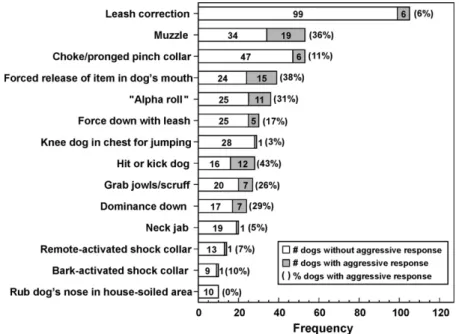
Many owners had attempted to modify their dogs’ behavior using direct confrontation. The most frequently attempted directly confrontational interventions were leash corrections (n= 105, 75%) the use of choke or pronged pinch collars (n= 53, 38%), and use of a muzzle (n= 53, 38%). All other methods were attempted by at least one owner (Fig. 1). Many owners who attempted these physically manipulative techniques reported that their dogs responded with aggression. For example, use of a muzzle, forced release of an item from the dog’s mouth, the ‘‘alpha roll’’, hitting or kicking the dog for undesirable behavior, grabbing jowls, and the ‘‘dominance down’’ elicited an aggressive response in at least a quarter of the dogs on which they were attempted (Fig. 1).
Owners also attempted to improve their dogs’ behavior by use of indirect confrontation (Fig. 2). As with direct methods of confrontation, several indirectly confronta-tional methods elicited an aggressive response. Methods that elicited an aggressive response from at least a quarter of the dogs on which they were attempted included the ‘‘stare down’’ and growling at the dog (Fig. 2).
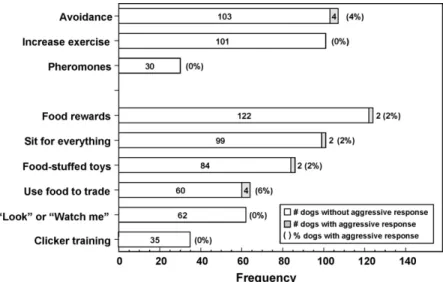
Few owners reported that their dog responded aggres-sively to the non-aversive, reward-based and ‘‘neutral’’ interventions described (Fig. 3). Reward-based training using food as a reward for desirable behavior was the most frequently-used behavior modification intervention (n= 124, 89%). Owners reported a variety of recommenda-tion sources for the intervenrecommenda-tions they used (Table 2). Owners’ opinions of each method’s effectiveness also varied (Table 3).
Analysis of responses relative to presenting complaints revealed that dogs presenting for aggression towards familiar people were significantly more likely to show an aggressive response to two interventions compared to dogs who presented for other complaints. For example, dogs presenting for aggression to familiar people were more likely than dogs with other presenting complaints to respond aggressively to the ‘‘alpha roll’’ (100% vs 50%;
difference 50%; 95%CI: 26–70%;P<0.001) and yelling ‘‘no’’ (30% vs 2%; difference 28%; 95%CI: 17–41%;P<0.001).
There were no statistically significant differences in aggressive responses to any of the interventions between dogs presenting for aggression to people (both familiar and/or unfamiliar) and dogs with other presenting complaints. Likewise, there was no relationship found between age of the dog and aggressive responses to the behavioral interventions.
4. Discussion
Owners attempted a variety of behavioral interven-tions, many of which elicited an aggressive response, with their dogs prior to their appointment with a referral Behavior Service. As we expected, the highest frequency of aggression occurred in response to aversive interventions, whether direct or indirect. In contrast, reward-based training elicited aggression in very few dogs, regardless of presenting complaint.
Although dogs who are historically aggressive to familiar people might respond aggressively to any inter-vention, whether or not aversive, owners of such dogs in our study were at greater risk of injury when attempting
Table 1
Categories of 30 behavioral interventions used by dog owners prior to a behavior consultation as listed in the survey.
Intervention Description
Aversive: direct confrontationa
‘‘Alpha roll’’ Roll dog onto back and hold down
‘‘Dominance down’’ Hold dog down on side, legs extended
Force down with leash Step on leash or collar and force dog to lie down
Hit or kick dog Grab jowls/scruff
Knee dog in chest for jumping Knee dog in chest in response to jumping up on people
Neck jab Abruptly jab dog on neck or side with fingers
Choke or pronged pinch collar
Leash correction Quick tug/yank of leash
Rub dog’s nose in house-soiled (HS) areas
Force release of item in dog’s mouth Apply pressure to dog’s gums with fingers to release an object in dog’s mouth
Remote-activated shock collar Shock administered at owner’s discretion
Bark-activated shock collar Shock administered in response to barking
Muzzle
Aversive: indirect confrontationb
Yell ‘‘no’’
Spray with water pistol/spray bottle
‘‘Schhhtt’’ Make abrupt sound to interrupt or correct undesirable behavior
Growl at dog
Force exposure Forcibly expose dog to stimulus that frightens dog (i.e., tile floors, noise, people)
Verbal punishment for house-soiling (HS)
‘‘Stare down’’ Stare at dog until he/she looks away
Non-aversive: reward-based training
‘‘Look’’ or ‘‘watch me’’ Teach dog to make eye contact on cue
Clicker training Use of clicker instrument as conditioned reinforcer
Food rewards Give food as reward for desirable behavior
Use food to trade for item Use food to trade for item in dog’s mouth
Food-stuffed toys Provide food-stuffed toys to dog
Sit for everything Ask dog to sit for all desired things/activities
Neutral
Avoidance Avoid exposing dog to stimuli that trigger aggression
Synthetic pheromones Chemical used to decrease fear/anxiety
Increase exercise To improve behavior
a
Techniques that physically manipulate the dog in an aversive and/or confrontational manner to stop unwanted behaviors; techniques with the potential to cause pain.
b
the ‘‘alpha roll’’ and ‘‘yelling no’’. The aggressive response to the ‘‘alpha roll’’ was not surprising as dogs will roll onto their backs as a means of threat avoidance or social appeasement, and may progress to defensive aggression if the threat persists, as it would when an owner continues to manipulate the dog (Shepherd, 2002). Such interactions present a substantial risk for owners who seek advice regarding the management of aggressive behavior; pun-ishment may increase fear and arousal, particularly in an already-defensive dog, and perhaps teach the dog to bite without warning (Landsberg et al., 2003). Studies have shown that most dog bites to humans are inflicted by
familiar dogs as opposed to stray dogs, making it even more crucial for owners to properly handle their own pets (Berzon and DeHoff, 1974; Moss and Wright, 1987).
The use of such confrontational and punitive training methods has been presented and popularized in books, on the internet, and on television (Ross and McKinney, 1996; Monks of New Skete, 2002; Millan et al., 2004; Millan and Peltier, 2007; Millan, 2008). Their common use may have grown from the premise that canine misbehavior or aggression is rooted in social dominance (to the owner), or, conversely, to a lack of assertiveness or dominance by the owner. Advocates of such theories suggest that owners
Fig. 1.Aversive (direct confrontation) interventions attempted by 140 dog owners prior to a behavior consultation and number of dogs who responded
aggressively.
Fig. 2.Aversive (indirect confrontation) interventions attempted by 140 dog owners prior to a behavior consultation and number of dogs who responded
Fig. 3.Non-aversive, neutral and reward-based interventions attempted by 140 dog owners prior to a behavior consultation and number of dogs who responded aggressively.
Table 2
Reports from 140 dog owners on sources of recommendations for 30 behavioral interventions they may have attempted.
Behavioral intervention Recommending resource
Attempted, N(%) Book, N(%)a Breeder, N(%)a Friend/ Relative, N(%)a Internet, N(%)a Self, N(%)a Television, N(%)a Trainer, N(%)a Veterinarian, N(%)a Direct confrontation Leash correction 105 (75) 3 (3) 1 (1) 6 (6) 4 (4) 45 (43) 13 (12) 53 (50) 4 (4)
Choke/pronged pinch collar 53 (38) 0 2 (4) 8 (15) 3 (6) 11 (21) 0 35 (66) 1 (2)
Muzzle 53 (38) 0 0 1 (2) 1 (53) 22 (42) 0 14 (26) 24 (45)
Force release of item in dog’s mouth 39 (28) 2 (5) 1 (3) 4 (10) 0 25 (64) 2 (5) 3 (8) 2 (5)
‘‘Alpha roll’’ 36 (26) 3 (8) 2 (6) 8 (22) 6 (17) 10 (28) 5 (14) 6 (17) 2 (6)
Force down with leash 30 (21) 0 0 2 (7) 2 (7) 7 (23) 3 (10) 21 (70) 1 (3)
Knee dog in chest for jumping 29 (21) 0 2 (7) 8 (28) 0 9 (31) 1 (3) 9 (31) 2 (7)
Hit or kick dog 28 (20) 1 (4) 0 2 (7) 0 22 (79) 0 0 0
Grab jowls/scruff 27 (19) 1 (4) 1 (4) 6 (22) 2 (7) 16 (59) 3 (11) 3 (11) 2 (7)
‘‘Dominance down’’ 24 (17) 3 (13) 2 (8) 4 (17) 3 (13) 7 (29) 4 (17) 2 (8) 0
Neck jab 20 (14) 2 (10) 0 1 (5) 0 4 (20) 13 (65) 1 (5) 0
Remote-activated shock collar 14 (10) 0 1 (7) 2 (14) 1 (7) 4 (29) 0 4 (29) 3 (21)
Rub dog’s nose in HS area 10 (7) 1 (10) 0 3 (30) 1 (10) 8 (80) 0 0 1 (10)
Bark activated shock collar 10 (7) 0 0 2 (20) 1 (10) 5 (50) 0 4 (40) 0
Indirect confrontation
Yell ‘‘no’’ 122 (87) 1 (1) 0 10 (8) 3 (3) 93 (76) 4 (3) 26 (21) 0
‘‘Schhhtt’’ sound 77 (55) 2 (3) 0 3 (4) 1 (1) 31 (40) 34 (44) 14 (18) 0
‘‘Stare-down’’ 53 (38) 3 (6) 0 3 (6) 4 (8) 29 (55) 2 (4) 11 (21) 0
Water pistol/spray bottle 51 (36) 1 (2) 2 (4) 8 (16) 3 (6) 23 (45) 4 (8) 17 (33) 9 (18)
Verbal punisment for house-soiling 47 (34) 2 (4) 0 15 (32) 0 29 (62) 0 1 (2) 2 (4)
Force exposure 25 (18) 0 0 2 (8) 1 (4) 13 (52) 3 (12) 9 (36) 4 (16)
Growl at dog 22 (16) 0 1 (5) 3 (14) 2 (9) 10 (45) 0 6 (27) 0
Reward-based
Food rewards 124 (89) 2 (2) 1 (1) 4 (3) 5 (4) 70 (56) 5 (4) 50 (40) 11 (9)
Sit for everything 101 (72) 3 (3) 0 6 (6) 6 (6) 54 (54) 4 (4) 50 (50) 7 (7)
Food-stuffed toys 86 (61) 3 (4) 0 11 (13) 4 (5) 37 (43) 4 (5) 27 (31) 22 (26)
Use food to trade for item 64 (46) 0 1 (2) 2 (3) 2 (3) 40 (63) 1 (2) 20 (31) 6 (9)
‘‘Look’’ or ‘‘watch me’’ 62 (44) 2 (3) 1 (2) 1 (2) 2 (3) 21 (34) 3 (5) 37 (60) 9 (15)
Clicker training 35 (25) 2 (6) 0 0 2 (6) 8 (23) 0 21 (60) 1 (3) Neutral Avoidance 107 (77) 3 (3) 0 3 (3) 0 80 (75) 2 (2) 18 (17) 9 (8) Pheromones 30 (21) 0 0 1 (3) 5 (17) 16 (53) 0 4 (13) 5 (17) Increase exercise 101 (72) 2 (2) 1 (1) 7 (7) 5 (5) 26 (26) 24 (24) 29 (29) 15 (15) a
need to establish themselves as the ‘‘alpha’’ or ‘‘pack leader’’, using physical manipulations and intimidation in order to do so, thereby forcing the dog into a subordinate attitude.
While the use of confrontational training methods to subdue hypothetical dominance is commonplace, the current scientific literature suggests, instead, that canine aggression and other behavior problems are not a result of dominant behavior or lack of the owner’s ‘‘alpha’’ status, but rather a result of fear (self-defense) or underlying anxiety problems, important for an understanding of the motivation and treatment of aggression (Guy et al., 2001a,b; Mertens, 2002; Luescher and Reisner, 2008). Techniques such as forcing a dog down by the collar or by pushing on its neck and back—as, for example, in the ‘‘dominance down’’—are associated with increased phy-siological stress (Beerda et al., 1998). Frightened animals are often self-defensively aggressive; it would not be unexpected, then, that dogs respond aggressively to such provocative handling.
The use of electric collars is controversial (Polsky, 1994; Cheetam, 2003). Shock collars were used infrequently in our study; however, use of shock might have contributed, indirectly, to aggression in other contexts. For example, dogs in one study that were shocked inconsistently and
those who were shocked as a result of incorrect obedience response were at higher risk for increased stress than were dogs shocked for approaching a specific, easily identifiable and avoidable object (Schalke et al., 2007). In another study, dogs who were shocked via remote control for obedience training showed an elevated stress response which persisted in the presence of the owner even outside the context of training (Schilder and van der Borg, 2004). These studies suggest that using remotely activated shock is likely to increase stress and fear of owners, and may put dogs at risk for compromised welfare and defensive aggression.
Sources of recommendations for the interventions evaluated in this study were varied. Owners listed ‘‘self’’ or ‘‘trainers’’ as the most frequent sources for all but three interventions (Table 2). Assuming that the average pet owner lacks training in behavior modification and management of aggression, it may, therefore, be dangerous for them to be handling such problems without profes-sional help. It was not surprising to find that trainers were the source for many recommendations. As reported in a recent survey, owners of dogs with behavior problems are likely to consult trainers rather than veterinarians (Lord et al., 2008). This lack of veterinary intervention is problematic as the lack of standardized oversight of many
Table 3
Owners’ opinion of effect of 30 behavioral interventions on their dog’s behavior.
Behavioral intervention ‘‘Positive effect’’,N(%)a
‘‘Negative effect’,’N(%)a
‘‘No effect’’,N(%)a
Direct confrontation
Leash correction 59 (62) 7 (7) 29 (31)
Choke/pronged pinch collar 26 (52) 7 (14) 17 (34)
Muzzle 18 (37) 20 (41) 11 (22)
Force release of item in dog’s mouth 17 (49) 12 (34) 6 (17)
‘‘Alpha roll’’ 14 (44) 8 (25) 10 (31)
Force down with leash 17 (61) 3 (11) 8 (29)
Knee dog in chest for jumping 13 (45) 1 (3) 15 (52)
Hit or kick dog 3 (11) 9 (35) 14 (54)
Grab jowls/scruff 7 (28) 8 (32) 10 (40)
‘‘Dominance Down’’ 10 (48) 5 (24) 6 (28)
Jab dog in neck with fingers 8 (44) 0 10 (56)
Remote activated shock 6 (42) 4 (29) 4 (29)
Rub dog’s nose in house-soiled area 0 1 (11) 8 (89)
Bark activated shock 5 (56) 2 (22) 2 (22)
Indirect confrontation
Yell ‘‘no’’ 50 (48) 14 (14) 40 (38)
‘‘Schhhtt’’ sound 26 (36) 1 (1) 45 (63)
‘‘Stare-down’’ 16 (34) 11 (23) 20 (43)
Water pistol/spray bottle 19 (37) 11 (22) 21 (41)
Verbal reprimand for house-soiling 18 (40) 5 (11) 22 (49)
Force exposure to frightening stimuli 6 (30) 4 (20) 10 (50)
Growl at dog 5 (23) 9 (41) 8 (36)
Reward-based
Food rewards 96 (87) 1 (1) 13 (12)
Sit for everything 79 (85) 1 (1) 13 (14)
Food-stuffed toys 48 (62) 1 (1) 28 (36)
Use food to trade for item 53 (86) 1 (2) 8 (13)
‘‘Look’’ or ‘‘watch me’’ 39 (71) 0 16 (29)
Clicker training 20 (65) 1 (3) 10 (32) Neutral Avoidance 72 (77) 1 (1) 20 (22) Increase exercise 66 (69) 1 (1) 29 (30) Pheromones 3 (13) 1 (1) 20 (83) a
Percentage based on number of owners who attempted each individual intervention and does not include owners who failed to complete this portion of the survey or reported more than one answer for the intervention’s effect.
training programs has resulted in a range of competence and ethical practice of behavior modification and owners may be at risk of receiving unsafe advice.
The recommendation made most by veterinarians was use of a muzzle, which may be attributable to the fact that most of the dogs in this population presented for aggression, and most veterinarians will muzzle biting dogs for safety during an examination. We did not differentiate or specify how the muzzle was used; in-clinic muzzling may have led to over-reporting of its use, as veterinarians may not have specifically recommended a muzzle for training outside the veterinary clinic.
Television was the most frequently reported source for the ‘‘schhhtt’’ sound correction and abruptly ‘‘jabbing the dog in the neck’’, both of which have been demonstrated on a popular dog training program (Millan et al., 2004). Because respondents were not asked to provide the names of specific television sources, it was assumed by the authors that owners listing television as the source for the two training techniques were referring to this popular show, although only one owner cited it specifically. Both techniques are potentially provocative and, therefore, may trigger defensive aggression.
Owners felt that most of the listed interventions had a positive or lack of effect on their dogs’ behavior. It was not specified in the survey, however, whether the effect referred to the dog’s reaction to intervention, or to the behavior problem itself. Contrary to expectations, not all owners reporting an aggressive response to a particular intervention felt that the training method had a ‘‘negative’’ effect on their dog’s behavior. For example, ‘‘hitting or kicking’’ led to the highest frequency of aggression for owners who attempted it (43%), yet only 35% of owners reported a negative effect.
Because of the risk of heightened fear of the owner as a result of their use, leash corrections are not typically recommended by positive-reinforcement-based trainers and behaviorists (Mills, 2002). However, in our study, 63% of owners who used leash corrections felt they had a positive effect. It is possible that the correction temporarily inhibited reactive or other undesirable behaviors, thus appearing that the behavior had improved and that the technique had had a positive effect. While it may be effective as a momentary interruption, correction or punishment alone does not selectively reinforce desirable behavior and is an inefficient way to train an animal to perform a specific behavior (Mills, 2002). In addition, owners may not have recognized non-aggressive fearful responses to the correction and may have felt the technique was, indeed, helpful in that particular context. There were several limitations in our study. First, the dog owners surveyed were recruited from a population of owners making appointments at a referral behavior clinic; in many cases, the behavior problems were significant. The frequency of aggressive responses and effectiveness of training methods might have been different if we had sampled a general population of dog owners. Next, the survey did not request a temporal description of these interventions and many of them may have been applied well before the presenting behavior problems occurred. It is, therefore, difficult for us to determine whether owners
attempted specific interventions to alter aggressive behavior or whether aggression developed as a result of their use. It is also possible that owners misinterpreted the meaning of the ‘‘effect’’ section of the survey. The terms ‘‘positive’’, ‘‘negative’’, and ‘‘no effect’’ are subjective, and judging a technique’s effectiveness based on theses options may not be accurate. Next, owners’ self-reporting may have led to recall bias and/or poor answer reliability. For example, each owner may have remembered the outcomes of various treatment techniques differently and some owners may have felt reluctant to admit to a veterinary professional that they used physically aversive methods on their dogs. Finally, the retrospective nature of the survey prevented the possibility for direct comparison of safety and efficacy between aversive and non-aversive techni-ques. It would, however, be unethical to put dog owners at risk for injury for a randomized, prospective comparison between the two categories. This study is the first of its kind to investigate several commonly used behavioral interventions and the potential for aggression as a result of their use. A larger scale study with a more general population of dogs would be the next step towards evaluating the effects of the various behavioral modifica-tion techniques and their associated risks.
In conclusion, confrontational or aversive behavioral interventions applied by dog owners before their pets were presented for a behavior consultation were associated with aggressive responses in many cases. Owners of dogs aggressive to family members are especially at risk for injury—and their pets at risk of relinquishment or eutha-nasia—when certain aversive methods are used. Ultimately, reward-based training is less stressful or painful for the dog, and, hence, safer for the owner. It is important for primary care veterinarians to advise owners about risks associated with aversive training methods, despite their prevalence in the popular media, and to provide resources for safe and effective management of behavior problems.
Acknowledgment
The authors thank Alison Seward and Katherine Magliente for technical assistance.
References
Beerda, B., Schilder, M.B., van Hooff, J.A., de Vries, H.W., Mol, J.A., 1998. Behavioral, saliva cortisol and heart rate responses to different types of stimuli in dogs. Appl. Anim. Behav. Sci. 58, 365–381.
Berzon, D.R., DeHoff, J.B., 1974. Medical costs and other aspects of dog bites in Baltimore. Public Health Rep. 90, 377–381.
Blackwell, E.J., Twells, C., Seawright, A., Casey, R.A., 2007. The relationship between training methods and the occurrence of behaviour problems in a population of domestic dogs. In: Proceedings of the 6th Inter-national Veterinary Behaviour Meeting. Fondazione Iniziative Zoo-profilattiche e Zootecniche, Brescia, Italy, pp. 51–52.
Cheetam, S., 2003. Electric shock collars and dog training. Vet. Rec. 153, 691. Guy, N.C., Luescher, U.A., Dohoo, S.E., Spangler, E., Miller, J.B., Dohoo, I.R., Bate, L.A., 2001a. Risk factors for dog bites to owners in a general veterinary caseload. Appl. Anim. Behav. Sci. 74, 29–42.
Guy, N.C., Luescher, U.A., Dohoo, S.E., Spangler, E., Miller, J.B., Dohoo, I.R., Bate, L.A., 2001b. A case series of biting dogs—characteristics of the dogs, their behavior, and their victims. Appl. Anim. Behav. Sci. 74, 43–57.
Hiby, E.F., Rooney, N.J., Bradshaw, J.W.S., 2004. Dog training methods— their use, effectiveness and interaction with behaviour and welfare. Anim. Welfare 13, 63–69.
Landsberg, G.M., Hunthausen, W., Ackerman, L., 2003. Canine aggression. In: Handbook of Behavior Problems of the Dog and Cat, second ed. Saunders, Edinburgh, pp. 385–426.
Lord, L.K., Reider, L., Herron, M.E., Graszak, K., 2008. Assessment of health and behavior for animals one week and one month post adoption from three shelters in the metropolitan Detroit area. J. Am. Vet. Med. Assoc. 233 (11), 1715–1722.
Luescher, U.A., Reisner, I.R., 2008. Canine aggression to people—a new look at an old problem. Vet. Clin. North Am. Small Anim. Pract. 38 (5), 1107–1130.
Mertens, P.A., 2002. Canine aggression. In: Horwitz, D., Mills, D., Heath, S. (Eds.), BSAVA Manual of Canine and Feline Behavioural Medicine. BSAVA, Gloucester, pp. 195–215.
Millan, C., Emery, S.P., Sumner, K.B., 2004. MPH Entertainment (Firm), Screen Media Films (Firm). Dog Whisperer with Cesar Milan: The Complete First Season.
Millan, C., Peltier, M.J., 2007. Be the Pack Leader—Use Cesar’s Way to Transform Your Dog and Your Life. Harmony Books, New York, pp. 42–120.
Millan, C., 2008. Understanding Aggression. Available at:http://www.ce sarmillaninc.com/tips/issues_understand_aggression.php.(accessed 22 5 2008).
Mills, D.S., 2002. Learning, training and behaviour modification tech-niques. In: Horwitz, D., Mills, D., Heath, S. (Eds.), BSAVA Manual of Canine and Feline Behavioural Medicine. BSAVA, Gloucester, pp. 37–48.
Monks of New Skete, 2002. How to Be Your Dog’s Best Friend. Little, Brown and Company, Boston, pp. 68–78.
Moss, S.P., Wright, J.C., 1987. The effects of dog ownership on judgements of dog bite likelihood. Anthrozo¨os 1, 95–99.
Polsky, R.H., 1994. Electric shock collars—are they worth the risk? J. Am. Anim. Hosp. Assoc. 30, 463–468.
Ross, J., McKinney, B., 1996. Puppy Preschool. St. Martin’s Press, New York, pp. 197–198.
Schalke, E., Stichnoth, J., Ott, S., Jones-Baade, R., 2007. Clinical signs caused by the use of electric training collars on dogs in everyday life situa-tions. Appl. Anim. Behav. Sci. 106, 369–380.
Schilder, M.B.H., van der Borg, J.A.M., 2004. Training dogs with help of the shock collar—short and long term behavioural effects. Appl. Anim. Behav. Sci. 85, 319–334.
Shepherd, K., 2002. Development of behaviour, social behaviour and communication in dogs. In: Horwitz, D., Mills, D., Heath, S. (Eds.), BSAVA Manual of Canine and Feline Behavioural Medicine. BSAVA, Gloucester, pp. 8–29.