Preferences in Case-Based
Reasoning
Amira Abdel-Aziz
Fachbereich Mathematik und Informatik Philipps-Universit¨at Marburg
Dissertation zur Erlangung eines
Doktorgrades der Naturwissenschaften (Dr. rer. nat.) Marburg/Lahn, 2016
Vom Fachbereich Mathematik und Informatik der Philipps-Universit¨at Marburg Hochschulkennziffer (1180) als Dissertation am 30. September 2016 angenommen.
1. Gutachter Prof. Dr. Eyke H¨ullermeier, Universit¨at Paderborn
2. Gutachter Prof. Dr. Mirjam Minor, Universit¨at Frankfurt
Tag der Einreichung: 28. Juni 2016.
Abstract
Case-based reasoning (CBR) is a well-established problem solving paradigm that has been used in a wide range of real-world applications. Despite its great practical success, work on the theoretical foundations of CBR is still under way, and a coherent and universally applicable methodological framework is yet missing. The absence of such a framework inspired the motivation for the work developed in this thesis. Drawing on recent research on preference handling in Artificial Intelligence and related fields, the goal of this work is to develop a well theoretically-founded framework on the basis of formal concepts and methods for knowledge representation and reasoning with preferences.
A preference-based approach to CBR appears to be appealing for several reasons, notably because case-based experiences naturally lend themselves to representations in terms of preference relations, even when not dealing with preference information in an explicit way. Moreover, the flexibility and expressiveness of a preference-based formalism well accommodate the uncertain and approximate nature of case-based problem solving.
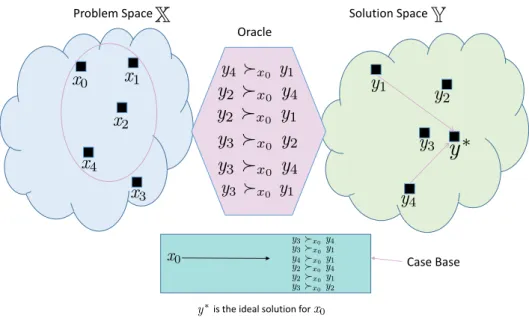
Preference-based CBR is conceived as a case-based reasoning methodology in which problem solving experience is mainly represented in the form of contextualized preferences, namely preferences for candidate solutions in the context of a target problem to be solved. The work in this thesis is based on the idea of the formalization of a preference-based CBR framework, by embedding a method to predict a most plausible candidate solution given a set of preferences on other solutions, deemed relevant for the problem at hand. In this framework, case-based problem solving is formalized as a search process, in which a solution space is traversed through the application
of adaptation operators, and the choice of these operators is guided by case-based preferences.
For further optimization of the developed framework, we include methods that learn how to combine given local similarity measures into a global one, for ensuring optimal performance of the case-based reasoning system. The learning method for the solution space is based on the Bayesian approach for distance metric learning, and the learning of the similarity measures in the problem space has been reduced to binary classification by a classifica-tion method (in our learning we use the perceptron algorithm). To complete the framework and maintain its efficiency, methods for dynamic case base maintenance specifically suited for our preference-based CBR (Pref-CBR) framework are also embedded. The main goal of these maintenance meth-ods is to increase efficiency of case-based problem solving, by reducing the size of the case base, while maintaining performance of the system. We implemented some experiments which show the efficacy of our Pref-CBR problem-solving framework. We also show several applications which high-light in isolation the affect of our methods for learning similarity measures on the performance of the search, as well as the affect of our maintenance strategies on the efficiency of the search.
Zusammenfassung
Das Paradigma des fallbasierten Schließens (engl.: Case-Based Reasoning, CBR) hat sich in zahlreichen Anwendungen als Werkzeug zur L¨osung neuer Probleme mithilfe bereits gel¨oster Probleme bew¨ahrt. Trotz dieses Erfolgs mangelt es dem CBR noch wie vor an theoretischen Grundlagen sowie einem allgemeinen methodischen Unterbau. Dies bildet den Ausgangspunkt f¨ur die vorliegende Arbeit. Das Hauptanliegen ist die Entwicklung eines the-oretisch fundierten Konzeptes, in dem die formale Wissensrepr¨asentation durch Pr¨aferenzrelationen erfolgt. Pr¨aferenzen und paarweise Vergleiche bieten einen sehr nat¨urlichen Zugang zur Modellierung und Durchf¨uhrung von Probleml¨oseprozessen, und ihre Nutzung ist daher von großem Interesse f¨ur die k¨unstlichen Intelligenz und angrenzende Bereiche.
Die Einbeziehung von Pr¨aferenzen in das fallbasierte Schließen ist aus ver-schiedenen Gr¨unden vorteilhaft. Insbesondere k¨onnen Probleml¨osungsprozesse durch sukzessive Anwendung von qualitativen Alternativentscheidungen mod-elliert werden. Auf diese Weise wird Erfahrungswissen ¨uber zur¨uckliegende Entscheidungen in ¨ahnlichen Situationen ber¨ucksichtigt. Dieser intuitive Ansatz spiegelt den Ann¨aherungscharakter von Probleml¨osungsprozessen gut wider und erm¨oglicht entlang von Entscheidungspfaden auch einen flex-iblen Umgang mit unsicheren Informationen.
Pr¨aferenzbasiertes fallbasiertes Schließen nutzt eine Falldatenbank, in der Probleml¨osungserfahrung in Form von kontextbezogenen Pr¨aferenzen abgelegt wird. Neue Probleme werden durch Wiederverwendung von Pr¨ aferenzp-faden ¨ahnlicher bereits gel¨oster Probleme gel¨ost. In dieser Arbeit wird der formale Rahmen f¨ur eine solche Vorgehensweise entwickelt. Probleml¨osung erfolgt als Suche im L¨osungsraum, wobei L¨osungen durch die Anwendung von Operatoren angepasst und verbessert werden, deren Auswahl durch ein Maximum-Likelihood-Modell mit den fallbasierten Pr¨aferenzen erfolgt.
Zur weiteren Verbesserung des vorgestellten Probleml¨osungsverfahrens wer-den Techniken zur Anpassung von ¨Ahnlichkeitsmaßen entwickelt. Ahn-¨ lichkeitsmaße beziehen sich einerseits auf den Vergleich von Problemen un-tereinander und andererseits von L¨osungen. Die Anpassung erfolgt durch Lernen einer f¨ur den Probleml¨osungsvorgang optimalen Gewichtung derjeni-gen Aspekte, deren Unterschiede f¨ur Vergleiche herangezogen werden. F¨ur den Raum der Probleme ergibt sich die Gewichtung als Ergebnis eines mit dem Perzeptronalgorithmus gel¨osten Klassifikationsproblemes von Proble-men, deren ¨Ahnlichkeiten mit L¨osungspr¨aferenzen kompatibel sein sollen. Die Wichtung des L¨osungsraumes ergibt sich dagegen aus einem Wahrschein-lichkeitsmodell durch Anwendung des Satzes von Bayes. Abschließend wer-den verschiewer-dene Techniken zur kontinuierlichen Wartung der Falldatenbank vorgestellt, die durch Ausd¨unnung von F¨allen und Pr¨aferenzen bei gleich-bleibender Probleml¨osungsqualit¨at auf eine Steigerung der Effizienz zielen.
I would like to dedicate this doctoral dissertation to my father. He always believed in me and continuously encouraged and motivated me, without his kind advice and support I would not have been able to continue this process. He is and always will be my great role model. The same goes
with my dear mother who always helped me and gave me advice and taught me how to be strong and responsible since I was a child. My mother has always been a source of strength, power and the light which
always directed me through dark tunnels.
I would also like to dedicate this to my dear husband, who made many sacrifices throughout the past years to let me finish my work. I thank you
deeply from my heart and I appreciate everything you have done for me.
I dedicate this dissertation also to my lovely children, who helped me so much at many times and always cared so much for me. No words can
express my gratitude and love for you.
I dedicate this work also to my dear brother, who has always been there for me and will always be a part of my heart.
Acknowledgements
I would like to express my appreciation and special thanks to my advisor Prof. Dr. Eyke H¨ullermeier, you have been a tremendous mentor for me. I would like to thank you for encouraging me to continue on with my research, and for allowing me to grow as a scientist. Your ideas and advice to me have been priceless and I am honored to have had the chance to work with you. I would also like to thank my committe members, Prof. Dr. Mirjam Minor, and Prof. Dr. Bernd Freisleben for giving me the time to read my work and be there for me. I would also like to thank my department members for always offering help and support at times when I needed them.
I would also like to sincerely thank the Yousef Jameel program for giving me the chance to produce this work. They have been supporting me throughout the past four years and I thank them greatly for their trust in me and for the opportunity they have provided to me to pursue and finish my PhD research. I appreciate very much your help and support and I hope that I have been up to your expectations.
I dearly thank my husband and my beautiful children for all the sacrifices they have made on my behalf, I am truly lucky to have such a wonderful family and nothing that I can say would express how much I love them. I would like to express special appreciation to my husband for supporting me and encouraging me to continue at difficult times. His encouraging words and confidence in me kept me going. I cannot thank enough my kids, who have also helped me and encouraged me. They were responsible enough to take care of many things to help me focus on my work.
A special thanks to my family, words cannot even express how grateful I am to my father, my mother and my brother for being there for me, and I am blessed to have such a wonderful family. Thank you so much for all
your kind support and encouragement at all times. I would also like to greatly thank my mother and father, who are role models for me. Thinking about what they achieved in life, even through hardships, always gave me the strength to continue and reach my goals in life.
I would also like to thank all of my friends for helping me in many ways, and motivating me to strive towards my goals. My appreciation and many thanks go to Dr. Marc Strickert, with whom I have worked closely and learned so much from. He was always there whenever I needed help and he has been a great source of support and encouragement throughout my PhD research trip. Last but not least, I would like to specifically thank Miriam Gross for her help and support from the first day I came here to Germany and even before that, throughout all my arrangements for coming here. No words can really express how grateful I am to all what she has done for me.
Contents
List of Figures ix
List of Tables xi
1 Introduction 1
1.1 Preference-based case-based reasoning . . . 4
1.2 Similarity measures . . . 5
1.3 Case base maintenance . . . 6
2 Case-Based Reasoning 9 2.1 Problem-solving CBR . . . 10
2.2 Conversational CBR . . . 15
2.2.1 CCBR systems . . . 15
2.2.2 Recommender systems . . . 17
2.3 Relationships of CBR to other approaches . . . 18
2.4 Practical applications in CBR . . . 22
2.5 Conclusion . . . 23
3 Preference-Based Case-Based Reasoning 25 3.1 Conventional CBR vs preference-based CBR . . . 27
3.2 Preference-based knowledge representation . . . 29
3.3 Formal setting and notation . . . 32
3.4 CBR as preference-guided search . . . 34
3.5 Case-based inference . . . 38
3.5.1 Case-based inference as probability estimation . . . 38
CONTENTS
3.5.3 Maximum likelihood estimation . . . 40
3.6 Conclusion . . . 41
4 Learning Similarity Measures in Pref-CBR 43 4.1 Learning similarity measures in the solution space . . . 44
4.1.1 Related work . . . 45
4.1.2 Pref-CBR formal framework for learning similarity measures . . 48
4.1.3 Distance learning of the solutions in Pref-CBR . . . 50
4.1.4 Synthetic data illustration . . . 53
4.2 Learning similarity measures in the problem space . . . 55
4.2.1 Related work . . . 55
4.2.2 Distance learning of the problems in Pref-CBR . . . 56
4.3 Conclusion . . . 61
5 Case Base Maintenance in Pref-CBR 63 5.1 Related work . . . 64
5.2 Case base maintenance for Pref-CBR . . . 66
5.2.1 Noise and redundancy in Pref-CBR . . . 67
5.2.2 Integration of case base maintenance into Pref-CBR framework . 68 5.3 Maintenance strategies . . . 70 5.3.1 Intra-case redundancy . . . 70 5.3.2 Intra-case noise . . . 71 5.3.3 Inter-case redundancy . . . 71 5.3.4 Inter-case noise . . . 73 5.4 Conclusion . . . 75 6 Related Methodologies 77 6.1 Heuristic search . . . 78
6.1.1 Best-first search algorithms . . . 79
6.1.2 Iterative improvement algorithms . . . 81
6.1.3 Nature-inspired optimization algorithms . . . 83
6.1.4 Black box search . . . 86
6.2 Machine learning . . . 88
CONTENTS
6.2.2 Machine learning with human in the loop . . . 90
6.2.3 Reactive search and intelligent optimization . . . 93
6.2.4 Selection of features . . . 95
6.3 Conclusion . . . 96
7 Experiments 99 7.1 Pref-CBR search performance . . . 99
7.1.1 Drug discovery . . . 100
7.1.2 Set completion . . . 102
7.2 Learning of similarity measures . . . 104
7.2.1 Wine recommendation – solution space learning . . . 104
7.2.2 Red wine recommendation – comparison of similarity measures of problems and solutions . . . 106
7.3 Case base maintenance in Pref-CBR . . . 107
7.3.1 Setting . . . 109
7.3.2 Inter-case maintenance methods . . . 109
7.3.3 Intra-case maintenance methods . . . 110
7.4 Image improvement application . . . 113
8 Conclusions and Outlook 123
List of Figures
1.1 Case-based reasoning cycle . . . 3
2.1 An example of problem-solving in CBR . . . 12
2.2 Case-based reasoning flow chart . . . 13
2.3 Relations of CBR to other areas . . . 19
3.1 An Example of preference-based knowledge representation of experience 31 3.2 An example of problem-solving in Pref-CBR . . . 33
3.3 A Discrete Choice Model for preferences on solutions . . . 40
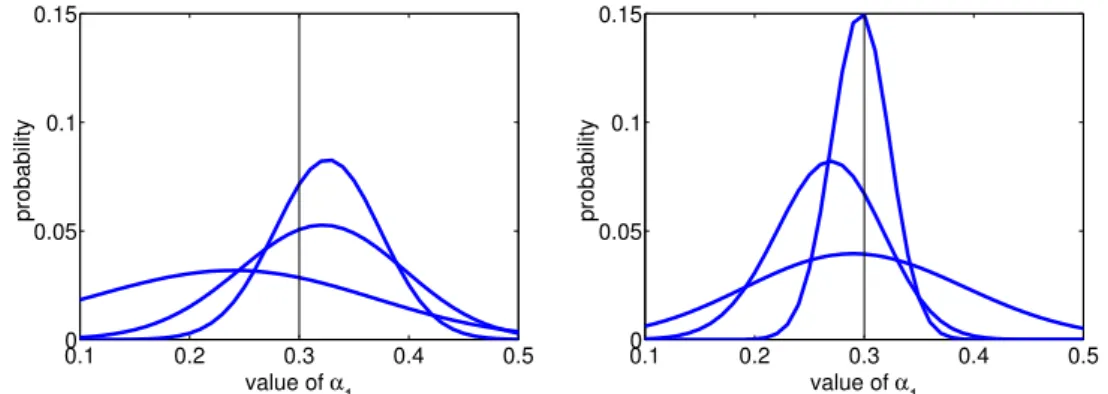
4.1 Probability distributions for the parameter α1 after N = 50, N = 200 and N = 500 examples, with β = 5 (left) andβ= 10 (right). . . 54
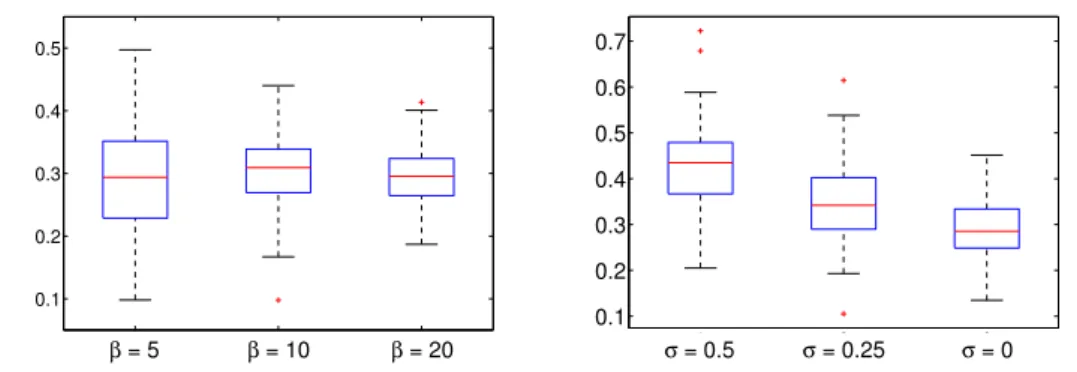
4.2 Boxplots for the mean value estimate ofα1. Left: Different values of the precision parameter β. Right: Different levels of noise in the estimatey•. 55 4.3 SoftDoubleMaxMinOver perceptron algorithm . . . 59
5.1 Intra-case redundancy strategy . . . 71
5.2 Intra-case noise strategy . . . 72
5.3 Inter-case redundancy strategy . . . 73
5.4 Inter-case noise strategy . . . 75
6.1 Pref-CBR framework and related methodologies . . . 78
6.2 Greedy best-first search . . . 80
7.1 Average performance of Pref-CBR and random search on the drug dis-covery problem in the first 150 problem solving episodes. . . 101
LIST OF FIGURES
7.2 Average performance of Pref-CBR and random search on the set
com-pletion problem in the first 100 problem solving episodes. . . 103
7.3 Evolution of the average rank error in sequential problem solving (each query gives rise to one problem solving episode) forL= 3,5 and 10 queries.105 7.4 Comparison of performance between no metric learning, problem metric learning, solution metric learning, problem&solution metric learning. . . 107
7.5 Pref-CBR search with and without inter-case maintenance methods of TSP (10cities) data and case base size. . . 111
7.6 Pref-CBR search with and without inter-case maintenance methods of TSP (20cities) data and case base size. . . 111
7.7 Pref-CBR search with and without intra-case maintenance methods of TSP (10cities) data and number of preferences in case base. . . 112
7.8 Pref-CBR search with and without intra-case maintenance methods of TSP (20cities) data and number of preferences in case base. . . 113
7.9 Performance showing different curves of average percentage difference between images. . . 117
7.10 Case base size . . . 118
7.11 Comparison between original, query, and final image after applying so-lution (set of filters) at different intervals of case base size. . . 118
7.12 Comparison between original, query, and final image after applying so-lution (set of filters) at different intervals of case base size. . . 119
7.13 Comparison between original, query, and final image after applying so-lution (set of filters) at different intervals of case base size. . . 119
7.14 Progress of image improvement. . . 120
7.15 Progress of image improvement. . . 120
7.16 Progress of image improvement. . . 121
7.17 Progress of image improvement. . . 121
List of Tables
1
Introduction
Case-based reasoning (CBR) is a problem solving paradigm built upon a rule of thumb suggesting that similar problems tend to have similar solutions [1]. More specifically, the idea of CBR is to exploit experience from similar problems in the past and to adapt successful solutions to the current problem. Thus, the core of every case-based problem solver is the case base, which is a collection of memorized chunks of experience, called cases.
The field of CBR arose originally from the research in cognitive psychology, where CBR research was highly regarded as a plausible high-level model for cognitive pro-cessing [2]. The idea of CBR is intuitively appealing because it is similar to human problem-solving behavior, where people draw on past experience when trying to solve new problems. This approach then does not require in-depth knowledge in a specific domain for solving the arising problems, and this is a main advantage of using CBR for effective results when there is only shallow knowledge of the domain. Case-based reasoning basically means using old experiences to understand and solve new problems, by reasoning from a previous situation resembling the current one [3].
An advantage of solving problems using CBR is described by [4]: “Neural network systems cannot provide explanations of their decisions and rule-based systems must explain their decisions by reference to their rules, which the user may not fully under-stand or accept. On the other hand, the results of CBR systems are based on actual prior cases that can be presented to the user to provide compelling support for the systems conclusions.” Case-based reasoning builds on the idea that human expertise is not composed of formal structures like rules, but of experience: a human expert reasons
1. INTRODUCTION
by relating a new problem to previous ones. An advantage of CBR over rule-based sys-tems is that experience in CBR consists of examples of problems in a specific domain with their associated solutions that are readily available and can be easily acquired, on the other hand it is difficult to capture that knowledge in a set of rules [5]. A more detailed comparison between CBR and other methodologies will be given in the next chapter.
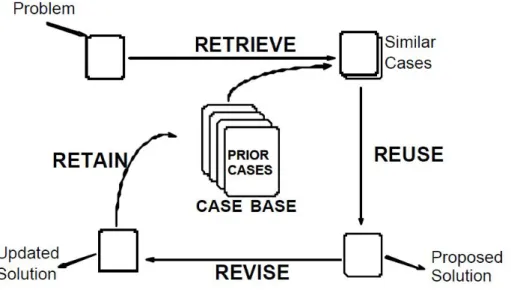
The following figure, Figure 1.1 from [6], illustrates the basic process of case-based reasoning and learning. The CBR cycle proposed by [7] consists of four sequential steps:
• Retrieve: one or more cases are selected from the case base, which have highest similarity to a query based on an underlying similarity measure.
• Reuse: the information and knowledge from the solutions of the retrieved cases, are used to solve the new problem.
• Revise: the selected solution is verified, corrected or improved.
• Retain: the new experience is incorporated into the existing case base for future problem-solving.
Being rooted in cognitive psychology [8], CBR is now considered as a proper sub-field of Artificial Intelligence (AI). As a specific approach to knowledge engineering and knowledge-based systems design, it is closely related to machine learning, information retrieval, databases, semantic web, and knowledge management. Research in CBR has put much emphasis on combining methods from these areas to tackle specific problem tasks, such as diagnosis, planning, product recommendation, and experience manage-ment [9]. Moreover, much effort has been invested in implemanage-menting case-based systems for certain application domains, such as medicine [10] and the health sciences [11]. From a methodological point of view, CBR research has made significant and original contributions to similarity modeling, similarity-based retrieval, and adaptation.
Case-based reasoning has proved to be a successful problem-solving paradigm over the past years. Despite its great practical success, work on the theoretical founda-tions of CBR is still under way. In addition, a coherent and universally applicable methodological framework for case-based reasoning was yet missing. We also believe
Figure 1.1: Case-based reasoning cycle
that although CBR systems exist and are used in many practical applications, there are some applications which might require solutions of a more flexible nature rather than a strict solution which is provided by standard CBR. These kind of applications exist in field areas which may have a very complex solution space as for example optimization problems. For those problems, specifying one optimal solution is almost impossible and in this case preference-relations of solutions (one solution preferred over another) would be a good remedy for the complex nature of solution representation in that field area. The aforementioned preference relations could be preferences of a user for example in qualitatively choosing one solution over another, such as choosing a preferred design or a preferred image or a preferred recipe of a meal over another. These preferences could be recommendations given by an expert in a specific domain, such as a doctor giving a preference for one treatment over another, or an architect giving a preference of some design fitting certain specifications more than another design, or a pharmacist recommending one drug over another for a person having some symptoms depending on his/her age and health status. In general, the preferences are qualitative choices based on some basis for comparison, where quantitative values, such as specifying for example
1. INTRODUCTION
how good an image is or a tastiness of a meal, are difficult or impossible to specify. The lack of a methodological framework in CBR which is based on theoretical foundations, and the absence of a case-based reasoning framework incorporating a preference-based approach, inspired the strong motivation for our work.
A preference-based approach to case-based reasoning (CBR) has recently been ad-vocated in [12]. The goal of preference-based CBR, or Pref-CBR for short, is to develop a coherent and universally applicable methodological framework for CBR on the ba-sis of formal concepts and methods for knowledge representation and reasoning with preferences. Building on general ideas and concepts for preference handling in artificial intelligence (AI), which have already been applied successfully in other fields [13, 14, 15], the goal of this work is to establish a theoretically sound framework for the use of pref-erences in solving problems, using case-based reasoning methodology. The work in this thesis consists of the development of the above mentioned framework, the Pref-CBR problem-solving framework. To optimize this framework further, we consider the im-portance of the concept of similarity in CBR and we introduce methods for learning similarity measures. To ensure efficiency and maintenance of the whole CBR system, we also support our framework by developing case base maintenance strategies which specifically fit our Pref-CBR framework.
1.1
Preference-based case-based reasoning
As introduced in [12], a preference-based approach to CBR appears to be appealing for several reasons, notably because the case-based experiences lend themselves to repre-sentations in terms of preference relations quite naturally. In addition, the flexibility and expressiveness of a preference-based formalism well accommodate the uncertain and approximate nature of case-based problem solving. In this sense, the advantages of a preference-based problem solving paradigm in comparison to the classical (one op-timal solution) one, which have already been observed for AI in general, seem to apply to CBR in particular. These advantages are nicely explained in [16]: “Early work in AI focused on the notion of a goal—an explicit target that must be achieved—and this paradigm is still dominant in AI problem solving. But as application domains become more complex and realistic, it is apparent that the dichotomic notion of a goal, while adequate for certain puzzles, is too crude in general. The problem is that in many
1.2 Similarity measures
contemporary application domains [...] the user has little knowledge about the set of possible solutions or feasible items, and what she typically seeks is the best that’s out there. But since the user does not know what is the best achievable plan or the best available document or product, she typically cannot characterize it or its properties specifically. As a result, she will end up either asking for an unachievable goal, get-ting no solution in response, or asking for too little, obtaining a solution that can be substantially improved.”
A first step taken toward preference-based CBR was made in [12], by addressing the important part of case-based inference, which is responsible for predicting a “con-textualized” preference relation on the solution space. More specifically, the latter consists of inferring preferences for candidate solutions in the context of a new prob-lem, given knowledge about such preferences in similar situations. The search-based problem-solving framework developed in this thesis embeds this inference procedure. More specifically, case-based problem solving is formalized as a search process, in which a solution space is traversed through the application of adaptation operators, and the choice of these operators is guided by case-based preferences.
1.2
Similarity measures
The main idea in CBR is solving new cases by reusing the knowledge from previously solved cases, which are stored in a case base. To this end, it is important to choose the useful cases for the current problem-solving episode, from all the cases in the case base. The CBR system chooses these useful cases based on somesimilarity measures, which are difficult for the users to express and yet are based on some heuristics (rule-of-thumb or argument) of the knowledge incorporated in a specific application domain.
It is clear that learning the similarity measures improves the choice of the useful cases to use for solving a new problem, leading to finding a better solution for the current problem, thus improving the overall performance of a CBR system. Since the concept of similarity lies at the heart of CBR, the success of a CBR system strongly relies on the specification of a suitable similarity measure [17]. As domain knowledge provided by human experts is mostly not sufficient to manually provide an optimal measure, machine learning algorithms could be used to learn these similarity measures efficiently.
1. INTRODUCTION
In standard CBR, it is common to define similarity measures on the problems. In Pref-CBR, since the preference relations are on solutions, it is hence important to also define a similarity measure on the solutions and not only on the problems. As a con-sequence, the performance and effectiveness of Pref-CBR is strongly influenced by the distance measure (smaller distance means higher similarity) between the solutions: the better this measure captures the true differences between solutions, the more effective Pref-CBR will be. Thus, the idea is to make use of the experience collected in a problem solving episode, not only to extend the case base through memorization of preferences, but also to adapt the distance measure between the solutions. For completeness, we also integrate a distance learning module to learn the distance measure between the problems.
1.3
Case base maintenance
As the case base contains all the solved problems along with their corresponding solu-tions, a case base can quickly expand in size and eventually its efficiency is hampered. In Pref-CBR, a case is not only stored in the case base along with one corresponding solution, but rather with a case along with its corresponding preferences over solutions. It is clear that simply storing each encountered problem along with a set of associated preferences is not advisable, especially since a case base of that type may quickly be-come too large and hamper efficient case retrieval; besides, many of the preferences collected in a problem solving episode will be redundant to some extent. In CBR, this problem of redundancy has been addressed by methods forcase base maintenance [18, 19]. Such methods seek to maintain the problem solving competence of a case base thanks to case base editing strategies, including the removal of misleading (noisy) or redundant cases. Case base maintenance (CBM) proved essential to guarantee the effi-ciency and performance of CBR systems. According to the aforesaid about a case base growing rapidly in Pref-CBR, CBM might be even more critical for preference-based than for conventional CBR.
Due to the above mentioned reasons for the importance of maintaining a case base, we address the problem of case base maintenance in Pref-CBR and develop a method for applying it specifically in our framework. We develop some CBM strategies that can be integrated into our Pref-CBR framework to increase the efficiency of the case base
1.3 Case base maintenance
and yet maintain its performance. Despite being inspired by existing CBM techniques for conventional CBR, our strategy is specifically tailored to our framework and ex-ploits properties of the underlying preference-based representation of problem solving experience.
The thesis is organized as follows, the second chapter introduces the methodology of CBR. The third chapter describes the developed preference-based CBR framework. In the fourth chapter, learning similarity measures is explained, and the case base main-tenance method which is specifically designed for the Pref-CBR framework is discussed in Chapter 5. In Chapter 6 methodologies related to Pref-CBR are reviewed; these include different search strategies, as well as machine learning approaches. Chapter 7 describes the case studies, which illustrate the performance of the Pref-CBR frame-work and show the effect of learning similarity measures and applying the maintenance methods. Chapter 8 includes the summary, conclusion and suggested future work.
2
Case-Based Reasoning
Case-based reasoning in general is the process of solving new problems based on pre-viously solved problems. Humans are using case-based reasoning most of the time in their every day life. Doctors use case-based reasoning when they get a patient suffering from certain symptoms, and immediately think of previous patients having the same or similar symptoms, they use that previous experience to come up with an appropriate treatment for the new patient. This treatment could be taken exactly as it was given to a previous patient or the doctor might see a need for changing it a bit, or adapting it to the new patient. An auto mechanic who fixes a car engine by recalling a previous car that exhibited similar symptoms is using case-based reasoning. The same reasoning is used by a lawyer faced with a new case, an electrician repairing some power outages, a cook having some ingredients to cook a meal. All these people use case-based reasoning; they think of a similar case in the past and from the knowledge of this past experience they solve the current case.
CBR is a problem solving paradigm which is characterized by two major distinc-tions from other AI approaches; it is able to utilize specific knowledge from previous experience of concrete cases and it is considered as an incremental and sustained (con-tinuous) learning approach [7]. Thus, a new problem is solved by adapting the solution of a similar case, rather than solving the case from scratch. Reuse of prior solutions helps increase problem solving efficiency by building on prior reasoning, rather than repeating prior effort [20]. Accordingly, a CBR system requires efficient techniques for retrieving cases (which are maximally similar to the problem), organizing and main-taining the case base, and adapting the stored cases to the problem at hand [21].
2. CASE-BASED REASONING
In this chapter, we will explain the problem-solving process of CBR and how CBR systems are used. We will discuss the relationships of CBR to other approaches. To better understand CBR, we will mention some practical applications which use CBR and will show why CBR systems are gaining interest and showing success.
2.1
Problem-solving CBR
CBR is considered as a psychological theory of human cognition and addresses issues in memory, learning, planning and problem solving [22]. In its simplest form, when a CBR system is faced with a new problem having a specific problem description, the system searches for other problems with similar problem descriptions. The solutions of those problems are used as the starting point for generating a solution for the new problem. Following the CBR notion of: similar problems have similar solutions, a solution for the new problem is found and maybe adapted if necessary [20]. The process of getting a new problem, finding similar problems and taking their solutions to adapt and find a final solution to that new problem, is called a problem solving episode.
It is important first to imagine what a case base looks like, what is the structure of the collected cases in the case base and how is the content of the cases organized in the case base? For ensuring effective retrieval and reuse of the cases from a case base, the description of the contents of the cases should be structured in such a way as to provide proper indexing of cases [7]. A case base can have a simple flat structure, where problems are represented by feature vectors and solutions are also represented by feature vectors or classes. As described by the authors in [7], a case base can also have a hierarchical structure, in which cases sharing similar properties are grouped together and the case memory looks like a network structure of categories, semantic relations, cases, and index pointers. A case base can also be structured as a dynamic memory model, proposed by [23], where similar cases are grouped together in clusters which are characterized by specific indexes. Properly structuring the case memory provides the ground basis on which the retrieval task will later efficiently operate on. The retrieval task will start with a problem description, a matching and selection of similar cases, based on the way the cases are organized and structured in the case base and finally providing best found matches [7].
2.1 Problem-solving CBR
CBR systems mostly exploit the nearest neighbor algorithm (NN) in their retrieval phase for finding similar cases to a new problem [24], where thenearest relation is com-puted using a similarity metric on the problem space. Given a description of a problem, a retrieval algorithm, using the indices in the case memory, should retrieve the most similar cases to the current problem or situation [25]. Commonly, CBR systems use mostly Hamming distance for finding nearest neighbors for an attribute-value repre-sentation of a problem, while for n-dimensional real vectors, Euclidean or Manhattan distance are often used [26, 27]. For other complex problems such as problems con-taining heavily inter-connected events (scheduling or time-tabling), the structured case representations require other similarity measures that incorporate deeper knowledge about how much modification of a case is required to fit a new problem [28]. An ex-ample of structured case representations are graphs, trees and semantic networks. The authors in [28] state that similarity based on feature-value representation is not suffi-cient in finding similarity between structured cases because the feature-value represen-tation alone in this case is not enough to find the correspondence between the features in cases and characteristics of the solutions; similarity measures accordingly should consider geometric relationships, hierarchically-structured and model-based similari-ties. Some similarity assessment methods for structured cases include network-based retrieval methods, graph editing operations and sub-graph matching [6].
After retrieval of similar cases to a problem by using some similarity measures, there might be the need for adaptation of a similar case to find a solution to fit the new problem.
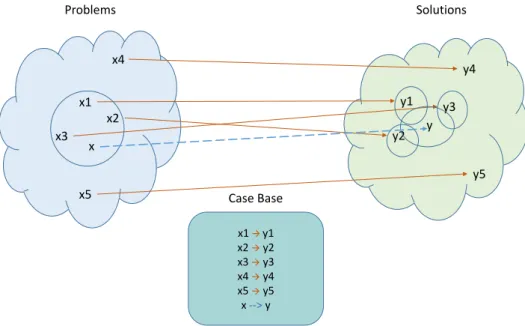
Shown in Figure 2.1 is an example of a problem-solving episode for problem x: first the nearest neighbors of problem x are retrieved using the NN algorithm, then a solu-tion is adapted from their corresponding solusolu-tions to fit problem x and final solusolu-tion y is obtained. All problems and their corresponding solutions are stored in the case base for future retrieval when needed. There are several adaptation methods which include: transformation adaptation (structure of solution is changed), substitution adaptation (some parts of solutions are replaced) and generative adaptaion (solution is recomputed and derived to fit new problem) [6]. In addition, the authors in [29] propose compo-sitional adaptation, which in the case of existence of several similar cases to a new case, their corresponding solutions would be combined in some efficient way to obtain a final solution. As will be described in the next chapter, our Pref-CBR framework
2. CASE-BASED REASONING y x1 y3 x2 x3 x y2 y1 x4 y4 y5 Problems Solutions x1 y1 x2 y2 x3 y3 x4 y4 x5 y5 x-->y Case Base x5
Figure 2.1: An example of problem-solving in CBR
incorporates in a way this idea of combining the solutions of some similar cases to yield a final solution.
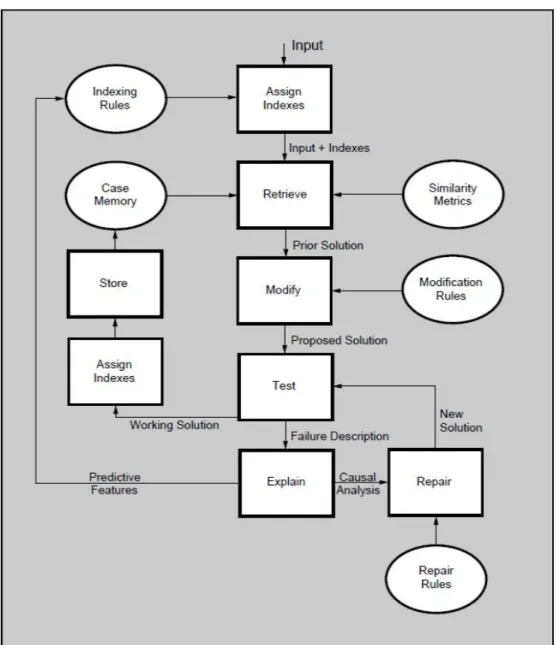
Figure 2.2 from [22] illustrates the CBR cycle as a flowchart, where boxes represent processes and ovals represent knowledge structures:
Let us assume that we have as a new problem some given resources and measure-ments of a house, and the solution should be a suitable design which optimally makes use of the given resources and the area of the house.
• Assign Indexes: features of a new problem are assigned as indexes characterizing that problem. For example specifications of number of rooms of a house and area as well as resources, and the problem is to find a suitable design.
• Retrieve: depending on the structure of the cases, some suitable similarity mea-sures are used. Indexes are used to retrieve a past similar case containing a prior solution, in our example we would retrieve a previous design.
• Modify: some adaptation method is applied on the retrieved solution to fit the new problem. Old solution is modified to fit the new situation, resulting in a
2.1 Problem-solving CBR
2. CASE-BASED REASONING
proposed solution. The design is modified to fit requirements of the features of the problem.
• Test: solution is tried out to see whether it succeeds or fails. Does the design include all required resources and user requirements as well as using the specified area optimally? Check the prototype design.
• Assign and Store: if solution is successful then assign indexes and store a working solution in the case memory. Store the successful design in the case base.
• Explain, Repair and Test: if solution fails then explain the failure, repair the working solution and test again. Failed plan is repaired and revised solution is tested. In our example we can state for example that for a specific area of a house, it is not recommended to have more than 4 rooms because of electricity and power supply resources.
Supporting the above processes are the following knowledge structures also ex-plained by [22]:
• Indexing Rules: identify predictive features in the input.
• Case Memory: database of experience.
• Similarity Metrics: are used to decide which case is more like the current situa-tion.
• Modification Rules: knowledge about what factors could be changed and how to change them.
• Repair Rules: rules for what kind of changes are permissible.
By design, CBR systems do not need deep general knowledge and can be used with just some initial knowledge and further knowledge could be manually added or learned over time [30]. Problem-solving CBR involves situation assessment, case retrieval and similarity assessment/retrieval. In addition to these tasks, the similarities and differ-ences between new and previously solved cases are used to determine how the solution of the previously solved cases can be adapted to fit the new situation [20]. As we learned up to this point, problem-solving systems will store and adapt prior solutions.
2.2 Conversational CBR
The notion of a quality of a solution to a certain problem has been introduced by [31], where quality represents some kind of utility or a degree of correctness. In the latter, the authors propose a formal model of transformational adaptation which defines a quality function that assigns a quality value to each problem-solution-pair; solutions with a higher quality are preferred over solutions with a lower quality value. An alter-native approach mentioned in [20] is to store and reuse traces of how those solutions were derived, instead of storing only the actual solutions. In our developed Pref-CBR framework, which will be explained in detail in the next chapter, we implement the aforementioned ideas; we generate preferences over solutions and we do not only store solutions, but we store the traces of how those solutions were derived.
2.2
Conversational CBR
Conversational CBR (CCBR) is a form of interactive case-based reasoning systems, it is a means of providing more effective support for interactive problem solving. CCBR is used in applications where the user does not necessarily have much domain knowledge, thus helping the user to reach a goal or find a solution for a problem, or help a user to make a decision. In this section we briefly describe how CCBR systems work and some applications which use these systems. We also show the resemblance of CCBR to our Pref-CBR framework.
2.2.1 CCBR systems
Most commercial CBR systems use an interactive questioning process, for example to assist maintenance personnel with fault diagnosis tasks or in e-commerce to help a user to buy certain products or in medical decision making [32, 33, 34, 35]. CCBR systems require a user to initially input a brief free-text description of his/her problem and accordingly the system then constructs a problem specification by interactive problem assessment [33]. As [33] describe the CCBR systems, they show the advantage to progressively rank and display the top matching cases’ solutions, not requiring the user to have a prior knowledge about these relevant cases. It can be stated that CCBR systems can be characterized as interactive systems that, via a mixed-initiative dialogue, guide users through a question-answering sequence in a case retrieval context [32].
2. CASE-BASED REASONING
A popular use for CCBR systems is for product recommendation. In this context, the query represents the preferences of the user according to the attributes of the available products [36]. Accordingly, at each stage of the recommendation dialogue, the system selects the most useful attribute (feature) and asks the user for a preferred value of this attribute and the product which is most similar to the query is retrieved and showed to the user. As mentioned by [36], the dialogue terminates based on a set termination criterion, or until no further attributes remain. The termination of the problem solving is unsuccessful when the system cannot find a good match or when there are no further relevant questions to ask [33].
CCBR systems can also be used in customer support domains by playing the role of customer support agents. They have been successfully used to improve knowledge management in corporate activities by aiding in problem solving, and they have also been used in designing the user-interface of e-commerce websites [34]. Another success-ful application where CCBR systems have been used is in medical classification and diagnosis, interactive fault diagnosis and helpdesk support [35]. It is worth mentioning that in contrast to traditional CBR approaches, it is not assumed that the problem to be solved has an available description. A problem description is instead elicited by the system, aiming to minimize the number of questions that the user is asked before a solution is reached [35].
An important issue addressed in CCBR is the attribute selection strategies that aim to minimize the length of the interactive dialogue with the user. Features are selected by maximizing information gain and avoiding redundant questions in conversation with the user. For example from the reply of the user to certain queries, some features of the problem are refined according to the user’s replies to better find similar cases fitting his/her needs. This in turn increases conversational efficiency, thus reducing the length of the dialogue [34]. Some potential benefits of minimizing the number of questions being presented to the user include avoiding frustration of users and reducing network traffic in e-commerce applications [36]. The criteria for termination of problem-solving dialogues is a very challenging issue for balancing the trade-offs between solution accuracy, and problem-solving efficiency [35, 36].
It can then be plausible to say that the conversational CBR systems are closely related to our Pref-CBR framework, in the sense that there is some form of feedback given during the search process, and based on this feedback the chosen solution for the
2.2 Conversational CBR
query is found. In our framework, this feedback is given by what we call an oracle, where this oracle does not necessarily represent a user but can also represent a program, an expert or a complex database and is described in more detail in the next chapter. In CCBR the problem can initially be defined by the user and it is more restricted to operate in certain environments and specific applications, but in our framework the interference of a user is only a part of the framework (generating preferences) which improves the initial solution to obtain the best possible solution based on the user’s preferences. In addition, in our framework the query does not necessarily represent the user’s preferences, but the user’s preferences are rather generated within the search to adapt the solution chosen based on solutions of similar cases to the query. Our framework is more generic and can be used in many applications in different fields, it is not only restricted for applications including user interaction. For some applications having structured problem/solution spaces, as for example providing the best graph or an optimal tour, our framework can be used while CCBR systems would not be suitable for such applications.
2.2.2 Recommender systems
Recommender systems have become popular over the past years and are applied in a variety of applications. The most popular and well known applications are probably movies, music, news, books, research articles, social tags, search queries and products in general. However, there are also recommender systems for experts, jokes, restaurants as well as financial services. It should be noted that recommender systems are not part of CBR systems, but case-based recommenders are special recommender systems. The success of case-based recommenders depends on two important domain properties: the items need to be described by well-defined features, and users must have some understanding of these features and how they are related to their requirements [37]. The details of a target problem are elicited from the user, often with questions selected or ranked in order of usefulness by the system [35].
Many recommender systems seek feedback from the user as part of the recommen-dation process, and based on this feedback these systems perform information filtering and user profiling using machine learning techniques and adaptive user interfaces, to help users find the information they are seeking [38]. A key feature which separates recommender systems from more conventional information retrieval technologies such
2. CASE-BASED REASONING
as search engines, is their conversational character. The conversational recommender systems guide users through a product space for example, and by eliciting user feed-back, alternatively making product suggestions, which prioritize products that best satisfy the user’s preferences [39].
The recommender systems incorporate four different feedback strategies from the user, which have been explained by [38]. Value elicitation (providing a specific value for a specific feature), tweaking (a directional preference for a particular feature), ratings-based (rate-recommended cases according to their suitability) and preference-ratings-based (selecting one of current set of recommendations that is closest to their requirements). The last form of feedback (preference-based), is the lowest cost form of feedback as it only requires a user to express a simple positive or negative preference for one of the recommended cases. This resembles closely our preference-based strategy which is incorporated in our Pref-CBR problem solving framework. The recommender systems which use the preference-based feedback have the closest resemblance to our framework, where the qualitative preferences play the major role in the search process for a suitable solution for a problem. Recommender systems though require well-defined features for queries, which the user understands to be able to relate them to his or her requirements, which is not the case in our Pref-CBR framework. The preferences of the user are used to optimize a solution for a query, where user only gives preferences of two suggested solutions, not necessarily having to understand or know the features of the problem. Our Pref-CBR framework can be used forsearching for a suitable solution and not just merely foranalyazing to find a suitable solution.
2.3
Relationships of CBR to other approaches
The following approaches are in some way connected to CBR and accordingly play some role within CBR. The relationships of CBR to other approaches is illustrated in the following diagram in Figure 2.3 by [40]:
• Database Management Systems: the connection between database management systems and CBR systems is that both contain data elements of interest to be retrieved if needed [40]. In contrast to database queries which extract only items which match exactly certain retrieval criteria mentioned in the query, CBR queries rank items retrieved using similarity. Unlike CBR systems which give solutions
2.3 Relationships of CBR to other approaches Case-based Reasoning Databases Knowledge-based Systems Management of Uncertainty Cognitive Science Pattern Recognition Machine Learning Information Retrieval
Figure 2.3: Relations of CBR to other areas
that could be adapted to a specific query, databases do not consider reuse or adaptation and certainly do not have the notion of a problem and solution that exists in CBR. In general, the relationship between CBR and database manage-ment systems can be described as follows: a case base can obviously be seen as a kind of database which needs an organization scheme, indexing of cases for retrieval, and storage of cases for later reuse.
• Information Retrieval Systems: information retrieval systems are similar to CBR systems in the sense that both try to retrieve best possible answers to queries. In-formation retrieval systems translate the needs of inIn-formation of a user to a query, which is compared to descriptions of information found in accessible documents [41]. The difference between information retrieval systems and CBR systems is that the former retrieve only documents and can then be more closely related to textual CBR, where both refer to written text [40]. It can then be concluded that information retrieval systems represent a form of CBR systems which specifically handles cases including text.
• Knowledge-Based Systems: the difference between knowledge-based systems and CBR systems is that the former focus on retrieval of implicitly stored knowledge
2. CASE-BASED REASONING
using a logical inference process (an inference engine represented mostly by if-then rules), while the latter retrieve explicitly stored knowledge [40]. Building knowledge-based systems requires expert knowledge while no expert knowledge is needed when building CBR systems. As a consequence, former systems give valid answers but updating the knowledge base is problematic, while the latter systems give approximate answers but are easier to maintain and are more systematic. We can also imagine that a case base is basically a knowledge base; it contains stored cases containing knowledge (problems, solutions and adaptation knowledge which is the experience used for solving new cases). CBR can be considered as a tool which technically supports knowledge-based systems, by organizing, restructuring and memorizing the knowledge to be managed [42]. As highlighted by [43], we can view CBR as a means of providing methodological support to a knowledge management system’s activities for a complete knowledge sharing experience within a learning environment.
• Machine Learning: as [40] simply states, machine learning systems and CBR sys-tems both operate on presented examples that we call experiences. A common aim for both systems is to reduce knowledge acquisition, unlike knowledge-based systems. Similar to rule-induction algorithms of machine learning, CBR starts with a set of cases or training examples to form generalizations of these examples by identifying the commonalities between a retrieved case and the target problem. In CBR, generalizations are made based on the given target problem (lazy learn-ing), while in other models such as rule-induction algorithms generalizations are drawn from training examples before the target problem is known (eager learn-ing) [44]. It can be noted that in machine learning, CBR can be seen as a specific type of learning, mainly instance-based learning. Instance-based (lazy learning) methods in machine learning include case-based reasoning methods that use more complex, symbolic representations for instances [45]. We can also consider that within CBR, some machine learning methods could be used for different purposes such as in the search process and for learning similarity measures.
• Cognitive Science: cognitive science is the interdisciplinary scientific study of the mind and its processes and includes research on intelligence and behavior, es-pecially focusing on how information is represented, processed, and transformed
2.3 Relationships of CBR to other approaches
[46]. Some of the basic roots of CBR are located in cognitive science and have a relation to cognitive psychology; solving complex problems similar to the way humans understand and memorize experiences with the integration of computa-tional techniques [40].
• Analogical Reasoning: as [20] pointed out: “CBR can be viewed as fundamentally analogical; the CBR process emphasizes the performance of analogical reasoning and the feedback of evaluation, in order for a case-based reasoner to learn its lessons while adding a new experiential episode of success or failure to its memory. Analogical reasoning has many overlaps with CBR and both have in common the way in which they make use of past experiences”. The difference between analogy and CBR is stated by [40], analogy operates on a more strategic level than CBR, where the former is based on comparing abstract structures of two entities, while the latter relies on the concept of similarity by focusing on the attributes shared by the two entities. Analogy aims at learning and generalizing by examining at least four entities, while it can be sufficient in CBR to solve a new problem from one similar case.
• Management of Uncertainty: uncertainty in CBR can occur due to information which maybe missing, or when two different descriptions are describing the same problem causing uncertainty of which description to be used, or when there is uncertainty of having the correct solution [47]. The need for suitable methods to model and reason under uncertainty has led to an increased interest in formalizing parts of the CBR methodology, by combining CBR with methods of uncertain and approximate reasoning and soft computing [48]. It is important to manage uncertainty in CBR as it is used in many applications for decision making. An example of using CBR for decision making is in enterprises, since it is considered as a suitable decision-making paradigm because it resembles closely the way man-agers make decisions [49]. A helpful description of decision making, uncertainty and CBR is given by [50]: “the idea of case-based decision making has recently emerged as a new paradigm for decision making under uncertainty. It combines principles from decision theory and case-based reasoning”.
2. CASE-BASED REASONING
2.4
Practical applications in CBR
CBR systems have been used for many tasks in classification, interpretation, scheduling, planning, design, diagnosis and explanation [20]. An approach for using CBR in story plot generation has been proposed by [51], where a CBR process is used to generate plots from a user query specifying an initial setting for the story by using an ontology to measure the semantic distance between words and structures in a text. CBR has been used for aiding designers to recall a relevant design and reuse it to help generate a solution to a new design [52]. The authors in [53] propose to use case-based reasoning to assist architects. As stated by [53], people generally find it easy to use analogs in reasoning but find it difficult to remember the right ones, thus CBR systems can be well used as human-aid systems to help people do better analogical reasoning.
CBR can also be used in interactive aiding of decision making, which is beneficial especially for novices who lack a sufficiently complete collection of prior experiences [54]. Such an example of a decision support system can be found in help-desk systems (first level support) in companies, where they can be used by customers who have problems with products or services from that company [55]. More recently, CBR techniques have also been applied in the design and construction of simulation-based learning systems and educational games; the iterative cycle of applying knowledge, interpreting feedback, explaining results and revising memory provides a model for active promotion of learning [56].
A case-based approach to knowledge navigation has been proposed by [57]. In their work, the authors propose three agents: browsing systems (Find-Me Systems), preference-based task organizers (BUTLERS) and internet news group agents (COR-RESPONDENTS). All three types of systems help users navigate through information spaces, and either find or construct responses to fit the needs of those users. CARE-PARTNER is another knowledge support system on the world wide web which inte-grates CBR; it is a complex medical application running on the internet for physicians to follow up post-transplant patient care. The system integrates rule-based reasoning, information retrieval and case-based reasoning, where CBR is used for refining and completing the knowledge of the system by learning from experience and improving results over time [58].
2.5 Conclusion
For illustrating how a CBR system works, let us take the CHEF system (builds new recipes on the basis of requests of a user from previously stored recipes) as a running example [59]. Recalling Figure 2.2 from [22] which illustrates the CBR cycle as a flowchart, the following procedure describes an example from the cooking domain illustrating how the CHEF system works:
• Assign Indexes: generate a beef and broccoli recipe.
• Retrieve: retrieve a stored beef and green beans recipe.
• Modify: apply modification rule to substitute green beans with broccoli and edit cooking time.
• Test: plan is executed in simulator and adapted recipe goals are checked against expectations.
• Assign and Store: broccoli is soggy!
• Explain, Repair, Test: beef releases water and broccoli steams. Add broccoli later on in the dish. Test for crispness of broccoli.
2.5
Conclusion
As we have seen, CBR systems can be used in different domains and have shown success in many practical applications. The analogy-based method which is used in CBR, recalling instances from a case base which are similar to a new given case, has been the reason for the support of these systems to humans. The reason for this is that they model the human behavior with the computational capability to support humans in knowledge extraction, diagnosis, problem solving and decision making. In this chapter we introduced key principles of CBR, its basic problem-solving process, its relationships to other approaches and some practical applications of CBR systems. In the next chapter we will highlight the difference between preference-based CBR and standard CBR and we will describe in detail our Pref-CBR framework.
3
Preference-Based Case-Based
Reasoning
The common knowledge representation in a case base, that we are generally familiar with, is a case and its solution. A major distinction of our Pref-CBR framework from the standard CBR systems is our knowledge representation in the case base, which is a case and its set of preferences over solutions. Our framework incorporates a search mechanism which operates on solving new problems using solutions of previously solved similar problems, where the solutions in our case are preferences over solutions rather than single solutions. This preference-based approach for problem-solving can be logical to use in certain domains, where preferences need to be included during the search process or when there is no one distinct solution for a problem. Some examples of such domains are the medical domain (two therapies could be used for curing a patient but one is preferred over another for that specific patient), cooking domain (two meals could be offered by using specific ingredients but one is preferred over another depending on user’s preferences), traveling domain (two trips could be offered satisfying requirements of user but one is preferred over another depending on user’s choice of priorities whether it be price or luxury, etc.).
There are also other domains which incorporate a more complex structure, where our Pref-CBR problem-solving framework has an important advantage over standard CBR as well as over other standard machine learning methods. The structure of the problem/solution spaces can be simple, where problems and solutions are represented by feature vectors and the spaces are continuous where similarity between problems or
3. PREFERENCE-BASED CASE-BASED REASONING
between solutions can be distinct and highly expressive. For these simple spaces, stan-dard CBR as well as many machine learning methods could be efficiently used. There are problem/solution spaces though which are more complex, such as having geomet-ric representation or discrete spaces such as procedures, item sets or permutations in which similarity between problems or solutions are more difficult to assess and distin-guish. For those complex spaces our Pref-CBR framework can show an advantage over standard CBR or other machine learning methods, since the comparisons for nearest neighbor search and pairwise preferences rely on distance measures which allows for spaces to have very unique structures. Our Pref-CBR framework can efficiently handle such complex spaces, only requiring the definition of a similarity measure in the space to implement the search. To be able to implement a good performance of the search it is essential to define distance values that are expressive enough to properly distinguish between different problem instances and to also properly distinguish between different solutions. Contrary to other methods, which are typically operating on feature repre-sentations, our framework is generic and can operate in different domains, even ones having complex structures. In Chapter 7 we describe two applications, one including item sets and the other including the traveling salesman problem, where we show how our framework operates within complex solution spaces provided that a there is a good definition of expressing similarities (distances) between solutions.
The preferences over solutions are generated by what we call an oracle. An oracle in our framework represents an expert of some kind: a doctor, a pharmacist, a cook, a designer, a program or a large and complex database. The idea of theoracle is that it gives a minimum amount, yet very knowledgeable and useful information, for finding an optimal solution to a given problem, by generating preferences over solutions. Needless to say, queries to the oracle are expensive and accordingly we try to keep this to be minimal. The queries to the oracle, in addition to our inference method for problem solving, lead us to find an optimal solution for our problem at hand.
The flexibility and expressiveness of a preference-based formalism well accomodate the uncertain and approximate nature of case-based reasoning, making a preference-based approach to CBR seem very appealing [12]. The preference-based approach for solving problems has been used successfully by several applications. Preference-based navigation can be used for online information access, for electronic catalogs and in general for e-commerce applications [60]. E-commerce recommender systems help
3.1 Conventional CBR vs preference-based CBR
consumers to locate products within a complex product space by using a technique of adaptive selection which employs preference-based feedback [61]. Conversational recommender systems often elicit feedback from the user during the recommendation process and this feedback is used to elaborate the query of the user and thus guide the next recommendation cycle [62]. A preference-based approach in CBR can also be used in decision-aiding, where a decision maker should be involved to express his/her preference to finally reach a decision [63].
Due to the attractiveness of using a preference-based approach in some domains for problem-solving, as well as accomodating the uncertain nature of CBR, we got the motivation to create a generic Pref-CBR problem-solving framework which can be used in many simple or even complex domains efficiently. In this chapter, the difference between conventional CBR and preference-based CBR is highlighted and the Pref-CBR problem-solving framework is thoroughly explained and its benefits will be shown. The main idea of Pref-CBR will be discussed, the case-based inference will be explained as well as a description of how this inference is then embedded in a more general search-based problem solving framework.
3.1
Conventional CBR vs preference-based CBR
Experience in CBR is most commonly (though not exclusively) represented in the form of problem/solution tuples (x,y)∈X×Y, wherexis an element from a problem space X, andyan element from a solution spaceY. Despite its generality and expressiveness, this representation exhibits some limitations, both from a knowledge acquisition and reuse point of view.
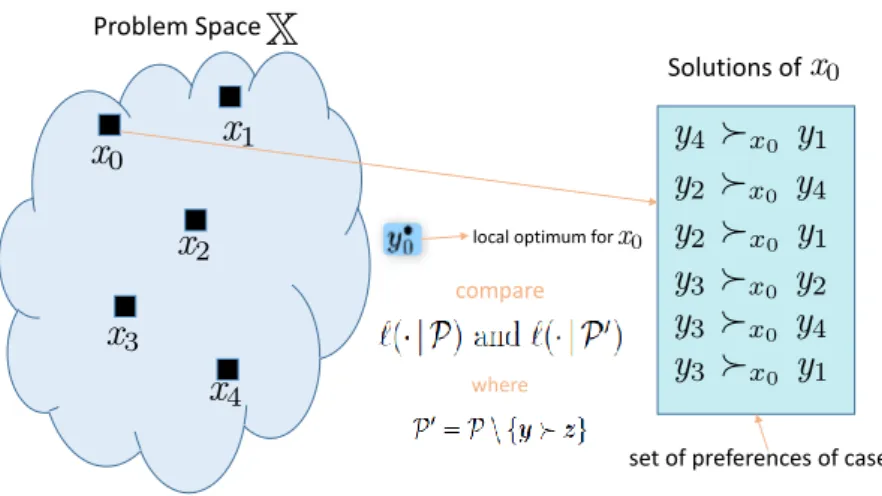
Preference-based CBR replaces experiences of the form “solution y (optimally) solves problemx” by weaker information of the form “yis better (more preferred) than
z as a solution for x”, that is, by a preference between two solutions contextualized by a problem x. More specifically, the basic “chunk of information” we consider is symbolized in the formyx z and suggests that, for the problem x, the solutionyis
supposedly at least as good asz.
This type of knowledge representation overcomes several problems of more common approaches to CBR. In particular, the representation of experience is less demanding: As soon as two candidate solutionsyand z have been tried as solutions for a problem
3. PREFERENCE-BASED CASE-BASED REASONING
Table 3.1: Notations notation meaning
X,x problem space, problem Y,y solution space, solution
CB case base (storing problems with preferences on solutions)
SX, ∆X similarity/distance measure on X
SY, ∆Y similarity/distance measure on Y
N(y) neighborhood of a solution y
yx z y is better (more preferred) thanz as a solution forx
P(Y) class of preference structures onY
P(x) set of (pairwise) preferences associated with a problem CBI case-based inference using ML estimation (see equation (3.5))
x, these two alternatives can be compared and, correspondingly, a strict preference in favor of one of them (or an indifference) can be expressed. To this end, it is neither required that one of these solutions is optimal, nor that their suitability is quantified in terms of a numerical utility.
Conventional CBR systems, as stated in [54], have been mainly designed as auto-mated problem solvers for producing a solution to a given problem by adapting the solution to a similarly solved problem. Such systems may have limited success in real-world applications for the following reasons:
• Existence of correct solutions: It assumes the existence of a “correct” solution for each problem, and implicitly even its uniqueness. This assumption is often not tenable. In the cooking domain, for example, there is definitely not a single “correct” recipe for a vegetarian pasta meal. Instead, there will be many possible alternatives, maybe more or less preferred by the user.
• Verification of optimality: Even if the existence of a single correct solution for each problem could be assured, it will generally be impossible to verify the optimality of the solution that has been produced by a CBR system. However, storing and later on reusing a suboptimal solution y as if it were optimal for a problem x
can be misleading. This problem is less critical, though does not dissolve, if only “acceptable” instead of optimal solutions are required.
3.2 Preference-based knowledge representation
• Loss of information: Storing only a single solution y for a problem x, even if it can be guaranteed to be optimal, may come along with a potential loss of information. In fact, during a problem solving episode, one typically tries or at least compares several candidate solutions, and even if these solutions are suboptimal, preferences between them may provide useful information.
• Limited guidance: From a reuse point of view, a retrieved case (x,y) only suggests a single solution, namely y, for a query problem x0. Thus, it does not imply a
possible course of action in the case where the suggestion fails: Ifyis not a good point of departure, for example since it cannot be adapted to solve x0, there is
no concrete recommendation on how to continue.
Due to these limitations, there has been a search for new paradigms for the utility of CBR systems for decision support [54]. Making further steps in avoiding such limi-tations, we take a first step toward developing a preference-based CBR framework. In our search-based problem solving framework we embed a case-based inference compo-nent, which is responsible for predicting a “contextualized” preference relation on the solution space [12]. More specifically, it consists of inferring preferences for candidate solutions in the context of a new problem, given knowledge about such preferences in similar situations. In our Pref-CBR framework, case-based problem solving is formal-ized as a search process, in which a solution space is traversed through the application of adaptation operators, and the choice of these operators is guided by case-based preferences.
In the following sections, there is a step by step description of the preference-based CBR framework.
3.2
Preference-based knowledge representation
In standard CBR, the experiences are stored in the form “solutiony(optimally) solves problem x”. In preference-based CBR these experiences are replaced by information of the form “y is better (more preferred) than z as a solution for x”. Accordingly, the structure of the experiences we work with is symbolized in the form y x z and suggests that, for the problem x, the solutiony is supposedly at least as good as z.