Learning visual attributes from contextual
explanations
by
Nils Ever Murrugarra Llerena
Msc, University of S˜
ao Paulo, 2011
Submitted to the Graduate Faculty of
the School of Computing and Information in partial fulfillment
of the requirements for the degree of
Doctor of Philosophy
University of Pittsburgh
2019
UNIVERSITY OF PITTSBURGH
SCHOOL OF COMPUTING AND INFORMATION
This dissertation was presented
by
Nils Ever Murrugarra Llerena
It was defended on
August 5, 2019
and approved by
Adriana Kovashka, PhD, Assistant Professor, Department of Computer Science
Rebecca Hwa, PhD, Associate Professor, Department of Computer Science
Milos Hauskrecht, PhD, Professor, Department of Computer Science
Daqing He, PhD, Professor, Department of Informatics and Networked Systems
Dissertation Director: Adriana Kovashka, PhD, Assistant Professor, Department of
Learning visual attributes from contextual explanations
Nils Ever Murrugarra Llerena, PhD
University of Pittsburgh, 2019
In computer vision, attributes are mid-level concepts shared across categories. They pro-vide a natural communication between humans and machines for image retrieval. They also provide detailed information about objects. Finally, attributes can describe properties of un-familiar objects. These are some appealing properties of attributes, but learning attributes is a challenging task. Since attributes are less well-defined, capturing them with compu-tational models poses a different set of challenges than capturing object categories does. There is a miscommunication of attributes between humans and machines, since machines may not understand what humans have in mind when referring to a particular attribute. Humans usually provide labels if an object or attribute is present or not without any ex-planation. However, attributes are more complex and may require explanations for a better understanding.
This Ph.D. thesis aims to tackle these challenges in learning automatic attribute predic-tive models. In particular, it focuses onenhancing attribute predictive power with contextual explanations. These explanations aim to enhance data quality with human knowledge, which can be expressed in the form of interactions and may be affected by our personality.
First, we emulate human learning skill to understand unfamiliar situations. Humans infer properties from what they already know (background knowledge). Hence, we study attribute learning in data-scarce and non-related domains emulating human understanding skills. We discover transferable knowledge to learn attributes from different domains.
Our previous project inspires us to request contextual explanations to improve attribute learning. Thus, we enhance attribute learning with context in the form of gaze, captioning, and sketches. Human gaze captures subconscious intuition and associates certain compo-nents to the meaning of an attribute. For example, gaze associates the tiptoe of a shoe to a pointy attribute. To complement this gaze representation, captioning follows conscious thinking with prior analysis. An annotator may analyze an image and may provide the
following description: “This shoe is pointy because its sharp form at the tiptoe”. Finally, in image search, sketches provide a holistic view of an image query, which complement specific details encapsulated via attribute comparisons. To conclude, our methods with contextual explanations outperform many baselines via quantitative and qualitative evaluation.
Table of Contents
Preface . . . ix
1.0 Introduction . . . 1
1.1 Discovering contextual explanations for attribute learning . . . 4
1.2 Requesting contextual explanations for attribute learning via human interac-tions . . . 6
1.2.1 Learning attributes from human gaze . . . 7
1.2.2 Cross-modality personalization for retrieval . . . 8
1.2.3 Image retrieval via reinforcement learning . . . 11
1.3 Projects contextualization . . . 13
1.4 Our contributions . . . 15
1.5 Organization . . . 16
2.0 Related work and background. . . 18
2.1 Attribute learning . . . 18
2.1.1 Multi-task learning approaches . . . 19
2.1.2 Localization-based approaches . . . 20 2.1.3 Subjectivity-based approaches . . . 21 2.1.4 Category-based approaches . . . 21 2.1.5 Context-based approaches . . . 22 2.1.6 Applications . . . 23 2.1.7 Our work . . . 24
2.2 Domain adaptation and transfer learning . . . 25
2.2.1 Transfer learning . . . 25
2.2.2 Transfer learning for attributes. . . 26
2.3 Localizing attributes, learning from humans and gaze . . . 26
2.3.1 Localizing attribute models . . . 27
2.3.3 Gaze and saliency . . . 28
2.4 Cross-modality personalization for retrieval . . . 28
2.4.1 Image captioning . . . 28
2.4.2 Gaze . . . 29
2.4.3 Relationship of captions and gaze . . . 29
2.4.4 Style vs content . . . 29
2.4.5 Privileged information . . . 30
2.5 Image retrieval, active learning, and reinforcement learning . . . 30
2.5.1 Attribute-based search. . . 30
2.5.2 Sketch-based search. . . 31
2.5.3 Interactive search. . . 32
2.5.4 Active learning. . . 32
2.5.5 Reinforcement learning . . . 32
3.0 Asking Friendly Strangers: Non-Semantic Attribute Transfer . . . 33
3.1 Approach . . . 34 3.1.1 Overview . . . 34 3.1.2 Network formulation . . . 36 3.1.3 Optimization . . . 37 3.1.4 Implementation . . . 38 3.2 Experimental validation . . . 38 3.2.1 Datasets . . . 39 3.2.2 Baselines . . . 39 3.2.3 Quantitative results . . . 41 3.2.4 Qualitative results . . . 42 3.3 Summary . . . 45
4.0 Learning Attributes from Human Gaze . . . 46
4.1 Approach . . . 47
4.1.1 Datasets . . . 47
4.1.2 Gaze data collection . . . 48
4.1.4 Learning attribute models using gaze templates . . . 50
4.1.5 Learning attribute models with gaze prediction . . . 51
4.2 Experimental validation . . . 53
4.2.1 Attribute prediction . . . 53
4.2.2 Adaptation for scene attributes . . . 59
4.2.3 Visualizing attribute models . . . 61
4.2.4 Using gaze to find schools of thought . . . 62
4.3 Summary . . . 63
5.0 Cross-modality personalization for retrieval . . . 65
5.1 Approach . . . 66
5.1.1 Dataset . . . 66
5.1.2 Tasks and embeddings . . . 70
5.1.3 Content Network . . . 70
5.1.4 Style Network . . . 72
5.1.5 Base network . . . 73
5.1.6 Combining base, content and style . . . 74
5.1.7 Joint embedding and privileged information . . . 74
5.1.8 Implementation details . . . 75
5.2 Experimental validation . . . 75
5.2.1 Setup and metrics . . . 75
5.2.2 Methods compared . . . 76
5.2.3 Benefit of combining content and style . . . 77
5.2.4 Joint modeling of all tasks . . . 78
5.2.5 In-depth look . . . 82
5.3 Summary . . . 85
6.0 Image retrieval with mixed initiative and multimodal feedback . . . 86
6.1 Approach . . . 86
6.1.1 Search setup and interactions . . . 87
6.1.2 Reinforcement learning representation . . . 88
6.2 Experimental validation . . . 92 6.2.1 Simulated experiments . . . 93 6.2.2 Live experiments . . . 94 6.2.3 Qualitative Results . . . 95 6.3 Summary . . . 98 7.0 Conclusions . . . 99 7.1 Main contributions . . . 100 7.2 Implications . . . 102 7.2.1 For researchers . . . 102
7.2.2 For designers of data collection interfaces . . . 104
7.3 Limitations . . . 105
7.4 Future work . . . 106
Preface
First of all, I would like to thank my advisor Professor Adriana Kovashka, who inspires and guides me along my Ph.D. journey. She helps me to unlock all my research potential via uncountable hours of discussion, insightful feedback for research and presentations, and a lot of passion and patience to pursue my projects. I feel grateful for believe in me, even in doubtful situations and provide me a spark of hope to be more perseverant.
I also like to thank my Ph.D. committee, Professors Rebecca Hwa, Milos Hauskrecht, and Daqing He. I appreciate their insights discussion, valuable feedback, and generous support to improve my research. I am grateful for their dedication and time in my thesis.
Besides my Ph.D. committee, I feel grateful to my labmates: Chris Thomas and Keren Ye. They always were willing to help with research and coding issues. They provide a friendly, intellectual and refreshing research environment. Also, I would like to thank my classmates at the computer science department, who promote pleasant times during my Ph.D. Specially, I would like to thank: Yuyu Zhou, Qin Guan, Gaurav Trivedi, Mao-Lin Li, Duncan Yung, Henrique Potter, Michael Cui, Angen Zheng, Jeongmin Lee, CharmGil Hong, Zhipen Luo, and Santiago Bock.
Besides Pitt community, I am grateful for internships at Education Testing Services (ETS) and ASEA Brown Bovery (ABB). I like to thank my mentors: Aoiffe Cahill, Mirrasoul Mousavi, and Mithun Acharya. They stretch my boundaries and extend my understanding of research in an industrial setting. I am grateful for all their insights in data collection strategies, which were crucial for this thesis.
Also, I would like to thank the Computer Science department at National University of Trujillo (UNT) and University of Sao Paulo (USP). First, I would like to thank my professors at UNT. Especially, I would like to thank Prof. Jose Saavedra, Violeta Chang, Ivan Sipiran and Jorge Guevara to spread their enthusiasm and curiosity in artificial intelligence. Also, I would like to thank Prof. Alneu de Andrade Lopes from USP to enhance my research skills and guide through my first serious research challenge: my master thesis.
my friends from Computer Science Students’ Society (SECC). They are always a source of inspiration in my life and one of the reasons to go abroad. I always remember our gatherings promoting computer science at our local University. I would like to thank specially to Marks Calderon, Clayder Gonzalez, David Wong, Fredy Carranza, Jorge Valverde, Pedro Shiguihara, Eduardo Rodriguez, Heider Sanchez, and Luis Lujan.
Also, I would like to thank my parents: Salomon and Genny; my brothers: Hans, Maisi and Jeffri; and my cousin Sandra for their love, sympathy, and support. They always inspire me to become a better person. I am grateful for their unconditional support in all projects in my life.
In addition to my family, I thank my friends in Pittsburgh. First, I thank Bazan family, who adopted me as an extra family member. Specially thanks to Cathy, Quique, Gaby, Claudia, Anton, Norma, Enrique, and Luis. Also, thanks to my friends: Lupita, Jorge, Ana Paula, Javier, and MariCarmen. All of them make my time at Pittsburgh pleasant and unforgettable. I really appreciate our board game gatherings.
Lastly, my whole appreciation goes to my girlfriend, Marleny. She always stays with me, even in hardest and unpredictable situations. She finds the correct words to support and encourage me to find a light of hope. She makes me happy when everything was going wrong. Without her support and love, I can not emotionally accomplish this Ph.D.
1.0 Introduction
In computer vision, attributes are mid-level concepts shared across categories. They provide a natural communication between humans and machines. For example, we can provide the query “I want a sky-blue and elegant shirt” to a search system. They also provide detailed information about objects. For example, let’s compare “cat” versus “a small domesticated animal with soft fur, and retractable claws”. The second statement provides much more detail about a cat. Finally, attributes can describe properties of unfamiliar objects. For example, if we know a horse and a cat, we can infer some properties of a zebra - even if we’ve never seen one. Zebra has four legs like a horse, and it has stripes as a cat.
These are some very appealing properties of attributes, but learning attributes is a chal-lenging task. They are not well-defined: they can have different interpretations for different people, as opposed to an object, where the meaning is more standard. To see why, consider the following thought experiment. If a person is asked to draw a “boot”, the drawings of different people will likely not differ very much. But if a person is asked to draw what the attributes “formal” or “feminine” mean, drawings will vary. Similarly, drawings of a “for-est” will likely all include a number of trees, but drawings of a “natural”, “open-area”, or “cluttered” scene will differ greatly among artists.
From the previous experiment, attributes are less well-defined than objects and may have different interpretations. There is a miscommunication of attributes between humans and machines, since machines may not understand what humans have in mind when referring to a particular attribute. Humans usually provide labels if an attribute is present or not without any explanation. However, attributes are more complex and may require explanations to understand them better.
This Ph.D. thesis aims to tackle these challenges in learning automatic attribute predic-tive models. Specifically, we investigate the following hypothesis:
Hypothesis. Algorithms learning from contextual explanations will learn to predict and use attributes more accurately, compared to algorithms that don’t use such explanations.
Contextual explanations are based on the context in which attributes occur and may clarify their meaning to facilitate accurate learning. For example, to categorize face images as happy or sad, brain imaging may show brain regions associated with positive and negative feelings. Similarly, brain waves may show opposite waves. These two forms of contextual explanations provide subconscious thinking to take a decision. We complement subconscious analysis with conscious thinking on visual cues via a selection interface. In this scenario, annotators draw a polygon around the lips region on a face to denote happiness or sadness. Also, contextual explanations can be complementary. Visual cues may be complemented by physical interactions. For example, to identify furry animals, we can observe the texture of their fur and also touch them.
From the vast options to encode contextual explanations through sensors or visual inter-faces, these contextual cues are also present in computer vision via saliency maps and gaze trackers. Saliency maps represent visual importance of a corresponding visual scene among its components (i.e. objects or parts) [62]. From our previous experiment, saliency maps can identify lips, teeth, and smiles as relevant parts highly correlated to identify happiness. Saliency maps also can encapsulate subconscious and conscious data. Saliency subconscious maps are acquired from a gaze tracker, while saliency conscious maps can be acquired from human interactions with a polygon drawing interface.
We discover and incorporate contextual explanations in recognition tasks. First, we emulate humans to understand unfamiliar situations. Humans try to infer properties from what they already know (background knowledge). In this setup, we represent unfamiliar situations via unrelated domains such as animal, scene, shoe, object, and texture. Also, we infer properties finding related attributes on unrelated domains. Given an attribute classifier, we aim to discover relevant components, that can be reused to learn other attributes. This finding inspires us to request contextual explanations via human rationale data to enhance attributes predictive power. We explore human rationales in the form of human gaze, text,
and sketches. Human gaze captures subconscious intuition of the meaning of an attribute. For example, it identifies a tiptoe of a shoe as the most important component for pointy shoes. In contrast, text follows a conscious thinking with prior analysis. Following our pointy example, an annotator analyze an image and produce the following description: “This shoe is pointy because of its sharp form at the tiptoe”. Finally, sketches encapsulate human rationale in a visual representation, which complements attributes representation. Sketches provide a holistic view of the query, in contrast to specific details encapsulated via attributes. Among these approaches, we incorporate contextual explanations for attribute learning via discovering relevant knowledge or requesting human intervention to enrich data, as shown in Figure 1.
Figure 1: Overview of the work in this thesis: enrich attributes with contextual explanations. We start from discovering explanations in traditional data (bottom left) to request contextual explanations by human enriched data (right). In traditional data, we enrich attributes by discovering contextual information (b). Then, attributes are enriched by requesting human rationale data in the form of: human gaze (c), gaze and text (d) and sketches (e).
Following our intuitive approaches for contextual explanations, we describe different ways to work with attributes. In the first category, we investigate how to improve attribute learning by discovering relevant components that are shared among different attributes. In the second category, we aim to enrich attributes by requesting human contextual expla-nations. First, we improve attribute learning with gaze. Then, we improve the ability to classify personality-related attributes by contextualizing these through the ways in which people describe or look images. And finally, we complement attribute descriptive power with human-generated sketches to improve image retrieval. These sketches encapsulate a holistic view of the image query and provide contextual explanation in the form of visual cues. These holistic visual cues complement attribute-based textual representations.
The remainder of this chapter is organized as follows. In sections 1.1 and 1.2, we briefly introduce our approaches to enrich attributes with contextual explanations and discuss our solutions. In section 1.3, we show how all the projects in this thesis relate to and complement each other. In section 1.4, we describe our contributions. Finally, we outline the organization of this thesis in section 1.5.
1.1 Discovering contextual explanations for attribute learning
Attributes can be learned in isolation or in a multi-task scenario. These approaches require huge amounts of data to succeed because they require many objects with the attribute present or not to capture its real meaning [36]. Also, most recent successful approaches are based on deep learning [39, 128], and they require lots of data [15]. However, what can we do in the case of data scarcity? A usual solution is to perform transfer learning.
Transfer learning aims to transfer knowledge from a source domain with huge data to a target domain with scarce data. Source and target domain must be related in some sense. For example, a computer can adapt a spam detector from one mailbox to another [61]. Also, a computer can learn a race car detector from a traditional car detector [147].
In attribute learning, traditional transfer approaches perform adaptation between at-tributes from the same domain [17, 89, 48]. We define a domain as a set of semantically
related categories. However, what could we do if in addition to the data scarcity, we do not have any data from semantic related categories? For example, let us imagine we have an entirely new domain of objects (e.g. deep sea animals) which is visually distinct from other objects we have previously encountered, and we have very sparse labeled data on that do-main. Let us assume we have plentiful data from unrelated domains, e.g. materials, clothing, and natural scenes. Can we still use that unrelated data?
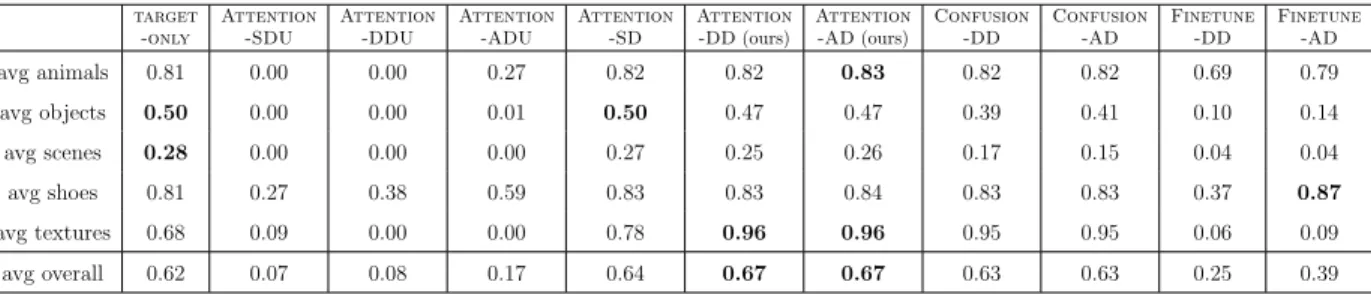
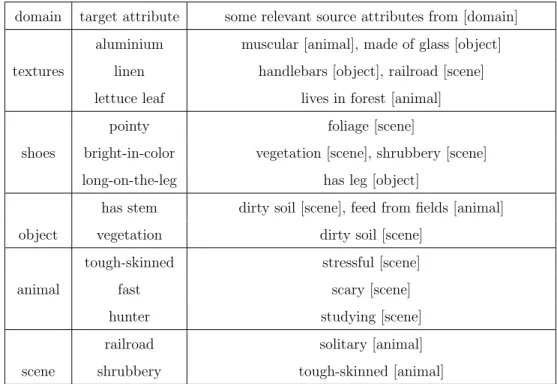
We examine how we can transfer knowledge from attribute classifiers on unrelated do-mains, as shown in Figure 2. For example, this transfer approach might mean we want to learn a model for the animal attribute “hooved” from the scene attribute “natural”, the tex-ture attribute “woolen”, etc. We define semantic transfer as learning a target attribute using the remaining attributes in that same data set as source models. This is the approach used in prior work [17, 89, 48]. In contrast, in non-semantic transfer (our proposed approach), we use source attributes from other datasets. We show that allowing transfer from diverse datasets allows computers to learn more accurate models, but only when we intelligently se-lect how to weigh the contribution of the source models. The intuition behind our approach is that the same visual patterns recur in different realms of the visual world, but language has evolved in such a way that they receive different names depending on which domain of objects they occur in.
Figure 2: We study transfer of knowledge among disjointed domains. Can shoe, object, scene, and texture attributes be beneficial for learning animal attributes, despite the lack of semantic relation between the categories and attributes?
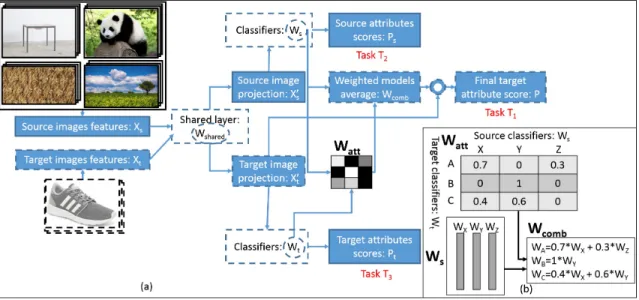
We propose an attention-guided transfer network. Briefly, our approach works as fol-lows. First, the network receives training images for attributes in both the source and target
domains. Second, it separately learns models for the attributes in each domain and then measures how related each target domain classifier is to the classifiers in the source domains via an attention mechanism. Finally, it uses these measures of similarity (relatedness) to compute a weighted combination of the source classifiers, which then becomes the new clas-sifier for the target attribute. Importantly, we show that when the source attributes come from a diverse set of domains, the gain we obtain from this transfer of knowledge is greater than if only the attributes from the same domain had been used.
Note that our current solution aims to discover and select the most relevant and shareable knowledge, similar to humans. The discovered rationale aims to define an attribute as the combination of others. Discovering meaningful transferable knowledge motivates us to request contextual explanations to improve attribute learning. Hence, in the next section, we explore attribute learning closely involving humans, to improve our data quality. One of these approaches also focuses on select relevant knowledge in the form of localization via human gaze data.
1.2 Requesting contextual explanations for attribute learning via human interactions
We present approaches that combine human intervention and contextual explanations to improve attribute learning. The first one focuses on attribute learning as a core task, and the remaining two on attribute learning as a side task for cross-modality retrieval and image search. Also, the first project enriches attributes via human gaze, and the last two enhance attribute representation with (gaze, text) and (sketches, user simulations), respec-tively. Human gaze captures subconscious intuition of the meaning of an attribute. In contrast, text follows a conscious thinking with prior analysis. Finally, sketches encapsulate human rationale in a visual representation, which complements attributes interaction.
1.2.1 Learning attributes from human gaze
In terms of attribute learning as a core task, which is similar to object recognition, we can learn attributes with a traditional machine learning pipeline. However, attributes are less-well defined and there exists a disconnect between humans and machines in how they perceive attributes, as we described in our previous section. Thus, the best way to narrow the discrepancy is by learning from humans what attributes really mean.
We propose to learn attribute models using human gaze maps that show which part of an image contains the attribute, as shown in Figure 3. To obtain gaze maps for each attribute, we conduct human subject experiments where we ask viewers to examine images of faces, shoes, and scenes, and determine if a given attribute is present in the image or not. We use an inexpensive GazePoint eye tracking device which is simply placed in front of a monitor to track viewers’ gaze and record the locations in the image that had some number of fixations. We aggregate the gaze collected from multiple people on training images, to obtain an averaged gaze map per attribute that we use to extract features from both train and test images. We also experiment with learning a saliency model that predicts which pixels will be fixated. To capture the potential ambiguity and visual variation within each attribute, we cluster the positive images per attribute and their corresponding gaze locations and obtain multiple gaze maps per attribute. We create one classifier per gaze map which only uses features from the region under nonzero gaze map values, for both training and testing.
The gaze maps that we learn from humans indicate the spatial support for an attribute
Figure 3: We learn the spatial support of attributes by asking humans to judge if an attribute is present in training images. We use this support to improve attribute prediction.
in an image and allow us to better understand what the attribute means. We use gaze maps to identify regions that should be used to train attribute models. We show this process achieves competitive attribute prediction accuracy compared to alternative ways to select relevant features. We also demonstrate additional applications showing how our method can be used to visualize attribute models, and how it can be employed to discover groups among users in terms of their understanding of attribute presence.
In this project, we study our sight sense in isolation as a contextual explanation. However, our perception through our senses is affected by our experience, personality, and bias. For example, “open-minded” people are more likely to combine visual elements and perceive them as a unified whole [5], disorganized people or ones with low self-confidence have a high tolerance of visual blur [164], and people who believe in paranormal events are more likely to perceive objects in images that only contain noise [109]. Hence, to learn gaze easily and more accurate, we learn gaze and personality jointly in our next project. Also, we enrich contextual explanations via text descriptions. Text encapsulates conscious thinking, complementary to gaze. These descriptions bridge the gap between gaze and personality and even enrich data by capturing the writing style of annotators.
1.2.2 Cross-modality personalization for retrieval
We extend our human gaze work for cross-modality personalized retrieval using gaze, captions, and personality questionnaires. Our goal is to find a shared embedding, where these paired data modalities are closed together. Hence, for example, we can retrieve the most probable caption given a gaze representation. Our gaze data collection does not use an eye-tracking device, which is not accessible for everybody and requires a meticulous calibra-tion. In order to solve these issues, our project employs arevealing mask web interface. This interface does not require any calibration and is widely accessible from any web browser. Hence, data can be collected at a higher scale with crowdsourcing. This interface shows a blurred image, and users click on it to reveal certain parts. Collecting data with this interface is positively correlated with data from eye-trackers [70]. In addition to gaze human enriched data, we collect image captions (writing style) and personality questionnaires. This project
uses attributes to represent personality, and as a side task to improve cross-modality person-alized retrieval. Also, gaze and writing styles capture indirectly different interpretation of personality traits (i.e. attributes). We find that personality traits complement and enhance gaze and image captioning learning, which reaffirms the fact that personality influences our perception.
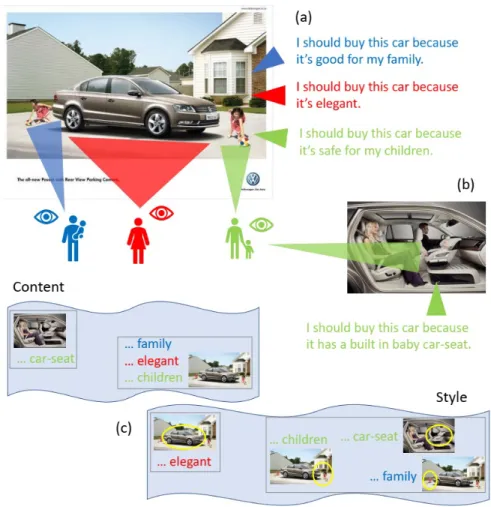
This variance in perception due to variance in personality is important to consider when predicting what meaning viewers will extract from imagery. It is especially important to model when predicting how humans will describe images that aim to impart opinions on the viewer in subtle ways. Prior work has examined the meaning that the average human extracts from images, by learning to predict what descriptive captions are appropriate for a given image. However, not all humans will describe the image in the same manner. Further, the way they describe it depends on how they look at it. We illustrate this in Fig. 4. When shown this car advertisement, an outgoing family man might first observe the children in front or behind the car, and interpret the message of the ad as emphasizing the safety features which are important for one’s family. On the other hand, an artistic single woman might first fixate on the visual elegance of the car. As a result, viewers might describe the image content in a different order, or even omit elements that are not interesting to them.
We study the relationship between personality, gaze and captioning. For example, we predicted how users will caption an image, conditioned on how they looked images or con-ditioned on their personality. Similarly, other queries are performed for the remaining com-binations of these data modalities. To do this, we learn a joint image-gaze-text-personality embedding space, in which we separately model content and style. We use these embeddings to retrieve content across modalities, in a pool of samples associated with different images and/or annotated by different users. For example, given how a person looked at an image, we learn to predict how that person might caption the image, in contrast to other users’ captions on the same or different images.
We collect a cross-modality per-annotator dataset capturing gaze, captions, and person-ality. Using this data, we find that when retrieving samples for each user across modalities, it is important to model the similarity in the annotations that the user provided. In contrast, methods that only capture similarities in content but not personal style, produce weaker
Figure 4: People with different personalities might perceive and describe the same image differently. A social, family person might observe the children, and an artistic person might perceive the elegance of the vehicle, in this car advertisement (a). Further, we expect there is consistency between how the same person observes and describes different images (b). To link content across modalities, but preserve differences between how different users might observe and caption the image, we combine both content and style constraints (c). The former encourages samples provided on the same image to be close in a learned space, while the latter encourages samples provided by the same user to be close.
retrieval results. We also compare to a recent personality-aware method which considers single words in the form of tags, and we achieve a stronger result.
1.2.3 Image retrieval via reinforcement learning
Until now, two projects have focused on attribute learning as a core task, and binary predictions and one uses attributes as a side task for cross-modality retrieval. This last project also uses attributes as a side task and combine them with visual data in the form of sketches. Attributes encapsulate rationales via comparison, and sketches encapsulate a visual reasoning via drawings. Specifically, relative attributes are helpful for image search refining [79, 134, 75, 179, 51, 114]. Attributes provide an excellent channel for communication because humans naturally explain the world to each other with adjective-driven descriptions. For example, [75] show how a user can perform rich relevance feedback by specifying how the attributes of a results image should change to better match the user’s target image. For example, the user might say “Show me people with longer hair than this one.” Another approach has been to engage the user in question-answering with questions that the system estimated are most useful [72, 37]. Thus, in prior work, the initiative for what guidance to give to the system has been taken by either the user [74, 75, 79, 134, 179] or system [37, 146, 72]but not both. Previous interactions use attributes, which are useful when concepts can be expressed in language, but some visual concepts are not nameable, so we rely on visual cues in the form of sketches [32, 180, 181, 123] to express them. The system can then retrieve visually similar results. Thus, the user can use either language or visuals to search, but it is not clear which modality is more informative.
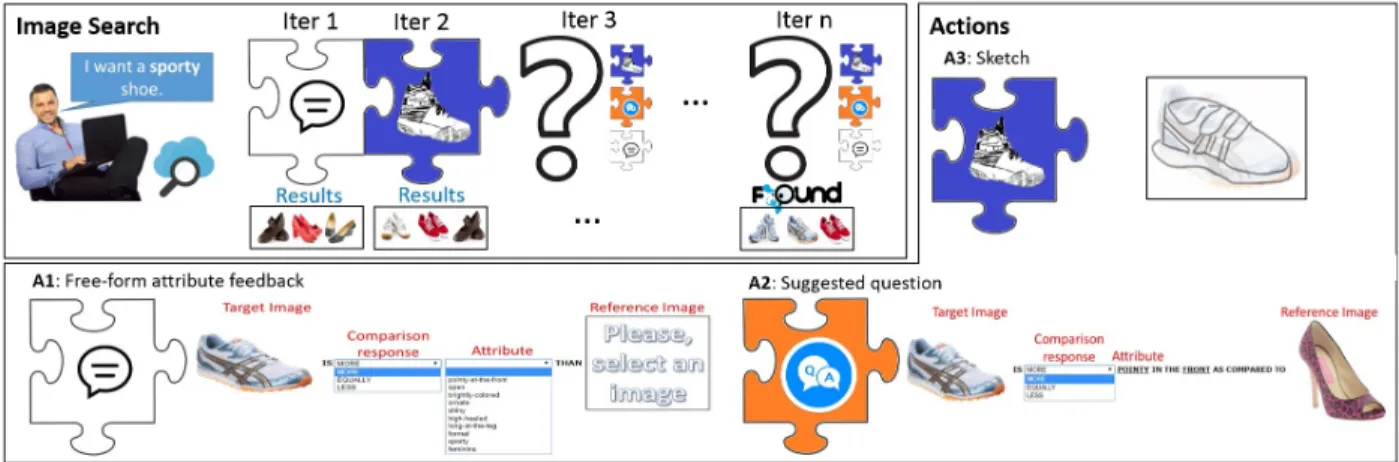
We propose a framework where either the user or system can drive the interaction, and the input modality can beeither textualor visual, depending on what seems most beneficial at any point in time. Since it is the system that must rank the results, we propose to leave the choice of what is most informative to the system. In other words, the system can decide to let the user lead and explore, if it cannot exploit any relevant information in a certain iteration. The system can request that the user provides multimodal feedback, i.e. textual or visual feedback. To make all these decisions, we train a reinforcement learning agent (see
Figure 5: We learn how to intelligently combine different forms of user feedback for interactive image search, and find the user’s desired content in fewer iterations. The image search section depicts our search agent that predicts an appropriate action at a certain iteration. For example, our agent selects free-form attribute feedback for iteration 1, and sketching for iteration 2. The actions section presents the three possible interactions (actions) of our agent.
Fig. 5).
In particular, the options that the reinforcement learning chooses between are (1) sketch feedback, (2) free-form attribute feedback, or (3) system-chosen attribute questions. At each iteration, the system adaptively chooses one of these interactions and asks the user to provide the corresponding type of feedback (e.g. it asks the user to choose an image and attribute to comment on).
Our agent optimizes both the informativeness and exploration capabilities allowing faster image retrieval. We find that our agent prefers human-initiated feedback in former iterations, and complements it with machine-based feedback (i.e. questions) in later iterations. We also outperform standard image retrieval approaches with simulated and real users.
Note that our solutions in this section employ contextual explanations in the form of human rationales. Our first solution improves attribute learning via human gaze maps with an eye-tracking device. Gaze captures subconscious intuition of the meaning of an attribute. Our second solution allows cross-modality retrieval from gaze, captions, and personality
questionnaires. Personality is embedded via attributes, and attributes are considered as a side task to improve gaze and caption retrieval. Gaze data was collected in a large scale setup via crowdsourcing and a revealing mask web interface, in contrast to restrictive eye-tracker devices. Contextual explanations are represented via gaze and captions. Captions capture personality information via writing style. Finally, our third solution considers attribute learning as a side task to improve image search. In this proposed solution, we request contextual explanations in the form of sketches and generate human data in the form of user responses. Sketches encapsulate human rationales via drawings, which complement attribute comparison rationale. We create simulated users from previous relative attribute annotations. In addition, our reinforcement agent constantly creates new data as it learns.
1.3 Projects contextualization
All our projects are linked by attribute learning and presented in Table 1. Two of them are centered on attribute learning as a core task, and they employ supervised learning. Also, they center on the problem of binary attribute learning. Our remaining projects complement the current ones using attributes as a side task and employ metric learning and crowdsourcing. Specifically, our image retrieval project uses relative attribute learning and reinforcement learning.
In relation to machine learning paradigms, two of our projects incorporate transfer learn-ing. One is used for attribute transfer learning, and the other to identify different attribute interpretations using gaze. The latter adapts a generic attribute classifier to group-specific at-tribute interpretations. Also, ournon-semantic attribute transfer learningandcross-modality personalization for retrieval employ multi-task learning. One learns attributes jointly, and the other learns different embedding tasks at the same time. Also, our image retrieval and cross-modality personalization projects benefits from metric learning. The former uses it to retrieve images from sketches, and the latter to find common embeddings between gaze, cap-tions, and personality. Finally, in relation to selection methods, our non-semantic attribute transfer learning aims to select source models using an attention mechanism. Similarly, our
projects using gaze (P2 and P3) select image subregions.
In relation to data, three of our projects focus on enriched human data (i.e. gaze, writing style, sketches, and/or user simulations). Two projects focus on human sense data. We learn attributes from gaze (sight). Also, the last two projects use crowdsourcing, one to evaluate our system lively with real users, and the other for data collection.
Among these projects, we have explored different challenges such as:
1. How do we integrate human data properly to improve attribute learning? a. How to properly collect rationale data?
b. How to properly represent rationale data?
2. How do we select relevant information in an effective and efficient way? 3. How do we combine different sources of knowledge effectively?
4. How to retrieve data effectively?
5. How to improve subjectivity-aware methods?
The first challenge was studied in three of our projects, and they were inspired by our project innon-semantic attribute learning. We ensure data quality via robust data collection interfaces. These interfaces are robust for device miscalibration and lack of participants concentration. We tackle these issues with validation images, which measures if our data is properly collected. Then, we find effective rationale data representations via spatial data
Table 1: Comparison table among all projects in this thesis.
Core task Binary attribute learning Super-vised learning Side task Relative attribute learning Reinforce-ment learning Transfer learning Multi-task learning Selection methods Human enriched data Human sense data Metric learning Crowd-sourcing P1: Non-semantic attribute learning X X X X X X P2: Learning attributes from gaze
X X X X X X X P3: Cross-modality personalization for retrieval X X X X X X X P4: Image retrieval with mixed initiative
and multimodal feedback
and textual data, which are easy to incorporate in our learning framework. First, spatial data represent gaze saliency maps, which captures subconscious reasoning and encapsulates image query understanding via sketches. Second, textual data capture conscious reasoning in the form of a textual message.
Then, we tackle the second challenge using gaze and an attention mechanism. Gaze follows a human-engineered approach via eye-tracker outperforming gaze-based and data-driven selection methods. In contrast, attention follows a data-data-driven approach to denote a target attribute as the combination of attributes from unrelated domains.
For our next challenge, we combine effectively different data sources via transfer learning and reinforcement learning. Transfer learning uses an attention mechanism to combine unrelated attributes, while a reinforcement agent combines different actions via a reward function to perform accurate and faster image retrieval. Our transfer learning project encodes a target attribute as a combination of relevant attributes from unrelated domains. Similarly, our reinforcement agent predicts an image retrieval action at an iteration. These actions are combined iteratively among all iterations.
Then, we retrieve data effectively via metric learning and reinforcement learning. Metric learning directly learns a ranking function combining content and style constraints among three different data modalities: gaze, text, and personality. While a reinforcement agent learns a reward function to select an action in a certain iteration and refine an image retrieval ranking function combining textual and visual feedback.
Finally, we improve subjectivity-aware methods adding explainability in the form of gaze, and learning personalized perception combining gaze, writing style, and personality traits. Our former method employs matrix factorization on gaze data in contrast to simple attribute presence annotations. Our later method finds that personality affects gaze and writing style, and learning these three modalities jointly is beneficial.
1.4 Our contributions
• Discovery of transferable rationale human knowledge components for attribute learning
– We present a novel attention-guided transfer network to improve attribute learning in scarce and unrelated domains.
– We show a study of transferability of attributes across semantic boundaries.
• Effective human intervention via contextual explanations in attribute learning for recog-nition and information retrieval
– We present a novel method for learning attribute models, using inexpensive but rich data in the form of gaze.
– We show two applications of how gaze can be used to visualize attribute models, and how it is useful to discover groups of users in terms of their interpretations of attributes.
– We study the relationship between personality, gaze, and captions allowing cross-modality retrieval.
– We find that learning about gaze, captions, and personality in the same framework is beneficial than learning them in isolation. Hence, these three modalities provide complementary sources of knowledge.
– We present a faster mixed-initiative image search retrieval system combining attribute-based methods with sketch retrieval. Both the user and the system are active par-ticipants depending on who can provide high-quality search results.
– We show a study of human-initiated and system-initiated actions in image retrieval.
1.5 Organization
This thesis is organized as follows. Chapter 2 reviews existing solutions for attribute learning, and how our projects solve some of its limitations. It also reviews related work for each of our projects. Chapter 3 shows our current solution to discover meaningful and shareable knowledge with traditional data in a scarcity of data of related attributes. We enrich this representation in chapter 4 using gaze as a meaningful representation. We also complement gaze representation with captions (writing style) and personality questionnaires
in chapter 5. Then, chapter 6 investigates how to improve image retrieval using reinforcement learning. Finally, we conclude and present ideas to extend this thesis in Chapter 7.
2.0 Related work and background
In this chapter, we review challenges and different approaches to learn attributes. In section 2.1.7, we also show how we tackle some of these challenges, and how we contribute to them. We also review the most relevant topics for our projects in this thesis. In Section 2.2, we review related topics for our project innon-semantic attribute transfer that involves transfer learning, and how to use it for attributes. In section 2.3, our project of learning attributes from human gaze reviews attribute localization, learning from humans, and human gaze. In Section 2.4, our projectcross-modality personalization for retrieval examines image captioning, relationship of gaze and captions, privileged information and style vs content approaches. Finally, in Section 2.5, our project of image retrieval with mixed initiative and multimodal feedback reviews image retrieval from attribute-based methods to sketch-based ones, active learning and reinforcement learning.
2.1 Attribute learning
Semantic visual attributes are properties of the visual world, akin to adjectives [81, 36, 10, 110]. Attributes bring recognition closer to human-like intelligence, since they allow generalization in the form of zero-shot learning, i.e. learning to recognize previously unseen categories using a textual attribute-based description and prediction models for these at-tributes learned on other categories [81, 36, 107, 59, 2]. Atat-tributes have also been shown useful for actively learning object categories [108], scene recognition [110], and action recog-nition [88]. Attributes are also useful for interactively recognize fine-grained object categories [10, 158], and learn to retrieve images from precise human feedback [79, 75].
Previous works deal with attributes in different situations. Many of these situations have associated challenges, such as:
• Is the attribute vocabulary expressive enough? In order to learn attributes, we define a subset of them in a specific domain. All these attributes are expressive enough to
describe all objects in our data. This is especially important in interactive systems [79, 75, 10, 158], where the user provide feedback with attributes. Attributes should allow an effective communication to the search user. Users should not be frustrated interacting with the system.
• How to learn attributes efficiently and confidently? Attributes can be grouped into many categories such as color, shape, texture, parts, and others. Which feature extractor should we use? Should one extractor be used per category? Should we focus on global or local descriptors? In relation to efficiency, should we learn all attributes together or should we learn separately? If we learn them together, some correlations can damage the true meaning of the attribute. For example, made of metal can be correlated withhas a wheel attribute, and our attribute predictor can fail for a wooden wheel. These are some of the questions that we need to address depending on our problem setup.
• Attribute accuracy is even more important for attribute applications, where attributes are used as a supportive tool for a more complex task, such as image retrieval or fine-grained object recognition. If we can not trust our attribute models, the applications results are not reliable.
• Do people mostly agree in identifying attributes? Unlike objects, attributes are subjective and human-dependent. For example, if a group of people draws a boot. Most of the drawings are very similar. However, if we ask them to draw a formal shoe. These drawings will have much more variation (subjectivity).
In this chapter, we review attribute learning, and how they deal with these challenges. We assume a fixed attribute vocabulary A= {am}, m∈ {1, ..., M}, whereM is the number of
attributes, and am is a function that determines if attribute m is present or not.
2.1.1 Multi-task learning approaches
Given that we have a set of attributes associated with an image, it is natural to learn them jointly. [128] employ multi-task learning to learn attributes for crowd scene understanding in videos. Their approach considers a deep network with an appearance and movement branches. Similarly, [39] also employs multi-task learning to recognize 3D shape attributes,
however, the authors consider a ∅ label when they do not have an annotation. Also, they
use an embedding loss to ensure that images of the same object are kept together in the feature space. Regularized hypergraphs [52] are also useful for joint learning. Hypergraphs represent instances and can capture correlations of multiple relations (i.e. attributes).
These approaches aim to find correlations among the presence of the attributes. For ex-ample, “made of metal” and “has wheels” can be highly correlated. However, these methods can fail to capture the real meaning of “has wheels”, and they do not recognize an object with a wooden wheel. [59] propose to decorrelate attributes using attribute grouping infor-mation (e.g. shape, color, texture, parts). They promote feature sharing among attributes from the same group, and feature competition across different groups.
2.1.2 Localization-based approaches
Other approaches claim that localization is a key step for attribute learning. [90] learn face attributes on the web employing a neural network for feature extraction, and linear SVMs for attribute predictions. Their architecture is composed of two localization components and an identity classifier. This classifier receives two images and determines if they belong to the same person. The localization components take care of localizing shoulders and face. Also, [66] learn facial attributes in conjunction with semantic segmentation, because many facial attributes describe local properties. Similarly, [7] employs poselets to localize body parts, and learn attributes.
In the relative attributes’ domain, [166] discover visual concepts that characterize an attribute, in a sequence of relative attribute comparisons. They generate visual chains among these comparisons, and select the most representative region using a ranking SVM. The drawbacks of this approach are that it is time-consuming, and that each step is done in isolation. Hence, optimal solutions are produced for individual steps, but an optimal solution is not produced for the whole problem. [136] tackle these problems using a siamese neural network with a localization and ranking network. The authors employ a localization network to transform the original image into a relevant subregion through translation and scaling operations. Then, image comparisons are learned through a ranking network.
These methods have the limitation that works properly for well-localized attributes. However, they do not provide any benefit for global attributes. For example, they work very well for parts-based attributes. However, they do not provide much benefit for texture and shape attributes, where the attribute lives on most of the whole image. Also, these methods do not consider different attributes interpretation, where attributes can be localized in different regions for each interpretation. In relation to faces, attractiveness is subjective. While some people only consider the eyes, others look for symmetries in the face. Also, these interpretations differ from localized features (i.e. eyes) to holistic ones (i.e. face).
2.1.3 Subjectivity-based approaches
Previous work assumes that there exists only one true annotation per attribute on an image. However, attributes are subjective and are interpreted differently by each user. [71] learn personalized attribute models to account for this issue. First, they learn a generic attribute classifier. Then, they adapt it to specific user annotations. In the same line of thought, [73] claim that user can be grouped in terms of how they interpret an attribute. In other words, users can be grouped in terms of how they respond to questions about the presence or absence of attributes, and how they use the attribute name. Then, a generic classifier is adapted for each group.
Previous approaches only consider one root model (generic classifier). However, this root model can not fit properly to all specific user needs. [80] learn an ensemble of multiple models. These root models are diverse, and are selected to best fit user personalized attributes.
All these approaches show a limited way of communication to learn user knowledge. They only require “what” attributes are in the image, and do not provide any explanation of “why” they are present. Thus, we should involve humans more closely in the learning process.
2.1.4 Category-based approaches
These approaches use information of categories (e.g objects) to improve attribute learn-ing. Attributes are shared among different categories. [81, 82] combines category-specific
features to learn attribute presence. For example, zebras, tigers, and bees are useful for the stripped attribute. [161] go a step further, and identify dependent and category-independent attribute relations. This knowledge is helpful for attribute and object learning. [52] model category and attribute data using a hyper-regularized graph. Hypergraphs rep-resent instances and capture multiple relations (i.e. attributes). They aim to find a cut in the graph that minimizes the attribute prediction loss, and preserves the clustering in the data (i.e. categories).
Other approaches find an intermediate useful representation. [84] learn attribute models finding latent spaces. Their optimization objective is composed of an object category loss and a multi-task attribute loss. Also, [40] use category labels to create category-invariant features. These invariant features are natural for attributes due to their universality among different categories.
In a transfer learning setup, [17] create an attribute-category table, and infers attribute classifiers for unseen (attribute, category) pairs. They employ tensor completion techniques and category-specific attribute classifiers.
All these works are limited to provided attributes and categories. These data are usually provided by domain experts. However, are they expressive enough? do they cover most prop-erties shared across categories? These questions are answered using a data-driven attribute vocabulary approach. For example, [3] aims to find automatically attribute vocabulary and their associations to categories from large-scale data. They aim to find numerous distinctive attributes shared across categories.
2.1.5 Context-based approaches
Previous section approaches are limited to attributes related to categories. We also can recover valuable knowledge from context [159, 44, 83, 160]. For example, most people wear formal suits in a funeral.
Contextual knowledge is useful for action recognition and attribute prediction [44]. The authors extend fast-RCNN [43] to find a secondary region, that encapsulates contextual data. Having a bigger bounding box as contextual data is restrictive and disorganized.
Thus, [83] use semantic organized context from human parts and the entire image. They employ the input image in conjunction with regions containing humans, human-parts regions, nearest human-parts, and the whole image in a neural network. In the same line of thought, [160] consider the context for pedestrian attribute recognition. Context is represented as a sequential set of sub images from top to bottom, and inter-person similarity, that consider visual similar images. These components are fed in a joint recurrent learning for attribute prediction. Also, [159] claim that location and weather are contextual information for facial attributes. They collect egocentric videos with location and weather labels.
Context is not restricted to knowledge in the same image. We can borrow meaningful knowledge from attributes in the same domain [17, 48, 89]. [17] use tensor factorization to transfer object-specific attribute classifiers to unseen object-attribute pairs. [48] learn a common feature space through maximum mean discrepancy and multiple kernels. [89] select features from the source and target domains, and transfer knowledge using Adaptive SVM [173] in a lower-dimensional space.
These approaches use complementary and related information in the form of context background and attributes from the same domain. However, they may not be applicable when this information is not available (i.e. images do not present a context background or there are not attributes in the same domain).
2.1.6 Applications
So far, we saw different ways to learn attributes. However, they are also helpful for more complicated tasks such as clothing style recognition [18], image captioning [162, 85], object retrieval [87], video annotation [104], and subjective tasks (i.e. aesthetics [27] and memorability [55, 69]). For example, [18] recognize clothing styles using attributes. They categorize clothing styles from famous people, and event-based clothing styles (e.g. weddings and basketball games). Also, [27] find the most aesthetically beautiful pictures from a search query or a photo album. They employ content, compositional and illumination attributes to recognize aesthetics in pictures. [55] help designers to create more effective memorable visual media. The authors identify the most relevant attributes in memorability. [69] extend
the previous study for a large scale setting. They study if popularity, saliency, emotional and aesthetically attributes influences memorability.
Previous applications are appropriate for binary attributes. However, relative attributes can be used to provide useful feedback for image retrieval. [75, 72] ask feedback to the user via relative attribute comparisons. [75] receive feedback in the form “I am looking for a shoe that is more sporty and less pointy than this shoe”. In this setting, the user selects the reference image and the comparison attribute. On the other hand, [72] suggest these data and the user only need to answer with more, less or equal. Finally, [96] extend this approach incorporating confidence and diversity of attribute models to refine the retrieval.
2.1.7 Our work
In this work, we face some of the attribute learning challenges. Our projects focus on learning attributes more confidently using contextual explanations. Two projects enrich data explaining “why” an attribute is present, and three projects use contextual data in the form of non-semantic attributes, gaze, captions, and sketches. Also, one project explores different interpretations of an attribute using gaze. Finally, we deal with attribute learning as a side task for data retrieval tasks. One uses attributes as a complementary task for cross-modal retrieval and the other deals with attribute accuracy for image retrieval. We show the benefits of these projects as follows.
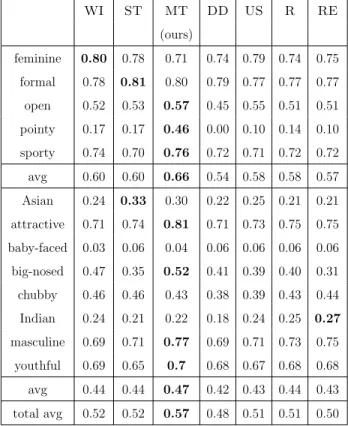
• First, we cope with the lack of explanation in subjectivity-based approaches via enriched data. We use gaze as a source of explanation and bring closer human-computer com-munication. We also incorporate gaze in [73], and show that gaze is more useful than plain attribute annotations. Also, this approach has time-efficient results comparable to data-driven approaches [166]. We also indirectly study writing styles in combination with gaze to capture different interpretation of personality traits via attributes.
• Second, we complement context-based approaches. Our non-semantic project shows that unrelated domains have valuable knowledge to improve attribute learning when there is no context background or semantically related attributes. Also, our cross-modality project learns together gaze, captions and personality attributes; which are contextual
data sources. Finally, we complement attribute-based image retrieval approaches with sketch-based ones via reinforcement learning. Sketches provide a visual context for at-tribute textual feedback.
• Third, in the applications domain, we developed two projects for data retrieval using at-tributes. The former performs cross-modality data retrieval using personality attributes as a side task via metric learning. Then, the later combines attribute-based [75, 72] and sketch-based [180] image retrieval approaches via reinforcement learning. These approaches complement each other, and they are beneficial in different retrieval stages.
Overall these projects, we focus on enhancing data representation for attribute learn-ing with human knowledge and contextual explanations in the form of related/selected at-tributes, gaze, captions, and sketches.
2.2 Domain adaptation and transfer learning
In order to learn knowledge from non context-based domains, we review topics on transfer learning, and specifically how transfer learning is done for attributes. This related work is relevant for our project on non-semantic attribute transfer learning.
2.2.1 Transfer learning
Many researchers perform transfer learning via an invariant feature representation [40, 46], e.g. by ensuring a network cannot distinguish between two domains in the learned feature space [148, 41, 91], training a network that can reconstruct the target domain [42, 67, 9], through layer alignment [20] or shared layers that bridge different data modalities [14]. Other methods [173] perform transfer learning via parameter transfer where the source classifiers regularize the target one. [145] employ an adaptive least-squares SVM to transfer model parameters from source classifiers to a target domain.
2.2.2 Transfer learning for attributes.
We review some transfer learning methods for attributes in attribute learning for context-based approaches. A modern way of transfer learning is zero-shot learning, which aims to transfer knowledge for unseen categories.
Some recent zero-shot learning work [16, 165, 182] learns an underlying embedding space from the seen classes and some auxiliary information (e.g. text), and then queries this embedding with a sample belonging to a new unseen class, in order to make a prediction. For example, [165] use attributes and text as a class embedding. They also use a non-linear latent embedding to compute projections of image or text features, which are then merged through a Mahalanobis distance. A scoring function is learned which determines if the source domain (class descriptions) and the target domain (test image) belong to the same class.
Similarly, [16] find an intermediate representation for text and images with dictionary learning. [182] use a topic-modeling-based generative model as an intermediate representa-tion. Usually, zero-shot learning is performed to make predictions about object categories, but it can analogously be used to predict a novel target attribute, from a set of known source attributes.
However, prior work only considers objects and attributes from the same domain. Our transfer learning project differs in that we study if transferability of unrelated attributes (from different domains) is more beneficial.
2.3 Localizing attributes, learning from humans and gaze
In order to understand and improve learning, we aim to improve the communication between humans and machines. Thus, we review topics on how to select relevant regions with humans, how to localize attributes, and human gaze. These topics are relevant to our project inlearning attributes from human gaze.
2.3.1 Localizing attribute models
In the domain of relative attributes [107], which we do not study, [122] discover parts that improve relative attribute prediction accuracy. It is unclear whether the discovered parts capture the true meaning of attributes as humans perceive them, or simply exploit image features which are correlated [59] with the attribute of interest, but are not part of the human perception of the attribute.1 In recent work, [166] propose to discover the spatial extent of relative attributes, as we discussed previously. While we model attributes as binary properties (in contrast to [166]), and use human insight to learn where an attribute lives, [166] is the most related work to ours so we compare to it in Section 4.2.
Other recent work applies deep neural networks to predict attributes [127, 128, 33, 159, 39]. While deep nets can improve the discriminative power of attribute models, they do not exploit human supervision on the meaning or spatial support of attributes. Thus, progress in deep nets is orthogonal to the objective of our study. We show that even when deep fea-tures are employed, using gaze maps to determine the spatial support of attributes improves performance.
2.3.2 Using humans to select relevant regions
[156] pair two humans in an image-based guessing game, where the goal is for the first person to reveal such image regions that allow the second person to most quickly guess the category of the image. The revealed regions are then assumed to be the most relevant for the category of interest. [25, 26] propose a single-player guessing game called “Bubbles,” where the player must reveal as few circular regions of an image as possible, in order to match that image to one of two categories with several examples shown. There are three important differences between our work and [156, 25, 26]: (1) These approaches are used to learn objects, not attributes, and attributes have much more ambiguous spatial support; (2) They require that a human should click on a relevant image region, which means that the user is consciously aware of what the relevant regions are, whereas in our approach a human uses her potentially subconscious intuition about what makes an image “natural”, “formal”,
or “chubby”; and (3) Clicking or drawing requires a bit more effort (looking is easier than moving one’s hand to use the mouse).
Our method can be seen as a form of annotator rationales [185, 28], which are annotations that humans provide to teach the classifier why a category is present. For example, the user can mark which regions of the face make a person “attractive”. However, providing gaze maps by looking is much faster than drawing rationales (see Section 4.1.2).
2.3.3 Gaze and saliency
[106] use human gaze to reduce the effort required in obtaining data for object detectors. They build bounding boxes from locations in a photo where a user fixates when judging which of two categories is portrayed in the image. [184] argue that using gaze can improve object detection—bounding box predictions that do not align with fixations can be pruned. They also use a gaze-based feature to classify detections into true and false positives, but only show small gains in detection accuracy.
In addition to gaze, saliency examines where a viewer will fixate in an image [57, 117, 101, 50, 63, 45, 62, 53]. We use [63]’s method to predict gaze maps for novel images. No prior work uses gaze to learn attribute models.
2.4 Cross-modality personalization for retrieval
In order to use attributes (personality) for gaze and caption retrieval, we review topics involving image captioning and gaze. We also focus on style and content approaches, as they are a key component of our approach. Finally, we review privileged information as we are learning different data modalities at the same time.
2.4.1 Image captioning
There is a large body of work [4, 118, 153, 178, 155, 68, 29] on automatic image cap-tioning, or predicting a description for a given visual. Common approaches include learning
a joint image-text embedding using triplet loss or by maximizing the correlation of the two modalities [34, 31]; training a recurrent network that predicts a sequence of words condi-tioned on the image and outputs at previous timesteps [155, 68, 29]; learning a template description and how to fill each position of the template with a word [93]; generative adver-sarial approaches [24]; etc.
Most captioning approaches assume all users would caption an image in the same way. In contrast, [22] learn individual differences in how an annotator describes an image, and [152] learn the types of hashtags a user might provide. However, none of these consider two manifestations or channels of personality as we do (i.e. gaze and captions). We show that having information from multiple modalities at training time allows us to better understand user differences.
2.4.2 Gaze
Saliency prediction work [57, 63, 62, 100] models what humans find fixate on in an image. Prior work has examined the relationship between sentiment and gaze [35] and the differences between viewers in how they look at an image [172], but none has examined the relationship between personalized perception and personalized meaning.
2.4.3 Relationship of captions and gaze
A few authors have examined the relationship between captions and attention. For example, [183, 142, 171, 92] predict captions conditioned on an attention map (learned from human gaze or discovered from a classification loss). However, these do not consider personalized captioning or gaze as we do.
2.4.4 Style vs content
In our work, we aim to separate similarities arising due to content (i.e. image and corre-sponding text should be close in our learned space) and similarities due to style (annotations produced by the same viewer should be close by). Prior work exists that separates
con-tent and style for different tasks. [186] separate concon-tent and style for handwritten Chinese characters, by training separate networks for each, and [143] use a model linear in both the content (character ID) and handwriting style. [46, 148, 41, 42, 91, 8] learn domain-invariant representations for object recognition, where objects are the “content” and modalities (e.g. paintings, sketches) are the “style”. We havemultiple content modalities, and multiple styles (one per user). Also relevant is [72] which train per-user attribute models, but this work only considers one modality.
2.4.5 Privileged information
Our approach utilizes a type of “privileged” feature information, which is available at training time only. Such information is useful to learn the structure of the space, and then utilize it at test time with only a subset of the input types. Prior work includes [150, 130, 131, 49, 97, 6]. For example, [130] use privileged information to learn which samples are easy to learn from, and [6] regularize the parameters of one network with another learned from privileged data. In contrast, we use privileged information for caption retrieval.
2.5 Image retrieval, active learning, and reinforcement learning
In order to combine different attribute-based image retrieval techniques with visual ap-proaches, we review topics in image retrieval, active learning and reinforcement learning. Image retrieval focuses on topics about attribute-based search, sketch-based search, and in-teractive image retrieval. These topics are relevant to our project in image retrieval with mixed initiative and multimodal feedback.
2.5.1 Attribute-based search.
Prior work has explored the value of the fine-grained detail that attribute descriptions provide, by using attributes to initiate a search [134, 151] or provide iterative feedback on the results of a search system [75, 72, 96]. [74] browses the current search results, and can then
provide a feedback statement of the form “The image I am looking for is more/less [attribute] than [this image in the results].” The choice of an attribute on which to comment is left to the user. This is helpful if the user is perceptive, or there are images which obviously differ from the user’s desired content for particular attributes. On the other hand, browsing a set of images and choosing attributes is time-consuming for the user, as we find in experiments. [72] shows that given a limited budget of interactions that the user is willing to perform, more accurate search results can be achieved if the system asks the user questions of the form “Is the image you are looking for more/less/equally [attribute] than [this image]?” The chosen questions are those with high information gain. The disadvantage of [72] is that it limits the ability of the user to browse and explore the dataset space.
2.5.2 Sketch-based search.
While attribute-based feedback is appropriate when the user can concisely describe what content they wish to find using words, some searches involve concepts which are purely visual. In our setting, we assume the user does not have a photograph of what they wish to find, so cannot directly do a similarity-based search with a query image. However, the user does have a clear visual idea of what content they wish to find. Sketch-based search approaches allow the user to convey this visual idea to the system, via a sketch or drawing, which provides a complementary way of communication. The system can then extract features from this sketch and compare to the features of the images in a database [32, 133, 180, 123, 181].
We use a similar approach, but also propose to convert the sketch to an image using generative models. Other authors use generative learning to find a representation appropriate for cross-domain (sketch-to-image [105, 138, 137] or text-to-image [138]) search. We use sketch-based retrieval in a larger reinforcement learning framework that chooses which search interaction to propose (sketch, attribute-based feedback, or question-answering). Note that our focus is not in how we perform sketch-based retrieval, but ratherhow to decide when to request a sketch.