*.,/'ŗ(-#(!ŗ ),ŗ
)!(#.#0ŗ#)-Ćŗ
&!),#."'-ąŗ, ),'(ąŗ
(ŗ#'#..#)(-ŗ
4
B
D
I
J
O$
I
B
VE
I
B
S
J
%0$503"- %*44&35"5*0/49HSTF
MG*aei
dbe+
*4#/ *4#/QEG *44/- *44/ *44/QEG "BMUP6OJWFSTJUZ 4DIPPMPG&MFDUSJDBM&OHJOFFSJOH %FQBSUNFOUPG4JHOBM1SPDFTTJOHBOE"DPVTUJDT XXXBBMUPGJ #64*/&44 &$0/0.: "35 %&4*(/ "3$)*5&$563& 4$*&/$& 5&$)/0-0(: $304407&3 %0$503"- " BMU P % % " #( ŗ " / " ,#ŗ * .,/ ' ŗ ( -#( !ŗ ), ŗ )! (#. #0 ŗ #) -Ćŗ &!) ,#. "' -ąŗ , ), ' ( ąŗ ( ŗ #' #. .#) (-ŗ " BMU P 6 O JW F ST JUZDOCTORAL DISSERTATIONS 135/2012
Spectrum Sensing for Cognitive
Radios: Algorithms, Performance,
and Limitations
Sachin Chaudhari
A doctoral dissertation completed for the degree of Doctor of Science (Technology) to be defended, with the permission of the Aalto University School of Electrical Engineering, at a public examination held at the lecture hall S3 of the school on the 23rd of November 2012 at 12 noon.
Aalto University
Academy Prof. Visa Koivunen
Thesis advisor
Academy Prof. Visa Koivunen
Preliminary examiners
Dr. Ananthram Swami, Army Research Laboratory, MD, USA Prof. Sergio Barbarossa, University of Rome 'La Sapienza', Italy
Opponents
Dr. Ananthram Swami, Army Research Laboratory, MD, USA Prof. Marco Lops, University of Cassino, Italy
Aalto University publication series
DOCTORAL DISSERTATIONS 135/2012 © Sachin Chaudhari ISBN 978-952-60-4831-4 (printed) ISBN 978-952-60-4832-1 (pdf) ISSN-L 1799-4934 ISSN 1799-4934 (printed) ISSN 1799-4942 (pdf) http://urn.fi/URN:ISBN:978-952-60-4832-1 Unigrafia Oy Helsinki 2012
Aalto University, P.O. Box 11000, FI-00076 Aalto www.aalto.fi
Author
Sachin Chaudhari
Name of the doctoral dissertation
Spectrum Sensing for Cognitive Radios: Algorithms, Performance, and Limitations Publisher School of Electrical Engineering
Unit Department of Signal Processing and Acoustics
Series Aalto University publication series DOCTORAL DISSERTATIONS 135/2012 Field of research Signal Processing for Communications
Manuscript submitted 7 May 2012 Date of the defence 23 November 2012 Permission to publish granted (date) 8 October 2012 Language English
Monograph Article dissertation (summary + original articles) Abstract
Inefficient use of radio spectrum is becoming a serious problem as more and more wireless systems are being developed to operate in crowded spectrum bands. Cognitive radio offers a novel solution to overcome the underutilization problem by allowing secondary usage of the spectrum resources along with high reliable communication. Spectrum sensing is a key enabler for cognitive radios. It identifies idle spectrum and provides awareness regarding the radio environment which are essential for the efficient secondary use of the spectrum and coexistence of different wireless systems.
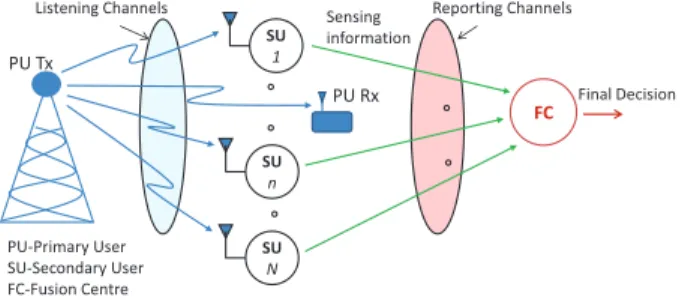
The focus of this thesis is on the local and cooperative spectrum sensing algorithms. Local sensing algorithms are proposed for detecting orthogonal frequency division multiplexing (OFDM) based primary user (PU) transmissions using their autocorrelation property. The proposed autocorrelation detectors are simple and computationally efficient. Later, the algorithms are extended to the case of cooperative sensing where multiple secondary users (SUs) collaborate to detect a PU transmission. For cooperation, each SU sends a local decision statistic such as log-likelihood ratio (LLR) to the fusion center (FC) which makes a final decision. Cooperative sensing algorithms are also proposed using sequential and censoring methods. Sequential detection minimizes the average detection time while censoring scheme improves the energy efficiency.
The performances of the proposed algorithms are studied through rigorous theoretical analyses and extensive simulations. The distributions of the decision statistics at the SU and the test statistic at the FC are established conditioned on either hypothesis. Later, the effects of quantization and reporting channel errors are considered. Main aim in studying the effects of quantization and channel errors on the cooperative sensing is to provide a framework for the designers to choose the operating values of the number of quantization bits and the target bit error probability (BEP) for the reporting channel such that the performance loss caused by these non-idealities is negligible.
Later a performance limitation in the form of BEP wall is established for the cooperative sensing schemes in the presence of reporting channel errors. The BEP wall phenomenon is important as it provides the feasible values for the reporting channel BEP used for designing communication schemes between the SUs and the FC.
Keywords Autocorrelation based detectors, censoring, cooperative detection, imperfect reporting channels, quantization, sequential tests
ISBN (printed) 978-952-60-4831-4 ISBN (pdf) 978-952-60-4832-1
ISSN-L 1799-4934 ISSN (printed) 1799-4934 ISSN (pdf) 1799-4942 Location of publisher Espoo Location of printing Helsinki Year 2012 Pages 203 urn http://urn.fi/URN:ISBN:978-952-60-4832-1
Preface
The research work leading to this thesis has been carried out under the able guidance of Academy Prof. Visa Koivunen at the Department of Sig-nal Processing and Acoustics, Aalto University School of Electrical En-gineering (formerly Helsinki University of Technology (TKK)) during the years 2007–2012. Our research group is part of SMARAD (Smart and Novel Radio Research Unit) which has been selected as a Center of Excel-lence (CoE) in research by the Academy of Finland.
I would like to acknowledge here one and all who have helped me to make this thesis possible. First of all, I would like to express my sincere gratitude to my supervisor Prof. Visa Koivunen for his guidance, support and patience during the entire course of this work. Visa, thanks for giv-ing me lot of freedom in this research while also makgiv-ing sure that I am moving in the right direction with your gentle pushes at the right times!
Further, I would like to thank my colleague Dr. Jarmo Lundén with whom I have co-authored several papers. Thanks Jarmo for keeping your doors always open for any technical discussions and bringing clarity to my research thoughts with your beautiful insights! I am also very grateful to Prof. H. Vincent Poor with whom I had the privilege of co-authoring some of the papers in this thesis. I am also indebted to Prof. K.V.S. Hari and my friend Vibhor Tikiya for encouraging me to pursue a doctoral degree. Hari also suggested me to apply to Visa’s group without which I would not have landed in this beautiful country to do my PhD.
Special thanks to my pre-examiners Dr. Ananthram Swami and Prof. Sergio Barbarossa for performing a thorough review of the thesis and providing insightful comments that helped to improve the quality of this thesis.
This research was also part of an European Union project SEnsor Net-work for Dynamic and cOgnitive Radio Access (SENDORA) during the
years 2008–2010. I would like to thank all the project members for many interesting technical discussions which greatly enriched my knowledge in the field of Cognitive Radios. Especially, I would like to thank Prof. Jussi Rynnänen, Dr. Marko Kosunen, Kari Kokkinen, Dr. Danyo Danev, and project coordinator Bertrand Mercier. The research was also funded by scholarships from Finnish Innovation Fund (SITRA), Jenny and Antti Wihurin Foundation, Nokia Foundation and Graduate School of Electrical Engineering. I sincerely appreciate the financial support they provided during the research.
Many thanks to my current and former colleagues at the Department of Signal Processing and Acoustics for many interesting discussion on technical and non-technical issues and making the lab a great place to work. Especially, I would like to thank Jan Oksanen, Jayaprakash Ra-jashekaran, Mário Costa, Pramod Mathecken, Alexandra Oborina, Mei Yen Cheong, Marian Bica, Taneli Riihonen, Azadeh Haghparast, Pekka Jänis, Tuomas Aittomäki, Dr. Eduardo Zacarias, Dr. Jussi Salmi, Dr. Tra-ian Abrudan, Dr. Stefan Werner, Dr. Jan Eriksson, Dr. Andreas Ritcher and Prof. Risto Wichman. The constant support and friendly attitude of our departmental secretaries Mirja Lemetyinen, Anne Jääskeläinen (former), Heidi Koponen, and of GETA coordinator Marja Leppäharju is greatly appreciated.
Finally and most importantly, I am thankful to my family and friends for the love and support they have given during all these years. In par-ticular, I am indebted to my parents Sadanand and Seema for making lot of sacrifices to provide me the best of opportunities that they never had. I also thank my sister Shweta and my friend Kiran Tatpalliwar for be-ing always there when I needed them. Many thanks to my beloved wife Sheeba for her love, understanding, and patience without which this the-sis would not have been possible. Lots of love to my cute little angel Yajat for adding new colors to my life.
Espoo, October 8, 2012,
Contents
Preface i
Contents iii
List of Publications vii
List of Abbreviations ix
List of Symbols xi
1. Introduction 1
1.1 Motivation . . . 1
1.2 Scope of the thesis. . . 3
1.3 Contributions of the thesis . . . 5
1.4 Structure of the thesis and summary of the publications . . 7
2. Cognitive Radios for Dynamic Spectrum Access 11 2.1 Cognitive radio . . . 12
2.1.1 Definitions . . . 12
2.1.2 Applications . . . 13
2.1.3 Enabling technologies . . . 13
2.2 Dynamic spectrum access . . . 14
2.2.1 Spectrum awareness . . . 17
2.2.2 Cognitive processing . . . 19
2.2.3 Spectrum access. . . 23
2.3 Standardization efforts . . . 25
3. Single-User Spectrum Sensing 27 3.1 System model . . . 28
3.1.1 Test statistics . . . 28
3.1.3 Detection criteria . . . 32
3.2 State-of-the-Art Sensing Algorithms . . . 33
3.2.1 Matched filter detection . . . 33
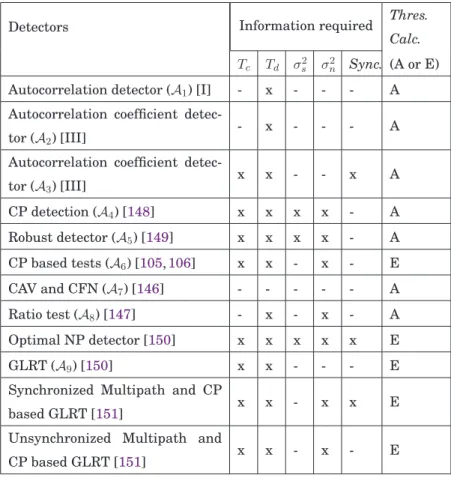
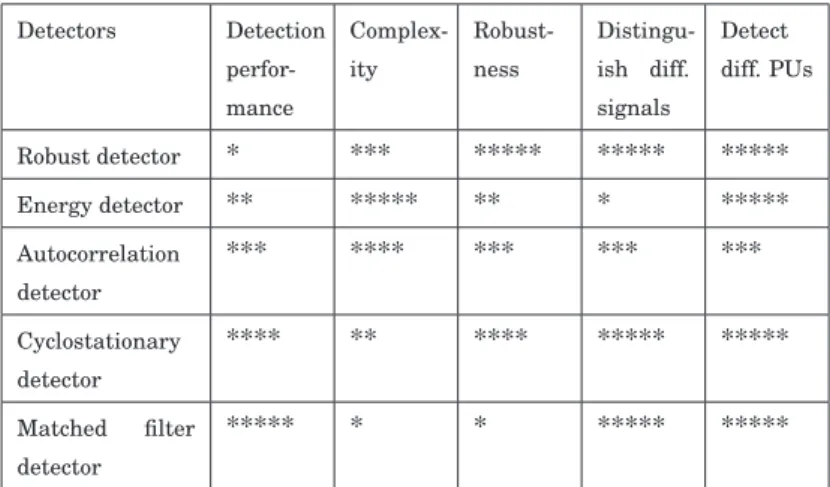
3.2.2 Energy detection . . . 34 3.2.3 Spectrum estimation . . . 36 3.2.4 Cyclostationary detection . . . 37 3.2.5 Autocorrelation detection . . . 38 3.2.6 Sequential detection . . . 45 3.2.7 Compressive sensing . . . 47 3.2.8 Multiantenna detector . . . 48 3.2.9 Multistage detection . . . 49 3.3 Non-idealities . . . 50 3.4 Discussion . . . 53
4. Cooperative Spectrum Sensing 57 4.1 Cooperation models . . . 58
4.2 Fusion rules . . . 60
4.2.1 Lossless fusion. . . 61
4.2.2 Lossy fusion . . . 62
4.3 Sequential detection . . . 64
4.3.1 Autocorrelation based sequential detection of OFDM systems . . . 65
4.3.2 Quickest detection . . . 66
4.4 Performance evaluation criteria . . . 67
4.4.1 Performance parameters . . . 67
4.4.2 Non-idealities . . . 69
4.5 Censoring. . . 71
4.5.1 Autocorrelation based censoring scheme for detect-ing OFDM systems . . . 72
4.6 Quantization . . . 73
4.6.1 Autocorrelation based soft decisions for detecting OFDM systems . . . 74
4.7 Imperfect Reporting Channels. . . 76
4.7.1 Effects on hard decision combining . . . 77
4.7.2 Effects on soft decision combining . . . 81
4.8 Discussion . . . 83
Bibliography 91
Errata 113
List of Publications
This thesis consists of an overview and of the following original publica-tions which are referred to in the text by their Roman numerals.
I S. Chaudhari, J. Lundén, and V. Koivunen, “Collaborative Autocorrelation-Based Spectrum Sensing of OFDM Signals in Cognitive Radios,” in
Proc. of the 42nd Annual Conference on Information Sciences and Systems (CISS), Princeton, USA, Mar. 19–21, 2008, pp.191–196. II S. Chaudhari, V. Koivunen, and H. Poor, “Distributed
Autocorrelation-Based Sequential Detection of OFDM Signals in Cognitive Radios,” inProc. of the 3rd International Conference on Cognitive Radio Ori-ented Wireless Networks and Communications (CrownCom), Singa-pore, May 15–17, 2008, pp.1–6.
III S. Chaudhari, V. Koivunen, and H. Poor, “Autocorrelation-Based De-centralized Sequential Detection of OFDM Signals in Cognitive Ra-dios,”IEEE Transactions on Signal Processing, vol. 57, pp. 2690– 2700, Jul. 2009.
IV S. Chaudhari and V. Koivunen, “Effect of Quantization and Chan-nel Errors on Collaborative Spectrum Sensing,” inProc. of the 43rd Asilomar Conference on Signals, Systems, and Computers, Pacific Grove, CA, USA, Nov. 1–4, 2009, pp. 528–533.
V S. Chaudhari, J. Lundén, and V. Koivunen, “BEP Walls for Collabo-rative Spectrum Sensing,” inProc. of the IEEE International Confer-ence on Acoustics, Speech, and Signal Processing (ICASSP), Prague, Czech Republic, May 22–27, 2011, pp. 2984–2987.
VI S. Chaudhari, J. Lundén, and V. Koivunen, “Effects of Quantization on BEP Walls for Soft Decision Based Cooperative Sensing,” inProc.
of the 12th IEEE International Workshop on Signal Processing Ad-vances in Wireless Communications (SPAWC), San Francisco, USA, Jun. 26–29, 2011, pp. 106–110.
VII S. Chaudhari, J. Lundén, and V. Koivunen, “Performance Limita-tions for Cooperative Spectrum Sensing with Reporting Channel Er-rors,” in Proc. of the 22nd IEEE Symposium on Personal, Indoor, Mobile and Radio Communications (PIMRC), Toronto, Canada, Sep. 11–14, 2011.
VIII S. Chaudhari, J. Lundén, V. Koivunen, and H. Poor, “Cooperative Sensing with Imperfect Reporting Channels: Hard Decisions or Soft Decisions?,” IEEE Transactions on Signal Processing, vol. 60, pp. 18–28, Jan. 2012.
List of Abbreviations
ASN average sample number AWGN additive white Gaussian noise BEP bit error probability
BPSK binary phase shift keying BSC binary symmetric channel CAV covariance absolute value CDF cumulative density function CDMA code division multiple access CFAR constant false alarm rate CFN covariance Frobenius norm
CGLRT constrained generalized likelihood ratio test CP cyclic prefix
CS cooperative sensing CUSUM cumulative sum
DFT discrete Fourier transform DSP digital signal processing DTV digital television
DVB-T digital video broadcasting — terrestrial EGC equal gain combining
FC fusion center
FCC Federal Communications Commission FDMA frequency division multiple access FPGA field programmable gate array FSK frequency shift keying
FSS fixed sample size
GLR generalized likelihood ratio GLRT generalized likelihood ratio test
HD hard decision
HSPA+ evolved high speed packet access
iid independent and identically distributed IQ in-phase/quadrature
ISM industrial, scientific and medical LLR log-likelihood ratio
LLRT log-likelihood ratio test LR likelihood ratio
LRT likelihood ratio test LTE long term evolution MAC medium access control
MIMO multiple input multiple output ML maximum likelihood
MOE maximum output entropy MRC maximal ratio combining NP Neyman-Pearson
OFDM orthogonal frequency division multiplexing pdf probability density function
PHY physical layer
pmf probability mass function PSK phase shift keying PU primary user RE relative efficiency RF radio frequency
ROC receiver operating characteristics SD soft decision
SDR software defined radio SNR signal to noise ratio
SPRT sequential probability ratio test SU secondary user
TDMA time division multiple access TV television
TVWS television whitespace
UMTS universal mobile telecommunication system WiMax worldwide interoperability for microwave access WLAN wireless local area network
List of Symbols
ˆ
a estimate of scalara
a∗ conjugate of scalara
|a| modulus of scalara
aH conjugate transpose of vectora
A−1 inverse of matrixA E[·] expectation operator
f(·) probability density function
F(·) cumulative density function
H0 null hypothesis
H1 alternative hypothesis
L number of channel taps
Ln log-likelihood ratio for thenthsecondary user
Lf cn received quantized log-likelihood ratio at the fusion
cen-ter from thenthsecondary user
Lsun transmitted quantized log-likelihood ratio from the nth
secondary user
M number of observations at a secondary user
min minimum value
max maximum value
N number of secondary users
N0 noise spectral density
Ns number of received OFDM symbols at a secondary user N normal distribution
Nns set of SUs in no-send region
p(·) probability mass function
P(·) probability function
P0 prior probability for null hypothesis
Pf,nsu probability of false alarm at then
thsecondary user
Pm,nsu probability of missed detection at thenthsecondary user
Pf,nf c probability of false alarm corresponding to then
th
sec-ondary user at the fusion center
Pm,nf c probability of missed detection corresponding to thenth
secondary user at the fusion center
Pf,cs global probability of false alarm for cooperative sensing
Pm,cs global probability of missed detection for cooperative
sensing
r(t, τ) time dependent autocorrelation function at lagτ
R(x) real part of a complex valuex s(t) transmitted signal
t discrete time index
T test statistic
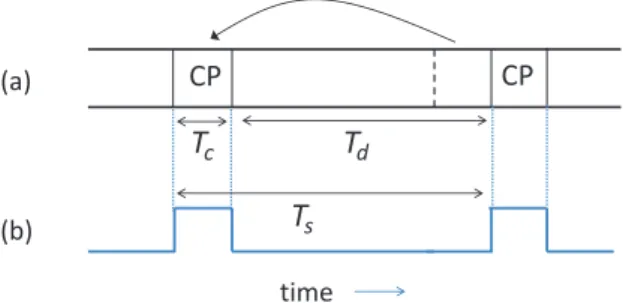
Tc number of cyclic prefix samples in an OFDM symbol
Td number of data samples in an OFDM symbol
Ts total number of samples in an OFDM symbol
un hard decision from thenthsecondary user to the fusion
center
w(t) additive white gaussian noise
x(t) received signal
αs constraint on the probability of false alarm for
single-user sensing
αcs constraint on the global probability of false alarm for the
cooperative sensing
βs constraint on the probability of missed detection for
single-user sensing
βcs constraint on the global probability of missed detection
for the cooperative sensing
η detector threshold
κn communication constraint between the nth secondary
user and the fusion center
τ time delay
χ2M central chi-square distribution with M degrees of
free-dom
χ2M(γ) non-central chi-square distribution with M degrees of
1. Introduction
1.1 Motivation
Wireless communication has been the fastest growing segment of the com-munications industry in the last decade. As a result, wireless systems have become ubiquitous with several applications (e.g., cellular telephony and wireless internet) and various devices (e.g., mobiles, laptops, and tablets). In addition, new applications like wireless sensor networks, automated factories, smart home appliances, remote telemedicine, and many more are emerging from research ideas to concrete systems [1].
With the incredible growth in the number of wireless systems and ser-vices, the availability of high quality wireless spectrum has become severely limited. This is evident from the frequency allocation charts for Fin-land [2] (see Fig. 1.1) and the United States [3]. This has lead to a com-mon belief that the spectrum is a scarce resource and it is difficult to find spectrum for new applications. However, actual measurements carried out in various countries show that most of the radio frequency spectrum is inefficiently utilized with spectrum utilization mostly in the range of 5%-50% [4–7]. Therefore the real problem is not the spectrum scarcity but the inefficient spectrum usage. This inefficiency results from static spectrum allocations, rigid regulations, fixed radio functions, and limited network coordination.
Cognitive radiooffers a novel solution to overcome the underutiliza-tion problem by allowing an opportunistic usage of the spectrum resources. This is evident from the definition of cognitive radio adopted by the Fed-eral Communications Commission (FCC): Cognitive Radio: a radio or system that senses its operational electromagnetic environment and can dynamically and autonomously adjust its radio operating parameters to
Use of radio frequencies 3 kHz R a d i o s p e c t r u m Electromagnetic spectrum [Hz] 1023 1022 1021 1020 1019 1018 1017 1016 1015 1014 1012 1012 1011 1010 109 108 107 106 105 104 103 102 101 Not allocated LA PR-27 CB TV PMR RHA68
FM-radio PMR Terrestrial digital audio broadcasting TV
VirvePMR TV and Digital TV GSM
900 Wind profiler GPS radars Sat. nav. GSM1800 DECT UMTS UMTS RLAN WLAN Blue- Tooth IMT-2000/UMTS expansion band FWA RLAN WLAN FWA FWA Not allocated Fixed Mobile Broadcasting Maritime mobile Aeronautical mobile Mobile-satellite Land mobile Earth exploration-satellite Fixed-satellite Space operation Amateur Radio astronomy Space research Inter-satellite Broadcasting-satellite Meteorological-satellite Radiolocation Radionavigation-satellite Maritime radionavigation Aeronautical radionavigation Radionavigation 30 kHz 300 kHz 3 MHz 30 MHz 30 MHz 100 MHz 200 MHz 300 MHz 300 MHz 1 GHz 2 GHz 3 GHz 3 GHz 10 GHz 20 GHz 30 GHz 30 GHz 100 GHz 200 GHz 300 GHz
Note: The division of frequencies between services and the usage indicated in the picture only gives an overview of the frequency utilisation. More detailed information can be obtained from FICORA’s Regulation 4 and the annexed Frequency Allocation Table (links from this picture).
FICORA, 16.2.2005 VLF LF MF HF VHF UHF SHF EHF
VLF (Very Low Frequency) VHF (Very High Frequency) LF (Low Frequency) UHF (Ultra High Frequency) MF (Medium Frequency) SHF (Super High Frequency) HF (High Frequency) EHF (Extremely High Frequency)
Figure 1.1.Finnish Communication Regulatory Authority’s frequency allocation chart for Finland [2].
modify interference, facilitate interoperability, and access secondary mar-kets[8].
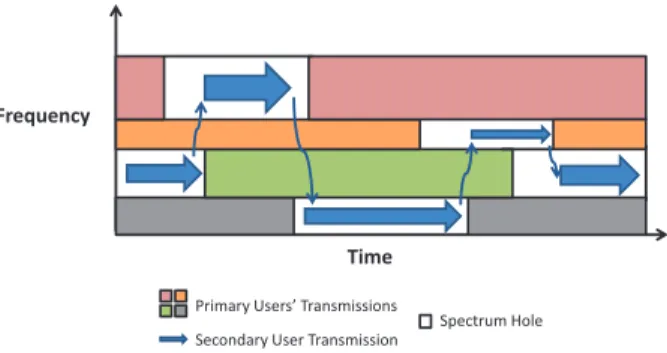
In cognitive radio terminology, aprimary user (PU)is defined as a legacy user or a licensed user who has higher rights on particular part of spec-trum. Examples of licensed technology are global system for mobile com-munications (GSM) [9,10], worldwide interoperability for microwave ac-cess (WiMax) [11,12], and long term evolution (LTE) [12,13] while exam-ples of legacy technology are microphone and wireless local area network (WLAN) [12,14]. On the other hand, unlicensed cognitive users with lower priority are defined assecondary users (SUs). A SU can access spectral re-sources of a PU when the PU is not using them. However the SU has to vacate the frequency band as soon as the PU becomes active so that neg-ligible (or no) interference is caused to the PU. Such opportunistic access of the PU resources by the SUs is called asdynamic spectrum access. A SU can opportunistically utilize different spectrum holes corresponding to different PUs in order to satisfy its bandwidth requirement without causing interference to the PUs as shown in Fig.1.2.
Spectrum sensing is a key enabler for dynamic spectrum access in cognitive radios. It is the task of obtaining awareness regarding the ra-dio spectrum as well as identifying idle spectrum. It enables the SUs to explore and exploit the unused PU spectrum. In addition it is crucial for managing the level of interference caused to the PUs of the spectrum.
Frequency
Time
Secondary User Transmission Primary Users’ Transmissions
Spectrum Hole
Figure 1.2.In cognitive radios, secondary users (SUs) opportunistically use the spectrum not used by the primary users.
Spectrum sensing can be done by an individual SU and is called as
single-user sensingorlocal detection. Single-user sensing becomes diffi-cult in challenging propagation environments like multipath fading, Doppler spread, and shadowing. In such a scenario a SU has to distinguish be-tween awhite space, where there is no primary signal, and adeep fade, where it is hard to detect the primary signal. Cooperative sensing (CS), where different SUs collaborate to detect the presence of a PU, provides diversity gains to tackle the fading and shadowing effects. CS also helps to increase the SNR gain and network coverage, decrease the detection time, and simplify the detector design.
1.2 Scope of the thesis
Cognitive radio is a very broad and a highly multidisciplinary technology involving several fields of research such as smart antennas, hardware ar-chitectures, signal processing, communication theory, medium access con-trol (MAC), learning mechanisms, dynamic spectrum allocation methods, cognitive network architecture, and protocol design. Moreover, cognition may take place in all layers of a protocol stack such as Open Systems Interconnection (OSI). However the main focus of this thesis is on the de-sign and analysis of local and cooperative spectrum sensing algorithms for dynamic spectrum access from the physical layer (PHY) signal processing point of view. The problem of spectrum sensing is commonly formulated as a binary hypothesis testing problem and the desired sensing algorithms stem from the detection theory.
Thefirst goalof this thesis is todevelop simple and computationally ef-ficient local spectrum sensing algorithmsto detect Orthogonal Frequency
Division Multiplexing (OFDM) based PU transmissions. OFDM is a key technology for the present and future broadband wireless communication systems. It is used in various applications: IEEE 802.22 or digital tele-vision (DTV) broadcasting, IEEE 802.11a/g/n or wireless local area net-works (WLANs), IEEE 802.16 or wireless metropolitan area netnet-works (WMANs) , IEEE 802.20 or mobile broadband wireless access (MBWA) systems, LTE, for example. Therefore, it is fair to assume that many of the PUs will be OFDM based. Hence, the problem of detecting OFDM signals is very relevant. Local spectrum sensing schemes are proposed to detect OFDM based PU in Publications I and III.
Thesecond goalof this thesis is to develop fast, energy efficient, and practical collaborative sensing algorithms. Cooperative sequential sens-ing schemes are proposed in Publications II and III. Cooperative senssens-ing may involve multiple SUs searching multiple bands corresponding to dif-ferent PUs. However, the discussion in this thesis is limited to the col-laborative scenarios where a group of SUs are trying to detect the same PU in a given single frequency band. The developed methods stem from decentralized detection theory. Sensing policy, which resolves different is-sues related to CS such as user selection and sensing scheduling, is not considered in this thesis.
Thethird goalof this thesis is tostudy the effects of non-idealities on the cooperative spectrum sensing algorithms. The effects of some typical non-idealities such as quantization, censoring, and imperfect reporting channels on CS are studied in Publications I, IV-VIII. Quantization and censoring schemes help in saving the bandwidth and energy required for transmitting the decision statistics from the SUs to the fusion center (FC). However these savings come at the cost of performance degradation for CS. In addition, reporting channels from the SUs to the FC may introduce errors in the SU decision statistics and severely affect the CS performance in a practical scenario. Therefore it is important to take these issues into account while designing the CS systems so that the performance degra-dation caused is negligible. Note that the effects of non-idealities in the radio frequency (RF) front end such as carrier frequency offset, DC-offset, non-linearity, IQ imbalance, and phase noise are not considered in this thesis.
1.3 Contributions of the thesis
The contributions of this thesis are in two fields related to spectrum sens-ing: single-user spectrum sensing and cooperative spectrum sensing. The problem of detecting a PU activity is modeled as a binary hypothesis test-ing problem where the null and alternate hypotheses correspond to the absence and presence of PU transmission, respectively. The observations at the cooperating SUs are considered independent conditioned on the either of the two hypotheses. For cooperative spectrum sensing, a par-allel network topology with a dedicated FC is considered where each SU sends decision statistic to the FC which makes the final decision. The per-formances of the proposed schemes are studied using analytical methods and extensive MATLAB simulations. For all the detailed derivations and simulation results see the Publications I-VIII.
The contributions of the thesis to theSINGLE-USER SPECTRUM SENS
-INGfor cognitive radios are listed as follows:
• Autocorrelation based detectorsare proposed in Publications I and III which use the autocorrelation property of cyclic-prefix (CP) OFDM based PU signals to detect them. The proposed detectors are simple, computationally efficient, and require minimal knowledge regarding the OFDM based PU. It is shown that the log-likelihood ratio test (LLRT) statistic in the low SNR regime is the maximum likelihood (ML) estimate of the autocorrelation coefficient. The dis-tribution of the test statistic has been derived under the two hy-potheses. The performances of the proposed schemes are studied in additive white Gaussian noise (AWGN) and multipath channels. The gain in assuming the knowledge of synchronization and the CP length is also demonstrated.
The contributions of the thesis to theCOOPERATIVE SPECTRUM SENS
-INGfor cognitive radios are listed as follows:
• Censoring based CS scheme is proposed in Publication I which uses autocorrelation based decision statistics to detect a CP-OFDM based PU system. In the censoring approach, only informative lo-cal decision statistics are sent to the FC. The motivation behind the censoring approach is to reduce the bandwidth and energy used for transmitting the decision statistics from the SUs to the FC. The dis-tribution of the decision statistics at the SU and the test statistic at
the FC are established under both hypotheses. Significant reduction in the transmissions of decision statistics is obtained under the null hypothesis while the performance loss is minimal even under strict communication constraints.
• Sequential detectionschemes are proposed in Publications II and III where SUs send autocorrelation based log-likelihood ratios (LLRs) to the FC which makes a decision sequentially. Expressions are de-rived for theaverage sample number (ASN), which is the number of samples required to arrive at a reliable decision under either of the hypotheses. Later the performance of the proposed cooperative se-quential scheme is compared to that of Neyman-Pearson (NP) fixed sample size (FSS) test in AWGN, multipath, and shadowing chan-nels. Significant gains are shown in terms of the number of samples sufficient for achieving the desired performance criteria.
• Effects of Quantization on CS are analyzed in Publications IV. Main aim is to find the number of bits required for quantizing the decision statistics at the SUs such that the CS performance loss re-mains negligible. The loss in the CS performance caused by the quantization decreases with an increase in the number of bits for quantization. It is shown that as low as four bits are required to achieve performance similar to that of the unquantized versions by simply using a uniform quantizer and the Gray mapping.
• Effects of Imperfect Reporting Channels on CSare analyzed in Publications IV-VIII. It is shown that there is increase in the er-ror probabilities of false alarm and missed detection when the re-porting channel errors increase. The rere-porting channel errors are modeled using bit error probability (BEP). Performance limitations of the CS have been introduced in the form BEP wall in the pres-ence of imperfect reporting channels. The BEP wall is defined as the BEP value above which it is impossible to satisfy the imposed performance constraints on the detector error probabilities at the FC irrespective of the SNR on the listening channel or the sensing time at the SUs. The performance is studied for CS schemes using one-bit hard decisions (HDs) and multi-bit soft decisions (SDs). It is shown that the BEP wall values are sufficiently low to be of practical im-portance and may cause severe performance limitation in certain CS schemes. Contrary to the popular belief that cooperation always
im-proves the CS performance, cooperation is shown to degrade the CS performance for some cases. Performance comparison of HD and SD based schemes have been provided to show the performance gain in using SDs for CS even in the presence of reporting channel errors.
1.4 Structure of the thesis and summary of the publications
This thesis consists of an introductory part and eight original publica-tions.Theintroductory partis organized as follows. Chapter2reviews cognitive radio networks and their application to dynamic spectrum ac-cess. Chapter3gives a review of local sensing algorithms and issues re-lated to them. In addition, an autocorrelation based detector (presented in Publications I-III) for detecting an OFDM based PU is discussed. The review of CS algorithms and related issues are presented in Chapter4. In addition, CS algorithms like censored distributed detection (proposed in Publication I) and sequential detection (proposed in Publications II and III ) are also discussed. The chapter also discusses the effects of non-idealities such as quantization and channel errors on the CS (presented in Publication IV) and the resulting performance limitations (presented in Publications V-VIII). Chapter5provides the concluding remarks.
InPublication I, a simple and computationally efficient autocorrela-tion based detector is proposed to detect an OFDM based PU in AWGN channel. Next, the proposed scheme is extended to the case of CS where the SUs send only the informative decision statistics to the FC. For cen-soring, the decision statistics used are autocorrelation values. Limits of the censoring region are found under constraints on the false alarm and transmission rates. The distributions of the local decision statistics at the SU and the test statistic at the FC are established under the two hypothe-ses.
InPublication II, a distributed autocorrelation based sequential detec-tion scheme of OFDM signals is proposed. Each SU sends autocorreladetec-tion based LLR to the FC, which employs sequential detection. Expressions are derived for the ASN under either of the hypotheses. Next, comparison of the proposed sequential detection scheme is carried out with NP FSS test in the AWGN channel.
InPublication III, the work in Publications I and II is extended. It is shown that for CP based OFDM system, the ML estimate of the au-tocorrelation coefficient at the lags equal to the useful data length in an
OFDM symbol is the LLRT statistic in the low SNR regime. The proposed detector does not assume the knowledge of CP length in an OFDM sym-bol. The distributions of the local decision statistic are established under the two hypotheses. Next, the effects of exploiting information related to the CP length and synchronization on detection performance are studied. The performances of the proposed local detectors are studied in AWGN and multipath scenarios. Later, sequential detection is considered for CS where local detectors send autocorrelation coefficient based LLRs to the FC. Expressions are derived for the ASN under either of the hypotheses. The performance is then compared with the FSS test in AWGN and shad-owing conditions.
InPublication IV, the effects of quantization and channel errors on the CS performance are studied. The autocorrelation coefficient based LLRs from the SUs to the FC are quantized to reduce the bandwidth con-sumption using a uniform quantizer. At the FC, the sum fusion rule is considered. The reporting channel errors are modeled using BEP and are considered to be independent and identically distributed (iid). The distri-bution of the decision statistics at the SU and the test statistic at the FC are established under either of the two hypotheses.
InPublication V, the existence of a performance limitation in the form of a BEP wall is demonstrated for HD based CS in the presence of im-perfect reporting channels. Each SU sends a one-bit decision to the FC, which employsK-out-of-Nfusion rule. Expressions for the BEP walls for theK-out-of-N rules (also calledcounting rules) are derived. Effects of parameters like false alarm probability, missed detection probability,K, andNon the BEP wall values are also studied.
In Publication VI, the existence of BEP walls for SD based CS is demonstrated in the presence of reporting channel errors. Cooperative de-tection is formulated as a composite hypotheses testing problem and PU signal distribution is assumed to be unknown. Each SU sends a quantized version of the ML estimate of the autocorrelation coefficient to the FC. Dif-ferent quantization schemes such as uniform quantization and maximum output entropy quantization are implemented. The reporting channel is modeled as a binary symmetric channel (BSC) with a particular BEP. A sum fusion rule is implemented at the FC along with NP detection crite-ria.
InPublication VII, the work of Publication V is extended to the case where the reporting channels are not necessarily identical. Expression
for the BEP wall values in the general scenario is obtained for the K -out-of-N fusion rules. The BEP wall values in this case form a surface of BEP values which divides the BEP region into two regions: feasible and unfeasible. It is also shown that the robustness of different fusion rules depends on different performance constraints.
InPublication VIII, the BEP wall phenomenon is demonstrated for SD based CS. Unlike Publication VI, CS is formulated as a simple hypothe-sis problem and an optimal fusion rule is used at the FC which takes the reporting channel errors into account. The distribution of the decision statistics at the SU and the test statistic at the FC are established under either of the two hypotheses. In addition, comparison of HD and SD based CS schemes is carried out for AWGN and shadowed listening channels in the presence of erroneous reporting channels.
In all the publications, the author of this thesis did the theoretical analysis, simulations, and writing of the publications. The co-authors guided the re-search and helped in writing the publications. The censoring framework in Publication I and the sequential detection framework in Publications II and III were suggested by the co-authors.
2. Cognitive Radios for Dynamic
Spectrum Access
Cognitive radio is an emerging concept which has a potential of being a disruptive technology and will enable the future wireless world [15,16]. In [15], the author envisions cognitive radio to be a convergence of sev-eral functionalities in a smart radio thereby providing a base for useful and innovative applications such as dynamic spectrum access. However the cognitive radio technology is still in its infancy and has attracted a lot of attention from the researchers in the field of wireless commu-nications. The concept of cognitive radio is highly multidisciplinary as inputs from several fields are needed on different issues. For example, smart antennas, hardware architectures including software-defined ra-dio (SDR), signal processing, networking, communication and information theory, learning mechanisms, game-theory, policy definitions, and moni-toring [15,16]. Interested readers are referred to [15–19] for details on the history, background, and various multidisciplinary issues related to the cognitive radios.
The main focus of this thesis is on spectrum sensing in cognitive radios for dynamic spectrum access. This chapter starts with a general descrip-tion of cognitive radio followed by its applicadescrip-tion for dynamic spectrum access. Later, brief overviews are presented on various issues related to the dynamic spectrum access including spectrum sensing, access policies, learning mechanisms, sensing policy, interference management, and stan-dardization efforts.
2.1 Cognitive radio
2.1.1 Definitions
Cognitive radio is a broad concept in general and has different meanings in several contexts [8,17,20,21]. The termcognitive radiohas been coined by Mitola asan intelligent radio which is aware of its surrounding envi-ronment and capable of changing its behavior to optimize the user experi-ence[20,22]. Therefore a cognitive radio has three important characteris-tics: awareness,cognition, andadaptability. Slightly different cognitive ra-dio characterizations are given in [21,23,24].Awarenessis the ability of the radio to measure, sense, and be aware of its environment and internal states. A radio may exhibit different levels of awareness such as spectrum awareness, location awareness, user awareness, and network awareness, etc. Cognitionis the ability to process information, learn about the en-vironment, and make decisions about its operating behavior to achieve predefined objectives.Adaptabilityis the capability of adjusting operat-ing parameters for the transmission on the fly without any modifications on the hardware components. This capability enables the cognitive radio to adapt easily to the dynamic radio environment. There are several re-configurable parameters: frequency, transmit power, waveforms, antenna configuration, communication technology, and protocol.
Dynamic spectrum access is cognitive radio’s most important applica-tion, which promises to overcome the apparent spectrum scarcity prob-lem caused by the rigid spectrum allocation and the underutilization of the spectral resources. In the context of dynamic spectrum access, a more pertinent definition of a cognitive radio is given by Haykin [21]: Cog-nitive Radio is defined as an intelligent wireless communication system that is aware of its surrounding environment and uses the methodology of understanding-by-building to learn from the environment and adapt its internal states to statistical variations in the incoming RF stimuli by mak-ing correspondmak-ing changes in certain operatmak-ing parameters (e.g. transmit power, carrier frequency, and modulation strategy) in real time with two primary objectives in mind: One: highly reliable communication whenever and wherever needed, Second: efficient utilization of the radio spectrum.
2.1.2 Applications
Cognitive radio presents the possibility of numerous revolutionary appli-cations apart from dynamic spectrum access. For example, cognitive radio may facilitatelocation services, seamless mobility, optimum performance, and coexistence of heterogeneous wireless systems. Cognitive radio may provide location servicesby helping the user locate services like restaurants, car rental, train, flights, etc., when he travels in a new country. Cognitive radio may facilitateseamless mobilityby automatically detecting and inter operating with different networks like WLAN, wireless metropoli-tan area network (WMAN), Bluetooth, etc. Cognitive radio may be useful in obtainingoptimum performanceby optimizing spectrum usage, data rates, service cost, battery power minimization, etc., or a mix of such ob-jective functions.Coexistence of heterogeneous wireless systemsin the same frequency bands (e.g., IEEE 802.15.4 Zigbee and IEEE 802.11 WLAN) results in severe interference caused by different power levels, asynchronous time slots, and incompatible MAC and physical layer pro-tocols [25]. This interference in turn severely degrades the performance of the coexisting wireless systems. Cognitive radio can provide solutions to reduce the interference among the coexisting heterogeneous wireless systems and improve their performance.
2.1.3 Enabling technologies
Many technologies and practical considerations, which are highly mul-tidisciplinary, need to come together to result in the cognitive technolo-gies [18]. There are a few enabling technologies that play an important role in cognitive radio systems:sensors, software technologies, andsoftware defined radio.
Sensorsare needed to create awareness about the environment. Some examples of sensors are RF receiver, microphone, camera, biometric scan-ners (fingerprint, iris, retina), global positioning system (GPS). Sensors such as microphone, camera, and biometric scanners can be used for user awareness, which is helpful in avoiding unauthorized access and provid-ing user centric experience in a multiuser scenario. GPS enables several useful applications for a cognitive radio by providing the location aware-ness.
Software technologies, which are enabling cognitive radio, include policy engine, machine learning, advanced signal processing, and
net-working protocols [15]. The spectrum usage is regulated by the regula-tory body and regulation policies may vary depending on country, time, software, and hardware developers. Policy engine helps in adhering to different regulations by having a library of policies in the form of down-loadable software. Machine learning focuses on automatically learning and making intelligent decisions based on the available information. Ex-amples of machine learning approaches are artificial neural networks, reinforcement learning, and genetic algorithms. Advanced signal pro-cessing approaches are required in cognitive radios for communications (e.g., modulation/demodulation, forward error correction, channel estima-tion, equalizaestima-tion, filtering) and sensor signal processing (e.g., spectrum analysis, feature extraction, pattern recognition, wavelet synthesis). Net-working protocols enable cooperation between different SUs which has the potential of increasing the cognitive radio capability. Moreover they may help SUs to coexist with the PUs and the other SUs. Examples of networking protocols are routing and medium access protocols.
Asoftware defined radioor SDR, is a radio communication system where components that have been typically implemented in hardware (e.g. mixers, filters, amplifiers, modulators/demodulators, detectors, etc.) are instead implemented in software using digital signal processing (DSP). Therefore simply modifying or replacing software programs can completely change the functionality of the radio. This flexible radio functionality al-lows the use of different wireless communication techniques in a single portable device making SDR a key enabling technology for cognitive ra-dios. Some examples of commercially available SDR are Universal Soft-ware Radio Peripheral (USRP), USRP2, FLEX-5000A [26].
2.2 Dynamic spectrum access
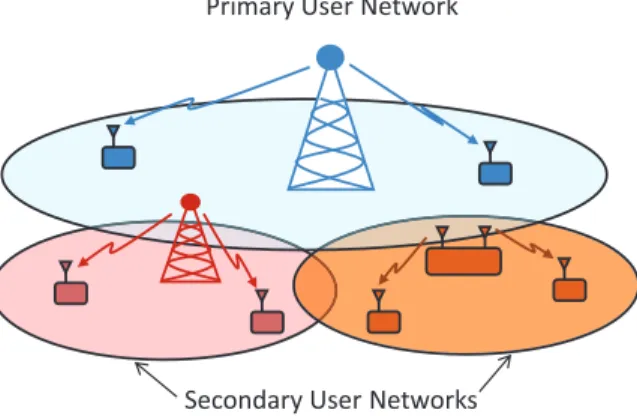
Currently dynamic spectrum access is the most important application of cognitive radios. It has attracted lots of interest among policy makers, regulators, network operators, and researchers [8,18,19,21,27–29]. Al-though cognition is a very broad term and has applications in all levels of a protocol stack, this thesis will focus only on the application of cogni-tion to the PHY/MAC layers for dynamic spectrum access. Fig.2.1shows the considered scenario for dynamic spectrum access where multiple PUs and SUs are coexisting. The SU networks opportunistically access the PU bands such that the interference caused to the PUs is negligible. The
Secondary User Networks Primary User Network
Figure 2.1.Coexistence of multiple primary and secondary user networks (homogeneous or heterogeneous).
SU networks operating may behomogeneousorheterogeneous. Examples of heterogeneous networks operating in the same frequency bands are WLAN (IEEE 802.11), Bluetooth, and Zigbee (IEEE 802.15.4).
Based on the sharing models or how the PUs share the spectrum with SUs, dynamic spectrum access can be broadly classified into three types [30]: dynamic exclusive use, spectrum commons, andhierarchical ac-cess. Similar categorization has been done in [31] with slightly different terminology. In the dynamic exclusive usemodel, the basic structure of the current spectrum policy is kept while introducing flexibility to im-prove spectrum utilization. There are two approaches under this model. First approach is spectrum property rights[32], where the license holder can trade spectrum and choose technology based on the market trend. Second approach is dynamic allocation[33], where spectrum allocation is varied at a faster scale as compared to current regulations by using the spectrum usage statistics of the PU in a particular location. Inspectrum commons model, every user has equal rights for using the spectrum. This is also called asopen spectrum modeland has been successfully applied for wireless services operating in the unlicensed industrial scientific and medical (ISM) radio band (e.g., WLAN). Inhierarchical accessmodel, SUs can use the primary resources such that the interference to the PU is limited. There are three approaches under this model [19,34,35]: un-derlay, overlay, andinterweave. While the SU utilizes gray spaces for the underlay and overlay approaches, the SU utilizes white spaces for the in-terweave approach. For the underlay approach, the SU transmits in the manner of ultra wideband (UWB) systems with sufficiently low power to limit the interference to the PU. In the overlay approach, SUs use the
! !
"
ŽŐŶŝƚŝ
#
Ğ
WƌŽĐĞƐƐŝŶŐ
^ƉĞĐƚƌƵŵ
ǁĂƌĞŶĞƐƐ
! $ % &'^ƉĞĐƚƌƵŵ
ĐĐĞƐƐ
(
)
ǀ
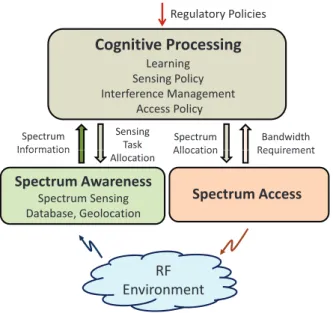
Figure 2.2.Dynamic spectrum access consists of three important functions: spectrum awareness, cognitive processing, and spectrum access. Spectrum awareness and spectrum access are the functions to explore and exploit the spectrum opportunities respectively. Cognitive processing is the intelligence and deci-sion making function that includes several subtasks: learning, sensing policy, interference management, and access policy.
partial or full knowledge of the PU information like codebooks or trans-mitted data to boost the PU performance and mitigate the interference from the PUs. There is a mix of terminology in the literature regarding overlay and interweave paradigms. For example in [30], the interweave approach described above is called overlay while the overlay approach de-scribed above is not considered. In this thesis we follow the definitions of underlay, overlay, and interweave given in [19,34,35].
Dynamic spectrum access consists of three main functions: spectrum awareness, cognitive processing, andspectrum access. Fig. 2.2shows these three functions and their interactions.Spectrum awarenesscreates aware-ness about the RF environment while spectrum accessprovides ways to exploit the available spectrum opportunities for efficient reuse.Cognitive processingis the intelligence and decision making function that includes several subtasks like learning about the radio environment, designing ef-ficient sensing, and access policies along with managing interference for coexistence of the SU networks with the PU networks. Cognitive process-ing uses spectrum information, bandwidth requirement, and regulatory policies as inputs while it provides sensing task and spectrum allocations as outputs. Next we present a brief overview of these three functions.
2.2.1 Spectrum awareness
Spectrum awareness is the task of obtaining awareness about the spec-trum usage and existence of PUs and SUs in a geographical area. A con-ventional approach to classify spectrum usage in space can be divided into three types [21]: black spaces, gray spaces,andwhite spaces. Black spaces are occupied by high power local interferers; gray spaces are occupied by low power interferers, while white spaces are free of any interferer ex-cluding ambient noise. The white and gray spaces are the spectrum op-portunities or spectrum holes, which can be used by the SUs. However this conventional approach of spectrum opportunities in [21] only exploits three dimensions of the spectrum: frequency, time,andspace. There may be additional dimensions that can be utilized [36]: code, polarization,and angle of arrival. In addition to the detection of spectral opportunities, spec-trum awareness can also provide various other useful information [37] such asradio environment map, channel gain map as well as locationsand statistics of the PUs and SUs.
Spectrum awareness can be obtained in two ways by using eitheractive or/andpassivemethods. In theactivemethod orspectrum sensing, the radios become spectrum aware by detecting and estimating the spectrum. Active methods have broader application areas and lower infrastructure requirement. Inpassivemethods, the information regarding the unoc-cupied spectrum is provided to the SU. For example, use of geolocation, database, and beacons fall into this category [27,36]. Passive methods need support from the PUs who are under no obligation to change their operation to aid the SU network. Therefore passive methods may be dif-ficult to implement. An alternative solution might be to use a dedicated sensor network maintained for creating databases and PU information in a geographical location to aid an incoming SU [24]. Although the users might have sensing capabilities, such supporting sensor network may be necessary in the start-up phase of the cognitive service and in rural ar-eas with low population. However the infrastructure requirement in this case may be complex and expensive. In the rest of the thesis, we focus on spectrum sensing performed by cognitive radios because of its broader application areas and lower infrastructure requirement.
Spectrum sensing schemes can be classified based on different criteria: detection target, architecture, number of primary users, number of secondary users,andnumber of bands to be sensed. Based on thetarget for
detec-tion, there are two approaches to spectrum sensing: detecting the trans-mitteranddetecting the receiver. Most of the approaches, including the ap-proaches proposed in this thesis, are based on detecting the transmitter. However the receiver is the actual victim of the secondary transmissions and detecting the transmitter only gives an approximate idea of the lo-cation of the receiver. Therefore detecting the receiver is an important task. Algorithms for detection of receiver have been considered in [27,38] which exploit the local oscillator power emitted by the RF front end of the receivers. However, detecting the receiver may be a demanding task as the power of the oscillator leakage is low thereby restricting the reliable detection range below 20 m [27,38].
Sensing can be performed via two differentarchitectures[39,40]: sin-gle anddual radio. In single radio, sensing is time multiplexed with the data transmission/reception while in dual radio, there is a dedicated RF front-end for both sensing and data transmission/reception. Single radio architecture has the advantages of low power consumption and hardware costs over dual radio architecture at the cost of sensing accuracy and effi-ciency. Based on thenumber of bandsto be sensed, sensing can be clas-sified assingle-bandandmulti-bandsensing [19]. There may be a case when there aremultiple primary usersin a given frequency band. For exam-ple, there are multiple users in a code division multiple access (CDMA) systems while WLAN and Bluetooth systems share the same bands. De-tection of multiple users has been studied in [41] while performance anal-ysis of spectrum sensing in the presence of multiple PUs has been done in [42]. Based on thenumber of secondary usersfor cooperation, sens-ing can be classified as single-userand multiusersensing. Multiuser co-operative detection has several advantages over single-user detection (or
local detection) like improved detector performance, increased coverage, and simplified local detector design. However these advantages come at the costs of increased complexity and overhead. Sensing can also be clas-sified based on thepriority of the target:detecting PUanddetecting SU. Most of the techniques applicable for detecting the PUs are also applicable for detecting SUs. Due to the possibility of coordination between different SU networks, detecting SUs may be easier especially for the case of homo-geneous SU networks [43]. Detecting PUs is much more important than detecting SUs as the secondary access is permitted only if the interference to the PUs is within a tolerable limit.
spectrum sensing for cognitive radios. In this thesis, we focus on active spectrum sensing techniques for detecting a single primary transmitter in a single-band. These techniques are applicable to both single and dual radio architectures. Without loss of generality, we have assumed detection of only PUs in this thesis.
2.2.2 Cognitive processing
Cognitive processing is the task of optimizing the sensing and access of the spectrum opportunities based on the sensing information, databases of spectrum occupancy, and regulatory policies. There are four subtasks of the cognitive processing: learning, sensing policy, interference management, and access policy. These four subtasks are inter-related to each other and will be discussed in the coming subsections. The cognitive processing function can be implemented in acentralizedordistributedmanner. In the centralized implementation, SUs process the observations and send sens-ing information to a centralized entity which performs the cognitive pro-cessing. In the distributed implementation of cognitive processing, SUs may or may not exchange information among each other but implement cognitive processing functionality on their own.
LEARNING
Learning is the subtask of estimating the current state and quality of the PU channels using experience rather than sensing alone which may be expensive. The occupancy and channel quality statistics are estimated in the frequency bands which may be favorable for the SUs requesting bandwidth. This helps in making efficient sensing policy, interference management, and access policy.
Assuming there are multiple frequency bands to be scanned, the SUs have to decide if they should exploit the identified spectrum opportunities or explore new frequency bands in hope of better opportunities at a later instant. Thus optimizing the sensing and access policies is similar to a bandit problem often encountered in stochastic optimization. Therefore,
reinforcement learning methods which are often employed for the ban-dit problem can also be employed for designing sensing and access poli-cies in cognitive radio networks [19]. In reinforcement learning, the SUs learn from experience and experiments. Thus its operation is in between the other two machine learning methods: supervised (teacher assisted) andunsupervisedlearning methods. Sensing and access policies based on
reinforcement learning methods have been proposed for cognitive radios in [44–46].
SENSING POLICY
Sensing policy defines which SUs sense which frequency bands and when. A sensing policy is needed as sensing the entire spectrum of interest si-multaneously is demanding for the hardware and may be energy ineffi-cient. Assuming the frequency bands to be sensed are decided or known, the sensing policy has two tasks: user selection and sensing scheduling. Although sensing scheduling can be implemented individually or collabo-ratively, user selection is specific to cooperative sensing.
Sensing schedulingdecides which subbands will be sensed and when. Scheduling helps in improving the efficiency of spectrum exploration. It is worth sensing bands which are unused persistently so that the sec-ondary throughput is increased while the sensing effort is reduced. As the sensing and access policies are closely connected to each other, co-operating SUs can jointly optimize the sensing and access efforts. The joint optimization of sensing and access policies is much easier in a cen-tralized approach as compared to a decencen-tralized approach. Individual sensing policies have been proposed in [47–50] using a decision-theoretic approach by formulating the design of optimal sensing policy as a par-tially observable Markov decision process (POMDP). Similarly coopera-tive sensing policies have been proposed in literature using different ap-proaches: negotiation based policy[51],pseudo random policy[52], and rein-forcement learning[44,46].
User selectiontells which SUs will participate in the cooperation. It is important to choose SUs experiencing independent fading and shadowing effects so that maximum diversity gain is achieved. In addition, inclusion of malicious users in the group should be avoided to ensure the reliability of the network. User selection can be implemented in two ways: central-ized[53] andcluster based[54,55]. Grouping different users for coopera-tion can also be modeled using game theory. Depending on the behaviors of different games, behaviors of the SUs can be modeled differently: coali-tional game[56] andevolutionary games[57].
INTERFERENCE MANAGEMENT
Interference management is important in cognitive radio networks since secondary usage is allowed only if the SU interference does not degrade the PU quality of service below a tolerable limit [58]. In addition, there
Figure 2.3.Received power of the licensed signal transmission as a function of the dis-tance from the transmitter to illustrate the interference temperature con-cept [60].
may be interference between different SU networks due to the lack of coordination resulting in substantial reduction of SUs’ throughputs. For the review of interference management and related issues in the context of cognitive radios, see [43,58,59].
Interference temperature modelwas introduced by the FCC for quan-tifying and managing the interference [60,61]. Fig.2.3shows the received power of the licensed signal transmission as the distance from the trans-mitter. In this interference model, each primary receiver has an inter-ference temperature limit that defines how much noise and interinter-ference it can tolerate to guarantee certain quality of service. This creates spec-trum opportunities for the SUs. Using this model, cognitive radios can measure and model the interference environment and adjust their trans-mission characteristics such that the interference to PU is not above the regulatory limits. However, major drawback of the model is to measure the interference temperature at the primary receivers which is unfeasible in practice. The FCC has abandoned the concept of interference tempera-ture as unworkable [62]. At the same time, the FCC has also encouraged the researchers to solve the problems related to the interference temper-ature and make it feasible.
Techniques managing the interference to the PUscan be broadly categorized into three groups [43]: interference avoidance, interference con-trol, and interference mitigation. The interference avoidance approach is same as the interweave approach. The effects of errors in the detection of white spaces on the performances of both PU and SU network has been studied in [63]. To minimize the interference from the SU transmission to a PU becoming active, algorithms using hidden Markov model (HMM) to estimate the state of the channel in the next instant have been proposed in [47]. The interference control approach is same as the underlay
ap-proach. Different methods are suggested for limiting the power directed towards the PU:estimating the PU location[64],spectrum shaping[65], beam-forming[66], andwater-filling[59]. Ininterference mitigation, SUs use the partial or full knowledge of the PU information like codebooks or trans-mitted data while operating in gray spaces. The interference mitigation approach is same as the overlay approach. Different methods for interfer-ence mitigation have been proposed based on dirty paper coding in [67] and using multiuser decoding in [68].
Interference among the SU networksis also an important concern. Although most systems use interference avoidance mechanisms like listen-before-talk, they are designed to resolve the collisions between homoge-neous networks. These mechanisms are less effective for heterogehomoge-neous networks where the employed standards, frame structure, communication protocols, and transmission powers are different in addition to the lack of coordination and synchronization [43].
ACCESS POLICY
In the case of cooperating SUs, the problem is how to allocate the available channels among the SUs to optimize a given network objective function. Few examples of such network objective functions: maximize the sum ca-pacity of the secondary network, maximize the minimum caca-pacity for an individual SU or minimize the interference to the primary network with constraints on transmit power or/and fairness of resource allocations [30]. Note that the design of the access policy is also related with different medium access techniques such as time division multiple access (TDMA), frequency division multiple access (FDMA), and CDMA. Similarly the ac-cess policy is closely connected to the sensing policy and both these policies can be jointly optimized as done in [44–46].
There are severalapproaches for designing policies to allocate or access the spectrum opportunities. These access policies can be di-vided into two categories [69]: direct access based anddynamic spectrum allocation. Thedynamic spectrum allocationpolicies exploit complex opti-mization algorithms to achieve a global purpose in an adaptive fashion. However they have issues of low scalability, negotiation delay and com-plexity. Examples of dynamic spectrum allocation policies aregraph color-ing scheme[70],game theory[71–73],stochastic algorithms[74],genetic algo-rithms[75], andswarm intelligence[76]. Thedirect access basedpolicies do not allow any global network optimization. However they are simple and
have low computational cost and latency. The direct access based methods can be further classified ascontention basedandcoordination based. In con-tention based policies, sender and receiver SUs exchange their sensing in-formation. Then the pair compares available resources and negotiates the channel for communication. Examples involving contention based policy are cognitive MAC (COMAC) [77], heterogeneous distributed MAC (HD-MAC) [78]. In coordination based policies, each SU shares its channel us-age information with its neighbors to increase sensing reliability and im-prove overall system performance. Example involving coordination based access policy is multichannel MAC for cognitive radio (MMAC-CR) [79]. 2.2.3 Spectrum access
Once the spectrum opportunities are found, several SUs may want to ac-cess the spectrum opportunities to transmit their data. This may lead to collisions in the absence of coordination even when sufficient spectrum opportunities are available. In the case of limited spectrum opportu-nities, collisions between different SU transmissions and the resulting interference become unavoidable. Spectrum access orspectrum sharing
is the task of accessing the unused PU spectrum by SUs such that the collisions and interference among different SUs are strictly controlled. Thus spectrum access helps in improving secondary network throughput. See [18,19,30,43,69] for overview on spectrum access or spectrum sharing. Note that spectrum access is different from access (or allocation) policy which is part of cognitive processing.Spectrum accessdefineshow differ-ent SUs access the given spectrum opportunities. On the other hand, the
spectrum access policydefineswhichSUs accesswhichspectrum oppor-tunities andwhen. Spectrum access policies have been explained earlier and this subsection focuses on spectrum access mechanisms.
Spectrum access can be classified based on the cooperation model used by the SUs [43]: cooperative andnon-cooperative. Cooperative ac-cess schemesrequire coordination among the cooperating SUs. Examples of cooperative spectrum access schemes are coordination based multiple access schemes such as TDMA, FDMA, CDMA, and orthogonal frequency division multiple access (OFDMA). Since SUs may need to transmit over noncontiguous frequency bands, OFDMA is an attractive candidate for medium access in cognitive networks [30]. The reconfigurable subcar-rier structure of OFDMA allows SUs to efficiently fill the spectral gaps left by the PUs without causing significant interference. However the
![Figure 1.1. Finnish Communication Regulatory Authority’s frequency allocation chart for Finland [2].](https://thumb-us.123doks.com/thumbv2/123dok_us/8997961.2797612/20.748.99.527.62.361/figure-finnish-communication-regulatory-authority-frequency-allocation-finland.webp)
![Figure 2.3. Received power of the licensed signal transmission as a function of the dis- dis-tance from the transmitter to illustrate the interference temperature con-cept [60].](https://thumb-us.123doks.com/thumbv2/123dok_us/8997961.2797612/39.748.211.650.62.207/received-licensed-transmission-function-transmitter-illustrate-interference-temperature.webp)