AC 2011-1161: DEVELOPING TECHNOLOGIES THAT ENABLE
INDI-VIDUALS WITH DISABILITIES: A UNIQUE DESIGN EXPERIENCE
Nina Robson, Texas A&M University
c
American Society for Engineering Education, 2011
P
Developing Technologies that Enable Individuals with Disabilities:
A Unique Design Experience
Abstract
People with disabilities encounter a significant number of barriers and challenges, including lack of employment opportunities and access to adequate facilities. Today, over 60% of people with disabilities do not have jobs. Lack of awareness about the challenges faced by persons with disabilities still is a considerable concern.
In an effort to ease some of those challenges, a semester long team design project has been introduced, to encourage the students to develop technologies that can empower people with disabilities to overcome barriers to employment. The students are challenged to design the assistive device in direct collaboration with a particular person who is disabled, a physical therapist at the local hospital, as well as with the disability services at Texas A&M University.
The project gives undergraduate students a chance to make a difference, by developing technologies to aid people with disabilities. It also enhances the design experience and self-learning of the undergraduate students in our department.
I expect that this project, which focuses on enabling the disabled, will encourage more students and engineering professionals to become interested in seeking degrees in Engineering with special emphasis on human-centered design.
Motivation
During the semester long Mechanical Design Applications II course of Fall 2010, a new learning strategy environment was created, by introducing the students to a team challenge where they were asked to design an assistive device for a particular person who is disabled. The students were introduced to local non-profit agencies that train and find employment opportunities for disabled people. During this semester, the students have been working in teams and in collaboration with specific disabled person, with physical therapists at the local hospitals, as well as with the disability services at Texas A&M University to better understand the barriers faced by the disabled on a daily basis.
The mathematical tools in analysis and design the students must understand to begin to design mechanisms and comprehend design flaws in the field of mechanical engineering are at times overwhelming. However, when students are given a chance to design devises that have an immediate real-world application, they are motivated to progress in ways that are unimaginable. They see the applications of the assistive devises beyond manufacturing and are excited to be the engineers to make a difference in the lives of targeted individuals.
To facilitate learning in a time demanding environment, authors have proposed Problem-based learning (PBL) into technical courses [1-7]. Cawley [8] introduced the problem in a mechanical
P
engineering course. Preparing students to actively participate in the learning process, be more responsible for their own learning and to become lifelong learners [9] were the main goals of the project. Since students who are capable of self-learning are better prepared to become lifelong learners, the teams were provided limited supervision and guidelines. To guarantee success, their work was assessed three times during the semester.
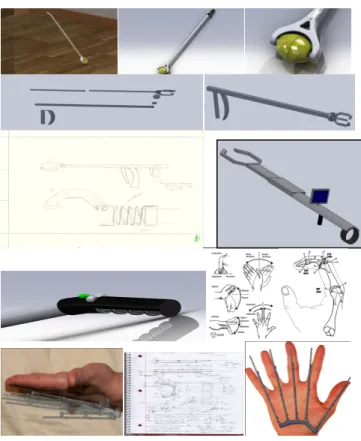
Figure 1. Examples of student ideas: From a novel device, providing navigation assistance to a visually impaired to a mechanical arm for a paraplegic person.
Course Description
Course specific material related to the design of technologies to aid people with disabilities were identified and included in the curriculum. The course specific activities and material were then mapped to desired course development and outcomes.
To increase the quality of learning and writing skills [10], the students were asked to submit and present a design overview report three times during the semester. By the end of the first month, teams formally presented their design ideas, based on customer needs and functional requirements for a possible financial assistance (Figure 1). The proposals from the nine teams were reviewed by a committee consisting of engineering professors and health care professionals. The review criteria of the assistive technology consisted of an overall solution, cost, function, survey of existing technologies, innovation and interaction with the customer. At that level top five design ideas were suggested for a possible financial assistance for prototype fabrication. The ideas were so successful that two of our design teams, out of a total of fifteen chosen nationwide, received financial assistance for prototype development (Figure 2 and Figure 3).
!
P
Figure 2. One of the preliminary designs, chosen for financial assistance: Hand Grip Strength
Assistive Device for a Person with Cerebral Palsy. It will allow easy manipulation of simple objects.
Figure 3. The second preliminary design, chosen for financial assistance: Robotic Device, Attached to
a Wheelchair. It enables a disabled person, confined to a wheelchair to better interact with the
surrounding objects in his workspace.
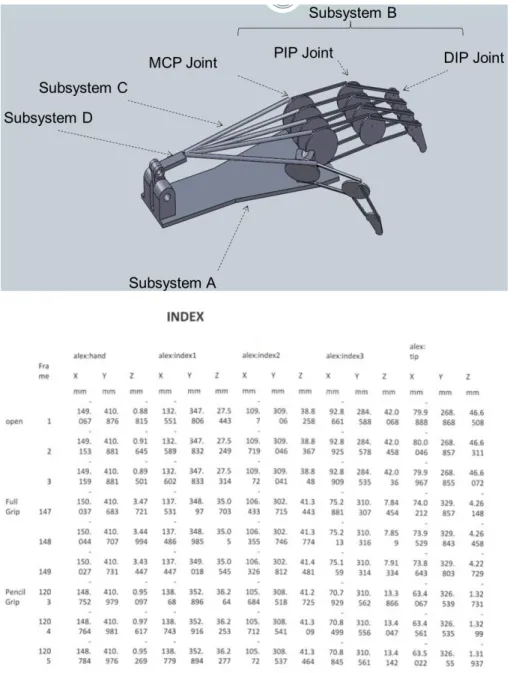
In the mid semester, the teams discussed their progress on the projects, by presenting their conceptual designs. An interesting issue appeared in the design of the hand grip assistive device, shown in Fig. 2. Since the students use four bar linkages for that specific design, the team was not able to optimally design the gripper, so that each finger moves smoothly throughout the desired path. This fact was the reason for a special discussion on parallel assembly of linkages and branching, a fundamental problem in kinematic linkage synthesis. The team was faced with the challenge to: (1) either reshape the coupler movement for non-branching solutions, (2) come up with a new design idea, or (3) get biological data from humans’ arm movement, using a Vicon 3D Motion Capture System, available in our “Human Interactive Robotics Lab” at Texas A&M University. The students eagerly chose the
!
P
latter and reconsidered their design solution, based on the biological data they obtained (see Figure 4).
This example shows the importance of providing students with the opportunity of relating theoretical and analytical results to the real world phenomena, by using leading edge technologies to experience the excitement of ongoing research.
Figure 4. Data from the movement of the index finger of the customer, obtained by the students, using Vicon 3D Motion Capture System, available in our Human Interactive Robotics Lab.
In the end of the semester (December 2010), the students presented their final assistive device design documents. They were reviewed by engineering professors and health-care professionals. The review criteria consisted of overall solution, cost, ease of use and implementation, safety features, quality and accuracy, function, plans for testing and evaluation, as well as innovation. Interactions of each
P
team with the customer/user of the assistive device and with the collaborators were also taken into account.
Assessment
The proposed and implemented for the first time in the Department of Engineering Technology and Industrial Distribution engineering project aims to take the study of mechanical design to the next level by motivating the students with real-world challenges that have a direct result in the lives of disabled people. The students take the theoretical ideas of mechanical design learned in their class and with limited guidance implement them first via a design ideas, conceptual design and finally fabrication of a prototype. The prototype development is the goal of this upcoming semester.
This project was evaluated at the end of the semester. Students were asked for a detailed feedback and recommendations for improvements. The questions were anonymous and the students had to grade their answers on a scale from 1 (poor/low) to 5 (excellent/high). The survey was completed by twenty two students. The median value from the survey was 4. The survey revealed areas that students did not feel comfortable with, such as knowledge in the development of a schedule for manufacturing, plans for testing, as well as identification of features that distinguish their design from the competition. Questions, regarding the student skills necessary to develop system and component requirements, as well as a concept for the design of the complete system, received the highest scores. These areas were part of the curriculum for the mechanical engineering design course and, as such, were skills students were able to utilize towards the project. In the end of the survey the students were given the opportunity to comment on the project. Below are some of the comments:
• “I think that after completing this project, I have a better understanding of the entire design
and manufacturing process”;
• “I view a 5 as near perfect, which is the reason for more of the 4’s”; • “It was a good learning experience”.
Feedback from the collaborators, regarding the teams development, experiences, as well as the industry-defined competency of the developed assistive device were also extremely important during the semester. This provided a partial summative evaluation of the project and the students’ learning. Further summative evaluation of the project, regarding the usability and quality of the products, is expected to be provided by the users of the assistive devices.
Lessons Learned
In order to allow the students and the course to progress to the next level, based on the student’s survey answers it is clear that:
1. Student’s professional skills, such as project management, have to be improved in the future class curriculum.
2. The use of leading edge technologies has to be included in the curricula and mapped to the desired course outcomes. Modern technologies give the students the experience of the on-going research, make engineering design exciting and involve the students to actively participate in the learning process.
Despite the areas to improve on, the project was a huge success. The students were truly interested in the subject matter and began to clearly see the important and needed applications of assistive devices
P
that go beyond the manufacturing process. Each prototype that will be developed will surely demonstrate that our students can make a difference in the lives of their fellow man. What a difference projects like that make in the life of the targeted disabled individuals!
Impacts
Diversity in the workplace is essential in today's society. Individuals with disabilities have much to offer and need just that little boost to push them on their way to a successful and fulfilling career. Likewise, the future generations of engineers must understand that their studies mean something. The implemented project addresses the need for combining analytical and theoretical knowledge with practical hands-on experience, with a particular focus on the field of integration of mechanical design and manufacturing. The goal is to develop assistive devises that will allow disabled individuals to perform tasks that they were otherwise unable to. In just one semester, a course in mechanical design applications at Texas A&M has sparked the first of many young mechanical engineers to begin to design real world solutions that make immediate impact on the society. These students were given the chance and when provided with the right motivation, they excelled.
Based on preliminary data, there can be no doubt that projects like that will not only bring the efforts of faculty working together, encourage and motivate current engineering students to work for a great cause, but will also attract students from a variety of backgrounds and interests to the field of engineering. This semester the students have progressed in the area of mechanical design and development of assistive technologies beyond our expectations. It is readily apparent that a hands-on and directed design theory and application multidisciplinary cross-course integration will be an inspiration for the students, faculty, collaborators, as well as for the end users.
Acknowledgements
The author would like to thank our collaborators from St. Joseph Outpatient Rehabilitation Center, Bryan, TX, as well as the Department of Disability Services at Texas A&M University.
References
1. Tanner C.K., J.L. Keedy and S.A. Galis, “Problem Based Learning: Relating the real-world to principalship Preparation”,
The Clearing House, v.68, n.3, p.154, (1995).
2. Foley R.P., Review of the Literature on PBL in the Clinical Setting”, The Journal of the American Medical Association,
v.278, n.9, p.696B, (1997).
3. Mehta S., “Quantitative and qualitative Assesment of Using PBL in a Mechanical Measurements Class”, Proc. of the
ASEE Annual Conference and Expo, Session 1566, Albuquerque, NM, (2002).
4. Lee L.W. and T. Ceylan, “Implementation of Design in Applied Thermodynamics Course”, Proc. of the ASEE Annual
Conference and Expo, Session 2633, Albuquerque, NM, (2001).
5. Brodeur D.R., Young P.W. and K.B. Blair, “ Problem-based Learning in Aerospace Engineering Education”, Proc. of the
ASEE Annual Conference and Expo, Session 2202, Albuquerque, NM, (2002).
6. Nasr K.J. and B. Ramadan, “Implementation of Problem-based Learning into Engineering Thermodynamics”, Proc. of the
ASEE Annual Conference and Expo, Session 1526, Portland, OR, (2005).
7. Tebbe P., “Brainstorming Exercises as an Active Learning Component of Thermal Systems Courses”, Proc. of the ASEE
Annual Conference and Expo, Session 3533, Portland, OR, (2005).
P
8. P. Cawley, “The Introduction of a Problem-based option into a Conventional Engineering Degree Course”, Studies in Higher Education, v.14, n.1, p.83, (1989).
9. Wang, Fang A., Johnson M., “Enhancing and Assessing Life Long Learning Skills through Capstone Projects”, Journal of
Engineering education, (2008).
10. P.C. Wankat, The Effective Efficient Professor, Allyn and Bacon Co.
P