This work was supported by the Center for Brains, Minds and
Machines (CBMM), funded by NSF STC award CCF-1231216.
CBMM Memo No. 052
August, 2016
Universal Dependencies for Learner English
Published in the Proceedings of ACL 2016
Yevgeni Berzak, Jessica Kenney, Carolyn Spadine, Jing Xian Wang,
Lucia Lam, Keiko Sophie Mori, Sebastian Garza and Boris Katz
We introduce the Treebank of Learner English (TLE), the first publicly available
syntactic treebank for English as a Second Language (ESL). The TLE provides
manually annotated POS tags and Universal Dependency (UD) trees for 5,124
sentences from the Cambridge First Certificate in English (FCE) corpus. The UD
annotations are tied to a pre-existing error annotation of the FCE, whereby full
syntactic analyses are provided for both the original and error corrected versions
of each sentence. Further on, we delineate ESL annotation guidelines that allow
for consistent syntactic treatment of ungrammatical English. Finally, we
benchmark POS tagging and dependency parsing performance on the TLE
dataset and measure the effect of grammatical errors on parsing accuracy. We
envision the treebank to support a wide range of linguistic and computational
research on second language acquisition as well as automatic processing of
ungrammatical language.
Universal Dependencies for Learner English
Yevgeni BerzakCSAIL MIT [email protected]
Jessica Kenney
EECS & Linguistics MIT [email protected]
Carolyn Spadine
Linguistics MIT [email protected]
Jing Xian Wang
EECS MIT [email protected]
Lucia Lam
MECHE MIT [email protected]
Keiko Sophie Mori
Linguistics MIT [email protected] Sebastian Garza Linguistics MIT [email protected] Boris Katz CSAIL MIT [email protected] Abstract
We introduce the Treebank of Learner En-glish (TLE), the first publicly available syntactic treebank for English as a Sec-ond Language (ESL). The TLE provides manually annotated POS tags and Univer-sal Dependency (UD) trees for 5,124 sen-tences from the Cambridge First Certifi-cate in English (FCE) corpus. The UD annotations are tied to a pre-existing er-ror annotation of the FCE, whereby full syntactic analyses are provided for both the original and error corrected versions of each sentence. Further on, we delineate ESL annotation guidelines that allow for consistent syntactic treatment of ungram-matical English. Finally, we benchmark POS tagging and dependency parsing per-formance on the TLE dataset and measure the effect of grammatical errors on parsing accuracy. We envision the treebank to sup-port a wide range of linguistic and compu-tational research on second language ac-quisition as well as automatic processing of ungrammatical language1.
1 Introduction
The majority of the English text available world-wide is generated by non-native speakers (Crys-tal, 2003). Such texts introduce a variety of chal-lenges, most notably grammatical errors, and are of paramount importance for the scientific study of language acquisition as well as for NLP. De-spite the ubiquity of non-native English, there is
1The treebank is available at universaldependencies.org.
The annotation manual used in this project and a graphical query engine are available at esltreebank.org.
currently no publicly available syntactic treebank for English as a Second Language (ESL).
To address this shortcoming, we present the Treebank of Learner English (TLE), a first of its kind resource for non-native English, contain-ing 5,124 sentences manually annotated with POS tags and dependency trees. The TLE sentences are drawn from the FCE dataset (Yannakoudakis et al., 2011), and authored by English learners from 10 different native language backgrounds. The tree-bank uses the Universal Dependencies (UD) for-malism (De Marneffe et al., 2014; Nivre et al., 2016), which provides a unified annotation frame-work across different languages and is geared to-wards multilingual NLP (McDonald et al., 2013). This characteristic allows our treebank to sup-port computational analysis of ESL using not only English based but also multilingual approaches which seek to relate ESL phenomena to native lan-guage syntax.
While the annotation inventory and guidelines are defined by the English UD formalism, we build on previous work in learner language anal-ysis (Dıaz-Negrillo et al., 2010; Dickinson and Ragheb, 2013) to formulate an additional set of annotation conventions aiming at a uniform treat-ment of ungrammatical learner language. Our annotation scheme uses a two-layer analysis, whereby a distinct syntactic annotation is pro-vided for the original and the corrected version of each sentence. This approach is enabled by a pre-existing error annotation of the FCE (Nicholls, 2003) which is used to generate an error corrected variant of the dataset. Our inter-annotator agree-ment results provide evidence for the ability of the annotation scheme to support consistent annota-tion of ungrammatical structures.
Finally, a corpus that is annotated with both grammatical errors and syntactic dependencies paves the way for empirical investigation of the relation between grammaticality and syntax. Un-derstanding this relation is vital for improving tag-ging and parsing performance on learner language (Geertzen et al., 2013), syntax based grammati-cal error correction (Tetreault et al., 2010; Ng et al., 2014), and many other fundamental challenges in NLP. In this work, we take the first step in this direction by benchmarking tagging and pars-ing accuracy on our dataset under different train-ing regimes, and obtaintrain-ing several estimates for the impact of grammatical errors on these tasks.
To summarize, this paper presents three contri-butions. First, we introduce the first large scale syntactic treebank for ESL, manually annotated with POS tags and universal dependencies. Sec-ond, we describe a linguistically motivated anno-tation scheme for ungrammatical learner English and provide empirical support for its consistency via inter-annotator agreement analysis. Third, we benchmark a state of the art parser on our dataset and estimate the influence of grammatical errors on the accuracy of automatic POS tagging and de-pendency parsing.
The remainder of this paper is structured as fol-lows. We start by presenting an overview of the treebank in section 2. In sections 3 and 4 we provide background information on the annota-tion project, and review the main annotaannota-tion stages leading to the current form of the dataset. The ESL annotation guidelines are summarized in section 5. Inter-annotator agreement analysis is presented in section 6, followed by parsing experiments in sec-tion 7. Finally, we review related work in secsec-tion 8 and present the conclusion in section 9.
2 Treebank Overview
The TLE currently contains 5,124 sentences (97,681 tokens) with POS tag and dependency an-notations in the English Universal Dependencies (UD) formalism (De Marneffe et al., 2014; Nivre et al., 2016). The sentences were obtained from the FCE corpus (Yannakoudakis et al., 2011), a collection of upper intermediate English learner essays, containing error annotations with 75 error categories (Nicholls, 2003). Sentence level seg-mentation was performed using an adaptation of the NLTK sentence tokenizer2. Under-segmented
2http://www.nltk.org/api/nltk.tokenize.html
sentences were split further manually. Word level tokenization was generated using the Stanford PTB word tokenizer3.
The treebank represents learners with 10 dif-ferent native language backgrounds: Chinese, French, German, Italian, Japanese, Korean, Por-tuguese, Spanish, Russian and Turkish. For every native language, we randomly sampled 500 au-tomatically segmented sentences, under the con-straint that selected sentences have to contain at least one grammatical error that is not punctuation or spelling.
The TLE annotations are provided in two ver-sions. The first version is theoriginal sentence au-thored by the learner, containing grammatical er-rors. The second,corrected sentenceversion, is a grammatical variant of the original sentence, gen-erated by correcting all the grammatical errors in the sentence according to the manual error anno-tation provided in the FCE dataset. The resulting corrected sentences constitute a parallel corpus of standard English. Table 1 presents basic statistics of both versions of the annotated sentences.
original corrected
sentences 5,124 5,124
tokens 97,681 98,976
sentence length 19.06 (std 9.47) 19.32 (std 9.59) errors per sentence 2.67 (std 1.9)
-authors 924
native languages 10
Table 1: Statistics of the TLE. Standard deviations are denoted in parenthesis.
To avoid potential annotation biases, the anno-tations of the treebank were created manuallyfrom scratch, without utilizing any automatic annota-tion tools. To further assure annotaannota-tion quality, each annotated sentence was reviewed by two ad-ditional annotators. To the best of our knowledge, TLE is the first large scale English treebank con-structed in a completely manual fashion.
3 Annotator Training
The treebank was annotated by six students, five undergraduates and one graduate. Among the un-dergraduates, three are linguistics majors and two are engineering majors with a linguistic minor. The graduate student is a linguist specializing in syntax. An additional graduate student in NLP participated in the final debugging of the dataset.
Prior to annotating the treebank sentences, the annotators were trained for about 8 weeks. Dur-ing the trainDur-ing, the annotators attended tutorials on dependency grammars, and learned the English UD guidelines4, the Penn Treebank POS guide-lines (Santorini, 1990), the grammatical error an-notation scheme of the FCE (Nicholls, 2003), as well as the ESL guidelines described in section 5 and in the annotation manual.
Furthermore, the annotators completed six an-notation exercises, in which they were required to annotate POS tags and dependencies for practice sentences from scratch. The exercises were done individually, and were followed by group meet-ings in which annotation disagreements were dis-cussed and resolved. Each of the first three exer-cises consisted of 20 sentences from the UD gold standard for English, the English Web Treebank (EWT) (Silveira et al., 2014). The remaining three exercises contained 20-30 ESL sentences from the FCE. Many of the ESL guidelines were introduced or refined based on the disagreements in the ESL practice exercises and the subsequent group dis-cussions. Several additional guidelines were in-troduced in the course of the annotation process.
During the training period, the annotators also learned to use a search tool that enables formulat-ing queries over word and POS tag sequences as regular expressions and obtaining their annotation statistics in the EWT. After experimenting with both textual and graphical interfaces for perform-ing the annotations, we converged on a simple text based format described in section 4.1, where the annotations were filled in using a spreadsheet or a text editor, and tested with a script for detect-ing annotation typos. The annotators continued to meet and discuss annotation issues on a weekly basis throughout the entire duration of the project.
4 Annotation Procedure
The formation of the treebank was carried out in four steps: annotation, review, disagreement reso-lution and targeted debugging.
4.1 Annotation
In the first stage, the annotators were given sen-tences for annotation from scratch. We use a CoNLL based textual template in which each word is annotated in a separate line. Each line contains 6 columns, the first of which has the word index
4http://universaldependencies.org/#en
(IND) and the second the word itself (WORD). The remaining four columns had to be filled in with a Universal POS tag (UPOS), a Penn Tree-bank POS tag (POS), a head word index (HIND) and a dependency relation (REL) according to ver-sion 1 of the English UD guidelines.
The annotation section of the sentence is pre-ceded by a metadata header. The first field in this header, denoted with SENT, contains the FCE er-ror coded version of the sentence. The annotators were instructed to verify the error annotation, and add new error annotations if needed. Corrections to the sentence segmentation are specified in the SEGMENT field5. Further down, the field TYPO is designated for literal annotation of spelling er-rors and ill formed words that happen to form valid words (see section 5.2).
The example below presents a pre-annotated original sentence given to an annotator.
#SENT=That time I had to sleep in <ns type= "MD"><c>a</c></ns> tent.
#SEGMENT= #TYPO=
#IND WORD UPOS POS HIND REL
1 That 2 time 3 I 4 had 5 to 6 sleep 7 in 8 tent 9 .
Upon completion of the original sentence, the annotators proceeded to annotate the corrected sentence version. To reduce annotation time, an-notators used a script that copies over annotations from the original sentence and updates head in-dices of tokens that appear in both sentence ver-sions. Head indices and relation labels were filled in only if the head word of the token appeared in both the original and corrected sentence versions. Tokens with automatically filled annotations in-cluded an additional # sign in a seventh column of each word’s annotation. The # signs had to be removed, and the corresponding annotations ei-ther approved or changed as appropriate. Tokens that did not appear in the original sentence version were annotated from scratch.
5
The released version of the treebank splits the sentences according to the markings in the SEGMENT field when those apply both to the original and corrected versions of the sen-tence. Resulting segments without grammatical errors in the original version are currently discarded.
4.2 Review
All annotated sentences were randomly assigned to a second annotator (henceforthreviewer), in a double blind manner. The reviewer’s task was to mark all the annotations that they would have an-notated differently. To assist the review process, we compiled a list of common annotation errors, available in the released annotation manual.
The annotations were reviewed using anactive
editing scheme in which an explicit action was re-quired for all the existing annotations. The scheme was introduced to prevent reviewers from over-looking annotation issues due to passive approval. Specifically, an additional # sign was added at the seventh column of each token’s annotation. The reviewer then had to either “sign off” on the exist-ing annotation by erasexist-ing the # sign, or provide an alternative annotation following the # sign.
4.3 Disagreement Resolution
In the final stage of the annotation process all annotator-reviewer disagreements were resolved by a third annotator (henceforth judge), whose main task was to decide in favor of the annotator or the reviewer. Similarly to the review process, the judging task was carried out in a double blind manner. Judges were allowed to resolve annotator-reviewer disagreements with a third alternative, as well as introduce new corrections for annotation issues overlooked by the reviewers.
Another task performed by the judges was to mark acceptable alternative annotations for am-biguous structures determined through review dis-agreements or otherwise present in the sentence. These annotations were specified in an additional metadata field called AMBIGUITY. The ambigu-ity markings are provided along with the resolved version of the annotations.
4.4 Final Debugging
After applying the resolutions produced by the judges, we queried the corpus with debugging tests for specific linguistics constructions. This additional testing phase further reduced the num-ber of annotation errors and inconsistencies in the treebank. Including the training period, the tree-bank creation lasted over a year, with an aggregate of more than 2,000 annotation hours.
5 Annotation Scheme for ESL
Our annotations use the existing inventory of En-glish UD POS tags and dependency relations, and follow the standard UD annotation guidelines for English. However, these guidelines were for-mulated with grammatical usage of English in mind and do not cover non canonical syntactic structures arising due to grammatical errors6. To encourage consistent and linguistically motivated annotation of such structures, we formulated a complementary set of ESL annotation guidelines.
Our ESL annotation guidelines follow the gen-eral principle ofliteral reading, which emphasizes syntactic analysis according to the observed lan-guage usage. This strategy continues a line of work in SLA which advocates for centering analy-sis of learner language around morpho-syntactic surface evidence (Ragheb and Dickinson, 2012; Dickinson and Ragheb, 2013). Similarly to our framework, which includes a parallel annotation of corrected sentences, such strategies are often presented in the context of multi-layer annota-tion schemes that also account for error corrected sentence forms (Hirschmann et al., 2007; Dıaz-Negrillo et al., 2010; Rosen et al., 2014).
Deploying a strategy of literal annotation within UD, a formalism which enforces cross-linguistic consistency of annotations, will enable meaning-ful comparisons between non-canonical structures in English and canonical structures in the author’s native language. As a result, a key novel character-istic of our treebank is its ability to support cross-lingual studies of learner language.
5.1 Literal Annotation
With respect to POS tagging, literal annotation im-plies adhering as much as possible to the observed morphological forms of the words. Syntactically, argument structure is annotated according to the usage of the word rather than its typical distribu-tion in the relevant context. The following list of conventions defines the notion of literal reading for some of the common non canonical structures associated with grammatical errors.
Argument Structure
Extraneous prepositionsWe annotate all nominal
dependents introduced by extraneous prepositions
6The English UD guidelines do address several issues
en-countered in informal genres, such as the relation “goeswith”, which is used for fragmented words resulting from typos.
as nominal modifiers. In the following sentence, “him” is marked as a nominal modifier (nmod) in-stead of an indirect object (iobj) of “give”.
#SENT=...I had to give <ns type="UT"><i>to</i> </ns> him water...
...
21 I PRON PRP 22 nsubj
22 had VERB VBD 5 parataxis
23 to PART TO 24 mark
24 give VERB VB 22 xcomp
25 to ADP IN 26 case
26 him PRON PRP 24 nmod
27 water NOUN NN 24 dobj
...
Omitted prepositions We treat nominal
depen-dents of a predicate that are lacking a preposition as arguments rather than nominal modifiers. In the example below, “money” is marked as a direct ob-ject (dobj) instead of a nominal modifier (nmod) of “ask”. As “you” functions in this context as a second argument of “ask”, it is annotated as an in-direct object (iobj) instead of a direct object (dobj).
#SENT=...I have to ask you <ns type="MT"> <c>for</c></ns> the money <ns type= "RT"> <i>of</i><c>for</c></ns> the tickets back. ...
12 I PRON PRP 13 nsubj
13 have VERB VBP 2 conj
14 to PART TO 15 mark
15 ask VERB VB 13 xcomp
16 you PRON PRP 15 iobj
17 the DET DT 18 det
18 money NOUN NN 15 dobj
19 of ADP IN 21 case
20 the DET DT 21 det
21 tickets NOUN NNS 18 nmod
22 back ADV RB 15 advmod
23 . PUNCT . 2 punct
Tense
Cases of erroneous tense usage are annotated ac-cording to the morphological tense of the verb. For example, below we annotate “shopping” with present participle VBG, while the correction “shop” is annotated in the corrected version of the sentence as VBP.
#SENT=...when you <ns type="TV"><i>shopping</i> <c>shop</c></ns>...
...
4 when ADV WRB 6 advmod
5 you PRON PRP 6 nsubj
6 shopping VERB VBG 12 advcl ...
Word Formation
Erroneous word formations that are contextually plausible and can be assigned with a PTB tag are annotated literally. In the following example, “stuffs” is handled as a plural count noun.
#SENT=...into fashionable <ns type="CN"> <i>stuffs</i><c>stuff</c></ns>... ...
7 into ADP IN 9 case
8 fashionable ADJ JJ 9 amod
9 stuffs NOUN NNS 2 ccomp ...
Similarly, in the example below we annotate “necessaryiest” as a superlative.
#SENT=The necessaryiest things...
1 The DET DT 3 det
2 necessaryiest ADJ JJS 3 amod
3 things NOUN NNS 0 root
...
5.2 Exceptions to Literal Annotation
Although our general annotation strategy for ESL follows literal sentence readings, several types of word formation errors make such readings unin-formative or impossible, essentially forcing cer-tain words to be annotated using some degree of interpretation (Ros´en and De Smedt, 2010). We hence annotate the following cases in the original sentence according to an interpretation of an in-tended word meaning, obtained from the FCE er-ror correction.
Spelling
Spelling errors are annotated according to the cor-rectly spelled version of the word. To support error analysis of automatic annotation tools, misspelled words that happen to form valid words are anno-tated in the metadata field TYPO for POS tags with respect to the most common usage of the misspelled word form. In the example below, the TYPO field contains the typical POS annotation of “where”, which is clearly unintended in the con-text of the sentence.
#SENT=...we <ns type="SX"><i>where</i> <c>were</c></ns> invited to visit...
#TYPO=5 ADV WRB
...
4 we PRON PRP 6 nsubjpass
5 where AUX VBD 6 auxpass
6 invited VERB VBN 0 root
7 to PART TO 8 mark
8 visit VERB VB 6 xcomp
...
Word Formation
Erroneous word formations that cannot be as-signed with an existing PTB tag are annotated with respect to the correct word form.
#SENT=I am <ns type="IV"><i>writting</i> <c>writing</c></ns>...
1 I PRON PRP 3 nsubj
2 am AUX VBP 3 aux
3 writting VERB VBG 0 root ...
In particular, ill formed adjectives that have a plural suffix receive a standard adjectival POS tag. When applicable, such cases also receive an addi-tional marking for unnecessary agreement in the error annotation using the attribute “ua”.
#SENT=...<ns type="IJ" ua=true>
...
6 interestings ADJ JJ 7 amod
7 things NOUN NNS 3 dobj
...
Wrong word formations that result in a valid, but contextually implausible word form are also annotated according to the word correction. In the example below, the nominal form “sale” is likely to be an unintended result of an ill formed verb. Similarly to spelling errors that result in valid words, we mark the typical literal POS an-notation in the TYPO metadata field.
#SENT=...they do not <ns type="DV"><i>sale</i> <c>sell</c></ns> them...
#TYPO=15 NOUN NN
...
12 they PRON PRP 15 nsubj
13 do AUX VBP 15 aux
14 not PART RB 15 neg
15 sale VERB VB 0 root
16 them PRON PRP 15 dobj
...
Taken together, our ESL conventions cover many of the annotation challenges related to gram-matical errors present in the TLE. In addition to the presented overview, the complete manual of ESL guidelines used by the annotators is pub-licly available. The manual contains further details on our annotation scheme, additional annotation guidelines and a list of common annotation errors. We plan to extend and refine these guidelines in future releases of the treebank.
6 Editing Agreement
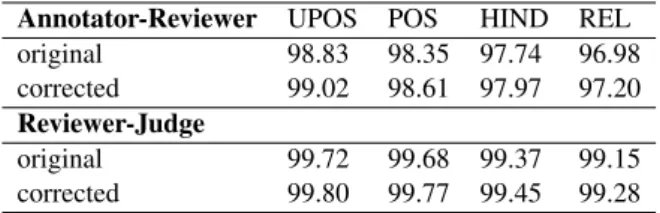
We utilize our two step review process to estimate agreement rates between annotators7. We measure agreement as the fraction of annotation tokens ap-proved by the editor. Table 2 presents the agree-ment between annotators and reviewers, as well as the agreement between reviewers and the judges. Agreement measurements are provided for both the original the corrected versions of the dataset.
Overall, the results indicate a high agreement rate in the two editing tasks. Importantly, the gap between the agreement on the original and cor-rected sentences is small. Note that this result is obtained despite the introduction of several ESL annotation guidelines in the course of the annota-tion process, which inevitably increased the num-ber of edits related to grammatical errors. We in-terpret this outcome as evidence for the effective-ness of the ESL annotation scheme in supporting consistent annotations of learner language.
7All experimental results on agreement and parsing
ex-clude punctuation tokens.
Annotator-Reviewer UPOS POS HIND REL original 98.83 98.35 97.74 96.98 corrected 99.02 98.61 97.97 97.20
Reviewer-Judge
original 99.72 99.68 99.37 99.15 corrected 99.80 99.77 99.45 99.28 Table 2: Inter-annotator agreement on the entire TLE corpus. Agreement is measured as the frac-tion of tokens that remain unchanged after an edit-ing round. The four evaluation columns corre-spond to universal POS tags, PTB POS tags, un-labeled attachment, and dependency labels. Co-hen’s Kappa scores (Cohen, 1960) for POS tags and dependency labels in all evaluation conditions are above 0.96.
7 Parsing Experiments
The TLE enables studying parsing for learner lan-guage and exploring relationships between gram-matical errors and parsing performance. Here, we present parsing benchmarks on our dataset, and provide several estimates for the extent to which grammatical errors degrade the quality of auto-matic POS tagging and dependency parsing.
Our first experiment measures tagging and pars-ing accuracy on the TLE and approximates the global impact of grammatical errors on automatic annotation via performance comparison between the original and error corrected sentence versions. In this, and subsequent experiments, we utilize version 2.2 of the Turbo tagger and Turbo parser (Martins et al., 2013), state of the art tools for sta-tistical POS tagging and dependency parsing.
Table 3 presents tagging and parsing results on a test set of 500 TLE sentences (9,591 original to-kens, 9,700 corrected tokens). Results are pro-vided for three different training regimes. The first regime uses the training portion of version 1.3 of the EWT, the UD English treebank, contain-ing 12,543 sentences (204,586 tokens). The sec-ond training mode uses 4,124 training sentences (78,541 original tokens, 79,581 corrected tokens) from the TLE corpus. In the third setup we com-bine these two training corpora. The remaining 500 TLE sentences (9,549 original tokens, 9,695 corrected tokens) are allocated to a development set, not used in this experiment. Parsing of the test sentences was performed on predicted POS tags.
The EWT training regime, which uses out of do-main texts written in standard English, provides the lowest performance on all the evaluation
met-Test set Train Set UPOS POS UAS LA LAS
TLEorig EWT 91.87 94.28 86.51 88.07 81.44
TLEcorr EWT 92.9 95.17 88.37 89.74 83.8
TLEorig TLEorig 95.88 94.94 87.71 89.26 83.4
TLEcorr TLEcorr 96.92 95.17 89.69 90.92 85.64
TLEorig EWT+TLEorig 93.33 95.77 90.3 91.09 86.27
TLEcorr EWT+TLEcorr 94.27 96.48 92.15 92.54 88.3
Table 3: Tagging and parsing results on a test set of 500 sentences from the TLE corpus. EWT is the English UD treebank. TLEorig are original
sen-tences from the TLE. TLEcorrare the
correspond-ing error corrected sentences.
rics. An additional factor which negatively af-fects performance in this regime are systematic differences in the EWT annotation of possessive pronouns, expletives and names compared to the UD guidelines, which are utilized in the TLE. In particular, the EWT annotates possessive pronoun UPOS as PRON rather than DET, which leads the UPOS results in this setup to be lower than the PTB POS results. Improved results are obtained using the TLE training data, which, despite its smaller size, is closer in genre and syntactic char-acteristics to the TLE test set. The strongest PTB POS tagging and parsing results are obtained by combining the EWT with the TLE training data, yielding 95.77 POS accuracy and a UAS of 90.3 on the original version of the TLE test set.
The dual annotation of sentences in their orig-inal and error corrected forms enables estimating the impact of grammatical errors on tagging and parsing by examining the performance gaps be-tween the two sentence versions. Averaged across the three training conditions, the POS tagging ac-curacy on the original sentences is lower than the accuracy on the sentence corrections by 1.0 UPOS and 0.61 POS. Parsing performance degrades by 1.9 UAS, 1.59 LA and 2.21 LAS.
To further elucidate the influence of grammati-cal errors on parsing quality, table 4 compares per-formance on tokens in the original sentences pearing inside grammatical error tags to those ap-pearing outside such tags. Although grammatical errors may lead to tagging and parsing errors with respect to any element in the sentence, we expect erroneous tokens to be more challenging to ana-lyze compared to grammatical tokens.
This comparison indeed reveals a substantial difference between the two types of tokens, with an average gap of 5.0 UPOS, 6.65 POS, 4.67 UAS, 6.56 LA and 7.39 LAS. Note that differently from
Tokens Train Set UPOS POS UAS LA LAS
Ungrammatical EWT 87.97 88.61 82.66 82.66 74.93 Grammatical EWT 92.62 95.37 87.26 89.11 82.7 Ungrammatical TLEorig 90.76 88.68 83.81 83.31 77.22 Grammatical TLEorig 96.86 96.14 88.46 90.41 84.59 Ungrammatical EWT+TLEorig 89.76 90.97 86.32 85.96 80.37 Grammatical EWT+TLEorig 94.02 96.7 91.07 92.08 87.41
Table 4: Tagging and parsing results on the origi-nal version of the TLE test set for tokens marked with grammatical errors (Ungrammatical) and to-kens not marked for errors (Grammatical).
the global measurements in the first experiment, this analysis, which focuses on the local impact of remove/replace errors, suggests a stronger ef-fect of grammatical errors on the dependency la-bels than on the dependency structure.
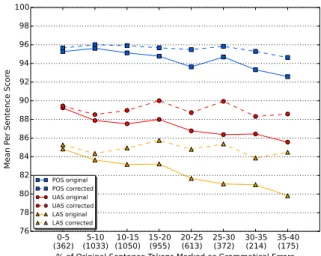
Finally, we measure tagging and parsing perfor-mance relative to the fraction of sentence tokens marked with grammatical errors. Similarly to the previous experiment, this analysis focuses on re-move/replace rather than insert errors.
0-5
(362) (1033)5-10 (1050)10-15 15-20(955) 20-25(613) 25-30(372) 30-35(214) 35-40(175) % of Original Sentence Tokens Marked as Grammatical Errors 76 78 80 82 84 86 88 90 92 94 96 98 100 Me an Pe r S en ten ce Sc ore POS original POS corrected UAS original UAS corrected LAS original LAS corrected
Figure 1: Mean per sentence POS accuracy, UAS and LAS of the Turbo tagger and Turbo parser, as a function of the percentage of original sentence tokens marked with grammatical errors. The tag-ger and the parser are trained on the EWT cor-pus, and tested on all 5,124 sentences of the TLE. Points connected by continuous lines denote per-formance on the original TLE sentences. Points connected by dashed lines denote performance on the corresponding error corrected sentences. The number of sentences whose errors fall within each percentage range appears in parenthesis.
Figure 1 presents the average sentential perfor-mance as a function of the percentage of tokens in the original sentence marked with
grammati-cal errors. In this experiment, we train the parser on the EWT training set and test on the entire TLE corpus. Performance curves are presented for POS, UAS and LAS on the original and error corrected versions of the annotations. We observe that while the performance on the corrected sen-tences is close to constant, original sentence pformance is decreasing as the percentage of the er-roneous tokens in the sentence grows.
Overall, our results suggest a negative, albeit limited effect of grammatical errors on parsing. This outcome contrasts a study by Geertzen et al. (2013) which reported a larger performance gap of 7.6 UAS and 8.8 LAS between sentences with and without grammatical errors. We believe that our analysis provides a more accurate estimate of this impact, as it controls for both sentence content and sentence length. The latter factor is crucial, since it correlates positively with the number of gram-matical errors in the sentence, and negatively with parsing accuracy.
8 Related Work
Previous studies on learner language proposed several annotation schemes for both POS tags and syntax (Hirschmann et al., 2007; Dıaz-Negrillo et al., 2010; Dickinson and Ragheb, 2013; Rosen et al., 2014). The unifying theme in these proposals is a multi-layered analysis aiming to decouple the observed language usage from conventional struc-tures in the foreign language.
In the context of ESL, Dıaz et al. (2010) pro-pose three parallel POS tag annotations for the
lexical,morphologicalanddistributionalforms of each word. In our work, we adopt the distinc-tion between morphological word forms, which roughly correspond to our literal word readings, and distributional forms as the error corrected words. However, we account for morphological forms only when these constitute valid existing PTB POS tags and are contextually plausible. Fur-thermore, while the internal structure of invalid word forms is an interesting object of investiga-tion, we believe that it is more suitable for anno-tation as word features rather than POS tags. Our treebank supports the addition of such features to the existing annotations.
The work of Ragheb and Dickinson (2009; 2012; 2013) proposes ESL annotation guidelines for POS tags and syntactic dependencies based on the CHILDES annotation framework. This
ap-proach, called “morphosyntactic dependencies” is related to our annotation scheme in its focus on surface structures. Differently from this proposal, our annotations are grounded in a parallel anno-tation of grammatical errors and include an ad-ditional layer of analysis for the corrected forms. Moreover, we refrain from introducing new syn-tactic categories and dependency relations specific to ESL, thereby supporting computational treat-ment of ESL using existing resources for standard English. At the same time, we utilize a multilin-gual formalism which, in conjunction with our lit-eral annotation strategy, facilitates linking the an-notations to native language syntax.
While the above mentioned studies focus on an-notation guidelines, attention has also been drawn to the topic of parsing in the learner language do-main. However, due to the shortage of syntactic resources for ESL, much of the work in this area resorted to using surrogates for learner data. For example, in Foster (2007) and Foster et al. (2008) parsing experiments are carried out on synthetic learner-like data, that was created by automatic in-sertion of grammatical errors to well formed En-glish text. In Cahill et al. (2014) a treebank of sec-ondary level native students texts was used to ap-proximate learner text in order to evaluate a parser that utilizes unlabeled learner data.
Syntactic annotations for ESL were previously developed by Nagata et al. (2011), who annotate an English learner corpus with POS tags and low syntactic parses. Our work departs from shal-low syntax to full syntactic analysis, and provides annotations on a significantly larger scale. Fur-thermore, differently from this annotation effort, our treebank covers a wide range of learner na-tive languages. An additional syntactic dataset for ESL, currently not available publicly, are 1,000 sentences from the EFCamDat dataset (Geertzen et al., 2013), annotated with Stanford dependen-cies (De Marneffe and Manning, 2008). This dataset was used to measure the impact of gram-matical errors on parsing by comparing perfor-mance on sentences with grammatical errors to er-ror free sentences. The TLE enables a more direct way of estimating the magnitude of this perfor-mance gap by comparing perforperfor-mance on the same sentences in their original and error corrected ver-sions. Our comparison suggests that the effect of grammatical errors on parsing is smaller that the one reported in this study.
9 Conclusion
We present the first large scale treebank of learner language, manually annotated and double-reviewed for POS tags and universal dependen-cies. The annotation is accompanied by a linguis-tically motivated framework for handling syntactic structures associated with grammatical errors. Fi-nally, we benchmark automatic tagging and pars-ing on our corpus, and measure the effect of gram-matical errors on tagging and parsing quality. The treebank will support empirical study of learner syntax in NLP, corpus linguistics and second lan-guage acquisition.
10 Acknowledgements
We thank Anna Korhonen for helpful discussions and insightful comments on this paper. We also thank Dora Alexopoulou, Andrei Barbu, Markus Dickinson, Sue Felshin, Jeroen Geertzen, Yan Huang, Detmar Meurers, Sampo Pyysalo, Roi Re-ichart and the anonymous reviewers for valuable feedback on this work. This material is based upon work supported by the Center for Brains, Minds, and Machines (CBMM), funded by NSF STC award CCF-1231216.
References
Aoife Cahill, Binod Gyawali, and James V Bruno.
2014. Self-training for parsing learner text. In
Proceedings of the First Joint Workshop on Statisti-cal Parsing of MorphologiStatisti-cally Rich Languages and
Syntactic Analysis of Non-Canonical Languages,
pages 66–73.
Jacob Cohen. 1960. A Coefficient of Agreement for
Nominal Scales. Educational and Psychological
Measurement, 20(1):37.
David Crystal. 2003. English as a global language.
Ernst Klett Sprachen.
Marie-Catherine De Marneffe and Christopher D Man-ning. 2008. Stanford typed dependencies manual. Technical report, Technical report, Stanford Univer-sity.
Marie-Catherine De Marneffe, Timothy Dozat, Na-talia Silveira, Katri Haverinen, Filip Ginter, Joakim Nivre, and Christopher D Manning. 2014. Univer-sal stanford dependencies: A cross-linguistic
typol-ogy. InProceedings of LREC, pages 4585–4592.
Ana Dıaz-Negrillo, Detmar Meurers, Salvador Valera, and Holger Wunsch. 2010. Towards interlanguage pos annotation for effective learner corpora in sla
and flt.Language Forum, 36(1–2):139–154.
Markus Dickinson and Marwa Ragheb. 2009.
Depen-dency annotation for learner corpora. In
Proceed-ings of the Eighth Workshop on Treebanks and Lin-guistic Theories (TLT-8), pages 59–70.
Markus Dickinson and Marwa Ragheb. 2013. Annota-tion for learner English guidelines, v. 0.1. Technical report, Indiana University, Bloomington, IN, June. June 9, 2013.
Jennifer Foster, Joachim Wagner, and Josef Van Gen-abith. 2008. Adapting a wsj-trained parser to
gram-matically noisy text. In Proceedings of the 46th
Annual Meeting of the Association for Computa-tional Linguistics on Human Language Technolo-gies: Short Papers, pages 221–224. Association for Computational Linguistics.
Jennifer Foster. 2007. Treebanks gone bad.
Interna-tional Journal of Document Analysis and Recogni-tion (IJDAR), 10(3-4):129–145.
Jeroen Geertzen, Theodora Alexopoulou, and Anna Korhonen. 2013. Automatic linguistic annotation of large scale l2 databases: The ef-cambridge open language database (efcamdat). InProceedings of the 31st Second Language Research Forum. Somerville,
MA: Cascadilla Proceedings Project.
Hagen Hirschmann, Seanna Doolittle, and Anke
L¨udeling. 2007. Syntactic annotation of
non-canonical linguistic structures.
Andr´e FT Martins, Miguel Almeida, and Noah A Smith. 2013. Turning on the turbo: Fast third-order
non-projective turbo parsers. In ACL (2), pages
617–622. Citeseer.
Ryan T McDonald, Joakim Nivre, Yvonne Quirmbach-Brundage, Yoav Goldberg, Dipanjan Das, Kuzman Ganchev, Keith B Hall, Slav Petrov, Hao Zhang, Oscar T¨ackstr¨om, et al. 2013. Universal
depen-dency annotation for multilingual parsing. InACL
(2), pages 92–97. Citeseer.
Ryo Nagata, Edward Whittaker, and Vera
Shein-man. 2011. Creating a manually error-tagged
and shallow-parsed learner corpus. In
Proceed-ings of the 49th Annual Meeting of the Association for Computational Linguistics: Human Language
Technologies-Volume 1, pages 1210–1219.
Associ-ation for ComputAssoci-ational Linguistics.
Hwee Tou Ng, Siew Mei Wu, Ted Briscoe, Christian Hadiwinoto, Raymond Hendy Susanto, and
Christo-pher Bryant. 2014. The conll-2014 shared task
on grammatical error correction. InCoNLL Shared
Task, pages 1–14.
Diane Nicholls. 2003. The cambridge learner corpus: Error coding and analysis for lexicography and elt.
InProceedings of the Corpus Linguistics 2003
Joakim Nivre, Marie-Catherine de Marneffe, Filip Gin-ter, Yoav Goldberg, Jan Hajiˇc, Christopher Man-ning, Ryan McDonald, Slav Petrov, Sampo Pyysalo, Natalia Silveira, et al. 2016. Universal dependen-cies v1: A multilingual treebank collection. In Pro-ceedings of the 10th International Conference on
Language Resources and Evaluation (LREC 2016).
Marwa Ragheb and Markus Dickinson. 2012. Defin-ing syntax for learner language annotation. In COL-ING (Posters), pages 965–974.
Victoria Ros´en and Koenraad De Smedt. 2010.
Syn-tactic annotation of learner corpora. Systematisk,
variert, men ikke tilfeldig, pages 120–132.
Alexandr Rosen, Jirka Hana, Barbora ˇStindlov´a, and Anna Feldman. 2014. Evaluating and automating
the annotation of a learner corpus. Language
Re-sources and Evaluation, 48(1):65–92.
Beatrice Santorini. 1990. Part-of-speech tagging
guidelines for the penn treebank project (3rd revi-sion).Technical Reports (CIS).
Natalia Silveira, Timothy Dozat, Marie-Catherine de Marneffe, Samuel R Bowman, Miriam Connor, John Bauer, and Christopher D Manning. 2014. A
gold standard dependency corpus for english. In
Proceedings of the Ninth International Conference on Language Resources and Evaluation (LREC-2014).
Joel Tetreault, Jennifer Foster, and Martin Chodorow. 2010. Using parse features for preposition selection and error detection. InProceedings of the acl 2010
conference short papers, pages 353–358.
Associa-tion for ComputaAssocia-tional Linguistics.
Helen Yannakoudakis, Ted Briscoe, and Ben Medlock. 2011. A new dataset and method for automatically