Who uses emoticons? Data from 86 702 Facebook users
Article (Accepted Version)
http://sro.sussex.ac.uk
Oleszkiewicz, Anna, Karwowski, Maciej, Pisanski, Katarzyna, Sorokowski, Piotr, Sobrado, Boaz and Sorokowska, Agnieszka (2017) Who uses emoticons? Data from 86 702 Facebook users. Personality and Individual Differences, 119. pp. 289-295. ISSN 0191-8869
This version is available from Sussex Research Online: http://sro.sussex.ac.uk/id/eprint/70862/ This document is made available in accordance with publisher policies and may differ from the published version or from the version of record. If you wish to cite this item you are advised to consult the publisher’s version. Please see the URL above for details on accessing the published version.
Copyright and reuse:
Sussex Research Online is a digital repository of the research output of the University.
Copyright and all moral rights to the version of the paper presented here belong to the individual author(s) and/or other copyright owners. To the extent reasonable and practicable, the material made available in SRO has been checked for eligibility before being made available.
Copies of full text items generally can be reproduced, displayed or performed and given to third parties in any format or medium for personal research or study, educational, or not-for-profit purposes without prior permission or charge, provided that the authors, title and full bibliographic details are credited, a hyperlink and/or URL is given for the original metadata page and the content is not changed in any way.
Who uses emoticons? Data from 86 702 Facebook users
Anna Oleszkiewicz1,2, Maciej Karwowski1, Katarzyna Pisanski1,3, Piotr Sorokowski1, Boaz Sobrado4, Agnieszka Sorokowska1,5
1 – Institute of Psychology, University of Wroclaw, ul. Dawida 1, 50-527, Wroclaw, Poland 2 – Smell and Taste Centre, TU Dresden, Fetscherstraße 74, 01307, Dresden, Germany 3 – Mammal Vocal Communication and Cognition Research Group, School of Psychology, University of Sussex, BN1 9QH, Brighton, UK
4 – Faculty of Social and Behavioural Sciences
, Utrecht University, Padualaan 14, 3584,
Utrecht, The Netherlands
5 – Department of Psychotherapy and Psychsomatic Medicine, TU Dresden, Fetscherstraße 74, 01307, Dresden, Germany
Correspondence: Anna Oleszkiewicz, Institute of Psychology, Dawida 1, 50-527 Wroclaw, +48502054092, [email protected]
Word count: 5044 *Title page with author details
Highlights:
We examined emoticon use in 86 702 Facebook users (59% women), aged 16-60 Emoticon use in Facebook status updates decreases with age
Women use more emoticons than do men
Sex and age explain more variance in emoticon use than do personality measures Our results contribute to research on psychological profiles of Internet users
1
Who uses emoticons? Data from 86 702 Facebook users Abstract
Emoticons are graphical representations of emotions used in virtual communication. We explored patterns of emoticon use in a sample of 86 702 Facebook users (aged 16 to 60, 59% women). We analyzed the total number and type of emoticons posted to public Facebook feeds as a function of a user’s gender, age and Big Five personality characteristics. In our sample, 90% of Facebook users employed emoticons. The most popular 15 emoticons represented 99.6% of all emoticons posted. Our results further showed that the frequency of emoticon usage was predicted mainly by age and gender, explaining 16% of the variance, whereas user’s personality scores explained less than 2%. These findings suggest that
emoticon usage may assist in profiling user’s demographic, but not necessarily psychological, traits.
Keywords: emoticons, Facebook, computer-mediated communication, Big Five, emotion,
personality
*Manuscript without author identities
2
1. Introduction
Human emotion is among the most popular topics of research in the social and biological sciences (Du, Tao, & Martinez, 2014; Nummenmaa, Glerean, Hari, & Hietanen, 2014; Sauter, Eisner, Ekman, & Scott, 2010). Yet research on emotional expression in the online virtual world has only just begun to gain momentum (Derks, Fischer, & Bos, 2008; Kramer,
Guillory, & Hancock, 2014). The most widespread systematic mode of emotional expression in virtual communication is the use of emoticons (Derks, Bos, & von Grumbkow, 2008). At the close of the millennium, emoticons were defined as visual cues developed from ordinary typographical symbols that, when read sideways, represented feelings or emotions (Rezabek & Cochenour, 1998). Today, emoticons (also known as smileys or emojis) are more
graphically advanced and span a wide range of expressions (Dresner & Herring, 2010). Despite their recent evolution, emoticons have always functioned to communicate the sender’s actual (or intended) emotional state or thoughts in the absence of nonverbal facial and vocal cues.
Former studies of computer-mediated communication were based on the assumption that online messaging is largely devoid of nonverbal cues (Sauer, Schramme, & Rüttinger, 2000; Sproull & Kiesler, 1986; Walther, 1992). However, more recent studies suggest that emoticons might serve the same function as physical nonverbal gestures including facial expressions and nonverbal vocal cues (Derks, Bos, & von Grumbkow, 2007; Lo, 2008). In fact, emoticons are perceived by their users not just as an enjoyable form of self-expression, but also as a valuable addition to virtual communication that enriches the message content (Huang, Yen, & Zhang, 2008). Indeed, emoticons are perceived as elements that enhance the text of messages (Walther & D’Addario, 2001), for example allowing users to express
3 sarcasm by introducing a meaningful ambiguity between the valence of the verbal content and the valence of nonverbal emoticons (Derks, Bos, & Grumbkow, 2007). Studies have also shown that people faced with plain text are less likely to assign the correct emotion, attitude, or intent to the sender compared to text accompanied by emoticons (Byron & Baldridge, 2007; Lo, 2008). At the same time, emoticons can be misinterpreted, resulting in
miscommunication between sender and receiver. This is most common in communication between people of different ages (Krohn, 2004), business statuses (Skovholt, Grønning, & Kankaanranta, 2014) or cultural backgrounds (Park, Baek, & Cha, 2014).
To understand the factors underlying effective computer-mediated communication, including the use of emoticons, comprehensive knowledge on the relationship between
individual characteristics of users and patterns of emoticon use is critical. To date, few studies have addressed this research question, the results of which are inconclusive. For instance, some studies show that women generally use more emoticons than do men in online mobile phone communication (Tossell et al., 2012) or in unmoderated web forums (Wolf, 2000). However, this sex difference disappears in mixed-sex forums (Wolf, 2000). In contrast, studies involving teenagers publishing content on personal web blogs suggest that young men use more emoticons than do young women (Huffaker & Calvert, 2006) and that men use a more diverse range of emoticons (Tossell et al., 2012). The influence of age on emoticon use has yet to be empirically investigated due to a narrow age range among participants
(predominately university students) used in small sample studies.
Psychological and personality characteristics have recently been considered an important potential predictor of social-network behaviours, including self-presentation (Błachnio, Przepiórka, & Rudnicka, 2013; Fox & Rooney, 2015; Sorokowska et al., 2016). However, the role of personality in regulating emotional expression in virtual communication
4 remains relatively unexplored. Although it has been demonstrated that both the personality of the sender and receiver is important for accurate communication of emotion via the use of emoticons (Byron & Baldridge, 2007), and that emoticons with positive valence are indicative of an agreeable, conscientious and open sender (Wall, Kaye, & Malone, 2016), surprisingly little else is known about the relationship between user personality traits and emoticon use. The only study to examine personality and emoticon usage in online messaging showed positive relationships between openness to experience and actual emoticon usage, and between agreeableness and self-reported emoticon usage (Wall et al., 2016). However, like most, Wall’s study was conducted on a homogenous sample of undergraduate psychology students. A broader demographic is needed to extend these observations to the general population.
In the present study, we examined relationships between patterns of emoticon use in virtual communication and various traits of emoticon users, including gender, age, and the Big Five personality traits using a large sample of Facebook users. We predicted that
emoticon usage would decline with age, however no a priori predictions were made regarding the users’ gender due to the mixed results reported in previous studies. We further predicted positive relationships between emoticon usage, openness to experience and extraversion.
2. Materials and methods 2.1. Participants
We examined data from 86 702 Facebook users (59% women), aged 16 to 60 (M = 27.06, SD
= 8.85 years), using the myPersonality database (mypersonality.org, see also: (Kosinski, Matz, Gosling, Popov, & Stillwell, 2015)). We excluded 955 (1.1%) observations from the
5 initial dataset based on the criterion that users must be 60 years of age of younger, because older users are not adequately represented relative to all Facebook users (approximately 5% of all users ("Social network demographics in 2012", 2012). In order to minimize possible cultural biases, we limited the sample to users from the United States of America. Participants voluntarily installed a custom-made myPersonality application and agreed to its terms of anonymity and data management, and were informed of their right to withdrawal from the study at any time. Participants provided informed consent to share their data via the myPersonality application for research purposes. As compensation for their time, they received feedback on their personality scores (for additional details see mypersonality.org).
2.2. Procedure
Data were collected using the Facebook application myPersonality in which users completed a series of personality tests while at the same time agreeing to have their Facebook public status updates (including emoticon usage) tracked and recorded. These data were collected between June 2007 and November 2012. We used a custom script to extract typographical notation (i.e., emoticons) from posted text. Number of emoticons was computed for each status update and then aggregated within users.
Participants’ Big Five personality traits were measured using the International Personality Item Pool (IPIP) questionnaire (Goldberg et al., 2006). The questionnaire
encompasses five personality dimensions: openness to experience (measuring e.g., curiosity, tolerance, willingness to explore new things and ideas), conscientiousness (e.g.,
organizational skills and risk aversion), extraversion (e.g., interest in and stimulation gained from social interaction), agreeableness (e.g., seeking compromise, friendliness), and
neuroticism (emotional stability and negative emotions) (McCrae & Costa, 2003). Participants answered each item using a 7-point Likert-type scale where 1 indicated “strongly disagree”
6 and 7 indicated “strongly agree”. Gender and age data were extracted from user’s Facebook
profiles.
2.3. Statistical analysis
We performed a series of hierarchical regressions. The first model tested the role of personality on the number of emoticons used (model A); the second model verified the robustness of these effects while controlling for the total number of posts published by users (model B); the third model focused on the ratio of positive emoticons to all emoticons (model C). In all three models, Step 1 consisted of two control variables (age and gender) and Step 2 additionally included participants’ scores on the Big Five personality traits. A change in R2
between Steps 1 and 2 (ΔR2) represented the variance in emoticon usage explained by personality traits alone (i.e. above and beyond the effects of gender and age).
As the total number of emoticons posted was negatively skewed (minimum = 0, maximum = 1366 emoticons, M = 23.27; SD = 50.83, skewness = 5.90, kurtosis = 60.88), this variable was log-transformed for all analyses (M = 1.94; SD = 1.58, skewness = 0.37, kurtosis
= -0.90). Due to the large sample size, we report effect sizes (β) in addition to p values (all effects were significant at p < .001).
3. Results
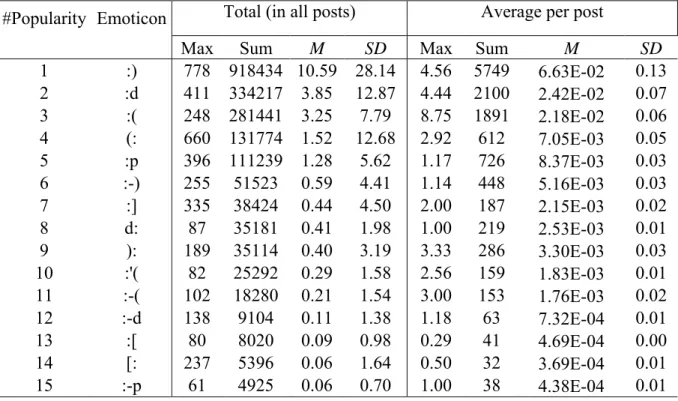
Overall, the Facebook users included in our sample posted more than 2 million (2 017 169) emoticons (Table 1). Approximately 24% of all status updates contained at least one emoticon and the majority of users (89.9%) used at least one emoticon. Table 1 shows the 15 most commonly posted emoticons (of the total number of 136 unique emoticons) that together represented 99.6% of all emoticons posted to Facebook. The top 5 emoticons represented 88%
7 of all posted emoticons. The most popular emoticon (the traditional smiley “:)”) was posted 918 434 times during the study period.
Table 1. The most popular emoticons and their distributions
#Popularity Emoticon Total (in all posts) Average per post
Max Sum M SD Max Sum M SD
1 :) 778 918434 10.59 28.14 4.56 5749 6.63E-02 0.13 2 :d 411 334217 3.85 12.87 4.44 2100 2.42E-02 0.07 3 :( 248 281441 3.25 7.79 8.75 1891 2.18E-02 0.06 4 (: 660 131774 1.52 12.68 2.92 612 7.05E-03 0.05 5 :p 396 111239 1.28 5.62 1.17 726 8.37E-03 0.03 6 :-) 255 51523 0.59 4.41 1.14 448 5.16E-03 0.03 7 :] 335 38424 0.44 4.50 2.00 187 2.15E-03 0.02 8 d: 87 35181 0.41 1.98 1.00 219 2.53E-03 0.01 9 ): 189 35114 0.40 3.19 3.33 286 3.30E-03 0.03 10 :'( 82 25292 0.29 1.58 2.56 159 1.83E-03 0.01 11 :-( 102 18280 0.21 1.54 3.00 153 1.76E-03 0.02 12 :-d 138 9104 0.11 1.38 1.18 63 7.32E-04 0.01 13 :[ 80 8020 0.09 0.98 0.29 41 4.69E-04 0.00 14 [: 237 5396 0.06 1.64 0.50 32 3.69E-04 0.01 15 :-p 61 4925 0.06 0.70 1.00 38 4.38E-04 0.01
Note. N = 86 702 Facebook users. In this Table we present the punctuation record of
emoticons that in Facebook appear as graphics. Max: maximal total number of emoticons per user
3.1 Total number of emoticons
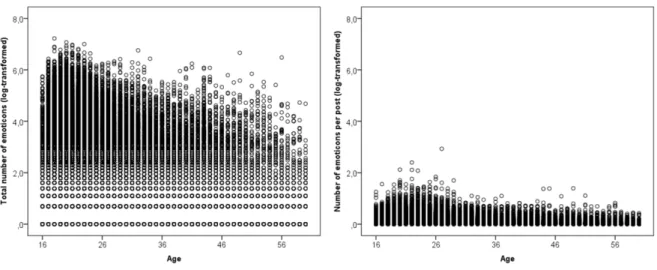
Gender and age significantly and robustly predicted the total number of emoticons posted; younger users and females posted more emoticons than did older users and males, respectively (Figure 1). Together, gender and age explained 16% of the variance in emoticon posting. Personality variables explained an additional 2% of the variance. Among these, extraversion had the greatest linear effect (β = .12), followed by neuroticism (β = .06) and agreeableness (β = .05). A closer look at these distributions (Figure 2) confirms that while the
8 effects of extraversion, agreeableness and neuroticism were generally linear and positive, both openness and conscientiousness were curvilineary related to the total number of posted
emoticons. Quadratic regressions confirmed that openness showed an inverted U-shaped pattern, F(2, 86701) = 40.19, p < .001, R = .030, adjusted R2 = .001, wherein the number of emoticons posted first increased with the level of openness (β = .24, p < .001) and then
decreased (β = -.25, p < .001). A similar pattern was observed for conscientiousness, F(2, 86701) = 174.40, p < .001, R = .063, adjusted R2 = .004, wherein the number of emoticons first increased (β = .28, p < .001) and then decreased (β = -.33, p < .001) with
conscientiousness (Figure 2).
9
Figure 2. Relationships between personality traits and the number of emoticons posted in Facebook status updates, controlling for gender and age (N=86 702). X axis: score obtained for each of the personality traits (in 10% intervals; deciles). Y axis: the log-transformed total number of posted emoticons. Grey lines represent 95% confidence intervals.
In model B we tested the robustness of model A while controlling for the number of Facebook posts. Including this variable in the model (log-transformed) resulted in a slight decrease of previously observed estimates, but did not change the overall pattern of results (Table 2). Although all observed effects held their direction and significance, the decrease in their strength suggested a possible indirect effect. Mediation analyses confirmed that although gender, age, and personality traits were significantly linked with overall number of Facebook posts, the number of posts mediated the relationship between demographic and personality predictors and the total number of emoticons posted, with the exception of agreeableness (Figure 3).
10
Table 2. Regression models predicting number of posted emoticons. Model B controls for the total number of user posts. Values in brackets are 95% confidence intervals.
Predictors Model A Model B Model C
B β B β B β Step 1: Controls Constant 2.83 (2.80, 2.86) --- (-0.18, -0.10) -0.14 --- (0.54, 0.56) 0.55 --- Gender (0 = M; 1 = F) 0.95 (0.93, 0.97) (.289, .301) .295 (0.69, 0.72) 0.70 (.213, .223) .218 (0.031, 0.038) 0.035 (.056, .069) .062 Age -0.053 (-0.054, -0.52) -.298 (-.300, -.296) -0.038 (-0.039, -0.037) -.212 (-.214, -.210) -0.001 (-0.001, -0.001) -.033 (-.040, -0.027) Total number of posts --- --- 0.626
(0.621, 0.632) .550 (.545, .555) 0.025 (0.023, 0.026) .126 (.119, .133) Step 2: Personality Constant 1.55 (1.43, 1.66) --- -0.47 (-0.57, -0.38) --- 0.46 (0.44, 0.48) --- Gender 0.90 (0.88, 0.92) .280 (.274, .286) 0.68 (0.66, 0.69) .210 (.205, .215) 0.035 (0.031, 0.039) .063 (.056, .070) Age -0.053 (-0.054, -0.051) (-.296, -.292) -.294 (-0.039, -0.037) -0.038 (-.214, -.210) -.212 (-0.001, -0.001) -0.001 (-0.045, -.032) -.039 Total number of posts --- --- 0.623
(0.618, 0.629) (.543, .553) .548 (0.022, 0.025) 0.024 (.114, .128) .121 Openness -0.03 (-0.05, -0.02) -.013 (-.019, -.007) -0.11 (-0.12, -0.09) -.045 (-.050, -.040) 0.001# (-0.002, 0.004) .003# (-.004, .009) Contentiousness -0.02 (-0.04, -0.01) -.011 (-.017, -.004) -0.01 (-0.03, -0.003) -.007 (-0.012, -.001) 0.005 (0.002, 0.007) .012 (.005, .020) Extraversion 0.23 (0.21, 0.24) (.109, .122) .116 (0.07, 0.10) 0.09 (.038, .049) .044 (0.01, 0.015) 0.013 (.030, .045) .038 Agreeableness 0.11 (0.09, 0.12) (.040, .053) .047 (0.09, 0.11) 0.10 (.040, .051) .045 (0.011, 0.017) 0.014 (.030, .044) .037 Neuroticism 0.12 (0.10; 0.13) (.052, .067) .060 (0.04, 0.07) 0.06 (.022, .034) .028 (-0.009, -0.003) -0.006 (-.025, -.010) -.018
Note. N = 86,702 Facebook users. All effects reported are significant at p < .001, except # (p
= .41). Model properties: Model A, step 1: F(2, 86701) = 8421.97, p < .001, R = .40, adjusted
R2 = .163, step 2: F(7, 86701) = 2656.71, p < .001, R = .42, adjusted R2 = .177; ΔR2 = .014. Model B, step 1: F(3, 86701) = 23943.20, p < .001, R = .67, adjusted R2 = .453, step 2: F(8,
86701) = 9164.28, p < .001, R = .46, adjusted R2 = .458, ΔR2 = .005. Model C, step 1: F(3, 86701) = 705.10, p < .001, R = .15, R2 = .024, step 2: F(8, 86701) = 322.55, p < .001, R = .17, R2 = .029, , ΔR2 = .005.
12
Figure 3. Mediation analysis testing the total number of user posts (status updates) as a mediator between user personality and total number of emoticons used (N=86 702). Arrows represent direct effects between variables. Given B values are unstandardized. Numbers in brackets represent bootstrap-corrected 95% confidence intervals. Effects were estimated with age, gender and all remaining personality factors included as covariates.
3.2 Emoticon valence
We explored the dominant emotional valence of emoticons, calculating the ratio of positive emoticons to all emoticons posted. Positive emoticons were most commonly used among all emoticons posted (M = .65, SD = .27; one-sample t-test relative to .50 t[86701] =
699.87, p < .001; Cohen’s d = 2.38). We further examined demographic and personality factors as predictors of positive emoticon usage, controlling for total number of posts (see Table 2, model C). Females and younger users posted the most positive emoticons.
Personality variables included in Step 2 explained an additional .5% of the variability in the ratio of positive emoticons to all emoticons. Interestingly, higher scores on extraversion, conscientiousness, and agreeableness predicted a higher proportion of positive emoticons, whereas this relationship was reversed for neuroticism, indicating that people scoring higher in neuroticism use more emoticons than do people scoring lower in neuroticism. At the same time, they tend to use fewer positive emoticons compared to less neurotic people.
4. Discussion
Our results show that emoticon use is mainly predicted by age and gender wherein females use more emoticons than do males and emoticon usage decreases with age. Taken together,
13 gender and age explain more than eight times the variance in emoticon usage than do user’s Big Five personality scores.
Emoticon usage decreased significantly with user’s age. Indeed, previous studies suggest that younger people spend more time, lead more open communication and disclose more personal information online compared to older people (Bryce & Klang, 2009;
Christofides, Muise, & Desmarais, 2012; Taraszow, Aristodemou, Shitta, Laouris, & Arsoy, 2010). The co-occurrence of positive and negative emotions is also more frequent in older age (Magai, Consedine, Krivoshekova, Kudadjie-Gyamfi, & McPherson, 2006; Schneider & Stone, 2015). Accurate communication of contrary emotional states in a virtual space might therefore be more difficult for older users who may consider using simple single-emotion graphical symbols as insufficient or misleading representations of their true feelings.
Our results also show that women use more emoticons than do men in their public Facebook activity. This result is consistent with studies showing that women share their emotions more often and more openly than do men in face-to-face interactions (Ashmore, 1990; Brody & Hall, 1993; Kring & Gordon, 1998) as well as in virtual communication (Tossell et al., 2012; Witmer & Katzman, 2006). Our findings demonstrate that gender-related differences in online emotional expression are observed not only in private one-on-one
messages, but also in public posts.
Our findings are consistent with studies examining the expression of emotional states in face-to-face interactions, reporting differences in emotional expression as a function of personality (Alllk & Realo, 1997; Emmons & Diener, 1986; Gross, Sutton, & Ketelaar, 1998; Larsen & Ketelaar, 1991; Watson & Clark, 1992). Here, we extend these findings to virtual communication, which is just as saturated with emotional expression as is face-to-face communication (Derks, Fischer, et al., 2008). Recent findings indicate that openness to
14 experience is positively related with emoticon usage in a sample of 92 university students (r = .27) (Wall et al., 2016). Here, utilizing a much larger and more diverse sample, we found that the personality trait that most strongly and positively predicted the number of emoticons actually used on Facebook is extraversion, but this effect was mediated by the overall tendency to post more content in social media. This indirect effect suggests that although demographics and personality are not highly informative when it comes to emotional expression in virtual communication, they might have a meaningful input into understating patterns of general Facebook activity.
In our study, users who scored higher on agreeableness and neuroticism also used more emoticons than did users who scored lower on these traits. Nevertheless, personality traits explained less than 2% of the variance in emoticon use. This might stem from the fact that we analyzed content of public status updates, rather than personal messages addressed to a particular recipient. However, former studies indicate that status updates contain more emoticons than do personal messages (Tossell et al., 2012), suggesting that a closer
relationship between sender and receiver reduces the need to signal emotions explicitly, while public posts are more often supplemented with graphical expression of emotion. This
potential difference in emoticons use between public and private forums is a topic for future study.
There are several potential explanations as to why a relatively small subset of emoticons were consistently used, whereas others were largely ignored. This may reflect a classic paradox of choice (Schwartz, 2004), or perhaps a limited range of emotional
expressions simply suffices, for instance those that map onto Ekman’s (Ekman & Oster, 1979) six basic facial emotional expressions: anger, disgust, fear, happiness, sadness and surprise. Alternatively, users may rely on a small subset of popular emoticons to reduce the risk of
15 miscommunication. This argument finds support in the rising popularity of emoji’s–
graphical representations of objects (e.g., a cake) that may be less ambiguous in meaning and interpretation compared to emoticons whose aim it is to express a complex human emotion. The myPersonality database is based solely on information provided by participants (either via their Facebook profiles or questionnaire responses), posing a potential limitation. The risk of misrepresentation in self-reports was minimized by offering participants feedback on their personality scores, thereby motivating honest responses.
4.1. Conclusion
To summarize, the current study analyzing data from 86 702 users shows that the number of emoticons used in public Facebook status updates decreases with age and is greater among women than men. A closer look at the relationships among patterns of emoticon use and personality revealed that extraversion, agreeableness and neuroticism show a linear, positive relationship with the overall number of emoticons used. Our results contribute to an ongoing discussion regarding the demographic and psychological profiles of Internet users, with many companies hoping to use such data to predict a wide variety of online activities such as shopping, travel and political leanings. Indeed personality profiling has been suggested as a means of predicting individual differences in online behavior (Kosinski, Stillwell, & Graepel, 2013). Our results suggest that measuring the use of emoticons in online social media may, in the absence of other data, provide very little information beyond a user’s sex and age. Nevertheless, tracking individual emoticon usage patterns might be helpful to understand and link customers’ emotions with their online decisions and actions. This knowledge might also contribute to the development of better suited online marketing campaigns and targeted ads.
16
5. Acknowledgments:
We kindly thank Michal Kosinski and David Stillwell for sharing the myPersonality database for the purposes of this study. This research was supported by the Foundation for Polish Science [START scholarship for 2017 to A.O. and 2015 to K.P.], and the Polish Ministry of Science and Higher Education [scholarships for years 2015–2018 to K.P. and 2012–2017 to P.S.].
17
6. References:
Alllk, J., & Realo, A. (1997). Emotional Experience and Its Relation to the Five-Factor Model in Estonian. Journal of Personality, 65(3), 625-647.
http://doi.org/10.1111/j.1467-6494.1997.tb00329.x
Ashmore, R. (1990). Sex, gender, and the individual. En L. Pervin (Ed.), Handbook of personality: Theory and research (p. 486-526). New York: Guilford Press.
Błachnio, A., Przepiórka, A., & Rudnicka, P. (2013). Psychological Determinants of Using Facebook: A Research Review. International Journal of Human-Computer Interaction,
29(11), 775-787. http://doi.org/10.1080/10447318.2013.780868
Brody, L. R., & Hall, J. A. (1993). Gender and emotion. En M. Lewis & J. M. Haviland (Ed.),
Handbook of emotions (p. 691-694). New York: Guilford Press.
Bryce, J., & Klang, M. (2009). Young people, disclosure of personal information and online privacy: Control, choice and consequences. Information Security Technical Report, 14(3), 160-166. http://doi.org/10.1016/j.istr.2009.10.007
Byron, K., & Baldridge, D. C. (2007). E-Mail Recipients’ Impressions of Senders’ Likability: The Interactive Effect of Nonverbal Cues and Recipients’ Personality. Journal of
Business Communication, 44(2), 137-160. http://doi.org/10.1177/0021943606297902 Christofides, E., Muise, A., & Desmarais, S. (2012). Hey Mom, What’s on Your Facebook?
Comparing Facebook Disclosure and Privacy in Adolescents and Adults. Social Psychological and Personality Science, 3(1), 48-54.
http://doi.org/10.1177/1948550611408619
Derks, D., Bos, A. E. R., & Grumbkow, J. von. (2007). Emoticons and social interaction on the Internet: the importance of social context. Computers in Human Behavior, 23(1), 842-849. http://doi.org/10.1016/j.chb.2004.11.013
Derks, D., Bos, A. E. R., & von Grumbkow, J. (2007). Emoticons and Online Message Interpretation. Social Science Computer Review, 26(3), 379-388.
http://doi.org/10.1177/0894439307311611
Derks, D., Bos, A. E. R., & von Grumbkow, J. (2008). Emoticons in Computer-Mediated Communication: Social Motives and Social Context. CyberPsychology & Behavior, 11(1), 99-101. http://doi.org/10.1089/cpb.2007.9926
Derks, D., Fischer, A. H., & Bos, A. E. R. (2008). The role of emotion in computer-mediated communication: A review. Computers in Human Behavior, 24(3), 766-785.
http://doi.org/10.1016/j.chb.2007.04.004
Dresner, E., & Herring, S. C. (2010). Functions of the Nonverbal in CMC: Emoticons and Illocutionary Force. Communication Theory, 20(3), 249-268.
http://doi.org/10.1111/j.1468-2885.2010.01362.x
Du, S., Tao, Y., & Martinez, A. M. (2014). Compound facial expressions of emotion.
18
111(15), E1454-62. http://doi.org/10.1073/pnas.1322355111
Ekman, P., & Oster, H. (1979). Facial Expressions of Emotion. Annual Review of Psychology, 30(1), 527-554. http://doi.org/10.1146/annurev.ps.30.020179.002523
Emmons, R. A., & Diener, E. (1986). An interactional approach to the study of personality and emotion. Journal of Personality, 54(2), 371-384.
http://doi.org/10.1111/j.1467-6494.1986.tb00400.x
Fox, J., & Rooney, M. C. (2015). The Dark Triad and trait self-objectification as predictors of men’s use and self-presentation behaviors on social networking sites. Personality and Individual Differences, 76, 161-165. http://doi.org/10.1016/j.paid.2014.12.017
Goldberg, L. R., Johnson, J. A., Eber, H. W., Hogan, R., Ashton, M. C., Cloninger, C. R., & Gough, H. G. (2006). The international personality item pool and the future of public-domain personality measures. Journal of Research in Personality, 40(1), 84-96.
http://doi.org/10.1016/j.jrp.2005.08.007
Gross, J., Sutton, S., & Ketelaar, T. (1998). Relations between affect and personality: Support for the affect-level and affective-reactivity views. Personality and Social Psychology Bulletin, 24, 279-288.
Huang, A. H., Yen, D. C., & Zhang, X. (2008). Exploring the potential effects of emoticons.
Information & Management, 45(7), 466-473. http://doi.org/10.1016/j.im.2008.07.001
Huffaker, D. A., & Calvert, S. L. (2006). Gender, Identity, and Language Use in Teenage Blogs. Journal of Computer-Mediated Communication, 10(2), 00-00.
http://doi.org/10.1111/j.1083-6101.2005.tb00238.x
Kosinski, M., Matz, S. C., Gosling, S. D., Popov, V., & Stillwell, D. (2015). Facebook as a research tool for the social sciences: Opportunities, challenges, ethical considerations, and practical guidelines. American Psychologist, 70(6), 543-556.
http://doi.org/10.1037/a0039210
Kosinski, M., Stillwell, D., & Graepel, T. (2013). Private traits and attributes are predictable from digital records of human behavior. Proceedings of the National Academy of Sciences of the United States of America, 110(15), 5802-5.
http://doi.org/10.1073/pnas.1218772110
Kramer, A. D. I., Guillory, J. E., & Hancock, J. T. (2014). Experimental evidence of massive-scale emotional contagion through social networks. Proceedings of the National
Academy of Sciences of the United States of America, 111(24), 8788-90.
http://doi.org/10.1073/pnas.1320040111
Kring, A. M., & Gordon, A. H. (1998). Sex differences in emotion: Expression, experience, and physiology. Journal of Personality and Social Psychology, 74(3), 686-703.
http://doi.org/10.1037/0022-3514.74.3.686
Krohn, F. (2004). A Generational Approach to Using Emoticons as Nonverbal
Communication. Journal of Technical Writing and Communication, 34(4), 321-328.
http://doi.org/10.2190/9EQH-DE81-CWG1-QLL9
Larsen, R. J., & Ketelaar, T. (1991). Personality and susceptibility to positive and negative emotional states. Journal of Personality and Social Psychology, 61(1), 132-140.
19 Lo, S.-K. (2008). The Nonverbal Communication Functions of Emoticons in
Computer-Mediated Communication. CyberPsychology & Behavior, 11(5), 595-597.
http://doi.org/10.1089/cpb.2007.0132
Magai, C., Consedine, N. S., Krivoshekova, Y. S., Kudadjie-Gyamfi, E., & McPherson, R. (2006). Emotion experience and expression across the adult life span: Insights from a multimodal assessment study. Psychology and Aging, 21(2), 303-317.
http://doi.org/10.1037/0882-7974.21.2.303
McCrae, R. R., & Costa, P. T. (2003). Personality in adulthood: A five-factor theory perspective. Guilford Press.
Nummenmaa, L., Glerean, E., Hari, R., & Hietanen, J. K. (2014). Bodily maps of emotions.
Proceedings of the National Academy of Sciences of the United States of America,
111(2), 646-51. http://doi.org/10.1073/pnas.1321664111
Park, J., Baek, Y. M., & Cha, M. (2014). Cross-Cultural Comparison of Nonverbal Cues in Emoticons on Twitter: Evidence from Big Data Analysis. Journal of Communication,
64(2), 333-354. http://doi.org/10.1111/jcom.12086
Social network demographics in 2012. (2012). Retrived from:
http://royal.pingdom.com/2012/08/21/report-social-network-demographics-in-2012/ Rezabek, L. L., & Cochenour, J. J. (1998). Visual cues in computer-mediated communication:
Supplementing text with emoticons. Journal of Visual Literacy, 18(2), 201-215.
http://doi.org/10.1080/23796529.1998.11674539
Sauer, J., Schramme, S., & Rüttinger, B. (2000). Knowledge acquisition in ecological product design: The effects of computer-mediated communication and elicitation method.
Behaviour & Information Technology, 19(5), 315-327. http://doi.org/10.1080/014492900750000027
Sauter, D. A., Eisner, F., Ekman, P., & Scott, S. K. (2010). Cross-cultural recognition of basic emotions through nonverbal emotional vocalizations. Proceedings of the National Academy of Sciences of the United States of America, 107(6), 2408-12.
http://doi.org/10.1073/pnas.0908239106
Schneider, S., & Stone, A. A. (2015). Mixed emotions across the adult life span in the United States. Psychology and Aging, 30(2), 369-382. http://doi.org/10.1037/pag0000018 Schwartz, B. (2004). The paradox of choice: Why more is less. Ecco New York.
Skovholt, K., Grønning, A., & Kankaanranta, A. (2014). The Communicative Functions of Emoticons in Workplace E-Mails: :-). Journal of Computer-Mediated Communication,
19(4), 780-797. http://doi.org/10.1111/jcc4.12063
Sorokowska, A., Oleszkiewicz, A., Frackowiak, T., Pisanski, K., Chmiel, A., & Sorokowski, P. (2016). Selfies and personality: Who posts self-portrait photographs? Personality and Individual Differences, 90, 119-123. http://doi.org/10.1016/j.paid.2015.10.037
Sproull, L., & Kiesler, S. (1986). Reducing Social Context Cues: Electronic Mail in Organizational Communication. Management Science, 32(11), 1492-1512. http://doi.org/10.1287/mnsc.32.11.1492
20 personal and contact information by young people in social networking sites: An analysis using Facebook profiles as an example. International Journal of Media & Cultural Politics, 6(1), 81-101. http://doi.org/10.1386/macp.6.1.81/1
Tossell, C. C., Kortum, P., Shepard, C., Barg-Walkow, L. H., Rahmati, A., & Zhong, L. (2012). A longitudinal study of emoticon use in text messaging from smartphones.
Computers in Human Behavior, 28(2), 659-663.
http://doi.org/10.1016/j.chb.2011.11.012
Wall, H. J., Kaye, L. K., & Malone, S. A. (2016). An exploration of psychological factors on emoticon usage and implications for judgement accuracy. Computers in Human
Behavior, 62, 70-78. http://doi.org/10.1016/j.chb.2016.03.040
Walther, J. B. (1992). Interpersonal Effects in Computer-Mediated Interaction: A Relational Perspective. Communication Research, 19(1), 52-90.
http://doi.org/10.1177/009365092019001003
Walther, J. B., & D’Addario, K. P. (2001). The Impacts of Emoticons on Message
Interpretation in Computer-Mediated Communication. Social Science Computer Review, 19(3), 324-347. http://doi.org/10.1177/089443930101900307
Watson, D., & Clark, L. A. (1992). On Traits and Temperament: General and Specific Factors of Emotional Experience and Their Relation to the Five-Factor Model. Journal of
Personality, 60(2), 441-476. http://doi.org/10.1111/j.1467-6494.1992.tb00980.x
Witmer, D. F., & Katzman, S. L. (2006). On-Line Smiles: Does Gender Make a Difference in the Use of Graphic Accents? Journal of Computer-Mediated Communication, 2(4), 0-0.
http://doi.org/10.1111/j.1083-6101.1997.tb00192.x
Wolf, A. (2000). Emotional Expression Online: Gender Differences in Emoticon Use.
CyberPsychology & Behavior, 3(5), 827-833. http://doi.org/10.1089/10949310050191809