Classifying quantum phases using matrix product states and projected entangled pair states
Norbert Schuch,1David P´erez-Garc´ıa,2and Ignacio Cirac3
1Institute for Quantum Information, California Institute of Technology, MC 305-16, Pasadena, California 91125, USA 2Departamento Analisis Matematico and IMI, Universidad Complutense de Madrid, E-28040 Madrid, Spain
3Max-Planck-Institut f¨ur Quantenoptik, Hans-Kopfermann-Strasse 1, D-85748 Garching, Germany (Received 15 March 2011; published 31 October 2011)
We give a classification of gapped quantum phases of one-dimensional systems in the framework of matrix product states (MPS) and their associated parent Hamiltonians, for systems with unique as well as degenerate ground states and in both the absence and the presence of symmetries. We find that without symmetries, all systems are in the same phase, up to accidental ground-state degeneracies. If symmetries are imposed, phases without symmetry breaking (i.e., with unique ground states) are classified by the cohomology classes of the symmetry group, that is, the equivalence classes of its projective representations, a result first derived by Chen, Gu, and Wen [Phys. Rev. B83, 035107 (2011)]. For phases with symmetry breaking (i.e., degenerate ground states), we find that the symmetry consists of two parts, one of which acts by permuting the ground states, while the other acts on individual ground states, and phases are labeled by both the permutation action of the former and the cohomology class of the latter. Using projected entangled pair states (PEPS), we subsequently extend our framework to the classification of two-dimensional phases in the neighborhood of a number of important cases, in particular, systems with unique ground states, degenerate ground states with a local order parameter, and topological order. We also show that in two dimensions, imposing symmetries does not constrain the phase diagram in the same way it does in one dimension. As a central tool, we introduce theisometric form, a normal form for MPS and PEPS, which is a renormalization fixed point. Transforming a state to its isometric form does not change the phase, and thus we can focus on to the classification of isometric forms.
DOI:10.1103/PhysRevB.84.165139 PACS number(s): 71.10.Hf, 03.65.Ud I. INTRODUCTION
A. Background
Understanding the phase diagram of correlated quantum many-body systems, that is, the different types of order such systems can exhibit, is one of the most important and challenging tasks on the way to a comprehensive theory of quantum many-body systems. Compared to classical statistical models, quantum systems exhibit a much more complex behavior, such as phases with topological order, as in the fractional quantum Hall effect, which cannot be described using Landau’s paradigm of local symmetry breaking.
In the last years, tensor-network-based ansatzes, such as matrix product states1 (MPS) and projected entangled
pair states2 (PEPS), have proven increasingly successful in
describing ground states of quantum many-body systems. In particular, it has been shown that MPS and PEPS can approxi-mate ground states of gapped quantum systems efficiently:3–5
That is, not only the ground state of systems with local order, but also, for instance, the ground states of topological insulators are well represented by those states. Since MPS and PEPS provide a characterization of quantum many-body states from a local description, they are promising candidates for a generalization of Landau’s theory. Moreover, they can be used to construct exactly solvable models, as every MPS and PEPS appears as the exact ground state of an associated parent Hamiltonian.1,6–8
In this paper, we apply the framework of MPS and PEPS to the classification of gapped quantum phases by studying systems with exact MPS and PEPS ground states. Here, we define two gapped systems to be in the same phase if and only if they can be connected by a smooth path of
gapped local Hamiltonians. Along such a path, all physical properties of the state will change smoothly, and as the system follows a quasilocal evolution,9 global properties are preserved. A vanishing gap, on the other hand, will usually imply a discontinuous behavior of the ground state and affect global properties of the system. In addition, one can impose symmetries on the Hamiltonian along the path, which in turn leads to a more refined classification of phases.
In the presence of symmetries, the above definition of gapped quantum phases can be naturally generalized to systems with symmetry breaking, that is, degenerate ground states, as long as they exhibit a gap above the ground state subspace. Again, ground states of such systems are well approximated by MPS and PEPS, which justifies why we study those phases by considering systems whose ground-state subspace is spanned by MPS and PEPS. On the other hand, the approach will not work for gapless phases, as the MPS description typically cannot be applied to them.
B. Results
Using our framework, we obtain the following classification of quantum phases.
For one-dimensional (1D) gapped systems with a unique ground state, we find that there is only a single phase, represented by the product state. Imposing a constraint in form of a local symmetryUg (with symmetry groupGg) on the Hamiltonian leads to a more rich phase diagram. It can be understood from the way in which the symmetry acts on the virtual level of the MPS, Ug ∼=Vg⊗Vg¯ , where the Vg are projective representations ofG. In particular, different phases under a symmetry are labeled by the different equivalence classes of projective representationsVgof the symmetry group
G,10which are in one-to-one correspondence to the elements
of its second cohomology group H2(G,U(1))(this has been
previously studied in Ref.11).
For 1D gapped systems with degenerate ground states, we find that in the absence of symmetries, all systems with the same ground-state degeneracy can be transformed into another along a gapped adiabatic path. In order to make these degeneracies stable against perturbations, symmetries need to be imposed on the Hamiltonian. We find that any such symmetry decomposes into two parts,Pg andWh. Here Pg
acts by permuting the symmetry-broken ground states of the system. To describe Wh, choose a “reference” ground state,
and letH ⊂Gbe the subgroup for whichPhacts trivially on the reference state: ThenWh(h∈H) is a unitary symmetry of the reference state, which again acts on the virtual level asWh∼=Vh⊗Vh¯ , withVh a projective representation ofH. Together, Pg and Wh form an induced representation. The different phases of the system are then labeled both by the permutation actionPg ofUgon the symmetry-broken ground states (or alternatively by the subgroupH ⊂Gfor whichPh
leaves the reference state invariant) and by the equivalence classes of projective representationsVhofH.
Our classification of phases is robust with respect to the definition of the gap: Two systems which are within the same phase can be connected by a path of Hamiltonians, which is gapped even in the thermodynamic limit; conversely, along any path interpolating between systems in different phases the gap closes already for any (large enough) finite chain. On the other hand, we demonstrate that the classification of phases is very sensitive to the way in which the symmetry constraints are imposed, and we present various alternative definitions, some of which yield more fine-grained classifications, while others result in the same classification as without symmetries. In particular, we also find that phases under symmetries are not stable under taking multiple copies and thus should not be regarded a resource in the quantum information sense.
Parts of our results can be generalized to two dimensions (2D), with the limitation that we can only prove gaps of parent Hamiltonians associated with PEPS in restricted regions. These regions include systems with unique ground states and with local symmetry breaking as well as topological models. We show that within those regions, these models label different quantum phases, with the product state, Ising Hamiltonians, and Kitaev’s double models12 as their representatives. We
also find that in these regions, imposing symmetries on the Hamiltonian does not alter the phase diagram, and, more generally, that symmetry constraints on two- and higher-dimensional systems must arise from a different mechanism than in one dimension.
As a main tool for our proofs, we introduce a new standard form for MPS and PEPS, which we call theisometric form. Isometric forms are renormalization fixed points which capture the relevant features of the quantum state under consideration, both for MPS and for the relevant classes of PEPS. Parent Hamiltonians of MPS can be transformed into their isometric form along a gapped path, which provides a way to renormalize the system without actually blocking sites. This reduces the classification of quantum phases to the classification of phases for isometric MPS/PEPS and their parent Hamiltonians,
which is considerably easier to carry out due to its additional structure.
C. Structure of the paper
The paper is structured as follows. In Sec.II, we prove the results for the 1D case: We start by introducing MPS (Sec. II A) and parent Hamiltonians (Sec. II B) and defining phases without and with symmetries (Sec. II C); we then introduce the isometric form and show that the problem of classifying phases can be reduced to classifying isometric forms (Sec. II D); subsequently, we first classify 1D phases without symmetries (Sec. II E), then phases of systems with unique ground states under symmetries (Sec. II F), and finally phases of symmetry-broken systems under symmetries (Sec. II G).
In Sec. III, we discuss the 2D scenario. We start by introducing PEPS (Sec. III A) and characterize the region in which we can prove a gap (Sec. III B). We then classify PEPS without symmetries (Sec. III C) and show that symmetries do not have an effect comparable to one dimension (Sec. III D).
SectionIV contains discussions of various topics which have been omitted from the preceding sections. Most impor-tantly, in Secs. IV B and IV C, we discuss various ways in which phases, in particular in the presence of symmetries, can be defined, and the way in which this affects the classification of phases, and in Sec.IV Dwe provide examples illustrating our classification.
II. RESULTS IN ONE DIMENSION
In this section, we derive the classification of phases for 1D systems both with unique and with degenerate ground states and in both the absence and the presence of symmetries. We start by giving the necessary definitions; we introduce MPS and their parent Hamiltonians and define what we mean by phases both without and with symmetries. Then we state and prove the classification of phases for the various scenarios (with some technical parts placed in Appendixes).
Note that, for clarity, we keep discussions in this section to a minimum. Extensive discussion of various aspects (motivation of the definitions, alternative definitions, etc.) can be found in Sec.IV.
A. Matrix product states
In the following, we study translational invariant systems on a finite chain of lengthN with periodic boundary conditions. While we do not consider the thermodynamic limit, we require relevant properties such as spectral gaps to be uniform inN.
1. Definition of MPS
Consider a spin chain (Cd)⊗N. A (translational invariant)
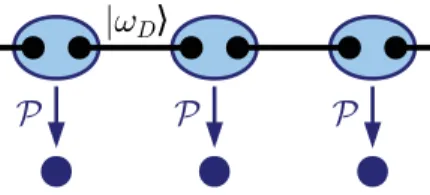
MPS|μ[P]ofbond dimensionDon (Cd)⊗N is constructed by placing maximally entangled pairs
|ωD:= D
i=1
|i,i
between adjacent sites and applying a linear map P :
FIG. 1. (Color online) MPS are constructed by applying a linear map P to maximally entangled pairs |ωD:=Di=1|i,i of bond dimensionD.
|μ[P] =P⊗N|ω
D⊗N. The map P is sometimes called the MPS projector(though it need not be a projector).
2. Standard form
The definition of MPS is robust under blocking sites: Blocking k sites into one super-site of dimension dk gives
a new MPS with the same bond dimension, with projector
P =P⊗k|ωD⊗(k−1), where the maximally entangled pairs
are again placed as in Fig.1.
By blocking and using gauge degrees of freedom (in-cluding changing D), any MPS which is well-defined in the thermodynamic limit can be brought into its standard form, where P is supported on a “block-diagonal” space, (kerP)⊥=H1⊕ · · · ⊕HA, with
Hα=span{|i,j:ζα−1< i,jζα}. (1)
Here 0=ζ0< ζ1<· · ·< ζA =D gives a partitioning of
1, . . . ,D; we defineDi :=ζi−ζi−1. The case whereA=1
(i.e.,P is injective) is called theinjectivecase, whereas the case withA>1 is callednoninjective.
In the following, we assume, without loss of generality, that all MPS are in their standard form; note that this might involve the blocking of sites of the original model. Moreover, we impose thatPis surjective; this can be achieved by restricting
Cd to the image ofP.
B. Parent Hamiltonians
For any MPS (in its standard form) one can construct local
parent Hamiltonians which have this MPS as their ground state. A (translational invariant) parent Hamiltonian,
H= N
i=1
h(i,i+1),
consists of local terms h(i,i+1)≡h0 acting on two adjacent sites (i,i+1) whose kernels exactly support the two-site reduced density operator of the corresponding MPS, that is,
kerh=(P⊗P)(CD⊗ |ωD ⊗CD). (2) By construction,H0 andH|μ[P] =0, that is,|μ[P]is a ground state ofH. It can be shown that the ground-state space ofHisA-fold degenerate and spanned by the states|μ[P|Hα], whereP|Hαis the restriction ofPtoHα.
1,6,7This associates a
family of parent Hamiltonians to every MPS, and by choosing
h a projector, the mapping between MPS and Hamiltonians becomes one to one.
Given this duality between MPS and their parent Hamil-tonians, we use the notion of MPS and parent Hamiltonians interchangeably whenever appropriate.
C. Definition of quantum phases
Vaguely speaking, we define two systems to be in the same phase if they can be connected along a continuous path of gapped local Hamiltonians, possibly preserving certain symmetries; heregappedmeans that the Hamiltonian keeps its spectral gap even in the thermodynamic limit. The intuition is that along any gapped path, the expectation value of any local observable will change smoothly, and the converse is widely assumed to also hold.14
The rigorous definitions are as follows.
1. Phases without symmetries
Let H0 and H1 be a family of translational invariant
gapped local Hamiltonians on a ring (with periodic boundary conditions). Then, we say thatH0andH1are in the same phase if and only if there exists a finiteksuch that after blockingk
sites,H0andH1are two local, Hp=
N
i=1
hp(i,i+1), p=0,1,
and there exists a translational invariant path
Hγ = N
i=1
hγ(i,i+1), 0γ 1,
with two-localhγ such that
(i) h0=hγ=0,h1=hγ=1;
(ii) hγop1;
(iii) hγ is a continuous function ofγ;
(iv) Hγ has a spectral gap above the ground state manifold
which is bounded below by some constant >0, which is independent ofNandγ.
In other words, two Hamiltonians are in the same phase if they can be connected by a local, bounded-strength, continuous, and gapped path.
Note that this definition applies to Hamiltonians both with unique and with degenerate ground states.
2. Phases with symmetries
Let Hp (p=0,1) be a Hamiltonian acting on H⊗N p ,
Hp =Cdp, and let U p
g be a linear unitary representation of
some groupGgonHp. We then say thatUg is a symmetry
of Hp if [Hp,(Ugp)⊗N]=0 for all g∈G; note that U p g is
only defined up to a 1D representation ofG,Ugp↔eiφ
p gUp
g.
Then we say that H0 and H1 are in the same phase under
the symmetryGif there exists a phase gauge forU0 g andUg1
and a representationU =U0
g ⊕Ug1⊕U path
g ofGon a Hilbert
spaceH=H0⊕H1⊕Hpathand an interpolating pathHγ on
Hwith the properties given in the preceding section, such that [Hγ,U⊗N
g ]=0, and whereH0 andH1 are supported on H0
andH1, respectively.
There are a few points to note about this definition. First, we allow for an arbitrary representation of the symmetry group along the path; we discuss in Sec. IV C why this is not a
restriction. Second, we impose thatH0andH1are supported
on orthogonal Hilbert spaces: This allows us to compare, for example, the spin-1 AKLT state with the spin-0 state under SO(3) symmetry, but we impose this even if the two representations are the same; we discuss how to circumvent this in Sec.IV C. Note that, just as without symmetries, this definition should be understood after an appropriate blocking of sites.
3. Robust definition of phases
In addition to the properties listed in the definition of phases in Sec.II C 1above, one usually requires a phase to be robust, that is, an open set in the space of allowed Hamiltonians: For every Hamiltonian H= N i=1 h(i,i+1),
there should be an >0 such that
H = N
i=1
[h(i,i+1)+ k(i,i+1)
is in the same phase for any bounded-strengthk(i,i+1) which obeys the required symmetries.
We are not going to rigorously address robustness of phases in the present paper; however, it should be pointed out that, in the absence of symmetries, Hamiltonians with degenerate MPS ground states do not satisfy this property: In its standard form, the different ground states of a noninjective MPS are
locallysupported on linearly independent subspaces, and we can use a translational invariant local perturbation k(i) to change the energy of any of the ground states proportionally toN, thereby closing the gap for aN ∝1/. On the other hand, in the presence of a symmetry which permutes the different ground states (such a symmetry always exists), those perturbations are forbidden, and the phase becomes stable. (A rigorous stability proof for MPS phases would make use of the stability condition for frustration-free Hamiltonians proven in Ref.15and its generalization to symmetry-broken phases analogous to the one discussed in Ref.16: The condition is trivially satisfied by the renormalization fixed points of MPS,17 and using the exponential convergence of MPS to their fixed point,17 the validity of the stability condition, and thus the
stability of MPS phases, follows.)
Therefore, when classifying phases of systems with degen-erate ground states, one should keep in mind that in order to make this a robust definition, a symmetry which protects the degeneracy is required.
4. Restriction to parent Hamiltonians
We want to classify the quantum phases of gapped Hamiltonians which have exact MPS ground states (or, in the case of degeneracies, the same ground-state subspace as the corresponding parent Hamiltonian). Fortunately, with our definition of phases it is sufficient to classify the phases for parent Hamiltonians themselves: Given any two gapped Hamiltonians H andH which have the same ground-state subspace, the interpolating path γ H+(1−γ)H has all desired properties, and in particular it is gapped. Note that
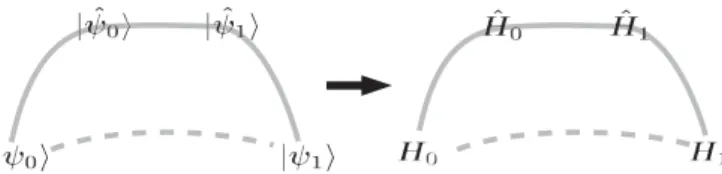
FIG. 2. Construction of the interpolating path for MPS and parent Hamiltonians. Instead of interpolating between the MPS|ψ0and
|ψ1directly (dotted line), we first show how to interpolate each of the two states toward a standard from|ψpˆ , theisometric form, and then construct an interpolating path between the isometric forms. Note that using the parent Hamiltonian formalism, any such path in the space of MPS yields a path in the space of Hamiltonians right away.
this also shows that all parent Hamiltonians for a given MPS are interchangeable.
D. The isometric form
1. Reduction to a standard form
Given two MPS |μ[Pp], p=0,1, together with their
nearest-neighbor parent Hamiltonians Hp, we want to see
whetherH0 andH1 are in the same phase, that is, whether
we can construct a gapped interpolating path. We do so by interpolating between P0 and P1 along a path Pγ, in
such a way that it yields a pathHγ in the space of parent
Hamiltonians which satisfies the necessary continuity and gappedness requirements.
In order to facilitate this task, we proceed in two steps, as illustrated in Fig.2: In a first step, we introduce a standard form for each MPS—theisometric form—which is always in the same phase as the MPS itself. This will reduce the task of classifying phases to the classification of phases for isometric MPS, which we pursue subsequently.
2. The isometric form
Let us now introduce theisometric formof an MPS. The isometric form captures the essential entanglement and long-range properties of the state and forms a fixed point of a renormalization procedure,17 and every MPS can be brought
into its isometric form by stochastic local operations.18Most
importantly, as we show, there exists a gapped path in the space of parent Hamiltonians which interpolates between any MPS and its isometric form.
Given an MPS|μ[P], decompose
P=Q W, (3)
withW an isometry W W†=1 and Q >0, by virtue of a polar decomposition ofP|(kerP)⊥; without loss of generality,
we can assume 0< Q1by rescalingP. Theisometric form
of|μ[P]is now defined to be|μ[W], the MPS described by W, the isometric part of the tensorP.
To see that|μ[P]and|μ[W]are in the same phase, define an interpolating path|μ[Pγ],Pγ =QγW, with
Qγ =γ Q+(1−γ)1, 1γ 0;
note that the path can be seen as a stochastic deformation |μ[Pγ] =Qγ⊗N|μ[P0](cf. Fig.3). Throughout the path, the
FIG. 3. Isometric form of an MPS. (a) The MPS projector P can be decomposed into a positive mapQ and an isometric map W. (b) By removing Q, one obtains the isometric form W of the MPS. (c) Interpolation to the isometric form is possible by letting Qγ =γ Q+(1−γ)1.
blocking pattern which is encoded in the structure of kerP stays unchanged.
Let us now see that |μ[P] ≡ |μ[P1] and its isometric
form |μ[W] ≡ |μ[P0] are in the same phase. To this end,
consider the parent HamiltonianH0=h0(i,i+1) of the isometric MPS|μ[P0], withh0a projector. Let
γ =Q−γ1⊗2,
and define theγ-deformed Hamiltonian
Hγ :=
hγ(i,i+1), with hγ :=γh0γ 0.
Sinceh0|μ[P0] =0, it follows thathγ|μ[Pγ] =0 (and, in
fact, the kernel of h is always equal to the support of the two-site reduced state); that is, Hγ is a parent Hamiltonian
of |μ[Pγ]. Note that the family Hγ of Hamiltonians is
continuous inγby construction.
It remains to show that the pathHγ is uniformly gapped; that is, there is a >0 which lower bounds the gap ofHγ
uniformly inγ and the systems sizeN: This establishes that the|μ[Pγ]are all in the same phase. The derivation is based
on a result of Nachtergaele6 (extending the results of Ref.1
for the injective case), where a lower bound (uniform inN) on the gap of parent Hamiltonians is derived, and can be found in AppendixA. The central point is that the bound on the gap depends on the correlation lengthξand the gap ofHγrestricted
toξ sites, and since both depend smoothly onγ, andξ →0 asγ →0, a uniform lower bound on the gap follows; for the noninjective case, one additionally needs that the overlap of different ground states goes to zero asγ →0.
3. Isometric form and symmetries
An important point about the isometric form |μ[P0] of
an MPS|μ[P1]is that both remain in the same phase even
if symmetries are imposed. The reason is that using gauge transformations
P ←→ P[Y ⊗(Y−1)T]
—such transformations do not change |μ[P] —any P can be brought into a standard form where Trleft[P†P]=1right[cf.
Refs.1,7]; in this standard form, any symmetryU⊗N g of the
MPS|μ[P]can be understood as some unitaryXgacting on the virtual level,19
UgP =PXg.
In the polar decompositionP=QW [Eq. (3)] we have that
Q=√PP†, and thus
Q2=PP†=Ug†PXgXg†P†Ug
=Ug†PP†Ug =Ug†Q2Ug.
That is, for anyg∈Gthe matricesQ2andUgare diagonal in a joint basis, and therefore [Q,Ug]=0, and it follows that both the interpolating path|μ[Pγ] =Qγ⊗N|μ[P0]and its parent
HamiltonianHγ are invariant underUg.
E. Phase diagram without symmetries
The preceding discussion show thats in order to classify quantum phases (both without and with symmetries), it is sufficient to consider isometric MPS and their parent Hamiltonians. In the following, we carry out this classification for the scenario where no symmetries are imposed. We find that without symmetries, the phase of the system only depends on the ground-state degeneracy, as any two systems with the same ground-state degeneracy are in the same phase (and clearly the ground-state degeneracy cannot be changed without closing the gap).
1. Unique ground state
Let us start with the injective case where the Hamiltonian has a unique ground state. In that case, the isometryW is a unitary. We can now continuously undo the rotationW; this clearly is a smooth gapped path and does not change the phase. This yields the state |μ[P =1] = |ωD⊗N, consisting of
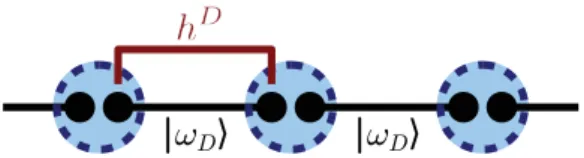
maximally entangled pairs of dimensionDbetween adjacent sites which can only differ in their bond dimensionD (cf. Fig. 4). The parent Hamiltonian is a sum of commuting projectors of the form
hD=1− |ωDωD| (4) and thus gapped. [HerehD should be understood as acting trivially on the leftmost and rightmost ancillary particle, and nontrivially on the middle two (cf. Fig. 4).] Moreover, for differentD andD one can interpolate between these states via a path of commuting Hamiltonian with local terms
hθ=1− |ω(θ)ω(θ)|, (5) where|ω(θ) =√θ|ωD +√1−θ|ωD. It follows that any two isometric injective MPS, and thus any two injective MPS, are in the same phase. In particular, this phase contains the product state as its canonical representant.
FIG. 4. (Color online) The isometric form of an injective MPS consists of maximally entangled states|ωDwith bond dimensionD between adjacent sites, where each site is aD2-level system. The local Hamiltonian termshD[Eq. (4)] acts only on the degrees of freedom corresponding to the central entangled pair.
FIG. 5. (Color online) Structure of the isometric form for nonin-jective MPS. The state consists of a GHZ stateα|α, . . . ,α(gray) and maximally entangled pairs between adjacent sites|ωDα, where the bond dimensionDαcan couple to the valueαof the GHZ state.
Note that in the previous derivation, the dimensions of the local Hilbert spaces differ. One can resolve this by thinking of both systems as being embedded in a larger Hilbert space or by adding ancillas; we discuss this further is Sec.IV.
2. Degenerate ground states
Let us now consider the case of of noninjective MPS, that is, systems with degenerate ground states? First, consider the case with block sizesDα :=dimHα=1, that is,P≡PGHZ=
α|αα,α| (up to a rotation of the physical system): This
describes an A-fold degenerate GHZ state with commuting Hamiltonian terms
h=1− α
|α,αα,α|. (6) ForDα =1, we have that (again up to local rotations)
P=
α
|αα,α| ⊗1D2 α, where1D2
α acts onHαin Eq. (1). This describes a state
α
|α, . . . ,α ⊗ωDα⊗N (7) (cf. Fig. 5), that is, a GHZ state with additional local entanglement between adjacent sites, where the amount of local entanglement Dα can depend on the value α of the GHZ state. (Since the Dα can be different, the correct
interpretation of Eq. (7) is |ωD1⊗
N⊕ · · · ⊕ |ωD A⊗
N, with
the |α labeling the direct sum components locally.) The corresponding Hamiltonian is a sum of the GHZ Hamiltonian (6) and terms
α
|αα| ⊗1−ωDαωDα,
which are responsible for the local entanglement. This Hamil-tonian commutes with the GHZ part (this can be understood by the fact that the GHZ state breaks the local symmetry; that is, there is a preferred local basis), and one can again interpolate to the pure GHZ state withDα =1 analogously to the injective case [Eq. (5)].
3. Summary: Classification of phases
Together, we obtain the following result on the classification of 1D phases in the absence of symmetries: Any two systems with MPS ground states with the same ground-state degeneracy are in the same phase; the canonical representant of these phases are the product and the GHZ-type states, respectively. Since the ground-state degeneracy cannot be
smoothly changed without closing the gap, this completes the classification.
F. Phase under symmetries: Unique ground state
Let us now discuss the classification of phases in the presence of symmetries, as defined in Sec. II C 2. In the following we first discuss the case of injective MPS, that is, systems with unique ground states. Note that we consider the symmetry of the blocked MPS, but as we have argued when defining phases under symmetries, this does not affect the classification.
An important prerequisite for the subsequent discussion is the observation that any MPS has a gauge degree of freedom
eiϑ|μ[P] = |μ[eiφP(Y ⊗Y∗)], (8) where Y is right-invertible (i.e., there exists Y−1 such that
Y Y−1=1D, but Y need not be square) and Y∗ =(Y−1)T.
Conversely, it turns out that any twoPrepresenting the same state are related by a gauge transformation (8).
1. Projective representations and the classification of phases
LetUg be a linear unitary representation of a symmetry
groupG. We start from the fact that for anyUg-invariant MPS
|μ[P]and parent Hamiltonian, there is a standard form forP and a phase gauge forUgsuch that
UgP =P(Vg⊗Vg¯ ), (9) where the bar denotes the complex conjugate.19 Here theVg
form a projective unitary representation of groupG, that is,
VgVh=eiω(g,h)Vgh(cf. AppendixBfor details). AsVgappears
together with its complex conjugate in Eq. (9), it is only defined up to a phase,Vg ↔ eiχgVg, and thus,ω(g,h) is only determined up to the equivalence relation
ω(g,h)∼ω(g,h)+χgh−χg−χhmod 2π.
The equivalence classes induced by this relation form a group under addition (that is, tensor products of represen-tations), which is isomorphic to the second cohomology group H2(G,U(1))of G over U(1); thus, we also call them cohomology classes.
In the following, we show that in the presence of sym-metries, the different phases are exactly labeled by the cohomology class of the virtual realizationVgof the symmetry Ug determined by Eq. (9); this result was previously found in
Ref.11.
2. Equality of phases
Let us first show that MPS with the same cohomology class forVgin Eq. (9) can be connected by a gapped path. We do so by considering the isometric point, wherePis unitary; recall that the transformation to the isometric point commutes with the symmetry, so that (9) still holds. Then (9) can be rephrased as
ˆ
Ug =P†UgP=Vg⊗V¯g;
that is, the action of the symmetry can be understood as ˆUg = Vg⊗V¯g acting on the virtual system, in a basis characterized
Now consider two MPS with isometric formsP0 andP1, and symmetries ˆ Ug0=P0†Ug0P0=Vg0⊗V¯g0, ˆ Ug1=P1†Ug1P1=Vg1⊗V¯ 1 g, whereV0
g andVg1are in the same cohomology class. We can
now interpolate between the two MPS with bond dimensions
D0andD1(in the “convenient basis” corresponding to ˆUg0and
ˆ
Ug1) along the path|ω(γ)⊗N, where |ω(γ) =(1−γ) D0 i=1 |i,i +γ D1 i=D0+1 |i,i, (10) which is an MPS with bond dimension D0+D1. Again, the parent Hamiltonian along this path is commuting and thus gapped and changes smoothly withγ. This path can be understood as a path with symmetry
Vg0⊕Vg1⊗V¯g0⊕V¯g1=Uˆg0⊕Uˆg1⊕Uˆgpath (11) (cf. Ref.11), with
ˆ
Ugpath=Vg0⊗V¯g1⊕Vg1⊗V¯g0
(this is where equality of the cohomology classes is required, since only then ˆUgpathforms a linear representation).
3. Separation of phases
As we have seen, MPS for whichVgin Eq. (9) is in the same cohomology class fall into the same phase. Let us now show that, conversely, states with different cohomology classes fall into different phases. We prove this again in the framework of MPS; that is, we show that there cannot be a smooth MPS path connecting two such states. Note that it is clear that the interpolation given above cannot work, as nowV0
g ⊕Vg1does
not form a representation any more.
The idea of the impossibility proof is to consider a chain of arbitrary lengthN and show that along any well-behaved path Hγ, Pγ needs to change continuously, which results
in a continuous change in the way the symmetry acts on the virtual system. In turn, such a continuous change cannot change the cohomology class. While this argument is based on the fact that the chain is finite (as the continuity bounds depend on N), it works for arbitrary system size N; also, our argument implies that, in order to interpolate between two systems with different cohomology classes, that is, in different phases, the gap of the Hamiltonian will have to close for a
finitechain, and not only in the thermodynamic limit. (This can be understood from the fact that along an MPS path, the virtual representation of the symmetry is well defined even for finite chains, so that it cannot change without closing the gap. While we believe that cohomology classes label gapped phases beyond MPS, this will likely not hold exactly for finite chains, thus leaving the possibility of a higher order phase transition when interpolating beyond MPS.) We will now proceed by fixing someγ along the path and show the continuity in an environmentγ+dγ.
Fix someγ, with corresponding ground state|μ[Pγ] of Hγ, where Pγ is, without loss of generality, in its standard
form, where UgPγ =Pγ(Vg⊗Vg¯ ) with Vg unitary. Now
considerHγ+dγ withdγ 1 small and expand its ground
state as |μ[Pγ+dγ] = 1−λ2|μ[Pγ] +λ|χγ, withχγ|μ[Pγ] =0. WithHγ+dγ =Hγ +dH, 0= μ[Pγ+dγ]|Hγ+dγ|μ[Pγ+dγ] =λ2χγ|Hγ|χγ + μ[Pγ+dγ]|dH|μ[Pγ+dγ] λ2− dH, (12)
where is the spectral gap of Hγ. Since λ= ||μ[Pγ] −
|μ[Pγ+dγ]|anddH →0 asdγ →0, this shows that|μ[Pγ]
is continuous inγ, and since|μ[Pγ]is a polynomial inPγ, it
follows thatPγ can be chosen to be a continuous function of γas well.
Let us now study how the virtual representation of the sym-metry is affected by a continuous changePγ+dγ =Pγ +dP.
Let us first consider the case wherePγ anddPare supported
on the same virtual space, that is, the bond dimension does not change, and let us restrict the discussion to the relevant space. The representation of the symmetry on the virtual level becomes19
Zg⊗Zg∗=Pγ−+1dγUgPγ+dγ,
whereZg ≡Zg(λ) is invertible, andZ∗g =(Z−g1)
T[cf. Eq. (8)].
Since bothPγ+dγand its inverse change continuously, one can
find a gauge such that this also holds forZg.
It remains to see that a continuous change of the represen-tationZgdoes not change its cohomology class; note that the
choice of gauge forPγ+dγ [Eq. (8)] leads to a transformation Zg ↔Y ZgY−1, which does not affect the cohomology class. Let us first assume thatZg ≡Zg(λ) is differentiable, and let
Zg =Ug+Ugdγ , (13)
andUgUh=eiω(g,h)Ugh. Then we can start from ZgZh=ei[ω(g,h)+ω(g,h)dγ]Zgh
(note that smoothness of Zg implies smoothness of
exp[iω(g,h)]=Tr[ZgZh]/Tr[Zgh] ) and substitute (13).
Col-lecting all first-order terms indγ, we find that
UgUh+UgUh=eiω(g,h)Ugh+iω(g,h)eiω(g,h)Ugh.
Left multiplication withUh−1U−1
g =e−iω(g,h)Ugh−1yields Uh−1Uh+Uh−1Ug−1UgUh=Ugh−1Ugh+i ω(g,h)1,
and by taking the trace and using its cyclicity in the second term, we obtain
ω(g,h)= −i(φg+φh−φgh), (14)
withφg =Tr[Ug−1Ug]: This proves that differentiable changes
ofZgcan never change the cohomology class ofω.
In case Zg ≡Zg(λ) is continuous but not differentiable, we can use a smoothing argument: For any, we can find a differentiable ˆZg(λ,) such thatZˆg(λ,)−Zg(λ), and
defineωλ,(g,h) via eiωλ,(g,h)=TrZ
g(λ,)Zh(λ,)Z−gh1(λ,)
This ωλ,(g,h) (and in particular its real part) varies again according to (14) for any and thus does not change its cohomology class, and since it isO() close toωλ(g,h), the same holds for the cohomology class ofZg(λ).
In order to complete our proof, we also need to consider the case wherePγ+dγis supported on a larger space thanPγ. (The
converse can be excluded by choosingdγ sufficiently small.) This can be done by considering the symmetry on the smaller space, and is done in AppendixC. Together, this continuity argument shows that we cannot change the cohomology class of the symmetryUgon the virtual level along a smooth gapped
pathHγ and thus completes the classification of phases with unique ground states in the presence of symmetries.
G. Phases under symmetries: Systems with symmetry breaking
Having discussed systems with unique ground states, we now turn our attention to systems with symmetry breaking, that is, degenerate ground states, corresponding to noninjective MPS. Recall that in that case, the MPS projectorPis supported on a “block-diagonal” space, H=A α=1 CDα⊗CDα =:Hα . (15)
Before starting, let us note that different from the injective case, symmetry-broken systems can be invariant under nontriv-ial projective representations as well. However, we can always find a blockingksuch that the symmetry of the symmetry on the blocked system is represented linearly (see Sec.IV C), and we consider that scenario in the following.
1. Induced representations and the structure of systems with symmetry breaking
Let us first explain how the physical symmetry is realized on the virtual level; we see that it has the form of a so-called
induced representationof a projective representation (the proof can be found in AppendixD). Consider an noninjective MPS |μ[P]and its parent Hamiltonian. Then any invariance of the Hamiltonian under a linear unitary representation of a group
Gcan be understood as invariance under an equivalent linear representationUgwhich, with the correct gauge forP, and in
the correct basis, acts on the virtual system as ˆ Ug =Pg a α∈a Vha⊗V¯ha . (16) HerePgis a permutation representation ofGpermuting blocks with differentα’s in (15).Pgleads to a natural partitioning of {1, . . . ,A}into minimal subsetsa invariant under the action of allPg, which we callirreducible; the first direct sum in (16)
runs over those irreducible setsa. TheVhaare unitaries, where
h≡h(g,α) is a function ofgandα. Before explaining their algebraic structure, note thatPgcan be thought of as composed of permutationsPa
g acting on irreducible subsets, and (16) can
be rewritten as a direct sum over irreducible subsets, ˆ Ug = a Pga α∈a Vha⊗V¯ha . (17)
In the following, we describe the structure of the symmetry for one irreducible subseta; in fact, degeneracies correspond-ing to different subsets a are not of particular interest, as they are not protected by the symmetry (which acts trivially between them) and are thus not stable under perturbations of the Hamiltonian. For a single irreducible subset a, the symmetry Pga α∈a Vha⊗V¯ha (18) has the following structure (which is known as an induced representation): Fix the permutation representationPa
g, pick
an elementα0∈a, and define a subgroupH⊂Gas
H = {g:πg(α0)=α0},
whereπg is the action ofPg on the sectors,Hπg(α) =PgHα. Further, fix a projective representationVa
h of the subgroupH.
Then the action of Va
h can be boosted to the full group G
in Eq. (18) by picking representativeskβof the disjoint cosets kβH, and labeling them such thatπkβ(α0)=β. Then, for every gandα, there exist uniquehandβsuch that
gkα =kβh, (19) and this is howh≡h(g,α) in (18) is determined. Note that the action of the permutation is to mapαtoβ, so that (19) carries the full information of how to boost the representationVha of the subsetH to the full group; this is known as aninduced representation. (It is straightforward to check that this is well defined.)
Before classifying the phases, let us briefly comment on the structure of (17). The sectors α correspond to different symmetry-broken ground states. The splitting into different irreducible blocksacorresponds to the breaking of symmetries
notcontained inUg, and it is thus not stable under perturba-tions. Within each block,Ughas subsymmetries which can be
broken by the ground states—theα∈a—and subsymmetries which are not broken by the ground states—corresponding to the symmetry actionVha⊗V¯hadefined on subspacesH, where the symmetry acts as in the injective case.
2. Structure of symmetry-broken phases
In the following, we prove that two Hamiltonians with symmetry breaking are in the same phase if and only if (i) the permutation representations Pg are the same (up to relabeling of blocks) and (ii) for each irreducible subseta, the projective representationVa
h has the same cohomology
class. (In different words, we claim that two systems are in the same phase if Ug permutes the symmetry-broken ground states in the same way, and if the effective action of the symmetry on each symmetry-broken ground state satisfies the same condition as in the injective case.) Note that having the samePg allows us to even meaningfully compare
theVhaas the subgroupsHcan be chosen equal. Also note that since the permutation is effectively encoded in the subgroup
H, we can rephrase the above classification by saying that a phase is characterized by the choice of a subgroupHtogether with one of its cohomology classes.
As a simple example, the Ising Hamiltonians Hx =
Z2 symmetry (σx)⊗N is imposed: While Hz can break the
symmetry,Hxcannot and thus belongs to a different phase.
3. Equality of phases
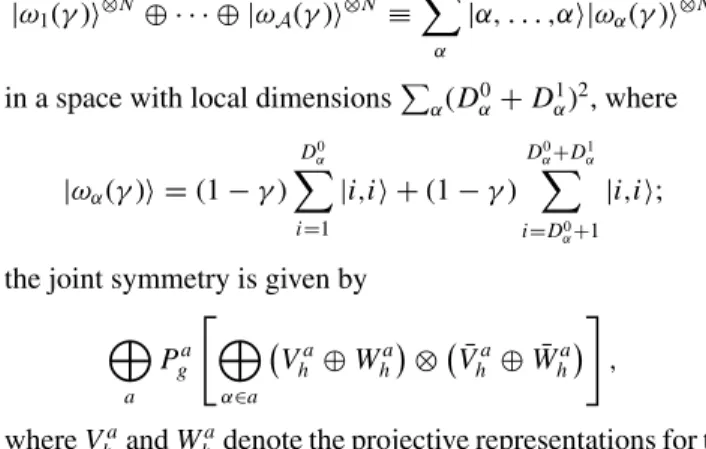
The proof of equality requires again to devise an interpo-lating path in the space of MPS which is sufficiently well behaved (i.e., it yields a smooth and gapped path in the set of parent Hamiltonians). It turns out that we can use essentially the same construction as in the injective case: We interpolate along a path
|ω1(γ)⊗N⊕ · · · ⊕ |ωA(γ)⊗N ≡
α
|α, . . . ,α|ωα(γ)⊗N in a space with local dimensionsα(Dα0+D1α)2, where
|ωα(γ) =(1−γ) D0 α i=1 |i,i +(1−γ) D0 α+D1α i=D0 α+1 |i,i;
the joint symmetry is given by
a Pga α∈a Vha⊕Wha⊗V¯ha⊕W¯ha , whereVa h andW a
hdenote the projective representations for the
two systems (as in the injective case, it can be thought of being embedded in the physical symmetry by blocking two sites). Again, the Hamiltonian along the path is the sum of the GHZ Hamiltonian and projectors of the form1− |ωα(γ)ωα(γ)|,
which couple to the GHZ degree of freedom; the resulting Hamiltonian is commuting and therefore gapped throughout the path.
4. Separation of phases
Let us now show that two phases which differ in either the permutation representationPg or the cohomology classes of
theVha cannot be transformed into each other along a gapped path. As in the injective case, we make use of a continuity argument. The argument goes in two parts: On one hand, continuity implies that each of the symmetry-broken ground states changes continuously, and thus the permutation action
PgofUgstays the same. The effective actionVha⊗V¯ a
h(modulo
permutation) of the symmetry on each of the symmetry-broken ground states, on the other hand, can be classified by reducing the problem to the injective case.
Let us first show that the symmetry-broken ground states change continuously. Let|ψα
γ:= |μ[P α
γ]be the (orthogonal)
symmetry-broken ground states ofHγ, withPα
γ :=Pγ|Hαthe restriction of Pγ to Hα (this describes an injective MPS).
For small changes dγ, we can again (as in Sec. II F 3) use continuity and gappedness ofHγ to show that the ground-state subspaces of Hγ andHγ+dγ =Hγ +dH are close to each
other; that is, there exist ground states|χα
γ+dγofHγ+dγ such
that
ψγα−χγα+dγO∗(dH),
where O∗(dH) goes to zero as dH goes to zero. Since the |χγα+dγ can be expanded in terms of the |ψγα+dγ, they are
MPS,|χα
γ+dγ = |μ[Qαγ+dγ]. Using continuity of the roots of
polynomials, we infer that we can choose |Qα
γ+dγ −P α γ|
O∗(dH). On the other hand, this implies that the Qαγ+dγ
are almost supported on Hα, and thus |Qαγ+dγ −P α γ+dγ| O∗(dH). Together, this shows that
Pα γ −P
α
γ+dγO∗(dH);
that is, thePα
γ, and thus the symmetry-broken ground states
|ψα
γ, change continuously. SincePgdescribes the permutation
action of the physical symmetryUg on the symmetry-broken
ground states, which is a discrete representation, it follows that
Pg is independent ofγ; that is, it cannot be changed along a gapped pathHγ.
In a second step, we can now break the problem down to the injective scenario. To this end, do the following for each irreducible block ofPg: Fix theα0used to define the subgroup H and its representation Vha, restrict the physical symmetry
Ugtog∈H, and consider the injective ground state|μ[Pα0
γ ]
and the correspondingly restricted parent Hamiltonian (this can be done by adding local projectors restricting the system to the subspace given byα0). SinceUg,g∈H, leaves|μ[Pγα]
invariant up to a phase, it is a symmetry of the restricted parent Hamiltonian; it acts on the virtual level asVha⊗V¯ha. The results for the injective case now imply that it is impossible to change the cohomology class ofVha, thus completing the proof.
III. TWO DIMENSIONS A. Projected entangled pair states
1. Definition
Projected entangled pair states form the natural general-ization of MPS to two dimensions2: ForP : (CD)⊗4→Cd,
the PEPS|μ[P]is obtained by placing maximally entangled pairs|ωD on the links of a 2D lattice and applyingP as in Fig.6. As with MPS, PEPS can be redefined by blocking, which allows to obtain standard forms forP, discussed later on. Parent Hamiltonians for PEPS are constructed (as in 1D) as sums of local terms which have the space supporting the 2×2 site reduced state as their kernel.
2. Cases of interest
As in 1D, each PEPS has an isometric form to which it can be continuously deformed, yielding a continuous path
FIG. 6. (Color online) PEPS are constructed analogously to MPS by applying linear mapsPto a 2D grid of maximally entangled states
of γ-deformed Hamiltonians along which the ground-state degeneracy is preserved. There are three classes of PEPS which are of special interest.
First, theinjective case, wherePis injective, and|μ[P]is the unique ground state of its parent Hamiltonian.8
Second, the block-diagonal case, where (kerP)⊥=
A
α=1Hα, with Hα=span{|i,j,k,l:ζα−1< i,j,k,lζα};
this corresponds again to GHZ-type states and Hamiltonians with A-fold degenerate ground states. These systems are closely related to the 1D noninjective case; they exhibit breaking of some local symmetry, and the ground-state subspace is spanned by|μ[P|Hα].
Third, the case where the isometric form ofPis
P=
g
Vg⊗Vg¯ ⊗Wg⊗Wg¯ (20) (the ordering of the systems is top-down-left-right), withVg
andWg unitary representations of a finite groupGcontaining all irreps of G at least once; this scenario corresponds to systems where the ground-state degeneracy depends on the topology of the system, and which thus exhibit some form of topological order20; in particular, for Vg and Wg the
regular representation ofG, the isometric form of these PEPS describes Kitaev’s double model of the underlying group.12All
these three classes have parent Hamiltonians at the isometric point which are commuting and thus gapped.
B. Gap in two dimensions
1. Gap in the thermodynamic limit
The major difference to the case of 1D systems is that it is much more difficult to assess whether the parent Hamiltonian is gapped in the thermodynamic limit, and examples which become gapless at some finite deformation 0< γcrit<1 of the isometric form exist. For instance, the coherent state corresponding to the classical Ising model21 on a hexagonal lattice at the critical temperature has critical correlations and is thus gapless,22while it is injective and therefore its isometric
form is gapped. In fact, this example illustrates that a smooth change inP can even lead to a nonlocal change in the PEPS |μ[P].
Fortunately, it turns out that in some environment of com-muting Hamiltonians (and, in particular, in some environment of the three classes introduced above), a spectral gap can be proven. To this end, let ˜H =h˜i, ˜hi 1with ground-state
energyλmin( ˜H)=0, where the condition ˜
hih˜j+h˜jh˜i −18(1−)( ˜hi+h˜j) (21)
holds for some >0 (here eachhiacts on 2×2 plaquettes on
a square lattice); in particular, this is the case for commuting Hamiltonians. Then ˜ H2 = i ˜ h2i hi + ij ˜ hihj˜ + hi˜ hj˜ 0 H˜ (22) (where the second and third sum run over overlapping and nonoverlapping ˜hi, ˜hj, respectively), which implies that ˜H
has a spectral gap between 0 and(cf. Ref.1).
As we show in detail in AppendixE, condition (21) is robust with respect toγ-deformations of the Hamiltonian. In
particu-lar, for any PEPS|μ[P]with commuting parent Hamiltonian (such as the three cases presented above), it still holds for the parent ofQ⊗N|μ[P]as long asλ
min(Q)/λmax(Q)0.967.
Thus, while considering the isometric cases does not allow us to classify all Hamiltonians as in 1D, we can still do so for a nontrivial subset in the space of Hamiltonians.
C. Classification of isometric PEPS without symmetries
Let us now classify the three types of isometric PEPS introduced previously in the absence of symmetries; together with the results of the previous section, this provides us with a classification of quantum phases in some environment of these cases.
1. Systems with unique or GHZ-type ground state
As in one dimension, any injective isometric P can be locally rotated to the scenario whereP=1; that is, it consists of maximally entangled pairs between adjacent sites. This entanglement can again be removed along a commuting path
hθ[Eq. (5)] as in one dimension. This implies that any injective PEPS and its parent Hamiltonian which is sufficiently close to being isometric is in the same phase as the product state.
The case with block-diagonal P, such as for GHZ-like states, is also in complete analogy to one dimension: Up to a rotation, it is equivalent to theA-fold degenerate GHZ state with additional maximally entangled pairs between adjacent sites, whose bond dimension Dα can again couple to the (classical) value of the GHZ state. This local entanglement can again be removed along a commuting path, as in one dimension, and we find that all block-diagonal PEPS which are close enough to being isometric can be transformed into the
A-fold degenerate GHZ state along a gapped adiabatic path.
2. Systems with topological order
What about the topological case of Eq. (20)? Of course, additional local entanglement |ωD can be present indepen-dently of the topological part of the state, which corresponds to replacing Vg with Vg⊗1 (and correspondingly for Wg),
and this entanglement can be manipulated and removed along a commuting path.
However, it turns out that the bond dimensionD of the local entanglement can couple to the topological part of the state even though there is no local symmetry breaking. In particular, the bond dimensionDα can couple to the irreps Rα(g) ofVg andWg; that is, we can change the multiplicity
Dαof individual irrepsRα(g), α Rα(g) ←→ α Rα(g)⊗1Dα.
The interpolation between different multiplicitiesDα can be done within the set of commuting Hamiltonians by observing that the Hamiltonian consists of two commuting parts:20One
ensures that the product of each irrep around a plaquette is the identity, and the other controls the relative weight of the different subspaces and thus makes it possible to change multiplicities. The underlying idea can be understood most
easily by considering a two-qubit toy model consisting of the two commuting terms,
hz= 12(1−Z⊗Z), hx(θ)=⊗θ2 1 2(1−X⊗X)⊗ 2 θ ,
where θ=(θ0 10): The term hz enforces the even-parity subspace α|00 +β|11, while hx(θ) takes care that the relative weight within this subspace is|00 +θ2|11, which
makes it possible to smoothly interpolate between |00 and |00 + |11within the set of commuting Hamiltonians.
Together, this proves that for a given groupG, all PEPS of the form (20), with representations Vg and Wg which contain all irreducible representations ofG, yield PEPS which are in the same phase. On the other hand, it is not clear whether the converse holds: Given two finite groups G, H
with corresponding representationsVg,Wg and Vh, Wh, for which Eq. (20) yields the same (or a locally equivalent) map
P—which means that the two models are in the same phase—is it true that the two groups are equal? While we cannot answer this question, let us remark that since both models can be connected by a gapped path, one can use quasiadiabatic continuation9,23 to show that their excitations need to have the same braiding statistics; that is, the representations of their doubles need to be isomorphic as braided tensor categories. Note that in Ref. 24, the mapP is used to map doubles to equivalent string-net models.
3. More types of local entanglement
Let us remark that while we have characterized the equiva-lence classes of isometric PEPS for the three aforementioned classes, this characterization is not complete, even beyond the difficulty of proving a gap: There are PEPS which can be transformed to those cases by local unitaries or low-depth local circuits, yet P has a different structure. The reason is that unlike in 1D, local entanglement need not be bipartite. For example, one could add four-partite GHZ states around plaquettes: While this is certainly locally equivalent to the original state, it will change the kernel of P, since only bipartite maximally entangled states can be described by a mapping P →P⊗1. Thus, the previous classification can be extended to a much larger class of isometric tensors, by including all symmetries of kerP which can arise due to adding local entanglement.
D. Symmetries in two dimensions
How does the situation change when we impose symmetries on the system and require the Hamiltonian path to commute with some unitary representationUg? Surprisingly, imposing symmetries in two dimensions has a much weaker effect than in one dimension, as we show in the following. In particular, we demonstrate how to interpolate along a symmetry-preserving path between arbitrary injective PEPS and between any two GHZ-type PEPS given that the permutation action of the symmetry on the symmetry-broken ground states is the same; note that the symmetry can, in particular, stabilize the degeneracy of GHZ-type states. Recall, however, that, in the following, we only show how to construct continuous
paths of PEPS; in order to turn this into a classification of phases under symmetries, we need to restrict to the regions characterized in Sec. III B where we can prove a gap. Yet the following arguments show that the reasoning used for 1D systems with symmetries will not apply in two dimensions, and a more refined framework might be needed.
1. Systems with unique ground states
Let us start by studying the injective case. There it has be shown25that any two mapsPandP which describe the same PEPS are related via a gauge transformation
P =P(eiφY⊗Y∗⊗Z⊗Z∗), (23)
withY∗=(Y−1)T. This implies that any unitary invariance of
|μ[P]can be understood as a symmetry ˆ
Ug=P−1UgP =Vg⊗V¯g⊗Wg⊗W¯g
acting on the on the virtual system, withVgandWgprojective
unitary representations.
While this is in complete analogy to the 1D case, there is an essential difference: The representation of the symmetry on the virtual level is not invariant under blocking sites. By blocking k×sites, we obtain a new PEPS projector with symmetriesVg =V⊗k
g andWg =Wg⊗, respectively. However,
taking tensor products changes the cohomology class, and in particular, for any finite-dimensional representationVg there exists a finitek such thatV⊗k
g is in the trivial cohomology
class. That is, by blocking afinitenumber of sites, any two PEPS|μ[P0]and|μ[P1]can be brought into a form where
the symmetry on the virtual level is represented byV0 g,Wg0
andV1
g,Wg1, which are all in the trivial cohomology class.
At this point, we can proceed as in the 1D case and construct an interpolating path which preserves the symmetry using nonmaximally entangled states|ω(γ) [Eq. (10)], now with joint symmetry
Vg0⊕Vg1⊗V¯g0⊕V¯g1⊗Wg0⊕Wg1⊗W¯g0⊕W¯g1.
Note that the whole construction can be understood as the sequential application of two 1D interpolations (since at the isometric point the horizontal and vertical directions decouple) and thus, all arguments concerning technical points such as the embedding in the physical space can be directly transferred.
2. Systems with local symmetry breaking
The results of Ref.25for the relation of two mapsP and
P [Eq. (23)] can be readily generalized to relate different representations of a PEPS with local symmetry breaking, that is, GHZ-type states. It follows that for any such PEPS, a symmetry can be understood at the virtual level as
ˆ Ug =Pg a α∈a Vha⊗V¯ha⊗Wha⊗W¯ha ,
where again thePg permutes the sectors, the a are minimal subsets invariant underPg, and theVha andWha, together with
Pg, form an induced projective representation.
The permutation action Pg of the symmetry is invariant
under blocking. Thus, we can apply the same type of continuity argument as in 1D to show that different permutations Pg