Regis University
ePublications at Regis University
All Regis University Theses
Summer 2013
A Study of Mongodb and Oracle in an
E-Commerce Environment
Aaron Ploetz
Regis University
Follow this and additional works at:
https://epublications.regis.edu/theses
Part of the
Computer Sciences Commons
This Thesis - Open Access is brought to you for free and open access by ePublications at Regis University. It has been accepted for inclusion in All Regis University Theses by an authorized administrator of ePublications at Regis University. For more information, please [email protected].
Recommended Citation
Ploetz, Aaron, "A Study of Mongodb and Oracle in an E-Commerce Environment" (2013).All Regis University Theses. 227.
Regis University
College for Professional Studies Graduate Programs
Final Project/Thesis
Disclaimer
Use of the materials available in the Regis University Thesis Collection
("Collection”) is limited and restricted to those users who agree to comply with the following terms of use. Regis University reserves the right to deny access to the Collection to any person who violates these terms of use or who seeks to or does alter, avoid or supersede the functional conditions, restrictions and
limitations of the Collection.
The site may be used only for lawful purposes. The user is solely responsible for knowing and adhering to any and all applicable laws, rules, and regulations relating or pertaining to use of the Collection.
All content in this Collection is owned by and subject to the exclusive control of Regis University and the authors of the materials. It is available only for research purposes and may not be used in violation of copyright laws or for unlawful purposes. The materials may not be downloaded in whole or in part without permission of the copyright holder or as otherwise authorized in the "fair use” standards of the U.S. copyright laws and regulations.
A THESIS
SUBMITTED ON 03 JULY 2013
TO THE DEPARTMENT OF INFORMATION TECHNOLOGY OF THE SCHOOL OF COMPUTER & INFORMATION SCIENCES
OF REGIS UNIVERSITY
IN PARTIAL FULFILLMENT OF THE REQUIREMENTS OF MASTER OF SCIENCE IN SOFTWARE ENGINEERING AND DATABASE TECHNOLOGIES
BY
Aaron Ploetz
APPROVALS
Darl Kuhn, Thesis Advisor
Don Ina, Faculty of Record
_________
A b stract
As worldwide e-commerce expands, businesses continue to look for better ways to meet their evolving
needs w1th web solut1ons that scale and perform adequately. Several onl1ne reta1lers have been able to
address scaling challenges through the implementation o f NoSQL databases. W hile architecturally different from their relational database counterparts, NoSQL databases typically achieve performance gains by relaxing one or more o f the essential transaction processing attributes o f atomicity,
consistency, isolation, and durability (ACID). As with any emerging technology, there are both critics and supporters o f NoSQL databases. The detractors claim that NoSQL is not safe and is at a greater risk for data loss. On the other hand, its ardent defenders boast the performance gains achieved over their relational counterparts. This thesis studies the NoSQL database known as “MongoDB,” and discusses its ability to support the growing needs o f e-commerce data processing. It then examines M ongoDB’s raw performance (compared to Oracle 11g R2, a relational database) and discusses its adherence to ACID.
Abstract ... ii
Table o f C ontents...iii
List o f F ig u res... vii
List o f T a b le s... xi
List o f Abbreviations U se d ... xii
Chapter 1 - Introduction... 1
W hat Makes NoSQL D ifferent?...1
Why is ACID Im portant?...3
Purpose o f this Study... 5
Research Questions and H ypotheses... 6
Limitations o f this Study...7
Chapter 2 - Review o f Existing Literature...9
Introduction... 9
Brewer’s CAP Theorem ...9
NoSQL Tradeoffs for Consistency, Performance, and A vailability... 10
MongoDB Technical G uidance... 11
Sum m ary...12
Chapter 3 - Research M ethodology... 14
Research Approach... 14 Table of Contents
Hardware Configuration #1... 15
Hardware Configuration #2... 16
Operating System Environment... 16
Description o f Lab Softw are...17
Use of the Term “ Schema” ... 17
Database Schema D e sig n ... 18
Data Generation Tools...21
Transaction Benchmarking... 22
Use Cases ... 24
Sum m ary...24
Chapter 4 - Performance Results and E valuation... 26
Product Navigation R esults... 26
Product Search R esults...30
Customer Update R esults... 33
Order Placement R esu lts... 35
Product Price Update R esults...39
Product Navigation Data Interpretation... 40
Product Search Data Interpretation... 42
Customer Update Data Interpretation...44
Order Placement Data Interpretation...45
Sum m ary...45
Chapter 5 - MongoDB ACID Experiments Results and Evaluation...47
Atomicity R esults... 47 Consistency R esults... 48 Isolation R esu lts...51 Durability R esults... 51 Atomicity Interpretation...51 Consistency Interpretation... 52 Isolation Interpretation...53 Durability Interpretation...54 Sum m ary...55
Chapter 6 - Other Considerations with MongoDB and O racle... 56
Security... 56
Backup and Recovery...57
Delivered Toolset ... 58
Sum m ary...59
Chapter 7 - Conclusions and Discussion...60
Conclusions... 60
Summary of Contributions... 62
Lessons Learned ... 62
Security... 64
Delivered Toolset... 65
Regular Expression Searching...65
Recommendations and Future R esearch ... 65
Recommendations... 65
Possible Future Research... 66
Sum m ary...67
Chapter 8 - Works C ite d ...70
Appendix A: Definition o f T erm s... 74
Appendix B: Annotated B ibliography... 77
Appendix C: Oracle and MongoDB Comparison o f Terms and K eyw ords...90
Appendix D: E-CommerceDB Schema (O racle)... 92
Appendix E: E-commerceDB Schema (M ongoDB)... 99
Appendix F: Data Generation and Insert C ode... 101
Appendix G: Testing Framework C ode...105
Appendix H: Database Architecture Questionnaire...110
Figure 3-1. Diagram o f the Oracle 11g R2 hardware configuration 15
Figure 3-2. Diagram o f the MongoDB hardware configuration 16
Figure 3-3. Oracle database e-commerce schema (ER diagram) 19
Figure 3-4. MongoDB database e-commerce schema 20
Figure 3-5. Disk storage example for a normalized blog post website 20
Figure 3-6. Code sample o f Oracle application-level transaction 23
Figure 3-7. Code sample o f MongoDB application-level transaction 23
Figure 4-1. Top Tier Product Navigation - Oracle 27
Figure 4-2. Top Tier Product Navigation - MongoDB 27
Figure 4-3. Product Group Navigation - Oracle 28
Figure 4-4. Product Group Navigation - MongoDB 29
Figure 4-5. Single Product Navigation - Oracle 29
Figure 4-6. Single Product Navigation - MongoDB 30
Figure 4-7. Case-Sensitive Keyword Search - Oracle 31
Figure 4-8. Case-Sensitive Keyword Search - MongoDB 32
Figure 4-9. Case-Insensitive Keyword Search - Oracle 32
Figure 4-10. Case-Insensitive Keyword Search - MongoDB 33
Figure 4-12. Customer Updates - MongoDB 34
Figure 4-13. Price Lookup - Oracle 36
Figure 4-14. Price Lookup - MongoDB 37
Figure 4-15. Order Insert - Oracle 37
Figure 4-16. Order Insert MongoDB 38
Figure 4-17. Order Items Insert - Oracle 38
Figure 4-18. Price Updates - Oracle 39
Figure 4-19. Price Updates - MongoDB 40
Figure 4-20. Top Tier Product Navigation - MongoDB (post schema change) 41
Figure 4-21. Product Group Navigation - MongoDB (post schema change) 42
Figure 5-1. Code to insert documents into the “postings” collection 48
Figure 5-2. Query number o f documents in the “postings” collection 48
Figure 5-3. Update, break, and query o f updated documents 48
Figure 5-4. “rs.status” for new replica set member 49
Figure 5-5. “rs.status” showing new member “RECOVERING” 50
Figure 5-6. “rs.status” showing new member in consistent state 50
Figure 5-7. Competing update commands 51
Figure D-1. Oracle database e-commerce ER diagram 92
Figure D-2. DDL for Oracle hierarchy, product, and pricing tables 95
Figure D-3. DDL or Oracle e-commerce customer table, with trigger and sequence 96
Figure D-4. DDL for Oracle order tables 97
Figure D-5. DDL for Oracle address table 98
Figure E-1. MongoDB e-commerce schema 99
Figure E-2. MongoDB categories collection 100
Figure F-1. Code to load data from prepared files 101
Figure F-2. Code to build the customer data file 102
Figure F-3. Code to insert customer data into Oracle 103
Figure F-4. Code to insert customer data into MongoDB 104
Figure G-1. Code to update customer records in Oracle 105
Figure G-2. Code to update customer records in MongoDB 106
Figure G-3. SQL code for the top tier navigation call in Oracle 107
Figure G-4. SQL code for product group navigation in Oracle 107
Figure G-5. SQL code for single product navigation in Oracle 107
Figure G-6. SQL code for case-sensitive product searching in Oracle 107
Figure G-8. SQL code for the customer updates in Oracle 108
Figure G-9. SQL code to perform a price lookup for the order process in Oracle 108
Figure G-10. SQL code to insert order records into Oracle 108
Figure G-11. SQL code to insert order items into Oracle 109
Figure G-12. SQL code to update product prices in Oracle 109
Table C-1. Comparison o f Oracle and MongoDB terms 90
Table C-2. Comparison o f Oracle and MongoDB aggregation operators 91
Table D-1. Indexes used in the Oracle 11g R2 database 92
ACID - Transaction which support Atomicity, Consistency, Isolation, and Durability (ACID). Relational database management systems are known for their support o f ACID transactions.
A C ID ity - A somewhat arbitrary method o f describing the level that database transactions adhere to ACID properties.
AMD - Advanced Micro Devices, Inc. A U.S.-based company which is chiefly known for manufacturing microprocessors, motherboard chipsets, and semiconductors.
A PI - Application Programmer Interface. A library written to abstract low-level data access tasks with the goal o f increasing developer productivity.
BASE - Basically Available Soft-state Eventual consistency. BASE is considered to be the antithesis o f ACID.
BSON - Binary JSON. Data serialization through the binary encoding o f JSON documents, used by MongoDB to store data.
CAP - Consistency, Availability, and Partition tolerance make up the three attributes o f Brewer’s CAP Theorem.
CRUD - Create Read Update Delete.
CSV - Comma Separated Value. Comma Separated Value files are a common way o f organizing data in export files.
DBA - Database Administrator. An individual who is responsible for the configuration and operational performance of a database.
DDL - Data Definition Language. A subset o f SQL used to define database tables, indexes, and other List of Abbreviations Used
objects.
E R - Entity Relationship. Typically used to describe an entity relationship diagram, which maps out the relationships between the database entities.
E R P - Enterprise Resource Planning. An ERP system is an application which handles a business’ customer relationships, supply chain and/or employee data. M ajor ERP vendors include Oracle and SAP.
FOSS - Free and Open Source Software. Software that is free o f charge and provides the source code to allow it to be changed by its user.
IE E E - Institute o f Electrical and Electronics Engineers. A professional society promoting standards and technological advancement.
JSO N - JavaScript Object Notation. A notation commonly used for serializing object data and/or passing data between distributed services.
LAN - Local Area Network.
M IT - Massachusetts Institute o f Technology.
ms - Milliseconds.
NoSQ L - A label for non-RDBMS, big-data databases that literally means “Not only SQL,” in reference to the Standard Query Language used by RDBMSs.
ns - Nanoseconds.
PC R E - Perl-Compatible Regular Expressions. A regular expression API implemented in both PHP and Oracle.
P H P - Personal Home Page tools. PHP is a popular language (Lerdof, Tatrow, 2002) developed by Rasmus Lerdof in 1995, which allows developers to easily add logic to HTML-based web pages.
PO SIX - Portable Operating System Interface for UNIX (Casteel, 2007). Essentially, it is a set of IEEE standards which allows for the portability and compatibility o f software between different platforms.
IT - Information Technology.
R A M - Random Access Memory.
RDBM S - Relational Database Management System.
RM AN - Oracle Recovery Manager. It is (Kuhn, 2010, p. 457) “Oracle’s flagship backup and recovery (B&R) tool.”
SKU - Stock Keeping Unit. An identifier typically used by retailers to refer to a specific product number.
SQ L - Structured Query Language. A scripting language used by relational database management systems.
SSL - Secure Socket Layer. A widely-used authentication protocol for secure network communications.
C h a p te r 1 - In tro d u ctio n
NoSQL databases have proven to be a viable solution for some unique scaling scenarios. However, the idea o f implementing a NoSQL solution (instead o f a relational database) seems
premature to many information technology organizations. Often, experienced professionals will decide to “live with” a process that is lengthy or slow due to an inability to scale appropriately.
Adding more confusion is NoSQ L’s status as a known “buzzword.” This has the effect of people seeking it out when it may not be the best solution. There have been many instances o f early adopters who do not really understand NoSQL technology (Banker, 2010), who have run into issues trying to implement a relational model with it.
InfoWorld columnist Andrew Oliver illustrates this confusion as he describes one individual who attempted (unsuccessfully) to implement MongoDB. He writes that (Oliver, 2012, p. 1) “if you’re working on a tiny application that doesn’t have high scalability requirements and you’re familiar with PostgreSQL, why not use PostgreSQL?” Oliver’s point is that if a developer or organization has in house knowledge o f a particular tool, and that tool will accomplish the task at-hand, then they should use it. Later on, he adds (Oliver, 2012, p.1) “The lesson to be learned here is: D on’t solve a simple problem with a completely unfamiliar technology and apply it to use cases it isn’t especially appropriate for.”
Are there problems that can be more appropriately solved with a NoSQL database instead o f a relational database management system (RDBMS)? Can NoSQL databases out-perform relational databases in some scenarios? Can NoSQL provide some semblance o f ACID transactions? These are questions that I will attempt to answer in this thesis.
W h at M akes NoSQ L D ifferent?
NoSQL database technology is premised on the work done by Dr. Eric Brewer on distributed systems. In his 1999 paper (co-authored with Armando Fox) “Harvest, Yield, and Scalable Tolerant
Systems”, Brewer (Brewer, Fox, 1999) introduced what he called the “CAP Principle.” Essentially, every distributed system strives to address three primary concerns:
1. Consistency - A system that has (Brewer, Fox 1999, p. 2) strong consistency” or “single-copy ACID consistency; by assumption a strongly-consistent system provides the ability to perform updates.”
2. Availability - (Brewer, Fox 1999) High availability is achieved if a read request can always reach and return data from a replica.
3. Partition Tolerance - The ability to easily add replicas o f the data to allow for horizontal scaling.
The key point o f Brewer’s CAP Principle (later known as both “Brewer’s CAP Conjecture” and “Brewer’s CAP Theorem”) indicated that it was impossible for a distributed system to fully satisfy all o f these conditions. MIT researchers Nancy Lynch and Seth Gilbert verified this in their 2002 paper, “Brewer’s Conjecture and the Feasibility o f Consistent, Available, Partition-Tolerant Web Services.” They found that (Gilbert, Lynch, 2002, p. 11 ) “it is impossible to reliably provide atomic, consistent data when there are partitions in the network.” They agreed with Brewer’s conclusion, that it was possible to (Gilbert, Lynch, 2002, p.11) “achieve any two o f the three properties: consistency, availability, and partition tolerance.”
Given that a distributed system (e.g.: database) could be expected to satisfy any two o f points of the CAP Principle, Brewer devised a list o f characteristics hereafter referred to as “CAP
Configurations.” These can be used to identify the architectural strengths o f various database systems:
1. CA - (Brewer, Fox, 1999) “Databases that provide distributed transactional semantics can only do so in the absence of a network partition separating server peers.” Relational database
transactions. Partition tolerance is a secondary consideration, and is typically achieved through replication, clustering or fail-over strategies.
2. AP - This designation describes databases that are both highly available and partition tolerant. With consistency as a secondary consideration, most o f these NoSQL databases (such as Cassandra, Riak, and CouchDB) operate under the assumption o f optimistic or (Browne, 2009) eventual consistency. However, the performance benefits achieved by sacrificing consistency (Yu, Vahdat, 2000, pp. 1-2) “comes at the expense o f an increasing probability that individual accesses will return inconsistent results, e.g., stale/dirty reads, or conflicting writes.”
3. CP - NoSQL databases achieve ACID-like transactions to their partitions through locking strategies. These types o f systems (such as MongoDB) sacrifice high-availability to ensure “strong” data consistency across all replicas/nodes, and (Brewer, Fox, 1999, p. 2) “avoid the risk o f introducing merge conflicts (and thus inconsistency).”
Essentially, NoSQL databases are architecturally different from relational databases because they are designed to reap the read and write performance benefits o f partition tolerance (horizontal scaling), while leaving either consistency or availability up for negotiation. Knowing this difference is paramount to understanding the situations where a NoSQL database may be a better fit than a RDBMS.
W hy is A CID Im p o rtan t?
One common way to describe relational database transactions is to say that they contain properties o f atomicity, consistency, isolation, and durability. These transaction properties are collectively known as ACID. The ability to provide ACID transactions is one o f the main reasons many businesses utilize RDBMSs. As author Joan Casteel illustrates in her 2007 book “Oracle 10g SQL,” an example that makes a good case for ACID transactions (Casteel, 2007) is a banking
transaction.
Assume a bank transaction in which $500 is withdrawn from one account, split in half and $250 is deposited into two other accounts. If the bank’s data center should suffer a power failure after the money is withdrawn, but before the other two transactions reach completion, is that $500 lost? If the transactions were completed on a database that supports ACID transactions, then (Casteel, 2007, p.
142) “the save will not occur until all three actions are entered.”
It should be noted that (Banker, 2012, p. 256) “MongoDB doesn’t provide ACID guarantees over a series o f operations, and no equivalent o f RDBM Ss’ BEGIN, COMMIT, and ROLLBACK semantics exists.” However, MongoDB does support (Banker, 2012, p. 256) “atomic, durable updates on individual documents and consistent reads.” The take-away from this: if you have a multi-operation transaction that decrements from one property and increments another (on a single document), then MongoDB can ensure atomicity and durability in this case. On the other hand, MongoDB cannot ensure atomicity (or durability) on a multi-operation transaction that updates properties on separate or multiple documents.
With ACID transaction support defined, it is time to ask next logical question. “Why would anyone choose to not implement ACID transactions?” After all, the reasons to use ACID transactions seem to be grounded in data safety and common sense.
In some scenarios, e-commerce retailers may allow certain non-critical data to go inconsistent or “stale” with the majority o f nodes, for short periods o f time. Assume a scenario where a customer places an order on a website, and it makes its way through their ERP system. After a while, it may be sent back to the order history database (in batch), and made available for query by a web user. If the order history database nodes are updated every hour, then a partial or failed update is not critical to a business transaction. In this case, an ACID transaction is not required as there is a good chance
will re-update successfully within the next hour.
The benefit to be gained (in the previous scenario) is that o f raw performance. Large internet retailers may have hundreds o f thousands (or even millions) o f customers. A database containing order history records for prior years may grow big rather quickly. The absence o f ACID transactions allows NoSQL databases to quickly serve this type o f data across multiple nodes.
Other times, going without ACID guarantees is not so much a choice as it is a way to deal with system failure. In the case o f Amazon, which has (Decandia et al, 2007, p. 205) “tens o f thousands o f servers” spread across the world; there is almost always some component in a state o f failure. To counter that, Amazon’s Dynamo NoSQL database (Decandia et al, 2007, p. 205) needed “to be
constructed in a manner that treats failure handling as the normal case without impacting availability or performance.” In this case, as long as the data is consistent across a majority (or preconfigured
quorum) o f nodes, the transaction is considered to be successful.
Purpose of this Study
This study will generate data based on e-commerce use cases to ascertain levels o f performance and data integrity on both MongoDB and Oracle database systems. A testing framework will simulate an e-commerce website. As a part o f the testing framework, a series o f common e-commerce functions will be written to perform operations against each database.
Test data will be generated to simulate customers, addresses (of customers) and products. The data will then be loaded into each database (MongoDB and Oracle 11 g), so that each will have the same product, customer, and address data. The database instances will be running on Linux machines with similar hardware configurations. Next, a series o f experiments will be run using the
aforementioned e-commerce functions o f the testing framework. Statistics will be tracked for
commerce website.
Some o f the experiments will be focused on testing the ACID transaction properties. The Oracle 11g R2 database is assumed to be fully ACID compliant, so it will not be subject to ACID tests. However, tests against MongoDB will be scrutinized for its adherence to ACID properties.
One goal o f this study is to determine how well MongoDB and Oracle 11g R2 match-up to each other in the context o f e-commerce usage. Many e-commerce database back-ends are built on
relational databases and still manage to provide adequate performance. They do this while providing ACID transaction guarantees, and a feature-rich toolset for their developers and users. While
MongoDB may not have this same level o f features, discovering if it can support a favorable trade-off o f features for raw performance is an aim o f this study.
Please note that this paper assumes that the reader has an intermediate to advanced
understanding o f database and software development terminology. All significant terms used in this paper have been defined in Appendix A “Definition o f Terms.” A list (and definition) o f all significant acronyms used can also be found in the “List o f Abbreviations” chapter.
R esearch Q uestions and H ypotheses
There are three fundamental questions which have driven the direction o f this study. These questions help to underscore the differences between Oracle and MongoDB, and (by proxy) RDBMS and NoSQL technologies. These questions are:
1. Between MongoDB and Oracle, which will perform faster e-commerce-based transactions?
2. Between MongoDB and Oracle, which will provide greater data integrity (based on ACID standards)?
e-an optimal e-commerce solution on MongoDB?
I hypothesize the following answers, respectively:
1. MongoDB will out-perform Oracle in terms o f raw read and write speeds.
2. MongoDB will fail to adequately negotiate multiple ACID tests.
3. An appropriate trade-off o f ACID for performance will be able to be made, to justify the use MongoDB in an e-commerce environment.
L im itations of this Study
My original thought was to compare NoSQL databases to RDBMSs. However, that topic was quickly determined to be too broad. NoSQL databases vary dramatically (even when compared to each other) from an architectural perspective. To assume that experiments done with MongoDB would reflect those done with Cassandra or CouchDB would be erroneous. Testing multiple NoSQL databases would be challenging and time-consuming, therefore, a single NoSQL database had to be chosen.
Also the original implementation o f this study was to be on “traditional data processing environments.” That statement is too vague to do a valuable study on, and had to be refined. Due to my experience and qualifications, the use cases for this study were chosen to relate to the e-commerce industry.
MongoDB (developed by 10gen, Inc.) has been chosen as the NoSQL subject for this study. It has been advocated for use in e-commerce by several authors, including “MongoDB in Action” author Kyle Banker and Forward Systems founder Eric Ingram. In their book “The Definitive Guide to M ongoDB,” authors Eelco Plugge, Peter Membrey, and Tim Hawkins mention that (Membrey, et-al,
2010, ch. 1) “for many things (such as building a web application), MongoDB can be an awesome tool for implementing your solution.”
While I do have experience in developing for and maintaining Cassandra NoSQL databases, Cassandra was determined to not be the best choice for this study. As author Kristov Kovacs noted, the best scenario for using Cassandra is if (Kovacs, 2012, para. 20) “you write more than you read.” W hile a typical e-commerce back-end database does plenty o f writing (customer orders, product updates, etc...), most o f the queries handled will be reads to support guided navigation, product and customer lookups. Also, Cassandra is known to have an AP CAP Configuration, which means that it sacrifices consistency. This was determined not to be ideal, as there are certain parts o f e-commerce systems (like orders and payments) that will require consistency across partitions.
Oracle 11g was chosen to represent the RDBMS side o f this study. Oracle is widely considered to be the front-runner in the current RDBMS market. ServerWatch’s Kenneth Hess (Hess, 2010, p. 3) puts Oracle at the top o f the list for enterprise databases, adding that “Oracle’s name is synonymous with enterprise database systems.” Craig S. Mullins o f The Data Administration Newsletter (TDAN) indicates that (Mullins, 2011, para. 3) Oracle is the “clear leader” in the RDBMS realm with a 48.1% market share.
It should also be noted that Oracle provides a solution for horizontal scaling with Oracle Real Application Clusters (RAC). The Oracle model for this study will not be subjected to the ACID tests, and will not be required to persist data on distributed nodes. Therefore, the implementation o f Oracle in a RAC was determined to be out o f scope for this project.
C h ap ter 2 - Review of Existing L ite ra tu re
In tro d u ctio n
Oracle’s RDBMS has been Oracle’s flagship product for more than 30 years. By contrast, production-ready versions o f MongoDB were not released until 2010; it is still considered to be a new product. This distinction also makes it a difficult subject upon which to find good resources.
Additionally peer-reviewed, scientific papers about MongoDB are even rarer. However, papers and journals covering basic NoSQL concepts do exist.
This review will cover literature addressing major aspects o f NoSQL architecture, and
especially those which are directly related to MongoDB and this project. This includes literature which helped to address the three hypothesized research questions, as well as works that assisted in the design o f the lab environment required for this study. It should be noted that the majority o f existing works examined will be focused on MongoDB and other NoSQL architectures. While a functioning Oracle 11g R2 database is certainly an integral part o f this project, Oracle architecture is well-known and also not the central focus o f examination.
B rew er’s CAP T heorem
As mentioned in the introduction chapter, the concepts behind NoSQL database architecture are based on Dr. Eric Brewer’s work. Early research quickly introduced me to the concept o f “Brewer’s CAP Theorem” and eventually, Brewer and Dr. Armando Fox’s 1999 paper “Harvest, Yield, and Scalable Tolerant Systems.” In this paper, Brewer discussed the challenges o f providing strong consistency and high availability in a distributed system. This paper signified the introduction o f the CAP Theorem, which Brewer described as his “CAP Principle.” The CAP Principle (Brewer, Fox, 1999, p. 2) “makes explicit trade-offs in designing distributed infrastructure applications.” Essentially it defined Consistency, Availability, and Partition Tolerance as desirable attributes of distributed
systems, but stated that it is only realistic to fulfill two o f those at any given time.
Following Brewer’s paper, I discovered Dr. Seth Gilbert and Dr. Nancy Lynch’s 2002 paper entitled “Brewer’s Conjecture and the Feasibility o f Consistent, Available, Partition-Tolerant Web Services.” Gilbert and Lynch offered a series o f proofs in an asynchronous network model to
demonstrate the tradeoffs between availability and consistency. Using this model, they concluded that Brewer was correct in that it is (Gilbert, Lynch 2002, p.11) “impossible to reliably provide atomic, consistent data when there are partitions in the network.” These papers are significant in that they laid the foundation o f the concepts by which all NoSQL databases are designed.
NoSQ L Tradeoffs fo r Consistency, Perform ance, and A vailability
Another significant work in the NoSQL world is “Design and Evaluation o f a Continuous Consistency Model for Replicated Services” by Dr. Haifeng Yu and Dr. Amin Vahdat. This paper further illustrated the trade-offs between consistency, availability, and performance. Additionally Yu and Vahdat introduced a continuous consistency model, in which they demonstrated the ability to (Yu, Vahdat, 2000) provide a configurable level o f consistency in a data store with remote replicas.
One o f the more-recent works to break new ground in the NoSQL world is Amazon’s 2007 “Dynamo: Am azon’s Highly Available Key-value Store.” This paper was written by several Amazon researchers including (but not limited to) Giuseppe DeCandia, Peter Vosshall, and W erner Vogels. In addition to providing insight into the architecture behind one o f the largest e-commerce operations in the world, this paper described the evolution o f Am azon’s Dynamo NoSQL database, and the types of availability issues that it was architected to solve.
While also designed to scale to serve (Decandia, et-al, 2007, p.205) “tens o f millions o f customers at peak times using tens o f thousands o f servers,” Amazon Dynamo delivers high-
to the designing o f Dynamo to operate with “weaker” replica consistency. These concepts (among others) led to the creation o f other Dynamo-based NoSQL products such as Cassandra and Riak. While not directly pertaining to the architecture behind MongoDB, this paper is significant to this study in that Dwight Merriman and the original developers o f MongoDB had to answer these same types of questions in their design.
M ongoDB Technical G uidance
This section will cover some o f the more technical MongoDB materials available. One o f the central aspects o f this project involved the planning, installation, and operation o f MongoDB databases. In addition, these sources were also referenced in structuring the application calls to the MongoDB Java API.
N ot surprisingly, much o f the existing materials are written by current and former 10gen employees. In terms o f working with MongoDB specifically, former 10gen engineer Kristina Chodorow published three works which address the perspectives o f application development for and database administration o f MongoDB. This study utilized the following works by Ms. Chodorow: “MongoDB: The Definitive Guide,” “50 Tips and Tricks for MongoDB Developers,” and “ Scaling M ongoDB.”
Kristina Chodorow and (former 10gen engineer) Michael Dirolf’ s “MongoDB: The Definitive Guide” provided an introduction to the core concepts o f MongoDB. It described topics such as quick installation, document structure and behavior, querying, indexing, and aggregation. Later chapters covered subjects such as sharding, replication, and administration. This work proved to be
instrumental to writing the early prototypes o f the testing framework and data loaders.
Chodorow’s “ 50 Tips and Tricks for MongoDB Developers” serves as a quick reference for application developers working with MongoDB as a data store. The book is broken up into sections
administration. The examples provided in the application design and implementation sections proved useful to the design o f the MongoDB data store and code for this project.
“ Scaling M ongoDB” (also by Kristina Chodorow) is a reference for MongoDB DBAs working with a sharded cluster. This book offered details on the setup, administration, and behavior of
MongoDB shards. Chodorow also discussed how to distribute and balance your data, emphasizing the importance o f choosing a good (Chodorow, 2011b) shard key. Examination o f this source also
provided insight into how to test MongoDB for specific ACID properties.
During my research on MongoDB use cases and schema designs, I happened to find (former 10gen engineer) Kyle Banker’s article titled “MongoDB and E-commerce” (Banker, 2010). This article described modeling an entire e-commerce system using MongoDB. While Banker would later publicly retract the assertions made about the feasibility o f running the order/payment operations in MongoDB (due to lack o f atomic transactions), his design strategies proved to be helpful for this project.
Reading through Banker’s “MongoDB and E-commerce” also led me to his 2012 book titled “MongoDB In Action.” W hile discussing the architecture and administration o f MongoDB, Banker specifically described e-commerce schemas, including a section called “Designing an e-commerce data model.” In this section, he presented a detailed product document model, as well as a separate model for category documents. These models directly influenced the e-commerce data models used in this thesis.
Sum m ary
These works demonstrated their relevance to this subject by illustrating some o f the problems introduced by databases with network partitions. They also bring to light some o f the methods used to pertaining to application design, implementation, organization, data safety and consistency, and
designed the way that they are. Many o f the MongoDB-specific sources were relied upon heavily during the construction o f the testing framework. The concepts introduced in this chapter will be referred to hereafter, as we explore some o f the advantages and challenges o f using MongoDB in an e-commerce environment. Please note that additional information on this and other works which have influenced this thesis can be found in Appendix B: Annotated Bibliography.
C h a p te r 3 - R esearch M ethodology
This chapter describes the research methodologies used for this study. It defines the research methods and how they will help to answer the posed research questions. Also included are sections detailing the lab hardware and software, the database configuration and schema design, as well as strategies used for benchmarking database performance.
R esearch A pproach
This study will use a quantitative approach to answer the three research questions posed in the introduction:
1. Between MongoDB and Oracle, which will perform faster e-commerce based transactions?
2. Between MongoDB and Oracle, which will provide greater data integrity (based on ACID standards)?
3. Is there an acceptable level o f compromise between performance and data integrity to allow for an optimal e-commerce solution on MongoDB?
Answers to the first question will be the result o f performance statistics obtained by measuring the application-level performance o f calls to both MongoDB and Oracle 11g R2. The answers to the second question will be determined by the pass/fail status o f ACID tests on MongoDB. The third question will be answered by analyzing data from the first and second questions.
D escription of L ab H a rd w are
This section details the hardware used to perform the performance experiments. It should be noted that I performed this study with my own resources, and without access to enterprise-grade hardware. Therefore this experiment utilized two AMD-based machines, detailed below:
System #1: AMD Athlon 64 X2 6400 3.2GHz Dual-Core Processor, 4GB DDR2 SDRAM, 7200rpm 260GB hard disk, Ubuntu (64-bit server edition) 10.04.
System #2: AMD Athlon 64 X2 4600 2.4GHz Dual-Core Processor, 4GB DDR2 SDRAM, 7200rpm 500GB hard disk, Ubuntu (64-bit server edition) 10.04.
These systems supported two different configurations (as shown in Figure 3-1). Only one database was running at any given time. This prevented the systems from having to divide resources between two concurrently-running database instances.
H a rd w are C onfiguration #1.
The first configuration (Figure 3-1) was designed for the Oracle 11g R2 experiments. System #1 functioned as the application server, and sent requests to the Oracle database on System #2 via a LAN connection. All tests for Oracle 11g R2 were run against one standalone-database server.
Configuring Oracle for replication across multiple servers (RAC cluster) was determined to be beyond the scope o f this project (partition tolerance is not considered to be a strength o f relational databases, so there is no need to test it).
H a rd w are C onfiguration #2.
W hile similar, Configuration #2 differed in that a MongoDB slave or “ SECONDARY”
replication server also ran on System #1 (as shown in Figure 3-2), alongside the testing framework. It executed transactions against the MongoDB database on System #2. Data from the MongoDB
“PRIMARY” was then replicated back to the MongoDB “ SECONDARY” on System #1.
Figure 3-2. Diagram o f the MongoDB hardware configuration.
O p e ratin g System E nvironm ent.
A decision was made early on in this study to have all systems running the Ubuntu version of the Linux operating system. W hile I do have extensive experience with both commercial Linux and Windows operating systems, it was more cost-effective to build the systems running a FOSS operating system. For this environment I have selected Ubuntu 10.04, a Debian-based Linux operating system.
I chose Ubuntu 10.04 due to my experience with that version, the maturity o f the release, and its cost (free). It should be noted that Oracle does not officially support enterprise database installations on Ubuntu. However I was unable to discover any technical reasons indicating that Oracle would not install or that it would perform poorly on a system running Ubuntu. And despite the level o f official
documentation on installing Oracle 11g R2 on the Ubuntu operating system, I was able to get it to install and run with minimal issues.
D escription of L a b Softw are
A testing framework was written in Java which ran on System #1 and interfaced with the database on System #2. Java was chosen as the language for the testing framework due to my
experience in that language, as well as the popularity and maturity o f the database software APIs. The specific API Java Archive (JAR) files and versions used for each database are listed here:
• MongoDB: mongo-2.7.3.jar
• Oracle 11g R2: ojdbc14.jar
To begin, the database software was installed on System #2. In the case o f MongoDB, version 2.0 was downloaded, unzipped and initialized in about a half an hour. As an additional challenge, MongoDB 2.2 was released on August 28th o f 2012, requiring an upgrade o f the database software prior to the “production” run o f the experiments. In the case o f Oracle, version 11g R2 Enterprise Edition was downloaded and installed.
Use of th e T erm “ Schem a”
It should be noted that there is more than one common definition for “schema.” Typically, schema is used as to describe the structure o f tables and how they relate to one another. There will also be references in this paper as to how MongoDB is “schema-less” or how it has a “flexible” schema. This is simply meant to imply that MongoDB does not enforce any kind o f document (row) structure within its collections (tables).
Within the context o f an Oracle database however, the use o f “schema” indicates a (Casteel, 2007) collection o f database objects which belong to a single user. In this way, “schema” means more than just the design and interrelationships o f the tables. It encompasses tables, indexes, triggers and many other types o f database objects.
Given the subject matter o f this paper, there will be several uses o f the word “schema.” For purposes o f clarification, it should be noted that this paper will use “schema” simply to indicate the design o f the tables as well as the relationships between them. If “schema” is used hereafter to refer to an “Oracle schema,” this distinction will be clearly made. Please note that this and other terminology differences between Oracle and MongoDB have been outlined in Appendix C, “Oracle and MongoDB Comparison o f Terms.”
D atabase Schem a Design
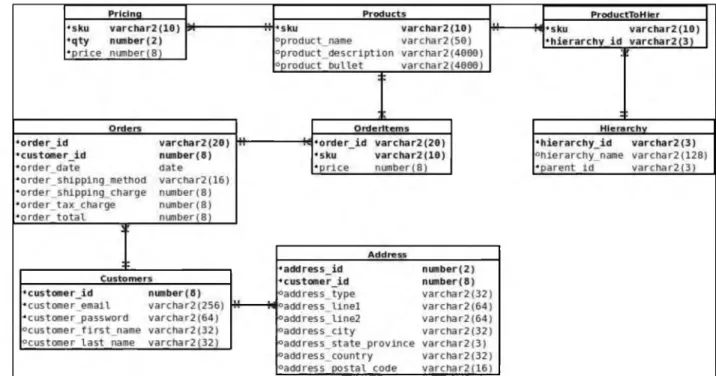
A preliminary (normalized) e-commerce database schema was then developed for the Oracle 11g R2 instance (Figure 3-3 is an entity relationship diagram which details the schema used in this configuration). A “products” table was required, as well as a related table for multiple price points. Additional design characteristics for the MongoDB schema were taken from Kyle Banker’s
“MongoDB and E-commerce” (Banker, 2010) which demonstrated embedded documents in lieu of complex JOIN operations. Additionally, a table was created to handle the product hierarchy, where each product belongs to a hierarchy consisting o f a top-level category and a product group.
The database also needs to keep information on customers, and the “customers” table was modeled (Grobler, 2010) to contain data pertaining to the customer’s name, email, and password. This project’s customer data model also had to account for the likelihood that customers will have multiple addresses (ship-to, bill-to, e tc...). This led to the creation o f the addresses table with a one-to-many relationship from customers to addresses. The customers entity in the MongoDB schema contained the addresses as documents embedded inside the customer documents.
Finally, tables were created to keep track o f data relating to e-commerce orders (customers, products ordered, prices paid, e t c . ) . The model used contained entities for both Orders and
OrderItems because (Song, Whang, 2000) each order can contain several items, demonstrating a one- to-many relationship. For the MongoDB schema, the items purchased on each order were added
the Oracle 11g R2 tests can be found in Appendix D “E-commerceDB Schema (Oracle).”
(Banker, 2010) as embedded documents. Additional technical details on the database schema used for
Figure 3-3. Oracle database e-commerce schema (ER diagram).
For Configuration 2 (MongoDB) a de-normalized, non-relational schema was developed (see Figure 3-4), which employed the use o f some redundant data to avoid having to reference it. This follows the NoSQL practice o f (Chodorow, 2011a, ch. 1) “Duplicate data for speed, reference data for integrity.” As mentioned in the previous paragraphs, the use o f M ongoDB’s embedded document feature was leveraged as well, and this prevented the need for additional data queries. Additional technical details on the database schema used for the MongoDB experiments can be found in Appendix E “EcommerceDB Schema (MongoDB).”
orders {
id ,
customer id , o r d e r d a te , o rde r ship method, o r d e r s h ip c h a r g e , ord e r ta x charge, ord e r t o t a l, o rd e r ite m s: [ id , sku, q ty , p ric e customers { id , em ail, password, firs tn a m e , lastname, addresses: [ id , typ e , l i n e l , lin e 2 , c it y , s ta te p ro vin ce , p o s ta l, co u n try products { id , sku, productnam e, product d e s c r ip tio n , p r o d u c t b u lle t , categorynam e, h ie ra rch yn a m e , p r ic in g : [ ( qty, p ric e
Figure 3-4. MongoDB database e-commerce schema.
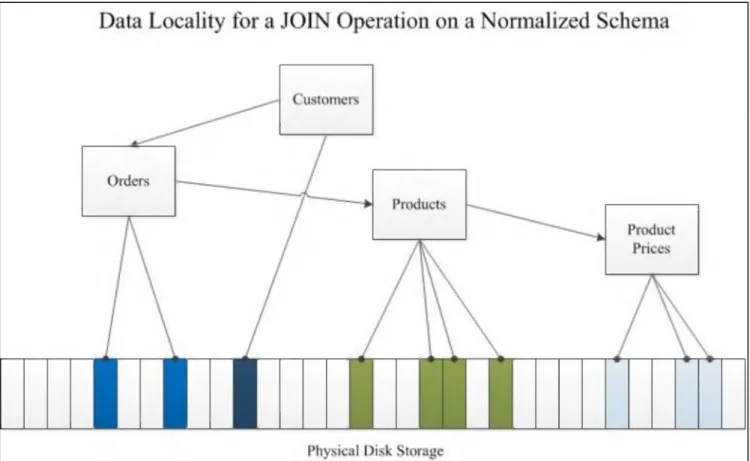
De-normalization o f the data can also improve disk read times. In a presentation at the 2012 MongoDB Chicago conference, 10gen Solution Architect Chad Tindel showed an example o f (Tindel, 2012) how data is stored on-disk for both a normalized and de-normalized schema. Figure 3-5 shows how customer orders are stored on disk in a normalized (relational) e-commerce database.
To retrieve all o f the data for a custom er’s order, the application or user would need to perform a join operation. Disk seek times are affected because the data must be read from multiple locations on the physical disk, as the parts o f the order record are stored in different tables. However, storing customer orders in a de-normalized schema ensures that each order document would contain all necessary information (order data, products, prices, etc) stored continuously on disk. Likewise retrieving this data is faster, because it is read all at once from one spot on the physical disk. Storing data in this manner decreases the time required for reading from disk.
One additional note about M ongoDB’s collection (table) design is that it is known to have a flexible schema. This allows (Membry, et-al, 2010, ch. 3) MongoDB to support documents with different properties (fields) to “co-exist in a single collection.” This is useful when storing documents which contain unique properties that may or may not need to exist on other data elements.
Consider a product database with the property o f “batterySize,” to contain the designation for the type o f batteries that the product takes. In a RDBMS, all products will be required to have a “batterySize” field, even if the product does not require batteries. In MongoDB, only products which required batteries would have a “batterySize” property on the document. All other products would be stored in a document which does not contain the “batterySize” property at all.
D ata G eneration Tools
Once the databases were installed and the schema was designed, a set o f data generation tools was written. First, I created several text files containing hundreds o f random data entries for first name, last name, email provider, street name, and city/state/zip combinations. Next, the “generateCustomers” method imported this data, and randomly assembled 250,000 customers each with one or two
addresses. This list o f customers was then exported to a file, allowing identical customers to be imported into both MongoDB and Oracle.
o f data for product categories, search keywords, and manufacturers. A format for the SKU (product number) was determined to take the two-character category abbreviation and follow it with four digits. This would allow for up to 9,999 products to be randomly created for each category type. The
“generateProductData” method then randomly assembled 80,000 products, and exported them to a file. As with the customer data, the same product list was then loaded into both MongoDB and Oracle, so that each would be tested with the same product offering. Technical details on the code used for data generation can be found in Appendix F “Data Generation and Insert Code.”
T ran sactio n B enchm arking
I (briefly) explored the use o f existing benchmark tools for both MongoDB and Oracle, but could not find one tool that handled both databases. Using one tool for MongoDB and another for Oracle (no matter how similar) would have been using two different measurement strategies, which would have been inherently inaccurate. To ensure accurate benchmarking, the decision was made to set a timer variable (in Java code) just prior to executing a transaction on the database, and to set another timer variable when control was returned to the testing framework. Measuring database activity from within common Java code (Figures 3-7 and 3-8) did offer a consistent way in which both the databases were called and application-level transactions could be measured. The testing framework was coded to function as closely as possible for MongoDB (MongoDB Java driver) and Oracle
(JDBC), with the only real difference being the database that was called.
String strSQL = "SELECT * FROM products WHERE sku = ? ";
PreparedStatement stmt = conn.prepareStatement(strSQL);
stmt.setString(1, strProductID);
// set start time
long beginDate = System.n a n o T i m e(); // execute transaction
ResultSet rset = stmt.executeQuery();
// control returned to application, set end time
long endDate = System.n a n o T i m e();
Figure 3-6. Code sample which measures an application-level transaction for Oracle.
DBObject prodQuery = new BasicDBObject(); prodQuery.put("sku", strProductID);
// set start time
long beginDate = System.n a n o T i m e(); // execute transaction
DBObject product = productCollection.findOne(prodQuery);
// control returned to application, set end time
long endDate = System.n a n o T i m e();
Figure 3-7. Code sample which measures an application-level transaction for MongoDB.
Preliminary testing indicated that measurement o f transactions in milliseconds was not nearly as granular as was necessary for this study. An overwhelming number o f transactions yielded a total time o f a single millisecond, increasing the difficulty in recording useful data. I then experimented with timing the transactions in nanoseconds, which provided a satisfactory amount o f data granularity. Additional technical details on the code used for the testing framework can be found in Appendix G “Testing Framework Code.”
It is important to note that there are multiple variables which can affect performance. These variables come from a variety o f realms, and can include (but are not limited to) hard disk RPMs, CPU
(JVM) settings. While an effort was made to take these variables into consideration, it is not realistic to test with every possible configuration.
Use Cases
There are several key components o f an e-commerce website. An e-commerce site is assumed to be selling something, and their customers must have (Moradi, 2011) quick and intuitive ways to find the products they want. Once customers find their products, (Song, Whang, 2000) the customers have to be able to place orders for them. There also has to be a mechanism to track customer data, and to allow the customers to update their own data. Finally, web merchandisers will need to occasionally update some aspects o f the product data.
Based-on the description above, the following use cases were built into the testing framework:
1. Product Navigation
2. Product Searching
3. Order Placement
4. Customer Data Updates
5. Product Data Updates
The testing framework was designed to simulate each o f these use cases. This allowed for the databases to be tested while attempting to complete operations that are similar to actual e-commerce based transactions. These transactions (and the results o f the testing) will be detailed in the next chapter.
Sum m ary
This chapter was written to accomplish two goals. The first was to discuss the methods of research and design considerations o f the testing software, database schema and queries. This will be helpful in understanding the results o f the tests on each configuration. The secondary goal was to illustrate the challenges involved in the development phase o f this project.
C h a p te r 4 - P erfo rm an ce R esults and E valuation
This chapter will describe each o f the use case-based experiments (for both MongoDB and Oracle), and the results that were returned. The results will be analyzed and compared between each database, and briefly discussed. In an effort to facilitate as direct o f a comparison as possible, the same CSV files were used to produce both the customer and product data sets on both MongoDB and Oracle. This helped to ensure that the content o f each data row (and the order in relation to the surrounding rows) was identical between each database.
The number o f application-level transactions varied by experiment. Experiments based on the customer entity were run once for each customer on-file, or 250,000 iterations. The order-based experiment produced seemingly-random amounts o f data, as the number o f products purchased (for each order) was randomly generated at runtime. Some o f the experiments were not dependent on the number o f rows stored, and were run for either 1,000 or 10,000 iterations. These experiments were more dependent on the time for the overall experiment to complete, or the size o f the data files produced.
Note that source code and queries for these experiments are not shown in this chapter. This decision was made due to space constraints, as well as not wanting to divert focus from the results or their interpretation. As mentioned in the previous chapter, code for the relevant pieces o f the testing framework (including SQL queries) can be found in Appendix G: Testing Framework Code.
P ro d u ct N avigation Results
Product navigation is a method used by e-commerce customers to locate products for purchase. Typically, the customers have some idea o f what they are looking for. The customer then selects a top- level category, followed by one or more sub-categories. On some e-commerce sites, a customer can choose various product attributes to further refine their navigation.
1. Top tier product navigation. Customers select their top-level category, and the database returns the list o f top tier categories for the next choice.
2. Product group navigation. The customer selects a category, and the database returns the list o f products under that category.
3. Single product navigation. The customer selects a product, and the database returns all of the data associated with that product.
To test this use case, three queries were run for 1,000 product navigation transactions each, against both databases:
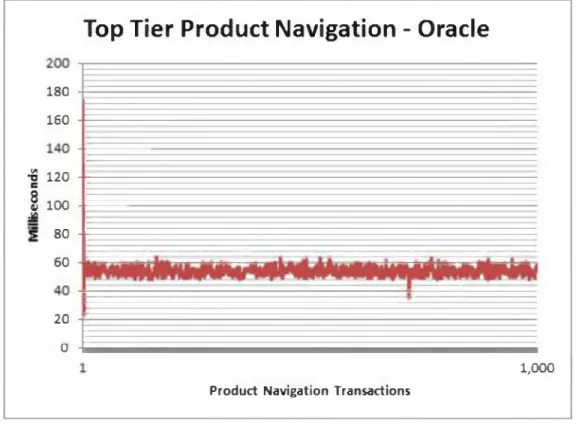
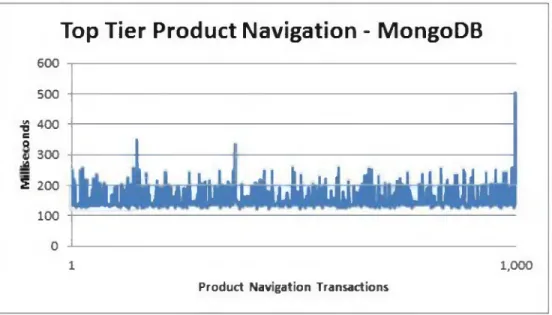
1. Query #1 (retrieval o f the top tier categories) on Oracle (Figure 4-1) took an average of 53.797ms, while running in an average o f 153.332ms on MongoDB (Figure 4-2). For this experiment, this works in a sequence o f three database queries:
Top Tier Product Navigation - Oracle
180 -r 160 -■8 120 - e § 100 M 5 80 60 -20 0 H 1,000 Product Navigation TransactionsMONGODB AND ORACLE IN AN E-COMMERCE ENVIRONMENT 28
Top Tier Product Navigation - MongoDB
600 500 -8 400 c Q v 300 M 2 200 100 0 1 1,000
Product Navigation Transactions
MongoDB. an average Figure 4-2. Performance statistics for retrieval o f top tier product categories from
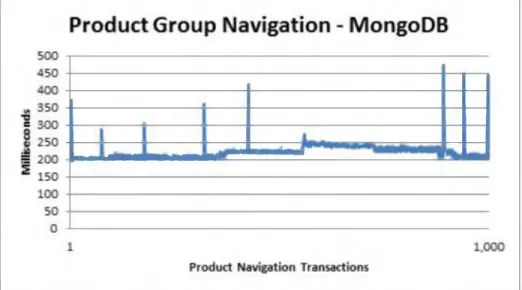
2. Query #2 (retrieval o f the product group’s product list) on Oracle (Figure 4-3) took o f 4.411ms, while running in an average o f 220.479ms on MongoDB (Figure 4-4).
1
|
k«J S L,
1
J Jl
ii .a
J , is. d! l! hsN
1
III
i o : . f fri it i" 'firr nnr "'p i r!n n M
Product Group Navigation - Oracle
0
1 1,000
Product Navigation Transactions
MONGODB AND ORACLE IN AN E-COMMERCE ENVIRONMENT 29
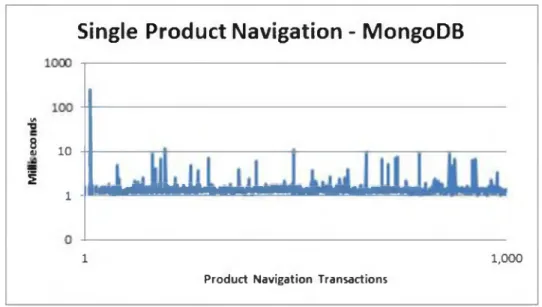
Figure 4-4. Performance statistics for retrieving the product groups from MongoDB. 3. Query #3 (retrieval o f the data for a single product) on Oracle (Figure 4-5) took an average of
13.318ms, while running in an average o f 1.726ms on MongoDB (Figure 4-6).
Single Product Navigation
-Oracle
200 -: IA 1 150 -8 V _ .1A S 100 -
s
Ii
•i
i i . i 50 - 0 i w n i r w r w i i n ' n m i i m r i r ™ k f e > i k l . m. a a rilft. 1Ml k 1.1 k l > t i l L4iM .-t.lM . k t i I l d J i i1 ]L 1,000Product Navigation Transactions
MONGODB AND ORACLE IN AN E-COMMERCE ENVIRONMENT 30
Single Product Navigation - MongoDB
IA> TJ § 1 0 .
1
i -1 1,000Product Navigation Transactions
Figure 4-6. Performance statistics for retrieval o f a single product from MongoDB. P ro d u ct Search Results
Although guided navigation is an excellent feature, every e-commerce website should have a well-functioning keyword-based search. Users who come to a website already knowing what they want need a way to search for it. These users may already have some information on the product (type, specification, product name, e tc...), which should allow them to locate it.
Neither table utilized an index on the product_description field, as the product_description is usually a “payload field.” The field’s maximum size o f 4000 characters allows it to contain free-form text, which could hamper attempts to quickly locate data. The product_description field was selected for this experiment because it is a subpar choice. However, the performance results o f the regular expression transactions could be more easily examined.
This experiment was driven by a list o f 17 search terms. The terms were compiled from a file o f (fictitious) companies and a file o f product description keywords. Both files were used in the random generation o f the product data.
generated as a random composition o f keywords, company names and noise words. Further study seemed to indicate that the difference between case sensitive and case insensitive matching was
significant to performance, so transactions were run for each. A series o f 10,000 transactions was then executed against each database, and yielded the following results:
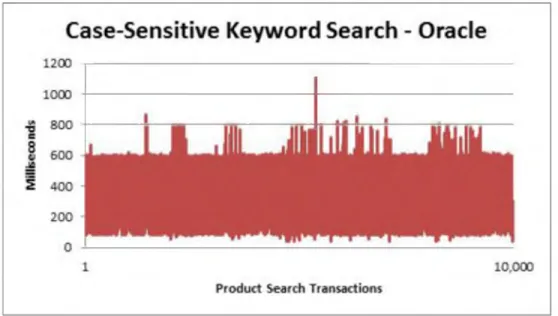
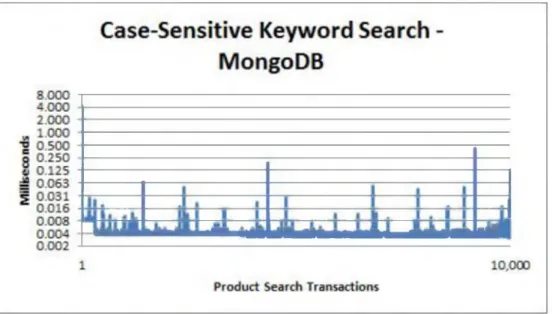
1. A case sensitive regular expression query against the products table ran in an average of 366.5300ms for Oracle (Figure 4-7), while running in an average o f 0.004491ms (4491ns) for MongoDB (Figure 4-8).
MONGODB AND ORACLE IN AN E-COMMERCE ENVIRONMENT 31 MongoDB and Oracle. A regular expression search was run against the product description, which was
MONGODB AND ORACLE IN AN E-COMMERCE ENVIRONMENT 32
Figure 4-8. Performance statistics for a case-sensitive keyword search from MongoDB. 2. A case insensitive regular expression query against the products table ran in an average of
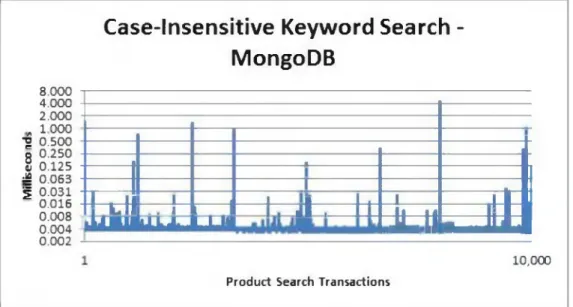
194.4144ms for Oracle (Figure 4-9), while running in an average o f 0.004937ms (4937ns) for MongoDB (Figure 4-10).
Case-Insensitive Keyword Search - Oracle
1000
900 800
Product Search Transactions
MONGODB AND ORACLE IN AN E-COMMERCE ENVIRONMENT 33
Case-Insensitive Keyword Search -
MongoDB
8.000 4.000 2.000 * 1000 ■g 0.500 o 0.250 8 0.125 :£ 0.063 f 0.031 0.016 0.008 0.004 0.002 1 1 1 1 1 i a 1 It i , ij I 1 IILii . , i! I I I , al 1 i I 1 iIE 1 1 1 1 U M I I I |ifi ii 1 1 V * ■ ■ n i L L l l y i i l 10,000Product Search Transactions
Figure 4-10. Performance statistics for a case-insensitive keyword search from MongoDB. C ustom er U pdate Results
This use case was designed around a customer needing to update his/her website account data. A common e-commerce user task is the updating o f the account password. This specific type o f update is also easily tested.
It should be noted that this experiment did not adhere to PCI (Payment Card Industry) standards concerning the storage o f passwords in plain-text. The topic o f PCI compliance is not in the scope of this project or these experiments. However, anyone building an e-commerce website should adhere to the PCI stipulation (PCI, 2010, p. 19) to “Render all passwords unreadable during storage and
transmission, for all system components, by using strong cryptography.”
This experiment was designed to read a text file containing each o f the 250,000 email addresses in the customer table/collection. The same file was run against both MongoDB and Oracle, allowing each database to be tested using update queries that ran with the same addresses in the same order. As the testing framework iterated through the email addresses in the file, it also generated a “strong” eight- character password. W ith the email and password in-hand, the framework sends a single update
MONGODB AND ORACLE IN AN E-COMMERCE ENVIRONMENT transactions for each database yielded the following results:
34
1. A simple update against the customers table ran in an average o f 0.8465ms for Oracle (Figure 4 11, while running in an average o f 0.2841ms for MongoDB (Figure 4-12).
Figure 4-11. Performance statistics for customer updates on Oracle.
MONGODB AND ORACLE IN AN E-COMMERCE ENVIRONMENT 35
O rd e r Placem ent Results
By their very nature, all e-commerce websites need to be able to store and track orders placed by customers. A customer order contains a list o f products (and quantities) to be ordered. It also contains information about the customer, such as shipping address and payment information.
It should be noted that this experiment did not adhere to Payment Card Industry (PCI) standards referring (PCI, 2010) to the transmission and storage o f unencrypted payment information. The topic o f PCI compliance is not in the scope o f this project or these experiments. However anyone building an e-commerce website should adhere to the PCI stipulation o f never storing payment information unless (PCI, 2010, p.14) it is “necessary to meet the needs o f the business.” Regardless, payment information should also be encrypted as soon as it enters the application.
For this experiment, 10,000 orders were placed against both databases by randomly-assigned customers. Only the customer’s ID was attached to the order. This way, the customer data could be available for reference on an as-needed basis. Each order was then given between one and five (random) products, each with a quantity between one and twelve (random). This resulted in a total product count o f 29,856 (or 2.9856 products per order) for Oracle and 30,088 products (3.0088 products per order) for MongoDB.
The product prices were then queried from the database, so that the correct quantity-break pricing could be established. Once the product prices were obtained, the order data was then inserted into the “orders” table/collection.
One difference in the ordering process between Oracle and MongoDB, was in how the ordered products were stored in the databases. In Oracle, the products were inserted to the “order_items” table
products were written into an embedded array on the order document, and inserted into the “order” collection along with the rest o f the order data.
This resulted in the following database transactions:
1. A pricing query against the “products” table/collection ran in an average o f 1.841ms for Oracle (Figure 4-13), while running in an average o f 0.005401ms (5401ns) for MongoDB (Figure 4 14).
MONGODB AND ORACLE IN AN E-COMMERCE ENVIRONMENT 36 in an additional transaction that took place after the initial insert to the “order” table. In MongoDB, the
1 n n n
Price Lookup - Oracle
-o 1U.U c 8 s A
U
.1
A.I.I LliHlljlllLiHllllUIHl.UJIIIIIillilL,
2
1.0 n 1 1 2 9 ,0 0 0Price Lookup Transactio n s
MONGODB AND ORACLE IN AN E-COMMERCE ENVIRONMENT 37
Figure 4-14. Performance statistics for a price lookup from MongoDB.
2. An insert into the “orders” table/collection ran in an average o f 20.312ms for Oracle (Figure 4 15), while running in an average o f 0 .1179ms for MongoDB (Figure 4-16).
MONGODB AND ORACLE IN AN E-COMMERCE ENVIRONMENT 38
Figure 4-16. Performance statistics for an order insert to MongoDB.
3. An additional insert into the “order_items” table was required only for Oracle (Figure 4-17), and ran in an average o f 20.513ms.
MONGODB AND ORACLE IN AN E-COMMERCE ENVIRONMENT 39
P ro d u ct P rice U pdate Results
In an effort to drive sales, web merchandizers occasionally offer certain products at discounts, in bulk or in combination with other products. This fluctuating nature o f product prices makes them a good topic for product update experimentation. In e-commerce, many product prices are subject to change based on the quantity ordered (known as a quantity break), and the data for this experiment was designed to reflect this.
This experiment simulates a product manager performing an alteration to a price for a specific product and quantity break. To provide us with an adequate data set, 10,000 product price update transactions were executed. This resulted in the following database transactions:
1. A pricing update against the “products” collection and “pricing” table ran in an average o f 19.65ms for Oracle (Figure 4-18), while running in an average o f 0.442ms for MongoDB (Figure 4-19).
Price U p d ates - O racle
180 160 140 ■3 120 8 100
v
£ 80 2 60 40 20 0 1 1 i l ________________ . ______________________ . 1 i . 1 • ________ r i l ! > I , r T i 1 . . I I 1 ! I I T L i = ! 1 H V I i ■ r i m r r w i I m r ■ ■ i i *i * i b *i i i i n i n1 1 j i ■ ■ i - ' i i m ii i n n n m n i i i nb ujmi i i ii i i p n n i H I I I 1 1 9 1 1 10,000Price Update Transactions
MONGODB AND ORACLE IN AN E-COMMERCE ENVIRONMENT 40
Price U p d ates - M ongoDB
32.00 i ---16.00 8.00 -g 4.00
|
2.00v
£ 1.00 2 0.50 0.25 1 10,000Price Update Transactions
Figure 4-19. Performance statistics for price updates in MongoDB. P ro d u ct N avigation D ata In te rp reta tio n
The results of queries #1 (Top Tier Navigation) and #2 (Product Group Navigation) were superior while running on Oracle. Additionally, the corresponding queries running on MongoDB exhibited sub-par performance. In the specific case of query #2, Oracle was running more than 50 times faster than MongoDB.
Query #3 (Single Product Navigation) however, performed as expected. This particular query ran more than 11 times faster on MongoDB than it did on Oracle. This would suggest that returning full documents from MongoDB was much faster when using a query that was premised on uniqueness (returning only one result).
The schema was examined to see if any improvements could be made. Although NoSQL databases (MongoDB, specifically) are known for achieving performance through de-normalization, I theorized that the hierarchy-to-category-to-SKU navigation queries might perform faster if the schema was re-engineered to produce a smaller amount of raw data. Or rather, that the queries concerned with