IMT School for Advanced Studies, Lucca
Lucca, Italy
A Formal Approach to Decision Support on
Mobile Cloud Computing Applications
PhD Program in Computer, Decision, and Systems Science
XXVIII Cycle
By
Andrea Morichetta
2016
The dissertation of Andrea Morichetta is approved.
Program Coordinator: Prof. Rocco De Nicola, IMT School for advanced studies, Lucca
Supervisor: Prof. Rocco De Nicola, IMT School for advanced studies, Lucca
Supervisor: Prof. Francesco Tiezzi, University of Camerino
Tutor: Prof. Francesco Tiezzi, University of Camerino
The dissertation of Andrea Morichetta has been reviewed by:
Dan Grigoras, University College Cork
Ivona Brandic, University of Wien
IMT School for Advanced Studies, Lucca
2016
Acknowledgements
In writing this thesis I closed a fantastic chapter of my life, full of challenges and hard work. It has been a great privilege to spend three years in a prestigious school like the IMT in the amazing city of Lucca.
I would like to express my sincere gratitude to my co-supervisor Francesco Tiezzi. He continually and convincingly supported me. Without his guidance and persistent help this disserta-tion would not have been possible. I would also like to thank my supervisor Rocco De Nicola, for his support through all these years.
I would like to thank many other people like Kim G. Larsen that hosted me for six months in the CISS Group at the Aal-borg University and all my co-authors with whom I had the pleasure to work, special thanks are due to Luca Aceto for his tireless work and unfailing readiness.
A special thank is due to my family and Elisa for helping me to survive all the stress of these years and not letting me to give up.
Contents
List of Figures ix
List of Tables xi
Declaration xii
Vita, Publications and Presentations xiv
Abstract xvii
1 Introduction 1
1.1 Contributions . . . 6
1.2 Structure of the thesis . . . 11
2 Background Notions 13 2.1 Timed Atomata . . . 13
2.1.1 Timed Automata in UPPAAL . . . 17
2.1.2 UPPAAL query language . . . 20
2.1.3 The UPPAAL tool . . . 21
2.2 Domain Specific Languages . . . 24
2.2.1 The Xtext tool . . . 26
2.2.2 Grammar language . . . 29
3 Domain Specific Language MobiCa 31 3.1 Language syntax . . . 32
3.2 TA-based semantics . . . 36
3.2.2 Fragments . . . 38 3.2.3 Resources . . . 39 3.3 Optimal scheduler . . . 40 3.4 MobiCa implementation . . . 43 3.4.1 MobiCa editor . . . 46 4 Scheduling Analysis 50 4.1 Design time approach . . . 51
4.1.1 Cost/reward horizon method . . . 51
4.1.2 The horizon method at work . . . 54
4.1.3 Evaluation of custom schedulers via SMC . . . 55
4.1.4 Application to the navigator case study . . . 58
4.2 Run-Time analysis . . . 62
4.2.1 Minimization of reachability properties . . . 63
4.2.2 Runtime framework . . . 66
4.2.3 Invocation interval . . . 68
4.3 Generation offloading strategies via UPPAAL Stratego . . 71
4.3.1 Navigator case study on Stratego . . . 72
5 Parallelized MCC Scheduling Algorithms 77 5.1 Parallel Dijkstra implementation . . . 78
5.1.1 Properties of shortest paths . . . 78
5.2 Parallel Depth First Search . . . 85
5.3 Analysis of the proposed algorithms . . . 86
6 Related Work 92 6.1 Optimization metrics . . . 94
6.2 Partitioning methods . . . 96
6.3 Offloading strategies . . . 98
6.4 Scheduling via Timed Automata . . . 100
7 Concluding Remarks 103 7.1 Challenges and Future Work . . . 104
A UPPAAL Syntax 107
A.1 Declaration . . . 107
A.2 Type . . . 107
A.3 Function . . . 108
A.4 Espression . . . 108
A.5 Query language . . . 109
A.6 Stratego query language . . . 110
B UPPAAL case study 111
List of Figures
1 Offloading problem . . . 5
2 Navigation case study: sequence diagram . . . 10
3 The door example . . . 18
4 UPPAAL editor . . . 22
5 UPPAAL simulator . . . 23
6 UPPAAL verifier . . . 24
7 A simple example of a MobiCa application . . . 35
8 Schedules for the simple application . . . 37
9 Fragment translation . . . 39
10 Mobile resource translation . . . 40
11 MobiCa Editor: Navigator application . . . 47
12 Cost/reward horizon method . . . 53
13 Reset TA . . . 53
14 Manager TA . . . 56
15 Simulation results . . . 59
16 Navigator case study: graphical representation of the Mo-biCa specification . . . 60
17 Navigator case study: optimal schedules . . . 61
18 Simulation results . . . 62
19 UPPAAL verification . . . 66
20 Runtime framework . . . 67
22 Manager example . . . 73
23 The resources’ models . . . 74
24 Strategy simulation . . . 76
25 State space exploration . . . 80
26 Graphical representation of results in Table 8 . . . 87
27 Another example of a MobiCa application . . . 88
28 Graphical representation of results in Table 9 . . . 89 29 Execution seconds for the P. Djkstra algorithm on Example 1 90
List of Tables
1 MobiCa syntax . . . 32
2 Operators translation . . . 38
3 Time and energy costs of the schedules for the simple ap-plication . . . 43
4 Query syntax . . . 47
5 Verification response time . . . 63
6 UPPAAL verification results . . . 64
7 Unfolding heuristics . . . 82
8 Performance results in seconds for Example 1 . . . 87 9 Performance results in seconds for the example in Figure 27 89
Declaration
In this thesis we focus on the main field of my research, so we include only part of the publications achieved during my Phd program. Part of the material presented has been previously published in two co-authored papers. Chapter 3 is based on (AMT15) a joint work with Luca Aceto, Reykjavik Univer-sity and Francesco Tiezzi, UniverUniver-sity of Camerino. Chapter 4 is based on (AMT15) and (ALMT15) a joint work with Luca Aceto, Reykjavik University, Kim G. Larsen, Aalborg Univer-sity and Francesco Tiezzi, UniverUniver-sity of Camerino.
Vita
February 3, 1987 Born, Macerata, Italy.
2006-2009 Bachelor degree in Computer science,
Final mark: 107/110, University of Camerino.
March 2011 - June2011 Erasmus period,
University of Iceland.
2009-2011 Master Degree in Computer Science,
Final mark: 110/110 cum laude, University of Camerino.
March 2012- February 2013 Research Fellow in the Software E. group,
I.S.T.I. A. Faedo CNR, Pisa, Italy.
February 2013 Present Phd Candidate,
IMT Lucca, Italy.
November 2014 - April 2015 Visiting Professor Kim G. Larsen,
University of Aalborg, Denmark.
June/July 2015 External Examiner in Computer Science,
ITC ”A Gentili”, Macerata, Italy.
Publications
1. Programming and Verifying Component Ensembles. Rocco De Nicola, Alberto Lluch-Lafuente, Michele Loreti, Andrea Morichetta, Rosario Pugliese, Valerio Senni, Francesco Tiezzi: FPS@ETAPS 2014: 69-83 2. The SCEL Language: Design, Implementation, Verification. Rocco
De Nicola, Diego Latella, Alberto Lluch-Lafuente, Michele Loreti, Andrea Margheri, Mieke Massink, Andrea Morichetta, Rosario Pugliese, Francesco Tiezzi, Andrea Vandin: The ASCENS Approach 2015: 3-71
3. Decision Support for Mobile Cloud Computing Applications via Model Checking. Luca Aceto, Andrea Morichetta, Francesco Tiezzi: MobileCloud 2015: 199-204
4. A Cost/Reward Method for Optimal Infinite Scheduling in Mobile Cloud Computing. Luca Aceto, Kim G. Larsen, Andrea Morichetta, Francesco Tiezzi: FACS 2015: 66-85
Presentations
Conference talks:
1. Decision Support for Mobile Cloud Computing Applications via Model Checking in the IEEE Mobile Cloud Conerence (San Fran-cisco, US)
2. A cost/reward method for optimal infinite scheduling in Mobile Cloud Computing in the FACS Conference (Rio de Janeiro, BR)
Other talks:
1. Specifying and Verifying SCEL programs with SPIN in the ASCENS Project (Modena, IT).
2. Decision Support for Mobile Cloud Computing Applications via Model Checking, Aalborg University
3. Optimal Scheduling for Mobile Cloud Computing Applications via Model Check- ing in the CINA Project (Civitnova Marche, IT)
Abstract
Mobile Cloud Computing (MCC) is an emergent topic growths with the explosion of the mobile applications. In MCC sys-tems, application functionalities are dynamically partitioned between the mobile devices and cloud infrastructures. The main research direction in this field aims at optimizing dif-ferent metrics, like performance, energy efficiency, reliability and security, in a dynamic environment in which the MCC application is located. Optimization in MCC refers to tak-ing advantages from the offloadtak-ing process, that consists in moving the computation from the local device to a remote one. The biggest challenge in this aspect is to define a strat-egy that is able to decide when offloading and which part of the application to move. This technique, in general, improves the efficiency of a system, although sometimes it can lead to a performance degradation.
To decide when and what to offload, in this thesis we pro-pose a new general framework supporting the design and the runtime execution of applications on their own MCC scenar-ios. In particular the framework provides a new specification language, called MobiCa, equipped with a formal semantics that permits to capture all characteristics of a MCC system. Besides the strategy optimization achieved by exploiting the potentiality of the model checker UPPAAL, we propose a set of methods for determining optimal finite/infinite schedules. They are able to manage the resource assignment of com-ponents with the aim of improving the system efficiency in terms of battery consumption and time. Furthermore, we propose two optimized scheduling algorithms, developed in Java, based on the exploitation of parallel computation in or-der to improve the system performance.
Chapter 1
Introduction
In the last decade, portable devices have increasingly pervaded our daily lives. Innovation in hardware has continuously provided powerful com-putational resources in lighter and smaller electronic handsets. This hard-ware evolution has triggered a tremendous amount of new mobile appli-cations; in a few years the mobile application market has exploded (EXP). The success of this market is strictly related to the ubiquitous access to data and computation that should satisfy the needs of users everywhere and at any time.
The majority of mobile applications that run on a portable device are strongly connected to the network for accessing data, but maintain the computational load locally. This characteristic requires a large amount of energy in battery-limited devices. For this reason there exist wired infrastructures, such as workstations, servers and, in particular, cloud systems, that provide more computational resources without being lim-ited by stringent size, weight and energy consumption. A combination of mobile devices and cloud infrastructures can provide computational resources everywhere and at any time in mobile devices. This is at the basis of an emerging paradigm, calledMobile Cloud Computing(MCC) (FLR13; DLNW13; Fli12), for developing mobile applications. It relies on theoffloadingconcept, i.e. the capability of moving the computational power and data storage away from mobile devices into the cloud.
There are many reasons (BKMS13) for executing part of the computa-tion on remote infrastructures in addicomputa-tion to the mobile device on which it is currently carried out. The first obvious potential benefit is improving storage capacity and performance. Indeed, even if the computational re-sources available to a mobile device have increased rapidly over the past few years, this computing power is still smaller than that of the station-ary counterparts. This is because smartphones and tablets must be much smaller and lighter than servers and desktop computers. Due to this gap between mobile and cloud processing power, CPU intensive applications can be executed much faster on remote than on mobile devices. On the other hand, interactive applications that require few computational re-sources may be executed on mobile devices as fast as on servers. Perfor-mance does not depend only on processor speed, but also on memory, storage, the ability of parallelizing across multiple cores and servers, and better connections. All of these characteristics can be simply provided by a common cloud infrastructure with a very small investment.
The second benefit is reducing energy consumption. According to (KL10), mobile device users found longer battery life to be more impor-tant than all other features. A mobile device should budget its finite source of energy wisely in order to arrive at the end of the day with-out exhausting all its available energy before. Designers are involved in the arduous challenge to make devices that are as energy efficient as pos-sible, for example using hardware power-saving modes or reducing the speed and quality of activities performed by mobile applications. While these measures are essential for extending battery lifetime, they also no-ticeably degrade the mobile users’ experience due to the slowing down of the execution of applications. Computation offloading is clearly an at-tractive alternative, because using remote computation and storage im-proves performance and, at the same time, saves battery power giving a better user experience.
Unfortunately the use of a remote infrastructure does not always come without a cost. Sometimes computation offloading may degrade the ap-plication’s performance. A possible way for measuring performance is to asses if the time saved by performing the computation remotely is
greater than the time spent communicating inputs and outputs over the network against the total computation executed locally. This measure, of course, could be highly influenced by network latency, bandwidth or computational power requirements of the offloaded code. For ex-ample, with high latency, low bandwidth and a consistent amount of offloaded code with a very low computational power requirement, exe-cuting the computation locally can improve the performance rate. The issues discussed above for improving the performance apply also to en-ergy saving. Indeed, code offloading through a power hungry wireless network may require more energy than performing the same activity lo-cally. According to the study proposed in (MN10), a critical aspect in energy saving is the necessity of finding at runtime, from time to time, the best trade-off between energy consumed by computation and energy consumed by communication.
It is therefore natural to ask how one should best build systems that combine all the introduced concepts. Current solutions tend to move from one extreme to the other; from one side it is given most function-ality to the cloud focusing the computation remotely and permitting its access to a thin-client; from the other side it is given most functionality to the mobile focusing the computation in a client architecture that runs usually in a portable device. In both of the cases we are in front of a static partition of the application. This client-server approach is known to be poorly suited for mobile environments, in which resource availabil-ity changes rapidly. MCC with respect to this old approach, introduces an important innovation: the dynamism of the application. In this way, the mobile applications are able to adapt to the continuous changing of the resources availability, by reallocating data and computation in order to improve performance, reduce energy usage and satisfy the final user goal.
Applications that benefit from MCC are both interactive and resource-intensive. Non-interactive applications can be executed easily on the cloud, since such applications can tolerate the communication latency between mobile and cloud. Application non resource-intensive instead can be executed entirely on mobile. The application that are currently
most popular with mobile users like web-browsing and e-mail require often few resources to the mobile device. Consequently MCC provides some benefit that cannot be perceived by the final user. On the other hand, the list of application supported by MCC includes more demand-ing applications, like speech recognition, face recognition, speaker iden-tification and image ideniden-tification. The challenge is to find a method that attempts to perceive the maximum benefit from the MCC paradigm for all applications where there is not a pronounced convenience to execute them in a hybrid computation with respect to the cloud or the mobile.
Here below we describe a concrete offloading problem and all the fac-tors that can influence negatively the MCC achievements. One concrete problem consists in executing a number of interdependent fragments of code into a number of heterogeneous resources like mobile devices and cloud infrastructures. Usually a fragment cannot be executed before all its predecessors have terminated, unless it is in parallel. Furthermore, each fragment can be execute in only one resource at the same time. An example of offloading of fragments is depicted in Figure 1. In detail, there are three fragments (A, B, C) that should be executed in a MCC sys-tem. In the first case (1) the computation is local on the mobile device for the fragments A and C and remote on cloud for the fragment B. How it is possible to notice in the figure, with respect to the second case (2) where the computation is maintained local for all fragments, the hybrid com-putation leads to an improvement of performance outlined by a shorter processing phase. Of course we cannot take this example as a general rule, the offloading is not always convenient. Indeed if we consider the last case (3), the hybrid computation degrade the final performance of the system, behaving worst than the second case. These negative perfor-mances are generated by a congested network, that slows down the pro-cessing of data synchronization, thus degrading the total performance of the system. In other words, the system is not able to compensate the syn-chronization time with the speed up obtained by executing the fragment B on a more powerful processor.
C omp ut e A Co m put e C Co m put e A Co mp ut e C Co m put e B Off loa d B Return B Co mp ut e A C om pu te C Of flo ad B Retu rn B
Clo
ud
C
loud
H ybr id C om put at ion F ini shed H ybr id C om put at ion F ini shed M obi le C om put at ion F ini shed time 1 ) 2) 1 ) 3) Figure 1: Of floading pr oblemThis thesis will focus on the MCC paradigm, and aims at support-ing the development of mobile applications whereby the data processsupport-ing and storage are moved from the mobile devices to powerful and cen-tralized computing platforms located in the cloud. Creating applications for MCC environments requires computing and communication capa-bilities, that should be gracefully integrated between local and remote devices. This integration can give a rich user experience under the bat-tery life concern, data/storage capacity and computational power. The user experience as mentioned in (OG13a) is the key concept of a MCC contest. Only integrating new functionalities with a new model of inter-action, computation intensive works can have a positive impact on the final user experience. For achieving this goal and make the interactions between the mobile and the cloud as seamless as possible, the developer should consider and take under control a set of parameters like the qual-ity and coverage of the network, the time and the energy cost required for the communication of data over the network and possibly disconnec-tions that inhibit the regular application usage. All these features make the MCC a very attractive and cutting-edge topic in research.
1.1
Contributions
What we want to do in this thesis is to exactly provide a new formal-based methodology, useful in MCC, for the offloading decision support and strategy assessment. The main novelty with respect to the related work in the literature, which mainly uses linear programming methods, is the introduction of a formal verification. This provides an exhaustive system configuration evaluation, by using well-established model check-ing techniques.
In other words, we imagine to have a MCC scenario where there is an application running on a mobile device that performs code offloading according to some strategies defined by the developer in terms of poli-cies. The duty of these policies is to manage the computation offloading according to the resources usage of the mobile device and the cloud. So, at this point, to achieve a good result in terms of performance and
en-ergy saved the main role is played by the policies setting, and so, by the developer decisions made at design time. Of course, at design time, for the policies configuration, the developer can follow his experience, re-sults of other applications or adjust values according some preliminary tests, but for sure he is not able to foresee all possible situations. For this reason we provide a framework that relies on a formal analysis, based on a model checking technique, to explore automatically and exhaustively all possible situations of the system, and give the right suggestions to the developer for properly tuning the policies configuration.
To achieve the mentioned goals, we need an application model to be used as input in an existing model checker. Indeed, the effort of creat-ing a compatible model with an existcreat-ing tool is given by the fact that proposing a novel ad-hoc model would require to develop a related soft-ware tool for the verification, with all problems connected. Furthermore a framework based on well established tool is more reliable and efficient. To make a fast prevision, our model should contain all information re-garding the application behavior and the application surrounding en-vironment. Some possible examples could be: information about the structure of the application, resources usage, offloading strategies, ex-ecution traces and so on. At this point it is simple enough to imagine the final complexity of this model and we are also conscious that mobile applications developer will not inclined to invest their time in generate a low-level model during the design of an application. However, we are confident that the developers can provide a more high-level specification of their systems. Therefore, in our framework we provide a high-level language that developers can use for the application specification. The framework, starting from this specification and by exploiting the formal semantics of the language, will generate automatically the input model for the incorporated verification tool. This tool, by means of some spe-cific techniques, is able to generate an optimal scheduler that will man-age the offloading strategy in order to improve the performance, while minimizing the energy consumption by devices. These concepts are im-perative for the applicability and satisfiability of prefixed service level agreement for computation-hungry applications in small devices.
Below we summarize the contributions presented in this thesis.
MobiCa: a Domain Specific Language for MCCMobiCa is a
domain-specific language for designing MCC systems in terms of installed ap-plications, code partitioning, and device characteristics (computational power, memory, network bandwidth, etc.). The main advantage of a domain-specific language, with respect to general-purpose modelling lan-guages, is to allow system designers to focus on those aspects of the mo-bile applications that are relevant for the MCC paradigm and, in partic-ular, for taking offloading decisions. These aspects are indeed first-class citizens of MobiCa, thus providing a high-level modelling perspective that abstracts from low-level details (e.g., the specific computations per-formed by the application components) that are not necessary for the offloading decision support.
The developer designs the system using MobiCa, by focusing on the MCC characteristics of the application(s) of interest, choosing the right partitioning, the typology and the time of the analysis.
Automatic translation into UPPAAL1.At the developer will be required
only to provide the application specification defined with the MobiCa language. The framework, starting from this specification and by exploit-ing the formal semantics of the language, will generate automatically the input model for the verification tool. We have defined and implemented a semantics for MobiCa via translation into timed automata (AD94), which automatically associates an UPPAAL model to each MobiCa specifica-tion. Timed automata are a formal language, that can be used to model and analyse the timing behavior of computer systems, and can be veri-fied using the well know model checker UPPAAL (see Chapter 2). This takes a weight off the developer, who does not have to take care of the details specified in the timed automata model. To simplify these steps we rely on the Xtext tool, an Eclipse open-source framework that allows one to generate editors equipped with auto-complete mechanisms, syn-tax highlighting, code completion and static error highlighting.
Design-time decision support. A design-time technique is provided to synthesize schedulers that produce infinite schedules ensuring the sat-isfaction of a property for infinite runs of the application. This is par-ticularly useful for MCC, where applications are supposed to provide permanent services, or at least to be available for a long period. In par-ticular, considering that our model is equipped with constraints on du-ration, costs and rewards, we are interested in identifying theoptimal
schedulers that permit the achievement of the best result in terms of en-ergy consumption and execution time. In fact, over infinite behaviors, it is possible to recognize a cyclic execution of components that is optimal and is determined by means of the limit ratio between accumulated costs and rewards. Consequently, an optimal scheduler is given by maximiz-ing or minimizmaximiz-ing the cost/reward ratio.
Run-time decision support.The main objective of our run-time decision
support is to attempt to maximize or minimize a chosen metric while achieving the expected system behaviour at run-time. Different metrics can be adopted; energy saving and time saving are probably the most important. In our approach we try to identify the best execution strategy for a finite amount of time/energy/fragments, basing this method on cost minimization for reachability properties. To mark this methodology usable in practice, we present also a dedicated framework able to incor-porate in the application the decision support and to collect important data for the verification phase. Furthermore, the framework is in charge to manage the analysis phase and take care of the reconfiguration of the system according to the environment variations.
Stratego Analysis. Besides to standard UPPAAL models, MobiCa
spec-ification can be translated to UPPAAL Stratego models. In this case, rather than verifying a proposed controller synthesis as usual with a Sta-tistical model checking, we use the Stratego facilities. Stratego, by means of an efficient on-the-fly algorithm, is able to construct at design-time a system controller that guarantees the correctness of reachability and
Configuration Panel
loop
Controller GPS CalculatorPath Maps EvaluatorTraffic Navigator NavigationPanel Voice Speed TrapIndicator destination getCoordinates coordinates coordinates coordinates map itineraries trafficInfo itinerary itinerary checkUpdate itinerary itinerary
Figure 2:Navigation case study: sequence diagram
safety properties for timed and hybrid games. However, once a strat-egy has been synthesized, Stratego permits further and deeper analysis in terms of other additional properties that may or may not hold un-der the strategy. Furthermore it permits to optimize a synthesized non-deterministic safety strategy with respect to a desired performance mea-sure.
Parallel algorithms. We also propose two optimized algorithms,
devel-oped in Java, that try to cover the performance issues observed using the model checking techniques and in particular UPPAAL. The main ad-vantages of the proposed algorithms with respect to the model check-ing methods is the exploitation of parallel computation, that in high dis-tributed systems like the cloud ones, permits to have significant benefits in terms of performance and throughput. The two algorithms are devel-oped on purpose for finding the optimal scheduling in MCC systems, revisiting the well known algorithms for the shortest path and for the depth first search in a tree.
Assesment on a case study. We show the effectiveness and feasibility
of our approach by means of a larger case study, drawn from (AMT15), concerning a navigator application. This kind of application is one of the most complex and used in mobile devices. This is an interesting case study for this work from the point of view of its complexity and its strong real-time requirements. In particular, the greatest challenge for
navigation system developers is to provide an application that is able to find the right route, and recalculate it as quickly as possible in case of changes, considering the current traffic condition. The dynamism of the current traffic variable requires a constant evaluation of the traffic due to the unpredictability evolution of its condition over time. This character-istic makes the traffic a real-time parameter to consider in order to obtain always the best navigation route.
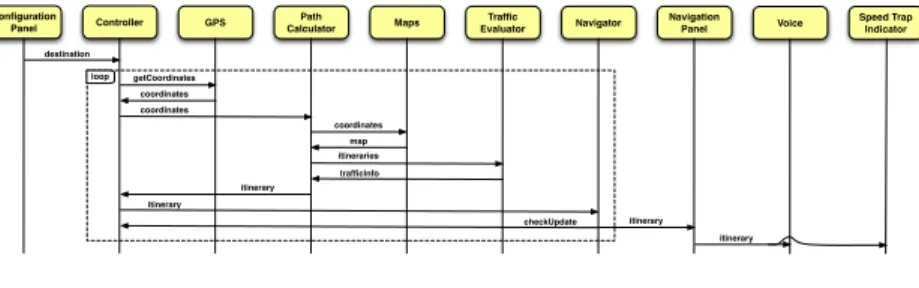
Due to these strong computational requirements, the navigation ap-plication is an interesting case study to analyze under the MCC paradigm. A common behavioural schema for a navigation application is depicted in Figure 2. The system starts when the user inserts the destination in the
configuration panelthat consequently activates thecontroller. Thecontroller
in turn asks theGPSfor the current coordinates and forwards them to the
path calculator. Thepath calculator, interacting with themapand thetraffic evaluator, will provide a possible itinerary. The itinerary is processed by thenavigator, which forwards information to thenavigation panel. This latter component, with the help of thevoiceandspeed trap indicator, pro-vides the navigation service to the end user. Thenavigatoris also respon-sible for reactivating thecontrollerin order to check possible updates of the route.
1.2
Structure of the thesis
The rest of the thesis is organized as follows.In Chapter 2, to accommodate readers with a cross-disciplinary back-ground, we provide a comprehensive introduction to terminology, nota-tion, and tools that are used extensively throughout the remainder of the thesis. In Chapter 3 we introduce the domain specific language MobiCa, with its syntax and semantics given by translation into Timed Automata. In Chapter 4 we present the main techniques we used to find the optimal scheduling at design-time for infinite behaviour, at run-time for finite be-haviour, and using Stratego. In Chapter 5 we introduce two algorithms developed in Java with the purpose of filling the gap of the model check-ing technique in MCC applications. Chapter 6 provides the context for
our research contribution with a discussion of related work in Mobile Cloud Computing and formal method applied to strategy techniques. Finally, Chapter 7 summarizes the main contributions and propose pos-sible directions for further research in Formal Methods applied to the MCC field.
Chapter 2
Background Notions
The use of formal specification in software and hardware development is a very diffused technique. In the last few years the use of formal ver-ification, like prediction and strategy analysis, on different fields has in-creased the interest of the researchers.
In the following we present some basic notions of timed automata, underlying the peculiarity of UPPAAL model checker, one of the most relevant verification environments for real time systems. The choice of UPPAAL with respect to its competitors was driven by the high flexi-bility of timed automata in describing dynamic environments based on time and for its well supported range of tools that has permitted an ex-haustive analysis of the system scenario. In our work we rely also on the Xtext tool, that is the base IDE for developing new domain specific languages on Eclipse. This tool allows us to specify the structure of a MCC system in MobiCa exploiting all the supporting feature available on a generic language.
2.1
Timed Atomata
In this section we report key concepts concerning timed automata; no-tions and definino-tions are mostly borrowed from the book by Aceto et al. (AILS07). A timed automaton is a finite state machine composed by
states, transitions, and real valued-clocks typically used for real-time sys-tem analysis. The time is the main characteristic that distinguishes timed automata from other formalisms; in particular time can elapse when the automaton is in a state or location. The system can evolve from one state to another one only if exists a transition that connects them; the execu-tion of a transiexecu-tion is supposed to be instantaneous. A clock constraint on a transition is called guard, and invariant when it is on a location. Time can elapse in a location only if the invariant is satisfied, while a transition can occur only if the guard associated is satisfied. A guard can be a boolean expression or a condition on clock values. The time in the system elapses at the same rate for all clocks and at any instant a clock is equal to the time that has elapsed since the last time it was reset.
Definition 1 (Timed Automaton) A timed automaton over a finite set of clocks C and a finite set of actionsActis a quadruple
(L,`0, E, I),
where:
• L is a finite set of locations, ranged over by`,
• `0∈L is the initial location,
• E⊆L×B(C)×Act×2C×L is a finite set of edges, and
• I : L→B(C) assigns invariants to locations.
The set of clock constraints B(C) is defined by the abstract syntax:
g, g1, g2::= x./n|g1∧g2;
where x∈C is a clock, n∈N and./∈ {≤, <,=, >,≥}
We write` −−−→g,a,r `0 instead of (`, g, a, r,`0)∈E . For such an edge,`is called the source location, g is the guard, a is the action, r is the set of clocks to be reset and`0is the target location.
Semantically, a timed automaton is modelled by a transition system de-fined as follow:
Definition 2 (Timed Labeled Transition System (TLTS)) Let A = (L,`0,
E, I) be a timed automaton over a set of clocks C and a set of actions Act . We de-fine the timed labelled transition system T(A) generated by A as T(A) = ( Proc, Lab,{−→ |a a∈Lab}), where:
• Proc ={(`, v)|(`, v)∈L×(C→ R≥0) and v|=I(`)}, i.e. states are
of the form (`,v), where`is a location of the timed automaton and v is a valuation that satisfies the invariant of`;
• Lab = Act∪R≥0is the set of labels;
• −→is defined by:
– (`, v)−→a (`0, v0)if there is an edge (`−−−→g,a,r `0)∈E such that v|=g, v’ = v[r] and v’|=I(`0),
– (`, v)−→d (`, v+d)for all d∈R≥0such that v|=I(`) and v+d|=
I(`).
Letv0denote the valuation such thatv0(x)= 0 for all x∈C . Ifv0satisfies the
invariant of the initial location`0, we shall call(`0, v0)the initial state (or
ini-tial configuration ) of T(A).
We use v[r] to denote the set of clocks valuations where the values of clocks r are reset to zero. Formally:
• for each d∈R≥0the valuation v+d is defined by:
(v+d)(x) =v(x) +d f or each x∈C
• for each r⊆C, the valuation v[r] is defined by:
v[r](x) =
0 if x∈r, v(x) otherwise.
Generally a real time model is a collection of timed automata running in parallel, called network of time automata. Timed automata in a net-work are able to collaborate by synchronizing input/output (with tags
?/!) actions on transition channels. The communication is implemented when one parallel component raises a synchronization request on a par-ticular channel and another component accepts the request on the same channel. Both components can then simultaneously perform the com-munication transitions, and the common assumption is that the duration of the synchronization action is zero time units, so, the communication is instantaneous. This form of communication is also calledhand-shake
synchronization.
Definition 3 (Network of Timed Automata) Let n be a positive integer and, for each i∈ {1,..., n}, let
Ai= (Li, `i
0, Ei, Ii)
be timed automata over a set of clocks C and a set of actionsAct. We call the compositionA=A1|A2|. . .|Ana network of timed automata withnparallel
components.
The following definition formalizes the behaviour of a network of timed automata.
Definition 4 (Network of Timed Automata Semantics) LetA=A1|A2|
. . .|An, whereAi = (Li, `i
0, Ei, Ii)for eachi∈ {1, ..., n}, be a network of timed
automata over a set of clocks C and actionsAct={c!|c∈Chan} ∪ {c?|c∈
Chan} ∪N. We define the TLTS T(A) generated by the network A as
T(A) = (P roc, Lab,{−→ |α α∈Lab}).
Here
• P roc={(`1, `2, ..., `n, v)|(`1, `2, ..., `n, v)∈L1×L2× ×Ln×(C→
R≥0)andv|=Vi∈{1,...,n}Ii(`i)}(i.e. states are of the form(`1, ..., `n, v),
where each`i is a location in the component timed automatonAiand v is a valuation over the set of clocks C that satisfies the invariants of all locations i present in the state),
• Lab=N∪ {τ} ∪R≥0is the set of labels, and
– (`1, ..., `i, ..., `n, v)
a
−→(`1, ..., `0i, ..., `n, v0)ifa∈Nand there is an
edge
(`i−−−→g,a,r `0i)∈ Eiin theith component automaton such that
v|=g, v0 =v[r]and v0|=Ii(`0i)∧V k6=iIk(`k); – (`1, ..., `i, ..., `j, ..., `n, v) τ −→(`1, ..., `0i, ..., `0j, ..., `n, v)if i6=j and
there are edges (`i gi,α,ri
−−−−→`0i)∈Eiand (`j −−−−→gj,β,rj `0j)∈Ejsuch
thatαandβare complementary,
v|=gi∧gj, v0=v[ri∪rj], and
v0|=Ii(`0i)∧Ij(`0j)∧V
k6=i,jIk(`k);
– (`1, ..., `n, v) d
−→(`1, ..., `n, v+d)for alld∈R≥0such that
v+d0|=V
i∈{1,...,n}Ii(`i)
for each real numberd0in the interval [0,d].
Let v0 denote the valuation v0(x) = 0for all x ∈ C. Ifv0 satisfies the
invariants of all the initial locations`i
0, we shall call (`10, `20, ..., `n0, v0) the initial
state (or initial configuration ) of T(A).
WhereNis a finite set of ordinary action names includingτformally:
Act={c!|c∈Chan} ∪ {c?|c∈Chan} ∪N
2.1.1
Timed Automata in UPPAAL
UPPAAL is a tool for the verification of real-time system. The tool, as de-scribed in the tutorial (BDL04), is designed to verify systems modelled as networks of timed automata extended with additional features, such as bounded integer variables and urgency. A current state of the system is defined by the locations, the clock values, and the values of the vari-ables of the automata. Every automaton may fire an edge (sometimes misleadingly called a transition) separately or synchronise with another automaton, which leads to a new state. Figure 3 shows a network of timed automata describing the interaction between two automata elling an user with an automatic door. The door in Figure 3 (a) is mod-elled with three locations: close, open, and hold open. If the user presses
(a) Door (b) User
Figure 3:The door example
a button, i.e., synchronises withpress?, then the door is opened. If the user presses the button again, the door is closed. However, if the user is fast and rapidly presses the button twice, the door is opened and then blocked in open position. The user model is shown in Figure 3 (b). The user can press the button randomly at any time or even not press the button at all. The clockyof the door is used to detect if the user was fast (y <5) or slow (y >= 5).
We present below the UPPAAL modelling language based on timed automata and later the query language, that is a subset of TCTL, used for specifying property to be checked. For having a more complete view of all the UPPAAL constructs, we refer the interested reader to the Ap-pendix A.
Templatesare the skeleton of automata and are defined with a set of pa-rameters that can be of any type (e.g., int, chan). These papa-rameters are substituted for a given argument in the process declaration.
Constantsare declared asconstfollowed by anameand avalue.
Con-stants by definition cannot be modified at runtime.
Bounded integer variablesare declared asint[min,max] name, where
min and max are the lower and upper bound, respectively. The bounds are checked upon verification and violating a bound in guards, assign-ments or invariants leads to an invalid state that is discarded (at run-time). If the bounds are omitted, the default range of -32768 to 32768 is used.
labelled with an output actionc!synchronises with another labelled in-put actionc?. A synchronisation pair is chosen non-deterministically if several combinations are enabled.
Broadcast channelsare declared asbroadcast chan. In a broadcast
synchronisation one senderc! can synchronise with an arbitrary num-ber of receiversc?. Any receiver than can synchronise in the current state must do so. The send on a broadcast channel is not a blocking action. If there are no receivers, then the sender can still execute thec!action.
Urgent synchronisationchannels are declared by prefixing the channel
declaration with the keywordurgent. Delays must not occur if a syn-chronisation transition on an urgent channel is enabled. Edges using ur-gent channels for synchronisation cannot have time constraints, i.e., no clock guards. Time is not allowed to pass when the system is in an urgent location.
Committed locationsare even more restrictive on the execution than
ur-gent locations. A committed location does not permit the time elapsing and has the priority on other executions. Usually it is used for creating atomic sequence in the execution between more than two components.
Arraysare data structures, like in classic programming languages, where type can be clocks, channels, constants and integer variables. They are defined by appending a size to the variable name, e.g. chan c[4]; clock a[2]; int[3,5] u[7].
Initialisersare used to initialise integer variables and arrays of integer variables. For instance,int i = 2; or int i[3] = {1, 2, 3}.
Record typesare declared with thestructkeyword and permit to
cre-ate a structure composed of different types. e.g. struct int a; bool b; s1 = { 2, true };.
Custom typesare defined with the C-liketypedefconstruct. You can
define any custom-type from other basic types such as records.
User functionsare defined either globally or locally to templates. Func-tion are callable from the update in edges or in invariant if the return type isbool.
Expressions in UPPAAL
Expressions in UPPAAL are defined on clocks and integer variables. Expressions can be setted using the dedicated text-box contained in the property form of edges.
• SelectA select label contains a comma separated list of names:
typeexpressions where nameis a variable name and typeis a defined type (built-in or custom). These variables are accessible on the associated edge only and they will take a non-deterministic value in the range of their respective types.
• GuardA guard is a particular expression side-effect free (i.e. ex-pressions that does not change the value of variables or the state of the system); it evaluates to a boolean and is defined only on clocks, integer variables, and constants. Guards over clocks are essentially conjunctions (disjunctions are allowed over integer conditions).
• SynchronisationA synchronisation label is either of the form
Ex-pression!orExpression?, or is an empty label.
• UpdateAn update label is a comma separated list of expressions
with a side-effect; expressions must only refer to clocks, integer variables, and constants. They may also call functions.
• InvariantAn invariant is an expression bound to a state that
sat-isfies the following conditions: it is side-effect free; only clock, in-teger variables, and constants are referenced. It is a conjunction of conditions of the formx<eorx6ewherexis a clock reference and evaluates to an integer. An invariant may call a side-effect free function that returns a boolean.
2.1.2
UPPAAL query language
UPPAAL uses a simplified version of the TCTL logic for verifying if the model under analysis satisfies a set of requirements. Like in TCTL, the UPPAAL query language consists in path formulae and state formulae.
State formulae describe properties on an individual state, whereas path formulae quantify over paths or traces. The path formulae are classified according to the quantifier and generally can expressreachability,safety
andlivenessproperties.
State formulaA state formula is an expression that describes a particular condition on a state. It can be a boolean evaluation or the internal state of a process, using the notationProcess.location. Another important expression on the state formula is the deadlock that is expressed with the keyworddeadlock; a system is in deadlock if there are no outgoing action transitions for the current state and neither a delay on that state is possible.
Path formulaThe path formulae are divided in three subcategories
ac-cording to the property to verify:
• Thereachability is the simplest form and checks if there exists a
path that eventually satisfies a certain property. This formula is also used for validating the basic behaviour of the model. In UPPAAL, we write this property using the syntaxE <> ϕ.
• Thesafetyproperty is used for avoiding that something bad will
happen. For example in a critical domain a bad action must be always avoided. In UPPAAL these properties are formulated posi-tively: a formula should be true in all reachable states with the path formulaA[ ]ϕorE[ ]ϕ.
• The liveness property expresses the willingness that something
good will eventually happen. The liveness in UPPAAL is expressed with the path formulaA <> ϕ.
2.1.3
The UPPAAL tool
UPPAAL is composed of two main parts: the interface and the model checking engine. The graphical interface that is shown in Figure 4 is
Figure 4:UPPAAL editor
divided in three main parts: the editor, the simulator, and the verifier, accessible via three tabs under the main toolbar.
The editorcontains the system model, which usually is composed by a
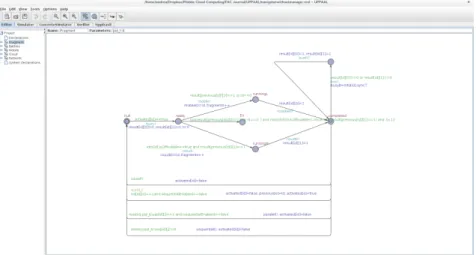
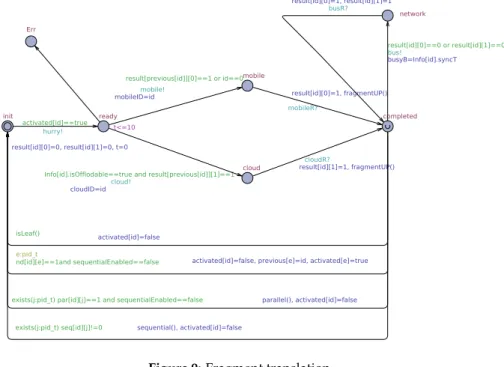
network of timed automata that are called processes in the tool. The ed-itor is divided in two parts: the one on the left is the tree panel where is shown the system structure and permits to access the different tem-plates and declarations; on the right hand side instead there is the canvas graphical editor. Figure 4 shows a fragment template composed by seven locations and some edges. The edges are labelled with guard conditions (e.g.activated[id]==true), synchronisations (e.g.hurry!) and as-signments (e.g.result[id][0]=0). In the tree panel is possible to find the global declaration, that contains variables, clocks, channels and con-stants. Fragment, Battery, Mobile, Cloud and Network are example of templates and usually are equipped with a local declaration of variables that is restricted to the template scope. The system declaration contains the processes instantiation, that can be used to parametrize template or directly invoked.
Figure 5:UPPAAL simulator
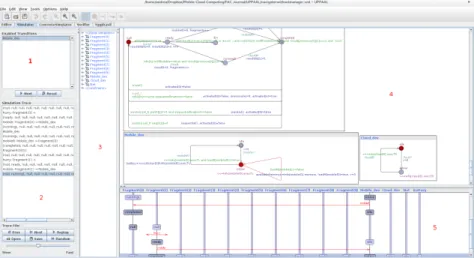
The Simulator, represented in Figure 5, is used for simulating a singular instance of the system. There are two ways of interaction, the first one is the manual selection of the next action to execute, or the other one is the automatic selection performed by the tool, which randomly chooses between the enabled actions.
The simulator view shows five sub-windows. In the window 1 there is theenabled trasitionwhere it is possible to choose the next transition. In the window 2, just below, there is thesimulation trace, that shows the cur-rent state for each process after the execution of an action. The window 3 is thevariable view, it shows the current values of variables and clocks dis-tinguished between global one and local imputable to each process. The window 4 shows the automata state in a graphical way. The window 5, calledsequence chartshows the synchronization between the processes.
The verifieris the last part of the graphical interface (Figure 6) where the user can verify properties expressed in the query box and selectable in the overview list. Thestatus panelis used to visualize the results of the
Figure 6:UPPAAL verifier
query and the communication with the server. The green/red semaphore near each property in theoverviewwindow indicates the result coming out from the verification phase activated by selecting the property and pushing the check button. The verification can be executed also with the trace generation settable from the option menu and by selecting the di-agnostic trace of interest. At the end of the verification with trace, the system will ask the willingness to import the resulting trace on the sim-ulator to allow further check to the user.
2.2
Domain Specific Languages
A Domain Specific Language (DSL), according to (Bet13), is a small lan-guage, developed on purpose for a particular application domain. Peo-ple find DSLs valuable because allow the programmer to increase his productivity, improve the communication with domain experts and do not require strong programming notions. Of course the DSL is not a sub-stitute of a general purpose language like Java or C. But it permits
solv-ing problems easier and faster on a particular domain with respect to traditional programming language. Sometimes it is not clear if it is more convenient to use a general language or a new DSL, for example may you want to introduce a new language for describing data of a model or application and someone else maybe prefer XML. Of course this is up to the developer, but the objective fact is that the XML is a good machine readable language but not human-readable; indeed XML tends to be ver-bose, and it fills documents with too much syntax noise.
Implementing a new DSL involves a series of procedures that allow the machine to read the text written in that DSL, succeed in the parsing phase, process and interpret it or generate the code in another language. This procedure is not always the same, but most of the listed phases are typical of all implementations. Usually a language is decomposable in single atomic elements. These elements can be akeyword such as the wordclassin Java, anidentifiersuch as a class name, asymbol namesuch as a variable name; and all other elements areliterals. The process of de-composing a sequence of characters into atomic elements is calledlexical analysisand the phase that checks for each statement that it is respect-ing the syntax structure expected by the language is calledparsing. The duty of the parser is to check if the given program respect a grammar. A
grammaris a set of rules that describe the form of the constructs that are valid according to the language syntax. The parsing mechanism does not guarantee the correctness of a program, this because for example the type checking cannot be done during the parsing but is part of the semantics analysis.
A good success for a DSL is given also by a IDE support. A large range of available features for the language generation permit an easier access to the final user, increasing his opinion on the DSL use. Among the most important features it is possible to find thesyntax highlight, that is the ability of colouring and formatting keywords in the language for giving the right visibility and an immediate feedback on the struc-ture of the program. Thebackground parsing, that checks continuously the program syntax to revel as soon as possible error; this implies less effort for fixing the problem in terms of time and costs. Error markers
have the duty of showing the right point in the language where the er-ror happened in order to stand out the right point that need to be fixed.
Content assistantis the auto complete mechanism that helps the
pro-grammer to remember commands or just the right sequence of parame-ters.Hyperlinkingpermits to navigate between references in a program, for example from a variable to its declarations or from a method call to its declaration.Quickfixesare fixes automatically suggested by the IDE to the programmer, for example, given a method that does not exist, two possible quick fixes could be to create a new method or simply correct the name generated by a typing error.
2.2.1
The Xtext tool
Xtext covers all aspects of a complete language infrastructure, from parsers, to compiler or interpreter and other useful tools. Xtext comes with great default solutions for all these aspects which at the same time can be easily tailored to developer individual needs. The host environment for Xtext is Eclipse, a free software distributed under the Eclipse public license. It is an Integrated Development Environment(IDE) based on multi-language and multi-platform paradigm. It offer a complete IDE for the Java lan-guage and rely on a plug-in system. In Eclipse using the traditional Xtext grammar language is possible to describe the syntax of a new DSL. The specialty for JVM languages is the possibility to inherit from an abstract grammar Xbase, which predefines the syntax for the reusable parts. It is not needed to use all of them directly and of course is possible to change the syntax or add new concepts, as it seems fit. Xtext can be simply in-stalled from the Eclipse marketplace, once inin-stalled, it is possible to cre-ate a new project just following the Eclipse wizard for the Xtext Project creation.
Following the wizard the system will create a new project
Project name: org.xtext.example.mydsl
Language name: org.xtext.example.mydsl.MyDsl Language Extensions: mydsl
1. org.xtext.example.mydslcontains the grammar definition and
all runtime components (parser, lexer, linker, validator, scope, etc.);
2. org.xtext.example.mydsl.testscontains the unit tests;
3. org.xtext.example.mydsl.uicontains the eclipse editor and the
related functionalities;
4. org.xtext.example.mydsl.sdkcontains the features of the project.
The wizard will automatically open the grammar file MyDsl.xtext in the editor, that is usually contained in theorg.xtext.example.mydsl
part under thesrcfolder.
grammar org.xtext.example.mydsl.MyDsl with org.eclipse. xtext.common.Terminals
generate myDsl "http://www.xtext.org/example/mydsl/MyDsl"
Model:
greetings+=Greeting*; Greeting:
’Hello’ name=ID ’!’;
The first rule in the grammar is usually the start rule and coincides with the root of the syntax three. In our example the model is composed by an arbitrary number (any operator *) of greetings which will be added (+=) to a feature called elements. TheGreetingrule start with the keyword
Hellofollowed by an identifier, which is parsed by a rule called ID, and by symbol !. The rule ID is a kind of terminal rule literal and it is in the
org.eclipse.xtext.common.Terminalspackage. The value returned
by the call to ID is assigned to the feature name.
Generate Language Artifacts
Once defined the grammar of the language it is possible to execute the code generator that will derive the various language components. To do so, once located the fileGenerateMyDsl.mwe2next to the grammar in the
package explorer view. From this context menu, it is sufficient to choose
Run As→MWE2 Workflow. This invocation triggers the Xtext language generator, producing the parser, the serializer and some additional in-frastructure code. The described process terminates with some logging messages in the Console View and the keyword ”Done”.
Run the Generated IDE Plug-in
In order to test the IDE integration is necessary to selectRun→Run Configurationsfrom the Eclipse menu and choose Eclipse Application→
Launch Runtime Eclipse. This preconfigured launch shortcut has the ap-propriate memory values and parameters already setted. The system, after the click on the run button starts a new Eclipse workbench with the newly developed plug-ins installed. In the new workbench, is pos-sible to create a new project following theFile→New→Project→Java Projectprocedure and therein a new file with the file extension specified in project creation (*.mydsl). This last step will open the adequate entity editor, where is possible to exploit the default functionalities for code completion, syntax highlighting, syntactic validation, linking errors, the outline view, find references, etc.
The final DSL implemented is able to accept the language composed by the Keyword ”Hello” followed by an identifier and closed with the symbol ”!”.
Hello Marius!
Hello Andrew! ...
An improvement in the presented example could be the introduction of a validator. To achieve this task in Xtext there are two ways, the first one is going directly in theGenerateMyDsl.mwe2file and uncomment the
NamesAreUniqueValidatorline. With this new line, the system checks
if the language contains multiple rules with the same identifier, if yes, an error alert for definition ambiguity is raised.
// Xtend-based API for validation
fragment = validation.ValidatorFragment auto-inject {
//composedCheck = "...validation.ImportUriValidator" composedCheck = "org.eclipse.xtext.validation.
NamesAreUniqueValidator" }
Of course this is the simplest validation that can be automatically done by the tool, more advanced check can be directly implemented in the
MyDslValidator.xtendin theorg.xtext.example.mydsl.validation
pack-age. Possible checks are related to Cross-link or custom syntax valida-tion, both of them can be alerted to the user with error or warning mes-sages.
Java Code Generation
As soon as the generation of the Xtext artifacts for a grammar, a code generator stub will be put into the runtime project of the language. This allows to automatically generate code rewritten in Java or any other lan-guage derived from the DSL elements.
2.2.2
Grammar language
The grammar language in Xtext is specifically designed for developing domain specific languages. The idea is to describe the syntax of the DSL using the given grammar. The grammar is composed byterminal rules, that are sequences of characters that are atomic symbols, informally called token rules. The ID rule is the most important terminal rule, it is usually composed by a sequence of letters or numbers in any order. In the definition of the grammar,data type rules are preferred to terminal one, this because using types is possible to avoid the ordering that is in-stead mandatory in the terminal one. Thereturn typeis present in each terminal rule and it is assumed that is of the formecore::EString. A
different type is necessary to specify other types; for example INT for the willingness to return an integer value.
The terminal rules has a cardinality that it is described using the Ex-tended Backus-Naur Form. There are four different cardinalities:
1. exactly one (no operator) 2. zero or one (operator ?) 3. any (zero or more, operator *) 4. one or more (operator +)
Aparser ruledoes not produce a single atomic terminal token but a tree of non terminal tokens. These rules are also called EObject rules because they are handled as a plan for the creation of a semantic model (Abstract Syntax Tree AST).
Not all the expressions that are available in terminal rules can be used in parser rules. Character ranges, wildcards, the until token and the negation as well as the EOF token are only available for terminal rules. For the parser rules the admitted elements are groups, alternatives, key-words and rule calls.
Chapter 3
Domain Specific Language
MobiCa
In this chapter we introduce the domain-specific language MobiCa (Mobile Cloud Computing Language), specifically devised for modelling MCC sys-tems at a high-level of abstraction. Such abstraction allows one to focus on those aspects of MCC systems that are relevant for taking decisions on whether to offload a given component of a mobile application. Low-level details, such as the precise computation performed by components, are abstracted. In this way, we have a modeling language that permits easily writing compact specifications, which enable an efficient analysis for selecting the most appropriate offloading strategy. In fact, the seman-tics of the language associates to each specification a model specifically expressed as a network of timed automata (see Section 2.1), thus support-ing the verification of properties through a model checksupport-ing technique.
The building blocks of MCC applications expressed in MobiCa are black-box elements calledfragments. Each fragment corresponds to a small part of an application devoted to a unique specific purpose. The language permits to model applications partitioned in fragments with different granularity, which depends on the level of detail required by the considered application domain. In coarse-grained partitions, fragments represent components offering functionalities and services to each other;
SYSTEMS: N ::= (c, em, ec, eb)(b, n, m).A˜ c .A˜ Sys1|Sys2 APPLICATIONS: A ::= hF˜;Si FRAGMENTS: F ::= f[i, m, s, o] STRUCTURE: S ::= f1Opf˜2 S1;S2 OPERATORS: Op ::= −→ 99K −
Table 1:MobiCa syntax
instead, in the fine-grained ones, fragments correspond to single func-tionalities, tasks or actions. Moreover, although MobiCa also permits modelling MCC applications having a static code separation between lo-cal and remote execution, it is designed to model more flexible and dy-namic systems, where the computation of any fragment can in principle be offloaded. The offloading decisions are taken according to the current environmental conditions, e.g. network connection, bandwidth, servers’ load, battery energy, etc. In fact, due to the variability of these factors, static partitioning leads in general to poor performance optimization.
3.1
Language syntax
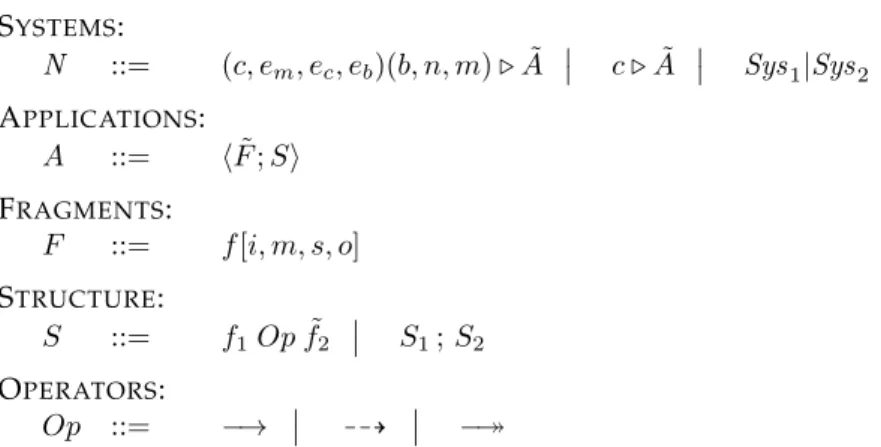
The syntax of the MobiCa language is defined by the BNF grammar given in Table 1. As a matter of notation, we use˜·to denote tuples of objects, e.g.F˜stands for the tuple of fragmentsF1, . . . , Fn(withn >0).
A MobiCa specification is asystemN consisting of a network of mo-bile devices and cloud machines (composed by means of the parallel op-erator|).
Amobile devicecorresponds to any portable device that is limited in computational capabilities, and without a stable connection and a con-stant power supply. Typical examples are smartphones, tablets, etc.
Specif-ically, a mobile device(c, em, ec, eb)(b, n, m).A˜can be seen as a container of applicationsA˜ characterized by some operational information. The static information is: the computational power of the device c (expressed in terms of number of instructions that can be executed per second), the energy consumed per time unit by the mobile device when it is in useem, when it is in idleecand during the synchronization along the buseb. The information that instead may change at runtime is: the battery levelb, the network bandwidthnand the used memorym. All such operational information is defined as integer values and indicates the status of the device at a given instant of time. It is worth noticing thatA˜represents the MCC applications installed in the device that are subject to dynamic offload handling. Non-MCC applications are not explicitly represented, although their effects on resources of the device are taken into account when the operational information is determined.
Acloud machine, differently from a mobile device, has a larger com-putation and memory capability, and a stable connection. Thus, for what concerns the aspects of interest for our analysis, a cloud machinec .A˜
only specifies the numbercof instructions executed per second, and the installed applicationsA˜.
Anapplicationis represented as a pairhF˜;Si. The first field is a tuple of fragments, while the second describes how they are connected to each other in order to form the structure of the application. The first fragment of the tupleF˜ is the initial fragment of the structure (i.e., it is the root of the corresponding graph). Afragmentf[i, m, s, o]is uniquely identi-fied by a namef and specifies the following parameters: the number
iof instructions to execute, the amountmof memory required at run-time, the amountsof data to be transferred for synchronization in case of offloading, and finally a booleanoindicating whether the fragment is offloadable or not. Notably, the first three parameters should be thought of as average values, which could be estimated from the code or, more practically, determined at runtime by monitoring the application execu-tion. Notice also that, in case of offloading, it is necessary to synchronize local and remote application instances to keep the state of the system consistent.
AstructureSis a graph whose nodes are fragments and whose edges represent their interactions. A structure is specified in MobiCa by a col-lection of terms of the formf1 Opf˜2, each one defining a set of edges
(fromf1 to each fragment inf˜2). There are three kinds of edges,
corre-sponding to three different ways to proceed with the application execu-tion from one fragment to further fragments according to three different synchronization operatorsOp:
• Non-deterministic choice(−→) indicates that the execution will progress from the source fragment tooneof the target fragments, which is non-deterministically selected. This operator allows one to abstract from choices that are internal to fragments.
• Sequential progress (99K) permits the computation to sequentially progress from the source fragment to the target ones (following the order in the tuplef˜2). This operator is used to make explicit the
relationship between a fragment and the others necessary to carry out its task. This allows one to partially ‘shed light’ on the black-box nature of fragments.
• Parallel execution(−) permits the execution to progress from the source fragment toalltarget ones, by activating their parallel exe-cution. This operator allows one to express applications with con-current components.
If more groups of edges have the same source, the execution proceeds from this source fragment by selecting a group in a non-deterministic way, and then by activating the target fragments of this group according to the corresponding operator. These two steps are performed atomically. For example, given the following structure termf1−f2, f3; f199Kf4, f5,
it is possible to proceed fromf1either by activatingf2andf3in parallel,
or by firstly activatingf4and then, oncef1is executed again, by
activat-ingf5. It is also worth noticing that a fragment may have more than one
incoming edge; each time an activation signal arrives from one of them, the fragment is activated, if it is not already activated, otherwise this ac-tivation is postponed (in other words, concurrent acac-tivations of the same fragment are not allowed).
Not all applications allowed by the syntax in Table 1 are meaning-ful. We only consider terms satisfying well-formedness conditions, i.e. syntactic constraints that can be easily verified with a static check on the syntax of terms.
Definition 5 (Well-formed applications) An applicationhF˜;Siis well formed if the following conditions hold: (i)all fragment names occurring inS are de-fined in the tupleF˜; and(ii)there is no termf1Opf˜2inSsuch thatf1occurs
in the tuplef˜2(i.e., self-loops are disallowed).
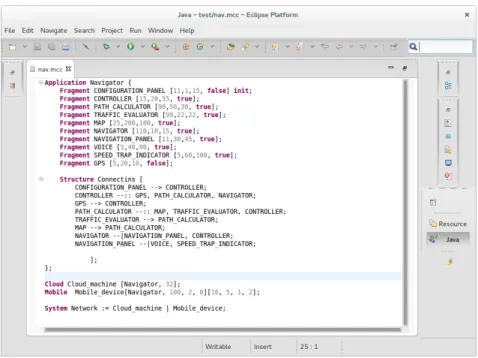
Below we use MobiCa to model a simple scenario where an optimal infinite scheduling is necessary for minimizing energy consumption and improving system performance. A more realistic scenario will be dis-cussed later on in section 3.4.1
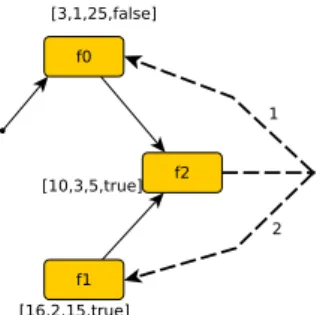
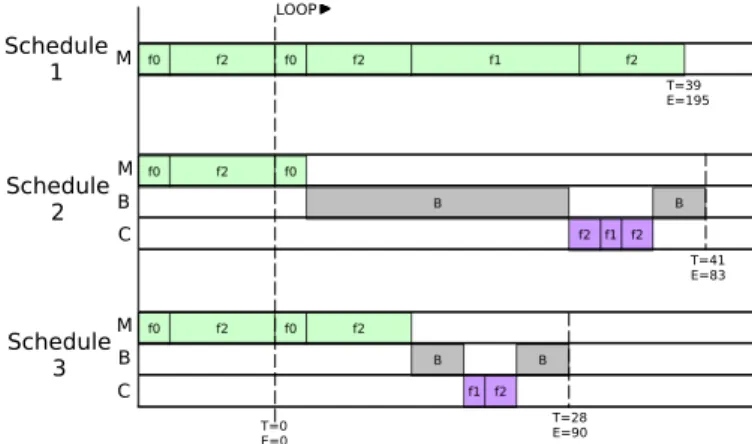
Example 1 (A simple application) This scenario is inspired by one from (GK99). It concerns a simple MCC application, whose graphical representation is shown in Figure 7 (right-hand side). The application is composed of three fragments,f0,f1andf2, connected by means of the non-deterministic operator
(−→) and by the sequential operator (99K). Since the application behavior is deterministic in this case, the unique run is composed by an initialization phase
f0→f2, followed by an infinite loopf2→f0→f2→f1→f2. The fragment
f0 can be executed only locally, instead the fragmentsf1, f2 can be executed
either on the mobile or in the cloud, with the only requirement of maintaining the data consistent. For consistency we intend that either a fragment is executed on the same location of its predecessor or at a different location only after the result of the predecessor has been synchronized.
Application structure: