
5
PARASKEVAS YIAPANIS, GAVIN BROWN, and MIKEL LUJ ´AN, University of Manchester
Current parallelizing compilers can tackle applications exercising regular access patterns on arrays or affine indices, where data dependencies can be expressed in a linear form. Unfortunately, there are cases that independence between statements of code cannot be guaranteed and thus the compiler conservatively pro-duces sequential code. Programs that involve extensive pointer use, irregular access patterns, and loops with unknown number of iterations are examples of such cases. This limits the extraction of parallelism in cases where dependencies are rarely or never triggered at runtime. Speculative parallelism refers to methods employed during program execution that aim to produce a valid parallel execution schedule for programs immune to static parallelization. The motivation for this article is to review recent developments in the area of compiler-driven software speculation for thread-level parallelism and how they came about. The article is divided into two parts. In the first part the fundamentals of speculative parallelization for thread-level paral-lelism are explained along with a design choice categorization for implementing such systems. Design choices include the ways speculative data is handled, how data dependence violations are detected and resolved, how the correct data are made visible to other threads, or how speculative threads are scheduled. The second part is structured around those design choices providing the advances and trends in the literature with reference to key developments in the area. Although the focus of the article is in software speculative parallelization, a section is dedicated for providing the interested reader with pointers and references for exploring similar topics such as hardware thread-level speculation, transactional memory, and automatic parallelization. Categories and Subject Descriptors: D.1.3 [Concurrent Programming]: Parallel programming, Distributed programming; D.2.2 [Design Tools and Techniques]: Software libraries; D.3.2 [Language Classifica-tions]: Concurrent, distributed, and parallel languages; D.3.5 [Processors]: Compilers, Optimization, Run-time environments
General Terms: Languages, Design, Algorithms, Performance
Additional Key Words and Phrases: Thread-level speculation, speculative parallelization, runtime paral-lelization, automatic paralparal-lelization, multicore processors
ACM Reference Format:
Paraskevas Yiapanis, Gavin Brown, and Mikel Luj ´an. 2015. Compiler-driven software speculation for thread-level parallelism. ACM Trans. Program. Lang. Syst. 38, 2, Article 5 (December 2015), 45 pages.
DOI: http://dx.doi.org/10.1145/2821505
1. INTRODUCTION
In recent years, multicore chips became the standard configuration in commercial computing. In order to harness the computing power they have to offer, applica-tions need to be structured in such a way that will yield efficient utilization of the available resources. Parallel programming accomplishes that by dividing the computa-tion across the available processors (or threads), yet this process involves experienced
This research was conducted with support from the UK Engineering and Physical Sciences Research Council (EPSRC), on grants PAMELA EP/K008730/1, AnyScale Apps EP/L000725/1, and iTLS EP/G000662/1. Dr. Luj ´an is supported by a Royal Society University Research Fellowship.
Authors’ addresses: P. Yiapanis, G. Brown, and M. Luj ´an, School of Computer Science, University of Manch-ester, Oxford Road, M13 9PL; emails: [email protected],{gavin.brown, mikel.lujan}@manchester.ac.uk. Permission to make digital or hard copies of all or part of this work for personal or classroom use is granted without fee provided that copies are not made or distributed for profit or commercial advantage and that copies bear this notice and the full citation on the first page. Copyrights for components of this work owned by others than the author(s) must be honored. Abstracting with credit is permitted. To copy otherwise, or republish, to post on servers or to redistribute to lists, requires prior specific permission and/or a fee. Request permissions from [email protected].
ACM 0164-0925/2015/12-ART5 $15.00 DOI: http://dx.doi.org/10.1145/2821505
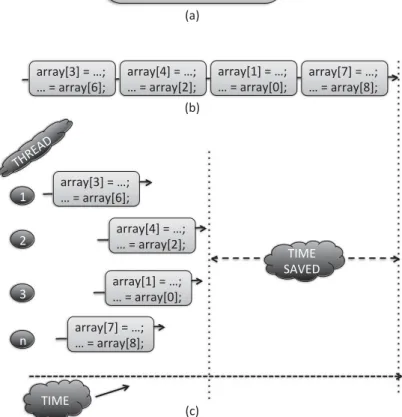
Fig. 1. (a) Code fragment of loop to be parallelized. (b) Sequential execution. (c) Sample parallel execution.
software engineers. An ideal scenario is when the compiler automatically can restruc-ture a sequential program into a faster parallel version offline. Although promising and inexpensive, in terms of application performance, offline automatic parallelization is sometimes limited mainly due to insufficient runtime information or the inability of the parallelizing compiler to perform the transformation due to complex interprocedu-ral relationships. For example, it is difficult to perform static dependence analysis on code that makes extensive use of pointers, which is typical for modern languages such as C++ or Java. More sophisticated memory dependence analysis (such as points-to analysis [Nystrom et al. 2004]) can help, but parallelization often fails due to unre-solved memory accesses. Furthermore, loops with unknown number of iterations make it hard to parallelize since there is no information on how to schedule the loop (e.g., the loop might terminate abruptly due to a runtime condition). Also, when subscripted subscripts are used to access array elements, the actual memory locations may not be available until runtime. This can be illustrated with the following example: as-sume that one wishes to parallelize the loop shown in Figure 1(a). Similarly, asas-sume that integer arrays B and C are populated at runtime. That is, there is no feasible means of performing any static analysis (manual or automatic) to prove correct parallel
executions by eliminating the possibility of data dependencies across threads. There-fore, conventional parallelizing compilers must conservatively produce sequential code for the loop in order to guarantee correct execution. Consider now the instance of se-quential execution shown in Figure 1(b). Clearly, the values populated for the array indices did not yield any data dependencies amongst them, and thus, the compiler could have generated a parallel code such as the one in Figure 1(c), and allow the application to run in parallel (assume for simplicity one loop iteration per thread). However, this was not possible since the indices were populated at runtime.
One solution to the preceding problem is to proceed with parallel execution spec-ulatively until sufficient information is collected, providing mechanisms to maintain sequential program correctness. Such a solution is known in the research literature as Speculative Parallelization,Thread-Level Speculation, orTLSin short. All three terms will be used interchangeably throughout the rest of the article. Speculative parallelism is also possible at the instruction level but this article is focused on the thread level. For the rest of the article thread-level parallelism is assumed unless otherwise specified.
The first part of this article, “Fundamentals of Speculative Parallelization,” explains speculative parallelization and its mechanics as well as the major design requirements for such an execution model. Furthermore, an overview of an earlier model for nonspec-ulative runtime parallelization, identified asInspector/Executor, is briefly discussed.
P
ARTI: F
UNDAMENTALS OFS
PECULATIVEP
ARALLELIZATION 2. SPECULATIVE PARALLELIZATION2.1. Brief Description
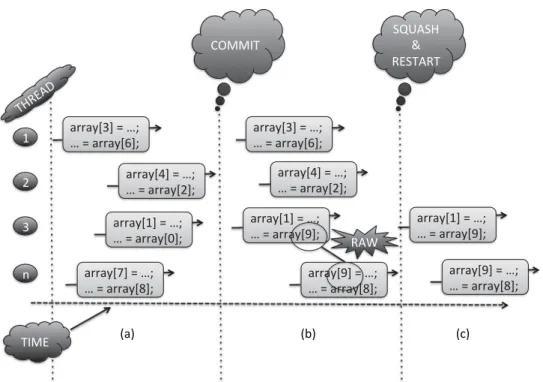
Speculative Parallelization (Thread-Level Speculation—TLS) is a technique that fa-cilitates automatic parallelization via optimistic execution of potentially independent threads. It is particularly useful where there exist ambiguous dependencies that cannot be resolved statically by the compiler. In the previous example of Figure 1, a TLS sys-tem circumvents the conservatism of a static compiler by executing the threads (which are formed by loop iterations in this case) in parallel assuming that the run-time val-ues of B[i] andC[j] will not trigger any cross-thread conflicts. For instance, in this case TLS would execute the loop iterations in parallel, while at the same time under-lying mechanisms would monitor every speculative access to ensure that the parallel execution will produce the same results as if the program was executed sequentially. In one design, any speculative memory updates are stored locally to the thread and eventually written back to main memory given correct execution. Figure 2(a) shows the case where all speculative threads executed successfully and thus are allowed to retireorcommitby propagating the buffered updates back to main memory. Sometimes we have the case of a memory dependency like the one shown in Figure 2(b). In this case, Thread 3 has loaded a value that was not produced by the correct store.1 This action causes what is known as aRead-After-Write (RAW)data dependence violation. As a result, the offending threads need tosquashby initiating therollbackprocedure (in this case discard any buffered updates) and reexecute in the correct order, that is, Thread 3 before Threadn(see Figure 2(c)).
The majority of the TLS systems this article describes address only data depen-dence speculation. Data dependepen-dence speculation breaks dataflow dependencies be-tween memory operations by guessing that they will access different locations, thereby 1Assuming that iterations are assigned to threads in order, Thread 3 should have read a value produced by
itself or a previous speculative thread. Instead, Thread 3 consumed a value produced by a future thread and that violates sequential program semantics.
Fig. 2. (a) Speculative loop execution without dependencies. (b) Speculative loop execution with dependency. (c) Reexecution of offending threads.
making the operations independent of one another. This is also known as alias speculation(or memory address disambiguation). There are also two other important types of speculation employed by parallelizing compilers:value speculationandcontrol speculation.
Control speculation [August et al. 1998] is used to execute unresolved edges in the control flow graph. It breaks control dependencies that exist between branches and other operations by predicting that a branch will go in a particular direction, thereby making an operation’s execution independent of the branch. A misspeculation is detected if the predicted value of a branch condition does not match the actual value at runtime.
Value speculation [Prabhu and Olukotun 2005] speculates on dependencies using a predicted value instead of the actual value to satisfy the dependence. Whenever the dependence executes and the actual value is not the predicted value, misspeculation is flagged [Raman et al. 2010].
For the rest of the article, alias speculation is assumed unless otherwise explicitly stated for a particular TLS system.
2.2. Design Specification
Implementing the underlying mechanisms that will guarantee correct execution in TLS requires certain design decisions. From the brief description given previously in Section 2.1 the main requirements for supporting speculative parallelization can be categorized as follows (also identified by Cintra and Llanos [2003, 2005]):
—Metadata management. A way to know which memory locations are accessed and by which threads. This will facilitate identifying whether or not any threads have accessed memory locations in a way that invalidates speculation.
—Version management. A way to manage speculative data. When threads execute speculatively, different versions of the data are produced. A mechanism is required to manage temporary (speculative) data and maintain consistency among operations. —Detect data dependence violations. A way to identify potential data dependence
violations.
—Commit and rollback operations. A way to maintain main memory at a correct state. That is, to be able to commit the correct values and rollback execution to a correct state when necessary.
—Scheduling speculative threads. An efficient way to schedule speculative work and threads.
The following sections provide an overview of each requirement and discuss the main implementation options available.
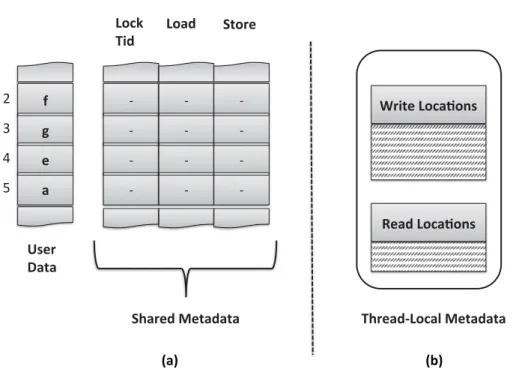
2.2.1. Metadata.Speculative execution proceeds in parallel optimistically with the hope that the code executes correctly without violating the sequential program seman-tics. If the program happens to be fully parallel (i.e., without any data dependencies across parallel threads), then it will execute successfully and values in main memory will be correct. But if a data dependency did exist across threads, then the values in main memory are likely to be incorrect if the threads were executed out of order. Thus, the system must take precautions in the event of potential failures so that memory is always left in a correct and consistent state. As we will discuss in more detail in Section 2.2.2, there are two main implementations to accomplish that. One way is to have speculative threads putting aside any tentative stores and only placing them to main memory if execution is proven to be correct (deferred updates). Another way is to put aside the current memory values and allow speculative threads to store directly any updates to main memory (in-place updates). This allows the TLS underlying system to monitor memory accesses and revert memory back to a correct state when required. Furthermore, a speculative thread needs a way to know when it is accessing the same memory location as another speculative thread and whether or not the other thread has performed an update there, effectively allowing the detection of memory conflicts. To enable a the system to monitor memory accesses, some auxiliary data (referred to in this work as metadata) are required to be associated with the user data struc-tures as well as the speculative threads. Figure 3 shows one way in which speculative memory access information can be kept in the system. This scheme is valid for systems implementing both in-place and deferred updates. The various ways metadata can be exploited are explored later under the “Version Management” section.
Metadata to Reflect User Data Structures. Figure 3(a) illustrates how metadata are arranged to reflect the user data that can potentially be accessed in a speculative way. Every user datum that can be potentially accessed speculatively (i.e., a datum that is shared among speculative threads) is associated with a record. This record represents actions on user data by a given speculative thread. For instance, a general TLS system could maintain information about which particular thread is operating, reading, or writing at a given moment in time on a given user memory location. The thread actions are denoted with the labels “Lock Tid,” “Load,” or “Store” in Figure 3(a). “Lock Tid” is used by a thread in order to acquireexclusive ownershipof a particular memory location. That is, by using a locking primitive a thread stores a unique thread identifier (Tid) in the “Lock Tid” column and proclaims ownership of the location associated with that record. This action prevents another speculative thread from performing an operation at the same memory location simultaneously with the current owner thread allowing predictable results. The owner thread is allowed to perform a speculative operation, either a load or a store, by setting the corresponding record with its unique thread
Fig. 3. (a) Metadata associated with the user data structure. This allows tracking of speculative threads’ memory accesses to ensure correct execution. Since threads speculate that there will be no memory conflicts between them, a mechanism is required to identify misspeculations in order to ensure that main memory is left at a valid state. A speculative thread wishing to access memory locationxcan check the “Lock Tid” field forxto examine whether another thread is currently accessing the same location or not. Once the lock is acquired a thread can indicate whether it has performed a Load or a Store by setting the corresponding field in the locked record. (b) Metadata associated with every speculative thread. This allows a speculative thread to keep track of memory locations accessed by it. Also, any tentative writes (or current memory values—depending on the implementation) can be saved there.
identifier. The lock is released immediately after the speculative operation takes place in order to allow other threads to examine the information on that location.
Metadata for Speculative Threads. Apart from the metadata required to reflect any user memory location, speculative threads also require some extra information regard-ing the locations they access durregard-ing their lifetime. For example, Figure 3(b) implies that information is kept regarding which memory locations have been accessed for reading or writing. When a speculative thread performs a read operation on a memory location, the address of that location is saved in a thread-local set that contains all locations read by that thread while executing a particular speculative region. This set is known as theread-set. Similarly, when a thread performs a speculative write on a memory location, that location is recorded on the thread-localwrite-set. In the case of deferred-updates, the write-set usually contains also the speculative value produced by the thread for the address accessed for writing. For in-place updates, the original value in memory is recorded before memory is updated with the speculative value. The reason for that is discussed later in the next section (“Version Management”).
2.2.2. Version Management.While threads execute speculative code, different versions of data are being produced. Version Management refers to the way those different versions are maintained by the TLS system. Typically, there are two major approaches for that:Lazy Version Management (LVM), also known asdeferred updatesandEager Version Management (EVM), also known asin-place updates.
When LVM is used as a choice, speculative threads require at least a write buffer per thread in order to keep any tentative stores. Speculative loads search first the thread’s local buffer in case they find an associated value for that location there. If not, the value needs to be loaded from memory. Speculative stores just need to add or update the corresponding value in the local buffer. At the end of a thread’s speculative execution (and provided that there was no conflict for this thread) the results from the local buffer are propagated to main memory to make visible the updates to other threads. In the case of a conflict, the speculative thread only needs to discard its local write buffer since there was no modification of the actual data in memory.
EVM systems, on the other hand, update memory locations directly when the specu-lative store occurs rather than delaying the action. This involves having a buffer that preserves the original value of the memory location just before the update. This buffer is known in the literature as theundo logsince in the case of a conflict the log is used to restore the memory back to a correct state. Speculative loads can use the values from memory, since the new values are already there. Upon successful commit, the thread simply discards the undo log without requiring any value propagation as in LVM.
2.2.3. Conflict Detection.A conflict can occur when two or more speculative threads access the same memory location in a way that causes a data dependency violation. Depending on the version management system used, different actions may or may not cause violations. There are three types of data dependencies: flow, anti, and output dependencies, which give rise to RAW,Write-After-Read (WAR), andWrite-After-Write (WAW)hazards,2respectively. A RAW violation is caused when a thread loads a value that was not produced by itself. WAR and WAW violations arise due to reuse of mem-ory locations. A system that uses LVM does not need to worry about WAR and WAW dependence violations since the updates are buffered and speculative loads use those instead. This is somewhat similar to theRegister Renamingaction taken at the hard-ware level to prevent those kind of hazards. In contrast, EVM has to take precautions for WAR and WAW dependence violations since the values in memory are always up to date. Nevertheless, both EVM as well as LVM systems need to be observant for RAW violations.
There are two types of conflict detection:Lazy Conflict Detection (LCD) andEager Conflict Detection (ECD). LCD implies that threads may be allowed to run through their respective speculative code without checking for conflicts on every access. Conflict detection can occur at a later stage as long as that happens before thread commit. In this way, eager checks during execution are eliminated. ECD checks for conflicts usually on every speculative access in order to catch any violations as soon as they arise. The idea here is to prevent any wasted work after a conflict has happened.
Another aspect is the granularity of conflict detection. Conflicts may be detected at a fine-grained level (e.g., word level) or at a coarse-grain level (e.g., object level). This introduces a notion of false sharing in which a TLS implementation treads two speculative threads as conflicting even though they have accessed distinct locations. Techniques using value-based (see Section 7.1.7) checking provide one way to avoid false conflicts.
2.2.4. Commit and Rollback.If the TLS system confirms that a group of speculative threads had correct execution the commit phase allows those threads to provide mem-ory with the correct values. A system using LVM typically commits those values se-quentially. That is, the threads propagate their speculative (currently buffered) values
to main memory one by one in order3of speculation (i.e., starting from the least and moving toward the most speculative thread). The reason is that, during speculation some threads might have triggered a conflict due to a RAW dependence violation and thus had to wait for the correct value to be produced. A less speculative thread is always more correct than a more speculative thread. If the threads are allowed to commit out of order, then this assumption is lost and the wrong values may be populated. On the other hand, since on an eager management system updates are performed in place, at the end of speculative execution the committed values are already in the correct place in memory. Thus, commit across multiple speculative threads occurs in parallel.
When a conflict arises, main memory must be restored to the last known correct state. This involves squashing the offending threads and rollbacking speculative state. With LVM this procedure is very simple, effective, and threads can operate in parallel. Since LVM systems buffer speculative updates, each thread is allowed to proceed in parallel with each other and discard their speculative values. For an EVM system the rollback process is more time consuming. Since speculative stores are written in place, main memory is already “polluted” with incorrect values by the time a conflict is detected. Thus, memory must be restored to the latest known correct state.
In cases where there is a frequently recurring RAW dependence between specula-tive threads, it is possible for the compiler to insert synchronization and enforce the dependency by having the reader explicitly block on the writer. However, this creates a dependence chain across the threads that may possibly limit the parallel speedup [Steffan 2003].
2.2.5. Scheduling.The way iterations are scheduled to run across the available threads can have significant impact in the final performance. Traditional scheduling possibil-ities includestaticanddynamic scheduling. Static scheduling partitions the loop into equal chunks4of iterations based on the number of available threads. The thread that will execute a particular chunk is decided statically. In contrast, dynamic schedul-ing allows those chunks to be assigned to threads at runtime. The simplest dynamic scheduling technique isself-scheduling[Tang and Yew 1986], where all the chunks are unit size.
While the static and dynamic scheduling techniques are effective for parallel loops, in Cintra and Llanos [2003, 2005] the authors argue that they are not very well suited for TLS. Static scheduling will perform poorly when there is load imbalance and frequent data dependence violations. Dynamic scheduling is not practical when the number of iterations is very large as the memory overhead of the speculative structures is effec-tively proportional to the number of iterations. This is because each thread requires its own set of data structures for speculative execution.
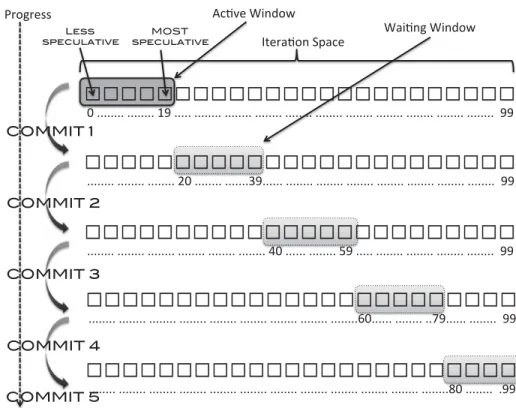
A different scheduling technique known asSliding Window(originally introduced by Dang et al. [2002]) was evaluated amongst different scheduling techniques by Cintra and Llanos [2003, 2005] and found to be a good alternative for TLS. Under sliding window (see Figure 4), chunks of iterations are assigned into windows of sizeW. At any time, there are onlyWactive threads (thus no overlapping of windows execution) and the memory overhead is proportional to W, regardless of the total number of chunks. The window moves forward (slides) when all iterations in the window have finished. This allows better load balancing, decrease in likelihood of dependence violation, and better decoupling of memory overhead [Cintra and Llanos 2003, 2005]. 3Assumeniterations are mapped onnthreads in order (thread 0 has iteration 0, thread 1 has iteration 1,
and so on). This specifies a speculation order in which threadkis less speculative than threadk+1, where 0<k<n.
Fig. 4. Sliding window scheduling.
Figure 4 shows a speculative execution instance that uses the sliding window schedul-ing policy. Iterations are mapped to windows of sizeW. The slots in the window dictate the speculation order. That is, slot 0 is the least speculative one and slot W −1 the most speculative (e.g., iterations assigned to slot 0 are less speculative than iterations assigned to slot 1). Only one window is active at any given time. The next window will be activated only when all iterations from the previous window have committed. 3. INSPECTOR/EXECUTOR: A NONSPECULATIVE APPROACH TO RUNTIME
PARALLELIZATION
Early work on runtime parallelization involved a nonspeculative technique known in the literature as Inspector/Executor [Zhu and Yew 1987; Salz et al. 1989; Salz and Mirchandaney 1991; Salz et al. 1991; Chen et al. 1994; Rauchwerger and Padua 1994b]. As the name implies, this method involves the generation of two versions of the loop to be parallelized during compilation. The first version, calledInspector, would simply execute a stripped version of the original loop that contains only accesses to shared mu-table data (although implementations are free to incorporate as much of the backward slice as is necessary to materialize those memory addresses), investigating whether the loop contains any data dependencies that prevent it from being parallelized. TheInspectoris not required to replicate all of the computation done by the original program (only memory accesses or a fraction of it), and thus could be executed quicker. 3.1. Work on Inspector/Executor
One of the most notableInspector/Executormodels in the runtime parallelization lit-erature was proposed by Rauchwerger and Padua [1994b]. Their approach used the inspector to simply detect whether or not a loop is fully parallel. Such loops are known
asDOALLloops. In Rauchwerger and Padua [1994b] each inspector thread would be allocated its own portion (chunk of iterations) of the stripped version of the original loop. Each thread will also make use of some thread-local auxiliary metadata (similar to the one in Figure 3(a) but without a “Lock Tid”) reflecting each memory location of the shared mutable data that can be accessed during parallelization. In this simplified version, each inspector thread will mark any loads or stores performed during the ex-ecution of its portion of iterations. A location in the thread-local auxiliary metadata is marked to indicate the corresponding action (e.g., Load or Store) by a particular thread. At the end of the inspection phase, all inspector threads will check each others findings to ensure that the same memory location was not accessed by different threads in a way that violates the sequential semantics of the loop. For instance, if two threads perform a store at the same memory location but in the wrong order the resulting value would be unpredictable. The only valid way multiple threads can access the same memory location is if they just read from that location. Since reading from a memory location does not affect its value, then threads are safe to read in any order they wish from there. The second version, calledExecutor, will execute the loop in parallel across mul-tiple threads, given that the inspector version indicated so. Otherwise the loop will be executed sequentially.
The focus of earlier attempts of theInspector/Executor, such as the one proposed by Zhu and Yew [1987], was mainly on partially parallel loops and they were using the inspector phase to order the iterations in groups that contained parallel iterations. Within those groups, iterations could execute in parallel between them, but the groups themselves have to be separated using synchronization. Their scheme was divided in multiple stages with each stage including both an inspector and an executor. Every stage would gather information (inspection phase) of which iterations are allowed to execute in parallel without any conflicts and record this information into an auxiliary data structure. Then, the executor would execute those iterations in parallel with the aid of the auxiliary data structure. The next stage would do the same and the process would continue in a repetitive fashion until all iterations of the loop finish. Later work, such as Salz et al. [1991], provide more optimized versions of theInspector/Executor technique by statically partitioning the iterations of the loop among processors and then reordering the iterations within each partition at runtime.
3.2. Weakness
As noted earlier,Inspector/Executorrelies on extracting a smaller version of the loop to execute faster. The model was successful mainly in cases where an efficient inspec-tor loop could be obtained [Rauchwerger 1998]. That is, if the inspecinspec-tor loop is not able to be decoupled sufficiently from the loop (i.e., small code replication), then the inspector becomes computationally expensive making it nearly equivalent to the loop itself. Mainly for this reason, research in runtime parallelization turned towards solu-tions employing speculation. Even though theInspector/Executormodel was not very successful it did form the basis of first research ideas in speculative parallelization [Rauchwerger and Padua 1994a, 1995].
P
ARTII: A
DVANCEDT
OPICS INS
PECULATIVEP
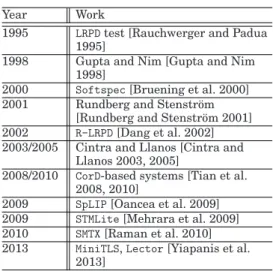
ARALLELIZATION 4. INTRODUCTIONThe first part of this article introducedspeculative parallelization, a way to parallelize an application at runtime. There has been numerous work in speculative paralleliza-tion over the last two decades. The second part, “Advanced Topics in Speculative Par-allelization,” identifies and delivers the most important ones while discussing various
Table I. The Design Points that Make Up a Speculative Parallelization System TLS Design Choices VERSIONMANAGEMENT CONFLICTDETECTION COMMIT ROLLBACK EXECUTIONMODEL WORKSCHEDULING METADATA
Table II. Advances in the Literature of Speculative Parallelization
Year Work
1995 LRPDtest [Rauchwerger and Padua 1995]
1998 Gupta and Nim [Gupta and Nim 1998]
2000 Softspec[Bruening et al. 2000] 2001 Rundberg and Stenstr¨om
[Rundberg and Stenstr¨om 2001] 2002 R-LRPD[Dang et al. 2002] 2003/2005 Cintra and Llanos [Cintra and
Llanos 2003, 2005]
2008/2010 CorD-based systems [Tian et al. 2008, 2010]
2009 SpLIP[Oancea et al. 2009] 2009 STMLite[Mehrara et al. 2009] 2010 SMTX[Raman et al. 2010] 2013 MiniTLS,Lector[Yiapanis et al.
2013]
advances in the area of speculation. The work discussed in the rest of this article con-cerns software implementations of speculative parallelization systems unless otherwise stated. A significant portion of Part I explored the various dimensions to implement a speculative parallelization system: metadata, version management, conflict detection, commit/rollback, and scheduling speculative threads. This information is summarized in Table I.
Those categories will lead the structure of Part II while explaining the main work in software speculative parallelization (summarized in Table II). As in Part I the terms Speculative Parallelization, Thread-Level Speculation, and TLS will be used inter-changeably throughout the rest of the article. To aid the information flow of this part, some categories will be merged together and one more category will be added in regard to the runtime execution model each system utilizes.
5. EXECUTION MODEL 5.1. Speculative Parallelization
The first trace of speculative parallelization in the literature was theDOALLtest pro-posed by Rauchwerger and Padua [1994a]. TheDOALLtest is a nonspeculative runtime technique forDOALLloop identification (i.e., loops without cross-iteration data depen-dencies) initially practiced using theinspector/executormodel. The test later became the core of one of the earliest and most influential work on speculative parallelization known as theLRPDtest (Lazy Reduction Privatization DOALLtest) [Rauchwerger and Padua 1995], proposed also by Rauchwerger and Padua.
LRPD [Rauchwerger and Padua 1995] eliminates the overheads of a possibly poor inspector (one that contains a large portion of the original loop) by combining the in-spection and execution face in a single step. Furthermore, certain types of anti and output dependencies are removed by using a transformation known asprivatization. Privatization transforms certain shared variables into private copies for each thread cooperating on the execution of the loop. For instance, variables that are firstdefined (written) every time before they areused(read) inside the same loop iteration, can be safely privatized. Sometimes, variables initialized outside of the loop could be priva-tized if acopy-inmechanism is provided (i.e., provide a copy of the external value for the first use of that variable in each iteration). Similarly, if a privatized variable is required
after the loop execution, acopy-outmechanism needs to be provided to ensure that the correct value is copied out to the original (nonprivatized) version of that variable.
While inspection of memory accesses takes place by a thread, the actual memory values of the shared user data structure are computed as well, only instead of being placed immediately to main memory, they reside in thread-local storage until inspection completes. This introduces a notion ofspeculationon the values being produced during the loop execution. Yet another novel feature ofLRPDis the ability to identify and handle code that fits thereduction5pattern, thus allowing for more loops to be parallelized.
The majority of subsequent speculative system implementations in the literature [Gupta and Nim 1998; Bruening et al. 2000; Rundberg and Stenstr¨om 2001; Dang et al. 2002; Cintra and Llanos 2003, 2005; Tian et al. 2008; Oancea et al. 2009; Mehrara et al. 2009; Tian et al. 2010; Yiapanis et al. 2013] are considered as an extension to theLRPD test.
5.2. Speculative Parallelization with Inspection Support
Luj ´an et al. [2007] investigated an idea inspired from the inspector/executor model in which sequential program execution is preserved together with speculative execu-tion in order to minimize the overheads caused from potential misspeculaexecu-tions. More specifically, the least speculative thread executes its assigned portion of iterations non-speculatively while writing its results directly to memory. This is achieved by extracting a lightweight inspector thread—coined as theco-inspector thread—(i.e., one that con-sists only of the memory accesses) from the least speculative thread, off-loading this way the least speculative thread from any access tracking. The co-inspector thread al-lows the least speculative thread (which is now nonspeculative) to continue executing the original loop unaware of the speculative threads, of tracking memory accesses, or of applying tests to establish the sequential semantic equivalence.
Yiapanis et al. [2013] propose a TLS system, calledLector, where the techniques of speculative parallelization and inspector/executor are combined together. For sim-plicity, assume that speculative parallelization is implemented in a similar manner to theLRPD[Rauchwerger and Padua 1995]. From the inspector/executor model, only the inspection loop is manipulated. Lightweight threads, coined inLectorasinspector threads, are extracted and applied in a similar fashion as theDOALL[Rauchwerger and Padua 1994a] runtime test. While inspector threads are running, speculation continues as usual. Inspector threads do not replicate the entire code from the loop and thus are expected to be faster than typical TLS threads. If the inspector threads determine that the loop is fully parallel, speculation is withdrawn and parallel execution continues without the speculative overheads. If inspector threads fail due to data dependencies, speculation continues without any changes.
The traditional inspector/executor model would suffer performance losses in two cases: (a) when the inspector replicates a large portion of the loop, and (b) when the inspector identifies data dependencies since the inspection time is completely lost. Combining the model with speculation, like inLector, these two drawbacks are ad-dressed as follows: (a) Even if inspection completes at the same time as speculation, at least the loop was executed speculatively rather than having to be computed serially. (b) If the inspector identifies data dependencies, the inspection time is amortized by having speculation executing the loop simultaneously.
5Reduction operation of the form:x=x⊗exp, where⊗is an associative operation and variablexdoes not
Fig. 5. (a) Linked-list traversal. (b) DOACROSS scheduling. (b) DSWP scheduling. This example appears in Ottoni et al. [2005a].
5.3. Decoupled Software Pipelining with Speculation Support
Raman et al. [2010] demonstrated a different approach to runtime parallelization by enhancing a technique known asDecoupled Software Pipelining (DSWP)[Rangan et al. 2004] with speculation support.
DSWP is somewhat similar to another earlier form of offline-based parallelism trans-formation known asDOACROSS[Cytron 1986]. DOACROSS targets loops with cross-iteration data dependencies and enables parallelism by scheduling parts of each loop iteration across multiple threads. In DSWP each thread executes part of the loop for all iterations and threads are scheduled is such a way to form a pipeline. To better understand the difference, consider an example6 code traversing a linked list as in Figure 5(a) and its dependence graph (the graph showing the program’s data depen-dence relationships). The pointer chasing load is labeled “LD” and the loop body is labeled “X.”
Figure 5(b) illustrates how the DOACROSS technique would schedule the loop iter-ations among two threads (T1 and T2) in an alternate fashion. This way the body of the loop in one thread can be executed in parallel with the next field traversal load of the other thread (in a pipelined fashion). In contrast, the DSWP technique (see Figure 5(c)) schedules the iteration of the loop in a way that half of the iteration (the pointer chasing load) is in one thread and the other half (the body of the loop) in another thread. What DSWP aims to optimize over the DOACROOS technique is to keep the loop’s critical path (the longest path in the dependence graph) dependence chain in the same thread. If the critical path has to be routed across threads as in the DOACROSS 6This example was taken from Ottoni et al. [2005a].
example, the total execution time of the loop may increase due to communication costs. Placing the critical path in the same thread allows decoupling from that communi-cation latency among multiple threads. One limitation of DSWP is the requirement that the loop must be able to be broken up in such a way that all instructions from the same recurrence (strongly connected component) in the flow graph can be placed on the same thread. This limits the scalability of DSWP to the number of strongly connected components in each loop, which is typically much smaller than the number of loop iterations [Rangan et al. 2008]. This issue is addressed in PS-DSWP [Raman et al. 2008], by enhancing DSWP with DOALL parallelization capabilities. After each recurrence in the loop is isolated in an individual pipeline stage using DSWP, stages that are free of interiteration (loop-carried) dependencies are parallelized in a DOALL fashion to exploit iteration-level parallelism.
By default, DSWP is a nonspeculative technique and therefore has to respect all dependencies in the loop. In an attempt to allow more loops to be parallelized, Vachharajani et al. [2007] proposed the first system toward speculative DSWP, although, requiring specialized hardware support. Raman et al. [2010] present a software approach for DSWP by providing a software TLS back-end to the initial idea in Vachharajani et al. [2007]. In their work, they coin this TLS support asSoftware Multithreaded Transactions (SMTX).
SMTX builds on top of Speculative Parallel-Stage DSWP (Spec-PS-DSWP) [Bridges 2008], which extends PS-DSWP by using speculation to break interiteration dependen-cies to expose data-level parallelism, allowing the replication of pipeline stages with no loop-carried dependencies. InSMTXa loop iteration is executed in a staged manner by multiple threads, making the atomic unit multithreaded (in contrast to TLS that the unit of atomicity is a single thread). These atomic units are supported by atomic sets of memory accesses called Multithreaded Transactions (MTXs) [Vachharajani et al. 2007] allowing speculative work done in different pipeline states (by different threads) to be committed together. MTXs can themselves contain multiple sub-Transactions (subTXs), each of which is executed by only one thread and ordered by the program order of the sequential loop. Typically, a subTX corresponds to the execution of a pipeline stage on each iteration.SMTX is a process-based system. Speculative threads are executed on different UNIX processes and a separate commit-unit is used to handle the nonspeculative state.
Apart from alias speculation,SMTXalso supports control and value speculation.
6. METADATA AND VERSION MANAGEMENT
Typically, work on speculative parallelization manipulates additional data structures to indicate an action on a particular memory location (this idea was explained in Part I, Section 2.2). Usually these data structures are implemented using arrays or hash tables. Since each of those array elements reflects a memory location, they are referred to as shadow arrays. There are three ways that have been mainly used in literature to maintain metadata: (a) keep the shadow arrays private to threads and check for correctness only at the end of speculation, (b) keep shadow arrays shared among threads so that each thread could see what other data threads are access-ing duraccess-ing speculative execution, and (c) keep shadow arrays private to threads but provide means to enable early detection in case of a conflict. In other words, allow threads to commit partial results during execution so that conflicts are not delayed until the end. The next sections elaborate more on those three types of maintaining metadata.
Fig. 6. DOALLtest [Rauchwerger and Padua 1994a] basic data structures.
6.1. Speculation with Private Shadow Data
Early work on speculative parallelization was fully optimistic in the sense that it was more effective when speculation triggered no conflicts. Speculative threads did not attempt to communicate between each other until only after the end of their corre-sponding speculative execution. Thus, a misspeculation was only detected after the final commit.
6.1.1.DOALL.Even though the DOALL test [Rauchwerger and Padua 1994a] is not a speculative techniqueper se, it is described here as it forms the baseline for schemes proposed later in literature. TheDOALLtest involves the manipulation of helper data structures in order to track any memory accesses performed on the user shared data structures. Loads and stores are marked during program execution based on memory accesses using those helper orshadowdata structures. In its simplest form, the com-piler analyzes the loop to be parallelized and generates shadow data structures for each user data structure under question. Figure 6(a) shows an example of a candidate loop for DOALL parallelization. In order for the loop to be classified asDOALL, no data dependencies must exist among different iterations (or chunks of iterations). The shared data structure in question for this example is an array A[n], wherenindicates the size of the array. Assuming that integer arraysBandCare populated at runtime, there is no way to analyze Afor data dependencies at compile time as its indices are unknown by that time. During compilation two versions of the loop are generated. The first loop will be used to compute all the indices and perform theDOALLtest, without actually modifying any shared data. The second loop, provided that the DOALL test was a success, will use those indices to access the actual storage and perform the
computation. Two additional arrays,Load[ ] andStore[ ], are introduced to record the indices of loads and stores, respectively, for array A(see Figure 6(b)). The two arrays have the same length asAand are used only to mark index locations. Loop iterations are distributed among multiple threads and the shadow structures are replicated for each thread to perform the marking concurrently (without the need of synchroniza-tion). At the end of the inspection/marking phase, the different copies of those shadow structures are examined. For a given indexi, ifLoad[i] andStore[i] are both marked in different threads (i.e., chunks of iterations), then the loop is NOT aDOALL. If no load from one thread intersects with a store from a different thread in the same memory lo-cation, then the loop is classified as fully parallel. Several extensions to this simplified version have been proposed over time and will be discussed next. Given the test yields a success, the second loop that will perform the actual computation can be executed as aDOALLloop across multiple threads.
6.1.2. TheLRPD.TheLRPD test [Rauchwerger and Padua 1995] takes the DOALL test [Rauchwerger and Padua 1994a] a step forward and actually computes the loop in a speculative fashion while inspecting.LRPD allocates five data structures in total: four boolean-valued shadow arrays to indicate actions on memory locations and another array as temporary space for speculative values to be stored during execution. The four shadow arrays are defined as follows:
—Load:An elementLoad[i] in this array is set to “true” to indicate a speculative load performed on a memory locationiin the user space.
—Store:Similar to the load array, an element in this array is set to indicate a specu-lative store operation on a memory location.
—NotPrivatizable: A thread sets an element in this shadow array if a load was performed in a location without a preceding write by the same thread. This is done to prevent the possibility of the loading thread reading a value produced by a different thread in the wrong order. Thus, the array is used to indicate an element that cannot be privatized.
—NotReduction:Indicates that memory location cannot participate in a reduction operation.
When the loop is parallelized speculatively, every thread is assigned a chunk of iterations to execute. Each thread has its own copy of the preceding data structures that reflect only the memory locations accessed by that thread. A local copy of those data structures can be accessed only by the thread that owns it. Therefore, during execution there is no need for synchronization to mark those arrays. Nevertheless, at the end of the speculative execution, all these local copies must be merged in order to check for cross-thread memory accesses.
LRPD is an example of a lazy version management system, since tentative stores reside in private storage and only become visible to memory at a thread’s commit time. 6.1.3.Softspec.Softspec [Bruening et al. 2000] is a TLS scheme that attempts to parallelizeDOALLloops with stride-predictable memory accesses. A memory access is stride predictable if the address it accesses is incremented by a constant stride for each successive dynamic instance. An example would be a loop accessing each element in an array in a sequence. InSoftspec, a potentiallyDOALLloop is transformed into four loops: aprofileloop, adetectionloop, aspeculationloop, and arecoveryloop.
The profile loop executes only the first three iterations to determine whether the loop has a constant stride. This requires a temporary data structure to record any memory addresses from loads or stores performed during these iterations. If the strides are not consistent, then speculation is not performed and the loops are executed sequentially.
The detection loop determines how many iterations can be executed in parallel before a memory dependence occurs. That is, for each pair of memory accesses it determines how many iterations can be executed before the addresses of those memory accesses become equal (in different iterations). If sufficient iterations cannot be executed in parallel, then speculation is abandoned.
As the name implies, the speculation loop is the one that actually does the speculative work. Memory is updated in-place (i.e., eager version management) and original values are stored in thread-private data structures in case of a rollback. This step requires a data structure per thread to record the original memory values before speculative updates. A per-thread shadow data structure of boolean values (used for flags) is also required for every memory access (loads and stores). These are used as flags to indicate a mispredicted address.
Finally, the recovery loop is used to restore memory in case speculation turned out to be incorrect. This is equivalent to the original sequential loop but it is used only to execute the misspeculated iterations.
6.2. Speculation with Shared Shadow Data
In the work discussed previously [Rauchwerger and Padua 1994a, 1995], threads avoid communication between them until the end of speculative execution. Other proposals, such as the ones that will be discussed next, expose the metadata to multiple threads during execution but prevent data races between threads through the use of locks or Compare-and-Swap (CAS) operations. One important reason that a TLS system designer might choose to do that is to allow threads to detect early misspeculations.
6.2.1. Rundberg and Stenstr ¨om.Rundberg and Stenstr¨om [2001] proposed a speculative parallelization scheme in which a thread must first secure exclusive ownership of a particular location before any speculative access. This is enabled by requiring a thread to acquire a lock associated with each memory location that may be accessed in a speculative manner.
Every user shared data structure is shadowed by three helper arrays. Every location of these shadow arrays is associated with an individual memory location in the user shared data structure, the same way as in theLRPDtest [Rauchwerger and Padua 1995]. The first shadow structure is an array of locks used to indicate ownership of a particular location by a thread. The remaining two are used to keep an identifier for a thread that has performed a speculative load or store on a particular location, respectively. Also, a private storage is maintained for each thread to buffer any speculatively produced values.
6.2.2. Cintra and Llanos.Cintra and Llanos [2003, 2005] use a slightly different layout for the metadata than the work from Rundberg and Stenstr¨om [2001]. Apart from the private storage for speculative values, three other shadow arrays are used as follows (and illustrated in Figure 7):
—AT: The AT array, short for Access Type, shadows the user memory locations. It is used to contain information about the access type upon a memory location by a thread. Access types can be inRead orMod state (corresponding to Load or Store actions, respectively), inNotAcc(to indicate a memory location never accessed before by different thread) state, or inExpLd state (to indicate a memory location could have potentially been written by a different thread and consumed by the current thread—this action is termed asexposed loadin this work).
—IA:Indirection Array. This array is just a summary of memory locations in a state other thanNotAcc (not accessed) for each thread. It is used to speed up checking
Fig. 7. The data structures used by Cintra and Llanos [Cintra and Llanos 2003, 2005]. “AT” stands for Access Type,“IA” stands for Indirection Array, and “GlExpLd” stands for Global Exposed Load. The values inside the “GlExpLd” can be either true (T) or false (F).
which data a given thread has accessed. An integer variable “Tail” is used to indicate the last element of this array.
—GlExpLd:An element of this array (Global Exposed Loads) reflects a memory lo-cation across multiple threads. If a given memory lolo-cationishadowed by GlExpLd is consumed by a speculative thread but not written first (i.e., exposed load), then GlExpLd[i] is set to indicate a potential violation. This is another attempt to speed up the checking process. If a memory located has never been exposed loaded, then there is no need to be included in any checking for violation.
The work of Cintra and Llanos [2003, 2005] is also an example of lazy version management. In their work, to prevent certain memory access violations, threads are allowed to communicate values between them using a mechanism known as value forwarding. This will be revisited in the discussion regarding conflict detection.
6.2.3.SpLIP.SpLIP[Oancea et al. 2009] is a TLS system supportingin-placeupdates (eager version management). A thread-local buffer is still required, only in this case it is used to record the original value of a memory location just before the speculative memory update is performed. Two supporting data structures are required in order to record the thread ID that is currently performing a load or a store for a given location, respectively (illustrated in Figure 8). Up to this point the data structures used are very similar to the ones used in the work by Rundberg and Stenstr¨om [2001]. A major difference from Rundberg and Stenstr¨om [2001] is the interesting way exclusive ownership is defined. SpLIP takes advantage of certain properties of the Intel ×86 architecture in order to abolish locks or CAS operations used by conventional TLS
Fig. 8. Metadata organization forSpLIP[Oancea et al. 2009].
systems to protect a speculative location from multiple thread accesses. This comes at the cost of increasing memory requirements by requiring two additional shadow data structures (SynchLoadandSynchStorein Figure 8) to ensure proper synchronization between multiple thread accesses. Intel×86guarantees that read/write access to a 64-bit word occurs atomically as well as access to any subwords of the corresponding word. Exploiting this information the four shadow structures (two for read/write marking and two for read/write synchronization) are implemented as interleaved, aligned 16-bit subwords of a 64-16-bit word; reading any of these is replaced by reading the full word and computing the required value. The authors ofSpLIPsuggest that this sequentially consistent behavior is likely due to flushing the cache line when cache coherency detects concurrent accesses to a word and one of its contained subwords.
TheTimeStampdata structure is used to indicate the relative time that a thread performed a store operation on a memory location. This feature facilitates recovery from conflicts and will be discussed in more detail in Section 7.2.
6.2.4.MiniTLS.MiniTLS[Yiapanis et al. 2013] is another system that implements in-place updates; however, unlike SpLIP, a bit-map data structure is utilized to record read/write information, minimizing this way the memory footprint for speculative in-formation. The layout is illustrated in Figure 9.
Every speculatively accessed datum is shadowed by a sequence of bits divided into buckets relative to the number of running threads. The first two buckets (starting from left to right) are used to acquire ownership of a particular location by setting the bit of the appropriate thread ID. Multiple concurrent readers and only a single writer (and
Fig. 9. Metadata organization forMiniTLS[Yiapanis et al. 2013].
no readers) are allowed at any given point in time. The ownership bits are bounded spinlocks7 set by using CAS operations. The rest of the buckets are used to capture reader and writer thread ID’s during speculative execution. Apart from minimizing the memory footprint required for speculative metadata, this configuration allows for an interesting optimization to parallelize the rollback operation. This optimization is discussed in Section 7.2.
6.3. Speculation Using a Centralized Manager Thread
The work discussed previously concerned either systems that communicate their shadow arrays at the end of speculation or work that the shadow arrays are shared between multiple threads. The following paragraphs discuss a different approach in which although shadow data are distributed among threads, there exists a centralized manager unit to ensure misspeculations are detected before the end of speculation. Also, if the manager is executed in a dedicated thread and it is the only thread allowed to commit values to memory, then commit-time locks can be avoided. Nevertheless, locks may still be required to coordinate multiple threads from accessing the manager thread andvice versa.
7Bounded spinlocks allow a thread to check a bounded number of times on a lock held by another thread.
This allows the thread, when the counter expires, to perform a more useful operation if desired rather than blocking on a particular lock.
Fig. 10. Metadata used forCorD[Tian et al. 2008].
6.3.1.CorD.Tian et al. describeCorD[Tian et al. 2008], a TLS system that maintains a central manager unit that is dedicated to only one thread. The manager is the only thread that has access to user data and it is not speculative. Each speculative worker thread maintains its own private space for marking and execution. When a spec-ulative thread is created, any value that is needed, is copied-in from the nonspecspec-ulative state (the user data) to the speculative one (the worker’s thread private space) and later the results are copied back if speculation was successful. This transfer of data between the user space and the speculative space is performed only through the central manager. A mapping table is maintained for each speculative thread that has entries associated with each variable’s copy. Version numbers are used between the two states (user space and speculative space) in order to detect misspeculations. When a memory location is needed, the main thread provides a copy of the associate value to a speculative thread and stores an integer value in the “version shadow array” (shown in Figure 10) for that location. The version number is also provided to the speculative thread’s mapping table. If that user location has changed during execution the version number will be updated. When a speculative thread finishes execution, its mapping table will be sent to the manager thread. The mapping table will be traversed by the manager thread to identify any expired versions. The “WriteFlag” is set totrueby a speculative thread to indicate the memory locations need to be copied back to the user space. Work from speculative threads is committed in-order by the main thread.
Furthermore, in Tian et al. [2010] they address certain challenges specific to appli-cations manipulating dynamic data structures. For example, the copying of objects is limited to only those that are modified by a speculative thread. Also, when an object
is moved to the speculative space, all other references that may point to that object must be changed to point to the speculative copy rather than the original. This causes the address translation problem. To overcome copying all those references, the authors introducedouble pointers. Under this idea, every pointer variable in the program is modified by the compiler and represented by two pointers. One for the nonspeculative state and one for the speculative state. In this way, extra copying is avoided by using the appropriate pointer for corresponding space.
One requirement inCorD is that the user space and speculative space remain com-pletely separated. The manager thread supplies any value needed to a newly created speculative thread, even values to be loaded. This could cause unnecessary copying overhead since, anyway, if a value needs to be loaded it could be retrieved on demand from main memory. In any case,CorDwould invalidate a copy that was updated during speculative execution. Also, in many scenarios pointer values may be undefined by the time they are required to be copied (i.e., when the speculative thread is created). CorDaddresses this issue by delaying the copying of the pointer address up until it is actually read for the first time.
6.3.2.STMLite.Mehrara et al. [2009] presentSTMLite, a Software Transactional Mem-ory (STM) model modified to support speculative parallelization.STMLiteaims to re-duce the overhead associated with validating the read-set by decoupling the conflict detection and commit process from the main transactional execution using a central-ized Transaction Commit Manager (TCM). Also, individual locks for copying out the write-set are avoided. The TCM, runs on a dedicated thread and allows only one trans-action (or in this case, a chunk of iterations) at a time to write to a particular location (note that, multiple transactions can update different locations concurrently). During execution, each transaction computes their read and write accesses in the form of soft-waresignatures(inspired by hardware signatures [Ceze et al. 2006]), while buffering their speculative store values. At the end of their speculative execution, signatures are sent for validation to the TCM. If granted by TCM, a transaction is safe tocommitits buffered values. The relative start and commit times of transactions are tracked us-ing aglobal clockmechanism (a shared counter used to maintain consistency between transactions). The clock is incremented every time a transactioncommitsand it is used to invalidate other “live” transactions with an out-of-date value. This is possible since every memory location is associated with a version number. Before the transaction terminates, as part of its commit procedure all write-sets are revalidated to ensure nonoverlapping write-back into main memory. If successful, the global clock is incre-mented atomically, all speculative updates are propagated to memory, and all writes are amended to hold the new value of the global clock. This way the next committing transaction can ensure consistency by comparing their previously recorded local value of the global clock against the current up-to-date clock of any values read. The global clock idea for STM was first used in Spear et al. [2006].
To ensure correct parallel execution,STMLite forces in-order chunk commit. Since STM does not require the execution to obey the sequential program’s order, some extra metadata are required. More specifically, the loop ID of the last committing parallel loop and the chunk ID of the last committed chunk in that loop. The authors refer to this information as Loop Chunk Commit Log (LCCL). The loop ID is assigned to each loop at compile time.STMLiteallows only one in-flight parallel loop at a time by introducing a barrier at the end of each chunk. This prevents multiple instances of the same loop running together and distorting each other’s execution in case a parallel loop is invoked multiple times.
6.3.3.SMTX.SMTX[Raman et al. 2010] also uses a centralized commit unit in a similar manner as in STMLite [Mehrara et al. 2009]. While prior lazy version management
systems had to check write sets,SMTXtakes advantage of Operating System (OS) process isolation to avoid doing so and making speculative loads cheap. The speculative regions are executed inside UNIX processes. This allows the underlying virtual memory to transparently create private physical copies of locations being updated (at the page granularity). As a result, any subsequent load operation to a memory location being updated in the same speculative thread will have the up-to-date value (with respect to that thread) available without the need to scan the write-set.
Each thread maintains a write-buffer that is part of the transaction’s private memory. This is used to keep any potential memory updates (if speculation is correct). Special data structures serve as communication channels between each speculative thread and the commit unit. These are single-producer/single-consumer lock-free queues that allow transfer of speculative writes as well as any other message.
TheCorD-based systems [Tian et al. 2008, 2010],STMLite[Mehrara et al. 2009], and SMTX[Raman et al. 2010] employ lazy version management.
7. CONFLICT DETECTION, ROLLBACK, AND COMMIT
Earlier, Section 6 described the methods that different TLS systems devised to enable a way of communication between the accesses from speculative threads and the rest of the system. The following paragraphs will provide the critical piece that is missing from the puzzle, which is how each of those approaches maintains correctness during speculative execution. This section is structured based on the two popular ways that a TLS system can use to detect a conflict: Lazy and Eagerconflict detection. While discussing conflict detection, information about different types of commit and rollback will be explained.
7.1. Lazy Conflict Detection
A thread that delays the validation for correctness to the end of its speculative execution is said to employ alazyconflict detection mechanism. The benefit of acting as such is to avoid the overhead of checking for correctness upon every speculative access. The downside is that if a misspeculation is detected, any work performed during speculative execution is wasted. So far in the literature of software speculative parallelization, lazy conflict detection has been used only by lazy version management systems.
7.1.1.LRPD.LRPDtest [Rauchwerger and Padua 1995] is a very simple and effective technique for applications that have no data dependencies. The user data structure is shadowed by helper arrays to mark the loads and stores from each thread. At the end of speculative execution the arrays are examined.
Rollback and Commit. In the simplest case, a conflict can ariseif two threads have marked the same location, one thread as a store and the other one as a load. That is, the same memory location has been read and written in different iterations (threads in this case) indicating a RAW or WAR violation. Nevertheless, if the load is preceded by a store from the same thread, then there is no conflict since speculative values are committed lazily. Furthermore, theLRPDkeeps track of the total number of store operations performed by all threads. If that number is different from the total number of store operation markings in the shadow arrays, then some locations have been overwritten causing a WAW violation. Also, violation is caused if a variable was not able to be privatized but written during speculation. When a conflict is detected all speculative work is discarded and the loop reexecutes sequentially. If the loop is found validly parallelized, then all threads can commit their speculative results in parallel to main memory (in parallel only if no two or more threads have performed an update to the same memory location, otherwise sequentially and in-order to avoid WAW conflicts).
TheLRPD test [Rauchwerger and Padua 1995] is probably one of the laziest8 TLS systems. The test for correctness is performed at the end of the entire speculative exe-cution. While this scheme is ideal for an application that contains no data dependencies, many opportunities for parallelization remain unexploited.
7.1.2.Softspec.Softspec[Bruening et al. 2000] employs lazy conflict detection. The system tries to predict the memory accesses of the loop before speculation begins (using constant strides). During speculative execution, memory updates are performed in-place while original memory values are preserved in thread-private data structures. At the same time, the predicted addresses for every speculative access (both loads and stores) are compared with the actual addresses and the result is also stored in thread-private data structures. The flags are checked at the end of each iteration and if a flag indicates a misprediction, then speculation fails.
Rollback. During rollback all stores performed during and after the misprediction are undone and those iterations are reexecuted sequentially by the recovery loop. The recovery loop is used to execute the remaining iterations and it is essentially identical to the original sequential loop. Memory updates during speculation are using the predicted addresses rather than the actual addresses. This allows for recovery in parallel in case of misspeculation.
7.1.3.R-LRPD.As mentioned earlier, the main disadvantage of theLRPD[Rauchwerger and Padua 1995] is having to waste all speculative work performed during execution, by discarding all computed values, when the test was unsuccessful. TheR-LRPD (Recursive-LRPD) test [Dang et al. 2002] aims to address this shortcoming. To a great extend R-LRPDis the same as its predecessor. The loop is executed speculative using the same technique as in LRPD and performing the correctness test at the end. If the test is “passed,” then the process is equivalent to theLRPDtest. However, in the unfortunate case where the test fails, a completerollbackis not necessary. Instead, all iterations of the loop under question that computed any results before the misspeculation is triggered, are allowed tocommit, whereas the rest of the iterations are reexecuted in the same fashion. This process continues in a recursive fashion until all the executions of the loop complete.
This optimized rollbackprocedure of R-LRPD is made possible by using a sliding windowscheduling mechanism. Only a set of iterations are executed in the window at a time. Thus, successful execution of iterations inside the same window phase appears the same asLRPD. When a conflict arises, it is isolated within the current window of execution.
7.1.4. Gupta and Nim.Gupta and Nim [1998] also aim to address the shortcomings of LRPDby proposing some simple extensions. The main extension concerns elements not able to be privatized. In LRPD a thread that loads a value initialized by a different thread causes a violation. In the scheme proposed by Gupta and Nim [1998] a thread that attempts to load a value not initialized by itself can decide to stall until the previous threads have finished execution. This is done by inserting synchronizations for the threads that may require a value not yet produced. This scheme assumes that threads are totally ordered and iterations are assigned to threads in increasing order. This implies that a lower thread in the ordering will always be less speculative than a higher thread. The stalled thread can proceed only when its less speculative threads have finished and thus commit the value needed in main memory.
![Fig. 6. DOALL test [Rauchwerger and Padua 1994a] basic data structures.](https://thumb-us.123doks.com/thumbv2/123dok_us/10213381.2925033/15.729.82.617.125.551/fig-doall-test-rauchwerger-padua-basic-data-structures.webp)
![Fig. 7. The data structures used by Cintra and Llanos [Cintra and Llanos 2003, 2005]. “AT” stands for Access Type,“IA” stands for Indirection Array, and “GlExpLd” stands for Global Exposed Load](https://thumb-us.123doks.com/thumbv2/123dok_us/10213381.2925033/18.729.74.655.106.511/structures-cintra-llanos-cintra-llanos-indirection-glexpld-exposed.webp)
![Fig. 8. Metadata organization for SpLIP [Oancea et al. 2009].](https://thumb-us.123doks.com/thumbv2/123dok_us/10213381.2925033/19.729.78.639.150.515/fig-metadata-organization-splip-oancea-et-al.webp)
![Fig. 9. Metadata organization for MiniTLS [Yiapanis et al. 2013].](https://thumb-us.123doks.com/thumbv2/123dok_us/10213381.2925033/20.729.90.635.109.577/fig-metadata-organization-minitls-yiapanis-et-al.webp)
![Fig. 10. Metadata used for CorD [Tian et al. 2008].](https://thumb-us.123doks.com/thumbv2/123dok_us/10213381.2925033/21.729.84.656.128.558/fig-metadata-used-cord-tian-al.webp)
