Utilizing External Information in Continuous
Innovation Processes:
The impact of managerial IT skills and
supportive capabilities on the innovativeness
of multinational companies
Gunnar Óskarsson
Supervisor: Dr. Ingjaldur Hannibalsson External supervisor: Dr. Patrick Joynt Doctoral committee: Dr. Ingjaldur Hannibalsson Dr. Patrick Joynt Dr. Fridrik H. JonssonMarch 2011
Utilizing External Information in Continuous Innovation Processes Utilizing External Information.
A thesis for a Ph.D. degree in Business
© 2011 Gunnar Óskarsson All rights reserved
Faculty of Business University of Iceland Gimli v/Suðurgötu 101 Reykjavík Tel.: 525 4500 ISBN: 978-9979-9743-3-8
Printed in Haskolaprent ehf. Reykjavík, March 2011
Abstract
Over the last two decades, academics have maintained that innovativeness will be the most important contributor to the sustainable competitive advantage of firms, and that the access and utilization of external information will have a profound impact on the firms‟ innovativeness. There is an increasing trend in the use of information technology (IT) in business processes, and it has been argued that IT will contribute to the effectiveness of information transfer, particularly in international firms in which managers co-operate over boarders and different time zones. Previously, new product development was viewed as an isolated function separated from other parts of the organization, but now it is argued that retaining new product development isolated from other parts of the organization is no longer the most appropriate approach due to the turbulent and demanding environment. Instead new product development should be viewed as an ongoing process, requiring company-wide involvement and inter-organizational collaboration. Drawing upon the theories of continuous innovation, information technology, and the resource based view (RBV), this research identifies and explores capabilities that have an impact on the utilization of external information, including information technology capabilities, and their contribution to the innovativeness of international firms.
Based on a survey among managers of international firms, this research identified three capabilities, managerial IT skills, market orientation and absorptive capacity, that contribute significantly to the innovativeness of international firms and explain 57% of its variance. The research further-more found that the impact of managerial IT skills on the innovativeness of firms is mediated by market orientation and absorptive capacity and can only be identified by considering the interaction effect of these capabilities.
Ágrip
Á síðustu tveimur áratugum hafa fræðimenn haldið því fram að nýsköpun sé mikilvægasta framlag til viðvarandi samkeppnishæfni fyrirtækja og að aðgangur að og nýting ytri upplýsinga hafi umtalsverð áhrf á nýhugsun. Aukin tilhneiging er til þess að að nýta upplýsingatækni (UT) í ýmsum ferlum í starfsemi fyrirtækja, og er því haldið fram að UT auki virkni í upplýsingamiðlun, sérstaklega í fjöl-þjóðafyrirtækjum þar sem stjórnendur hafa samskipti milli landa og á mismun-andi tímabeltum. Áður fyrr var litið á vöruþróun sem eingangraðan þátt starfseminnar, aðskildan frá öðrum hlutum hennar. Nú er því hins vegar haldið fram að það eigi ekki lengur við vegna óstöðugs og krefjandi umhverfis. Þess í stað er litið á vöruþróun sem viðvarandi ferli sem gerir kröfur um víðtæka þátttöku starfsmanna á ólíkum sviðum og samstarf fyrirtækja. Á grundvelli kenninga um stöðuga nýsköpun, upplýsingatækni og auðlindasýn er í þessari rannsókn leitast við að greina færni sem hefur áhrif á nýtingu ytri upplýsinga, og þá sérstaklega hæfni stjórnenda í upplýsingatækni, og framlag hennar til nýhugsunar í fjölþjóðafyrirtækjum.
Könnun meðal stjórnenda í fjölþjóðafyrirtækjum, sem var hluti rann-sóknarinnar, leiddi í ljós að þrenns konar færni, hæfni stjórnenda í upplýsingatækni, markaðsfærni og meðtökuhæfni, hafa umtalsverð áhrif á nýhugsun og skýra 57% af breytileika hennar. Ransóknin leiddi ennfremur í ljós að hæfni stjórnenda í upplýsingatækni væri háð markaðshneigð og meðtökuhæfni, og ekki væri unnt að greina áhrif hennar á nýhugsun án þess að mæla samvirkni hennar við ofgreinda færni.
Acknowledgements
Now, when I have completed my dissertation and submitted it for a defence, I would like to mention the people who provided a support to my work. During the research and writing up of my dissertation I have received considerable support. First and foremost I like to thank my supervisors, Dr. Ingjaldur Hannibalsson and Dr. Patrick Joynt for their comments and practical advice. Dr. Ingjaldur Hannibalsson was always willing to support my plans and with his power all the arrangements were made easier. Even though Ingjaldur has many responsibilities, he kept an open door, and was always willing to give me the time I needed. This was of great support and eliminated many of the possible stress factors.
Dr. Patrick Joynt (Pat), my external supervisor, whom I happened, almost by coincidence, to get to know in 1981, when I had a summer job at Bedriftsøkonomisk Institutt (now BI Norwegian School of Business), doing research and writing a working paper for Pat, and at which time he said “Gunnar, you should be a doctorate”. Through him, I had an access to a wealth of work by previous doctoral students, which carried me over the first hurdle, provided me with an insight into what the PhD journey was all about, and what kind of requirements were made. He was in fact so kind, that he invited me to most of his places, including his home in Henley UK, his summer house (chalet) in Madison Wisconsin, where he arranged a theme group with students from all over the world for thorough discussions, and his wonderful wife, Unni, who took good care of us all during the stay. But this is just small gimps of his support. He invited me to a methodology course in Henley Business School at the University of Reading as ´a guest´, where I did not only learn the theory, but also got connected to a network of other doctoral students who supported me later on. Apart from that, he always gave me very useful feedback, almost instantly, which was so condensed and straight to the point in fact, that I often printed them out to show me fellow students at the University of Iceland what a genius support I had. Most importantly, however, was that with the support of these comments, I knew exactly what I needed to do and fulfil strict academic requirements. If I had an idea he was not happy with, he simply said, straight forward, “no, you will not have my support for that”.
Another excellent source of advice and support was from Dr. Eirikur Hilmarsson, who always managed to make the most complicated statistical
formulas as easy to understand as elementary mathematics. He always saw the light in the numbers and how to present them clearly so others could join us and celebrate how valuable the numbers were. Last, but not least, the discussions I had with him, even late in the evening, when I was writing the conclusions chapter, and finally preparing the speech were invaluable.
Good support has also been provided by Dr. Fridrik H. Jonsson, a member of the doctoral committee, who provided useful feedback and comments regarding the research design and the survey. Mid in his illness, he also managed to read through the dissertation and provided me with valuable feedback, only few months before he passed away, far too early.
A colleague of mine, Mr. Fridrik Eysteinsson at the University of Iceland was of great support in a focus group and has been a very helpful reviewer. Dr. Hanna Bjorg Sigurjonsdottir provided good recommendations and excellent feedback on the preparation and analysis of the in-depth interviews, and the focus group that was conducted regarding preparation for the survey and to support the interpretation of the results. I would not want forget Dr. Thorhallur Gudlaugsson, who support me with the survey and provided me with books that guided me through the jungle of methodologies for my research. Last but not least, I would like to thank my wife, Ms. Dagny Brynjolfsdottir, who has been patient during all the time when I was working on the research, and supported me to the extent that without her support I would probably not have completed my journey. Finally, I would like to mention my mother, who during her last days, motivated me strongly to take on this journey and complete the PhD degree. I have always kept her motivation in mind, particularly when I found the task to be overwhelming, and was not sure it was worth it.
Many other people have been supportive, such as reviewers at CINet, those who participated in the qualitative research and a number of colleagues and academics. I thank these and others for their contributions, but the responsibility for completing the research project and the final „product‟, good or bad, is basically mine.
This research was supported by the Icelandic Graduate Research Fund (RANNIS), the University of Iceland, the Faculty of Social Sciences, and the School of Business, both for their grants, and support for attending a number of advanced courses at EDEN, EIASM‟s doctoral educational network in Bruxelles.
Table of contents
Ágrip ... iii
Abstract ... iii
Acknowledgements ... vii
Table of contents ... ix
List of Figures ... xiv
List of Tables ... xvi
Preface ... xix
Executive summary ... xxi
1 Introduction ... 1
1.1 Overview ... 1
1.2 The need for research ... 1
1.3 Motivation ... 3
1.4 Background of the study and research questions ... 5
1.5 Definitions ... 10
1.6 The structure of the dissertation ... 12
2 Literature review ... 13
2.1 Introduction ... 13
2.2 Innovation processes ... 14
2.2.1 Continuous innovation... 17
2.2.2 Exploration and Exploitation ... 19
2.2.3 International diversity ... 23
2.2.4 Performance in innovation processes ... 26
2.2.4.1 The firms innovativeness ... 26
2.2.4.2 Innovation capability ... 27
2.2.5 Section summary ... 30
2.3 Networking ... 31
2.3.1 Interaction ... 33
2.3.2 Section summary ... 36
2.4 The Resource based view ... 37
2.4.1.1 Learning orientation ... 39 2.4.1.2 Norms... 39 2.4.1.3 Trust ... 40 2.4.1.4 Reward systems ... 41 2.4.2 Dynamic capabilities ... 41 2.4.3 NPD Dynamic Capability ... 43 2.4.3.1 Reconfigurability ... 47 2.4.3.2 Market orientation ... 47 2.4.3.3 Absorptive capacity ... 48 2.4.3.4 Coordination capability ... 49 2.4.3.5 Collective mind ... 50 2.4.4 Competencies... 51 2.4.5 Section summary ... 52
2.5 IT for information transfer ... 53
2.5.1 Information system capabilities ... 54
2.5.2 IT capabilities ... 58
2.5.3 IT attributes ... 59
2.5.4 Managerial IT skills ... 59
2.5.5 Section summary ... 62
2.6 Preliminary summary of the literature review ... 63
2.7 The Research questions and model ... 66
2.7.1 Research questions ... 66
2.7.2 Constructs for the research ... 67
2.7.2.1 The firm‟s innovativeness ... 67
2.7.2.2 Managerial IT skills ... 68 2.7.2.3 Supportive capabilities ... 69 2.7.3 Section summary ... 69 2.8 Chapter summary ... 70 3 Methodology ... 73 3.1 Introduction ... 73 3.2 Approaches to research ... 73 3.3 Research strategy ... 77 3.4 Research design ... 80
3.4.1 Choosing research design ... 81
3.4.3 Supporting qualitative research ... 84
3.4.4 Section summary ... 85
3.5 Research method ... 86
3.5.1 What information is sought ... 89
3.5.2 Type of questionnaire and method of administration ... 90
3.5.3 Individual question content ... 91
3.5.3.1 Questions for sources of external information ... 92
3.5.3.2 Questions for Firm innovativeness ... 92
3.5.3.3 Questions for Managerial IT capabilities ... 93
3.5.3.4 Questions for learning orientation ... 95
3.5.3.5 Questions for Norms ... 96
3.5.3.6 Questions for Trust ... 97
3.5.3.7 Questions for reward systems ... 98
3.5.3.8 Questions for NPD Dynamic Capability ... 100
3.5.3.9 Form of response ... 102
3.5.3.10 The background variables ... 103
3.5.3.11 Wording of each question ... 103
3.5.4 Questionnaire sequence ... 104
3.5.5 Physical characteristics of the questionnaire ... 104
3.5.6 Re-examine steps and revise ... 106
3.5.7 Pre-test and revise... 106
3.6 Supplementary research ... 107
3.7 Summary ... 107
4 Data analysis ... 109
4.1 Introduction ... 109
4.2 Development of the instruments ... 109
4.2.1 The transfer of information ... 110
4.2.2 The draft questionnaire ... 114
4.2.3 Revising the questionnaire ... 115
4.3 Data collection ... 117
4.3.1 The sample ... 117
4.3.2 The responses ... 119
4.3.3 The sample size ... 120
4.3.4 Respondents profile ... 123
4.4.1 Errors and omissions ... 125
4.4.2 Outliers ... 127
4.4.3 Testing the assumptions ... 129
4.5 Sources of external information ... 130
4.5.1 Section summary ... 140
4.6 Examining relationships ... 141
4.6.1 Variable for Innovativeness ... 145
4.6.2 Variable for Managerial IT capabilities ... 147
4.6.3 Variable for learning orientation ... 150
4.6.4 Variable for Norms ... 151
4.6.5 Variable for Trust ... 154
4.6.6 Variable for Reward system ... 157
4.6.7 Variable for NPD dynamic capability ... 157
4.7 Summary of factor analysis ... 158
4.8 Revising the research model ... 159
4.9 Regression analysis ... 159
4.9.1 The modelling approach ... 161
4.9.2 All independent variables in revised research model ... 163
4.9.3 Variables: NPD dynamic capability and learning orientation ... 165
4.9.4 Variables: Learning orientation and all NPD variables ... 166
4.9.5 Final research model ... 167
4.9.6 Summary of research models ... 168
4.10 Mediating impact of supportive capabilities ... 170
4.11 The impact of background variables ... 172
4.12 Discussion on the results ... 177
4.12.1 Innovativeness ... 178
4.12.2 Capabilities ... 180
4.13 Chapter summary ... 184
5 Contributions, limitations and future directions ... 187
5.1 Introduction ... 187
5.2 Academic contributions ... 187
5.2.1 Innovativeness ... 188
5.2.2 The external information chain in innovation processes ... 188
5.2.3 Capabilities that contribute to innovativeness ... 189
5.2.3.2 Absorptive capacity ... 190
5.2.3.3 Market orientation ... 191
5.2.4 Other supporting capabilities ... 191
5.2.4.1 Learning orientation ... 192 5.2.4.2 Trust ... 192 5.2.4.3 Norms ... 193 5.2.4.4 NPD dynamic capability ... 193 5.2.5 Reflections on methodology ... 194 5.3 Contribution to practice ... 195
5.4 Limitation of the research ... 196
5.5 Directions for future research ... 197
5.6 Concluding remarks ... 198
6 References: ... 201
Appendices ... 233
Appendix 1: Initial list of potential respondents ... 233
Appendix 2: Initial research model and preliminary questionnaire ... 234
Appendix 3: The final questionnaire ... 240
Appendix 4: A proposed sample for the survey ... 245
Appendix 5: Summary of statistics on access to external information . 247 Appendix 6: An example of cover letter ... 248
Appendix 7: Summary of descriptive statistics ... 250
Appendix 8: Tests of normality of variables in research model ... 259
List of Figures
Figure 1-1: Knowledge management in continuous innovation. ... 7
Figure 1-2: The overall research framework ... 8
Figure 2-1: The contributions of theory to the literature review ... 15
Figure 2-2: Third generation - model of innovation processes ... 16
Figure 2-3: Relationship between variables in the CIMA model... 18
Figure 2-4: Semiotic model of exploration spinning cycle. ... 21
Figure 2-5: A knowledge integration model. ... 24
Figure 2-6: Interaction according to the IMP approach ... 34
Figure 2-7: The relationship between resources and competitive advantage. ... 38
Figure 2-8: Proposed Nature of NPD Dynamic Capabilities ... 44
Figure 2-9: A Resource-Based Model of Competitive Advantage. ... 60
Figure 2-10: Preliminary research model ... 68
Figure 3-1: The process of deciding on a research strategy ... 79
Figure 3-2: An integrated research strategy ... 83
Figure 3-3: Nine step model for questionnaire design ... 87
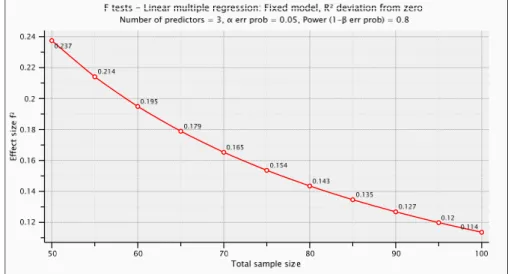
Figure 4-1: Sensitivity of effect size to total sample size ... 121
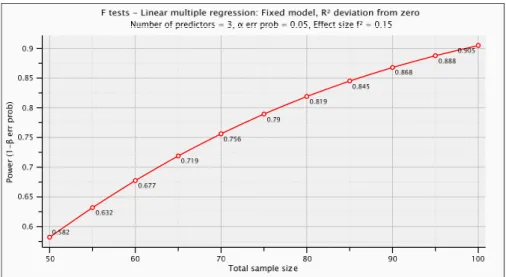
Figure 4-2: Sensitivity of statistical power, alpha (α) ,05 ... 122
Figure 4-3: Sensitivity of statistical power, alpha (α) ,10 ... 122
Figure 4-4: Missing values by question... 126
Figure 4-5: Outliers of composite scales ... 128
Figure 4-6: Sources of external information ... 131
Figure 4-7: Access to information by age group ... 132
Figure 4-8: Access to information by occupation ... 133
Figure 4-9: Access to external information by industry ... 134
Figure 4-10: Access to information by national clusters ... 135
Figure 4-11: Access to external information by degree of education ... 136
Figure 4-12: Access to information by field of main study ... 137
Figure 4-13: Access to information by duration ... 138
Figure 4-14: Revised research model ... 160
Figure 4-16: Final research model ... 168
Figure 4-17: The external information chain in innovation processes ... 177
Figure 4-18 Innovativeness, results from the survey ... 179
Figure 4-19: Model I2: Impact of the variables on innovativeness ... 182
Figure 4-20: Model I3: Impact of the variables on innovativeness ... 183
List of Tables
Table 2-1: Strategy elements in Fifth generation innovation processes ... 17
Table 2-2: The roles of Exploration and Exploitation spin cycles ... 22
Table 2-3: Definitions and external orientation of innovation capability ... 28
Table 2-4: Sample definitions of innovation capability dimensions ... 30
Table 2-5: Processes that have an impact on NPD Dynamic capabilities ... 44
Table 2-6: IT-Related Resources that combine to form IT Capability ... 56
Table 2-7: IT capability dimensions ... 57
Table 2-8: The nature of managerial IT skills ... 60
Table 3-1: Definition of explanation types ... 75
Table 3-2: List of potential companies and respondents ... 89
Table 3-3: Characteristics of on-line surveys ... 105
Table 4-1: Profile of participants in the pretest ... 111
Table 4-2: Non response analysis by industry ... 119
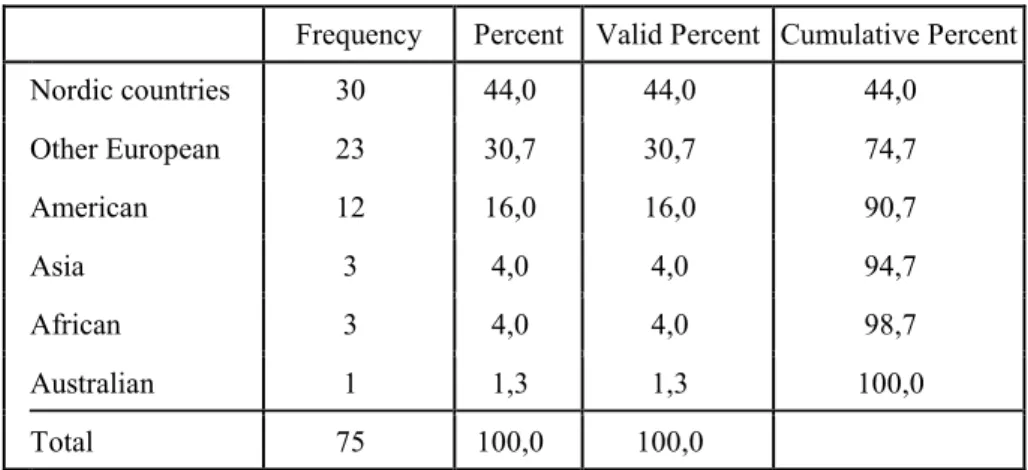
Table 4-3: Breakdown of respondents by nationality clusters ... 123
Table 4-4: Breakdown of respondents by industry ... 124
Table 4-5: Breakdown of respondents by education ... 124
Table 4-6: The impact of the treatment of missing values ... 126
Table 4-7: Descriptive statistics and normality tests ... 130
Table 4-8: Summary of access to external information ... 139
Table 4-9: Applicability of scales for factor analysis ... 142
Table 4-10: Evaluation of the acceptability of Kaiser‟s measure of sampling adequacy ... 143
Table 4-11: Factor analysis – Innovativeness ... 146
Table 4-12: Factor analysis for resulting Innovativeness scale with 4 items ... 147
Table 4-13: Factor analysis - Managerial IT skills, unrotated solution ... 148
Table 4-14: Rotated component matrix - Managerial IT skills ... 149
Table 4-15: Total item statistics - Managerial IT skills ... 150
Table 4-16 Factor analysis - Learning orientation ... 151
Table 4-17: Total item statistics – Learning orientation ... 152
Table 4-19: Rotated component matrix - Norms... 153
Table 4-20: Total item statistics - Norms ... 155
Table 4-21: Factor analysis - Trust ... 156
Table 4-22: Total item statistics - Trust ... 156
Table 4-23: Comparison of scales with original research ... 159
Table 4-24: Correlations... 163
Table 4-25: Coefficients and collinearity statistics ... 164
Table 4-26: Model summaryb ... 165
Table 4-27: Coefficients and collinearity statistics ... 165
Table 4-28: Model summaryb ... 165
Table 4-29: Model summaryb ... 166
Table 4-30: Coefficients and collinearity statistics ... 166
Table 4-31: Coefficients and collinearity statistics ... 167
Table 4-32: Model summaryb ... 167
Table 4-33: Summary of regression analysis and revision of the research model1 ... 169
Table 4-34: Interaction effect of supportive capabilities ... 171
Table 4-35: Models with interaction effect ... 171
Table 4-36: Results from regression analysis for models I2 and I3 ... 172
Table 4-37: Groups for comparison of survey results ... 174
Table 4-38: Comparison of innovativeness by background variables ... 175
Table 4-39: The impact of access to information on capabilities ... 176
Preface
The PhD journey was exciting and challenging, but not an easy job, particularly for a person who had not been an active student for a long time. It was however my own wish and decision, presumably as I have always hungered for new knowledge and enjoyed philosophical discussions, to engage in the journey. This task was different from anything I had done before, mainly for two reasons. Firstly it is a „looong‟ term task, requiring one to dig very deep into a narrowly focused topic from different perspectives. Secondly, it is to a considerable extent a solitary task, although I enjoyed the privilege of having good support and motivation from many very nice, but demanding individuals, who assisted me in staying on the track as much as possible and decide not to investigate all of the interesting „islands‟ that were on my way.
Learning the various dimensions of the academic culture, including how to write for research purposes, as was the title of a course I attended in a small island in Venice, was a challenge and sometimes entailed a radical change in my working procedures. Perhaps the most radical change was on the administration site, as it was necessary to find ways to keep track of my work during the entire journey. Becoming better organized contributed very much to the final phase of my research and when writing up the final dissertation.
When looking back at the original research ideas, quite little remains, except the initial idea, to focus on innovations. This is even exaggerated, as my initial research topic was on e-business strategy, but that did not remain for long. Having dug into the literature, I decided to investigate the use of information technology on the utilization of external information specifically, as there was only limited research on the topic and focus on the innovativeness of firms as opposed to innovations in general. As I dug into the methodology, the research developed even further and it appeared that I was more inclined to conduct a quantitative research than mainly qualitative.
I had the privilege of being one of the first PhD students in the School of Business at the University of Iceland, with the dean of the department as my main supervisor, and a highly experienced professor who had connections all over the world as my external supervisor. This offered me an opportunity (as well as expenses) to enjoy an enviable journey and do some interesting things, such as attending PhD courses and theme groups in a number of countries and locations. Most of the PhD courses I attended were organized by an organization called
EDEN, headquartered in Belgium that offered focused courses at a doctoral level that would unlikely be offered in specific universities.
The end result of my journey is reflected in this dissertation, which identified and investigated the impact of a set of capabilities on the innovativeness of international firms applying a quantitative approach as the main approach, supported with qualitative research, which contributed to the quality of the research and provided better insight into the research results. By completing this research, I would like to think that I have made a remarkable contribution to theory and practice, but most likely, as in a song by Pink Floyd, I have probably only added „another brick in the wall‟. My previous work for many innovative companies, both in Iceland and abroad offers a context that hopefully facilitates the use and implementation of some of the findings. The journey has been an extraordinary source of learning, which I am grateful to be a recipient of, and look forward to utilizing my knowledge in practice or further research initiatives and hopefully follow up the research.
Executive summary
Due to increased competition, faster technological development, increased complexity of products and better access to information, product life cycles have shortened substantially and the importance of fast response to continuous changes in customer requirements has increased. Innovating quickly, reliably and effectively is therefore an important advantage for achieving growth and profitability. Yet, all too often, organizations are unable to generate sufficiently creative ideas and effectively move them to market. One of the reasons is that given the growing complexity of technologies, even big firms seldom possess a sufficient range of in-house capabilities and knowledge needed for new product development. In order to sustain their competitiveness firms need to develop a capability to innovate efficiently in this dynamic environment and to learn from previous innovation activities. This has been coined continuous innovation capability, and refers to the ability to reconfigure functional competencies and utilize internal and external knowledge to decrease the response time in new product development processes. It has been identified that continuous innovation capability can be enhanced by IT resources that support information and knowledge transfer, integration and co-operation.
The need for the development of this new capability is supported by the theory of continuous innovation which emphasizes the need for a new way of thinking of innovation processes. Instead of viewing innovation as an output of independent and isolated activities within specific product development projects, it is argued that in today‟s hypercompetitive environment, companies need to develop a capability that utilizes all potential effects of people, stakeholders and society on the speed and effectiveness in product development. Continuous innovation is a process of knowledge transfer within and between a broad range of activities, covering all phases of the product life cycle, such as concept generation, product and process design, product launch, sales, customization in sales and installation, enhancement and upgrading during use and services, not only in the life cycle of independent products, but of a whole family of products. This capability does not only refer to the capability of developing new products, but also the capability to renew and reconfigure knowledge and resources in the innovation process.
The theory of continuous innovation emphasizes the importance of a synergistic balance between the exploitation of existing capabilities and exploration of new capabilities, and to complement and enhance existing
capabilities through collaboration between firms within an industry and between industry and academia. Companies therefore need to extend their innovation efforts and organize for effective knowledge transfer and learning both within the company and with other partner organizations. It has furthermore been argued that mastering, transfer and sharing of knowledge within this process requires new managerial skill that can become a powerful competitive weapon. Although the theory is reasonably well supported in a number of research projects, the theory of continuous innovation is still under development, and has only been implemented and tested to a limited extent, particularly with respect to the utilization of external information.
External knowledge is an increasingly important element of the innovation process, due to increased specialization, increased complexity of products, use of multiple technologies and the increased importance of the speed to develop, test and market new products. In order to use external knowledge, the firm needs to have access to the information, and processes to share it. The emphasis in the research in information technology (IT) has changed from focusing mainly on identifying how IT can support and improve operational issues towards identifying how IT can support the firms‟ strategy and applied to sustain the competitive advantage of firms. The main objective of this research is to investigate the relationship between the use of information technology for the utilization of external information and knowledge on performance in innovation processes. A survey approach was chosen for the research on a sample of Icelandic multinational firms which will provide an opportunity to obtain generalizable results from one market. The research is conducted within the framework of the resource based view (RBV), which emphasises resources and capabilities that contribute to the sustainable competitive advantage of firms as opposed to only temporary advantage that can be competed away. The main focus is on capabilities that have an impact on the transfer and use of external information in innovation processes and the extent to which the use of information technology contributes to this process.
The research will contribute to the theory of continuous innovation by identifying how firms utilize information technology for enhancing interaction, collaboration and integration of external information in innovation processes in dynamic environments. The research contributes to the RBV by extending the knowledge on the impact of the use of information technology on the sustainable advantage of firms through the firm‟s innovativeness. The research is one of the first to provide an empirical test on a number of relationships that have been proposed in the literature.
1
Introduction
1.1
Overview
The main goal of this chapter is to introduce the overall scope of the research, highlight the topics that captured the imagination of the author and contributed to the motivation behind the research. This dissertation is the final part of the deliverables in a PhD study at the University of Iceland. It consists of an introduction, literature review, methodology, data analysis, findings and conclusions. The dissertation and the research revolve around the identification of capabilities that contribute to the utilization of external information in continuous innovation processes and their impact on the innovativeness of international firms. The chapter examines the need for the research (section 1.2) and is intended to create a context which sets the scene in terms of explaining the rationale behind it. The motivation for the research is introduced in section 1.3, the theoretical background of the study and the research questions in section 1.4. The key terms are defined in section 1.5, and finally the chapter concludes with an introduction of the structure of the dissertation in section 1.6.
1.2
The need for research
Rapid changes in the environment and increased technological complexity make it ever more difficult for firms to rely only on internal sources of information and knowledge in their innovation processes. Knowledge sourcing and learning is a major motive for the internationalization of multinational corporations which provides them with an access to external information from a variety of sources that contribute to innovation and innovation capability (Almeida & Phene, 2004; Moenaert, Caeldries, Lievens, & Wauters, 2000). It is therefore of importance to gain an understanding on the processes and factors that contribute to the transfer and use of external information in international firms.
Following different emphases in the theory of strategic management, many scholars agree that innovation and innovativeness will be the main contributions to the competitiveness of firms in years to come (Andrew, Manget, Michael, Taylor, & Zablit, 2010; Boer et al., 2001; Deshpande, Farley, & Webster, 1993; Kim & Atuahene-Gima, 2010). A survey conducted by the Boston Consulting Group confirmed the increased importance of innovation in the management of
The need for research
firms, where a large majority of companies, or 72%, consider innovation a top strategic priority for 2010, up from 64% in 2009 (Mackinnon, 2010). An interesting finding of the survey is that companies consider innovation to be even more important in the current economic environment than previously, and are increasingly willing to spend more to become more innovative. The literature revealed that it is particularly useful to focus a research on the identification of factors that have an impact on the performance of specific business processes on resources, and capabilities, that contribute to the sustainable competitive advantage of firms (Barney, 1991; Wade & Hulland, 2004).
Two main concepts or capabilities frequently cited in the literature, exploration and exploitation, offer an insight on how new information is utilized in innovation processes (March, 1991b). “Exploration includes things captured by terms such as search, variation, risk taking, experimentation, play, flexibility, discovery, and innovation. Exploitation includes such things as refinement, choice, production, efficiency, selection, implementation, execution.” (p. 71). March further states:
“Both exploration and exploitation are essential for organizations, but they compete for scarce resources. As a result, organizations make explicit and implicit choices between the two. The explicit choices are found in calculated decisions about alternative investments and competitive strategies. The implicit choices are buried in many features of organizational forms and customs, for example, in organizational procedures for accumulating and reducing slack, in search rules and practices, in the ways in which targets are set and changed, and in incentive systems” (March, 1991b, pp. 71-72).
It is apparent that both exploration and exploitation have an impact on the utilization of external information or knowledge in innovation processes. Firstly, exploration leads to the search for external information that may contribute to innovation, whereas exploitation enables the firm to utilize the information more effectively by capitalizing on existing knowledge and experience. The objective of this research is not focused on the difference between the two, but on the identification of organizational features, forms and customs that enable the firm to effectively utilize external information which it has access to in innovation processes. The literature has frequently indicated that the use of information systems supports transfer and use of information and contributes to the firms‟ performance (cf. Dewett, 2003; Ray, Muhanna, & Barney, 2005), but the impact of information system on the transfer and use of external information in innovation processes has only been explored to a limited extent.
This research focuses on the identification of factors that support the utilization of external information in continuous innovation processes in international companies with a special emphasis on the impact of infor-mation systems on the transfer of inforinfor-mation. The research has both theoretical and practical orientation. It is specifically focused on the identification of factors that managers can have an impact on to help companies utilize external information, and how the use of information systems contributes to the sustainable competitive advantage of firms taking the resource based view (RBV). The literature repeatedly indicated that the use of information systems contributes to the transfer and utilization of external information, its impact on the firm‟s performance (including innovation performance) and their sustainable competitive advantage (Wade & Hulland, 2004). The literature revealed that managerial IT skills are the only information technology skills that contribute to the sustainable completive advantage of firms as all the other IT capabilities are not unique to the firm and can be copied by the competition (Bharadwaj, 2000).
The research contributes to the theory of management in two ways. Firstly, from a theoretical perspective, the research provides a valuable insight into the theory of innovation by providing a further understanding of which factors have the most impact on the utilization of external information and the innovativeness of firms. From a managerial perspective the research provides an understanding on factors that managers can have an impact on and will be of particular importance for the development of new managerial skills for the 21st century.
In summary, there is an increasing need for utilizing external information in innovation processes. This is particularly important for international firms that have access to information from different locations which can support their sustainable competitive advantage. It is however not self evident that the information which the firm has access to will be transferred and utilized in innovation processes. Given the need for the development of new managerial processes, the potential impact of the use of information systems, and lack of research on the topic, there is a need for understanding which factors have an impact on the utilization of external information in innovation processes of international firms.
1.3
Motivation
The research interest behind this dissertation was initially rooted in the authors experience working for companies that served innovative firms as well as my participation in the development of information technology solutions for
Motivation
a number of companies. Utilizing relations with leading companies in their field of specialization and taking their managers and technical experts to production firms where they shared information from their wealth of knowledge and research initiatives convinced me that there was much to learn for my clients from external sources of knowledge. I often wondered in fact, why the companies were doing so much by themselves. Based on the limited information I had from academic literature, I was concerned that it might harm the competitiveness of the firms I was supporting if they diversified their efforts too much in this very fast changing environment, where specialization was a common buzzword. Even though they could possibly do a number of things themselves, too much diversification might harm their sustainable competitive advantage due to limited resources and the need for focusing their efforts on staying in the forefront in their specialized field of expertise.
Research has shown that the average period which firms can sustain their competitiveness has decreased over time, suggesting that there is a need, even for leading companies, to gain an insight into capabilities that contribute to their ability to achieve sustainable competitive advantage (Zwass, 2003). Further to my interest in supporting managers, I have always been inclined to gain a deep theoretical understanding of things, learning why and how certain factors have an impact on the performance of firms and preferably make a contribution to both theory and managerial practices. My initial review of the literature indicated that although there was a considerable research on capabilities that have an impact on the innovation performance of firms (Pavlou & El Sawy, 2006) or specific capabilities (cf. Davenport, Prusak, & Prusak, 1997; Leonard-Barton, 1992; Szulanski, 1995), there was lack of research specifically oriented towards capabilities that have an impact on the utilization of external information in innovation processes. As these results indicated a gap in the theory it was not difficult to choose or develop a topic for my PhD dissertation. As I was teaching international marketing and international business at the Masters program in the School of Business at the University of Iceland, I was furthermore interested in gaining an insight into the extent to which they could utilize the wealth of information that they have access to through their foreign subsidiaries, a topic which was in fact well supported in the literature (Bartlett & Ghoshal, 1986). Having selected the topic for investigation and reviewed briefly the academic literature, supported my idea, and the final topic of the research emerged. It came apparent that the access to external knowledge and transfer of information contributed significantly to the innovativeness of international firms (Caloghirou, Kastelli, & Tsakanikas, 2004; Tsai, 2001). The conclusion was to identify capabilities that have an impact on the utilization of
external information in innovation processes of international firms, and which of them contribute most to their innovativeness, with a specific focus on the role of information systems for that purpose.
Early in my PhD journey I attended the EDEN doctoral seminar on research in continuous innovation (CI) which further narrowed the focus of my research within the CI framework. I was convinced that I could make, at least a reasonable contribution to both theory and practice by gaining an insight and providing academics and practitioners with further knowledge on how managers of international firms can enhance the innovativeness of their firms through an effective utilization of external information. These results as well as my eagerness to learn more and complete my PhD degree provided sufficient motivation to proceed with my research.
1.4
Background of the study and research questions
This research is conducted within the framework of the theory of continuous innovation (CI) processes. The CI theory emphasises two important issues. Firstly the performance of innovation processes is not only viewed as the outcome of the innovation projects, but also the learning that will take place as the result of the innovation project. The importance of implementing processes that stimulate learning is emphasised, such that new information and experiences from the innovation projects will be objectively utilized to enhance the firms‟ innovation capability (Boer et al., 2001; Gieskes, 2001). Secondly the theory emphasizes that innovation should not be the responsibility of specific group of people working in isolation on R&D projects, but the whole organization, including stakeholders internal and external to the company (Boer et al., 2001). Therefore, all employees, shareholders and other stakeholders should be well aware of the importance of their potential contribution to innovation processes and be proactive in sharing information which they access through their relationships with the internal (e.g. other departments) and the external environment. The theory refers to all types of innovations. It applies to radical innovations (cf. McDermott & O'Connor, 2002; Tushman & Anderson, 1986) as well as small scale improvements of products and services (Candi, 2008; Flynn, Dooley, O'Sullivan, & Cormican, 2003; Rothwell & Gardiner, 1985).
Soosay, Hyland et al (2008) define continuous innovation as: “a process of successively applying new ideas and methods of improvement in the organisation, requiring a methodical, programmed, incremental or radical approach throughout the company involving all employees in the organization” (p.162). To complement their resources and capabilities, and to meet the
Background of the study and research questions
demand for faster speed to market of new products, firms do increasingly co-operate and involve customers and partners outside the organisational boundaries and which are at times transnational (Capello, 1999; Soosay et al., 2008). Following these changes firms need to emphasize their managerial skills for successful co-operation in inter-firm relationships and to effectively increase learning from their external relationships. The ensuing organization will be an open and networked organization that focuses on continuous innovation and learning, in which suppliers, customers and even competitors will become a part (Boer & Gertsen, 2003).
Successful continuous innovation is beneficial to a wide range of stakeholders, including customers, employees and owners/shareholders of companies. Achieving such benefits requires company-wide involvement and commitment, cross-departmental and inter-organisational collaboration, continual learning (and unlearning), and deep insight into the innovation process (De Luca & Atuahene-Gima, 2007). Continuous innovation is an essentially cross-disciplinary field of research. In the CIMA1 final report for a research carried out by partners of CINet2 in Europe and Australia (ESPIRIT-project-26056, 2002), new product development projects are defined as:
“steps within a more general process of continuous product innovation that, besides involving more products within a family, includes phases of the product life cycle that follow the launch on the market (fig. 1.1). Evidence from best practice companies, for instance, shows how manufacturing, maintenance and service, though not integral parts of product development, can still provide valuable feedback and additional opportunities to improve products. In this perspective product innovation is a continuous and cross-functional process involving a growing number of different competencies inside and outside the organization. Managing the sharing and transfer of knowledge within this process can be a powerful competitive weapon, but requires new managerial skills.” (ESPIRIT-project-26056, 2002, p. 36).
Figure 1.1 depicts the utilization of information within the organization and the main routes of feedback provided from various phases of the product life cycle as well as between departments. The examples of knowledge transfer highlighted in the figure are;
1 Euro-Australian co-operation centre for Continuous Improvement and innovation
MAnagement
Knowledge transfer between different phases within one innovation process (1, 2, 3)
Knowledge transfer within one phase between different innovation processes (4, 6)
Knowledge transfer between different phases of different innovation processes (5, 7, 8, 9)
Adapted from: Bartezzaghi, Corso et al. (1998) Figure 1-1: Knowledge management in continuous innovation.
It is emphasised that it is not only the transfer of information or knowledge that is important, but also the consequent learning that takes place both within each innovation process or projects and between innovations processes from the information transfer (Gieskes, 2001). The information does therefore not only have a direct impact on the generation of innovations, but also enhances the firms‟ innovation capability. As can be seen from the figure, the information is not only generated within in the firm, but also from external sources, such as information generated during the instalment and improvements during use, both which are accessed through relationships with customers. In international companies these relationships are accessed through managers and employees at different locations that may not be well connected to managers of new product development. The model depicted in figure 1.1 provides an insight into some of the sources of external information. The model furthermore suggests that there is a need for processes which enhance the awareness of the potential impact of information on innovations and support its transfer and use.
The introduction and the motivation of the research indicated three issues or topics that contribute to understanding how firms utilise external information in
Background of the study and research questions
their continuous innovation processes. The first topic is that the sources and access to information have an impact on the extent to which firms can utilize external information. The second is that organizational processes and customs have an impact on the extent to which the information is transferred and used. The third topic is that the use of information systems will most likely contribute to performance in innovation processes, particularly in international firms which operate across different locations and time zones.
This research takes a sociotechnical system (STS) perspective with respect to the use of information systems. The STS perspective considers the organization to be made up of a social subsystem (the people, e.g. employees that have access to the information) using tools, techniques and knowledge (the technical subsystem, e.g. information systems) to produce input which is valuable for the firm. The success of the firm depends upon the compatibility between its three subsystems (Shani, Grant, Krishnan, & Thompson, 1992, citing Pasmore (1988) and Pava (1984)). It is therefore important that all the factors that have an impact on the firms‟ success are aligned and in such a way that they contribute to the overall objective, which in this study is focused on the use of external information that the firm has access to. Figure 1.2 depicts the overall framework for the research.
Figure 1-2: The overall research framework
The framework and the emphasis on the holistic approach introduced in figure 1.2 prompted four research questions. The first question aims at identifying the sources of external information originated in different operation units of international firms. Previous research has already indicated sources of external information (Cho, Cheng, & Hung, 2009; Frishammar & Horte, 2005; Kim & Atuahene-Gima, 2010), but it is of importance to identify which of them are most important in this research as it may contribute to an understanding and interpretation of the research results.
RQ 1. What are the main sources of external information that contribute to innovation performance of international firms? The second research question is centered on the identification of how the firms can gain access to external information. It is specifically focused on the impact the profile of managers has on the access to external information as an answer to the question might contribute to issues that managers can have an impact on, such as training or human resource management (HRM).
RQ 2. What impact has the profile of managers on the access to different sources of external information?
The resource based view (RBV) contributes to the identification of capabilities that are important for the sustainable competitive advantage of firms. Although a number of capabilities have been identified in the literature, there is scant research on which of them are most important for the transfer and utilization of external information and what their impact is on the innovativeness of international firms. The third research question is intended to fill this gap.
RQ3a. Which capabilities contribute most to the utilization of external information in innovation processes?
RQ3b. What is the impact of the capabilities on the innovative-ness ofinternational firms?
Previous research has revealed that the only information technology capability that contributes to the sustainable competitive advantage of firms is managerial IT skills. The impact of managerial IT skills on the performance in competitive advantage in new product development in turbulent environments has been confirmed (Pavlou & El Sawy, 2006), as well as its impact on the sustainable competitive advantage of firms (e.g, Mata, Fuerst, & Barney, 1995). The literature did however not reveal any research that investigates the impact of managerial IT skills on the innovativeness of international firms. The fourth research question is particularly aimed at filling this gap.
RQ4 Is there a relationship between managerial IT capabilities and the innovativeness of international firms considering the impact of supporting capabilities?
Definitions
The research question does not assume that managerial IT skills will have an impact on the innovativeness of firms as it has not been confirmed in an empirical research. The question furthermore acknowledges that it is not sufficient to view the association between managerial IT only and the firms performance due to the interrelationships with other complementary capabilities. This is particularly important as the literature confirms that the impact of managerial IT skills on the firms‟ performance will be affected by other complimentary organizational resources (Melville, Kraemer, & Gurbaxani, 2004).
1.5
Definitions
This research covers a broad spectrum of issues relating to the utilization of external information in continuous innovation processes and the impact of managerial IT skills on innovativeness of international companies. The research title, “Utilizing External Information in Continuous Innovation Processes: The impact of managerial IT skills and supportive capabilities on the innovativeness of multinational companies” includes a number of terms that warrant explanation.
The word, “utilizing” used in the title, sets the scene for the research, which is to contribute to the understanding on how firms can utilize the information it has access to. It follows a definition in a number of many dictionaries, such as “put into service; make work or employ for a particular purpose or for its inherent or natural purpose”. The objective is to investigate how the firm can make use of external information to support their innovation processes. It includes the identification of the means through which the firm has access to it, the features of organizational processes, forms and customs that have an impact on the extent to which the information is transferred, and factors that have an impact on the effectiveness of using the information for innovation processes in international firms.
External information refers to all information that is originated outside the boundaries of the firm and is accessed through relationships employees or stakeholders have with the external environment. Once the firm has accessed the information and learned from it, the information is no longer external. External information does therefore only relate to information from external source that is new to the firm at the time it is accessed. The definition therefore relates to the specific firms‟ perspective, but not to the
external environment of all firms. The information can therefore still be new and external to other firms that have not yet accessed it.
Managerial IT skills (managerial information technology skills) refers to the extent to which managers are aware of how the use of information technology (including information systems) contributes to the improvement of business processes. More specifically, they refer to the extent to which line managers understand the potential use and benefit of utilizing information technology in the firms‟ processes and the extent to which information technology managers understand business opportunities and priorities (Bhatt & Grover, 2005).
Further to managerial IT skills, a number of supporting capabilities
contribute to the innovativeness of firms. They relate to capabilities that support the innovativeness of firms, including the transfer of external information and may enhance the impact of managerial IT skills on the firms‟ performance. This research will aim at identifying capabilities that support the utilization of external information and their impact on the innovativeness of firms.
One of the most important definitions is the innovativeness of firms. Several issues make the concepts of innovation capability and innovativeness extremely challenging and difficult to analyse. Firstly, the literature appears to use the concepts interchangeably and does frequently not distinguish between them. Secondly, some articles are focused on product innovativeness which has been defined as the product's degree of novelty, that is, its level of newness in relation to the firm and the outside world (Song & Montoya-Weiss, 1998) as opposed to the firms‟ innovativeness which refers to the notion of openness to new ideas as an aspect of a firm's culture (Hurley & Hult, 1998). One of the early definitions of the firms‟ innovation capability is the ability of the organization to adopt or implement new ideas, processes, or products successfully (Burns & Stalker, 1961). When combined with resources and other organizational characteristics, innovativeness creates a greater capacity to innovate as it has an impact on the generation and utilization of new ideas.
Although external information will have an impact on many facets of the firms‟ innovation capability, innovativeness appears to be a more suitable construct to measure how effectively the firm utilizes external information. The main argument is that although innovativeness is reflected in the firm‟s innovation performance, its relationship with the overall performance in innovation processes is less direct, including the number of new products introduced to the market due to various other phases of the innovation process which do not necessarily benefit as much from external
The structure of the dissertation
information. As an example, even if the firm is open towards new ideas, it may not be reflected in its overall innovation performance if lack of capabilities related to the other phases of the innovation process prevents new ideas to be utilized. However, if the firm is not open to new ideas, its innovation performance will be limited, even if the firm‟s capability in later phases of the innovation process is high.
A multinational company has been defined as an enterprise that owns and controls value adding activities in more than one country and takes full advantage of the geographical distribution of natural and created assets (Dunning & Various, 2000). For this research, the multinational company is assumed to be an organisation with one or more business units operating in different markets.
1.6
The structure of the dissertation
The introduction chapter has stressed the increased importance of innovation in firms and the problems that companies face in utilizing external information in their innovation processes. These issues determine the scope of the literature review in chapter 2 which identifies and summarises the literature that contributes to the development of the research questions and the research model. Chapter 3 introduces the research model, which summarises capabilities indentified in the study that have an impact on the transfer of external information and contribute to the innovativeness of firms. The methodological issues are discussed in chapter 4, including discussion on the research strategy and design, and the development of the research methodology. The chapter includes a discussion on the choice of questions applied in a survey which was conducted as part of the research, the individual question content, and approach used to conduct the survey, and concludes with a discussion of a qualitative research that supports the overall research strategy. Chapter 5 covers that data analysis, including a description of collecting the data, examining and screening, analysing and reporting the data. It includes a brief introduction of the research problem and the development of a revised research model. The previous chapters build a platform for a discussion on the findings and conclusion, which is the subject of chapter 6, which summarises and concludes previous chapters. This dissertation concludes with chapter, which reflects on the theory, discusses limitations and strength of the research carried out, and highlights the contributions. The final sections of the chapter reflect on the research background, process as well as suggestions for future research, and concluding remarks.
2
Literature review
2.1
Introduction
The main goal of this chapter is to describe the theoretical background for the research, in order to highlight the starting point of the research, and then to facilitate the understanding of its original contribution. As stated in the introduction, the research interest underpinning this research is to identify factors and capabilities that have an impact on the utilization of external information and the innovativeness of international firms. The research furthermore explores if and under which conditions the use of information technology supports the transfer and use of external information in continuous innovation processes from the resource based view (RBV) perspective.
The process of identifying the literature for this research was conventional. The key areas of the subject were identified and the literature scanned to find the main contributions, both in theory, and in practice. As the literature scanning process progressed, the key references emerged and the key contributions were identified. There was a pre-mediated choice of using leading journals where possible, even though authors had published books on the subject. This was done in order to safeguard against references that would be deemed to be too colloquial or otherwise non preferable in terms of academic standards.
The most difficult issue, which was also a challenge, was to understand and combine contributions coming from different streams of literature that address the topics related to this research. In this chapter an overview of the theoretical background is provided. The final section of the chapter is dedicated to the development of a research model, based on the theoretical background for the research. Literature which is relevant for this research comes from studies on innovation, strategy, networking, and IT management. These streams of literature are extremely comprehensive, and so, in order to focus the overview of the background theory in this chapter, the contributions have been assessed in terms of their relevance.
What are the main phases of innovation processes and to what extent can they be supported with external information?
What are the main sources of external information and what factors have an impact on information sharing and interaction that contributes to the utilization of the information?
Innovation processes
Which capabilities support the utilization of external information in innovation processes and how do they contribute to the innovativeness of international firms?
In which way does information technology support the utilization of external information in innovation processes?
Even though every attempt has been made to identify major contributions, it should never be over-emphasised that no literature review for such a project can be exhaustive enough, but even though, it covers the mainstream of ideas and reflections on the subject at a given point in time.
The contributions of the main streams of theory to the literature review are depicted in figure 2.1. As can be seen from the figure, most of the streams of theory only have an impact in a focused way into their respective sections of the literature review, except the strategic literature which contributes throughout all the sections. This is due to the fact that this research takes a resource-based view (RBV), which is focused on resources and capabilities that contribute to the sustainable advantage of firms. The RBV assumes that value is a function of the way in which these resources are managed, which is the main foundation for this research. The strategic literature, particularly the RBV, is therefore interwoven into a number of sections in all of the chapters.
2.2
Innovation processes
In exploring the relationship between performance in innovation processes and the utilization of external information it is first necessary to understand the nature of innovation, how it occurs and in which phases of the innovation processes external information can be utilized. Several theories have been developed that explain the nature of innovation and how it occurs. Rothwell (1992) provided an overview of the development of models for industrial innovations, which provide an insight into the potential use of external information in innovation processes. The models develop from:
“the simple linear „technology push‟ and „need pull‟ models of the 1960s and early 1970s, through the „coupling model‟ of the late 1970s to early 1980s, to the „integrated‟ model of today. The latter (the 4th Generation innovation process) marked a shift from percep-tions of innovation as a strictly sequential process to innovation perceived as a largely parallel process” (Rothwell, 1992, p. 221).
The 3rd generation model depicted in figure 2.2, which Rothwell refers to as the „coupling model‟ provides a useful insight into the potential use of external information in innovation processes. According to this model the innovation process is sequential and is divided into a series of interdependent stages and feedback from previous stages. The model furthermore shows the inter-organizational and external connections that create a complex net and potential impact from the society and technology.
Innovation processes
According to the model, three types of information contribute to the innovation process. Firstly, the generation of ideas is derived from information on new needs and new technology. Secondly information on the needs of the society and the marketplace contribute to various phases, and are of particular importance for marketing and sales and to the testing of prototypes (Bonner, 2010). Thirdly, information on new technology or production methods contributes particularly to the research and development phase, prototype testing and manufacturing (Karlsson, Taylor, & Taylor, 2010; Powell, Koput, & SmithDoerr, 1996). Both types of information contribute to some extent to all the phases of the process, as they might offer an early indication for a need to revise the product, to make adjustments in the production methods, or even cancel the innovation project after it has started due to market or technology related issues. The information does therefore not only contribute to the phases sequentially, but to a continuous review through all the phases of the innovation project, independent on if it evolves around product or service innovation (Thrane, Blaabjerg, & Møller, 2010).
Adapted from Rothwell (1992) Figure 2-2: Third generation - model of innovation processes
According to the 4th generation innovation process theory, referred to as the
functional integration innovation process theory (Rothwell, 1992), different functions of the firm which are responsible for the new product design and development are involved parallel. The core feature is to combine the expertise of the different specialists in order to reduce the time to complete the project and reduce the work needed at later stages of the process (Schilling & Hill, 1998). The 5th generation is based on the 4th generation process, but highlights the need for continuous change. It emphasises efficiency and speed, which is mainly achieved through information efficiency and continuous communication across the innovation network. The underlying strategy elements in the 5th generation innovation process are shown in table 2.1