1
Eye Tracking and Avatar-Mediated
Communication in Immersive Collaborative
Virtual Environments
William Arthur Hugh Steptoe
A dissertation submitted in partial fulfilment of the requirements for the degree of
Doctor of Philosophy of the
University College London.
Department of Computer Science University College London
2 To Peter and Patrick
3 I, William Steptoe, confirm that the work presented in this thesis is my own. Where information has
Abstract 4
Abstract
The research presented in this thesis concerns the use of eye tracking to both enhance and understand avatar-mediated communication (AMC) performed by users of immersive collaborative virtual environ-ment (ICVE) systems. AMC, in which users are embodied by graphical humanoids within a shared virtual environment (VE), is rapidly emerging as a prevalent and popular form of remote interaction. However, compared with video-mediated communication (VMC), which transmits interactants’ actual appearance and behaviour, AMC fails to capture, transmit, and display many channels of nonverbal com-munication (NVC). This is a significant hindrance to the medium’s ability to support rich interpersonal telecommunication. In particular,oculesics(the communicative properties of the eyes), including gaze, blinking, and pupil dilation, are central nonverbal cues during unmediated social interaction. This re-search explores the interactive and analytical application of eye tracking to drive the oculesic animation of avatars during real-time communication, and as the primary method of experimental data collection and analysis, respectively.
Three distinct but interrelated questions are addressed. First, the thesis considers the degree to which quality of communication may be improved through the use of eye tracking, to increase the non-verbal, oculesic, information transmitted during AMC. Second, the research asks whether users engaged in AMC behave and respond in a socially realistic manner in comparison with VMC. Finally, the degree to which behavioural simulations of oculesics can both enhance the realism of virtual humanoids, and complement tracked behaviour in AMC, is considered.
These research questions were investigated over a series of telecommunication experiments inves-tigating scenarios common to computer supported cooperative work (CSCW), and a further series of experiments investigating behavioural modelling for virtual humanoids. The first, exploratory, telecom-munication experiment compared AMC with VMC in a three-party conversational scenario. Results indicated that users employ gaze similarly when faced with avatar and video representations of fellow interactants, and demonstrated how interaction is influenced by the technical characteristics and lim-itations of a medium. The second telecommunication experiment investigated the impact of varying methods of avatar gaze control on quality of communication during object-focused multiparty AMC. The main finding of the experiment was that quality of communication is reduced when avatars demon-strate misleading gaze behaviour. The final telecommunication study investigated truthful and deceptive dyadic interaction in AMC and VMC over two closely-related experiments. Results from the first exper-iment indicated that users demonstrate similar oculesic behaviour and response in both AMC and VMC,
Abstract 5 but that psychological arousal is greater following video-based interaction. Results from the second experiment found that the use of eye tracking to drive the oculesic behaviour of avatars during AMC increased the richness of NVC to the extent that more accurate estimation of embodied users’ states of veracity was enabled. Rather than directly investigating AMC, the second series of experiments ad-dressed behavioural modelling of oculesics for virtual humanoids. Results from the these experiments indicated that oculesic characteristics are highly influential to the perceived realism of virtual humanoids, and that behavioural models are able to complement the use of eye tracking in AMC.
The research presented in this thesis explores AMC and eye tracking over a range of collaborative and perceptual studies. The overall conclusion is that eye tracking is able to enhance AMC towards a richer medium for interpersonal telecommunication, and that users’ behaviour in AMC is no less socially ‘real’ than that demonstrated in VMC. However, there are distinct differences between the two commu-nication mediums, and the importance of matching the characteristics of a planned commucommu-nication with those of the medium itself is critical.
Acknowledgements 6
Acknowledgements
My research was supported by the EPSRC funded projects: EQUATOR (GR/N15986/01) and Eye Catch-ing (EP/E010032/1).
Firstly, I would like to thank Dave Roberts, who supervised my undergraduate project at University of Reading, which was my first exploration into Virtual Reality. During that project I worked with the DIVE system, for which I have my primary PhD supervisor, Anthony Steed, to thank. I could not have asked for a better supervisor than Anthony, whose knowledge, enthusiasm, and support have been invaluable in developing my ideas and research skills. I would also like to thank my secondary supervisor, Simon Julier, with whom I shared teaching duties for the Virtual Environments course at UCL.
I have worked with a number of talented people (and good friends) while carrying out my PhD. Robin Wolff, Alessio Murgia, and Aitor Rovira deserve medals for their patience when acting as con-federates during the three major experiments appearing in this thesis. Thanks also go to John Rae and Estefania Guimaraes, who introduced me to Conversation Analysis and gave me a deeper understanding of social interaction research. I would like to thank John in particular for teaching me lashing as we attempted to build a bamboo stand for some heavy cardboard cubes. The stand was rickety, but just about did its job. Finally, thanks to Oyewole Oyekoya, who continues to be a close colleague.
Thanks to everyone, both past and present, in the VECG group at UCL. In particular, David Swapp for managing the CAVE lab and providing support during experiments, Vijay Pawar for the mutual moaning when times got tough, Vinoba Vinayagamoorthy, Marco Gillies, and all those in room 6.22 and beyond.
Finally, and most importantly, I want to thank my family and friends for their love and support. Laura, with whom I have shared these years. Lucy, has recently brought a new addition into the family. Matt for the good times. Ed, who comfortably pipped me to the post. Nick, who will go on for great things. Love also to my grandparents. Immense gratitude goes to my father, who is an inspiration to me, and to my mother, whose love knows no bounds.
Contents 7
Contents
1 Introduction 21 1.1 Research Problem . . . 22 1.2 Research Questions . . . 23 1.3 Contributions . . . 24 1.3.1 Methodological Contributions . . . 24 1.3.2 Substantive Contributions . . . 24 1.4 Scope of Thesis . . . 25 1.5 Structure. . . 26 2 Background 28 2.1 Communication and the Eyes . . . 292.1.1 Nonverbal Communication: an overview . . . 30
2.1.2 Oculesics . . . 32
Gaze . . . 32
Physiological Properties of Eye Movement . . . 35
Pupil Dilation . . . 37 Eyelid Kinematics . . . 38 2.1.3 Communication of Deception . . . 40 Detection of Deception . . . 41 2.2 Visual Telecommunication . . . 42 2.2.1 Video-Mediated Communication. . . 43
Limitations of Video-Mediated Communication . . . 47
2.2.2 Immersive Collaborative Virtual Environments . . . 48
Immersion . . . 48
Presence . . . 51
Spatiality . . . 52
2.3 Avatars . . . 54
2.3.1 Social Agency . . . 55
2.3.2 User Embodiment and Tracking . . . 56
Contents 8
2.3.4 Media Richness. . . 60
2.3.5 Fidelity . . . 61
2.3.6 Avatar Oculesics . . . 62
Gaze Models . . . 63
2.3.7 Animating the Eyelids . . . 67
2.3.8 Pupil Dilation . . . 68
2.4 Tracking versus Simulation . . . 70
2.4.1 Limitations of Gaze Models . . . 70
2.4.2 Gaze Practices in Collocated Social Interaction . . . 71
Speaker Selection in Multiparty Interaction . . . 72
Promoting Sequence Expansion . . . 73
Characterising a Suspension of Talk . . . 73
Projecting Involvement with a Different Activity . . . 75
2.4.3 Discussion . . . 76
2.5 Chapter Summary . . . 78
3 Technical and Analytical Methods 80 3.1 EyeCVESystem Overview . . . 80
3.1.1 Requirements . . . 81
3.1.2 Distribution Architecture . . . 82
3.1.3 Eye Tracking . . . 85
Gaze Calibration . . . 87
Blink Calibration . . . 87
Pupil Dilation Calibration . . . 88
3.1.4 Avatar Subsystem. . . 89
Avatar Gaze. . . 91
Avatar Eyelid Kinematics . . . 92
Avatar Pupil Dilation . . . 92
Avatar Head and Hand Movement . . . 93
Avatar Mouth Movement . . . 94
3.1.5 Evaluation . . . 94
Results . . . 96
3.1.6 Summary . . . 98
3.2 Multimodal Data Collection and Analysis . . . 100
3.2.1 Requirements . . . 101
3.2.2 Capture Architecture . . . 102
3.2.3 Multimodal Interaction Analysis . . . 106
Conversational Scenario . . . 107
Contents 9
3.2.4 Summary . . . 109
3.3 Chapter Summary . . . 110
3.3.1 Reading Guide to Experimental Chapters . . . 110
4 Experiment: Three-Party Conversation 112 4.1 Experimental Aims and Expectations. . . 112
4.2 Experimental Design . . . 113
4.2.1 Independent Variables . . . 113
4.2.2 Apparatus . . . 113
EyeCVE Setup . . . 113
Gaze Aware Access Grid Setup . . . 115
Eye Tracking . . . 116
4.2.3 Population . . . 118
4.2.4 Procedure . . . 118
Phase 1: Briefing . . . 118
Phase 2: Technical Setup . . . 118
Phase 3: Eye Tracker Calibration . . . 119
Phase 4: Experimental Interaction . . . 119
4.3 Analysis . . . 120
4.3.1 Supporting Gaze Practices . . . 120
4.3.2 Management of Speaker Transition . . . 121
VMC . . . 122 AMC . . . 123 4.3.3 Gaze Distribution . . . 124 4.4 Discussion. . . 126 4.4.1 Spatiality . . . 126 4.4.2 User Representation . . . 127
4.4.3 Emergent Gaze Behaviour . . . 128
4.5 Chapter Summary . . . 129
5 Experiment: Object-Focused Scenario 130 5.1 Experimental Aims and Expectations. . . 130
5.2 Experimental Design . . . 131 5.2.1 Independent Variables . . . 132 5.2.2 Piloting . . . 133 5.2.3 Apparatus . . . 134 EyeCVE Setup . . . 134 Eye Tracking . . . 135 Gaze Model . . . 135
Contents 10
5.2.4 Population . . . 136
5.2.5 Procedure . . . 137
Phase 1: Briefing . . . 137
Phase 2: Technical Setup . . . 138
Phase 3: Eye Tracker Calibration . . . 138
Phase 4a: Experimental Interaction 1 . . . 138
Phase 4b: Questionnaire 1 . . . 139
Phase 5a: Experimental Interaction 2 . . . 140
Phase 5b: Questionnaire 2 . . . 140
Phase 6a: Experimental Interaction 3 . . . 141
Phase 6b: Questionnaire 3 . . . 141 Phase 7: Interview . . . 141 5.2.6 Data Collection . . . 141 5.3 Analysis . . . 141 5.3.1 Task Performance. . . 142 Errors . . . 142 Time Taken . . . 143
5.3.2 Gaze Model Performance . . . 144
Task Performance Summary . . . 146
5.3.3 Subjective User Experience . . . 146
5.3.4 Interaction Analysis . . . 146
Responses to Grab Instructions. . . 147
Movement as a Resource . . . 149
Gaze as a Resource . . . 149
Glances Per Grab Instruction . . . 150
5.4 Discussion. . . 150
5.4.1 Gaze as a Determinant of Action . . . 151
5.4.2 Technical Factors . . . 152
5.5 Chapter Summary . . . 153
6 Experiment: Truth and Deception 154 6.1 Experimental Aims and Expectations. . . 155
6.2 Experiment 1: Interactions . . . 155
6.2.1 Independent Variables . . . 156
6.2.2 Piloting . . . 157
6.2.3 Apparatus . . . 157
EyeCVE Setup . . . 158
Video Conferencing System . . . 158
Contents 11
6.2.4 Population . . . 160
6.2.5 Procedure . . . 161
Phase 1: Briefing . . . 161
Phase 2: NEO Five-Factor Inventory . . . 161
Phase 3: Technical Setup . . . 162
Phase 4: Calibration . . . 162
Phase 5: Experimental Interaction . . . 162
Phase 6: POMS Questionnaire . . . 163
Phase 7: Interview . . . 163
6.2.6 Analysis . . . 163
Gaze . . . 163
Blinking . . . 165
Pupil Dilation . . . 165
Profile of Mood States . . . 166
6.2.7 Discussion . . . 167
AMC and VMC . . . 168
Truth and Deception . . . 169
6.3 Experiment 2: Detecting Deception . . . 170
6.3.1 Technical Preparation. . . 170 6.3.2 Experimental Design . . . 171 6.3.3 Procedure . . . 172 6.3.4 Results . . . 173 6.3.5 Discussion . . . 175 6.4 Chapter Summary . . . 176
7 Models of Oculesic Behaviour and Experiments 178 7.1 Oculesic Behaviour Experiment . . . 179
7.1.1 Technical Preparation. . . 179
7.1.2 Experimental Design . . . 180
7.1.3 Procedure . . . 181
7.1.4 Results . . . 182
Gaze Direction Identification . . . 182
Subjective Rating . . . 184
7.1.5 Discussion . . . 185
7.2 Eyelid Kinematics Models and Experiments . . . 186
7.2.1 Parametrisation . . . 187
Lid Saccade Model Parameters. . . 188
Blink Model Parameters . . . 188
Contents 12
7.2.3 Blink Model . . . 190
7.2.4 Model Validation Experiment . . . 191
Technical Preparation. . . 191
Experimental Design . . . 192
Results . . . 193
7.2.5 General Impact Experiment . . . 194
Technical Preparation. . . 195
Experimental Design . . . 195
Analysis . . . 196
7.2.6 Discussion . . . 197
7.3 Saliency-Based Gaze Model . . . 199
7.3.1 Gaze Model . . . 199
Spatial and Temporal Distribution of Fixations . . . 200
Intrinsic Saliency Criteria . . . 200
Saliency Scoring and Fixation Duration . . . 201
7.3.2 Eyeball Dynamics . . . 201 7.3.3 Experiment . . . 202 Technical Preparation. . . 202 Experimental Design . . . 203 7.3.4 Analysis . . . 204 7.3.5 Discussion . . . 205 7.4 Chapter Summary . . . 206 8 Conclusions 209 8.1 Conversation Experiment . . . 210 8.2 Object-Focused Experiment . . . 211
8.3 Truth and Deception Experiments . . . 212
8.4 Oculesic Models and Experiments . . . 213
8.5 Contributions . . . 214
8.5.1 Methodological Contributions . . . 214
8.5.2 Substantive Contributions . . . 215
8.6 Directions for Future Work . . . 217
Appendices 221
A Publications 221
Contents 13
C Materials for the Conversation Experiment 227
C.1 Information Sheet for Participants . . . 227
C.2 Consent Form for Participants . . . 229
C.3 Personal Information Form . . . 230
C.4 Extended Conversation Analysis . . . 231
C.5 Extract of Mobile Eye Log File . . . 238
D Materials for the Object-Focused Experiment 239 D.1 Consent Form for Participants . . . 239
D.2 Ethics Form for Participants . . . 241
D.3 Extended Conversation Analysis . . . 245
E Materials for the Truth and Deception Experiments 250 E.1 Consent Form for Participants (Experiment 1) . . . 250
E.2 Information Sheet for Participants (Experiment 1) . . . 251
E.3 Technical Procedure (Experiment 1) . . . 253
E.4 NEO Five-Factor Inventory Questionnaire (Experiment 1). . . 255
E.5 POMS Questionnaire (Experiment 1). . . 262
E.6 Experiment 1 Questions (Experiment 1) . . . 264
E.7 Veracity Orders (Experiment 1). . . 270
E.8 Experimenter’s Notes Sheet (Experiment 1) . . . 276
E.9 Extract of Log File (Experiment 1) . . . 277
E.10 Consent Form for Participants (Experiment 2) . . . 278
E.11 Information Sheet for Participants (Experiment 2) . . . 279
E.12 Participant Response Sheet (Experiment 2) . . . 281
F Materials for the Oculesic Models Experiments 282 F.1 Images from the Oculesic Behaviour Experiment . . . 282
F.2 Participant Response Sheet for Eyelid Models Validation Experiment. . . 285
F.3 Images from the Eyelid Models General Impact Experiment . . . 287
F.4 Images from the Gaze Model Experiment . . . 289
List of Figures 14
List of Figures
2.1 External eye muscles illustration from Gray’s Anatomy [Gra18]. . . 36
2.2 Patient suffering from tonic pupil. . . 37
2.3 External eyelid muscles illustration from Gray’s Anatomy [Gra18].. . . 39
2.4 Johansen’s CSCW Matrix as represented in [SMIRM07]. . . 43
2.5 Cisco’s TelePresence system, supporting gaze awareness, and life-size representations of users in a visually-seamless workspace [Sys10b].. . . 44
2.6 Aligning cameras and video displays to users natural line of sight in VMC to achieve gaze awareness. . . 45
2.7 Sensitivity to gaze direction (Chen [Che02]). . . 46
2.8 EyeCVE users engaged in AMC. . . 50
2.9 Object-focused AMC ([SSA+01] and [RWOS03]). . . 50
2.10 Comparison of visual telecommunication systems in terms of Benford et al.’s three di-mensions of spatiality [BBRG96]. . . 53
2.11 Images of the blue-c system (Gross et al. [GWN+03]). . . 57
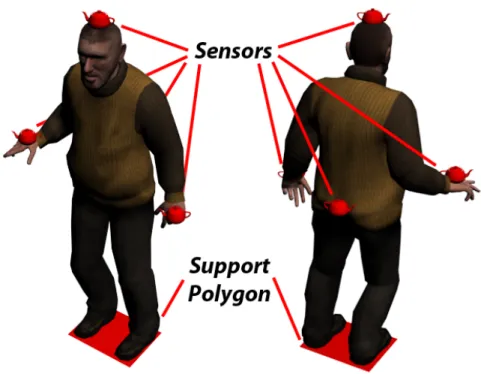
2.12 Minimal sensor placement for approximation of human pose Badler et al. [BHG93] . . . 58
2.13 Low-, medium- and high-fidelity avatars.. . . 61
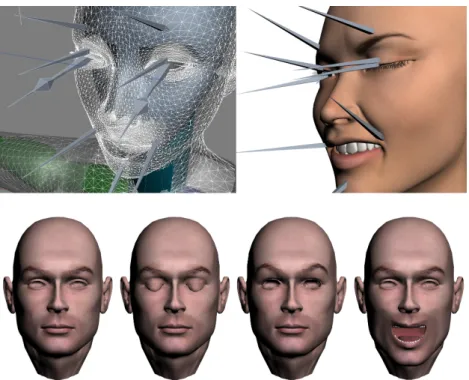
2.14 Sequences of immersive AMC illustrating gaze redirection despite similar head orientation. 63 2.15 Technical methods to achieve facial animation, and in particular, eyelid movement. . . . 68
2.16 Previous work animating pupil dilation ([KJC+09] and [POB09]). . . 70
2.17 Extract from Lerner [Ler03] . . . 73
2.18 Extract from Kidwell [Kid05]. . . 74
2.19 Extract from Rae [Rae01]. . . 75
3.1 Distribution architecture of EyeCVE.. . . 83
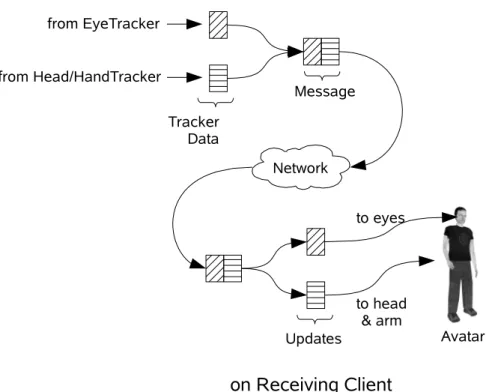
3.2 Bundling discrete eye and head and hand tracker data in one network message. . . 84
3.3 ASL MobileEye eye tracker, and also head tracker, mounted on CAVE’s shutter glasses to combine head and eye tracking. . . 86
3.4 Arrington Research ViewPoint EyeTracker eye tracker mounted on the CAVE’s shutter glasses (left) and the WALL’s empty frame (right). . . 86
3.5 ViewPoint GUI. The calibration procedure maps the eye position as observed by the eye camera to the gaze direction superimposed on the scene camera view. . . 88
List of Figures 15 3.6 Views captured from the ViewPoint eye camera during the down-phase of a blink. From
left to right, the tracked pupil aspect ratio gradually flattens until a threshold is met, signalling a blink. . . 88 3.7 Views captured from the ViewPoint eye camera during pupil size calibration. Left:
ex-treme constriction in high luminance lighting. Right: exex-treme dilation in darkness. . . . 89 3.8 Basic avatar model. Avatar is used in the conversation and object-focused experiments
in Chapters 4 and 5. . . 89 3.9 Male and female advanced avatars. Avatars are used in the truth and deception
experi-ment presented in Chapter 6 and the simulation work presented in Chapter 7. . . 90 3.10 Examples of blend shapes for male and female advanced avatars. . . 91 3.11 Calibration plane in EyeCVE which maps the initial eye tracking calibration to the avatar
eye movement in the VE, including vergence. . . 92 3.12 Sample implementation of combined lid saccade and blink models using multimodal
detection methods. . . 93 3.13 Images taken during a model-generated blink animation displayed by the female
ad-vanced avatar. . . 93 3.14 Extremes of pupil constriction (left) and dilation (right) as displayed by the female
ad-vanced avatar. An individual’s current pupil size acts as input to the avatar animation system which blends accordingly between the two extremes. . . 94 3.15 Arm poses generated by an IK algorithm, which uses hand tracker position and
orienta-tion as input.. . . 94 3.16 Opening phase of mouth movement performed by male advanced avatar upon detection
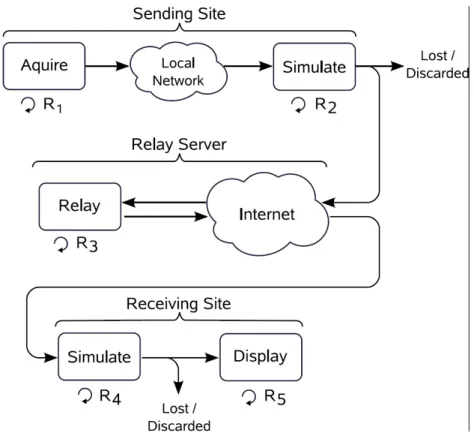
of audio input from microphones worn by users. Closing phase reverses the sequence at a faster rate. . . 95 3.17 Processing pipeline from sending to receiving site. R1– R5represent the various
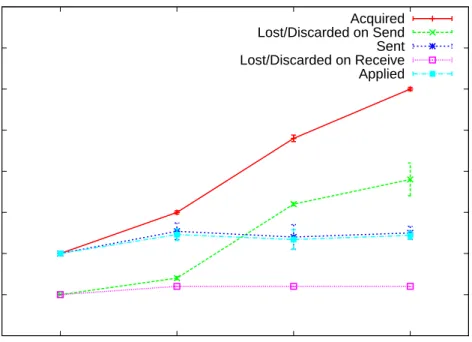
simu-lation cycle rates at each stage. . . 95 3.18 Frequency (occurrences) of updates that passed through the system at various stages. . . 97 3.19 Extract of latency measurements in condition R1= 20 Hz. End-to-end latency (from
acquisition to application) is composed of delays within the various stages of the pro-cessing pipeline.. . . 98 3.20 Mean latency caused by stages of the processing pipeline.. . . 98 3.21 Multimodal data collection pipeline. . . 103
4.1 A user located in a CAVE system, prepared for three-party AMC supported by EyeCVE. The user is fitted with eye, head, and hand tracking devices.. . . 114 4.2 The VE in which the experimental interactions took place, consisting of a white 3×3 m
room with a round meeting table in the centre surrounded by three chairs. . . 115 4.3 AMC in progress. . . 115
List of Figures 16 4.4 Arrangement of Access Grid displays, cameras, and speakers to achieve gaze aware
VMC at UCL. Note the head and shoulders views of fellow interactants. . . 116
4.5 Visualisations of gaze awareness in VMC supported by display and camera alignment in AG (left) and tracked gaze AMC achieved in EyeCVE using mobile eye tracking (right). 117 4.6 Frame captured by eye tracker scene camera. Gaze direction overlay marked by red crosshair. . . 117
4.7 VMC: simplified CA transcript illustrating “at-away-at” gaze behaviour of the partici-pant when being asked, and when responding to, a question. Names have been changed to ensure anonymity. . . 120
4.8 AMC: simplified CA transcript illustrating “at-away-at” gaze behaviour of the partici-pant when being asked, and when responding to, a question. Names have been changed to ensure anonymity. . . 121
4.9 VMC: simplified CA transcript demonstrating the deployment of gaze for conversation management. Gaze is used to signal speaker transition between confederates, which is subsequently observed and recognised by the participant. . . 122
4.10 VMC: simplified CA transcript highlighting difficulties in conversational management due to fragmentation of the shared workspace. . . 123
4.11 Participant view during VMC, illustrating the fragmentation of the shared workspace. . . 124
4.12 AMC: simplified CA transcript highlighting gestural strategies to conversation manage-ment. Figure 4.13 shows the corresponding view from the participant’s viewpoint.. . . . 125
4.13 Gestural management of conversation corresponding to Figure 4.12. . . 126
4.14 Gaze distribution analysis application. Participants’ gaze while being asked a question was classified into four groups: at speaker, at non-speaking confederate, away from both confederates, and ambiguous.. . . 126
4.15 Participant engaged in AMC deploying gaze, marked by crosshair, at various stages of the interaction. . . 128
5.1 Views of the completed ‘Rubik’s cube’ puzzle, formed by arranging eight small cubes to form one large cube in which each side displays exactly one colour. . . 131
5.2 Renders of the three starting configuration VEs for the object-focused experiment.. . . . 135
5.3 Random gaze model input frustum.. . . 136
5.4 Screen captures during the object-focused experiment. . . 140
5.5 Mean number of errors (with standard deviation) per session while performing grab and position instructions in each of the avatar gaze conditions.. . . 143
5.6 Mean time taken in seconds (with standard deviation) per session to perform all grab and position instructions in each of the avatar gaze conditions.. . . 144
5.7 Left: Mean total puzzle completion time in seconds (with standard deviation) in each of the avatar gaze conditions. Right: Mean total puzzle completion time, plotted by order of experimental session.. . . 145
List of Figures 17 5.8 Percentage equality of eye target (ET), head target (HT) and model target (MT) in all
ex-perimental sessions and participants. Small points denote individual participants. Square is mean. Range is standard deviation. . . 145 5.9 Comparisons of gaze parameters (—tracked,—random ). . . 146 5.10 CA transcript of tracked gaze AMC. Confederate, “Rob”, issues a grab instruction to
participant, “Tim”, who responds by grabbing the correct cube. . . 147 5.11 CA transcript of model gaze AMC highlighting problematic interaction and subsequent
repair during a grab instruction. Confederates are “Rob” and “Paul”. Participant is “Owen”.148
6.1 EyeCVE supporting AMC between users of the WALL (left) and CAVE (right) immer-sive projection systems.. . . 158 6.2 The VE in which the experimental AMC took place. The VE depicted a simple meeting
room, with two chairs separated by a table. Before interaction, the virtual furniture was aligned to their real counterparts as illustrated in Figure 6.1. . . 159 6.3 Grid (not rendered by EyeCVE) positioned behind confederate avatar to aid classification
of participants’ at and away gaze.. . . 159 6.4 Users engaged in VMC.. . . 160 6.5 Eye tracker mounted on the WALL’s lens-free frame (left), and on the CAVE’s
Crys-talEyes 3 [Rea10] shutter glasses (right). . . 160 6.6 Mean percentage and standard deviation of gaze directed at the confederate in AMC and
VMC during truth and lie stages, and combined. . . 164 6.7 Mean percentage of gaze directed at the confederate when answering two
randomly-selected questions in AMC and VMC with telling truths and lies. . . 164 6.8 Mean number and standard deviation of blinks performed per question in AMC and
VMC when answering truthfully, deceptively, and combined. . . 165 6.9 Mean pupil size and standard deviation in AMC and VMC during truth and lie stages,
and combined.. . . 166 6.10 Mean change in pupil size when answering two randomly-selected questions in AMC
and VMC when telling truths and lies. . . 167 6.11 Mean and standard deviation mood-factor scores elicited by the POMS questionnaire
following AMC and VMC. . . 168 6.12 E2’s clip viewer interface. . . 171 6.13 Photograph of E2’s setup, conducted in a lecture theatre at UCL. . . 172 6.14 Percentages of veracity accuracy and confidence between clip conditions when judging
truth and lie question stages. . . 173 6.15 Significances of post-hoc Tukey tests for all questions and truth/lie data sets. Conditions
jointly underlined are statistically similar. . . 174 6.16 Percentages of engagement and confidence between clip conditions when judging truth
List of Figures 18 7.1 Agent development in 3DS Max 8 [Aut10]. Image shows close view of agent’s eye area.
Note controllers extruding from the eyes to allow fine control of eye rotation. . . 179
7.2 Oculesic behaviour experimental setup from above. . . 180
7.3 Oculesic behaviour sequence of agent behaviour. . . 181
7.4 Oculesic behaviour experimental interface for gaze direction identification task. . . 181
7.5 Oculesic behaviour experimental interface for subjective questionnaire. . . 182
7.6 Overall combined condition gaze identification accuracy from centre, toward, and away cameras for symmetrical gaze angle pairs. . . 184
7.7 Detailed screen captures of the agent’s eyes when looking at number 5 (150◦offset from vertical gaze angle 12) from the toward (right) camera. Top: no eyelid animation, no vergence. Bottom: eyelid animation and vergence.. . . 185
7.8 State diagram detailing the lid saccade model. . . 189
7.9 State diagram detailing the blink model. . . 190
7.10 Motion capture encoding onto two different avatars using 3DS Max 2010 [Aut10] (left) and Poser 7 [Sof10b] (right). . . 191
7.11 Experimental interfaces for eyelid model validation.. . . 192
7.12 Results of realism and similarity to source rankings of each animation type normalised to 1. . . 193
7.13 Average blink profile of each animation method. Y=1 indicates full eyelid closure. . . . 194
7.14 Experimental interface for eyelid model general impact experiment. . . 196
7.15 Eyelid models general impact experiment multiple comparison scores. Conditions un-derlined by the same line are statistically similar. . . 198
7.16 Eyelid model general impact experiment radial plot comparing the six pairs of conditions.198 7.17 VEs used for the gaze model experiment. . . 202
7.18 Gaze model experimental interface. . . 203
7.19 Multiple comparison score for all data. Any conditions whose scores are underlined are considered statistically similar. . . 206
7.20 Gaze model experiment radial plot comparing the six pairs of conditions. . . 207
7.21 Comparisons of gaze observed in tracked, saliency model, and random model conditions for each scene. . . 207
8.1 Revisiting the conversational experiment. . . 210
8.2 Revisiting the object-focused experiment. . . 211
8.3 Revisiting the truth and deception experiments. . . 212
List of Tables 19
List of Tables
2.1 Proxemic zones, phases and ranges [Hal63]. . . 31
2.2 Definitions of gaze behaviour by Cranach [Cra71]. . . 33
2.3 Gaze distribution during dyadic conversation at social distance [AI72].. . . 34
2.4 Gaze distribution during male (MMM) and female (FFF) triads [Exl63]. . . 35
2.5 Turn-taking and associated gaze practices [GB06]. . . 35
3.1 Selected data from an interaction sequence taken from the truth and deception experiment.107 3.2 Selected data from an interaction sequence taken from the object-focused experiment.. . 108
3.3 Overview of experimental chapters. Information includes VR system in use, maturity of EyeCVE, eye tracker in use, avatar type in use, and analysis methods. . . 111
4.1 Questions issued to participants during the mediated interviews. . . 119
4.2 Participant gaze direction while being asked questions in AMC and VMC conditions . . 125
5.1 Order of independent variables presented to the twelve participants in object-focused experiment. . . 137
5.2 Questionnaire issued to participants following completion of each of the three experi-mental sessions. Responses were scored on 1..7 Likert scale. . . 142
5.3 Mean time taken in seconds (with standard deviation) of each experimental session, grouped by session order. . . 144
5.4 Mean task performance per session measured by number of errors andtime in seconds, with standard deviation, for each condition. . . 146
5.5 Mean number (and standard deviation) of glances to and from the instructing avatar and target cubes per grab instruction. . . 150
6.1 Question stage and veracity condition presented to participants for each mediation type.. 161
6.2 Mean percentage (and standard deviation) of gaze directed at the confederate in AMC and VMC during truth and lie stages, and combined. . . 163
6.3 Mean number (and standard deviation) of blinks performed per question in AMC and VMC when answering truthfully, deceptively, and combined. . . 165
6.4 Mean pupil size (and standard deviation) in AMC and VMC during truth and lie stages, and combined.. . . 166
List of Tables 20 6.5 Mean (and standard deviation) mood-factor scores elicited by the POMS questionnaire
following AMC and VMC. . . 167
6.6 Percentages of veracity accuracy and confidence, and engagement and confidence be-tween clip conditions when judging truth and lie question stages. . . 173
7.1 Mean (and standard deviation) gaze direction identification accuracy for conditions and cameras. . . 183
7.2 Mean response and (standard deviation) for Questions 1, 4 and 5 on the 1..7 (nega-tive..positive) Likert scale questionnaire. . . 185
7.3 Equations acting as input to thelid saccademodel. . . 188
7.4 Equations acting as input to theblinkmodel. . . 188
7.5 Preference matrix for eyelid model general impact experiment. . . 197
7.6 Eyelid model general impact experiment comparisons of consistency and agreement test statistics.. . . 197
7.7 Gaze model experiment preference matrices.. . . 205
21
Chapter 1
Introduction
“Mr. Watson, come here, I want to see you.” These were the words, spoken by Alexander Graham Bell, and heard by Thomas A. Watson, on March 10th 1876, that comprised the first telephone communication. Since then, audio telecommunica-tion between geographically-remote people has become a ubiquitous part of life throughout the world. More recently, the rapid advancement of computing performance and computer networks has allowed real-time video-mediated communication (VMC) to enjoy a similar status. Thus, when AT&T intro-duced the Picturephone in 1964 [Mol69], Bell’s wish to see Watson, as well as speak to him, may have been granted.
Interpersonal communication is a continuous process, in which both verbal and nonverbal infor-mation is imparted by a sender, and subsequently decoded and responded to by a receiver. Nonverbal communication (NVC) relies on the sending and receiving of signals via wordless expressive channels, and hence, mediating these signals is the primary goal of visual telecommunication systems. VMC por-trays users’ actual visual appearance, so is optimally-suited to the task of capturing many channels of NVC, particularly the subtle nature of facial expression. However, the three-dimensional (3D) nature of social interaction in reality ensures that many nonverbal cues, such as movement, gesture, and gaze direction are inherently spatial. It is in this regard that Bell’s intermediate request, for Watson to “come here”, is still some way from being achieved convincingly with VMC, being as it provides a ‘window’ into a user’s surroundings, rather than creating the illusion of a shared space.
To this end, avatar-mediated communication (AMC) in immersive collaborative virtual environ-ments (ICVEs) has recently, and rapidly, emerged as an alternative mode of visual telecommunication. Spatiality is a central feature of such immersive virtual interaction, and users populate a shared virtual en-vironment (VE) with humanoid graphical embodiments, known asavatars. The idea of being immersed in a VE, generated by computer displays, dates back to Ivan Sutherland’s work during the 1960s [Sut68]. Sutherland’s system comprised a formidable structure suspending a head-mounted display (HMD), capa-ble of generating simple wire-frame graphics. It was the advent of multi-user virtual reality (VR, a term credited to Jaron Lanier in the early 1980s) systems which introduced the paradigm of user embodiment within a VE, implying that users “puppeteer” their avatars via natural bodily movement. Thus, based on natural sensory input and proprioception, ICVE users are able both to transmit and observe nonverbal signals in a shared and spatial setting.
1.1. Research Problem 22 The term “avatar” finds its origins in the religious tradition of Hinduism, in which the term refers to an Immortal Being’s descent and incarnation, or embodiment, into mortal realms. In the domain of computer science, the semantics of the term are similar, but the embodiment that takes place is between people, in reality, and graphical humanoids, in VR. Released in 1986, Lucasfilm’s online role-playing game, Habitat [GL86], provides perhaps the first example of the term as it is now used in today’s online culture. Habitat may also be seen as a forerunner to the online virtual worlds of today, which enable millions of remote users to engage in AMC, catering to both small-group and large-scale social interac-tion. Currently, the vast majority of users enjoying this emerging form of mediated interaction are doing so via non-immersive computing hardware, comprised of standard displays and input devices. However, driven by the video games and film industries, immersive hardware devices, such as motion tracking interfaces and large field-of-view stereoscopic displays, are emerging for both home and commercial use. Historically, such hardware has been the domain of VR labs, in which much of the research and development into AMC continues to be carried out. However, as consumer technology evolves and is adopted, it is certain that over the coming years, forms of AMC which are technically comparable to that which is investigated by the research presented in this thesis will become commonplace.
1.1
Research Problem
A major hindrance to high-quality interpersonal AMC is the fact that many channels of users’ nonverbal expression are not transmitted by the medium. Unlike VMC, which transmits a user’s actual visual appearance, AMC generally relies upon specialist tracking devices to capture and replicate a user’s expressive behaviour in their embodied avatar. Hence, an avatar’s capacity for nonverbal replication is dependent on the tracking devices available to the system operating the ICVE. Studies into small-group interaction in ICVE systems typically employ minimal bodily tracking devices to drive avatar animation, generally consisting of head tracking to update position, gross posture, and head orientation, and a single hand tracker to infer arm gesture [BBH+90,BBF+97,SSA+01,RWOS03]. Thus, while AMC in ICVEs may offer a spatial and immersive context for interaction, the relative lack of nonverbal information exchange is clearly lacking compared to VMC. A significant challenge to the maturation of AMC is the capture of critical channels of users’ natural NVC, which may then be used to drive the expressive behaviour of an embodied avatar in real-time, thereby developing avatars that more faithfully exhibit their embodied user’s actual nonverbal behaviour.
The complexity of human behaviour ensures that holistic reproduction of users’ behaviour in AMC is not a realisable goal at the present stage of maturity in the research area. Indeed, Schroeder suggests that AMC will never provide completely realistic ways of interacting or communicating with others because a number of features of face-to-face interaction will always be lacking [Sch02]. However, the bidirectional flow of nonverbal information is considered to be a critical requirement in order to support avatar-mediated interactions that are more similar to those which take place in reality, between humans [Sch02,SRSH05]. This argument is derived from the importance of the visual, nonverbal, element of collocated communication, where people draw impressions of one another regarding intention, mood, and emotional state [AT79]. It is important, then, to focus on critical behavioural cues, which, unless
1.2. Research Questions 23 they are tracked and replicated, are likely to be a hindrance to communication.
Oculesics, or the use of the eyes during communication, are of central importance to social be-haviour and NVC, and the eyes are considered to be the most intense social signallers on the human face [Arg88]. Gaze is perhaps the most salient oculesic cue, providing a bidirectional signal used both to monitor and indicate focus of attention, as well as a resource to manage the unfolding interaction. More subtle, but providing rich insight into an individual’s emotional and cognitive states, are pupil dilation and blinking. The capture of oculesics may be achieved using eye tracking.
The research presented in this thesis investigates the use of eye tracking, with the parallel aims of enhancing and understanding AMC in ICVE systems. The first challenge, to enhance AMC, aims to enable oculesics as a nonverbal resource during the virtual social interaction, similar to how oculesics are both transmitted and observed in face-to-face meetings. This implies that theinteractivecapability of eye tracking must be exploited to capture users’ oculesic cues, and replicate them in their embodied avatars, in real-time. The second challenge, to understand AMC, aims to make use of theanalytical capability of eye tracking, to gather data describing users’ behaviour and response during the mediated interactions.
1.2
Research Questions
The overarching goal of the research presented in this thesis has been to investigate how eye tracking may be used to both enhance and understand AMC. The research extends earlier studies in the VE literature, by conducting a series of controlled experiments designed to observe social interaction performed by users engaged in AMC. The main experimental research, presented in Chapters4–6, investigates small-group interaction between users of state-of-art visual telecommunication systems. The three chapters are each concerned with a specific collaborative scenario, and document the associated experiments. Chapter 4investigates a three-party conversation scenario in both AMC and VMC, Chapter5investigates three-party object-focused interaction in AMC, and Chapter6investigates truthful and deceptive interaction in both AMC and VMC. In addition to these telecommunication studies, three experiments investigating behavioural simulations of oculesics are presented, in Chapter7. These studies investigate factors in-fluential to AMC, rather than AMC itself. Section7.1presents a preliminary experiment assessing how behavioural fidelity is seen to impact observers judgements of an avatar. Section7.2presents and in-vestigates parametric models of eyelid motion, which generate realistic blinks and lid saccades. Finally, Section7.3presents and investigates a gaze model, which aims to generate realistic and meaningful gaze behaviour by computing the saliency of the objects within a VE.
The experimental work was guided by, and addressed, the following overall questions:
1. Can eye tracking be used to increase the nonverbal information transmitted during AMC, and does this improve quality of communication between users?
2. Measured by eye tracking, do users engaged in AMC behave and respond in a socially realistic manner compared to users engaged in VMC?
1.3. Contributions 24 4–6. The work addresses the central premise of whether eye tracking may be applied both in-teractively, to enhance the nonverbal richness of AMC (Question1), and analytically, to further understand peoples’ social behaviour and response during AMC (Question2). In Chapters4and6 VMC provides the base class of visual telecommunication with which AMC is compared, whereas in Chapter5, only AMC is investigated.
3. Can simulations of oculesic behaviour have a positive impact on observers’ perceptions of virtual humanoids, and can such models be used to complement tracked behaviour in AMC?
The final question (Question 3) is addressed by the behavioural simulation work presented in Chapter 7. The work is secondary to the central focus of the research, and presents models of oculesics, together with associated experimental evaluations, which assess the models’ ability to generate realistic oculesic animation for avatars and agents. The combined use of tracking and modelling to drive embodied avatars is also investigated.
1.3
Contributions
The main contribution of this thesis is the evaluation of the use of eye tracking to enhance and understand AMC in ICVE systems. While the work’s driving motivation lies in the aspiration to enhance AMC, insight into the understanding of how people behave and respond when engaged in AMC is a no less fundamental goal. The research covers multiple collaborative scenarios, comparisons with state-of-art VMC, methods for representing gaze, blinks and pupil dilation data in AMC, models of gaze and eyelid movement, networked VE system design and development, and analytical techniques. The contributions of this thesis can be classified as methodological and substantive:
1.3.1
Methodological Contributions
1. Methods of processing the tracked oculesic cues of gaze, blinks, and pupil size, and mapping them onto an embodied avatar for real-time display of replication of behaviour in AMC (Chapter3).
2. A method for collecting multimodal interaction data in a single log-file (Chapter 3). Data com-prises of oculesics, head movement, hand movement, verbal signals, and additional experimental markup information.
3. Experimental task designs for use in studies on interpersonal and object-focused AMC (Chapters 4–6), and experimental frameworks for studying perceptual aspects of virtual humanoids (Chapter 7).
1.3.2
Substantive Contributions
1. A review of the problematic use of simulation, as opposed to tracking, to control avatar behaviour during AMC (Chapter2). Focusing on gaze, the review argues that, due to the unpredictable, inter-personal, and idiosyncratic nature of human social interaction, it is not feasible to simulate a user’s nonverbal behaviour without distorting the semantic content of the human communication. Hence,
1.4. Scope of Thesis 25 for faithful telecommunication mediated by avatars, tracking and replication must be implemented wherever possible.
2. Research findings that address the impact of the interactive and analytical use of eye tracking in AMC (Chapters4–6). These findings have implications for the design of future AMC systems. 3. Oculesic models which generate realistic animation of eyelid kinematics and gaze behaviour for
use in real-time AMC (Chapter7).
1.4
Scope of Thesis
This thesis is concerned with the operation and evaluation of eye tracking in AMC that takes place between users of ICVE systems. The focus of the research is therefore not on the technology itself, but rather on the use of the technology to support both interpersonal and object-focused collaboration. However, the software platforms used throughout are bespoke, and have been developed with the exper-imental evaluations in mind. Where appropriate, key phases of development, and system overviews are provided.
The three telecommunication experiments are concerned with small-group collaboration performed by users of highly immersive state-of-art VR technologies such as CAVETMsystems [CNSD93]. Chapters 4and5investigate three-party collaboration between three networked CAVE systems in conversational and object-focused scenarios, while Chapter6investigates truth and deception between dyads perform-ing between a CAVE system and a semi-immersive VR system, the WALL. Thus, the research presented in this thesis does not consider HMDs, which hinder natural proprioception, or non-immersive systems, such as desktop displays or mobile devices.
There is little work in the VE literature investigating avatars featuring a non-humanoid form [FSS07], and the research documented here is no exception. Reeves and Nass proposed that if an agent or avatar looks or behaves like a human, observers will have an automatic social response to it, similar to how they would respond to another person [RN96]. Findings in the VE literature unambiguously support this theory, which is detailed Chapter2. Thus, the avatars appearing in this work exhibit high levels of anthropomorphism, and cartoon-like or semi-realistic avatars are not investigated. This is reflected in the behavioural simulation work, which presents physiologically-accurate models of eyelid movement, and simulation of human gaze behaviour.
Finally, as covered in Chapter2, there are several potential applications of eye tracking in VEs, some of which could be used or adapted to benefit collaboration in ICVEs. However, this work is explicitly concerned with real-time AMC, and the use of eye tracking to enhance NVC through replication of oculesics, including gaze, eyelid movements, and pupil dilation. In accordance to the realistic appearance of the avatars embodying each user, this research is concerned only with faithful replication of behaviour to achieve high-quality AMC, as opposed to “transformed” social interaction, as studied by Bailenson et al. [BBL+05]. From an analytical standpoint, eye tracking is used as the primary data source to describe the captured interactions, but questionnaire and performance metrics, as commonly used in VE studies, are also applied throughout.
1.5. Structure 26
1.5
Structure
Chapters2and3are introductory and cover relevant research and methods. Chapters4–6present the design and findings of three studies investigating eye tracking in AMC. Chapter7presents simulations of oculesics and associated experiments. Chapter8 draws conclusions from the findings and propose directions for continuing research.
Chapter2contextualises the research by expanding upon the motivation, the central problem ad-dressed, and the general approach taken. Although ICVEs are able to support spatial and fully-immersive interaction, a significant deficiency of the medium, as a form of interpersonal telecommunication, is the limited expressivity of users’ avatar embodiments. The communicative properties of the eyes, their relevance to visually-mediated interaction, and previous work on avatar oculesics inform the general approach taken in this research. Finally, the theoretical arguments surrounding issues related to repro-ducing users’ gaze with eye tracking, versus simulating eye movement through gaze modelling, are awarded detailed discussion.
Chapter3 covers both technical and methodological aspects of the research. Firstly, the design and key features of EyeCVEare presented. EyeCVE is the ICVE system which was developed (in collaboration) throughout the course of this research, and was used as the primary platform supporting the experimental AMC. The eye tracking and avatar subsystems are presented in detail, followed by a performance evaluation of an early version of the system. A multimodal data collection system that is closely coupled to EyeCVE is then presented. During an EyeCVE session, a user performance is captured using several tracking devices, each monitoring a separate channel of natural communication. These data input streams include eye tracking, head tracking, hand tracking, and microphones which detect verbal communication. The data collection system is able to collate the synchronous data streams in an holistic manner, thereby preserving the temporal characteristics of the multimodal action. Together with the traditional approaches to measuring user experience and quality of communication in VEs, this data collection system is used to analyse the experimental interactions presented in Chapters4–6.
Chapter4presents the first of the three telecommunication experiments which form the main em-pirical research contribution of this thesis. The first experiment investigates three party conversation in tracked gaze AMC and gaze aware VMC. In the VMC setting, gaze awareness is realised by care-ful alignment of video displays and camera positions, while the AMC setting uses an early version of EyeCVE, networking three CAVEs, to drive avatar gaze. Eye tracking is combined with conversation analysis as the primary means of evaluation and analysis of the interactions.
Chapter 5 presents the second telecommunication experiment, again performed between three CAVEs, networked with EyeCVE. The experiment investigates the impact of varying methods of avatar gaze control on quality of communication during object-focused multiparty AMC in ICVE systems. An experimental puzzle scenario was devised to emphasise the operational importance of gaze during the collaborative interactions. The experiment compared three forms of AMC: tracked gaze using eye track-ing, static gaze featuring no eye movement, and a simple gaze model. Eye tracking data, performance timing, and questionnaires were used to assess the interactions in terms of task performance, subjective
1.5. Structure 27 user experience, and interaction analysis.
Chapter6presents the final telecommunication study, consisting of two closely related experiments investigating truthful and deceptive interaction in AMC and VMC. The first experiment in the chap-ter aims to compare participants’ behaviour during truthful and deceptive conversation between dyads. Alongside gaze, blinking and pupil size are also captured for real-time representation in AMC, and also for post-experimental analysis. Following the interactions, a questionnaire collects data describing par-ticipants’ psychological arousal and mood state. The second, follow on, experiment aims to assess the impact of bestowing avatars with faithful reproduction of their embodied users’ tracked oculesic be-haviours of gaze, blinks, and pupil dilation. The AMC recorded from the first experiment are replayed to a new set of participants, who assess the original participants in terms of veracity and engagement, together with confidence levels relating to the two judgements. These ratings are performed over three stimuli conditions: avatars exhibiting oculesics, avatars featuring no oculesics, and audio-only.
Chapter7presents models of oculesics and associated experiments. The first of three sections in the chapter investigates the impact of varying the fidelity of an avatar’s oculesic behaviour on observers’ ability to identify its direction of gaze, together with subjective perceptions of realism. The second sec-tion presents two parametric models, based on physiological data, that generate lid saccades and blink animation. The models are detailed algorithmically, before being validated against motion captured data, and then being assessed in terms of general impact on realism. The third section focuses on gaze modelling. The gaze model computes the saliency of objects in the VE, and animates avatar gaze accord-ingly. The model is assessed in terms of realism against tracked gaze, the basic gaze model presented in Chapter5, and static gaze.
28
Chapter 2
Background
Driven by the potentials and demands of an increasing global market, and fed by advances in information and communication technology, one of the trends in the modern workplace is for more distributed team working. Within the domain of computer supported cooperative work (CSCW), telecommunication systems that enable synchronous interaction amongst geographically-separated users are referred to as remote interaction systems[Joh88]. Visual telecommunication systemscomprise that subset of remote interaction systems which aim to transmit visual information, usually alongside the aural component of an unfolding communication. State-of-art VMC systems remain the most favoured form of visual telecommunication in terms of supporting NVC between users. This thesis focuses on AMC performed by users of ICVE systems as a maturing form of visual telecommunication, but one which has superlative potential for fostering the perceptual illusion of being collocated with others in a shared space [Sch06].
This chapter aims to contextualise the research presented in this thesis, by discussing the literature that has shaped its motivation, the problem it aims to address, and the approach it takes. The chap-ter is comprised of four main sections, which narrow down the focal area of research in a top-down manner. The first section explores natural human nonverbal communication in collocated (face-to-face) small-group interaction, with a particular focus on the communicative properties of the eyes, known as oculesics. The second section discusses visual telecommunication systems, and covers the relevant literature in small-group CSCW, with a particular focus on VMC and AMC. The issues of gaze communi-cation, termedgaze awareness, in VMC systems is covered in detail, together with topics of immersion, place illusion (PI, also known aspresence) and spatiality in ICVEs. The third section explores the re-search’s central topic of AMC. The importance, and methods, of expressing nonverbal behaviour are presented. Current failings of these methods, which limit the ability of avatars to act as the visual media-tors for interpersonal telecommunication, are presented. The theories of social presence, media richness, and avatar fidelity are introduced. A review of oculesic animation, including gaze, eyelid dynamics, and pupil dilation is then presented. The fourth section motivates the research problem by discussing the problematic implications which arising from the use of behavioural simulation to drive avatar animation during AMC, as opposed to tracking and replicating users’ actual behaviour. By reviewing analyses of social interaction, this section identifies common gaze practices that add information that is critical to those engaged in an unfolding communication, but which cannot be predicted or determined by a be-havioural simulation, nor indeed by the participants themselves in the unfolding interaction. Hence, the
2.1. Communication and the Eyes 29 motivation for the use of eye tracking to capture users’ oculesics for real-time replication by embodied avatars is developed, drawing into the focal area of the research.
2.1
Communication and the Eyes
Communication in general occurs in order for some number of parties to perform in four different task contexts [WPKD02]: cooperationto perform a task together, coaction to exist in the same vicinity, competitionto perform a task at the expense of another, andconversationto entertain or pass on infor-mation. The act of communication is a continuous process in which discrete packages of information are imparted by a sender, and subsequently decoded and responded to by a receiver. This bidirectional feedback loop must be supported by at least one channel or medium, and hence requires both semantic and syntactic commonality between all parties. In collocated communication, the process of decoding messages is a part ofintrapersonalcommunication, or internal and private cognition [Lan03], while the sending and receiving of messages is a process ofinterpersonalcommunication, in which participants have access to the full gamut of sensory channels [Bor04]. Collocated interaction is classified as un-mediated communication, as it involves direct exchange of information between interactants, with no intervening agents or technologies.
Mediated communication relies on a process by which messages are transmitted via some form, or medium, external to direct face-to-face interaction [PM04]. Parties involved in mediated communication may still be collocated, and have partial access to unmediated expressive cues. For instance, the task of linguistic translators is to decode, recode and send verbal messages between parties sharing a common language barrier, but the nonverbal channels such as body language, touch, and eye contact may generally still be observed directly [OA02]. In the case of translation, a by-product of the mediation is that the two major components, visual nonverbal and aural verbal, of a communication are separated by some temporal measure throughout the exchange. Thus, the verbal signal reaches the receiver at an offset delay from the time of the original utterance by the sender, and with that delay, any concomitant nonverbal signalling has already occurred.
Generation of verbal and nonverbal cues are highly interrelated, both temporally and semantically [AT79], so alteration of these characteristics has the potential to influence a communication from a sub-tle to drastic manner. Unless a telecommunication system is “perfect”, transmitting and displaying all communicative channels and spatial context in a timely manner, alterations arising from mediation are always present. This situation holds true for all forms of mediated communication, whether human or technological. Thus, mediated communication may be viewed as applying a filter to direct, unmedi-ated, collocated interaction. Transmitting high quality and synchronous verbal and nonverbal signals is the central goal of visual telecommunication systems. Bodily movement and expression is the primary source of the visual component of human interaction, and is briefly reviewed in the following section. In accordance to the aims of this research, the subset of NVC related to the communicative and physiologi-cal properties of the eyes is then explored in detail. The behaviours of gaze, eyelid movement, and pupil dilation in common social interaction scenarios are discussed, followed by a review of how oculesics are influenced by deceptive situations.
2.1. Communication and the Eyes 30
2.1.1
Nonverbal Communication: an overview
Nonverbal communication (NVC) is a subset of human communication which relies on the sending and receiving of signals via wordless expressive channels. NVC can give tone, accent, and sometimes even override verbal messages [AT79]. Channels of NVC include, but are not restricted to, gaze facial ex-pression, gesture, bodily movement, posture and contact, physical proximity and appearance [Arg88]. NVC provides information regarding beliefs, desires, and intentions of an individual, and also provides indicators regarding various psychological states, including cognitive, emotional, physical, intentional, attentional, perceptual, interactional and social [Duc86]. The corresponding verbal component of com-munication is similar in that every message contains insight into the psychological state of the individual and the relationship between the individuals in the conversation [WBJ+67]. Nonverbal signals are able to manipulate the verbal component of face-to-face communication, and even though verbal and nonver-bal content might not always indicate the same message, what they convey is almost always compatible [GRA+02].
Kinesicsis the study of the visual aspects of nonverbal communicational behaviour related to move-ment: either of any part of the body, or the body as a whole [Bir60]. Burgoon et al. consider kinesics to be one of the richest nonverbal codes [BBW96], providing people engaged in collocated interaction with a wealth of information. This is due, in part, to the range of kinesic cues, which includes posture, gesture, and facial expression. Argyle classifies three main human postures: standing, sitting (including squatting and kneeling), and lying down [Arg88]. Each of these has further variations corresponding to different positions of the arms and legs, and different angles of the body. In any given culture, there are a finite number of postures commonly used, and the ways in which attitudes and emotions are ex-pressed vary accordingly. Observation of interactants’ posture during collocated communication is able to provide insight, both with regards to how they may feel about one another, and information of their emotional state [Meh07].
Gestures, while not exclusively related to emotional expression, are a ubiquitous part of human communication. Gestures are voluntary bodily movements, usually made by the head or hands, which are intended to independently communicate, or correlate with, some verbal utterance [Arg88]. Ekman and Friesen classify the structural elements of gesture as emblems, illustrators, affect displays, regulators, and adaptors [EF69]: emblems have a direct verbal translation, and are most often used with concious intent to transmit a message, such as lifted shoulders and upturned palms to indicate “I don’t know”; illustrators aid in the description of what is being said; affect displays are used to display emotion; regulators aid in the turn-taking of conversations; and adaptors are those behaviours which are essentially private reactions to stimuli, such as fidgeting when nervous, and are generally thought of as being involuntary [Mas96].
Facial expressions displaying the basic emotions of anger, disgust, fear, joy, sadness, and surprise, take specific forms that are universal across human cultures [Ekm92]. The answer to why this is the case can be traced back to Darwin, who argued that facial expressions are primarily vestiges of behaviours that, previously in our evolutionary history, had specific and direct biological function [Dar04]. As exemplified by Krauss et al. [AS96], for a species that attacked by biting, baring the teeth was a necessary
2.1. Communication and the Eyes 31 prelude to an assault, and wrinkling the nose reduced the inhalation of foul odours. The reason that these formally functional behaviours have persisted as facial expressions (people bare their teeth when they are angry, and wrinkle their noses in disgust despite absence of an unpleasant odour) is because they have acquired communicative value: they provide observers with external evidence of an individual’s internal state [Hin72].
Before the literature regarding oculesics is presented, the communicative modalities ofproxemics andchronemics, related to space and time respectively, are detailed. Management of the exocentric environment, in particular with regards to the physical proximity of the communicating parties, is funda-mental practice during collocated communication. Hall defines proxemics as the study of how humans unconsciously structure microspace in terms of the interpersonal distance during daily transactions, and extends the theory to the organisation of space in buildings, and ultimately, the layout of towns [Hal63]. Table2.1shows Hall’s four concentric, but not necessarily circular, ranges. The study of proxemics is particularly useful when determining interpersonal relationships and current purpose of the communica-tion. Embracing, touching or whispering is generally reserved for intimate distance, interactions among good friends generally occurs in the personal range, interactions among acquaintances is performed at social distance, and public distance is used for public speaking.
Zone Phase Range
Intimate Close phase <15 cm Far phase 15 - 45 cm Personal Close phase 45 - 75 cm Far phase 75 - 120 cm Social Close phase 1.2 - 2.1 m
Far phase 2.1 - 3.6 m Public Close phase 3.6 - 7.5 m
Far phase ≥7.5 m
Table 2.1:Proxemic zones, phases and ranges [Hal63].
Chronemics refers to how people perceive, structure, and react to time, and the messages that may be interpreted from such usage [Bru80]. Chronemics is studied on two scales: those related to social and cultural organisation, and those that are managed on a micro-level during interpersonal communication. There is growing interest in chronemics in the CSCW literature [Tid95,KR05]. The use of time as a communicative channel can be a powerful, if subtle, force in collocated interaction, where it is used for regulation, expression, and affect management [Bru80]. Regulation refers to managing the orderly transition of conversational turn-taking. For instance, when the current speaker “opens the floor” for a response, they will pause, or when no response is desired, they may talk at a faster pace with minimal pauses [Cap85]. Expression refers to changes of chronemic behaviour depending on relationship type. For instance, people who are part of an intimate relationship will often maintain mutual eye contact for a length of time beyond what would be the norm in a non-intimate relationships [Pat90]. Affect management is related to the onset of powerful emotions which may cause a stronger affect, such as joy, sorrow, or embarrassment. Some of the behaviours associated with negative affects include decreased time of gaze and awkwardly long pauses during conversations. When this happens, it is common for the
2.1. Communication and the Eyes 32 individuals to try and decrease any negative affects and subsequently strengthen positive affects [EI87].
2.1.2
Oculesics
The eyes have been characterised as the most significant area of the body for communicating messages [RM95], and the most intense social signallers in the human face [Arg88]. As Heron states, “The most fundamentalprimarymode of interpersonal encounter is the interaction between two pairs of eyes and what is mediated by this interaction. For it is mainly here, throughout the wide ranges of social encounter, that people actuallymeet(in the strictest sense)” [Her70].
As was documented in the preceding kinesics literature regarding facial expression, Darwin argued that an intimate relationship exists between almost all human emotions and their outward manifestations [Dar04]. Subsequently, Ekman and Friesen have demonstrated universal recognition of basic emotions [EF71,EF75]. This is a clear indication that symptoms of a cognitive mental state are observable in the face. Extending emotional communication by facial expression, Baron-Cohen et al. have shown that a range of mental states beyond these basic emotions can be read from facial expressions, and particularly from the eyes [BCWJ97]. This theory is aided by normal adults’ ability to consistently interpret both basic and complex mental states in the face. Baron-Cohen et al. suggest that, regarding complex mental states, the eyes convey as much information as the whole face, and significantly more information than the mouth. This nonverbal communicative channel of the eyes is what Baron-Cohen terms the “language of the eyes” [BC95]. More commonly, it is termedoculesics, and in this thesis, the term is employed to refer to the communicative properties of the eye, including gaze, pupil dilation, and eyelid movement.
Gaze
Human capacity for information processing is limited, so inspection of a visual scene is performed by paying particular attention to selected stimuli of interest. In natural scenes, attentional selections are influenced by complex interactions between top-down goal driven control, and bottom-up stimuli driven control [IKN98]. Understanding how visual targets compete for attention is critical in understanding how gaze is allocated to targets within a visual scene. While attention has been shown to be influenced heavily by top-down components, referring to visual inspection with a task in mind (e.g., looking for John Doe in a crowd), it has also been shown to be strongly influenced by the bottom-up approach guided by the contents of the visual input [Yar67].
Gaze is of central importance in social behaviour, where it acts both as a nonverbal signal, showing, for example, direction of attention, while also opening a channel so that another person’s nonverbal signals, and particularly their facial expression, can be received [AF67]. Hence, gaze is both signal for the person being looked at, and a channel for the person doing the looking. We use our eyes to study the behaviour and appearance of others, and we look particularly in the region of the eyes. For instance, when looking at a photograph or painting of a person, we will typically spend 60% of the time looking at the eyes, and 15% at the mouth [PW96]. Mutual gaze, or eye contact, refers to when two people are looking at each other’s eyes at the same time, and is used as a bond-forming social signal very early in life: mutual gaze between mother and child first occurs at the age of three or four weeks [BB01]. Several types of gaze behaviour in human communication have emerged, and Cranach offers the
![Figure 2.5: Cisco’s TelePresence system, supporting gaze awareness, and life-size representations of users in a visually-seamless workspace [Sys10b].](https://thumb-us.123doks.com/thumbv2/123dok_us/10201377.2923108/44.892.239.706.879.1096/figure-telepresence-supporting-awareness-representations-visually-seamless-workspace.webp)
![Figure 2.7: Sensitivity to gaze direction as presented by Chen [Che02]. The contour curves mark how far away, in degrees of visual angle, the looker could look above, below, to the left, and to the right of the camera without losing perception of eye conta](https://thumb-us.123doks.com/thumbv2/123dok_us/10201377.2923108/46.892.300.646.111.438/figure-sensitivity-direction-presented-contour-curves-degrees-perception.webp)
![Figure 2.10: Comparison between visual telecommunication systems in terms of Benford et al.’s three dimensions of spatiality [BBRG96]](https://thumb-us.123doks.com/thumbv2/123dok_us/10201377.2923108/53.892.287.699.110.469/figure-comparison-visual-telecommunication-systems-benford-dimensions-spatiality.webp)