Colophon
ThesisTitle: Increase Quality through Information Management
Subtitle: Designing a plan for implementing an Information
Management System with Integrated Quality Management for a contractor
Location: Delft
Date: December 2013
Author:
Name: M.C. (Martijn) van Leeuwen
Student number: 1304070
E-mail address: [email protected]
University: Delft University of Technology
Faculty: Civil Engineering and Geosciences
Master track: Construction, Management & Engineering
Academic supervisors:
Prof.dr.ir. M.J.C.M. (Marcel) Hertogh Delft University of Technology
Faculty of Civil Engineering and Geosciences Professor Infrastructure Design and Management Dr.ir. A. (Alexander) Koutamanis Delft University of Technology
Faculty of Architecture
Associate Professor of Computational Design Dr.ir. G.A. (Sander) van Nederveen Delft University of Technology
Faculty of Civil Engineering and Geosciences Assistant Professor BIM for integrated design
Industry supervisors:
Company Mobilis B.V.
Fascinatioboulevard 522, 2909 VA Capelle a/d Ijssel +3155-5382222
Ing. J.R. (Rutger) van der Noort Mobilis B.V.
Building Process Specialist Ing. M. (Marjolein) van Beek Mobilis B.V.
Preface
For graduation in the Master Construction, Management & Engineering (CME) at the Delft University of Technology (DUT) it is required to finish with a graduation thesis. In front of u lies the thesis with the title “Increase Quality through Information Management”. With a bachelors in Civil Engineering this would not be the first topic to come to mind, but it proved to be a very interesting subject during the graduation process. Quality Management is a topic that was not completely clear for me at the beginning of my graduation. This is the first topic that I learned a lot about and now I realise it’s a very important part of the construction process. At the start of this thesis the topic Information Management sounded clear to me, but also during the
graduation I realised it is handled differently within a contractor than I thought. Therefore it was really useful to execute this thesis at the company. Also, the implementation of a new software tool that leads to a change in the way employees have to work is really useful to research; there is a lot to take care about if you want to change the way people work. In the end, it was really informative for me to do research on these three subjects and try to combine these.
This thesis was executed at the company Mobilis B.V., a civil engineering contractor. The first thing that attracted me to this company were the large infrastructure projects the company is executing. It is really interesting to see how these projects are executed, but also how a design for such projects develops.
Furthermore, I received a lot of support of colleagues during my graduation which helped me a lot. I would like to thank the Quality department, the Building Process department and especially my supervisors from Mobilis, Marjolein van Beek and Rutger van der Noort, for their support and interesting discussions during my
graduation.
I would especially like to thank my graduation committee, Marcel Hertogh, Alexander Koutamanis and Sander van Nederveen, for their help and support during the most important period of my study.
Finally, I would like to thank my family and friends for the support during my complete studies and especially for the support during the last nine months; the finishing of my studies with this master thesis.
Martijn van Leeuwen December 2013
Summary
Introduction
With construction projects there is a shift in responsibilities from client to contractor, which means that the contractor is earlier involved in the construction processes. This makes the contractor more influential, but makes the project for a contractor more complex. To manage these construction projects a contractor has five ‘control factors’; Money, Organisation, Time, Quality and Information. ‘Information’ and ‘Quality are chosen for this thesis to research and more specifically, how to integrate these two factors. Information Management Systems (IMS) and Quality Management Systems (QMS) are separately available for contractors, but combined systems are not. To improve the activities of a contractor the implementation of a combined system is
researched. Therefore the following research question is composed: How to efficiently implement an Information Management System integrated with the processes of the Quality Management System within a contractor and its projects?
Literature study
To answer this research question a literature study is undertaken to clarify what Quality Management and Information Management is, how it is used in the construction industry and why it is necessary. Quality
management is a system by which an organisation aims to reduce and eventually eliminate non-conformance to specifications, standards and customer expectations in the most cost effective manner. In the construction industry a QMS is mostly a collection of processes that have to be followed to come to a sufficient design and construction that meets the requirements of the client.
Information Management in the construction industry is often executed according to the method Systems Engineering (SE). SE is used to structure the requirements and the information during a project; it makes communication between client and customer easier. An Information Management System is a centralised information system that is accessible to all parties in a construction project. Because of the large amount of information during a construction project, it is important to have the right information available for the right person.
To create a framework for the success of the implementation of a combined IMS with QMS 26 Success Factors (SF) are derived from literature about the implementation of Information Management Systems and Quality Management Systems.
Quality Management and Information Management Mobilis
This thesis is executed at the civil contractor Mobilis; Mobilis is currently developing a combined IMS with QMS, named IMT-MS (Information Management Tool with integrated Management System) . The goal of Mobilis with IMT-MS is to come to a successful project control according to the company’s quality plan where process management and information management go hand in hand and where the processes are explicit and transparent. IMT-MS is implemented in several projects in tender phase and the implementation of this system is considered a case study for this research.
Results and discussion
A survey is conducted among the user of IMT-MS; this survey is based on the Success Factors defined in the literature study. The questions are separated in six different subjects; Personal data, Development,
Communication, Possibilities, Processes and Ease of use. The results of the survey are further discusses in five different interviews with the managers and developers of IMT-MS: the management director and the department heads. In the interviews the most important Success Factors and the topics that couldn’t be discussed with the end users in the survey are discussed.
In the discussion the results of the survey and interviews are further discussed to create a clear and consistent interpretation of the results. The conclusions of the discussion are further elaborated at the conclusion. Implementation plan – organisation level
The success factors, interviews and the survey results in an implementation plan, which is structured in two parts; implementation on organisation level and implementation on project level. The implementation plan is written for a contractor that wants to start with a combined IMS with QMS. This is explained with Figure 1; considerations first have to be taken into account to start with development. After the development phase there has to be decided if the system should be implemented or further developed. After implementation phase, the implementation can be a success or not; if not, the system has to be further developed.
Figure 1: Flowchart implementation plan organisation level
The considerations that have to be taken into account before development are the current position of the company; the financial position, organisation culture, management board policy, competitors and computer experience.
With the development phase the following success factors are important: The goal of the system; possibly interlinked with the company goals Functions of the system
Integration of processes Ease of use
During the implementation phase the following success factors are important: Clarity of the goal to the end user
Top management support from management board, department heads and direct supervisors. Training and support before and during implementation
A reliable system to create confidence among the end users. Implementation plan – project level
On project level there first have to be decided (with considerations taken in mind) if the project is suitable for the system. After that there has to be decided on which phase the system has to start; the tender phase or realisation phase. Working with the system on the project should be evaluated after the project. This is visualised in Figure 2.
Before the implementation of the system in a project the following considerations have to be taken into account to consider if the project is suitable for the system; uniqueness of the project, company share in the project, knowledge of employees, amount of disciplines involved and the contract form.
After the decision, the following success factors are important during implementation on project level: The goal should be clearly announced to the project team; including own company employees, but
also employees of alliance partners.
The project managers and department heads play a crucial role during implementation in a project; they should actively motivate the end users to use the system and ‘translate’ the vision of the management board to the end user.
A different explanation should be given when the system is implemented in the tender phase or realisation phase; in the tender phase there should be focused on how to structure the requirements and in the realisation phase on how to create sufficient design detail and on the other processes that are included in the realisation phase.
After the first explanation adequate and intensive support is necessary. Conclusion
The conclusions are mainly based on the results, discussion and implementation plan.
The goal of the to be developed system is very important for the development and implementation. The goal should be clearly introduced in the company and its projects.
The influence of the management board, department heads and direct supervisors is important for the implementation; they should motivate the end user.
The main points that should be mentioned during a first training are:
o The goal of the new system
o The processes of the company’s Quality Management System
o Explanation how the system is structured.
The primary functions should be first sufficiently developed and implemented before secondary functions are involved.
This also counts for the involvement of clients and suppliers; they should be involved when the system is running sufficiently in the company.
Recommendations
The research method including Success Factors can serve as a basis for further research on the topic or implementation of other systems.
It can be useful to research how other industries handle this topic. On the other hand it can be useful to see if a system like IMT-MS is useful for other industries.
Samenvatting
Inleiding
In de afgelopen decennia is er een verschuiving van verantwoordelijkheden gaande van de opdrachtgever naar de aannemer (of opdrachtnemer); dit betekent dat de aannemer vroeger in het ontwerpproces is betrokken. Hiermee krijgt de aannemer meer invloed, maar maakt het bouwprojecten ook complexer voor de aannemer. Om deze projecten te beheersen heeft een aannemer vijf projectmanagement paramaters; Geld, Organisatie, Tijd, Kwaliteit en Informatie. ‘Informatie’ en ‘Kwaliteit zijn de parameters die gekozen zijn voor deze thesis om te onderzoeken en deze twee te integreren. Informatie Management Systemen (IMS) en Kwaliteit
Management Systemen (KMS) zijn apart beschikbaar voor aannemers, maar gecombineerde systemen zijn niet beschikbaar. Om de activiteiten van aannemers te verbeteren is de implementatie van een gecombineerd systeem onderzocht. Hiervoor is de volgende onderzoeksvraag gesteld: Hoe kan een Informatie Management Systeem geïntegreerd met de processen van een Kwaliteit Management Systeem efficiënt geïmplementeerd worden binnen een aannemer en zijn projecten?
Literatuuronderzoek
Om deze onderzoeksvraag te beantwoorden is een literatuuronderzoek gedaan om te definiëren wat
Kwaliteitsmanagement en Informatiemanagement is, hoe het gebruikt wordt in de bouwnijverheid en waarom het nodig is. Kwaliteitsmanagement is een systeem waarmee een organisatie zich inzet om afwijkingen aan eisen, standaarden en klantvragen te reduceren en uiteindelijk te elimineren in de meest kostenefficiënte manier. In de bouwnijverheid is een KMS voornamelijk een verzameling processen die gevolgd dienen te worden om tot een toereikend ontwerp en bouwwerk te komen dat overeenkomt met de klanteisen. Informatie management in de bouwnijverheid wordt vaak uitgevoerd d.m.v. Systems Engineering (SE). SE wordt gebruikt om de eisen en informatie tijdens een project te structureren; het maakt daarmee communicatie tussen opdrachtgever en aannemer makkelijker. Een IMS is een gecentraliseerd informatie systeem dat toegankelijk is voor alle partijen in een bouwproject. Omdat er tijdens bouwprojecten een grote hoeveelheid informatie beschikbaar is, is het belangrijk om de juist informatie bij de juiste persoon beschikbaar te hebben.
Om een kader te creëren voor het succes van de implementatie van een gecombineerd IMS met KMS zijn 26 succes factoren (SF) gedefinieerd. Deze zijn afgeleid uit literatuur over de implementatie van Informatie Management Systemen en Kwaliteit Management Systemen.
Kwaliteitsmanagement en informatiemanagement Mobilis
Deze thesis is uitgevoerd bij de civiele aannemer Mobilis; Mobilis is momenteel een gecombineerd IMS met KMS aan het ontwikkelen, genaamd IMT-MS (Informatie Management Tool met geïntegreerd Management Systeem). Het doel van Mobilis met IMT-MS is om tot een succesvolle projectbeheersing overeenkomstig met het kwaliteitsplan van het bedrijf te komen waar procesmanagement en informatiemanagement hand in hand gaan en waarbij de processen expliciet en transparant zijn. IMT-MS is momenteel geïmplementeerd in meerdere projecten in de tender fase en de implementatie van dit systeem wordt bij dit onderzoek gezien als case studie.
Resultaten en discussie
Een enquête is uitgevoerd onder gebruikers van IMT-MS; deze enquête is gebaseerd op de succesfactoren gedefinieerd in het literatuuronderzoek. De vragen van de enquête zijn onderverdeeld in zes verschillende onderwerpen; Persoonlijke informatie, Ontwikkeling, Communicatie, Mogelijkheden en Gebruiksgemak. De resultaten van de enquête zijn verder bediscussieerd tijdens vijf interviews met de managers en ontwikkelaars van IMT-MS: de directeur en afdelingshoofden. In de interviews zijn de belangrijkste succesfactoren aan bod gekomen en onderwerpen die niet aan bod konden komen tijdens de enquête met gebruikers van het systeem.
In de discussie worden de resultaten van de enquête en interviews verder besproken om tot een duidelijke en consistente interpretatie van de resultaten te komen. De discussie is verder besproken in de conclusie.
Implementatieplan - organisatieniveau
Het implementatieplan is gestructureerd in twee onderdelen; implementatie op organisatieniveau en implementatie op projectniveau. Het implementatieplan is geschreven voor een aannemer die wil beginnen met een gecombineerd IMS met KMS. Dit is verder uitgelegd in Figure 3; de afwegingen moeten eerst genomen worden om te beginnen met de ontwikkeling. Na de ontwikkelfase moet er besloten worden of het systeem voldoende ontwikkeld is om over te gaan op de implementatiefase of dat het systeem verder ontwikkeld moet worden. Na de implementatiefase wordt gekeken of de implementatie een succes is of niet; zo niet, moet het systeem verder ontwikkeld worden.
Figure 3: Flowchart implementatieplan organisatieniveau
De afwegingen die gemaakt moeten worden voor de ontwikkeling gaan voornamelijk over de positie van het bedrijf; de financiële positie, organisatiecultuur, directiebeleid, concurrenten en computerervaring.
In de ontwikkelfase zijn de volgende succesfactoren van belang: Het doel; mogelijk gelinkt met de bedrijfsdoelen Functies van het systeem
Integratie van processen Gebruiksgemak
Tijdens de implementatiefase zijn de volgende succesfactoren van belang: Duidelijkheid van het doel naar de eindgebruiker
Steun van het management op directieniveau, afdelingshoofden en directe leidinggevenden Training en ondersteuning voor en tijdens de implementatiefase
Een betrouwbaar systeem dat vertrouwen creëert onder de eindgebruikers in het systeem
Implementatieplan – projectniveau
Op projectniveau moet er eerst beslist worden of (met de afwegingen in het achterhoofd) het project geschikt is voor het systeem. Vervolgens moet er beslist worden in welke fase de implementatie moet beginnen in het project; de tenderfase of realisatiefase. Na het project moet het werken met het systeem geëvalueerd worden.
Voor de implementatie van het systeem moeten de volgende afwegingen genomen worden om te overwegen of het project geschikt is voor het systeem; uniekheid van het project, het bedrijfsaandeel in het project, kennis van de (project)medewerkers, hoeveelheid disciplines betrokken en de contractvorm.
Na de beslissing of het systeem gebruikt zal worden voor het project zijn de volgende succesfactoren van belang tijdens de implementatie:
Het doel moet duidelijk bekend gemaakt worden onder het projectteam; inclusief de medewerkers van het bedrijf, maar ook medewerkers van combinanten.
De projectmanagers en afdelingshoofden spelen een cruciale rol in het implementatietraject; zij dienen actief de eindgebruiker te motiveren en de visie van de directie aangaand het systeem te ‘vertalen’ naar de eindgebruiker.
Een verschillende uitleg dient gegeven te worden wanneer het systeem geïmplementeerd wordt in de tenderfase of realisatiefase; met de tenderfase moet de nadruk liggen op het structureren van eisen, met de realisatiefase op het bereiken van voldoende detail en op andere processen die gebruikt worden tijdens de realisatiefase.
Na de eerste uitleg is intensieve ondersteuning nodig. Conclusies
De conclusies zijn voornamelijk gebaseerd op de resultaten, discussie en het implementatieplan.
Het doel van het ontwikkelde systeem is zeer belangrijk voor de ontwikkeling en implementatie. Het doel dient duidelijk bekend gemaakt te worden in het bedrijf en de projecten.
De invloed van de directie, afdelingshoofden en directe leidinggevenden is belangrijk voor de implementatie; deze dienen de eindgebruiker te motiveren.
De belangrijkste punten die uitgelegd dienen te worden tijdens een eerste uitleg zijn:
o Het doel van het systeem
o De processen van het Kwaliteit Management Systeem van het bedrijf
o Uitleg hoe het systeem is gestructureerd
De primaire functies moeten eerst voldoende ontwikkeld en geïmplementeerd zijn voordat secundaire functies geïntegreerd dienen te worden.
Dit geldt ook voor de betrokkenheid van klanten, onderaannemers en leveranciers; deze dienen pas in het systeem betrokken te worden als het voldoende werkt in het bedrijf en projecten zelf.
Aanbevelingen
De onderzoeksmethode inclusief Succesfactoren kan als basis dienen voor verder onderzoek naar dit onderwerp of voor implementatie van andere systemen.
Onderzoek naar hoe andere industrieën met dit onderwerp omgaan kan nuttig zijn. Het kan ook nuttig zijn om te kijken of het nuttig is voor andere industrieën of een systeem als IMT-MS gebruikt kan worden.
Abbreviations
AB As-Built drawings
AEC Architecture, Engineering and Construction industry BIM Building Information Modelling
BVP Best Value Procurement
DD Definitive Design (Definitief ontwerp) DMS Document Management System ED Execution Design (Uitvoeringsontwerp) EDMS Electronic Document Management System
EMVI Economisch Meest Voordelige Inschrijving (Economical Most Beneficial Offer) ERP Enterprise Resource Planning
HR Human Resources
HSE Health, Safety and Environment IMS Information Management System
IMS-QMS Information Management System integrated with the processes of the Quality Management System
IMT Information Management Tool
IMT-MS Information Management Tool with Management System IPM Integral Product Model
IT Information Technology
OD Offer Design (Aanbiedingsontwerp) PDI Product Data Interchange
PDM Product Data Management or Product Data Model PIM Project Information Management System
PLM Product Lifecycle Management (EDM PDM PLM) PR Public Relations
QMS Quality Management System
QIM Quality and Information Management
RAW Rationalisering Automatisering Water- en wegenbouw SD Structure Design (Structuurontwerp)
SE Systems Engineering
SF Success Factor
SMART Specific Measurable Acceptable Realistic Time-bound TD Temporary Design (Voorlopig ontwerp)
UAV Uniforme Administratieve Voorwaarden (Uniform Administrative Conditions) UAV-gc Uniforme Administratieve Voorwaarden voor geïntegreerde contractvormen
(Uniform Administrative Conditions for integrated contract forms) VS Vraag Specificatie (Requirement Specification)
Table of Contents
Colophon ... iii Preface ... v Summary ...vii Samenvatting... xi Abbreviations ... xvTable of Contents... xvii
1. Introduction ... 1 2. Thesis structure ... 3 2.1. Problem definition ... 3 2.2. Objective ... 3 2.3. Scope of study... 3 2.4. Research question ... 4 2.5. Research approach ... 4 3. Literature study ... 7 3.1. Introduction ... 7
3.2. Quality management in construction industry ... 7
3.2.1. Quality management systems ... 8
3.3. Information management in construction industry ... 9
3.3.1. Information management systems ... 10
3.4. Differences tender and realisation phase ... 12
3.5. Definition of success factors ... 13
3.6. Implementation theories ... 15
3.7. Interim conclusion... 17
4. Information Management and Quality Management Mobilis ... 19
4.1. Introduction ... 19
4.2. Introduction Mobilis ... 19
4.3. Contract forms ... 19
4.4. Quality management Mobilis... 21
4.5. Information management Mobilis ... 22
4.6. IMT-MS ... 23 4.7. Interim conclusion... 24 5. Results ... 27 5.1. Introduction ... 27 5.2. Survey ... 27 5.3. Survey results... 31 5.4. Interviews ... 43
5.5. Interview results ... 47 5.6. Interim conclusion... 53 6. Discussion ... 55 6.1. Introduction ... 55 6.2. Personal data ... 55 6.3. Development IMT-MS ... 55 6.4. Communication ... 57 6.5. Possibilities ... 58 6.6. Processes ... 60 6.7. Ease of use ... 61 6.8. Interim conclusion... 62 7. Implementation plan ... 64 7.1. Introduction ... 64 7.2. Organisation level ... 64 7.2.1. Considerations ... 64 7.2.2. Development ... 65 7.2.3. Implementation ... 68 7.3. Project level ... 72 7.3.1. Considerations ... 72 7.3.2. Implementation ... 73 7.3.3. Tender phase ... 73 7.3.4. Realisation phase ... 73 7.4. Interim conclusion... 74 8. Conclusions ... 77 9. Recommendations ... 79 References... 81
1.
Introduction
In previous times designs and calculations of infrastructure projects could be kept simple and most of the design work was done by public parties. With new contract forms like Design-Build-Finance-Maintain-Operate (DBFMO) or Public-Private Partnership (PPP) the responsibility of the complete project lies more and more with the private parties like contractors. The client wants to be unburdened and wants to utilize the market, with consequences for the contractor.
The contractors have to adapt to this policy change of mainly the Dutch government (Rijkswaterstaat, ProRail, provinces, etc.). The complexity of these projects leads to relatively high failure costs; about 8 to 10% of the total turnover of the construction sector, which is five to six billion euros per year (Brokelman, 2005). To decrease these costs the construction sector has to improve their processes and activities.
A contractor has five different ‘control factors’ to manage a construction project: Money, Organisation, Quality, Information and Time (Baars, 2006). This thesis is focused on the two factors Quality and Information and the integration of these two factors. The quality of a construction project means that the project must fulfil a number of quality requirements. The information factor is about the information necessary to fulfil a project and to have the information available for the right person. The goal with focusing on these two factors is to improve the processes of the construction sector and create synergy between the two factors.
Many articles are written about the two subjects ‘Information’ and ‘Quality’ in the construction industry separately, but there is not much information available about the integration of these two subjects (Cunha and Figueredo, 2005). Especially not specifically in the construction sector. While today the combination of the two factors is possible with current technologies and software. Another goal of this thesis is to fill this knowledge gap.
Mobilis
Mobilis B.V., a Dutch contractor specialized in concrete infrastructure, has developed an Information Management Tool including Management System (IMT-MS) which combines the information and quality factors in a software tool. This IMT-MS is developed for the information and quality management in projects and is currently implemented in several projects in the tender phase. This thesis was carried out at Mobilis B.V. and describes the information and quality management of the company, evaluates the implementation of IMT-MS in the tender phase and defines a plan to implement IMT-IMT-MS further in the company.
Reading guide
The first chapter after the introduction is the thesis structure (Chapter 2) including the problem definition, objective, scope of study, research question and research approach. Afterwards the literature study (chapter 3) includes Quality management and Information management in the construction industry, differences in the tender and realisation phase, the definition of success factors for the implementation of a combined Information management and Quality management system and implementation theories. Chapter 4 is about Mobilis and the literature applied on Mobilis; the contract forms of Mobilis are discussed, the Quality management and Information management of Mobilis and the combined system; IMT-MS. In the chapter Results (chapter 5) the survey and interviews are presented including the results. These results are combined and discusses in chapter 6 (Discussion). Eventually, the results and literature are combined in the
implementation plan (chapter 7). The implementation plan is split up in organisation level and project level. At last the conclusions and recommendations are presented.
2.
Thesis structure
This chapter clarifies the research and the steps that will be undertaken in this thesis. The thesis structure consists of the problem, the objective of the research, the research question with sub questions and the research approach.
2.1.
Problem definition
The construction process is becoming more and more multidisciplinary with a large team of actors including the client, architect, engineers, designers, contractors and consultants. These team members often specialize in their discipline, but they are dependent on the other team members for their information. To improve the efficiency of this team, the information should be easily available for every team member.
The size and complexity of construction projects increases and therewith also the amount of information that will be produced and has to be processed. During a large scale project thousands of documents has to be processed. Therefore the management of the information is identified as an essential part of project management in the construction industry and is also one of the five project management factors (Money, Organisation, Quality, Information and Time) (Baars, 2006).
Another important factor of project management is quality. Multiple definitions of quality are available, but a practical definition applicable on the construction sector is “fitness to purpose” (Chau, 1991). The ‘purpose’ in the construction industry are the client’s requirements that have to be met. The main quality aspect in the construction sector is to meet the client’s requirements. Therefore, the client bears the responsibility of the requirements; the contractor bears the responsibility to meet those requirements.
With the size and complexity increasing in construction projects, the difficulty of verifying the requirements and therewith the verifying of the quality of the project increases. The overview is important with the verification of the quality, which is difficult to retain with a large project. The transferal of a project between different phases of the project is important to retain the overview and should also be checked on quality. Together, these steps make the quality an important factor and needs certain processes to follow to maintain sufficient quality. The information flows are very important to ensure the quality of a project; therefore it is useful to integrate these two factors, but it’s difficult to thoroughly execute this. Lots of literature is written about the two factors separately, but not much is written about the combination of the two factors or the implementation of a QMS in an IMS. Therefore there is a knowledge gap, especially on this subject in the construction industry.
2.2.
Objective
The primary objective that is defined:
“The research objective is to describe the experiences of users of a new information management and quality management system during the tender phase and to design an implementation plan for this system for a contractor at organisation level and tender and realisation project level.”
2.3.
Scope of study
The demarcation of the research: The research will aim on the implementation of a combined QMS with IMS.
The software and software development behind IMT-MS will be left out of consideration.
The research will focus on the tender phase, because the new Quality and Information Management (QIM) is implemented in projects in the tender phase. The experiences from the tender phase can be used for the implementation plan for the realisation phase.
The research is based on the current situation according to IT developments.
The primary phase is considered the acquisition, selection, tender and realisation phase of a contractor.
The research on IMT-MS at Mobilis is considered a case study for this research.
2.4.
Research question
The main research question:
“How to efficiently implement an Information Management System integrated with the processes of the Quality Management System within a contractor and its projects?”
To clarify and structure the research the following sub research question are defined: Literature study
What are the most relevant theoretical views on Quality Management, Information Management,
Implementation and the success factors for implementation of quality management and information management systems?
Information and Quality management Mobilis
What are the contract forms used and how is the Quality Management and Information Management
structured at Mobilis? Results
What are the experiences of the users with IMT-MS during the tender phase, what are the
considerations of the developers and managers regarding these experiences and what is the vision on the implementation process?
Discussion
What is a clear and consistent interpretation of the results?
Implementation plan
What is an effective set of considerations to decide on applying IMT-MS and further recommendations
on developing and implementing this system on organisation and project level?
2.5.
Research approach
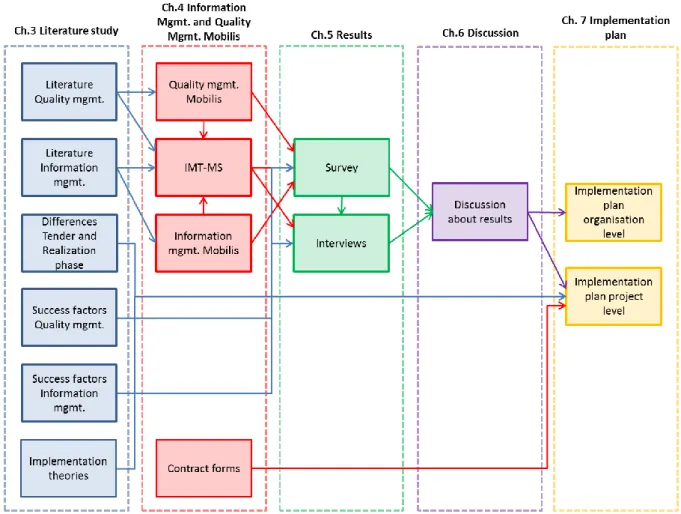
The research approach is summarized in Figure 5. In Chapter 3, the literature study, the basis for the research is set. The literature study consists of literature about: Quality management, Information management, the differences of the tender and realisation phase, implementation theories and success factors for the implementation of a quality management system and an information management system.
The literature about quality management and information management is further used in chapter 4
(Information and Quality management Mobilis) to describe the information and quality management of Mobilis B.V. In this chapter the contract forms used by Mobilis B.V. are also described.
With the success factors defined in chapter 3.5 a survey has been developed which is sent to users and managers of the combined quality and information management system (IMT-MS). The results of this survey are also summed up in chapter 5. The success factors and the results of the survey are used to conduct five
interviews with the management and developers of Mobilis. The results of the interviews are summarized in chapter 5.
The results of the survey and interviews are further discussed in chapter 6.
The results of the survey and interviews, the literature, the quality and information management of Mobilis and the contract forms are further used to come to an implementation plan on organisation level and on project level for the tender and realisation phase in chapter 7. These two implementation plans are the main result of the conducted research.
Finally, the conclusion will be drawn based on the main research question in chapter 8 and recommendations in general, for Mobilis and for further research on this subject will be given in chapter 9.
3.
Literature study
3.1.
Introduction
To create a solid base for the research, a literature study has been undertaken. The main research question of this chapter is:
What are the most relevant theoretical views on Quality Management, Information Management,
Implementation and the success factors for implementation of quality management and information management systems?
The chapter is split up in : Quality management
An introduction and explanation of quality management in the construction industry and a brief introduction of different quality management systems.
Information management
An introduction of information management in the construction industry and a short summary of the different information management systems available on the market for project management in the civil engineering sector.
Differences tender and realisation phase
To come to a better understanding of the different phases in a contractor, the differences between the two main phases of a contractor will be appointed which can be used in the implementation plans. Definition of success factors
From articles about the implementation of Information Management Systems (from Web-based Project Management Systems until general ICT systems) and Quality Management Systems (different QMS’s like ISO9001, Lean, Six Sigma, etc.) success factors will be derived for the implementation of a combined Quality Management System and Information Management System.
Implementation theories
Several theories for the implementation of ICT systems and general implementation theories are analysed as a basis for the implementation plan.
The sub research questions that will be questioned in this chapter and tried to be answered in the interim conclusion of the literature study:
Which quality management systems are available on the market and what are the advantages and
disadvantages of these systems?
Which information management systems are available on the market and what are the advantages
and disadvantages of these systems?
What are the essential differences between the tender and realisation phase for a contractor?
What are the success factors for implementation of information management and quality
management in a company?
Which theories for implementation of a new Project Management System or ICT system are available?
3.2.
Quality management in construction industry
“The main goal of the construction industry is to ensure that projects are successfully completed within the constraints of best quality, stated period and at minimum cost possible” (Alaudin and Hassan, 2011). Therefore clients in the Architecture, Engineering and Construction (AEC) industry have high demands for the quality of the construction and the construction process. To guarantee the quality of a construction, different quality management methods are used to ensure the quality of buildings (Steens et al., 1998).
The origin of quality management can be explained from history; from 1900 until 1950 the engineers and architects were in total control during the design phase. In the construction phase they acted as supervisors to ensure the quality the owner requested was met. In the 1950’s and 1960’s the owners became more
concerned at the cost and schedule factors, because the professionals were lacking on these factors. In that time the sealed competitive bid arose in the construction sector, giving the owner more possibility for advantageous pricing and the contractor to look to every advantage during construction to control cost and schedule. Also during that time mechanical and electrical systems became too complex for a general contractor to control, which leaded to subcontracting and sub-subcontracting. With these subcontracts, the quality control was delegated to the subcontractor. This leaded in the 1980’s to construction management firms that didn’t construct, but only managed the construction project. They emphasized on the quality control and a project quality control plan, because before the requirements on this topic were scattered throughout the contract. This leaded to procedures for inspecting and testing and procedures for the design process. These processes eventually became the Quality Management Systems. (Arditi and Gunaydin, 1997).
The definition of a Quality Management System (QMS) that is used for this thesis is: “A system by which an organisation aims to reduce and eventually eliminate non-conformance to specifications, standards, and customer expectations in the most cost effective manner.” (Business Dictionary, 2013) This ‘system’ in this thesis are the processes defined by the organisation, varying from the main processes in the company (acquisition and realisation of a construction) until the details in a company. To control these processes, the processes are constantly improved and updated to the current times and there is constantly checked if the defined processes are abided.
To achieve the level of quality requested by a client the production process has to be assured or the product quality has to be tested. The major goal of controlling the production process is to achieve more certainty about reaching the requested product quality. This can be reached by effectiveness, efficiency and balance. Effectiveness means that the set goals have to be reached, efficiency means that the project has to be
executed as efficient as possible and balance means that the interests of the stakeholders have to be respected (Steens et al., 1998).
3.2.1. Quality management systems
Which quality management systems are available on the market and what are the advantages and disadvantages of these systems?
In the Netherlands, the most used Quality Management System (QMS) certification is based on the ISO 9000 series. Most of the contractors, suppliers and advising companies are certified, because most clients demand this during the tender phase. The ISO 9001 certification does not ensure that every construction project is successful, but it helps by defining the company processes in a management system (Steens et al., 1998). The ISO 9001 is generic, which in this case means that it can be applied on every kind of company; not only the construction industry. (Carlebur, 2007).
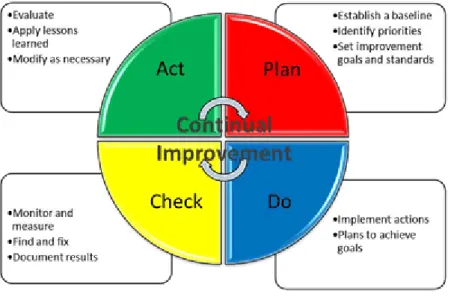
The major requirement for ISO 9001 certification is that the company has to develop a QMS, implement this in the company and continuous improvement of this QMS (ICS, 2008b). The improvement is summarised in the Plan-Do-Check-Act (PDCA) cycle of Deming, visualised in Figure 6. ‘Plan’ means to plan the activity beforehand, ‘Do’ to execute this activity according to the plan, ‘Check’ to check if the result is sufficient and ‘Act’ if
measures have to be taken to reach the expected result or to prevent mistakes in the future. The PDCA cycle can be applied on different levels; from activity to complete project or company process. (Steens et al., 1998)
Figure 6: Deming's PDCA cycle
Other quality management systems are also available, although they are less used in the Dutch construction industry, therefore only the definition is given:
Total Quality Management (TQM):
“TQM is an integrative philosophy of management for continuously improving the quality of products and processes” (Ahire, 1997).
Business Process Re-Engineering (BPR):
“The fundamental rethinking and radical redesign of business process to achieve dramatic improvement in critical contemporary measures of performance, such as cost, quality, service and speed” (Habib, 2013).
Lean manufacturing:
“The core idea is to maximize customer value while minimizing waste.” (Lean Enterprise Institute, 2009) Furthermore, there is no agreed upon definition of lean, because lean is constantly evolving. (Pettersen, 2009).
Six sigma:
“Six sigma seeks to improve the quality of process outputs by identifying and removing the causes of defects (errors) and minimizing variability in manufacturing and business processes” (Antony, 2008).
3.3.
Information management in construction industry
An information management system for a contractor is mainly a “centralised information system that is accessible to all parties in a construction project.” (Scott et al., 2012). Currently, information systems are almost all electronically and the amount of web-based information systems are increasing. The internet is a useful medium for the exchange of information for construction projects, because of the often large size of the projects, the amount of stakeholders and the location of the projects (Scott et al., 2012).
An information management system is a central data facility that can be used to create and maintain goals, schedules, standards, policies, procedures, etc. Common features of such a system are (Scott et al., 2012):
Access to project information is accessible anywhere and at any time (often through internet). Team communication, collaboration and decision-making is improved through the increased
transparency in the management process.
Handling data is cost effective and not prone to errors and delays caused in duplication.
Project management is controlled and systematic. Updated information on progress is available to all and is shared as soon as possible.
The quality of the project data is high and meets the real needs of the professionals involved, as a result of the timely transmission of information between designated parties, use of specified task specific formats, data accuracy and backup in well-defined and powerful database repository. Data of past projects is available for retrieval for new applications; for project maintenance needs,
project planning, etc.
The information management in the construction industry went through three stages: the first stage was until the 1970s; products were directly used to improve efficiency by manual processes of information manipulation at operational level. The second stage was the development of stand-alone packages from 1970. The third stage, from 1990, was the development of stand-alone systems into strategic electronic platforms for real-time structured data exchange. These information systems hold, manage and use data for a variety of management functions; the internet is an ideal medium for this goal.
Another certification for construction companies is the ISO 15288, which is a Systems Engineering (SE) standard. SE is not an information management system, but it influences the information management in contractors, because the method is often used to structure the information during construction projects. The definition of INCOSE (International Council on Systems Engineering), which is also used by Rijkswaterstaat (RWS) of Systems Engineering is: “An interdisciplinary approach and means to enable the realisation of successful systems. Systems Engineering considers both the business and the technical needs of all customers with the goal of providing a quality product that meets the user needs.” Systems Engineering is advised to be used by Rijkswaterstaat and ProRail, which are the major clients in the Civil Engineering industry in the Netherlands. It is currently not mandatory for contractors to be certified for the ISO 15288, but it is sometimes required for a construction project (RWS and ProRail, 2009).
3.3.1. Information management systems
Which information management systems are available on the market and what are the advantages and disadvantages of these systems?
Different Information Management Systems (IMS) are described and compared at certain aspects. The variety of the IMSs is broad and they focus on different aspects of a company or project.
Electronic Document Management System (EDMS)
The Electronic Document Management System (EDMS) is the simplest version of the discussed Information Management Systems. The definition of Electronic Document Management of CIMdata:
“Electronic Document Management (EDM) is the management of electronic documents and the processes used to create, release and maintain those documents within an enterprise. Most EDM systems can also manage paper based documents by reference to the physical location of the ‘paper’ document” (www.cimdata.com). Two types of data are stored in an EDM system (Leenen, 2002):
Product Data generated by various applications, such as specifications and CAD models. Meta-data, which is data about controlled product data. Meta-data is stored in a database and
An EDM system provides the following functions (Leenen, 2002): Central document storage
Document retrieval and searching Document viewing, editing and printing Document version and status control Document authorisation
Enterprise Resource Planning (ERP)
Enterprise Resource Planning (ERP) is a system to integrate different processes inside a company or project. It started as a system for administration, but it grew to integrate multiple departments and it differs per company what is exactly integrated in the ERP.
A definition of Enterprise Resource Planning is “an integrated information technology solution, to better integrate various business functions and resources, particularly those related to project accounting procedures and practices” (Chung, 2008).
Product Lifecycle Management (PLM)
For comparison of different Information Management Systems the two systems Product Data Interchange (PDI) and Integral Product Model (IPM) are included under the name Product Lifecycle Management (PLM). The reason for this is because the terms PDI and IPM are slightly out of date and PLM is currently more used. Furthermore, the three systems have that much similarities, that for this comparison it is more useful to include the three under one name. The definitions of PDI and IPM are:
“Product Data Interchange (PDI) involves all activities that are necessary for the definition, archiving, management, exchange and usage of product data by means of electronic media in a technical environment. The product data is stored in standardised documents or product models and covers the total lifecycle of a product” (Teeuw, 1994).
“An Integral Product Model (IPM) is an electronic replica of the product (building) in a computer system. It is a single, well managed source of information and contains all data required for designing, building and (possibly) maintaining the product” (Leenen, 2002).
The definition of PLM is:
“Product Lifecycle Management (PLM) is the business activity of managing, in the most effective way, a company’s products all the way across their lifecycles; from the very first idea for a product all the way through until it’s retired and disposed of.“ (Saaksvuori, 2011)
PLM is more used for the lifecycle of products in industry instead of projects in the construction industry, but the system can also be used for the construction industry.
Building Information Modelling (BIM)
Building Information Modelling (BIM) is an innovation that is increasingly used in the AEC industry. This new technology improves the design process, the lifecycle management of the facility and the project team collaboration. BIM uses parametric designing creating one model consisting of the input of all disciplines and creates a unique information database for a project. (Eastman et al., 2011)
“Building Information Modelling (BIM) is a digital representation of physical and functional characteristics of a facility. A BIM is a shared knowledge resource for information about a facility forming a reliable basis for
decisions during its life-cycle; defined as existing from earliest conception to demolition.” (National BIM Standard – United States)
3.4.
Differences tender and realisation phase
What are the essential differences between the tender and realisation phase for a contractor?
Because the eventual implementation plan for the Information Management System with integrated Quality Management System will be separated for the tender phase and the realisation phase the differences of these two phases will be appointed. These differences are further used in chapter 6, the implementation plan. At first, the processes of the tender and realisation phase are described according to the Quality Management System of Mobilis:
Tender phase
The tender phase follows after the acquisition and possibly selection phase. The acquisition phase is where the available projects on the market are selected by the organization. The selection phase is where a company or alliance has to prove that they are capable of executing the project by selection criteria defined by the client. After the acquisition phase or selection phase the tender phase commences. A tender team is composed, the contract is analysed, an approach plan is made and risk analysis is executed; after the risk analysis there is a GO / NO GO moment. When there is a GO after this moment, the tender team is enlarged and the data and objects are structured. Variants for the design are made and elaborated to come to an Offer Design (OD). After comment on the OD the activities are planned, the work methods are decided and the organisation of the project is decided.
After the calculation there is another internal GO / NO GO moment to decide by the management board if the price will be offered to the client. After this moment a file is made to offer to the client. After decision of the client, the project will be awarded or not. When the project is awarded, the contract will be signed and there can be continued to the realisation phase. (Mobilis, 2012a)
Realisation phase
After the awarding of the project during the tender phase, the realisation phase can start. At first a realisation team is composed and the project is transferred from the tender team to the realisation team. The data is structured in more detail and research is undertaken in more detail. The Quality Management System is filled in with; project management, surroundings management, technical management, procurement management, project control and project support. Further risks are analysed and the specifications for the Temporary Design (TD) are made and the TD is executed. The TD is checked and the same steps are taken for the Definitive Design (DD); the same steps are undertaken for the Execution Design. With the design steps the design is taken further in detail.
Work methods are defined and there is applied for permits. A detailed planning is made and the execution is started. During the execution the project is controlled and tested. A delivery file is made after completion including the As-Built drawings, test results and requirement validation report. With the delivery of this delivery file the project will be completed and afterwards evaluated. (Mobilis, 2012b)
Differences
With the processes explained, there are a lot of coincidences with the two phases. Both phases contain design loops to go further into detail and both phases have the composition of a project team. But there are also differences, based on the Quality Management System of Mobilis (Mobilis, 2012a and 2012b) and the conducted interviews of paragraph 5.5:
The biggest difference lies in the level of detail; in the realisation phase the design goes through five loops to come to further detail.
Specific elements can be kept out of the design in the tender phase, but in the realisation every detail has to be designed.
The financial control during the realisation phase is more strict.
The client will test if the requirements are met during the realisation phase, not during the tender phase.
The team is newly started at the tender phase, with the realisation phase there is a transfer of the project, but often a large part of the team goes from the tender team to the realisation team, to keep the knowledge obtained during the tender phase.
The design that has won during the tender phase has to be ‘frozen’ including all the data that has been agreed upon by signing the contract. With the realisation phase there will be started with this design.
3.5.
Definition of success factors
What are the success factors for the implementation of information management and quality management in a company?
To define the success factors for the implementation of the implementation of an integrated Quality Management System (QMS) in an Information Management System (IMS) different literature has been reviewed on different subjects. Direct literature about this subject was not available, therefore success factors are defined about the implementation of a IMS and QMS separately first. These are compared, along with the few articles available about systems that combined QMS and IMS, and this leads to success factors (SF) which can be used for both systems.
The sequence of the success factors is now presented with the SF’s about IMS’s specifically first, then QMS’s specifically and afterwards a combined IMS with QMS. The sequence is changed for later purposes with the survey, therefore the SF’s are in a different sequence in this chapter.
First of all, literature on the implementation of IMS’s is reviewed. IMS’s are in this case Information systems
Web-based project management systems
Web-based construction information management systems Product Data Interchange (PDI)
Enterprise Resource Planning (ERP)
These systems represent different industries; some systems can be used in every market segment, some only in the construction industry. These systems also differ on the usability; some systems can only be used in one part of a company (for instance administration), others for a complete company. The success factors derived from these articles can be found in Appendix A. All these success factors leaded to the following list of success factors, specifically for IMS’s:
SF19: Decision support (Kim (2003))
SF20: Compatibility with other systems (Scott (2012), Chung (2008)) SF21: System quality (DeLone (2003), Kim (2003))
SF22: Flexibility of queries and reporting formats (Nitithamyong (2010)) SF23: System possibilities
o SF23a: Document management
o SF23b: Planning
o SF23c: Costs
o SF23d: Administration
o SF23f: Human Resources
o SF23g: Safety department
o SF23h: Quality department
Next to the success factors about IMS, success factors for the implementation of Quality Management Systems (QMS) are also derived from multiple articles. The different QMS’s analysed are:
ISO 9001
Total Quality Management (TQM) Business Process Re-engineering (BPR) Lean manufacturing
Six sigma
These systems are not all used in the construction industry, but the implementation success factors and experiences with the systems can prove useful for the construction industry. The success factors derived from the different articles can be found in Appendix B. The success factors specifically for the implementation of a QMS are:
SF24: Process support
SF25: Process improvement (Sharp et al. (2005), Yusof and Aspinwall (1999), Pheng and Teo (2004), Salaheldin (2008), Al-Mashari and Zairi (1999))
SF26: Process mapping (Al-Mashari and Zairi (1999))
The goal of this chapter is to come to success factors for the implementation of an IMS with an integrated QMS. Further literature about combined QMS and IMS were analysed, but no success factors could be defined. Therefore, the success factors of QMS and IMS are compared to lead to success factors that can be used for a combined system. These success factors are separated in technical and organisational:
Organisational success factors
SF1: Clear and open goals and policy (Salaheldin (2008), Habib (2013), Al-Mashari and Zairi (1999), Bakas et al. (2011))
SF2: Top management support (Nitithamyong (2010), Chung (2008), Yusof and Aspinwall (1999), Pheng and Teo (2004), Salaheldin (2008), Habib (2013), Al-Mashari and Zairi (1999), Bakas et al. (2011), Coronado et al. (2002))
SF3: User involvement
o SF3a: User involvement development phase (Nitithamyong (2010), Pheng and Teo (2004), Salaheldin (2008), Al-Mashari and Zairi (1999), Bakas et al. (2011))
o SF3b: User involvement implementation phase (Nitithamyong (2010), Pheng and Teo (2004), Salaheldin (2008), Al-Mashari and Zairi (1999), Bakas et al. (2011))
SF4: Presence of a ‘champion’(Nitithamyong (2010))
SF5: Adequacy of training (Nitithamyong (2010), Sharp et al. (2005), Yusof and Aspinwall (1999), Salaheldin (2008), Al-Mashari and Zairi (1999),Bakas et al. (2011), Coronado et al. (2002))
SF6: Computer experience of project team members (Nitithamyong (2010)
SF7: Open and effective communication (Sharp et al. (2005), Habib (2013), Al-Mashari and Zairi (1999), Bakas et al. (2011), Coronado et al. (2002))
SF8: Exchange of data by team members(Teeuw (1994))
SF9: Improvement of collaboration (Teeuw (1994), Sharp et al. (2005), Salaheldin (2008), Habib (2013), Al-Mashari and Zairi (1999))
SF11: Support quality (DeLone (2003), Nitithamyong (2010), Scott (2012), Chung (2008)) o SF11a: Quality of support service (Nitithamyong (2010))
o SF11b: Knowledge of support provider in construction (Nitithamyong (2010)) SF12: Project duration (Nitithamyong (2010))
SF13: Customer involvement (Pheng and Teo (2004), Salaheldin (2008))
SF14: Supplier involvement (Yusof and Aspinwall (1999), Pheng and Teo (2004), Salaheldin (2008))
Technical success factors
SF15: Adequate alignment of IT infrastructure with QMS strategy (Salaheldin (2008), Habib (2013), Al-Mashari and Zairi (1999))
SF16: Redesign of QMS processes for integration in IMS
SF17: System reliability (Saarinen (1996), Nitithamyong (2010), Scott (2012), Chung (2008), Kim (2003)) o SF17a: Availability and reliability of data connections and IMT-MS access (Nitithamyong
(2010))
o SF17b: Data security (Nitithamyong (2010))
SF18: Ease of system use (Nitithamyong (2010), Scott (2012), Kim (2003)) o SF18a: Interface satisfaction (Kim (2003))
These success factors are further used to create a survey in chapter 5.2.
3.6.
Implementation theories
Which theories for implementation of a new Project Management System or ICT system are available? Lots of theories are available for implementing a new system or product in general and there are several theories for implementing a new ICT system. Not every theory will be summarized, but two useful theories will be explained for implementing a new information management system or implementing a system in general. Gartner’s Hype Cycle
Gartner’s hype cycle treats five phases of the introduction of a new product or system, the theory can be applied on a large variety of products or systems. The theory is visualised in Figure 7, the five different phases:
1. Technology trigger
A new product or system is implemented. 2. Peak of inflated expectations
Only limited information is available about the system, but the expectations are high and limitations are not discussed.
3. Trough of disillusionment
There will be realised that the high expectations cannot be met. Still only limited information is available about the system and this information is mainly about the problems and limitations of the system.
4. Slope of enlightenment
After previous phases a large part of supporters has pulled out of the system, but the group still active with the system is working on the real implementation.
5. Plateau of productivity
In this phase the system is implemented, can be used and there is transparency about the possibilities of the system.
Figure 7: Gartner's Hype Cycle (source: O'Leary, 2008)
This theory can be used to analyse in which phase the implementation of a new information management system is at a certain moment and how users think about the system.
Innovation theory Rogers
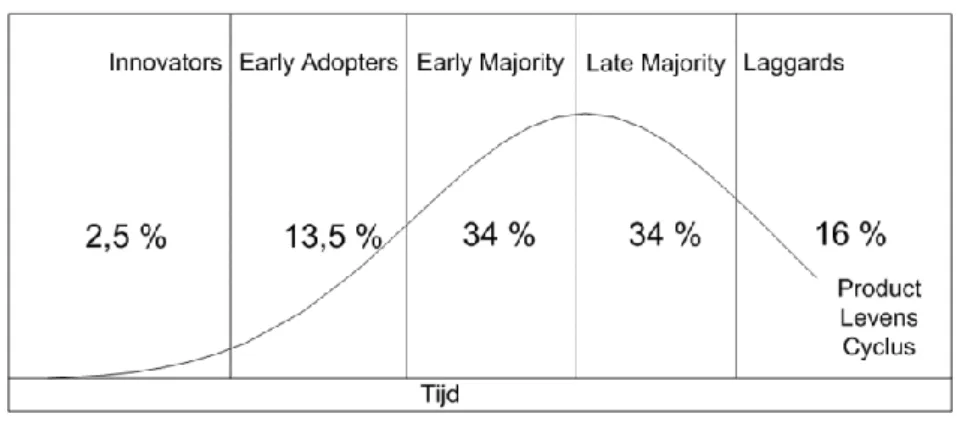
The innovation theory from Rogers aims on the users of a new technology. Five different groups are separated, see also Figure 8:
1. Innovators
The first people who want to develop or adapt to a new technology. 2. Early adopters
Small part of majority that want new products or want to adapt to new systems. 3. Early majority
The ‘mass’ that start using a new system or product; with this group the group reaches maturity. 4. Late majority
The group that adapts to a new technology if the majority already uses it; more than 50% of the total group uses the product or system.
5. Laggards
The last persons that will use the system; with this group the system is fully implemented.
Figure 8: Innovation theory Rogers (Source: Rogers, 1971)
With this theory it is possible to determine in which group the different developers, users or managers are located.
3.7.
Interim conclusion
The literature study has been undertaken to answer the following research question:
What are the most relevant theoretical views on Quality Management, Information Management,
Implementation and the success factors for implementation of quality management and information management systems?
Because different topics are addressed within this research question, the topics are answered separately. Quality management
The introduction of quality management in the construction industry started in the 1950’s and the improvement of quality management systems (QMS) is still continuing. The origin lies in the shift of
responsibilities and the complexity of the construction projects. A QMS is nowadays necessary to ensure the quality of a construction. The most relevant definition of a QMS is: “A system by which an organisation aims to reduce and eventually eliminate non-conformance to specifications, standards, and customer expectations in the most cost effective manner” (Business Dictionary, 2013). The system in this thesis consists of the processes defined by the organisation; these processes are improved with the Plan-Do-Check-Act method. A well
renowned certification for QMS’s in the construction industry is the ISO9001, different QMS’s used are: Total Quality Management (TQM)
Business Process Re-engineering (BPR) Lean manufacturing
Six sigma
Information management
Information management in the current construction industry is necessary because of the complexity of construction projects. The definition of an information management system (IMS) for the construction industry is a “centralised information system that is accessible to all parties in a construction project” (Scott et al., 2012). The difficult thing is to have the right information available for the right person, because with large construction projects there is a very large amount of information available, which has to be structured and clear to be easily accessible. The internet is now often used as a medium for IMS’s in the construction industry, because of the easy accessibility. Systems Engineering is now often used to structure the information during a project; which makes the communication easier between client and contractor. Information management systems that are often used are:
Electronic Document Management System (EDMS) Enterprise Resource Planning (ERP)
Product Lifecycle Management (PLM) Building Information Modelling (BIM) Differences tender and realisation phase
The biggest difference between the tender and realisation phase is the level of detail of design; the design in the realisation phase is far more detailed than in the tender phase. Furthermore, the financial pressure and control of the client is added in the realisation phase. Another difference is that certain processes are added during the realisation phase, like testing and delivery. It is useful for the consistency of the project that key players of the tender project team are transferred to the realisation project team, because not all of the information can be transferred.
Definition of success factors
From literature about the implementation of IMS’s and QMS’s success factors are defined about the implementation of these two systems separately. These SF’s are compared to come to SF’s for a combined
system. Eventually, 26 success factors are defined, where 5 are specifically for the implementation of a IMS, 3 are specifically for the implementation of a QMS and 18 are for the implementation of a combined QMS with IMS. The success factors for a combined system are split up in organisational and technical success factors. The list of success factors can be found in paragraph 3.5.
Implementation theories
Two theories are explained for the implementation of a new IT system; the Gartner’s Hype cycle and the Innovation theory of Rogers. Gartner’s hype cycle separates five stages of the introduction of a new system; Technology trigger, Peak of inflated expectations, trough of disillusionment, slope of enlightenment and the plateau of productivity. The innovation theory of Rogers defines five different groups of users for a new technology; innovators, early adaptors, early majority, late majority and laggards.
4.
Information Management and Quality Management Mobilis
4.1.
Introduction
This thesis research has been conducted at the company Mobilis; Mobilis developed an Information
Management System with integrated Quality Management System (IMT-MS). At first, Mobilis will be explained and the contract forms that Mobilis executes. The quality management, information management and IMT-MS of Mobilis is explained. This will be done according to the following research question and sub research question:
What are the contract forms used and how is the Quality Management and Information Management
structured at Mobilis? Sub research questions:
What are the current contract forms and demands from the different project in the markets
infrastructure, water and industry?
4.2.
Introduction Mobilis
Mobilis is a Dutch contractor and part of TBI Infra (see Figure 9: Organisation chart TBI Holdings B.V.). TBI is a holding with 8.500 employees and an annual turnover of 2.2 billion euro. Mobilis, as part of TBI Holdings B.V., is a civil contractor specialised in the contracting and executing of projects in the civil construction industry in the Netherlands. Mobilis is active in the market segments Infrastructure, Water treatment and Industry and has an annual turnover of 185 million euros and has 240 employees (in 2011).
Figure 9: Organisation chart TBI Holdings B.V.
In July 2006 the three civil contractors Haverkort, Voormolen and Galjaard, all part of TBI Holdings B.V., merged to Haverkort Voormolen. The name changed to Mobilis in July 2009.
4.3.
Contract forms
What are the current contract forms and demands from the different project in the markets infrastructure, water and industry?
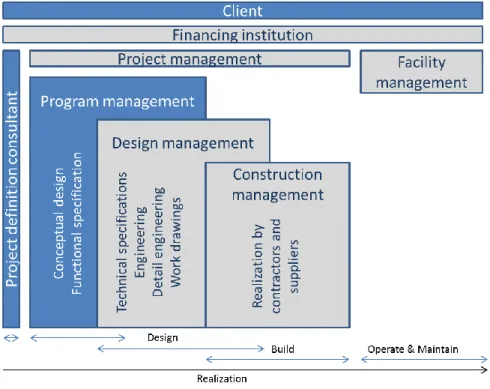
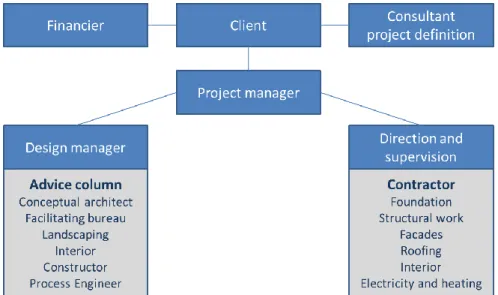
Currently lots of different contract forms are available in the construction industry. These contract forms mainly differ by the amount of responsibility the contractor is assigned to during the construction process. To organize the different contracts and responsibilities during a contract a standard scheme can be used to visualise the roles during a contract. The two schemes below (Figure 10 and Figure 11) can be used in almost every construction project to define the activities in phase or time and to define the participants in the project.