open access
1Nordic Cochrane Centre, Rigshospitalet, Copenhagen, Denmark
2University of Copenhagen, Faculty of Health and Medical Sciences, Denmark
Correspondence to: T Sharma Nordic Cochrane Centre, Rigshospitalet, Blegdamsvej 9, Department 7811, 2100 Ø Copenhagen, Denmark [email protected]
Additional material is published online only. To view please visit the journal online (http://dx.doi. org/10.1136/bmj.i65) Cite this as: BMJ 2016;352:i65 http://dx.doi.org/10.1136/bmj.i65 Accepted: 03 December 2015
Suicidality and aggression during antidepressant treatment:
systematic review and meta-analyses based on clinical
study reports
Tarang Sharma,
1 ,2Louise Schow Guski,
1 ,2Nanna Freund,
1 ,2Peter C Gøtzsche
1 ,2ABSTRACT
ObjeCtive
To study serious harms associated with selective serotonin and serotonin-norepinephrine reuptake inhibitors. Design
Systematic review and meta-analysis. Main OutCOMe Measures
Mortality and suicidality. Secondary outcomes were aggressive behaviour and akathisia.
Data sOurCes
Clinical study reports for duloxetine, fluoxetine, paroxetine, sertraline, and venlafaxine obtained from the European and UK drug regulators, and summary trial reports for duloxetine and fluoxetine from Eli Lilly’s website.
eligibility Criteria fOr stuDy seleCtiOn Double blind placebo controlled trials that contained any patient narratives or individual patient listings of harms.
Data extraCtiOn anD analysis
Two researchers extracted data independently; the outcomes were meta-analysed by Peto’s exact method (fixed effect model).
results
We included 70 trials (64 381 pages of clinical study reports) with 18 526 patients. These trials had limitations in the study design and discrepancies in reporting, which may have led to serious under-reporting of harms. For example, some outcomes appeared only in individual patient listings in
appendices, which we had for only 32 trials, and we did not have case report forms for any of the trials. Differences in mortality (all deaths were in adults, odds ratio 1.28, 95% confidence interval 0.40 to 4.06),
suicidality (1.21, 0.84 to 1.74), and akathisia (2.04, 0.93 to 4.48) were not significant, whereas patients taking antidepressants displayed more aggressive behaviour (1.93, 1.26 to 2.95). For adults, the odds ratios were 0.81 (0.51 to 1.28) for suicidality, 1.09 (0.55 to 2.14) for aggression, and 2.00 (0.79 to 5.04) for akathisia. The corresponding values for children and adolescents were 2.39 (1.31 to 4.33), 2.79 (1.62 to 4.81), and 2.15 (0.48 to 9.65). In the summary trial reports on Eli Lilly’s website, almost all deaths were noted, but all suicidal ideation events were missing, and the information on the remaining outcomes was incomplete.
COnClusiOns
Because of the shortcomings identified and having only partial access to appendices with no access to case report forms, the harms could not be estimated accurately. In adults there was no significant increase in all four outcomes, but in children and adolescents the risk of suicidality and aggression doubled. To elucidate the harms reliably, access to anonymised individual patient data is needed.
Introduction
Selective serotonin reuptake inhibitors (SSRIs) and serotonin-norepinephrine reuptake inhibitors (SNRIs) are some of the most commonly prescribed drugs.12 SSRI induced suicidality was first reported in 19903 but only became generally recognised after a BBC Pan-orama programme focused on it in 2002.4
A 2004 UK review showed a noticeable discrepancy between published and unpublished trials and increased suicidal behaviour in children and adoles-cents (aged <18 years),5 which resulted in serious warn-ings against these drugs being used in this age group.6 It is widely believed that the risk of suicide is not increased in adults, and support for this was provided by a Food and Drug Administration meta-analysis of about 100 000 patients.7 However, a large systematic review of published trials found an increase in suicide attempts with SSRI treatment,1 and another review using data submitted to the UK’s Medicines and Health-care products Regulatory Agency (MHRA) could not rule out an increased risk of suicidal behaviour during early treatment with these drugs.8
For aggressive behaviour (for example, hostility, assault) in general, reports are conflicting.9-15 A UK review using MHRA data found an increase in hostility in children and adolescents,16 and an analysis of adverse events reported to the FDA showed that antide-pressants were disproportionately involved in cases of violence, including murder.17 Many cases of aggressive behaviour have been reported,24 but, unlike with
WhAT IS AlReAdy knoWn on ThIS TopIC
Important information on harms is often missing in published trial reports Clinical study reports should therefore be the preferred source for systematic reviews of drugs
Antidepressants can increase the risk of suicide in children and adolescents
WhAT ThIS STudy AddS
Despite all the limitations we identified in the trials and in the clinical study reports, we found an increase in events of aggression with antidepressants (lost in adults alone), with a doubling of both suicidality and aggression in children and adolescents Selective reporting of relevant harms across the different sections of the clinical study reports meant that patient narratives, tables with individual patient listings (often found in appendices), and case report forms are needed for complete information Online summary reports of trials available from Eli Lilly’s website are inadequate as source documents for identifying harms data
suicidality, little systematic research has been under-taken. Perpetrators of school shootings and similar events have often been reported to be users of antide-pressants18 and the courts have in many cases found them not guilty as a result of drug induced insanity.4
Akathisia is an extreme form of restlessness, which some patients describe as wanting to “jump out of their skin,” that may increase the risk of suicide and vio-lence.241119-25 The Diagnostic and Statistical Manual of Mental Disorders describes akathisia or similar activa-tion symptoms as “medicaactiva-tion-induced movement dis-order not otherwise specified.”26
Clinical study reports are detailed summaries of trial results prepared by the drug industry for submission to regulatory authorities to obtain authorisation for market-ing. A recent review of clinical study reports showed that essential information on patient relevant outcomes was often missing in the published articles.27 Research undertaken by our centre using nine clinical study reports on duloxetine found that data on major harms was missing from journal articles and in summary trial reports.28 We did not have access to any case report forms (paper or electronic questionnaires that contain the col-lected data on each participant in the trial), although they would have been the ideal information source.28
We report here our results for mortality, suicidality, aggression, and akathisia based on clinical study reports for five different antidepressants.
Methods
In 2011, we requested clinical study reports on SSRIs and SNRIs from the European Medicines Agency and the UK’s MHRA. We did not get access to clinical study reports for all trials or for all the commonly pre-scribed drugs, and we did not receive case report forms for any of the trials. One researcher (TS) selected those clinical study reports that described double blind placebo controlled trials and which contained patient narratives (brief summaries of deaths, serious adverse events, or other events of clinical importance) or listings of adverse events in individual patients (with details such as patient iden-tifier, the adverse event (preferred term and verbatim term), duration, severity, and outcome).28
We were able to include five drugs: duloxetine, fluox-etine, paroxfluox-etine, sertraline, and venlafaxine (or venla-faxine extended release). We converted the clinical study reports to readable portable document format, and one researcher (TS) copied all relevant pages—with study information, protocols, all adverse event summa-ries and tables, relevant appendices (where available), patient narratives, and individual patient listings—for use in data extraction.
As a pilot, we randomly chose one report for each drug and read it in its entirety to help understand the different formats of the clinical study reports and to refine the data extraction form. We had planned that the second observer would extract the data blindly, with the treatment groups masked, but the pilot showed that the format and language used made blinding impossible. The primary researcher (TS) and a second
observer (LSJ or NF) extracted data from the selected pages of all the clinical study reports independently; disagreements were resolved by discussion and docu-mented using κ statistics (see supplementary data A). Outcomes
The primary outcomes were mortality and suicidality (suicide, suicide attempt or preparatory behaviour, intentional self harm, and suicidal ideation); secondary outcomes were aggressive behaviour and akathisia. To identify the primary outcomes, we used the same terms and phrases as those of the FDA729 and added addi-tional terms from our pilot. We searched the clinical study reports both electronically and manually. For people with more than one suicidality event, we counted only the most severe one, whereas this was not possible for the secondary outcomes, which only allowed us to count events. Terms for aggressive behaviour were informed by the pilot, and akathisia was identified by searching for “akathisia” in the text (see supplementary data A). All relevant events were classified using the Medical Dictionary for Regulatory Activities (MedDRA) coding dictionary. For duloxetine and fluoxetine, we compared the data with the sum-mary trial reports from Eli Lilly’s website.30
For meta-analysis of rare events, we reported odds ratios using Peto’s exact method and calculated 95% confidence intervals with a fixed effect model using RevMan 5.3.3132 All post-randomisation events were included, so when data from the lead-out and post-treat-ment phases were available, we combined them with the data from the randomised phase. In trials with multiple intervention arms, we added the data on arms arithmeti-cally to get a combined drug arm. We planned and con-ducted subgroup analyses for adults for all outcomes and for suicides and suicide attempts combined, and did post-hoc analyses for suicides and children and ado-lescents and a sensitivity analysis removing data from fraudulent centres, as suggested by peer reviewers. Patient involvement
No patients were involved in setting the research ques-tion or the outcome measures, nor were they involved in the design and implementation of the study. We plan to involve patient organisations in the dissemination of our results.
Results
We excluded 125 of the 198 clinical study reports: 96 were not double blind placebo controlled trials, 28 were studies in healthy volunteers, and one was a crossover trial (fig 1). Of the remaining 73 clinical study reports, we excluded five that had no patient narratives or indi-vidual patient listings of adverse events. The 68 included clinical study reports amounted to 64 381 pages and corresponded to 70 trials.
trial characteristics and study design
The experimental drugs were duloxetine (23 trials), flu-oxetine (n=3), paroxetine (n=8), sertraline (n=28), and venlafaxine (n=8). In total, 10 258 patients received a
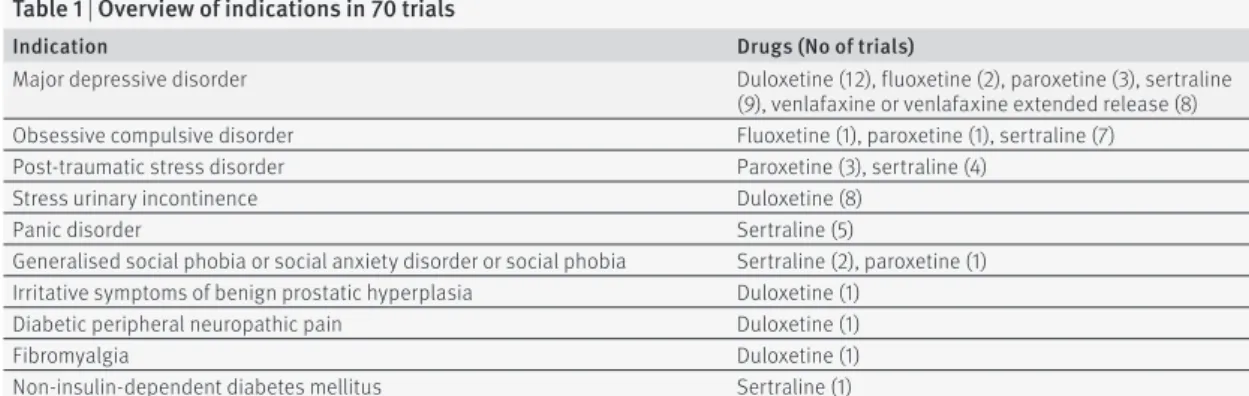
drug and 6832 a placebo. Fifteen trials had an additional (SSRI or SNRI) comparator in 669 patients (228 receiving fluoxetine and 441 receiving paroxetine) and a tricyclic or tetracyclic comparator in 767 patients. Eleven of the trials (12% of the patients) concerned children and ado-lescents. Table 1 shows the indications for treatment; 34 trials included 7882 patients with major depressive dis-order. Patients at risk of suicide were excluded in 44 tri-als (63%); in 16 tritri-als, suicide risk was not an exclusion criterion (23%), whereas it was unknown in 10 trials (14%). The randomised phase of the trials lasted from one to 54 weeks (median nine weeks).
Sixty trials (86%) had a placebo lead-in period (4 to 14 days, median 7 days) and all of them excluded from randomisation those who improved while receiving pla-cebo, as judged by their Hamilton scores or similar. Rarely was there any information about the numbers excluded.
It was unclear to what extent sedatives were allowed or used. Four duloxetine trials and four sertraline trials allowed benzodiazepines or similar psychoactive drugs. However, in at least 50 trials (71%, we did not have access to the full protocol for all the trials), sedatives such as choral hydrate or zolpidem were allowed if the patients had difficulty sleeping.
The quality of the clinical study reports varied. For 32 trials we had individual patient listings of adverse events for all patients (in appendices, apart from the venlafaxine trials where the listings were part of the main report). We had access to the protocol for 44 trials;
for the remaining trials, only a summary of the study design was available. It seemed that all other appendi-ces were either only “available on request” to the author-ities or came under “the system of exceptions set out in the Regulation (EC) No 1049/2001,” and so could not be released to us. This is in line with the guidance for clini-cal study reports, where certain appendices are not required to be submitted to the EMA.33 For 27 trials, we only had abbreviated or summary clinical study reports; some of these were titled accordingly whereas others were called clinical study reports, although they were only short summaries of about 100 pages. For four trials of sertraline, we only had summary reports combining two trials each (trials 51 and 52, and trials 53 and 54) for which the protocols were the same. We analysed the results accordingly. Key characteristics of the included trials are available in the supplementary data B.
The drug companies had concerns about the validity of the data or fraudulent behaviour in three trials. The data from one centre in trial 28 was not included in the efficacy analyses “due to concerns over the validity of the data,” and in trial 34, one centre was shut down “following an internal audit that detected significant compliance violations.” Four centres in trial 70 exhib-ited potentially fraudulent behaviour: three centres had their study records “impounded by the Swiss police for fraud”; and for the fourth centre, “Many of the enrolled patients . . . had identical evaluations for consecutive visits, and . . . all 35 patients from this site had very sim-ilar evaluation patterns.”
The interobserver agreement for our assessments was high (κ=0.94). Most disagreements resulted from errors in data extraction; discussion and consensus was needed for only two events.
Mortality
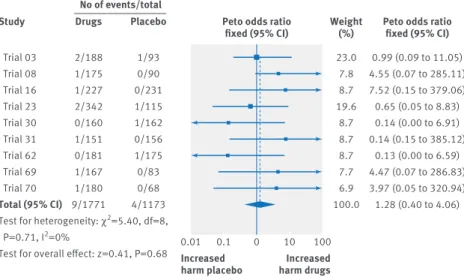
Sixteen deaths occurred, all in adults: one in the pla-cebo lead-in phase and one in a 12 week lead-in phase during treatment with duloxetine 60 mg/day. Post-ran-domisation, nine deaths occurred during treatment with an SSRI or SNRI and four with placebo (odds ratio 1.28, 95% confidence interval 0.40 to 4.06) plus one with imipramine (table 2 , fig 2, and supplementary data C). As none of the deaths occurred in fraudulent cen-tres, no sensitivity analysis was needed.
Four deaths were misreported by the company, in all cases favouring the active drug. One death in a
Clinical study reports available from regulators (n=198)
Total clinical study reports with double blind placebo controlled and/or active comparator randomised controlled trials (n=73)
Total relevant randomised controlled trial clinical study reports included, corresponding to 70 randomised controlled trials (n=68) Excluded non-double blind randomised
controlled trials, healthy volunteer studies, and crossover randomised
controlled trials (n=125)
Excluded trial reports without any individual patient listings or narratives (n=5)
fig 1 | flowchart showing selection of relevant studies for inclusion
table 1 | Overview of indications in 70 trials
indication Drugs (no of trials)
Major depressive disorder Duloxetine (12), fluoxetine (2), paroxetine (3), sertraline (9), venlafaxine or venlafaxine extended release (8) Obsessive compulsive disorder Fluoxetine (1), paroxetine (1), sertraline (7)
Post-traumatic stress disorder Paroxetine (3), sertraline (4)
Stress urinary incontinence Duloxetine (8)
Panic disorder Sertraline (5)
Generalised social phobia or social anxiety disorder or social phobia Sertraline (2), paroxetine (1) Irritative symptoms of benign prostatic hyperplasia Duloxetine (1)
Diabetic peripheral neuropathic pain Duloxetine (1)
Fibromyalgia Duloxetine (1)
participant receiving paroxetine (trial 31) was called a post-study event, taking place 21 days after the patient had admitted to taking the last dose, but this was on day 63 out of the 84 days of randomised treatment. Moreover, the patient had detectable paroxetine in the blood at the time of death. A patient receiving venlafax-ine (trial 69) attempted suicide by strangulation with-out forewarning and died five days later in hospital. Although the suicide attempt occurred on day 21 out of the 56 days of randomised treatment, the death was called a post-study event as it occurred in hospital and
treatment had been discontinued because of the suicide attempt. Conversely, a patient receiving placebo (trial 62) died on day 404, 26 days after the randomised phase ended, but the death was not listed as a post-study event as the patient had allegedly taken treatment until the previous day. Finally, a death in a participant receiv-ing venlafaxine (trial 70) that occurred three months after treatment was only noted in the patient narratives and nowhere else in the clinical study report.
suicidality
Overall, 155 suicidality events took place, 13 before ran-domisation. The odds ratio post-randomisation for sui-cidality in patients was 1.21 (95% confidence interval 0.84 to 1.74) and was similar for number of suicidality events (1.14, 0.80 to 1.64). The odds ratio for suicidality in adults was 0.81 (0.51 to 1.28) and 0.77 (0.49 to 1.21 for events) and for children and adolescents was 2.39 (1.31 to 4.33) and 2.24 (1.24 to 4.04 for events). None of the suicid-ality events occurred in patients from fraudulent centres. See table 3 , fig 3 and supplementary data C and D. Suicides
Six suicides were reported, one in the duloxetine lead-in phase. Post-randomisation five suicides were reported: two in the study drug group, two in the pla-cebo group (odds ratio 0.58, 95% confidence interval 0.07 to 4.48), and one in the imipramine group (see sup-plementary data C and D).
Suicide attempts
We counted all attempted suicides, including intentional self harm (for example, slitting of wrists), intentional overdoses, and obvious preparatory events (for example, putting a knife to the wrist or neck, but being stopped before any harm). Six of the 73 events (n=70 patients) took place before randomisation (four in participants taking duloxetine and two in participants taking placebo).
One of the events, in a participant taking placebo before randomisation, occurred on day 29, although the lead-in phase was supposed to last only 14 days. Also, one of the four suicide attempts in participants taking duloxetine before randomisation was only identified by
table 2 | number of all cause mortality events in 70 included trials
Phase of trial
no of deaths before
randomisation Drug arm third arm (imipramine) Placebo arm
Before randomisation 2 0 0 0
Randomised phase 0 8 1 3
Lead-out and post-treatment 0 1 0 1
Total No of deaths 2 9 1 4
Drugs: duloxetine, fluoxetine, paroxetine, sertraline, venlafaxine.
Trial 03 Trial 08 Trial 16 Trial 23 Trial 30 Trial 31 Trial 62 Trial 69 Trial 70 Total (95% CI)
Test for heterogeneity: χ2=5.40, df=8, P=0.71, I2=0%
Test for overall effect: z=0.41, P=0.68
0.99 (0.09 to 11.05) 4.55 (0.07 to 285.11) 7.52 (0.15 to 379.06) 0.65 (0.05 to 8.83) 0.14 (0.00 to 6.91) 0.14 (0.15 to 385.12) 0.13 (0.00 to 6.59) 4.47 (0.07 to 286.83) 3.97 (0.05 to 320.94) 1.28 (0.40 to 4.06) 23.0 7.8 8.7 19.6 8.7 8.7 8.7 7.7 6.9 100.0 0.01 0.1 0 10 100 Study Increased
harm placebo harm drugsIncreased
Peto odds ratio fixed (95% CI) Peto odds ratio
fixed (95% CI) Weight(%) 2/188 1/175 1/227 2/342 0/160 1/151 0/181 1/167 1/180 9/1771 Drugs 1/93 0/90 0/231 1/115 1/162 0/156 1/175 0/83 0/68 4/1173 Placebo No of events/total
fig 2 | Meta-analysis of all cause mortality for selective serotonin reuptake inhibitors (ssri s) or serotonin-norepinephrine reuptake inhibitors (snri s) compared with placebo post-randomisation
table 3 | Overall suicidality events in 70 included trials, before and post-randomisation
suicidality events Duloxetine fluoxetine Paroxetine sertraline venlafaxine all drugs Placebo imipramine
Before randomisation Drug event: Suicides 1 —* —* —* —* 1 0 —* Suicide attempts 4 —* —* —* —* 4 2 —* Suicidal ideation 4 —* —* —* —* 4 2 —* Suicidality 9 9 4 Post-randomisation Drug (any arm) event:
Suicides 1 0 0 0 1 2 2 1
Suicide attempts 8 5 18 9 3 43 22 2
Suicidal ideation 8 1 18 11 3 41 25 4
Suicidality 17 6 36 20 7 86 in 85 patients 49 in 46 patients 7 in 7 patients
Total population 4277 456 1766 3165 1263 10 927 6832 767
going over the appendices containing individual patient listings. This “possible suicide attempt” was listed as “mild” and was not documented elsewhere in the clini-cal study report and there was no patient narrative.
Five of the 67 post-randomisation events occurred during the lead-out or post-treatment phase of the trials (in three patients receiving study drugs and in two receiving placebo).
Of the remaining 62 suicide attempts (in 59 patients), 40 occurred in 39 patients receiving the study drug, 20 in 18 patients receiving placebo, and two in two patients receiving imipramine. Four of these events were only listed in the individual patient listings and three others only noted in adverse events tables (no further informa-tion was available as there was no narrative). Twenty seven events were coded as emotional lability or worsen-ing depression, although in patient narratives or individ-ual patient listings they were clearly suicide attempts. Conversely, several cases of suicidal ideation were called suicide attempts in the adverse events tables. One sui-cide attempt (intentional overdose with paracetamol (acetaminophen)) in a patient receiving fluoxetine was described as “elevated liver enzymes” in the adverse events tables, in contrast with the narrative (see supple-mentary data C). There was no difference between sui-cides and suicide attempts (odds ratio 1.05, 95% confidence interval 0.63 to 1.75). The odds ratio for adults was 0.60 (0.29 to 1.24) and for children and adolescents was 1.85 (0.90 to 3.83, see supplementary data D). Suicidal ideation
Seventy five participants experienced 76 suicidal ideation events, of which six events were in the lead-in phase (four were taking duloxetine and two placebo). Two of the four events in the duloxetine users were severe and had patient narratives. A third event was mild and was only recorded in treatment emergent adverse events tables. The fourth event, mild suicidal thoughts, appeared only in the appendix containing individual patient listings. Of the 70 post-randomisation events, 41 occurred in partici-pants receiving study drugs, 25 in those receiving placebo, and four in those receiving imipramine.
Sixty two patients experienced 63 events during the randomised phase of the trials (34 events in those receiving drugs, 25 in 24 participants receiving placebo, and four in participants receiving imipramine). Thirty two of these events were coded as emotional lability or worsening of depression in the treatment emergent adverse events tables, but it was clear from the patient narratives or individual patient listings that they were in fact ideation events.
Seven events occurred in the lead-out or post-treat-ment phases of the trials, and all in participants receiv-ing the study drug (see supplementary data C). aggressive behaviour
Three events of aggressive behaviour in participants receiving duloxetine and two in participants receiving pla-cebo took place before randomisation. Post- randomisation there were 62 events in participants receiving the study drugs, 28 in participants receiving placebo, and four in Adults Trial 03 Trial 04 Trial 05 Trial 06 Trial 07 Trial 08 Trial 09 Trial 11 Trial 30 Trial 31 Trial 32 Trial 38 Trial 39 Trial 40 Trial 44 Trial 45 Trial 46 Trial 47 Trial 48 Trial 49 Trial 50 Trial 51 and 52 Trial 53 and 54 Trial 59 Trial 63 Trial 64 Trial 67 Trial 68 Trial 69 Trial 70 Subtotal (95% CI)
Test for heterogeneity: χ2=35.60, df=29,
P=0.19, I2=19%
Test for overall effect: z=0.91, P=0.36
Children and adolescents
Trial 24 Trial 25 Trial 26 Trial 27 Trial 28 Trial 29 Trial 33 Trial 34 Trial 42 Trial 43 Trial 56 Subtotal (95% CI)
Test for heterogeneity: χ2=8.90, df=10,
P=0.54, I2=0%
Test for overall effect: z=2.86, P=0.004
Total (95% CI)
Test for heterogeneity: χ2=52.46, df=40,
P=0.09, I2=24%
Test for overall effect: z=1.02, P=0.31 Test for subgroup differences: χ2=7.96,
df=1, P=0.005, I2=87.4% 0.46 (0.02 to 8.88) 4.50 (0.07 to 285.95) 7.45 (0.77 to 72.30) 0.39 (0.05 to 2.84) 7.72 (0.15 to 389.54) 3.84 (0.16 to 92.95) 3.82 (0.16 to 93.42) 1.13 (0.24 to 5.23) 0.51 (0.10 to 2.58) 7.64 (0.15 to 385.12) 1.48 (0.19 to 11.05) 0.42 (0.02 to 7.30) 0.13 (0.01 to 2.16) 0.15 (0.00 to 4.93) 0.72 (0.12 to 4.23) 0.96 (0.19 to 4.90) 7.31 (0.15 to 368.46) 7.47 (0.15 to 376.30) 7.15 (0.14 to 360.43) 0.05 (0.00 to 3.27) 7.59 (0.15 to 382.44) 0.13 (0.00 to 6.67) 3.88 (0.29 to 51.92) 0.14 (0.00 to 7.06) 0.14 (0.00 to 7.20) 0.05 (0.00 to 3.04) 0.27 (0.01 to 6.52) 0.14 (0.00 to 7.09) 2.14 (0.46 to 9.84) 0.09 (0.02 to 0.41) 0.81 (0.51 to 1.28) 7.55 (0.47 to 122.46) 1.98 (0.20 to 19.22) 0.90 (0.08 to 10.61) 4.76 (1.25 to 18.14) 1.06 (0.32 to 3.57) 3.85 (0.76 to 19.44) 7.08 (0.44 to 113.82) 7.92 (0.16 to 400.28) 7.09 (0.73 to 69.11) 1.04 (0.14 to 7.54) 0.14 (0.00 to 6.89) 2.39 (1.31 to 4.33) 1.21 (0.84 to 1.74) 1.5 0.8 2.6 3.4 0.9 1.3 1.3 5.6 5.1 0.9 3.1 1.6 1.7 1.1 4.2 5.0 0.9 0.9 0.9 0.8 0.9 0.9 2.0 0.9 0.9 0.8 1.3 0.9 5.7 5.3 62.7 1.7 2.6 2.2 7.4 9.0 5.0 1.7 0.9 2.6 3.4 0.9 37.3 100.0 0.01 0.1 0 10 100 Study Increased
harm placebo harm drugsIncreased
Peto odds ratio fixed (95% CI) Peto odds ratio
fixed (95% CI) Weight(%)
1/188 1/196 3/123 1/128 1/136 2/264 2/264 7/390 2/160 1/151 3/365 2/151 0/129 1/159 2/100 3/86 1/94 1/96 1/211 0/135 1/76 0/44 3/241 0/85 0/72 0/315 1/238 0/100 8/249 2/180 50/5126 2/48 2/109 2/71 8/93 8/187 5/104 2/165 1/100 3/97 2/92 0/94 35/1160 85/6286 Drugs 1/93 0/99 0/122 3/139 0/142 0/90 0/89 2/126 4/162 0/156 1/186 1/37 2/129 1/40 3/108 3/83 0/93 0/97 0/204 1/69 0/78 1/43 0/84 1/88 1/76 1/152 1/80 1/104 1/83 6/68 35/3120 0/48 1/110 1/32 1/87 4/99 1/102 0/157 0/107 0/91 2/96 1/95 11/1024 46/4144 Placebo No of events/total
fig 3 | Meta-analysis of suicidality in participants receiving selective serotonin reuptake inhibitors (ssris) or serotonin-norepinephrine reuptake inhibitors (snris) compared with placebo post-randomisation
participants receiving imipramine, of which three in the paroxetine group and two in the placebo group occurred in the lead-out or post-treatment phase (table 4 ). Aggres-sive behaviour occurred more often in the drug group com-pared with placebo group (odds ratio 1.93, 95% confidence interval 1.26 to 2.95). The odds ratio for adults was 1.09 (0.55 to 2.14) and for children and adolescents was 2.79 (1.62 to 4.81, figure 4). If data were removed from trials 28 and 34 (paediatric trials in which each centre had fraudu-lent data), the increase in aggression remained: all ages 1.58 (1.00 to 2.51) and children and adolescents only 2.19 (1.17 to 4.11, see supplementary data D).
Only patient narratives were available for serious events and they included homicidal threat, homicidal ideation, assault, sexual molestation, and a threat to take a gun to school (all five participants receiving sertraline), damage to property, punching household items, aggres-sive assault, verbally abuaggres-sive and aggresaggres-sive threats (all five participants receiving paroxetine), and belligerence (fluoxetine). Details were unavailable for non-serious events, as they were either listed in adverse events tables or given in the appendix of individual patient listings without any narratives. These events were increased hos-tility, aggressiveness, rage, or anger.
akathisia
Thirty akathisia events occurred, all post-randomisa-tion (22 in participants receiving study drugs, six in par-ticipants receiving placebo, and two in parpar-ticipants receiving clomipramine); two of the events, both in par-ticipants receiving duloxetine, took place in the lead-out phase (table 5 ). Akathisia occurred more often in participants receiving the study drug than in those receiving placebo (2.04, 0.93 to 4.48), but this difference was not statistically significant: for adults 2.00 (0.79 to 5.04) and for children and adolescents (2.15, 0.48 to 9.65, fig 5). If data were removed from trial 70 (adults), where some centres had fraudulent data, the odds ratio becomes 1.99 (0.90 to 4.44) and for adults becomes 1.94 (0.75 to 4.99, see supplementary data D).
Some events were not listed as akathisia in the adverse events tables because of the coding dictionar-ies used. For example, in the three sertraline trials where we had access to both the verbatim and the coded preferred terms, akathisia seemed to have been coded as “hyperkinesia” according to the World Health Organisation Adverse Drug Reaction Terminology dic-tionary. We could only identify akathisia if we had access to the verbatim terms, which were sometimes available from individual patient listings or patient nar-ratives. For most duloxetine and fluoxetine trials, akathisia was also noted in the regular adverse events tables, and therefore the trials appeared to have more events than those for other drugs for which akathisia
table 4 | aggressive behaviour events in 70 included trials, before and post-randomisation
events Duloxetine fluoxetine Paroxetine sertraline venlafaxine all drugs Placebo imipramine
Before randomisation 3 0 0 0 0 3 2 0
Post-randomisation (any arm) 7 6 31 14 4 62 26 4
Total population 4277 456 1766 3165 1263 10 927 6832 767 Adults Trial 04 Trial 05 Trial 06 Trial 07 Trial 09 Trial 10 Trial 11 Trial 16 Trial 30 Trial 31 Trial 32 Trial 38 Trial 39 Trial 44 Trial 45 Trial 49 Trial 53 and 54 Trial 58 Trial 63 Trial 64 Trial 67 Trial 68 Subtotal (95% CI)
Test for heterogeneity: χ2=23.60, df=21,
P=0.31, I2=11%
Test for overall effect: z=0.24, P=0.81 Children and adolescents
Trial 24 Trial 25 Trial 26 Trial 27 Trial 28 Trial 29 Trial 33 Trial 34 Trial 42 Trial 43 Trial 56 Subtotal (95% CI)
Test for heterogeneity: χ2=10.67, df=10,
P=0.38, I2=6%
Test for overall effect: z=3.70, P<0.001 Total (95% CI)
Test for heterogeneity: χ2=38.80, df=32,
P=0.19, I2=18%
Test for overall effect: z=3.04, P=0.002 Test for subgroup differences: χ2=4.53,
df=1, P=0.03, I2=77.9% 4.50 (0.07 to 285.95) 0.51 (0.05 to 4.91) 0.39 (0.05 to 2.84) 7.78 (0.48 to 125.09) 3.82 (0.16 to 93.42) 0.13 (0.01 to 2.13) 0.02 (0.00 to 1.60) 7.52 (0.15 to 379.06) 1.01 (0.06 to 16.26) 7.64 (0.15 to 385.12) 0.48 (0.03 to 9.08) 3.47 (0.03 to 480.43) 0.13 (0.01 to 2.16) 8.00 (0.16 to 404.57) 7.14 (0.14 to 359.84) 4.53 (0.07 to 285.39) 3.85 (0.04 to 338.83) 3.82 (0.04 to 344.50) 7.81 (0.15 to 394.22) 7.20 (0.45 to 115.73) 0.02 (0.00 to 1.72) 0.53 (0.05 to 5.16) 1.09 (0.55 to 2.14) 0.14 (0.00 to 6.82) 1.01 (0.28 to 3.58) 4.27 (0.06 to 294.70) 7.41 (1.64 to 33.47) 4.67 (0.43 to 50.76) 7.32 (0.45 to 117.83) 2.28 (0.51 to 10.17) 6.01 (1.79 to 20.19) 7.09 (0.73 to 69.11) 1.04 (0.06 to 16.82) 1.36 (0.30 to 6.12) 2.79 (1.62 to 4.81) 1.93 (1.26 to 2.95) 1.0 3.5 4.6 2.3 1.8 2.3 0.9 1.2 2.3 1.2 2.1 0.7 2.3 1.2 1.2 1.0 0.9 0.9 1.2 2.3 0.9 3.5 39.3 1.2 11.2 1.0 7.9 3.2 2.3 8.0 12.2 3.5 2.3 7.9 60.7 100.0 0.01 0.1 0 10 100 Study Increased
harm placebo harm drugsIncreased
Peto odds ratio fixed (95% CI) Peto odds ratio
fixed (95% CI) Weight(%) 1/196 1/123 1/128 2/136 2/264 0/89 0/390 1/227 1/160 1/151 1/365 1/151 0/129 1/100 1/86 1/135 1/241 1/132 1/72 2/157 0/238 1/100 21/3770 0/48 5/109 1/71 7/93 3/187 2/104 5/165 10/100 3/97 1/92 4/94 41/1160 62/4930 Drugs 0/99 2/122 3/139 0/142 0/89 2/88 1/126 0/231 1/162 0/156 1/186 0/37 2/129 0/108 0/83 0/69 0/84 0/45 0/76 0/152 1/80 2/104 15/2507 1/48 5/110 0/32 0/87 0/99 0/102 2/157 1/107 0/91 1/96 3/95 13/1024 28/3531 Placebo No of events/total
fig 4 | Meta-analysis of aggressive behaviour in patients receiving selective serotonin reuptake inhibitors (ssris) or serotonin-norepinephrine reuptake inhibitors (snris) compared with placebo post-randomisation
was miscoded—for example, no cases of akathisia were reported in the paroxetine trials. These events would be missed in trials where such detailed information was not available. Therefore our number of akathisia events is likely to be an underestimate, as the event appeared to be have been coded under many other activation terms, such as irritability, agitation, or nervousness. Comparison of our data with the summary trial reports on eli lilly’s website
Information was limited on adverse events in these summary reports and it was not reliable. The number of serious events was always mentioned but the cases were not always explained and the reports focused on the most common adverse events. All reports contained tables of treatment emergent adverse events, but not for all patients (with the exception of trials 23 and 26 where complete data were tabulated), and in most cases the events were only shown if they occurred in, for exam-ple, at least 5% of patients. We were unable to find the
online summary reports for four trials (trials 19-22, all on duloxetine). All the eight deaths (six in participants receiving duloxetine and two in participants receiving placebo) post-randomisation were noted in the online summaries, although information on one suicide in a participant receiving duloxetine in the open label phase before randomisation in trial 7 was missing, as no data from that phase were available online. Only two (both participants receiving fluoxetine) of the 20 suicide attempts (14 participants receiving duloxetine, three fluoxetine, and three placebo) were documented in the summaries, and none of the 14 suicidal ideation events (eight in participants receiving duloxetine, two paroxe-tine, one fluoxeparoxe-tine, and three placebo) were men-tioned. Only 10 (three participants receiving fluoxetine and seven placebo) of the 25 aggressive behaviour events (five participants receiving duloxetine, six fluox-etine, and 14 placebo) were found online. Only three akathisia events (all participants receiving fluoxetine) of the 17 (10 receiving duloxetine, five fluoxetine, and two placebo) were in the summaries. However, the case of the “elevated liver enzymes” in a patient receiving fluoxetine in trial 26 was clarified as an intentional overdose.
discussion
Systematic reviews of harms are needed for a balanced view of medical interventions, particularly to elucidate the occurrence of rare but serious events.34 Clinical study reports are far more reliable than published trial reports,2428 but even using these we were unable to unravel the true number of serious harms. The trials had many shortcomings, in both the design and the reporting of the trials in the clinical study reports, and therefore our numbers are likely to be underestimates. The summary reports on Eli Lilly’s website were even more unreliable than we previously suspected.28 Only mortality had (almost) complete information.
Comparison with other studies
We found no significant differences in mortality or sui-cidality overall, but our data confirmed the increased risk of suicide in children and adolescents.516 We wanted to clarify these risks in adults and found no significant increase in association with drugs, similar to previous analyses.78 Our results however, cannot be compared easily with the results of the 2006 FDA meta-analysis7 as we had data from 18 526 patients, whereas the FDA included about 100 000 patients. The FDA did not con-sider the limitations of the trials that we identified and introduced some of their own—for example, by only counting events within 24 hours after the randomised phase was over. We counted all post- randomisation events in our study, although they were not always available. Interestingly, an FDA employee published a
table 5 | akathisia events in 70 included trials, post-randomisation (no events noted previously)
Drug (any arm) Duloxetine fluoxetine sertraline venlafaxine all drugs Placebo Clomipramine
Akathisia events 12 7 2 1 22 6 2 Total population 4277 456 3165 1263 10 927 6832 767 Adults Trial 01 Trial 02 Trial 05 Trial 08 Trial 09 Trial 10 Trial 11 Trial 49 Trial 53 and 54 Trial 70 Subtotal (95% CI)
Test for heterogeneity: χ2=8.56, df=9, P=0.48, I2=0%
Test for overall effect: z=1.47, P=0.14
Children and adolescents
Trial 24 Trial 25 Trial 26 Trial 42
Subtotal (95% CI)
Test for heterogeneity: χ2=3.58, df=3, P=0.31, I2=16%
Test for overall effect: z=1.00, P=0.32
Total (95% CI)
Test for heterogeneity: χ2=12.15, df=13, P=0.52, I2=0%
Test for overall effect: z=1.77, P=0.08 Test for subgroup differences: χ2=0.01, df=1, P=0.94, I2=0% 5.47 (0.54 to 55.61) 0.12 (0.00 to 6.28) 7.33 (0.15 to 369.38) 4.55 (0.07 to 285.11) 4.55 (0.41 to 50.48) 7.39 (0.46 to 119.09) 0.36 (0.06 to 2.06) 4.53 (0.07 to 285.39) 3.85 (0.04 to 338.83) 3.97 (0.05 to 320.94) 2.00 (0.79 to 5.04) 1.00 (0.06 to 16.22) 7.60 (0.78 to 73.80) 4.27 (0.06 to 294.70) 0.13 (0.00 to 6.40) 2.15 (0.48 to 9.65) 2.04 (0.93 to 4.48) 11.5 4.0 4.0 3.6 10.7 8.0 20.6 3.6 3.1 3.2 72.5 8.0 12.0 3.5 4.0 27.5 100.0 0.01 0.1 0 10 100 Study Increased
harm placebo harm drugsIncreased
Peto odds ratio fixed (95% CI) Peto odds ratio
fixed (95% CI) Weight(%)
3/103 0/82 1/123 1/175 3/177 2/89 4/390 1/135 1/241 1/180 17/1695 1/48 3/109 1/71 0/97 5/325 22/2020 Drugs 0/70 1/75 0/122 0/90 0/89 0/88 3/126 0/69 0/84 0/68 4/881 1/48 0/110 0/32 1/91 2/281 6/1162 Placebo No of events/total
fig 5 | Meta-analysis of akathisia in participants receiving selective serotonin reuptake inhibitors (ssris) or serotonin-norepinephrine reuptake inhibitors (snris) compared with placebo post-randomisation
paper in 2001 using FDA data that showed 22 suicides in 22 062 patients randomised to antidepressants,35 which equates to 10 per 10 000 population, but in the large FDA meta-analysis five years later, five suicides were reported in 52 960 patients, or 1 per 10 000 population.7
A review with over 40 000 patients using data sub-mitted to the UK’s Medicines and Healthcare products Regulatory Agency (MHRA) also found no increased risk for suicidality in adults using serotonin reuptake inhibitors (SSRIs), but noted that the relative frequency of reported self harm and suicidal thoughts in the trials compared with suicide indicated that non-fatal end-points were under-recorded.8 Another review, with 87 650 patients (all ages), reported a doubling in the odds of suicide attempts, which was statistically signif-icant,1 in contrast with our findings in adults. As with our study, both reviews found serious limitations in the trials and evidence of under-reporting of serious harms.
This under-reporting was also confirmed in the recent republication by independent investigators of study 329 of paroxetine in children and adolescents.36 We did not get access to the appendices of this trial, which contained the individual patient listings. Many suicidal events were only documented there, and even more suicidal events were only identified in the case report forms, which the investigators got access to after protracted negotiations with GlaxoSmithKline and then only through a single screen remote desktop interface, which made it impossi-ble for the researchers to review all 77 000 pages.36
We found that the risk of aggressive behaviour was doubled with use of antidepressants (all ages), which was a statistically significant result, but when we restricted our analysis to adults, there was no such effect. However, we did find a doubling of risk for children and adolescents, which is consistent with the increased inci-dence in hostility noted by the MHRA.16 We found that akathisia was much under-reported. Akathisia occurred more often in participants receiving drugs than receiving placebo, both in children and adolescents and in adults, but the difference was not significant (all ages, odds ratio 2.04, 95% confidence interval 0.93 to 4.48). We also found similar results in a systematic review of trials in healthy adult volunteers that included data from 10 published trials and two unpublished trials (clinical study reports obtained from EMA). Compared with placebo (n=226), antidepressants (n=318) were associated with an increased rate of activation or other precursor events for aggression and suicidality (odds ratio 1.81, 95% confi-dence interval 1.05 to 3.12).37
limitations in the trials and clinical study reports In most trials (86%), patients were only randomised if they failed to improve in the placebo lead-in period. One large trial had a 12 week open label period where 533 patients received duloxetine and only 278 patients (52%) who tolerated the drug were randomised. This gives rise to response based selection bias, which has an impact on the subsequent randomised phase. During that open label period for duloxetine, there was one suicide (by hanging), four suicide attempts, and four suicidal ideation events.
Another problem was insufficient lead-in periods.424 At least 36 trials had insufficient wash-out periods, lasting for only a few days or a week. An additional nine trials had no lead-in period. Even when a placebo lead-in period was specified it was not always adhered to—for example, in a venlafaxine trial (trial 70), the wash-out period was inadequate in 30 patients who received drugs before the study, and in a sertraline trial (trial 50) it was stated that “some patients proceeded to double-blind treatment without a prior placebo run-in.” As patients are often receiving treatment with similar drugs already, some may develop withdrawal effects when they are switched to a placebo,2412142324 which can be wrongly counted as adverse events. These iatrogenic harms can be substantial. In a large study supported by Eli Lilly, with-drawal symptoms were registered in patients during a 5-8 day period; 4-24 months after their depression had remit-ted. Placebo was substituted for active drug, unknown to the patients, and when the patients were switched to pla-cebo, about one third receiving sertraline or paroxetine became agitated, irritable, reported worsened mood, and their Hamilton depression score increased by at least 8.38
Most trials did not report on post-treatment events. As previously noted, the FDA included events occur-ring within the first 24 hours after the randomised phase ended.7 For sertraline trials in adults (the report’s table 30; we reanalysed this summary data), there was no increased risk of suicide or suicide attempts (risk ratio 0.87, 95% confidence interval 0.31 to 2.48).7 When Pfizer analysed its trial data, the results looked much better for sertraline (we reanal-ysed their data for suicide or suicide attempts); risk ratio 0.52 (0.17 to 1.59).39 However, Pfizer published an additional analysis where the patients were followed up for 30 days after the randomised phase ended and then sertraline did not seem to protect against suicides or suicide attempts in adults but rather seemed to cause them (we reanalysed their data, risk ratio 1.47, 0.77 to 2.83), even though these findings were not sig-nificant.39 The investigators who used MHRA data8 found that when events after 24 hours were included, the risk of suicide or self harm was doubled with ser-traline: we reanalysed the data (risk ratio 2.14, 0.96 to 4.75), although the finding was not statistically signif-icant (see supplementary data D).7
Another limitation was the use of different coding dictionaries; 32 trials (46%) did not state which one they used. Sixteen of the sertraline trials used the World Health Organisation Adverse Drug Reaction Terminol-ogy, and as it does not allow for coding of akathisia or suicidal ideation, such events are most likely to be underestimated in our review. Furthermore, we found that many suicidal ideation events were coded as “worsening depression” or “emotional lability” in treat-ment emergent adverse events tables in the paroxetine trials, which used their own dictionary (the Adverse Drug Experience Coding System, ADECS), as has been noted by other studies.3640 Only one trial (trial 27) men-tioned this problem in the clinical study report, which stated that “emotional lability captures events such as suicidal ideation/gestures as well as overdoses.” We
could not find any akathisia events in the paroxetine trials, as we did not have access to the verbatim terms and the events were coded as other activation terms despite akathisia being the preferred term in the Coding Symbols for a Thesaurus of Adverse Reaction Terms dic-tionary, on which ADECS is based.41
Minor tranquillisers and sleeping aids were used in many of the studies, which tend to obscure aggression and akathisia events. Additionally, two thirds of all tri-als excluded patients at risk of suicide.
strengths and limitations of this review
We believe ours is the first comprehensive review of ran-domised controlled trial data using clinical study reports for aggressive behaviour and akathisia, and our finding of the doubling of aggression in children and adolescents is novel. Our review has highlighted limita-tions in the trials, not only in their design but also in their reporting in the clinical study reports, which may have led to serious under-estimation of the harms.
A main limitation of our review was that the quality of the clinical study reports differed vastly and ranged from summary reports to full reports with appendices, which limited our ability to detect the harms. Our study also showed that the standard risk of bias assessment tool was insufficient when harms from antidepressants were being assessed in clinical study reports. Most of the trials excluded patients with suicidal risk and so our numbers of suicidality might be underestimates com-pared with what we would expect in clinical practice. We also did not have access to case report forms and because of coding problems we deliberately took a con-servative approach and used only one term for identify-ing akathisia.
Conclusions and implications for research and practice
We believe our study shows that, despite using clinical study reports, the true risk for serious harms is still uncertain. The low incidence of these rare events and the poor design and reporting of the trials makes it dif-ficult to get accurate effect estimates.
The FDA has advised that antidepressants may also cause suicide in young adults (18 to 24 years) and recom-mends that “patients of all ages” treated with antide-pressants should be monitored for “clinical worsening, suicidality, and unusual changes in behaviour.”42 GlaxoSmithKline also issued letters to doctors, inform-ing them about the increased harm in young adults6 and admitted that for adults with depression “(all ages), the frequency of suicidal behaviour was higher in patients treated with paroxetine compared with placebo: 11/3455 (0.32%) versus 1/1978 (0.05%).”43 A cohort study from Sweden recently showed an increase in violent crime in young adults taking antidepressants (hazard ratio 1.43, 95% confidence interval 1.19 to 1.73).44
Therefore we suggest minimal use of antidepressants in children, adolescents, and young adults, as the seri-ous harms seem to be greater, and as their effect seems to be below what is clinically relevant.445-47 Alternative treatments such as exercise4849 or psychotherapy450 may
have some benefit and could be considered, although psychotherapy trials also suffer from publication bias.51
The need for identifying hidden information in clini-cal study reports to form a more accurate view of the benefits and harms of drugs has been highlighted by the Restoring Invisible and Abandoned Trials (RIAT) initia-tive,52 and the recent revised version of trial 329.36 More data from clinical study reports are expected to become available in the coming years, with the EMA’s new policy to make all newly submitted reports publicly available.53 As it can be quite labour intensive to perform systematic reviews using clinical study reports, more reliable auto-mated methods for text mining are needed, such that all data, including that from individual patient listings and case report forms, can be routinely considered.3654 We thank the European Medicines Agency and Medicines and Healthcare products Regulatory Agency for providing the clinical study reports used for this review. Some results of this study were presented at the Research waste/EQUATOR conference in Edinburgh, Scotland (September 2015).
Contributors: All authors had complete access to the data in the study. LSG was known by her maiden name Jensen at the time of the study. TS and PCG contributed to the study concept and design, wrote the protocol, and obtained funding. TS, LSG, and NF acquired the data for the study; all authors contributed to the analysis and/or interpretation of data. TS developed the first draft of the manuscript and all authors critically revised the manuscript and approved the final version. PCG is the study supervisor and guarantor.
Funding: This study is part of a PhD (TS) thesis, funded by the Laura and John Arnold Foundation. The funding source had no role in the design and conduct of the study; data collection, management, analysis, and interpretation; preparation, review, and approval of the manuscript; or the decision to submit the paper for publication. Competing interests: All authors have completed the ICMJE uniform disclosure form at http://www.icmje.org/coi_disclosure.pdf (available on request from the corresponding author) and declare: this study is part of a PhD funded by the Laura and John Arnold Foundation for lead author (TS); no financial relationships with any organisations that might have an interest in the submitted work in the previous three years; no other relationships or activities that could appear to have influenced the submitted work.
Ethical approval: Not required.
Transparency: The lead author (TS) and study guarantor (PCG) affirm that the manuscript is an honest, accurate, and transparent account of the study being reported. No important aspect of the study has been omitted. No discrepancies are withheld.
Data sharing: Additional data and the clinical study reports can be obtained from the corresponding author on request.
This is an Open Access article distributed in accordance with the Creative Commons Attribution Non Commercial (CC BY-NC 3.0) license, which permits others to distribute, remix, adapt, build upon this work non-commercially, and license their derivative works on different terms, provided the original work is properly cited and the use is non-commercial. See: http://creativecommons.org/licenses/ by-nc/3.0/.
1 Fergusson D, Doucette S, Glass KC, et al. Association between suicide attempts and selective serotonin reuptake inhibitors: systematic review of randomised controlled trials. BMJ 2005;330: 396. doi:10.1136/bmj.330.7488.396
2 Healy D. Let them eat Prozac.New York University Press, 2004. 3 Teicher MH, Glod C, Cole JO. Emergence of intense suicidal
preoccupation during fluoxetine treatment. Am J Psychiatry 1990;147: 207-10. doi:10.1176/ajp.147.2.207
4 Gøtzsche PC. Deadly psychiatry and organised denial.People’s Press, 2015.
5 Whittington CJ, Kendall T, Fonagy P, et al. Selective serotonin reuptake inhibitors in childhood depression: systematic review of published versus unpublished data. Lancet 2004;363: 1341-5.
6 Healy D. Did regulators fail over selective serotonin reuptake inhibitors?BMJ 2006;333: 92-5. doi:10.1136/bmj.333.7558.92 7 Laughren TP. Overview for December 13 meeting of
Psychopharmacologic Drugs Advisory Committee (PDAC). 2006. www.fda.gov/ohrms/dockets/ac/06/briefing/2006-4272b1-01-fda. pdf.
8 Gunnell D, Saperia J, Ashby D. Selective serotonin reuptake inhibitors (SSRIs) and suicide in adults: meta-analysis of drug company data from placebo controlled, randomised controlled trials submitted to the MHRA’s safety review. BMJ 2005;330: 385. doi:10.1136/bmj.330.7488.385 9 Bond AJ. Antidepressant treatments and human aggression. Eur J
Pharmacol 2005;526: 218-25. doi:10.1016/j.ejphar.2005.09.033 10 Bouvy PF, Liem M. Antidepressants and lethal violence in the
Netherlands 1994-2008. Psychopharmacology (Berl) 2012;222: 499-506. doi:10.1007/s00213-012-2668-2
11 Breggin PR. Fluvoxamine as a cause of stimulation, mania, and aggression: a critical analysis of the FDA-approved label. Ethical Hum Sci Serv 2002;4: 211-27
12 Breggin PR. Suicidality, violence and mania caused by selective serotonin reuptake inhibitors (SSRIs): a review and analysis. Int J Risk Saf Med 2003;16: 31-49
13 Krakowski M. Violence and serotonin: influence of impulse control, affect regulation, and social functioning. J Neuropsychiatry Clin Neurosci 2003;15: 294-305. doi:10.1176/jnp.15.3.294
14 Lucire Y, Crotty C. Antidepressant-induced akathisia-related homicides associated with diminishing mutations in metabolizing genes of the CYP450 family. Pharmgenomics Pers Med 2011;4: 65-81. doi:10.2147/PGPM.S17445
15 Walsh MT, Dinan TG. Selective serotonin reuptake inhibitors and violence: a review of the available evidence. Acta Psychiatr Scand 2001;104: 84-91. doi:10.1034/j.1600-0447.2001.00357.x 16 United Kingdom Committee on Safety of Medicines, CSM. report of
the CSM Expert Working Group on the safety of selective serotonin reuptake inhibitor antidepressants. Medicines and Healthcare products Regulatory Agency; 2004
17 Moore TJ, Glenmullen J, Furberg CD. Prescription drugs associated with reports of violence towards others. PLoS One 2010;5: e15337. doi:10.1371/journal.pone.0015337
18 SSRI stories. SSRI stories: antidepressant nightmares. 2013. http:// ssristories.org/.
19 Adler LA, Angrist BM. Paroxetine and akathisia. Biol Psychiatry 1995;37: 336-7. doi:10.1016/0006-3223(94)00158-Y
20 Baldassano CF, Truman CJ, Nierenberg A, Ghaemi SN, Sachs GS. Akathisia: a review and case report following paroxetine treatment. Compr Psychiatry 1996;37: 122-4. doi:10.1016/S0010-440X(96)90572-6. 21 Bass A. Side effects: a prosecutor, a whistleblower, and a bestselling
antidepressant on trial.Algonquin Books, 2008.
22 Breggin P, Breggin GR. Talking back to Prozac: what doctors aren’t telling you about today’s most controversial drug.E-reads, 1994. 23 Breggin P. Medication madness: the role of psychiatric drugs in cases
of violence, suicide, and crime.St Martin’s Griffin, 2008. 24 Healy D, Herxheimer A, Menkes DB. Antidepressants and violence:
problems at the interface of medicine and law. PLoS Med 2006;3: e372. doi:10.1371/journal.pmed.0030372
25 Miller M, Swanson SA, Azrael D, Pate V, Stürmer T. Antidepressant dose, age, and the risk of deliberate self-harm. JAMA Intern Med 2014;174: 899-909. doi:10.1001/jamainternmed.2014.1053
26 Koliscak LP, Makela EH. Selective serotonin reuptake inhibitor-induced akathisia. J Am Pharm Assoc (2003) 2009;49: e28-36, quiz e37-8. doi:10.1331/JAPhA.2009.08083
27 Wieseler B, Wolfram N, McGauran N, et al. Completeness of reporting of patient-relevant clinical trial outcomes: comparison of unpublished clinical study reports with publicly available data. PLoS Med 2013;10:e1001526. 28 Maund E, Tendal B, Hróbjartsson A, et al. Benefits and harms in
clinical trials of duloxetine for treatment of major depressive disorder: comparison of clinical study reports, trial registries, and publications. BMJ 2014;348: g3510. doi:10.1136/bmj.g3510
29 Stone M, Laughren T, Jones ML, et al. Risk of suicidality in clinical trials of antidepressants in adults: analysis of proprietary data submitted to US Food and Drug Administration. BMJ 2009;339: b2880.
doi:10.1136/bmj.b2880
30 Lilly E. Clinical Trial Report (CTR) summaries. 2014. www.lillytrials. com/results/ctr_toc.pdf.
31 Higgins JPT, Green S, eds. Cochrane handbook for systematic reviews of interventions version 5.1.0. Cochrane Collaboration, 2011. www. cochrane-handbook.org.
32 Sweeting MJ, Sutton AJ, Lambert PC. What to add to nothing? Use and avoidance of continuity corrections in meta-analysis of sparse data. Stat Med 2004;23: 1351-75. doi:10.1002/sim.1761
33 Structure and content of clinical study reports: E3. International Conference on Harmonisation of Technical Requirements for Registration of Pharmaceuticals for Human Use, 1995. www.ich.org/ fileadmin/Public_Web_Site/ICH_Products/Guidelines/Efficacy/E3/ E3_Guideline.pdf.
34 Chou R, Helfand M. Challenges in systematic reviews that assess treatment harms. Ann Intern Med 2005;142(12_Part_2):1090-9. 35 Laughren TP. The scientific and ethical basis for placebo-controlled
trials in depression and schizophrenia: an FDA perspective. Eur Psychiatry 2001;16: 418-23. doi:10.1016/S0924-9338(01)00600-9 36 Le Noury J, Nardo JM, Healy D, et al. Restoring Study 329: efficacy and harms of paroxetine and imipramine in treatment of major depression in adolescence. BMJ 2015;351: h4320. doi:10.1136/bmj.h4320 37 Bielefeldt AØ, Danborg PB, Gøtzsche PC. Systematic review of adverse effects of antidepressants in healthy volunteer studies. Proceedings of the 23rd Cochrane colloquium. Vienna, Austria; Cochrane 2015.
38 Rosenbaum JF, Fava M, Hoog SL, Ascroft RC, Krebs WB. Selective serotonin reuptake inhibitor discontinuation syndrome: a randomized clinical trial. Biol Psychiatry 1998;44: 77-87. doi:10.1016/ S0006-3223(98)00126-7
39 Vanderburg DG, Batzar E, Fogel I, Kremer CM. A pooled analysis of suicidality in double-blind, placebo-controlled studies of sertraline in adults. J Clin Psychiatry 2009;70: 674-83. doi:10.4088/JCP.07m04004 40 Furukawa TA. All clinical trials must be reported in detail and made
publicly available. BMJ 2004;329: 626. doi:10.1136/ bmj.329.7466.626-a
41 Breggin PR. How GlaxoSmithKline suppressed data on Paxil-induced akathisia: implications for suicidality and violence. Ethical Hum Psychol Psychiatry 2006;8: 91-100.doi:10.1891/ehpp.8.2.91. 42 FDA. Antidepressant use in children, adolescents, and adults. 2014.
www.fda.gov/downloads/Drugs/DrugSafety/ InformationbyDrugClass/UCM173233.pdf.
43 GlaxoSmithKline. Important prescribing information. Letter to healthcare professionals, May 2006. www.gsk.com/media/388699/ adult_hcp_letter.pdf.
44 Molero Y, Lichtenstein P, Zetterqvist J, Gumpert CH, Fazel S. Selective serotonin reuptake inhibitors and violent crime: a cohort study. PLoS Med 2015;12: e1001875. doi:10.1371/journal.pmed.1001875 45 Gøtzsche PC, Young AH, Crace J. Does long term use of psychiatric
drugs cause more harm than good?BMJ 2015;350: h2435. doi:10.1136/bmj.h2435
46 Leucht S, Fennema H, Engel R, Kaspers-Janssen M, Lepping P, Szegedi A. What does the HAMD mean?J Affect Disord 2013;148: 243-8. doi:10.1016/j.jad.2012.12.001
47 Moncrieff J, Wessely S, Hardy R. Active placebos versus antidepressants for depression. Cochrane Database Syst Rev 2004;1: CD003012. 48 Larun L, Nordheim LV, Ekeland E, Hagen KB, Heian F. Exercise in
prevention and treatment of anxiety and depression among children and young people. Cochrane Database Syst Rev 2006;3: CD004691.
49 Cooney GM, Dwan K, Greig CA, et al. Exercise for depression. Cochrane Database Syst Rev 2013;9: CD004366.
50 Cox GR, Callahan P, Churchill R, et al. Psychological therapies versus antidepressant medication, alone and in combination for depression in children and adolescents. Cochrane Database Syst Rev 2012;11: CD008324.
51 Driessen E, Hollon SD, Bockting CL, Cuijpers P, Turner EH. Does Publication bias inflate the apparent Efficacy of psychological treatment for major depressive disorder? A systematic review and meta-analysis of US National Institutes of Health-funded trials. PLoS One 2015;10: e0137864. doi:10.1371/journal.pone.0137864 52 Doshi P, Dickersin K, Healy D, Vedula SS, Jefferson T. Restoring
invisible and abandoned trials: a call for people to publish the findings. BMJ 2013;346: f2865. doi:10.1136/bmj.f2865
53 European Medicines Agency. Publication and access to clinical-trial data. 2014. www.ema.europa.eu/docs/en_GB/document_library/ Other/2013/06/WC500144730.pdf.
54 Cohen D. Rosiglitazone: what went wrong?BMJ 2010;341: c4848. doi:10.1136/bmj.c4848
© BMJ Publishing Group Ltd 2016
Web extra material
Supplementary data A: additional details on methods Supplementary data B: trial characteristics of included 70 randomised controlled trials
Supplementary data C: case notes for primary outcomes Supplementary data D: additional analyses