Imperial College London Department of Computing
Distributed Optimisation in Dynamic Wireless
Sensor Networks
Shusen Yang
Submitted in part fulfilment of the requirements for the degree of Doctor of Philosophy in Computing of Imperial College London and
Abstract
Over the past decade, Wireless Sensor Networks (WSNs) have evolved into a hot interdisci-plinary research area. WSNs are generally considered to be statically deployed, but in reality they are dynamic in nature due to a variety of characteristics including fluctuating wireless link quality and clock drift. Furthermore, new WSN topologies and applications have introduced more dynamics, such as time-varying power resources, data traffic patterns, and mobile sensing. These dynamics pose challenges to the theoretical understanding of WSN behaviours and the design of practical algorithms.
This thesis investigates distributed network optimisation in three types of dynamic WSNs: WSNs powered by time-varying solar energy, WSNs with fluctuating wireless channel quality, and WSNs with mobile relays and mobile sinks. In distributed optimisation, sensor nodes communicate with each other to collaboratively solve the overall network optimisation problem. Realistic models are established for these dynamic WSNs, and efficient distributed algorithms are developed to optimise network performance, including power management, duty cycling, wireless link scheduling, data routing and forwarding, sensing rate control, and network resource allocation and pricing. Considering the limited capacity of typical sensor nodes, this thesis also aims to understand and balance the tradeoff between system performance and complexity, bridging the gap between optimisation theory and practical algorithm design in dynamic WSNs. The proposed algorithms are shown to outperform state-of-the-art schemes through theoretical analysis, simulations, and real testbed experiments.
The work presented in this thesis should be of interest to researchers in the areas of general embedded networked systems and wireless networks. It should also prove useful in emerging research areas including the Internet of Things (IoTs), Cyber-Physical Systems (CPS), and Information and Communications Technology (ICT) for smart sustainable cites.
Declaration
I declare that this thesis was composed by myself, that the work contained herein is my own except where explicitly stated otherwise in the text.
Copyright
The copyright of this thesis rests with the author and is made available under a Creative Commons Attribution Non-Commercial No Derivatives licence. Researchers are free to copy, distribute or transmit the thesis on the condition that they attribute it, that they do not use it for commercial purposes and that they do not alter, transform or build upon it. For any reuse or redistribution, researchers must make clear to others the licence terms of this work.
Acknowledgements
First, I would like to give my sincerest thanks to my PhD supervisor, Dr. Julie McCann, for her guidance, advice, support, and above all, encouragement and patience.
I would also like thank to the rest of AESE group: Usman Adeel, Babu Choudhary, Po-Yu Chen, Dr. Michael Breza, Dr. Poonam Yadav, Evangelos Spyrou, Pedro Martins, and Roman Kolcun. I have learned so much from them during our weekly meetings and through research collaborations over the past four years.
I also thank Prof. Xinyu Yang and his group in China for developing hardware for the solar-powered sensors, which greatly supports my research. In addition, it is always a pleasure to collaborate with Prof. Kin K. Leung in the EEE department and Dr. Zhengguo Sheng in the Orange Research Lab.
Most importantly, my PhD would not be possible without my family. My fiancee, Yan Yaya, has all my love and gratitude. During the stressful times, she has provided me a sweet home full of understanding, patience, and encouragement. I am forever indebted to my Mom and Dad who are missing their son thousands of miles away, for their endless love and support from the first second I was born.
Contents
Abstract i Declaration iii Copyright v Acknowledgements vii 1 Introduction 1 1.1 Motivation . . . 11.1.1 Practical Challenges in Wireless Sensing and Networking . . . 2
1.1.2 Dynamics in Real-world WSNs . . . 4
1.1.3 Distributed Operations . . . 5
1.1.4 Network Optimisation for Dynamic WSNs . . . 6
1.1.5 Limitations of Current Research . . . 7
1.2 Our Approach . . . 7
1.3 Contributions of This Thesis . . . 9
1.4 Publications . . . 11 ix
2 Background Theory 15
2.1 Optimisation Theory . . . 15
2.1.1 Optimisation Objectives . . . 17
2.2 Optimisation and Network Layers . . . 19
2.3 Distributed Optimisation Methods . . . 20
2.3.1 Decomposition Techniques . . . 21
2.3.2 Lyapunov Stochastic Network Optimisation . . . 21
2.4 Summary . . . 22
3 A Practical Solar Powered WSN 23 3.1 Introduction . . . 25
3.2 Related Work . . . 28
3.3 System Overview . . . 28
3.3.1 AutoSP-WSN Architecture . . . 28
3.3.2 Time Horizon and Protocol Types . . . 30
3.4 Energy-Awareness Support . . . 31
3.4.1 Brief Description of the Hardware . . . 31
3.4.2 Knowledge Base Establishment: Off-line Modelling and Profiling . . . 32
3.4.3 Online Monitoring . . . 34
3.5 Solar Power Prediction: The WC-EWMA Algorithm . . . 34
3.5.1 Reference Power . . . 35
CONTENTS xi
3.5.3 Adaptive Solar Power Prediction . . . 37
3.6 Local Power Management . . . 37
3.6.1 LPM for S-type protocols . . . 38
3.6.2 LPM for D-type protocols . . . 41
3.7 A D-type Routing Protocol: SP-BCP . . . 42
3.8 A S-type Rate Control Protocol: PEA-DLEX . . . 45
3.9 Evaluation . . . 49
3.9.1 WC-EWMA . . . 49
3.9.2 LPM (S-type protocols) and PEA-DLEX . . . 50
3.9.3 LPM (D-type Protocols) and SP-BCP . . . 53
3.10 Summary . . . 55
4 Distributed Lexicographic Max-min Rate Allocation for Solar Powered WSNs 57 4.1 Introduction . . . 59
4.2 System Model . . . 62
4.2.1 Network Topology and Flow Model . . . 62
4.2.2 Energy Constraint . . . 63
4.2.3 Problem Formalisation . . . 63
4.2.4 Overview of Distributed Solution . . . 65
4.3 Distributed MCR . . . 67
4.4 LM Rate Determination . . . 74 4.4.1 Graph-theoretic Understanding of the LM rate Determination Problem . 74
4.4.2 The LMD scheme . . . 76
4.5 Performance Analysis . . . 78
4.6 Evaluation . . . 79
4.6.1 Performance of the Whole System: A Case Study . . . 79
4.6.2 Sub-optimality Study . . . 82
4.6.3 Scalability Study . . . 85
4.7 Related Work . . . 86
4.8 Summary . . . 87
5 Distributed Cross-layer Optimisation in Stochastic Cooperative WSNs 89 5.1 Introduction . . . 91 5.1.1 Our Contributions . . . 93 5.1.2 Related Work . . . 94 5.1.3 Outline . . . 95 5.2 System Model . . . 95 5.2.1 Channel Model . . . 95
5.2.2 Topology Model and Hyper Forwarding Graph . . . 97
5.2.3 Hyper Conflict Graph and Link Rate Region . . . 98
5.2.4 Multi-commodity Sensor Data Traffic . . . 100
5.2.5 Problem Formalisation . . . 101
5.3 Algorithms for Joint Sensing Rate Control, Cooperative Routing, and Scheduling 102 5.3.1 Initialisation–Distributed HFG Establishment . . . 102
CONTENTS xiii
5.3.2 The Global Distributed Cross-layer Algorithm . . . 104
5.3.3 Scheduling for Hybrid Direct, Broadcast and Beamforming Links . . . . 107
5.3.4 Complexity Reduction . . . 112
5.4 Extensions . . . 114
5.4.1 Outage Probability Minimisation . . . 114
5.4.2 All Possible Cooperative Routing Policies . . . 115
5.4.3 Stochastic Queueing Networks . . . 116
5.5 Simulations . . . 117
5.5.1 Simulation Setting . . . 118
5.5.2 Results . . . 118
5.6 Summary . . . 121
6 Opportunistic Backpressure Collection in WSN with Mobile Sinks 123 6.1 Introduction . . . 126
6.2 Related Work . . . 129
6.3 System Model . . . 130
6.4 Contact Aware ETX . . . 131
6.4.1 CA-ETX Gradient in Opportunistic Contact Graphs . . . 131
6.4.2 An Opportunistic Shortest Path Routing (OSPR) Scheme Based on CA-ETX . . . 133
6.4.3 Link CA-ETX Calculation . . . 133
6.4.5 Discussion . . . 136
6.5 Opportunistic Backpressure Collection . . . 137
6.5.1 Queueing Dynamics . . . 137
6.5.2 Link Rate Region . . . 138
6.5.3 Network Capacity Region . . . 138
6.5.4 OBC Algorithm . . . 138
6.6 Evaluation . . . 140
6.6.1 Testbed Experiments . . . 140
6.6.2 Simulation . . . 142
6.7 Summary . . . 144
7 Social Profit Maximisation in Sparse WSN with Rational Selfish Relays 147 7.1 Introduction . . . 150
7.1.1 Our Approach . . . 151
7.1.2 Related Work . . . 152
7.1.3 Chapter Organisation . . . 153
7.2 Network Model . . . 153
7.2.1 Topology and Communication model . . . 154
7.2.2 Queueing Dynamics . . . 155
7.2.3 Mobility Pattern and Social Network of Human Relays . . . 156
7.2.4 A Social Forwarding Metric: Sink-Aware Centrality . . . 158
CONTENTS xv
7.2.6 Social Profits Maximisation . . . 161
7.3 Opportunistic Backpressure with Social/Economic Awareness . . . 162
7.3.1 SA Centrality Updating . . . 162
7.3.2 OBSEA Algorithm . . . 163
7.4 Performance Analysis . . . 165
7.4.1 Control Overhead . . . 165
7.4.2 Bounded Queues . . . 166
7.4.3 Social Profits performance . . . 167
7.5 Simulation . . . 168
7.6 Summary . . . 171
8 Conclusion 173 8.1 Summary of Achievements . . . 173
8.1.1 Solar Powered WSNs . . . 173
8.1.2 Stochastic WSNs with Cooperative Communications . . . 175
8.1.3 WSNs with Mobile Sinks and Mobile Relays . . . 176
8.2 Future Work . . . 178
8.2.1 Multiple Data Traffic Patterns . . . 179
8.2.2 Seamlessly Integrating Hybrid Communication Paradigm . . . 179
A.1 Proofs of Theorem 4.1 . . . 181
A.2 Analysis of DMCR . . . 181
A.3 Analysis of LMD . . . 183
A.4 Analysis of The Whole System . . . 187
B Proofs in Chapter 5 189 B.1 Proofs of Theorems 5.1 and 5.2 . . . 189
B.2 Proof of Theorems 5.3–5.5 and Supporting Lemmas . . . 191
B.3 Proof of Theorem 5.6 and Supporting Lemma . . . 196
B.4 Proof of Theorem 5.7 . . . 197
C Proofs in Chapter 6 199 D Proofs in Chapter7 202 D.1 Proof of Theorem 7.1 and The Supporting Lemma . . . 202
D.2 Proof of Theorem 7.2 . . . 203
Bibliography 206
List of Tables
3.1 Summary of symbols used in Chapter 3. . . 24
3.2 Summary of abbreviations used in Chapter 3. . . 25
3.3 Experiment parameter settings of the three solar prediction algorithms. . . 49
3.4 Experiment parameter settings of LPM. . . 50
4.1 Summary of symbols used in Chapter 4. . . 58
4.2 Summary of abbreviations used in Chapter 4. . . 59
5.1 Summary of symbols used in Chapter 5. . . 90
5.2 Summary of abbreviations used in Chapter 5. . . 91
6.1 Summary of symbols used in Chapter 6. . . 125
6.2 Summary of abbreviations used in Chapter 6. . . 126
7.1 Summary of symbols used in Chapter 7. . . 149
7.2 Summary of abbreviations used in Chapter 7. . . 150
List of Figures
2.1 Optimisation classification and relating chapters. . . 16
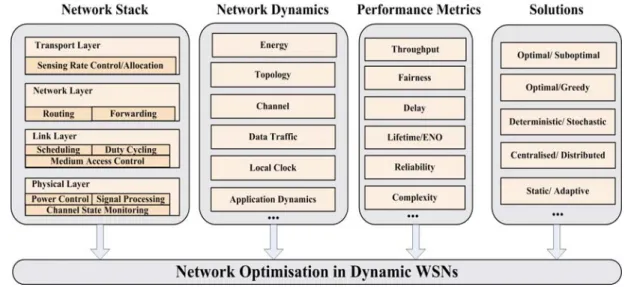
2.2 Protocol stack and dynamic WSN optimisation. . . 18
2.3 The architecture of network optimisation in dynamic WSNs. . . 22
3.1 Illustration of a typical multi-hop SP-WSN. . . 26
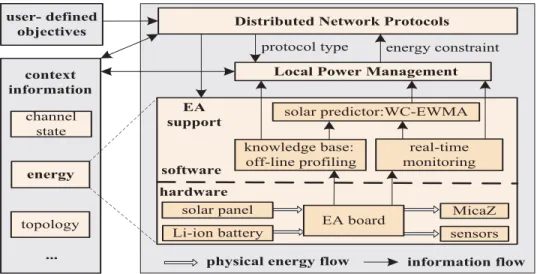
3.2 AutoSP-WSN architecture. . . 29
3.3 Time horizon and duration terms. . . 30
3.4 EA support hardware and its architecture. . . 32
3.5 Solar profile during 15 days [7], and weather volatilitywv(d) for each daydwith αwv = 0.8. . . 36
3.6 Pseudocode of LPM algorithm, computing the maximum feasible duty cycle for a future prediction interval. . . 40
3.7 Final state parameterϕi x(d) and real battery level evolutions. . . 41
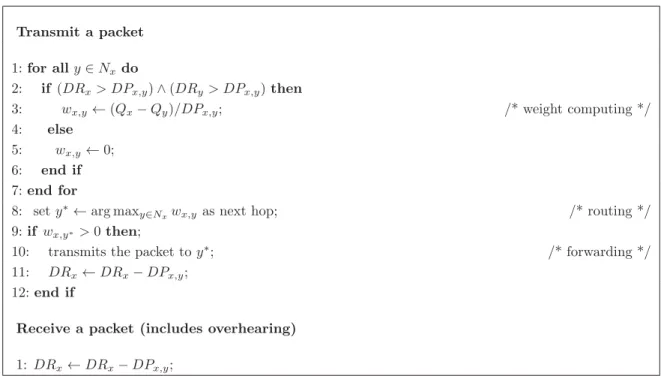
3.8 Pseudocode of SP-BCP: transmitting and receiving operations of nodex during sloti. . . . 43
3.9 An example of PEA-DLEX in a line topology SP-WSN in 4 slots 1 < i1 < i2 < i3≤L during a prediction interval l. Saturated and unsaturated nodes are marked as black and white circles respectively. . . 48
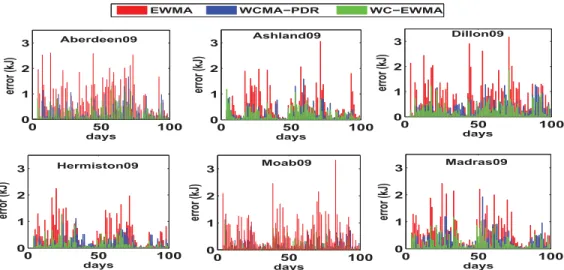
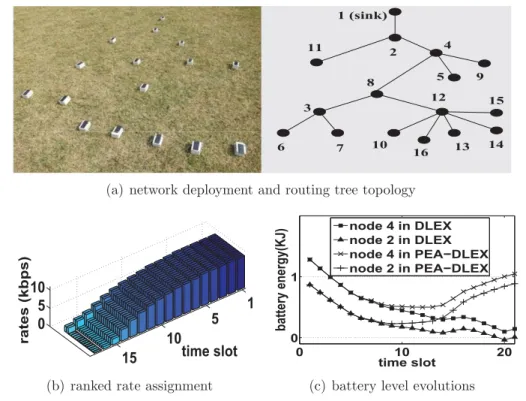
3.10 Average prediction errors for three solar prediction algorithms. Areas A-F re-spectively represent Aberdeen, Ashland, Dillon, Hermiston, Moab, and Madras. 50 3.11 Daily prediction error of the three solar prediction algorithms. . . 50 3.12 Evaluations of LPM for S-type protocols. . . 51 3.13 Evaluation of DLEX and PEA-DLEX on a 16-node SP-WSN. . . 52 3.14 Simulation of DLEX and PEA-DLEX for an 50-node SP-WSN with a randomly
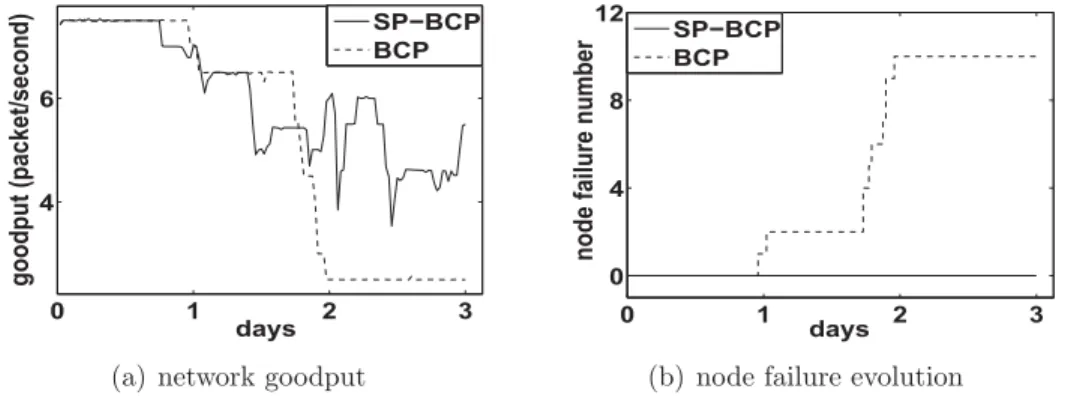
constructed routing tree. . . 52 3.15 Performance of LPM for D-type protocols. . . 53 3.16 Comparison of BCP and SP-BCP on a 16-node SP-WSN platform for three days. 54 3.17 Simulation of BCP and SP-BCP for a randomly constructed SP-WSN with 50
nodes for 12 days. . . 54
4.1 LM∗ for a SP-WSN with seven sensor nodes and a sink. Assume Es = Er = Et = 1 unit and the maximum feasible energy consumption of all sensor nodes are 20 units. (a) The network topology. (b) The first maximum common rate and corresponding routes (data forwarding directions and rates). (c) LM∗ and corresponding optimal routes. . . 65 4.2 Logical flow of our distributed approach. . . 67 4.3 An example for DMCR. . . 69 4.4 An example of a temporary graph. . . 75 4.5 Pseudo-code of the LMD for a sensor node x∈ V − V(r) . . . 77 4.6 The topology of a 20-node SP-WSN. . . 80 4.7 Simulation results of a 20-node SP-WSN. . . 81
LIST OF FIGURES xxi 4.8 Simulations of LM rate allocation for original topology, predetermined Shortest
Path Tree (SPT) and Directed Acyclic Graph (DAG). (a) LM∗ for a SP-WSN with a single sink. (b) Communication overheads of our approach over three topologies. (c) LM∗ for a SP-WSN with 3 sinks. . . 83 4.9 Simulation topology for a 50-node SP-WSN with 3 sinks, a 75-node SP-WSN
with 4 sinks, and a 100-node SP-WSN with 5 sinks. All sinks are marked as red squares. . . 84 4.10 Simulation results for a 50-node SP-WSN with 3 sinks, a 75-node SP-WSN with
4 sinks, and a 100-node SP-WSN with 5 sinks. All sinks are marked as red squares. 85
5.1 An example of HFG and HCG. The 8 relay sets are: a={1, 3}, b={1, 5}, c={5, 3}, d={1, 3, 5}, e={2, 3}, f={2, 4}, g={3, 4}, h={2, 3, 4}. . . 98 5.2 Architecture of the cross-layer framework. . . 102 5.3 The pseudocode of distributed HFG establishment for every node x∈N. . . 103 5.4 The pseudocode of the global distributed algorithm for joint flow control,
coop-erative routing and scheduling. The operations of a node x∈N and a relay set RS∈ R. . . 106 5.5 Pseudocode of the centralised cooperative greedy scheduling scheme. . . 108 5.6 Definitions of the distributed greedy scheduling algorithm for a nodex∈N. . . 109 5.7 Operations of the distributed greedy scheduling for a node x∈N. . . 110 5.8 The time table of distributed scheduling of a hyper link incident to RS, where
NRS∗ denotes the optimal neighbour of REP(RS). (a) and (b) show success-ful handshakes between REP(RS) and REST(RS), while (c) and (d) show two unsuccessful cooperative handshakes. . . 111 5.9 Network deployment and original graphs used in simulations. . . 117
5.10 Hyper forwarding graph and complexity reduction for the 10-node network. . . . 118
5.11 Convergence results of the three schemes for the 10-node WSN: (a)-(c) show the evolution of source rates rd
s(t), (d)-(f) show the convergence of average source ratesrd
s(t). . . 119
5.12 Long-term optimal routes of the three schemes for the 10-node WSN. . . 119
5.13 Convergence results of the 25-node network. . . 120
6.1 An example for shortest path routing in WSN-MS. (a) An opportunistic contact graph with the CA-ETX value for each link, where solid and dashed lines repre-sent sensor-to-sensor links and sensor-VS links respectively; (b) node CA-ETX values; and (c) an opportunistic shortest path routing strategies by using CA-ETX: when a node is in contact with any mobile sink, it sends packets through a dashed link; otherwise, it sends packets through a solid link (if it has one). . . 132
6.2 An example to show how to compute and update CA-ETX value for sensor-VS-links133
6.3 Delay performance under OSPR with different metrics in a WSN-MS with ho-mogeneous and heterogeneous sink moving speeds. . . 136
6.4 Experiment results of the CTP and M-CTP: (a) Sensor deployment topology and mobility hot spots, (b) Cumulative Distribution Function (CDF) of E2E delay. . 141
6.5 Experiment results of the OBC and BCP: (a) Sensor deployment topology and mobility hot spots, (b) average E2E delay (every 30 seconds) over time, (c) CDF of queue length and, (d) CDF of each nodes’s packet transmission (transmitting and receiving) rates. . . 143
6.6 Simulation results of OBC, BP, and MG-IF:(a)-(c) with different sensing rates (average sink speed is 5 m/s); (d)-(f) with different sink speed (sensing rate is 10 packets per 200 seconds); (g)-(i) with different scale WSN-MSs (average sink speed and sensing rate are 5 m/s and 10 packets per 200 seconds respectively, the average node density of different scale networks remain the same by adjusting the size of corresponding simulation areas. . . 143
7.1 Conceptual illustration of a WSN-HR. (a) Four static clusters of a static dis-connected WSN Gwsn(S ∪ D,Lwsn). (b) An example of instantaneous graph G(N,L,c(t)) at a slot, and community-location mapping. Solid lines between nodes represent the wireless links with non-zero capacities, and the wireless links with zero capacity are not plotted. The colourful rectangles indicate the geo-graphic areas associated with the communities. (c) The underlying social net-work consisting of mobile relays, and an example of 4-clique overlapping com-munity structure over the social network. . . 155 7.2 The concept of contact time and inter-contact time between a pair of nodes. . . 156 7.3 Illustration of slots and frames. . . 167 7.4 Long-term average simulation results for different α and Qmax
relay. (a) The object
of this chapter Γ, which can be transferred to various units such as pounds or dollars per day. (b) The sum of the packet receiving rates of all sinks. (c) The average sensor-to-sink delivery delay of all generated sensor-data packets during the simulation. (d) Average queue backlog of all sensor nodes and mobile relays during the simulation. . . 170 7.5 Distribution of average individual profit and dynamic global social profit with
Qmax
relay= 600, α= 100, and λscale = 104. . . 171
Chapter 1
Introduction
Wireless Sensor Networks (WSNs) [187] are a type of wireless networks that consist of spatially distributed sensor devices monitoring physical information such as temperature, humidity, light, acoustics, vibration, and pressure. The sensor information is transmitted to one or multiple gateways (sinks) over wireless links. In the last decade, WSNs have proven their applicability in many scenarios including ecosystem management, smart homes and buildings, natural hazards monitoring, intelligent transportation, and human behaviour sensing. Research into WSNs has also motivated emerging research areas, such as the Internet of Things (IoTs) [17], Cyber-Physical Systems (CPSs) [139], and smart sustainable cities [133, 153].
1.1
Motivation
Due to the limited transmission ranges of typical low-power sensor nodes1, WSNs normally
adopt multi-hop communication topologies, especially for applications that require large sensing coverage. Besides transmitting its own data, a sensor node in a WSN may also relay data produced by sensors further from the sink.
The performance of sensing applications strongly depends on the underlying networking ser-1For example, the communication range of a typical sensor node is approximately less than 50 metres for
IEEE 802.15.4 radio, and less than 250 metres for IEEE 802.11 radio.
vices. For example, applications of emergent event monitoring such as fire detection would be sensitive to data transmission delay, while data collection applications require high network throughput and fairness of sensor readings. Therefore, wireless communication and networking including sensing rate control, routing, Medium Access Control (MAC), and wireless signal processing, all play key roles in the overall WSN design.
1.1.1
Practical Challenges in Wireless Sensing and Networking
Current research demonstrates the following challenges in WSNs:
• Network Throughput. Due to wireless interference, duty-cycled and multi-hop oper-ations, and the limited data rates of low-power wireless radios, wireless bandwidth is a scarce resource in WSNs. For example, experimental results show that a typical IEEE 802.15.4 radio, CC2420 [6], can only support around 100 40-bytes packets per second [164], which implies that serious congestion and packet loss would occur when sensing applica-tions produce heavy data traffic. In addition, recent studies [21, 118] have suggested that it is essential to maximise data collection throughput. Further more, for resource reuse, multiple sensing applications may coexist in one physical network (e.g. the future Internet of Things [9]), which poses more challenges for underlying high-throughput end-to-end network communications.
• Sensor Reading Fairness. Data collection applications typically require fair allocation for sensor sampling rates (i.e. the rate at which each sensor node collects environment data) [68, 105, 144, 164]. However, due to the fundamental tradeoff between throughput and fairness [79], pure throughput maximisation would result in poor fairness. For ex-ample, in a throughput-optimal setting, much lower sensing rates would be allocated to the sensor nodes far from the sink, than those close to the sink, resulting in potentially unacceptable bias in the readings coming from the network.
• Energy. Due to their limited energy storage capacity and potential long-term deploy-ment, the energy scarcity of low-cost and low-power sensor nodes has been a key issue for
1.1. Motivation 3 the WSN [16, 166]. Although the recent development of energy harvesting technologies (such as solar power) can mitigate this issue [166], energy is still a bottleneck resource. This is due to limited energy harvesting capacity (e.g. solar panels equipped on tiny sensor nodes must be small) and intermittent availability of environmental energy (e.g. there is no solar energy at night.).
• Limited Capacity of Sensor Nodes. Sensor nodes normally adopt simple and low-cost hardware system for potential large-scale deployment. For example, a typical sensor node, MicaZ mote, [6] has an 8 bit processor, a 4 KB RAM, and a 250 kbps wireless radio. Such low-cost hardware can only support highly efficient and lightweight embedded software, which require low computation and storage complexities of WSN algorithms.
• System Dynamics and Uncertainty. WSNs are dynamic in nature with fluctuat-ing wireless link quality [63, 118], local clock drift [162], and hybrid (e.g. periodical, event-driven and query-based) data traffic patterns [10]. In addition, node mobility is in-troduced in WSNs, to save energy [114], to ensure connectivity [137], or to satisfy specific application requirements [170]. Furthermore, recent advances in energy harvesting tech-niques provide opportunities to achieve sustainable operations in WSNs [166]. However, this also introduce time-varying and uncertain power resources. These network dynamics all have significant impacts on WSN performance and pose challenges for WSN algorithm design. Various sources of WSN dynamics will be discussed in Subsection 1.1.2.
• Requirements of Distributed Operations. Due to their scalability and adaptabil-ity to network dynamics, distributed algorithms are normally preferred over centralised algorithms in WSNs. The advantages of using distributed algorithms in WSNs will be discussed in Subsection 1.1.3. In contrast to centralised approaches that solve network problems based on complete network information, distributed algorithms require indi-vidual sensor nodes to communicate with each other in order to collaboratively solve the overall network problem based on local and incomplete network knowledge, which is therefore more challenging.
light sensors in smart buildings, to water leak detection in the sewer, and noise and air-quality monitoring in the streets. Some sensors are able to connect to the Internet. However, this may in some instances prove prohibitive. For example, 3G cellular data communications can be expensive, while CSMA-based short-range connections are not always available. An attractive alternative is to employ mobile devices carried by ve-hicles or individuals to collect sensor data in an opportunistic way, thereby leveraging both low-cost short-range communications and ubiquitous mobile devices. However, this opportunistic sensing and communication paradigm introduces new challenges such as incentivising participation of mobile device owners.
1.1.2
Dynamics in Real-world WSNs
The major sources of WSN dynamics can be classified into the following three categories:
• Fundamental Physical Behaviours. WSN dynamics, including wireless channel qual-ity and local clock drift, are caused by foundational physical behaviours that are in-dependent of the applications and network protocols. The wireless channel quality is inherently time-varying due to complex physical signal wave propagations, such as multi-path propagation and shadowing from obstacles [146]. The other fundamental dynamic characteristic is the hardware clock drift of the embedded sensor node, which is mainly caused by the surrounding temperature, humidity, and supply voltage [163].
• Network Resource Constraints. Addressing limited WSN resources also introduces WSN dynamics. For example, in energy harvesting WSNs, environmental energy sources such as solar, wind, thermal energy, and mechanical vibration are time-varying. Other aspects, such as node mobility, are also introduced to address the resource limitation in WSNs. The use of mobile sinks has been shown to be an efficient way to save energy for data collections [114]. Also, due to the short communication range of typical sensor nodes, opportunistic data forwarding2has been used in large-scale sparsely-deployed WSNs (e.g.
1.1. Motivation 5 [137]) to bridge the connectivity gap between sensor nodes and sinks.
• User-defined Dynamics. Many sensing applications are also major sources of WSN dynamics. For instance, event-driven sensing applications such as information query ap-plications generate dynamic data traffic [180], according to time-varying user behaviours. Data traffic such as this is delay-sensitive and can cause traffic burstiness when events occur. In addition, some applications require the use of over-the-air reprogramming pro-tocols such as Deluge [67] to update software or modify tasks on demand.
Specifically, this thesis aims to deal with the first two types of dynamics, i.e. those caused by fundamental physical behaviours and resource constraints. Similar approaches can be used for user-defined dynamics but this is beyond the scope of this work.
1.1.3
Distributed Operations
In this thesis, a key challenge is to design network algorithms that are adaptive to various WSN dynamics. Compared with centralised schemes, distributed approaches have the following advantages:
• Scalability. For distributed protocols, nodes make decisions based on their local and (normally one-hop) neighbour information rather than global information covering the network. As a result, the control overheads of distributed protocols such as energy, memory, and bandwidth can be much less than those of centralised approaches, especially in large-scale networks.
• Adaptability to Network Dynamics. In WSNs, the changes in network conditions at some individual nodes would only affect local network conditions rather than the whole network. For instance, consider a routing tree: the congestion at a node would only affect the subtree rooted at this node. Centralised approaches require the collection of informa-tion from the whole network to monitor time-varying network condiinforma-tions, such as energy and link quality, as well as nodes joining and leaving the network. However, distributed
approaches can address the dynamic events locally without expensive communications across the whole network.
• Faster Response. To save energy, WSNs normally operate at a low-duty-cycle mode. In centralised low-duty-cycle WSNs, it can take a large amount of time not only to transmit the local information from each sensor node to the central controller through multi-hop wireless paths, but also to disseminate information from the central controller to sensor nodes, thereby significantly degrading the system performance. In contrast, in distributed low duty-cycle WSNs, each node needs only to exchange its local information with its one-hop neighbours, avoiding large multi-hop transmission delays.
Due to the advantages of distributed WSN solutions, this thesis will focus on designing adaptive and efficient distributed schemes in dynamic WSNs.
1.1.4
Network Optimisation for Dynamic WSNs
Many practical sensing and networking problems related to the challenges listed in Subsection 1.1.1 can be formulated as optimisation problems. Network optimisation theories such as La-grangian duality and Lyapunov stability theories [39, 125, 184] are graceful and powerful tools for understanding the structure and features of various sensing and networking problems, esti-mating performance and cost bounds, and providing guidelines for practical network protocol design.
Due to the network dynamics, time should be explicitly considered in the modeling of op-timisation problems. Naturally, sensing and networking problems in dynamic WSNs can be formulated as stochastic optimisation problems [125, 184]. Alternatively, if the knowledge of future dynamic network resources (e.g. solar power) can be obtained with a high accuracy 3,
deterministic optimisation solutions [39] can be also used. Compared with stochastic optimi-sation, which aims to optimise infinite horizon (or long-term finite horizon) statistic objectives
1.2. Our Approach 7 (e.g. mathematical expectation), deterministic optimisation methods are more precise but are more sensitive to the prediction accuracy of future network state.
A description of network optimisation theory will be presented in Chapter 2.
1.1.5
Limitations of Current Research
Although a large body of work exists for dynamic WSNs, most of them are either practical work, based on heuristic approaches without performance guarantees, or theoretical approaches with unrealistic assumptions and high complexity. Additionally, some sensing and networking problems in dynamic WSNs do not have any distributed solutions, such as the the lexicographic maximin sensing rate allocation problem studied in Chapter 4. This thesis aims to bridge the gap between theory and practice in dynamic WSNs and to develop fully distributed algorithms and protocols, guided by both quantitative insights gained from mathematical theories and the practical principles of real dynamic WSNs.
1.2
Our Approach
This section introduces our approach to distributed optimisation in dynamic WSNs. Specif-ically, this thesis investigates three types of dynamic WSNs: WSNs powered by solar energy (Chapter 3 and Chapter 4); WSNs with time-varying wireless channel quality (Chapter 5); and WSNs with mobile sinks (Chapter 6) and mobile relays (Chapter 7). It is worth noting that the related work on each topic has been localised to the relevant chapters. The issues listed below aim to show the methodology and the big picture of this thesis.
• Modeling WSN Dynamics The first step in designing adaptive schemes is to real-istically model the network dynamics according to the specific sensing and networking problems and scenarios. Specifically, the time-varying solar energy considered in Chap-ter 3 and ChapChap-ter 4 is modelled as a predictable system parameChap-ter, and a lightweight
algorithm is developed to predict future solar energy with high accuracy. In these two chapters, power management and networking problems are formalised as deterministic op-timisation problems, by using predicted solar energy values as deterministic parameters. In addition, dynamic wireless channel quality and node mobility (addressed in Chapters 5-7) are modelled as random parameters. Stochastic optimisation approaches are used for the corresponding WSN problems.
• Network Problems. For cost-efficient dynamic WSN design, this thesis deals with net-work problems at every layer of the netnet-work stack, including signal processing at the physical layer, wireless scheduling at the link layer, routing at the network layer, and rate control/allocation at the transport layer. In addition, useful interactions between different layers are exploited to optimise the utilisation of limited network resources, such as energy and bandwidth. Specifically, Chapter 3 and Chapter 4 propose distributed algorithms for joint power management, routing, and sensing rate control to achieve sus-tainable operations of the solar power network, while optimising the end-to-end network performance (i.e. throughput and sampling rate fairness). Chapter 5 investigates how to exploit the advantage of an advanced physical-layer technique, cooperative communica-tion [76, 91], to improve the performance of upper layers. Chapter 6 studies the routing problem in large-scale WSN with mobile sinks, which achieves optimal network through-put and small end-to-end delay. Chapter 7 studies the joint sensor data communication and incentivisation issues for emerging urban sensing systems, based on the investigation of coupled sensor, social, and economic networks.
• Theories. This thesis develops fully distributed sensing and networking algorithms based on the development and application of the following theories:
1. Optimisation theory including linear programming in Chapter 3, convex optimisation and Lagrangian duality [25, 121, 172] in Chapters 4 and 5, and Lyapunov stochastic minimisation [61, 125] in Chapters 5-7.
2. Graph theory in Chapters 3-7. 3. Queueing analysis in Chapter 6.
1.3. Contributions of This Thesis 9 4. Social network theory and economic networks in Chapter 7.
• Complexity, Reality and Optimality. The key effort of this thesis is to address tradeoffs between reality, optimality, and complexity. Generally, the optimal solutions of network problems result in large computation, communication, or storage complexity. For instance, the optimal solutions to general wireless scheduling considered in Chapter 5 and Chapter 6, and the general cooperative routing problem considered in Chapter 5, are NP-hard. For polynomially-solvable problems, such as the Lexicographic max-min rate allocation problem studied in Chapter 4, the complexity of the current solution is not only centralised but also too heavy for the resource-limited WSNs. In addition, realistic modeling also introduces complexity. This thesis addresses such complexity using the following methods: (1) Introducing reasonable models to balance the reality and com-plexity; (2) Developing efficient algorithm to reduce the complexity of optimal solutions; (3) Developing suboptimal solutions with performance bounds.
• Evaluation. Three methods are used in this thesis to evaluate the performance of the proposed network algorithms: (1) Deriving the performance and cost bounds of proposed algorithms based on theoretical analysis; (2) Using extensive trace-driving simulations to evaluate long-term performance of network algorithms in large-scale WSNs; (3) imple-menting proposed schemes in sensor devices and evaluating their real-world performance.
1.3
Contributions of This Thesis
The broad aims of this thesis are to develop efficient distributed algorithms for network problems in dynamic WSNs. In doing so, this thesis makes the following contributions to the state-of-the-art:
• Spatiotemporal networking frameworks are provided for distributed network optimisation in three types of dynamic WSNs: solar-powered WSNs (Chapter 3 and Chapter 4), WSNs with time-varying link qualities (Chapter 5), and WSNs with mobile sinks and relays (Chapter 6 and Chapter 7 respectively).
• Extensive experience is offered on how to model different types of dynamic WSNs, how to use optimisation theory for practical WSN design, and how to balance tradeoffs between reality, optimality, and complexity.
• Chapter 3 presents AutoSP-WSN: the complete design and implementation of a solar-powered WSN, including energy awareness support, solar energy prediction, local power management, and network protocols. AutoSP-WSN achieves sustainable operation (no node runs out of its battery), outperforms state-of-the-art approaches. More importantly, this chapter highlights design principles of practical dynamic WSNs, which are useful in theoretical modeling, optimisation, and solutions.
• Chapter 4 studies a multi-objective optimisation problem, lexicographic max-min sens-ing rate allocation, in solar-powered WSNs with arbitrary topologies; which optimise the tradeoff between sensing rate fairness and network throughput, while achieving sus-tainable operation. Based on Lagrangian duality and graph-theoretical approaches, we develop the first distributed optimal solution to this problem, with much less complexity than current optimal solutions.
• Chapter 5 proposes the first distributed network optimisation framework for WSNs with general cooperative relay patterns and time-varying wireless channel qualities. This work shows that significant throughput improvement can be achieved by incorporating coop-erative communications in WSNs and general wireless multi-hop networks, and the per-formance of the developed distributed approach is close to the optimal. This work also shows how to reduce the complexity of optimal solutions with proper approximations.
• Chapter 6 studies ubiquitous sensor data collection in large-scale WSNs with mobile sinks. Based on queuing analysis theory, a novel routing metric, called CA-ETX, is proposed to estimate packet transmission delay caused by both link unreliability and intermediate connectivity. By integrating CA-ETX into Lyapunov optimisation theory, a throughput-optimal data collection algorithm is then developed. Testbed experiments and extensive simulations show that the proposed algorithm can achieve much better performance than current state-of-the-art approaches, in terms of energy consumption, end-to-end delay,
1.4. Publications 11 scalability, and sensitivity to sink movement speeds. In addition, CA-ETX can work seamlessly and synchronously with the well-known routing metric, ETX [44], illustrating that existing ETX-based routing protocols, such as the de-facto TinyOS routing standard CTP [63] and IETF IPv6 Routing Protocol RPL [9], can be easily applied to WSN-MSs, using the CA-ETX.
• Chapter 7 proposes a novel citizen-centric sensing paradigm for ubiquitous sensing in the future smart and sustainable cities. Here, mobile phones are used to relay the sensor data from sensor nodes to sinks. By combining complex network theory and wireless sensing, a distributed algorithm is developed for joint rate control, opportunistic routing, and resource pricing. This algorithm not only maximises global social profits, but also manages to incentivise rational phone users to participate.
1.4
Publications
The work presented in this thesis is supported by the following top-tier journal publications, of which I am the first author.
1. Autonomic Solar Powered WSN for Network-wide Protocols, IEEE Journal on Selected Areas in Communications (JSAC), vol.31, no.12, pp.750-761, 2013.
(Contributes to Chapter 3)
2. Distributed Optimal Lexicographic Max-min Rate Allocation in Solar Powered Wireless Sensor Networks, ACM Transactions on Sensor Networks (TOSN), in press.
(Contributes to Chapter 4)
3. Distributed Cross-layer Optimization in Stochastic Multi-hop Wireless Networks with Co-operative Communications, IEEE Transactions on Mobile Computing (TMC), in press, DOI: 10.1109/TMC.2013.101.
4. Opportunistic Backpressure Collection in Wireless Sensor Networks with Mobile Sinks,
IEEE Transactions on Mobile Computing, Under Review.
(Contributes to Chapter 6)
5. Selfish Mules: Social Profit Maximization in Sparse Sensornets Using Rationally-Selfish Human Relays, IEEE Journal on Selected Areas in Communications (JSAC), vol.31, no.6, pp. 1124 - 1134, 2013.
(Contributes to Chapter 7)
Besides the above publications, I am also the first author or coauthor of the following publica-tions in the area of WSNs and other wireless networks, to which I made significant contribupublica-tions during my PhD study:
Journals and magazines:
6. Using Social Network Theory for Modeling Human Mobility, IEEE Network, vol.24, no. 5, pp. 6-13, 2010.
7. A Survey on IETF Protocol Suite for Internet-of-Things: Standards, Challenges and Opportunities, IEEE Wireless Communications, vol.20, no.6, pp.91-98, 2014.
8. A Cross-Layer Approach Handling Link Asymmetry for Wireless Mesh Access Networks,
IEEE Transactions on Vehicular Technology (TVT), vol.60, no.3, pp.1045-1058, 2011. 9. Efficiency-Aware: Maximizing Energy Utilization for Sensor Nodes Using
Photovoltaic-Supercapacitor Energy Systems, International Journal of Distributed Sensor Networks, 2013.
10. A Greedy-based Stable Multi-path Routing Protocol in Mobile Ad Hoc Networks,Ad Hoc Networks (Elsevier), vol.9, no.4, pp. 662-674, 2011.
11. HLLS: A History Information Based Light Location Service for MANETs, Computer Networks (Elsevier), vol.56, no.2, pp.731-744, 2012.
1.4. Publications 13
Conferences:
12. Towards Energy-Efficient Cooperative Routing Algorithms in Wireless Networks, inProc. IEEE CCNC, 2012.
13. Multi-Protocol Scheduling for Service Provision in WSN, inProc. SENSORNETS, 2012. 14. Joint Multipath Routing and Admission Control with Bandwidth Assurance for
802.11-based WMNs, in Proc. IEEE WCNC, 2011.
15. On an Efficient Estimation of Available Bandwidth for IEEE 802.11-based Wireless Net-works, in Proc. IEEE GLOBECOM, 2011.
16. How Current Challenges will drive the Second Decade of Wireless Sensor Networking, inProc. ACM-BCS, 2010.
Submitted papers
17. Scalable Anomaly Detection for Sensing Networks in The Wild, submitted to Proc. VLDB.
18. Citizen-centric Networking for Mobile Urban Sensing, submitted toIEEE Communication magazine.
19. Detection of False Data Injection in Smart-Grid Systems, IEEE Communication Maga-zine, revised.
Chapter 2
Background Theory
This chapter briefly introduces the necessary theoretical background related to the main work presented in this thesis. Many well-known concepts and standard definitions such as convexity, stochastic process, probability theory, and basic graph theory are omitted for brevity. However, they can be found in books [24, 25, 47, 175]. Henceforth, detailed backgrounds relating to the covered topics will be provided in each chapter, as well as clear definitions of the terms and symbols used.
2.1
Optimisation Theory
An optimisation problem for a dynamic network has a general formulation as follows:
max x(t) or minx(t) 1 T T t=1 obi(x(t)), i={1, 2, ... a} (2.1) subject to 1 T T t=1 fj(x(t),y(t),z(t)) = 0, j={1, 2, ... b} (2.2) 1 T T t=1 gk(x(t),y(t),z(t))≤0, k={1, 2, ..., c} (2.3) y(t+ 1) =u(x(t),y(t)) (2.4) 15
where t≥1 represents discrete time slots and T >1 is the time horizon of the problem (2.1)-(2.4). If T < +∞, then problem (2.1)-(2.4) is a finite-horizon problem; otherwise it is an infinite-horizon problem. The vector x(t) is the optimisation variable such as routing and rate control decisions. The vector y(t) represents the controllable network state (or parameters) at slot t, such as network queue backlogs and battery levels of sensor nodes. The vector
z(t) represents the uncontrollable time-varying network state (or parameters) at slot t that is independent of x(t) and y(t), such as the harvested environmental energy in networks with renewable energy resources (e.g. energy harvesting WSNs and smart grids).
(2.1) represents i= {1, 2, ... a} time-average objective functions such as maximising network utilities or minimising network costs. (2.2) and (2.3) respectively state {j = 1, ..., b} and k = {1, ... , c} time-average equality and inequality constraints. Constraint (2.4) models the dynamic process of the network, i.e. the controllable network state at next sloty(t+ 1) depends on both network statey(t) and control actions x(t) at current slott.
Figure 2.1: Optimisation classification and relating chapters.
In a dynamic WSN, the problem (2.1)-(2.4) can be classified into different types of optimisation problems, in terms of the number of objective functions, the types of dynamics (i.e. determin-istic or stochastic), and the continuity of x(t). Figure 2.1 summarises the classification of the general formulation (2.1) and the specific problems studied in later chapters.
2.1. Optimisation Theory 17 If the problem (2.1)-(2.4) only optimises one objective function (i.e. a = 1 ), it is a single-objective optimisation problem; otherwise, it is a multi-single-objective optimisation problem [112]. According to types of dynamics, problem (2.1)-(2.4) can be categorised as deterministic [25] and stochastic [125] problems. Finally, according to the continuity of variable x(t), problem (2.1)-(2.4) can be classified into the following three types: continuous (e.g. flow rate control and multi-path routing for networks with continuous channel capacity), discrete (e.g. single-path routing and scheduling), and mixed (e.g. joint flow control and scheduling for networks with continuous channel capacity).
2.1.1
Optimisation Objectives
Most current network optimisation research, such as the well-known Network Utility Maximi-sation (NUM) [38], focuses on the single-objective optimiMaximi-sation problems, i.e. a = 1 in the objective function (2.1).
• Utility and Cost. The objective ob1(x(t), t) can represent network utilities, such as fairness utilities [36] and network lifetime [110]. For instance, the objective function
ob1(x) = ⎧ ⎪ ⎪ ⎨ ⎪ ⎪ ⎩ s∈S(1−α)−1x1− α s α >0, α= 1 s∈Slog(xs) α= 1
is the well-known α-fair utility functions [116], whereS is the set of all sensor nodes, and xsrepresents the sampling rate of each sensor nodes∈ S. Whenα= 1, the α-fair utility function represents proportional fairness [83]; when α → +∞, it tends to the maxi-min fairness [79, 90]. In addition, the objective ob1(x(t), t) can also represents the reverse of network cost metrics such as transmission delay [86] and energy consumption [189].
• Convex and Non-convex functions. In communication and sensor networks, many utility and cost functions can be modelled as concave and convex functions respectively, such as the α-fair utility function. In addition, some network applications aim at max-imising non-concave utility functions. For instance, the utility for multimedia streaming
applications in the Internet or multimedia WSNs [12] can be described by a sigmoidal function with a convex part at low rate, a concave part at high rate, and an inflexion point separating the two parts [40].
If the problem (2.1)-(2.4) has more than one objective function to be optimised simultaneously (i.e. a > 1), then it is a multi-objective optimisation problem [113]. Multi-objective optimi-sation has been applied in many fields including engineering and economics, where optimal decisions need to be made in the presence of tradeoffs between multiple conflicting objectives. In contrast to single-objective optimisation, a solution to a multi-objective problem is more of a concept than a definition. Typically, there is no single global solution, and it is often necessary to determine a set of points that all fit a predetermined definition for an optimum. The predominant concept in defining an optimal point is that of Pareto optimality [136]. A solution is Pareto optimal, if none of the objective functions can be improved in value without impairment in some of the other objective values.
2.2. Optimisation and Network Layers 19
2.2
Optimisation and Network Layers
This section presents a general formalisation, problem (2.5)-(2.9), for the entire protocol stack of dynamic WSN optimisation. Figure 2.1 illustrates the relationships and interactions of optimisation variables of problem (2.5)-(2.9).
maximise 1 T T t=1 U(r(t)) or 1 T T t=1 −C(w(t),d(t)) (2.5) subject to 0 f(t) c(w(t),d(t)), ∀1≤t≤T (2.6) 0 q(f(t),r(t)) qmax, ∀1≤t≤T (2.7) E(f(t),r(t),d(t))∈ E(t), ∀1≤t≤T (2.8) f(t) ∈ I(w(t)) orf(t)∈ S(c(t)), ∀1≤t≤T (2.9)
Here represents the sign of entry-wise smaller than or equal to 1. Vector r(t) 0 denotes
the sampling rate at which each sensor node collects the environmental data at time t, and
w(t) represents the dynamic physical-layer channel resource, such as channel fading and node transmission power. The utility functionU(·) and cost functionC(·) can be any concave non-decreasing and convex non-increasing functions respectively. Vector f(t) represents the actual amount of data forwarded over each wireless link, which depends on arrival traffic r(t), and is bounded by wireless link capacitiesc(t). The vector of wireless link capacityc(t) is the function of physical-layer resourcesw(t), and duty cyclesd(t) of sensor nodes, 0≺d(t) 1. Vectorq(t) represents the dynamic backlog of the data queue maintained at each node, which should be no larger than the size of the nodes’ data buffers,qmax 0. Inequalities (2.6) and (2.7) capture
the network constraints above the link layer, including the queueing stability [125] and flow conservation law [38, 125]; shown in Figure 2.2. Constraint (2.8) highlights the energy resource constraint in WSNs, where the energy E(f(t),r(t),d(t)), cost by sensing, data processing, and 1Letaiandbibe theithentry of twon-dimensional vectorsAandBrespectively,n >1. We sayA B, if
data forwarding, are constrained by available energy E(t) such as residual battery levels of sensor nodes and harvested environmental energy.
At the physical and link layers, there are two widely-used models to characterise wireless inter-ference relationship in wireless networks [38, 160], namely the physical model and the protocol model. The physical model, also known as the signal-to-interference-and-noise-ratio (SINR) model (e.g. [28]), is based on practical transceiver designs of communication systems that treat interference as noise. Under the physical model, a transmission is successful if and only if SINR at the intended receiver exceeds a threshold that enables the transmitted signal to be decoded with a desired decoding error probability. Furthermore, link capacitiesc(t) are computed based on SINR (via Shannon’s formula), which takes into account interference due to simultaneous transmissions by other nodes. In constraint (2.9),f(r(t))∈ I(w(t)) represents this SINR-based dependence. Besides the physical model, the protocol model (e.g. [173]) has been widely used to simplify the mathematical characterisation of the physical layer. Under the protocol model, a successful transmission occurs when a node (i.e. the receiver) falls inside the transmission range of its intended transmitter and outside of the interference ranges of other non-intended transmitters. The link-layer issues, including random access and scheduling, are captured in constraints of the schedulability regionS(c(t)).
It is worth noting that we only use the per-slot instantaneous constraints in problem (2.5)-(2.9) to demonstrate the layered structure of resource-constrained WSNs for brevity. Besides instantaneous constraints, long-term average constraints are also commonly used in various WSN models.
2.3
Distributed Optimisation Methods
Distributed algorithms developed in this thesis are based on various techniques, including graph theory, queueing analysis, dual decomposition, Lynapupov stochastic optimisation, and social network theory. In this section, we briefly introduce two commonly used techniques in this thesis, dual decomposition and Lyapunov stochastic optimisation. Detailed discussions of these
2.3. Distributed Optimisation Methods 21 two techniques can be found in [38, 125, 135].
2.3.1
Decomposition Techniques
Decomposition techniques based on Lagrangian duality theory are efficient and powerful tools for distributed solutions of deterministic network optimisation problems [38, 135]. Most of the existing decomposition techniques can be classified into primal decomposition and dual decomposition methods. The former is based on decomposing the original primal problem, whereas the latter is based on decomposing the Lagrangian dual problem.
This thesis specifically focuses on dual decomposition. The basic idea of dual decomposition is to break down the dual problem into distributively solvable subproblems which can be solved at each node, through gradient or sub-gradient algorithms according to the differentiability of the Lagrangian dual function [24]. Typically, the network converges to the optimal (if the optimisation problem is convex) after a number of iterations2. In each iteration, all nodes only
require some simple calculations and exchanges a small amount of local information with their neighbours.
2.3.2
Lyapunov Stochastic Network Optimisation
Lyapunov optimisation approaches [61, 125] refer to the use of a Lyapunov function to opti-mally control a stochastic system. Lyapunov drift is central to the study of optimal control in queueing networks. System stability is achieved by taking control actions that make the Lyapunov function drift in the negative direction. By adding a weighted penalty term to the Lyapunov drift and minimising the sum, the ’drift-plus-penalty’ algorithm can be obtained for joint network stability and penalty minimisation (or utility maximisation), which stabilise all network queues while providing elegant cross-layer solutions for integrating medium access control, routing, and rate control.
Different from dual decomposition based approaches, Lyapunov optimisation techniques do not require any prediction ability. Therefore they are more suitable for the development of distributed WSN algorithms when the precise future network state (e.g. channel quality and mobility) is difficult to obtain.
2.4
Summary
Figure 2.3: The architecture of network optimisation in dynamic WSNs.
This chapter briefly discusses network optimisation theories related to this thesis. Figure 2.3 summarises the architecture of network optimisations in dynamic WSNs.
Chapter 3
A Practical Solar Powered WSN
Recent advances in solar harvesting technologies pave the way for sustainable environmental-monitoring applications in the emerging field of solar powered wireless sensor networks (SP-WSNs). The complexities associated with the low-resource, high-dynamic, and vulnerable sensor nodes operating in potentially unattended or hostile environments require a high degree of self-management and automation. This chapter presents AutoSP-WSN, a novel distributed framework that achieves sustainable data collection while also optimising end-to-end network performance for SP-WSNs. Initially, we present an energy-aware support component that provides reliable energy monitoring and prediction. This drives the power management com-ponent, which is adaptive to time-varying solar power, avoiding battery exhaustion as well as maximising the per-node utility. Finally, to demonstrate the key design issues of the network protocols, we propose two adaptive network protocols, a routing protocol SP-BCP and a rate control scheme PEA-DLEX. Through extensive experiments on a real SP-WSN platform and hardware-driven simulations, we show that the proposed schemes achieve substantial improve-ments over previous work, in terms of reliability, sustainable operation, and network utility. The experimental work in this chapter demonstrates the practical issues of dynamic low-power and low-capacity WSNs. The algorithm design principles such as the adaptiveness of dynamic network conditions, and the tradeoffs between optimality and complexity are also highlighted. Such practical principles also guide the algorithm design in later chapters.
Pload Power consumed by the load (MicaZ mote). Psolar Power generated from solar panel.
Pbattery Battery recharging power. Iload The electric current of the load. Isolar The electric current of the solar panel. Vsolar The voltage across the solar panel.
η1 Energy translation efficiency from solar panel to load. η2 Energy translation efficiency from solar panel to battery. η3 Energy translation efficiency from battery to load. M The number of prediction intervals in a day. L The number of slots in a prediction interval. T The duration of a slot.
Pre(i, l, d) The reference solar power at the ith slot in lth at the dth day. Psolar
real (i, l, d) The real solar power at the ith slot inlth at the dth day.
αre Weighting parameter for computing the reference solar power vector. αwv Weighting parameter for strong weather volatility.
wv(d) Overall weather condition level of thedth day.
wv0(d) The number of peaks and troughs of the solar profile in the dth day.
wv1(d) Strong weather volatility of thedth day.
F IT Predefined threshold to defined strong weather volatility. αwv Weighting parameter for strong and weak weather volatilities. Pactive Load power when a sensor node is active.
Pidle Load power when a sensor node is idle. Dmax
x (l) The maximum feasible duty cycle of node x at prediction interval l. P Si
x The solar power of node x at sloti. Eleak Battery energy leakage in a slot.
Bmax The maximal amount of energy that a battery can store.
Dmin User defined minimum duty cycle.
ϕ A constraint parameter for S-type LPM. ϕi
x(d) A constraint parameter of nodex at slot iin the dth day for D-type LPM. Emin The minimum energy consumption in a slot.
i0(d) The first slot of daytime in thedth day.
i1(d) The first slot of night in the dth day.
BEN O The minimal energy that a sensor node should store at i1(d) to ensure ENO. DRx The remaining active durations of node x.
DPx,y The duration required for transmitting a packet from node x to nodey. Qx The data queue backlog at node x.
wx,y the backpressure weight of wireless link (x,y). STx A subtree rooted at node x, excluding x. C wireless link capacity.
rx The sensing rate of node x.
R R=r1, r2, ... , rx, a sensing rate allocation of all nodes. AFx The actual date forwarding rate of node x.
λx The maximum allowed data rate ofx.
Bx(i) The difference between actual and expected battery levels of node xin slot i. DBT Predefined threshold of battery level difference to trigger RD or RI events.
λx The difference between current and last updatedλx. Table 3.1: Summary of symbols used in Chapter 3.
3.1. Introduction 25 SP-WSNs Solar Powered Wireless Sensor Networks
AutoSP-WSN Autonomic SP-WSN
BCP Backpressure Collection Protocol SP-BCP Solar Powered BCP
DLEX A Distributed max-min rate allocation algorithm defined in [54] PEA-DLEX Prediction Error Adaptive DLEX.
LPM Local Power Management
ENO Energy Neutral Operation
EA Energy Awareness
WC-EWMA Weather-Conditioned Exponential Weighted Moving Average D-type Dynamic type
S-type Static type
MAC Medium Access Control
CTP Collection Tree Protocol MCU MicoController Unit
RD Rate Decrease
RI Rate Increase
Table 3.2: Summary of abbreviations used in Chapter 3.
3.1
Introduction
Environmental monitoring is one of the most important applications for Wireless Sensor Net-works (WSNs) [187]. The majority of sensor nodes are currently powered by batteries that require manual replacement when they are depleted. However, in many outdoor deployments it can be difficult or even impossible to physically access the sensor nodes. As a result, the bounded lifetime of WSNs has become a restriction that impacts their use in long-term envi-ronmental monitoring applications.
The development of new photovoltaic harvesting techniques, such as those found in [14,141], are demonstrating that solar power is indeed a viable first step towards autonomous WSNs [171]. However, due to the limited size of micro solar panels, harvested solar energy remains scarce. To make best use of this resource, one needs to know how the node uses power, and to understand the dynamics of energy generation. However, hardware power usage is complex and the nature of solar power is highly dynamic. Further complications arise because of the heterogeneous spatial harvesting capabilities across different nodes in a sensing space, due to shading or cloud
the sink
wireless channel
(a) A sunny day
(b) A cloudy day
7LPH 3R Z HU P : 7LPH 3R Z H U P :solar powered sensor nodes
time-varying solar profile
heterogeneous harvesting opportunities
Figure 3.1: Illustration of a typical multi-hop SP-WSN.
coverage: see Figure 3.1. These have significant impacts on the design of reliable multi-hop solar-powered WSNs (SP-WSNs). For instance, a routing protocol should adaptively select and dynamically adjust the end-to-end path to avoid the time-varying routing hot-spots (i.e. relay nodes with low harvesting power).
This chapter therefore aims to provide sustainable data collection capability, while also max-imising end-to-end delivery performance (e.g. network goodput) for SP-WSNs. To this end, the following issues should be considered. Firstly, the internal power system of sensor nodes should be realistically modelled (e.g. solar power and battery recharging/discharging process) to pro-vide reliable energy awareness. Secondly, the capacity of self-management for each individual node is required to ensure sustainable operation while optimising its local long-term utilities (this is its power management function). Thirdly, through adapting to the time-varying and heterogeneous distributed solar harvesting opportunities, distributed and responsivenetworking protocols (e.g. routing) should be derived for SP-WSNs to achieve sustainable data collection and optimal global end-to-end performance.
Current studies on energy harvesting WSNs, per-node power management schemes [81, 108, 119, 151], and network-wide protocols [51, 53, 103, 190, 192], address the above issues separately.
3.1. Introduction 27 Furthermore, most are theoretical work, and are therefore likely to perform poorly or even fail in real-world SP-WSNs. In this chapter, we present a systematic study covering both individual components (i.e. energy awareness, power management, and network protocols)and
the SP-WSN as a whole. The contributions of this chapter are summarised as follows:
1. We develop and implement AutoSP-WSN which is, to our knowledge, the first distributed framework for practical SP-WSNs. The overarching goal of the AutoSP-WSN is to opti-mise the usage of solar power as well as the end-to-end network performance, and more importantly, to achieve so-called Energy Neutral Operation (ENO) [81], i.e. to guarantee that no node will run out of energy at any point in real-world deployments.
2. We propose an efficient and reliable Energy Awareness (EA) support component that pro-vides realistic hardware-driven power models as well as reliable real-time energy monitor-ing. To further support EA, we also propose Weather-Conditioned Exponential Weighted Moving Average (WC-EWMA), a lightweight weather-aware prediction algorithm that forecasts future solar energy with a high degree of accuracy.
3. Based on the reliable EA support, we develop a Local Power Management (LPM) com-ponent that achieves both ENO and long-term per-node utility optimisation. Compared with directly solving a linear programming problem at runtime, our LPM remains optimal while achieving a much lower overhead. In addition, the LPM can automatically tune its parameters to support different types of network protocols.
4. To demonstrate the key issues of designing network protocols in practical SP-WSNs (e.g. the requirement of self-protection capacity to avoid network failure caused by solar power prediction error), we propose two adaptive network protocols: a routing protocol called SP-BCP, and a rate control protocol called PEA-DLEX, for sustainable multi-hop data collections.
5. Through extensive evaluations on both our own developed SP-WSN platform and the Tossim simulator [97], we show that both the proposed individual schemes and the entire AutoSP-WSN achieve substantial improvements over previous approaches.



![Figure 3.5: Solar profile during 15 days [7], and weather volatility wv(d) for each day d with α wv = 0.8.](https://thumb-us.123doks.com/thumbv2/123dok_us/10191149.2921870/62.918.262.658.81.240/figure-solar-profile-days-weather-volatility-wv-day.webp)