Defining recovery from an eating disorder: Conceptualization, validation,
and examination of psychosocial functioning and psychiatric comorbidity
Anna M. Bardone-Cone
a,*, Megan B. Harney
a, Christine R. Maldonado
b, Melissa A. Lawson
c,
D. Paul Robinson
c, Roma Smith
c, Aneesh Tosh
caDepartment of Psychology, University of North Carolina at Chapel Hill, Chapel Hill, NC 27599, USA bDepartment of Psychological Sciences, University of Missouri, Columbia, MO, USA
cUniversity of Missouri School of Medicine, Columbia, MO, USA
a r t i c l e
i n f o
Article history:
Received 26 November 2008 Received in revised form 5 November 2009 Accepted 6 November 2009 Keywords: Eating disorders Recovery Psychosocial functioning Psychiatric comorbidity
a b s t r a c t
Conceptually, eating disorder recovery should include physical, behavioral, and psychological compo-nents, but such a comprehensive approach has not been consistently employed. Guided by theory and recent recovery research, we identified a ‘‘fully recovered’’ group (n¼20) based on physical (body mass index), behavioral (absence of eating disorder behaviors), and psychological (Eating Disorder Examina-tion-Questionnaire) indices, and compared them with groups of partially recovered (n¼15), active eating disorder (n¼53), and healthy controls (n¼67). The fully recovered group was indistinguishable from controls on all eating disorder-related measures used, while the partially recovered group was less disordered than the active eating disorder group on some measures, but not on body image. Regarding psychosocial functioning, both the fully and partially recovered groups had psychosocial functioning similar to the controls, but there was a pattern of more of the partially recovered group reporting eating disorder aspects interfering with functioning. Regarding other psychopathology, the fully recovered group was no more likely than the controls to experience current Axis I pathology, but they did have elevated rates of current anxiety disorder. Results suggest that a stringent definition of recovery from an eating disorder is meaningful. Clinical implications and future directions regarding defining eating disorder recovery are discussed.
Ó2009 Elsevier Ltd. All rights reserved.
Introduction
Can an individual who has had an eating disorder every truly recover? To begin to answer that question, we need to have a clear sense of what ‘‘true recovery’’ looks like, yet this is precisely what the field is lacking. Researchers repeatedly bemoan the lack of consensus regarding what constitutes recovery from an eating disorder (e.g.,Herzog et al., 1993; Quadflieg & Fichter, 2003; Stein-hausen, 2002; Walsh, 2008). Adopting a consensus definition of recovery is necessary for comparison of findings as well as for the combination of data across studies, with this point being made in both the eating disorder literature (Walsh, 2008) and the depression literature (Frank, 2005). Ideally, agreed-upon provisional criteria would be set forth and then subjected to empirical validation by various research groups so as to permit data-drive refinements. In this paper we propose a theory of eating disorder recovery, along with an operationalization of full recovery which we then seek to
validate. We also examine how groups categorized by full recovery and partial recovery compare with active eating disorder cases and healthy controls in important non-eating disorder domains: psychosocial functioning and psychiatric comorbidity.
Review of approaches to defining eating disorder recovery
A variety of issues come to bear in determining how to define eating disorder recovery, including what should be included and for how long eating disordered behavior should be absent. Regarding inclusion criteria, the eating disorder field has seen an evolution from a focus on physical criteria such as weight and menses (e.g., Morgan-Russell criteria; Morgan & Russell, 1975) to the addition of behavioral indices of recovery such as absence of binge eating, compensatory behaviors, and restrictive eating (e.g.,Bulik, Sullivan, Fear, & Pickering, 2000; Field et al., 1997; Matsunaga et al., 2000; Strober, Freeman, & Morrell, 1997) to the inclusion of psychological aspects such as body image concerns and fear of weight gain (e.g., Bachner-Melman, Zohar, & Ebstein, 2006; Couturier & Lock, 2006a; Strober et al., 1997). However,
*Corresponding author. Tel.:þ1 919 962 5989; fax:þ1 919 962 2537.
E-mail address:[email protected](A.M. Bardone-Cone).
Contents lists available atScienceDirect
Behaviour Research and Therapy
j o u r n a l h o m e p a g e : w w w . e l s e v i e r . c o m / l o c a t e / b r a t0005-7967/$ – see front matterÓ2009 Elsevier Ltd. All rights reserved.
incorporating physical, behavioral, and psychological indices into a definition of recovery is still far from the norm and is not being done in any standardized way across studies.
Most often missing from ‘‘recovery’’ is the psychological component of eating disorders, especially how individuals think about their bodies, food, and eating. Not assessing for psychological recovery may produce a ‘‘pseudorecovery’’ state (Keski-Rahkonen & Tozzi, 2005) where individuals are ‘‘walking the walk’’ but internally ‘‘talking’’ the same eating disordered talk. The presence of lingering eating disorder attitudes is not trivial, since elevated anorexic atti-tudes and residual concerns about weight and shape predict relapse (Carter, Blackmore, Sutandar-Pinnock, & Woodside, 2004; Channon & DeSilva, 1985; Federici & Kaplan, 2008). Some researchers note that the findings that cognitive features of disordered eating, including body image disturbance, predict relapse may reflect a deficiency in how recovery from an eating disorder is defined (Keel, Dorer, Franko, Jackson, & Herzog, 2005). Interestingly,Cogley and Keel (2003)found that when influence of weight/shape was included as a recovery criterion, the fully recovered group had less body dissatisfaction, less negative affect, and better social adjust-ment than a partially recovered group and looked similar to healthy controls on these measures. Similarly,Bachner-Melman et al. (2006) reported that only individuals who were recovered cognitively in addition to behaviorally were comparable to controls on measures of body dissatisfaction, disordered eating, drive for thinness, and endorsement of the thin ideal. Furthermore, women who identified as recovered highlighted accepting one’s appearance and not obsessing about weight (i.e., psychological aspects) as representing full recovery to them (Noordenbos & Seubring, 2006).
In addition to which criteria should be included is the issue of how long eating disorder behaviors should be absent to constitute recovery. Studies of eating disorder recovery have used various durations, typically specifying from eight consecutive weeks to one year without eating disorder behaviors (Bachner-Melman et al., 2006; Daley, Jimerson, Heatherton, Metzger, & Wolfe, 2008; Herzog et al., 1999; Kordy et al., 2002).Kordy et al. (2002)provide some support for absence of anorexic symptoms for two months being an adequate duration for stable remission from anorexia nervosa, but suggest that four months should be the duration of the absence of bulimic symptoms for bulimia nervosa. Other work argues for a one year period without eating disorder behaviors, based on the liter-ature indicating that risk for relapse is greatest within one year post-treatment or post-recovery (Herzog, Schellberg, & Deter, 1997; Strober et al., 1997). Given the consistent finding that psychological recovery follows behavioral recovery (Fichter, Quadflieg, & Hed-lund, 2006; Strober et al., 1997), a shorter duration of behavioral recovery is arguably acceptable when combined with a valid measure of psychological recovery.1
Operationalization and theory of eating disorder recovery
We propose that full recovery is achieved when individuals with a history of an eating disorder appear indistinguishable from healthy
controls (defined as having no history of an eating disorder) on indices reflecting behavioral and psychological aspects of eating disorders. We have operationalized our definition of full recovery as follows: 1) no longer meeting diagnostic criteria for an eating disorder (anorexia nervosa-AN, bulimia nervosa-BN, or eating disorder not otherwise specified-EDNOS); 2) no binge eating, purging (e.g., vomiting, laxative use), or fasting in the past three months; 3) a body mass index of at least 18.5 kg/m2 (a BMI of 18.5–24.9 is considered normal by the World Health Organization; Bjorntorp, 2002); and 4) scores within 1SDof age-matched community norms on all the subscales of the Eating Disorder Examination-Question-naire (EDE-Q;Fairburn & Beglin, 1994): Restraint, Eating Concern, Weight Concern, and Shape Concern. In contrast, we refer to ‘‘partial recovery’’ as meeting all of the above criteria except the EDE-Q thresholds; that is, meeting physical and behavioral criteria, but not psychological criteria, for recovery.
The combination of both a weight threshold and psycholog-ical indices (i.e., EDE-Q) is in line with work by Couturier and Lock (2006a)who suggest that this combination yields a more accurate and comprehensive picture of recovery. Unlike Coutu-rier and Lock (2006a), we use the EDE-Q rather than the Eating Disorder Examination (EDE;Fairburn & Cooper, 1993). Since the EDE-Q is directly derived from the EDE (Fairburn & Beglin, 1994), is well-established with psychometric support (Fairburn & Beglin, 1994; Grilo, Masheb, & Wilson, 2001; Luce & Crowther, 1999), has normative data from a large community sample (Mond, Hay, Rodgers, & Owen, 2006), and is easier to administer and more likely to be used by clinics than the EDE, it is a valu-able assessment tool to implement in the service of identifying full recovery.
It could be argued that this definition of recovery is too ambitious. However, we believe there is value in setting the bar high for full recovery for several reasons. First, once attained, this stage of recovery should represent individuals who are at minimal risk of relapse and permit the assessment of predictors of this level of recovery. Second, by identifying this group, we provide images of recovery that exist but that individuals with eating disorders, their families, and their health care providers may not think are possible. Third, a more stringent definition of recovery offers greater conceptual clarity which is important in fine-tuning interventions.
Our proposed conceptualization of full recovery is applicable regardless of the past eating disorder diagnosis. That is, we argue that a meaningful and parsimonious way to define recovery is to make it applicable to those recovering from AN, BN, or EDNOS. This approach is practical given that migration from one type or subtype of eating disorder to another is common (Tozzi et al., 2005) and given that EDNOS is a large and heterogeneous group (Eddy, Doyle, Hoste, Herzog, & le Grange, 2008).
Psychosocial functioning and Axis I psychopathology
We believe it is important to examine psychosocial functioning and other psychopathology to further understand the lives of individuals recovering from eating disorders, but do not include these domains in the definition of eating disorder recovery. This approach is similar to that applied by researchers defining recovery for major depressive disorder (Frank et al., 1991; Rush et al., 2006); for example, Rush et al. (2006) argue that daily functioning should not be included in defining recovery from depression since this is affected both by the disorder of interest and any number of other factors. Below we summarize psycho-social and Axis I disorder findings, but note that they are gener-ally constrained by the different definitions of recovery and, notably, by the absence of clear psychological recovery from
1 Other sources of variability in defining eating disorder recovery include choice
of weight threshold, with studies using BMIs of 18, 18.5, and 19 as lower bounds for
recovery (Bachner-Melman et al., 2006; Bachner-Melman, Zohar, Ebstein, & Bachar,
2007; Bosanac et al., 2007) and whether or not a return to normal menstrual
functioning should be required for recovery. Regarding weight,Couturier and Lock
(2006b)argue that a lower weight threshold is acceptable if paired with more stringent psychological criteria. Regarding the return of menses, evidence suggests
that amenorrhea may not have diagnostic significance (Roberto, Steinglass, Mayer,
Attia, & Walsh, 2008) and that the return of normal menstrual functioning is of limited use as a recovery criterion since it does not apply to males, premenstrual girls, or females using oral contraceptives.
eating disorders including healthier attitudes toward the body, food, and eating.
Research examining psychosocial outcomes across stages of recovery has typically focused on overall functioning ratings or questions about status (e.g., marriage, employment) with less attention to qualitative psychosocial adjustment in different domains (Pike, 1998). Studies have generally found overall improvement in psychosocial functioning among recovered indi-viduals (Halvorsen, Andersen, & Heyerdahl, 2004; Keel, Mitchell, Miller, Davis, & Crow, 2000; Keski-Rahkonen et al., 2009; Lowe et al., 2001). However, others found that even among those who appeared recovered from an eating disorder there was impaired social functioning as indicated by low social support, low social network size, and low life satisfaction (Striegel-Moore, Seeley, & Lewinsohn, 2003). In another study, although individuals in remission from BN reported similar overall social adjustment as did a community sample, impairments in relationships appeared to persist (Keel et al., 2000).
Researchers interested in non-eating disorder pathology among those with past but not current eating disorders have found significant depressive and anxiety symptoms in weight-recovered AN groups (Bosanac et al., 2007; Pollice, Kaye, Greeno, & Weltzin, 1997).Wagner et al. (2006)reported that women recovered from an eating disorder had similar rates of Axis I disorders (mood, anxiety, substance use) as women with a current BN diagnosis. However,Herpertz-Dahlmann et al. (2001) found that long-term recovered individuals were no more likely to have Axis I disorders than healthy controls, andHalvorsen et al. (2004)found that those with good outcomes from AN were more likely to be free of Axis I pathology. In one study that made a distinction between levels of recovery, there was a general pattern for the group with the good outcome having fewer cases of mood and anxiety disorders compared to the group with the intermediate outcome which, in turn, had fewer cases than the active eating disorder group (Lowe et al., 2001).
The current study
In sum, in the current study we operationalized a way of defining eating disorder recovery that is based on theory and prior research and that is parsimonious and easily applied. We tested the validity of this definition by examining how the fully recovered group compared to healthy controls, a partially recovered eating disorder group, and an active eating disorder group using eating disorder assessments not used in defining recovery. We hypothesized that the fully recovered group would be indistinguishable from the healthy controls on these measures, and that the partially recovered group would fall some place between the fully recovered group and the active eating disorder group on eating disorder-related pathology. We also examined how these groups compared on current psychosocial functioning and non-eating disorder Axis I psychopathology, hypothesizing that the fully recovered group would have better psychosocial functioning and less psychopa-thology than the partially recovered and active eating disorder groups.
Method
Participants and recruitment
Attempts were made to contact all current and former female eating disorder patients (ages 16 and older) seen at the University of Missouri Pediatric and Adolescent Specialty Clinic (N ¼273)
between 1996 and 2007, the year of data collection. This clinic is a primary care and referral clinic specializing in the care of chil-dren and adolescents (ages 10–25 years) that has physicians with expertise in eating disorders. Of the 273 eating disorder patients, 96 (35.2%) were successfully contacted and recruited. Fifty-five (20.1%) of the 273 were contacted but did not participate due to other time commitments or lack of interest. Of the remaining patients, four (1.5%) were deceased and 118 patients (43.2%) could not be contacted due to absent or incorrect mailing addresses or inability to make phone contact. These rates are fairly comparable to those of other studies doing a follow-up of eating disorder patients over a range of about 10 years (Reas, Williamson, Martin, & Zucker, 2000; Yackobovitch-Gavan et al., 2009). In sum, of the 151 eating disorder patients we were able to contact, 63.6% participated. Healthy controls were recruited from two sources: the clinic from which the eating disorder patients were recruited (n ¼ 17) and the university campus (n ¼ 50). Eligible controls were females ages 16 and older with no current or past eating disorder symptoms.
For all participants recruited from the clinic (former and current eating disorder patients and healthy controls), current contact information was sought via patient records, public records such aswhitepages.com, court records, and marriage records, and paid tracking searches. Eligible participants were mailed a cover letter that described the study and included the lead researcher’s phone number for finding out more information or expressing interest. Up to two mailings were sent out and if there was no response at that point, then attempts were made to contact the eligible participant via phone to describe the study and solicit participation. Recruitment for the healthy controls outside of the clinic occurred through fliers and introductory psychology cour-ses. Those who responded to the flier, which noted inclusion criteria of no current or past eating disorder symptoms, called the lead researcher at which point the inclusion criteria were reiter-ated and the study was described. Those who were recruited from introductory psychology classes were contacted via phone if they met inclusion criteria based on screening measures administered at the start of the semester.
Study procedures
After providing written consent, all participants first completed a set of questionnaires and then, on a separate date, an interview. (For participants under the age of 18, we obtained written assent from the minor and written consent from a parent.) For the majority of the participants, the time between questionnaires and interview was within one week. Most partic-ipants completed the questionnaires (71.2%) and interview (82.9%) in person. Those who lived too far away to travel to the study site completed the questionnaires via mail and did a phone interview. Interviews were privately conducted by one of three extensively trained individuals who participated in over 50 h of training videos, role plays, and discussions about interviewing. Partici-pants were provided financial remuneration after completing the interview, except for the controls from psychology classes who received course credit. Current and former eating disorder patients received $50 and healthy controls recruited from outside psychology classes received $35, with the difference reflecting differences in time in the study. (The eating disorder groups’ interviews were on average 1.5 h longer than controls’ interviews due to greater complexity in their diagnostic interviews and additional interview components such as motivation for recovery) All aspects of this study were approved by the university’s insti-tutional review board.
Measures used for defining eating disorder status groups
Structured Clinical Interview for DSM-IV patient edition (SCID;First, Spitzer, Gibbon, & Williams, 1995)
The SCID was administered to determine lifetime and current eating disorder diagnoses (AN, BN, EDNOS).2EDNOS cases were those that met the SCID’s guidelines for EDNOS (e.g., subthreshold AN, subthreshold BN, regular use of inappropriate compensatory behaviors, and binge eating disorder). A random subset (about 5%) of the principal investigator’s (AB-C) audiotaped interviews were rated by the other two interviewers to assess inter-rater reliability, yielding absolute agreement for current AN, BN, and EDNOS. Eating Disorders Longitudinal Interval Follow-up Evaluation Interview (LIFE EAT II;Herzog et al., 1993)
We used portions of the LIFE EAT II asking about the presence of binge eating, vomiting, laxative use, and fasting over the past three months.
Eating Disorder Examination-Questionnaire (EDE-Q;Fairburn & Beglin, 1994)
The EDE-Q assesses disordered eating thoughts and behaviors over the past four weeks, yielding four subscales: Restraint (attempts to restrict food intake), Eating Concern (feeling guilty and concerned about eating), Weight Concern (dissatisfaction with and overvaluation of weight), and Shape Concern (dissatisfaction with and overvaluation of shape). The EDE-Q is one of the most commonly used measures of disordered eating attitudes and behaviors in clinical and community populations (Anderson & Williamson, 2002) and its subscales have good internal consistency (alphas of .78–.93;Luce & Crowther, 1999) and convergent validity (Fairburn & Beglin, 1994; Grilo et al., 2001). This questionnaire is derived from the EDE interview (Fairburn & Cooper, 1993), which was used in prior work in defining eating disorder recovery (Couturier & Lock, 2006a). In the current study, coefficient alphas were.85 for all subscales.
Body mass index
Weight and height were measured after the interview and used to compute body mass index (BMI). For those who completed the interview over the phone, we used self-reported height and weight in the BMI computations.
Measures used for demonstrating validity of the full recovery group The validity of our operationalization of full eating disorder recovery was tested using both well-established measures and items developed for this study, all administered as questionnaires prior to the interview. The published measures, described inTable 1, assessed disordered eating behaviors and attitudes with special emphasis on psychological aspects including eating disorder cognitions and body image. All of these measures have strong psychometric support, are commonly used in eating disorder research, and had excellent reli-ability in the current sample (all coefficient alphas.90).
Additionally, we assessed obsessionality related to eating disorders in two ways. Participants reported on how much time they typically spent thinking about their weight, part of their body, and food/eating, using a 5-point scale fromno time or almost no time toalmost all of the time or all the time. Coefficient alpha for this
3-item measure was .83, and the mean score was used in analyses. Participants also reported how difficult it would be to stop thinking about each topic (weight, body, food/eating), with response options of 1¼extremely easyto 5¼extremely difficult. Coefficient alpha for this 3-item measure was .91, and the mean score was used in analyses. We also asked about strength of urges to engage in the following behaviors: binge eating, vomiting, laxative use, and food restriction, using a 7-point scale fromno urges at alltoextremely strong urgesin reference to the past week. Coefficient alpha for this 4-item measure was .79, and the mean score was used in analyses. Measures related to psychosocial functioning
All of the items described in this section were part of the interview, collected after the completion of the SCID. Although interviewers were aware of participants’ current eating disorder diagnosis during the psychosocial assessment part of the interview, they were unaware of the additional data used to determine recovery group status, namely EDE-Q scores.
To assess domain-specific functioning in the areas of work, school, and relationships (mother, father, romantic partner, friends), we used questions from the psychosocial section of the LIFE EAT II (Herzog et al., 1993). Based on participants’ descriptions of their functioning and responses to probes, interviewers rated their functioning for each of the past three months. For work and school, the ratings ranged from 1¼no impairment and functioned at a high levelto 6¼did not work or attend school due to psychopa-thology. For relationships, the ratings ranged from 1¼very goodto 5¼very poor. The average functioning across the three months was used in analyses, and inter-rater reliability for these mean ratings ranged fromr¼.89 tor¼1.00 in the subset of interviews exam-ined. Participants for whom the domain did not apply (e.g., no romantic partner in the past three months) were excluded from analyses involving functioning in that domain. All participants other than the healthy controls were also asked for each domain whether eating disorder aspects ever interfered with their func-tioning in the past three months.
Measures related to Axis I psychopathology
The SCID (First et al., 1995) was used to determine current diagnoses of: mood disorders (major depressive disorder, Table 1
Description of published measures used for testing the validity of the eating disorder status groups.
Measure Description
Eating Attitudes Test-26 (EAT-26) (Garner, Olmsted, Bohr, & Garfinkel, 1982)
Assesses anorexic behaviors and cognitions
Mizes Anorectic Cognitions
Test-Revised (MAC-R) (Mizes et al., 2000)
Assesses eating disorder cognitions related to weight, food, and eating Body Shame subscale of the Objectified
Body Consciousness Scale (OBCS) (McKinley & Hyde, 1996)
Assesses the degree to which an individual feels like a bad person if she isn’t fulfilling cultural expectations regarding the body
Appearance Schemas
Inventory-Revised (ASI-R) (Cash, Melnyk, &
Hrabosky, 2004)
Assesses individuals’ psychological investment in their physical appearance
Thinness and Restricting Expectancy
Inventory (TREI) (Hohlstein, Smith,
& Atlas, 1998)
Assesses broad expectations for overgeneralized life improvement due to dieting and thinness
General Internalization subscale of the Sociocultural Attitudes Toward Appearance Questionnaire (SATAQ-3) (Thompson, van den Berg, Roehrig, Guarda, & Heinberg, 2004)
Assesses the degree to which individuals ‘‘buy into’’ the thin-ideal presented in the media as being important and goal-worthy
2 A diagnosis of AN was given whether or not the amenorrhea criterion was met.
Other researchers have expressed concerns about requiring this criterion (Roberto
et al., 2008) and have not required the presence of amenorrhea for a diagnosis of AN (Kaye et al., 2004).
depressive disorder not otherwise specified, bipolar I, bipolar II), anxiety disorders (panic disorder, agoraphobia, social phobia, specific phobia, obsessive compulsive disorder, generalized anxiety disorder, anxiety disorder not otherwise specified), and substance use disorders (alcohol abuse or dependence and substance abuse or dependence). Based on the subset of interviews, there was absolute agreement for current mood disorder and substance disorder. For current anxiety disorder,
k
ranged from moderate to excellent: .50– 1.00.Results
Creating eating disorder status groups
Participants were categorized into four eating disorder status groups in the following way. Healthy controls (N¼67) had no history of an eating disorder, and active eating disorder cases (N ¼ 53) had a current eating disorder diagnosis (AN, BN, or EDNOS). Individuals who had a history of an eating disorder (AN, BN, or EDNOS), but did not currently meet eating disorder criteria were further examined to determine the extent of their recovery, following the general guidelines recommended byCouturier and Lock (2006a). The fully recovered group (N ¼ 20) comprised women without a current eating disorder who had a BMI of at least 18.5, reported no binge eating, purging, or fasting in the prior three months, and scored within 1SDof age-matched community norms on each of the EDE-Q subscales. The partially recovered group (N¼15) included women without a current eating disorder who were recovered physically (BMI18.5) and behaviorally (no binge eating, purging, or fasting in the past three months) but not psychologically (at least one EDE-Q subscale greater than 1SDof age-matched norms).3The norms used for determining fully and partially recovered status were the age-banded norms reported by Mond et al. (2006), so that for a given eating disorder patient, her EDE-Q scores were compared to those of women of a similar age. We chose to use 1 SDfrom norms rather than 2SDfrom norms because 2SDfrom norms on the EDE-Q subscales often included scores of 4 or higher, which are considered clinically significant (Mond et al., 2006), and because we wanted to set a high bar for recovery.
Descriptive statistics and attrition analyses
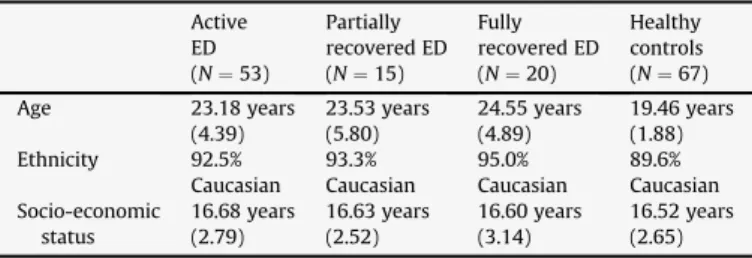
Table 2includes descriptive statistics of the four groups in terms of age, ethnicity, and socio-economic status. The groups did not differ in terms of ethnicity and socio-economic status, but did differ in age (F(3, 151)¼15.44,p<.001), with healthy controls signifi-cantly younger than the eating disorder groups. Controlling for age did not change the pattern of significance, so results without age as a covariate are presented for parsimony. The fully recovered, partially recovered, and active eating disorder groups did not differ in their pattern of lifetime eating disorder diagnoses (e.g., no significant differences in the percentage with a lifetime diagnosis of
AN), the number of years since the emergence of the eating disorder symptoms, or age or BMI at start of treatment (all p’s>.37). Of the active eating disorder group, 17.0% currently had AN, 5.7% had BN, and 77.4% had EDNOS.
In order to examine whether the individuals who participated differed from those who did not, we used clinic chart data to make comparisons. The participants were not significantly different from the non-participants (those with whom contact was never made or who declined to participate but agreed to let us use limited chart information) in terms of current age, age at first clinic visit, BMI at first clinic visit, eating disorder diagnoses, and number of years since last clinic visit. These findings provide confidence that, at least on these measures, study participants were representative of the larger eating disorder patient population at this clinic. Validity of recovery groups
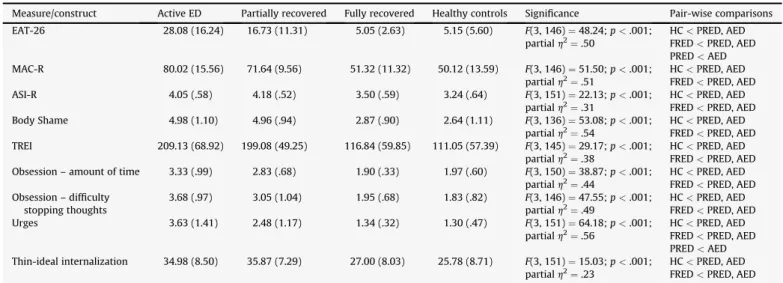
Table 3displays information from analysis of variance (ANOVA) analyses where eating disorder status was the independent able and the disordered eating measure was the dependent vari-able. Significant effects were followed up with Tukey HSD tests for pair-wise comparisons. The fully recovered group was consistently significantly less disordered than both the partially recovered and active eating disorder groups. It is notable that the fully recovered group and healthy controls did not differ significantly on any of the eating disorder assessments; furthermore, inspection of the means for these two groups revealed remarkably similar scores. In contrast, the partially recovered group was significantly less disordered than the active group on only two measures: the EAT-26 and urges to binge, vomit, use laxatives, and restrict. Interestingly, the partially recovered group did not differ from the active eating disorder group on any of the body image-related constructs, for example, appearance schemas, body shame, and thin-ideal inter-nalization. As additional evidence supporting the current eating disorder status distinctions, the mean EAT-26 score of the active eating disorder group was above the clinical cut-off of 20, the mean for the partially recovered group was below but close to 20 (mean of about 17), and the fully recovered group and healthy controls had similarly low scores (about 5) well below the clinical cut-off. Psychosocial functioning
Table 4contains findings related to functioning in the specific domains in the past three months based on ANOVAs, with signifi-cant effects followed up with Tukey HSD tests for pair-wise comparisons. There were group differences in work functioning, with healthy controls, fully recovered, and partially recovered groups functioning better than the active eating disorder group. Healthy controls and the fully recovered group also reported having better relationships with their fathers and with their friends than Table 2 Descriptive statistics. Active ED (N¼53) Partially recovered ED (N¼15) Fully recovered ED (N¼20) Healthy controls (N¼67) Age 23.18 years (4.39) 23.53 years (5.80) 24.55 years (4.89) 19.46 years (1.88) Ethnicity 92.5% Caucasian 93.3% Caucasian 95.0% Caucasian 89.6% Caucasian Socio-economic status 16.68 years (2.79) 16.63 years (2.52) 16.60 years (3.14) 16.52 years (2.65) Note: ED¼eating disorder. Means and standard deviations are reported for age and socio-economic status, with socio-economic status reflecting parents’ highest level of education attained.
3 Eight of the 96 current and former eating disorder patients did not meet criteria
for a current eating disorder or either definition of recovery (i.e., partial recovery of physical and behavioral recovery, but not psychological recovery, or full recovery of physical, behavioral, and psychological recovery). These were primarily individuals who had reported some (though minimal) binge eating or purging, typically once or twice in the past three months. We excluded these individuals from analyses in order to produce ‘‘cleaner’’ recovery groups and in order to include a recovery group more typical of what is seen in the literature (i.e., physical and behavioral recovery). However, when analyses were run including these eight individuals in the ‘‘partial recovery’’ group, the same pattern of results emerged as presented in this work using the stricter definition of partial recovery.
the active eating disorder group. There was a less striking group difference in terms of functioning in romantic relationships, and no group differences related to relationships with mothers.
Table 5provides descriptive information regarding the percen-tiles endorsing that eating disorder aspects interfered with their lives in the past three months. The general pattern was for the fully recovered group to have the fewest reporting this interference, followed by the partially recovered group, and then the active eating disorder group. When groups were compared on whether they reported eating disorder aspects interfering with any psychosocial domain in the past three months, 11.8% (n¼2) of the fully recovered group, 40.0% (n ¼6) of the partially recovered group, and 72.9% (n ¼35) of the active eating disorder group reported such interference,
c
2(2,N¼80)¼20.29,p<.001.4 As another way to consider group differences in psychosocial func-tioning, a logistic regression was run with the binary outcome ofpresence/absence of any psychosocial interference as the depen-dent variable. In comparison to the active eating disorder group, the fully recovered group was significantly less likely to report eating disorder aspects interfering in their lives (odd ratio (OR) ¼.05, Table 3
Comparison of disordered eating cognitions and behaviors across eating disorder status groups.
Measure/construct Active ED Partially recovered Fully recovered Healthy controls Significance Pair-wise comparisons
EAT-26 28.08 (16.24) 16.73 (11.31) 5.05 (2.63) 5.15 (5.60) F(3, 146)¼48.24;p<.001;
partialh2¼.50
HC<PRED, AED
FRED<PRED, AED
PRED<AED
MAC-R 80.02 (15.56) 71.64 (9.56) 51.32 (11.32) 50.12 (13.59) F(3, 146)¼51.50;p<.001;
partialh2
¼.51
HC<PRED, AED
FRED<PRED, AED
ASI-R 4.05 (.58) 4.18 (.52) 3.50 (.59) 3.24 (.64) F(3, 151)¼22.13;p<.001;
partialh2¼.31
HC<PRED, AED
FRED<PRED, AED
Body Shame 4.98 (1.10) 4.96 (.94) 2.87 (.90) 2.64 (1.11) F(3, 136)¼53.08;p<.001;
partialh2¼.54
HC<PRED, AED
FRED<PRED, AED
TREI 209.13 (68.92) 199.08 (49.25) 116.84 (59.85) 111.05 (57.39) F(3, 145)¼29.17;p<.001;
partialh2
¼.38
HC<PRED, AED
FRED<PRED, AED
Obsession – amount of time 3.33 (.99) 2.83 (.68) 1.90 (.33) 1.97 (.60) F(3, 150)¼38.87;p<.001;
partialh2¼.44
HC<PRED, AED
FRED<PRED, AED
Obsession – difficulty stopping thoughts
3.68 (.97) 3.05 (1.04) 1.95 (.68) 1.83 (.82) F(3, 146)¼47.55;p<.001;
partialh2¼.49
HC<PRED, AED
FRED<PRED, AED
Urges 3.63 (1.41) 2.48 (1.17) 1.34 (.32) 1.30 (.47) F(3, 151)¼64.18;p<.001;
partialh2¼.56
HC<PRED, AED
FRED<PRED, AED
PRED<AED
Thin-ideal internalization 34.98 (8.50) 35.87 (7.29) 27.00 (8.03) 25.78 (8.71) F(3, 151)¼15.03;p<.001;
partialh2¼.23
HC<PRED, AED
FRED<PRED, AED
Note: ED¼eating disorder; AED¼active eating disorder; PRED¼partially recovered eating disorder; FRED¼fully recovered eating disorder; HC¼healthy controls;
EAT-26¼Eating Attitudes Test-26; MAC-R¼Mizes Anorectic Cognitions Test-Revised; ASI-R¼Appearance Schemas Inventory-Revised; TREI¼Thinness and Restricting
Expectancy Inventory. Pair-wise comparisons listed were significant at least atp<.05.
Table 4
Comparison of domain-specific psychosocial functioning across eating disorder status groups.
Active ED Partially recovered Fully recovered Healthy controls Significance Pair-wise comparisons
Work 2.03 (1.32)n¼40 1.28 (.47)n¼13 1.18 (.31)n¼17 1.17 (.34)n¼53 F(3, 119)¼9.94;p<.001;
partialh2¼.20
HC<AED
FRED<AED
PRED<AED
Relationship with mother 2.07 (1.18)n¼50 1.77 (.82)n¼15 1.61 (1.09)n¼18 1.59 (.91)n¼66 F(3, 145)¼2.25;p¼.085;
partialh2
¼.05
–
Relationship with father 2.41 (1.27)n¼49 2.02 (1.45)n¼15 1.50 (1.10)n¼18 1.65 (.85)n¼64 F(3, 142)¼5.45;p¼.001;
partialh2¼.10 HC<AED FRED<AED Romantic relationship 2.19 (1.04)n¼33 1.61 (1.15)n¼12 1.50 (.90)n¼16 1.61 (.86)n¼48 F(3, 105)¼3.05;p¼.032; partialh2¼.08 HC<AED
Relationship with friends 2.23 (1.05)n¼50 1.69 (.83)n¼15 1.62 (.83)n¼18 1.48 (.66)n¼67 F(3, 146)¼7.81;p<.001;
partialh2
¼.14
HC<AED
FRED<AED
Note: ED¼eating disorder; AED¼active eating disorder; PRED¼partially recovered eating disorder; FRED¼fully recovered eating disorder; HC¼healthy controls. Means and standard deviations are presented for interviewer ratings of functioning in each domain, along with the number of participants within each eating disorder status group that provided data for each psychosocial domain. Ratings reflect average ratings across past 3 months, with lower numbers reflecting better psychosocial functioning.
Pair-wise comparisons listed were significant at least atp<.05.
Table 5
Comparison of presence of eating disorder interference in specific psychosocial domains across eating disorder status groups.
Active ED Partially recovered Fully recovered Significance
Work 23.7% 7.7% 0% Fisher’s exact test¼5.50,
p¼.054 Relationship with
Mother
34.7% 13.3% 5.9% Fisher’s exact test¼6.66,
p¼.038 Relationship with Father 35.4% 6.7% 0% Fisher’s exact test¼12.04,p¼.002 Romantic Relationship 69.7% 33.3% 14.3% c2(2,N¼59)¼13.58, p¼.001 Relationships with Friends 39.5% 6.7% 5.9% Fisher’s exact test¼10.45,p¼.004
Note: ED¼eating disorder. Fisher’s exact tests are reported in cases when one or more cells had an expected count less than 5. Percentiles represent the percentages who reported having eating disorder aspects interfere with their functioning in the various psychosocial domains in the past 3 months.
4 Since such a small subset of the eating disorder groups (active, partially
recovered, fully recovered) reported student activity in the past three months, we only included data about student functioning in the composite of experiencing interference from eating disorder aspects in any psychosocial domain (i.e., work, school, relationships).
confidence interval (CI)¼.01–.25,p<.001), as was the partially recovered group (OR¼.25, CI¼.07–.83,p¼.024).
Axis I psychopathology
Table 6displays the percentages of each group with a current mood disorder, anxiety disorder, substance use disorder, and any non-eating disorder Axis I disorder. For mood disorders (primarily major depressive disorder), healthy controls and the fully recovered group had similarly low rates of current diagnoses, in contrast to the one-fifth of the partially recovered group and about one-third of the active eating disorder group with mood disorders. For anxiety disorders, it was the fully recovered and partially recovered groups that were more similar, exhibiting higher rates than the healthy controls but lower rates than the active eating disorder group. Groups were similar in terms of substance use disorders, which had low base rates. Finally, when compared in terms of presence of any current non-eating disorder diagnosis, there was a stairstep progression across the groups by level of eating disorder severity. Based on a logistic regression analysis with the binary outcome of presence/absence of any non-eating disorder Axis I disorder as the dependent variable, the partially recovered group was about 3 times more likely to have a psychological disorder than the healthy controls (OR¼3.31, CI¼1.03–10.70,p¼.045), while the active eating disorder group was about 7 times more likely (OR¼7.35, CI¼3.20–16.86,p<.001). The fully recovered group did not differ from the healthy controls in their likelihood of having a non-eating disorder Axis I disorder (OR¼1.89, CI ¼.60–5.94, p¼.274).
Discussion
The current findings provide evidence that full recovery from an eating disorder is possible, including the attainment of normal attitudes toward food and the body. This suggests that prior find-ings that residual symptoms often persist in those recovered from an eating disorder may be an artifact of an incomplete definition of recovery. We found that those who no longer meet criteria for an eating disorder, who have not engaged in bingeing, purging, or fasting in the past three months, who have a BMI of at least 18.5, and who score within 1SDof age-matched community norms on all the EDE-Q subscales appear to have attained full recovery, and were indistinguishable from healthy controls on a wide range of disordered eating measures that focused on cognitions related to body image, eating, and food. In contrast, a partially recovered
eating disorder group that was recovered physically and behav-iorally, but not psychologically, was similar to an active eating disorder group, in terms of disordered eating cognitions. It is noteworthy that the partially recovered and active eating disorder groups did not differ on body image-related measures, but fully recovered and active eating disorder groups did. This finding is consistent with prior work where only individuals who were both cognitively and behaviorally recovered looked comparable to controls in terms of body dissatisfaction and endorsement of the thin ideal (Bachner-Melman et al., 2006). It appears as though body image disturbances may be key to distinguishing between partially and fully recovered individuals, and that a healthier relationship with one’s body may be the final hurdle in recovery.
In terms of functioning in specific psychosocial domains, partially recovered, fully recovered, and healthy control groups functioned at comparable levels. These findings provide some optimism that even if a partially recovered individual maintains eating disorder attitudes similar to her active eating disorder peers, she may function similarly to those with no eating pathology in terms of psychosocial adjustment. There was some evidence that only healthy controls and fully recovered individuals functioned better than active eating disorder individuals in some relationships (with father, friends).
To some degree, it was surprising that 12% of the fully recovered group reported that aspects of the eating disorder had interfered with psychosocial functioning in the past three months. However, this percentage is markedly less than the 40% for the partially recovered group and the 73% for the active eating disorder group. For a minority of the otherwise fully recovered individuals, there may be some scar effects of the eating disorder. It could also be that in some cases the eating disorder interference in relationships was due to others continuing to express concerns that may be unwar-ranted – for example, a mother pushing her daughter to eat more when the daughter has eaten a reasonable meal and is sated, leading to tension. Of note, participants reported if eating disorder aspects had ever interfered in various domains across the past three months, so individuals for whom this had happened once were grouped with those for whom it had happened frequently. Future research should assess eating disorder interference as a continuous rather than dichotomous variable. Also, future work should incor-porate more tailored measures of psychosocial impairment secondary to disordered eating attitudes and behaviors and make use of new quality of life instruments (Bohn et al., 2008; Engel, Adair, Las Hayas, & Abraham, 2009).
In terms of Axis I disorders, there was evidence for the fully recovered group looking both similar to controls (in terms of percentiles with a current mood disorder) and more pathological (in terms of percentiles with a current anxiety disorder). These results fit with existing work suggesting that anxiety disorders tend to precede eating disorders (Kaye et al., 2004), but depressive disorders are more often a consequence or concomitant of eating disorders (Herpertz-Dahlmann et al., 2001; Wentz, Gillberg, Gill-berg, & Rastam, 2001). Interestingly, the fully and partially recov-ered groups had similar proportions of individuals with an anxiety disorder (about one-third). It could be that for those who are fully recovered but with a current anxiety disorder, the underlying pathology that may have driven both an eating disorder and an anxiety disorder continues to be expressed, but only in the domain of non-eating disorder-related anxiety. Overall, the partially recovered and active eating disorder groups, but not the fully recovered group, were significantly more likely to experience current non-eating disorder pathology than healthy controls.
This study contributes to the literature with its theoretical conceptualization and operationalization of eating disorder recovery, along with a validation of this way of defining recovery. Table 6
Comparison of current non-eating disorder Axis I pathology across eating disorder status groups. Active ED Partially recovered Fully recovered Healthy controls Significance
Mood disorder 30.0% 20.0% 0% 3.0% Fisher’s exact
test¼20.83,
p<.001
Anxiety disorder 50.0% 33.3% 27.8% 16.4% Fisher’s exact
test¼15.21, p¼.001 Substance use disorder 6.0% 6.7% 5.6% 1.5% Fisher’s exact test¼2.96, p¼.324 Any non-eating disorder Axis I disorder 66.0% 46.7% 33.3% 20.9% c2(3,N ¼150)¼ 24.88,p<.001
Note: ED¼eating disorder. Fisher’s exact tests are reported in cases when one or more cells had an expected count less than 5. Percentiles represent the percentages who currently met criteria for non-eating disorder Axis I psychopathology.
Thus, this work follows recommendations in the depression liter-ature related to empirically validating a proposed category of recovery (Frank et al., 1991). It is also one of a limited number of recovery studies assessing non-eating disorder psychopathology and psychosocial functioning, and one of the few focusing on quality of psychosocial functioning rather than status variables. Generalizability is also a strength; by sampling from a facility other than an eating disorder clinic we were able to study a group with greater variability of severity – our sample included individuals with diagnosable but less severe eating disorders as well as indi-viduals with multiple hospitalizations. Finally, it is a strength that the healthy controls were determined only by absence of a past or current eating disorder, rather than by absence of any past psychopathology which would create ‘‘super healthy’’ controls that are less representative and against which it would be easier to find group differences (Klump et al., 2004).
In terms of limitations, all data were self-report (albeit via a combination of interview and questionnaires) and the sample size was relatively small. We note that we were not able to contact a significant minority of individuals. Some of the particular chal-lenges in locating young women for follow-up, in some cases over 10 years since their last clinic visit, included women who married and changed their last name as well as the now widespread use of mobile phones for which numbers are not recorded in any acces-sible registry. Of those we were able to contact, the majority did participate and no significant differences were found between participants and non-participants on relevant measures such as eating disorder diagnosis. It is also a limitation that the healthy controls were younger than the other three groups and that the participants were homogenous in terms of demographics. Future work should ensure that comparison groups are age-matched and should include males and greater racial/ethnic diversity for better generalizability. Another limitation is the cross-sectional design, which provides a snapshot of what is a dynamic process. Prospective, longitudinal research is needed to understand move-ment across eating disorder stages, to better assess the degree of severity during the active phase of an eating disorder that might predict recovery outcome, and to identify who relapses, thus providing further tests of the validity of this definition of full recovery. Finally, it may be argued that lumping together AN, BN, and EDNOS is a limitation, especially given evidence of different temporal patterns of recovery for AN and BN (Von Holle et al., 2008). Others may argue that this is an appropriate approach given eating disorder diagnostic migration (Tozzi et al., 2005) and the common core pathology of overvaluation of weight and shape (Fairburn, 2008). Future research with larger samples will want to examine these groups separately in order to determine if there are differences in predictors of comprehensive recovery for different eating disorder diagnoses.
The finding that full recovery exists is important information for practitioners and eating disorder patients and their families so that they have a sense of what recovery can look like. Given that the fully recovered and partially recovered individuals differed in terms of body shame, appearance schemas, and thin-ideal internalization, these may be fruitful targets of intervention among those on a recovery trajectory. Also, given that individuals fully and partially recovered from eating disorders reported elevated rates of current anxiety disorders and given the biological and genetic underpin-nings of eating and anxiety pathology (Kaye et al., 2004), practi-tioners working with individuals with eating disorders may want to make sure that anxiety symptoms are also a focus of treatment. What needs to occur for full recovery, namely, psychological recovery in addition to physical and behavioral recovery, also has implications in the context of managed care. While future prospective research needs to determine whether those fully
recovered are at significantly lower risk for relapse than those partially recovered, should this be borne out, then insurance companies should cover services that facilitate comprehensive recovery in order to reduce the revolving door phenomenon of eating disorder relapse. Finally, the findings also have implications for the definition and assessment of full recovery. Using the EDE-Q, BMI, and an assessment of binge eating, purging, and fasting among those with a past, but not current, eating disorder appears to be a logistically practical way to identify meaningful recovery that is cost-effective and efficient time-wise.
In sum, full recovery from an eating disorder appears to be a realistic goal, with future research needed to determine for whom it is a more realistic goal than for others. The inclusion of an explicit psychological piece of recovery is critical for identifying a more meaningfully recovered group that should be at low risk for relapse in what are often seen as chronic disorders. Future research should prospectively follow these recovery groups to provide further validation of the current operationalization of recovery and to identify predictors of trajectories. For example, longitudinal research could elucidate what predicts someone in partial recovery progressing to full recovery, staying in partial recovery, or relapsing. Factors such as coping skills and social support should be examined as potential contributors to full recovery (Bloks, van Furth, Call-ewaert, & Hoek, 2004). Given the need for researchers to agree on a definition of eating disorder recovery (Walsh, 2008) and the desirability of finding a definition of full recovery that is valid, based on psychometrically strong measures, and easily applied, we propose that the current operationalization is a promising approach that is both meaningful and practical. Thus, rather than arguing that other operationalizations should not be considered, we propose that researchers interested in examining eating disorder outcomes should design their studies to allow them to operationalize recovery as proposed in this paper.
Acknowledgements
This research was supported in part by the following grants: NIH 1 R03MH074861-01A1; University of Missouri PRIME Grant; and University of Missouri Research Council Grant. We greatly appre-ciate the time and effort of the study participants in sharing their past and current experiences with us.
References
Anderson, D. A., & Williamson, D. A. (2002). Outcome measurement in eating
disorders. In W. W. IsHak, T. Burt, & L. I. Sederer (Eds.),Outcome measurement in
psychiatry: a critical review(pp. 289–301). Washington, DC: American Psychi-atric Press.
Bachner-Melman, R., Zohar, A. H., & Ebstein, R. P. (2006). An examination of cognitive versus behavioral components of recovery from anorexia nervosa. Journal of Nervous and Mental Disease, 194, 697–703.
Bachner-Melman, R., Zohar, A. H., Ebstein, R. P., & Bachar, E. (2007). The relationship between selflessness levels and the severity of anorexia nervosa
symptom-atology.European Eating Disorders Review, 15. 213–220.
Bjorntorp, P. (2002). Definition and classification of obesity. In C. G. Fairburn, &
K. D. Brownell (Eds.),Eating disorders and obesity(2nd ed.). (pp. 377–381) New
York: Guilford.
Bloks, H., van Furth, E. F., Callewaert, I., & Hoek, H. W. (2004). Coping strategies and
recovery in patients with a severe eating disorder.Eating Disorders, 12, 157–169.
Bohn, K., Doll, H. A., Cooper, Z., O’Connor, M., Palmer, R. L., & Fairburn, C. G. (2008). The measurement of impairment due to eating disorder psychopathology. Behaviour Research and Therapy, 46, 1105–1110.
Bosanac, P., Kurlender, S., Stojanovska, L., Hallam, K., Norman, T., McGrath, C., et al. (2007). Neuropsychological study of underweight and ‘‘weight-recovered’’
anorexia nervosa compared with bulimia nervosa and normal controls.
Inter-national Journal of Eating Disorders, 40, 613–621.
Bulik, C. M., Sullivan, P. F., Fear, J. L., & Pickering, A. (2000). Outcome of anorexia
nervosa: eating attitudes, personality, and parental bonding. International
Journal of Eating Disorders, 28, 139–147.
Carter, J. C., Blackmore, E., Sutandar-Pinnock, K., & Woodside, D. B. (2004). Relapse
Cash, T. F., Melnyk, S. E., & Hrabosky, J. I. (2004). The assessment of body image investment: an extensive revision of the appearance schemas inventory. International Journal of Eating Disorders, 35, 305–316.
Channon, S., & DeSilva, W. P. (1985). Psychological correlates of weight gain in
patients with anorexia nervosa.Journal of Psychiatric Research, 19, 267–271.
Cogley, C. B., & Keel, P. K. (2003). Requiring remission of undue influence of weight and shape on self-evaluation in the definition of recovery for bulimia nervosa. International Journal of Eating Disorders, 34, 200–210.
Couturier, J., & Lock, J. (2006a). What is recovery in adolescent anorexia nervosa? International Journal of Eating Disorders, 39, 550–555.
Couturier, J., & Lock, J. (2006b). What is remission in adolescent anorexia nervosa? A
review of various conceptualizations and quantitative analysis.International
Journal of Eating Disorders, 39, 175–183.
Daley, K. A., Jimerson, D. C., Heatherton, T. F., Metzger, E. D., & Wolfe, B. E. (2008). State self-esteem ratings in women with bulimia nervosa and bulimia nervosa
in remission.International Journal of Eating Disorders, 41, 159–163.
Eddy, K. T., Doyle, A. C., Hoste, R. R., Herzog, D. B., & le Grange, D. (2008). Eating
disorder not otherwise specified in adolescents. Journal of the American
Academy of Child and Adolescent Psychiatry, 47, 156–164.
Engel, S. G., Adair, C. E., Las Hayas, C., & Abraham, S. (2009). Health-related quality of
life and eating disorders: a review and update.International Journal of Eating
Disorders, 42, 179–187.
Fairburn, C. G. (2008). Eating disorders: the transdiagnostic view and the cognitive
behavioral theory. In C. G. Fairburn (Ed.),Cognitive behavior therapy and eating
disorders(pp. 7–22). New York: Guilford Press.
Fairburn, C. G., & Beglin, S. J. (1994). Assessment of eating disorders: interview or
self-report questionnaire?International Journal of Eating Disorders, 16, 363–370.
Fairburn, C. G., & Cooper, Z. (1993). The eating disorder examination. In
C. G. Fairburn, & G. T. Wilson (Eds.), Binge eating: Nature, assessment, and
treatment(12th ed.). (pp. 317–360) New York: Guilford Press.
Federici, A., & Kaplan, A. S. (2008). The patient’s account of relapse and recovery in
anorexia nervosa: a qualitative study. European Eating Disorders Review, 16,
1–10.
Fichter, M. M., Quadflieg, N., & Hedlund, S. (2006). Twelve-year course and outcome
predictors of anorexia nervosa.International Journal of Eating Disorders, 39,
87–100.
Field, A. E., Herzog, D. B., Keller, M. B., West, J., Nussbaum, K., & Colditz, G. A. (1997). Distinguishing recovery from remission in a cohort of bulimic women: how
should asymptomatic periods be described?Journal of Clinical Epidemiology, 50,
1339–1345.
First, M. B., Spitzer, R. L., Gibbon, M., & Williams, J. B. (1995).Structured clinical
interview for the DSM-IV Axis I disorders – Patient edition (SCID-I/P, version 2). New York: New York State Psychiatric Institute, Biometrics Research Department.
Frank, E. (2005). Describing course of illness: does our language matter?
Interna-tional Journal of Eating Disorders, 38, 7–8.
Frank, E., Prien, R. F., Jarrett, R. B., Keller, M. B., Kupfer, D. J., Lavori, P. W., et al. (1991). Conceptualization and rationale for consensus definitions of terms in major
depressive disorder: remission, recovery, relapse, and recurrence.Archives of
General Psychiatry, 48, 851–855.
Garner, D. M., Olmsted, M. P., Bohr, Y., & Garfinkel, P. E. (1982). The eating attitudes
test: psychometric features and clinical correlates.Psychological Medicine, 12,
871–878.
Grilo, C. M., Masheb, R. M., & Wilson, G. T. (2001). A comparison of different methods for assessing the features of eating disorders in patients with binge
eating disorder.Journal of Consulting and Clinical Psychology, 69, 317–322.
Halvorsen, I., Andersen, A., & Heyerdahl, S. (2004). Good outcome of adolescent onset anorexia nervosa after systematic treatment: intermediate to long-term
follow-up of a representative county-sample. European Child & Adolescent
Psychiatry, 13, 295–306.
Herpertz-Dahlmann, B., Muller, B., Herpertz, S., Heussen, N., Hebebrand, J., & Remschmidt, H. (2001). Prospective 10-year follow-up in adolescent anorexia nervosa: course, outcome, psychiatric comorbidity, and psychosocial
adapta-tion.Journal of Child Psychology and Psychiatry, 42, 603–612.
Herzog, D. B., Dorer, D. J., Keel, P. K., Selwyn, S. E., Ekeblad, E. R., Flores, A. T., et al. (1999). Recovery and relapse in anorexia and bulimia nervosa: a 7.5-year
follow-up study.Journal of the American Academy of Child & Adolescent
Psychi-atry, 38, 829–837.
Herzog, D. B., Sacks, N. R., Keller, M. B., Lavori, P. W., von Ranson, K. B., & Gray, H. M. (1993). Patterns and predictors of recovery in anorexia nervosa and bulimia
nervosa.Journal of the American Academy of Child and Adolescent Psychiatry, 32,
835–842.
Herzog, W., Schellberg, D., & Deter, H. (1997). First recovery in anorexia nervosa
patients in the long-term course: a discrete-time survival analysis.Journal of
Counseling and Clinical Psychology, 65, 169–177.
Hohlstein, L. A., Smith, G. T., & Atlas, J. G. (1998). An application of expectancy theory to eating disorders: development and validation of measures of eating
and dieting expectancies.Psychological Assessment, 10, 49–58.
Kaye, W. H., Bulik, C. M., Thornton, L., Barbarich, N., Masters, K., & , Price Foundation Collaborative Group. (2004). Comorbidity of anxiety disorders with anorexia
and bulimia nervosa.American Journal of Psychiatry, 161, 2215–2221.
Keel, P. K., Dorer, D. J., Franko, D. L., Jackson, S. C., & Herzog, D. B. (2005).
Post-remission predictors of relapse in women with eating disorders.American
Journal of Psychiatry, 162, 2263–2268.
Keel, P. K., Mitchell, J. E., Miller, K. B., Davis, T. L., & Crow, S. J. (2000). Social
adjustment over 10 years following diagnosis with bulimia nervosa.
Inter-national Journal of Eating Disorders, 27, 21–28.
Keski-Rahkonen, A., Hoek, H. W., Linna, M. S., Raevuori, A., Sihvola, E., Bulik, C. M., et al. (2009). Incidence and outcomes of bulimia nervosa: a nationwide
pop-ulation-based study.Psychological Medicine, 39, 823–831.
Keski-Rahkonen, A., & Tozzi, F. (2005). The process of recovery in eating disorder
sufferers’ own words: an Internet-based study.International Journal of Eating
Disorders, 37(Suppl.), S80–S86.
Klump, K. L., Strober, M., Bulik, C. M., Thornton, L., Johnson, C., Devlin, B., et al. (2004). Personality characteristics of women before and after recovery from an
eating disorder.Psychological Medicine, 34, 1407–1418.
Kordy, H., Kramer, B., Palmer, R. L., Papezova, H., Pellet, J., Richard, M., et al. (2002). Remission, recovery, relapse, and recurrence in eating disorders: conceptualization
and illustration of a validation strategy.Journal of Clinical Psychology, 58, 833–846.
Lowe, B., Zipfel, S., Buchholz, C., Dupont, Y., Reas, D. L., & Herzog, W. (2001). Long-term outcome of anorexia nervosa in a prospective 21-year follow-up study. Psychological Medicine, 31, 881–890.
Luce, K. H., & Crowther, J. H. (1999). The reliability of the eating disorder
exami-nation – self-report questionnaire version (EDE-Q). International Journal of
Eating Disorders, 25, 349–351.
Matsunaga, H., Kaye, W. K., McConaha, C., Plotnicov, K., Pollice, C., & Rao, R. (2000).
Personality disorders among subjects recovered from eating disorders.
Inter-national Journal of Eating Disorders, 27, 353–357.
McKinley, N. M., & Hyde, J. S. (1996). The objectified body consciousness scale:
development and validation.Psychology of Women Quarterly, 20, 181–215.
Mizes, J. S., Christiano, B., Madison, J., Post, G., Seime, R., & Varnado, P. (2000). Development of the Mizes anorectic cognitions questionnaire – revised: psychometric properties and factor structure in a large sample of eating
disorder patients.International Journal of Eating Disorders, 28, 415–421.
Mond, J. M., Hay, P. J., Rodgers, B., & Owen, C. (2006). Eating disorder examination
questionnaire (EDE-Q): norms for young adult women.Behaviour Research and
Therapy, 44, 53–62.
Morgan, H. G., & Russell, G. F. (1975). Value of family background and clinical features as predictors of long-term outcome in anorexia nervosa: a 4-year
follow-up study of 41 patients.Psychological Medicine, 5, 355–371.
Noordenbos, G., & Seubring, A. (2006). Criteria for recovery from eating disorders
according to patients and therapists.Eating Disorders, 14, 41–54.
Pike, K. M. (1998). Long-term course of anorexia nervosa: response, relapse,
remission, and recovery.Clinical Psychology Review, 18, 447–475.
Pollice, C., Kaye, W. H., Greeno, C. G., & Weltzin, T. E. (1997). Relationship of depression, anxiety, and obsessionality to state of illness in anorexia nervosa. International Journal of Eating Disorders, 21, 367–376.
Quadflieg, N., & Fichter, M. M. (2003). The course and outcome of bulimia nervosa. European Child and Adolescent Psychiatry, 12, 99–109.
Reas, D. L., Williamson, D. A., Martin, C. K., & Zucker, N. L. (2000). Duration of illness
predicts outcome for bulimia nervosa: a long-term follow-up study.
Interna-tional Journal of Eating Disorders, 27, 428–434.
Roberto, C. A., Steinglass, J., Mayer, L. E. S., Attia, E., & Walsh, B. T. (2008). The clinical significance of amenorrhea as a diagnostic criterion of anorexia nervosa. International Journal of Eating Disorders, 41, 559–563.
Rush, A. J., Kraemer, H. C., Sackeim, H. A., Fava, M., Trivedi, M. H., Frank, E., et al. (2006). Report by the ACNP Task Force on response and remission in major
depressive disorder.Neuropsychopharmacology, 31, 1841–1853.
Steinhausen, H.-C. (2002). The outcome of anorexia nervosa in the 20th century.The
American Journal of Psychiatry, 159, 1284–1293.
Striegel-Moore, R. H., Seeley, J. R., & Lewinsohn, P. M. (2003). Psychosocial adjust-ment in young adulthood of women who experienced an eating disorder during
adolescence.Journal of the American Academy of Child and Adolescent Psychiatry,
42, 587–593.
Strober, M., Freeman, R., & Morrell, W. (1997). The long-term course of severe anorexia nervosa in adolescents: survival analysis of recovery, relapse, and
outcome predictors over 10–15 years in a prospective study.International
Journal of Eating Disorders, 22, 339–360.
Thompson, J. K., van den Berg, P., Roehrig, M., Guarda, A. S., & Heinberg, L. J. (2004). The sociocultural attitudes towards appearance scale-3 (SATAQ-3):
develop-ment and validation.International Journal of Eating Disorders, 35, 293–304.
Tozzi, F., Thornton, L. M., Klump, K. L., Fichter, M. M., Halmi, K. A., Kaplan, A. S., et al. (2005). Symptom fluctuation in eating disorders: correlates of diagnostic
crossover.American Journal of Psychiatry, 162, 732–740.
Von Holle, A., Pinheiro, A. P., Thornton, L. M., Klump, K. L., Berrettini, W. H., Brandt, H., et al. (2008). Temporal patterns of recovery across eating disorder
subtypes.Australian and New Zealand Journal of Psychiatry, 42, 108–117.
Wagner, A., Barbarich-Marsteller, N. C., Frank, G. K., Bailer, U. F., Wonderlich, S. A., Crosby, R. C., et al. (2006). Personality traits after recovery from eating
disor-ders: do subtypes differ?International Journal of Eating Disorders, 39, 276–284.
Walsh, B. T. (2008). Recovery from eating disorders.Australian and New Zealand
Journal of Psychiatry, 42, 95–96.
Wentz, E., Gillberg, C., Gillberg, I. C., & Rastam, M. (2001). Ten-year follow-up of adolescent-onset anorexia nervosa: psychiatric disorders and overall
func-tioning scales.Journal of Child Psychology and Psychiatry, 42, 613–622.
Yackobovitch-Gavan, M., Golan, M., Valevski, A., Kreitler, S., Bachar, E., Lieblich, A., et al. (2009). An integrative quantitative model of factors influencing the course of