Wright State University Wright State University
CORE Scholar
CORE Scholar
Kno.e.sis Publications The Ohio Center of Excellence in Knowledge-Enabled Computing (Kno.e.sis)
2006
Semi-Supervised Conditional Random Fields for Improved
Semi-Supervised Conditional Random Fields for Improved
Sequence Segmentation and Labeling
Sequence Segmentation and Labeling
Feng JiaoShaojun Wang
Wright State University - Main Campus, [email protected] Chi-Hoon Lee
Russell Greiner Dale Schuurmans
Follow this and additional works at: https://corescholar.libraries.wright.edu/knoesis
Part of the Bioinformatics Commons, Communication Technology and New Media Commons, Databases and Information Systems Commons, OS and Networks Commons, and the Science and Technology Studies Commons
Repository Citation Repository Citation
Jiao, F., Wang, S., Lee, C., Greiner, R., & Schuurmans, D. (2006). Semi-Supervised Conditional Random Fields for Improved Sequence Segmentation and Labeling. Proceedings of the 21st International Conference on Computational Linguistics and the 44th Annual Meeting of the Association for Computational Linguistics, 209-216.
https://corescholar.libraries.wright.edu/knoesis/100
This Conference Proceeding is brought to you for free and open access by the The Ohio Center of Excellence in Knowledge-Enabled Computing (Kno.e.sis) at CORE Scholar. It has been accepted for inclusion in Kno.e.sis Publications by an authorized administrator of CORE Scholar. For more information, please contact [email protected].
Semi-Supervised Conditional Random Fields for Improved Sequence
Segmentation and Labeling
Feng Jiao
University of Waterloo Russell Greiner Dale SchuurmansShaojun Wang Chi-Hoon Lee
University of Alberta
Abstract
We present a new semi-supervised training procedure for conditional random fields (CRFs) that can be used to train sequence segmentors and labelers from a combina-tion of labeled and unlabeled training data. Our approach is based on extending the minimum entropy regularization frame-work to the structured prediction case, yielding a training objective that combines unlabeled conditional entropy with labeled conditional likelihood. Although the train-ing objective is no longer concave, it can still be used to improve an initial model (e.g. obtained from supervised training) by iterative ascent. We apply our new training algorithm to the problem of iden-tifying gene and protein mentions in bio-logical texts, and show that incorporating unlabeled data improves the performance of the supervised CRF in this case.
1 Introduction
Semi-supervised learning is often touted as one of the most natural forms of training for language processing tasks, since unlabeled data is so plen-tiful whereas labeled data is usually quite limited or expensive to obtain. The attractiveness of semi-supervised learning for language tasks is further heightened by the fact that the models learned are large and complex, and generally even thousands of labeled examples can only sparsely cover the parameter space. Moreover, in complexstructured prediction tasks, such as parsing or sequence mod-eling (part-of-speech tagging, word segmentation, named entity recognition, and so on), it is con-siderably more difficult to obtain labeled training data than for classification tasks (such as docu-ment classification), since hand-labeling individ-ual words and word boundaries is much harder than assigning text-level class labels.
Many approaches have been proposed for semi-supervised learning in the past, including: genera-tive models (Castelli and Cover 1996; Cohen and Cozman 2006; Nigam et al. 2000), self-learning
(Celeux and Govaert 1992; Yarowsky 1995), co-training (Blum and Mitchell 1998), information-theoretic regularization (Corduneanu and Jaakkola 2006; Grandvalet and Bengio 2004), and graph-based transductive methods (Zhou et al. 2004; Zhou et al. 2005; Zhu et al. 2003). Unfortu-nately, these techniques have been developed pri-marily for single class label classification prob-lems, or class label classification with a struc-tured input (Zhou et al. 2004; Zhou et al. 2005; Zhu et al. 2003). Although still highly desirable, semi-supervised learning for structured classifica-tion problems like sequence segmentaclassifica-tion and la-beling have not been as widely studied as in the other semi-supervised settings mentioned above, with the sole exception of generative models.
With generative models, it is natural to include unlabeled data using an expectation-maximization approach (Nigam et al. 2000). However, gener-ative models generally do not achieve the same accuracy as discriminatively trained models, and therefore it is preferable to focus on discriminative approaches. Unfortunately, it is far from obvious how unlabeled training data can be naturally in-corporated into a discriminative training criterion. For example, unlabeled data simply cancels from the objective if one attempts to use a traditional conditional likelihood criterion. Nevertheless, re-cent progress has been made on incorporating un-labeled data in discriminative training procedures. For example, dependencies can be introduced be-tween the labels of nearby instances and thereby have an effect on training (Zhu et al. 2003; Li and McCallum 2005; Altun et al. 2005). These models are trained to encourage nearby data points to have the same class label, and they can obtain impres-sive accuracy using a very small amount of labeled data. However, since they model pairwise similar-ities among data points, most of these approaches require joint inference over the whole data set at test time, which is not practical for large data sets. In this paper, we propose a new semi-supervised training method for conditional random fields (CRFs) that incorporates both labeled and unla-beled sequence data to estimate a discriminative
structured predictor. CRFs are a flexible and pow-erful model for structured predictors based on undirected graphical models that have been glob-ally conditioned on a set of input covariates (Laf-ferty et al. 2001). CRFs have proved to be partic-ularly useful for sequence segmentation and label-ing tasks, since, as conditional models of the la-bels given inputs, they relax the independence as-sumptions made by traditional generative models like hidden Markov models. As such, CRFs pro-vide additional flexibility for using arbitrary over-lapping features of the input sequence to define a structured conditional model over the output se-quence, while maintaining two advantages: first, efficient dynamic program can be used for infer-ence in both classification and training, and sec-ond, the training objective is concave in the model parameters, which permits global optimization.
To obtain a new semi-supervised training algo-rithm for CRFs, we extend the minimum entropy regularization framework of Grandvalet and Ben-gio (2004) to structured predictors. The result-ing objective combines the likelihood of the CRF on labeled training data with its conditional en-tropy on unlabeled training data. Unfortunately, the maximization objective is no longer concave, but we can still use it to effectively improve an initial supervised model. To develop an effective training procedure, we first show how the deriva-tive of the new objecderiva-tive can be computed from the covariance matrix of the features on the unla-beled data (combined with the launla-beled conditional likelihood). This relationship facilitates the devel-opment of an efficient dynamic programming for computing the gradient, and thereby allows us to perform efficient iterative ascent for training. We apply our new training technique to the problem of sequence labeling and segmentation, and demon-strate it specifically on the problem of identify-ing gene and protein mentions in biological texts. Our results show the advantage of semi-supervised learning over the standard supervised algorithm.
2 Semi-supervised CRF training
In what follows, we use the same notation as (Laf-ferty et al. 2001). LetXbe a random variable over data sequences to be labeled, andY be a random variable over corresponding label sequences. All components, Yi, of Yare assumed to range over
a finite label alphabet Y. For example, X might range over sentences and Y over part-of-speech
taggings of those sentences; henceYwould be the set of possible part-of-speech tags in this case.
Assume we have a set of labeled examples, Dl = (x(1),y(1)),· · · ,(x(N),y(N), and
unla-beled examples,Du =x(N+1),· · ·,x(M). We
would like to build a CRF model
pθ(y|x) = 1 Zθ(x) exp K X k=1 θkfk(x,y) = 1 Zθ(x) exphθ, f(x,y)i over sequential input and output data x,y, where θ = (θ1,· · · , θK)>, f(x,y) = (f1(x,y),· · · , fK(x,y))>and Zθ(x) = X y exphθ, f(x,y)i Our goal is to learn such a model from the com-bined set of labeled and unlabeled examples,Dl∪
Du.
The standard supervised CRF training proce-dure is based upon maximizing the log conditional likelihood of the labeled examples inDl
CL(θ) =
N
X
i=1
logpθ(y(i)|x(i))−U(θ) (1)
whereU(θ) is any standard regularizer on θ, e.g. U(θ) = kθk2/2. Regularization can be used to
limit over-fitting on rare features and avoid degen-eracy in the case of correlated features. Obviously, (1) ignores the unlabeled examples inDu.
To make full use of the available training data, we propose a semi-supervised learning algorithm that exploits a form of entropy regularization on the unlabeled data. Specifically, for a semi-supervised CRF, we propose to maximize the fol-lowing objective RL(θ) = N X i=1 logpθ(y(i)|x(i))−U(θ) (2) + γ M X i=N+1 X y
pθ(y|x(i)) logpθ(y|x(i))
where the first term is the penalized log condi-tional likelihood of the labeled data under the CRF, (1), and the second line is the negative con-ditional entropy of the CRF on the unlabeled data. Here, γ is a tradeoff parameter that controls the
This approach resembles that taken by (Grand-valet and Bengio 2004) for single variable classi-fication, but here applied to structured CRF train-ing. The motivation is that minimizing conditional entropy over unlabeled data encourages the algo-rithm to find putative labelings for the unlabeled data that are mutually reinforcing with the super-vised labels; that is, greater certainty on the pu-tative labelings coincides with greater conditional likelihood on the supervised labels, and vice versa. For a single classification variable this criterion has been shown to effectively partition unlabeled data into clusters (Grandvalet and Bengio 2004; Roberts et al. 2000).
To motivate the approach in more detail, con-sider the overlap between the probability distribu-tion over a label sequenceyand the empirical
dis-tribution of p˜(x) on the unlabeled data Du. The
overlap can be measured by the Kullback-Leibler divergence D(pθ(y|x)˜p(x)k˜p(x)). It is well
known that Kullback-Leibler divergence (Cover and Thomas 1991) is positive and increases as the overlap between the two distributions decreases. In other words, maximizing Kullback-Leibler di-vergence implies that the overlap between two dis-tributions is minimized. The total overlap over all possible label sequences can be defined as
X y D(pθ(y|x)˜p(x)kp˜(x)) = X y X x∈Du pθ(y|x)˜p(x) log pθ(y|x)˜p(x) ˜ p(x) = X x∈Du ˜ p(x)X y
pθ(y|x) logpθ(y|x)
which motivates the negative entropy term in (2). The combined training objective (2) exploits unlabeled data to improve the CRF model, as we will see. However, one drawback with this approach is that the entropy regularization term is not concave. To see why, note that the en-tropy regularizer can be seen as a composition,
h(θ) = f(g(θ)), where f : <|Y| → <, f(g) = −P ygyloggy and gy : <K → <, gy(θ) = 1 Zθ(x)exp PK k=1θkfk(x,y)
. For scalar θ, the
second derivative of a composition, h =f ◦g, is
given by (Boyd and Vandenberghe 2004)
h00(θ) = g0(θ)>∇2f(g(θ))g0(θ)+∇f(g(θ))>g00(θ) Althoughf andgyare concave here, sincef is not
nondecreasing,his not necessarily concave. So in
general there are local maxima in (2).
3 An efficient training procedure
As (2) is not concave, many of the standard global maximization techniques do not apply. However, one can still use unlabeled data to improve a su-pervised CRF via iterative ascent. To derive an ef-ficient iterative ascent procedure, we need to com-pute gradient of (2) with respect to the parameters
θ. Taking derivative of the objective function (2)
with respect toθyields ∂ ∂θRL(θ) (3) = N X i=1 f(x(i),y(i))−X y pθ(y|x(i))f(x(i),y) ! − ∂ ∂θU(θ) + γ M X i=N+1 covpθ(y|x(i)) h f(x(i),y)iθ
The first three items on the right hand side are just the standard gradient of the CRF objective,
∂CL(θ)/∂θ (Lafferty et al. 2001), and the final
item is the gradient of the entropy regularizer (the derivation of which is given in Appendix A).
Here, covpθ(y|x(i))
f(x(i),y)
is the condi-tional covariance matrix of the features,fj(x,y),
given sample sequence x(i). In particular, the (j, k)th element of this matrix is given by
covpθ(y|x) h fj(x,y)fk(x,y) i = Epθ(y|x) fj(x,y)fk(x,y) −Epθ(y|x) fj(x,y) Epθ(y|x) fk(x,y) = X y pθ(y|x) fj(x,y)fk(x,y) (4) − X y pθ(y|x)fj(x,y) X y pθ(y|x)fk(x,y) To efficiently calculate the gradient, we need to be able to efficiently compute the expectations with respect to y in (3) and (4). However, this can pose a challenge in general, because there are exponentially many values for y. Techniques for computing the linear feature expectations in (3) are already well known ify is sufficiently struc-tured (e.g. yforms a Markov chain) (Lafferty et al. 2001). However, we now have to develop effi-cient techniques for computing thequadratic fea-ture expectations in (4).
For the quadratic feature expectations, first note that the diagonal terms, j = l, are
thatfj(x,y)2 =fj(x,y), and therefore the
diag-onal terms in the conditidiag-onal covariance are just linear feature expectationsEpθ(y|x)
fj(x,y)2 = Epθ(y|x) fj(x,y) as before.
For the off diagonal terms, j 6= l, however,
we need to develop a new algorithm. Fortunately, for structured label sequences, Y, one can devise an efficient algorithm for calculating the quadratic expectations based on nested dynamic program-ming. To illustrate the idea, we assume that the dependencies of Y, conditioned on X, form a Markov chain.
Define one feature for each state pair (y0, y), and one feature for each state-observation pair (y, x), which we express with indicator functions
fy0,y(hu, vi,y|hu,vi,x) = δ(yu, y0)δ(yv, y) and gy,x(v,y|v,x) = δ(yv, y)δ(xv, x) respectively.
Following (Lafferty et al. 2001), we also add spe-cial start and stop states,Y0 =start andYn+1 =
stop. The conditional probability of a label se-quence can now be expressed concisely in a ma-trix form. For each position j in the observation
sequence x, define the|Y| × |Y| matrix random variableMj(x) = [Mj(y0, y|x)]by Mj(y0, y|x) = exp(Λj(y0, y|x)) where Λj(y0, y|x) = X k λkfk ej,y|ej = (y0, y),x +X k µkgk vj,y|vj =y,x Hereej is the edge with labels(Yj−1,Yj)andvj
is the vertex with labelYj.
For each indexj= 0,· · ·, n+ 1define the for-ward vectorsαj(x)with base case
α0(y|x) = 1 if y= start 0 otherwise and recurrence αj(x) =αj−1(x)Mj(x)
Similarly, the backward vectorsβj(x)are given by
βn+1(y|x) =
1 if y= stop 0 otherwise
βj(x) = Mj+1(x)βj+1(x)
With these definitions, the expectation of the product of each pair of feature func-tions, (fj(x,y), fk(x,y)), (fj(x,y), gk(x,y)),
and (gj(x,y), gk(x,y)), for j, k = 1,· · · , K,
j6=k, can be recursively calculated.
First define the summary matrix
Ms+1,t−1(y, y0|x) = Yt−1 l=s+1 Ml(x) y,y0
Then the quadratic feature expectations can be computed by the following recursion, where the two double sums in each expectation correspond to the two cases depending on which feature oc-curs first (esoccuring beforeet).
Epθ(y|x) fj(x,y)fk(x,y) = n+1 X s,t=1,s<t X y0,y fj es,y|es = (y0, y),x X y00,y000 fk et,y|et = (y00, y000),x αs−1(y0|x)Ms(y0, y|x)Ms+1,t−1(y, y00|x) Mt(y00, y000|x)βt(y000|x)/Zθ(x) + n+1 X s,t=1,t<s X y0,y fj et,y|et = (y0, y),x X y00,y000 fk es,y|es = (y00, y000),x αt−1(y000|x)Mt(y000, y00|x)Mt+1,s−1(y00, y0|x) Ms(y0, y|x)βt(y|x)/Zθ(x) Epθ(y|x) fj(x,y)gk(x,y) = n+1 X s,t=1,s≤t X y0,y fj es,y|es = (y0, y),x X y00 gk vt,y|vt =y00,x αs−1(y0|x)Ms(y0, y|x) Ms+1,t−1(y, y00|x)βt(y00|x)/Zθ(x) + n+1 X s,t=1,t<s X y0,y fj et,y|et = (y0, y),x X y00 gk vs,y|vs =y00,x αt−1(y00|x) Mt+1,s−1(y00, y0|x)Ms(y0, y|x)βt(y|x)/Zθ(x) Epθ(y|x) gj(x,y)gk(x,y) = n+1 X s,t=1,s<t X y0 gj vs,y|vs=y0,x X y gk(vt,y|vt=y,x)
αs−1(y0|x)Ms+1,t−1(y0, y|x)βt(y|x) Zθ(x) + n+1 X s,t=1,t<s X y0 gj vt,y|vt=y0,x X y0 gk(vs,y|vs=y,x) αt−1(y|x)Mt+1,s−1(y, y0|x)βt(y0|x) Zθ(x)
The computation of these expectations can be or-ganized in a trellis, as illustrated in Figure 1.
Once we obtain the gradient of the objective function (2), we use limited-memory L-BFGS, a quasi-Newton optimization algorithm (McCallum 2002; Nocedal and Wright 2000), to find the local maxima with the initial value being set to be the optimal solution of the supervised CRF on labeled data.
4 Time and space complexity
The time and space complexity of the semi-supervised CRF training procedure is greater than that of standard supervised CRF training, but nevertheless remains a small degree poly-nomial in the size of the training data. Let
ml = size of the labeled set
mu = size of the unlabeled set
nl = labeled sequence length
nu = unlabeled sequence length
nt = test sequence length
s = number of states
c = number of training iterations.
Then the time required to classify a test sequence isO(nts2), independent of training method, since
the Viterbi decoder needs to access each path. For training, supervised CRF training requires
O(cmlnls2) time, whereas semi-supervised CRF
training requires O(cmlnls2 + cmun2us3) time.
The additional cost for semi-supervised training arises from the extra nested loop required to cal-culated the quadratic feature expectations, which introduces in an additionalnusfactor.
However, the space requirements of the two training methods are the same. That is, even though the covariance matrix has size O(K2),
there is never any need to store the entire matrix in memory. Rather, since we only need to compute the product of the covariance with θ, the
calcu-lation can be performed iteratively without using extra space beyond that already required by super-vised CRF training. start 0 1 2 stop
Figure 1:Trellis for computing the expectation of a feature product over a pair of feature functions,f00vsf10, where the
featuref00occurs first. This leads to one double sum.
5 Identifying gene and protein mentions
We have developed our new semi-supervised training procedure to address the problem of infor-mation extraction from biomedical text, which has received significant attention in the past few years. We have specifically focused on the problem of identifying explicit mentions of gene and protein names (McDonald and Pereira 2005). Recently, McDonald and Pereira (2005) have obtained inter-esting results on this problem by using a standard supervised CRF approach. However, our con-tention is that stronger results could be obtained in this domain by exploiting a large corpus of un-annotated biomedical text to improve the quality of the predictions, which we now show.
Given a biomedical text, the task of identify-ing gene mentions can be interpreted as a taggidentify-ing task, where each word in the text can be labeled with a tag that indicates whether it is the beginning of gene mention (B), the continuation of a gene mention (I), or outside of any gene mention (O). To compare the performance of different taggers learned by different mechanisms, one can measure the precision, recall and F-measure, given by
precision = # predicted gene mentions# correct predictions recall = # true gene mentions# correct predictions F-measure = 2×precision×recallprecision
+recall
In our evaluation, we compared the proposed semi-supervised learning approach to the state of the art supervised CRF of McDonald and Pereira (2005), and also to self-training (Celeux and Gov-aert 1992; Yarowsky 1995), using the same fea-ture set as (McDonald and Pereira 2005). The CRF training procedures, supervised and
semi-supervised, were run with the same regularization function,U(θ) =kθk2/2, used in (McDonald and Pereira 2005).
First we evaluated the performance of the semi-supervised CRF in detail, by varying the ratio be-tween the amount of labeled and unlabeled data, and also varying the tradeoff parameter γ. We
choose a labeled training setAconsisting of 5448
words, and considered alternative unlabeled train-ing sets, B (5210 words), C(10,208 words), and D(25,145 words), consisting of the same, 2 times
and 5 times as many sentences asArespectively.
All of these sets were disjoint and selected ran-domly from the full corpus, the smaller one in (McDonald et al. 2005), consisting of 184,903 words in total. To determine sensitivity to the pa-rameterγ we examined a range of discrete values
0,0.1,0.5,1,5,10,20,50.
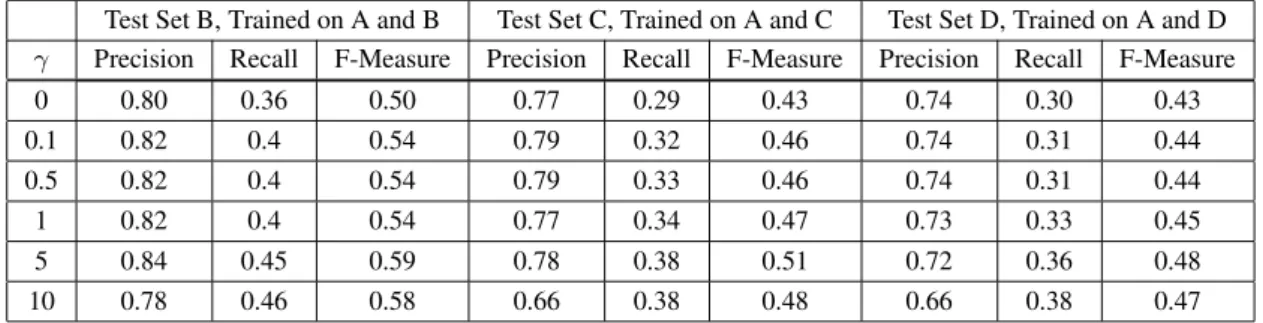
In our first experiment, we train the CRF models using labeled set Aand unlabeled sets B, C and D respectively. Then test the performance on the
sets B, C and D respectively The results of our
evaluation are shown in Table 1. The performance of the supervised CRF algorithm, trained only on the labeled setA, is given on the first row in Table
1 (corresponding toγ = 0). By comparison, the results obtained by the semi-supervised CRFs on the held-out setsB,CandDare given in Table 1
by increasing the value ofγ.
The results of this experiment demonstrate quite clearly that in most cases the semi-supervised CRF obtains higher precision, recall and F-measure than the fully supervised CRF, yielding a 20% im-provement in the best case.
In our second experiment, again we train the CRF models using labeled set A and unlabeled
setsB,CandDrespectively with increasing
val-ues ofγ, but we test the performance on the
held-out set E which is the full corpus minus the
la-beled setA and unlabeled setsB,C and D. The
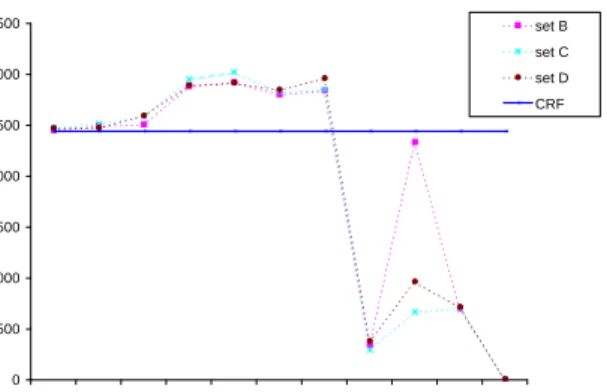
results of our evaluation are shown in Table 2 and Figure 2. The blue line in Figure 2 is the result of the supervised CRF algorithm, trained only on the labeled setA. In particular, by using the
super-vised CRF model, the system predicted 3334 out of 7472 gene mentions, of which 2435 were cor-rect, resulting in a precision of 0.73, recall of 0.33 and F-measure of 0.45. The other curves are those of the semi-supervised CRFs.
The results of this experiment demonstrate quite clearly that the semi-supervised CRFs
simultane-0 500 1000 1500 2000 2500 3000 3500 0.1 0.5 1 5 7 10 12 14 16 18 20 gamma n u m b e r o f c o rr e c t p re d ic ti o n ( T P ) set B set C set D CRF
Figure 2: Performance of the supervised and semi-supervised CRFs. The setsB,CandDrefer to the unlabeled
training set used by the semi-supervised algorithm.
ously increase both the number of predicted gene mentions and the number of correct predictions, thus the precision remains almost the same as the supervised CRF, and the recall increases signifi-cantly.
Both experiments as illustrated in Figure 2 and Tables 1 and 2 show that clearly better results are obtained by incorporating additional unlabeled training data, even when evaluating on disjoint testing data (Figure 2). The performance of the semi-supervised CRF is not overly sensitive to the tradeoff parameter γ, except that γ cannot be set
too large.
5.1 Comparison to self-training
For completeness, we also compared our results to the self-learning algorithm, which has commonly been referred to as bootstrapping in natural lan-guage processing and originally popularized by the work of Yarowsky in word sense disambigua-tion (Abney 2004; Yarowsky 1995). In fact, sim-ilar ideas have been developed in pattern recogni-tion under the name of the decision-directed algo-rithm (Duda and Hart 1973), and also traced back to 1970s in the EM literature (Celeux and Govaert 1992). The basic algorithm works as follows:
1. Given Dl and Du, begin with a seed set of
labeled examples,D(0), chosen fromDl.
2. Form= 0,1,· · ·
(a) Train the supervised CRF on labeled ex-amplesD(m), obtainingθ(m).
(b) For each sequence x(i) ∈ Du, find
y((im)) = arg maxypθ(m)(y|x(i)) via Viterbi decoding or other inference al-gorithm, and add the pair(x(i),y(i)
(m))to
the set of labeled examples (replacing any previous label forx(i)if present).
Table 1: Performance of the semi-supervised CRFs obtained on the held-out setsB,CandD
Test Set B, Trained on A and B Test Set C, Trained on A and C Test Set D, Trained on A and D
γ Precision Recall F-Measure Precision Recall F-Measure Precision Recall F-Measure
0 0.80 0.36 0.50 0.77 0.29 0.43 0.74 0.30 0.43 0.1 0.82 0.4 0.54 0.79 0.32 0.46 0.74 0.31 0.44 0.5 0.82 0.4 0.54 0.79 0.33 0.46 0.74 0.31 0.44 1 0.82 0.4 0.54 0.77 0.34 0.47 0.73 0.33 0.45 5 0.84 0.45 0.59 0.78 0.38 0.51 0.72 0.36 0.48 10 0.78 0.46 0.58 0.66 0.38 0.48 0.66 0.38 0.47
Table 2: Performance of the semi-supervised CRFs trained by using unlabeled setsB,CandD
Test Set E, Trained on A and B Test Set E, Trained on A and C Test Set E, Trained on A and D
γ # predicted # correct prediction # predicted # correct prediction # predicted # correct prediction
0.1 3345 2446 3376 2470 3366 2466 0.5 3413 2489 3450 2510 3376 2469 1 3446 2503 3588 2580 3607 2590 5 4089 2878 4206 2947 4165 2888 10 4450 2799 4762 2827 4778 2845 (c) If for eachx(i) ∈ Du, y(i) (m) = y (i) (m−1),
stop; otherwisem=m+ 1, iterate. We implemented this self training approach and tried it in our experiments. Unfortunately, we were not able to obtain any improvements over the standard supervised CRF with self-learning, using the sets Dl = A, and Du ∈ {B, C, D}. The
semi-supervised CRF remains the best of the ap-proaches we have tried on this problem.
6 Conclusions and further directions
We have presented a new semi-supervised training algorithm for CRFs, based on extending minimum conditional entropy regularization to the struc-tured prediction case. Our approach is motivated by the information-theoretic argument (Grand-valet and Bengio 2004; Roberts et al. 2000) that unlabeled examples can provide the most bene-fit when classes have small overlap. An itera-tive ascent optimization procedure was developed for this new criterion, which exploits a nested dy-namic programming approach to efficiently com-pute the covariance matrix of the features.
We applied our new approach to the problem of identifying gene name occurrences in biological text, exploiting the availability of auxiliary unla-beled data to improve the performance of the state of the art supervised CRF approach in this do-main. Our semi-supervised CRF approach shares all of the benefits of the standard CRF training, including the ability to exploit arbitrary features of the inputs, while obtaining improved accuracy
through the use of unlabeled data. The main draw-back is that training time is increased because of the extra nested loop needed to calculate feature covariances. Nevertheless, the algorithm is suf-ficiently efficient to be trained on unlabeled data sets that yield a notable improvement in classifi-cation accuracy over standard supervised training. To further accelerate the training process of our semi-supervised CRFs, we may apply stochastic gradient optimization method with adaptive gain adjustment as proposed by Vishwanathan et al. (2006).
Acknowledgments
Research supported by Genome Alberta, Genome Canada, and the Alberta Ingenuity Centre for Machine Learning. References
S. Abney. (2004). Understanding the Yarowsky algorithm. Computational Linguistics, 30(3):365-395.
Y. Altun, D. McAllester and M. Belkin. (2005). Maximum margin semi-supervised learning for structured variables. Advances in Neural Information Processing Systems 18. A. Blum and T. Mitchell. (1998). Combining labeled and
unlabeled data with co-training. Proceedings of the Work-shop on Computational Learning Theory, 92-100. S. Boyd and L. Vandenberghe. (2004).Convex Optimization.
Cambridge University Press.
V. Castelli and T. Cover. (1996). The relative value of la-beled and unlala-beled samples in pattern recognition with an unknown mixing parameter. IEEE Trans. on Informa-tion Theory, 42(6):2102-2117.
G. Celeux and G. Govaert. (1992). A classification EM al-gorithm for clustering and two stochastic versions. Com-putational Statistics and Data Analysis, 14:315-332.
I. Cohen and F. Cozman. (2006). Risks of semi-supervised learning. Semi-Supervised Learning, O. Chapelle, B. Scholk¨opf and A. Zien, (Editors), 55-70, MIT Press. A. Corduneanu and T. Jaakkola. (2006). Data dependent
regularization. Semi-Supervised Learning, O. Chapelle, B. Scholk¨opf and A. Zien, (Editors), 163-182, MIT Press. T. Cover and J. Thomas, (1991). Elements of Information
Theory, John Wiley & Sons.
R. Duda and P. Hart. (1973). Pattern Classification and Scene Analysis, John Wiley & Sons.
Y. Grandvalet and Y. Bengio. (2004). Semi-supervised learn-ing by entropy minimization, Advances in Neural Infor-mation Processing Systems, 17:529-536.
J. Lafferty, A. McCallum and F. Pereira. (2001). Conditional random fields: probabilistic models for segmenting and labeling sequence data. Proceedings of the 18th Interna-tional Conference on Machine Learning, 282-289. W. Li and A. McCallum. (2005). Semi-supervised sequence
modeling with syntactic topic models. Proceedings of Twentieth National Conference on Artificial Intelligence, 813-818.
A. McCallum. (2002). MALLET: A machine learning for language toolkit. [http://mallet.cs.umass.edu]
R. McDonald, K. Lerman and Y. Jin. (2005). Con-ditional random field biomedical entity tagger. [http://www.seas.upenn.edu/˜sryantm/software/BioTagger/] R. McDonald and F. Pereira. (2005). Identifying gene and
protein mentions in text using conditional random fields. BMC Bioinformatics 2005, 6(Suppl 1):S6.
K. Nigam, A. McCallum, S. Thrun and T. Mitchell. (2000). Text classification from labeled and unlabeled documents using EM.Machine learning. 39(2/3):135-167.
J. Nocedal and S. Wright. (2000). Numerical Optimization, Springer.
S. Roberts, R. Everson and I. Rezek. (2000). Maximum cer-tainty data partitioning. Pattern Recognition, 33(5):833-839.
S. Vishwanathan, N. Schraudolph, M. Schmidt and K. Mur-phy. (2006). Accelerated training of conditional random fields with stochastic meta-descent. Proceedings of the 23th International Conference on Machine Learning. D. Yarowsky. (1995). Unsupervised word sense
disambigua-tion rivaling supervised methods.Proceedings of the 33rd Annual Meeting of the Association for Computational Lin-guistics, 189-196.
D. Zhou, O. Bousquet, T. Navin Lal, J. Weston and B. Sch¨olkopf. (2004). Learning with local and global con-sistency.Advances in Neural Information Processing Sys-tems, 16:321-328.
D. Zhou, J. Huang and B. Sch¨olkopf. (2005). Learning from labeled and unlabeled data on a directed graph. Proceed-ings of the 22nd International Conference on Machine Learning, 1041-1048.
X. Zhu, Z. Ghahramani and J. Lafferty. (2003). Semi-supervised learning using Gaussian fields and harmonic functions.Proceedings of the 20th International Confer-ence on Machine Learning, 912-919.
A Deriving the gradient of the entropy We wish to show that
∂ ∂θ M X i=N+1 X y
pθ(y|x(i)) logpθ(y|x(i))
! = M X i=N+1 covpθ(y|x(i)) h f(x(i),y)iθ (5)
First, note that some simple calculation yields
∂logZθ(x(i)) ∂θj = X y pθ(y|x(i))fj(x(i),y) and ∂pθ(y|x(i)) ∂θj = ∂ ∂θj exphθ, f(x(i),y)i Zθ(x(i)) = pθ(y|x(i))fj(x(i),y) − pθ(y|x(i)) X y pθ(y|x(i))fj(x(i),y) Therefore ∂ ∂θj M X i=N+1 X y
pθ(y|x(i)) logpθ(y|x(i))
! = M X i=N+1 ∂ ∂θj X y pθ(y|x(i))hθ, f(x(i),y)i −logZθ(x(i)) = M X i=N+1 X y pθ(y|x(i))fj(x(i),y) +X y ∂pθ(y|x(i)) ∂θj hθ, f(x(i),y)i −X y pθ(y|x(i))fj(x(i),y) ! = M X i=N+1 X y
pθ(y|x(i))fj(x(i),y)hθ, f(x(i),y)i
−[X y pθ(y|x(i))hθ, f(x(i),y)i] [X y pθ(y|x(i))fj(x(i),y)] ! = M X i=N+1 X k θk h X y pθ(y|x(i))fj(x(i),y)fk(x(i),y) −[X y pθ(y|x(i))fk(x(i),y)] [X y pθ(y|x(i))fj(x(i),y)] i !