Reasoning in Non-probabilistic Uncertainty: Logic
Programming and Neural-Symbolic Computing
as Examples
Tarek R. Besold1•Artur d’Avila Garcez2• Keith Stenning3• Leendert van der Torre4• Michiel van Lambalgen5
Received: 15 August 2016 / Accepted: 28 February 2017 Springer Science+Business Media Dordrecht 2017
Abstract This article aims to achieve two goals: to show that probability is not the only way of dealing with uncertainty (and even more, that there are kinds of uncertainty which are for principled reasons not addressable with probabilistic means); and to provide evidence that logic-based methods can well support rea-soning with uncertainty. For the latter claim, two paradigmatic examples are pre-sented: logic programming with Kleene semantics for modelling reasoning from information in a discourse, to an interpretation of the state of affairs of the intended model, and a neural-symbolic implementation of input/output logic for dealing with uncertainty in dynamic normative contexts.
& Tarek R. Besold
[email protected] Artur d’Avila Garcez [email protected] Keith Stenning [email protected] Leendert van der Torre [email protected] Michiel van Lambalgen [email protected]
1 Digital Media Lab, Center for Computing and Communication Technologies (TZI), University of Bremen, Bibliothekstraße 5, 28359 Bremen, Germany
2
Department of Computer Science, City University London, London EC1V 0HB, UK 3
School of Informatics, University of Edinburgh, 10 Crichton Street, Edinburgh EH8 9LE, Scotland, UK
4
Computer Science and Communication, University of Luxembourg, 2, avenue de l’Universite´, 4365 Esch-sur-Alzette, Luxembourg
5 Faculty of Humanities, Logic and Language, University of Amsterdam, Oude Turfmarkt 141, 1012 GC Amsterdam, The Netherlands
Keywords Uncertainty in reasoningInterpretationLogic programming Dynamic normsNeural-symbolic integration
1 Introduction
‘‘Almost all everyday inference is uncertain, and, thus, human reasoning should be assessed using probability theory, the calculus of uncertainty, rather than logic, the calculus of certainty.’’ (Oaksford and Chater1998, p. 308) While fully agreeing on the premise of the statement—namely the observation that most human reasoning is uncertain in nature—we want to challenge the conclusion Oaksford and Chater (1998) (and many others) draw from it: in our view probability theory is neither the perfect solution solving all challenges introduced by reasoning’s inherent uncertainty, nor should logic be overly casually discarded as exclusively fit to deal with reasoning in certainty. In fact, the conception of monotonic classical logic as ‘reasoning in certainty’ can be misleading. In order to substantiate these two claims, below we first illustrate how logic programming (LP)—as a logic-based reasoning and computation paradigm—can be used to model reasoning which involves the resolution of uncertainties of a kind not amenable to probability theory. This is followed by the presentation of a neural-symbolic approach to LP extended to implement Makinson and van der Torre (2000)’s input/ output (I/O) logic, which can similarly be used to model non-probabilistic uncertainty in normative reasoning; uncertainty which is compounded by changing or newly added norms (i.e. dynamic environments requiring machine learning).
Among the main foundations of our argument is the observation that there are several qualitatively different kinds of uncertainty, for some of which probability— as convincingly shown by Oaksford and Chater (1998)—can be a powerful modelling technique, while others clearly lie outside of the reach of probabilistic approaches. The need for distinguishing kinds of uncertainty has surfaced regularly, for instance, in the study of judgement and decision-making. Knight (1921) made an early distinction between ‘risk’ (which could be modelled in probability) and ‘uncertainty’ (which could not), in economics. Kahneman and Tversky (1982) already discussed several variants of uncertainty, distinguishing, for example, what we might call private uncertainty (‘‘How sure am I that Rome is south of New York?’’ where the truth is taken to be already known by others) from communal uncertainty (‘‘How likely is it at the time of writing that the euro will collapse?’’). More recently, (Bradley and Drechsler 2014, p. 1225) proposed a taxonomy of uncertainties, in which:
‘‘[...] ethical, option and state space uncertainty are distinct from state uncertainty, the empirical uncertainty that is typically measured by a probability function on states of the world.’’
This comes with the claim that a single probability function cannot provide an adequate simultaneous account.1Mousavi and Gigerenzer (2014) expand Knight’s distinctions adding a further type of ‘utter uncertainty’ which describes cases where models are used in new domains.
One way of making the existence of a range of kinds of uncertainty distinct from probability generally plausible, is to think in terms of what a probabilistic model has to specify—and then consider what happens when elements are unavailable. Probabilistic models have to specify an algebra of propositions (variables) which exhaust the ‘effects’ encompassed by the model. Structural relations of dependence and independence then have to be supplied or assumed. Distributional information has to be attached; and last but not least, an assumption of ‘stationarity’ has to be made, i.e. the probabilistic relations between the isolated algebra of propositions have to be assumed to remain constant, and without intrusion of extraneous influences.
Several example phenomena that make this probabilistic schema impossible or unfruitful to apply will recur throughout this paper: LP modelling of the interpretation of discourse (Sect.2); learning (Sect.3.5.2) which contributes various ‘nonstationarities’ to reasoning systems; motivational phenomena which include both the norms expressed in deontic concepts such as priorities, obligations, permissions, contrary to duties (CTDs) (Sect.3.2.1), but also motivational ones such as goals and values. All these various examples share the requirement for the flexible handling of dynamic contexts, with the ensuing robustness to exceptions, as we illustrate.
Discourses are connected language. The process starts with input of discourse sentences, and sequentially builds a unique minimal ‘preferred’ model at each step.2 The algebra of propositions grows at each step, and when examined carefully, the propositions already in the model change—if only by taking on temporal/causal relations to the new ones that arrived (van Lambalgen and Hamm 2004)—even when they are not dropped nonmonotonically. The structural ‘common core’ of the last LP model in this sequence can provide, for instance, the basis for creating a Bayes Net by adding distributional information (Pearl2000; Pinosio, in prep.). Still, the propositions had not been identifiable until now, and so, no distributions could be attached, nor judgments made about causal stationarity. Reasoning to this point cannot be probabilistic; and even at this point, it is not entirely clear whether or how the necessary distributional information is available in general. And this is just the beginning of the difficulties since, for example, LP can freely express intentional relations between acts and actors’ multiple goals (Varga2013), which can at best be inflexibly ‘operationalised’ in extensional systems. Extensional systems may be able to formulate propositions that, when they become true, indicate that a goal has been fulfilled. However, they cannot capture what goals are: namely, the abstract 1 However, these authors—somewhat paradoxically—in the end come to the view that whatever uncertainty is the topic, probability is the framework for modelling it; cf. Sect.2.2 for some considerations on the corresponding argument and conclusion.
2 Later, we shall consider an alternative LP semantics based on Answer Sets (Gelfond and Lifschitz
1991), but we choose Preferred Model Semantics (Shoham1987) for now because the uniqueness of preferred models is a crucial feature for cognitive processes such as discourse processing.
flexibility of systems of motivational states and their interactions in unpre-dictable environments, as we shall see.
It is worth noting that the recent success of probabilistic language models based on neural networks (Weston et al.2014; Graves et al.2013) is orthogonal to the arguments presented in this paper. Yet, within the area of neural-symbolic computing (Garcez et al. 2009), equivalences have been proved between LP and neural networks, which indicate the possibility of reconciling such apparently very distinct representational frameworks. In fact, later in this paper a (non-probabilistic) neural characterisation of LP will be proposed which seeks to combine the requirements identified here of three-valued semantics and spreading of activation (discussed in what follows) with an ability to learn from examples, which is also a requirement of discourse processing in the case of dynamic environments. This neural-symbolic approach will be applied to deontic attitudes which preclude probability, since they aremotivationalin the extended notion of the word used in this paper: an obligation establishes a goal, even if that goal gets overridden by dynamic changes in circumstance. This will be exemplified in the context of reasoning in uncertainty about an environment of changing norms, which might themselves evolve in many as yet indeterminate ways.
At this point we take a step back and include what might seem like a mere clarification of terminology, but goes in fact much beyond that: the sense of ‘extensional’ and ‘intensional’ we use here are from the psychological decision making literature—stemming from Tversky and Kahneman (1983)—in which probability is extensional because its predicates are defined as sets, even though its conditional is non-truthfunctional. In that literature, ‘intensional’ is often synony-mous with ‘informal’ as it lacks a suitable logic. Nonetheless, LP (with the semantics as specified by Stenning and van Lambalgen2008) is intensional in the general philosophical sense: its predicates are defined in terms of ‘senses’ which are cashed out as algorithms (completion), and its closed-world reasoning conditionals are ‘licenses for inference’ (roughly contentful inference rules) rather than compound propositions (cf. Sect.2 for an introduction). An example of the role this interpretation of the intensional/extensional distinction plays, is the famous ‘Conjunction Fallacy’ (Tversky and Kahneman1983) which is supposed to be about judgements of the relative sizes of sets of cases corresponding to predicates and their conjunctions in probability. If a reader’s interpretation is in LP, then this extensional distinction makes no sense. The distinctions required for differentiating qualitatively different kinds of uncertainty can be seen more clearly in the contrast in the semantics of the intensional and extensional systems we discuss below. Stenning et al. (2017) use the Linda Task (the origin of the supposed Conjunction Fallacy) to illustrate this intensional option for interpretation, and its consequences. In the large, we believe these contrasts between intensional and extensional systems are at the heart of the contrasts in kinds of uncertainty which are our focus.
All these issues concerning the variety of kinds of uncertainty, and the characteristics of different formalisms and representation systems, also resound in the many different types of uncertainty Artificial Intelligence (AI) has to deal with in realistic scenarios: the world might only be partially observable, observation data might be noisy, the actual outcome of actions might be different from the
theoretically assumed one (either due to previously unknown or unconsidered factors, or due to independent external influences), or a prediction and assessment of present and future world states, action outcomes, etc. might just practically be outright impossible due to the immense complexity of the environment and scenario. As can be expected, there is an accordingly large AI literature on reasoning in uncertainty, and the variety of systems other than probability which are available. Quite recently Kern-Isberner and Lukasiewicz (2017) provided a helpful brief map of approaches to uncertainty—which, among others, demarcates logic programming under answer set semantics as distinctively outside both the currently popular system P (Kraus et al.1990) and the AGM axioms (Alchourro´n et al.1985). Another aid to navigation is offered by Halpern (2005) who is concerned with distinguishing different representations of uncertainty, and then studying reasoning from those representations. The example problems he gives in Chapter 1, pages 1 to 4, all have the property that the domain of interpretation and the properties and relations defined thereon are fixed at the outset. This need to fix interpretation is imposed by classical logic and probability, because of their need to generalise about all assignments of values to the vocabulary. Only the sampling, and with it the epistemic states of the judges of uncertainties, varies. For such problems, Halpern argues convincingly that plausibility measures are a generalisation of probability measures, and that different plausibility measures are more or less appropriate for different problems.3But contrary to this general line of investigation, our focus is on the more radical kind of uncertainty faced by reasoningtointerpretations.
Our paper thus has a much more modest exploratory goal than Halpern’s monumental work. It seeks to develop two examples in some detail of reasoningto
interpretations. So by definition, in these examples, much less is known about the particularities of their domains until their specification is finished, and it is the uncertaintyduring this process of reasoning which is our focus. A great deal of general knowledge must be applied in the dynamic development of their specificationduring the period of interpretation whose uncertainties are of interest. The example of narrative discourse interpretation exemplifies this character: At the outset of a story, the hearer may know nothing in particular of what will turn out to be in the preferred model of the story that will develop; not even what range of properties and relations will distinguish the characters and events that unfold, even though the hearer’s knowledge base must contain a great deal of general knowledge, some of which has to be mobilised to interpret the current input discourse. We nevertheless succeed in reasoning to interpretations of such stories with remarkable, though not inevitable, success. This reasoning is omnipresent in human problem solving and communication (Stenning and van Lambalgen 2008). It has to be a precursor to modelling in probability, or plausibility measures more generally, because the vocabulary of predicates and relations has to be established by reasoningtointerpretations. Modelling this reasoning tointerpretations requires a framework that is more radically nonmonotonic than probability theory, whose underlying propositions to which probabilities are attached, are classical logical 3 In terms of concrete examples, the work by Nilsson (1986) comes to mind as a prominent instance falling within the domain of Halpern’s plausibility measures.
propositions. Stenning et al. (2017) argue that such extensional systems are inherently incapable of providing the requisite flexibility. Understanding how reasoning to interpretations works with reasoning from them can lead to a deeper understanding of both.
Still at this synoptic level, another difference between Halpern’s plausibility measures and LP doing discourse interpretation is that the former begin with numerical parameters on propositions, and output numerical parameters on inferred propositions. In contrast, LP reasoning to interpretations of discourse need have no numerical parameters, even though numerical properties of the logical structures
involved have been shown to be the basis on which reasoners make quantitative judgments of LP conditionals’ reliability in inference (Stenning et al. 2017). Counting the defeaters for a conditional can predict confidence in inferences from that conditional. For another example, Halpern’s conditionals with plausibility measures treat conditionals as propositions having truth values. In LP with Kleene semantics modeling discourse interpretation, conditionals are not propositions (they are licences for inference), and erate (cf. Stenning and van Lambalgen2008, p. 184, footnote 9), nor do they become false if they do not apply because of an abnormality condition.
At a more technical level, there are a number of contrasts between LP (and also the later discussed I/O logic) and plausibility measures (Halpern2005) which adopt the KLM axioms. For example, plausibility measures apply to systems with the ‘OR-rule’. Fromp!q;r!qit follows thatðp_rÞ !q. This rule does not apply in LP because the ‘abnormality clauses’ defeat it:p^ :ab0!q;r^ :ab00!q it does not follow thatðp_rÞ !q.
We close this differentiation of our focus from existing work with an example of a more empirical dissatisfaction with probability as a model of human reasoning. Tversky and Kahneman (1974) and Gigerenzer et al. (1999,2011) have extensively developed evidence that human reasoning is heuristic with regard to probability models. In an especially clear case of this relation, Juslin et al. (2009) argue that peoples’ judgements of likelihoods in uncertainty do not obey probabilistic models. However, their concern is with heuristic approximations for combinations of probabilities. They assume that people have access to the probabilities (or their estimates), and produce evidence that people combine them in the conjunctive case by ‘weighting and adding’, rather than the probabilistically normative procedure of multiplying. This is a different, calculative level of issue with probability than the conceptual differences that concern us here. These authors tiptoe towards the cliff of appreciation that probability might not be the right normative theory:
‘‘Importantly in this context, to the extent that problems are framed in terms of probability that often requires multiplicative information integration, the strong inclination for linear additive integration is a first sense in which probability theory may often not be a very useful (or useable) guide in life.’’ (Juslin et al.2009, p. 861)
Nonetheless, they do not take the leap of offering an intensional framework. Stenning et al. (2017) explore an incorporation of such heuristic approaches within LP to provide a simple probability-free model of judgement and decision. This
approach offers insights into how intensional reasoning produces structural foundations for subsequent probabilistic modelling through their ‘common core’ (Pinosio). This functional relation of the two contrasting types of reasoning in uncertainty is of central importance in human reasoning, and is possibly one of its main ingredients which is least represented in current AI.
In Sect.2we first focus on the application of LP in building process models of ‘‘reasoning to an interpretation’’ as a crucial part of human reasoning. As, for instance, Stenning and van Lambalgen (2010) argue, when faced with interpreta-tional uncertainty about the information involved in a problem, we cannot engage the computational complexity of probability, but have to take more accessible inferential paths—which are often quite successful. Here, among other work building on the book by Stenning and van Lambalgen (2008), a version of LP, using a semantics based on three-valued Kleene logics, offers itself as a modelling approach. Since it is a crucial cognitive capacity involved in our daily lives, as already mentioned above, discourse processing will serve as core theme and paradigmatic example in this section.
Section3 subsequently takes a more AI-centric view and describes a neural-symbolic architecture combining the I/O logic proposed by Makinson and van der Torre (2000) with artificial neural networks (ANNs), applied to normative reasoning tasks involving uncertainty introduced by changing norms over time. I/O logic seeks to analyse the sometimes subtle asymmetries between what can be fed into, and what can be output from, other logics, wherever there are inputs that cannot occur as outputs, orvice versa. Normative reasoning is chosen because deontic systems have to encode obligations and permissions which will be manipulated as propositions by the ‘inner logic’, but whose force is not entirely captured by such manipulation. For example, consider ‘cottage regulations’ often discussed in deontic logic. When the input says that there is a dog, and the output says that there should be no dog, then there is a violation (which could be sanctioned). Alternatively, if the input says that there is no dog, and the output says again that there should be no dog, then there is a fulfilled obligation (which could be rewarded). Moreover, we may also have according-to-duty relations such that the output says that there should be no fence either when the input says there is no dog, or when the input is just a tautology; and contrary-to-duty (CTD) relations in which case the output may say that it is obligatory that there is a fence when the input says that there is a dog. Examples like these will be discussed later. Simply put, the challenge of norm dynamics is to change such—already by themselves quite complex and often highly interdepen-dent—relations between input and output when new information becomes available that norms have changed. Interestingly, in neural networks, as in I/O logic, what can be fed into and what can be output from a neural network is strictly defined, in contrast to LP. This will be analyzed in detail. The neural part of the neural-symbolic approach enables the required form of learning, and learning introduces a dynamics to normative systems that also exercises I/O logic, introducing more kinds of uncertainty differentiated from probability.
Section4then concludes our argument and sketches several directions for future work.
2 Logic Programming Modelling Reasoning to an Interpretation
In this section we focus on the applicability and advantages of an LP-based approach for modelling reasoning in interpretatively uncertain situations, i.e. situations in which there is uncertainty concerning the relevance or precise meaning/ interpretation of propositions. Section2.1introduces the relevant form of LP using three-valued Kleene semantics, and conceptually motivates its use as a modelling tool for this human reasoning. This is followed by a more focused treatment of this type of LP applied to dealing especially with the uncertain aspects of reasoning in Sect.2.2.
2.1 Logic Programming Modelling Reasoning
LP is a formal system that has been used extensively to model reasoning in a variety of domains, as widely separated as motor control (Shanahan 2002), and imitative learning (Varga2013). Its employment in cognitive modelling grew primarily out of an analysis of discourse processing, in particular of interpretation (van Lambalgen and Hamm2004; Stenning and van Lambalgen2008; Stenning and Varga 2016). People take in sentences online, in fractions of a second, and effortlessly update their current discourse model, fully indexed for co-references of things, times and events, and their temporal and causal relations. This may require far-flung bits of background knowledge, retrieved from a huge knowledge base (KB) of semantic memory composed of conditional rules understood as licences for inference. Discourse interpretation involves constructing a preferred or intended model4of the context. A crucial application of LP is modelling the efficient inferential retrieval from long-term memory of the relevant cues needed to construct or decide on an interpretation of the state of affairs as basis for, e.g., choosing a course of action.
Following Stenning and van Lambalgen (2008), we view reasoning to be a two-stage process. It starts with reasoning to an interpretation (the computation or retrieval of a meaningful model of the current situation), which may be followed by reasoning from the interpretation. In a typical (i.e. cooperative) conversational context this amounts to computing the model the speaker must have intended to convey. The computation of the intended or preferred model by LP complies with cooperative Gricean principles, but is much more efficient than computing directly with those principles. Imagine you are talking to a friend who is telling you her holiday stories, including an outing into the countryside by car. She says: ‘‘And then I press the brake! And then. . .’’. LP is constructed so that it interprets this utterance online under the assumption that the speaker’s goal is to provide everything the hearer needs to know and nothing more, in order to construct a minimal model of the discourse at each point. At this point that model predicts a continuation of the story consistent with the car slowing down, though this may well be retracted at the next point. It does not consider, without positive evidence, that there might have
4 Intended modelis the psychological notion which corresponds tominimal model.Modelis to be read as semantic model.Preferred modelis the logical notion used by Shoham (1987). Keeping in mind the terms belonging to different fields, we use intended, minimal and preferred as synonyms.
been ice on the road, or that hers functions differently from all other cars, (or any other defeater). LP with negation-as-failure and Kleene’s strong semantics has shown to be a good candidate for a suitable logic of such cooperative intensional reasoning.
LP conditionals function as ‘licenses for inference’, rather than sentences compounded by the ‘if ...then’ connective. They can be thought of as highly content-specialised rules of inference which are always applicable when a clause matches them. But it has the important consequence, already mentioned, that—like natural language conditionals—LP conditionals do not iterate, especially in the antecedent, to produce compound propositions, and do not themselves have truth-values: they are assumed applicable on an occasion unless evidence of exception arises. LP as discussed by Stenning and van Lambalgen (2008) and van Lambalgen and Hamm (2004) formalises a kind of reasoning which uses closed-world assumptions (CWAs) in order to keep the scope of reasoning to manageable dimensions by entities with limited time, storage, and computational resources, though with very large knowledge bases (KBs)—such as we are. Historically, LP is a computational logic designed and developed for automated planning (Kowalski1988; Doets1994) which is intrinsically preoccupied with relevance—making for an important qualitative difference between LP and classical logic (CL). Returning to the type of communicative situation as just introduced in the car example, discourse processing in LP is cyclical. When a new input sentence arrives, its terms are searched for in the KB. The existing minimal model of the discourse to this point is then updated with any new relevant information, according to CWAs, and the cycle repeats. CL, in contrast, assesses the validity of inferences from premises to conclusions with respect toall possible modelsof the premises, so the question of relevance does not even arise in CL, except outside the logic in the framing of problems. So LP isnot
just a poor man’s way of doing what can be done better but with more difficulty in CL—the two different types of logic simply serve different incompatible reasoning purposes, and in this sense are incommensurable.
The basic format of CWAs is the one for reasoning about abnormalities ðCWAabÞ, which prescribes that, if there is no positive information that a certain
abnormality-event must occur, it is assumed not to occur.5These abnormalities are with respect to the regularity expressed by a conditional; for example, ice on the road causing a car not to stop although the brake is pressed, is an abnormality with respect to the default functioning of brakes. Potential abnormalities are included in the LP meaning of the conditional!, hence what is labeled ‘counterexample’ in CL does not invalidate a conditional inference in LP, it is merely treated as an exception. The conditional has an operational semantics as an operator that modifies
5 Abnormalityis a technical term for exceptions and should not be taken as having any other overtones. Some terminology: in the conditionalp^ :ab!q,abis the schematic abnormality clause. A distinctab
is indexed to each conditional, and stands for a disjunction of a list of defeaters for that conditional; CWAab is the CWA applied to abnormality clauses; :is the 3-valued Kleene connective, whereas
negation-as-failure is an inference pattern that results in negative conclusions by CWA reasoning from absence of positive evidence; falsum (?) and verum (>) are proposition symbols which always take the values false or true respectively; turnstile (‘) and semantic turnstile () are symbols indicating syntactic and semantic consequence respectively.
truth values of atomic formulas. This is the logical mark of its use as an exception-tolerant ‘licence for inference’. It is represented as p^ :ab!q; it reads as ‘If
pandnothing abnormal is the case, thenq’. The antecedentpis called thebodyof the clause, and the consequent q is its head.6 p and q are composed of atomic formulas, withqrestricted to literals (atomic formulas or their negations) andp to conjunctions of literals. The only connectives that may occur in the antecedent are^ and:.
Sets of such conditional clauses constitute a general logic program P (i.e. a program allowing negation in the antecedents of clauses).Pcan be understood as a recipe for computing a unique model of the discourse it represents, on the basis of information from background knowledge inferentially selected as relevant. Nega-tion in the antecedent requires utilisaNega-tion of a three-valued semantics.7We opt for strong Kleene semantics for LP, where the middle truth valueumeans ‘currently indeterminate’; it is not a graded truth akin to a probability—as in Lukasiewicz three-valued logic—but rather a stage of computation of an algorithm which can evolve towards either 0 or 1. This gives LP the sort of semantic mobility which constitutes a crucial reason for claiming that it can capture the particular kind of nonmonotonic flexibility of reasoning required to deal efficiently with interpreta-tional uncertainty (cf. Sect.2.2). Facts q can be represented in logic programs as consequents of tautologies, > !q (for simplicity we write only q). The CWAab
requires that for an initial interpretation at least, abnormalities are left ‘at the back of the reasoners’ minds’, i.e. outside of theminimal modelofP. However conditional clauses have conjoined abnormality conditions of the kindr1 !ab1;. . .rn!abn;
when evidence ofr1;. . .rn becomes available, it activates the correspondentabk. If
we take P ¼ fIf the brake is pressed, the car will slow downg, the fact ‘there is ice on the road’ is not represented in its minimal model because this model disregards all potential abnormalities without explicit evidence. The information in a minimal model includes all that is currently known to be relevant and nothing more than that; the only relevant information is explicitly mentioned or derivable. The derivation capacities of LP’s search of its KB are what achieves this computation of relevance. If new input is that there was a storm last night, then this, together with other information in the KB about local meteorology, may yield an inference that there is ice on the road. The input does not mention ice, but ice on the road is a relevant defeater for braking causing slowing, that we assume is already in the list of defeaters for the brakes conditional. Of course, the new information will lead to many other potential inferences during the sweep through the KB, but if they do not connect with anything in the current model, these inferences will not be added because there is no evidence of their relevance. Sometimes such retrieval can involve several conditional links. This is a computationally explicit example of what psychology knows as ‘spreading activation’ models of memory retrieval, but has been neurally implemented for ‘propositional LP’ as described in (Stenning and van 6 Another remark concerning terminology: while in this context the use of the terms ‘head’ and ‘body’ is commonplace in computer science, we will in the following restrict ourselves to ‘antecedent’ and ‘consequent’ in order to maintain homogeneity also with terminology in philosophy and logic. 7 Cf. (Stenning and van Lambalgen2008, chapter 2) for the justification, or the Appendix in (Stenning et al.2017) for a more succinct version.
Lambalgen2008, chapter 8). Spreading of activation will also be given a slightly different implementation in the neural networks used later in this paper. Such networks will adopt an answer set semantics (Gelfond and Lifschitz1991) allowing the use of default negation for implementing CWA explicitly, and classical
(sometimes called explicit) negation, which allows for reasoning as intended here, that is, in the absence of a proof of A and its negation, the truth-value of A is ‘currently indeterminate’.
LP models embody much information about stereotypes. For a micro example, it is part of the stereotype of our braking scenario, that the car that is conjured is in motion when the brake is pressed, as developed below. Minimal models are at the intersection between the current input (be that heard language, or observations of any other form) and the reasoner’s background knowledge; they contain all the relevant information and nothing more. In logical terms, they are constructed using the two-step rule ofcompletion(comp):
1. take the disjunction_of all antecedentsp1;. . .pnwith the same consequentqin
programP;
2. replace !with$.8
Thus, if P ¼ fp1 !q;. . .pn!qg, compðPÞ ¼ fp1_. . .pn$qg. The minimal
model of P is in fact a model of compðPÞ. Such a model does not include information that is either not explicitly mentioned inP, or not derivable from it, and in this sense it is minimal. The CWAab provides the notion of valid inference in
LP—an inference is valid if it is truth-preserving with respect to the minimal model of the premises. The contrast with CL is noteworthy: in CL an inference is valid if and only if the conclusion is true in all possible models of the premises. Because of this LP turns out much less computationally complex than CL, and therefore is a promising candidate framework for realistic performance models of fast, implicit, or automatic reasoning (online discourse interpretation being the paradigmatic case).9 Once a minimal model is constructed, further reasoningfromthat model ensues according to the derivation rule ofresolution, or the reduction of goals to subgoals by means of backwards chaining.10The syntactic manifestation of the CWAabis the
inferential rule of negation-as-failure, which is applied restrictively to proposition letters which are consequents of falsum, i.e. toqoccurring in formulae like? !q.
Queriesorgoal clausesinitiate derivations.
8 Here,$denotes a classical biconditional in the object language. 9
Basically, in LP queries can be answered in time linear with the length of the shortest inferential path in the KB.
10This direction of reasoning is from effect to cause, from goals to subgoals, or simply backwards in time. The typical backward inferences are modus tollens (p!q;:q :p) and affirmation of the consequent (p!q;q p), initiated by the consequent. The psychological findings that these inferences are more difficult might well be a result of the micro-scale of the tasks being used (Sloman and Lagnado
2015), or of the slightly more complex form of the CWAab needed (Stenning and van Lambalgen 2008, pp. 176–177).
‘‘Operationally, one should think of a query ?q as the assumption of the formula:q, the first step in provingq fromP using a reductio ad absurdum argument. In other words, one tries to show that P;:q ?. [...] one rule suffices for this, a rule which reduces a goal to subgoals.’’ (van Lambalgen and Hamm2004, p.230)
Suppose one wants to reduce the query ?q with respect to the program P ¼ fp^ :ab!q;? !abg, which contains no positive information about abnormality. Negation-as-failure allows the reduction of q to p, because ab is a consequence of falsum.
The formal parameters of LP, e.g., the semantics based on truth in unique minimal models, the nonmonotonic definition of validity, or the syntactic rules, such as negation-as-failure, recommend it for applications in the modelling of human reasoning. In the first place, individuals’ background KBs are sets of exception-tolerant regularities. Further, LP provides a ‘direct route’ to (the reasoner’s beliefs about) states of the environment which ground inferences: observations can be looked at as the effects of those (beliefs about) states, represented as literals occurring in the consequents of KB clauses. We saw above that the LP syntactic rule of resolution amounts to stepwise backward reasoning from goals (effects) to subgoals (causes), i.e. from queries to their causes represented in the bodies of conditionals. This matches conceptually with the plan-like psychological structure of reasoning strategies: starting from the goal, i.e. a particular desired state of affairs that calls for action, one attempts to derive a behaviour that presumably leads to that state. Similarly, when a certain state is observed, backwards reasoning derives as its cause the (beliefs about) states which appear in the antecedent of the clause whose consequent it is. This ‘effect to cause’ inference takes place with respect to the minimal model ofP, after the operation of completion has been performed; further, it is made under the auspices ofCWAabin the syntactic form of negation-as-failure. Therefore the (beliefs about) states are presumably, to the best of the reasoner’s knowledge, relevant for the current inference—they are the most plausible conditions for the observed effect to occur.
Tying back into our overarching theme for this article, it should be noted that LP has some close correspondences with probabilistic models. At least in causal cases, LP produces the structural features of the models which are shared with the structural features of causal Bayes Nets (Pearl 2000; Pinosio). Nevertheless, the computational properties are highly distinct (Baggio et al.2016; Stenning and van Lambalgen2010). Probability cannot be the basis for what LP does in discourse processing. Discourse processing at a semantic level requires extremely fast reasoning about novel arrangements of properties and goals, currently unknown by the reasoner to be relevant to the discourse, in order to identify the propositions underlying the discourse, and this without knowledge of the distributions required for probability models. Probability has the general computational feature that the heavy computation of critical probabilities has to be done when the information defining the problem is complete (i.e. the relevant propositions identified and refined), and this is not viable in on-line discourse processing. Foreshadowing the discussion in the following subsection, the relevant type of uncertainty here is
uncertainty of interpretation, not uncertainty about truth values or their probabilities. We strongly suggest that this state of affairs is not limited to discourse processing, but continues into many of the situations where people must interpret novel information.
2.2 The Many Logical Faces of Uncertainty, or What Logic Programming Can Do for Reasoning
We have introduced LP modelling of discourse interpretation in some detail because it is perhaps the extreme example of reasoning to interpretation. Once this contrast with probability models is established, it enables us to understand its kind of uncertainty as qualitatively distinct from probability. For this we resort to comparison of the logical systems that define them. In contrast to most of the proposals of kinds of uncertainty listed in the introduction, we see the necessary focus as on differences in the epistemic relations of the user of a logic to the propositions expressed, rather than in the content of the propositions themselves. To illustrate with examples of the version of LP just described, a speaker and a hearer are modelled as cooperating for the speaker to communicate to the hearer her intended preferred model by uttering a sequence of sentences. As is typical in cooperative action, this is a non-zero sum game. If the hearer doesn’t get the model, then the pair have failed (blame is another matter irrelevant here). Once this cooperative nature is captured in the semantics, it becomes evident that there is a concomitant kind of necessity: one might call it communicative necessity. If the speaker says ‘‘Once upon a time there was a cat and a dog’’ the hearer can conclude with certainty that the intended model contains two distinct animalsat this point. This is not certainty about the real world (whatever that is). It is certainty about the expressed intended model, where the relation of that model to the world is for the time being suspended. However complex the gyrations in the continuation are that perhaps reveal that the cat was actually mistaken for the very dog, so that the model communicated then has only one animal in it, the initial proposition that there are two animals is ‘communicatively necessary’ in this logic of interpretation. What is certain is the interpretative facts (as long as the discourse is clear, which in turn depends whether the speaker and hearer’s KBs are well aligned in their relevant parts): not any existing situation in the world. Fictional examples are extreme and therefore helpful, but in fact much of our communication starts out nearer to this kind of process than to the construction of a state of affairs that the hearer already knows how to anchor to the world. With ‘true’ stories, we also do not know what is going to happen, or even who is going to turn up, until they are done. Once the appropriate kind of necessity is grasped, it is easier to see the kind of uncertainty that is involved. The hearer is uncertain about what information will arrive, and what updating of the model will therefore be required to form the propositions that will be in the final model.
Different disciplines over the last half century or so have contributed to a greater understanding of the range of logical systems for treating uncertainty. To see the importance of a qualitative classification of kinds of uncertainty, consider CL as distinct logic also exhibiting a characteristic kind of uncertainty while reasoning
toward a proof of a conjecture.11This is reasoning in uncertainty about whether the conjecture is a theorem, and it cannot be measured by probability. A proof dispels this uncertainty with a positive answer, while a counterexample resolves it with a negative answer. For another example, deontic logic defines reasoning in moral uncertainty toward moral necessity. Each logic has its own kind of uncertainty. If there were no uncertainty, the entire motivation behind reasoning would be more than questionable. Also—coming back to the remark concerning the kinds of uncertainty treated by a logic being twinned with the logic’s kind of necessity—the CL example can serve as prime example: CL’s kind of necessity is truth in all models of the premisses, which is distinctively not explicable in terms of probability.
First, a general characterisation of the problem of distinguishing kinds of uncertainty, before returning to the example. Any kind of uncertainty is a three-way relation between a person, their epistemic state, and a proposition. A probability model is one kind of specification of an epistemic state, which assigns probabilities to component propositions. This is not a point about the subjectivity or otherwise of probability. However objective the probability of an event may or may not be, it also depends on the epistemic state of the assigner—what they know or believe that is expressed in the relevant probability model. This epistemic state is also objective. Epistemic agents with different knowledge and belief about the same objective events will generally rationally assign them different probabilities on the basis of different models. Think of the players in a card game who know their own but only their own hand: each has a different probability model assigning different probabilities, to say, the next card played.
If the epistemic state of an agent does not permit them to specify a probability model by identifying the propositions relevant to their epistemic state, then their uncertainty will be of a different kind than probability. The authors cited in Sect.1
as advocating varieties of uncertainty—with the exception of Mousavi and Gigerenzer (2014)—look to identify them through probability models. For example, take the most elaborated classification by Bradley and Drechsler (2014). It starts out promisingly qualitative, as demonstrated by the quote above. But the authors still end up with probabilities. The authors’ argument is only that they cannot be assigned asingleprobability function. But they do not consider the variety of logics that are required to characterise the epistemic states that constitute the uncertainties. It is the characterisation of epistemic states that requires the different logics; not particularly the nature of the ‘output proposition’ to which the uncertainty is assigned.
Again using discourse processing as example, LP describes the sequence of epistemic states the hearer goes through as they interpret a discourse. In this view, LP—as candidate for a logic underlying cooperative discourse semantics—specifies 11Nota bene: This stands in harsh contrast to Oaksford and Chater (1998)’s above quoted conventional characterisation of CL as ‘reasoning in certainty’. When this way of conceptualising monotonic CL in contrast to nonmonotonic logics was introduced in the mid-1970s and 1980s—for instance, in the wake of Minsky (1974)’s frames or McCarthy (1980)’s circumscription approach— the underlying concern was not with characterising kinds of uncertainty, but with contrasting two systems on the one specific property of (non)monotonicity.
a process which takes in new information about the current context of reasoning, and interprets it in the light of background KB of regularities into a unique minimal model which identifies the relevant propositions. Consider the case of a discourse-initial: ‘‘Max fell. John pushed him’’. First it is crucial to see that the discourse model we construct is more than the set of sentences. The two sentences ‘‘Max fell’’ and ‘‘John pushed him’’ are logically unrelated, but the model we derive (perhaps unwittingly) is extensively augmented with new information. For example, the link attributed is causal—Max’s falling follows John’s pushing in time, as its effect— and there is a spatial contact between Max and John. And the model specifies that Max is not John. And so on. This extra material is derived based on our general knowledge about human-on-human pushings and fallings. The example is chosen because here the KB actually induces an interpretation where the sequence of events departs from the sequence of narration, making the reasoning more prominent. Of course, it quickly becomes obvious that here context is everything. If Max and John were fish in water, we would struggle to interpret, because falling in water is hard for a fish, and not the typical result of pushing. If, on the other hand, the next clause were to be a continuation of the second sentence: ‘‘[...], or what was left of him after hitting the ground, over the cliff.’’, we would have to revise the model in the light of the new information. Now, the pushing is subsequent to the falling (whose causation is unknown), and there is a cliff in the model, near to the protagonists. The uncertainty resides in the fact that we do not know what information is going to be involved; and this information is not available until we have integrated the current input and our background knowledge into the developing model, resolving temporal, causal and referential relations, among others. We will not present an LP formalisation here (cf. van Lambalgen and Hamm2004, p. 131): our purpose is to point to the omnipresence of such inference, and the richness of the general knowledge that has to be found and applied, generally at speed, and without awareness. Electrophysiological observations on analogous materials strongly corroborate these inferences’ occurrence (Pijnacker et al.2010).
What is also important is that—as already stated above—interpretative inferences define their own kind of necessity, namely communicative necessity. They entail nothing about how the world has to be, but they do entail what we have to take as the speaker’s intended model of her discourse. This does not mean we have to take it as truth: we may even have good reason to believe it is part of a deliberate deception. But if we need to understand that deception, we must first understand the intended model to see what pack of lies is being offered, i.e. what has been communicated. The general point is that wemustconstruct our interlocutors’ intended models if we are to communicate.
But now, returning to our overarching question, how does this relate to the types of uncertainty probability theory can and cannot cover? As we engage in this little cliff top drama, we are uncertain at every new discourse addition what meanings are involved. Until each new sentence has been successfully incorporated into the model we do not know which sense it expresses. But the arrival of new propositions is just the tip of the iceberg. We also do not know its effect on the other bits of meanings that were there before. They may have disappeared completely, and they probably have changed, if only by the relations that are now determined between the
old and the new. In contrast, a probability model has to be founded on a set of propositions where such relations are explicit. So at best, our discourse could invoke a sequence of probability models, one at each step. But there need not be any systematic relation between one and the next. The only one likely to be of much interest as the foundation of a probability model is the ‘final’ one (cf. Stenning and van Lambalgen2010; Baggio et al.2016). And if one wanted a probability model of this last one, then the corresponding LP model provides exactly the common structural core on which the necessary probability information would have to be hung, perhaps even provided by estimates from the conditional frequencies available in the LP net involved (cf. Stenning et al.2017). In other words, while probability theory does not deal with the dynamics of uncertainty about interpretation, LP can serve as a modelling approach for this crucial part of human reasoning (remember the 3-valued Kleene semantics we use for LP, in which the
utruth value can evolve during computations towards 1 or 0).
So discourse processing provides our first example of a prevalent cognitive process which deals in uncertainties and certainties of a kind not treated by probability. And LP provides an alternative logic for this examples’ analysis.
3 Neural-Symbolic Computing Modelling Dynamic Normative Contexts
Following our presentation of LP as a promising approach to modelling reasoning to an interpretation (and resolving the associated communicative uncertainty), in this section—building upon and expanding the ideas from Sect.2 conceptually as well as formally—we focus on normative reasoning and the associated form of uncertainty resulting from dynamic changes or expansions of norms. Regarding aspects of uncertainty, norms and norm-based reasoning pose several challenges: among others they tend to be highly sensitive to the context the reasoner finds herself in and her interpretation thereof (e.g., when deciding which norms apply, or—if several options could be chosen from—which would be preferred options, either due to the resulting actions or to abstract value-related considerations), and usually are subject to change over time (e.g., when existing norms are altered in content or interpretation, or new norms are introduced). These properties establish a natural connection to the virtues of LP-based models of reasoning described above: LP’s construction of preferred models can be seen as construction of contexts. Still, while in the previous section we were mostly focused on the application of LP in modelling human reasoning, we now shift emphasis to a more AI-based perspective, considering reasoning in intelligent agents in general. In artificial social systems, norms serve as mechanisms to effectively deal with coordination in multi-agent systems (MAS). Among the open problems relating to the use of norms in these systems is how to equip agents to deal effectively with norms that change over time (Boella et al.2009), either due to the introduction of new norms, due to explicit changes made by legislators to already existing norms, or due to different interpretations of the law by judges, referees, and other judicial bodies.12
12
In trying to tackle the difficulties arising from the dynamic nature of norms, we combine I/O logic (Makinson and van der Torre2000,2001,2003a) with neural-symbolic computation (Garcez et al.2002) in order to propose a formal framework for reasoning and learning about norms in a dynamic environment. I/O logic is a symbolic formalism—in several ways closely related to LP as will become apparent below—used to represent and reason about norms, providing reasoning mechanisms to produce outputs from the inputs, each of them bearing a specific set of features. The neural-symbolic paradigm of Garcez et al. (2002) on the other hand embeds symbolic logic, and in particular LP into ANNs. Neural-symbolic systems provide translation algorithms from symbolic logic to ANNs and vice-versa: the resulting network is used for robust learning and efficient computation within a connectionist framework, while the logic provides background knowledge to help learning, as the logic is translated into the ANN, and high-level explanations for the network models, when the trained ANN is translated into logic. The combination of logic and networks is achieved by representing the I/O logic within the computational model of ANNs, leveraging a similarity between I/O logic and ANNs: both have separate specifications of inputs and outputs. We exploit this analogy to encode symbolic knowledge expressed as I/O logic rules into a standard ANN, and use the resulting ANN to learn new norms in a dynamic environment. Thus, two main steps have to be achieved, namely the translation of I/O logic rules into ANNs, and the evaluation of the ANN learning mechanism at refining normative rules in time.
With the exception of game-theoretic approaches (cf., e.g., Sen and Airiau2007; Boella and van der Torre 2006; Shoham and Tennenholtz 1997), few machine learning techniques have been applied to tackle open problems like revising and learning new norms in open and dynamic environments. We show how to use ANNs to cope with some of the underpinnings of normative reasoning—namely
permissions, CTDs and exceptions—by using the concept of priorities between I/O (or LP) rules, i.e. LP rules with metalevel priorities (Antoniou et al. 1998). Thus, the contribution here is in allowing the handling of the uncertainty associated with norm changes by combining symbolic and sub-symbolic representations to provide a flexible and effective methodology for learning, normative reasoning, and specification in MAS. After a short introduction to neural-symbolic integration and the corresponding conceptual and architectural paradigm in Sect.3.1, I/O logic is formally introduced in Sect.3.2, explaining abstract normative systems, proposi-tional I/O logic, and the notion of permissions in the corresponding normative framework. Section3.3then gives an overview of the neural-symbolic architecture implementing I/O logic, before Sect.3.4shows how priorities can be used to encode and regulate certain types of normative problems. Section3.5then finally draws all pieces together in presenting the resulting system for normative connectionist learning and LP.
3.1 Neural-Symbolic Systems
The main purpose of neural-symbolic integration is to bridge the gap between symbolic and sub-symbolic representations. To this end, neural-symbolic systems bring together connectionist networks and symbolic knowledge representation and
reasoning (Garcez et al.2015). In this way, neural-symbolic systems seek to take advantage of the strengths of each approach whilst hopefully avoiding their drawbacks. For our current purposes, we are particularly interested in three consecutive steps: representing the norms governing a normative system formally and soundly in an ANN, using the network to achieve efficient parallel computation, and finally exploiting the instance learning capacities of ANNs to adapt the norms in the system through learning. This should give rise to a normative system capable of integrating reasoning and learning capacities in an effective way. In what follows, we introduce the basic concepts of ANNs and neural-symbolic systems used in this article, with an emphasis on an extension of the connectionist inductive learning and logic programming(CILP) system by Garcez et al. (2002).
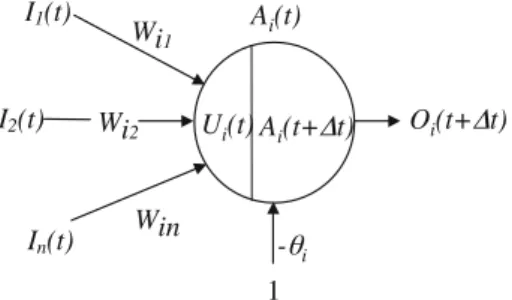
An ANN is a directed graph with the following structure: a unit (or neurone) in the graph is characterised, at timet, by its input vector IiðtÞ, its input potential UiðtÞ, itsactivation state AiðtÞ, and itsoutput OiðtÞ. The units of the network are interconnected via a set of directed and weighted connections such that if there is a connection from unitito unitjthenWji2Rdenotes theweightof this connection.
The input potential of neurone i at time t (UiðtÞ) is obtained by computing a weighted sum for neurone i such that UiðtÞ ¼PjWijIiðtÞ (see Fig.1). The
activation stateAiðtÞof neuroneiat timet—a bounded real or integer number—is
then given by the neuron’s activation function hi such that AiðtÞ ¼hiðUiðtÞÞ.
Typically,hi is either a linear function, a non-linear (step) function, or a sigmoid
function (e.g.:tanh(x)). In addition,hi(an extra weight with input always fixed at 1)
is known as thethresholdof neuronei. We say that neuroneiisactiveat timetif
AiðtÞ[hi:Finally, the neurone’s output valueOiðtÞis given by its output function fiðAiðtÞÞ. Usually,fi is the identity function.
The units of an ANN can be organised in layers. An-layer feedforward network
is an acyclic graph. It consists of a sequence of layers and connections between successive layers, containing one input layer,n2 hidden layers, and one output layer, wheren2. Whenn¼3, we say that the network is asingle hidden layer network. When each unit occurring in the i-th layer is connected to each unit occurring in theiþ1-stlayer, we say that the network isfully-connected.
A multilayer feedforward network computes a function u:Rr!Rs, where r
andsare the number of units occurring, respectively, in the input and output layers of the network. In the case of single hidden layer networks, the computation ofu
occurs as follows: at timet1, the input vector is presented to the input layer. At time
Wi1 Wi2 Win Ui(t) Ai(t+ t) Oi(t+ t) Ai(t) I1(t) I2(t) In(t) - i 1 Fig. 1 The neurone or
t2, the input vector is propagated through to the hidden layer, and the units in the
hidden layer update their input potential and activation state. At timet3, the hidden
layer activation state is propagated to the output layer, and the units in the output layer update their input potential and activation state. At timet4, the output vector is
read off the output layer. In addition, most neural models have alearning rule, responsible for changing the weights of the network progressively so that it learns to approximate u given a number of training examples (input vectors and their respective target output vectors).
In the case ofbackpropagation—probably the most commonly applied neural learning algorithm (Rumelhart et al.1986)—anerroris calculated as the difference between the network’s actual output vector and the target vector, for each input vector in the set of examples. This error E is then propagated back through the network, and used to calculate the variation of the weightsMW. This calculation is
such that the weights vary according to thegradientof the error, i.e.MW¼ grE;
where 0\g\1 is called the learning rate. The process is repeated a number of times in an attempt to minimise the error, and thus approximate the network’s actual output to the target output, for each example. In order to try and avoid shallow local minima in the error surface, a common extension of the learning algorithm above takes into account, at any timet, not only the gradient of the error function, but also the variation of the weights at timet1, so thatMWt¼ grEþlMWt1, where
0\l\1 is called theterm of momentum. Typically, a subset of the set of examples available for training is left out of the learning process so that it can be used for checking the network’s generalisation ability, i.e. its ability to respond well to examples not seen during training.
CILP now is a neural-symbolic system based on an ANN that integrates inductive learning and deductive reasoning. In CILP, atranslation algorithm maps a logic programPinto a single hidden layer ANNN such thatN computes the least fixed-point ofP (Lloyd1987). This provides a massively parallel model for computing the stable model semantics ofP(Gelfond and Lifschitz1988). In addition,N can be trained with examples using a neural learning algorithm, havingP as background knowledge. The knowledge acquired by training can then be extracted (Garcez et al.
2001), closing the learning cycle, as advocated by Towell and Shavlik (1994). Let us exemplify how CILP’s translation algorithmworks. Each rule (rl) ofP is mapped from the input layer to the output layer ofN through one neurone (Nl) in the single hidden layer ofN. Intuitively, thetranslation algorithmfromPtoN has to implement the following conditions: (c1) the input potential of a hidden neurone Nl can only exceed its thresholdhl, activatingNl, when all the positive antecedents
of rl are assigned truth-value true while all the negative antecedents of rl are assignedfalse; and (c2) the input potential of an output neuroneAcan only exceed
its threshold (hA), activating A, when at least one hidden neurone Nl that is
connected toAis activated.
Example 1 (CILP) Consider the logic program P ¼ fB^C^ D!A;
E^F!A;Bg, where stands for LP’s negation by failure (a.k.a. default negation) (Lloyd 1987). Given P, the CILP translation algorithm produces the networkN of Fig.2, setting weights (W) and thresholds (h) in a way that conditions
ðc1Þandðc2Þabove are satisfied. Note that, ifN ought to be fully-connected, any
other link (not shown in Fig.2) should receive weight zero initially. Each input and output neurone ofN is associated with an atom ofP. As a result, each input and output vector ofN can be associated with an interpretation for P. Note also that each hidden neuroneNlcorresponds to a rulerl ofP such that neuroneN1 will be
activated if neuronesBandCare activated while neuroneDis not; output neuroneA
will be activated if either N1 or N2 is activated; and output neurone B will be
activated ifN3is, whileN3is always activated regardless of the input vector (i.e.B
is afact). To compute the stable models ofP, the output vector is recursively given as the next input to the network such thatN is used as a recursive network to iterate the fixed-point operator ofP as suggested by Garcez et al. (2002). For example, output neuroneB should feed input neurone B.N will eventually converge to a stable state which is identical to the stable model of P provided that P is an acceptable program (Apt and Pedreschi 1993). For example, given any initial activation in the input layer ofNr(i.e. the network of Fig.2recurrently connected),
it always converges to a stable state in which neuroneBis activated and all the other neurones are not. We associate this with literalB being assigned truth-value true, while all the other literals are assigned truth-valuefalse, which represents the unique fixed-point ofP.
CILP thereby provides a (provably sound) translation from a symbolic representation into an ANN that can be trained with examples as part of a knowledge evolution process, whereby the original symbolic representation is seen as background knowledge to the network. In what follows, we extend CILP to handle a range of normative rules and prove soundness. Notice how in the standard CILP translation, the weights of the connections linking the hidden and output layers of the network are always positive. As will become clearer in what follows, normative rules require the use of negative weights from the hidden to the output layer of the CILP network as well. This implements priorities in the rules (Garcez et al.2002) and is responsible for adding alternative paths that enable robustness in the networks also. As we study such different forms of representation in different
E D D W W C C B B A W W W W A E F F N1 N2 N3 W
Fig. 2 A neural network for logic programP
applications, such as CTD, we are interested in proving soundness, but also in efficient computation and learning, as exemplified later in this article.
3.2 Input/Output Logic
As explained by Makinson and van der Torre (2003b), I/O logic takes its origin in the study of conditional norms which, either in imperative or indicative form, express obligations under some legal, moral, or practical code, goals, contingency plans, advice, etc. Putting this overall notion in formal terms, Makinson and van der Torre (2000) represent rules by ordered pairs (a,x), where the antecedenta is thought of as an input, representing some condition or situation, and the consequentxis thought of as an output, representing what the rule tells us to be desirable, obligatory, or whatever else in that situation.
Concerning the overall motivation behind the development of I/O logic, in philosophy—but also significant in our current context—norms are commonly distinguished from declarative statements. The latter may bear truth-values, while describing norms as true or false is meaningless. Instead, norms may be respected (or not), can be in force in the current context (or not), or can be assessed from the standpoint of other norms (e.g., when judging a law from a moral point of view). Still, much work addressing deontic formalisms in the study of logic and AI seem to ignore this distinction: most presentations of deontic logic—whether axiomatic or semantic—treat norms as if they could be subjected to an assessment in terms of truth-values. In particular, the truth-functional connectives ‘and’, ‘or’, and ‘not’ are routinely applied to norms, forming compound norms out of elementary ones. Semantic constructions using possible worlds go further by offering rules to determine, in a model, the truth-value of a norm. I/O logic has its source in precisely this tension between philosophy and studies in formal logic (the reader may identify a similar tension between human reasoning and formal classical logic, as discussed earlier in the case of discourse processing).
In the following, we first present abstract normative systems as a general descriptive framework for formal approaches to normative reasoning and basis for the subsequent introduction of propositional I/O logic, both of which then are applied to modelling the three types of permissions commonly encountered in normative context.
3.2.1 Abstract Normative Systems
Modal logic has been the standard for normative reasoning ever since von Wright (1951). Still, for instance in Gabbay et al. (2013)’s ‘‘Handbook of Deontic Logic and Normative Systems’’, the classical modal logic framework is mainly confined to the historical chapter. Another chapter presents the alternatives to the modal framework, and three chapters discuss concrete approaches, namely I/O logic, the imperativist approach (Hansen 2006), and the algebraic conceptual implication structures (Lindahl and Odelstad2003).13 Against this multitude of approaches as
13Of course this list is non-exhaustive as there are further alternative candidates for a new standard, such as nonmonotonic logic (Horty1993) or deontic update semantics (van der Torre and Tan1999).
backdrop, Tosatto et al. (2012) proposed abstract normative systems as common framework for comparing and analysing these new proposals.
Abstract normative systems study frameworks such as I/O logic on a general level, to which Tosatto et al. (2012) add two notions. First, each element in the (finite) universe comes with its ‘‘anti-element’’: this is the minimal extension to represent violations, namely elements in the input whose anti-element is in the output. Second, there is an element in the universe called>, contained in every context.
Definition 1 [Universe L (Tosatto et al. 2012)] Given a finite set of atomic elements E, the universe L is E[ f eje2Eg [ f>g. For e2E, let a¼ eiff
a¼e,a¼eiffa¼ e, and undefined iffa¼ >.
An abstract normative system is a directed graph, and a context is a set of nodes of the graph containing>. In abstract normative systems there are three kinds of relations, for the regulative, permissive, and constitutive norms, respectively. We start with the regulative norms only. The edges in an abstract normative system exactly define what a ‘‘conditional norm’’ (with respect to this abstract normative system) is.
Definition 2 (ANS hL;Ni [Tosatto et al. 2012)] An abstract normative system ANS is a pairhL;NiwithNLLa set of pairs of the universe, called conditional norms, andAL a subset of the universe such that> 2A, called the context.
In a context, an abstract normative system generates or produces an obligation set, a subset of the universe, reflecting the obligatory elements of the universe. The class of deontic operations is specified by their domain and codomain. Some examples of deontic operations are given below.
Definition 3 (Deontic operation [Tosatto et al.2012)] A deontic operation is a function from an abstract normative systemhL;Niand a contextAto a subset of the universe ðhL;Ni;AÞ L. Since L is always clear from context, we write ðN;AÞfor ðhL;Ni;AÞ.
Simple-minded output or 1 is Makinson and van der Torre’s minimal system.
Basic output or 2 allows for reasoning by cases, which now means that if
something is obligatory in the context of a and its complement a, then it is obligatory also in the minimal context. Reusable output or 3 allows for deontic
detachment, which now corresponds to iteration of the rules. Throughput or þi allows for identity. All possible combinations lead to eight input/output operations.
Definition 4 [Eight deontic operations (Tosatto et al.2012)] A contextAL is complete if for alle2E, it contains eithereore(or both).
1ðN;AÞ ¼NðAÞ ¼ fxj ða;xÞ 2N for somea2Ag 2ðN;AÞ ¼ \fNðVÞ jAV;V completeg 3ðN;AÞ ¼ \fNðBÞ jABNðBÞg 4ðN;AÞ ¼ \fNðVÞ jAV NðVÞ;V completeg þ i ðN;AÞ ¼ iðN[ fða;aÞ ja2Lg;AÞ
Equivalently, 3ðN;AÞ can be defined as N(B) where B is the smallest set
containing A and closed under N, i.e. ABNðBÞ. Moreover, to emphasise symmetry, 1ðN;AÞcan be defined equivalently as\fNðBÞjABg.
At least since the work of Horty (1993), nonmonotonic techniques have been used to deal with reasoning in the context of dilemmas, CTD reasoning, and defeasible norms:
• Dilemmas are two (or more) obligations with contradictory content, like the obligation for aand the obligation for a.
• CTDor secondary obligations (a,x) are in force only in case ofviolationof a primary obligation, e.g., generated usingð>;aÞ.14
• Defeasible deontic logic is concerned with violations and exceptions (van der Torre 1997; Nute1997).
3.2.2 Propositional Input/Output Logic
As explained by Makinson and van der Torre (2000), propositional I/O logic establishes a relatively simple setting, abstracting from important aspects of deontic reasoning, such as CTD reasoning or permissions.15 The construction of the semantics is analogous to the just discussed abstract normative systems, adding the closure of input and output under propositional consequence. As before,
NðAÞ ¼ fxj ða;xÞ 2N for somea2Ag.
Definition 5 [out(Makinson and van der Torre 2000)] LetLbe a propositional logic withCnthe consequence operator ofL,>a tautology ofL, acomplete setone that is either maxiconsistent or equal toL, and letNbe a set of ordered pairs ofL
(called the generators). A generator (a,x) is read as ‘if inputathen outputx’. The following logical systems are defined:
out1ðN;AÞ ¼CnðNðCnðAÞÞ
out2ðN;AÞ ¼ \ fCnðNðVÞÞ:AV;V completeg out3ðN;AÞ ¼ \ fCnðNðBÞÞ:AB¼CnðBÞ NðBÞg out4ðN;AÞ ¼ \ fCnðNðVÞÞ:AV NðVÞ;V complete g
14
To give an intuitive example of a CTD, we report the so-calleddog-signexample by Prakken and Sergot (1997) already hinted at in the introduction: ‘‘Suppose that: there must be no dog around the house, and if there is no dog, there must be no warning sign, but if there is a dog, there must be a warning sign.’’ Obviously, if there is a dog, the conditional obligation that there must be no sign does not become unconditional, since its condition is not fulfilled. On the other hand, it can also be inferred that if no obligations are violated, there will be no sign (modulo exceptions, of course).
15These require much more involved I/O operations, which we shortly discuss in Sect.3.4below. Cf. the work by Makinson and van der Torre (2001) and Makinson and van der Torre (2003a) for more detailed treatments.