Documents
de travail
Faculté des sciences économiques et de gestion Pôle européen de gestion et d'économie (PEGE) 61 avenue de la Forêt Noire F-67085 Strasbourg Cedex Secétariat du BETA Christine DEMANGE Tél. : (33) 03 90 24 20 69 Fax : (33) 03 90 24 20 70
« A two–pillar strategy to keep inflation
expectations at bay :
A basic theoretical framework »
AuteurMeixing DAI
Document de Travail n° 2007–20
A two-pillar strategy to keep inflation expectations at bay: A basic
theoretical framework
Meixing DAI *
June 2007
Abstract: Using a simple macro-economic model, this study shows how a two-pillar monetary strategy as practiced by the European central bank (ECB) can be conceived to guarantee dynamic macro-economic stability and the credibility of monetary policy. This strategy can be interpreted as a combination of inflation targeting and monetary base targeting. A commitment to a long-run monetary base growth rate (monetary targeting) corresponding to inflation target could reinforce the credibility of central bank announcements and the role of inflation target as strong and credible nominal anchor for private inflation expectations. However, achieving price stability under inflation-targeting regime associated with Friedman’s money supply rule can generate dynamic instability in output, inflation and money demand. Alternative stabilizing monetary targeting rules, of which the design depends on economic structure and central bank preferences, are discussed relative to their capability to warrant dynamic macroeconomic stability.
Key words: two-pillar monetary strategy, inflation targeting, monetary targeting, macro-economic stability.
JEL Classification: E44, E52, E58
(*) BETA-Theme, University Louis Pasteur of Strasbourg, France.
Adresse of correspondance:
Meixing Dai, Université Louis Pasteur, BETA, 61, avenue de la Forêt Noire – 67085 Strasbourg Cedex – France. Phone: (33) 03 90 24 21 31; Fax: (+33) 03 90 24 20 71, e-mail: [email protected].
1. Introduction
Over the last decade, more and more central banks have adopted a new framework for conducting monetary policy known as inflation targeting, which is presented by Mishkin (1999) as a successor to and more efficient in controlling inflation than monetary targeting. In this context, the two-pillar strategy of the ECB appears quite singular since this strategy can be considered as a bridge between monetary targeting and inflation targeting (Mayer, 2006).
The current debate opposes generally monetary targeting to inflation targeting and questions over whether the ECB has to move to full-fledged inflation targeting. Alesina et al.
(2001) claim that the ECB could improve its policy by adopting inflation targeting. Cabos et
al. (2003), comparing alternative monetary targeting and inflation targeting strategies using
German data from the end of the Bretton Woods system until 1997, show that control problems involved in targeting broad or narrow money are larger than for direct inflation targets. Rudebusch and Svensson (2002), using U.S. data, show monetary targeting to be quite inefficient, yielding both higher inflationand output variability and therefore, there is no support for the prominent role given to money growth in the Eurosystem’s monetary policy strategy1. For Laubach (2003), monetary targeting facilitates communication of the central
bank’s type. But, this advantage is outweighed for most parameter values by the advantage of inflation targeting in terms of inflation control. Gersbach and Hahn (2003) suggest that inflation targeting is superior to monetary targeting as it makes it easier for central banks to commit to low inflation. Evans and Honkapohja (2003)2 show that Friedman’s k-percent
1 A simulation study in the case of Japon by Ugomori (2007) gives similar conclusions.
2 However, Friedman’s rule can generate equilibria that are determinate and stable under learning. In the
contrary, open-loop interest rate rules are subject to indeterminacy and instability problems. Minford et al.
money supply rule (strict monetary targeting)performs poorly in terms of welfare compared to optimal interest rate rule (flexible inflation targeting).
The rare success stories of monetary targeting, as in the case of Bundesbank and Swiss National Bank, are explained then as due to that their monetary policy is actually closer in practice to inflation targeting than it is to Friedman-like monetary targeting3 and thus might
best be thought of as “hybrid” inflation targeting. The Bundesbank’s monetary targeting is quite similar to inflation targeting as it announced inflation target and communicated transparently to the public and market participants. Using real-time data, Gerberding et al.
(2005) find that the Bundesbank took its monetary targets seriously, but also responded to deviations of expected inflation and output growth from target. In practice, the Bundesbank was a monetary targeter as well as an inflation targeter. Central bankers (Freedman, 1996; King, 1996) have also noted the close similarity in the use of central bank instruments and the reaction of central banks to news and shocks under inflation forecast and monetary targeting. That suggests that choice of one or other monetary regime does not seem to matter much for the day-to-day conduct of monetary policy. Empirically, inflation targeting seems to have made little if any difference for inflation and interest rate dynamics (or conduct of interest rate policy) in the countries that adopted this strategy in the 1990s (Groeneveld et al., 1998;
Almeida and Goodhart, 1998).
Several economists advocate that if money demand is stable at European level, monetary targeting makes a suitable concept for the ECB. Neumann and von Hagen (1995) show that monetary targeting is an effective device for anchoring medium-term inflation expectations. At the same time, this approach permits sufficient flexibility for leaning against the wind of currency appreciation and for responding to short-term events. In contrast, inflation targeting
3 See for example, Clarida and Gertler (1996), Bernanke and Mishkin (1997), Bernanke and Mihov (1997),
is likely to either prevent the ECB from gaining credibility or to require responding to price level shocks in an overly contractionary fashion. For von Hagen (1999), the Bundesbank’s experience suggests that a strategy of money growth targeting might help the ECB to successfully establish and assert its control over monetary conditions in the monetary union, define its policy goals and its role in macroeconomic policy, and establish its reputation for pursuing these goals consistently over time.
Political considerations (the need to demonstrate continuity with the policies of the Bundesbank) apparently have dictated that the ECB pays attention to monetary aggregates as well in its pillar monetary strategy. Many observers have interpreted the ECB’s two-pillar strategy as a bridge between the monetary targeting strategy of the old Bundesbank and the more up-to-date inflation targeting approach (Bernanke et al., 1999; Svensson, 2000;
Rudebusch and Svensson, 2002; Mayer, 2006). In effect, the “economic pillar” resembles an implicit form of inflation targeting and the “monetary pillar” a weak type of monetary targeting. This “misinterpretation” (Assenmacher-Wesche and Gerlach, 2006) has lead to the criticism of the framework for being inconsistent and lacking clarity. The controversial debate is arguably due to the fact that the ECB provides neither an explicit representation of the inflation process nor an explanation for why it necessitates a two-pillar framework4. In other
words, it lacks a theory justifying the simultaneous use of monetary and inflation targeting. In the case of the ECB, there is an evident gap between institutional setting and official discourse. Duisenberg (1997) has indicated that monetary and inflation targeting are seen as the two main benchmarks in the light of which the choice of the ECB’s monetary strategy in Stage Three would be made. In effect, both strategies have a number of key elements in common, such as the objective of price stability, a forward-looking nature and the use of a
4 Empirical model of two-pillar strategy is provided by Neumann (2003), Neumann and Greiber (2004), Gerlach
wide range of indicators in determining the monetary policy stance. But recently, the ECB (ECB, 2001) has argued that it does not regard inflation targeting as an appropriate monetary policy framework. For Mayer (2006), the ECB’s monetary policy strategy was initially conceived as a bridge between the older paradigm of monetary targeting and its successor, inflation targeting. In fact, according to the Maastricht treaty, without prejudice to the objective of price stability, the ECB would also support the general economic policies in the Community with a view to contributing to the achievement of the objectives of the Community. These include a high level of employment and sustainable and non-inflationary growth. This sounds quite like flexible inflation targeting. Mayer remarks that using the strategy this way would require the Council to be able to reconcile different signals from the two pillars of the strategy into a consistent interest rate (and communication) policy. For now, the Council seems to be unable to do this and hence tends to wait for the signals from the two pillars to coincide before taking action. To avoid policy inertia and mistakes, the ECB needs to resolve quarrels within the Council about the appropriate policy paradigm. That is possible when the ECB can justify its two-pillar monetary policy strategy in going beyond inflation targeting and in providing a bridge between the latter and a new paradigm, which takes account of financial developments in monetary policy decisions.
In the literature about monetary strategy, there is a theoretical gap between the practice of combining monetary and inflation targeting and the theoretical and empirical studies opposing these two strategies. We try to bridge this gap in a simple framework that unifies these two strategies and to provide theoretical foundation for the ECB’s two-pillar strategy. One central point of our analysis is to rehabilitate the role of money market and so that of monetary base targeting in determining the endogenous adjustment of inflation expectations. In the inflation-targeting literature, one important implicit assumption is that central bank’s announcements are perfectly credible so that its inflation target is exactly equal to expected
inflation rate of private sector as shocks are assumed to be i.i.d.. In fact, a central bank has no control over inflation expectations other than just trying different tactics of persuasion through the implementation of complex operational instruments, procedures and communication techniques. But, there is not any reason that shocks are always i.i.d., the central bank always credible and private agents believe always in its announcements. Furthermore, speculative inflation bubbles cannot be excluded in dynamic framework by assuming rational expectations. For the inflation target to be an anchor in all circumstances (with temporary, persistent and/or permanent shocks) for private inflation expectations, the credible commitment of the central bank to an inflation target seems necessary. Targeting monetary growth according to Friedman’s k-percent money supply rule might be, at a first
sight, an effective way to keep inflation expectations in check. This kind of quantitative limitation of money supply can be put in place without major difficulty since the central bank can serve only partially the demand of commercial banks for liquidity at announced interest rate.
The remainder of the paper is organised as follows. In the next section, we present a theoretical model in which money market plays a role. In the section after, we characterise the optimal reaction function of the central bank. In the fourth section, we analyse the dynamic stability of the economy under Friedman’s k-percent monetary base growth rule. The fifth
section examines three alternative monetary base targeting rules. The final section concludes.
2. The Model
We consider a continuous time closed economy model described by an inflation adjustment equation, an aggregate spending relationship linking output to real interest rate and an equilibrium condition in asset markets (domestic money and short-run bonds)5:
t t e t t π α (y y ) επ π = + − ∗ + , α >0, (1) dt e t t t i y =−β( −π )+ε , β >0, (2) lt t t t t p l y l i m − = 1 − 2 +ε , l1 ,l2 >0, (3) where πt
(
≡dp/dt)
is the current inflation rate which is the time derivation of general price level pt, πte the expected inflation rate of time t conditional on information available at themoment where expectations are formed (i.e. previous to t ), yt the actual output, y∗ the
natural rate of output, it the nominal interest rate and mt the money supply. The variables y, m and p are expressed in logarithmic terms. επt, εdt and εlt are respectively contemporary
shocks6 affecting the supply and the demand of goods and the demand of money. Equation (1)
stipulates that inflation is governed by an expectational Phillips curve. According to equation (2), the aggregate demand depends on expected real interest rate ( e)
t t
i −π . Equation (3) corresponds to LM curve with a real money demand depending on real income and nominal interest rate. In the following, the time index t is neglected whenever there is no confusion.
The current consensus in the inflation-targeting literature is that money market is only useful for determining money supply which responds endogenously to money demand, and so
5 Walsh (2002) used similar model (without explicit LM equation) as a pedagogical device to explain inflation
targeting. The closed economy model allows us to discuss the essential problem without the dynamic complexities introduced by the presence of nominal exchange rate.
6 These shocks are not necessarily random disturbances with null average. Some shocks could be persistent or
permanent, that means mathematical expectations of inflation rate cannot capture the rationality of private agents in forming their inflation expectations.
can be ignored in making monetary policy decisions (Rudebusch and Svensson, 1999, 2002; King, 2000). This is equivalent to assume that money supply is infinitely elastic (Figure 1a).
i ↑y ms d m m i ms ↑y d m m
1a. Money supply is perfectly elastic. 1b. Money supply is imperfectly elastic.
Figure 1. Money market equilibrium under inflation-targeting regime.
This view is contested notably by Friedman B. (2003), since abandoning the role of money and the analytic of the LM curve makes it more difficult to take into account how the functioning of the banking system (and with it the credit markets more generally) matter for monetary policy and also leaves open the underlying question of how the central bank manages to fix the chosen interest rate in the first place. Friedman M. (2005), using data covering three booming periods in US and Japan, shows that what happens to the quantity of money has a determinative effect on what happens to national income and to stock prices. Hafer and Jones (2006), adding money to a dynamic IS model, discover that evidence from six countries indicates that money growth usually helps predict the GDP gap and that the predictive power of a short-term real interest is much weaker than previous work suggests. Hafer et al. (2007) find that money is not redundant, notably there is a significant statistical
relationship between lagged values of money and the output gap, even when lagged values of real interest rates and lagged values of the output gap are accounted for. Their results suggest that, for dynamic IS models such as that used by Rudebusch and Svennson (1999, 2002), the
omission of money appears to come at a high cost. Considering money market as coordination device of private inflation expectations, Dai and Sidiropoulos (2003, 2005) and Dai (2006) provide some theoretical justifications of the utility of money market other than only determining endogenously money supply in a typical inflation-targeting framework.
The present paper gives a special attention to money market in order to examine the adjustment dynamics of expected inflation rate. We assume that the central bank has not direct control over the money supply. Instead, if the central bank desires, control can be exercised over a narrow monetary aggregate such as monetary base, and variations in this aggregate are then associated with variations in broader measures of money supply. The money supply is endogenous but it is imperfectly elastic as the banking system will increase or decrease the internal money in taking account of nominal interest rate and will not satisfy the money demand whenever it appears (Figure 1b). The link between the money supply and the base, used here as a second policy instrument beside nominal interest rate, is modelled as follows:
m hi b
m= + +ε . (4)
where b is the (log) monetary base, and money multiplier (m−b in log terms) is assumed to be an increasing function of nominal interest rate (i.e. h>0). In addition, εm is a money-multiplier disturbance. Equation (4) could arise under a financial reserve system in which excess reserves are a decreasing function of interest rate7 (Modigliani et al., 1970; McCallum
and Hoehn, 1983; Walsh, 1999). Time derivation of equation (3) taking account of equation (4) yields: l m l y l i i h +ε −π= − +ε +
μ & & 1& 2& & . (5)
7 M. El-Erian, president and chef executive of the Harvard Management Company, remarks in his paper “In the
new liquidity factories, buyers must still beware” published in Financial Times, March 22, 2007, that financial
market innovations (e.g. credit derivatives) and private equity activities could create important endogenous liquidity that cannot be moped up by monetary policies except when higher interest rate undermine economic growth, curtail the flow of investor funds to “alternatives” and widen risk spreads in debt markets.
where μ=b&=db/dt, and the dot over a variable indicates it is a time derivation of the
variable. Equation (5) implies that, in average, the monetary base growth rate μ must be equal to current and expected inflation rates, adjusted for the steady state growth rate of output, i.e.,
μ
=π
+l1y&*=π
e+l1y&*. If the central bank desires a credible inflation-targetingpolicy, it could monitor the expected inflation rate in keeping an average long-term monetary base growth rate consistent with its inflation target8, i.e. *
1y l T & + =π μ . However, monetary base targeting must not be considered as an independent strategy for achieving price stability by stabilising inflation around a given inflation target since it faces, as shown by Svensson (1999a), an unpleasant choice between being either inefficient and transparent or efficient and non-transparent. In the inflation-targeting literature, money-growth targeting is considered as a means to control the path of optimal nominal interest rate in the future (Svensson, 1997; Taylor, 1999). In effect, for Svensson (1997), money-growth targeting implies a particular
reaction function for the interest rate and very little information about the economy is used in the construction of this reaction function. The instrument only depends on the parameters of the money-demand function, the money-growth target and the information predicting money demand. No other information about the model is used, for instance the equations for aggregate supply and demand, nor is any other information about the state of the economy predicting future inflation.
The way to close the model generally adopted in the inflation-targeting literature is to assume that money supply adjusts automatically to money demand so that money market can be ignored without serious consequences. In our model, we assume that money supply is endogenous, but not automatically equal to money demand. The major difference with the
8 This is consistent with the practice of Bundesbank. Each year, Bundesbank sets its money-growth target equal
to the sum of an inflation target, a forecast of the growth of potential output, and an estimated trend in velocity (Svensson, 1999a).
previous studies of inflation targeting is that the money supply obeys to its own logic and cannot be assimilated to the money demand. The maladjustment between the supply and demand of money could be due to the imperfect access of economic agents to credit, money and financial markets or to the desire of the central bank to control monetary base growth in order to influence directly inflation expectations.
We assume that the central bank acts systematically to minimise fluctuations of output around the natural rate and inflation around its inflation target. More precisely, the central bank is assumed to minimise the following loss function measured in terms of present discounted value:
[
]
dt t y y L ( ) ( T) exp( ) 2 1 0 2 2 κ π π θ λ − + − − =∫
∞ ∗ , λ ,κ ,θ >0, (6) where parameters λ and κ denote respectively the weight that the central bank assigns to output and inflation stabilisation, and θ is the discount factor. This strategy of flexible inflation targeting is implanted through an optimal nominal interest rate rule, which corresponds to the optimal inflation targeting rule of the central bank.We complete our model description by the following time sequence of events: 1) Workers form their inflation expectations and negotiate current wages. 2) Shocks realise. 3) The central bank fixes nominal interest rate following an optimal interest rate rule. 4) Firms decide their production and prices. 5) Workers revise their inflation expectations and the central bank could influence, if this is its desire, this revision with monetary base growth rule.
3. The optimal interest rate rule
The optimal inflation targeting rule is the solution to the sequence of single period decision problems of the central bank. Since private inflation expectations is taken as given when it makes the decision of interest rate, the central bank’s single period decision problems
are then independent. The central bank’s optimisation problem consists simply of minimising the one-period loss function in (6) under the economic constraint represented by equation (1). Thus, the first-order condition is given by
( ) ( T) y y y π π κ π λ − =− − ∂ ∂ ∗ , ⇒ ( T) y y π π λ κα − − = ∗ , (7) that, with equation (2), leads to the following nominal optimal interest rate rule:
1[ ( ) d] T e y i π π ε λ κα β π + − − + = ∗ . (8) According to equation (8), it is optimal for the central bank to adjust the nominal interest rate upward to reflect expected inflation rate (to a full extend), the gap between current inflation and the inflation target, as well as increases in the output gap due to a positive demand shock. In the case of white noise shocks, the time-consistent expected inflation rate of private sector is equal to the central bank’s inflation target πe =πT. It is important to note that, in our model, expected inflation rate can differ from the inflation target when shocks are persistent or permanent, or/and when the central bank fixes a monetary base growth rate inconsistent with the inflation target.
4. The dynamics of expected inflation
As expected inflation rate is determined before current inflation rate and output, its dynamic trajectory can be more easily studied in a reduced dynamic system where the values of π and y are substituted by their solution in terms of expected inflation rate, exogenous
variables and shocks. Once the dynamic trajectory of πe is solved, we can determine these of π and y. Equations (1)-(2) and (8) enable us to solve inflation rate and output as follows:
π ε κα + λ λ + π κα + λ κα + π κα + λ λ = π 2 e 2 2 T 2 , (9)
π ∗ ε κα + λ κα − π κα + λ κα + π κα + λ κα − = 2 e 2 T 2 y y . (10)
Equations (9) and (10) are not final solutions for inflation rate and output, which can only be obtained after having solved expected inflation rate. They show that, departing from an initial equilibrium where πe =πT, an increase in inflation expectations will impact positively current inflation and negatively current output.
As we have argued before, economic agents will not believe blindly in the announced inflation target πT in all circumstances since they cannot distinguish
a priori between i.i.d.,
persistent or permanent shocks. If shocks are always i.i.d., using simply equation (9) to estimate expected inflation rate gives the result πe =πT
. That is misleading for the central bank as well as for private agents when shocks are not random and transitory. For this reason, the revision of rational inflation expectations by market participants is necessary. Since the money market (and so financial markets) conveys all information about the economy, it can serve as the co-ordination place for private agents in forming good and consensual inflation expectations (Dai and Sidiropoulos, 2003, 2005; Dai, 2006). They will use a whole set of information provided by monetary and financial markets to revise their expectations. Furthermore, the inclusion of monetary base targeting in the monetary strategy implies that monetary base would have an important impact over the determination of current price level and inflation rate and consequently over that of future inflation rate.
In modern economies with developed financial markets, sophisticated financial instruments (such as inflation-indexed bonds, interest rate options, swaps or futures) are traded and convey implicitly market expectations about future inflation. These complex financial instruments are not modelled in this simple model, so we suppose that private agents learn directly form the information conveyed to money market to determine expected inflation rate. However, in this simple model, expected inflation rate underlying the prices of the
financial assets (short term bonds) can be estimated using information about equilibrium condition on every market.Using equations (5), (8)-(10) and admitting πT =0
& , we derive the following differential equation of πe (Appendix):
( ) ( ) ( 2)( ) 1 2 . 1 ed e e l e m e e e l y l h y l ∗ ∗ επ κα + λ κα Ψ − ε − β + Ψ − Ψ + ε − ε Ψ + μ − π Ψ =
π& & & & & & & (11)
where ( ) /[ ( )( 2)( )] 0 2 1 2 + + + + > + =
Ψ λ κα βλ lκαβλ h l λ κα βλ κα . The first term of equation (11) represents the impact of difference between expected inflation rate and expected monetary base growth rate on the adjustment of inflation expectations. The other terms represent fundamental variables influencing expected inflation rate: the variation of output potential and diverse shocks affecting the preferences or the attitudes of private agents in their choice of consumption, production and acquisition of monetary and financial assets.
The inflation expectations resulting from equation (11) is compatible with rational expectations. When shocks επ are all transitory white noises, the solution πe =πT, resulting from mathematical expectations of equation (9), is also the steady equilibrium solution of equation (11) with
μ
=π
T +l1y&*. In this specific case, equation (11) turns to be) ( e T
e π π
π& =Ψ − . The steady equilibrium condition, π&e =0, implies also πe =πT. However, equation (11) is a more realistic description of revision mechanism of inflation expectations, since it takes account of economic and monetary factors that are ignored completely in mathematical expectations of equation (9) under the assumption of i.i.d. inflationary shocks.
As equation (11) corresponds to equilibrium condition on money and financial asset markets, it can be considered as a condition of no arbitrage in the short-run on the financial market. It shows a direct relation between money supply and expected inflation. Indeed, the link between monetary policy and expected inflation rate is very complex as illustrated by equation (11). Inflation targeting (through the fixation of nominal interest rate) influences monetary supply at one hand, and real money demand directly (through nominal interest rate)
and indirectly (through revenue) on the other hand. If the central bank adopts monetary base targeting as second monetary instrument, it can, through the manipulation of monetary base growth rate to create excess or shortage of liquidity, influence short-run inflation expectations so that they will not deviate significantly from the inflation target over the intermediate term.
5. The dynamic behavior of the economy under Friedman’s k-percent rule
Equation (5) implies that, in order to stabilise current and expected inflation rates around of a constant steady state level, monetary authorities are constrained to set a monetary base growth rate consistent with their inflation target. One example of monetary base targeting rule can be:
* 1y l & + μ = μ , with μ =πT , (12) where μ is the long-run monetary base growth rate consistent with the inflation target, i.e.
T π =
μ . This is a variant of Friedman’s k-percent rule. This monetary base targeting rule
could be considered as a warrant against major deviations of current and expected inflation rates from the inflation target and thus reinforce the belief of private sector on that monetary authorities will be more successful in implementing their interest rate policy consistent with their inflation target. For von Hagen (1999), this kind of monetary targeting is a signal that the central bank is independent and fighting against price instability, and a means to define the role of monetary policy vis-à-vis other players in the macroeconomic policy game, and to structure the internal monetary policy debate.
In the absence of monetary base targeting rule, inflation targeting might not be perfectly credible. The concept of imperfect credibility is used in this paper in the sense that private agents don’t use automatically and uniquely the inflation target as nominal anchor and instead, they use information extracted from current market conditions to revise their expected inflation rate. In effect, to believe entirely in the inflation target, private agents must
believe that the random shocks must conceal their inflation consequences in their respective time horizon. As their time horizons are far from infinite and the effects of shocks cannot be mutually compensated automatically, they might be incited to use alternative method to formulate their inflation expectations which correspond better to their horizon of decision during which current inflation rate could be systematically different from expected inflation due to permanent, persistent or even stochastic shocks9. If this is the case, private agents
could anticipate an inflation rate different from the inflation target announced by the central bank. Thus, without other warrant, inflation targeting will not offer necessarily the nominal anchor for private inflation expectations as assumed in the inflation-targeting literature.
Taking account of equation (12) into equation (11):
( ) ( ) ( 2)( e) 1 2 e. d e m e l e e l y l h π ε κα λ κα ε β ε ε μ π
π& & & & & &
+ Ψ − − + Ψ + − Ψ + − Ψ = ∗ (13)
The dynamic behaviour of the economy described by equation (13) can be summarized in the following proposition.
Proposition 1: Under inflation targeting rule (8) combined with monetary base targeting rule
such as (12) (Friedman’s k-percent rule), expected and realised inflation rates, real output and real money stock will follow an unstable dynamic process of adjustment.
The characteristic equationof (13) has a unique solution equal to Ψ >0. The solution of expected inflation rate is indeterminate in the sense that it will be on a divergent trajectory whenever there is a shock perturbing the economy. According to equations (9) and (10), realised inflation rate and output will diverge also form their average equilibrium value.
9 The random nature of shocks does not exclude that the same kind of shocks arrive repetitively for several
For the algebraic result to be economically valid and in order to exclude the possibility that expected inflation rate jump directly to its value at steady state equilibrium, inflation rate (π) and hence expected inflation rate (πe) are considered as predetermined10. In effect, it is quite reasonable to admit that πe is a predetermined variable in a low inflation environment, where the adjustments of prices and consequently of current and expected inflation rates are quite slow due to different mechanisms entailing nominal rigidities in the short-run (menu costs, partial adjustments, overlapping contracts etc.). Under this assumption, the dynamic system is indeterminate whenever it is perturbed by a shock. This indeterminacy appears even with the introduction of Friedman’s k-percent rule as shown by equation (13), where the
coefficient (Ψ>0)associated with πe stays the same after its introduction. The only way to escape form this indeterminacy is to assume that πe is a jumping variable. Meanwhile, the latter assumption is less plausible in low inflation modern economy.
Since expected inflation rate diverges from its equilibrium value after any shock affecting economic system, equations (9)-(10) imply that realized inflation rate and output would also follow divergent trajectories. It follows that real money demand is also instable. This observation is interesting since instability in money demand is notably observed when central banks use in practice more intensely interest rate policy while keeping simple monetary base targeting rule.
It is easy to understand why macroeconomic instability could arise as a result of optimal nominal interest rate rule combined with rigid monetary base targeting rule. For given inflation expectations, higher nominal interest rate reduces real money demand directly (thorough negative effect of higher nominal interest rate on demand of money for speculation or other motives) and indirectly (through its negative effect on goods demand and so on
demand of money for transactions). The reduction of goods demand implies also smaller real money demand. For given monetary base growth rate, higher nominal interest rate implies higher monetary growth rate due to money-multiplier effect according to equation (4). With a reduced real money demand, the equilibrium condition of money market implies a higher future inflation rate that economic agents could easily anticipate if they observe attentively this market. Workers could ask higher nominal wages to compensate for the loss of purchasing power due to higher future inflation. That will generate effectively further inflationary pressures. In effect, emerging market economies (i.e., Latin American countries during the 1980s) and transition economies (i.e., Eastern European countries in 1990s) provide numerous examples where a sharp increase in nominal interest rate is incapable of reducing expected and hence realised inflation rates.
5. Endogenous monetary base targeting rules
The instability result of k-percent monetary base targeting rule under inflation-targeting
regime is due to the fact that monetary base growth rate is given when the interest rate policy is tightening to answer to inflationary and demand shocks. The solution to this problem is to fine-tune monetary base targeting rule so that it reacts in harmony with nominal interest rate rule. Three alternative monetary base targeting rules are considered in the following.
5.1. Monetary base growth rate varying with the variation of inflation rate
The first monetary base targeting rule remedying the instability due the Friedman’s k
-percent rule (12) ties negatively monetary base growth rate to the variation of inflation rate: π ϕ μ μ= + &*− & 1y l , with μ =πT. (14)
. ) 1 )( ( ) ( ) 1 ( ) ( ) ( ) 1 ( ) ( ) 1 ( 2 21 e e d e l e m T e e l y l h π ε ϕ κα λ κα ε ϕ β ε ε ϕ π π ϕ
π& & & & & &
Ψ − + Ψ − − Ψ − + Ψ − − Ψ − Ψ + − Ψ − Ψ = ∗ (15)
Proposition 2: i) Under inflation-targeting rule (8) combined with monetary base targeting
rule (14), the equilibrium solution of equation (15) is dynamically stable under the condition
ϕ < Ψ) / 1
( . ii) The minimal value of ϕ (minϕ =1/Ψ) compatible with stable equilibrium
decreases with λ and β, increases with κ, l1, h, l2 and increases with α if λ>κα2.
Proof: To demonstrate the party i) of Proposition 2, it is sufficient and straightforward to
show that the characteristic root of equation (15) is negative when (1−Ψϕ)<0 or equivalently (1/Ψ)<ϕ.
To show the party ii) of Proposition 2, we take the derivatives of min with respect to ϕ different parameters: 0 ) ( ) ( min 2 2 2 2 1 − + < + − = ∂ ∂ βλ ακ κα λ ακ λ ϕ l h l ; ( ) 0 ) ( min 2 2 2 1 + + > + = ∂ ∂ βλ α κα λ αλ κ ϕ l h l ; 0 ) ( min 22 < + − = ∂ ∂ λ β κα β ϕ h l ; 0 ) ( min 2 1 > + = ∂ ∂ κα λ κα ϕ l ; 1 0 min min 2 > + = ∂ ∂ = ∂ ∂ λβ κα ϕ ϕ l h ; 0 ) ( ) ( ) ( min 2 2 2 2 1 + + + ≥ + − = ∂ ∂ λβ κ κα λ κα λ κ α ϕ l h l if λ>κα2.
When (1/Ψ)<ϕ, the rule (14) allows reducing sufficiently monetary base growth rate to equilibrate the money market following shocks that lead initially to a rise in current and future expected inflation rates and consequently to an increase in nominal and real interest rates, that involves a reduced real money demand. No further increase in inflation rate is then justifiable by evocating the existence of excessive liquidity in the economy.
The minimal value of ϕ compatible with stable equilibrium diminishes with the weight assigned to output stabilization (greater λ) and increases if the central bank worries more
about the realization of inflation target (greater κ). It varies also with parameters (β,α, l1, h
and l2) reflecting the economic and financial characteristics of the underlying economy. In particular, more financial developments (greater β), more efficient transaction and payment system (smaller l1), smaller interest elasticity of the money demand (smaller l2) and supply (smaller h) and less flexible labor market (smaller α and under the condition λ/κ >α2, i.e.
the central bank is a quite flexible targeter) allow the central bank to link less strongly monetary base growth (smaller ϕ) to the rate of change in expected inflation without creating macro-economic instability. Meanwhile, when the interest elasticity of money demand and supply are more important (greater substitution between money and other financial assets), the central bank must keep monetary base more reactive to the rate of change in expected inflation.
5.2. Monetary base growth rate varying with the variation of output
The second alternative monetary base targeting rule takes into account the variation of output: y y l & η& μ μ= + *+ 1 , with μ=πT. (16)
The monetary base targeting rule (16) implies that the central bank accommodates to the variation of output over the current period (easily observable) in determining current monetary base growth rate. Substituting μe in equation (11) by e e
y y l & η& μ μ = + *+ 1 , which is
the mathematical expectations of equation (16), and using the mathematical expectations of
y& obtained form the time derivation of equation (10), the dynamic equation of expected
inflation rate can be rewritten as:
e e e d e l e m e e l y l h y π επ κα λ ηκα ε κα λ κα ε β η ε ε μ π
π& & & & & & & &
) ( ) ( ) ( ) ( ) ( 2 1 2 2 + Ω + + Ω − − + Ω − Ω − − Ω + − Ω = ∗ ∗ , (17)
where ηκα κα λ κα λ Ψ − + Ψ + = Ω ( 2 2) .
Proposition 3: i) The dynamic equation (17) under inflation-targeting rule (8) combined with
monetary base targeting rule (16) has a stable equilibrium solution under the condition
κα κα
λ
η>( + 2)/Ψ . ii) The minimal value of η (minη =(λ+κα2)/Ψκα) compatible with
stable equilibrium decreases with β, increases with h, l1 and l2. If λ/κ < α3/β , it
decreases with λ and increases with κ and α.
Proof. To demonstrate the party i) of Proposition 3, it is sufficient and straightforward to show that the Ω is negative when η >(λ+κα2)/Ψκα. In effect, the root of the characteristic equation of (17) is equal to Ω=(λ+κα2)Ψ/(λ+κα2−Ψηκα). It is negative if 0λ+κα2−Ψηκα< , i.e. η >(λ+κα2)/Ψκα. In this case, expected inflation rate is determinate and converge to its equilibrium value after any shock.
To show the party ii) of Proposition 3, we derive min with respect to different η parameters: 0 ) )( ( min 2 3 2 2 2 − < + = ∂ ∂ καβλ α κ βλ λ η h l if β α κ λ 3 < ; 0 ) )( ( min 2 2 3 2 2 − > + = ∂ ∂ α βλκ βλ α κ κ η h l if β α κ λ 3 < ; min ( )(2 ) 0 2 2 + < + − = ∂ ∂ λ β κα λ β η h l ; 1 min 1 = ∂ ∂ l η ; min min ( )( ) 0 2 2 > + + = ∂ ∂ = ∂ ∂ καβλ κα βλ κα λ η η l h ; 0 ) 2 )( ( min 2 3 2 2 2 2 − + > + = ∂ ∂ βλκα α κ βλ βλκα α η h l , if β α κ λ 3 < .
When η >(λ+κα2)/Ψκα, the rule (16), in responding to the variation of output, allows reducing sufficiently monetary base growth rate to equilibrate the money market following shocks that lead to a rise in current and future expected inflation rates and consequently to an increase in nominal and real interest rates (that reduces the output), which in turn yields directly and indirectly reduced real money demand.
The minimal value of η compatible with stable equilibrium diminishes with the weight assigned to output stabilization (λ) and increases if the central bank worries more about the realization of the inflation target (κ) if the initial relative weight λ/κ is small ( i.e.
β α κ
λ/ < 3/ , which means that the central bank is a less flexible targeter). Similarly to the
case of the precedent monetary base targeting rule, more financial developments (greater β), more efficient transaction and payment system (smaller l1), smaller interest elasticity of the money demand (smaller l2) and supply (smaller h) and less flexible labor market (smaller α, but under the condition11 λ/κ < α3/β ) allow the central bank to link less strongly
monetary base growth (smaller η) to the rate of change in output without creating macro-economic instability. Meanwhile, when the interest elasticity of money demand and supply are higher (greater substitution between money and other financial assets), the central bank must keep monetary base more reactive to the rate of change in output.
5.3. Monetary base growth rate varying with the variation of nominal interest rate
The third alternative monetary base targeting rule takes into account the variation of nominal interest rate:
11 Which is a sufficient condition for ∂minη/∂α >0. A less restrictive condition for ∂minη/∂α >0 is
0
2 2 3
2
2−βλ + κ α >
i y l & −χ& + μ = μ * 1 , with μ=πT. (18)
The rule (18) implies that the central bank answers to the variation of nominal interest rate in determining current monetary base growth rate. Substituting μe in equation (11) by
e e i y l & −χ& + μ = μ *
1 , which is the mathematical expectations of the rule (18), and using
mathematical expectations of i& resulting form the time derivation of equation (8), the
dynamic equation of expected inflation rate can be rewritten as:
( ) ( ) ( 2)( ) 1 2 . ⎥ ⎦ ⎤ ⎢ ⎣ ⎡ + Ψ − − + + Ψ − − Ψ + − Ψ Ψ − Ψ − = ∗ e e d e l e m e e l y l h π ε κα λ κα ε β χ ε ε μ π κα χ χβλ βλ βλ
π& & & & & & (19)
Proposition 4 : i) The dynamic equation (19) under inflation-targeting rule (8) combined
with monetary base targeting rule (18) has a stable equilibrium solution under the condition
) /( βλ κα βλ
χ> Ψ +Ψ . ii) The maximal value of χ (minχ =βλ/(Ψβλ+Ψκα))
compatible with stable equilibrium increases with β and decreases with l1, h and l2. It
decreases with λ, increases with κ and α if λ/κ < α3/β .
Proof. The party i) of Proposition 4 is verified straightforward when χ >βλ/(Ψβλ+Ψκα).
Under this condition, the characteristic equation of (19) has one root equal to )
/(βλ χβλ χ κα
βλΨ −Ψ − Ψ , which is negative if βλ−Ψχβλ−χΨκα<0, i.e. )
/( βλ κα βλ
χ> Ψ +Ψ .
The party ii) of Proposition 4 can be easily demonstrated in deriving min with respect χ to different parameters. Using the definition Ψ into the expression of min leads to: χ
) )( ( ) )( )( ( min 2 2 2 1 κα λ κα βλ κα βλ κα λ καβλ χ + + + + + + =l h l . (20) The derivation of min given by (20) with respect to different parameters yields: χ
0 ) ( ) ( ) ( min 2 2 2 2 3 2 1 > + + − = ∂ ∂ κα λ κα βλ βλ α κ καβ λ χ l , if β α κ λ 3 < ; 0 ) ( ) ( ) ( min 2 2 2 3 2 2 1 < + + − = ∂ ∂ κα λ κα βλ α κ βλ αβλ κ χ l , if β α κ λ 3 < ; 0 ) ( ) ( min 2 2 2 2 1 > + + = ∂ ∂ κα λ κα βλ κ α λ β χ l ; 0 ) )( ( min 2 1 > κα + λ κα + βλ καβλ = ∂ χ ∂ l ; 1 min min 2 = ∂ χ ∂ = ∂ χ ∂ l h ; 0 ) ( ) ( ) 2 ( min 2 2 2 3 2 2 2 1 < κα + λ κα + βλ α κ − βλκα − βλ κβλ = α ∂ χ ∂ l , if β α κ λ 3 < .
When χ >βλ/(Ψβλ+Ψκα), the rule (18) allows a sufficient reduction in monetary base growth rate to equilibrate the money market where real money demand diminishes following shocks that lead to a rise in current and future expected inflation rates and consequently to an increase in nominal and real interest rates, decided by the central bank under the strategy of flexible inflation targeting. Under the above condition, the rule (18), by mopping up excessive liquidity in the economy, discards any justification of further increase in current and expected inflation rates. Comparing with the precedent monetary base targeting rule, structural parameters l1, h and l2 have similar effects while λ, κ, α and β have opposite effects over the minimal value of the coefficient (min ) linking negatively monetary base growth to χ the rate of change in nominal interest rate. For parametersλ, κ and α , the results are obtained under the same condition (λ/κ < α3/β ) as under the second alternative rule.
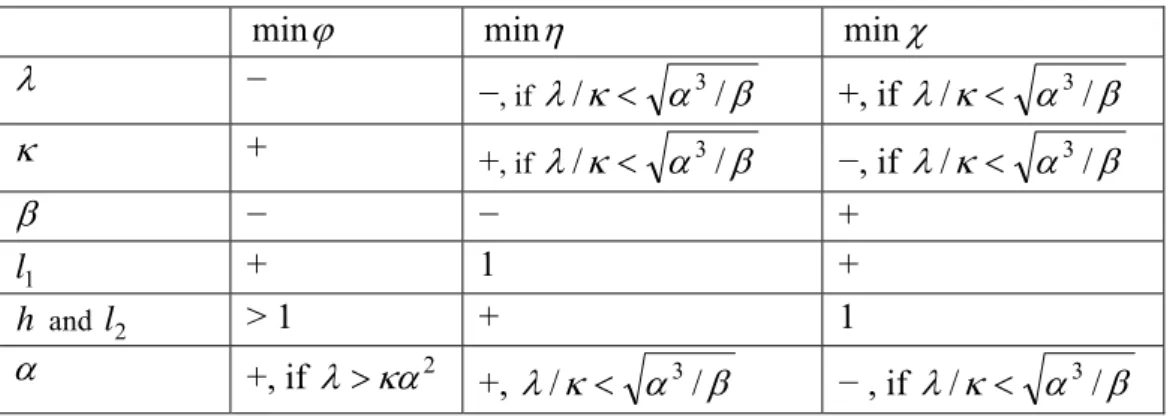
For comparison, the effects of structural and preferences parameters of the economy over the liberty of formulating these three alternative monetary base targeting rules are recapitulated in the Table 1.
Table 1. The effects of parameters on the formulation of stabilising monetary base targeting rules.
ϕ
min min η min χ
λ − −, if λ/κ < α3/β +, if λ/κ < α3/β κ + +, if λ/κ < α3/β −, if λ/κ < α3/β β − − + 1 l + 1 + h and l2 > 1 + 1 α +, if λ>κα2 +, λ/κ < α3/β − , if λ/κ < α3/β
The Propositions 2, 3 and 4 summarizes some results which are compatible with the view of the modern quantitative theory of money, according to which, whenever there is an inflation pressure, the money supply must be tightened to limit the rise of prices. The implications of these propositions are also compatible with inflation-targeting framework where shocks are assumed to be i.i.d. In fact, under stochastic inflation-targeting framework where expected inflation rate is set equal to the inflation target, money supply is endogenous and perfectly elastic. In the present paper where i.i.d., persistent and permanent shocks could coexist, the monetary base growth rate could not be rigidified as a k-percent rule as implied
by proposition 1. It must answer sufficiently to current inflation rate, output or/and nominal interest rate. Therefore the money supply is also endogenous but imperfectly elastic.
Most importantly, our principal findings put in question some most important clichés of the modern quantitative theory of money as well as these of the standard stochastic inflation targeting framework. In order to curb an increase in inflation rate, inflation targeting implies an increase of nominal interest rate to raise sufficiently real interest rate. But that is not sufficient to ensure economic stability when shocks are not i.i.d. or/and when the credibility of the central bank is not perfect. Under k-percent monetary base targeting rule, the resulting
excess of liquidity due to diminishing real money demand for transaction and speculation is translated into vicious circle of increasing expected inflation rate, increasing nominal and real
interest rates and diminishing real money demand. To avoid that, the monetary base growth rules (14), (16) and (18) suggest diminishing enough liquidity respectively when current inflation rate varies positively, current output varies negatively and nominal interest rate varies positively. These simple rules can be combined to create other stabilising monetary base growth rules.
6. Conclusion
In this paper, we have examined macro-economic stability under flexible inflation-targeting regime associated with monetary base inflation-targeting as communication and anchoring device. Our study leads to four interesting results: Firstly, monetary base targeting with a commitment to a long-run monetary base growth rate identical to the inflation target, as part of this hybrid inflation-targeting regime, could reinforce the credibility of the central bank and the role of inflation target as strong and credible nominal anchor for private inflation expectations. Secondly, it is shown that achieving price stability under this hybrid inflation-targeting regime associated with simple k-percent monetary base growth rate rule can
generate macro-economic instability. Thirdly, to guarantee the stability of economic equilibrium, the monetary base growth rules must be designed to diminish sufficiently the liquidity in the economy when current inflation rate varies positively, or/and current output varies negatively or/and nominal interest rate varies positively. Finally, the design of these stabilising monetary base growth rules is strongly influenced by interest elasticity of goods demand, circulation speed of money, labour market flexibility, and central bank’s preferences for output and inflation stabilisation as well as interest elasticity of money demand and supply.
These results might help to stop internal quarrels in the ECB about two-pillar strategy and calm the enthusiasm of these for abandoning this strategy to the profit of full-fledged
inflation targeting. Further research using new Keynesian models and other monetary targeting rules could bring new interesting insights.
Appendix: Dynamics of the expected inflation rate (πe
& )
At the end of a period, private agents revise their inflation expectations for the future using the money market equilibrium condition. Taking mathematical expectation of equation (5), it yields e l e e e e m e e i l y l i h +ε −π = − +ε +
μ & & 1& 2& & . (A.1) Taking time derivation of equations (8) and (10) and the mathematical expectations of the resulting equations leads to
] ) ( [ 1 e d T e e e y i π −π − +ε λ κα β + π
= & & & &∗ &
& (A.2) e T e e y y ∗ επ κα + λ κα − π κα + λ κα + π κα + λ κα −
= & & & &
& 2 2 2 . (A.3)
Substituting (A.2)-(A.3) into (A.1) gives:
. ] ) ( [ 1 ) ( 2 2 2 2 1 el e d T e e e T e e e m e y l h y l ⎥+ε ⎦ ⎤ ⎢ ⎣ ⎡ π −π − +ε λ κα β + π + − ⎥⎦ ⎤ ⎢⎣ ⎡ ε κα + λ κα − π κα + λ κα + π κα + λ κα − = π − ε + μ ∗ π
∗ & & & & & & & & &
& &
(A.4) Rearranging the terms in (A.4) yields,
. ) ( ) ( ) ( ) ( 2 1 2 2 1 2 1 de T T e e l e m e e e l h l l y l h y l επ κα λ κα π βλ κα π κα λ κα ε β ε ε μ π
π& & & & & & & & &
+ Ψ − + Ψ + + Ψ + − + Ψ − Ψ + + − − Ψ = ∗ ∗ (A.5) where ) )( )( ( ) ( 2 2 1 2 κα + βλ κα + λ + + καβλ βλ κα + λ = Ψ l h l . References:
Alesina, A. O. Blanchard, J. Gali, F. Giavazzi & H. Uhlig (2001), Defining a Macroeconomic Framework for the Euro Area. Monitoring the European Central Bank 3. London: CEPR.
Almeida, Alvaro & Charles A. E. Goodhart (1998), “Does the Adoption of Inflation Targets Affect Central Bank Behaviour?” Banca Nazionale del Lavoro Quarterly Review (Rome), 204
(supplement), pp. 19-107.
Assenmacher-Wesche, Katrin & Stefan Gerlach (2005), “Interpreting Euro Area Inflation at High and Low Frequencies”, mimeo, Swiss National Bank.
Assenmacher-Wesche, Katrin & Stefan Gerlach (2006), “Understanding the Link between Money Growth and Inflation in the Euro Area.” This paper was prepared for the Money, Macro and Finance Research Group Conference on “The Travails of the Eurozone.” Edinburgh, March 24,
2006.
Bernanke, Ben S. & Ilian Mihov (1997), “What does the Bundesbank target?” European Economic Review, Volume 41, Issue 6, pp. 1025-1053.
Bernanke, Ben S., & Frederic S. Mishkin (1997), “Inflation Targeting: A New Framework for Monetary Policy?” Journal of Economic Perspectives 11, no. 2 (spring), pp. 97-116.
Buiter W. H. & N. Panigirtzoglou (2003), “Overcoming the Zero Bound on Nominal Interest Rates with Negative Interest on Currency: Gesell’s Solution”, Economic Journal, 113, pp. 723-746.
Cabos, Karen, Michael Funke & Nikolaus A. Siegfried (2003), “Some Thoughts on Monetary
Targeting vs. Inflation Targeting,” The German Economic Review, Vol. 5, Issue 3, pp.219 – 238.
Clarida, R., Gali, J., Gertler, M., (1998), “Monetary policy rules in practice: Some international evidence.” European Economic Review 42, pp. 1033-1068.
Clarida, R., Gertler, M. (1996), “How the Bundesbank conducts monetary policy.” NBER Working Paper 5581.
Dai, Meixing, Moïse Sidiropoulos (2003), “Règle du taux d’intérêt optimale, prix des actions et taux d’inflation anticipé : une étude de la stabilité macroéconomique,” Économie Appliquée, tome LVI,
n°4, p. 115-140.
Dai, Meixing, Moïse Sidiropoulos (2005), “Should Inflation-Targeting Central Banks care about dynamic instabilities in an open economy,” Ekonomia, Vol. 8(2), pp. 1-20.
Dai, Meixing. (2006), “Inflation-targeting under a Managed Exchange Rate: the Case of Chinese Central Bank”, Journal of Chinese Economic and Business Studies, Vol. 4, No. 3, pp. 199-219.
Duisenberg, Willem F. (1997), “Monetary policy in EMU”, Speech by Dr. Willem F. Duisenberg President of the European Monetary Institute. Third International Finance and Economic Forum Vienna, 20 November 1997.
ECB (2001), “The Monetary Policy of the ECB”. Frankfurt: ECB.
Evans, George W. & Seppo Honkapohja (2003) “Friedman’s money supply rule vs optimal interest rate policy,” Scottish Journal of Political Economy, vol. 50, pp. 550-566.
Freedman, C. (1996), “What operating procedures should be adopted to maintain price stability? Practical issues.” In: Federal Reserve Bank of Kansas City, Achieving Price Stability. Kansas City.
Friedman, Benjamin. M. (2003), “The LM curve: a not-so-fond farewell,” NBER Working Paper n°
10123.
Friedman, Milton (2005), “A Natural Experiment in Monetary Policy Covering Three Episodes of Growth and Decline in the Economy and the Stock Market”, Journal of Economic Perspectives,
vol. 19, issue 4, pp. 145-150.
Gerberding, Christina, Franz Seitz & Andreas Worms (2005) “How the Bundesbank really conducted monetary policy,” The North American Journal of Economics and Finance, Volume 16, Issue 3, pp.
277-292.
Gerlach, Stefan (2004), “The Two Pillars of the European Central Bank,” Economic Policy 40, pp.
389-439.
Gersbach, Hans & Volker Hahn (2003), “Signalling and Commitment: Monetary versus Inflation Targeting,” CEPR Discussion Papers No. 4151.
Groeneveld, H., Koedijk, K.G., Kool, C.J.M., (1998), “Inflation Dynamics and Monetary Strategies: Evidence from Six Industrialized Countries.” Open Economies Review, Volume 9, Number 1 /
January, pp. 21-38.
Hafer R.W., Joseph H. Haslag & Garett Jones (2007), “On money and output: Is money redundant?”
Journal of Monetary Economics, Volume 54, Issue 3, pp. 945-954.
Hafer R.W. & Garett Jones (2006), “Dynamic IS Curves With and Without Money: An International Comparison,” forthcoming in
King, M., (1996), “Direct inflation targets”. In: Deutsche Bundesbank (Ed.), Monetary Strategies in Europe. Vahlen, MuKnchen.
King, Robert G. (2000), “The new IS-LM model: language, logic, and limits,” Economic Quarterly- Federal Reserve Bank of Richmond, issue Sum, pp. 45-103.
Laubach, Thomas (2003), “Signalling commitment with monetary and inflation targets,” European Economic Review, Volume 47, Issue 6, pp. 985-1009.
Laubach, Thomas; Posen, Adam S., (1997), “Disciplined discretion: the German and Swiss monetary targeting frameworks in operation,” Federal Reserve Bank of New York, Research Paper No. 9707.
Mayer, Thomas (2006), “The ECB’s monetary policy strategy: Trying to go beyond inflation targeting,” Society of Business Economists, Vol 37, no 1.
McCallum, Bennett T. & James G. Hoehn(1983), “Instrument Choice for Money Stock Control with
Contemporaneous and Lagged Reserve Requirements: Note,” Journal of Money, Credit and Banking, Vol. 15, No. 1, pp. 96-101.
Minford, P., F. Perugini & N. Srinivasan (2003), “How different are money supply rules from Taylor rules?” Indian Economic Review, Vol. 38, Issue 2, 2003, pp. 157-166.
Mishkin, Frederic S. (1999), “International Experiences with Different Monetary Policy Regimes,”
Journal of Monetary Economics, Vol. 43, No. 3, pp. 579-606.
Mishkin, Frederic S. (2002), “From Monetary Targeting to Inflation Targeting: Lessons from Industrialized Countries,” in Banco de Mexico, Stabilization and Monetary Policy: The International Experience (Bank of Mexico: Mexico City, 2002), pp. 99-139.
Modigliani, Franco, Robert Rasche & J Philip Cooper (1970), “Central Bank Policy, the Money Supply, and the Short-Term Rate of Interest,” Journal of Money, Credit and Banking, Ohio State
University Press, vol. 2(2), pp. 166-218.
Neumann, M. J. M. & von Hagen, Jürgen (1995), “The Strategy of Monetary Targeting: Can the German Experience Provide a Model for the ECB?” University of Bonn, Germany, Discussion Paper No. B-324.
Neumann, Manfred J. M. (2003), “The European Central Bank's First Pillar Reassessed,” unpublished
working Paper, University of Bonn.
Neumann, Manfred J. M. & Claus Greiber (2004), “Inflation and Core Money Growth in the Euro Area,” Discussion Paper No. 36, Economic Research Centre of the Deutsche Bundesbank.
Rudebusch, G. & Svensson, Lars E. O. (1999), “Policy Rules and Inflation Targeting,” in Taylor, J.B. (Ed.), Monetary Policy Rules. University of Chicago Press, Chicago, pp. 203-246.
Rudebusch, Glenn D. & Svensson, Lars E. O. (2002), “Eurosystem Monetary Targeting: Lessons from U.S. Data,” European Economic Review, Vol. 46, iss. 3, pp. 417-42.
Svensson, L.E.O. (1997), “Inflation Forecast Targeting: Implementing and Monitoring Inflation Targets,” European Economic Review 41, pp. 1111-1146.
Svensson, L.E.O. (1999a), “Inflation Targeting as a Monetary Policy Rule,” Journal of Monetary Economics 43, pp. 607-654.
Svensson, L.E.O. (1999b), “Monetary Policy Issues for the Eurosystem,” Carnegie-Rochester Conferences Series on Public Policy 51(1), pp. 79-136.
Svensson, L.E.O. (2000), “The First Year of the Eurosystem: Inflation Targeting or Not?” American Economic Review: Papers and Proceedings 90, pp. 95-99.
Taylor, John B. (1999), “A Historical Analysis of Monetary Policy Rules,” in Taylor, John B., ed. (1999), Monetary Policy Rules, Chicago University Press.
Ugomori, Takayuki (2007), “The relative efficiency of various targeting regimes in Japan: A simulation study with linear quadratic dynamic programming,” Japan and the World Economy,Vol.
19, Iss. 2, pp. 292-302.
von Hagen Jürgen (1999) “Money growth targeting by the Bundesbank,” Journal of Monetary Economics, Vol. 43, Issue 3, pp. 681-701.
Walsh, Carl E. (1999), MonetaryTheory and Policy, The MIT Press.
Walsh, Carl E. (2002), “Teaching Inflation Targeting: An Analysis for Intermediate Macro,” Journal of Economic Education 33 (4), pp. 333-347.
1
Documents de travail du BETA
_____
2000–01 Hétérogénéité de travailleurs, dualisme et salaire d’efficience.
Francesco DE PALMA, janvier 2000.
2000–02 An Algebraic Index Theorem for Non–smooth Economies.
Gaël GIRAUD, janvier 2000.
2000–03 Wage Indexation, Central Bank Independence and the Cost of Disinflation.
Giuseppe DIANA, janvier 2000.
2000–04 Une analyse cognitive du concept de « vision entrepreneuriale ».
Frédéric CRÉPLET, Babak MEHMANPAZIR, février 2000. 2000–05 Common knowledge and consensus with noisy communication.
Frédéric KŒSSLER, mars 2000.
2000–06 Sunspots and Incomplete Markets with Real Assets.
Nadjette LAGUÉCIR, avril 2000.
2000–07 Common Knowledge and Interactive Behaviors : A Survey.
Frédéric KŒSSLER, mai 2000.
2000–08 Knowledge and Expertise : Toward a Cognitive and Organisational Duality of the Firm.
Frédéric CRÉPLET, Olivier DUPOUËT, Francis KERN, Francis MUNIER, mai 2000. 2000–09 Tie–breaking Rules and Informational Cascades : A Note.
Frédéric KŒSSLER, Anthony ZIEGELMEYER, juin 2000.
2000–10 SPQR : the Four Approaches to Origin–Destination Matrix Estimation for Consideration by the MYSTIC Research Consortium.
Marc GAUDRY, juillet 2000.
2000–11 SNUS–2.5, a Multimoment Analysis of Road Demand, Accidents and their Severity in Germany, 1968–1989.
Ulrich BLUM, Marc GAUDRY, juillet 2000.
2000–12 On the Inconsistency of the Ordinary Least Squares Estimator for Spatial Autoregressive Processes.
Théophile AZOMAHOU, Agénor LAHATTE, septembre 2000. 2000–13 Turning Box–Cox including Quadratic Forms in Regression.
Marc GAUDRY, Ulrich BLUM, Tran LIEM, septembre 2000.
2000–14 Pour une approche dialogique du rôle de l’entrepreneur/managerdans l’évolution des PME : l’ISO comme révélateur ...
Frédéric CRÉPLET, Blandine LANOUX, septembre 2000.
2000–15 Diversity of innovative strategy as a source of technological performance.
Patrick LLERENA, Vanessa OLTRA, octobre 2000.