Dissertations
Summer 8-2015
Generalization and Maintenance of High School
Teachers' Use of Behavior Specific Praise Following
Direct Behavioral Consultation in Classrooms
Traci Ann Taber
University of Southern Mississippi
Follow this and additional works at:https://aquila.usm.edu/dissertations
Part of theSchool Psychology Commons
This Dissertation is brought to you for free and open access by The Aquila Digital Community. It has been accepted for inclusion in Dissertations by an authorized administrator of The Aquila Digital Community. For more information, please [email protected].
Recommended Citation
Taber, Traci Ann, "Generalization and Maintenance of High School Teachers' Use of Behavior Specific Praise Following Direct Behavioral Consultation in Classrooms" (2015).Dissertations. 108.
The University of Southern Mississippi
GENERALIZATION AND MAINTENANCE OF
HIGH SCHOOL TEACHERS’ USE OF BEHAVIOR SPECIFIC PRAISE FOLLOWING DIRECT BEHAVIORAL CONSULTATION IN CLASSROOMS
By Traci Ann Taber
Abstract of a Dissertation Submitted to the Graduate School of The University of Southern Mississippi in Partial Fulfillment of the Requirements for the Degree of Doctor of Philosophy
ABSTRACT
GENERALIZATION AND MAINTENANCE OF
HIGH SCHOOL TEACHERS’ USE OF BEHAVIOR SPECIFIC PRAISE FOLLOWING DIRECT BEHAVIORAL CONSULTATION IN CLASSROOMS
by Traci Ann Taber August 2015
This study tested the efficacy of in situ direct training on increasing high school teachers’ use of behavior specific praise in the classroom. Of further interest was the extent to which training led to teachers’ maintained praise and generalized praise use in untrained classes. Students’ disruptive behaviors were measured concurrently to test the relationship between increased praise use and decreases in students’ inappropriate
behavior in the classroom. Increasing the frequency of teachers’ use of praise statements with students for engaging in appropriate behavior has shown subsequent reduction in the occurrence of classroom disruptions resulting in less time that a teacher spends
addressing inappropriate behaviors. Ultimately, this results in more time available for instruction and feedback to students. The current study found that use of in situ direct training resulted in an increase in high school teachers’ use of BSP in the classroom where the training occurred. Three of the four participants required one brief
performance feedback session to maintain a substantial increase in BSP over baseline rates, but all participants ultimately maintained a rich rate of BSP in the class where training occurred. Additionally, generalization of increased use of BSP was evident, although three of the four participants required a simple generalization prompt to bring about this end. Student level of disruptive behavior decreased as a result of the increase
in BSP. Results from this study are discussed in terms of the consultation literature and implications for applied practice.
COPYRIGHT BY TRACI ANN TABER
The University of Southern Mississippi GENERALIZATION AND MAINTENANCE OF
HIGH SCHOOL TEACHERS’ USE OF BEHAVIOR SPECIFIC PRAISE FOLLOWING DIRECT BEHAVIORAL CONSULTATION IN CLASSROOMS
by Traci Ann Taber
A Dissertation
Submitted to the Graduate School of The University of Southern Mississippi in Partial Fulfillment of the Requirements for the Degree of Doctor of Philosophy
Approved: Dr. Brad Dufrene ____________________________ Committee Chair Dr. Daniel Tingstrom________________________ Dr. D. Joe Olmi_______________________________
Dr. Keith Radley III_________________________
Dr. Karen Coats_____________________________
ACKNOWLEDGMENTS
Special thanks go to my committee director, Dr. Brad Dufrene, as well as my other committee members, Dr. Dan Tingstrom, Dr. D. Joe Olmi, and Dr. Keith Radley, for their advice and support throughout the duration of this research.
I would also like to thank Heather Whipple, Hannah Cavell, Shauna Lynne, John Lum, Kelly Walker, and Allison Battaglia for their help and support with data collection and the implementation of this project.
Finally, I would like to express my appreciation to Judith A. Taber and Amy B. Carrillo for their time and support while I was preparing my document.
TABLE OF CONTENTS
ABSTRACT... ii
ACKNOWLEDGMENTS ... iv
LIST OF TABLES... vi
LIST OF ILLUSTRATIONS... vii
CHAPTER I. INTRODUCTION ...1
Statement of the Problem Review of the Literature II. METHOD ...30
Participants and Setting Instruments Experimental Design and Data Analysis Dependent Variables and Data Collection Procedures Procedures Interobserver Agreement and Procedural Integrity III. RESULTS ...42
Effect Size Calculation PBIS-SAS JSS Acceptability of Consultation Procedures IV. DISCUSSION...58
Limitations Implications for Practice Conclusion APPENDIXES ...65
LIST OF TABLES Table
1. Mean Behavior Specific Praise Rate Per Minute by Condition For Target
Classrooms...44
2. Mean Percentage of Intervals with Disruptive Behavior by Condition for Target
Classrooms...44
3. Mean Behavior Specific Praise Rate Per Minute by Condition For Classes Where
Generalization Probes Were Conducted ...45
4. Mean Percentage of Intervals with Disruptive Behavior by Condition For Classes
Where Generalization Probes Were Conducted ...45 5. NAP Effect Size ...52
LIST OF ILLUSTRATIONS Figure
CHAPTER I INTRODUCTION Statement of the Problem
Disruptive behavior is an ever-increasing issue in public schools. Teachers report that inappropriate behavior is becoming more prevalent and is a threat to effective teaching and learning (Skiba & Peterson, 2000). According to Walker, Ramsey, and Gresham (2005), instructional activities in schools are regularly interrupted by problem behavior, such as harassment, aggression, social withdrawal, and insubordination. Teachers consistently report concerns regarding their ability to effectively manage classroom behavior. Across several studies, teachers have reported classroom behavior management as their greatest need for training and support (Kratochwill, 2012; Reinke, Stormont, Herman, Puri, & Goel, 2011). With regard to classroom behavior
management, teachers report their areas of most significant need to be preventing discipline problems in the classroom and addressing behavior problems as they occur (Crone, Horner, & Hawken, 2004). Without an effective classroom management plan in place, teachers are less likely to effectively instruct students and must rely on the school’s discipline plan to address problem behavior in the classroom.
When teachers rely on their school’s discipline plan to respond to students’ disruptive behavior, they commonly use punitive techniques such as exclusion (e.g., suspensions; Sprick, Borgmeier, & Nolet, 2002), yet these techniques have been
demonstrated to be ineffective in changing students’ behavior in a meaningful and lasting way (Costenbader & Markson, 1998). Costenbader and Markson found that more than 50% of students that had been suspended reported they were angry with the person who
had made the discipline referral and were happy to get out of class. Fewer than 20% of suspended students reported feeling sorry for their actions or embarrassed. In addition, one-third of students that had been suspended reported that they believed they were likely to be suspended again in the future. Additionally, use of exclusionary techniques is more likely to result in higher dropout rates than improved school outcomes (Sprick et al., 2002), with a high school completion rate of 50% for students that have been suspended, as compared to 72% for all students (Costenbender & Markson, 1998).
The educational cost of increasing behavior problems in schools includes not only lost instructional time, but teacher attrition as well. The increasing amount of time teachers are spending on managing students’ inappropriate behaviors directly results in less time spent teaching and engaging students in academic tasks (Matheson & Shriver, 2005); and more and more teachers are leaving the field out of frustration due to
addressing behavior issues in the classroom. Teacher attrition is on the rise, with up to 33.5% of teachers leaving the field of education within their first three years of teaching (Marvel, Lyter, Peltola, Strizek, & Morton, 2006). Classroom management is cited as one of the most prevalent causes of job burnout and teacher attrition (Kratochwill, 2012). Turnover leads to instability, which affects children’s ability to succeed academically and socially (Billingsley, 2004). Ronfeldt, Lankford, Loeb, and Wykoff (2011) reported that as teacher turnover increased by one standard deviation, a corresponding decrease in math performance of 2% of a standard deviation was evident. Students in grade levels with turnover rates approaching 100% were particularly affected, with test scores decreasing by 6 to 10% of a standard deviation, depending on the content area of the assessment. Given the economic costs and negative student outcomes associated with
failure to effectively manage students’ classroom behavior, there is a clear need for positive and proactive approaches to managing students’ classroom behavior.
Positive Behavioral Interventions and Supports
Positive Behavioral Interventions and Supports (PBIS) was developed in response to the need for school-wide discipline systems that focus on the prevention of problem behavior, while providing evidence-based procedures for reducing problem behaviors of students already presenting with behavioral difficulties (Sugai & Horner, 1999). School-wide PBIS is a term that refers to the use of reinforcement-based interventions and supports to achieve behavior change that is socially significant; PBIS involves universal screening for emotional and behavioral disorders, tiered interventions (i.e., universal, targeted, tertiary), and data-based decision-making (Sugai & Horner, 1999).
PBIS has been demonstrated as a promising approach to establishing school
environments that address problem behavior in a positive and preventative manner, as the emphasis is on the application of evidence-based behavioral technologies as they are applied to the individual, the classroom, the school, and the district. PBIS uses three levels, or tiers, of assessment and intervention to accomplish meaningful outcomes for each student, with the prevention of problem behavior using antecedent-based
interventions being an important component (Sugai & Horner, 2006). PBIS promotes using procedures based on positive reinforcement (Horner et al., 1990), which occurs when a behavior is followed by the presentation of a stimulus that increases the future probability of that behavior under similar circumstances (Cooper, Heron, & Heward, 2007). One simple, yet effective method of positive reinforcement is teachers’ delivery of behavior specific praise (BSP) following students’ display of appropriate behavior
(Musti-Rao & Haydon, 2011). Moreover, BSP, or regular acknowledgement of students’ appropriate behavior, is a core feature of PBIS’ Tier I universal supports (Tillery, Varjas, Meyers, & Collins, 2010). Despite the documented benefits of teachers’ use of BSP and it being a cornerstone of Tier I PBIS, research indicates that BSP is not regularly used by teachers across grade levels (Reinke, Herman, & Stormont, 2013; White, 1975). White observed the natural rates of teacher approval, defined as verbal praise or encouragement, and disapproval, defined as verbal criticism, reproach, or any statement indicating the student’s behavior should change, in classrooms for grades 1 through grade 12. Findings indicated that the rates of verbal approval delivered by teachers decreased across grade levels, with a noted decline after second grade. Also noted were rates of verbal
disapproval that were higher than rates of approval delivered in grades 3 through 12. Rates of approval at the high school level ranged from .06 to .21 per minute, or between 3 and 12 demonstrations of approval per hour. A meta-analysis conducted by Beaman and Wheldall (2000) found that high school teachers have been observed to naturalistically deliver BSP at a rate of .02 praise statements per minute, or one BSP statement delivered every 50 minutes. BSP has been clearly found to be effective in reducing disruptive behavior and increasing appropriately engaged behavior for high school students (Blaze, Olmi, Mercer, Dufrene, & Tingstrom, in press). A method is clearly needed to
effectively increase the rate with which high school teachers deliver BSP in the classroom.
Behavioral Consultation
Behavioral consultation is one procedure that can be used to increase the probability that teachers engage in simple evidence-based techniques that effectively
manage student behavior. Behavioral consultation (BC) was initially described by Bergan (1977), with later elaboration by Kratochwill and Bergan (1990). BC is an indirect service model and involves four-steps of problem-solving: a) problem identification, b) problem analysis, c) treatment implementation, and d) treatment evaluation. Problem identification involves defining the problem behavior, gathering data and other pertinent information about the problem behavior, and establishing goals. This is often accomplished through the use of interviews. Problem analysis includes examining the environmental factors that are related to the problem behavior, which may be a barrier to progressing toward the goal set during problem identification. This step typically involves the use of an objective measure such as direct observation of a student’s behavior in the classroom. Treatment implementation typically begins with training the teacher on the appropriate use of the treatment that has been decided upon. During treatment implementation, the integrity of implementation as well as the effect of the treatment is monitored by collecting data. The final step in the problem-solving process, treatment evaluation, involves determining when the goal of the consultative process has been reached. That is, when the problem behavior has been ameliorated as outlined by the goal set during the problem identification step.
Empirical evidence for both the effectiveness of BC in schools (Busse, Kratochwill, & Elliott, 1999) and the preference for the model among school psychologists (Gutkin & Curtis, 1999) is available. In a meta-analysis conducted by Busse et al. (1999),
interventions that resulted from a BC process were effective in reducing aggressive behavior, increasing on-task behavior, increasing work completion, and improving compliance in the classroom. However, BC is not without limitations; Witt, Noell,
LaFleur, and Mortenson (1997) indicated that BC relies too heavily on the verbal interactions of consultation, with insufficient use of guided practice and performance feedback.
Direct Behavioral Consultation (DBC; Watson & Robinson, 1996; Watson & Sterling-Turner, 2008) was developed to address some of the limitations of BC. DBC is similar to BC in that it relies on the same four-step problem-solving model. However, the primary difference between BC and DBC is that DBC includes consultation practices such as assessment and teacher training conducted in the classroom during on-going instructional activities. Moreover, DBC places a greater focus on doing, or practicing implementation, as opposed to talking about doing.
For both BC and DBC, the two primary consultation activities for increasing the probability that teachers implement interventions with integrity include direct training and performance feedback. Direct training has been shown to be more beneficial, in terms of increased treatment integrity, relative to indirect training (Sterling-Turner, Watson, & Moore, 2002). Additionally, performance feedback, which includes providing teachers with information about their implementation as well as a rationale for improving implementation, has been shown to effectively increase teachers’ treatment integrity. The following review of the literature will focus on the BC and DBC, performance feedback, and training literatures, particularly as they relate to increasing the extent to which teachers use praise in the classroom.
Review of the Literature
Performance Feedback
Classroom management is an important component of teaching, as it is directly relates to student involvement in learning and academic achievement. Teachers express a need for more training and support in utilizing effective classroom management
techniques (Kratochwill, 2012). Decreasing disruptive behavior and increasing student academic engagement is dependent upon the use of effective classroom management (Matheson & Shriver, 2005). According to Reinke, Lewis-Palmer, and Merrell (2008), many simple, yet effective, classroom management strategies are supported by empirical evidence, including having explicit expectations for student behavior, use of BSP, and consistently providing consequences. Classrooms that include clear expectations, routine BSP, and consistent consequences display increased student academic engagement and reductions in disruptive behavior (Horner, Sugai, Todd, & Lewis-Palmer, 2005).
However, there is an ongoing need for effective methods to encourage teachers to employ these strategies.
Performance feedback (PF) refers to actions taken by an agent that provide information regarding some aspect(s) of an individual’s task performance (Kluger & DeNisi, 1996). The intent of PF is to improve the target behaviors measured by the observer or performance analyst (Cavanaugh, 2013). PF has been used to encourage teachers to employ effective instructional strategies (L’Allier, Elish-Piper, & Bean, 2010; National Council of Teachers of Mathematics, 2009), and behavior management
suggested as a component of coaching to help teachers improve their classroom management skills (Sprick et al., 2002).
Performance feedback has been extensively examined as a consultative technique to encourage teachers to maintain treatment integrity after a training procedure. Noell, Witt, Gilbertson, Ranier, and Freeland (1997), found that the integrity of teachers’ implementation of a prescribed intervention began to deteriorate two to four days after consultation. The participants for this study were three elementary school teachers and students; the teachers sought consultative services for help with the identified student’s behavior. The teachers were initially trained using a consultative procedure where the recommended reinforcement-based intervention was described and a rationale for its use was provided. The teacher then implemented the intervention, and had no further contact with the consultant during this phase. All three teachers initially implemented the
intervention with 100% of the treatment steps completed and maintained this level of integrity for two to four days. When the level of treatment integrity demonstrated by the teacher was low and stable or trending downward, a PF procedure was implemented. The PF procedure involved the consultant meeting with the teacher for three to five minutes before school began for the day. During this time, graphed data indicating the student’s academic performance and the teacher’s intervention implementation were reviewed. Following the PF procedure, all three teachers demonstrated increased treatment
integrity. The addition of daily PF that included a graph of both teacher performance and student behavior resulted in sustained high levels of implementation integrity.
A subsequent study conducted by Noell et al. (2000) found that teacher training and a follow-up meeting were insufficient to produce consistent and accurate
implementation of a reading intervention, but that the addition of daily PF that included graphed information regarding both the teacher’s and students’ performance improved the level and consistency of treatment integrity. The participants for the study were five elementary school teacher-student dyads who had been referred for consultative services due to concern for students’ poor reading skills, although it was determined in the initial consultative interview that all students also demonstrated problem behavior severe enough to warrant individualized intervention. The recommended intervention was a peer tutoring procedure that required the teacher to provide materials, support, and feedback to the students. The teachers were initially trained by consultants to complete the procedure with 100% integrity. During the implementation phase following training, the integrity of implementation declined. When integrity data were low and stable or trending downward, follow-up meetings were held in which the consultants talked with the teachers about the intervention. No data was provided to the teacher regarding her performance. During the follow-up meeting phase, the integrity of implementation improved for two of the five participants. PF was then conducted in which the consultant met with the participant for three to five minutes before school and reviewed graphed data of both the teacher’s performance with the intervention and the student’s outcomes. Graphed PF resulted in high levels of implementation integrity for four of the five participants. For the fifth participant, an additional follow-up consultation meeting was held discussing an upcoming conference where the results of the intervention were to be discussed. The teacher was reminded that it would be difficult to evaluate the
effectiveness of the intervention if it had not been implemented with integrity, and was offered the opportunity to terminate the intervention early. This meeting resulted in high
levels of implementation integrity. For all participants, the PF was faded to every other day as the teacher demonstrated consistent implementation of the intervention with a high level of integrity.
Noell, Duhon, Gatti, and Connell (2002) found that high, stable implementation of behavior management interventions was achieved only after graphed PF was provided to the teacher participants. The participants for this study were four elementary school teachers and eight of their students. All participants were initially trained to implement a self-monitoring intervention with their students with 100% integrity, with permanent products being used to measure level of implementation. Teachers were then expected to implement the intervention with no contact from the consultant. When implementation integrity was low and stable or trending downward, a data review meeting was held in which the consultant met with the teacher for three to five minutes before school each day to review the behavior monitoring record from the previous day. Plan
implementation was discussed and the teacher was given an opportunity to ask questions. If the intervention was not being implemented as planned, the teacher and consultant problem-solved for plan implementation for the current day. If a participant
demonstrated sustained, accurate implementation during the data review meeting phase, the meetings were faded to every other day. PF was provided to teachers who did not reach a high, stable level of implementation integrity during the data review meetings. The PF was a modification of the data review meeting in which the previous day’s behavior monitoring sheet was replaced with graphed PF of the teacher’s implementation of the intervention steps. The consultant identified any steps the teacher had missed or had difficulty completing correctly and a plan for improving implementation that day was
discussed. When a participant implemented the intervention with 100% integrity for four consecutive days, the PF meetings were faded to every other day. After an additional four consecutive days of 100% implementation integrity, the PF meetings were faded to every three days. Results indicated that the data review meeting was sufficient to reach a high, stable level of implementation integrity for one participant. Three participants required the addition of graphed PF to reach consistently high levels of implementation integrity.
According to Noell et al. (2005), PF, when compared to brief weekly interviews and weekly interviews combined with an emphasis on the commitment to implement the treatment, was found to have a better effect on treatment implementation. The
participants for this study were 45 student-teacher dyads. Participants were identified when the teachers sought consultative support for a student experiencing an academic or behavioral difficulty. Individual plans were developed for each student and plan
implementation was measured using permanent products. Teachers were initially trained to implement the intervention through a meeting with the consultant to review the steps of the intervention, followed by the consultant observing the teacher implement the intervention and providing feedback. The teacher then implemented the intervention for three weeks. Participants were randomly assigned to one of three follow-up conditions. The weekly follow-up condition consisted of a weekly meeting between the consultant and teacher that served as a Plan Evaluation Interview (PEI). The consultant asked about the extent to which the plan was being implemented, how well the student was
improving, and if the teacher had any questions or concerns. Intervention materials were not reviewed unless the teacher asked that the consultant look at them, and no treatment
integrity information was shared with the teacher. The commitment emphasis condition included all of the components of the weekly follow-up condition, with the addition of a social influence procedure that was included in the final meeting prior to intervention implementation. The social influence procedure involved reviewing five specific points: (a) people frequently make commitments to behavior change but fail to follow through due to other demands on their time, (b) the importance of the intervention plan as a commitment to the student and/or his parents, (c) the possible harm of not following through with the plan and the potential loss of credibility that would accompany failure to keep the commitment, (d) the importance of implementing the plan to evaluate its
effectiveness and keep the commitment to the student, and (e) proactive steps the teacher could use to support plan implementation, such as goal setting, monitoring, and self-rewards for implementation. The PF condition involved the consultant meeting briefly with the teacher, reviewing the intervention permanent products, graphing student behavior, and graphing intervention implementation. The consultant also provided positive feedback to the teacher for steps completed, and identified any steps omitted or implemented incorrectly. The consultant and teacher then problem-solved and discussed the importance of any missed steps. PF was conducted following the first day of
implementation and every day thereafter until the teacher implemented the intervention with 100% integrity. PF was then conducted every other day until the teacher
implemented the intervention with 100% integrity for 2 consecutive days. PF was then conducted weekly. An analysis of variance (ANOVA) was conducted examining effects
for time, condition, and the interaction of time and condition. PF differed from weekly follow-up and commitment emphasis, which were not statistically significantly different
from one another. PF was associated with substantially higher levels of treatment integrity than the other two conditions. This series of studies provides clear evidence of
the effectiveness of frequent graphed PF to improve treatment integrity.
A study conducted by DiGennaro, Martens, and McIntyre (2005) found that, while daily PF was necessary for achieving high levels of implementation integrity, progressively decreasing the frequency of the PF and using negative reinforcement to maintain high levels of treatment integrity produced sustained results. This subsequently resulted in reductions in student off-task behavior. It appeared that the behavior of the teacher, in the form of treatment implementation, could be influenced through the use of contingencies of reinforcement. That is, PF used in conjunction with a negative
reinforcement contingency (avoiding a meeting contingent upon adequate integrity) was effective in increasing treatment integrity, and high levels of treatment integrity were maintained while feedback and reinforcement were gradually made less frequent.
Performance feedback has also proven effective for encouraging teachers to increase their use of BSP in the classroom. Duchaine, Jolivette, and Fredrick (2011), found that teacher coaching with performance feedback was effective for training high school teachers to increase their use of BSP statements. The PF consisted of a written feedback note with information on the teacher’s rate of using BSP statements and was provided every third intervention session. Teachers’ rate of BSP increased from an average of .67 to 7 statements per 15-minute observation. The increase in teachers’ use of BSP was maintained at the same level, or higher, during follow-up observations completed two and three weeks after PF was discontinued. Similarly, in Reinke et al., (2008), while consultation and self-monitoring alone did not increase teachers’ use of
BSP, the addition of visual PF resulted in an increase in BSP rates for all participants. The PF was provided in the form of graphed data of teachers’ rate of BSP and concurrent level of classroom disruptive behavior. The increased use of BSP was noted across all classrooms, primarily during the visual performance feedback phase. Additionally, teacher use of reprimands and instances of classroom disruption were noted to decrease concurrently with increased rates of BSP. Maintenance data collected one month after the visual PF had been discontinued indicated rates of BSP similar to those achieved in the PF phase, suggesting the results were maintained after the PF was no longer provided.
Pisacreta, Tincani, Connell, and Axelrod (2011) trained teachers to deliver praise at a 1:1 ratio with behavior correction, that is one praise statement delivered for each instance of behavior correction used, and evaluated the effect on students’ disruptive behavior. The training included modeling of appropriate praise use, graphed PF, and both verbal and gestural prompts for praise. Results indicated that each teacher increased praise use to a ratio of at least one praise statement per instance of behavior correction, with a concurrent decrease in students’ disruptive behavior. Following the training phase, a PF only phase resulted in maintenance of both the teachers’ increased level of praise and students’ decreased level of disruptive behavior. Additionally, two teachers demonstrated increased use of praise in classes where no training had occurred. While the results of this study are encouraging, there are no data to indicate whether the results were maintained after the PF was no longer provided.
Previous studies suggest that teachers fail to implement agreed upon
interventions with integrity without ongoing consultative support (Noell et al., 2002). While PF has shown to be a promising technique to achieve and maintain high levels of
treatment integrity, the use of PF has its shortcomings. Traditionally, PF needs to be presented frequently through face-to-face contact, requiring time and resources that are not generally available in a school environment (Duchaine, Jolivette, & Fredrick, 2011). Other strategies that have been attempted include less frequent contact, and methods such as PF through email (Hemmeter, Snyder, Kinder, & Artman, 2011) or online
wireless technology (Rock et al., 2009). Another issue with the use of PF to improve and maintain treatment integrity is that the feedback usually is not introduced until treatment integrity has begun to deteriorate (Myers, Simonsen, & Sugai, 2011).
Performance feedback is one of the most widely used consultation practices for increasing the extent to which teachers implement an intervention. One important limitation of PF is that it is most often implemented as a reactive consultation practice. That is, when teachers fail to consistently implement an intervention, PF is initiated in an attempt to increase teachers’ intervention implementation. As a result, school-based consultation practice would benefit from consultation strategies that proactively increase the extent to which teachers implement interventions in the classroom.
School-based consultation is conducted to improve teachers’ instructional and behavior management techniques, and ultimately improve outcomes for students. While PF, as a consultative practice, is often effective for improving treatment integrity, it is typically used reactively when intervention implementation has deteriorated. There is a clear need for evidence-based consultative practices that can be used to encourage intervention implementation with high levels of treatment integrity from the outset. Teacher training is an example of one such practice.
Training
Teacher training is one consultation strategy used to encourage teachers to
employ evidence-based classroom management procedures, although the effectiveness of the training methods can vary considerably. Various approaches to training teachers have been employed, with comparisons between indirect training and direct training
demonstrating that direct training is more effective (Dufrene et al., 2012; Moore et al., 2002; Sterling-Turner, Watson, Wildmon, Watkins, & Little, 2001). However, while simply training teachers can be effective for immediate implementation of an
intervention, teachers may not maintain or adequately generalize intervention implementation following training (Noell et al., 2002).
With regard to training teachers to use BSP more frequently, several studies have evaluated training teachers to increase BSP in the classroom, with varied results regarding maintenance and generalization. Keller, Brady, and Taylor (2005) trained teachers to increase BSP and included a self-evaluation procedure in addition to training. Participants were three female undergraduate students completing the student teaching portion of their teacher education program. A 60-minute scripted training session that included information on the characteristics of BSP, the benefits of using BSP, and goal setting for the frequency of BSP was conducted. A visual prompt (i.e., cue card) was displayed in the classroom to remind the interns to frequently use BSP. The participants then used an audio recording device to record their instruction during the targeted content area, and later listened to a five-minute sample of the recorded instruction to evaluate their use of BSP. Participants were provided a graph that included their baseline frequency of BSP and a representation of the goal they had set during the training
session. They subsequently graphed their frequency of BSP use daily during the intervention. The researchers recorded the participants’ instruction during non-targeted content area to probe for generalization. A multiple baseline across participants was used to evaluate the effectiveness of the self-evaluation intervention. Results indicated that all participants increased their use of BSP during instruction in the targeted content area with the introduction of the intervention; however, a decreasing trend for BSP use was
demonstrated by two of the three participants during maintenance. Two participants demonstrated some increase in BSP use in non-targeted content areas during the maintenance phase. Limitations noted include the inconsistency of generalization probing and lack of data on student behavior.
In a similar study, Slider, Noell, and Williams (2006), evaluated the use of a self-study method that included print materials and videotaped models of effective classroom management strategies. The method was intended to train teachers to increase their use of BSP, effective instructional delivery (EID), and time-out. The participants were three teachers in preschool classrooms for students with speech and language delays. All three participants were certified speech therapists, with Master’s degrees. After the baseline phase, where the teacher was instructed to conduct the class as she normally would, the training materials were delivered. Participants reviewed the written materials included in the package, and watched the 15- to 25-minute videos that modeled examples and non-examples of the targeted classroom management strategies. Results indicated an increase in the implementation integrity of the targeted classroom management strategies for all participants, with maintenance of the increase during two follow-up observations
conducted several days after the completion of the intervention phase. Noted limitations of this study include the lack of student outcome data and minimal follow-up data.
Although the results of these studies are encouraging, identifying effective ways to improve teacher behavior is a persistent challenge. Myers et al. (2011) targeted middle-school teachers that did not increase praise following general training in positive behavior supports, and used a Response to Intervention (RTI) approach to teacher
training. That is, all teachers were provided with universal training for implementation of evidence-based classroom management strategies (e.g., BSP), and additional supports were provided to teachers that failed to respond to universal training alone. The secondary level of intervention, in this case, was a continuum of PF on each teacher’s rate of praise. Results indicated that the level of PF intensity necessary varied based on the teachers’ individual needs, but that, overall, PF resulted in increased use of praise statements in the classroom. The results suggest that one type or level of training may not meet the needs of all teachers, and that teacher training should be approached in a similar fashion to that with which we approach educating students. That is, a continuum of supports that includes targeted instruction and PF may benefit teachers, just as a school-wide PBIS system for social and academic behavior benefits students.
A study conducted by Armstrong, McNeil, and Van Houten (1988) used a
behavioral training procedure to increase the use of BSP of all teachers at a small, rural elementary school in the northeastern region of the United States. The training procedure was referred to as the Principal’s Inservice Training Package, and included a training component to provide information to teachers on the value of using BSP statements in the classroom, feedback on the rate of BSP being used before the training procedure,
modeling of appropriate use of BSP, guided practice using BSP with feedback from peers, and goal setting for a target level of BSP for the staff. Following the training, posters were placed in various locations on the school campus with messages indicating the value of using BSP in the classroom. Teachers were then expected to practice the use of BSP in their classrooms. Weekly written feedback was provided to teachers indicating his/her rate of BSP for the week. Additionally, a chart with the feedback data was posted in the staffroom with the mean rate of BSP for the school, as well as the highest rate of BSP to date. Finally, the principal regularly prompted teachers to increase their rate of BSP, as well as praised teachers that had increased their use of BSP following
observation sessions. Results indicated that, following the Principal’s Inservice Training package, teachers’ rate of BSP increased from .07 per minute to .33 per minute, or from 4 to 20 BSP statements delivered each hour.
A subsequent presentation of the Principal’s Inservice Training Package was delivered to target teachers’ use of praise directed at students not working directly with the teacher (outside circle). The second presentation of the training package resulted in an increase of BSP to outside circle students from a rate of .09 per minute to .23 per minute. A year after the original data were collected, follow up data indicated that teacher use of BSP for students both inside and outside the circle remained high. While the results of this study are positive, there is no way to determine which component(s) of the Principal’s Inservice Training Package are necessary to increase teachers’ use of BSP.
Dufrene et al. (2012) evaluated the effectiveness of in situ direct training on Head Start teachers’ use of praise. In this case, in situ refers to the fact that the direct training technique took place in the classroom while the teachers led instructional activities. Four
teachers and their Head Start students participated in the study. Following baseline, teachers were provided with didactic training for increased praise use; however, didactic training did not result in substantial increases in teachers’ use of praise or concomitant decreases in children’s disruptive behavior. Following didactic training, consultants provided in situ direct training for increased praise use via a bug-in-the-ear device (i.e., FM radio). During direct training, teachers’ rate of praise increased substantially. Immediately after the direct training phase, the researchers evaluated maintenance of findings and found that three teachers maintained increased praise, with one teacher leaving the study prior to the maintenance phase to take a position with another agency. Additionally, the researchers evaluated maintenance again during one-month follow-up observations and found that the three teachers that remained in the study continued to maintain increased praise use at one-month follow-up. Finally, researchers collected data for children’s disruptive behavior throughout the study and found that as teachers
increased their use of praise, children’s disruptive behavior decreased. The researchers hypothesized that teachers maintained praise use following training because doing so was negatively reinforced by reductions in children’s disruptive behavior.
The Dufrene et al. (2012) study was not without limitations. In particular, order effects (i.e., didactic training always preceded direct training) may have influenced the results and reduces confidence that in situ training alone resulted in increases in the use of BSP. Additionally, the researchers did not evaluate the extent to which teachers’ generalized their praise use to untrained settings. Finally, the study included only Head Start teachers and children, so the researchers were not able to make statements regarding the effectiveness of direct training with other teacher and student populations. However,
it is important to note that Dufrene et al. demonstrated that a single component consultation procedure (i.e., in situ direct training) could result in increased and maintained teacher praise.
In a follow-up study, Dufrene, Lestremau, and Zoder-Martell (2014) replicated the Dufrene et al. (2012) study with two teacher participants in two alternative
classrooms on an elementary school campus located in a southeastern state. A multiple baseline design across teachers was used to experimentally evaluate the effectiveness of teacher training procedures. The participants were identified after routine observations to assess the integrity with which teachers at the alternative school were using BSP, and students’ academically engaged behavior and disruptive behavior were evaluated. The didactic training for this study was conducted one-on-one using a training protocol in which an experimenter provided instructions for using BSP, in addition to handouts detailing the use of BSP. The training session lasted approximately 30 minutes and included the experimenter providing a rationale for the use of BSP with students and examples of BSP statements. The teacher then practiced delivering BSP statements with the experimenter providing feedback regarding the teacher’s behavior. The feedback included praise for correct examples of BSP and corrective feedback for non-examples of BSP. The teacher was then given an opportunity to ask questions or solicit clarification on any issues related to training or classroom implementation. Results indicated that the didactic training procedure was followed by a marginal increase in the use of BSP for one teacher, with no increase in BSP for the other teacher.
As in the Dufrene et al. (2012) study, an in situ direct training procedure
bug-in-the-ear to deliver accurate BSP statements was then conducted. The direct training procedure resulted in increases in the use of BSP for both participants. Students’ disruptive
behavior decreased concomitantly with the increase in BSP. One participant maintained the use of BSP at the level attained by direct training during a one-month follow-up and a two-month follow-up. The second participant’s level of BSP use dropped to that of baseline once the direct training procedure was terminated. For this participant, the direct training procedure was reinstated, and a performance feedback component was added that involved graphical representation of the previous session’s data, as well as an explanation of the data. Additionally, praise and corrective feedback were provided based on the teacher’s implementation of BSP during the previous day’s session. The additional direct training and PF resulted in the teacher reaching the same level of BSP use that was evident during the initial direct training phase. At the one-month follow-up, this teacher’s rate of BSP use fell below that of baseline, but at the two-month follow-up returned to the level attained during phases that included the direct training procedure. Like the Dufrene et al. (2012) study, the results of this study are limited by the
sequencing effects created by all direct training phases being preceded by a didactic training phase. Moreover, this study did not include evaluating the extent to which teachers generalized praise use to untrained settings. However, as with Dufrene et al. (2012), results indicated that a single consultation procedure (i.e., in situ direct training) resulted in increased and maintained praise, albeit for one of two teachers.
Martell (2012) further replicated the findings of Dufrene et al. (2012) and Dufrene et al. (in press). Martell examined the effects of in situ direct training for increasing the extent to which direct care staff (DCS) at a residential facility for individuals with
intellectual disabilities increased positive interactions with residents during meals. Participants were four female DCS employed by the facility. A direct training procedure was used to prompt the DCS to engage in positive interactions with residents during mealtime. The dependent variables for DCS were the rate of positive and negative verbal interactions initiated and maintained by the DCS. An additional dependent variable was challenging behavior exhibited by residents during mealtime. In the direct training phase, the primary experimenter provided the DCS with real-time verbal prompts to initiate positive interactions. Prompts were delivered via a bug-in-the-ear device, and were delivered every two minutes. Results indicated that the direct training procedure resulted in an increase in DCS initiation of positive interactions with residents. A maintenance phase was then conducted during which the experimenter observed mealtimes, but did not provide any prompts or feedback to the DCS. For three of the four participants, the increase achieved through the direct training procedure was maintained for several observations conducted immediately after the direct training procedure had concluded, as well as during observations conducted two weeks later. When the fourth participant demonstrated a decrease in the level of positive interactions with residents, a single performance feedback session was implemented that resulted in an increase in rate of positive interactions with residents to levels above those attained with the direct training procedure. This increase was maintained during the follow up observations. While this study was conducted in a residential facility as opposed to a school setting, it has
relevance for the current study as it employed a direct training procedure that was not preceded by a didactic training session. However, no data on the generalization of DCS
initiation of positive interactions with residents other than the study participants were gathered.
Generalization
One of the primary limitations of the Dufrene et al. (2012), Dufrene et al. (2014), and Martell (2012) studies is that those studies did not evaluate the extent to which in situ
direct training led to generalized intervention use. Moreover, the consultation literature in general has failed to evaluate the extent to which consultation activities result in teachers’ generalized intervention implementation (Riley-Tillman & Eckert, 2001). Generalization occurs when a behavior change that has not been directly taught takes place (Cooper, Heron, & Heward, 2007). In the early behavioral intervention and consultation literatures, generalization was thought of as a passive phenomenon, occurring without specific procedures to encourage or produce generalization.
Researchers employed what might be considered “train and hope” procedures (Stokes & Baer, 1977, p. 351). That is, researchers implemented various interventions and
consultation activities and hoped that clients and consultants would naturally generalize behavior change to untrained behaviors and conditions. Unfortunately, train and hope may not be the most effective method for guaranteeing generalized outcomes, as
evidence suggests that generalization requires specific programming. Based on a review of research, Scheeler (2008) identified four factors that are important to the
generalization and maintenance of teaching skills in the classroom. The four factors are: use of immediate feedback to promote efficient and effective acquisition of new skills, training to mastery on specific teaching skills, programming for generalization, and providing performance feedback in classroom settings. Lentz and Daly (1996) suggested
that when discussing generalization, it is important for researchers to consider that generalization will occur or not occur based on environmental events that are not part of the programmed intervention. That is, whether or not the interventionist encounters naturally occurring reinforcement (e.g., improved student behavior), for the
implementation of the intervention will determine whether generalization occurs. Even with programming for generalization in place, studies that consider generalization have produced results that are inconsistent.
Riley-Tillman and Eckert (2001) provided one of the few studies to evaluate the extent to which teachers increased and generalized their use of praise following
consultation. They began by providing participants with classroom-based consultation services that resulted in a recommendation for the teacher increasing use of BSP with a target student. A goal was set for the teacher to use between four and five BSP
statements during a 20-minute classroom period. The consultation resulted in an increase in BSP use for all participants toward target students. Once stability or a decreasing trend was observed in post-consultation data, a generalization prompt was delivered. The generalization prompt consisted of the consultant meeting briefly with the teacher
participant and asking if there were any other students in the class that might benefit from the intervention. Each teacher indicated there were other students that would benefit from increased BSP use. The generalization prompt resulted in a modest increase in BSP toward non-target students for only one teacher. As a result, generalization training was then delivered to all teacher participants. The training was conducted in a one-on-one meeting with teacher participants, where a script was used to program for generalization
using components adapted from Stokes and Osnes (1989). The generalization training did not result in clear, consistent evidence of generalization for any participants.
Duncan, Dufrene, Sterling, and Tingstrom (2013) conducted a systematic replication of the Riley-Tillman and Eckert (2001) study. Specifically, Duncan et al. (2013) evaluated the effects of generalization training with goal setting and a feedback note on teachers’ BSP toward target and non-‐target students. During baseline, all teachers demonstrated low, stable rates of BSP towards target and non-target students. A training method was then employed that included written and verbal
instructions, role-playing, practice, and PF. The intention of the training was to increase teachers’ use of BSP with a target student identified by consultation with the teacher. After the training, a goal for the number of times to provide BSP to the target student was set by the consultant in collaboration with the teacher. A feedback note was then given to the teacher each day data were collected indicating whether or not the teacher had met the goal number of praise statements. If the goal was not met, the consultant briefly
reviewed the intervention with the teacher, with an instruction to meet the goal the following day. Training with goal setting and the feedback note resulted in all teachers increasing their rate of BSP toward the target student, although all teachers did not meet their BSP goal for all sessions. In the next phase, a generalization prompt that consisted of the consultant asking the teacher if she had considered using BSP with any students other than the target student was delivered. No other generalization methods were used during this phase, and the feedback note was withdrawn. This resulted in a decrease in the rate of BSP for all teachers, although the rate of BSP did not decrease to baseline levels, so some maintenance of the increased use of BSP was evident. The last phase of
the study included further training for generalization of the use of BSP to the non-target students in the classroom. The generalization training consisted of a discussion of the goal for using BSP in the classroom, the possible benefits for other students, the experimenter suggesting other students in the class that might benefit from receiving acknowledgement of appropriate behavior, and a discussion of the disadvantages of reprimanding inappropriate behaviors. Goal setting and the feedback note were re-introduced, this time focusing on BSP statements used for any student in the classroom. The generalization training did not result in further increase of BSP statements toward the target students, but did result in the highest rate of BSP for non-target students across all participants. Finally, a follow-up phase that included data collected once per week for one month following the termination of goal setting and provision of a feedback note was conducted. The rate of BSP toward both target and non-target students during follow up decreased from the generalization phase. Overall, the results of Duncan et al. (2013) indicated that training, goal setting, and feedback for praising target students may be effective for increasing teachers’ praise toward target students. However, those
procedures may not result in generalization of praise to non-target students. Additionally, when goal setting and feedback is directed to all students, praise for non-target students may increase, but maintenance of praise to target students may deteriorate.
Summary
As disruptive behavior continues to be an issue in schools that interferes with student learning, that creates an unsafe educational environment, and that leads to teacher attrition, school administrators and other professionals will continue to search for
teacher can use to promote and encourage classroom behaviors. Behavioral consultation can be useful for equipping teachers with the skills to effectively manage student
behavior in the classroom, but is not without limitations. Direct behavioral consultation (DBC) is a promising approach that may result in increased teacher implementation of research-based classroom management strategies such as BSP. However, there are gaps in the empirical support for DBC, particularly with regard to in situ direct training, and teachers’ generalization and maintenance of the skills and strategies they acquire.
This study involved training high school teachers to increase their use of BSP statements in their classroom, and sought to measure generalization and maintenance of BSP statement use. Disruptive behaviors were measured concurrently to provide
evidence that as use of BSP statements increases, inappropriate behavior in the classroom decreased. Previous studies (Dufrene et al., 2012; Dufrene et al., in press) have
demonstrated that direct training is more effective than didactic training to increase the use of BSP in preschool and elementary alternative classrooms, therefore a direct training procedure was employed.
The purpose of the current study was to extend the school-based consultation literature in two important ways. First, this was the first study to evaluate DBC in high school classrooms. Second, this study was the first to evaluate the extent to which DBC leads to maintained and generalized intervention implementation. The DBC literature is limited in that there are few empirical studies examining the efficacy of DBC, there are no demonstrations of the efficacy of DBC in high school, and there are no demonstrations of the efficacy of DBC with regard to generalized teacher intervention implementation.
Research Questions
1. Does in situ training via a bug-in-the-ear device increase teacher’s use of BSP statements in high school classrooms after training is terminated?
2. Does in situ training via a bug-in-the-ear device result in maintained teacher use of BSP at one-month follow-up?
3. Does in situ training via a bug-in-the-ear device result in teachers’ generalization of BSP use to untrained classrooms?
CHAPTER II METHOD Participants and Setting
The participants in this study were four female teachers referred to by pseudonyms (Ms. Shipp, Ms. Winchester, Ms. Kennedy, and Ms. Santana) and their students from four high school classrooms in a public school in the rural southeastern Unites States. A total of eleven classrooms were referred to the researcher by the school principal for needing help with classroom management; the four participants volunteered for inclusion in the study. The remaining referred classrooms were provided with
consultation for support with classroom management.
The current study was approved by the Institutional Review Board (IRB) at the University of Southern Mississippi (see Appendix A). District and teacher consent (see Appendix B) were obtained prior to the collection of baseline data. Teachers volunteered to participate in this study following a presentation by the researcher that solicited
teachers seeking assistance with classroom management. Additionally, in order to
participate a teacher needed to deliver BSP at a rate below .50 BSP statements per minute during a screening observation.
All classrooms were located in a single school within the same school district. The total enrollment for the school was 615 students. Sixty-five percent of students were eligible for the free or reduced lunch program. Ms. Shipp taught English to ninth grade students. Her target class was comprised of 26 students, seven of whom had an
Individualized Education Plan (IEP). Ms. Shipp’s classes observed for generalization were comprised 23 students and 25 students, respectively. All blocks were receiving
instruction in ninth grade English. Ms. Winchester taught Science to students in ninth through eleventh grade. Her target class was comprised of 22 students, four of whom had an IEP, and were receiving instruction in Natural Science. Ms. Winchester’s classes observed for generalization were Botany classes comprised of 17 students in ninth and tenth grade, and 19 students in tenth and eleventh grade. Ms. Kennedy taught Math to ninth grade students. Her target class was comprised of 17 students, five of whom had an IEP. Ms. Kennedy’s generalization classes were also receiving instruction in ninth grade math, and were comprised of 20 students and 23 students. Ms. Santana taught Spanish I to ninth and tenth grade students. Her target class was comprised of 27 students; none of her students had an IEP. Ms. Santana’s classes observed for generalization were also receiving instruction in Spanish I. One class was comprised of 24 students and the other was comprised of 25 students.
Ms. Shipp was a first-year teacher of Caucasian descent. She was certified to teach English and had a Bachelor of Science degree in English Education. Ms. Winchester was a first-year teacher of Native American descent. She was certified to teach Science and had a Bachelor of Science degree in Behavioral and Biological
Sciences. Ms. Kennedy was a first-year teacher of Caucasian descent. She was certified to teach Elementary Education and had endorsements in Reading, Language, and Math. Ms. Santana was a first-year teacher of Caucasian descent. She was certified to teach Spanish and had endorsements for Visual Arts and French.
Instruments
The PBIS Self-Assessment Survey (PBIS-SAS; see Appendix C) and the Job Satisfaction Survey (JSS; see Appendix D) were completed by teachers prior to baseline
data collection and again after the one-month follow-up phase. The PBIS-SAS (Sugai, Horner, & Todd, 2003) is a 43-item self-report inventory that evaluates teachers’ perception of the presence and need for improvement of effective behavior support systems in the classroom, in non-classroom settings, school-wide, and at the individual student level. Subscale and overall scores can range between 0 and 100% of respondents who said effective behavior support systems are in place in the school. Subscale and overall scores between 50 and 70% suggest strong implementation integrity of PBIS. The PBIS-SAS has been found to have internal consistency coefficients that range from .60-.75 on the current status scales (Safran, 2006).
The JSS is a questionnaire designed to determine an employee’s job satisfaction in their current position. The questionnaire is made up of 30 items to which the
participant indicates a response of ‘Yes’ or ‘No.’ Items are all positively worded and include statements such as, “I feel valued and affirmed at work,” “I feel positive and up most of the time I am working,” and, “I am fairly compensated.” Scores are calculated by awarding two points for every item with a ‘Yes’ response. Scores are categorized as follows: 1-19 Depressing job, 20-29 Bad job, 30-39 OK job, 40-49 Good job, and 50-60 Great job. Information on the technical adequacy of this measure is not currently available.
An acceptability measure, the Consultation Acceptability Rating Scale (CARS; see Appendix E), was created for this study. The measure is a rating scale that contains 12 items that are scored on a 6 point Likert-scale, with a score of 0 indicating Strongly Disagree, and a score of 5 indicating Strongly Agree. The items are designed to assess the consultee’s level of satisfaction and acceptability of both the consultant and the
consultative practices employed. Information regarding the technical adequacy of this measure is not available, as this is the first study to use this measure.
Experimental Design and Data Analysis
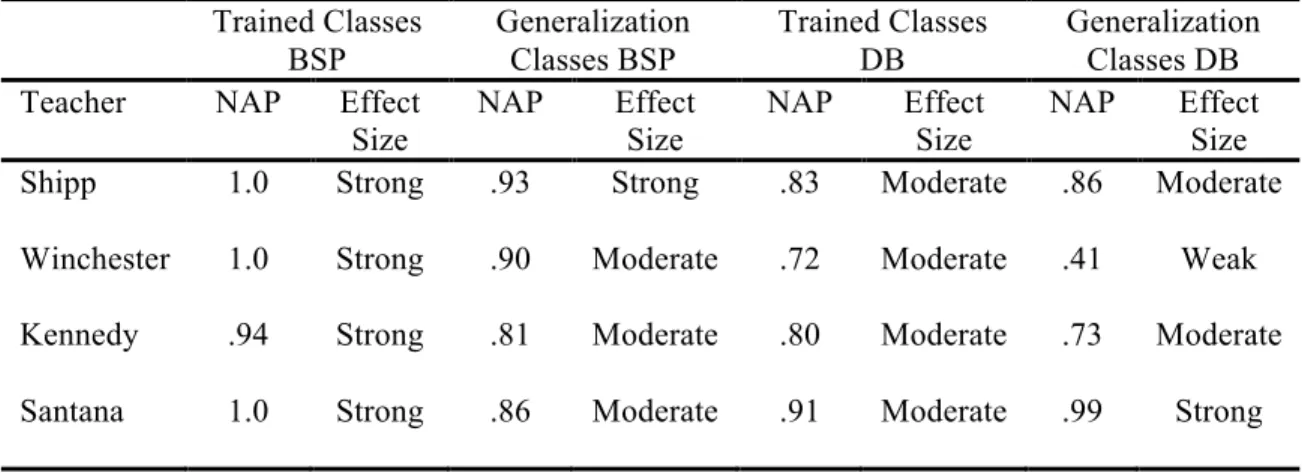
A multiple baseline design (Cooper et al., 2007) across classrooms with probing for generalization was used to evaluate the effectiveness of in situ direct training on teacher rate of praise in target and generalization settings. The concurrent multiple baseline design included four classrooms. The following phases were evaluated: baseline, direct training, maintenance, generalization prompt (for three of the four participants), and one-month follow-up. Visual analysis (Kazdin, 2011) was used to evaluate level, trend, and variability of the data. In addition to visual analysis of data, Non-overlap of All Pairs (NAP; Parker & Vannest, 2009) was calculated to estimate consultation effects. NAP is a non-parametric method for determining overlap between each baseline datum and each intervention datum and is strongly correlated with the R2 effect size. According to Parker and Vannest, NAP scores between 0 and .65 are considered weak effects, scores between .66 and .91 are moderate effects, and scores between .92 and 1.0 are considered strong effects. NAP was calculated for BSP in the target classrooms by comparing the baseline rate of BSP to maintenance, GP, and follow-up rates of BSP. The DBC phase rate of BSP in target classrooms was not included in the comparison, as it represents behavior that was prompted by the primary investigator. NAP was calculated for DB in the target classrooms by comparing the percentage of intervals of DB in baseline to the percentage of intervals of DB in the DBC, maintenance, GP, and follow-up phases. NAP was calculated for BSP in the generalization classrooms by comparing the baseline rate of BSP to DBC, maintenance, GP, and follow-up rates of BSP. The DBC phase rate of BSP
was included in the comparison, as it represents generalized use of BSP as a result of DBC implemented in the target classrooms. NAP was calculated for DB in the
generalization classrooms by comparing the percentage of intervals of DB in baseline to the percentage of intervals of DB in the DBC, maintenance, GP, and follow-up phases.
Dependent Variables and Data Collection Procedures
The primary dependent variable for this study was teachers’ rate of BSP. Teacher implementation of BSP was recorded manually using observational coding forms (see Appendix F). BSP was defined as any response dependent, specific, labeled praise statement that includes a description of the behavior being praised (e.g., “Great job attending to lecture!”). Teacher delivered BSP was recorded using an event recording procedure where frequency of BSP statements within 10-s intervals was recorded, converted to a rate-based measure, and reported as the number of BSP statements per minute during 20-minute observation sessions. A secondary dependent variable, students’ disruptive behavior, was observed, and included out of seat, inappropriate vocalizations, and playing with objects. Out of seat was defined as no part of the student’s buttocks in contact with a seat, including standing or walking around without permission. Inappropriate vocalizations was defined as the student making any vocal, audible noise unrelated to the task at hand such as talking, mumbling, yelling, singing, or humming. Playing with objects was defined as student(s) manipulating objects or
materials in a manner unrelated to the academic task, throwing objects, or tapping fingers or objects on a desk, twisting hair, or rocking desk/chair. The precise nature of students’ disruptive behavior was determined and operationalized in collaboration with the
was recorded using a momentary time sampling method during the 20-minute
observation sessions (i.e., concurrent with coding for teacher praise statements). For each 10-s interval, the observer observed a row or cluster of students and indicated if
disruptive behavior was present by any student during the first 2 seconds of the interval. The observer then moved to the next row or cluster of students, starting over with the first row once all rows/clusters had been observed. Rows or clusters were comprised of three to five students. Observing the alternating rows continued until the 20-minute observation was complete. Disruptive behavior data are reported as the percentage of intervals of occurrence of disruptive behavior.
For at least every third observation session, a generalization probe was conducted on the same school day in a randomly selected class period where training did not occur throughout all phases. Random selection of the class period to observe was completed by writing the numbers of the untrained periods the teacher had classes on slips of paper, and pulling one from a hat. The slip of paper was then replaced. If the same class period was chosen for two consecutive observations, it was not replaced for the next (3rd) choice. Therefore, no class period was observed for generalization more than two consecutive times. These generalization observations were conducted by a member of the research team not associated with training to minimize teacher reactivity during the generalization probes. Generalization observations were conducted every second or third observation throughout the course of the study, across all phases.
Observations were conducted by graduate students who were previously trained to conduct behavioral observations for a variety of target behaviors to a 90% agreement criterion. Additionally, the primary researcher met with all observers prior to data
collection and reviewed operational definitions of target behaviors and observation recording procedures. Moreover, each observer met a 90% agreement criterion for BSP and disruptive classroom behavior before serving as an observer for this study. A primary observer was designated for each observation and the graphed score is the score collected by this observer. Observers sat in a nonobtrusive location in the classroom while conducting observations and used a digital audio device to cue interval changes. If interobserver agreement fell below 90% for any observation, observers were retrained until the 90% criterion was again met.
Procedures
Baseline
During baseline, researchers did not provide any instructions to teachers, or provide any feedback regarding performance. Observers sat in an unobtrusive location in the classroom and conducted observations of both teacher and student behavior.
Direct behavioral consultation
Following the baseline phase, the researcher met briefly (i.e. less than 5 minutes) with the teacher to orient her to the bug-in-the-ear device and explain that she would be prompted to deliver a BSP statement every two minutes. Examples and non-examples of BSP statements were reviewed. It was suggested that increasing the use of BSP would likely result in improved student behavior in the classroom. Previous research conducted in high school classrooms has found that increasing teachers’ rate of BSP to at least once every two minutes has produced measurable change in students’ behavior (Blaze et al., in press; Duchaine et al., 2011; Sutherland, Lewis-Palmer, Stichter, & Morgan, 2008). During the DBC phase, a bug-in-the-ear device was used to direct the teacher to deliver