STUDENT PERCEPTIONS OF LEARNING IN ONE TO ONE PROGRAMS By
Mark Standley
Dr. Ray feafinhardt, Director, Center for Cross-Cultural Studies
APPROVED;
Dr. Anita Hartp^ann, Interim Dean, College o f Liberal Arts
M
awrence K. Duffy, Inte
Date
Graduate School
3
/---A Dissertation Presented to the Faculty of the University of Alaska Fairbanks
in
Partial Fulfillment of the Requirements for the Degree of
DOCTOR OF PHILOSOPHY
By
Mark Standley, B.A., M.S. Fairbanks, Alaska
All rights reserved
INFORMATION TO ALL USERS
The quality of this reproduction is dependent upon the quality of the copy submitted.
In the unlikely event that the author did not send a complete manuscript and there are missing pages, these will be noted. Also, if material had to be removed,
a note will indicate the deletion.
UMI 3534193
Published by ProQuest LLC 2012. Copyright in the Dissertation held by the Author. Microform Edition © ProQuest LLC.
All rights reserved. This w ork is protected against unauthorized copying under Title 17, United States Code.
ProQuest LLC
789 East Eisenhower Parkway P.O. Box 1346
programs in rural Alaska. This research used constructing grounded theory methods by conducting five focus groups in rural high schools in order to gather and analyze data from the students themselves. The research intent was to let the students' words and experiences shape a new theory how about they learn with these laptop programs. From an epistemological standpoint the goal of this qualitative research was to create a more complete picture of learning in one to one programs using grounded data through gathering, analyzing, and working directly with the students in these programs as “co participants” to learn from their perceptions of learning using laptops. The new literacies student develop through being 21st century learners were reflected in the student
perceptions in one to one programs and challenge researchers to re-examine learning theory in light of the ubiquitous nature of digital learning. This research was part of a larger collaboration with the Tech Cohort (Appendix A) to conduct mixed methods research using the same population to create a more complete picture of the research topics and participants.
Signature Page... i
Title Page... ii
Abstract... iii
Table of Contents... iv
Biographical Sketch... vii
List of Figures... ix List of Tables... x List of Appendices... xi Acknowledgements... xv Preface... xvi Chapter 1: Introduction...1 1.1 Theoretical framework... 1 1.2 Overview of methodology...3
1.3 Statement of the problem...6
1.4 Backdrop for study: description o f the communities... 7
1.4.1 Cordova... 9
1.4.2 Dillingham...9
1.4.3 Kwethluk... 10
1.4.4 Petersburg... 11
1.4.5 Selawik... 11
1.5 Significance of the study... 12
1.6 Purpose of the study... 13
1.7 Research questions... 14
1.8 Limitations to the study... 15
1.9 Summary...16
Chapter 2: Review of the Literature... 17
2.2 One to one laptop research...18
2.3 Literature on methods leading to grounded theory... 21
2.4 Learning theory...22
2.4.1 Canfield...23
2.4.2 Vygotsky...23
2.4.3 Gardner... 25
2.4.4 Silverman and Casazza... 26
2.4.5 Van Eck... 27 2.4.6 Dede... 30 2.5 New literacies... 30 Chapter 3: Methods... 34 3.1 Research questions...34 3.2 Theoretical lens... 35
3.3 Control for bias... 36
3.4 Methodology choices...37
3.5 Research design... 37
3.6 Parameters of research population... 38
3.7 Research methods...40
3.7.1 Focus group methods...41
3.7.2 Research process... 42
3.8 IRB approval... 43
3.9 Pilot study... 44
3.10 Instrumentation...46
3.11 Analysis of qualitative data... 47
3.12 Triangulation o f data... 49
3.13 Summary... 50
Chapter 4: Results... 51
4.1 Research questions and data...51
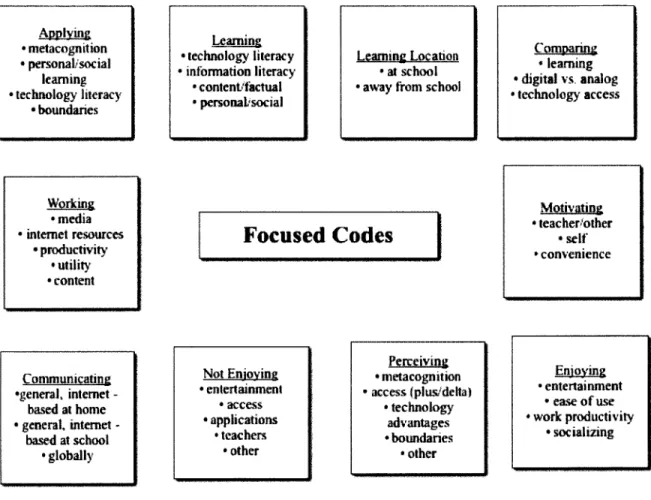
4.3 Focused coding... 54 4.3.1 Applying... 56 4.3.2 Working... 57 4.3.3 Communicating... 57 4.3.4 Not enjoying... 57 4.3.5 Perceiving... 58 4.3.6 Enjoying...58 4.3.7 Motivating...59 4.3.8 Comparing... 59 4.3.9 Learning... 59 4.3.10 Learning location...59
4.4 Frequency of co-occurrence results... 60
4.5 Co-occurrence tables and responses... 62
4.5.1 Learning... 62
4.5.1.1 Selected student quotes from co-occurrences learning codes...64
4.5.2 Enjoying...64
4.5.2.1 Selected student quotes from co-occurrences in enjoying code... 65
4.5.3 Perceiving... 66
4.5.3.1 Selected student quotes co-occurrences in perceiving codes. 68 4.5.4 Applying... 68
4.5.4.1 Selected student quotes co-occurrences in applying codes. ... 70
4.5.5 Comparing... 70
4.5.5.1 Selected student quotes co-occurrences in comparing codes...72
4.5.6.1 Selected student quotes co-occurrences in working codes.
... 73
4.5.7 Not enjoying...74
4.5.7.1 Selected student quotes co-occurrences in not enjoying codes... 75
4.5.8 Motivating...76
4.5.8.1 Selected student quotes co-occurrences in motivating codes... 78
4.5.9 Communicating... 79
4.5.9.1 Selected student quotes co-occurrences in communicating codes... 80
4.6 Summary... 81
Chapter 5: Discussion... 82
5.1 Findings for research questions...82
5.1.1 What are students in one to one laptop programs perceptions of learning?... 82
5.1.1.1 What does their software usage (self-reported) tell us about student appropriation of one to one laptops for learning?...83
5.1.1.2 How do they perceive the differences between laptop usage for school (formal) and the non-school (informal) w ork?...83
5.1.1.3 How do they perceive school laptops in one to one programs vs. their home computers)?...84
5.1.1.4 What do they perceive as the benefits o f laptops?...84
5.1.1.5 How do they perceive their teachers’ usage of technology in pedagogy?...84
5.1.1.6 How do they perceive bandwidth issues at home and at school?... 85
5.1.2 What theory(s) can researchers develop to better explain the patterns of student usage and learning in one to one laptop programs?... 87
5.1.2.2 What does this tell us about a student’s “learning
landscape?” ...88
5.1.2.2.1 Relationship between formal/informal learning. 89 5.1.2.2.2 Perceptions of access to information...89
5.1.2.2.2.1 Control/filters... 89
5.1.2.2.2.2 Bandwidth... 90
5.1.2.2.2.3 Content... 90
5.1.2.2.2.4 Research/inquiry... 91
5.1.2.2.2.5 Pursuit of interests...91
5.1.2.2.3 Interactions with others...92
5.1.2.2.4 Use o f tools (software, laptop, networks, etc.).. 92
5.2 Limitations... 93
5.3 Implication for further study...94
5.4 Summary... 95
Appendices... 97
List of Figures
Page
Figure 1. Research questions in tech cohort... xvii
Figure 2. Student perceptions o f learning...6
Figure 3. One to one high school laptop programs in Alaska...8
Figure 4. Population data and list of school districts... 39
Figure 5. Research process...43
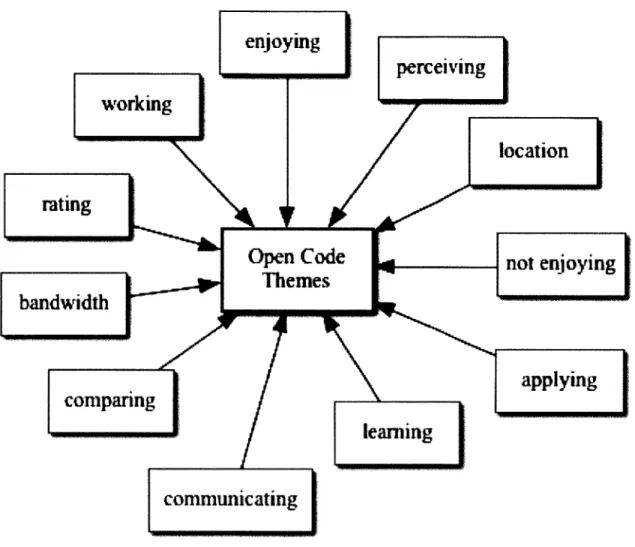
Figure 6. Open code themes...54
Page
Table 1. Summary of Co-occurrences... 61
Table 2. Co-occurrences in Learning C ode... 63
Table 3. Co-occurrences in Enjoying Code... 65
Table 4. Co-occurrences in Perceiving Code... 67
Table 5. Co-occurrences in Applying Code... 69
Table 6. Co-occurrences of Comparing Code... 71
Table 7. Co-occurrences of Work C ode... 73
Table 8. Co-occurrences of Not Enjoying Code... 75
Table 9. Co-occurrences of Motivating Code... 77
Table 10. Co-occurrences of Communicating Code...80
Page
Appendix A: Cohort Experience...97
Appendix B: Cohort Glossary... 103
Appendix C: Open Codes... 109
Appendix D: Focused Codes... 127
Appendix E: IRB Approval Letter... 129
Appendix F: Community Profile References...130
Appendix G: Focus Group Questions... 133
Appendix H: Parent Assent Form... 135
Appendix I: Student Assent Form... 137
He first came to the state working on a National Geographic/University of Alaska Museum archeology research project in limestone caves on the Porcupine River. For the next six summers he worked in the Arctic National Wildlife Refuge, Tetlin Wildlife Refuge, and Gates of the Arctic National Park, conducting survey archeology work. Winters were spent at the University Museum at University o f Alaska Fairbanks or the National Park Service lab in Fairbanks, analyzing data, documenting collections, and writing up reports.
From archeology Mark moved back into the education field as a teacher in Northway. He began his teaching experiences through two years at a middle school in a rural mountain village in South Korea for the U.S. Peace Corps. He then spent third year doing cross cultural training for the U.S. Embassy in Seoul. Mark continued to work for a total of ten years as a teacher, principal, and assistant superintendent in the Alaska Gateway School District centered in Tok, Alaska. During this time Mark was elected President of the Alaska Society for Technology in Education (ASTE), a statewide education technology group. He also served as co-chair of the Alaska Technology Content Standards group, who created the first set o f technology standards for Alaska students.
Mark moved from education into the business world as Statewide Account Executive for Apple Computer, Inc. During his six years with Apple, Mark became involved with many education projects including helped to found the “iDidaMovie” (www.aste.org) media contest for students across the state. After Apple, Mark accepted an assistant professor position at University of Alaska Anchorage (UAA) in Education Leadership. Mark began writing education leadership books dealing in subjects o f School Business Partnerships, Technology Standards, and Global Project-based Learning
(Visions Publishing, Eugene, OR) and doing leadership presentations in the U.S. and other countries. Other books include a series on Digital Storytelling for students and educators.
Mark left the UAA position for one year to work for the University o f Alaska’s President and State of Alaska Commissioner as Executive Director of the Alaska Center for Excellence in Schools. The Center created a mentoring project for rural principals to provide better training for these administrators through technology and University support. After one more year at UAA’s Education Leadership program, Mark left the University to help start and lead Highland Tech School, a charter in the Anchorage School District. Highland Tech (www.highlandtech.org) is a student-centered,
technology based, charter school in rented space in a shopping mall. Over six years, all Highland Tech stakeholders acted on a shared vision of mastery learning and standards based curriculum (Delorenzo, Battino, Schreiber & Gaddy, 2009). During this time Mark also help found and run with other educators Science and Storytelling Camps; week long exploration events for students doing science and digital storytelling in National Parks in Alaska, Hawaii, Walden Pond and the United Kingdom (www.teachingstory.com). They received funding for two years from the Office of Naval Research to study factors that would cause students in Alaska and Hawaii to want to pursue science careers
(www.futurescientists.org) and Mark served as curriculum director and editor of the project’s report.
After six years at Highland Tech, Mark retired from public education and began a non-profit, Educating 4 Leadership (www.educating41eadership.org) It focused on
creating student leaders and providing training for student school leaders on one to one programs across Alaska. He also provided consulting and training for students and teachers across Alaska and Hawaii for several education technology firms and
foundations. He also began a cohort, interdisciplinary doctoral program at the University of Alaska with a number of educators from Alaska. Since beginning work on this
research, Mark has begun supervising education administrator interns at the University o f Alaska Southeast, where he is teaching a course on Education Research in the Summer semester, 2012. Mark has also been elected to serve again as President for ASTE during the 2013 - 2014 year.
Mark is the very proud father of two children, Aron (24) and Robin (21), who make their parents proud by pursuing their dreams, passions, and curiosities in raw food, yoga, creative writing, art, spirituality, and organic farming in this country and others.
Acknowledgements
First and foremost, I want to extend my deep appreciation for the members of the Tech Cohort - Larry Ledoux, Pam Lloyd, and Bob Whicker. No one could ask for more intelligent, supportive, or courageous people to work through a doctoral, blue water sailing, research project together.
Second, a bottomless well of gratitude for Dr. John Monahan, committee chair and friend, and members of my committee and our UAF interdisciplinary doctorate faculty: Dr. Barb Adams, Dr. Bob Crumley, Dr. Spike Jorgensen, Dr. Rob Lang, Dr. Jean Richey, and Dr. Roy Roehl, for the patient wisdom of true scholarship to teach, to guide, and to mentor through one of academia’s great challenges.
And to my good friends and family. Your wellspring of support and unending encouragement has meant everything over the years, and especially during the wonderful challenge of completing this research. Special thanks to Christine Bridges, Karen Cator, Arun Croll, John Crowder, Dr. John Davis, Melora Gaber, Robbie Kinner, Kim Hanisch, Mark Hines, Rebecca Midles, Jane Monahan, Steve Moss, Roxy Mourant, Chris Selin, Jeanne Sivertson, Vicki Skarie, Bill Sullivan, and Kelly Tonsmiere; I’m quite sure I would not have made it without you.
I’d like to acknowledge the wealth of knowledge and great skills with qualitative research, Atlas TI software, and good humor of Dr. Nick Woolf and the quality teaching and guidance in conducting focus groups as research and storytelling from Dr. Richard Krueger.
And to my parents living and above - this one’s for you! Thanks for the nudges in curiosity for learning, persistence, and compassion.
And finally to our children - Aron and Robin. It seems every chapter in life has a different lesson to teach us...just getting to share lives and stories together with each other, I believe I have learned the most by listening to you. You are my life’s greatest gift and joy. Thanks for being who you are!
Preface
This dissertation explores student perceptions of learning in one to one laptop programs in rural Alaska. A problem exists that what students do with the laptop computers do not always align with their schools expectations of them. Students are using the laptops for school work assigned by their teachers, they are abiding somewhat by the filters and boundaries set up by the schools, and they are using the laptops beyond the educators’ knowledge and boundaries to create their own learning opportunities. The students are getting away with learning, and typically educators and even the students themselves do not fully know or appreciate how students are doing it. Through focus groups grounded in the students’ own words (Morgan, 1993, 1998; Stewart &
Shamdasani, 1990), this research offers some insights and new avenues for theory on literacy, learning, and implementation of one to one programs.
While looking for theories to help explain the trends in the focused codes, a powerful quote jumped out. Here, Vygotsky (1978) describes the research and
theoretical orientations of Jean Piaget, and perfectly summarizes the aim o f this research. “The point of asking questions that are so far beyond the reach of the child’s intellectual skills is to eliminate the influence of previous experience and knowledge. The experimenter seeks to obtain the tendencies of children’s thinking in “pure” form entirely independent of learning.” (p. 30)
If done properly the process and conclusions of this research are intended as a declaration of the sentiments of the above quote from two scholars who thought and wrote much about children’s perceptions o f learning.
Other cohort members (Appendix A) addressed research questions using the same population in rural Alaska and different methods. Figure 1 represents the different pieces of the puzzle we were asking regarding pedagogy, teacher/student use of technology, impact of bandwidth, and student perceptions of learning. Each dissertation represents a different look at learning and teaching in the one to one programs. Together the four dissertations represent an attempt to explore aspects of the one to one programs toward understanding their impact and improving their implementation in the future.
e 1. R es ea rc h q ue sti on s in tec h cohort. H o w does access to a 1 :1
classroom provide digital enhanced _ teaching environm ent facilitate the I )
2 1 s t century learner outcom es?
W h at theory(s) can researchers develop to better explain the patterns of student usage and learning in one to one laptop program s?)
?
W hat d o patterns of student usage and learning in a one to on e laptop program tell us about a student's le a rn in g landscape
D o students'and teachers'use technology differ in personal use and classroom use?
D o e s a c c e s s to b r o a d b a n d al h o m e us in g s c h o o l-p ro v id e d te c h n o lo g y m a k e a d iffe re n c e m le ve ls of ad optm r for s tu d e n ts an ti te a c h e r s ’
What is the level of adoption of the one to one laptop program as measured by the Concerns Based Adoption Model?
D o teacher s perceived levels of uses in their personal and/or professional practice lives relate to levels of technology uses In the
.
/ / / A
J - rC'Vv'V/ I D o e s a c c e s s to b ro a d b a n d h o m e m a k e a d iffere nc e h o w te a c h e rs a s s ig n h o m e w o rk a n d w h e th e r trie c re a te on lin e lea rn ing re s o u rc e s ’Chapter 1: Introduction
Across the U.S. and Alaska schools are adopting one-to-one laptop programs at an unprecedented rate. This rush to new technology is not necessarily new, but the impact of “digital learning” for students is something worth researching (Prensky, 2006). Students have access to these laptops throughout their day at both school and at home. As the Metiri Group (Lemke & Coughlin, 2006) defines it, “... 1 to 1 learning involves one student, one computer, one interactive, personalized learning experience in a wireless environment with anytime access to the internet” (p. 3). This ubiquitous access means an extended learning day for students and the chance for researchers to look at student perceptions of their own learning in these one to one environments.
Schools have created or purchased curriculum for the students to formally engage in using the laptops. Teachers are being trained to enhance their pedagogy to help
students take advantage o f the laptops at school and at home (Whicker, 2012). Outcomes of this formal pedagogy and learning can be measured by teacher-created assessments, standards-based assessments, and student self-reports of their progress. But the nature of one to one laptop program environments also includes the informal or unintended
learning that students acquire through their own interests, peers, social networking, and “goofing around” on the computer. This study researched student perceptions of learning with laptops through focus groups towards development of theory o f student learning in one to one programs.
1.1 Theoretical framework
The theoretical framework for this qualitative research was the phenomenological approach using constructivism and grounded theory methods. Student access to one to one laptops is a relatively new occurrence in schools (Apple, n.d.; 2004a,b,c; 2005a,b; Greaves & Hayes, 2008; Lemke, Coughlin, Thadani, & Martin, 2000; Livingston, 2006; Texas Education Agency, 2002). The phenomena being explored were the patterns of learning students adopt and/or adapt to make use o f these digital devices for formal (school oriented) and informal (more personal, social-oriented) tasks.
From an epistemological standpoint the goal of this qualitative research was to create a more complete picture of learning in one to one programs using grounded data through gathering, analyzing, and working directly with the students in these programs as “co-participants” (Charmaz, 2006) to learn from their perceptions of learning using laptops. The approach reflected the researcher’s worldview o f constructivism that students make their own meaning o f their experiences with these devices working by themselves, with peers, and under the instruction o f educators. Hearing directly from student experiences allowed the researcher to observe the processes they described and deductively interpret these patterns around learning in these programs. The core
assumption behind this approach was the researcher neither knew nor experienced the student perceptions or reality o f digital learning.
From a research standpoint the goal was to discover the student perceptions in these programs of laptops as a learning tool. The researcher used the words and phrases from the students to analyze how they adapted the laptops into their school and non school behaviors to discover perceptions o f learning. The student perceptions described patterns of learning that helped this researcher discover and offer concepts for new theory about student learning in one to one laptop environments.
The research designs considered for this work included mixed methods in concert with a Tech Cohort (Appendix A) as described in the Preface. There are a number of quantitative studies on laptop programs in other states (Gulek & Demirtas, 2005; Otto, Hannon, Mainzer, & Bautz, 2010; Penuel, 2006; Silvemail, 2007) examining specific numeric data regarding impact and achievement. The researchers tested theories using quantitative methods and numeric data to measure student achievement and engagement using laptops. From a theoretical basis that research assumed a positivistic approach for testing a hypothesis based on the relationship between use o f laptops and variables such as school outcomes (Penuel, 2006).
Most o f the quantitative data from the literature suggested few academic gains with laptops, yet many educators and parents reported there is “something” about laptops that motivates students (Penuel, 2006). While many critics claimed that technology does
not lead to increased achievement (Cuban, 2006a,b; Dunleavy & Heinecke, 2007), many other studies show specific gains in writing and technology skills. The patterns are elusive around which skills are impacted most (Harris, 2010).
New theories need to be developed to better understand the relationship between students, laptops and learning. Existing learning theory needs to be evaluated in light o f this opportunity students have with nearly unbounded access to virtually unlimited amounts of information outside the bounds of school curriculum, adult control, and appropriate level of the student’s cognitive development. Qualitative methods represent a new and useful approach to the new experience of student access to one to one laptops and digital information throughout their day (Denzin & Lincoln, 2008). Research using grounded theory methods creates new ways of examining that relationship from the direct experiences and words of the students (Charmaz, 2006).
There are few qualitative studies in the area of one to one laptop programs (Weston & Bain, 2010) and fewer still using mixed methods (Dalgamo, 2009; Lowther, Ross, & Morrison, 2003). These studies (Harris, 2010; Lowther, Strahl, Inan, & Bates, 2007; Penuel, 2006) seemed to get closer to the dynamic that something new is
happening for students and learning that is not measured by quantitative methods
(Prensky, 2006). The qualitative methods using grounded theory provided a tool to get a fresh view o f these laptop programs that researchers were not getting from a strictly quantitative approach. This research also combined efforts with a Tech Cohort (Appendix A) to provide insights from mixed methods sampling from the same population of schools in thirteen Districts in rural Alaska. From a research design perspective it was more appropriate to study the research question o f student perceptions of learning in one to one laptop programs from a constructivist, emerging approach.
1.2 Overview of methodology
This research adopted a qualitative approach to understand student perceptions of learning in one to one laptop programs in rural Alaska. Qualitative research is ".. .any kind of research that produces findings not arrived at by means of statistical procedures or other means of quantification" (Strauss & Corbin, 1998, p. 17). Qualitative methods
emphasize working in setting natural to the phenomenon being studied with the least intrusion and . .real world setting [where] the researcher does not attempt to manipulate the phenomenon of interest" (Patton, 2002, p. 39).
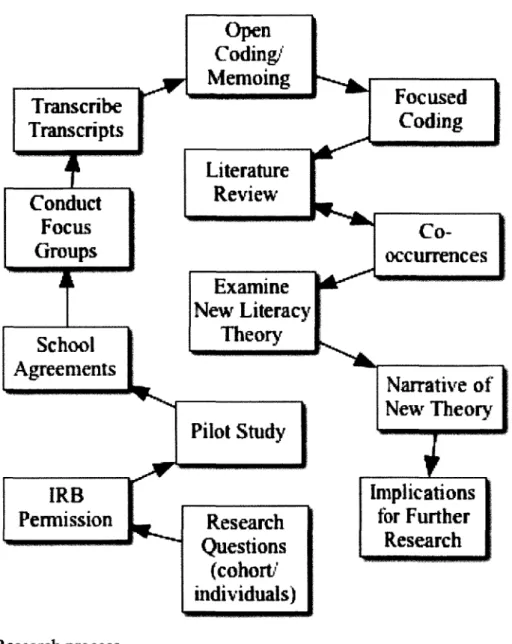
Methodology for this research used the grounded theory methods described by Strauss and Corbin (1998) and Charmaz (2006). These methods focus on analysis of data from co-participants experiencing a phenomenon (i.e. one to one laptops) and use of coding (open and focused) to analyze data, which in this research were the words and perceptions of the students in five different focus groups. Approaching gathering
information from students in rural Alaska required consideration of methods through the questions and responses in focus groups. The need to develop new theory to help explain unexplored student perceptions o f learning in one to one programs helped shape the choice of using grounded theory methods for this research.
Grounded theory allows the researcher to work directly with individuals who have experienced a phenomenon (in this case using a laptop computer and ubiquitous access to information) and to collect data through an interview process (i.e. focus groups) for the purpose of gathering and analyzing data to develop new theories. Furthermore it allows the researcher to use the constant comparative method of refining questions in the focus groups based on data from early groups to improve the vector of the questions toward openness and reporting by the students of their perceptions and experiences with learning on the laptops (Charmaz, 2006).
The advantage of the Tech Cohort was the use of mixed methods with a
combination of qualitative and quantitative approaches. Specifically, the Tech Cohort used online surveys, interviews, and focus groups in rural districts in Alaska
implementing one to one laptop programs under the auspices of the Consortium of Digital Learning (CDL) (Ohler, 2009). The characteristics o f the CDL one to one program included:
“ 1) students and teachers having access to laptops anytime, anywhere, in and out of school, 2) access to a wireless infrastructure, 3) the use o f the laptops included in the
curriculum as tools of learning, and 4) a professional development model including technology integration in the learning process.” (Whicker, 2012, p.20)
Hence the choice of grounded theory for methods because students and teachers had first hand knowledge and insights through their experiences with using and learning with laptops.
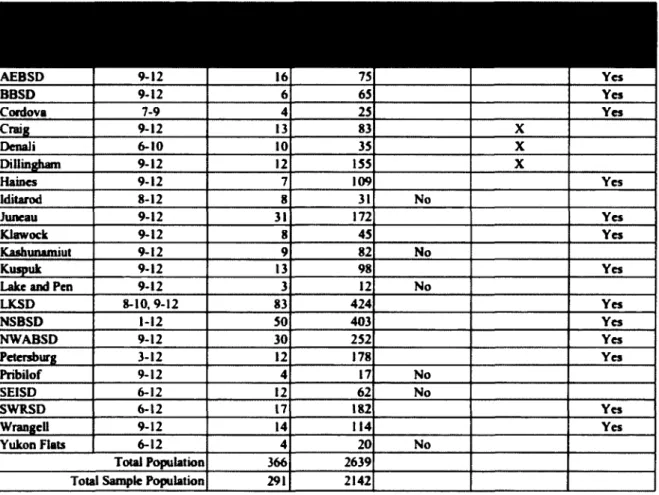
This dissertation used qualitative research methods o f conducting focus groups in five rural Alaska districts (Appendix F). The Tech Cohort involved in this research conducted online surveys in thirteen districts that included all but one district (Dillingham) where the focus groups were conducted. The Tech Cohort’s research population overlapped in four districts (Cordova, Lower Kuskokwim, Northwest Arctic, and Petersburg) where online surveys, interviews, and focus groups were conducted. All districts in this research were chosen because of their participation in the CDL program from approximately 30 districts currently engaged in one to one laptop programs. The mixed methods approach provided the benefit of open and closed ended questions, multiple forms o f data, text and statistical analysis, and multiple perspectives from the research co-participants in the one to one laptop programs (Creswell, 2009).
The data analysis plan described above was designed to listen, gather, transcribe, code (open and focused), process through careful analysis, and synthesize according to the students’ concepts, the direct words and thoughts around their perceptions of learning using laptops in one to one programs. The reason for using qualitative methods such as grounded theory is not to prove but rather to discover new paths of inquiry and theory (Straus & Corbin, 1998) in a relatively new education situation of students have ubiquitous access to a laptops and information for school work and their own interests.
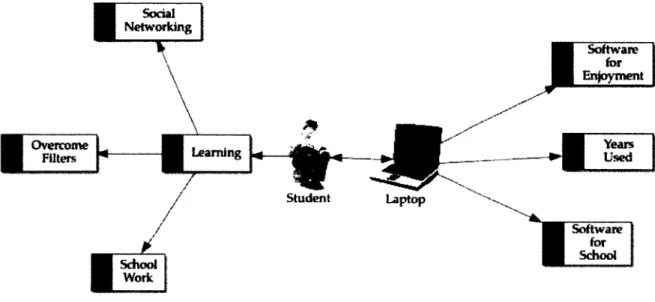
The key to using this method and data analysis was staying open minded and open eared to what students had to share about learning through one to one laptop programs. It appeared students attach little conscious thought or metacognition to the idea of learning while using their laptops. They also seem to differentiate between schoolwork (“little 1”) and pursuing their own interests (“big L”). Also, there is a lot of motivation, interest, and skill attached to social learning. The data analysis described above was the manner used
to ascertain the student perceptions and pursue new theory to explain their learning behaviors. Software for Enjoyment Years Used
Figure 2. Student perceptions of learning.
1.3 Statement of the problem
With all the laptop programs in the United States, and in Alaska in particular, students have more extended access to digital technology, information and potential learning. Little is known about the learning strategies individual students are using to take advantage of this unprecedented access. Studies confirm laptops are motivating to
students and that they are willing to spend more time using them for instructional and non-instructional purposes (Lowther et al., 2007; Penuel, 2006). The problem to be investigated is how they are adapting their individual learning strategies with the availability of the laptops.
These perceptions are “windows” into the thinking, motivations, and
metacognition of the students. An assumption made in this research’s constructivist approach was to hear and see the adaptive nature o f a student’s brain in digital
other measures (Howe & Strauss, 2000). Therefore educators implementing one to one programs cannot always know or direct these programs into the most productive ways. This research aimed to bridge our understanding between one to one programs designs and the reality of how students actually respond in digital learning environments.
Typically goals of the laptop programs are to increase student achievement, enhance access to learning materials and online courses, improve student opportunities for jobs and entrepreneurial activities, and/or motivate the students to attend school and more fully participate in academic, digital curriculum (Muir, Knezek, & Christensen, 2004; Lemke & Martin, 2004; Lowther et al., 2007; Silvemail & Buffington, 2009). Despite increases in one to one programs and access to digital content, researchers may not know or understand student perceptions of learning in these one to one laptop
programs. There is a lack of confirmed data in the relationship between the way students use the laptops and the way they perceive them as learning tools. There is also a lack of understanding between the way students perceive the use the laptops and various
software as enjoyment (i.e. social networking) and for schoolwork. There is a question about the difference between how students perceive using the laptop and the real or implied goals of the school program. Finally there is a question about how students view the benefit(s) of one to one laptop programs.
The movement of education technology towards one to one laptop programs changes the nature of the relationship between students, digital devices and learning. Instead of access to a device being restricted to school or home, students in one to one programs have continual access to a laptop computer and a wider array o f digital information to help in their learning. Schools are adapting their professional
development, pedagogy, and policy to the new one to one programs. Student learning patterns and behaviors in these digital realms are new to researchers and practitioners (Bebell & O’Dwyer, 2010; Colvin, 2008; Penuel, 2006; Prensky, 2006; Tapscott, 1998).
1.4 Backdrop for study: description of the communities
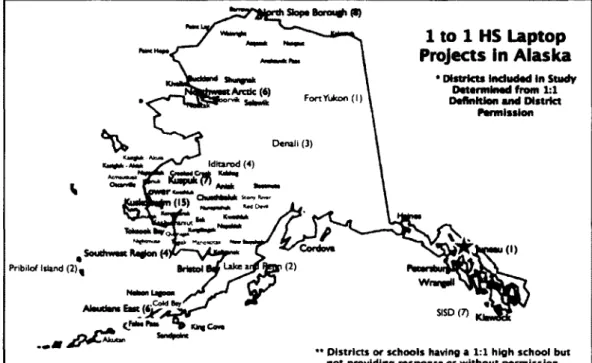
This study was set in rural Alaskan schools that are participating in the Alaska Association of School Board’s (AASB) Consortium for Digital Learning (CDL) one to
one Laptop Program over the past 10 years (Figure 3). Not all schools in this study participated in that program for that length of time, but all were currently operating according to Program’s original parameters. More importantly, the schools and students had multi-years using the one to one laptops and represented a population o f users ranging from one to six years o f experience. This experience gave the students a base from which to describe their formal (schoolwork) and informal (personal) use of the devices and their perceptions of learning through that differentiated usage.
Figure 3. One to one high school laptop programs in Alaska.
The five high schools researched in this study are located in different parts of rural Alaska. All require air or water transportation to get to the larger communities o f Anchorage or Juneau. The schools and communities range from predominately Alaska native or Caucasian to a mixture o f races as reported by the school districts in their annual report cards and the Alaska Community Database Community Information Summary (Appendix F). They also range from traditional subsistence to fishing economies depending on their locations and cultural histoiy. Despite their cultural,
** Districts or schools having a 1:1 high school but not providing response or w ithout permission
economic, and geographic differences, all the schools in this study were part of the Consortium for Digital Learning (CDL) one to one laptop programs.
1.4.1 Cordova.
Cordova Middle/High School is a part of the Cordova City School District and located in the community of Cordova in Southcentral Alaska. Cordova is located at the southeastern end of Prince William Sound in the Gulf of Alaska. The community was built on Orca Inlet at the base of Eyak Mountain. It lies 52 air miles southeast of Valdez and 150 miles southeast of Anchorage. The area has historically been home to the Alutiiq and migrating Athabascan and Tlingit Natives who called themselves Eyaks, as well as Alaskan Natives of other descents. Alaskan Natives o f other descents also settled in Cordova. Cordova hosts a large fishing fleet for Prince William Sound, as well as several fish processing plants. The average daily membership (ADM) for the District was 337.75 for the FY 11. The population of the community is 2,289 and during the 2010-2011 school year the population of the Cordova middle/high school was 117 students. Cordova City School is a single site school district. Cordova Middle/High School student population is made up o f 16% of Alaska Native and American Indian students, 18% o f Asian students, 57% of Caucasian students, and less than 2% each of African America, Hispanic and/or two or more races. For this same year the graduation rate was 94%. The percentage of economically disadvantaged students was 50% and the percentage of students with disabilities was 10% for this same school year. The school did meet Annual Yearly Progress (AYP) (Alaska Department of Commerce, Community and Economic Development, 2012)
1.4.2 Dillingham.
Dillingham Middle/High School is a part o f the Dillingham City School District and located in the community o f Dillingham in Southwest Alaska. Dillingham is located at the northern end of Nushagak Bay in northern Bristol Bay, at the confluence o f the Wood and Nushagak Rivers. It lies 327 miles southwest of Anchorage. Traditionally a Yup'ik Eskimo area with Russian influences, Dillingham is now a highly mixed
the Bristol Bay area are at the center of the local culture. Dillingham is the economic, transportation, and public service center for western Bristol Bay. Commercial fishing, fish processing, cold storage, and hosting the fishing industry are the main activities. The average daily membership (ADM) for the District was 478.70 for the FY 11. The
population of the community is 2,376 and during the 2010-2011 school year the
population of the Dillingham middle and high school was 176 students. Dillingham City School is a single site school district and is a Title I school. Dillingham Middle/High School student population is made up of 82% of Alaska Native and American Indian students, 12% of Caucasian students, and less than 2% each of African American, Hispanic, Asian, and/or two or more races. For this same year the graduation rate was 73%. The percentage of economically disadvantaged students was 75% and the
percentage of students with disabilities was 16% for this same school year. The school did not meet Annual Yearly Progress (AYP) and was at AYP Level 5 for the third year (Alaska Department of Commerce, Community and Economic Development, 2012).
1.43 Kwethluk.
Ket’acik/Aapalluk Memorial School is a part of the Lower KuskokwimSchool District and located in the village of Kwethluk in Western Alaska. Kwethluk is a Yup'ik community located 12 air miles east of Bethel on the Kwethluk River at the junction with the Kuskokuok Slough of the Kuskokwim River. It is the second largest community along the Lower Kuskokwim River. Kwethluk is an Yupik Eskimo community involved in traditional subsistence fishing and hunting. Residents haul water for household use. The average daily membership (ADM) for the District was 3995.15 for the FY 11. The population of the community was 741 and during the 2010-2011 school year the population of the Ket’acik/Aapalluk Memorial school (grades 3-10) was 142 students. Ket’acik/Aapalluk Memorial School is a part of a regional education attendance area (REAA) school district. Ket’acik/Aapalluk Memorial School student population is made up of 100% of Alaska Native and American Indian students. For this same year the graduation rate was 73%. The percentage of economically disadvantaged students was
The school did not meet Annual Yearly Progress (AYP) and was at AYP Level 5 for the eighth year (Alaska Department of Commerce, Community and Economic Development, 2012).
1.4.4 Petersburg.
Petersburg High School is a part of the Petersburg City School District and located in the community of Petersburg in Southeast Alaska. Petersburg is located on the northwest end of Mitkof Island, where the Wrangell Narrows meet Frederick Sound. It lies midway between Juneau and Ketchikan, about 120 miles from either community. The community is known for its blend of Tlingit and Scandinavian history. It is known as "Little Norway." Petersburg hosts a fishing fleet for Southeast and the Bering Sea, as well as several fish processing plants that date back to the early 1900’s. The average daily membership (ADM) for the District was 485.83 for the FY 11. The population of the community was 3,030 and during the 2010-2011 school year the population o f the Petersburg High School was 93 students. Petersburg City School is a single site school district. Petersburg High School student population is made up of 14% of Alaska Native and American Indian students, 71% of Caucasian students, and less than 2% each of African American, Asian, and Hispanic races. For this same year the graduation rate was 80%. The percentage of economically disadvantaged students was 54% and the
percentage of students with disabilities was 17% for this same school year. The school did meet Annual Yearly Progress (AYP) (Alaska Department of Commerce, Community and Economic Development, 2012).
1.4.5 Selawik.
Davis-Ramoth School is a part of the Northwest Arctic Borough School District and located in the village of Selawik in Northwest Alaska. Selawik is situated at the mouth of the Selawik River, where it flows into Selawik Lake, about 90 miles east of Kotzebue. It lies 670 miles northwest of Anchorage. The city is near the Selawik National Wildlife Refuge, an important breeding and habitat spot for migratory waterfowl.
Selawik is an Inupiat Eskimo community involved in traditional subsistence fishing and hunting. The community is noteworthy for its extensive system of boardwalks for foot
traffic, ATV’s, and snow-machines to get between households, school, and the three local stores. The average daily membership (ADM) for the District was 1776.08 for the FY
11. The population of the community was 868 and during the 2010-2011 school year the population o f the Davis-Ramoth school (Grades 3-10) was 144 students. Davis-Ramoth School is a part of a regional education attendance area (REAA) school district and is a Title I school. Davis-Ramoth School student population is made up of 100% of Alaska Native and American Indian students. For this same year the graduation rate was 12%. The percentage of economically disadvantaged students was 89% and the percentage of students with disabilities was 18% for this same school year. The school did not meet Annual Yearly Progress (AYP) and was at AYP Level 5 for the eighth year (Alaska Department of Commerce, Community and Economic Development, 2012).
1.5 Significance of the study
The importance of this study was primarily with the focus on sussing out new theories of learning from the perceptions of students in one to one laptop programs. Millions of dollars have been invested in digital learning devices for students and schools (Silvemail, 2007) across this and other countries. The rush to have a one to one program is going to overtake the very real consideration of how to design the learning experiences of students to align with a) how students learn in digital environments, b) the issues with bandwidth and content filtering in and away from school, and c) effective pedagogy in 21st century schools.
This study sought to better inform researchers and practitioners regarding the design and implementation of one to one programs to accommodate the learning patterns of students, also referred to as “digital natives” with their characteristic ease in use, navigating and multi-tasking with technology. As Marc Prensky (2001a) defines this term:
“Digital Natives are those who grew up with digital technology from birth, whereas Digital Immigrants are those who were already socialized in pre-digital ways when digital technology arrived on the scene.” (p. 28)
The other aim of this study was to develop new theory (Strauss & Corbin, 1998) to better explain the relationship between learning and the occurrence of ubiquitous learning environments. These one to one programs allow students to have more access to information for longer periods of time than ever before. How do researchers and
educators explain or take positive advantage of the adaptive nature of student learning in these environments?
The other significance of this study was its attempt to shed light on the
relationships between technology, learning, culture, pedagogy, and bandwidth access in rural Alaska. Alaskan schools are not newcomers to technology, but the 24 X 7 nature of one to one programs is something new. This mixed methods study in concert with the studies of the Tech Cohort (Appendix A) provided unequaled insights into the above topics. This research intends to help in informing practices in the implementation of one to one programs in Alaska.
1.6 Purpose of the study
This study sought to ascertain patterns of student learning in one to one programs to develop a theory that better explains and supports the implementation of these
programs. This study researched how students learn in ubiquitous, digital environments in unique Alaska settings with the intention of improving one to one programs and contributing to the body o f research on learning theory in this area overall. While many studies of one to one programs in other states (Lowther et al., 2007; O ’Dwyer, Russell, Bebell, & Seeley, 2008; Silvemail, 2007) provide many insights into one to one programs there, none address issues of Alaska’s education system, technology infrastructure,
geography and cultural diversity.
The purpose of this research also included helping to design and implement one to one programs in practice and in policy by learning directly from students. The research used qualitative methods to gather the experiences and data from students through focus groups in five different schools around the state (Appendix H). This approach provided the advantage of listening directly to the students in focus groups as they adopt and adapt one to one laptops in their learning strategies. By gathering and analyzing this data using
grounded theory methods these focus groups were transcribed and analyzed to ascertain the students’ experiences and perceptions about learning using laptops. This analysis aimed to develop new insight, implementation strategies and theory about ways student use laptops (software, social media, school work, etc.) for learning.
1.7 Research questions
Studying both formal and informal learning behaviors by students in one to one learning environments can help researchers develop new theory about the nature of student learning in digital environments. Researchers and educators do not fully
comprehend nor do they have specific plans about leveraging student informal learning behaviors to achieve school goals or increase student achievement in traditional
measurements and/or technology standards at a state or national level. Understanding both the formal and informal patterns of digital learning through questions provide researchers and educators new insights into how students function, respond to teacher expectations, think, network, and pursue their curiosity. As Strauss and Corbin (1998) note “Every type of inquiry rests on the asking of effective questions” (p.73). The
research questions of student perceptions o f learning pursued in this study were designed to explore new theory around how students learn in one to one laptop programs.
Research questions pursued in this study include:
1) What are students in one to one laptop programs perceptions o f learning?
a) What does their software usage (self-reported) tell us about student appropriation o f one to one laptops for learning?
b) How do they perceive the differences between laptop usage for school (formal) and non-school (informal) work?
c) How do they perceive school laptops in one to one programs vs. their home computers)?
d) What do they perceive as the benefits of laptops?
e) How do they perceive their teachers’ usage of technology in pedagogy? f) How do they perceive bandwidth issues at home and at school?
2) What theory(s) can researchers develop to better explain the patterns o f student usage and learning in one to one laptop programs?
a) What are the patterns of their laptop usage in schoolwork (formal) and non-school work (informal)?
b) What does this tell us about a student’s “learning landscape”? i) Relationship between formal/informal learning
ii) Perceptions of access to information (1) control/filters
(2) bandwidth (3) content
(4) research/inquiry (5) pursuit of interests iii) interactions with others
iv) use o f tools (software, laptop, networks, etc.)
1.8 Limitations to the study
The study was limited to students in nine school districts in rural Alaska. There were several limits to the study based on time, logistics, resources, and research intent. The limits created certain boundaries for inquiry but also represented the chance to focus on the situation of native and non-native students engaged in to one to one laptop
programs for multiple years in rural and smaller urban settings. Despite the challenges of expense and logistics, the research was conducted in rural school sites with the benefits of face to face interactions with the students. Overcoming these limitations provided a level of interaction in keeping with qualitative research methods of hearing directly from students as co-participants in this work.
The data gathering for this research was on site in five different schools over a three-month period in winter, 2011. Access to the school sites was by commercial jet and prop “bush” airlines and by taxi or ATV/snow-machines rides to the school buildings. The expense of flying to communities in “bush” Alaska to conduct the focus group was
high. The average airfare from Anchorage to regional hub communities is approximately $800. Three of the focus groups were in Dillingham, Petersburg, and Cordova. The two focus groups conducted in “bush” communities o f Kwethluk and Selawik required further air travel from the regional hubs. Each of these airfares were approximately an additional $400. Accommodations included staying at the school or (when available) in a local motel. Due to the rural nature of the communities/schools, research logistics were relatively expensive and time consuming over the course of the data gathering process.
1.9 Summary
This dissertation explores rural Alaska student perceptions o f learning in one to one laptop programs to develop new theories of student learning in ubiquitous digital environments. The organization of the research created a unique opportunity for our University of Alaska Fairbanks Tech Cohort (see Appendix A) to explore and examine in some detail the nature of one to one programs in Alaska locations. By using online surveys, interviews, and focus groups, this research triangulated collected data through mixed methods. The strength o f this approach was to validate results and open up new paths of inquiry into theory of learning with technology in one to one programs. Given the ubiquity of these programs in Alaska, nationally, and globally, this joint research offers insights in designing and implementing more effective one to one programs.
Additionally, the mixed methods and cohort approach in this research as
described in the Preface represented an attempt to develop new theory to better explain the relationships between ubiquitous, digital environments, pedagogy, learning,
bandwidth, teacher professional development, and culture. Together the four interlinking studies represent a larger and more comprehensive glimpse o f that same puzzle in light of the shared data, methods, research collaboration, and cooperation from the students, teachers, and administrators in this research. These research efforts contribute to the foundation o f much needed new theory, design, and implementation strategies for creating effective digital learning for students.
Chapter 2: Review of the Literature 2.1 Introduction
The search for student perceptions of learning in one to one laptop programs entailed a review of the literature in the field of education technology and learning theory. The literature review of educational technology focused on one to one programs in Alaska and other states prior to the data collection process. This review helped frame the methodological and method approaches for this research, as well as the range of findings and calls for research described in the one to one literature. Initial exploration of literature on learning theory before collecting data expanded afterwards in the analysis phase and attempted to compare student responses in this research with extant theory on the process and perceptions of their learning using laptops.
The literature review in education technology and learning theory has provided ample evidence that this research topic and methodology have a larger group of
researchers than just the Tech Cohort. The increasing numbers of one to one programs and research suggest this phenomenon is growing. The rising population in schools
-“From 2008-09 through 2020-21, public elementary and secondary school enrollment is projected to increase from 49.3 to 52.7 million students, but with
differences across states.” (Aud et al., 2011, p.22). Combined with the decreasing costs of technology per unit, it is probable that these one to one, as well as Bring Your Own Device (BYOD, Bring Your Own Network (BYON), and Bring Your Own Browser (BYOB) will increase (Lemke & Coughlin, 2006).
Another reality to consider is how much United States spends per student compared to other countries as measured by a comparison of national expenditures in education. “In 2007 the United States spent $10,768 per student on elementary and secondary education, which was 45 percent higher than the Organization for Economic Co-operation (OECD) average of $7,401.” (Aud et al., 2011, p. 106). The investment in education technology as a subset o f this per capita spending reflects the growing
availability and ubiquity o f laptops and computing tablets for schools. The trends suggest a strong increase in the presence and availability for one to one computers for students
(Penuel, 2006). Hence, the importance of research to investigate the relation between this technology and student learning to measure, leverage, and improve the efficacy o f these investments. The literature review was a point o f discovery and departure for research. As Charmaz (2006) puts it, “The literature review and theoretical frameworks are
ideological sites in which you claim, locate, evaluate, and defend your position.” (p. 163) As recommended by the grounded theory approach some of the literature review was conducted after the data collection in order to enter the data gathering and analysis without a burden of theoretical concepts through which to filter student responses. While extant learning theory was explored prior and after the data collection, the process lead to exploration of other theory in new literacy and digital media related to learning. The result of this process lead directly to the new literacy and 21st century learning research that was more closely aligned with the focused coding that resulted from this analysis in this study.
2.2 One to one laptop research
United States and Alaska schools are adopting one to one laptop programs at an unprecedented rate. This rush to new technology is not necessarily new, but the potential impact on “digital learning” for students is gaining a lot of attention in the literature (Oppenheimer, 1997,2003). Students have access to these laptops throughout their day at school and at home. In Alaska one to one laptop programs exist in over 30 of 53 school districts over the past 5 years (Ohler, 2009). Limited research has been conducted to examine the impact of these infusions of technology into the learning environment (Silvemail, 2007; Texas Education Agency, 2002; Weston & Bain, 2010). This ubiquitous access means an extended learning day for students and the chance for researchers to look at the nature o f student cognition in digital learning.
In most laptop programs students have increased access to more information and learning opportunities (Coughlin & Martin, 2004; Rockman, Chessler, & Walker, 1998). The results of increased access have been measured by researchers over the past twenty years with a variety of findings (Becker & Ravitz, 2001; Dwyer, Ringstaff, & Sandholtz,
suggest increased access to information through technology provides mixed benefits for student learning depending on the subject area (Bebell & Kay, 2010; Bums & Polman, 2006; Harris, 2010; Rockman et al., 1998, 2000), technology support (Warschauer, 2004), pedagogy by teachers (Dwyer et al., 1990; Swan, Van’t Hooft, Kratcoski, & Unger, 2006) and student initiative (Harris, 2010; Rockman et al., 1998) among other factors. Other research details the costs and technical issues on the implementation of one to one laptop programs around the country (Lei & Zhao, 2006; Lemagie, 2010; Lowther et al., 2007). What is clear from this research literature is the difficulty o f assigning specific benefits to student learning through traditional measures (Barth, 2001; Darling- Hammond, 1997; Jaillet, 2004; Marzano, 2003; Marzano, Pickering, & Pollock, 2001; Penuel, 2006; Rockman et al., 2000).
Less understood are the perceptions and learning strategies of students using one to one laptops. Research literature is less explicit regarding the learning strategies individual students are using within this unprecedented access (Bebell & O’Dwyer, 2010). Research finds laptops are motivating students; they are willing to spend more time using them for instructional and non-instructional purposes (Harris, 2010; Lowther et al., 2003), but this research needs to be tied to learning theory, which will be discussed later in section 2.3.
Across the spectrum of literature around one to one laptop programs, or what is also referred to as “ubiquitous technology environments,” there are a variety o f studies that focus on separate or individual studies (Boija, 2006; Lowther et al., 2007), others that compared case studies (Penuel, 2006), and others that were synthesis statements from the literature (Bebell & O ’Dwyer, 2010). These articles develop an overall sense of the state of the union regarding laptop programs.
Current literature profiles key elements in one to one laptop programs across the country. Some are school or district specific (Lowther et al., 2003; O’Dwyer, Russell, Bebell, & Seeley, 2005), others covered the work in entire states (Bebell & Kay, 2010; Greaves, Hayes, Wilson, Gielniak, & Peterson, 2010; Ohler, 2009; Silvemail, 2007), and some were meta-analyses of many studies to explore broader perspectives (Penuel, 2006).
These articles described projects and data with implications for schools and policy. This research covered goals of the programs, technical details, pedagogical strategies, barriers to entry, ongoing successes and instances o f insight regarding policy, and best practices.
Several insights came from this part of the literature review influencing the development of this research’s conceptualization, topic, and methodology. First, few of these articles included research methodologies that actually engaged students in direct, open-ended questions about their perceptions of the laptop programs (Swan et al., 2006; Lei & Zhao, 2006). Students, being half of the equation of “one to one,” had seldom been queried directly to describe their perceptions of learning.
Second, specific findings regarding the logistics of the implementations that contributed or took away from the overall program were also helpful (Lemagie, 2010; Lemke, 2009). It was clear that significant variables (i.e. technical support, professional development, etc. (Penuel, 2006) were critical to the success of the programs. Third, was the importance of moving from a teacher centered to student centered pedagogy and changes in pedagogy across a school or district. (Bain, 2004; Harris, 2010). The final insight from this part of the literature review was the commonality o f quantitative
evaluations centered through data correlated to student outcomes in core subjects (Bebell & Kay, 2010; Lowther et al., 2007) with emphasis on subjects like technology literacy, writing and editing papers (Lowther et al., 2007; Warschauer, 2004), math and
humanities (Russell, O'Dwyer, Bebell, & Tucker-Seeley, 2004). Examining the
relationship between students’ mathematics test scores and computer use at home and at school, science (Bums & Polman, 2006; Garthwait & Weller, 2005; Rockman et al.,
1998). All of these suggest the academic gains measured by traditional assessments fall short in answering questions about learning in other subjects, correlations to learning theory, and new insights through student perceptions.
The lack of qualitative approaches focused on the student perspectives and perceptions of the programs was evident (Land & Hannafin, 1997; Silvemail & Buffington, 2009). The representation o f one to one assumes one student and one
or voices in the literature (Swan et al., 2006; Harris, 2010). Notable exceptions included Swan (2006), Harris (2010), and Rockman et al (Rockman et al., 1998). In their research Rockman (Rockman et al., 1997) described the following results: When asked the open- ended question, “How would your schoolwork be different if you didn’t use computers?” Both groups of students perceived benefits from computer use. These included greater productivity in their schoolwork (primarily in writing and research), the ability to create more professional products, an increase in creative opportunities, and increases in the skill set they feel they’ll need in future employment. This type of research allowed insights into student perceptions of their experiences with digital learning, which will be discussed later in this chapter.
2.3 Literature on methods leading to grounded theory
What was not often represented in the literature cited above was the individual nature of student experiences with the technology: ubiquitous access to information, cognition, interaction with teachers, peers, and self, boundaries (digital/physical), and metacognition. Put another way, the research literature revealed a gap in the exploration of students’ experiences directly related to their perceptions of learning and the field of one to one programs through their eyes.
The literature review of the research methodology provided strategies for approaching one to one programs based on theory and qualitative methods that explore student perceptions. Creswell (2007,2009), Merriam (2002), and Kvale & Brinkmann (2009) provided the components and methodology relating to quantitative and qualitative strategies and mixed methods. Specific theory and methods of grounded theory,
described in Chapter 3, provided further guidance (Charmaz, 2006; Denzin & Lincoln, 2008; Lincoln, 2008; Strauss & Corbin, 1998).
Another article that helped shape the development and conceptualization of this research topic and methodology was done by Kent State and Virginia Commonwealth University researchers (Swan et al., 2006) entitled, “Uses and Effects o f Mobile Computing Devices in K-8 Classrooms.” The theoretical lens of this research describes
an end point based on the premise that we can know the impact of one to one laptops on student learning by gathering experiences through qualitative methods.
2.4 Learning theory
The literature review for learning theory came after substantial data gathering and analysis had taken place in this research. This is consistent with grounded theory
methods (Charmaz, 2006) as the comparative/contrast method allows the researcher to begin speculation on the importance or relevance between the data and substantial theory. This section will detail learning theory related to “pre-digital learning” environments, provide comments on the “digital learning” theories, and conclude with a review of the “new literacy” theories that seem to be more consistent with the analysis of this research data.
Student perceptions of learning in one to one programs represent a fundamental new opportunity to explore learning theory. As previously mentioned, one to one programs in which students have unprecedented access to information, data processing, and digital communication with others in their vicinity and around the world, are a new phenomenon in education. This research explored a variety of theories including
Canfield (1988), Vygotsky (1978), Gardner (1983), Silverman and Casazza (2000), Van Eck (2006), and Dede (2004,2005) to compare the results o f the data grounded in the responses from students in this research with extant theory.
As described in Chapter 4, results from the open coding of focus group responses to questions suggested areas of perceptions grounded in the words and experiences of students. Students reported what they enjoyed and did not enjoy, what they felt they were learning, their perceptions, their comparisons, how they were applying skills and learning strategies, how they were overcoming internet filters, describing what they liked and did not like about their teachers’ teaching styles, and more. Focused coding
(Charmaz, 2006) provided more conceptual codes “ .. .to synthesize and explain larger segments of data” (p.57). Acting on this focused coding required going back to the literature to explore learning theories that might help explain the nature o f student
the results o f this “looking back” into theory to look forward (Chapter 5) to what student responses might tell researchers about how students learn in these programs.
2.4.1 Canfield.
One theory and tool worth exploring is the Canfield Learning Style Inventory (Canfield, 1988), which has four scales. They include:
Learning conditions:
• affiliation (need for personal relationships), • structure (need for detail and organization),
• achievement (desire to set goals and be independent), • eminence (orientation towards authority and competition). Learner preference content:
• numeric, • qualitative, • inanimate, • people.
Learner preferred mode: • listening,
• reading, • conic,
• direct experience.
Learner expectation for a particular grade.
(in Silverman & Casazza, 2000, p.47). Students in this research expressed similar themes and within the focused coding, areas of preference in content and conditions emerged. Comparisons with Canfield’s Inventory are further detailed in Chapter 5.
2.4.2 Vygotsky.
Vygotsky (1978) credits interactions with others as key to human cognitive development. He maintains that social learning precedes development, and that “Every function in the child’s cultural development appears twice: first, on the social level, and later, on the individual level; first, between people (inter-psychological) and then inside the child (intra-psychological).” (Vygotsky,1978, p. 57). He describes the development of children as never following school learning the way a shadow follows the object that casts it (Vygostsky, 1978; Bruner, 1985). Rather, he asserts that “...there are highly
complex dynamic relations between developmental and learning processes that cannot be encompassed by an unchanging hypothetical formulation” (p. 91).
Human learning, in fact, . .presupposes a specific social nature and a process by which children grow into the intellectual life of those around them” (p. 88). Vygotsky’s theory (1978) promotes learning contexts in which students play an active role in learning. Roles of the teacher and student shift, as teachers collaborate with students in order to help facilitate meaning construction in students. Growth occurs as the result of meaningful verbal interaction between novices and more knowledgeable interlocutors such as parents, peers, or teachers (Crawford, 1996; Vygotsky, 1978; Wertsch & Sohmer,
1995).
According to Vygotsky (1978), students are capable of performing at higher intellectual levels when asked to work in collaborative situations than when asked to work individually. Group diversity with respect to knowledge and experience contributes positively to the learning process. Perhaps collaborative work that is done digitally has the potential to harness those diversities, to bring together not only peers, but subject matter experts and adults in a particular field. When students in this research reported their strong interest in learning from Facebook, that interest may be explained in part by Vygotsky’s theory.
2.4.3 Gardner.
In his 1983 book, Frames of Mind: The Theory of Multiple Intelligences, Howard Gardner identified seven intelligences or ways in which people understand and perceive die world. Gardner originally put the list together as a conceptual model about the nature of the mind, and not necessarily a practical way from which educators might address student individual differences. However, understanding a learner’s strengths and weaknesses based upon different intelligences has helped educators embrace Gardner’s work and adapt it to the classroom. This theory has important elements for student responses from this research in one to one programs and served to better frame coding categories in the analysis process.
Gardner (1999) defines an intelligence as “ biopsychological potential to process information that can be activated in a cultural setting to solve problems or create products that are of value in a culture” (pp. 33-34). Gardner claims that all people have all the intelligences, but that individuals are not alike. He lists the following types of
intelligences:
• Linguistic. The ability to use spoken or written words.
• Logical-Mathematical. Inductive and deductive thinking and reasoning abilities, logic, as well as the use of numbers and abstract pattern recognition.
• Visual-Spatial. The ability to mentally visualize objects and spatial dimensions. • Body-Kinesthetic. The wisdom o f the body and the ability to control physical motion
• Musical-Rhythmic. The ability to master music as well as rhythms, tones and beats.
• Interpersonal. The ability to communicate effectively with other people and to be able to develop relationships.
• Intrapersonal. The ability to understand one’s own emotions, motivations, inner states of being, and self-reflection.
According to Gardner, integration o f multiple intelligences into the classroom involves changing ideas about teaching and learning. Technology provides the