© 2013. Md. Mahmudul Hasan & Mahmuda Akhter. This is a research/review paper, distributed under the terms of the Creative Commons Attribution-Noncommercial 3.0 Unported License http://creativecommons.org/licenses/by-nc/3.0/), permitting all
non-Network, Web & Security
Volume 13 Issue 16 Version 1.0 Year 2013Type: Double Blind Peer Reviewed International Research Journal Publisher: Global Journals Inc. (USA)
Online ISSN: 0975-4172 & Print ISSN: 0975-4350
Design and Development of English Learning Facebook
Application based on Platform as a Service (Paas) by using Smart
Gamification
By Md. Mahmudul Hasan & Mahmuda Akhter
Daffodil International University, BangladeshAbstract -
Social networking sites like Facebook are not just an element of passing time but a
platform for learning as well. The goal of this paper is to show the effectiveness of a Facebook
application named “Wishdom” to teach English language based on cloud platform. This application
tries to introduce English language in an authentic and communicative manner to the students,
where they have to assume different roles (i.e. avatar) to achieve a particular goal. For that purpose
they communicate with the other avatar and participate in several quizzes. This study shows the
performance of a group of students who played “Wishdom” game and take a quiz as a part of their
assessment. Their performance has been presented to show their success rate in learning English.
The performance of the application is also measured based on Facebook Graph API. In addition,
platform as a service (PaaS) of cloud computing from Heroku has been integrated to host the
application and its compatibility is checked in this study.
Keywords :
gamification, facebook, paas, social media, virtual world, gaming, english learning.
GJCST-E Classification :
I.2.6
Design and Development of English Learning Facebook Application based on Platform as a Service Paas by using Smart Gamification
Design and Development of English Learning
Facebook Application based on Platform as a
Service (Paas) by using Smart Gamification
Md. Mahmudul Hasan α & Mahmuda AkhterAbstract- Social networking sites like Facebook are not just an element of passing time but a platform for learning as well. The goal of this paper is to show the effectiveness of a Facebook application named “Wishdom” to teach English language based on cloud platform. This application tries to introduce English language in an authentic and communicative manner to the students, where they have to assume different roles (i.e. avatar) to achieve a particular goal. For that purpose they communicate with the other avatar and participate in several quizzes. This study shows the performance of a group of students who played “Wishdom” game and take a quiz as a part of their assessment. Their performance has been presented to show their success rate in learning English. The performance of the application is also measured based on Facebook Graph API. In addition, platform as a service (PaaS) of cloud computing from Heroku has been integrated to host the application and its compatibility is checked in this study.
σ
Keywords: gamification, facebook, paas, social media, virtual world, gaming, english learning.
I.
I
ntroductionnline social networks (OSN) have brought a change of how people interact to others in virtual world. Most of the people are engaging (statistics) themselves in social media such as facebook , twitter, myspcae, google +. In this context and current trend of users’ activities, we created a game named “Wishdom“ which is designed and developed in a Workshop organized by BBC Media Action in Bangladesh at University of Liberal Arts Bangladesh on 24 September, 2012. In this research paper, we highlighted the basic design and development of the game and how it works with its output of learning English. Moreover, we have designed the game to accommodate smart gamification in it[1].
a) Role of Games in Learning
According to Warschauer and Kern (2000), over the last 40 years, the focus of language teaching has shifted from teaching discrete grammatical structure to improving communicative ability that makes the language teaching not only more complex but also more exciting. Nowadays, simulation and game are widely
Author α: Senior. Lecturer, Department of Computer Science and Engineering, Daffodil International University, Bangladesh.
e-mail: [email protected]
Author σ: Lecturer, Department of English and Humanities, BRAC University, Dhaka, Bangladesh. e-mail: [email protected]
used in language learning. It provides the language learners with the opportunities to learn the authentic use of language[2].
Using simulation in language promote positive affective factors such as increased motivation and engagement.Students are highly motivated when they are engaged in simulations and games that bring a positive attitude towards learning. According to Macedonia (2005), language games provide opportunities of “redundant oral repetition of grammar structures”, yet in a playful way. From a neurological perspective, she stresses the important role of positive emotions in game-based language learning, which can enhance students’ basic motivation[3].
Gaudart (1999) believes that one major advantage of using simulations and games in language classroom is to alter teacher-centered classrooms by providing students with opportunities to fully use the language. Many researchers like Jung and Levitin (2002) find that simulation can offer real life cultural and linguistic environments for language students. However, they also point out that all students may not realize the value of the simulation. They may find it to be time consuming and non-academic[4,5].
Virtual environments (VE) have gained immense popularity over last few years. VE is an umbrella term that refers to open social virtualities (e.g. Second Life), commercial 3-D gaming spaces and online environments designed to support educational objectives (Thorne, Black and Sykes, 2009) [6]. In virtual environments, human agents interact with the each other or with software generated characters, such as avatar. At present, the most popular social virtual site is Second Life that serves both entertainment and educational purposes. Nowadays many renowned universities have set their virtual campus in Second Life for residential and distance education, student admission and so on. They also host special media events through educators’ blog and forum of Second Life.
In spite of gaining popularity, there are very limited numbers of studies that explore the prospects of using VE in academia. Sadler and Nurmukhamedov (2008) conducted a study on 10 undergraduate ESL (English as a Second Language) students and 23 master’s students in TESOL [7]. The study results show
O
Global Journal of Computer Science and Technology Volume XIII Issue XVI Version I
47 (DDDDDDDD ) Year 013 2 E
that task based language learning can be carried out successfully in Second Life where the students’ motivation level is very high and they use English with each other to complete the task. Similarly, Zheng, Li and Zhao (2008) use Second Life for teaching Chinese language culture. Their study shows that Second Life provides enough opportunity to the students to negotiate for meaning and to learn pragmatics. Pena and Hancock’s (2006) study reveals that even in a battle and competition oriented game, students try to good interpersonal relation with the other players using proper language. Besides, adopting a new identity (avatar) challanges students to think of a problem from different point of view, making them open to different perspective (Lee and Hoadley, 2007) [8, 9].
b) Background and Motivation
According to Richard Bartle, there are four types of gamers in social media platform such as-
a. Achievers b. Explorers c. Socializers d. Killers
Keeping the above list in our mind, we targeted facebook users where more than 3.5 million users are daily active online in Bangladesh. Though BBC Janala produced “Mojai Mojai Engreji Shekha”which is a popular TV reality game show showed by Bangladesh Television (BTV). And, they have already launched m-Learning application of that show.
II.
L
iteratureR
eviewa) About Wishdom
Wishdom is a facebook based game that is primarily designed for English language learning. The game is divided into eight levels and the gamer has to successfully complete each level to unlock the next level.
In each level, the gamer has his own avatar and there is also a default avatar that guides the gamer in the game. The default avatar helps the gamer to learn a new item (it can be English grammar or something else). One of the most interesting parts of the game is that in each level, the setting is changed. For instance, in level one the game location is set in Cox’s Bazar sea beach. There are quizzes in different parts of the game. If the gamer can give correct answer of the questions he will get various gifts. The type of gift also depends on the setting of game. For example, in level one the setting is in sea-beach. So the gamer gets gifts like, sea shell, sunglass, sea food, beach cap etc. since it is facebook based game, the gamer can share his score and gifts with his friends and he can also challenge the other people to beat his score.
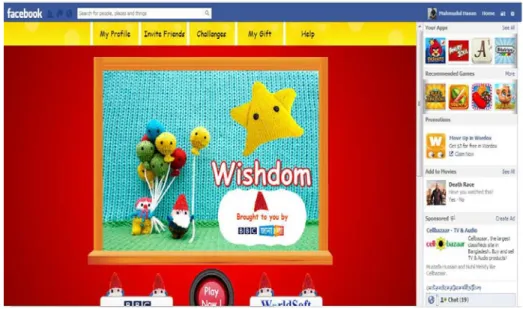
Avatar is one of the attracting features of wishdom. In each level of the game, there are two avatars. The character of the avatars is decided based on the game setting. For example, in level one, the game is set in Cox’z Bazar. So, one avatar is playing the role of tourist while the other one is tourist guide. Figure 1 shows the wishdom game snapshot which runs on the facebook platform using smart gamification.
Figure 1 : Wishdom – a social game based on smart gamification b) Goals and objective
The game “Wishdom”was initially designed to teach and test the knowledge of English of the students, keeping in mind their personal interests and desires. So the game provides them with the opportunity to play it in
their preferred areas (like, food, travel, family, fashion etc.) with a customized Avatar. This idea has been integrated so that the students can have fun while playing the game and learn grammar without being
Global Journal of Computer Science and Technology Volume XIII Issue XVI Version I
48 ( DDDDDDDD ) Year 013 2 E
only a platform to teach and learn. It will not confine itself to English language teaching. This platform can be used for any kind of teaching and testing purpose, considering that the game needs to be customized.
The idea of “Wishdom”was born and nurtured in a creative workshop titled “Future leaders in media and English language teachingorganized by BBC Media Action. People from different background participated in the workshop. The participants were trained in developing ideas of game and different platforms of gaming. It was then when the idea of Wishdom first came out.
III.
P
reviousR
esearches andR
elated workIn recent days, academia and industry put more concentration of making successful apps based on social media considering its high number of audiences and flexibilities. For this reason, it is not a new idea to develop apps based on social media such as facebook to reach target audiences.Needless to say, there are more than 4000+ apps based on different platforms including mobile smart phones and social media to teach English. But there are very few works have been done based on gamification.
Lara et.al (2011) showed an application based on facebook platform named “Happy Movie” which recommends movies to selective groups [10]. In addition, Ben et.al showed a facebook application named “familiars” which represents facebook users’social behaviour through a reflective playful experience [11].“Wordox” is a word matching puzzle game available on facebook and have more than 500,000 thousands monthly users[12].“Words with friends”has more than 1, 00, 00000 + monthly users [13]. However, these sorts of game do not follow gamification aspects in their game play that’s why it is difficult to measure the benefit of the gamers to play the games and how they are getting benefitted by these games. The following section describes the basic idea for integrating wishdom into gamification.
IV.
W
ishdom andS
martG
amificationIn recent days, gamification gets a huge concentration and focus towards industry and academia for research and its applications purpose. In this research project, we integrated gamification in our game which is based on facebook platform to learn English. Before starting integration of gamification in our games, we need to clarify what actually gamification is.
According to Wikipedia, Gamificaion is the use of game play thinking and mechanics to solve problems and engage audiences. On the other hand, researcher Sebastian Deterding defines gamificaion as “it is the use of game design elements in the non-game context” [14]. In this research work, we defined gamification as a
smart tool which helps players or audiences to learn English by engaging themselves through gaming based on facebook.
a) Popular Gamification Examples
There are many examples of gamification. In this sub section we will briefly describe some successful applications which have been successfully applied gamification to their target audiences.
Nike +: It is an application based on iOS. It applies game mechanics to runners to compete and improve their fitness. This social game attempts to make fun with some physical exercises. The following figure 2 showsthe application.
Figure 2 :
Screenshot of Nike + gamification app based on iOS Four Square is a location based game which employing gamification by points, rewards, badges, levels and leader boards to engage players or users to revisit the places such as restaurants, pubs and any historical places o become royal customer or visitors among their friends in virtual world.
Microsoft RibbonHero us an application which attempts to help users to discover new features in Microsoft Office by playing games.
RecycleBank is another popular application based on gamification towards “Green Challenges” which motivates participants to learn about green living andto take small green actions to live more sustainable lives outside of the virtual world.
b) Wishdom as smart gamification
As described it earlier, our developed game is an outcome of creative workshop organized by BBC Media Action. It has been highly emphasized on smart gamification where user journey has been integrated as the games go further.
Design and Development of English Learning Facebook Application Based on Platform as a Service (Paas) by Using Smart Gamification
Global Journal of Computer Science and Technology Volume XIII Issue XVI Version I
49 (DDDDDDDD ) Year 013 2 E
Smart Gamification approach for learning English: Phase 1:Reaching the target audience i. Key challenge
Though we have chosen social media (i.e. facebook) to implement our game, it is often challenging o reach the target audience by application because of users of social media can use simultaneously different features such as chatting, browsing, uploading photos and so on.
ii. Smart Gamifiction Approach
Inviting and suggesting friends to accept requests and give points through sharing. Push the users to share for extra points and energy pills for each level.
Phase 2: Integrating the users to feel that they are component of the game
Key challenge: In this stage, the fundamental challenge is to design the game play in such a way that participants can feel they are the part of the game and they feel the user journey in true sense.
Smart gamification approach: In this stage, we have made a journey for the users so that they can feel that they are the essential component of he game and it has been highly integrated with social plugin API
provided by facebook which will be described in the architecture of the game.
Phase 3: English learning aspects by playing games.
Key challenge: English learning by engaging players to play the Wishdom game. By the skill building approaches, we made the users more comfortable to the game play and it also increases confidence to practice English and they become more proficient into the game.
Smart gamification Approach:In this phase, we ensured that users are engaged by getting points, energy pills andbadges. They get extra energy by inviting and sharing their achievements to others.By this way, players engage themselves for long time and they are not dropped out and continue their playing and learning English.
V.
D
esign andD
evelopment ofW
ishdomIn this section, we will briefly describe about the high level architecture of the game. As we have discussed it earlier, smart gamification has been tightly coupled with this game. We made it sure that a player journey must integrated with intrinsic reward preferred over extrinsic reward [15].
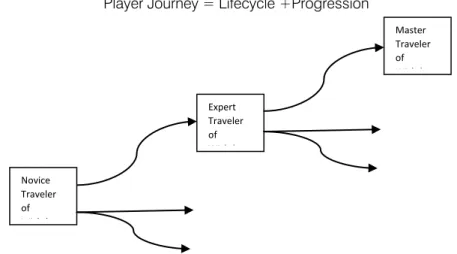
Player Journey = Lifecycle +Progression
Figure 3 :Good games with smart gamification aspects take the player on a journey towards mastery.
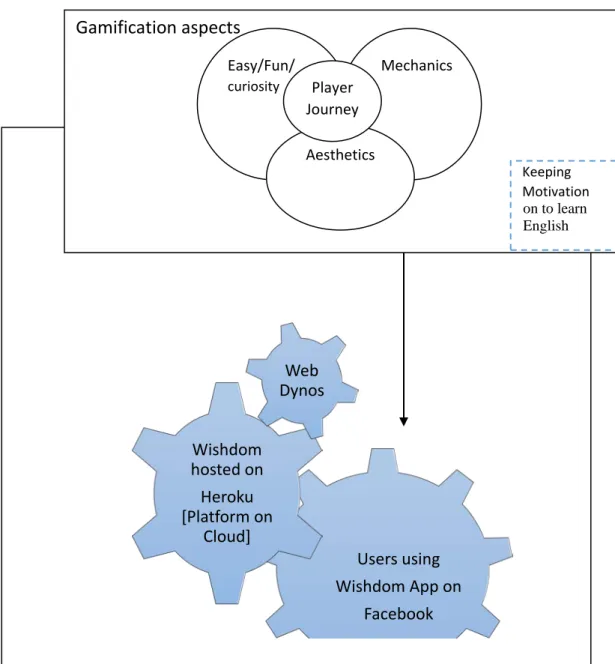
The following figure 4 shows the high-level architecture of Wishdom game based on gamification and Heroku hosting on facebook platform.
Novice Traveler of Wi hd Expert Traveler of Wi hd Master Traveler of Wi hd
Global Journal of Computer Science and Technology Volume XIII Issue XVI Version I
50 ( DDDDDDDD ) Year 013 2 E
Figure 4 : High-Level architecture of wishdom game with gamification aspects Platform as a Service (PaaS)in a cloud for
Wishdom:
According to SalesForce.com, a leading giant for cloud computing service provider, Platform as a Service (PaaS) is is a proven model for running applications without the hassle of maintaining the hardware and software infrastructure at your company.
We chose Heroku to host our application. It is a powerful platform as a service (PaaS) provider to iterate quickly and adopt the changes of our project. It is robust and highly scalable platform for facebook apps development. Needless to say, it is the recommended platform by facebook to have smooth operation and user experiences.
The following figure 5 shows the high level working structure of Heroku platform integration with Wishdom game on facebook.
Users using
Wishdom App on
Wishdom
hosted on
Heroku
[Platform on
Cloud]
Web
Dynos
Gamification aspects
Easy/Fun/ curiosity Mechanics Aesthetics Player Journey Keeping Motivation on to learn EnglishDesign and Development of English Learning Facebook Application Based on Platform as a Service (Paas) by Using Smart Gamification
Global Journal of Computer Science and Technology Volume XIII Issue XVI Version I
51 (DDDDDDDD ) Year 013 2 E
Figure 5 :
High-level architecture of integration between Wishdom and Heroku [16] The following figure6shows an avatar conversation with the gamer.
Figure 6 :The game in progress at level 3
VI.
P
ilotS
tudySince the purpose of this study is to show the usability of wishdom game for teaching and learning purpose, students’ performance in the game is considered as data. To collect data, students are asked to play the game where they have to participate in the quiz. The quiz questions are based on a topic that has already been taught in their class.
a) Participants
There are 30 students who participated in this study. All of them are from English department of BRAC University and of sophomore level. It is to be noted here that this is the first time they play the game and they are
Global Journal of Computer Science and Technology Volume XIII Issue XVI Version I
52 ( DDDDDDDD ) Year 013 2 E
not provided any training or instruction to play the game. They play the game on their own. It is done to test whether the game is user friendly or not.
b) Quiz
Students’ performance is measured based on their score in quiz. The quiz is comprised of objective questions like, MCQs, true or false item, short questions and so on. There are two or three quizzes in each level. Gamers answer the quizzes at different stages of the game.
VII.
R
esults andD
iscussionsa) Gamification Analytics
There are three kinds of approaches to measure gamification in a particular game. They are mentioned below [17]:
1. E- Score
2. Social game metrics 3. A/B Testing
Since Wishdom is a game in social media platform such as facebook. That is why, we analyzed gamification in terms of social game metrics.
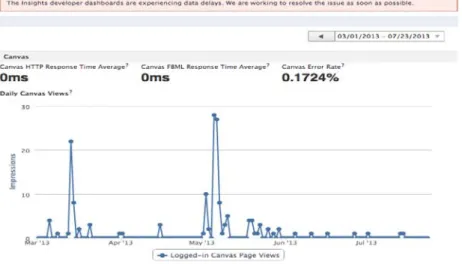
Figure 7 shows performance analysis of the application where we can see the canvas HTTP response time average is 0ms and canvas Facebook markup language (FBML) response time is 0ms and canvas error rate is 0.1724%.
Figure 7 :
Performance analysis of Wishdom game through facebook API On the other hand, figure 8 shows average
application programming interface request time for the application. From the below figure it is clear that when it
calls the facebook API, it responds faster and less than 1000 milliseconds.
Figure 8 :
Average API request time for Wishdom game on facebook b) English learning test
As we have mentioned it earlier, we made our pilot study at BRAC University, Bangladesh and we test the players by playing the games and taking the quizzes related to the game which is appeared at the end of the game.
Design and Development of English Learning Facebook Application Based on Platform as a Service (Paas) by Using Smart Gamification
Global Journal of Computer Science and Technology Volume XIII Issue XVI Version I
53 (DDDDDDDD ) Year 013 2 E
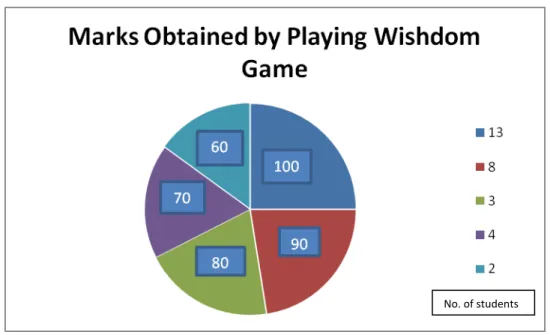
Figure 9 :Pie-chart of getting marked by playing wishdom game by the students Figure 9 shows marks obtained by the gamers
who have played wishdomgame. Here, we can see 13 students got100 out of 100 among 30 students while only 3 students got 60 out of 100.
c) Evaluation
We have successfully developed the game based on social platform such as facebook while we get a tremendous supports and feedback from the users. From the performance test, we can define that the application is perfectly alright while it is active. In addition, students or users became benefitted by playing the games while they are engaging themselves to learn English through differentactivities.
Since we consider only web basedfacebook platform, we could not make any tests for mobile native applications.Moreover, the application has been hosted on Heroku platform and for this reason;wecould not measure the performance on dedicated server if it is expected to have million users in monthly basis.
VIII.
C
onclusionIn this research work, we have developed the game “Wishdom” and it is based on social media platform which follows smart gamification with proper user journey including different avatars and environments. Our focus was to make the game more friendly and fun centric. In this project, we also examined how a game can be integrated and be used to academic purposes using strong social media platform. Keeping always the positive motivation by levels, badges and learning aspects of English language, we successfully integrated gamification. In this game players learn by playing games while they may be engaged to other issues such as chatting, surfing and so on. We also made a pilot study and examined usability test and ELT features in the game.
By sharing players’ points and challenges, one can be more effective and self motivated to play as well as learn languages.
In future, we can integrate the games in various platforms such as in android, iOS, windows phone etc. Moreover, we may include different course contents and exams into this game by using flip class room concepts. In other words, we can commercially release the application with internationalization aspects in different languages and parts in the world.
IX.
A
cknowledgmentAuthors would like to give thanks Mr. Mark Atkin who conduct the BBC Janala Creative Workshop and BBC Media Action to support this research work. This project was partially supported by WorldSoft BD Limited and 143play.com.
R
eferencesR
éférencesR
eferencias1. N. B. Ellison, C. Steinfield, and C. Lampe, "The benefits of Facebook "friends:" Social capital and college students' use of online social network sites," Journal of Computer-Mediated Communication, 2007.
2. Gaudart, H. (1999). Games as teaching tool for teaching English to the speakers of other language.Simulation and gaming, 30(3), 283-291.
No. of students
Global Journal of Computer Science and Technology Volume XIII Issue XVI Version I
54 ( DDDDDDDD ) Year 013 2 E
3. Jung, Carries S. Y. and Levitin, H. (2002). Using simulation in an ESL classroom: A descriptive analysis. Simulation and gaming, 33(3), 367-375. 4. Lee, J. and Hoadley, C. (2007). Leveraging identity
to make learning fun: Possible selves and experiential learning in massively multiplayer online games (MMOGs). Innovative, 3(6). Retrieved July 31, 2013, from http://www.innovateonline.info/pdf/ vol3_issue6/Leveraging_Identity_to_Make_Learning
_Fun_Possible_Selves_and_Experiential_Learning_i n_Massively_Multiplayer_Online_Games_(MMOGs). pdf
5. Macedonia, M. (2005), Games and foreign language teaching.Support for Learning, 20(3), 135– 140. doi: 10.1111/j.0268-2141.2005.00377.x
6. Pena, J. and Hancock, J. (2006). An analysis of socioemotional and task communication in online multiplayer video games.Communication research, 33(1), 92-109.
7. Sadler, R. and Nurukhamedov, U. (2008, March). Second Life and task-based learning. Paper presented at CALICO annual conference, San Francisco, CA.
8. Warschuer, M. and Kern, R. (2000). Network-based language teaching: Concept and practice. Cambridge: Cambridge University press.
9. Zheng, D., Li, N. and Zhao, Y. (2008, March). Learning Chinese in Second Life Chinese language school. Paper presented at CALICO Annual Coference, San Francisco, CA.
10. Lara Quijano-Sanchez, Juan A. Recio-Garcia, Belen Diaz-Agudo, “HappyMovie: A Facebook Application for Recommending Movies to Groups”, 23rd IEEE International Conference on Tools with Artificial Intelligence, 2011.
11. Ben Kirman, Eva Ferrari, Shaun Lawson, Jonathan Freeman, Jane Lessiter, Conor Linehan, “Familiars: Representing Facebook Usersʼ Social Behaviour through a ReflectivePlayful Experience”, ACE, 2009. 12. Wordox game,
https://apps.facebook.com/wordox-the-game accessed on 12 July, 2013 at 12:30 am. 13. Words with friends, https://apps.facebook.com/
wordswithfriends accessed on 12 July at12:35 am. 14. Sebastian Deterding, Dan Dixon, Rilla Khaled, and
Lennart Nacke. From game design elements to gamefulness: Designing gamification". In Proceedings of MindTrek, 2011.
15. Dan Dixon. Player types and gamification. In Proceedings of the CHI 2011 Workshop on Gamification, 2011.
16. Heroku application p
.com/accessed on 14 July, 2013 at 11:30 pm. 17. M. Gjoka, M. Sirivianos, A. Markopoulou, and X.
Yang, "Poking facebook: characterization of osn applications, " in WOSP '08: Proceedings of the first workshop on Online social networks. New York, NY, USA: ACM, 2008, pp. 31-36.
Design and Development of English Learning Facebook Application Based on Platform as a Service (Paas) by Using Smart Gamification
Global Journal of Computer Science and Technology Volume XIII Issue XVI Version I
55 (DDDDDDDD ) Year 013 2 E
This page is intentionally left blank
© 2013 Global Journals Inc. (US)
Global Journal of Computer Science and Technology Volume XIII Issue XVI Version I
56 ( DDDDDDDD ) Year 013 2 E