Sparse Temporal Difference Learning via
Alternating Directions Method of Multipliers
Nikos Tsipinakis and James D. B. Nelson
Department of Statistical Science, University College London, UK {nikolaos.tsipinakis.14, j.nelson}@ucl.ac.uk
Abstract—Recent work in off-line Reinforcement Learning has focused on efficient algorithms to incorporate feature selection, via `1-regularisation, into the Bellman operator fixed-point esti-mators. These developments now mean that over-fitting can be avoided when the number of samples is small compared to the number of features. However, it remains unclear whether existing algorithms have the ability to offer good approximations for the task of policy evaluation and improvement. In this paper, we propose a new algorithm for approximating the fixed-point based on the Alternating Direction Method of Multipliers (ADMM). We demonstrate, with experimental results, that the proposed algorithm is more stable for policy iteration compared to prior work. Furthermore, we also derive a theoretical result that states the proposed algorithm obtains a solution which satisfies the optimality conditions for the fixed point problem.
I. INTRODUCTION
A core problem in off-line reinforcement learning (RL) emerges in situations where the state space is large and the dynamics are unknown. In such cases, explicit computation of the value functions becomes infeasible. Instead approximation techniques provide the only way forward. In particular, com-mon choices to represent the value functions are those of linear architecture [24] where the hypothesis spaceFis defined by a set of feature vectors. In this domain, Least-Squares Temporal Difference (LSTD) algorithms [1], [8], [9] attempt to find the fixed point of the projected Bellman operator, ΠT, by using a rich number of samples. Unfortunately, in off-line learning, it is typically the case that the amount of available data is not sufficient, leading LSTD to poor predictions. Indeed, in the regression setting, when only a small number of samples are available relative to the number of features, the least-squares method is known to be very vulnerable to over-fitting. A typical way to overcome this issue is by incorporating`1- or
`2-regularization known as LASSO [10] and ridge-regression
[11], respectively. The former turns out to be of particular interest in the context of high-dimensional problems since it produces sparse solutions and therefore performs feature selection.
Many authors have explored regularized approximations for the value functions [3], [5], [12], [13] as a means to address the over-fitting problem in RL. However, none of these methods are able to both produce sparse solutions and treat the function approximation as a fixed-point problem. On the other
Nikos Tsipinakis is funded by a Dstl/UCL Impact studentship
James Nelson is partially supported by grants from the Dstl and Innovate UK/EPSRC
hand, several recent methods has been proposed which add an `1 penalty to the fixed-point [2], [14]. Kolter and Ng [14]
were the first to introduce the `1-regularization of the
least-squares fixed-point. As the name suggests, their LARS-TD algorithm is inspired by the Least Angle Regression (LARS) algorithm. However, as is shown, the algorithm only converges to the fixed-point under some strong assumptions which rarely hold in the context of policy iteration. In [2] Johns et al. compute the same fixed point using the linear complementarity formulation but again the algorithm shares the same conditions with LARS-TD. Thus, there still remains an apparent need to introduce new algorithms to TD learning in order to efficiently evaluate the `1-regularized fixed-point problem within policy
iteration.
In this work we propose to solve the`1-regularized
fixed-point problem with the help of the ADMM [15]— a general optimisation framework which has recently received a wave of attention for various large regression problems. We also establish some theoretical properties of ADMM in the TD context. As in [2], [14], our problem formulation does not correspond to any convex optimization problem. However, our experimental results show that the proposed algorithm is able to find the fixed-point solution in both the prediction and control problem. More importantly, our results indicate a more efficient performance in the off-policy case compared to LARS-TD. On the other hand, LARS-TD is able to offer a richer set of solutions as a path method.
This paper is organized as follows. In Section II, we review the basic RL theory along with LSTD and LARS-TD. In Section III, we present the new ADMM algorithm for TD learning. In Section IV, we validate the efficiency of the algorithm through several experiment. In Section V, we discuss our contributions in the context of the most relevant, recent work and, finally, in Section VI we provide a general discussion for the proposed method and conclusions.
II. PRELIMINARIES ANDNOTATION
A Markovian Decision Process (MDP) [16] is defined as the tuplehS, A, P, R, γi, whereSdenotes the set of states and A(s) the set of actions available at each state; a policy, π : S→A, is a mapping from states to actions;P :S×A×S → p(s0|s, π(s))∈[0,1]are the transition probabilities of moving
to a new state,s0, after executing an actionπ(s)∈A(s). When
reaching a new state the system returns a reward (or a cost), R(s, π(s), s0) :S→R;γ∈[0,1) is the discount factor.
The quality of a policy can be determined by the value function defined as the expected discounted reward,Vπ(s) =
Eπ[P∞t=0γtR(st)]. For simplicity, we assume large finite state
and action space, and thus the value function can be expressed in matrix form as a set of linear equations
Vπ=R+γPπVπ.
If R and P are known, one can analytically solve the above linear system:Vπ= (I
−γPπ)−1R. Finally, the value function
can be seen as the unique fixed point of the Bellman operator, T :R|S|→R|S|, namely
Vπ=TπVπ, TπVπ=R+γPπVπ. A. Function Approximation
We often deal with large action and state spaces where P and R are not known at hand, and hence deriving the value function explicitly is infeasible. In such situations, approximation of the value function is necessary. The most common approach is to employ a linear representation of the value function ˆ Vπ= Φw= |S| X i=1 φi(s)wi, (1)
whereΦ∈R|S|×n is the feature matrix, andwthe vector of
the weights,w∈Rn.
B. Least-Squares Temporal Difference
Approximating value function, as in (1), defines a hypothe-sis space spanned by the columns of Φ,F ={Φw, w∈Rn
}. However, when applying the Bellman operator, the point TπVˆπ does not necessarily lie on
F. LSTD [1] solves the problem of approximating the vector w by projecting TπVˆπ
back onto the hypothesis space. The objective function subject to approximation is therefore defined as, Vˆπ = ΠTπVˆπ, whereΠ is the projection operator. As a consequence, LSTD searches for the fixed-point, Vˆπ, of the composed operator ΠTπ. The latter fixed-point problem can be then written as the optimization problem:
w= argmin
θ∈Rn
kΦθ−(R+γPΦw)k2ξ, (2) where ξ ∈ R|S|×|S| is a diagonal matrix with entries
repre-senting the stationary distribution of the states.
The fixed-point problem (2) requires knowledge of P and the construction of a large matrix, Φ. To this end LSTD collectsmsamples of the form,{si, ai, ris0i}i=1,...,m, possibly
sampled over several trajectories. This results in the sampled matrices ˜ Φ = φ(s1)T .. . φ(sm)T , Φ˜0= φ(s01)T .. . φ(s0m)T ˜ R= r1 .. . rm ,
where Φ0 =PΦ. Replacing the sampled features and reward matrices in (2) we have that
w= argmin
θ∈Rn
kΦθ˜ −( ˜R+γΦ˜0w)
k2.
The above problem can be solved explicitly yielding the following set of linear equations
˜ Aw= ˜b, whereA˜∈Rn×n,˜b∈ Rn are defined asΦ˜T ˜ Φ−γΦ˜0and ˜ ΦTR˜, respectively.
The main drawbacks of applying least-squares to function approximation emerge often if m < n. In this case, least-squares is prone to over-fitting and results in poor approxima-tions, and also the matrixA˜ need not be full column rank— hence its left-inverse is not even guaranteed to exist.
C. LARS-TD
To overcome the limitations arising in LSTD, Kolter and Ng proposed LARS-TD [14]. They apply the`1-regularization
penalty to the LSTD objective function which has the charac-teristic of avoiding over-fitting and performing feature selec-tion. More precisely, the penalty is added to the projection of TπV onto the hypothesis space
F, which yields the following optimization problem
w= argmin
θ∈Rn
kΦθ˜ −( ˜R+γΦ˜0w)k2+λkθk1. (3)
The above optimization problem can be alternatively written as a fixed-point
˜
Φw= ˜Π`1T˜( ˜Φw),
for which it has been proved that the operator Π˜`1T˜ is aγ
-contraction, which in turn ensures the existence and unique-ness of the fixed-point Φw˜ [17]— although we note that w, itself, need not be unique.
Least Angle Regression (LARS) [18] is then adapted ap-propriately to problem (3) to efficiently solve for the `1
-regularized fixed-point. Furthermore, LARS is based on a homotopy method which allows the computation of the com-plete regularization path. During this procedure, the algorithm maintains an active set,I, indicating the number of non zero elements ofw. At each step, the regularization path is shrunken and a new elementI is added or removed toA˜I,I andwI in
order for the optimality conditions never to be violated. It has been shown that as long asA˜is aP-matrix1, each LARS-TD step satisfies the optimality condition, and thus the algorithm always finds a solution to (3).
It is instructive to analytically review the major steps of the optimality conditions since the play a important role for LARS-TD and our proposed algorithm (cf. Section III). Define G(θ) =12kΦθ˜ −( ˜R+γΦ˜0w)k2+λ
kθk1, and thus the optimality
condition for the convex problem is
0∈∂G(θ), (4)
1A square matrixA, not necessarily symmetric, is aP-matrix when all its
where ∂ denotes the sub-differential (since kθk1 is not dif-ferentiable). Moreover, ∂G(θ) = ˜ΦT( ˜Φθ −( ˜R+γΦ˜0w)) + λ∂kθk1,where: ∂kθk1∈ {+1}, θi>0 [−1,1], θi= 0 {−1}, θi<0,
Therefore, equation (4) implies that
[ ˜ΦT( ˜Φθ−( ˜R+γΦ˜0w)]i ∈ {−λ}, θi>0 [−λ, λ], θi= 0 {λ}, θi<0.
Now, setting w = θ, as required at the fixed point, the optimality conditions for the problem (3) become
[˜b−Aw]˜ i∈ {λ}, wi>0 [−λ, λ], wi= 0 {−λ}, wi<0, (5)
A solution w satisfying the optimality conditions yields the fixed pointΦw˜ of the composed operatorΠ`1T
π.
LARS-TD enjoys many of the benefits of LARS, in that it follows a homotopy path and hence it offers all the solutions w∗(λ). Its computational complexity is O(mnk2), where k
denotes the cardinality of the active set. Therefore, if the solution is sparse enough, the algorithm can compute the fixed-point very efficiently, i.e., after a few numbers of iterations. On the other hand, LARS-TD also inherits the LARS drawbacks, too. If the whole path need to be computed, the complexity reduces to a full least-squares, requiring to invert a nearly dense A˜, many times. Additionally, LARS-TD converges to the fixed point under the assumption that A˜ is a P-matrix. However, A˜ is not necessarily a P-matrix when samples are collected off-policy where, inevitably, the distribution of states is different from the distribution of the underlying policy. To overcome this issue, the authors propose adding an `2
-penalty to the fixed-point problem, known as elastic net [19], to ensure thatA˜is positive definite. Elastic net formulation of the problem (3) nevertheless comes at cost of reduced sparsity. More importantly, in context of policy iteration, computing an almost complete regularization path could be inefficient, as also discussed in [2].
III. ADMM-TD
Our proposed approach is to apply ADMM to TD learning for solving the fixed-point problem (3). ADMM exploits some nice characteristics of the structure of (3) which matches those of `1-regularization in linear regression [15]. For this reason,
we name the algorithm ADMM-TD. A. The Algorithm
We proceed by deriving the ADMM steps. Problem (3) can be seen as an optimization problem of the form
minimize 1 2k
˜
Φθ−(R+γΦ˜0w)k+λkθk1.
The above problem has the property of being separable and, hence, it can been split into two parts, namelyf(x)andg(z). Furthermore, the requirement that the separate variables are equal yields the following equivalent problem:
minimize f(x) +g(z) subject to x=z,
where f(x) = 12kΦθ˜ −(R+γΦ˜0w)k and g(z) = λkzk1.
The ADMM steps for the fixed point problem can be derived through the augmented Lagrangian which, in terms of the proximal form [20, Section 4.4], reduces to
θk+1 := proxµf(zk−uk) (6) zk+1 := proxµg(θk+1+uk) (7) uk+1 := uk+θk+1−zk+1, (8) whereu= 1ρy denotes the dual variable andµ= 1ρ the step-size parameter. The proximal operator of the first subproblem (6) is equal to θk+1:= argmin θ 1 2k ˜ Φθ−(R+γΦ˜0w)k+ρ 2kθ−z k+uk k , which can be solved by setting the gradient, w.r.t.θ, of12kΦθ˜ − ( ˜R+γΦ˜0w)k+ρ2kθ−zk+uk
k. equal to zero: ˜
ΦT( ˜Φθ−( ˜R+γΦ˜0w)) +ρ(θ−zk+uk) = 0 At the fixed point we requirew=θ, and thus it follows the fixed point solution
wk+1:=A˜+ρI
−1
˜b+ρ(zk
−uk), (9) whereA˜= ˜ΦTΦ˜
−γΦ˜0andb˜= ˜ΦTR˜. Note thatρequal to
zero yields exactly the LSTD fixed point solution. For solving the second subproblem (7), we evaluate the proximal operator with respect to the previous iteration, i.e.,
zk+1 := argmin z n kzk1+ ρ 2kw k+1 −z+ukko, which reduces to thesoft-thresholding shrinkage operator[21]
zk+1 := Sλ/ρ(wk+1+uk), (10)
with
Sβ(x) = sgn(x)max{|x| −β,0}, (11)
and where sgn(x)is the signum function define as
sgn(x) = {+1}, xi>0 {0}, xi= 0 {−1}, xi<0.
The soft-thresholding is a component-wise operation, and thus
denotes the component-wise multiplication.
The stopping criteria used in the following algorithm are the same with those discussed by the authors in [15, Section 3.3]. Note that the value w will be equal to z, and hence sparse, only in the limit. The ADMM-TD pseudocode is presented in Algorithm 1.
Algorithm 1 ADMM-TD
1: Input:
2: {si, ri, si}i0 =1,...,n and form Φ˜ andΦ˜
0 3: Initialize: 4: γ∈[0,1],λ≥0 ,ρ >0 5: A˜←Φ˜TΦ˜−γΦ˜0, ˜b←Φ˜TR 6: fork= 0,1, . . .do 7: wk+1 ←( ˜A+ρI)−1(˜b+ρ(zk −uk)) 8: zk+1 ← Sλ/ρ(wk+1+uk) 9: uk+1 ←uk+wk+1 −zk+1 10: end for 11: return w B. Properties of ADMM-TD
In what follows, we show that the ADMM-TD fixed point solution,w, is also a solution to the`1-regularized fixed point
problem (3) with optimality conditions (5).
Lemma 1. The fixed point solution,w∗, as obtained from the
ADMM-TD iterations in Algorithm 1, satisfies the optimality conditions (5), and is thus a solution to problem (3), for any λ≥0 andρ >0.
Proof. At the fixed point, ADMM-TD iterations satisfy the following equations
w∗= ( ˜A+ρI)−1(˜b+ρ(z∗−u∗)) (12)
z∗= Sλ/ρ(w∗+u∗) (13)
u∗=u∗+w∗−z∗. (14)
Equation (14) implies thatw∗=z∗. From (12) it follows that u∗= 1
ρ(˜b− ˜
Aw∗). (15)
Similarly, equation (10) can be rewritten as:
w∗ = Sλ/ρ(w∗+u∗). (16)
Now, combining (15) with (16) we have that w∗ = Sλ/ρ w∗+1 ρ(˜b− ˜ Aw∗) . (17)
From this point, the proof parallels those in [21] and [22]. Using now the definition of the shrinkage operator (11), the right-hand side of the equation (17) can be written as sgn wi∗+1 ρ[˜b− ˜ Aw∗]i max w∗i +1 ρ[˜b− ˜ Aw∗]i − λ ρ,0 . Since the max operator is nonnegative, the sign of operator sgn must agree with the sign ofwi∗. Therefore, ifwi∗>0, it follows that sgn wi∗+1 ρ[˜b− ˜ Aw∗]i = 1, and also max w∗i +1 ρ[˜b− ˜ Aw∗]i − λ ρ,0 =wi+ 1 ρ[˜b− ˜ Aw∗]i− λ ρ.
Replacing the above results to the equation (17) we have that [˜b−Aw˜ ∗]i=λ, w∗i >0,
as the optimality conditions (5) indicate. With similar opera-tions one can show that [˜b−Aw˜ ∗]i =−λ, for any w∗i <0.
Finally,w∗i = 0 implies either that
sgn 1 ρ[˜b− ˜ Aw∗]i = 0, (18) or max 1 ρ[˜b− ˜ Aw∗]i − λ ρ,0 = 0. (19)
In the first case, (18), we must have that[˜b−Aw˜ ∗]i= 0, which
satisfies the optimality conditions. From the second case, (19), it follows that |1ρ[˜b−Aw˜ ∗]i| ≤ λρ ⇒ −λ≤[˜b−Aw˜ ∗]i ≤λ,
which concludes the proof.
The above Lemma shows that the ADMM-TD solves the fixed point problem (3), and that the above proof also holds for w = z. A convergence proof of the ADMM-TD to the fixed point remains outstanding. However, our experimental results in Section IV below indicate comparable, if not better, behavior relative to the LARS-TD algorithm. In particular, unlike LARS-TD, the proposed ADMM-TD converges to the fixed point in both on- and off-sampling cases.
IV. EXPERIMENTS
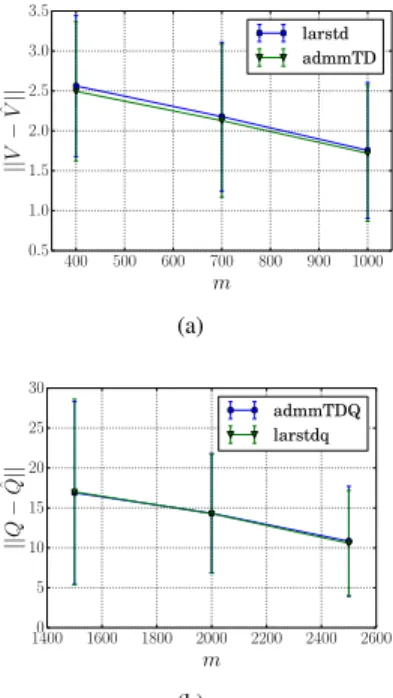
The four-rooms grid problem, as discussed in [23, Section 5], was used to compare the proposed ADMM-TD with LARS-TD. The problem involves a two dimensional grid with total number of states S = M ×N, where M and N are chosen as the largest factors of S. The grid is split into four interconnected rooms where only the neighbor rooms are connected to each other. Goal states are the statesS−1, S−2. The agent receives a reward of 1 when it visits the goal states and receives −1 elsewhere. The action set available to the agent comprises eight actions (towards all possible directions) —agents with this characteristics are called “king-move” agents. Each action has a probability of success of0.85. We use the four-rooms environment with a total of 25states in all our experiments. The value functions are represented with Gaussian Radial Basis Functions (RBFs) concatenated over different two-dimensional grids. Training samples are collected in different episodes of5 steps each. The step-size parameter is kept fixed for all the experiment, ρ = 0.1. To select the most effective value of the regularization parameter, we useK-fold cross-validation, for a total of100values ofλ, withK either5or10according to the magnitude of samples. In the first experiment, Figure 1a, we approximate the state-value function using 1365 features concatenated over [2,4,8,16,32] grids. We compare the performance of the algorithms over different number of samples(400,700,1000) collected on-policy, in 50 trials. As expected, LARS-TD and the LASSO formulation of ADMM-TD yielded similar averaged approximation errors.
400 500 600 700 800 900 1000 m 0.5 1.0 1.5 2.0 2.5 3.0 3.5 || V − ˆV|| larstd admmTD (a) 1400 1600 1800 2000 2200 2400 2600 m 0 5 10 15 20 25 30 || Q − ˆQ|| admmTDQ larstdq (b)
Fig. 1. (a) Averaged approximation error over50trials forV function using 1365features versus samplesm. (b) Averaged approximation error over50 trials forQfunction using2728features versus samplesm.
(a)
(b)
Fig. 2. (a) 10-fold cross-validation (CV) versus regularization parameter
λ; minimum CV achieved for λ = 0.214. (b) averaged sparsity versus regularization parameter λ; λ = 0.214yields approximately 227 nonzero features.
Subsequently, we test both algorithms in the context of Q value approximation. In this experiment we supply both meth-ods with 2728 features concatenated over [2,4,8,16] grids. Again, we average our results over 50 trials using different number of samples (see Figure 1b). This time, we collect our samples off-policy (executing a random policy each time).
TABLE I
MEAN SIMULATED REWARD(20TRIALS)±STANDARD ERROR BETWEEN
ADMM-TDANDLARS-TDFORm= (1500,2000)SAMPLES AND2728
FEATURES.
averaged simulated reward
No. of samples ADMM-TD LARS-TD
1500 73.06±5.001 66.76±6.91 2000 73.77±3.47 67.78±7.14
Under these circumstances, LARS-TD was not always able to find a solution. In particular, we found LARS-TD to violate the optimality conditions 27/150 times, while ADMM-TD never failed. For this reason, the LARS-TD results, illustrated in Figure 1b, incorporate `2-regularization as proposed in
[14]. The results, though, indicate identical behavior for both algorithms, showing the same averaged approximation error, even with the elastic net formulation of LARS-TD. However, this modification in LARS-TD comes with the drawback of increased computational cost due to reduced sparsity. For instance, 10-fold cross-validation in the case of m = 1500 indicates λ = 0.214 producing about 200 nonzero features (Figures 2a, 2b), while for the same example, LARS-TD produces approximately2000nonzero features.
In the final experiment, the ability of both algorithms to find good policies (policy iteration) is evaluated. We use (1500,2000)samples and, as before, the samples are collected in the same manner. The results are averaged over 20 trials where each policy iteration trial is run until either convergence to the optimal solution or a maximum of15steps is reached. In this setting, we found that LARS-TD violated the optimality conditions repeatedly, and hence was never able to find a good policy. This is understandable because the policy changes drastically at each step due to the rich available action set. On the other hand, given enough samples, ADMM-TD never failed to reach the optimal policy —we only found ADMM-TD not satisfying the optimality conditions for m < 1000. Therefore, in order to compare both methods in terms of the simulated reward, we, again, aplly the an`2penalty in
LARS-TD algorithm. Nevertheless, LARS-LARS-TD now requires storing and inverting a square matrix with almost 2000 entries (as described in the previous paragraph) many times at each policy iteration step. The fact that LARS-TD computes a complete homotopy path within policy iteration makes the algorithm inefficient with respect to time complexity (the same issue is also discussed in [2]). As a result, for practical purposes, we tuned both algorithms to produce no more than200 nonzero features. In this context, ADMM-TD yielded better policies compared to LARS-TD, as shown in Table I. Furthermore, we noted that approximately5steps were needed for ADMM-TD to reach an optimal policy, while LARS-TD needed always more than10steps.
V. RELATEDWORK
There has been several works recently which perform feature selection in Temporal Difference learning. In [2], the `1-regularized fixed point problem is solved as Linear
Complementarity Problem rather than using LARS algorithm. This approach overcomes the limitations of LARS-TD in the context of policy iteration by allowing for warm-starts at each step. However, for finding a solution to (3), LCP requires A˜ to be a P-matrix. Loth et al. [3] perform `1-regularization
to the Bellman Residual Minimization which cannot then be considered as a fixed point problem. Furthermore, Petrick et al. [4] propose`1-regularization in the context of approximate
linear program which suffers when applied to noisy samples. Geist and Scherrer [5] take a different route by solving a convex optimization problem. They apply `1-regularization to
the Projected Bellman Residual (PBR), instead. Although this formulation enjoys the benefits of a convex problem, it comes with the increased computational cost requiring the calculation of the projection,Π˜, and moreover it cannot then be interpreted as a fixed-point problem.
Finally, the only other ADMM approach to RL that we are aware of, called ADMM-BPDN [6], solves the`1-PBR
prob-lem as a constrained convex probprob-lem, withkCw˜ + ˜dk ≤. This formulation reduces to a first-order method which effectively corresponds to the basis pursuit denoising problem (BPDN) [7]. It has been proved that the algorithm converges to a
solution if τ ≤ 1
eigmax( ˜CTC˜), where
τ is the proximal step-size parameter. However,eigmax( ˜CTC)˜ is often too large and
hence it is unclear whether the method is efficient, in terms of time complexity, when dealing with large problems.
VI. CONCLUSION
We here proposed an alternative off-line algorithm for solv-ing the `1-regularized fixed-point. We validated the efficacy
of our algorithm against LARS-TD in a complex experimental environment with many available actions. Results indicate that, given enough samples, ADMM-TD is able to find the fixed-point solution even within the policy iteration procedure.
The advantage of ADMM-TD as a direct method committed to only a single value of λ is that, even in the case where the optimality conditions are violated, one may discard the coefficient for the specific λ without affecting the other solutions. However, when LARS-TD violates the optimality conditions, the complete homotopy path is affected. As also shown in [14], the homotopy path reaches discontinuities which makes the algorithm return multiple fixed-point. On the other hand, LARS-TD, as path algorithm, is able to return the complete set of solutions, while ADMM-TD only returns a subset over a fixed grid. Further, we demonstrated that LARS-TD modified to incorporate `2-regularization loses its
computational efficiency due to the decreased sparsity. We also note that, similar to the usual ADMM, the proposed ADMM-TD can be easily extended to allow other forms of regularization (eg. Tikhonov regularization or elastic net).
As a future direction, we plan for a proof of convergence of the ADMM-TD. We conjecture that the algorithm could be shown to converge to the fixed point under much weaker assumption compared to the existing work. Our anticipation is driven, first, from the fact that the step-size parameter ρ is incorporated in the diagonal of A˜ and, second, due to the
behavior of our algorithm in the context of policy iteration. We also plan to apply ADMM-TD to control problems.
ACKNOWLEDGMENTS
The authors would like to thank A. J. Weinstein for kindly sharing his code with us.
REFERENCES
[1] S. Bradtke and A. Barto, Linear least-squares algorithms for temporal difference.Machine Learning. 22, 33-57, 1996.
[2] J. Johns and C. Painter-Wakefield, Linear complementarity for regularized policy evaluation and emprovement. InAdvances in Neural Information Processing Systems. 23, 1009-1017, 2010.
[3] M. Loth, M. Davy and P. Preux, Sparse temporal difference learning using LASSO.IEEE, International Symposium on Approximate Dynamic Programming and Reinforcement Learning. 352-359, 2007.
[4] M. Petrik, G. Taylor, R. Parr and S. Zilberstein, Feature selection using regularization in approximate linear programs for Markov decision pro-cesses. InProccedings of the 27th International Conference on Machine Learning. 27, 871-878, 2010.
[5] M. Geist, and B. Scherrer, `1-Penalized projected bellman residual.
Recent Advances in Reinforcement Learning. 89-101, 2012.
[6] Z. Qin, W. Li and F. Janoos, Sparse reinforcement learning via convex optimization. In Proccedings of the 31st International Conference on Machine Learning. 31, 424-432, 2014.
[7] J. Yang and Y. Zhang, Alternating direction algorithms for`1-problems
in compressive sensing. SIAM Journal on Scientific Computing. 33, 250-278, 2011.
[8] J. Boyan, Technical update: least-squares temporal difference learning. Machine Learning. 49, 233-249, 2002.
[9] M. Lagoudakis and R. Parr, Least-squares policy iteration. Journal of Machine Learning Research. 4, 1107-1149, 2003.
[10] R. Tibshirani, Regression shrinkage and selection via the LASSO. Journal of the Royal Statistics Society B. 58, 267-288, 1996. [11] T. Hastie, R. Tibshirani and J. Friedman,The Elements of Statistical
Learning: Data Mining, Inference, and Prediction. Springer, 2001. [12] A. M. Farahmand, M. Ghavamzadeh, C. Szepesvari and S. Mannor,
Reg-ularized policy iteration. InAdvances in Neural Information Processing Systems. 21, 441-448, 2008.
[13] M. Geist, B. Scherrer, A. Lazaric and M. Ghavamzadeh, A Dantzig Selector Approach to Temporal Difference Learning. InProccedings of the 29th International Conference on Machine Learning. 2012. [14] Z. Kolter and A. Ng, Regularization and feature selection in least-squares
temporal difference. InProccedings of the 26th International Conference on Machine Learning. 521-528, 2009.
[15] S. Boyd, N. Parikh, E. Chu, B. Peleato and J. Eckstein, Distributed optimization and statistical learning via the alternating direction method of multipliers.Machine Learning. 3(1), 1-123, 2010.
[16] R. Sutton and A. Barto,An introduction to Reinforcement Learning. MIT Press, 1998.
[17] M. Ghavamzadeh, A. Lazaric, R. Munos and M. Hoffman, Finite sample analysis of Lasso-TD. InProccedings of the 28th International Conference on Machine Learning. 2011.
[18] B. Efron, T. Hastie, I. Johnstone and R. Tibshirani, Least angle regres-sion.Annals of Statistics. 32, 407-499, 2004.
[19] H. Zou and T. Hastie, Regularization and variable selection via the elastic net.Journal of the Royal Statistics Society B. 67, 301-320, 2007. [20] N. Parikh and S. Boyd, Proximal Algorithms.Foundations and Trends
in Optimization. 1(3), 123-231, 2013.
[21] E. T. Hale, W. Yin and Y. Zhang, A fixed-point continuation method for`1-regularized minimization with applications to compressed sensing.
Technical report: Department of Computational and Applied Mathemat-ics, Rice University, Houston, Texas, CAAM TR07-07, 2007.
[22] C. Painter-Wakefield and R. Parr,L1 regularized linear temporal differ-ence learning. Technical report: Department of Computer Scidiffer-ence, Duke University, Durham, NC, TR-2012-01, 2012.
[23] A. J. Weinstein, Inference and Learning in High-Dimensional Spaces. PhD Thesis. Department of Electrical Engineering and Computer Science, Colorado School of Mines, Golden, Colorado, 2013.
[24] J. Tsitsiklis and B. V. Roy, An analysis of temporal-difference learning with function approximation.IEEE Transactions on Automatic Control. 42, 674-690, 1997.