
Rational Pension Reform
23
0
0
Full text
(2) [23. May 2007]. Rational Pension Reform Axel Börsch-Supan Mannheim Institute for the Economics of Aging (MEA), Universität Mannheim, and National Bureau of Economic Research (NBER), Cambridge, Mass., USA. ABSTRACT This paper is motivated by the idea to create, wherever possible, rational mechanisms that adapt pension systems automatically to a changed economic and demographic environment, rather than to leave such adaptations to discretionary high-profile pension reforms which all too often stir political opposition. The paper delineates the theory behind such rational mechanisms, shows the advantages and limits of „self-stabilizing“ pension systems, and compares the Swedish and the German approaches to rule-bound pension policy.. Address: Prof. Axel Börsch-Supan, Ph.D. Mannheim Institute for the Economics of Aging (MEA) Universität Mannheim D-68131 Mannheim Email: [email protected]. Acknowledgements: I am grateful to Anette Reil-Held and Christina Wilke for their helpful comments. The paper is based on a string of work that has been financially supported by the German Science Foundation (DFG), the State of Baden-Württemberg, the German Insurance Association (GDV), the Michigan Retirement Research Center (MRRC), and the U.S. National Institute on Aging (NIA)..
(3) Rational Pension Reform by Axel Börsch-Supan. 1. Introduction Pension systems take many forms, and so do pension reforms. They heavily depend on the historical and cultural circumstances that generated the current status quo. In the UK, for instance, pension reform is preoccupied with the complex mixture of privately funded and public baseline pensions, while in Continental Europe and the US, pension reform is mainly targeted to unsustainably large pay-as-you-go systems. In spite of this variety, pension reforms in all countries have something in common: they stir great controversy and provoke often explosive and highly emotional reactions. Pension reform is called the “third rail” in politics, referring to the high voltage rail in underground transportation. Touching it spells trouble. Pension reform attempts have caused violent demonstrations in countries with a strong leftist movement such as France and Greece, but pension reform has also failed in the archetypical capitalist country of the United States, where the last significant reform took place in 1983, followed by 25 years of debate and several commissions without producing a tangible result. On the other hand, like it or not, pension reform is a necessity since the social, economic and demographic environments have changed dramatically since the development of formal pension systems in the late 19th and early 20th century. Labor force participation patterns have changed; capital markets have been developed; economic growth has altered our perception of what a welfare state can afford; and – arguably most importantly for our pension systems – the fundamental demographics of our societies are transiting to a very different new pattern which changes the implicit intergenerational contract on which most pension systems have been built. As a result, the pressures exerted by population aging, amplified by negative incentive effects on early retirement, will make public pension systems unsustainable all over the world in a very foreseeable future. Given that reforms are a necessity, but also given that they are likely to hurt politicians, an attractive idea is to automate inevitable adjustments of the pension system through indexation.
(4) rules and other self-stabilization mechanisms. This is the topic of this paper. It reflects on the design and the success of pension reforms that attempt to minimize discretionary decisions by political institutions which easily get pressured into doing nothing because short-run costs for the current actors are higher than long-run benefits for society as a whole. Self-stabilization mechanisms make the pension reform process more rational in the sense that society first sets rules which a majority of the voters finds reasonable in the abstract, and then applies these rules even if concrete changes would not find a majority. The search for a perfectly self-regulating pension system that withstands all future societal changes is of course a naïve undertaking. For one, history has confronted us with many unanticipated developments since formal pension systems have been developed, and history is likely to continue surprising us. Moreover, and equally important, societies change their preferences, and every rule-bound pension policy is subject to those preferences. Rules imply re-distributional features, almost always between generations (i.e., between workers and pensioners) and often also within generations (e.g., between rich and poor, or between male and female). Making re-distributive decisions, however, requires the democratic process in order to reflect the changing preferences of the populace. As we will see, even the very objective of the rule (i.e., the target that should be stabilized) is subject to the preferences of the populace. The paper combines several strands of the literature. There is a long tradition of the pros and cons of rule-based monetary policy (the classical reference is Kydland and Prescott, 1977) which had so far relatively little impact on pension economics. There is a recent literature on notional defined contribution systems (see, e.g., the reader edited by Holzmann and Palmer, 2005) which represents a prominent implementation of rule-bound pension policies. There is also a literature on how to continuously re-define our conventional view of life age as we live longer and age-specific morbidity rates decline (see, e.g., Börsch-Supan and Reil-Held, 2004, and Shoven, 2007). This paper weaves these three strands of literature together. Then there is of course the fundamental literature on optimal pension design with its stress on the paretooptimality of pay-as-you-go vs. fully-funded pension systems (see, e.g., the debate between Fenge, 1995, and Börsch-Supan, 1999), and the literature on the political economy of pension systems (see, e.g., the recent textbook by Galasso, 2007). We will touch on many of these fundamental issues but refrain from taking up well-documented debates in any deeper detail. The paper begins by providing some theoretical and conceptual guidance (Section 2). It then 2.
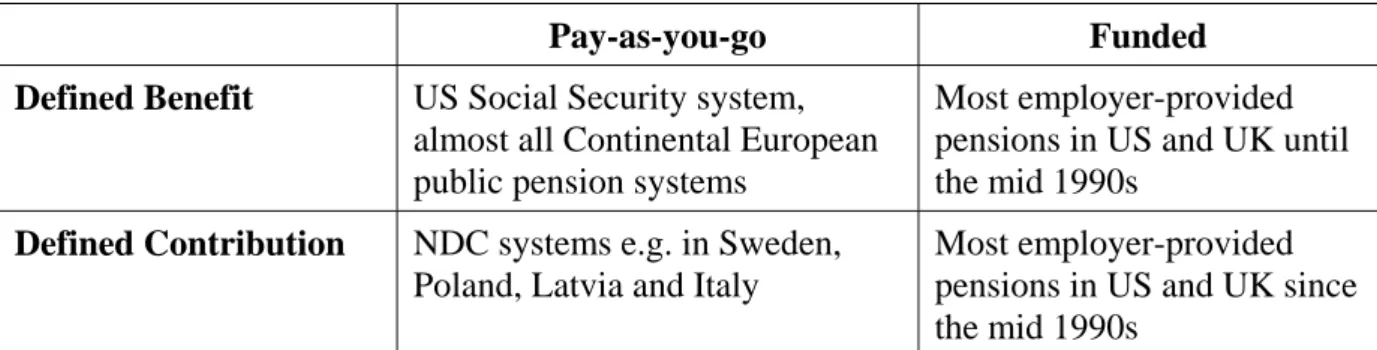
(5) describes two examples of rule-bound pension systems with self-stabilizing properties. Section 3 describes the “notional defined contribution system” that has been installed in Sweden and some other countries. Section 4 then shows how the indexation rules of the German pension system have converted it step by step into a system with strong selfstabilizing features without leaving the traditional defined benefit structure even after introduction of the so-called “sustainability factor”. Section 5 compares the two approaches, puts them into the context of the general pension reform debate, and concludes.. 2. Pension systems and stabilization strategies Pension systems are complex and their many institutional details have important effects on their financial stability, labor supply and income redistribution, among others. Nonetheless can their principle functioning be described by two dimensions: whether they are funded or pay-as-you-go, and whether they are defined contribution or defined benefit. All four combinations are possible and have been realized, see Figure 1 for a few examples. Figure 1: Fundamental pension principles Pay-as-you-go. Funded. Defined Benefit. US Social Security system, almost all Continental European public pension systems. Most employer-provided pensions in US and UK until the mid 1990s. Defined Contribution. NDC systems e.g. in Sweden, Poland, Latvia and Italy. Most employer-provided pensions in US and UK since the mid 1990s. Pension design is the art of finding the right mixture of the four fields in Figure 1. Each carries advantages and disadvantages, risks and opportunities. Given the amount of uncertainty about future events and the working of a complex society, extreme solutions are unlikely to represent an optimum. Pay-as-you-go (PAYG) pension systems are important devices because they are able to spread risk across generations. Moreover, PAYG systems can begin paying benefits without delay, and they can easily be expanded if the population and/or productivity grow quickly. Exactly these features are also their Achilles heal: Pay-as-you go systems are unsustainable if the size of the contributing population shrinks. Their crucial parameter is the system dependency ratio, i.e., the number of beneficiaries per contributor.. 3.
(6) Fully funded (FF) pension systems are able to decouple generations, at least to a first degree of approximation, because every generation can be made responsible for its own ratio between contributions and benefits. Funded systems require a long time of capital accumulation and thus feature long transition periods until they can pay benefits. They are dependent on capital market performance over a long time horizon. Thus, the crucial parameter is the rate of return based on life-time contributions and eventual benefits. Macroeconomic feedback effects link the rate of return to demographics. They are small but not negligible and therefore limit the extent of the decoupling between generations (BörschSupan, Ludwig, and Winter, 2006). Defined benefit (DB) pension systems have been an important achievement of social policy during the emergence of modern welfare states. They provide workers with a reliable perspective on their retirement income. They are, however, unsustainable if the balance between young contributors and older benefit recipients changes, e.g., due to earlier retirement ages, as they emerged since the 1970s in almost all industrialized countries, or due to population aging, which will double the number of beneficiaries per contributor during the next three decades. Since promises are made over a long time, they involve two generations; hence, defined benefit systems share many features of pay-as-you-go systems even if they are funded. Defined contribution (DC) pension systems automatically react to these changes. They are thus sustainable by design. However, they expose workers to types of risk modern societies have not yet adapted to. Unfunded DC systems shift long-run demographic and productivity risks unilaterally to pensioners, a risk that most of ordinary citizens cannot quantify. For funded DC systems, capital markets provide income risks. Moreover, the risk of being underfunded at retirement – e.g., if a workers starts saving late or interrupts contributions due to unemployment or family events – is not a risk which we are well equipped to calculate. Pension reform is therefore the art of finding a compromise between sustainability with respect to secular changes and the stability of retirement income for the individual worker. There is a painful tension between these two goals as the preceding discussion has shown. Rule-bound pension policies have to resolve this tension ex ante. This makes them at the same time attractive but also vulnerable: one may have second thoughts of binding oneself.1 1. Jumping ahead: The Italian NDC system is a good example of a system designed to head such second thoughts, see Sections 3 and 5.. 4.
(7) It reflects the time-inconsistency problem of all ex ante fixed rules in an uncertain environment, well-known from monetary policy.2 In the sequel of this section, we will formalize, how rule-bound pension policy may resolve some of the tension among the four principles in Figure 1. Starting point: Pay-as-you-go systems with a fixed retirement age An easy starting point is a pay-as-you-go system with an exogenously given path of demographics and employment. Here, the budget constraint defines all possible pension policy rules. For the contribution rate c, the average labor income w, and the number of workers NW, the revenue of the pension system is approximately3 described by c*w*NW, while the expenditures are approximately described by the product of the replacement rate q, the average labor income w to be replaced, and the number of pensioners NP. The budget constraint in year t is therefore: (2.1) ct * wt * NWt = qt * wt * NPt . If society wishes to maintain a stable contribution rate c0, the replacement has to be set according to the following rule-bound policy: (2.2) qt = c0 * NWt / NPt . This is the principle of a defined contribution system in a pay-as-you-go system. The replacement rate is not a policy instrument, but reacts passively on developments in demography and employment, compactly described by the system dependency ratio s (2.3) st = NPt / NWt . If society wants instead to maintain a given replacement rate q0, this defines an adjustment rule for the contribution rate (2.4) ct = q0 * NPt / NWt , which reacts on demography and employment. This is the typical defined benefit system when it is financed pay-as-you-go. So far, defined benefit and defined contribution systems appear as mutually excluding. 2. Kydland and Prescott (1977 ).. 3. This formulation of the budget constraint holds only approximately because it averages over the distribution of wages and benefits rather than representing their full distribution.. 5.
(8) options. In fact, however, any combination between the two systems is possible. This is best seen as follows. The average pension pt is the replacement rate applied to the average wage, qt*wt. Hence, a defined benefit system with a stable replacement q0 changes the average pension in proportion to the average wages: (2.5) pt/pt-1 = wt/wt-1 while a defined contribution system with a stable contribution rate c0 evolves over time according to the rule (2.6) pt/pt-1 = wt/wt-1 * st-1/st . The two pension benefit determination rules (2.5) and (2.6) can be combined as (2.7) pt/pt-1 = wt/wt-1 * (st-1/st)α , where the parameter α between 0 and 1 represents all possible compromises between a pure DB and a pure DC system. If α=0, the replacement rate of pension benefits is stabilized (pure DB system), while α=1 stabilizes the contribution rate (pure DC system). The resulting internal rate of return of such a hybrid system is thus to a first degree of approximation (2.8). rINT = g + αn,. where g denotes the rate of wage growth and n the growth of the labor force relative to the number of beneficiaries. It would be nice to develop a “natural” value of α, i.e., a natural compromise between a pure DB and a pure DC system. This compromise will depend on the labor/leisure preferences of the society, the marginal utility of consumption and similar preference parameters, but also on the relative efficiencies of labor and capital in the production process and all the many feedback and incentive effects on the macroeconomic level. In principle, this could be computed using an overlapping generations’ model if one were willing to make strong assumptions how each generation values consumption and leisure, and how strong the feedback and incentive effects of the pension system are on labor supply and the domestic production level.4. 4. See the computational general equilibrium models of Krüger and Kübler (2002), Natatraj and Shoven (2003), and Börsch-Supan, Ludwig and Winter (2006) as templates which could be built upon.. 6.
(9) In practical pension policy, however, α has been indirectly determined, e.g. via a maximum tolerable increase of the contribution rate, or a minimum tolerable decrease of the replacement rate. While this may sound equally arbitrary, practice shows that there is not much room between these yardsticks, see Section 4. Retirement age So far, we have assumed that the system dependency ratio (2.3) is exogenously fixed. It is not. It includes labor supply parameters that can relax the budget constraint and therefore favorably change the trade-off between the defined benefit and the defined contribution principles. One important such parameter is the retirement age. Later retirement ages lower the system dependency ratio and thus reduce contributions for a given replacement rate. Of course, this relaxation of the budget constraint has a price, namely less life-time leisure. A natural idea is to automatically index retirement age to life expectancy to avoid the problems of discretionary policy adjustments that have been described above. Future increases of life expectancy may be large, but the likely extent of the increases is controversial.5 This makes fixed schedules as they have been implemented, e.g., in Germany and the United States less attractive than automatic adjustment rules which index retirement age and similar milestone ages to mortality and morbidity parameters. As opposed to the compromise between defined contribution and defined benefit systems, it is more straightforward to find a “natural” compromise between the extremes of a fixed retirement age (hence all life years gained extend time in retirement) and of shifting the retirement age by the full amount of a change in life expectancy (hence all life years gained extend the length of work life). This compromise is reached by keeping the proportion between life spent in retirement and life spent working constant.6 The indexation of retirement age to life expectancy has important psychological aspects in taking out some of the drama surrounding population aging. Figure 2 applies to Germany and shows how the adjustment of the retirement and other such milestone ages to life expectancy changes the perception of demographic change and the dependency ratio.. 5. Vgl. Oeppen und Vaupel (2002).. 6. See Clemens (2006). Other, in effect similar rules to index retirement age can be found in Shoven (2007).. 7.
(10) 80 70. Population [Mio]. 70,9%. 72,8%. 90. 90%. 80%. 80. 80%. 70%. 70. 70%. 60. 55,5% 60%. 60%. 60 50 44,2% 40. 90%. 50%. 54,8% 46,0%. 40%. 30. 30%. 20. 20%. 10. 10%. 0 2002. 2010. 2020. 2030. 2040. 0% 2050. Population [Mio]. 77,8%. Old-Age Dependency Ratio [%]. 90. 57,3%. 50 44,2% 40. 57,5%. 47,2%. 50% 40%. 42,7%. 30. 30%. 20. 20%. 10. 10%. 0 2002. 2010. 2020. 2030. 2040. 0% 2050. Source: Börsch-Supan and Reil-Held (2004). The left part of the figure shows the conventional measurement of the demographic dependency ratio (60/20-59) and conventional definitions of old (60+) and very old (85+). In the right part of the figure, these milestone ages have been adapted in proportion to the projected development of life expectancy, which increases by 6 years from age 78 to age 84 during 2003 to 2050. “Old” in 2050 is therefore not 60, but 65 years of age, while ”very old” is not 85, but 91 years. The dependency ratio is still rising, but much less dramatically; the share of “very old” individuals will not increase at all; and the share of “old” individuals increases much less dramatically than suggested by the conventional point of view. Pre-funding Another relaxation mechanism of the pay-as-you-go budget constraint (2.1) is funding. Partially funding a pension system has two effects. First, as stated before, it contributes to decoupling the link between generations in the funded part of the pension system. Second, funded systems tend to increase labor and capital productivity through an increase in the efficiency of financial markets.7 This ultimately increases the wage level w. Both effects have a price: pre-funding means more saving and thus less consumption possibilities during the early stages of the life cycle.8 Main insights. 7. See Börsch-Supan, Köke und Winter (2005) for evidence in Germany.. 8. The discussion about the pros and cons of funded vs. unfunded systems fills volumes and is not the subject of this paper.. 8. Old-Age Dependency Ratio [%]. Figure 2: Conventional and adjusted age.
(11) This conceptual section can be summarized in two insights. First, defined benefit and defined contribution systems are polar cases of a continuum of pension benefit adaptation rules that represent compromises between the sustainability of the system and the desire for a prespecified benefit level. An important goal of a pension reform process is to find an optimum between the two extremes. Second, any pension reform has only four policy options to react to negative demographic and employment shocks (i.e., an increasing system dependency ratio): It can (a) reduce the replacement rate of pension benefits, (b) increase contribution rates to the pension system, (c) increase the retirement age, and (d) increase the amount of pre-funding. The mixture of these four options defines a pension reform. All four options are costly in terms of consumption possibilities and/or leisure time. All four options are thus unpopular, and any mixture as well. Certain mixtures, however, may do less damage to the re-election ambitions than others, depending on the political circumstances that differ from country to country. Rational pension policy is the attempt to find this optimum, and the outcome will thus vary from country to country.. 3. The case of Sweden: Notional defined contribution system Sweden has developed the first show case of a self-stabilizing, rule-bound pension system. Its “Notional Defined Contribution” (NDC) system was legislated 1994 in Sweden and was applied to all employees within a 15-year transition period. Palmer (2000) provides a helpful description of the Swedish NDC system and its transition.9 While Sweden is the most often quoted example of NDC systems, they have been pioneered in Latvia and Poland, more or less as trial grounds (Rutkowski, 1998; Chlon, Gora, and Rutkowski, 1999). In Italy, the NDC system was introduced as part of the so-called Dini-Reform with a very long transition period. It will be relevant only for workers who are younger than the baby boom generation. Franco and Sator (2003) provide a critical evaluation of this reform due to the long transition period. NDC systems are accounting devices that treat PAYG systems like DC systems.10 Pension benefits are paid out of current contributions like in a conventional PAYG system, but the link between benefits and contributions is individualized and defined by the NDC accounting 9. A general debate about the economic and political aspects of NDC systems can be found in Holzmann and Palmer (2005) and in Disney (1999).. 10. The following exposition draws from Börsch-Supan (2005).. 9.
(12) mechanism. Like any other defined contribution system, the system starts with the individual contributions to the pension system which are credited to, and accumulated on, individual accounts kept by the pension system. The balance is fictitious (or “notional”) since no real capital is accumulated. The accumulated sum represents the fictitious (or “notional”) pension wealth. The balance earns interest at some rate of return. The magnitude of this return is a central parameter of the NDC system. Since no capital is accumulated and the claims on the balance are not traded, there is no natural market-mechanism to determine the rate of return. Viewed from a macroeconomic perspective, the “natural” rate of return for a NDC system is the implicit return of a PAYG system, i.e. the growth rate of the contribution bill, composed of the growth rate of productivity (g) and the growth rate of the labor force (n): (3.1). rNDC = g + n. However, some NDC systems – such as the Swedish system – have chosen rates of return that are higher under current circumstances, such as the rate of wage growth in Sweden, plus an “automatic adjustment mechanism” that kicks in if demography changes quickly (Settergreen, 2001). This is a first step towards a hybrid system, see equation (2.8). Upon entering retirement, the notional pension wealth is converted into a lifelong pension according to actuarial rules. The annual pension benefit depends on three variables: •. the notional pension wealth (proportionality guarantees equivalence). •. the interest rate used to compute the annuity (using the implicit rate of return from the PAYG system guarantees equivalence within each birth cohort), and. •. life expectancy at retirement (using up-to-date cohort-specific life tables guarantees actuarial sustainability).. The two last elements are often combined and referred to as “annuitization divisors” (or “Gvalues” in Sweden and Latvia). In Italy, these values have been tabulated. Benefits B are then B = NPW/G, where NPW denotes the notional pension wealth. Since the benefit computation includes the implicit rate of return from a PAYG system and the expected length of retirement, benefits are effectively indexed to demography and employment. This makes NDC systems in principle automatically sustainable with respect to population aging because the expected changes in the demographic and macroeconomic. 10.
(13) environment will automatically lower benefits. And since the remaining life expectancy at the individually chosen retirement age codetermines benefits, NDC systems are automatically actuarially neutral at the employed “notional” rate of interest. While this holds in principle, the actual properties of a NDC system depend on many design details (Valdes-Prieto, 2000; Börsch-Supan, 2005). First and foremost, the determination of the “notional” interest rate is central since it governs both the demographic and macroeconomic sustainability of the system and the microeconomic incentive effects. Sweden, with a very large capital reserve at disposal, has chosen to deviate from the macroeconomically correct rate, as described above. Second, it makes a big difference which life tables are used. Italy has implemented a procedure that is likely to re-introduce discretionary policy elements. Third, the extent to which retirees are protected from future shocks is an important parameter potentially conflicting with financial sustainability. NDC accounting systems do not change the mechanics of PAYG systems, i.e. the necessity to adapt either the contributions or the replacement rate (or both) to changes in the demographic or macroeconomic environment. This is an important point. The current young generation pays the current old generation. The determination of the notional interest rate and the estimated remaining life expectancy amounts to the specification of the link between benefits (represented by some replacement rate) and contributions (represented by some payroll-tax rate). By changing this link, the system can shift the burden of population aging between the younger and the older generation. A pure NDC system cannot mimic a pre-funded system in the sense that the financial burden of a cohorts’ worth of pensions will be carried by that same cohort. The significance of this point is most clearly seen in the sudden transition from a thick baby boom to a thin baby bust generation. If the thick baby boom generation should finance a major part of their retirement income out of their own income, rather out the income of the much thinner baby bust generation, the baby boomers need to give up some consumption early in life and transfer the corresponding resources to their post-retirement period. This requires saving and the build-up of a real capital stock by the baby boomers. A notional capital stock cannot serve this purpose, because the annuities computed from the national wealth accumulated by the baby boomers have to be financed by the contributions of the baby bust generation.. 11.
(14) 4. The case of Germany: A long road to a sustainable system The German pension system, designed by Bismarck almost 120 years ago, has always been a traditional defined benefit system.11 It has started as a funded system, but then developed into a pay-as-you-go system. This transition was first implicit and came about because of its increasing reliance on government bonds. It became formally a pay-as-you-go system through the pension reform in 1957. The remainder of the capital stock was spent about 10 years later. As opposed to other countries such as the United Kingdom and the Netherlands, which originally adopted a Beveridgian social security system that provided only a base pension, public pensions in Germany were from the start designed to extend the standard of living that was achieved during work life also to the time after retirement: Individual pension benefits are essentially proportional to individual labor income averaged over the entire life course and feature only few redistributive properties. The insurance character of the German pension system is strengthened by institutional separation and the “point system”. The German retirement insurance system is not part of the government budget but a separate entity. While this entity is subsidized by the federal government (to compensate for “non-insurance benefits”, e.g., increased pensions for women with children), any surplus remains in the system and is not transferable into a “unified budget” as it is in the United States. The point system, similar to the French system, relates benefits to the number of years contributed and the relative earnings position in each year. Workers who contribute longer to the public system or earn a higher salary receive a proportionally higher pension. These features are important because they represent crucial elements of a defined contribution system. Threatened by demographic change even more than the Swedish system, Germany began in the early 1990s a 15-year lasting process of reform steps, unlike the one-shot systemic Swedish NDC reform that was legislated in 1994. The German reform steps were not masterminded; just the opposite: some “happened” due to budget crises and new political constellations. Seen from hindsight, however, the reform steps follow an astoundingly consistent red threat. Step 1: Towards actuarial adjustments (1992) 11. A detailed description of the evolution of the German pension system can be found in Börsch-Supan and Wilke (2003).. 12.
(15) The first step in the long German reform process was the 1992 reform. It anchored benefits to net rather than to gross wages. This removed an odd mechanism that would have created a vicious cycle of increasing pension benefits in response to increasing contribution rates. The second important element in the 1992 reform was the introduction of “actuarial” adjustments to benefits to retirement age. Actuarial is set in quotes because the adjustments factors have been set discretionarily and are not directly linked to changes in life expectancy. They are about 1.5 percentage points lower than current life tables and a 3 percent discount rate would imply.12 Nevertheless, their introduction will reduce incentives to retire early since benefits now depend on the date of retirement and are lower for early retirees. The adjustment factors mimic, although not perfectly, the annuitization mechanism in a NDC system. One step forward and back again: Failed automatic adjustment to demography (1999) It became quickly clear that the 1992 reform was too little and too late to put the German system on a stable and sustainable path. In 1999, a new pension reform attempt was supposed to lower the replacement rate by indexing the change of pension benefits to changes in life expectancy at age 60 plus several correction factors (Breyer and Kifmann, 2003). This reform was revoked before it came in effect immediately after the conservative government lost elections in 1998, and the new social-democratic government, strongly supported by the unions, fulfilled its election promise not to touch pension benefits. Step 2: Towards a genuine multi-pillar system (2001) This, however, was easier said than done. The financial situation of the pension system worsened rather quickly after the 1998 elections that brought the social democrats to power in Germany. As a remarkable irony in politics, the former union leader then secretary of labor Walter Riester successfully passed a major reform bill through parliament in 2001.13 The Riester reform is a major change of the German public pension system. It changed the monolithic pay-as-you-go retirement insurance to a genuine multi-pillar system by partially substituting pay-as-you-go financed pensions with funded pensions. The reform aimed to. 12. Actuarial computations depend on a discount or interest rate which makes payments made or received at different points in time commensurable. Usually, a rate of 3 percent is assumed, sometimes 4 or 5 percent. The German computations rest on a discount rate of about 1 percent.. 13. The 2001 reform is therefore popularly referred to as the Riester reform.. 13.
(16) achieve three main objectives. First, the reform was to stabilize contribution rates. The Riester reform law actually states that contribution rates to the public retirement insurance scheme must stay below 20 percent until 2020 and below 22 percent until 2030 while the net replacement rate must stay above 67 percent. Failure must precipitate further government action. Second, a new pillar of supplementary funded pensions was introduced. Contributions to this pillar are subsidized, either by tax deferral and tax deduction, or by direct subsidies. These supplementary pensions are, however, not mandatory. Third, benefits of the pay-asyou-go system will be gradually reduced in proportion to the maximum subsidized contribution to the new supplementary pensions. This third step introduced a very complex annual adjustment formula of pension benefits, which relates changes in the basic pension value (pt) to lagged changes in gross income (wt) reduced by the actual contribution rate to public pensions (ct) and a fictitious contribution rate to the new private pension accounts (cpt), gradually increasing from 0.5 percent in 2003 to 4 percent in 2009. In addition, a somewhat awkward “sensitivity factor” dt was introduced. It is 100 until 2010, then decreases to 90, which effectively increases the sensitivity of benefits to increases in the contribution rate after 2010, thus accelerating the reduction of the replacement rate after 2010:. (4.1). dt − c − cp t −1 w t −1 100 t −1 p t = p t −1 . w t − 2 d t − c − cp t −2 t −2 100. The complex design of the formula (compare with those in section 2) reflects the balance between the two opposing aims of the reform: to keep the contribution rate below a fixed schedule and at the same time keep the redefined standard replacement level sufficiently high. Step 3: Towards sustainability (2004) When it became obvious that the Riester reform measures would not suffice to meet the contribution rate targets, a new reform commission, the “Commission for Sustainability in Financing the German Social Insurance Systems”,14 was established in November 2002.15 Its twin objectives were those of the Riester reform: to stabilize contribution rates while at the same time ensuring appropriate future benefit levels. 14. Popularly referred to as the Rürup commission after its chairman, Bert Rürup.. 14.
(17) The Commission met in 2003 very different circumstances than Riester faced just a few years earlier. Unexpectedly high unemployment rates and the poor performance of the German economy with extremely low growth rates precipitated a short-run financial crisis of the pension system and created a sense of urgency for reform. Moreover, the electorate became increasingly aware that stabilizing social security contributions and thus limiting the increase of total labor compensation will be essential for enhancing future growth. This paradigm shift away from thinking in pension claims toward thinking in financing possibilities had a noticeable impact on the Commission’s reform proposals. The Commission proposed an entire reform package (Kommission, 2003). In addition to a gradual shift of the retirement age in proportion to the expected change of life length after retirement, the key element of the Commission’s reform proposal was a new pension benefit indexation formula linking benefits to the system dependency ratio, replacing the complex formula (4.1) by a variant of formula (2.7), called “sustainability formula”.16. The. Commission set the value of α to 0.25 since this parameter value would just keep the contribution rate below the limits set by the Riester reform law (under 20 percent until 2020 and under 22 percent until 2030). The sustainability formula will lead to further decreases in pension benefits vis-à-vis the path planned by the Riester reform. In contrast to the proposed demographic indexation factor in the failed 1999 reform attempt, the “sustainability formula” (2.7) considers not only the development of life expectancy but also other demographic changes (including changes in migration and notably in birth rates), as well as changes in employment. This is important since the inevitable reduction of the working-age population in Germany can be partially be compensated by a higher labor force participation of women and elderly workers. As described in Section 2, the sustainability formula directly links pension benefit adjustments to the crucial factors determining pension financing, namely the number of contributors and benefit recipients, thereby providing a self-stabilizing feedback mechanism into the system similar to the notional rate-of-return mechanism in NDC systems. We will discuss this further below. Most of the Commission proposals, and most significantly the 15. The Commission was in charge of making reform proposals for the pension system, health care, and long-term care insurance. We only refer to the proposals of the pension group which was co-chaired by the author of this paper.. 16. Technical details are described in Börsch-Supan and Wilke (2003).. 15.
(18) introduction of the sustainability formula, were quickly passed by the German parliament in May 2004. Step 4: Towards later retirement ages (2007) The Commission also proposed an increase of the normal retirement age from 65 to 67 years according to a schedule from 2011 to 2035 reflecting expected future changes in life expectancy. The underlying rationale was to divide the life time gained in proportion to the current division between life time in work and in retirement, namely two-to-one. In order to prevent substitution into early retirement and disability pensions as a result of the increase in the retirement age, the Commission also proposed to increase the early retirement ages (to the same extent and on the same schedule as the normal retirement age) and to increase the actuarial adjustments for disabled and long-term insured workers. The shift in the retirement age was excluded from the legislation package in March 2004. Since the Commission proposed that the phasing-in period should start in 2011, it was decided that there was no need for immediate legislative action. Moreover, unions heavily opposed this adaptation of retirement age to life expectancy. In yet another ironic move, just two years later, with population aging high on the political agenda, the government announced an accelerated increase of the retirement age, being fully effective in 2029. It was legislated in March 2007.. 5. Conclusions: Comparison of the Swedish and German reforms On first sight, the reforms in Sweden and Germany appear to have created very different pension systems. Sweden converted its pay-as-you-go pillar into a defined contribution system, while Germany has stayed with its traditional defined benefit system. Moreover, Sweden has introduced a mandatory second pillar of pre-funded pensions, while Germany relied on voluntary saving in individual accounts. Third, Sweden has effectively indexed the retirement age by linking pension benefits to remaining life expectancy, while German sticks to a retirement age fixed by a predefined schedule. In fact, the economics behind the two approaches are not that different. As pointed out in Section 2, the distinction between DB and DC systems is anyway blurred. How close the two systems are is easy to see in the stylized case when all contributions (normalized to one unit). 16.
(19) are credited upfront.17 If this stylized pension system is dressed up as NDC system, the notional pension wealth after T years is T*(1+n)T*(1+g)T; the pension benefit is therefore P=T*(1+n)T*(1+g)T/G where G denotes the annuity factor. In the German defined benefit system, this average worker earns T earnings points, and during these T years, the average pension value PV – the current benefit value of one earnings point – will increase with the rate of wage growth (g) and the growth rate of the dependency ratio (n, if the number of pensioners remains constant): PVT = PV0 *(1+n)T*(1+g)T. Hence, the pension benefit is P= T*PV0*(1+n)T*(1+g)T, proportional to the NDC value. Another major difference between Sweden and Germany is the second pillar. The mandatory character in Sweden makes sure that there will be sufficient funded pension income to close the pension gap created by the reduction of the PAYG pillar. The voluntary character of the German supplementary funded pensions leaves this up to the savers. So uptake is a critical issue. First survey results showed that the demand for Riester products was very sluggish: only around 9 percent had actually taken out a policy by mid 2002, and not much changed until 2004. This led to some disillusion among pension policy makers. Recent figures, however, show a very steep increase in uptake rates. Börsch-Supan, Reil-Held und Schunk (2006), using the SAVE panel data on German households’ saving behavior, show that the share of of non-retired households with state-promoted private pensions doubled between 2002 and 2004 and further increased in 2005 up to 17 percent2006 was another year of a steep increase. The uptake rate end of 2006 exceeded with more than 8 million Riester products 23 percent of all employees who also belong to the first pillar of the German pension system, the primary target population of the Riester reform.18 This number must be seen in connection to other retirement savings products and occupational pension schemes which significantly increased as well: About 80 percent of all households, in which at least one person is enrolled in the first pillar public pension system, are covered by a second and/or third pillar pension. The main difference between Sweden and Germany is coverage among those in the lower income brackets, which is still poor in Germany. Finally, at conventional estimates of the future development of life expectancy, the increase in the effective retirement age will be quite similar in both countries, although starting from 17. 18. This exposition draws from Börsch-Supan (2005). Bundesministerium für Arbeit und Sozialordnung:, http://www.bmas.bund.de/BMAS/Redaktion/Pdf/Rente. 17.
(20) rather different levels. Again, this is not by chance, since the German schedule has been designed to keep the proportions between work life and retirement approximately constant. Hence, it is more rhetoric than economic substance which distinguishes the Swedish and the German approach. These differences in rhetoric can be explained by the political dynamics in each country. The Swedish old system was discredited. One needed a new system, at least new terms and a new rhetoric. In Germany, any reference to financial market terms creates nervousness, while the notion of a well-defined benefit after a pre-defined retirement age carries emotional support. The usage of rhetorical devices, although not without irony in a paper entitled “rational policy reform”, should not be belittled, and insights among workers and pensioners precipitated by a new rhetoric may have real economic effects, such as later retirement or more saving. Ultimately, however, the rhetoric employed cannot deviate too much from the thinking of the people. The tale of the two countries, Sweden and Germany, shows that pension reform needs economic substance as well as a rhetoric that fits the historic and cultural circumstances of the country seeking reform. Whether rule-bound pension systems will overcome the time-inconsistency problems remains to be seen. Both the Swedish NDC and the German traditional defined benefit system attempt to avoid discretionary decisions. In both countries, the benefit rules are written into the law as mathematical formulae. This reduces the political risk. So far, this attempt has been fairly successful in Sweden, and, with some notable exceptions between 1999 and 2001, also in Germany. Discretionary deviations have taken place more often in the French point system, and the Italian NDC system leaves ample room for discretionary adaptations to the political climate. The future has yet to show whether the political risk is smaller in formal NDC systems like the Swedish one than in rule-bound defined benefit systems like the German pension system.. 18.
(21) References Boeri, T., A. Börsch-Supan, and G. Tabellini (2002): “Would You Like to Reform the Pension System? The Opinions of European Citizens.” American Economic Review 92, 396-401. Börsch-Supan, A. (1999): Zur deutschen Diskussion eines Übergangs vom Umlage- zum Kapitaldeckungsverfahren in der Gesetzlichen Rentenversicherung. Finanzarchiv, Band 55, Heft 3, 400-428. Börsch-Supan, A. (2003): Labor Market Effects of Population Aging, Review of Labour Economics and Industrial Relations, Vol. 17, Special Issue 2003, 5-44. Börsch-Supan, A. (2005): From Traditional DB to Notional DC Systems: The Pension Reform Process in Sweden, Italy, and Germany, Journal of the European Economic Association, Vol. 3(2-3), April-May 2005, 458-465. Börsch-Supan, A., J. Köke and J. Winter (2005): Pension reform, savings behavior, and capital market performance, Journal of Pension Economics and Finance, Vol. 4, No. 1, 87-107. Börsch-Supan, A., A. Ludwig, and J. Winter (2006): Aging, pension reform, and capital flows: A multi-country simulation model, Economica, 73, 625-658. Börsch-Supan, A., and A. Reil-Held (2004): Ökonomische Auswirkungen der Alterung auf das Land Hessen, Mannheim Research Institute for the Economics of Aging (MEA). Börsch-Supan, A., A. Reil-Held and D. Schunk (2006): Das Sparverhalten deutscher Haushalte: Erste Erfahrungen mit der Riester-Rente, Gutachten für das Bundesministerium für Bildung und Forschung, Mannheim Research Institute for the Economics of Aging (MEA). Börsch-Supan, A., and C. B. Wilke (2003): The German Social Security System: How it Was and How it Will Be, NBER Working Paper No. 10525, Cambridge, Mass. Breyer, F. und M. Kifmann (2003): The German Retirement Benefit Formula: Drawbacks and Alternatives. DIW Discussion Paper 326, DIW Berlin. Chlon, A., M. Góra, and M. Rutkowski (1999): Shaping Pension Reform in Poland: Security through Diversity. Social Protection Disc. Paper 9923. The World Bank. Clemens, J. (2006): Anmerkungen zur geplanten Anhebung des gesetzlichen Rentenalters. Wirtschaftsdienst 3: 153-67. Disney, Richard (1999): Notional Accounts as a Pension Reform Strategy: An Evaluation, Social Protection Discussion Paper 9928. World Bank, Washington, D.C. Fenge, R. (1995): “Pareto–Effciency of the Pay-As-You-Go Pension System with Intergenerational Fairness.” Finanzarchiv 52: 357–64. Franco, Daniele, and Nicola Sartor (2003): Notional Defined Contribution in Italy: Unsatisfactory Present, Uncertain Future. Mimeo, Bank of Italy. Galasso, V. (2007): The Political Future of Social Security in Aging Societies, MIT Press, Cambridge, Mass.. 19.
(22) Holzmann, Robert, and Edward Palmer (2005, eds.): Pension Reform – Issues and Prospects for Non-Financial Defined Contribution (NDC) Schemes, World Bank, Washington D.C. Kommission für die Nachhaltigkeit in der Finanzierung der Sozialen Sicherungssysteme. (2003): Abschlußbericht. Bundesministerium für Gesundheit und Soziale Sicherheit, Berlin. http://www.bmgs.bund.de/deu/gra/themen/sicherheit/kommission/index.cfm. Krüger, D. und F. Kübler (2002): Intergenerational Risk Sharing via Social Security when Financial Markets are Incomplete, American Economic Review, Papers and Proceedings 92 (2), 407-410. Kydland, F. and E. Prescott (1977), “Rules rather than discretion: The inconsistency of optimal plans”, Journal of Political Economy, 85, 473-490. Nataraj, S., und J.B. Shoven (2003): Comparing the Risks of Social Security with and without Individual Accounts, American Economic Review, Papers and Proceedings 92, 348353. Oeppen, J., und J. Vaupel (2002): Enhanced: Broken Limits to Life Expectancy, Science 296 (5570), 1029–1031. Palmer, Edward (2000): The Swedish Pension Reform Model: Framework and Issues, Social Protection Discussion Paper No. 12, The World Bank, Washington, D.C. Rutkowski, M. (1998): “A New Generation of Pension Reforms Conquers the East: A Taxonomy in Transition Economies.” Transition 9 (4). Settergren, O. (2001): The Automatic Balance Mechanism of the Swedish Pension System, Wirtschaftspolitische Blätter 2001/4. Shoven, J. (2007): Trends in Work and Retirement Behavior, Paper at the NBER Economics of Aging Conference 2007, Carefree, Arizona. Storesletten, K., C. I. Telmer und A. Yaron (1999): The Risk-Sharing implications of Alternative Social Security Arrangements, Carnegie-Rochester Series on Public Policy 50, 213-259. Valdés-Prieto, Salvador (2000): “The Financial Stability of Notional Account Pensions.” Scandinavian Journal of Economics.. 20.
(23) Discussion Paper Series Mannheim Research Institute for the Economics of Aging Universität Mannheim To order copies, please direct your request to the author of the title in question. Nr. 120-07. Autoren Melanie Lührmann. Titel. Jahr 07. 121-07. Daniel Schunk. A Markov Chain Monte Carlo Multiple Imputation 07 Procedure for Dealing with Item Nonresponse in the German SAVE Survey. 122-07. Matthias Sommer. Fiskalische Auswirkungen einer Erweiterung des 07 Förderrahmens von Riesterrenten. 123-07. Karsten Hank Stephanie Stuck. Ehrenamt, Netzwerkhilfe und Pflege in Europa – Komplementäre oder konkurrierende Dimensionen produktiven Alterns?. 07. 124-07. Daniel Schunk. What Determines the Saving Behavior of German Households? An Examination of Saving Motives and Saving Decisions. 07. 125-07. Matthias Sommer. 126-07. Axel H. Börsch-Supan, How an Unfunded Pension System looks like. 07. 07. Anette Reil-Held, Christina B. Wilke. Defined Benefits but works like Defined Contributions: The German Pension Reform. 127-07. Karsten Hank Isabella Buber. Grandparents Caring for Their Grandchildren: Findings from the 2004 Survey of Health, Ageing and Retirement in Europe. 07. 128-07. Axel Börsch-Supan. European welfare state regimes and their generosity towards the elderly. 07. 129-07. Axel Börsch-Supan Alexander Ludwig Mathias Sommer. Aging and Asset Prices. 07. 130-07. Axel Börsch-Supan. Nachfrageseitiger Wettbewerb im Gesundheitswesen. 07. 131-07. Florian Heiss, Axel Pathways to Disability: Predicting Health Börsch-Supan, Michael Trajectories Hurd, David Wise. 07. 132-07. Axel Börsch-Supan. 07. Rational Pension Reform.
(24)
Figure
![Figure 2: Conventional and adjusted age 46,0% 54,8% 70,9% 72,8% 77,8%44,2% 0102030405060708090 2002 2010 2020 2030 2040 2050Population [Mio] 0% 10%20%30%40%50%60%70%80%90%](https://thumb-us.123doks.com/thumbv2/123dok_us/1840366.2766785/10.892.122.806.138.420/figure-conventional-adjusted-age-population-mio.webp)
Related documents
17 And the LORD 1 spake unto Moses, saying, 18 “Speak unto the sons of Israel, and say unto them, ‘When ye come into the land whither I bring you, 19 Then it shall be,
Policy Response & Management Options Policy Response & Management Options Environmental ‘State’ Changes : Environmental ‘State’ Changes : Impacts- Coastal Respons e
mixta plants seem to be tolerant to medium salinity stress (S1 treatment) since plant growth was not severely impaired, while salinity and harvesting time a ff ected the
Even though we have reduced national study of hearing showed that approximately 16% of the populations have a significant hearing loss, indicating that working in this field
Dip each filter completely into the hybridization solution and place filters face-up onto a parafilm covered glass slide; spread the rest of the solution evenly onto the filters;
a. EPSDT provides which of the following; a. Referral for further diagnostic and treatment services d. Malocclusion teeth are teeth that fit together properly, and have a near
This paper argues that the IAS 19/FRS102 requirement for scheme liabilities to be discounted by reference to market yields at the end of the reporting period on high quality
