www.amazoniainvestiga.info ISSN 2322 - 6307
DOI: http://dx.doi.org/10.34069/AI/2020.28.04.6
Round table technology in university educational process
Технология проведения круглого стола в образовательном процессе вуза
Received: January 15, 2020 Accepted: March 12, 2020
Written by: Olga I. Vaganova19 http://orcid.org/0000-0001-8347-484X
Ludmila A.Sundeeva20 https://orcid.org/0000-0002-2205-7986
Elena Yu. Ponomareva21 https://orcid.org/0000-0001-8224-2203 Julia A. Kulagina22 https://orcid.org/0000-0002-8892-0367 Anna V. Lapshova23 https://orcid.org/0000-0001-7017-3589 Abstract
The process of building students' competence must meet modern requirements and include the
use of innovative technologies. The
development trends of modern society have led to the emergence of a competency-based approach in vocational education. In the process of building professional competence, it is necessary to use technologies that meet the requirements of the Federal state educational standards which contribute to the development of practical focus of training. Among such technologies we single out technologies for holding a round table.
The technologies of the round table are not new, but due to combination with various innovative technologies, they become more relevant. The implementation of the round table in the training of vocational education teachers is a discussion process that speculates about a relevant topic requiring a comprehensive analysis. Modern conditions provide arrangements of round tables with their own specifics.
The purpose of the article is to identify the effectiveness of holding round tables in students’ preparation in higher educational institutions. The article presents basic principles on which the technology of the round table is based, its ideas and essence, as well as the features of its holding. A study conducted at a pedagogical
Аннотация Процесс формирования компетентности студентов должен отвечать современным требованиям и включать использование инновационных технологий. Тенденции развития современного общества обусловили появление компетентностного подхода в профессиональном образовании. В процессе формирования профессиональной компетентности необходимо использование технологий, отвечающих требованиям Федеральных государственных образовательных стандартов, способствующих развитию практической направленности обучения. Среди таких технологий мы выделяем технологии проведения круглого стола. Технологии круглого стола не новы, но благодаря сочетанию с различными инновационными технологиями они становятся все более актуальными. Реализация круглого стола в подготовке педагогов профессионального образования представляет собой дискуссионный процесс, в ходе которого высказываются предположения по актуальной теме, требующей всестороннего анализа. Современные условия предусматривают проведение круглых столов со своей спецификой.
19 Minin Nizhny Novgorod State Pedagogical University, Russia
20 Federal State Budget Educational Institution of Higher Education «Togliatti State University», Russia 21 V.I. Vernadsky Crimean Federal University, Russia
22 Penza State Technological University, Penza, Russia 23 Minin Nizhny Novgorod State Pedagogical University, Russia
university during the training of vocational education teachers is presented. It showed the need for implementing round-table technologies in preparing students for future professional activities, as the ones allowing students to build effective discussions, negotiate based on arguments and facts.
We have identified the effectiveness of the "round tables" in the training of students in higher educational institutions. The study made it possible to establish the level of students’
preparedness for conducting effective
discussions for the implementation of future professional activities in secondary vocational educational institutions. The technology of the round table allows to increase the knowledge level of students. The results can be used in students’ training in various faculties.
Key Words: competence, competencies, discussion technologies, problem education technologies, round table.
Цель статьи: выявление результативности проведения круглых столов в подготовке студентов высших учебных заведений. В статье представлены основные принципы, на которые опирается технология круглого стола, его идеи и сущность, а также особенности его проведения. Представлено исследование, проводимое в педагогическом вузе при подготовке педагогов профессионального обучения, которое показало необходимость реализации технологий «круглых столов» в подготовке студентов к будущей профессиональной деятельности, поскольку они позволяют студентам выстраивать результативные дискуссии, вести переговоры на основе аргументов и фактов. Нами была выявлена результативность проведения «круглых столов» в подготовке студентов высших учебных заведений. Проведенное исследование позволило установить уровень подготовленности студентов к проведению результативных дискуссий для осуществления будущей профессиональной деятельности в средних профессиональных образовательных учреждениях. Технологии проведения «круглого стола» позволяют повысить уровень студентов. Полученные результаты могут быть использованы при подготовке студентов различных специальностей. Ключевые слова: дискуссионные технологии, круглый стол, компетентность, компетенции, технологии проблемного обучения. Introduction
Modern educational process is subject to constant transformation. Traditional methods and tools lose their relevance but do not become a thing of the past as they acquire new features due to their competence and technological approaches. The process of building students' competence must meet modern requirements and include the use of innovative technologies (Abramova et al., 2018). The technologies of the round table are not new, but due to combination with various innovative technologies, they become more relevant. The implementation of the round table in the training of vocational education teachers is a discussion process that speculates about a relevant topic requiring a comprehensive analysis (Ihnatenko et al., 2018). Students discuss fundamental issues that will help them master the content more efficiently, prepare for independent activities and defend their position reasonably (Prokhorova et al., 2018).
The technology of the round table provides effective interaction between students within the framework of which they exchange their experience, independently master new material, and are creative in solving tasks. The technology of the round table is one of the most popular, allowing to develop the creative potential of students. The implementation of this technology takes place in a positive emotional mood in which students are not afraid to exchange opinions on various issues and problems. The technology of the round table allows students to form the ability to conduct a discussion, together solve various problems, and contributes to the formation of professional competencies.
The purpose of such a discussion is to teach students a constructive dialogue, build their evidence-based position on the basis of arguments and facts that will help them in their
www.amazoniainvestiga.info ISSN 2322 - 6307 future professional activities when working with
a large audience. Theoreticalframework
The study of the issues of holding the round table has been conducted for a rather long time, however, under the influence of innovations in
modern educational environment, the
implementation of round tables acquires new features (Garnevska et al., 2018).
The main idea of the round table is to discuss a large number of opinions on the issue under study and other controversial issues (Klinkov et al., 2018). The round table allows you to solve the problem of organizing and activating
participants to solve specific problems
(Makhometa et al., 2018).
Round tables are not fundamentally new technologies in the field of vocational education (Pometun et al., 2018), however, adapted to the realities of modern educational process, they acquire new features (Vaganova et al., 2019c). Before proceeding with the disclosure of the topic of updating the process of organizing and conducting round tables, several basic principles that will ensure the success of the round table should be highlighted. Firstly, round tables focus on fairly narrow topics (Vaganova et al., 2019d). Usually, these are topics that are extensive and difficult to master within a short period of time (Vaganova et al., 2019e). Students are usually overloaded with a lot of information and stop perceiving it at the proper level (Smirnova et al., 2019). To prevent this process, there are round tables that allow you to memorize material during the discussion (Ilyashenko et al., 2019b). When a student expresses his point of view and listens to the others, he starts to remember information better (Vaganova et al., 2019f). The second principle is availability of a large list of subtopics for discussion within the framework of one large topic (Chirva et al., 2018). To organize a round table, a plan consisting of several elements is needed (Kamenez et al., 2019). Although the main theme should be clearly stated, the success of the round table is also determined by the list of small subtopics or issues for discussion (Vaganova et al., 2019a). This is necessary for the discussion of the main topic to be completed, there is data for further discussion (Nikonova et al., 2019a). The third principle is the availability of a trained moderator, since it is he who is the key figure in holding the round table (Ivanova et al., 2019). The moderator (most often a teacher) should have extensive knowledge on the topic being studied, correctly
reorganize the discussion from one channel to another (Vaskovskaya et al., 2018), lead the participants away from possible conflicts in the discussion, involve the least active subjects and generally monitor the emotional situation (Rakhimbaeva et al., 2019).
Modern conditions, as we said above, provide arrangements of round tables with their own specifics (Vaganova et al., 2019b). For example, in modern conditions, round tables are
accompanied by the use of electronic
technologies, the use of multimedia training tools (Bartkiv et al., 2018), such as interactive
whiteboards, multimedia projectors,
presentations, which make the interaction process more visual, efficient and interesting (Denysenko et al., 2018), and motivate students to discuss a particular issue (Markova et al., 2019).
The features of the round tables are information personalization (students express their personal rather than general opinion and listen to their opponents) (Myalkina et al., 2018) as well as creation of emotional interest atmosphere (discussion of the questions is quite stormy, therefore, a business noise is created in the audience (Ilyashenko et al., 2019a). It is maintained constantly, as opinions are often
expressed simultaneously, although the
moderator keeps this noise at an acceptable level (Bulaeva et al., 2018); students' presentations are regulated (a certain amount of time is allocated for presenting their opinions) (Koshechko et al., 2018).
Methodology
Identification of the level of students' training was carried out by creating and using various forms of conducting the educational process based on the use of round table technologies. The study was attended by 2nd year students of the Pedagogical University in the amount of 45 people whose major is "Vocational training (by industry)." The level of students' preparation for
conducting an effective discussion was
identified. The study is due to the need to identify the most appropriate technologies for the formation of professional incompetence of future teachers of vocational training. Their future
activities are associated with constant
communication with a large audience, where the ability to use weighty arguments, present facts and build an evidence-based position is necessary. The level of training was determined using the following criteria: activity in the
argumentativeness and evidence of their position; the ability to perceive information from their opponents, to draw appropriate conclusions. We divided these criteria into three levels: high, medium, low. The results were obtained thanks to the statistical processing of data to identify the level of training. The mathematical and statistical analysis of the results of the study made it possible to verify the effectiveness of the round table technologies in improving the level of training of students.
Results and discussion
At the Pedagogical University, to train vocational education teachers, round tables are held to involve students in conditions close to their real professional ones (Sedykh et al., 2019). Future professional educators will have to interact with a large number of people, with a wide audience
(Nikonova et al., 2019b). In the process of holding a round table discussion, students learn to answer questions, build their position, reasonably prove their point of view, thereby preparing for this interaction with students of secondary vocational educational institutions. A study was conducted at the pedagogical university to identify the level of students' preparedness for conducting an effective discussion. The criteria by which preparedness assessment was carried out, we include: activity in the process of discussion of the issue; argumentativeness and evidence of their position; the ability to perceive information from their opponents, to draw appropriate conclusions. We divided these criteria into three levels: high, medium, low. Table 1 presents a breakdown of students' preparedness levels for conducting effective discussions.
Table 1. Levels of preparedness of students for conducting an effective discussion (author's study)
Level Criteria
High
The student is very active in discussing the topic, easily answers questions asked, is interested in the opinions of others, argues his position reasonably, knows how to listen to his opponent
Average
The student participates in the discussion of the topic, answers the questions posed, expresses his opinion, however, is not always well-reasoned, listens to his opponents without much attention
Low
The student shows little interest in discussing the topic, his attention depends on the constant influence of the teacher, does not seek to express his opinion, is inattentive to his opponents
The round table was held for 2nd year students enrolled in the field of study "Vocational training (by industry)" at the beginning of the 2018 school year. The construction of the process was as follows. At the first stage, the selection of an urgent problem of practical interest from the point of view of the development of professional competencies of future teachers of vocational training was carried out. Students were divided into subgroups for a more detailed study of the information for preparation. At the same time, the teacher develops the scenario (defines the
conceptual framework, prepares a short
introductory speech, the topics covered, provides counseling to the participants, prepares a presentation that is informative and represents the contents of the conceptual framework, the regulation, the rules of the round table. To the general rules for students include: avoiding
common phrases; constantly focusing on the main task; displaying activity; constructive criticism; inadmissibility of insults in the address opponents. The second stage is an “information attack.” Participants speak out in a certain order, using facts and evidence to illustrate the problem at hand. The facilitator makes small conclusions on each speech. At the final stage, students conduct reflection, work together with the
teacher to develop recommendations or
decisions, the overall results of the event are established.
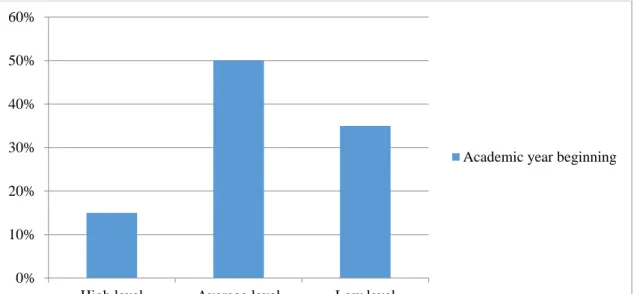
The results of determining the preparedness of students for conducting an effective discussion after the round table at the beginning of 2018 among 2-year students of 45 people are shown in Figure 1.
www.amazoniainvestiga.info ISSN 2322 - 6307
Figure 1. The results of determining the preparedness of students for conducting a productive discussion (the results of our study at the beginning of 2018) (author's study)
During the year, many seminars and workshops were held in the form of “round tables”, which were based on several positions, different points of view on the same problem. Such forms of collective discussion in modern conditions help to conduct fruitful discussions, subject topics to
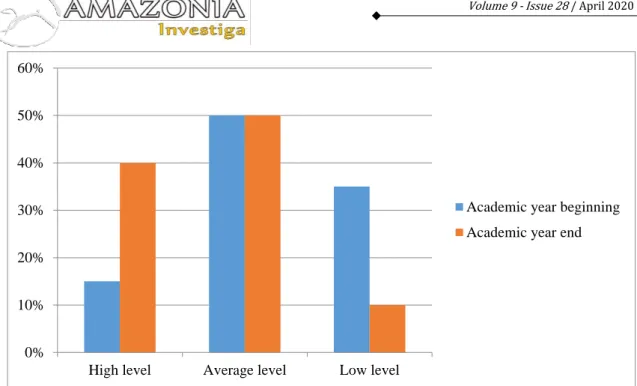
comprehensive analysis and develop joint solutions. Students prepared for them using electronic resources. We independently selected relevant information, prepared presentations. Figure 2 shows the results of the preparedness of students at the end of the 2018 school year.
Figure 2. The results of determining the preparedness of students for conducting an effective discussion (results of our study at the end of 2018) (author's study)
The results obtained indicate an increase in the level of preparedness of students for conducting productive discussions. Figure 3 shows a
comparison of the results at the beginning and at the end of 2018. 0% 10% 20% 30% 40% 50% 60%
High level Average level Low level
Academic year beginning
0% 10% 20% 30% 40% 50% 60%
High level Average level Low level
Figure 3. The results of determining the preparedness of students for conducting an effective discussion (end of 2018 and beginning of 2018) (author's study)
The presented figure clearly shows that we were able to significantly reduce the percentage of students with a low level of preparedness for conducting discussions.
Conclusions
We have identified the effectiveness of the "round tables" in the training of students in higher educational institutions. The study made it possible to establish the level of students’
preparedness for conducting effective
discussions for the implementation of future professional activities in secondary vocational educational institutions.
At the beginning of 2018 (before the active implementation of technologies for conducting round tables) the following results were established: only 15% of students were prepared to conduct discussions, the average level was 50%, and the low level was 35%. At the end of the year, a second study was conducted (without changing the number of participants). It was found that 40% of students managed to bring to a high level of discussion using the technology of organizing a round table. They actively participate in conversations, answer questions reasonably and are ready to listen, and sometimes even accept the position of their opponent. The results were obtained thanks to the statistical processing of data to identify the level of training. The mathematical and statistical analysis of the results of the study made it possible to verify the effectiveness of the round
table technologies in improving the level of training of students.
The results can be used in the preparation of students of higher educational institutions of various majors.
Bibliographicreferences
Abramova, N.S., Vaganova, O.I., Kutepova, L.I.
(2018) Development of educational and
methodological support in the context of the implementation of information and communication
technologies. Baltiyskiy gumanitarnyy zhurnal
(Baltic Humanitarian Journal), 7, no. 2 (23),
181-184. (in Russ.).
Bartkiv, O. S., Durmanenko, E. A. (2018). Interactive methods in the process of future teachers’ training for the higher education
institutions modeling. Humanitarian Balkan
Research, 1, 30-32.
Bulaeva, M.N., Vaganova, O.I., Gladkova, M.N. (2018). Activity technologies in a professional educational institution. Baltiyskiy gumanitarnyy
zhurnal (Baltic Humanitarian Journal), 7, no. 3
(24), 167-170. (in Russ.).
Chirva, A.N., Chirva, O.G. (2018). Contents and method of professionally oriented training of informatic disciplines of future teachers of technologies. Scientific Vector of the Balkans, 1, 27-31.
Denysenko, S.M. (2018). Application of quest technology in the professional training of Bachelor of Publishing and Polygraphy in Higher School.
Balkan Scientific Review, 1, 29-33.
0% 10% 20% 30% 40% 50% 60%
High level Average level Low level
Academic year beginning Academic year end
www.amazoniainvestiga.info ISSN 2322 - 6307 Garnevska, S.M. (2018). Opportunities for forming
communication technology images in training in technology and entrepreneurship. Balkan Scientific
Review, 1, 34-37.
Ihnatenko, H.V., Ihnatenko, K.V. (2018).
Formation of self-dependence as a professional ly-important personality trait of a future vocational education teacher by means of case-technology.
Humanitarian Balkan Research, 1, 40-42.
Ilyashenko, L.K., Gladkova, M.N., Kutepov, M.M., Vaganova, O.I., Smirnova, Z.V. (2019 b). Development of communicative competencies of students in the context of blended learning.
Amazonia Investiga, 8 (18), 313-322.
Ilyashenko, L.K., Markova, S.M., Mironov, A.G., Vaganova, O.I., Smirnova, Z.V. (2019 a). Educational environment as a development
resource for the learning process. Amazonia
investiga, 8 (18), 303-312.
Ivanova, N. L., Korostelev, A. A. (2019). The impact of competitive approach on students' motivation in sport. Amazonia Investiga, 8 (18), 483-490.
Kamenez, N., Vaganova, O. Smirnova, Z., Kutepova, L., Vinokurova, I. (2019). Development of content of educational programs of additional education for professor-teaching composition in organization of educational services of training with disability. Amazonia investiga, 8 (18), 267-278. Klinkov, G.T. (2018). The specificity of manifestation of pedagogical communication as a special construct. Scientific Vector of the Balkans, 1, 51-52.
Koshechko, N.V. (2018). Innovations from educational discipline "Pedagogical conflictology" in professional preparation of students. Scientific
Vector of the Balkans, 1, 59-63.
Makhometa, T.M., Tiahai I.M. (2018). The use of interactive learning in the process of preparing future math teachers. Balkan Scientific Review, 1, 48-52.
Markova, S.M., Zanfir, L.N., Vaganova, O.I.,
Smirnova, Z.V., Tsyplakova, S.A. (2019).
Department of educational process in conditions of implementation of interactive training of future engineers. Amazonia Investiga, 8 (18), 450-460. Nikonova, N.P., Vaganova, O.I., Smimova, Z.V., Bystrova, N.V., Markova, S.M. (2019a). Providing
partnerships and promotion of additional
educational services. International journal of
applied exercise physiology, 8 (2.1), 347-355.
Nikonova, N.P., Vaganova, O.I., Smirnova, Z.V., Chelnokova, E.A., Kutepov, M.M. (2019b). Methodological support in partnerships with the institution of additional education and teachers.
International journal of applied exercise
physiology, 8 (2.1), 339-346.
Pometun, O.I., Gupan, N.M. (2018). Studying history as an educational space of students'critical
thinking development. Humanitarian Balkan
Research, 1, 60-63.
Sedykh, E.P., Zanfir, L.N., Vaganova, O.I., Smirnova, Z.V., Bulayeva, M.N. (2019). Use of training technology in the preparation of students of engineering specialties. Amazonia Investiga, 8 (18), 461-470.
Smirnova, Z.V., Kamenez, N.V., Vaganova, O.I., Kutepova, L.I., Vezetiu E.V. (2019). The experience of using the webinar in the preparation of engineering specialists. Amazonia Investiga, 8 (18), 279-287.
Myalkina, E.V., Sedhyh, E.P., Zhitkova, V.A., Vaskina, V.A., Isaykov, O.I. (2018). University resource center as an element of social development of the region. Vestnik Mininskogo universiteta (Vestnik of Minin University), 6, (3), 1. DOI: 10.26795/2307-1281-2018-6-3-1.
Prokhorova, M.P., Semchenko, A.A. (2018). Involving of trainees-future teachers of professional training in project activities in the discipline.
Vestnik Mininskogo universiteta (Vestnik of Minin
University), 6, (2), 6. DOI: 10.26795/2307-1281-2018-6-2-6.
Rakhimbaeva, Inga E.; Korostelev, Aleksandr A., Shakirova, Indira A., Ayshwarya, B., Phong Thanh Nguyen, Hashim, Wahidah, Maseleno, Andino. (2019). Integration of the Educational and Didactic Systems in the Training of Future Teachers.
International Journal of Applied Exercise
Physiology, 8 (2.1), 1131-1136.
Vaganova, O.I., Konovalova, E.Yu., Abramova, N.S., Lapshova, A.V., Smirnova, Z.V. (2019a). Increasing the level of teachers' readiness for pedagogical project. Amazonia Investiga, 8 (22), 286-294.
Vaganova, O.I., Odarich, I.N., Popkova, A.A.,
Smirnova, Z.V., Lebedeva, A.A. (2019b).
Independent work of students in professional educational institutions. Amazonia Investiga, 8 (22), 295-304.
Vaganova, O.I., Sirotyk, S.D., Popkova, A.A., Smirnova, Z.V., Bulaeva, M.N. (2019c). Additional education in higher professional educational institution. Amazonia Investiga, 8 (22), 305 – 310. Vaganova, O.I., Smirnova, Z.V., Gruzdeva, M.L.,
Chaykina, Z.V., Ilyashenko, L.I. (2019d).
Development of training content for master students in course "mechatronics and robotics" at the University. Amazonia Investiga, 8 (22), 694-700. Vaganova, O. I. (2019e). Formation of competence
in the possession of modern educational
technologies at a university. Amazonia Investiga, 8 (23), 87-95.
Vaganova, O. I. (2019f). Organization of practical classes in a higher educational institution using
modern educational technologies. Amazonia
Investiga, 8 (23), 81-86.
Vaskovskaya, G.A. (2018). Features of
implementation of pedagogical technologies of profile training. Balkan Scientific Review, 1, 76-79.