Institute of Software Technology University of Stuttgart Universitätsstraße 38 D–70569 Stuttgart Masterarbeit Nr. 3102-004
Aspects of Event-Driven
Cloud-Native Application
Development
Tareq Ahmed Ali Al-MaamariCourse of Study: INFOTECH
Examiner: Prof. Dr. rer. nat. Stefan Wagner
Supervisors: Asim Abdulkhaleq, M.Sc.
Dr. Andreas Nauerz (IBM)
Commenced: April 1, 2016
Abstract
Managing and configuring servers have been challenging burdens. Therefore, serverless computing has been introduced to overcome the complexities of managing servers, get rid of operations and handle different terms such as scalability and high availability. Codes or binaries in serverless computing are executed upon direct invocation or as a response to events in a highly scalable manner, which makes it most appropriate for building event-driven applications.An example of such serverless computing services provider, is OpenWhisk the open-sourced project by IBM. To receive events and react to them by invoking or running OpenWhisk actions (codes or Docker containers), OpenWhisk provides an ecosystem of packages of services to enable, facilitate, ease the usage of the services and subscribe to their events.
While OpenWhisk provides different powerful means and tools to interact with events, it lacks a number of important services (event sources) packages within the OpenWhisk ecosystem which are necessary to ease and facilitate subscribing to receive their events and using the different functionalities of the services. This thesis enriches the OpenWhisk ecosystem by integrating and enabling more services. A use-case-based approach is chosen to select services to be integrated and enabled. The proposed use-case is anEarly Warning System (EWS)used to warn the public for disasters, possible incidents and helping rescue survivors. In this approach, diversity of the integrated services in terms of domains and vendors are guaranteed to avoid vendor lock-in and provide flexibility in the available services. The integrated services were then categorized based on taxonomic categories using the domain of services to ease out finding and organizing packages.
To start with, I do owe many thanks and gratitude to theDeutscher Akademischer Aus-tauschdienst (DAAD)especially my contact person Mrs. Andrea Gerecke, for sponsoring my master studies at University of Stuttgart. They have been of a great support for whenever I needed help and encountered several challenges.
I do express my deepest gratitude to Prof. Stefan Wagner and Mr. Asim Abdulkhaleq for supervising my thesis and for their support and guidance. I am also thankful to my supervisors in IBM: Dr. Andreas Nauerz and Mr. Simon Moser for giving me the opportunity to do my master thesis under their supervision and for their guidance, patience and support.
I cannot forget the help from the proofreaders, their great feedback have made this thesis as it is now. My warm thanks go especially to Dr. Murad Saeed, Dr. Mustafa Al-Hajjaji, Mr. Jeremias Wagner and Dr. Manaf Gharaibeh.
Contents
1 Introduction 15 1.1 Motivation . . . 15 1.2 Problem Statement . . . 16 1.3 Research Objectives . . . 16 1.4 Thesis Structure . . . 17 2 Background 19 2.1 Cloud Computing . . . 192.1.1 Cloud Service Models . . . 20
2.1.2 Cloud Deployment Models . . . 20
2.1.3 Essential Cloud Computing Characteristics . . . 21
2.1.4 Application Workloads . . . 22
2.1.5 Cloud-Native Application Properties . . . 23
2.2 Microservices Architecture . . . 25
2.2.1 Characteristics . . . 26
2.2.2 Challenges and Complexities . . . 27
2.3 Serverless Computing . . . 28
2.3.1 Basic Principle . . . 30
2.3.2 Advantages . . . 31
2.3.3 Disadvantages . . . 31
2.4 IBM Bluemix OpenWhisk . . . 31
2.4.1 High Level Architecture . . . 32
2.4.2 OpenWhisk Entities . . . 33
2.4.3 System Design / Architecture . . . 35
2.4.4 OpenWhisk Services Ecosystem . . . 37
2.4.5 Specifications and Characteristics . . . 38
2.5 Serverless Computing Providers . . . 40
2.5.1 Amazon Web Services Lambda . . . 40
2.5.2 Google Cloud Functions . . . 41
2.5.3 Microsoft Azure . . . 42
2.5.4 Auth0 Webtasks . . . 43
3.2 Google Cloud Functions . . . 47
3.3 Microsoft Azure . . . 48
3.4 Auth0 Webtasks . . . 48
4 Services Categorization, Integration and Enablement 49 4.1 OpenWhisk Ecosystem . . . 49 4.1.1 OpenWhisk Packages . . . 50 4.2 Services Categorization . . . 50 4.2.1 Types of Categories . . . 50 4.2.2 Categorization Similarities . . . 52 4.2.3 OpenWhisk Categorization . . . 53 4.3 Services Selection . . . 54 4.3.1 Selection Criteria . . . 54 4.3.2 Usage-Based Selection . . . 55 4.3.3 Use-Case-Based Selection . . . 55
4.3.3.1 Use-Case Selection Criteria . . . 55
4.3.3.2 Scenarios . . . 56 4.4 Services Integration . . . 58 4.4.1 Overview . . . 58 4.4.2 Integration Methods . . . 59 4.4.3 Package Structure . . . 62 4.5 Challenges . . . 65
5 Design and Implementation 67 5.1 Early Warning System Scenario . . . 67
5.1.1 Sensors and Human Reporting . . . 68
5.1.2 Report Analyzer . . . 69
5.1.3 Authority Confirmation . . . 69
5.1.4 Alarm and Red Code Firing . . . 70
5.1.5 Rescue Operations . . . 70
5.2 Feed / Trigger Provider . . . 72
5.3 IBM Watson IoT Platform Package . . . 74
5.3.1 Actions . . . 75
5.4 IBM Watson IoT Real-Time Insights Package . . . 79
5.4.1 Actions . . . 80
5.4.2 Feed Action . . . 84
5.5 IMAP Package . . . 85
5.5.1 Feed Actions . . . 85
5.6 IFTTT Package . . . 86
5.7 Box Package . . . 88
5.7.1 Webhooks V1 . . . 88
5.7.2 Box API V2 . . . 89
5.7.2.1 Actions . . . 90
5.7.2.2 Feed Action (Webhook) . . . 90
6 Results and Evaluation 91 6.1 Serverless Computing Providers . . . 91
6.2 OpenWhisk Categorization . . . 95
6.3 Services Selection . . . 96
6.3.1 Usage Statistics Based Selection . . . 96
6.3.2 Use-Case Based Selection . . . 97
6.3.2.1 Early Warning System . . . 97
6.4 Services Integration . . . 99
6.4.1 Template Package . . . 100
6.4.2 Watson IoT Platform & Watson IoT Real-Time Insights Packages . 100 6.4.3 IMAP Package . . . 100
6.4.4 Box Storage Package . . . 100
6.4.5 IFTTT OpenWhisk Channel & Package . . . 101
7 Conclusions and Future Work 103
Glossary 105
Acronyms 107
List of Figures
2.1 Mind map of this section . . . 19
2.2 Hardware level virtualization . . . 28
2.3 Operating system level virtualization (containers) . . . 29
2.4 Abstracted overview of serverless computing . . . 30
2.5 High level architecture . . . 32
2.6 OpenWhisk Action . . . 33
2.7 OpenWhisk Actions Sequence . . . 33
2.8 Relationship between triggers, rules and actions . . . 35
2.9 Package Example: WatsonInternet of Things (IOT)Platform Package . . 36
2.10 System Architecture . . . 37
4.1 High level workflow of this chapter . . . 49
4.2 Scenario votes . . . 58
4.3 Polling . . . 59
4.4 Polling using feeds . . . 60
4.5 Websockets using feeds . . . 61
4.6 Message queues . . . 61
4.7 Package template content . . . 64
5.1 High level architecture of the EWS scenario . . . 68
5.2 Data flow diagram of the report analyzer process . . . 70
5.3 Authorities confirmation process data flow diagram . . . 71
5.4 Rescue operations flow diagram . . . 72
5.5 High level architecture of feeds . . . 73
5.6 Feed use case diagram . . . 73
5.7 Watson IoT platform and OpenWhisk . . . 75
5.8 Watson IoTReal-Time Insights (RTI)and OpenWhisk . . . 80
5.9 Internet Message Access Protocol (IMAP)package . . . 86
5.10 OpenWhisk channel inIf This Then That (IFTTT) . . . 88
5.11 Box mapper feed . . . 89
List of Tables
2.1 AWS Lambda limits & properties . . . 41
2.2 Google Cloud limits & properties . . . 42
2.3 Microsoft Azure Functions limits & properties . . . 43
2.4 Auth0 webtasks limits & propertpies . . . 44
2.5 Serverless providers comparison . . . 45
5.1 Create device type parameters . . . 76
5.2 Add device parameters . . . 77
5.3 Delete device type parameters . . . 77
5.4 Delete device parameters . . . 78
5.5 Send event parameters . . . 79
5.6 Add message source action parameters . . . 81
5.7 Delete message source action parameters . . . 81
5.8 Add message schema action parameters . . . 82
5.9 Delete message schema action parameters . . . 83
5.10 Webhook parameters . . . 84
5.11 IMAP feed action parameters . . . 85
5.12 Search action parameters . . . 90
5.13 Box webhooks feed action parameters . . . 90
List of source codes
1 Example of JavaScript action . . . 34
2 Activation example . . . 36
3 An example of multi-hierarchal categorization . . . 53
4 OpenWhisk package template . . . 63
5 Usage example of device type action . . . 75
7 Usage example of delete device type action . . . 77
6 Usage example of add device action . . . 78
8 Usage example of delete device action through OpenWhiskCommand-Line Interface (CLI) . . . 79
9 Usage example of send event action . . . 79
10 Usage example of add message source action . . . 81
11 Usage example of delete message source action . . . 82
13 Usage example of add message schema action . . . 82
12 Message schema request example . . . 83
14 Usage example of delete message schema action . . . 84
15 Usage example of webhook feed action . . . 85
1 Introduction
1.1 Motivation
Due to the technological changes in recent years, massive amounts of data are getting generated that require large scale of computing power to process and store. Therefore, the concept of cloud computing has developed. Cloud computing provides highly virtualized, distributed, scalable, on-demand and shared pool of resources which provide the required computing power to deal with such amounts of data. These characteristics and the benefits such as driving down the costs and allowing organization to focus more on business logic that make cloud computing involve in one way or another in every discipline and change the structure and nature of IT world.
In cloud computing, different levels of services are provided through different service models which range from the underlying hardware or virtual machines (Infrastructure as a Service (IAAS)) up to offering software as a service (Software as a Service (SAAS)). Regardless of the service model where an application is deployed, servers are still needed to run such applications either on a physical machine, virtual machine,Software Containeror even in an application-centric runtime environment. Unfortunately, the time and effort spent in creating and configuring servers and taking care of the different cloud-related complexities all present a challenge. Furthermore, as servers are lifelong running, the overall utilization might be low due to the long idle periods.
The need for having a solution is highly conducive in order to evade the mentioned problems. A possible solution that 1) abstract all complexities which come with servers, 2) run a cloud-native application only when it is needed either upon a direct invocation or as a response to events, and 3) can highly scale to cope with the different types of workloads. All these characteristics lead to serverless computing, the new computing model where an application is split into small parts (i.e. snippets of code, containers or even binaries), each is executed only upon a direct request or as a response to events. Obviously, serverless computing is event-driven in nature, which can be the best ap-proach that fits event-driven applications well. In serverless computing, applications are executed and scaled rapidly in response to unpredictable and large demand workloads
which result from emitting events. There are many use cases where cloud-native appli-cations should react to events, therefore, it should be designed on top ofEvent Driven Architecture (EDA)to enable such applications to efficiently react and respond to these events.
1.2 Problem Statement
Internet of Things is one popular use-case for such EDA applications where non-computing devices like washing machines and dish-washers are emitting events to the Internet. Thus, large number of events need to be processed and stored in real-time manner. In order to receive the emitted events to react and respond to it, event consumers are required to subscribe to receive the events.
As mentioned above, serverless computing can be the best choice when it comes to interacting with events. Therefore, there is a big need for serverless computing providers to provide efficient and convenient mechanisms to allow event consumers to subscribe and receive events in a way that abstracts the underlying complexities such as taking care of communications, different implementations and the nature serverless applications that differs from server-based applications. Nowadays, there are many cloud providers who provide serverless computing services such asInternational Business Machines (IBM)
Bluemix OpenWhisk, Amazon Web Services (AWS)Lambda, Microsoft Azure Functions, and Google Cloud Functions, each has different limitations and characteristics.
1.3 Research Objectives
Within The above highlighted issues, there is a need to carry out analysis and comparison of the various serverless computing services providers. So as the first focus of this work, the comparison will be based on aspects such as the different system limitations as well as how powerful the services ecosystem of a given provider is. The service ecosystem defines how far a given service provider is integrated with third-party services in order to minimize the effort to create a serverless function and therefore maximize the value-added. Obviously, the more services exist inside the ecosystem, the more powerful the service provider is. Therefore, the second focus of this master thesis is to enrich the services ecosystem of OpenWhisk the serverless event-driven programming services provider in order to enable event consumers to register to receive events and react to it. In addition, the enabled and integrated services should be categorized base on the characteristics or domains of the services. Specifically, the thesis aims to achieve the following research objectives:
1.4 Thesis Structure
• To compare among various serverless cloud providers. • To investigate and propose a list of services.
• To propose a categorization system for categorizing OpenWhisk packages.
• To integrate some of the proposed services into the serverless computing provider IBM Bluemix OpenWhisk.
• To provide useful scenarios where the proposed and integrated services can be well exploited.
1.4 Thesis Structure
The rest of this thesis is organized and structured as follows:
Chapter 2 – Background: It starts with some fundamentals of the work and provides the reader with a clear background of the overall research topic, including basics in cloud computing, microservices architecture, serverless computing , OpenWhisk as well as introducing and comparing the main different serverless computing providers.
Chapter 3 – Related Work: In this chapter, the related work to this thesis is described of how far different serverless computing providers integrate, enable and enrich their services ecosystem.
Chapter 4 – Services Categorization, Integration and Enablement: In order to pro-vide more useful scenarios, more services need to be integrated and enabled into OpenWhisk to enrich the OpenWhisk ecosystem and categorizing them. Therefor, in this chapter, we discuss the concepts behind them.
Chapter 5 – Design and Implementation: Here, we design and implement the con-cepts behind integration, and enable the proposed services into OpenWhisk.
Chapter 6 – Results and Evaluation: This chapter shows the results and evaluation of what have been achieved along this thesis.
Chapter 7 – Conclusions and Future Work: This chapter contains a summary of the thesis achievements and possible improvements and some recommendations for future work.
2 Background
In this chapter, different topics are described for an overall understanding of the back-ground of the core work of this thesis.
2.1 Cloud Computing
Since the last decade, sources of data have been exponentially increasing, and they have generated enormous amounts of data. To process and store these data, a huge computing power is needed which can be expensive and might be hard to access. Therefore, different terms have been introduced to solve this issue, such as grid and cloud computing. Cloud computing which is, in fact, a highly virtualized, distributed, scalable, on-demand and shared pool of resources provides computing power as a utility where resources are provisioned and de-provisioned on-demand. In this thesis, we refer to the provider of cloud computing offerings as a cloud provider, and for the consumer of cloud computing offerings as a cloud consumer.
Due to the benefits offered by cloud computing, it is involved in many areas and a wide number of applications have been built on top of it, such as distributed storages, data analytics, IOT, communication between devices have been built on based on cloud
computing. Figure 2.1 shows a mind map of this section’s content.
Cloud Computing
Service Models Deployment Models Essential Characteristics
Cloud-Native Applications Properties Workloads
2.1.1 Cloud Service Models
In cloud computing, IT resources can be delivered to cloud consumers through different service models. Each service model has different levels of abstraction ranging from the very bottom of fundamentals resources such as processing power up to readySoftware as a Service. According toThe NIST Definition of Cloud Computing [MG11], there are three cloud service models which are presented as follows:
• Infrastructure as a Service (IAAS): Cloud providers provide fundamental
com-puting resources to cloud consumers such as processing and storage.
• Platform as a Service (PAAS): Cloud providers provide a cloud platform where
cloud consumers can deploy their applications and use ready-to-use services. The underlying cloud infrastructure is abstracted. Thus, cloud consumers have no control and knowledge about it.
• Software as a Service (SAAS): Cloud providers offer to users applications which are running in the cloud with abstraction to the underling infrastructure with the possibility of limiting application specification to individual users. A good example of an SAAS service is the on-line document processing applicationOffice 365.
2.1.2 Cloud Deployment Models
Regardless of the followed cloud service models, IT resources are deployed and available based on the targeted group of consumers. There are four cloud deployment models [MG11] which are presented as follows:
• Public Cloud: In this deployment model, cloud offerings are open to the general public use. The public term here does not necessarily mean that the namespace of a consumer is publically visible, but it is isolated and can be accessed and controlled via different means of access control. In this model, cloud resources may be owned and can be managed by different types of organizations such as academic institutions or business organizations.
• Private Cloud: This model has almost the same benefits and services that offered in public clouds, except that the cloud infrastructure in this model is exclusively used by a single institution and may be managed by the organization itself or third-party institutions.
• Community Cloud: Cloud infrastructure is shared among a specific community of different organizations that have shared missions or common restrictions such as
2.1 Cloud Computing
specific security configurations. It may be owned and managed by one or multiple organizations.
• Hybrid Cloud: This model is a result of combining two or more different cloud infrastructures (private, public or community). In this model, cloud resources of different cloud providers with different service deployment models can federate their resources and deliver them as a combined cloud provider [AAA+10].
2.1.3 Essential Cloud Computing Characteristics
As mentioned earlier, cloud computing resources range from fundamental resources such as servers to a ready-to-use software. Thus, cloud offerings for such resources should be characterized. According toThe NIST Definition of Cloud Computing [MG11], there are five essential characteristics that each cloud computing provider should provide:
• On-demand self-service: Computing resources are provisioned and de-provisioned whenever they are required. [MG11].
• Broad network access: Computing resources are available and accessible over a network in a way that allows a wide range of heterogeneous clients/devices to connect to cloud resources from a wide range of locations. [MG11].
• Measured service (pay-per-use): Consumption of different resources provided by the cloud provider such as processing, storage or networking resources should be measured by providing a metering system. It is responsible for leveraging a suitable measurement unit for each cloud offering resource in each cloud model such as storage used or bandwidth consumed. The metering system should also abstract and show the cloud offering as a black box to the cloud consumer. [FLR+14; MG11].
• Resource pooling: Computing resources are pooled and shared using multi-tenant model to serve multiple consumers in an automatic way by provisioning and de-provisioning resources automatically on-demand. As the resources are shared, each tenant’s resource must be isolated from others. [MG11]
• Rapid elasticity: Computing resources are provisioned and de-provisioned on-demand to allow cloud offering consumers to have the exact needed amount of resources on time.
2.1.4 Application Workloads
Workloads in cloud computing are defined as the utilization of cloud resources within a specific period of time. Based on the type of cloud resources, workloads measure-ments change. For example, in storage cloud offerings, such measuremeasure-ments might be the amount of data stored. Understanding workloads will help provisioning and de-provisioning resources elastically [FLR+14]. The following types of workloads that cloud applications may experience:
• Static Workload: Has fixed utilization over a certain period of time. In this case, usually, there is no need for provision or even de-provision of cloud resources to the existing resources. Normally at the provision time, the needed resources can be provisioned as well as a certain amount of over-provisioning to cope with the minimal overhead.
• Periodic Workload: Periodic tasks or events such as transferring money in the banks by the beginning of a month will lead to periodic utilization peaks. So, during the peaking, more cloud resources are needed and vice versa. In order to scale; in case of static scaling, resources are statically provisioned as in case of static workload. However, another way is to elastically scale, and in this case, the consumed resources are exactly as needed with no over and under provisioning. • One-in-a-Life Workload: One time peaking in application’s life can result into
different situations such as having an offer for a specific product in case of e-commerce applications. In this case, there is a big gap between the needed resources during the peak and otherwise. One way to solve this or fill up the gab is to have a static scaling which is inefficient as the needed resources may under-provisioned. Another alternative way is to have an automated elastic scaling where only the needed resources will be consumed.
• Unpredictable Workload: Random and unknowable utilization peaks over time will lead to unpredictable workload. In this case, it is hard to cope with it by using static scaling as the time of the unpredictable peak is unknown. Therefore, elastic scaling can be used to provision and de-provision of resources without predicting the workload.
• Continuously Changing Workload: Continuous increasing and decreasing on utilization will lead to perpetual changing workload. The rate of changing is consistent. As a solution, the scaling can be done statically as well as elastically. In case of static scaling, provisioning and de-provisioning can be performed in a stepwise way as some resources can be provisioned and de-provisioned in bulks such as provision additional 100 GB of storage once needed and de-provision 100
2.1 Cloud Computing
GB otherwise. In contrast, elastic scaling will be provisioned in a consistent way so the provisioned resources are almost the same as the consumed ones.
2.1.5 Cloud-Native Application Properties
Obviously, the different workloads have different scaling requirements, and therefore, they have different requirements related to the application design. One popular approach is to split an application into several small parts, so that they can be scaled easily and independently. To take an advantage from cloud environments, it is not enough to split an application into several small parts, but it has to be designed and built in a way that ensures some properties derived from cloud computing characteristics. [FH15; FLR+14]
• Distribution: Cloud resources are scattered over a big distributed pool of resources. Therefore, cloud-native application should be built in a way that can be distributed among the distributed resources.
• Elasticity: According to Shouten [Sho12], elasticity is a synonym to scalability which is the ability to cope with the increased traffic or size with a proper cost [Bon00]. Scalability should be automated in response to the different workloads. As a result, the occupied resources match the demand. Thus, cloud-native applica-tions should be designed to be scaled. In other words, they should be able to run on independent cloud resources. Scalability can be either horizontal where more cloud resources nodes are added or vertical where more capabilities are added to the existing cloud resource node. [FLR+14]
• Isolated State: Comes from the requirements of being stateless. As elasticity will allow an application to be scaled out and in, which means more instances of the application should are created, thus, the application should be stateless, where each instance of the application needs to be operated independently of the other instances, and whenever a state is required, it must not be in the application (i.e. stored somewhere else).
• Automated Management: As a result of elasticity, resources are provisioned and de-provisioned, added and removed automatically, and consequentially, the load should be monitored to ensure provisioning the needed resources and de-provisioning the unneeded resources on time.
• Loose Coupled: Distributed applications consist of distributed components that may depend on each other. Thus, dependencies should be as less as possible in order to ease scaling and minimizing the impact of failing applications compo-nents.[FLR+14]
• The Twelve-Factors: Sometimes, building applications that work as cloud-native applications and SAAS services sometimes is tricky. This is due to the dynamic
continuous expansion of applications, the dynamic collaboration of the teams involved and the cost of slow deterioration of software. The Twelve-Factors is a methodology for building SAAS applications which are 1) a declarative-based
format is used for automation to improve the time and cost, 2) a high portability between environments, 3) compatible and proper for deploying on different mod-ern cloud platforms, 4) have divergence between development and production, which enables a continuous deployment and 5) highly scalable with no or slight effect on the architecture and tools [Her].
1. Codebase: Different versions of source code are tracked through a version control system such asGit. A codebase is a repository that is shared among different deployments (Production, staging, etc.)
2. Dependencies: Twelve-factor applications should use a dependency manager such as NodeJS Package Manager (NPM) for NodeJS and should explicitly declare dependencies through dependency declaration manifest, thus, simpli-fying the setting up of the application.
3. Config: Application’s config is the configurations that differs based on deploys (production, staging, etc.). Application’s config includes the resources handled to the database or any backing service, credentials of external services or specific or even pre-deploy values for different deploys. Config should not be stored within the application itself and it should not be applied to internal configuration of applications. However, it should be stored in a way that can be easily changed between deploys such as environment variables.
4. Backing services: Backing service is any service that is used by the application to achieve its normal operations such as datastores services (CloudantDB, dashDB, etc.). A twelve-factor application should not differentiate between local and external services.
5. Build, release, run: The codebase can be moved into a non-development deploy through different stages:
a) Build stage: The code is transfered into executables called builds. b) Release stage: The build produced in the build stage is combined with
the deploy’s specific config. The resulting is the release that contains the build as well as the config.
2.2 Microservices Architecture
6. Processes: The app is executed in one or more processes, which imply that the app is stateless and share-nothing among the different processes.
7. Port binding: The twelve-factor application self-contained does not rely on runtime injection of webservers into the execution environment to create a web-facing service. Instead, The application should export Hypertext Transfer Protocol (HTTP)as a service by binding to a port.
8. Concurrency: The workload is handled by running different processes where each process presents a type, for each type of work, it is assigned to the corresponding process to handle it.
9. Disposability: Processes in the twelve-factor applications are disposal, which means that they are started and stopped at moment’s notice.
10. Dev/prod parity: The different deployment (i.e. development, staging, and production) should have as small gab as possible between them.
11. Logs: Logs should be treated as events stream.
12. Admin processes: Any administrative and management related work should be done on an one-off admin processes in an identical environment.
2.2 Microservices Architecture
As technology emergence increases, several factors arise and require software archi-tectures to evolve in order to cope with these factors. Interactive, dynamic and rich applications demand scalability and availability in the first place. In other words, this needs a software architecture that can scale and resist failures such as microservices architecture [Ric].
Microservices architecture is an architectural style that intends to split an application into small services. Such services comprise cloud-native application properties as discussed in the previous section. Microservices gets rid of the problems of monolithic architecture when the whole application logic is implemented in a single unit. For small applications, monolithic can fit well and can scale by using a simple load balancer, but as soon as it gets growing, and becomes bigger and bigger, different problems appears are likely to emerge, including the hardness to scale, failures to take the whole big singular unit down rather than only small part of it, challenge to adapt new technologies as well as understanding the code [BHJ15].
In microservices architecture, an application is divided into small services where each can be implemented, deployed, scaled, tested and monitored independently. To have deeper
knowledge about microservices, we will discuss its basic and common characteristics in the following section:
2.2.1 Characteristics
There are common characteristics of microservices architecture, and it is not necessarily that a microservice should meet all of them, but it can be a minimum [DVE+16]:
• Business-oriented: Applications are splitted into small parts which serve as ser-vices. The splitting boundaries should be carefully analyzed to avoid the risks of resulting in lack of integration which will lead to a fragile system. Thus, mi-croservices should be designed based on business objectives, but this requires more efforts and different cross-teams involvement within organization boundaries. • Design for failures: Isolating failures are inescapable, as application is divided
into small services. Moreover, when designing microservices, designer should ensure that a failed service does not affect the overall system/application. Auto-mated testing and real-time monitoring mechanisms necessary to detect failures as quickly as possible. As a result, a quick restore can be done. [LF14]
• Decentralized Data Management: Distributed transactions over different ser-vices. In case of microservices (Basically Available, Soft state, Eventual consistency (BASE)) it is preferred over (Atomicity, Consistency, Isolation, Durability (ACID)). As the principle behind microservices is to split applications into small services, hence, each microservice should ideally have its own database. This will intro-duce polyglot persistence by using different databases such as (DB2 vs Oracle, CloudantDB vs MongoDB) and different data stores types (SQL, NoSql (document based, graphs, etc.)). However, in most of the cases, transactions need to be accessible through multiple microservices, and a centralized database which can be accessed by multiple microservices. This should be avoided as much as possible to ensure the loosely-coupled nature of microservices.
• Discoverability: Underlying infrastructure may fail anytime, and therefore, con-structing microservices should guarantee reconfiguring services to update the location of other services that they need to connect to. Usually, service discovery can be achieved by using a service registry where all services explicitly register with.
• Inter-service communication design: Regardless of the way microservices are deployed (application-centric runtime environment,Software Container,virtual ma-chine, or even as a function/action in serverless platform), a question arises: How
2.2 Microservices Architecture
do services communicate with each other?. In case of one-way communication, message queues are considered a good way. In contrast, for two-way communi-cation, this solution of message queues does not fit well. One way of handling two-way communication work is by makingRepresentational State Transfer (REST)
calls where each service calls others through a lightweight HTTP requests. This guarantees loose coupling as well as abstracting implementation details of each microservice, but there are cases where the caller service (client) requires a chatty messaging or requires multiple calls to achieve its goals (get, add, update, delete resources). Another way is to use an additional layer that sits between the clients and microservices which act as a controller to hide complexities and heterogeneity of communication.
• Evolutionary Design: It is common that applications requirements are frequently changed. As a result, new features and capabilities are introduced, and the good point is that only the changed microservice rather than the whole system needs to be taken care of.
2.2.2 Challenges and Complexities
Microservices also introduce a few drawbacks and complexities presented as follows [DVE+16]:
• Testing: As any distributed and complex applications, testing of microservices-based systems requires additional different testing components, a set of unit and integration tests, load tests as well as overall system behavior tests.
• Monitoring: Microservices are independently built and deployed. Therefore, it is hard to monitor them using the traditional monitoring approaches. However, to cope with this, services should be designed and built in a way that provide health check information which can be used by the monitoring system in tracking the overall behavior of microservices-based system.
• Dependencies: Normally, dependencies are frequently updated, which in many cases, requires changing on the code where it is used. In monolithic applications, the normal procedure of updating dependency is by updating a single component where other parts and applications use it as an interface of that dependency. In contrast, in case of microservices-based applications, different services may depend on the same dependency, and in such cases, each single rather than a single component needs to be updated.
• Development and Operations: Regardless of the advanced monitoring system needed in microservices-based systems, keeping each microservice up and running is a challenge which requires more a high-quality DEVOPS skills to deal with it.
2.3 Serverless Computing
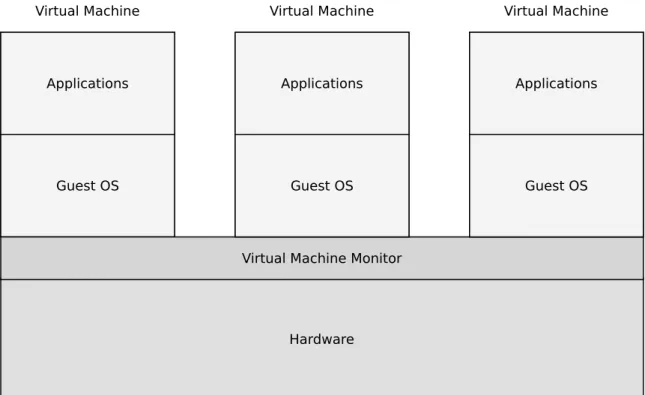
Traditionally, applications ran on physical machines. A large number of machines are expensive, hard to configure, manage, maintain and are frequently underutilized. Moreover, scalability cannot be achieved easily due to different reasons such as the size and complexity of modern operating systems [BDGR97]. Under those circumstances, virtualization (Figure 2.2) provides abstraction on the physical hardware level and consolidates the hardware, thus, utilizing resources more efficiently, decreasing the cost and improving maintenance. Above the abstraction level, multiple virtual machines run simultaneously, and each can be a separate server running on different operating systems. Hence, multiple servers can be run simultaneously on those virtual machines.
Hardware Guest OS
Applications
Virtual Machine Monitor Virtual Machine Guest OS Applications Virtual Machine Guest OS Applications Virtual Machine
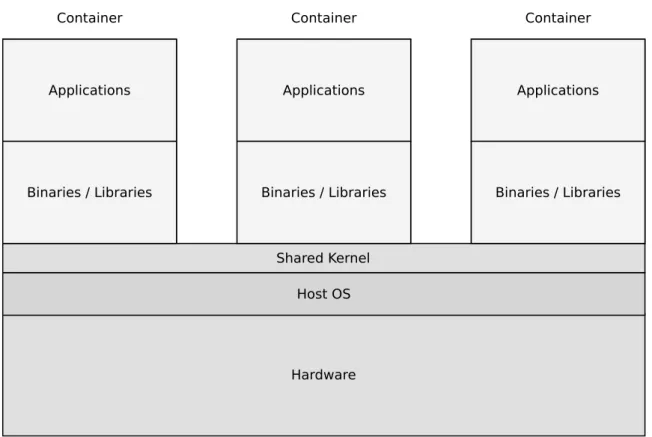
2.3 Serverless Computing Hardware Applications Host OS Container Applications Container Applications Container Shared Kernel
Binaries / Libraries Binaries / Libraries Binaries / Libraries
Figure 2.3:Operating system level virtualization (containers)
Despite all the pretty good advantages of virtualization, it is not ideal due to the overhead of having a completely installed operating system on each virtual machine
which makes it hard to scale efficiently. On the other hand, virtualization on the operating system level such as containers is lighter-weight and gets rid of hardware-based virtualization problems. In containers, the operating system kernel is shared among different containers, each of which is a separated package of Unix-style processes [Mer14a]. With these containers, servers can be configured and managed easier but managing many tasks, such as concurrency, memory management and database access still represents a burdens. Moreover, servers configuration in general is hard, complex and an error-prone process [XLR+04]. In addition, applications are limited by the servers’ startup time to scale efficiently. Consequentially, serverless computing the new computing model hides the complexities of managing servers, get rid of operations and handling different terms such as scalability and high availability. Serverless computing is a new computing model that exploits containers to execute users’ code rather than a whole application.
In serverless computing, the deployable unit is a snippet of code or even a whole container which is executed only by an explicit request or as a response to an event. It changes the way of architecting and implementing cloud-native applications in a way similar to microservices architecture except that in servlerless computing a microservice is executed only upon a request.
2.3.1 Basic Principle
The basic principle behind serverless computing is similar to traditional servers such as
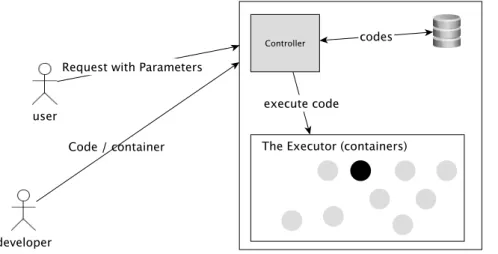
Apache Tomcat [Fou16]. In Apache Tomcat, there is a pool of threads (The executor). Whenever there is a new incoming request, an available thread within the pool is used to handle that request. Similarly, serverless computing providers such as OpenWhisk has a pool of containers. Whenever there is a new incoming request to execute a specific code or container that has been provided by the user, an available container executes that code and returns the result to the caller (requester). As these containers and threads whenever they finish their work or are interrupted by any signals such as timeout, they are returned back to the pool and are marked ready to handle new requests. The key here is that these containers are shared among different users (multi-tenancy) and are managed by the serverless computing provider. Thus, all complexities of servers are hidden in such a way that users do not need to involve with any servers. Figure 2.4 shows an example of an abstracted overview of the basic principle of serverless computing.
2.4 IBM Bluemix OpenWhisk
2.3.2 Advantages
Highly and rapidly scalable applications can be created on top of serverless computing, where the more requests come in, the more containers are created to handle these requests. They can be reused for new incoming requests in a very fast manner. All of these operations of handling and configuring the underlying infrastructure is abstracted and handled by the provider. Thus, operations such as managing scalability, availability, maintenance, monitoring and other operations can be discarded, which allows organiza-tions to focus more in application logic. Furthermore, since containers are reused and users’ code is only executed whenever it is invoked. Resources are also highly utilized and terms like over or under provisioning are hidden.
2.3.3 Disadvantages
Although serverless computing has several advantages, unfortunately, many aspects are abstracted and hidden. Its providers take care of setting up the infrastructure of fundamental resources such as the type ofCentral Processing Unit (CPU)that are needed to execute users’ requests. Thus, users with specific infrastructure requirements cannot change the underlying resources to meet their requirements. Moreover, containers’ pools are shared based on the multi-tenancy principle where a container can be reused to execute a code of different tenants. Therefore, many concerns are rising and security is one of them such as the concerns of accessing other tenants’ data within a container that may has been used by other tenants.
2.4 IBM Bluemix OpenWhisk
The Serverless market has been incredibly increasing due to the benefits it brings. Cur-rently, there are many serverless computing providers who offer different serverless computing services. This section provides a bird’s-eye view of one of the new server-less computing services provider (IBM OpenWhisk). OpenWhisk is an open-sources cloud-based, serverless, distributed and event-driven engine that provides event-driven programming services which allow you to build powerful and convenient event-driven applications.
2.4.1 High Level Architecture
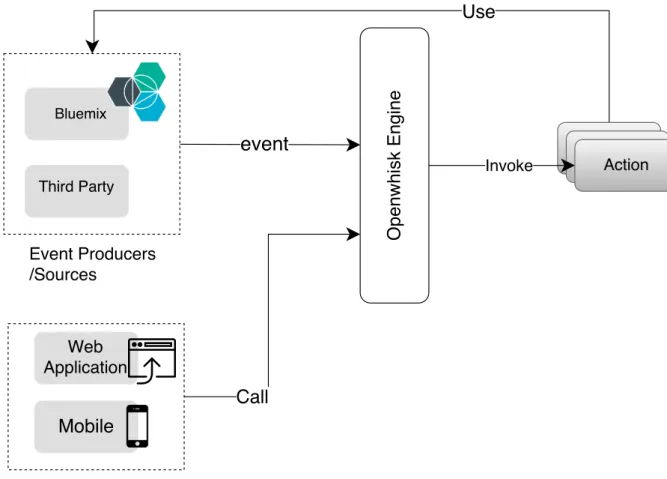
Since OpenWhisk is event-driven, it allows organizations to build efficient and powerful event-driven systems by providing all tools needed to interact with the events. Event pro-ducers emit events to OpenWhisk through different means, e.g. direct REST Application Programming Interface (API)requests. In order to receive such events in OpenWhisk, event producers need to be configured probably. As result of event emitting, an action or a sequence of actions are executed with the event payload as parameters. Actions can be written in JavaScript(Node.js), Swift, Java, Python or even can be a Docker container and it can be user-defined or even a ready-to-use action within OpenWhisk ecosystem such as “send an SMS” action in Twilio package or actions that are shared by another user. Figure 2.5 shows a high level architecture of OpenWhisk [Ope16].
2.4 IBM Bluemix OpenWhisk
2.4.2 OpenWhisk Entities
OpenWhisk provides different tools and means to interact and respond to events. The following is a list of OpenWhisk entities:
• Action: A snippet of code or a container that represents the application logic and it is executed only upon a direct request or as a result of rule activation. In Listing 1, an example of JavaScript action is to calculate the speed of a moving objects as well as the invocation command and the result as JavaScript Object Notation (JSON)object.
Figure 2.6:OpenWhisk Action
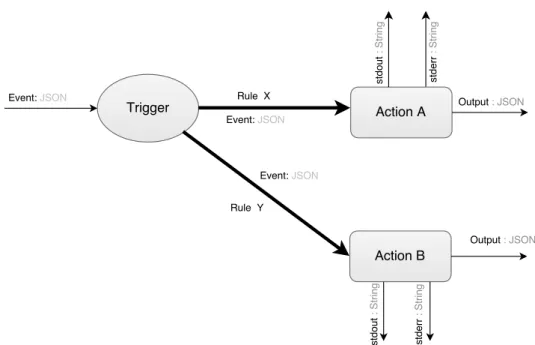
• Actions Sequence: Pipeline of actions which are chained together by their output, so that, the output of an action is passed as input to the next action in the chain. Figure 2.7 shows a high level architecture of actions sequence.
Figure 2.7: OpenWhisk Actions Sequence
• Trigger: A class of event types where each trigger represents a unique type of events such as a trigger for incoming IMAP emails which is fired whenever there is an incoming email.
• Rule: Association between triggers and actions, and it is kind of bindings. Each rule is a1 to 1 relationship between a trigger and an action or sequence of actions. A rule is activated as a result of trigger firing. Consequentially, the associated action or sequence of actions are executed with the payload of the trigger.
1 /**
2 * An action to calculate speed of a moving object, it recieves time in seconds and distance in meters and return speed in meters per second
,→
3 */
4 function main(parameters) {
5 console.log("Incoming request with parameters: ",parameters)
6 return new Promise(function(resolve, reject) {
7 if (!parameters.hasOwnProperty(’time’) || !parameters.hasOwnProperty(’distance’)) {
,→
8 console.error("time, distance or both parameters are missing")
9 reject("missing required parameters")
10 }
11 if (parameters.time <= 0) {
12 console.error("time should be larger than zero")
13 reject("Time value is invalid")
14 }
15 resolve({"speed": (parameters.distance/parameters.time)})
16 })
17 }
1 #Invoke example action through terminal
2 $ wsk action invoke example -p time 120 -p distance 50 1 //Output of invocation (JSON)
2 {
3 "speed": 0.16666666666666666 4 }
Listing 1:Example of JavaScript action
• Feed Action: A special action that manages feed of events from a specific event producer (i.e. {create, pause, unpause and delete). Normally, feed actions are used by triggers to control subscription through the trigger itself (i.e. ‘wsk trigger create newComment –feed /whisk.system/github/webhook -p‘ and ‘wsk trigger delete newComment‘ to delete the subscription). It has different life cycle events such as delete, create, pause and unpause.
• Feed: A separate application or service that produces events, manages subscrip-tions or does additional procedures to get events from another service in special cases. In other words, it is stream of events that feed OpenWhisk to fire OpenWhisk triggers and are subscribed by feed actions.
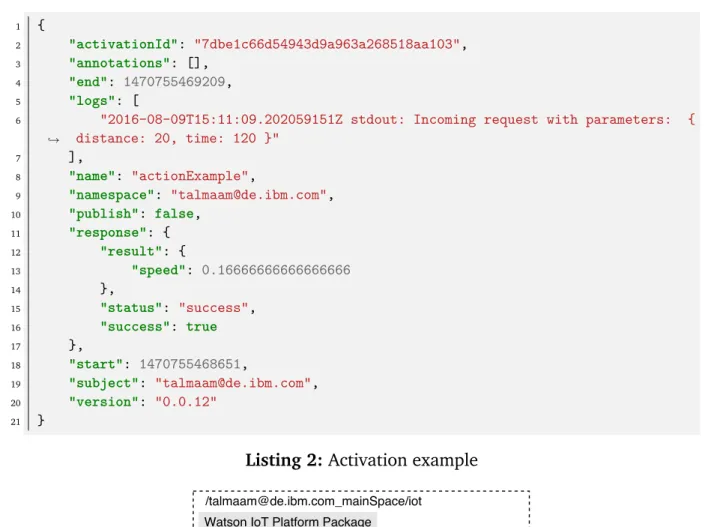
• Activation: A record that contains information about action invocation, triggers firing or rules activation. The information includes a unique id, time of start and end of execution, version number, as well as the logs and the result returned. List-ing 2 is an example of an activation record. Such information provides important
2.4 IBM Bluemix OpenWhisk
Figure 2.8:Relationship between triggers, rules and actions
information which can help in debugging and analyzing systems built on top of OpenWhisk.
• Package: A group for organizing related actions and feed actions. Packages in OpenWhisk can have global parameters, so that, whenever an action or a feed action is invoked, the global parameters of the package are passed as well. Figure 2.9 shows an example of Watson IOT platform package, which contains a feed
action webhookto register receiving events which are sent to the platform, as well as other actions to interact with the Platform.
• Namespace: Class of all entities; packages, actions, feed actions, triggers, rules and activations which belong to a namespace.
• Packages and Namespaces: Each namespace N may contain a set of packages, actions, feed actions, triggers, rules and activations. Each package may contain actions, feed actions, triggers and rules.
2.4.3 System Design / Architecture
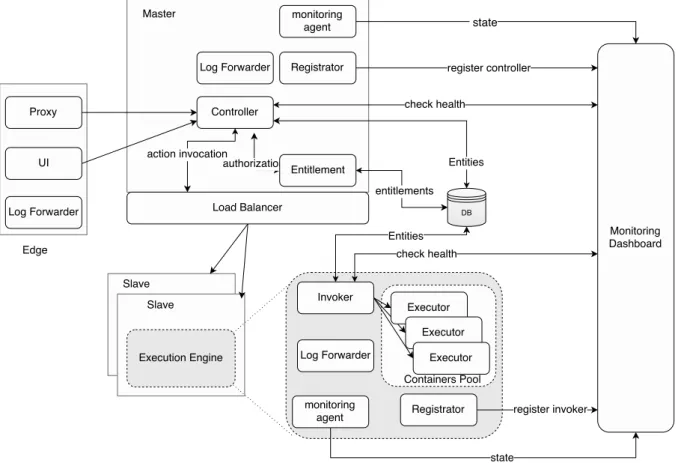
As shown in Figure 2.10 (inspired by [Sut16]), OpenWhisk is a microservice-based sys-tem where each component is a microservice that is implemented, tested, integrated and deployed independently. OpenWhisk consists of 1) Edge, 2) Controller and 3) Invokers. The edge is the component that manages the access to the system, which contains a
1 {
2 "activationId": "7dbe1c66d54943d9a963a268518aa103",
3 "annotations": [],
4 "end": 1470755469209,
5 "logs": [
6 "2016-08-09T15:11:09.202059151Z stdout: Incoming request with parameters: {
distance: 20, time: 120 }" ,→ 7 ], 8 "name": "actionExample", 9 "namespace": "[email protected]", 10 "publish": false, 11 "response": { 12 "result": { 13 "speed": 0.16666666666666666 14 }, 15 "status": "success", 16 "success": true 17 }, 18 "start": 1470755468651, 19 "subject": "[email protected]", 20 "version": "0.0.12" 21 }
Listing 2:Activation example
Figure 2.9:Package Example: Watson IOT Platform Package
proxy where OpenWhisk CLI and the different OpenWhisk Software Development Kit (SDK)s can be downloaded from. In addition, it forwards the different requests to the controller to handle it. The controller receives the request such as package creation. Before processing the request, the controller checks whether the request is authorized, and if the request is not an action invocation, the controler then serves it and responds directly with the result. If the request is an action invocation, the controller assigns it to an available Invoker to execute the action. Each Invoker has a pool of containers
(execu-2.4 IBM Bluemix OpenWhisk
tors) of different runtimes, an Invoker receives the request and assigns it to an available executor or creates a new executor to execute it and store the result or the invocation state into an activation record. All entities and entitlements are stored persistently in a document-based database (Cloudant/CouchDB). To ensure availability and maintain reliability, all components are monitored by explicit registration and repeatedly update their states through a monitor agent to the monitoring dashboard.
Figure 2.10:System Architecture
2.4.4 OpenWhisk Services Ecosystem
Powerful applications outsource some of their secondary work, tasks or features to external services such as storage and database capabilities to get rid of many complexities like taking care of eventual consistency in databases. They also allow applications to focus more on business logic and improve the expenses. OpenWhisk provides an ecosystem of a collection of packages for external services which help applications to use such services efficiently. This master thesis focuses on enriching this ecosystem. Chapter 4 – Services Categorization, Integration and Enablement provides more information.
2.4.5 Specifications and Characteristics
To have a better understanding of OpenWhisk, different characteristics and specifications of OpenWhisk are described as follows:
• Openess: OpenWhisk is open-sourced, and therefore, its code is exposed and publically accessible, and developers and specialists can see what is under hood, contribute and get involved. Typically, being open-sourced makes hard-to-measure technical aspects such as reliability and security more visible. Furthermore, open-ness provides many busiopen-ness benefits as well, such as the flexibility by licenses and escaping from vendor lock-in [MF07].
• ExtensibilityOne of the special cases of design for change is extensibility which is the ability to add new features and capabilities with slight or no effects on the existing design of a system [Par79]. OpenWhisk allows to add more action runtimes (action containers) with no changes on the current design of OpenWhisk. Adding more actions runtimes can be done through action containers API except light changes on the controller and invoker to add some properties of the new runtime such as the requirements to execute an action within the new action container (action runtime) (e.g. “code” for JavaScript action and “image name” for containers) [Sut16].
• Throughput: OpenWhisk caches the executed actions (actions containers), which leads to higher throughput of actions execution and improvement of the overall throughput of systems that are built on top of OpenWhisk.
• Quality: Generally, open-sourced software are known to be of a higher level of quality due to the open-source community contributions, peer reviews and suggestions for imporvements.
• Immutability and Versioning: Actions are immutable, and to make changes on actions, changes are done locally and then they are committed to create a new version. Versions can be accessed through the different interaction means such as CLI, REST API and the UI.
• Asynchronous and Synchronous Invocation: Variation of invocation paradigms provides more options to support different needs and requirements of systems. Thus, more powerful systems can be built by using both paradigms. OpenWhisk provides the choice to invoke actions synchronously (blocking) as well as Asyn-chronously (non-blocking). In the case of blocking invocation, the process of invoking an action is blocked till the action returns an output, throws an error or triggers an interrupt signal (e.g. timeout). In case of non-blocking, an activation
2.4 IBM Bluemix OpenWhisk
id is returned immediately which may include the output of the execution in case of success invocation.
• Real-Time Pipeline Processing and Content Enriching: Actions sequence pro-vide a mean of realtime pipeline processing, where an output of an action is passed as input of the next action in the chain. Actions sequence can act as a content-enriching as it enriches the input from the previous action in the chain and passes it as input to the next action.
• Sharing: Entities such as packages, actions and feed actions can be publically shared which allows other users to get benefit from it.
• Statelessness: Statelessness is a design paradigm where the state data of an action is separated and hosted somewhere else. Actions are stateless where statuses are not available across invocations. Thus, state data should be externalized, and this can be achieved by using other services.
• Request-Response Pattern: OpenWhisk is accessible through REST where a requester sends a request such as a request to invoke an action to OpenWhisk. Based on the execution paradigm specified in the request, OpenWhisk responds by either an activation Id in the case of non-blocking execution or by the activation record itself (including the execution output) in the case of success blocking execution.
• Ordering: Order of Actions invocation or firing triggers is not guaranteed. Open-Whisk is accessible through REST API which is HTTP/Transmission Control Proto-col (TCP)based protocol where requests are not ordered. Hence, ordering is not guaranteed [Ope16].
• Idempotent: Idempotent operation is an operation that can be applied multiple times with no change on the result. This can be expressed mathematically as
f(x) =f(f(x)). OpenWhisk actions are idempotent, even if OpenWhisk does not enforce this property [Ope16].
• At-most-once Semantic: When requesting for action invocation, OpenWhisk records the incoming request and dispatches a new activation for it. OpenWhisk replies with the activation Id in the case of non-blocking invocation to confirm receiving the request. OpenWhisk will attempt to to invoke the action once with one of the following output [Ope16]:
– Success: Invocation is completed with successful action execution.
– Application error: invocation is succeeded, but an error within the action itself is returned on purpose.
– Action developer error: Action invoked successfully with abnormal and uncompleted execution due to some problems with the action implementation itself such as existing of syntax errors.
– Whisk internal error: OpenWhisk is unable to invoke the action, and the result is recorded in thestatusobject within the activation record.
2.5 Serverless Computing Providers
Serverless computing is a hot topic in cloud computing due to its significant impact on software architecture. This section goes through different serverless computing providers and explores them to provide a clear overview about of the differences between them. Thus, users can decide which provider to use based on their requirements. Here, we will briefly analyze the most popular serverless providers from different aspects such as the different system limitations.
2.5.1 Amazon Web Services Lambda
Besides the most popular service by AWS Elastic Compute Cloud (EC2), AWS Lambda is also getting more lighter. AWS Lambda is the first serverless computing services provider (refer to 2.3 for more information about serverless computing). Lambda allows you to upload your code with its dependencies (called Lambda function) and execute such functions with AWS infrastructure. Hence, all complexities of the underlying infrastructure are hidden. Functions can be written in NodeJS(JavaScript) v0.10.36and
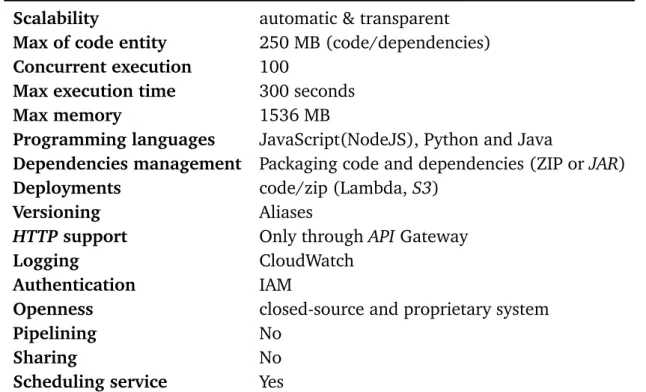
v4.3.2 but not v6.0, Python 2.7 or Java 8. In addition, functions can be executables as they can be run using spawning child processes [Wag15]. Unfortunately, there is no support for containers which is a good option, especially when there is a need to execute binaries and other non-supported runtimes without spawning child processes. Lambda functions can be invoked through theUser Interface (UI), AWS CLI or through the REST API using AWS API Gateway. Unfortunately, there is no support for direct invocation through HTTP requests which can be done by separating API manager (AWS API Gateway). Lambda also supports versioning (Immutable versions) through Lambda Aliases, which is a pointer for a specific Lambda functions, each version of the same function has different Alias. As any other serverless computing provider, AWS Lambda limits the underlying resources as shown in table 2.1 [Ser16]:
2.5 Serverless Computing Providers
Scalability automatic & transparent
Max of code entity 250 MB (code/dependencies)
Concurrent execution 100
Max execution time 300 seconds
Max memory 1536 MB
Programming languages JavaScript(NodeJS), Python and Java
Dependencies management Packaging code and dependencies (ZIP orJAR)
Deployments code/zip (Lambda,S3)
Versioning Aliases
HTTPsupport Only throughAPI Gateway
Logging CloudWatch
Authentication IAM
Openness closed-source and proprietary system
Pipelining No
Sharing No
Scheduling service Yes
Table 2.1: AWS Lambda limits & properties
Besides the above resources limitations, quota plans can be used to limit a specific consumer with predefined plans, so that, a single consumer is restricted to a specific number of function executions. Lambda Functions executions are logged using the AWS
CloudWatch service. The logs contain different records such as the memory used, the maximum memory that is available for the function, execution duration time and the code size.
2.5.2 Google Cloud Functions
Google Cloud Functions at the moment of writing this thesis is still an alpha. Like any other serverless provider, Google Cloud Functions provide services for executing codes in serverless manner in response to events or as a direct invocation through different means. Until now, JavaScript (NodeJS) is the only supported programming language. Google Cloud Functions supports NPM to manage NodeJS dependencies. Invocation and management of functions can be done through Google Cloud CLI as well as a built-in support of HTTP requests. Google Cloud Functions have two flavored functions, HTTP and Backgroundfunctions. HTTP functionsare these functions which can be accessible through HTTP requests, such functions are fully HTTP controlled which can handle all HTTP operations. The other functions called Background Functions that are executed
on response to events. The only difference between the two mentioned flavors is the signature of the function. Any updates on functions are versioned based on the GIT versioning concept. In addition, logging in Google Cloud Functions is managed by the Google Cloud Logging service. In addition. logs can be also logged to other services such as StackDriver using specific SDK which provides more features to store, search, analyze, monitor, and alert on log data and events from Google Cloud Platform in general.
Scalability automatic & transparent
Max of code entity no limits
Concurrent execution no limits
Max execution time no limits
Max memory 1024 MB
Programming languages JavaScript(NodeJS)
Dependencies management NPM
Deployments ZIP (Cloud Storage Cloud Source Code Repositories)
Versioning Cloud Repositories Service (branches and tags)
HTTPsupport full support
Logging Stackdriver Logging
Authentication OAuth 2.0
Openness closed-source and proprietary system
Pipelining No
Sharing No
Scheduling service Yes
Table 2.2:Google Cloud Functions limits & properties
2.5.3 Microsoft Azure
Another main serverless computing services provider is Microsoft Azure Functions. Azure Functions allows users to execute code or executables as an explicit request or as a response to events. Currently, the supported runtimes are C, NodeJS, Python, F#, PHP, Bash, CMD, Java and also executables. Regarding the dependencies, Azure Functions supports NuGet and NPM. Moreover, they have a full support of HTTP almost the same as Google Cloud Functions. A specific application folder structure as well as an additional configuration file are required to deploy a functions application. Hence, more complexities are introduced when it is compared to other serverless providers. Unlike the other providers, maximum concurrent functions invocations in Azure Functions are
2.5 Serverless Computing Providers
limited by the size of memory assigned and scalability is nontransparent where users are able to see how many instances of computing power are used.
Scalability automatic & nontransparent
Max of code entity no limits
Concurrent execution based on the memory assigned
Max execution time no limits
Max memory 1536MB
Programming languages C#, Node.js, Python, F#, PHP, Batch, Bash, Java, or executable
Dependencies management NuGet and NPM
Deployments SCMservices,FTPand Web deploys
Versioning
-HTTP support full support
Logging embedded
HTTP support full support
Logging Stackdriver Logging
Authentication OAuth 2.0
Openness closed-source and proprietary system
Pipelining No
Sharing No
Scheduling service Yes
Table 2.3:Microsoft Azure Functions limits
2.5.4 Auth0 Webtasks
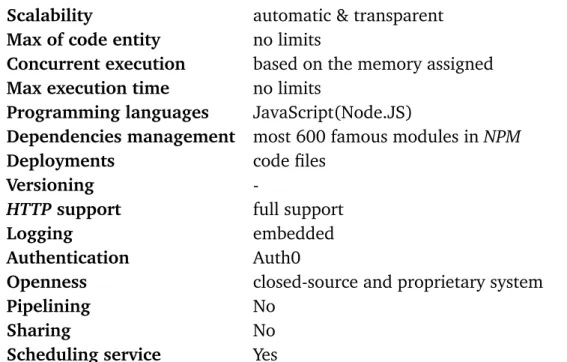
Webtask is another serverless computing services provider. The main idea behind Auth0 Webtask is to execute NodeJs runtime based code upon a direct invocation. In Webtask, the only supported programming language is JavaScript (NodeJS runtime), and other runtimes can be supported through by using Transpilers (Transpilation). It is a source-to-source compilation where a source-to-source code written in programming language is translated into another programming language. In case of Webtasks, it is translated into NodeJS using specific NodeJS modules to achieve this. Dependencies in Webtasks are limited to the most popular 600 modules in NodeJS. The code units in Auth0 are called Webtasks, and a Webtask is a snippet of code written in JavaScript or another programming language (that can be traspiled as mentioned before). Webtasks have a full HTTP support, and it comes with three different function signatures (callback only, context and callback as well as a signature for the HTTP support function (request, response and
callback)). Webtasks can be invoked and managed through two means, using REST API and Webtasks CLI. Authentication in Webtasks is token-based, and tokens are are used to restrict a specific user or an application from using specific Webtask. Hence, Webtask can be restricted by different logics, such as restricting a specific Webtask to execute code from a specificUniform Resource Locater (URL), or restricting the execution of a Webtask by a point of time (e.g. executing before or not after a specific point of time). Moreover, Auth0 Webtasks provides a mean of persistency during Webtasks execution, so that, states can be stored and accessed during different execution of a Webtask. Above that, standard output and errors are logged and can be accessed through Webtasks REST API and Webtasks CLI in a real-time manner.
Scalability automatic & transparent
Max of code entity no limits
Concurrent execution based on the memory assigned
Max execution time no limits
Programming languages JavaScript(Node.JS)
Dependencies management most 600 famous modules inNPM
Deployments code files
Versioning
-HTTP support full support
Logging embedded
Authentication Auth0
Openness closed-source and proprietary system
Pipelining No
Sharing No
Scheduling service Yes
Table 2.4: Auth0 webtasks limits
2.5.5 Overall Comparison
To have an overview of all serverless providers, table 2.5 is a summary of what have been discussed in this section, the table summarizes the differences between the observed providers in various aspects.
2.5 Serverless Computing Providers Provider IB M OpenWhisk A W S L ambda Azure F unctions Google F unctions Auth0 W ebtasks Scalability transparent transparent nontransparent transparent transparent Max of code entity 48 MB 250 MB no limits no limits no limits Concurrent ex ecution 100 per namespace 100 per region based on the memory no limits no limits Max ex ecution time 300 s 300 s no limits no limits no limits Max memory 512 MB 1536 MB 1536 MB 1024 MB -Dependencies few NPM modules ZIP or JAR NuGet and N P M NPM 600 NPM modules Deployments code files/J ARs code/zip (Lambda, S3 ) SCM services, FTP and W eb deploys ZIP (Cloud Storage & Cloud Source Code R epositories) code files V ersioning embedded Aliases embedded Cloud R epositories Service (branches and tags) -HT TP support embedded and limited A P I Gateway full support full support full support L ogging embedded CloudW atch embedded Stackdriver Logging embedded Authentication Basic Authentication IAM OAuth 2.0 OAuth 2.0 Auth0 Openness Yes No No No No Pipelining Sequence Action No No No No Sharing Yes No No No No T able 2.5: Serverless providers comparison
3 Related Work
This chapter intends to provide an overview of the related work of the core work of this thesis, in this chapter we explore how the main serverless computing services providers integrate and enable event sources as well as what are the different means to interact with events.
3.1 Amazon Web Services Lambda
AWS Lambda provides only what is called lambda functions, but there are no additional tools to support real-time pipelining or rule management. Event sources in AWS Lambda are limited to a few of AWS services which are API Gateway, AWS IOT, Alexa Skills Kit, Alexa Smart Home,CloudWatch Events - Schedule, CloudWatch Logs,Cognito Sync Trigger, DynamoDB, Kinesis, S3and SNS. As Lambda is a closed-source and propriety system, it is hard to have a deeper look at the current used mechanisms to subscribe and receive events from events sources. According to Lambda, both models (poll and push) are used to get events from the services mentioned above. Moreover, the absence of additional tools such as a tool to provide the ability to easily enable and disable single event sources from executing specific function introduces another deficiency of Lambda. In addition, event sources are not categorized, which provides a lower quality user experience [Ser16].
3.2 Google Cloud Functions
Event sources in Google Cloud Functions are limited to only two services Google Cloud Pub/Sub and Google Cloud Storage. Further different event sources might emit their events throughGoogle Cloud Pub/Sub. Google Cloud Pub/Subsupports both models to receive events, push using what is called Webhooks and poll models. Google Cloud Functions is also closed-source. Therefore, it is hard to have a deeper look at the mechanisms used to integrate with the event sources. Like AWS Lambda Functions,