Performance Analysis of LMS and Normalized LMS
Adaptive Filter Algorithms
Ramesh Yadav
1, Mr. Deepak Sharma
2 ME Scholar1, Associate Professor2CSIT, Durg
Abstract - Interference is the major problem in wireless communication. And suppression of interference or noise of a noisy signal is not an easy task when the frequency varies and having Gaussian noise. Frequently used filter like BPF, LPF has taken to de-noise, i.e. useful for the fix bandwidth, but if bandwidth is not fixed and it varies with respect to time, then it requires advance filter that can able to adjust the bandwidth of the desired signal like an adaptive filter which update its weight vector automatically and adjust the bandwidth of the desired signal. This paper analyzes the performance of LMS & Normalized LMS adaptive filter in the basis of taking output parameters like RMS value, Mean and Median of the de-noising signal. This paper also gives the brief detail of the adaptive filter.
Keywords - RMS value, Mean, Median & Adaptive Filter
________________________________________________________________________________________________________
I. INTRODUCTION
The Wireless communication system is the fastest growing trends in the markets and competition is growing even more. More communication system increases more interference or noise to others so reduce the interference , required more generalized and advance competitive filter like Adaptive filters. These are mainly used for (i) adaptive equalizer system used for removing inter symbol interference, [1],[2] (ii) echo cancellation system, generated by the system itself [2]and (iii) de-noising system where message signal corrupted by the noise,[3] i.e. Gaussian or random generated signal, this noisy signal subtracted by reference signal i.e. noise and get back the original signal[4]. There are various adaptive filter algorithms like LMS algorithm, RLS algorithm, MVDR algorithm, etc. These different algorithms are used for different application. This paper considers LMS algorithm and Normalize LMS algorithm for de-nosing the signal and analyzes its various parameters.
An adaptive filter algorithm based on adaptation processes, i.e. It updates its tap weight vector automatically of the filter according to the incoming signals. This paper analyzes the de - nosing of the received signal from the system.
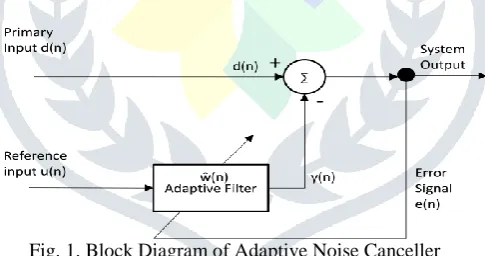
Fig. 1. Block Diagram of Adaptive Noise Canceller
This is the setup for a noise canceller system of adaptive filter. Noisy signal is provided to system as a primary input and interference or noise also provided to the system as a reference signal for the system. Analyzing the performance of the LMS and Normalized LMS filter on the basis of the input parameter and output parameters of the system.
II. ADAPTIVE FILTER ALGORITHM
LMS Filter
The LMS (Least Mean Square) filter is a linear adaptive algorithm. It consists two main processes a) filtering process – It shows the estimated error by comparing the output signal and desired signal b) adaptation process – according to the estimate error, it automatically adjusts of the tap weights of the filter [2],[5].
There are three basic relations in LMS filter
1. Filter Output : y(n) = ŵ𝐻(n) u(n) (1)
2. Estimated Error : e(n) = d(n)-y(n) (2)
3. Tap – weight adaption : ŵ(n+1) = ŵ(n)+μu(n)e*(n) (3)
Here u(n) is the tap input signal, y(n) is the output signal, d(n) is the reference signal for interference and e(n) is the error signal. Ŵ(n) is the weight vector of the filter.
Where M is the maximum power value of the power spectral density of the tap input u(n) and the M is the filter length.
Normalized LMS Filter
It is a Normalized Least Mean Square algorithm. This is used to normalize the high input power of input vector u (t). When a high power signal comes in input vector, then LMS filter suffers gradient noise amplification problems. To overcome this problem, adjustment in tap weight vector of the filter at iteration (n+1). Step size of the filter is under the control of the designer. It supports the real value’s error e (n) as well as complex conjugate error *e(n)[2],[6].
The mathematical relation of the filter is given bellow. e(n) = d(n) - ŵ𝐻(n) u(n) (4) ŵ(n+1) = ŵ(n) + ũ/(||u(n) ||2) u(n) *e(n) (5)
ŵ(n) is a old weight vector of the filter with n iteration and ŵ(n+1) is the updated weight vector of (n+1) iteration. ũ is the adaptation constant. The conversion rate is much faster than conventional LMS filter.
III. SIMULATION AND RESULTS
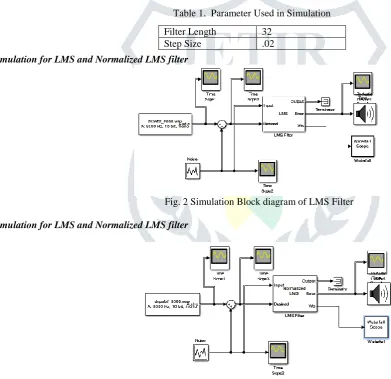
Simulation is done in MATLAB/Simulink software, where it has been taken Gaussian Noise signal as an interference signal to the input signal. It has been simulated for two adaptive filters. It has been set following parameters of these systems.
Table 1. Parameter Used in Simulation
Simulation for LMS and Normalized LMS filter
Fig. 2 Simulation Block diagram of LMS Filter
Simulation for LMS and Normalized LMS filter
Fig. 3. Simulation Block Diagram of NLMS Filter
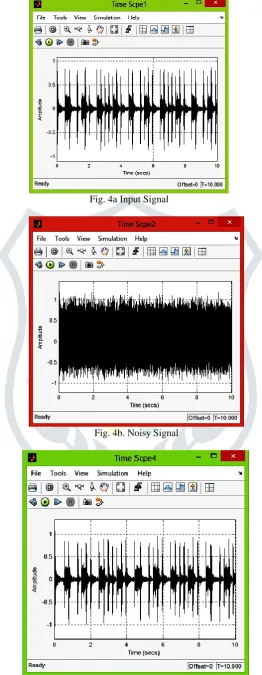
This is the arrangement for the Noise canceller system by LMS filter and Normalized LMS filter. One audio source (wav file) is used as a desired with the interference of Gaussian noise. Interference signal or noise signal taken as a reference signal for the system. Input signal and the output signal are observed by time scope and audio device produced the de-noised signal. Output parameters are Mean, Median and RMS value. Frequency is also a comparable parameter. Comparing these values to LMS and Normalized LMS filters and analyzed its performance.
A. Input , Interference and Output Signals
The equations are an exception to the prescribed specifications of this template. You will need to determine whether or not your equation should be typed using either the Times New Roman or the Symbol font (please no other font).To create multileveled
Filter Length 32
Fig. 4a Input Signal
Fig. 4b. Noisy Signal
Fig. 4d. Normalized LMS Filtered Output Signal
B. Plotting Graph for Mean, median and RMS value
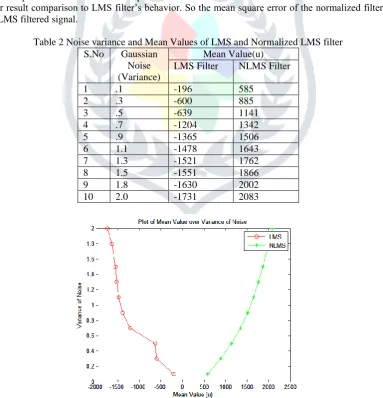
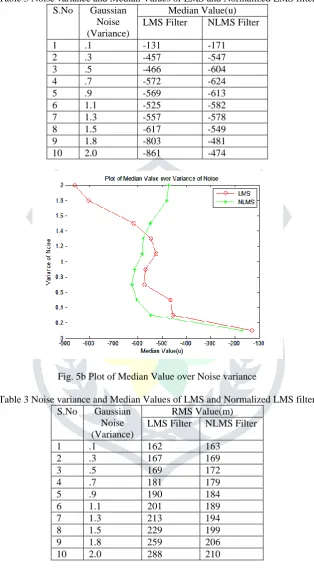
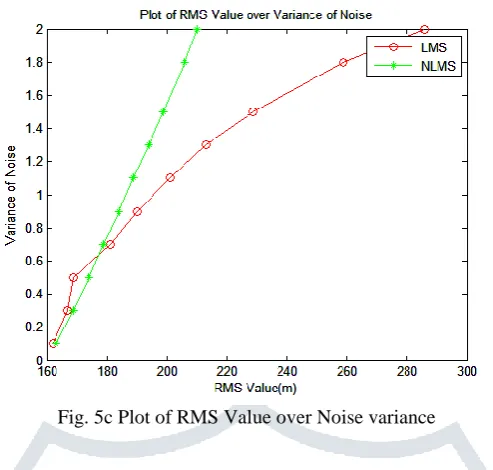
It has been compared the behavior of LMS Filter and Normalized LMS filter. In first plot mean of LMS filter is moving to the left (negative mean) and Mean moves to the right (Positive Mean) in Normalized filter. Increasing the variance of noise, affects the mean value of the filter. Normalized LMS filter shows linear behavior of the mean value and less affected. In the second plot of median value both filters show nonlinear behavior [7], but at the end normalized LMS filter improve its median value. And LMS filter does not improve its value. In the third plot normalized LMS filter shows linear behavior and less affected by noi se and shows a better result comparison to LMS filter’s behavior. So the mean square error of the normalized filtered signal is also low compared to LMS filtered signal.
Table 2 Noise variance and Mean Values of LMS and Normalized LMS filter S.No Gaussian
Noise (Variance)
Mean Value(u) LMS Filter NLMS Filter
1 .1 -196 585
2 .3 -600 885
3 .5 -639 1141
4 .7 -1204 1342
5 .9 -1365 1506
6 1.1 -1478 1643
7 1.3 -1521 1762
8 1.5 -1551 1866
9 1.8 -1630 2002
Table 3 Noise variance and Median Values of LMS and Normalized LMS filter S.No Gaussian
Noise (Variance)
Median Value(u) LMS Filter NLMS Filter
1 .1 -131 -171
2 .3 -457 -547
3 .5 -466 -604
4 .7 -572 -624
5 .9 -569 -613
6 1.1 -525 -582
7 1.3 -557 -578
8 1.5 -617 -549
9 1.8 -803 -481
10 2.0 -861 -474
Fig. 5b Plot of Median Value over Noise variance
Table 3 Noise variance and Median Values of LMS and Normalized LMS filter S.No Gaussian
Noise (Variance)
RMS Value(m) LMS Filter NLMS Filter
1 .1 162 163
2 .3 167 169
3 .5 169 172
4 .7 181 179
5 .9 190 184
6 1.1 201 189
7 1.3 213 194
8 1.5 229 199
9 1.8 259 206
Fig. 5c Plot of RMS Value over Noise variance IV. DISCUSSION
It has been compared the behavior of LMS Filter and Normalized LMS filter. In first plot mean of LMS filter is moving to the left(negative mean) and Mean moves to the right(Positive Mean) in Normalized filter. Increasing the variance of noise, affects the mean value of the filter. Normalized LMS filter shows linear behavior of the mean value and less affected. In the second plot of median value both filters show nonlinear behavior, but at the end normalized LMS filter improve its median value. And LMS filter does not improve its value. In the third plot normalized LMS filter shows linear behavior and less affected by noise and shows a better result comparison to LMS filter’s behavior. So the mean square error of the normalized filtered signal is also low compared to LMS filtered signal.
V. CONCLUSION
By analyzing these two filters, and comparison shows in each parameters. Normalized LMS filter shows better results than LMS filter. Normalized LMS filter’s behavior is linear in all the parameters. And Normalized filter less affected by Gaussian noise when increasing the variance. So the normalized LMS filter is the best choice for noise cancellation system. And filtered signal’s frequency of the normalizes LMS filter is much closer to the original signal’s frequency.
LMS filter is the simple and easy to understand its functionality. Its convergence rate is slow. The normalized LMS filter is more complex than LMS filter, but better for the high power interference.
REFERENCES
[1] Paulo.S.R.Diniz, “Adaptive Filtering Algorithms and Practical Implementations”, Kluwer Academic Publishers ,London. 2nd Edition.
[2] S. Haykin. Adaptive Filter Theory, 4th Edition Pearson Education, 2008. [3] Monsoon .H.Hayes, “Statical Digital Processing And Modelling “, Wiley India.
[4] S.Radhika1 Sivabalan Arumugam, “A Survey on the Different Adaptive Algorithms Used In Adaptive Filters”, International Journal of Engineering Research & Technology (IJERT), Vol. 1 Issue 9, pp.1-5 November- 2012.
[5] Raj Kumar Thenu & S.K. Agarwal , “Simulation And Performance Analysis of Adaptive Filter in Noise Cancellation”, International Journel of Engineering Science And Technology Vol 2(9), pp. 4373-4378, 2010
[6] Leonardo Rey Vega, Hernán Rey, Jacob Benesty, Senior Member, IEEE, and Sara Tressens, “A New Robust Variable Step-Size NLMS Algorithm”, IEEE TRANSACTIONS ON SIGNAL PROCESSING, VOL. 56, NO. 5, pp. 1878-1893, MAY 2008.
[7] W. A. Sethares, Member IEEE and J. A. Bucklew, Member IEEE, “Local Stability of the Median LMS Filter”, IEEE TRANSACTIONS ON SIGNAL PROCESSING, VOL. 42, NO. 11, pp. 2901-2905, NOV 1994.
[8] Sayed. A. Hadei, Student Member IEEE and M. lotfizad, “A Family of Adaptive Filter Algorithms in Noise Cancellation for Speech Enhancement”, International Journal of Computer and Electrical Engineering, Vol. 2, No 2, April 2010.
[9] V.JaganNaveen , T.prabakar , J.Venkata Suman , P.Devi Pradeep, “Noise Suppression in speech signal using adaptive algorithms”, International Journal of Signal Processing, Image Processing and Pattern Recognition, Vol. 3, No. 3, September, 2010.
[10] Danilo P. Mandic, “ A Generalized Normalized Gradient Desent Algorithm”, IEEE Signal Processing Letters, Vol. 11, No. 2, pp. 115-118, FEBRUARY 2004
[11] R.H. Kwong And E. W. Johnston, “A Variable Step Size LMS Algorithm,”IEEE Trans. Signal Process., Vol. 40, No. 7, Pp. 1633–1642,Jul. 1992.
[13] Ying He, et. al., “The Application And Simulation of Adaptive Filter in Noise Cancelling”, International Conference on Computer Science And Software Engineering, Vol 4, pp. 1-4, 2008.
[14] Rajeev Shrivastava1& Sonali Mishra, “Performance Analysis Using LMS and RLS Alhorithms of Noise Cancellation in Speech Signal.