TECHNO–ECONOMIC ANALYSIS OF DISTRIBUTED SPV
BASED AC MICRO-GRID VS DC MICRO-GRID
Abrar Ahmad1
1.INTRODUCTION
There is significant increase in global consumption of electricity by DC devices, presently powered by AC mains via multitudinous individual transformers. For example lighting load comprises around 20% of total electricity consumption and a recent report for IEA estimates that up to 15% of domestic energy consumption is by electronic gadgets that is converted from AC to DC and incurs a significant loss of energy while conversion and transformation. In this paper we propose to have DC equipments designed to be operated on DC power without the use of inverters to decrease load and losses [8]. We also propose LEDs which runs on DC Power as a preferred option for high efficiency lighting as it also inherently operates on DC Power [1].
Many small scale Renewable including PV solar and micro wind turbines that inherently generates low voltage DC Power. Most of these generators supplies power to AC mains network and thus requires costly and in-efficient power inverters, even when the power is ultimately delivered to the DC devices. As the need of electricity especially in the un-electrified villages is comparatively less due to rural way of life, less electricity loads, and lesser development; the model we propose here is sufficient to meet these requirements.
In term of AC grid, transmission losses accounts up to 35% percent in India and has limited reach in terms of far flung areas [2]. Considering this fact distributed generation has lots of advantage over the conventional grid, especially for those places where the electrification is still a dream and it is not likely to be electrified in many years to come. For example top 5 states e.g. Jharkhand, Orissa, Bihar, U.P and Rajasthan comprises 28.77% of un-electrified villages in India. Nationally there are 89808 villages that are un-electrified out of 593732 which amount to be 15% of whole India is still without power [6]. In other words every 6th village of India is un-electrified. The detail of un-electrified villages in India is presented in Table 1.
Table 1: Un-electrified Villages in India (MNRE- As on 31.08.2010)[7]
S. No. State Total Villages Un-electrified Villages
Percentage Un-electrified Villages
1. Jharkhand 29354 20235 31.1%
2. Orrisa 47529 17794 62.6%
3. Bihar 39015 12216 68.7%
4. Uttar Pradesh 97942 11492 88.3%
5. Rajasthan 39753 11228 71.8%
6. Others 340139 16843 4.95%
Total 593732 89808 15.12%
1
Jamia Millia Islamia, New Delhi, India
Abstract-The rising influx of Solar Photo Voltaic (SPV) and other distributed generation sources has opened up new possibilities of electrical energy manoeuvring. DC form of electricity which has been dominated by AC since its birth is now competing it due to rising share of DC loads such as computers, CFL, and other solid state devices. In this paper we analyze the technical and economic comparison between an SPV based AC grid Vs SPV based DC grid for a far flung rural un-electrified village. This paper concludes that a reduction of 35% load and 42% cost is possible by just switching to a purely DC based grid fed by SPV as compared to SPV fed AC micro-grid. In this paper load requirements in both the systems AC as well as DC based on equipments rating for the same application have been compared. This paper also compares the financial burden for the same amount of load e.g. wind requirement (fan sweep area), lighting lumens, and other electronic devices. Another key advantage of DC grid is that it has low risk of dangerous electric shocks. However, this approach is not very appropriate for fulfilling the luxurious needs such as Air Condition and refrigeration etc. This paper proposes an appropriate techno-economic solution for far flung rural loads especially relevant for 90 thousands un-electrified villages in India.
Keywords: DC Micro grid, AC Micro grid, Rural Electrification, Distributed Generation
The objective of this paper is to propose a cost effective stand alone SPV system for electricity generation which would supply the basic need of electricity for villages. The system is designed to neglect the use of inverter and use the DC power received from sun in its original form to the DC load.
2.DCMICRO GRID
A micro-grid consists of interconnected distributed energy resources capable of providing sufficient and continuous energy to a significant portion of internal load demand. DC Micro-grids can be deployed in a portion of a building, building wide or covering several buildings. It is a small scale power supply net work that is designed to provide power for a small community. It enables local power generation for local needs. [7]
Main features of DC grid are that here synchronization of distributed generators are not necessary and fluctuation of generated power of distributed generators and load power can be compensated in the dc line by using energy storage devices. Furthermore loads are not affected by voltage sag, voltage swell, three-phase voltage unbalance, and voltage harmonics. Along with this even power quality is not affected by Inrush current, single phase loads and single-phase generators and higher efficiency than AC micro-grid is expected due to less transmission losses, converter losses, transformer losses etc.
3.SPV WITH ACMICRO-GRID
Figure 1 - Block Diagram of SPV with AC Load for a typical household[4]
Figure -1 suggests the normal operation of solar PV system where we are feeding the household loads through inverter directly and the extra power from that solar is fed to battery for storage. All these loads are actually designed to be worked on AC Supply system that is the default supply system in the world today. There are many devices such as Mobile, laptop, computers and other electronic gadgets which are inherently DC driven equipments, But due to prevalence of AC System and absence of DC supply system these devices involve inversion from DC to AC and again AC to DC for these equipments, therefore two step conversion and inversion takes extra equipment that comes as a financial burden as well as electrical loss that comes as extra load burden. [4]
3.1 Load Requirement:
In the hose hold environment of remote areas, following loads are worth consideration for one house, hereby referred as „Home-Module‟. It is assumed for a household load comprising of four Lighting / Illumination load of 1000 lumens intensity per lamp, two fans with 400mm sweep area and 1350RPM speed per house hold, a mobile charger or radio with 5W and a TV with 70W wattage. The Micro-grid is assumed to be comprised with 100 such modules dispersed around the full terrain of a village. The PV is installed at the top of all houses or other such open spaces in the village. All these panels are connected to separate battery banks and all the modules are interconnected by 2 wire distribution system. Transmission loss that occurs in transmission is also considered. It is found that in conventional electrical transmission the losses in AC and DC transmission are comparable a slightly favourable to DC. Here transmission loss is considered as 20% for AC transmission and 15% in DC distribution losses.
charger of 5 watt is considered along with a colour TV set of 70Wattage per household. Total load for SPV based AC Micro-grid is estimated to be 33KW. The detail breakup is as follows.
Table 2 – Load Analysis for AC Micro-Grid
S. No. Device Rating Quantity Total Load in Watt
1. CFL (AC) 20W,
1000 Lumens
400 8000W
2. AC Fan 60W,
400 mm, 1350 rpm,
200 12000W
3. Radio/ Charger 5W 100 500W
4. TV 70W – 19” Colour TV 100 7000W
TOTAL - 27500W
Transmission Loss Load
@ of 20% of total load 5500W
Grand Total 33000W
3.2 Cost Involvement:
The cost involvement in AC environment is accounted in the table – 3. Most economic way of lighting equipment in AC environment i.e. CFL is considered lighting purpose that costs around Rs 175, similarly AC fan with 400mm sweep area is considered for costing, while common prices of Panel and installation is considered for costing. The detail breakup is tabulated in the following table. The total coast for a 100 house based AC Micro-grid is costing Rs 2310000 neglecting the distribution system (2 wire line) expenditure.
Table 3 – Cost analysis of AC Micro-grid
S. No. Equipment Name
AC Equipment Ratings Equipment Quantity
Cost per
Equipment in ₹ Total Cost in ₹
1. Lighting 20W CFL,
1000 Lumens 400 175 70000
2. Fan 35W,
400 mm, 1350 rpm 200 2000 400000
3. Inverter 300 VA 100 4000 400000
4. PV Panel 275 W 100 9400 940000
5. Cost of
Installation N.A 100 5000 500000
Total cost 23,10000
3.3SPV WITH DC MICRO-GRID
The following figure 2 is an alternative that is being proposed here. Solar PV is directly feeding DC load instead of converting it to AC. The energy coming from solar PV through charge controller is directly fed to DC equipments and the extra electricity is feed to recharge the batteries. The DC Micro-grid here is composed with 100 household loads as mentioned above.
3.4 Load Requirement:
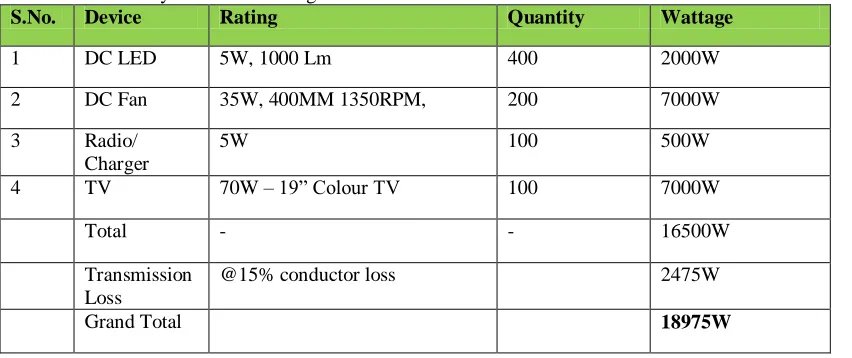
The following table 4 details the DC equipments alternative for a household with same amount of lumen, sweep area, and Electronics equipment rating. Here DC LED is used with 5W, 1000 lumen rating, DC Fan with 35W, 400MM 1350RPM, and radio / charger and TV with same wattage as of AC supply system are taken. Here again a DC micro-grid comprising of 100 household is considered for study. The total load to the DC Micro-grid is calculated to be 18.975KW. This load as compared to AC Micro-grid for the same village/area and amenities is 33% less which is a huge reduction in load.
Table 4 – Load analysis of DC Micro-grid
S.No. Device Rating Quantity Wattage
1 DC LED 5W, 1000 Lm 400 2000W
2 DC Fan 35W, 400MM 1350RPM, 200 7000W
3 Radio/
Charger
5W 100 500W
4 TV 70W – 19” Colour TV 100 7000W
Total - - 16500W
Transmission Loss
@15% conductor loss 2475W
Grand Total 18975W
3.5 Cost Involvement:
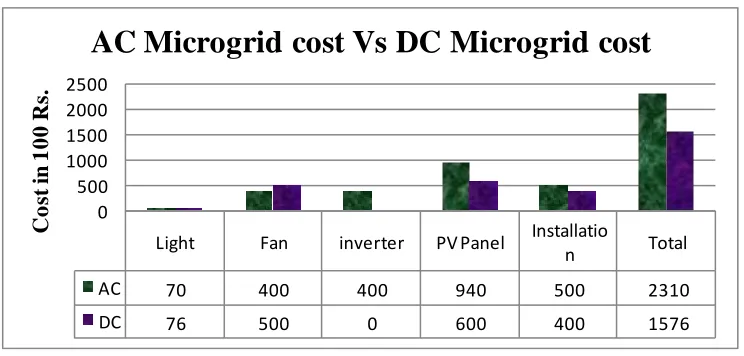
Here in table 5 the cost involvement is done in DC environment. LEDs have been taken into account especially designed to work on DC system. [1] The lumen of DC is taken exactly the same as in case of AC system. Fan is taken of the same sweep area and rpm as of AC environment. The most notice-able point here is that the cost of Inverter is nil, as in this design inverter has been made redundant. As far PV panel and installation cost is concerned, it has been taken as per industry standards. The total cost involvement in SPV based DC micro-grid for an area with 100 households (as described above) is Rs 1576000. This amount as compared to SPV based AC micro-grid is 42% less. This again is a huge saving in terms of money.
Table 5 – Cost Analysis of DC Micro-grid
S. No. Equipment
Name DC Equipment Ratings
Equipment Quantity
Cost per
Equipment in Rs.
Total Cost in Rs.
1. Lighting 5W LED,
1000 Lumens 400 190 76000
2. Fan 35W,
400mm, 1350 rpm 200 2500 500000
3. Inverter - - - 0
4. PV Panel 165W 100 6000 600000
5. Cost of
Installation - 100 4000 400000
Total cost 15,76000
4. LOADANDCOSTCOMPARISON
Light Fan inverter PV Panel Installatio
n Total
AC 70 400 400 940 500 2310
DC 76 500 0 600 400 1576
0 500 1000 1500 2000 2500
C
o
st
in
1
0
0
R
s.
AC Microgrid cost Vs DC Microgrid cost
Figure 3. Graph comparing the cost involved in AC micro grid and DC micro grid
Installation cost for 2 wire distribution system across the area is neglected as both the system shall require almost comparable amount of installation devices in terms of wire, electrical poles etc. Although it is sure that DC installation cost in any case would be less as compared to AC due to inherent AC problems such as skin effect making wider conductor diameter this adding to extra cost. The difference of cost involved with AC along with grid as compared to stand alone DC system in following ways:
(a) Load reduction and Cost reduction in purely DC Micro-grid is by 33% and 42% respectively as compared to Inverter-converter based AC Micro-grid
(b) The losses in inverter will be eliminated as well as cost of inverter. Instead of going for CFLs we will take diode based lights for lighting which will consume less power for the same amount of illumination.
(c) I Square R losses in AC is 1.25 times I Square R Losses in DC (The power carrying capacity in DC is more than AC due to Skin effect of AC)
(d) AC equipments are costlier than DC. 18 watt bulb actually consumes almost double of wattage due to third & fifth harmonic contents. Thus in DC system this losses can be reduced.
(e) Transformation losses while converting voltage from low to high and high to low voltage while rectification can be saved.
(f) Aside from reducing resource and financial cost, a key advantage of DC based system is that the low risk of dangerous electric shock (redundancy of associated accessories) from low voltage DC makes plug and play grid a possibility. This greatly reduces the installation cost of micro generation and empowers end users to take responsibility for understanding and controlling their energy consumption.
5.CONCLUSION
For the same amount of household requirement, it is concluded that both the load requirement and cost is reduced to a significant level using generated DC power directly to the load. The load requirement is reduced to approximately 67% and the total cost involved is reduced to around 60% of the total cost involved. However, in the environment where AC in ubiquitous, having this isolated model suffers the disadvantage of grid connection. But to the areas where there are no possibilities of grid approachability, this model is extremely useful and highly advantageous.
6.REFERENCES
[1] B. J. Huang, P. C. Hsu, M. S. Wu, K.Y. Chen, “A high-performance stand-alone solar PV power system for led lighting”, IEEE Conference on Photovoltaic Specialists (PVSC), 35th ,pp.2346-48,2010
[2] Mohamed H. Beshr Hany A. Khater, “Modelling of a residential solar stand-alone power system”, IEEE Transactions on Energy Conversion, Vol. 9, No. 3, September 1994.
[3] Bogdan S. Borowy, Ziyad M. Salameh, “Optimum Photovoltaic Array Size for a Hybrid Wind/PV System”, IEEE Transactions on Energy Conversion ,Vol. 9 , No. 3,pp.482-488,1994.
[4] A. Ahmad, A.S. Siddiqui “Techno-economic analysis of standalone solar fed AC Vs DC System”, Solaris International Conference on Energy Security, Global warming and Sustainable climate”, February 4-9, 2012, Varansi, India.
[5] http://www.indiaenergyportal.org/engstats/stat16.htm [6] http://powermin.nic.in/JSP_SERVLETS/internal.jsp [7] http://www.mnre.gov.in
![Table 1: Un-electrified Villages in India (MNRE- As on 31.08.2010)[7] Un-electrified](https://thumb-us.123doks.com/thumbv2/123dok_us/1393680.1650826/1.612.52.511.589.698/table-electrified-villages-india-mnre-electrified.webp)
![Figure 1 - Block Diagram of SPV with AC Load for a typical household[4]](https://thumb-us.123doks.com/thumbv2/123dok_us/1393680.1650826/2.612.127.495.267.484/figure-block-diagram-spv-ac-load-typical-household.webp)
![Figure 2 – PV with DC Load for a typical household [4]](https://thumb-us.123doks.com/thumbv2/123dok_us/1393680.1650826/3.612.148.475.567.737/figure-pv-dc-load-typical-household.webp)