R E S E A R C H
Open Access
Wireless sensor network node optimal
coverage based on improved genetic
algorithm and binary ant colony algorithm
Jingwen Tian
*, Meijuan Gao and Guangshuang Ge
Abstract
Considering the situation of some practical factors such as energy saving of the nodes and the high density of distributing nodes in wireless sensor networks, a wireless sensor network (WSN) node optimal coverage method based on improved genetic algorithm and binary ant colony algorithm is proposed in this paper. The genetic algorithm and ant colony algorithm are improved and fused aiming at their disadvantages. The binary code expects a low intelligence of each ant, and each path corresponds to a comparatively small storage space, thus considerably improving the efficiency of computation. The optimal working node set is computed according to the max-coverage area of working sensor and the min-number of working sensor constraint conditions to optimize algorithm. The simulation results demonstrate that the proposed algorithm can converge at the optimal solution fast and satisfy the requirement of low node utilization rate and a high coverage rate, thus prolonging the network lifetime efficiently.
Keywords:Wireless sensor network, Node optimal coverage, Genetic algorithm, Binary ant colony algorithm
1 Introduction
A wireless sensor network is made up of a large number of sensor nodes which possess perceptual ability, calculation of capacity, and communication ability with self-organizing style. Sensor nodes complete the data collection and trans-mission together. It has wide application such as battlefield surveillance, environmental protection, intelligent home furnishing, and so on [1–6]. However, sensor nodes usually adopt limited-capacity battery to provide energy due to the limit of volume and cost. The energy cannot regenerate or supply. So the coverage and energy consumption are the key problems of wireless sensor network research.
At present, many scholars have done a lot of research for the node location and coverage optimization algo-rithm in wireless sensor network, and some feasible and effective algorithms were proposed such as Huang algo-rithm [7], TianD algoalgo-rithm [8], CCP algoalgo-rithm [9], and so on [10–12]. Chi-Fu Huang and Yu-Chee Tseng pro-posed a polynomial time algorithm (polynomial-time algorithms) in the literature [4]; in the sensor network, it is a distributed protocol method, which has positioning
capabilities, environmental monitoring capability, and fault tolerant capability. Liang Ying, Zeng Peng, and Yu Haibin, in reference [7], proposed using adaptive cluster head communication (cluster-heads communication) method. The method can ensure that energy consumption is balanced in the whole network and can improve the net-work life cycle. Mihaela Cardei and Ding-Zhu Du, in the literature [8], proposed a rule and method to establish a “maximum disjoint set cover problem.”The method is that nodes which are included in the maximum disjoint cover-age area are at work, while other nodes are in a dormant state, which saves the system energy and prolongs the network life cycle. Jia Jie, Chen Jian, Chang Guiran, Zhao Linliang, and Wang Guangxing, in the literature [11], put forward the two based on weighted genetic algorithm and constraint genetic algorithm-based optimization coverage mechanism. According to generated fitness function to do genetic algorithm operation and calculate the sensor net-work, full coverage region is required for the approximation of the optimal set of nodes and complete working node selection, thereby reducing the redundant network and prolonging the survival time of the network. Xu et al. [13–17] proposed a crowdsourcing-based framework for processing mobile network data. Joon-Min Gil and
* Correspondence:[email protected]
College of Information Technology, Beijing Union University, Beijing 100101, China
Youn-Hee Han, in the literature [10], proposed a goal based on genetic algorithm coverage scheduling scheme, using evolutionary global search techniques for monitoring all targets and that can find the optimal coverage set, prolong-ing the network life cycle. Mohamed Aadhil M. and Roselin M.E.J., in the literature [12], using the genetic algorithm to optimize the node placement method, the method can achieve the purpose of optimizing the node coverage.
However, these algorithms have some limitations. The complexity of Huang algorithm is too high, and it could easily lead to the blockage of the channel when the com-munication data is large. The computing complexity and communication complexity of the TianD algorithm are lower, but there are two problems: first, inability to make the redundant nodes of monitoring area boundary dor-mant and second, without consideration of the overlap between node coverage areas, which led to elected ex-cessive working nodes, thus affecting the lifetime of the network. CCP algorithm is not suitable for high-density sensor networks.
Based on the above issues and the special predominance of genetic algorithm and ant colony algorithm possess, a WSN node optimal coverage method based on improved genetic algorithm and binary ant colony algorithm is pro-posed in this paper, based on the location information of the nodes to build node coverage optimization model and then using the improved genetic algorithm and binary ant colony algorithm to solve the optimization model. The op-timal solution is used as the working nodes of wireless sensor networks, the remaining nodes sleep to save en-ergy. The simulation results show that this algorithm pro-posed in this paper effectively improves the coverage rate of the wireless sensor network.
2 Wireless sensor network coverage optimization
2.1 Wireless sensor network coverage
The network coverage is the basic problem of the con-struction of wireless sensor networks. The network cover-age needs to reach the maximum under the conditions that guarantee a certain quality of service (QoS) [18–21], by measuring the network coverage to determine whether the presence of communication blind area and get the monitoring area of wireless sensor network coverage. The sensor node distribution can be adjusted or sensor nodes can be added according to the measurement condition. In addition, by changing the density of the network coverage, the more sensor nodes were deployed in some important areas in order to guarantee the reliability of measured data. Therefore, the network coverage is not only for com-munication coverage and monitoring area coverage but also for better meeting of the needs of certain applications. Generally speaking, quality of service is the measure of wireless sensor network coverage [22].
The wireless sensor network coverage is mainly divided into certainty coverage and the random covering. For the certainty coverage, the coverage area size is determined in order to cover the area using the minimum number of sensors. The certainty coverage is adopted to deploy the sensor nodes of a known region in this paper.
At present, a kind of widely used strategy is choosing part nodes which can be enough to cover the monitoring area as working nodes, at the same time, turn off redundant nodes [23]. A certain number of sensor nodes are deployed in the monitoring area, under the ensuring network con-nectivity in normal condition, letting part of the redundant nodes into low-power sleep state, while the rest of the ac-tive node is used to cover the whole region in the most likely small amount, which form the optimal coverage node set. In the wireless sensor network, the node number in the increased network not only means increased cost but also brings the limited bandwidth congestion because of the inter-node communication conflict. The optimal coverage node set is the minimum node set which does not affect the entire network coverage. This way does not only reduce potential conflicts in a wireless channel and reduce the pos-sibility of competing for access to the media but also save energy in order to prolong the network lifetime [11].
2.2 Wireless sensor network optimization coverage model
Supposed that the target monitoring area A is a two-dimensional plane, and it will be divided intom×ngrid, and each grid area is 1. The N sensor nodes are ran-domly distributed in theA, the sensor node setScan be expressed as S= (s1, s2,⋯,si ,⋯,sN ). The (xi,yi) is the
coordinate of sensor node si in a target monitoring area
A, each node coordinate is known, and effective percep-tion radii are rand si= {xi,yi,r}. Perception range of
nodesiis a circular region with the coordinates (xi,yi) of
node sias the center and the ras the perception radius,
to express with ci= {p∈A|d(p, (xi,yi))≤r, i∈[1, N]},
where,pis an arbitrary point of area A, anddis the Eu-clidean distance. The perception range of the whole sen-sor network is C=∪i∈[1,N]ci, that all network nodes
perceptual range are in union.
There is m×n target point. (a1, a2, ⋯,aj,⋯am×n)
need to be monitored or sensed in target monitoring area A; suppose aj is si perception then d(aj,si)≤r; an
arbitrary point of monitoring areaAis at least perceived by a sensor node. Assume the communication range of sensor node si is a circle with the coordinates (xi,yi) of
nodesias the center and thercas the radius; ifd(si,sj)≤
rc, then the sensor node si and sj can communicate
directly.
Definition 1: given a sensor node setS, the communi-cation network G= (V, E) , {V=S,L(si,sj)∈E} composed
diagramGderived fromSthen the communication dia-gram is connected, whend(si,sj)≤rc.
Definition 2: for the sensor node set S and the target monitoring areaA; if every point ofA is perceived by a sensor node ofSthen theSis a covering set ofA. If the communication diagram derived from S is connected then theSis a connected cover set ofA.
Definition 3: for the connected cover setSand the target monitoring area A, the minimal connected cover set is looking for a minimal subsetS′ S, while the monitoring areaA is covered by S′completely and the communica-tion diagram derived fromS′is connected.
On the basis of energy efficiency, this paper presents optimization goal of a connectivity covering set: ensur-ing that each target point in A is at least covered by a sensor node, at the same time, ensuring that a subset is a connected set.
In order to ensure connectivity, the communication radiusrcis at least two times perception radiusr, namely
rc≥2 r. On this condition, the researchers only need to
consider the coverage problem in the sensor network, if the network is covered then it is connected [24].
LetPcov(x,y,si) represent the probability that any point
As long as there is a sensor node,si covers the
moni-toring point (x,y) then the monitoring point (x,y) is cov-ered by the sensor node set S. So the regional coverage area of sensor node setkis expressed as follows:
AareaðSÞ ¼
The area of monitoring area isAs, the working sensor
node set isS′, the target function of network coverage of working node set is as follows:
f1ðS′Þ ¼AareaðS′Þ=As ð3Þ
whereAarea(S′) is the cover area of working sensor node
setS′.
The target function of nodes utilization rate is as follows:
f2ðS′Þ ¼ jS′j=N ð4Þ
whereNis the total number of sensor nodes, |S′| is the number of working sensor nodes.
The aims of wireless sensor network node optimal coverage are to reduce the sensor node’s utilization and to ensure maximum network coverage at the same time, this is a multi-objective optimization problem. So the
multi-objective optimization coverage model of wireless sensor network is expressed as follows:
maxfðS′Þ ¼ max
f1ðS′Þ; 1−f2ðS′Þ
ð5Þ
3 Improved genetic algorithm and binary ant colony algorithm
3.1 Genetic algorithm
The genetic algorithm (GA) is a kind of self-adapting heur-istic global search algorithm which was derived from imitat-ing the thought of natural biological evolution. In nature, it is a cycle process made up of reproduction-crossover-mutation operators. In the process of searching for the glo-bal optimum solution, GA needs neither the information of gradient nor the calculus computing, it can find out the global optimum solution or near-optimal solution in the solution space with high probability only by operating the reproduction-crossover-mutation operators; thereby, it could reduce the probability of getting into the local mini-mum efficiently.
Adaptive genetic algorithm (AGA) is a kind of GA that has scale reproduction and self-adaptive crossover and mutation operations. In the process of searching for the optimum parameter, AGA changes the crossover prob-ability and mutation probprob-ability adaptively according to the different conditions of individuals in order to keep the diversity of colony and prevent the premature con-vergence; further, it can enhance the calculating speed and precision of the algorithm.
Pc¼
wherePcis exchanging probability,Pmis mutation
prob-ability, fmax is the biggest fitness of colony, favg is the
average fitness of colony, f′ is the bigger fitness of two strings used for crossover, fis the fitness of the individ-ual to mutate.
3.2 Binary ant colony algorithm
The binary ant colony algorithm denotes the parame-ters directly with binary-coding; thus, it can take up less storage space and reduce the complexity of the algo-rithm compared to decimal-coding. Moreover, the tra-versal search capability of binary-coding is better than that of decimal-coding. the 0 and 1 states of bitbjin binary-coding. For all
ver-tex, when j= 2, 3,⋯, N, there are only two directed arcs which point toc0
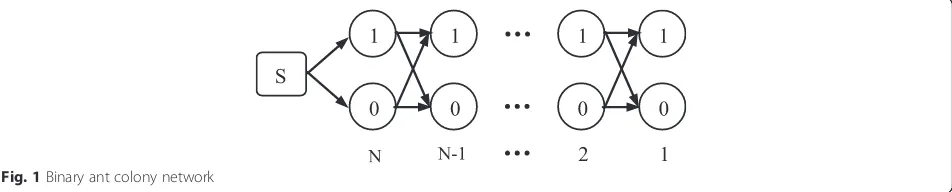
j−1 andc1j−1, these two directed arcs respectively stand for the 0 and 1 states of each ant next step allowed, theNis the binary encoding length, this binary ant colony network is shown in Fig. 1. Each ant travels their own path and then get the solution of the problem by integrating each ant’s traversal solution [26–31].
At the start, the information quantity of each path is equal, supposeτi,j(0) =C(Cis a constant),Δτi,j= 0 (i,j= 1,
2,⋯,N). In the process of movement, thek (k= 1, 2,⋯, M) ant determines the movement direction according to the information quantity of each path, and the movable probability is
i;jis the probability that the kant moves from the i position to the jposition at the t moment. α (α≥0) is the relative importance of a moving path. β(β≥0) is the relative importance of visi-bility. τi,j is the residual information amount in the i j connection at thetmoment.ηi,jis the visibility in thei j connection. allowedk= {0, 1} is the next select status.
With the passage of time, the leaving information gradually disappear.ρ(0≤ρ≤1) is persistence of a mov-ing path. 1−ρ is the information loss degree. After n
moment, the ant completes one cycle. Theτi,jis renewed
as follows:
τi;jðtþ1Þ ¼ρ⋅τi;jðtÞ þΔτi;j ð9Þ
where Δτi,j= 1/fbest(S), fbest(S) is the iteration-best
solu-tion or global best solusolu-tion, which can enhance the opti-mizing ability and improve the speed of solution.
Compared with the traditional ant colony algorithm, the biggest difference of binary ant colony algorithm is the ant’s path selection. The states of binary ant colony algorithm only have 0 and 1, the ant does not need to remember those nodes which have traveled, it selects only on the basis of prior to the two path pheromones. The traverse path in the binary ant colony algorithm is shown in Fig. 2.
3.3 Improved genetic algorithm and binary ant colony algorithm
The improved genetic algorithm and binary ant colony algorithm introduce a genetic operator into the binary ant colony algorithm, using the crossover and mutation operations to expand the search space and enhance the global property of solutions [26, 32]. The solution is formed by the binary ant colony algorithm as an initial population of genetic algorithm then a better solution is searched by iterative evolution. Thus, it can enhance the convergence speed of algorithm, improve efficiency for solution, and avoid the local optimal and precocious defects [32].
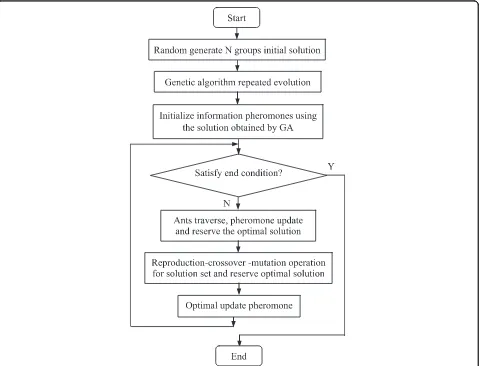
Randomly generated initial solution executes mul-tiple evolutionary using the reproduction-crossover-mutation operators of genetic algorithm and, at the same time, using the solution obtained by genetic algorithm to initialize the information pheromones of a network. If the loop end conditions are met, then the algorithm ends; else, the researchers execute the ants’ traverse and phero-mone update and reserve the optimal solution, execute the reproduction-crossover-mutation operation to the obtained solution set and reserve the optimal solution, and use the optimal update pheromone and determine whether the end condition is met.
The algorithm flow is shown in Fig. 3.
4 Wireless sensor networks nodes optimal coverage based on IGA-BACA
The wireless sensor network node optimal coverage is a typical multi-objective optimization problem, this problem can be expressed as follows: existing sensor set S= (s1, s2 ,⋯,si ,⋯, sN ), seeking the
working set S′, which can obtain the maximum network coverage rate, and the minimum working node set. When the maximum network coverage rate is selected as the opti-mal objective, network sensor nodes with hexagon struc-ture distributed in the monitoring area, the minimum working nodes set can be obtained [33].
From formula (5), we know that the maximum net-work coverage f1(S′) and minimum working nodes set f2(S′) are contradictory; compromising the two, the multi-objective optimization coverage model of wireless sensor network is changed into the maximum objective functionf(S′).
fðS′Þ ¼
f1ðS′Þ⋅f1ðS′Þ
=f2ðS′Þ ð10Þ
The algorithm implementation of wireless sensor network node optimal coverage based on improved genetic algorithm and binary ant colony algorithm is as follows [34–39].
Fig. 2Traverse path in the binary ant colony algorithm
4.1 Code
It is a key problem to complete the mapping from the solution space of optimization problem to the coding space. Aiming at the random distribution nodes, the control vector (individual) L= (l1, l2,⋯, li,⋯, lN) of
wireless sensor node is expressed in a binary coded form, which stands for the position of all sensor nodes in the target monitoring area A, where the li value is 1
or 0, which separately correspond to the active or sleep of the i sensor node. The selection of nodes and the gene of chromosome is one to one correspondence.
4.2 Initial solution and adaptation function
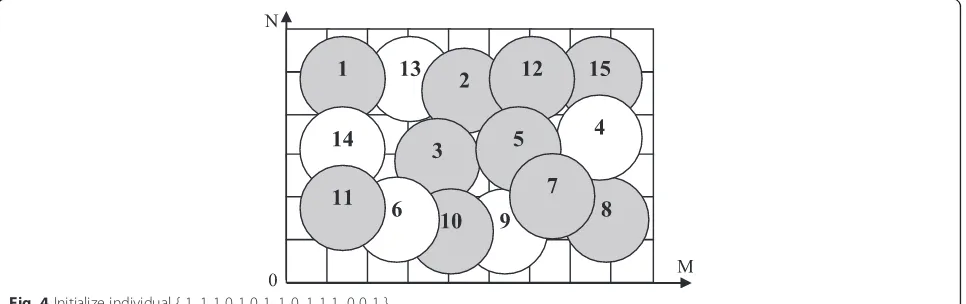
At random initialization, ten sensor nodes randomly dis-tribute in the target monitoring areaA, where the nodes of 1, 2, 3, 5, 7, 8, 10, 11, 12, 15 are working nodes and then the corresponding individual is { 1 1 1 0 1 0 1 1 0 1 1 1 0 0 1 }, this is shown in Fig. 4. A large number of individuals will be generated in the initialization phase, which is called a colony.
Use the formula (10) as the adaptation function, the higher is the adaptation function value, the higher is the selected probability of individual.
4.3 Operation operator
The operation operator of genetic algorithm and binary ant colony algorithm is composed of four operators that is reproduction operator, crossover operator, mutation operator, and pheromone update operator.
The reproduction operator reproduces the individuals to the new colony according to the probability in pro-portion as their adaptive value. After reproduction, the preponderant individuals are preserved and the inferior individuals are weeded out, and the average fitness de-gree of the colony is increased, but the variety of colony is lost at the same time. The action of reproducing an operator is to realize the principle of winner priority for preserving predominance and natural selection and mak-ing the colony converge on the optimum solution.
The crossover operator first selects two individuals sto-chastically according to the certain adaptive exchanging probabilityPc then it can produce two new individuals by
exchanging parts of chromogene stochastically. The two-point crossover is adopted in this paper, randomly generat-ing two crossover points is shown in Fig. 5. The genetic al-gorithm can generate filial generation colony which have higher average fitness and better individuals through the reproduction and crossover operators and can make the evolutionary process proceed to the optimum solution.
The mutation operator changes several bits of the chromosome string stochastically with a small prob-abilityPm, namely turning 0 to 1 and 1 to 0. The
mu-tation operator is very important to recoup the loss of colony diversity.
The pheromone update operator (Tg) is a mapping of
pheromone update for optimal individual which is se-lected from an ant sequence. According to the Max-Min rule, pheromone only be released in the path of optimal solution ant traverse, namely Δτi,j= 1/fbest(S), fbest(S) is the iteration-best solution or global best solu-tion. The probability of pheromone update operator is shown as follows:
PfTg¼xig ¼fðxiÞ=
XN
k¼1
fðxkÞ ð11Þ
where,Nis the number of individuals.
4.4 Ants traverse
When an ant travels, the path selection of different ants is mutual independence. Starting from the nest, every ant performs path selection with the movable probability formula (8) and according to Fig. 2; be-cause of the binary-coding, the ants do not possess memory function, it selects only on the basis of prior to the two path pheromones. The path that has higher density pheromone will have higher selection prob-ability. When an ant completes the path selection in an ant sequence, it arrives at the food source.
5 Simulation experiment
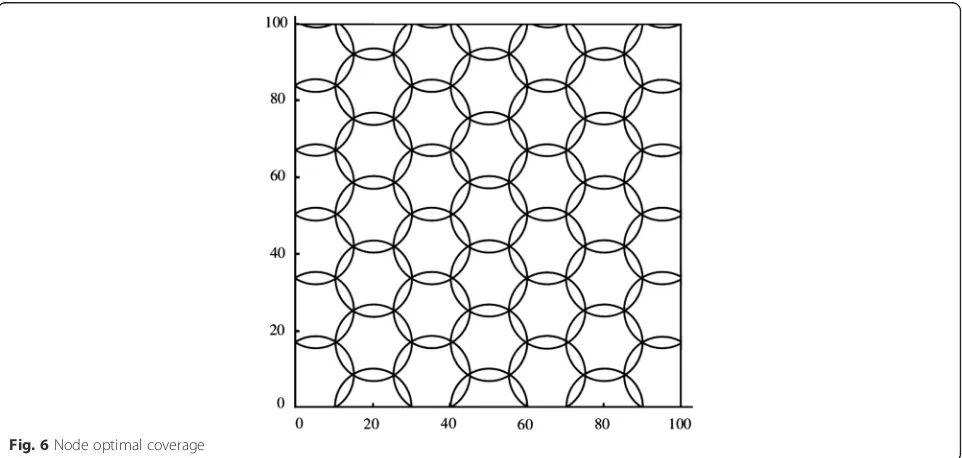
The set of the monitoring areaA is 100m× 100m, the perception radius rof sensor nodes is 10 m. When the network sensor nodes with hexagon structure distrib-uted in the monitoring area and the distancedbetween nodes are d¼pffiffiffi3⋅r, the coverage of target monitoring areaAcan achieve optimal. From this, we know that 45 nodes with a radius of 10 can completely cover the mon-itoring areaA, this is shown in Fig. 6.
We write the corresponding algorithm program using C++. The improved genetic algorithm and bin-ary ant colony algorithm adopt two-point crossover, scale reproduction, and self-adaptive crossover and mutation operations. Population size is 60. There was random distribution of 100 sensor nodes in monitoring areaA, the perception radius of sensor nodes is 10mthen every individual is composed of 100 binary bits. Algorithm iterative number is 200. Figure 7 is the 100 nodes in the areaArandom distribution. Although the nodes can cover the target region, but there are a lot of redundant nodes.
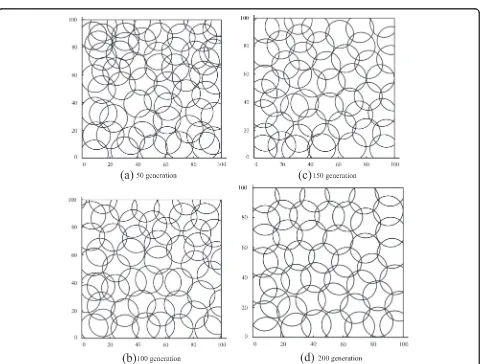
Figure 8a–d shows the working nodes set coverage using the improved genetic algorithm and binary ant colony al-gorithm evolution 50, 100,150, 200 generations.
From Fig. 8a–d, we can see that the algorithm search towards the global optimal solution direction. When the iterative number is 200, the sensor nodes is near to the optimal distribution, using less number of sensor nodes, obtaining more than 97% coverage.
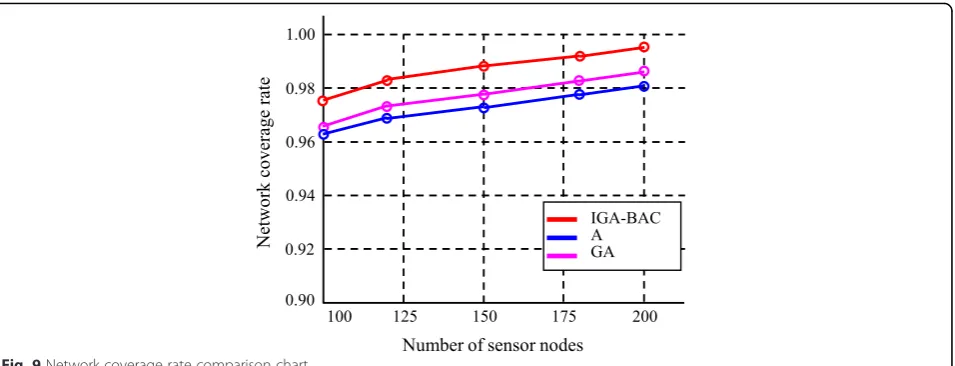
In order to evaluate the performance of IGA-BACA algorithm, in the other parameters unchanged, we evalu-ate its performance using different random deployment scenarios. In different sensor node density experiments, the number of sensor nodes deployed is, respectively, 100, 120, 150, 180, and 200. From the network coverage rate and the convergence of the algorithm, the improved genetic algorithm and binary ant colony algorithm are compared with ACA algorithm and GA algorithm. The experimental results are the average of 30 experiments. Figure 9 is a network coverage rate comparison chart of different sensor nodes.
Fig. 5Two-point crossover
Fig. 7Random distribution 100 nodes in the areaA
From Fig. 9, we can see that the coverage quality in-creases along with the increase of sensor node density. In the same iteration, coverage quality of IGA-BACA al-gorithm is higher than those of GA alal-gorithm and ACA algorithm. After 200 generations of evolution, the num-ber of network sensor node is 100, the network coverage rate of IGA-BACA algorithm is 97.5 %, the network coverage rate of GA algorithm is 96.2 %, and the net-work coverage rate of ACA algorithm is 96.5 %. The number of network sensor node is 150, the network coverage rate of IGA-BACA algorithm is 98.7 %, the network coverage rate of GA algorithm is 97.3 %, and the network coverage rate of ACA algorithm is 97.7 %. The number of network sensor node is 200, the network coverage rate of IGA-BACA algorithm is 99.5 %, the network coverage rate of GA algorithm is 98.1 %, and the network coverage rate of ACA algorithm is 98.6 %. These results show that the IGA-BACA algorithm is better than the ACA algorithm and GA algorithm in wireless sensor network coverage quality improvement.
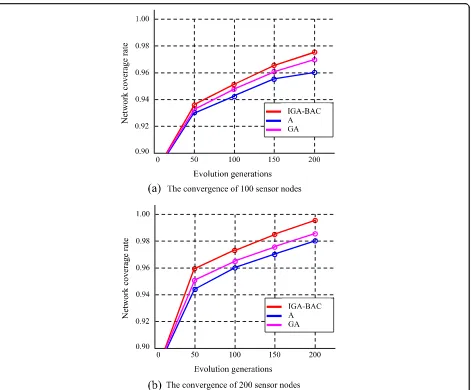
Figure 10 is the convergence comparison chart of IGA-BACA algorithm, GA algorithm, and ACA algo-rithm in 200 generations of the evolutionary process. Figure 10a is the convergence comparison chart in the 100 sensor nodes deployed, and the Fig. 10b is the con-vergence comparison chart in the 200 sensor nodes deployed. Figure 10 shows the convergence of the three algorithms. From Fig. 10a, we can see that this figure clearly shows the convergence of the three algorithms’ performance. The IGA-BACA algorithm, GA algorithm, and ACA algorithm can converge, and the convergence of IGA-BACA algorithm is better than that of ACA algorithm and GA algorithm, the convergence of ACA algorithm is better than that of GA algorithm. From Fig. 10b, we can get the same conclusion, for the three algorithms, and the convergence of IGA-BACA is the best, followed by ACA, finally GA. So the performance
of IGA-BACA is better than the GA algorithm and ACA algorithm under the same parameters.
In order to further illustrate the validity of the IGA-BACA, we adopt IGA-BACA and GA to realize the opti-mal coverage of wireless sensor network node in the same conditions. In the 100 sensor nodes deployed, the simula-tion results by IGA-BACA and GA are shown in Table 1.
From Table 1, we can see that the network coverage rate of IGA-BACA is greater than that of GA in the same evolution generation condition. Moreover, the working set node number of IGA-BACA is smaller than that of GA in the same evolution generation condition. We also can see that along with the evolution generation increase, the network coverage rate is gradually ap-proaching the optimal solution; moreover, the working set sensor node number is gradually reduced, this will reduce energy loss of a wireless sensor network and pro-long the network lifetime. From the CPU time, we can see the IGA-BACA algorithm to optimize the speed fas-ter than the GA algorithm.
All of these show that the IGA-BACA is superior to the GA and ACA at the convergence of the optimal so-lution with less working nodes and high network cover-age rate.
6 Conclusions
The coverage and energy consumption are the key prob-lems of wireless sensor network research because the sen-sor node energy cannot regenerate or supply. This paper analyzes the characteristics of wireless sensor network limited node energy. With the network coverage and the number of working set nodes as the optimization object, research on the working node set selection optimization problem of nodes explore the high-density deployment in wireless sensor network.
The wireless sensor network node optimal coverage based on improved genetic algorithm and binary ant colony
algorithm is proposed and applied to node optimal cover-age. The aim at the disadvantages of the genetic algorithm and ant colony algorithm is introduce binary ant colony al-gorithm and combine it with genetic alal-gorithm to form im-proved genetic algorithm and binary ant colony algorithm which has higher accuracy and faster convergence speed. Considering the relationship between network coverage and the number of working set nodes, the complex
multi-objective problem is simplified into a single-multi-objective fitness function in this paper, which can balance network coverage rate and energy consumption of the system.
The simulation results show that the improved genetic algorithm and binary ant colony algorithm can achieve the optimal working set with less working nodes and high net-work coverage rate, effectively reducing energy loss of a wire-less sensor network and prolonging the network lifetime.
Fig. 10The algorithm convergence comparison chart.aThe convergence of 100 sensor nodes.bThe convergence of 200 sensor nodes
Table 1Simulation results by IGA-BACA and GA
Evolution generations
IGA-BACA GA
Network coverage rate (%)
Working set node number
CPU-time (s) Network coverage rate (%)
Working set node number
CPU-time (s)
– 100 45 – 100 45 –
50 93 63 11 93.1 65 13
100 95.2 56 21 94.3 59 25
150 96.5 51 31 95.6 53 37
Competing interests
The authors declare that they have no competing interests.
Acknowledgements
This work is supported in part by the National Natural Science Foundation of China under Grant No. 61271370, the National High Technology Research and Development Program of China (863 Program) under Grant No. 2013AA013202, and Funding Project for Academic Human Resources Development in Beijing Union University No. 11101501105.
Received: 28 December 2015 Accepted: 4 April 2016
References
1. IF Akyildiz, W Su, Y Sankarasubramaniam, E Cayirci, Wireless sensor networks: a survey. Comput. Netw.38, 393–422 (2002)
2. I.T. Almalkawi, Guerrero Zapata, M., Al-Karaki, J.N. A cross-layer-based clustered multipath routing with QoS-aware scheduling for wireless multimedia sensor networks. Int. J. Distributed Sensor Net.2012, 1–11 (2012)
3. J Yang, C Zhang, X Li, Y Huang, S Fu, MF Acevedo, Integration of wireless sensor networks in environmental monitoring cyber infrastructure. Wirel. Netw16(4), 1091–1108 (2010)
4. H Chi-Fu, T Yu-Chee, The coverage problem in a wireless sensor network. Mobile Network Appl.10(4), 519–528 (2005)
5. J Yick, B Mukherjee, D Ghosal, Wireless sensor network survey. Comput. Netw.52, 2292–2330 (2008)
6. H Alemdar, C Ersoy, Wireless sensor networks for healthcare: a survey. Comput. Netw.54, 2688–2710 (2010)
7. Y LIANG, P Zeng, H Yu, Energy adaptive cluster-head selection for wireless sensor networks. Inf. Control.35, 141–146 (2006)
8. M Cardei, D Ding-Zhu, Improving wireless sensor network lifetime through power aware organization. Wirel. Netw11, 333–340 (2005)
9. X. R. Wang, G. L. Xing, Y. F. Zhang, C. Y. Lu, R. Pless, C. D. Gill. Integrated coverage and connectivity configuration in wireless sensor networks. Proceedings of the 1st ACM Conference on Embedded Networked Sensor Systems (SenSys’03), Los Angeles, CA,2003.
10. G Joon-Min, H Youn-Hee, A target coverage scheduling scheme based on genetic algorithms in directional sensor networks. Sensors, Sensor11, 1888–1906 (2011). doi:10.3390/s11020188
11. J Jia, J Chen, J Chang, L Zhao, G Wang, Optimal coverage scheme based on genetic algorithm in wireless sensor networks. Control Decis.1(22), 1289–1292 (2007)
12. MM Islam, M Ahasanuzzaman, MA Razzaque, MM Hassan, A Alelaiwi, Y Xiang, Target coverage through distributed clustering in directional sensor networks. EURASIP J. Wireless Commun. Netw.3, 1–18 (2015)
13. X Luo, Z Xu, J Yu, X Chen, Building association link network for semantic link on web resources. IEEE Trans. Autom. Sci. Eng.8(3), 482–494 (2011) 14. Z. Xu et al. Crowdsourcing based social media data analysis of urban
emergency events. Multimed Tools Appl. doi:10.1007/s11042-015-2731-1. 15. Z. Xu et al. Crowdsourcing based description of urban emergency events
using social media big data. IEEE Transactions on Cloud Computing. doi:10. 1109/TCC.2016.2517638.
16. Z Xu et al., Participatory sensing based semantic and spatial analysis of urban emergency events using mobile social media. EURASIP J. Wirel. Commun. Netw.44, 2016 (2016)
17. Z. Xu et al. Building knowledge base of urban emergency events based on crowdsourcing of social media. Concurr. Comput. doi: 10.1002/cpe.3780. 18. HM Ammari, On the problem of k-coverage in mission-oriented mobile
wireless sensor networks. Comput. Netw.56(7), 1935–1950 (2012) 19. E. Lattanzi, A. Bogliolo, VirtualSense. A java-based open platform for
ultra-low-power wireless sensor nodes. Int. J. Distributed Sensor Netw.2012, 1–16 (2012) 20. C Wenping, C Si, L Deying, Minimum-delay POIs coverage in mobile wireless
sensor networks. EURASIP J. Wireless Commun. Netw2013, 1–12 (2013) 21. Y Sun, Y Sun, Z Fang, Connectivity and coverage of wireless sensor
networks. J. Tianjin University38(1), 14–17 (2005)
22. S. Meguerdichian, F. Koushanfar, M. Potkonjak et al, Coverage problem in wireless ad-hoc sensor networks. IEEE INFOCOM, vol 3 (IEEE Press, IEEE, Anchorage, 2001) 1380-1387.
23. M Liu, J Cao, Y Zheng, L Chen, L Xie, Analysis for multi-coverage problem in wireless sensor networks. J. Softw.18, 127–136 (2007)
24. H. Do. Research on the coverage and connectivity algorithm of wireless sensor network, Master degree thesis, Hunan University, (2007) p. 41–45. 25. Y Sun, JW Tian, WSN path optimization based on fusion of improved ant colony
algorithm and genetic algorithm. J. Comput. Info. Syst.6, 1591–1599 (2010) 26. W Xiong, P Wei, Binary ant colony evolutionary algorithm. Acta Automat.
Sin.33, 259–264 (2007)
27. B Yan, W Xiong, M Cheng, Q Ye, Multi-population binary ant-colony algorithm with congestion control strategy. Control Theory & Applications
26(4), 387–394 (2009)
28. Q Qian, M Cheng, W Xiong, M Zhou, Reviews of binary ant colony optimization. Appl. Res. Computers29(4), 1211–1215 (2012)
29. C Yan, W Xiong, Y Zhang, Binary ant colony optimization based on traffic flow control. J. Syst. Simulation19(10), 2346–2350 (2007)
30. W Xiong, P Wei, J Zhao, Binary ant colony algorithm with signal transfer. Pattern Recognit. Artif. Intell.20(1), 15–20 (2007)
31. G Hu, W Xiong, X Zhang, J Yuan, Binary ant colony algorithm with controllable search bias. Contr. Theor. Appl.28(8), 1071–1080 (2011) 32. J Pan, X Wang, Y Chen, Improved ant colony algorithm for mobile robot path
planning. J. China University of Mining & Technology41(1), 108–113 (2012) 33. Z Honghai, JC Hou, Maintaining sensing coverage and connectivity in large
sensor networks. Ad- hoc and Sensor Wirel. Netw1, 89–124 (2005) 34. Y Zeng, J Cao, J Hong, S Zhang, L Xie, Secure localization and location
verification in wireless sensor networks: a survey. J. Supercomput.64(3), 685–701 (2013)
35. WSH Siu, C-K Chan, HCB Chan, Green cargo routing using genetic algorithms. Lect. Notes Eng. Comput. Sci.1, 170–175 (2012)
36. A Chen, S Kumar, TH Lai, Local barrier coverage in wireless sensor networks. IEEE Trans. Mob. Comput.9(4), 491–504 (2010)
37. X. Yu, J. Zhang, J. Fan, and T. Zhang. A faster convergence artificial bee colony algorithm in sensor deployment for wireless sensor networks. Int. J. Distributed Sensor Netw.2013, 1–9 (2013).
38. M Koç, I Korpeoglu, Coordinated movement of multiple mobile sinks in a wireless sensor network for improved lifetime. EURASIP J. Wireless Commun. Netw.2015, 1–16 (2015)
39. S Jin-Taek, L Heung-No, 4-ary network coding for two nodes in cooperative wireless networks: exact outage probability and coverage expansion. EURASIP J. Wireless Commun. Netw.2012, 1–12 (2012)
Submit your manuscript to a
journal and benefi t from:
7 Convenient online submission 7 Rigorous peer review
7 Immediate publication on acceptance 7 Open access: articles freely available online 7 High visibility within the fi eld
7 Retaining the copyright to your article