R E S E A R C H A R T I C L E
Open Access
Evaluation of the clinical process in a critical care
information system using the Lean method:
a case study
Maryati Mohd Yusof
1*, Soudabeh Khodambashi
1and Ariffin Marzuki Mokhtar
2Abstract
Background:There are numerous applications for Health Information Systems (HIS) that support specific tasks in
the clinical workflow. The Lean method has been used increasingly to optimize clinical workflows, by removing waste and shortening the delivery cycle time. There are a limited number of studies on Lean applications related to HIS. Therefore, we applied the Lean method to evaluate the clinical processes related to HIS, in order to evaluate its efficiency in removing waste and optimizing the process flow. This paper presents the evaluation findings of these clinical processes, with regards to a critical care information system (CCIS), known as IntelliVue Clinical Information Portfolio (ICIP), and recommends solutions to the problems that were identified during the study.
Methods:We conducted a case study under actual clinical settings, to investigate how the Lean method can be
used to improve the clinical process. We used observations, interviews, and document analysis, to achieve our stated goal. We also applied two tools from the Lean methodology, namely the Value Stream Mapping and the A3 problem-solving tools. We used eVSM software to plot the Value Stream Map and A3 reports.
Results:We identified a number of problems related to inefficiency and waste in the clinical process, and proposed
an improved process model.
Conclusions:The case study findings show that the Value Stream Mapping and the A3 reports can be used as
tools to identify waste and integrate the process steps more efficiently. We also proposed a standardized and improved clinical process model and suggested an integrated information system that combines database and software applications to reduce waste and data redundancy.
Background
The application of information technology in healthcare has significant potential and benefits; particularly with regards to innovations in improving both clinical and administrative processes. Health Information Systems (HIS) support specific tasks in the clinical workflow that include order entry, resource planning, accounting, and scheduling [1].
The evaluation of HIS is crucial for ensuring that max-imum benefits are gained from the system and for asses-sing the achievement of its objectives in supporting healthcare delivery services [1]. HIS evaluation analyses
a range of factors that may determine its effectiveness, such as change management, user adoption and work-flow, and other human and cognitive factors.
Numerous studies on clinical processes have shown that systems often do not fit well with actual clinical practices. Users may refuse to work with a system, if it is not adapted to their routine tasks. Therefore, the imple-mentation of information systems in healthcare is a process of mutual transformation [2]. It has been reported that clinical workflow support is the highest-ranked indicator in the assessment of IT systems in hos-pitals [3] and has a major determinant effect on HIS adoption [4]. HIS implementation affects the clinical workflow. Therefore, it is essential to evaluate and re-design clinical processes and workflows, to ensure that they fit with the HIS; and thereby achieve a successful implementation [5].
* Correspondence:[email protected]
1Center for Technology and Software Management, Faculty of Information
Science and Technology, Universiti Kebangsaan Malaysia, Bangi 43600, Malaysia
Full list of author information is available at the end of the article
Quality management methods were introduced into healthcare organizations during the 1980s. Over the last decade, these methods have been used to improve the quality of healthcare and its processes. The selection of these techniques depends on multiple factors, such as organizational requirements, objectives and environ-ment, as well as, available resources and knowledge. One of the most popular quality improvement methods, i.e., the Lean method, is designed to improve process effi-ciency by eliminating non-value-added activities, known as waste [6]. Waste uses resources, but does not add any value to the product or service [7]. The seven most com-mon contextual synonyms of waste are“overproduction, waiting, transport, inappropriate processing, unnecessary inventory, waste of motion, and defects”[8].
A number of studies have reported the application of the Lean method in the analysis of clinical processes. Kuo et al., [9] proposed a new model, known as the Lean Six Sigma System, to improve workflow in a post-anaesthesia care unit. DelliFraine et al., [10] conducted a systematic review to examine the empirical evidence relevant to the Six Sigma and Lean methods, in improv-ing clinical outcomes, care processes, and the financial performance of healthcare institutions. The use of the Lean method, in the management of hip fracture patients, significantly reduced waste and overall mortal-ity and improved patient flow from admission to dis-charge [11]. In another case, the application of the Lean method in outpatient services increased the capacity for admitting new patients by 27% [12]. The use of the Lean and Six Sigma methods also substantially improved Op-erating Room (OR) efficiency, in terms of on-time starts and a reduction in the number of cases past 5pm; as well as significant gains in non-operative time, staff overtime, and ORs saved [13].
The Lean method is a good option for optimizing clin-ical workflow, because it focuses on detailed process components, such as workflow and problems, and then redesigns the processes by removing waste [8]. The Lean method eliminates unnecessary intermediate steps such as time and personnel, and retains only those that add value [14]. Value is created when wasteful activities are removed or reduced. Value can also be increased by add-ing services and features that are based on customer needs. This aim could also be achieved by shortening de-livery cycles or reducing dede-livery batches without incur-ring additional costs [8].
Tools and techniques are available that enhance the Lean concept, such as Value Stream Mapping (VSM) and A3 reports [7,8,15-20]. These are clear and objective communication tools that are able to capture workers’ knowledge of work processes in the value stream. When value stream maps are drawn, and A3 documents are written, all specialists and staff can review them. This
allows for cross-departmental sharing of process changes and generates even more problem-solving ideas.
In VSM, the key people, resources, activities, and in-formation flows involved in delivering a product or service, are drawn on a graph. VSM provides a deep understanding of how work is currently being performed and where work is unreliable or inconsistent. VSM is a key tool for identifying opportunities to reduce waste and integrate process steps more tightly, in order to im-prove process efficiency [8].
VSM does not just focus on single processes; but in-stead, creates a holistic schema of all processes and workflows, to understand the interdependency of func-tions and departments, and the effect of the unit as a whole [7]. Similarly, the A3 problem-solving method was originally borrowed from the Toyota Motor Com-pany, and adapted to manufacturing companies in the United States and elsewhere. By reworking and removing workarounds, the A3 problem solving method improves the value stream.
Simply designing the map is insufficient for identifying waste. Once a VSM has been designed as a starting point, problems, such as long waiting times between steps or high amounts of reworking, can be identified and solved more easily. Tasks that do not add any value to the process (especially to the customers) should be removed before implementing any HIS solution. Therefore, identi-fying all of the value-added and non-value-added activities in the VSM, and assessing their impact on the overall process, is essential. Once the improvements in VSM have been identified, a future version of the VSM should be created, to show how the process will work if it is rede-signed. This could include, for example, a smaller number of process steps and/or a shorter waiting time between steps [21].
In Lean application design, cultural changes need to be considered to achieve the desired result [10]. The import-ance of cultural changes has been reported by many researchers [10,22,23]. It is difficult for employees, par-ticularly those who have been in their positions for a long time, to accept standardized work guidelines because they think that they already know how to perform the work correctly. However, employees will follow standar-dized work guidelines, when they understand the reasons behind them [21]. The Lean method is suitable for solv-ing chronic problems, because it uses simple problem-solving tools, such as VSM and A3. A key advantage of the Lean transformation is in establishing a culture of continuous improvement and organizational learning. After the Lean method has been implemented, continu-ous improvement is important as a practice, because it allows for the monitoring and measuring of changes.
fundamental limitation of one of its tools, VSM, is that it requires manual process mapping. Even with the aid of eVSM software, in designing these maps electronically, the basic map needs to be designed on paper during data collection. As described earlier, VSM needs to be com-plemented with other tools, such as A3 [9]. While VSM is used as a method for visualizing and understanding work from a high level view, A3 problem-solving uses the same logic, but focuses on specific problems with microscopic detail [24]. However, A3 is not applicable for very complex situations, because it focuses on find-ing the root cause of the problem. In a complex situ-ation, the link between cause and effect is often unclear; therefore, A3 is not a suitable option for chaotic situa-tions. In addition, there is no theoretical basis for gener-ating an A3 report, which results in a variety of reports constructed by various analysts, who have differing sub-jective views on the same issues, thus leading to ambigu-ity and multiple interpretations [9].
There are a limited number of comprehensive studies on, and weak evidence for, Lean health care quality im-provement; particularly those related to HIS [10,25]. Ap-plying the Lean method in the clinical process, as related to HIS, helps us to obtain a more accurate view of the process and find errors and waste. We applied the Lean method and its related tools in an actual clinical setting, to reduce cycle time and remove waste.
Methods
Research methodology
We conducted a case study in order to have a better understanding of the clinical process related to the clin-ical care information system.
Data collection
Data was collected by one of the authors using inter-view, observation, and document analysis methods. The observations were performed over sixteen working days in June, 2011. Clinical processes were observed for around eight hours each day, totalling 128 hours of ob-servation time. We recorded the time frame for each step involved in the entire process of a pre-anaesthesia check-up. Ten semi-structured, face-to-face, individual interviews were conducted during fifteen to forty-five minute sessions. The interview questions are attached in Appendix A.
Site observations of the process allowed us to validate the flow of data from the beginning of the process to the end. For example, the anaesthetist is required to verify that the patient is ready for an operation by performing a physical assessment. However, the anaesthetist cannot start their assessments until after 3 pm, when the oper-ation list is ready for the following day.
Study location
The case study was performed in the Anaesthesia Department at the National Heart Institute (“Institut Jantung Negara”) (IJN) of Malaysia. Prior approval was obtained to conduct the study.
Study subject and respondents
We investigated the use of a Critical Care Information Systems (CCIS) known as the IntelliVue Clinical Informa-tion Portfolio (ICIP) during the pre-anaesthesia process; particularly during the pre-anaesthesia physical assess-ment. The ICIP helps to streamline the workflow and pro-vides support for automated regulatory and protocol compliance for the anaesthetists. The ICIP was commer-cially purchased from the Philips Company, to automate anaesthesia documentation and optimize patient care, throughput, and reimbursement. The ICIP was deployed mid-2009, two years before our case study was conducted, and no similar system had been launched before it.
The aim of the ICIP is to provide a paperless environ-ment, as well as to improve patient care and safety, in an intensive care provision. It uses a centralized patient re-pository to manage and perform a number of functions, namely automatic charting, which includes vital signs, bedside device data, laboratories, pathology reports, medication orders, planned interventions, and other related data for nursing care and monitoring, anaesthesia care, surgical care, and allied health. In order to ease the technology adoption process, improve patient safety, and increase efficiency, the system is customized according to the IJN organizational setting.
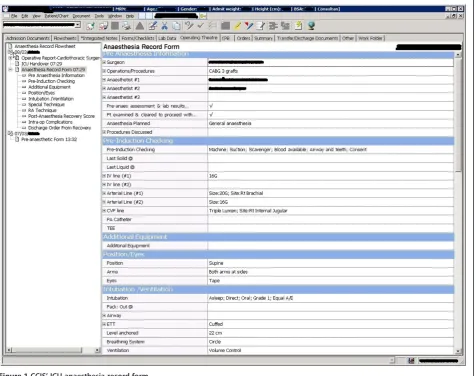
All nurses are required to use the system, and all used it to chart and generate nursing progress notes and reports on a daily basis. Several doctors used the system for patient care planning and census generation from patients, while allied health professionals; particularly physiologists, used it to monitor patient progress. Figure 1 illustrates an example of the ICIP interface for the anaes-thesia record form in the Intensive Control Unit (ICU).
We collected feedback from anaesthetists on their use of the ICIP and observed their interaction with the sys-tem. Ten participants were selected from those who were involved in the selected workflow. They consisted of four consultant anaesthetists, two anaesthetists, three clinical specialists, and one anaesthesia fellow, who was selected based on a purposive sampling method. An an-aesthesia fellow is a trainee from another organization who spends one to two years at the IJN, while a clinical specialist is a qualified anaesthesiologist who is undergo-ing cardiac subspecialty trainundergo-ing.
Data analysis and analysis framework
process. We used eVSM to map the stated clinical process (eVSM is a software tool that is designed to sup-port maps and other visuals commonly leveraged in Lean implementations, such as value stream maps). We adopted the A3 tool to eliminate waste from the auto-mated clinical workflow to achieve the desired outcome. eVSM also supports the A3 tool, which is used to design and map the“to-be”process.
Validity and reliability of the research
In order to ensure the validity and reliability of the re-search, we triangulated our collected data from multiple sources and respondents. The designed process and the A3 map were then reviewed with the process owner, to validate our data in relation to the study's purpose.
Results
Each anaesthetist has either completed or passed a short-term training course to use the ICIP, or has learned how to use the system, by working with another
anaesthetist. All anaesthetists mentioned that the level of training was sufficient to work with the system. The system is sufficiently user-friendly and does not have any unidentified errors. All anaesthetists have access to the ICIP, and system usage can be tracked according to its user log history.
Prior to conducting this case study, the anaesthesia de-partment performed an assessment on the usage rate of the ICIP, by checking the degree of completion of docu-ments; particularly the pre-anaesthesia forms after operations. The assessment shows that in 2011, the per-centages of filled in ICIP pre-anaesthesia forms were 44% in January, 45% in February, 34.6% in March, and 69.4% in April.
time-consuming and takes anaesthetists away from their other responsibilities. They argued that someone else should enter this information. This is a common reason why anaesthetists refuse to use ICIP during the pre-anaesthesia process. It is generally the responsibility of the anaesthetist to verify the accuracy of entered infor-mation pertaining to the anaesthesia process. However, they prefer to see verified data when they log in to the system.
Information that should be entered into the form includes the lab report, echocardiograph report, pre-operative history, physical and airway examination, an-aesthetic plan and risk, preoperative medication, and orders. This information must be made available during the patient’s visit. Most of the time, the information is ready - but not always.
The pre-anaesthesia process focuses on the activities related to anaesthesia that should be performed a day before each patient's operation. The anaesthetist records all necessary information during the patient’s physical assessment. This process includes the following steps: operating theatre list preparation, premedication process, patient education, anaesthesia consent, and anaesthesia planning and documentation. During this process, the anaesthetist sees all patients who are on the operation list, one day before surgery. During the patient’s visit, an anaesthetist performs a physical assessment of the patient and reviews the lab and echocardiograph reports to provide the patient with accurate medication. The pre-anaesthesia process starts when the operating theatre list is prepared. An anaesthetist collects the operation list for the following day from a nurse, before visiting the patients. The process can be delayed if there is an issue with the patient, lab reports, or finding a patient meeting room or Personal Computer (PC).
A PC, installed with the ICIP, is located in the patient’s meeting room for the anaesthetists to log onto and enter their comments and information on medication into the system. These PCs are occasionally used by nurses, be-cause the number of PCs at the nurse’s stations is insuf-ficient. Therefore, these situations can cause delays for the anaesthetists, in starting the physical assessment of the patients. Sometimes, the anaesthetists are unable to use the ICIP due to technical problems with the PC or the system. When problems occur, technical staff are usually unavailable to solve them. Anaesthetists are often too tired to wait for the system to resume, because most physical assessments are performed after 3 pm. In this case, they prefer to use paper instead of the ICIP.
In terms of patient availability, 10% of the patients were not ready when an anaesthetist went to the ward to visit them; thus requiring the anaesthetist to revisit them. During the patient’s revisits, the anaesthetists sometimes found that another anaesthetist had already
completed the physical assessment without prior
notification.
When the anaesthetist completes the pre-anaesthesia assessment form, the preoperative medication and orders should be adhered to by the nurse. The medica-tion and its direcmedica-tions for use are written by the anaes-thetist on paper for the nurse to follow. When the anaesthetist uses the ICIP instead of paper, all directions and medications are given to the nurse verbally, because the nurse does not have access to the ICIP. The outcome of this process is to ensure that the patient is physically ready for the operation, and that the anaesthetist’s instructions are followed one day before the operation.
In practice, anaesthetists do not follow a standard flow to complete their work. During our observations, only one out of ten anaesthetists used the ICIP when doing their job, while the others preferred to use a paper-based system.
In order to better understand the problems and propose a solution, we organized this paper as follows: a value stream map of the pre-anaesthesia process and A3 reports to find the root cause of the problem and our proposed future state map.
VSM of the pre-anaesthesia process
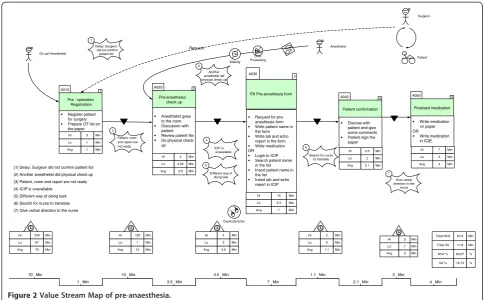
The as-is VSM of the pre-anaesthesia process is depicted in Figure 2. When we consider the time taken to complete each step, as well as the delay between steps, we can identify the waste and defects of the as-is process. The non-value-added activities are represented in Figure 2 by deltas. A value stream map illustrates the way the actual work was performed and clearly high-lights any delays that may occur. This delay enables us to determine how much of the total time spent in the process is value added to the patient, as opposed to being non-value-added. The lowest number in each box reflects the shortest amount of time required to complete the step being measured. Conversely, the high-est number in each box shows the longhigh-est time required to complete the step being measured; thus highlighting an unusually complex set of activities, or one in which many interruptions or workarounds may have occurred. Again, the lowest number in the delta demonstrates the shortest delay between essential steps, and the highest number indicates the longest delay. Once we had identi-fied the problems in the VSM, we proceeded to further analyse the problems. To find the root cause of each problem and remove it, we adopted a root cause analysis to determine the reasons for the problems using the A3 problem-solving method.
and non-value-added time (the deltas) reveals a shocking discovery. We recorded the shortest and longest amounts of time required to complete the process for each step. Furthermore, we calculated the average time spent for each step, as well as the deltas based on the ten participants’time spent on each step. The total non-value-added time in the pre-anaesthesia process, calcu-lated based on the average time for each step, is 83.27% of the total time; which is very high. If we look at the VSM in detail, we can see the wasteful areas that caused the process delays.
The highest delay occurred at the start of the “ pre-operation registration” step, with an average delay time of 70 minutes. The operation list should be ready by 2 pm on the day before the operation. However, sur-geons are usually too busy performing in the OR to confirm the operation list for the following day; and therefore, the operation list is usually only available after 3 or 4 pm. If the list is not ready before 5 pm, the on-call anaesthetist will visit the patient to do a physical assessment and prescribe medication.
Further-more, the average delay between the “pre-operation
registration” and the “pre-anaesthesia check-up” was 10 minutes, which caused the total non-value-added time to
increase. Next, the average delay between the “
pre-anaesthesia check-up” and the“fill in the pre-anaesthesia form” step was 3.5 minutes, which was due to duplicate
data entries or the unavailability of the ICIP system be-cause of technical problems. The total percentage of all value-added steps is 16.73% of the total time, which is clearly too low for this process. The waste that increased the total non-value-added time in the process is discussed in detail in the following subsection.
Preanaesthesia current state map
In the as-is process of preanaesthesia, various types of waste and defects were identified. One of them was wait-ing waste (labelled as ‘number 1’in Figure 2). The root cause of this waste was the waiting time for surgeon confirmations. Other identified types of waste were mo-tion and unnecessary activities (labelled as‘number 2’in Figure 2). When anaesthetists go to the wards to visit patients, they sometimes find that another anaesthetist has already performed the physical assessment. This is due to a lack of task coordination, which leads to over-processing. We also identified a third type of waste i.e., the waiting time for resources, such as information,
equipment, and systems (labelled as ‘number 3’ and
‘number 4’in Figure 2). When an anaesthetist starts the physical assessment process, it is essential that the lab, echocardiograph, and lung function reports are ready and that the room and the patient are available. How-ever, most of the time, at least one (if not all) of the above items are unavailable to implement the process.
Surgeon
Patient
A010 1
Pre - operation Registration
Register patient for surgery Prepare OT list on the paper Anesthetist A020 2 Pre-anesthesia check up Anesthetist goes to the room Discussion with patient Review patient file Do physical check up
A030
3
Fill Pre-anesthesia form A040
4
Patient confirmation
Discuss with patient and give some comments Patient sign the paper Request
Delay: Surgeon did not confirm patient list 1 ICIP is unavailable 1 Min 10 Min 3.5 Min 3.5 Min 7 Min 1.1 Min 2.1 Min 3 Hi Min 1 Lo Min 1 Avg Min 4 Hi Min 2.25 Lo Min 3.5 Avg Min 10 Hi Min 5.3 Lo Min 7 Avg Min 2.5 Hi Min 2 Lo Min 2.1 Avg Min 120 Hi Min 1 Lo Min 10 Avg Min 4 Hi Min 3 Lo Min 3.5 Avg Min 87.6 Total NVA Min
17.6 Total VA Min
83.27 NVA % % 2 Hi Min 0 Lo Min 1.1 Avg Min 16.73 VA % % Another
anesthetist did physical check up 2
Over Processing Waiting
70 Min
Request for pre-anesthesia form Write patient name in the form Write lab and echo report in the form Write medication OR
Login to ICIP Search patient name in the list Insert patient name in the list Insert lab and echo report in ICIP
A050 4 Finalized medication Write medication on paper OR Write medication in ICIP 7 Hi Min 3 Lo Min 4 Avg Min 3 Min 4 Min
On call Anesthetist
Patient, room and report are not ready 3
Different way of doing task 4
5
Search for nurse to translate 6
Give verbal direction to the
nurse 7
Duplicate Entry
(1) Delay: Surgeon did not confirm patient list (2) Another anesthetist did physical check up (3) Patient, room and report are not ready (4) ICIP is unavailable
(5) Different way of doing task (6) Search for nurse to translate (7) Give verbal direction to the nurse
240 Hi Min 67 Lo Min 70 Avg Min .5 Hi Min .1 Lo Min .3 Avg Min
The unavailability of the system, due to a lack of compu-ters in the paediatric ward, and technical problems oc-curring in PCs and the system is highlighted as‘number 4’in Figure 2.
During the patient visit, an anaesthetist can use two different ways to complete the pre-anaesthesia form (paper-based and ICIP), indicating a non-standardization
of task implementation (labelled as ‘number 5’ in
Figure 2). Next, we identified a communication problem, related to searching for a nurse to translate labelled as
‘number 6’ in Figure 2). Some foreign anaesthetists are unable to speak Malay (or English), but most of the patients are Malaysian.
We also identified confusion (with verbal medication directions to the nurse) as being another type of waste (labelled as‘number 7’in Figure 2). When the anaesthe-tists wrote directions and medication instructions on the pre-anaesthesia form in the ICIP, the completed form was not printed for inclusion in the patient’s history file. Because nurses do not have access to the ICIP, this situ-ation resulted in verbal instructions being given; thus in-creasing the risk of medication errors. Task duplication was identified as originating from the data entry process. Multiple reports, such as lab, echocardiographs, and lung
functions, were entered into different software systems, and the relevant information from those reports were entered again into the ICIP, resulting in data redundancy due to the lack of an integrated information system.
Problem identification using A3
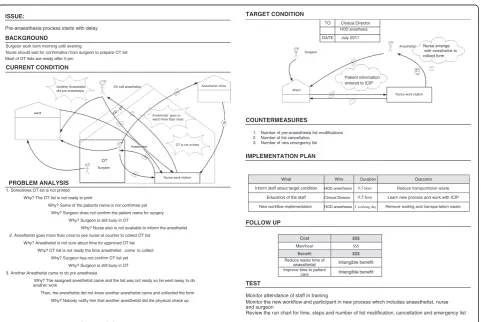
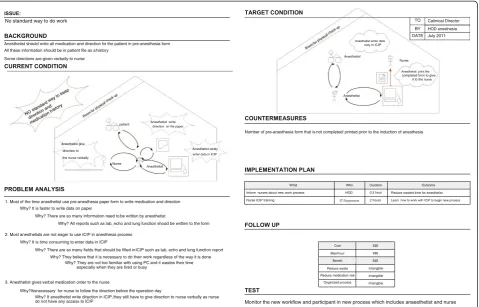
An A3 report is a storyboard that visualizes how a current process happens, what is wrong with it, and why it happens that way. These factors are illustrated on the left side of an A3 report. The right side of the report illustrates a better work process, the issues that need changing, and a plan for changing them.
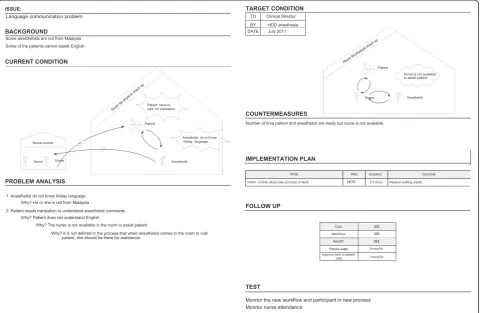
We identified seven problems in the pre-anaesthesia process. When we analysed the root cause of these problems, we found that some of them had similar-ities. We therefore developed four A3 reports that cover the aforementioned problems, namely the delay in the start of the pre-anaesthesia process, the delay in patient visits, the non-standardized working process, and the interaction problem. For each problem, we developed an A3 report to perform a root cause ana-lysis, in order to design an improved process (see Figures 3, 4, 5, and 6).
ISSUE:
Pre-anaesthesia process starts with delay
BACKGROUND
Surgeon work form morning until evening
Nurse should wait for confirmation from surgeon to prepare OT list Most of OT lists are ready after 5 pm
CURRENT CONDITION
Another Anesthetist On call anesthetist Anesthetist office did pre-anesthesia
ward
Anesthetist goes to ward more than once
Anesthetist OT is not printed
OT
Surgeon
Nurse work station
PROBLEM ANALYSIS 1. Sometimes OT list is not printed
Why? The OT list is not ready to print
Why? Some of the patients name is not confirmed yet Why? Surgeon does not confirm the patient name for surgery
Why? Surgeon is still busy in OT
Why? Nurse also is not available to inform the anesthetist 2. Anesthetist goes more than once to see nurse at counter to collect OT list
Why? Anesthetist is not sure about time for approved OT list Why? OT list is not ready the time anesthetist come to collect
Why? Surgeon has not confirm OT list yet Why? Surgeon is still busy in OT 3. Another Anesthetist came to do pre anesthesia
Why? The assigned anesthetist came and the list was not ready so he went away to do another work
Then, the anesthetist did not know another anesthetist came and collected the form Why? Nobody notify him that another anesthetist did the physical check up
TARGET CONDITION
TO Clinical Director
HOD anesthesia
DATE July 2011
Anesthetist Nurse arrange
Surgeon with anesthetist to
collect form
Patient information entered to ICIP
Ward
Nurse work station
COUNTERMEASURES
1. Number of pre-anaesthesia list modifications 2. Number of list cancellation 3. Number of new emergency list
IMPLEMENTATION PLAN
What Who Duration Outcome
Inform staff about target condition HOD anesthesia 0.5 hour Reduce transportation waste
Education of the staff Clinical Director 0.5 hour Learn new process and work with ICIP
New workflow implementation HOD anesthesia1 working day Remove waiting and transportation waste
FOLLOW UP
Cost $$$
Man/hour $$$
Benefit $$$
Reduce waste time of Intangible benefit anaesthetist
Improve time to patient Intangible benefit care
TEST
Monitor attendance of staff in training
Monitor the new workflow and participant in new process which includes anaesthetist, nurse and surgeon
Review the run chart for time, steps and number of list modification, cancellation and emergency list
Discussion
The anaesthesia department performed an assessment of the anaesthetist’s use of ICIP by checking the completion of documents; particularly the pre-anaesthesia form, before this case study was performed. The assessment shows that in 2011, the percentages of filled in ICIP pre-anaesthesia forms were 44% in January, 45% in February, 34.6% in March, and 69.4% in April. The completion of the pre-anaesthesia form is assessed after the operation, based on the availability of the printed form in the patient’s file, and not on the comple-tion of the form. Many of the anaesthetists completed the form, but did not print it out to keep in the patient’s file. Furthermore, several anaesthetists completed the form after the operation; instead of one day before. Therefore, these assessment results were inaccurate, because the assessment was performed after operations, and there is no evidence to show whether anaesthetists completed the necessary forms in the ICIP before or after each operation. The inaccuracy of these assessment results is also affected by a lack of availability of the ICIP system in the paediatric depart-ment, meaning that anaesthetists are unable to complete the pre-anaesthesia form during patient visits.
Since the results of the previous assessment were in-accurate, and no performance measurements of the current system were performed, an evaluation of the clinical process was needed to determine the best pos-sible performance, in terms of removing waste and in-creasing the process flow. Therefore, we investigated the pre-anaesthesia process related to the ICIP and focused more on the workflow to remove defects and waste.
In order to evaluate the existing process related to the ICIP, we identified the problems and classified them to find their root causes. We classified these problems from three intertwined factors: Human, Organizational, and Technology (HOT); and the fit between them, based on the HOT-fit evaluation framework [26]. Human, organization and technology factors are the essential components of any IS, and the impact of any HIS system is assessed by evaluating its net benefits. These three factors, and their impact on HIS, correspond to the nine interrelated dimensions of HIS success: technology (system quality, in-formation quality, and service quality), human (system de-velopment, system use, and user satisfaction), organization (organizational structure and organizational environment),
ISSUE: TARGET CONDITION
Delay to visit patient
BACKGROUND
Lab, echo and lung function report are essential for pre anaesthesia check up Anaesthetist goes to the ward after 3 pm to visit the patient
PC is used by nurse to work with other HIS Nurse in the ward also uses room
CURRENT CONDITION
Anesthetist wait for the room to
become available Patient
TO Clinical Director BY HOD anaesthesia
DATE July 2011
Anaesthetist
All reports Nurse knows when are ready
anesthetist comes to the ward
Nurse
reports
Patient
PC or ICIP is not working Anaesthetist
Patient
Nurse Nurse counter
Nurse Nurse Nurse
Lab, echo and lung function report are not ready Anesthetist
comes more PC is occupied
than once
PROBLEM ANALYSIS
PC is available and working
COUNTERMEASURES
Duration of time for anesthetist to visit the patient Number of time patient is ready and anesthetist not ready
Number of time anesthetist is ready but the patient or reports/ICIP is not ready
IMPLEMENTATION PLAN
What Who Duration Outcome
Inform nurses about new work process Clinical Director 0.5 hour Reduce waiting waste 1. Room is occupied
Why? The other nurse visit another patient in the room
Why? There is not many rooms available for nurse to visit patient
Why? Nurse does not know that anesthetist comes and needs the room Why? There is no schedule that when anesthetist comes
2. Anesthetist comes more than once to visit the patient Why? Patient is not available
Why? Patient is in lab or any other places
Why? It was not arranged with patient to be ready during the time anesthetist comes to the ward
3. PC is occupied
Why? It is used by other nurse to access other HIS Why? There is not enough PC at nurse counter for nurses
Why? Nurse does not know anesthetist comes to the ward to use ICIP
FOLLOW UP
Cost $$$
Man/hour $$$
Benefit $$$
Reduce waste time of Intangible benefit
anaesthetist
Improve time to patient Intangible benefit care
4. PC or ICIP is not working Why? PC or ICIP is down
Why? The previous person used the system and left it inaccessible
Why? Nobody comes and check whether the system is working properly before anesthetist comes Why? Nobody in the ward is familiar with computer and ICIP
Why? Technical people check the system periodically instead of daily 5. Lab, echo or lung function report are not ready
Why? Anesthetist do not know that the reports are not ready Why? Nobody notify him
TEST
Monitor staff attendance during training
Monitor the new workflow and participant in new process which includes anaesthetist and nurse
and net benefits. Each of these dimensions is associated with a number of evaluation measures.
In terms of the technology factor, we identified three problems from the System Quality dimension: system availability, flexibility, and reliability. The unavailability of the ICIP in the paediatrics’ department is one of the reasons why the anaesthetists are not eager to use the ICIP to complete the pre-anaesthesia form. In terms of flexibility, the information and the database between the different platforms are not integrated or linked. For ex-ample, the specified software for the lab report is not integrated in the ICIP. As a result, the printed lab reports need to be manually attached to the patient’s file. All critical information, relating to the patient, needs to be recorded in the ICIP; therefore, the anaesthetist must enter this data manually into the ICIP, so that it can be accessible in the operating room. Technical problems are either hardware or software related. We also iden-tified a number of problems from the technology di-mension of Information Quality, namely: fragmented information, late reporting, repetitive information, in-complete data entry, and delay of lab reports.
In terms of human factors, we identified user know-ledge and skill problems from the System Use dimen-sion. Users lacked a basic knowledge of the operating
system, and their slow typing speed affected their task when entering data into the ICIP. In terms of organizational factors, problems were identified in the Organizational Structure (i.e., the internal parts of the organization): resources, clinical process, and a culture that caused process delays. A shortage of resources was identified for the pre-anaesthesia procedure, in terms of technical staff and room availability. Moreover, there was a lack of integration between the people involved in the clinical process. Every person works in a different way, which means there is no standardized work method in the process. It would be difficult to change the way clinicians perform their work using the new HIS, be-cause anaesthetists prefer to use a paper-based system. Even in their best form, paper documents have legibility and accuracy issues [27]. Manual transcription is also time-consuming, and in complex cases, the number of parameters that need to be documented may increase greatly; and may create a possible time lag between ob-servation and charting.
These problems cause the people who are involved in the process to ignore the role of the ICIP in their work. Furthermore, when the information is not integrated be-tween various related departments, it increases the human error factor in data entry. When the activities that are
No standard way to do work
Anesthetist should write all medication and direction for the patient in pre-anesthesia form All these information should be in patient file as a history
Some directions are given verbally to nurse
patient Anesthetist writedirection on the paper
1. Most of the time anesthetist use pre-anesthesia paper form to write medication and direction Why? It is faster to write data on paper
Why? There are so many information need to be written by anesthetist
Why? All reports such as lab, echo and lung function should be written to the form 2. Most anesthetists are not eager to use ICIP in anesthesia process
Why? It is time consuming to enter data in ICIP
Why? There are so many fields that should be filled in ICIP such as lab, echo and lung function report Why? They believe that it is necessary to do their work regardless of the way it is done
Why? They are not too familiar with using PC and it wastes their time especially when they are tired or busy
3. Anesthetist gives verbal medication order to the nurse
Why?Itisnecessary for nurse to follow the direction before the operation day
Why? If anesthetist write direction in ICIP, they still have to give direction to nurse verbally as nurse do not have any access to ICIP
TO Calinical Director BY HOD anesthesia
DATE July 2011
Anesthetist enter data only in ICIP
Anesthetist
Nurse
Anesthetist print the completed form to give
it to the nurse
Anesthetist
Number of pre-anesthesia form that is not completed/ printed prior to the induction of anesthesia
Outcome Duration
Who t
a h W
Inform nurses about new work process HOD 0.5 hour Reduce wasted time for anesthetist Nurse ICIP training IT Department 2 hours Learn how to work with ICIP to begin new process
Cost $$$
Man/hour $$$ Benefit $$$ Reduce waste Reduce medication risk
Organized process
Monitor the new workflow and participant in new process which includes anaesthetist and nurse
Anesthetist give
Anesthetist rarely direction to
enter data in ICIP the nurse verbally
Nurse
Anesthetist
Intangible Intangible Intangible
included in one process are not standardized, the need for verbal directions for medication increases and the use of the ICIP decreases. The lack of standardization also caused more delays in the process and increased waste. As our focus in this research was to apply the Lean method, to clinical processes that are related to HIS, we focused more on the workflow to identify waste and remove defects from the process, that were directly related to ICIP.
Study limitations
This study has three limitations. First, the study scope is small as it is limited to one specific clinical process only. Hence, the findings may not represent the overall clinical process, other users, and system use. However, our results can serve as an outlook that reports the feasibility of ap-plying the Lean method in the HIS context. Second, the study is conducted in a specific tertiary healthcare setting. However, like Cima [13], our findings show that the Lean method can be applied to a dynamic, high-volume surgical practice, in order to identify wastes and their relevant improvements. Third, the study is conducted on a rela-tively short-term duration, capturing limited data types, without detailed statistical reports. Thus, this study was not able to demonstrate actual improvements to particular
aspects of the exercise that reflected the multi-attribute nature of the Lean method [25].
The next part of this study discusses the existing clin-ical processes and related activities that could reduce waste and increase value-added activities.
Pre-anaesthesia future state map (improved process model)
We attempted to simplify processes using as few steps as possible. When examining the steps, the number of con-nections between people provided a clear indication of the complexity of the process. Ideally, all connections should be as direct as possible, with the fewest steps and the fewest people being involved in relaying the process.
We removed waste and problems from the pre-anaesthesia process and subsequently developed a future state map using the A3 problem-solving method. In the future state map, we suggested that the hospital conduct a pre-anaesthesia clinic, which, depending on the work-load, would assign one or more anaesthetists to visit patients and prepare the pre-anaesthesia reports, with the goal of removing over-processing waste. Given that anaesthetists work in the operating room from morning until late afternoon, it is vital for them to focus more on their core tasks. The quality and efficiency of preoperative
Man/hour
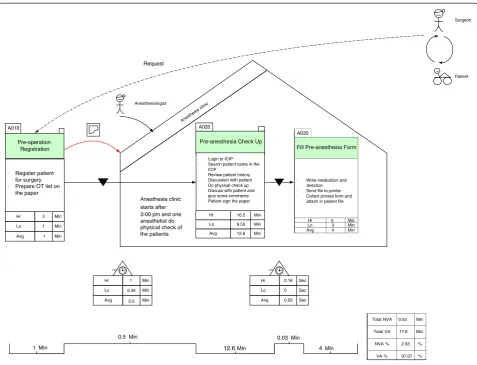
care is likely to be affected when anaesthetists need to al-locate time for accessing multiple data sources and Clinical Information Systems (CIS), and when they de-pend on manually documenting information in various systems [28]. In this proposed solution, the anaesthetists in charge of physical assessments, would be available at the pre-anaesthesia clinic and could concentrate on their tasks. The future state map is shown in Figure 7, along with the suggested changes for removing waste from the current state map.
The highest delay identified, in the pre-anaesthesia process, occurred at the start of the“pre-operation regis-tration” step, with an average delay of 70 minutes. These delays would not appear in the future state map, if anaes-thetists started their work with the first patient who was ready for physical assessment. The over-processing waste, identified in the current process, can also be removed if there is only one anaesthetist in charge of performing pa-tient physical assessments.
In order to resolve duplicate data entries, we proposed that the ICIP be integrated with the Electronic Medical
Record (EMR) and other relevant HIS and devices. The actual advantages of an Anaesthesia Information Man-agement System (AIMS) (which in our case is part of the ICIP) can only be realized if it is fully integrated with other health IT systems or if it is able to communicate automatically and bidirectionally with them [28,29]. There are a number of options that can be chosen in in-tegrating AIMS with EMR [29,30]. An enterprise EMR enables the merging of anaesthesia documentation with other clinician documentation, as well as the ability to interface with related medical devices [30]. With this proposal, the current process that requires anaesthetists to enter lab, echocardiograph, and lung function reports, will be eliminated. Under the proposal, when anaesthe-tists go to the anaesthesia clinic, they can simply find this patient information in the ICIP without having to enter it, and thereby reduce the patient’s waiting time.
As a result, the average delay between the “
pre-operation registration” and the “pre-anaesthesia
check-up” (of 10 minutes) can be removed from the current
state map. This small change removes waiting waste
Total NVA 0.53 Min
Total VA 17.6 Min
NVA % 2.93 %
VA % 97.07 %
A030
Fill Pre-anesthesia Form
· Write medication and direction
· Send file to printer
· Collect printed form and attach in patient file
Hi 5 Min
Lo 3 Min
Avg 4 Min
Surgeon
Request
Patient
Anesthesiologist
A010
Pre-operation Registration
A020
Pre-anesthesia Check Up
· Register patient for surgery
· Prepare OT list on the paper
Anesthesia clinic starts after
· Login to ICIP
· Search patient name in the ICIP
· Review patient history
· Discussion with patient
· Do physical check up
· Discuss with patient and give some comments
· Patient sign the paper
Hi
Lo
Avg 3
1
1 Min
Min
Min
3:00 pm and one anesthetist do physical check of the patients
Hi
Lo
Avg 16.5
9.55
12.6 Min
Min
Min
Hi
Lo
Avg 1
0.45
0.5 Min
Min
Min
Hi
Lo
Avg 0.16
0
0.03 Sec
Sec
Sec
1 Min
0.5 Min
12.6 Min
0.03 Min
4 Min
from the process and reduces the process’s complexity. Furthermore, the integrated information may encourage anaesthetists to use the ICIP when performing their tasks, even if they were initially reluctant to use the ICIP before. As mentioned previously, most anaesthetists complained about having to perform data entry in the ICIP. They stated that it is time-consuming for them, and that their responsibility is to perform physical assessments, and not to work as a secretary.
Furthermore, with an integrated HIS, the ward nurse can check the availability of all reports that are required for the anaesthetist. When the anaesthetist goes to the clinic, they can login to the ICIP and read the relevant reports. This process can therefore reduce patient wait-ing time, as opposed to the as-is process, where anaes-thetists must complete the form in the ICIP themselves, which keeps the patient waiting. Ideally, most medical history and physical assessment information should be collected from other sources and given to the anaesthe-tist for review [29]. The anaestheanaesthe-tist should spend more time analysing the information and developing an anaes-thetic plan and less time collecting information.
Another suggested change in the future state map is process standardization. In the as-is process, anaesthe-tists can use either paper or the ICIP to write medica-tion instrucmedica-tions and direcmedica-tions. In the to-be process, all anaesthetists can conveniently use the ICIP to complete the form, because all necessary data entered into the ICIP is linked to other systems through an integrated HIS. Reports can be printed, appended to a patient’s file, and referred to by the nurses, and thus confusion waste can be removed from the future state map. The standardization of preoperative evaluations, amongst other factors, has yielded a significant improvement in starting surgeries on time [13].
In the to-be process, the proposed solution is to con-duct a daily anaesthesia clinic at 3 pm. The patient, the examination room, and all necessary equipment needed by the anaesthetists, can be arranged by nurses in ad-vance, and the stated waiting waste can be removed from the future state map. Standardized room allocation guidelines were one of the factors that resulted in improved efficiency of the overall specialties operation of an academic medical centre [13]. As for the commu-nication problems, we suggest that a nurse should be available in the examination room to assist foreign anaesthetists during patient visits, in order to eliminate the wasted miscommunication waiting time.
In addition to the above suggestions, a balance of quick fixes and more fundamental approaches, such as a
“well-coordinated and planned multidisciplinary
ap-proach,” could reduce waste and subsequently improve the quality of care; as demonstrated by Yousri et al., [11]. Mazzocato et al., [25] showed improvements in
emergency care by adopting this approach, based on four Lean rules [31]: standardized work and reduced am-biguity, linked interdependent people, enhanced
pro-cesses that are seamless and uninterrupted, and
empowered staff to identify problems and make
improvements using a scientific method.
Based on our suggestions, we calculated the total value-added and non-value-added time of the process in the designed future state map. As shown in Figure 7, the value-added time increased to 97.07% of the total time, and the non-value-added time decreased to 2.93%. In order to achieve the future state map, the implementa-tion plan provides a structure to improve work and its required cost, time, and effort. Calculating the cost benefit provides a fair justification for the cost of the plan. However, monetary measures may be reflected later in patient safety factors, quality of care, patient sat-isfaction, and workplace appreciation.
In summary, we designed a chart based on a time-frame analysis of the as-is and to-be processes of value-added and non-value-value-added activities, in order to identify improvements for each studied process (see Figure 8). When we compared the results based on the timeframe, it is obvious that the total non-value-added time decreased in all processes. Figure 8 shows that the
total non-value-added time in the to-be process
decreased, because in the current process, there were activities that were considered as waste. Therefore, by removing those activities, we simplified the overall process flow.
Conclusions
We used the Lean method to increase collaboration and teamwork across departments to minimize the risk of sub-optimization, which we demonstrated in the future state map. We also assessed and redesigned the auto-mated workflow and recommended an integrated clinical
As-Is NVA To-Be NVA As-Is VA To-Be VA
87.6 0.53 17.6 17.6
0 10 20 30 40 50 60 70 80 90
As-Is NVA To-Be NVA As-Is VA To-Be VA
information system to increase database consistency and data completeness. We applied the Lean method to ana-lyse the problem by exploring a root cause analysis and identifying both value-added and non-value-added time. Based on the analysis, we recommended improvements, in terms of increased collaboration and teamwork. Fur-thermore, we proposed a standardized way of perform-ing tasks by encouragperform-ing anaesthetists to use ICIP, based on its integration with HIS. We applied the Lean method as a tool to help us improve effectiveness and increase the quality of healthcare delivery by aligning the process, the people, and the technology, with each other. This study was performed to assess the feasibility of implementing the Lean method using VSM and A3 tools in evaluating the clinical process. We believe that there is still more work that needs to be performed and tan-gible measures that need to be instituted into the initia-tive, before any clear demonstrable benefit can be shown. However, the study has achieved its purpose in demonstrating that the application of the Lean method; particularly the feasibility of using both the VSM and A3 tools, is an effective mechanism for identifying oppor-tunities for reducing waste, for integrating process steps more tightly, and for standardizing work in the clinical process. Nevertheless, for this proposed solution to suc-ceed, it needs to be implemented enterprise-wide and with extensive training and knowledge acquisition.
Appendix A: Interview Questions
1. How does a new anaesthetist learn this process to work with the ICIP?
2. Were the anaesthetists trained properly in the use of the software?
3. Do they have access to easy-to-use documentation that is written in a very simple language?
4. Is there any limitation in using the software to enter the patient information?
5. Does the software display any errors or unknown messages during data entry?
6. When is the operation list usually ready? 7. Is the PC used for other purposes?
8. Is the ICIP software available any time they want to use it in the ward?
9. Who is responsible for the information that is entered in the pre-anaesthesia form?
10. What information is required to fill in the form? 11. Is all of the information available when the anaes-thetist visits the patient to fill in the form?
12. How many fields are mandatory? 13. Is the current condition ideal?
14. Does the work happen in a straight line with a continuous flow?
15. What roadblocks exist that must be worked around?
16. Are all of the steps in the process necessary? 17. Is the information flow direct and simple?
18. Is the participation of every person who touches the process necessary?
19. Does everyone who is involved in the process work the same way?
Competing interests
The authors declare that they have no competing interests.
Authors’contributions
MMY suggested the subject. AMBM suggested the area of the case study at the National Heart Institute. SKH conducted the case study and reported the findings under the close supervision of MMY and AMBM. AMBM was the clinical supervisor. MMY was the research supervisor. SKH drafted the paper. MMY approved and finalized it. All authors read and approved the final manuscript.
Acknowledgements
We would like to extend our sincerest appreciation to all of the surgeons and anaesthetists who participated in this study for their invaluable input and support.
Author details
1Center for Technology and Software Management, Faculty of Information
Science and Technology, Universiti Kebangsaan Malaysia, Bangi 43600, Malaysia.2Anesthesia Department, National Heart Institute, No. 145 Jalan Tun
Razak, Kuala Lumpur 50400, Malaysia.
Received: 18 October 2011 Accepted: 17 December 2012 Published: 21 December 2012
References
1. Yusof MM, Papazafeiropoulou A, Paul RJ, Stergioulas LK:Investigating
evaluation frameworks for health information systems.Int J Med Inf2008,
77(6):377.
2. Berg M:Implementing information systems in health care organizations:
myths and challenges.Int J Med Inf2001,64(2–3):143–156.
3. Hübner-Bloder G, Ammenwerth E:Key performance indicators to
benchmark hospital information systems–a delphi study.Methods Inf Med
2009,48(6):508–518.
4. Yusof MM, Stergioulas L, Zugic J:Health Information Systems Adoption:
Findings from a Systematic Review [online]. InMedinfo 2007: Proceedings
of the 12th World Congress on Health (Medical) Informatics; Building Sustainable Health Systems. Edited by Kuhn KA, Warren JR, Leong TY.
Amsterdam: IOS Press; 2007:262–266. Studies in health technology and
informatics, ISSN 0926-9630; v. 129.
5. Lau F, Price M, Keshavjee K:From benefits evaluation to clinical adoption:
making sense of health information system success in canada. Healthc Quart2011,9(4):11–17.
6. Schweikhart S, Dembe A:The applicability of lean and Six sigma
techniques to clinical and translational research.J Investig Med2009,
57(7):748–755.
7. Singh B, Garg S, Sharma S, Grewal C:Lean implementation and its
benefits to production industry.Int J Lean Six Sig2010,1(2):157–168.
8. Vinodh S, Arvind K, Somanaathan M:Application of value stream mapping
in an Indian camshaft manufacturing organisation.J Manuf Tech Manag
2010,21(7):888–900.
9. Kuo AM-H, Borycki E, Kushniruk A, Lee T-S:A healthcare lean Six sigma
system for postanesthesia care unit workflow improvement.Q Manage
Health Care2011,20(1):4–14.
10. DelliFraine J, Langabeer J, Nembhard I:Assessing the evidence of Six
sigma and lean in the health care industry.Qual Manag Healthc2010,
19(3):211–225.
11. Yousri TA, Khan Z, Chakrabarti D, Fernandes R, Wahab K:Lean thinking: can
it improve the outcome of fracture neck of femur patients in a district
12. LaGanga LR:Lean service operations: reflections and new directions for
capacity expansion in outpatient clinics.J Oper Manag2011,29:422–433.
13. Cima RR, Brown MJ, Hebl JR, Moore R, Rogers JC, Kollengode A, Amstutz GJ,
AWeisbrod C, Narr BJ, Deschamps C:Use of lean and six sigma
methodology to improve operating room efficiency in a high-volume
tertiary-care academic medical center.J Am Coll Surg2011,213:83–94.
14. Poppendieck M:Principles of Lean Thinking; 2002. http://www.gregoryneilassociates.
com/articles/lean_thinking.pdf.
15. Hines P, Holweg M, Rich N:Learning to evolve: a review of contemporary
lean thinking.Int J Oper Prod Man2004,24(10):994–1011.
16. Singh B, Sharma S:Value stream mapping as a versatile tool for lean
implementation: an Indian case study of a manufacturing firm.Meas Bus
Excel2009,13(3):58–68.
17. Monden Y:Toyota production system: an integrated approach to just-in-time.
Georgia: Industrial Engineering and Management Press; 1998.
18. Monden Y:Toyota production system: practical approach to production
management. Georgia: Industrial Engineering and Management Press; 1983.
19. Schonberger R:World class manufacturing: the lessons of simplicity applied.
New York: The Free Press; 1986.
20. Harrison A:Just-in-time Manufacturing in Perspective. London: Prentice Hall;
1992.
21. Jimmerson C:Value stream mapping for healthcare made easy. New York:
Productivity Press; 2009.
22. Womack JP, Jones DT:Beyond toyota: How to root Out waste and pursue
perfection.Harv Bus Rev1996, 140–158. http://www.business.uzh.ch/
professorships/som/stu/Teaching/FS10/MA/som/Womack_1996_lean.pdf.
23. Yamamoto Y, Bellgran M:Fundamental mindset that drives
improvements towards lean production.Assembly Autom2010,
30(2):124–130.
24. Jimmerson C:A3 Problem Solving for Healthcare: A Practical Method for
Eliminating Waste. New York: Productivity Press; 2007.
25. Mazzocato P, Holden RJ, Brommels M, Aronsson H, Bäckman U, Elg M,
Thor J:How does lean work in emergency care? a case study of a
lean-inspired intervention at the astrid lindgren Children’s hospital,
Stockholm, Sweden.BMC Health Serv Res2012,12(28):1–13.
26. Yusof MM, Kuljis J, Papazafeiropoulou A, Stergioulas LK:An evaluation
framework for health information systems: human, organization and
technology-fit factors (HOT-fit).Int J Med Inf2008,77(6):386–398.
27. James R, Douglas J, Ritter MJ:Implementation of an anesthesia
information management system (AIMS).Ochsner J2011,11:102–114.
28. Kadry B, Feaster WW, Macario A, Ehrenfeld JM:Anesthesia information
management systems: past, present, and future of anesthesia records. Mt Sinai J Med2012,79:154–165.
29. Shah NJ, Tremper KK, Kheterpal S:Anatomy of an anesthesia information
management system.Anesthesiology Clin2011,29:355–365.
30. Springman SR:Integration of the enterprise electronic health record and
anesthesia information management systems.Anesthesiology Clin2011,
29:455–483.
31. Spear S, Bowen HK:Decoding the DNA of the toyota production system.
Harv Bus Rev1999, 96–106. http://www.busn.uco.edu/gwillis//ISOM% 204043/Decoding%20DNA%20of%20TPS.pdf.
doi:10.1186/1472-6947-12-150
Cite this article as:Yusofet al.:Evaluation of the clinical process in a critical care information system using the Lean method: a case study. BMC Medical Informatics and Decision Making201212:150.
Submit your next manuscript to BioMed Central and take full advantage of:
• Convenient online submission
• Thorough peer review
• No space constraints or color figure charges
• Immediate publication on acceptance
• Inclusion in PubMed, CAS, Scopus and Google Scholar
• Research which is freely available for redistribution