An Efficient and Unbiased Power Control
Algorithm Based on Game Theory in Cognitive
Radio
Xianzhong Xie
Institute of Broadband Access Networks
Chongqing University of Posts & Telecommunications, Chongqing, P. R. China, 400065 Email: [email protected]
Lu He, Helin Yang and Bin Ma Institute of Broadband Access Networks
Chongqing University of Posts & Telecommunications, Chongqing, P. R. China, 400065 Email: {helcqupt, yhelincqupt}@163.com
Abstract—Based on the non-cooperative power control game theory, we propose an efficient and unbiased power control algorithm in cognitive radio network (CRN) by improving the utility function. Without causing interference to the primary users (PUs), this effective utility function balances the fairness and system throughput of secondary users (SUs) via a fair pricing function. The pricing punishment parameter setting depends on the quality of received signal to guarantee the quality of service (QoS) requirement of the SUs. In addition, we prove that the proposed game model has ‘Nash equilibrium point (NE)’ by supermodular game theory and we give the iterative algorithm for the proposed game to attain the optimal power for all SUs. Simulation results show that the proposed game not only enhances the system throughput, reduces transmission power of SUs, and maximizes the global utility, but also takes the system fairness into account to some extent, which differs from other previous schemes.
Index Terms—Cognitive radio networks; power control; game theory; efficiency function; pricing function; fairness
I. INTRODUCTION
With the rapid development of wireless communication technology, more and more access demands of communication terminals lead to increasingly scarce spectrum resources. Federal Communications Commission (FCC) indicates that under the fixed spectrum allocation, the utilization of licensed spectrum is 15%-85%. To deal with the dilemma between spectrum congestion and spectrum underutilization, Cognitive radio (CR) technology has been proposed and advocated [1]. CR is an enabling technique that allows SUs to make
full use of spectrum holes to improve the efficiency of the spectrum by spectrum sensing and spectrum sharing, without causing interference to PUs [2].
In CRNs, power control is an efficient way to select proper transmission power for SUs that achieves high spectrum efficiency by enabling SUs to reuse PUs spectrum bands under the interference constraints imposed by PUs. Game theory is used as an efficient mathematical tool for resource allocation in [3-4]. Moreover, power control using game theory has been attracted considerable attention recently [5-6]. Excellent literatures for power control using game theory can be found in [7]-[12]. Non-cooperative power control game (NPG) was first developed in [7], in which the existence and uniqueness of NE were proved, which is an equilibrium point where each player has no chance to increase its utility by unilaterally deviating from this equilibrium. Unfortunately, this NE point could not achieve Pareto-optimality which shows the achievable network-wide sum utility can be low compared with centralized optimization. In these games, rational but selfish users maximize their individual utilities in a self-interested manner without considering the impact of their strategies on other users.
There has been recent work that aims to improve the network-wide utility by introducing some pricing schemes [13]-[21]. Some forms of user cooperation are enforced in these pricing schemes to improve network utility. The improvement of Pareto-optimality was first achieved by NPG with pricing (NPGP) which introduced a linear-pricing function into the utility function in [13]. The combination pricing function (NPGP-CP) which was improved via non-linear function was proposed in [14]. In order to improve convergence speed, a modified shuffled frog leaping algorithm (NPGP-MSFLA) for solving NE was proposed in [15]. Moreover, an efficient swarm intelligent algorithm based on power control game (NPGP-ESIA) with underlay spectrum access to attain Manuscript received February 15, 2014; revised March 1, 2014;
accepted March 7, 2014.
NE was proposed in [16]. the problem of efficient distributed power control in the uplink of CDMA wireless networks supporting multiple services was addressed in [17] , via the introduction of a game theoretic framework adopting convex pricing of users’ transmission power. However, those papers ignored the minimum SINR requirement among SUs and fairness issue in the CRNs.
Because the utility of the base station (BS) is a non-convex function, it is difficult to find the optimal pricing scheme. Therefore, a novel price-based power control algorithm was presented in [18] to find the optimal price for each SU. In [19], a novel non-cooperative game power control model was given to verify the sub-optimality, fairness, and efficiency of the proposed pricing scheme. Joint pricing and power allocation for Dynamic Spectrum Access (DSA) networks with Stackelberg game was developed in [20]. In [21], the authors considered a wireless amplify-and-forward relay network with one relay node and multiple source-destination pairs and proposed a pricing framework that enabled the relay to set prices to maximize either its revenue or any desirable system utility. However, those research studies didn’t take the energy-efficiency into account, and the minimum SINR requirement among each SU was ignored either. While these schemes offer some remedies to the non-cooperative game approach, they still leave room for improvement toward the global optimum.
In this paper, motivated by the game theory in wireless system, we improve the sigmoid efficiency function and pricing function to propose an efficient and unbiased non-cooperative power control game with pricing algorithm (S-NPGP). This pricing punishment parameter setting depends on the quality of received signal to guarantee the QoS requirement of the SUs, which is suitable for CRNs to balance the fairness and system throughput of SUs. Simulation results show that the S-NPGP enhances the network throughput, reduces transmission power of SUs, improves the utility, and considers system fairness to some extent.
The rest of the paper is organized as follows. Section II describes the system model. In Section III, we not only introduce the classic NPG models, but also propose our NPG model with pricing punishment parameter setting and sigmoid efficiency function. This section also proves the existence of NE in the proposed game and gives the iteration algorithm. Simulation results and analysis are illustrated in Section IV. Finally, Section V concludes this paper.
II. SYSTEM MODEL
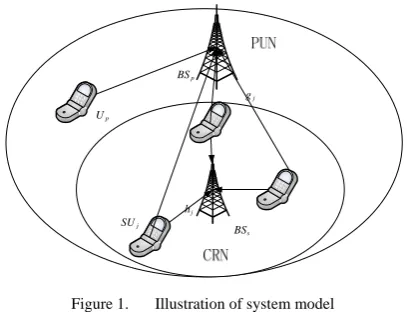
In this paper, we consider a spectrum-sharing scenario in a heterogeneous network in which a primary network coexists with a secondary cognitive network in a spectrum underlay manner shown in Fig. 1. SUs and PU can transmit data simultaneously, but SUs have to strictly control their transmit power to avoid harmful interference to PUs.
We focus on the uplink of power control. For
simplicity, it is assumed that one PU link consists of a primary BS, denoted asBSpand a PU, denoted asUp,
which uses a licensed spectrum to communicate with the
p
BS . A single-cell cognitive communication system without the spectrum license lies in the range of the PU networks. There are N SUs transmitting data to the secondary base station, denoted asBSs. Assuming that
the PU and SUs employ code division multiple access (CDMA) technique to utilize common spectrum for their own communications, the PU sends data to BSp with a
constant power. The received SINR of the kth SU can be written as follows
2
1,
( ) k k , 1, 2,...,
k k N
i i k
i i k Gh p
p k K
h p
γ
δ
= ≠
= =
+
∑
(1)where pk is the transmission power of the kth SU and G is the processing gain. hk denotes the path gain
between the kth SU and the BSs , gk denotes the
channel gain of the kth SU to the BSp, and
2
k
δ is the power spectral density of the additive white Gaussian noise (AWGN) which causes degradation of the received signal at the BS. For practical consideration, the received SINR of the kth SU is no less than its threshold min
k
γ
which is defined as minimum requirement of SINR for th
k SU that is, min
k k
γ ≥γ .
p BS
s BS p
U
j SU
j g
j h
Figure 1. Illustration of system model
In this scenario, the power of the kthSU satisfies
,max
0≤pk≤pk . Meanwhile, all the SUs must restrain their
transmission power in order not to cause interference to the PUs. The interference power received by the PU is
1
N k k k=g p
∑
which is no greater than the interference power threshold tolerable for Updenoted as T . So theinterference power constraint of the SUs system is given as
1
N
k k k
g p T
=
≤
∑
(2)In the next generation wireless communications, SUs are expected to be uncoordinated opportunistic users. Therefore, there are conflicting interests among the SUs. This motivates the NPG theory play an important role in the complicated and competitive schemes in CRNs.
In this section, first, we introduce the classic NPG model and investigate the design guideline of pricing function in the NPGP. Second, we present our proposed S-NPGP model by introducing a new efficiency function and a fair pricing function. Third, we prove the existence of the NE for S-NPGP by supermodular game theory. In addition, we give the iteration algorithm to achieve the optimal transmission power of each SU.
A. Classic Non-cooperative Game Model
Game theory represents a kind of mathematical tool which is proposed for the purpose of analyzing interactions among players in decision processes. In [13], the authors define the power control as a non-cooperative game as follows
G=
{
N,{ }
Pk{
Uk( )
⋅}
}
(3)where N =
{
1, 2,...,N}
is the index set for the participating SUs currently in the cell, Pkis the strategyspaces of transmission power, Uk( )⋅ is the payoff function of SU k which measures the number of bits that can be successfully transmitted per joule of energy consumed. Each SU selects a power level pk such that
k k
p ∈P. Let the power vector p=(p1,...,pN) denote the
outcome of the game in terms of the selected power levels of all the SUs. The resulting utility level for the
th
k SU is Uk
( )
p . The objective of each SU in thesystem is to adapt its transmit power to maximize the utility under the power threshold tolerable of PU.
Based on the classic NPG model, a more effective utility function has been proposed in [14] can be expressed as follows
(
)
( 2)
NPGP-CP: ( , ) (1 0.5* k )M 1 Bp hk k
k k k k
k LR
U p e Ah e
Mp
γ
− −
− = − − −
p (4)
Where M is the length of the packet and every SU transmits L bits in every packet (L<M ), Ris the transmission rate of the kthSU. For simple consideration, the transmission rate of all the SUs are the same. c is predefined positive cost factor , p−kis the power vector
sets of SUs other than the kth SU denoted as
1 2 1 2
[ , , , , , , ]
k p p pk pk pK
− = − −
P … … . In this utility function,
the efficiency function related to non-coherent frequency shift keying (FSK) modulation scheme defined to match with the frame success ratio (FSR) which can be described as follows
( 2) 1( ) (1 0.5 * k )
M k
f γ = − e−γ (5) Based on the utility function above,a novel one with a
new designed pricing function is proposed in [16] which is defined as
(( ) 1) th 1
NPGP-ESIA : ( ) 1
tar k k tar
k k
k k
k k
k
LR e p
U p e
Mp e p
γ
μ γ γ γ γ η
−
− −
−
= −
+ (6)
where ηand μare positive constants. The unit of ηis bit/Joule and μis used to adjust the order of punishment. Moreover, the efficiency function based on [16] can be described as follows which is different from f1
( )
γk2( ) 1 (1 ) tar
k
k k
k
f γ = −( e−γ ) +eγ −γ (7) Which is regardless of the modulation schemes, is only relevant to the γkof the kthSU and its threshold
tar k
γ . In that paper, the authors set the parameters
2
η= μ=1. The available interference power of the
th
k SU under maximum interference is denoted by th k p . Assuming that all the SUs have the same priority to use the licensed spectrum, the PU treats all the SUs equally. Therefore the average interference power threshold can be obtained by the mean value of
th k
p : ( 1 2 )
th th th th
k
p = p +p +…+p K.
For a reasonable pricing function, the link quality and the fairness of punishment should be concerned. The utility function of NPGP-CP is unfair for which it is only related to the SINR of SU. But the link quality is not taken into account. The pricing function of NPGP-ESIA is unreasonable either, for which it fails to guarantee the minimum QoS requirement of SUs.
B. The Proposed Game Model
In this section, focusing on the problem in paper [14] and [16], we propose a proper pricing function to maximize its revenue according to the optimal transmission power of SUs. Moreover, in order to reduce the computational complex, a new efficiency function based on the sigmoid function [22] is presented as follows
3
( )
(
1 k) (
1 k)
x k
f γ = −e−γ +e −γ (8) This sigmoid efficiency function is related to the SINR of SU and the value of x which is superior to others for which our efficiency function can reduce the computational complexity under the similar frame success ratio. This efficiency function is the S-shaped with f( ) 1∞ = , and f(0)=0 to ensure uk=0when
0
k
p = . In addition, the value of x is related to M defined in (4) and we can get the optimal xby using the least square method.
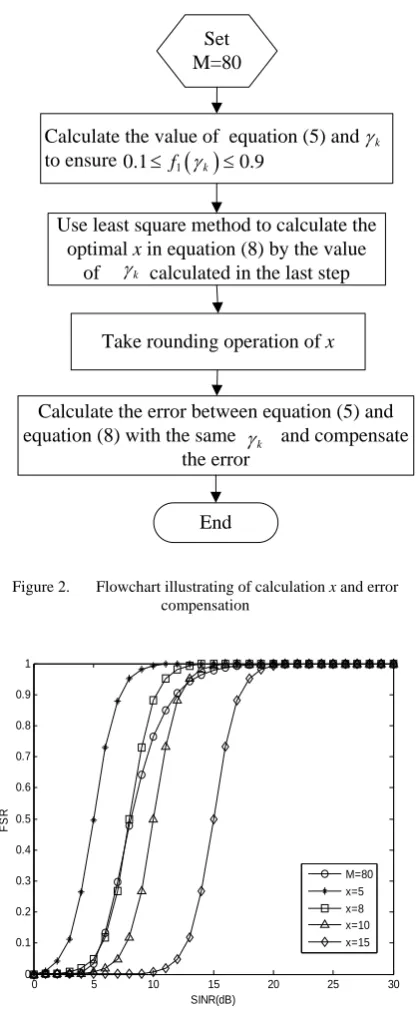
Fig. 2 illustrates the flowchart of calculation xand error compensation. When M =80, we get the optimal value of x that is, x=8 and error compensation according to the flowchart.
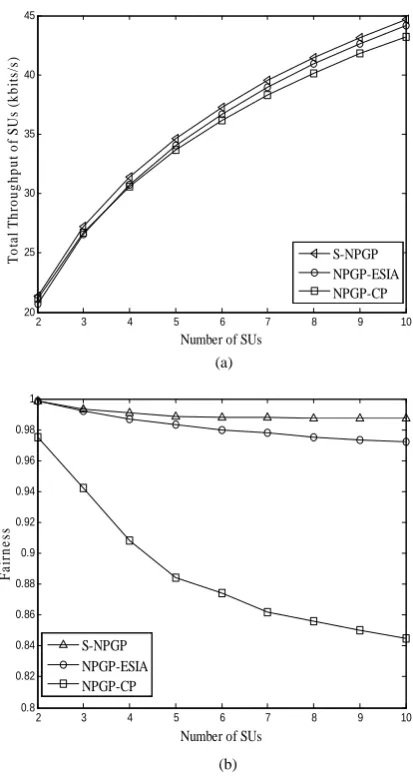
Fig. 3 shows the comparison of f1
( )
γk with M =808
x= , our proposed efficiency function f3
( )
γk is themost closest to the efficiency function f1
( )
γk proposedin [14].
Set M=80
Calculate the value of equation (5) and to ensure
Use least square method to calculate the optimalxin equation (8) by the value
of calculated in the last step
Take rounding operation of x
Calculate the error between equation (5) and equation (8) with the same and compensate
the error
End
k
γ
( )
10.1≤ f γk ≤0.9
k
γ
k
γ
Figure 2. Flowchart illustrating of calculation x and error compensation
0 5 10 15 20 25 30
0 0.1 0.2 0.3 0.4 0.5 0.6 0.7 0.8 0.9 1
SINR(dB)
FS
R
M=80 x=5 x=8 x=10 x=15
Figure 3. Comparison of the optimal x and other x
Table 1 shows the error compensation compared to the efficiency function f1
( )
γk when x=8, from which wecan see that the frame success ratio of our efficiency function is similar to f1
( )
γk . The comparison amongthese efficiency function is shown in Fig.4, which shows that the performance of the three efficiency functions are analogous. However, our efficiency is superior to f1
( )
γkfor which ours can reduce the computational complexity
compared to f1
( )
γk . Moreover, f2( )
γk is not as flexibleas ours for which the FSR of f2
( )
γk is related to tar kγ .
TABLE I.
ERROR COMPENSATION
SINR 7 8 9 10 11 12
Error
compensation 0.027 0.021 0.091 0.117 0.103 0.077
0 5 10 15 20 25 30
0 0.1 0.2 0.3 0.4 0.5 0.6 0.7 0.8 0.9 1
SINR(dB)
FSR
( 2) 1
2 3
( ) (1 0.5 ) ( ) (1 ) (1 ) ( ) (1 )/(1 )
k tar
k
k k
k k
M k
k
x k
f e
f e e
f e e
γ
γ γ γ
γ γ
γ γ γ
− − −
− −
= − ∗
= − +
= − +
Figure 4. Different efficiency functions comparison
Before the discussion of the pricing function, a performance metric is needed to assess the fairness incurred in the system as a result of competition. We adopt the throughput fairness defined in [23] which can be described as
2
max 1
1 1
=1-1
K k
k k
T T
N T
T
ξ
=
⎛
⎞ ⎞
⎛ −
⎜ ⎟
⎜ − ⎟
⎝ ⎠
∑
⎝ ⎠ (9)Where max
k
T is the maximal throughout if transmitters only distribute power to the user k , and
max = ) Kk( k/ k )
T (1/K
∑
T T is the normalized throughput percommunication pair, ξis the normalized variance of SUs throughput compared with the single-user case. So ξ provides a possible definition to measure the fairness in CRNs, that means ξ is higher, the throughput among the SUs will be more unbiased.
In order to improve the fairness of the pricing function, we define the pricing function according to the link quality, transmission power, and the received SINR which can be denoted as
th
(
)
min 1
th
( , )= k k
N k
k k
k
I I
k k
p
c p e e
p
γ γ
α β =
− + ∑
P (10)
parameter,
1,
( )
N
k i i
i i k
k
I − h p
= ≠
=
∑
p means that the interference
of the thi SU except the interference itself and the average interference can be obtained follow
as: 2
th 1
(I I N)
I = + +…+I N .Moreover,
(
min)
1 N k k k γ γ =∑ means
the SU who with higher SINR (better channel condition) after each one receives their maximized utility should be distributed with lower transmission power by setting higher pricing punishment and vice versa. th
k
p p is
combined with pkand the average interference power
threshold th
p means that the punishment is light when
k
p is less than th
p , otherwise, the punishment is serious. Therefore the punishment parameter should be strictly charged according to the SINR value and the interference from other SUs to discourage SUs who have high SINR and interference. So our proposed utility function is denoted as follows
(
min)
th
1
th 1
S-NPGP : ( ) 1 k k N k k k k k
k k x
k
I I
LR e p
U p e e
Mp e p
γ γ γ γ α β = − − ∑ − = − − + (11)
In this utility function, the punishment should be strictly charged by the interference, the SINR, and transmission power. So the effective pricing punishment parameter setting can avoid the selfish SUs who want to increase power level to reach the QoS requirement irrationally. Therefore, the throughout fairness can be achieved in this context implicitly as SUs who are interfered severely can improve their SINR by increasing their transmission power level fairly.
C. Existence of NE
According to [12], if all of the participants in the utility function satisfy the following two conditions, the schema will be a supermodular game.
(1) All of the strategy spaces is tight sets.
(2) 2 * ( ) 0, k SINR k i U
k i K
p p
∂
≥ ∀ ≠ ∈ ∂ ∂
Based on Topkis fixed point theorem, all supermodular games have at least a NE point. Therefore, as long as our proposed game G=
{
N,{ }
Pk{
Uk( )
⋅}
}
is proved as asupermodular game, it has at least a NE point. Since the strategy space of the kth SU satisfies0≤pk≤pk,max, it is obvious that it satisfies the first condition of supermodual game. We only need to verify whether the scheme satisfy the second condition or not.
The first-order derivative of the S-NPGP utility function with respect to pk has the form
( )
( )
(
min)
1 * 3 3 2 mi 1 n = 1 N k k k k k k k k N k th
k k k
k f
U LR e
f
p Mp p
γ γ γ γ β γ γ γ γ = = ⎛ ⎞ ∂ ⎛ ⎞ ∂ − − ⎜ + ⎟ ⎜ ⎟ ⎜ ⎟ ∂ ⎝ ∂ ⎠ ⎝ ⎠ ∑
∑
(12)And then, the second-order derivative of (12) with
respect to pican be written as
(
min)
1
2 * 2
3
2 2 min min
1 1 ( ) = 2 N k k k k k k N N k
k k k k
th k i
k
k i k i k
U LR f e
p p Mp p p p
γ γ γ γ γ β γ γ γ γ γ = = = ⎛ ⎞ ∂ ∂ ∂ − ∂ ⎜ + ⎟ ⎜ ⎟ ∂ ∑
∂ ∂ ∂
∑
∂ ⎝∑
⎠(13)From (13), we get the first-order derivative of γk with
respect to pi can be written as
2 2
1,
0
( )
k k k i
k K
i
k i i
i i k h p h G
p h p
γ
δ
= ≠
∂ = − <
∂ +
∑
(14)The first-order and second-order derivative of the efficiency function f3(γk) with respect to γk has the
form respectively as
3 2 ( ) (1 ) k k k x k x k
f e e
e γ γ γ γ γ − − − ∂ = +
∂ + (15)
2
3
2 3
( ) ( )( 1)
(1 )
k k k
k
x x
k
x k
f e e e
e γ γ γ γ γ γ − − − − ∂ = + −
∂ + (16)
From (16), when x≤γk, we can get
( )
2 2
3 k k 0
f γ γ
∂ ∂ ≤ . Substituting (16) and (14) into (12), we can get inequality 2 *
/ ( ) 0
k k i
U p p
∂ ∂ ∂ ≥ . Hence, based on the
aforementioned definition, the S-NPGP model is a supermodular game. So it has a reasonable NE point at least. Moreover, we introduce the iteration algorithm to attain the optimal power of each SU as follows.
Algorithm :S-NPGP
The efficient and unbiased non-cooperative power control game with pricing algorithm (S-NPGP) given in (11) is described as follows.
1) Set k=0, and input the initial transmission power vector P( )k =[p k p k1( ), 2( ),⋅⋅⋅,pK( )]k and
set an infinitely small quantity ε(ε>0).
2) k= +k 1, update the value of γiby the follow
equation
( )
(
)
2 1,2,..., 1i i i
j j i
j i
Gh p k
i n
h p k
γ
δ
≠
= =
− +
∑
(17)And then compute the value of p ki
( )
by( )
0 1, 2,...,i i
u p k i n
∂ ∂ = =
3) for each SU i , if p ki
( )
−p ki(
−1)
>ε go back to step (2), otherwise stop the algorithm,( )
k ={
p k1( ) ( )
,p k2 ,...,p kn( )
}
p is the optimal
power control vector for all the SUs.
control arrayP( )k . Also, the system guarantees the QoS requirement of SUs and ensures fairness among all SUs.
Compute the value of by Set k=0,initialize the transmission power vector
and the infinitely small quantity
Update the value of By the follow equation (15)
i
γ
( )
0i i
u p k
∂ ∂ =
( )
i p k
( )
(
1)
i i
p k −p k− <ε
is the optimal power control vector for all the SUs
NO
1 2
( )k =[p k( ),p k( ),⋅⋅⋅,pK( )]k P
ε
( )
k ={
p k1( )
,p2( )
k ,...,pn( )
k}
p
End YES All SUs are active
Figure 5. Flowchart illustrating the S-NPGP scheme
IV. SIMULATION RESULTS
In this context, we compare the efficient and unbiased power control algorithm (S-NPGP) with the power control algorithm based on nonlinear pricing (NPGP-CP) algorithm described in [14] and efficient swarm intelligent algorithm for power control (NPGP-ESIA) described in [16].
As shown in Fig.1, we consider a heterogeneous CRN with radius of 3km with primary BS BSpin the center
of the cell. The CRN with radius1km, lies 500m south to BSp where SUs are uniformly distributed around the
secondary BSBSs. The distance between the SUs and the
s
BS is chosen randomly within (0,1) km. The processing
gain G=100 , bit rate 4 10 bit/s
R= , total number of bitsM=80bits, number of information bitsL=64bits, and minimum requirement of SINR for kth SU min
8
k
γ = . Each SU deploys an isotropic transmitter with the same maximum power of pmax=20 mW, channel path gain
4 0.097
k
h = d− , d is the distance between the SU and
s
BS , and the background noise is assumed to be additive
white Gaussian noise of 12
(0 )
~ 10
k
δ , −
N which is
assumed to be uniform for all users.
Moreover, we set the punishment parameters 30000
α= ,β=50000and 2 10
ε= −
. It is assumed that all SUs cannot cause the interference to PUs beyond the maximum interference threshold of the PUs. Simulation results are shown in Fig.6 and Fig.7, which illustrates the system performance of the three algorithms.
2 3 4 5 6 7 8 9 10
20 25 30 35 40 45
Number of SUs
To
ta
l T
h
ro
u
g
h
p
u
t o
f SU
s
(k
b
its
/s
)
S-NPGP NPGP-ESIA NPGP-CP
(a)
2 3 4 5 6 7 8 9 10
0.8 0.82 0.84 0.86 0.88 0.9 0.92 0.94 0.96 0.98 1
Number of SUs
Fa
ir
n
e
ss
S-NPGP NPGP-ESIA NPGP-CP
(b)
Figure 6. Total throughput and fairness comparison for the three schemes
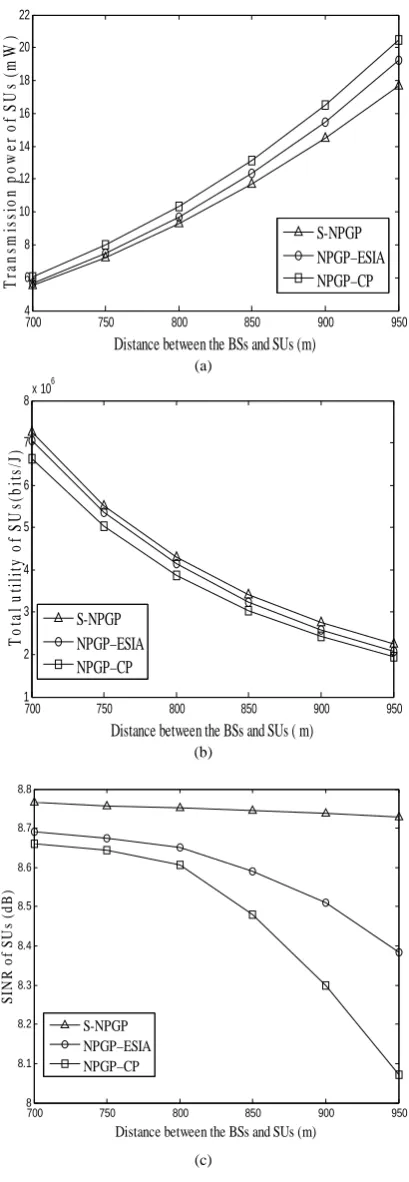
Fig. 6 shows the comparison of total throughput performance and fairness with respect to different number of SU of different algorithms. From Fig. 6 (a), it can be seen that the total throughput of S-NPGP is always larger than that of NPGP-CP and NPGP-ESLA with different number of SU.
punishment parameter like interference from other SUs to guarantee the minimum QoS requirement of SUs and takes an available iteration algorithm to achieve NE. Therefore, our proposed scheme can improve the total throughput and guarantee fairness among SUs.
700 750 800 850 900 950
4 6 8 10 12 14 16 18 20 22
Distance between the BSs and SUs (m)
T
ra
n
sm
is
si
o
n
p
o
w
e
r
o
f SU
s
(m
W
)
S-NPGP NPGP–ESIA NPGP–CP
(a)
700 750 800 850 900 950
1 2 3 4 5 6 7 8x 10
6
Distance between the BSs and SUs ( m)
T
o
ta
l
u
tili
ty
o
f S
U
s(
b
it
s/J
)
S-NPGP NPGP–ESIA NPGP–CP
(b)
700 750 800 850 900 950
8 8.1 8.2 8.3 8.4 8.5 8.6 8.7 8.8
Distance between the BSs and SUs (m)
SI
N
R
o
f SU
s
(d
B
)
S-NPGP NPGP–ESIA NPGP–CP
(c)
Figure 7. The transmission power, total utility, and SINR comparison for the three schemes.
From Fig. 7 (a) and (b) here, we can easily get the
conclusion that S-NPGP with sigmoid efficiency function and new pricing function has obvious improvement. Not only because the transmit power of the SUs are lower than the other two, but also the utilities of the SUs are also larger with the rise of distance between the BSsand
SUs.
Due to the adaptive price mechanism presented in S-NPGP, the SUs need to pay the price to prevent selfish SUs increase power blindly, which can affect other SUs, so the total transmit power naturally reduce compared with other schemes. In addition, although the utilities of all the three algorithms reduce as link quality become worse with the rise of distance between the SU BS and SUs, the total utility of S-NPGP is always larger than the other algorithms. Moreover, the sigmoid efficiency function is used to approximately match with the success probability of data transmission to reduce the system error.
The comparison of SINR of SUs for the three schemes are shown in Fig.7 (c), which shows when the SUs are far away from the SBs, the SINR reduce fast in NPGP-CP. Because the author ignores the minimum requirement of SINR, it cannot ensure fairness among all the SUs. In addition, the same does NPGP-ESLA, for which the path gains cannot be taken into account. However, the SINR of S-NPGP keep stable with the rise of distance between theBSsand SUs, thanks to the pricing function which can
ensure the fairness and the minimum requirement of SINR among all the SUs with different distance by using the quality of received signal as punishment.
V. CONCLUSION
In this paper, we propose an efficient and unbiased power control algorithm based on game theory in a heterogeneous CRN by improving the sigmoid efficiency function and pricing function to balance the fairness and system throughput of SUs. This effective utility function considers the throughput and fairness among SUs, where the pricing punishment parameter setting depends on the quality of received signal to guarantee the QoS requirement of the SUs. Simulation results show that the proposed power control game not only enhances the network throughput, reduces emission power of SUs, and improves the utility, but also takes the system fairness into account to some extent, which differs from other previous schemes.
ACKNOWLEDGMENTS
We gratefully thank anonymous reviewers for their constructive comments and suggestions to improve the quality of this paper. This work was supported by the National Nature Science Foundation of China under contract number 61271259 and 61301123, the Chongqing Nature Science Foundation under contract number CSTC2010BB2415 and CTSC2011jjA40006, the Research Project of Chongqing Education Commission under contract number KJ120501, and KJ110530.
[1] Y. C. Liang, K. C. Chen, G. Li, and P. Mahonen, “Cognitive radio networking and communications: an
overview,” IEEE Transactions Vehicular Technology, vol.
60, no. 7, pp. 3386–3407, 2011.
[2] Y. AN, Y. Xiao, D. Wang, and Z. Ji,“Security Spectrum
Auction Framework for Cognitive Radio Networks,”
Journal ofComputers, vol. 8, no. 11, pp. 2202–2208, 2013.
[3] W. Sun, Q. Xia, Z. Xu, M. Li, and Z. Qin, “A Game
Theoretic Resource Allocation Model Based on Extended
Second Price Sealed Auction in Grid Computing,” Journal
ofComputers, vol. 7, no. 1, pp. 65–75, 2012.
[4] C. Zhang, Q. Zhu, and Z. Chen, “Credit-based Repeated
Game Model Applied in Transfer Decision of
Opportunistic Network,” Journal of Software, vol. 6, no. 9,
pp. 1649–1654, 2011.
[5] B. Wang, Y. Wu, and K. J. R. Liu, “Game theory for
cognitive radio networks: An overview,” Computer
Networks Journal, vol. 54, no. 14, pp. 2537–2561, 2010.
[6] O.B. Abdulghfoor, M. Ismail, and R. Nordin, “Application
of game theory to underlay ad-hoc cognitive radio
networks: An overview,” Proceeding of the 2013 IEEE
International Conference on Space Science and Communication, pp. 296–301, 2013.
[7] D. J. Goodman and N. B. Mandayam, “Power control for
wireless data,” IEEE Personal Communications, vol. 7, pp.
48-54, 2000.
[8] S. Buzzi, and D. Saturnino, “A game-theoretic approach to
energy efficient power control and receiver design in
cognitive CDMA wireless networks,” IEEE Journal of
selected topics in signal processing, vol. 5, no. 1, pp. 137–150, 2011.
[9] P. Zhou, Y. Chang, and J.A. Copeland, “Reinforcement
Learning for Repeated Power Control Game in Cognitive
Radio Networks,” IEEE Journal on Selected Areas In
Communications, vol. 30, no. 1, pp. 54–69, 2012.
[10]M. Alayesh, and N. Ghani, “Game-theoretic approach for
primary-secondary user power control under fast at fading
channels,” IEEE Communication Letters, vol. 15, no. 5, pp.
491–493, 2011.
[11]X. Huang, B. L. Baltasar, and C. Botella, “Quasi-Nash
Equilibria for Non-Convex Distributed Power Allocation
Games in Cognitive Radios,” IEEE Transactions on
WirelessCommunications , vol. 12, no. 7, pp. 3326–3337, 2013.
[12]H. Khayatian, R. Saadat, and J. Abouei, “Coalition-Based
Approaches for Joint Power Control and Relay Selection in
Cooperative Networks,” IEEE Transactions on Vehicular
Technology, vol. 62, no. 2, pp. 835–842, 2013.
[13]C. U. Saraydar, N. B. Mandayam, and D. J. Goodman,
“Efficient power control via pricing in wireless data
networks,” IEEE Transactions on Communications, vol. 50,
no. 2, pp. 291–303, 2002.
[14]S. Liu; H. Liu; Z. Gao, “Power Control Game Algorithm
Based on Combination Pricing Function,” 2011 IEEE 10th International Conference on Trust, Security and Privacy in Computing and Communications (TrustCom) , pp.1421-1424, 2011.
[15]X. D. Zhang, Y. F. Zhang, Y.H. Shi, L. Zhao, and C. R. Zou,
“Power control algorithm in cognitive radio system based
on modified shuffled frog leaping algorithm,” Int. J.
Electron. Commun. (AEÜ).
[16]Y. Kuo, J. Yang, and J. Chen, “Efficient swarm intelligent
algorithm for power control game in cognitive radio
networks,” IET Communications, vol. 7, no. 11, pp.
1089–1098, 2013.
[17]E. E. Tsiropoulou, G. K. Katsinis, and S. Papavassiliou,
“Distributed Uplink Power Control in Multiservice
Wireless Networks via a Game Theoretic Approach with
Convex Pricing,” IEEE Transactions on Parallel and
Distributed Systems, vol. 23, no.1, pp. 61–68, 2012.
[18]Z. Wang, L. G. Jiang, and C. He, “A Novel Price-Based
Power Control Algorithm in Cognitive Radio Networks,”
IEEE Communications Letters, vol.17, no.1, pp.43–46, 2013.
[19]H. Yu, L. Gao, Z. Li, X.B. Wang, and E. Hossain, “Pricing
for Uplink Power Control in Cognitive Radio Networks,”
IEEE Transactions on Vehicular Technology, vol. 59, no. 4, pp.1769 –1778, 2010.
[20]Y. Wu, T. Zhang, and D. H. K. Tsang, “Joint Pricing and
Power Allocation for Dynamic Spectrum Access Networks
with Stackelberg Game Model,” IEEE Transactions on
WirelessCommunications, vol. 10, no. 1, pp.12–19, 2011
[21] S. Ren and M. Schaar, “Pricing and Distributed Power
Control in Wireless Relay Networks,” IEEE Transactions
on Signal Processing, vol. 59, no. 6, pp. 2913–2926, 2011.
[22] Xiao, M.B., Shroff, N.B., Chong, E.K.P.: “A
utility-based power-control scheme in wireless cellular systems”, IEEE/ACM Trans. Netw. , 2003, 11, (2), pp. 210 –221.
[23] H. Han and K. J. R. Liu, “Non-cooperative
power-control game and throughput game over wireless
networks,” IEEE Transactions on Communications, vol.
53, no. 10, pp. 1625–1629, 2005.
Xianzhong Xie, received his Ph.D. degree in communication and information systems from Xi’dian University, China, in 2000. He is currently with the School of Computer Science and Technology at Chongqing University of Posts and Telecommunications, China, as a professor and director of the Institute of Broadband Access Technologies. His research interests include cognitive radio networks, MIMO precoding, and signal processing for wireless communications. He is the principal author of five books on cooperative communications, 3G, MIMO, cognitive radio, and TDD technology. He has published more than 80 papers in journals and 30 papers in international conferences.
Lu He, received her B.S. degree from Chongqing University of Posts and Telecommunications, China, in 2012. She is a postgraduate student of Chongqing University of Posts and Telecommunications, China, and will receive his M.S. degree in computer science and technology in 2015. Her research interests include cognitive radio networks, cooperative communications and wireless communications.
wireless communications.