Research Article
CODEN: IJPNL6
DEVELOPMENT AND EVALUATION OF PRESS COATED TABLET BY USING
RUPTURABLE MATERIAL (EC) COMBINED WITH ERODIBLE MATERIAL
(KLUCEL EXF) OF ACECLOFENAC
Mayee RV and Shinde PV*
Department of pharmaceutical sciences,
Shri Jagdish Prasad Jhabarmal Tibrewala University,
Vidyanagari, Jhunjhunu, Rajasthan – 333001
*Corresponding author e-mail:
[email protected]
ABSTRACT
The objective of this study was to develop and evaluate a press-coated pulsatile drug delivery system intended for treatment of early morning stiffness and symptomatic relief from pain in patients with rheumatoid arthritis with a distinct predetermined lag time of 6 h .Aceclofenac as a model drug by using various proportion of polymers such as rupturable material (EC) combined with erodible material (klucel EXF). Seven formulations were prepared and formulation F2 possessed good lag time time 6 hr and showed pulsatile drug delivery pattern the tablets were also evaluated for its hardness, friability and other In- vitro evaluation tests. All parameters complied with IP limits. Results of this study indicated that the combinations of rupturable material (EC) combined with erodible material (klucel EXF) are suitable to optimize pulsatile drug release formulation of aceclofenac. The formulation involved press coating of a rupturable coat around a rapidly disintegrating core tablet of aceclofenac.
Keywords: Pulsatile delivery, press coated tablet, Aceclofenac.
INTRODUCTION
In recent years, oral drug delivery systems with zero order sustained-release kinetics have been developed to control drug release using various mechanisms, including matrices with controllable swelling, diffusion, erosion, and osmotically driven systems. [1] Efforts are being made to avoid typical plasma concentration peak trough fluctuations and to reduce frequency of drug administration for better patient compliance. Recently, novel systems have been developed that release the drug after a programmable lag time.
The concept of chronotherapeutics originates from the finding of the major disease conditions such as asthma, cardiac disorders, allergic rhinitis, and arthritis following circadian example of symptom outburst. Chronotherapeutic delivery system has been developed to provide the best treatment regimens which revolve around the objective of assuring
maximum concentration of the drug at the time of symptom onset. [2-6]Nowadays, concept of chronopharmaceutics has emerged, wherein, research is devoted to the design and evaluation of drug delivery systems that release a therapeutic agent at a rhythm that ideally matches the biological requirement of a given disease therapy. Future of drug delivery must meet the challenge of future medicine [7]
Aceclofenac, a nonsteroidal anti-inflammatory drug, is used for the symptomatic relief of pain and joint stiffness in patients suffering from rheumatoid arthritis, which is characterized by diurnal variation in circulating levels of proinflammatory cytokines, interleukin-6 and/or tumor necrosis factor-α. Due to this diurnal variation, many symptoms and signs of active rheumatoid arthritis are manifested in the morning. [8] On oral administration at bed-time, releases aceclofenac after a desired lag time of about 6 hr which corresponds with peak levels of
International Journal of Pharmacy
proinflammatory mediators. The current study illustrates the formulation, characterization, and optimization of a press coated tablet for aceclofenac. The system is involved press coating of a rupturable coat around a rapidly disintegrating core tablet of aceclofenac combinations of rupturable material (EC) combined with erodible material (klucel EXF).
METHOD
Preparation of Press coated pulsatile release tablets: Press coated pulsatile release tablet was prepared by using compression coating method. Initially, core tablet of aceclofenac was prepared and coated on compression machine.
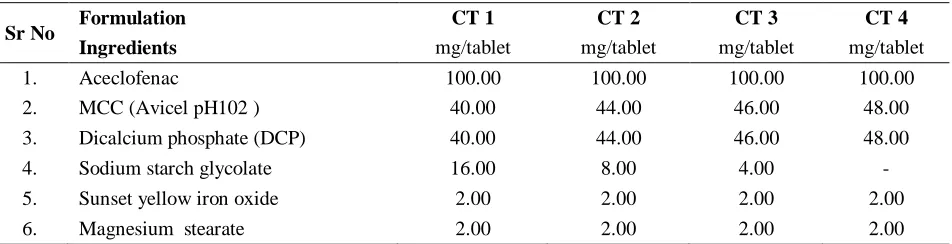
A. Preparation of core tablets (CT): All ingredients of core tablet given in Table1 were weighed and passed through 30 mesh standard sieve. Resultant powder was mixed thoroughly in mortar and lubricated with magnesium stearate (1 % w/w). A 200 mg powder was weighed and transferred manually in to die and compressed by using 8 mm diameter SC punch tooling.
B Press coated tablets: Formulation compositions of coating layer (F1 to F7) are shown in Table 2 describes varying percentage of polymers were weighed and passed through 22 mesh standard sieve. The ingredients of coating layer were mixed in a mortar. Required weight of coating powder was weighed and used in two steps 200 mg of the powder mixture was used for the upper and lower shell. first half coating powder was filled into the die and CT 1 was placed in the center of die. CT 1 was slightly pressed to fix the coating around and under the CT1
Then rest of half coating powder was filled and compressed by using 12 mm flat faced punch tooling. Table 2 shows different ratio of rupturable material (EC) combined with erodible material (klucel EXF) in the outer shell.From developed formulation best formulation study for Effect of rotational speed on lag time.
Evaluation of Tablet Characteristics: Weight variation: Twenty tablets were selected at random and weighed individually. The average weight of 20 tablets was calculated. Individual weights of the tablets were compared with the average weight.
Hardness: Tablet hardness has been defined as the force required breaking a tablet in a diametric compression test. A tablet was placed between two anvils of hardness tester, force was applied to the
anvils, and the crushing strength that causes the tablet to break was recorded in N.
Friability:Tablets require certain amount of strength or hardness and resistance to withstand mechanical shock of handling in manufacturing, packaging, and shipping. A pre-weighed sample (20 tablets) were placed in the friabilator, and operated for 100 revolutions, then again weighed the tablets and % friability was calculated using the formula.
100
1
0
W
W
F
WhereW0 – Weight of tablet before test
W – Weight of tablet after test
Drugs content: To evaluate a tablet potential for efficacy, the amount of drug per tablet needs to be monitored from tablet to tablet, and batch to batch. To perform the test, 10 tablets were crushed using mortar pestle. Quantity equivalent to 100 mg of drug was dissolved in 100 ml phosphate buffer pH 6.8, filtered and diluted up to 50µg/ml, and analyzed spectrophotometerically at 274.2nm. The concentration of drug was determined using standard calibration curve.
In vitro Dissolution Study: The in vitro dissolution test was performed using USP type II dissolution test apparatus. The drug release study was carried out in phosphate buffer pH 6.8 900 ml of dissolution media, maintained at 37±0.5◦C and agitated at 50 rpm. Periodically 5 ml samples were withdrawn and filtered through Whatman filter paper and samples were replaced by its equivalent volume of dissolution media. The concentration of Aceclofenac was measured by spectrophotometrically at 274.2 nm for 6.8 media.
Effect of rotational speed on lag time of press-coated tablet: Effect on rotational speed on lag time of press coated tablet studied on best formulation obtain in EC) combined with erodible material (klucel EXF) in dissolution test.
RESULTS AND DISCUSSION
Evaluation of Tablet characteristics: Tables are evaluated for Weight variation, thickness. Hardness, friability and drug content
B. Results of physicochemical evaluation of press coated tablets (F1 –F7) are given in Table 4
In vitro Dissolution Study:
A. Dissolution of core tablets (CT): In vitro dissolution test was carried out in phosphate buffer pH 6.8 for 60 min. Results of in vitro dissolution test presented in Table 5.and figure 1 In order to perform different release kinetics; depending upon different release mechanism involved, effect of Sodium starch glycolate level on drug release profile from uncoated tablet (Formulations CT1 to CT4) were determined.
As amount of Sodium starch glycolate level decrease from formulations CT-1 to CT-4; the formulation containing highest amount of Sodium starch glycolate (CT-1) showed fast disintegration and fast release because of swellable disintegrant present in it. As amount of swellable disintegrant decrease amount of drug release decreased. Without disintegrate Sodium starch glycolate level in formulation CT-4 showing decrease in dintengrant property. As shown in figure1 significant change in release profile CT1 shows drug release initially faster compare to CT -4 which without disintegrant.
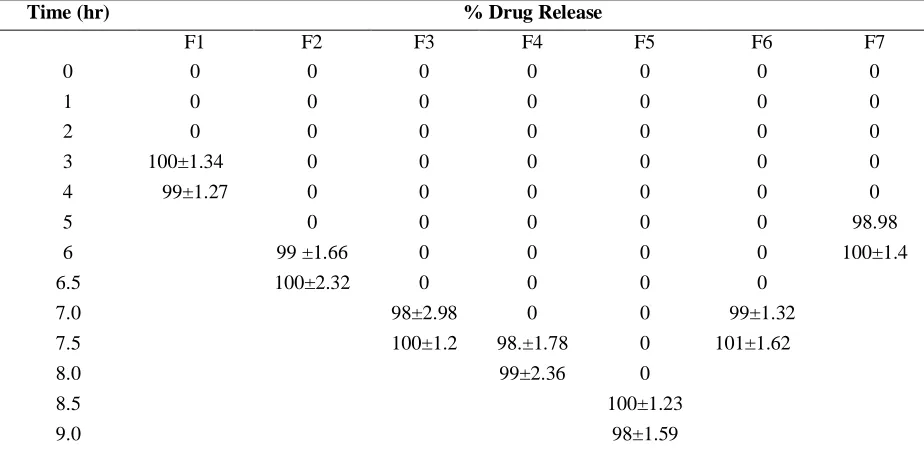
B. Dissolution of press coated tablets: By combining rupturable polymer (EC) with erodible polymer (HPC-EXF) lag time increases with increasing weight ration of EC/HPC-EXF in formulation F1 to F5. But while using EC alone lag time is lowest as compared to any weight ratio of EC/HPC-EXF. This is only because while combining hydrophilic HPC-EXF with EC; HPC-EXF acts as a binder too. As tablet comes in the contact of dissolution medium HPC-EXF hydrates but as EC is hydrophobic in nature it retards the hydration of HPC-EXF and as EC is semipermeable in nature. Dissolution medium penetrates faster in EC coated tablet compared to along with HPCEXF.While HPC-EXF forms a compacts with EC and water would not penetrate faster as compared to EC outer coating shell.
Thus due to both concomitance synergistic effect lag time is increase with increasing weight ratio of EC/HPC-EXF. As HPC-EXF made a compact with EC; because of different weight ratio of EC/HPC-EXF, outer shell may get eroded first and then when sufficient internal pressure built
because of AC-Di-Sol present in formulation F1 to F5 outer shell broke into two halves and cause a stage of rapid drug release. Obviously, the period of lag time was different and dependent on the weight ratio of EC/HPC-EXF. The order of the time lag changed according to the weight ratio of EC/HPC-EXF mixture as follows: (100: 0)-3hr,( 87.5 : 12.5)-6 hr, (75 : 25)-7 hr, (50 : 50)-7.5 hr, (25 : 75)-8.5 hr (12.5: 87.5)-7 hr, (0: 100)-5 hr The lag time and drug release profile of Aceclofenac from dry-coated tablets using different weight ratio of EC/HPC-EXF mixture are given in table 6 and illustrated in figure 2.
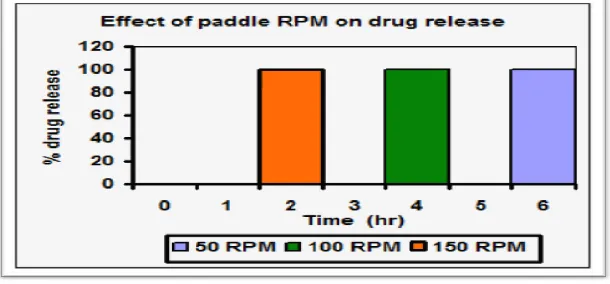
Effect of rotational speed on lag time of press-coated tablet: To determine the effect of peristalsis and contraction movement of gastrointestinal tract on lag time and drug release rate, study was carried out using different rotational speed of paddle on formulation F2 and the changes in lag time were examined (table 7 and Figure 3 )Decrease in lag time observed with increasing paddle rotational speed. The shorter lag time with increasing paddle rotational speed was presumed to be correlated well with the removal of the gel layer in the gastrointestinal tract due to peristalsis and contraction.
CONCLUSION
Table 1: Effect of Sodium starch glycolate level on drug release profile from uncoated Tablet (CT-1-CT-4) 8 %,4%,2% & without disinegrant.
Sr No Formulation CT 1 CT 2 CT 3 CT 4
Ingredients mg/tablet mg/tablet mg/tablet mg/tablet
1. Aceclofenac 100.00 100.00 100.00 100.00
2. MCC (Avicel pH102 ) 40.00 44.00 46.00 48.00
3. Dicalcium phosphate (DCP) 40.00 44.00 46.00 48.00
4. Sodium starch glycolate 16.00 8.00 4.00 -
5. Sunset yellow iron oxide 2.00 2.00 2.00 2.00
6. Magnesium stearate 2.00 2.00 2.00 2.00
F= Formulation code, CT1= Core tablet 1 with Sodium starch glycolate 8%, CT2= Core tablet 2 with Sodium starch glycolate 4%, CT3= Core tablet 3 with Sodium starch glycolate 2%, CT4= Core tablet 4 with Sodium starch glycolate without disintegrant
Table 2:Effect of rupturable material (EC) combined with erodible material (klucel EXF) in the outer shell.
Formulation Core Tablet
Coating Material (200 mg)
Ratio %
F1 CT-1 Klucel EXF: EC N 20 100 : 0
F2 CT-1 Klucel EXF: EC N 20 87.5 : 12.5
F3 CT-1 Klucel EXF: EC N 20 75 : 25
F4 CT-1 Klucel EXF: EC N 20 50 : 50
F5 CT-1 Klucel EXF: EC N 20 25 : 75
F6 CT-1 Klucel EXF: EC N 20 12.5 : 87.5
F7 CT-1 Klucel EXF: EC N 20 0 : 100
Table 3: Results of physicochemical evaluation of core tablets (CT)
F Weight Variation (mg)
n=20
Thickness (mm) n=10
Hardness (N)
n=10 Friability (%)
Drug Content (%) n=3
CT 1 200.10±1.24 3.20±0.1 80 N ± 10N 0.21 99.58±1.65
CT 2 200.15±1.11 3.20±0.1 80N ± 12N 0.11 100.25±1.98
CT 3 200.24±1.27 3.20±0.1 80N ± 9 N 0.25 99.98±1.56
CT 4 200.24±1.19 3.20±0.1 80 N ± 11N 0.15 100.58±2.15
Table 4: Results of physicochemical evaluation of press coated tablets (F1 –F7)
F Weight Variation (mg) n=20
Thickness (mm) n=10
Hardness (N)
n=10 Friability (%)
Drug Content (%) n=3
F1 600 mg ±1.24 4.65±0.24 196 0.025 100.24
F2 600 mg ±2.45 4.65±0.15 188 0.015 99.98
F3 600 mg ±2.24 4.65±0.12 179 0.044 102.12
F4 600 mg ±3.00 4.65±0.11 210 0.021 101.31
F5 600 mg ±2.62 4.65±0.20 200 0.036 99.82
Table 5: Effect of Sodium starch glycolate level on Drug Release Profile from Uncoated Tablet (CT-1-CT-4)8 %, 4%, 2% & without disintegrant. in phosphate buffer pH6.8 of different core tablets formulations.
Time (min) % Cumulative Drug Release
CT-1 CT-2 CT-3 CT-4
5 72.4 46.5 20.2 5.25
10 99.5 62.7 44.2 17.58
15 101.2 84.1 80.5 30.22
30 100.1 100.5 100.1 79.0
45 99.6 99.3 98.7 100.7
60 98.4 98.6 98.2 99.1
Table 6:Effect of rupturable material (EC) combined with erodible material (klucel EXF) in the outer shell. (Formulation F1 to F7) on drug release.
Time (hr) % Drug Release
F1 F2 F3 F4 F5 F6 F7
0 0 0 0 0 0 0 0
1 0 0 0 0 0 0 0
2 0 0 0 0 0 0 0
3 100±1.34 0 0 0 0 0 0
4 99±1.27 0 0 0 0 0 0
5 0 0 0 0 0 98.98
6 99 ±1.66 0 0 0 0 100±1.4
6.5 100±2.32 0 0 0 0
7.0 98±2.98 0 0 99±1.32
7.5 100±1.2 98.±1.78 0 101±1.62
8.0 99±2.36 0
8.5 100±1.23
9.0 98±1.59
Table 7: Effect of rotational speed on lag time of press-coated tablet.
Time (hr) % Drug Release
50 rpm 100 rpm 150 rpm
0 0 0 0
1 0 0 0
2 0 0 99.70 ±1.66
3 0 0 100.25±2.32
4 0 99.70 ±1.66 -
5 0 100.25±2.32 -
6 99.70 ±1.66 - -
Figure 1:Dissolution of aceclofenac core tablet formulation with various concentration of disintegrant Sodium starch glycolate 8 %(CT-1),4% (CT-2),2%(CT-3) & without disintegrant (CT-4)
Effect of rupturable material (EC) combined with erodible material (klucel EXF) in the outer shell on drug release
0 20 40 60 80 100 120
0 1 2 3 4 5 6 7 8 9 10
T ime (hr)
%
D
ru
g
re
lea
se
100:00:00 87.5 : 12.5 75:25:00 50:50:00 25 : 75 12.5 : 87.5 0:100
Figure 2: Effect of rupturable material (EC) combined with erodible material (klucel EXF) in the outer shell. (Formulation F1 to F7) on drug release.
Figure 3: Effect of rotational speed on lag time of press-coated tablet
REFERENCES
1. Anil KA, Recentpatents on drug delivery and formulation ,2007;1, 73-79
2. Ali J, Baboota S, Ahuja A, Saigal N, Journal of drug targeting, 2010; 18(6), 413–419. 3. Alessandra M, Lucia Z, Giulia Loreti, Andrea G, Int Journ of Pharm; 2010; 398, 1–8.
4. Michael H. Smolensky, Nicholas A, Peppas B, Advanced Drug Delivery, Reviews 2007; 59. 828–851 5. Erhard Haus , Advanced Drug Delivery, Reviews 2007; 59 , 985–1014
6. Asim SM, Nikhil B, Kazi MK, Arijit G, Sugata C, Mamata B, Ketousetuo K, Jour of Cont Rele, 2010;147 , 314–325
7. D.D. Breimer,. Jour of Cont Rele,, 1999;62 , 3–6