ISSN (e): 2250-3021, ISSN (p): 2278-8719
Vol. 09, Issue 5 (May. 2019), ||S (XI) || PP 01-06
Evaluating Performance of Neural Networks for load Forecasting
in IoT
Manisha Gaidhane, Ms. Mona Mulchandani
2, Ms. Priyanka Dudhe
3M.Tech, Department of Computer Science & Engineering, Jhulelal Institute of Technology, Nagpur, India
Abstract:
Load forecasting is an area of data prediction which uses short term memory models in order to predict an even shorter term data. Usually the extent of forecasting is not more than 2 to 4 weeks at maximum, due to the fact that the amount of load increasing due to an increase in number of household connections is exponential. Thereby researchers usually follow models like neural networks, linear classification, naive bayes, support vector machines and others to predict the load. In this paper, we evaluate the performance of load forecasting using neural network predictor which uses a non-auto regression network or NARNET, and takes into consideration the previous values of the current load values to predict the next load values. The performance evaluation is done on different network configurations, and the results are observed to conclude the best possible configuration for the given load data.Keywords:
Load, prediction, neural, configurations
I.
Introduction
The prediction of load is a complicated process, in order to perform accurate and precise prediction of load; the following steps must be followed,
1.1 Collection of information tests
Appropriate gathering of the info information is of most extreme significance for any forecast framework. For the most part for burden expectation, this information is as time labeled burden esteems, which needs further preparing so as to assess the data. For instance, the heap information may contain estimations of current and voltages of a specific zone for a given range of time. This information is for the most part in an exceptionally crude configuration, and in this manner isn't helpful for what it's worth, yet the exactness with which this information is gathered, mirrors the proficiency of the created expectation framework. Different web assets are accessible for getting the information for burden.
1.2 Processing of information tests to assemble data
When the crude information has been gathered it must be changed over into data which can be utilized for further handling. For doing this, the scientist needs to apply propelled flag handling techniques on the information. For instance, on account of burden investigation, the scientists are expected to pre-process the got information, with the goal that any missing qualities are expelled from the information. The prepared information is then given to an element extraction unit, which separates the required qualities from the information, and produces a gauge of how much level of burden is available in the info esteems. This rate is the data which is required by the forecast calculation for preparing and assessment purposes. Division calculations like thresholding, saliency maps, fluffy C implies, and so on can be utilized for this reason.
1.3 Representation of the got data
1.4 Trend investigation of the spoke to information for forecast
Investigation of patterns from the legitimately spoken to information is finished with the assistance of standard calculations like auto relapse neural systems, fluffy derivation frameworks, AI methods and others. Out of these methods the neural systems are viewed as the defacto standard for pattern investigation, and are commonly utilized by specialists for applications like market expectation, oil forecast and different regions. Burden expectation can likewise be performed by neural systems. We will portray this in subtleties in the proposed work area of this paper.
The next section describes various techniques used by researchers for load prediction, followed by the proposed technique and later by the result analysis and conclusions. We conclude the paper with some observations about our research and suggest some future ways via which load prediction can be improved
.
II.
Literature review
Load Forecasting is essentially a heap anticipating framework with a given driving time, which is vital for satisfactory booking and activity of intensity frameworks. It has been a fundamental part of Energy Management Systems (EMS). For legitimate and productive administration in electrical utilities, load guaging has part of significance.
Comparative Day Look up Approach: Similar day approach depends on seeking recorded information of long stretches of one, a few years having the comparable attributes to the day of estimate. The qualities incorporate comparative climate conditions, comparable day of the week or date [1].
Relapse based Approach: Linear relapse is a procedure which looks at the reliant variable to indicated free. The autonomous factors are right off the bat considered in light of the fact that changes happen in them sadly. In vitality determining, the needy variable is generally request of the power since it relies upon creation which then again relies upon the autonomous factors [2] .
Time Series Analysis: Time arrangement guaging depends on the possibility that solid forecasts can be accomplished by demonstrating designs in a period arrangement plot, and afterward extrapolating those examples to what's to come. Utilizing authentic information as information, time arrangement investigation fits a model as indicated by regularity and pattern. Time arrangement models can be exact in certain circumstances, however are particularly unpredictable and require a lot of recorded information [3].
Neural Networks: NN is a delicate strategy utilized in different streamlining forms. This strategy can perform non-direct demonstrating and adjustment. It doesn't require presumption of any practical connection among burden and climate factors ahead of time. We can adjust the ANN by presenting it to new information. The ANN is additionally presently being explored as an instrument in other power framework issues, for example, security appraisal, consonant burden distinguishing proof, alert handling, issue conclusion, and topological discernibleness [4].
Master Systems: A specialist framework is a PC program, which can go about as a specialist. This implies this PC program can reason, clarify, and have its learning base extended as new data winds up accessible to it. The heap figure demonstrate is fabricated utilizing the information about the heap conjecture area from a specialist in the field [5].
Fuzzy Logic: Fuzzy rationale dependent on the typical Boolean rationale which is utilized for advanced circuit structure. In Boolean rationale, the information might be reality esteem as "0" and "1". If there should be an occurrence of fluffy rationale, the info is identified with the correlation dependent on characteristics.
Support Vector Machines: Support Vector Machines (SVM) is the most dominant and late strategies for the arrangement of characterization and relapse issues. In help vector machines, direct capacities are utilized to make straight choice limits in the new space. On account of neural system, the issue is in the picking of engineering and on account of help vector machine, issues happens in picking an appropriate piece [6].
Pattern Analysis: Trend investigation (drifting) stretches out past development rates of power request into the future, utilizing methods that run from hand-attracted straight lines to complex PC delivered bends. These expansions comprise the conjecture. Pattern investigation centers around past changes or developments in power request and uses them to anticipate future changes in power request. Generally, there isn't much clarification of why request goes about as it does, before or later on. Slanting is as often as possible altered by educated judgment, wherein utility forecasters adjust their conjectures dependent on their insight into future improvements which may make future power request carry on uniquely in contrast to it has in the past [7].
gauge of how much power will be expected to run all family unit machines in a geological zone amid a specific year later on can be resolved. Utilizing comparative systems for power utilized in business and industry, and after that including the aggregates for private, business, and mechanical divisions, an all out figure of power request can be inferred. The upsides of end-use investigation is that it recognizes precisely where power goes, what amount is utilized for each reason, and the potential for extra protection for each end-use [8].
Econometric Analysis: Econometrics utilizes financial matters, science, and measurements to figure power request. Econometrics is a blend of pattern investigation and end-use examination, however it doesn't make the pattern investigator's supposition that future power request can be anticipated dependent on past interest. Also, dissimilar to many end-use models, econometrics can take into account varieties in the connection between power information and end-use. Econometric models work best when anticipating at national, local, or state levels. For littler geological regions, meeting the model can be an issue [9].
Various Linear Regressions: Regression is the one of most broadly utilized factual procedures. Since, the heap is absolutely reliant on the temperature, dampness, wind speed and day type parameters subsequently relapse is utilized to get the connection among burden and these parameters [10].Firstly, utilizing the past information the estimations of relapse parameters a, b, c is determined and utilizing these parameters and the heap is guage for long haul.
III.
Neural Network design for load forecasting
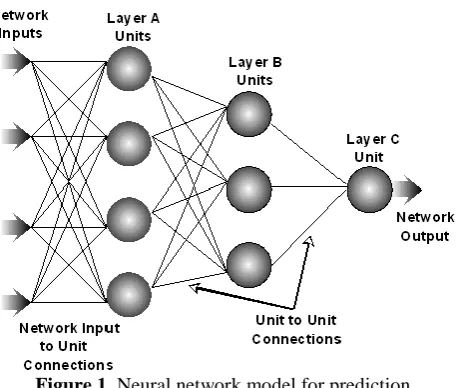
A neural system is a computational model that is approximately founded on the neuron cell structure of the organic sensory system. Given a preparation set of information, the neural system can get familiar with the information with a learning calculation; in this examination, the most widely recognized calculation, backpropagation, is utilized. Through backpropagation, the neural system frames a mapping among sources of info and wanted yields from the preparation set by changing weighted associations inside the system.
Figure 1. Neural network model for prediction
To make important estimates, the neural system must be prepared on a proper information arrangement. Models as <input, output> sets are separated from the information arrangement, where information and yield are vectors equivalent in size to the quantity of system data sources and yields, individually. At that point, for each model, back-proliferation preparing comprises of three stages:
3.1 Present a model's info vector to the system information sources and run the system: process actuation works successively forward from the main shrouded layer to the yield layer (referencing Figure 1, from layer A to layer C).
3.2 Compute the distinction between the ideal yield for that model, yield, and the genuine system (yield of unit(s) in the yield layer). Engender the mistake consecutively in reverse from the yield layer to the primary shrouded layer (referencing Figure 1, from layer C to layer A).
3.3 For each association, change the weight adjusting that association in extent to the mistake.
underneath a satisfactory edge. Preparing can be tedious, contingent upon the system estimate, number of models, ages breaking point, and mistake limit. The accompanying condition 1 will help in further understanding,
x Hidden
c P
p cp cp Hidden c e x h where b w i h O 1 1 ) ( 1 , ,
Oc is the yield of the current concealed layer unit c, P is either the quantity of units in the past shrouded layer or number of system inputs, ic,p is a contribution to unit c from either the past concealed layer unit p or system input p, wc,p is the weight changing the association from either unit p to unit c or from information p to unit c, and bc is the inclination.
Every one of the three stages will presently be point by point. In the initial step, an information vector is introduced to the system inputs, at that point for each layer beginning with the main concealed layer and for every unit in that layer, register the yield of the unit's initiation work (Equation 1). In the long run, the system will spread qualities through all units to the system output(s).
In the second step, for each layer beginning with the yield layer and for every unit in that layer, a mistake term is processed. For every unit in the yield layer, the mistake term in Equation 2 is processed.
Equation 2 Error term for an output layer unit.
)
)(
(
c cOutput
c
h
x
D
O
Dc is the ideal system yield (from the yield vector) relating to the present yield layer unit, Oc is the real system yield comparing to the present yield layer unit, and is the subsidiary of the yield unit straight actuation work, for example 1. For every unit in the shrouded layers, the blunder term in Equation 3 is registered..
Equation 3 Error term for a hidden layer unit.
N n c n n Hiddenc
h
x
w
1 ,
)
(
N s the blunder term for a unit in the following layer, and wn,c is the weight changing the association from unit
c to unit n. The subsidiary of the concealed unit sigmoid actuation work,
h
Hidden
(
x
)
, isO
h(
1
O
h)
.In the third step, for every association, Equation 4, which is the adjustment in the weight altering that association, is registered and added to the weight.
Equation 4 Change in the weight adjusting the association from unit p or system input p to unit c.
p c p
c
O
w
,The weight changing the association from unit p or system input p to unit c is wc,p, is the learning rate (talked about later), and Op is the yield of unit p or the system input p. Subsequently, after stage three, most, if not all loads will have an alternate esteem. Changing loads after every precedent is displayed to the system is approached line preparing. Another choice, which isn't utilized in this exploration, is group preparing, where changes are gathered and connected simply after the system has seen all models.
The objective of backpropagation preparing is to combine to a close ideal arrangement dependent on the complete squared mistake determined in Equation 5.
Equation 5 Total squared error for all units in the output layer.
C c c cC
D
O
E
1
2
2
1
IV.
Result analysis and conclusion
We compared the developed neural network based prediction engine by varying the network configurations, and obtained the following outputs,
Table 1. Accuracy v/s Number of neurons
Training Set Size
Neurons in each layer
Accuracy (%) NN
5 5 90
10 10 93
20 20 94
30 30 95
50 50 96
100 70 96.5
From the table, we can analyze that the prediction accuracy of the NN engine with 70 neurons is atleast 7% better when compared to the accuracy of the lower neurons Neural Network based predictor. This is due to the fact that higher the number of neurons, the better processing will be done by the network, thereby improving it's accuracy. The following graph shows the prediction accuracy comparison,
Figure 2. Prediction accuracy comparison
Thus, we can conclude that the prediction accuracy of the network with higher number of neurons will be better as compared to the network with lower number of neurons.
V.
Future work
Load prediction is a very vast field of research, currently not a lot of work is done in the field of artificial intelligence for load prediction, so researchers can look at this field in order to predict load. Moreover, integration of block chain based techniques can be done, so that the process can be securely done for government organizations.
References
[1]. S. Ruzic, A.Vuckovic, and N. Nikolic, "Climate Sensitive Method for Short-Term Load Forecasting in Electric Power Utility of Serbia", IEEE Transaction on Power Systems, 18:1581– 1586, 200
[2]. D.C. Park, M.A. El-Sharkawi, R.J. Imprints II, L.E. Map book and M.J. Damborg,"Electric load determining utilizing a counterfeit neural system", IEEE Transactions on Power Engineeringvol.6,pp.442-449(1991)
[3]. T. Haida and S. Muto, "Relapse Based Peak Load Forecasting utilizing TransformationTechnique". IEEE Transactions on Power Systems, 9:1788– 1794, 1994.
[4]. Short term load determining utilizing time arrangement displaying with pinnacle load estimation ability", IEEE Transactions on Power Systems, Vol.16, No.3 August 2001
[5]. Mohamed Mohandes, Support vector machines for momentary electrical burden anticipating INTERNATIONAL JOURNAL OF ENERGY RESEARCH Int. J. Vitality Res. 2002;26:335}345(DOI:10.1002/er.787)
[6]. M. S. Kandil, S. M. El-Debeiky, Senior Member, IEEE, and N. E. Hasanien , Long-Term Load Forecasting for Fast Developing Utility Using a Knowledge-Based Expert System.
[7]. Qingqing Mu , Yonggang Wu , Xiaoqiang Pan, Liangyi Huang, Xian Li Short-term Load Forecasting Using Improved Similar Days Method 978-1-4244-4813-5/10/$25.00 ©2010 IEEE
[9]. H. Mori and S. Tsuzuki, "Power System Topological Observability Analysis Using a Neural NetworkModel," Proc. of second Sym. on Expert Systems Application to Power Systems,pp.385-391,July,1989