A Novel DWT based Video Watermarking
Scheme using Selective Column in Frames
Ms. ChetnaShinghde Mr. Amit Mishra
M. Tech Scholar Assistant Professor
RGPV, Jabalpur RGPV, Jabalpur
Abstract
One of the most secure and efficient method of video authentication is to watermark the video which is known as the video watermarking. Earlier watermarking is used in authentication of text and image later on this is extended to the video sequence as well. In this paper, an attempt has been done to design an efficient and secure watermarking method for protecting the video from unauthorized access. In the proposed method column from each frame are randomly selected to form a new frame which is used for embedding the watermark after DWT operation. Experimental results reveal that the proposed method is able to produce least distortion in the video sequence by keeping the watermark in the video secure.
Keywords: SVD (Singular value Decomposition), DCT (Discrete Cosine Transform), PSNR (Peak Signal to noise ratio), DWT (Discrete wavelet Transform), contour let Transform (CT)
________________________________________________________________________________________________________ I. INTRODUCTION
Information interchange among the people and agencies situated in different areas of the world has become common now a day. The progress and advancement in the information technology has enabled us to share the information across the world. People are now able to share text and images and with the emergence of site like You-tube, social site such as Facebook, Whatsapp, it is now possible to share their personal photo, audio clips and video clips.
Earlier when the internet was in its childhood state, data transfer rate is very low which is main hurdles to share the video in internet as video data takes lots of space and require high data rate to view in the internet without buffering. Later on with the introduction of the 3G and 4G high speed networking protocol it has now become possible to share the video in the internet without ant buffering problems.
Information sharing in the internet is on one hand is very advantageous because any one can see the video across the world with one click but at the same time sharing such kind of information is very problematic. People can use it illegally for fulfilling their own interest by tempering the video which is undesirable.
This creates lots of problems to those who want to share their video in the internet free of cost. This inspire the researcher to design some kind of algorithm which can be used for authentication of video and add some security to these video along with the actual owner information so that no one can temper the video and claim to be its own[1].
One of the best solutions of this problem is digital watermarking. Digital watermarking is the operation in which one can hide the ownership information inside the video in such a way that none other than a authorized person is able to access it. The ownership information which is embedded in the video is called digital watermark.
A digital watermark can be used in any digital media such as the text, image, audio and even in video. Since video consist of different time spaced still images so all the digital watermarking of image can also be used in watermarking the video.
Digital media such as text, audio, image and video in which the watermark is embedded is called the cover media. The amount of information which can be embedded in the cover media without producing the appreciable distortion is called the payload. One of the problems in video watermarking is to manage the large volume of digital video data which is huge as compared to the image data. Watermarking algorithm generally embed the secure information or watermark in the host media either directly (Spatial domain based approach) or in the transformed version (Transform domain based approach) of the cover media.
In watermarking, watermark is applied for authentication purpose. Methods to extract out the watermark from the video or cover media is known to actual owner of the video so it is difficult to temper the video watermark and hence can be used for protection of unauthorized access.
One of the important properties of the watermarking algorithm is that it must be capable of producing least distortion in the host media [2].
In the past, most of the research work has been carried out in the field of image watermarking and only few work has been carried out in the field of video watermarking.
The approach proposed in this paper is frame by frame approach. Watermark embedding is accomplished in the transform domain because it is more secure and robust. In the transform domain based approach, cover media is first converted in to a frequency domain by applying some suitable transform. Watermark insertion take place in frequency domain and after embedding the watermark, reverse transformation is applied to get back the original host media in time domain.
Next section discusses some important contribution accomplished in the video watermarking area.
II. RELATED WORK
In the last couple of years various literatures has been published in the field of watermarking. Watermarking approach for watermarking in text [3] [4] [5], Audio [6] and image [7] [8] [8] [10] has been reported earlier.
These approaches modify the cover file for embedding.
Generally two different approaches are used in video watermarking. First approach is based on the frequency domain while the second approach is based on the spatial domain. Both the approaches have some advantages and disadvantages. Some of the important contribution in the field of video watermarking is presented in the next section.
I 2002, Xiamu [11] presented a video watermarking technique which is rotation/scale/translation invariant. In this method, Pixel lie on the temporal axis is used for watermark embedding.
In 2006, Noorkami [12] suggested that motion intensity can also be used for watermark signal embedding and hence proposed the method which is based on the motion intensity of the video. For embedding the watermark in the video, motion intensity of the frames is first computed then watermark is inserted on the frames which has motion intensity greater than some predefined threshold.
In 2006, Chung [13] worked on video watermarking method which produce least distortion in the host media or host video. Error correcting code is applied in this approach for improving the quality of the video. BCH and turbo code is used for correcting the error introduced during the transmission.
In 2008, Hanane Mirza [14] suggested a video watermarking algorithm based on the principal component analysis (PCA). This method use color similarity for choosing the scene of the video in which the watermark is to be inserted. Frames of the such scene is used for watermark embedding with the help of PCA.
Lama rajab Tahlani [15] presented a approach of video watermarking using SVD (Singular Value Decomposition). This approach is an extension of the SVD based approach earlier applied to the image. SVD transformation of the video is performed in this approach and the watermark is embedded in the SVD trabsformed Frames.
In 2009 sakib ali[16] proposed a method of video watermarking using spread spectrum techniques. In this method Video frames is first of all converted in to a DCT domain and watermark is inserted in DCT domain.
In 2009, Lin in [17] introduced the wavelet based blind video watermarking scheme. This scheme, first of all, form the different size block of wavelet coefficient. Random block out of these blocks are then used for watermark embedding. This method is very robust and secure.
In 2013, Masouumi Majid[18] introduced another approach of video watermarking which is again based on the scene detection. In this scheme, scene are first detected in a video and then that part of the scene is converted in to wavelet domain for inserting the watermark.
In 2013, Yung-Lung Kuo[19], introduced an approach of watermarking which utilizes the texture, intensity and motion property of the video for video watermark. All the frames which satisfy above criterion are used for watermark embedding. Simulation result reveals that this method is very robust.
Double transformed based video watermarking[20], different scene based video watermarking[21] and transcoding invariant video watermarking method [22] are some other noteworthy contribution in video watermarking.
III. METHODOLOGY
As already mentioned in the previous section that video is basically a series of equally time spaced still images known as the frames.
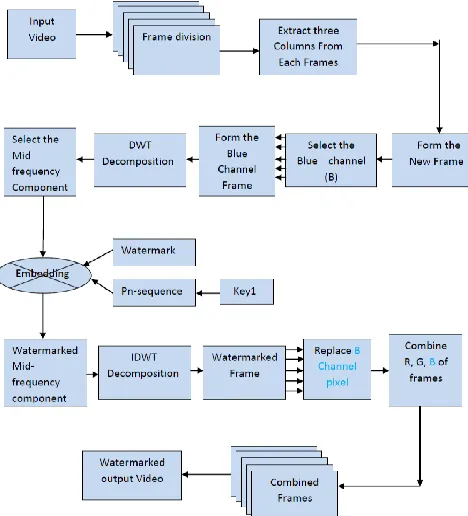
Block diagram of embedding process for the proposed method is shown in the figure 2. In the proposed method, video sequence is first converted in to frames. Number of frames in video sequence depends on the length of the video sequence. Number of frame obtained by converting the video in to frame is stored in a variable. Since blue colour is least sensitive to eyes therefore blue channel of each frame are selected for embedding the watermark. 3 consecutive column of each blue channel frame are separated out and stored stack-wise in a new frame which later on used as the host file.
A new frame is obtained which carry the column of each frame. This new frame is then converted in to a frequency domain by applying the discrete wavelet transform. Watermark is the embedded in to it using procedure describe below. After embedding the watermark in these new frames, this new frame is again converted back to time domain. All the column of respective frames are then re-placed in their respective frames. At the last all the frames are again combined to form the watermarked video.
Proposed method has two phase. First phase embed the watermark (Known as the embedding process) in the video sequence while the second phase is used to extract out the watermark from watermarked video.
Following are the algorithm steps for embedding operation 1) Step 1: Input the video Sequence.
2) Step 2: Convert the video sequence into frames.
Fig. 1: Video to Frame conversion process
3) Step 3: Select the frames one by one.
4) Step 4: Extract out first three columns of the entire three channels (Red, Green and blue) from each frames. 5) Step 5: Repeat step 3-4 for all the frames and obtained the new frame.
6) Step 6: Separate out the Blue channel of this new frame.
7) Step 7: Convert the blue channel of new frames in to different frequency band by applying discrete wavelet transform i.e. LL (Low Frequency band), LH (Mid frequency band), HL (Mid frequency band) and HH (High frequency Band).
8) Step 8: Select the mid frequency band (LH and HL).
Fig. 2: Block Diagram of Watermark Embedding Process
10) Step 10: Apply the watermark embedding process on mid frequency band as shown in following equation. 𝐹𝑊𝑢,𝑣= {
𝐹𝑖 + 𝐺 ∗ 𝑝𝑛 𝑖𝑓 𝑊 = 0, 𝑢, 𝑣 ∈ 𝐻𝐿, 𝐿𝐻 𝐹𝑖 𝑢, 𝑣 ∈ 𝐻𝐿, 𝐿𝐻 Where
𝐹𝑊𝑢,𝑣 = Watermarked Frame
𝐹𝑖 = Original frame 𝐺 = Gain factor 𝑝𝑛 = pseudo random number
11) Step 11: Combine the HH, LL and modified watermark embedded mid frequency band LH and HL.
12) Step 12: Apply the IDWT (Inverse discrete wavelet transform) to obtain the watermarked New frame in time domain. 13) Step 13: Replace group of three columns to the blue channel of their respective frames.
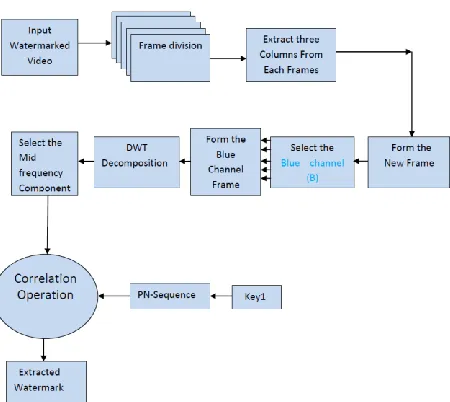
Similarly following are the algorithm steps for watermark extraction- 1) Step 1: Input the watermarked video sequence.
2) Step 2: Convert the video sequence into different frames. 3) Step 3: Select the frames of video sequence one by one.
4) Step 4: Extract first three columns of the entire three channels (Red, Green and blue) from each frames. 5) Step 5: Repeat step 3-4 for all the frames and form the new frame.
6) Step 6: Separate out the Blue channel of this new frame.
7) Step 7: Convert the blue channel of new frames in to different frequency band by applying discrete wavelet transforms i.e. LL (Low Frequency band), LH (Mid frequency band), HL (Mid frequency band) and HH (High frequency Band)
8) Step 8: Extract the mid frequency band (LH and HL).
9) Step 9: With the help of PN- sequence generator key i.e Key1, obtain a random pn-sequence.
10) Step 10: Obtain the correlation between mid-frequency components HL, LH and pn-sequence by using following relation
𝑀𝑠𝑔 = {0 𝑖𝑓 𝐶𝑀 > 𝑇ℎ𝑟𝑒𝑠ℎ𝑜𝑙𝑑
1 𝑒𝑙𝑠𝑒 Here,
𝐶𝑀= Correlation Matrix between HL, LH coefficients and Psudo-random Number Threshold= A fixed numerical value (Generally mean of correlation Matrix)
Fig. 3: Block Diagram of Watermark Extraction Process
11) Step 11: End of Watermark extraction Module.
In the whole process of embedding and extraction three columns of each randomly selected frame are extracted and stored in new frames which work as the host frames. Random selections of the frames are accomplished by selecting frame randomly. Use of pn-sequence based random generator enhances the security of the proposed method.
IV. EXPERIMENTAL RESULTS
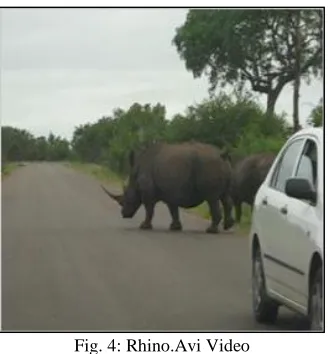
Fig. 4: Rhino.Avi Video
A simulation program is developed in MATLAB environment. MATLAB version 2009B has been taken for development the above simulation program.
Fig. 5: Costguard.avi Video
Fig. 6: Akiyo.avi video
Figure 4, figure5 and figure5 shows the actual video taken in this work.
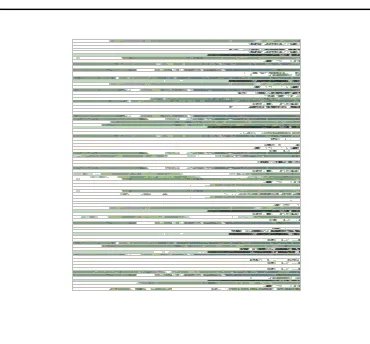
Fig. 7: Frame obtained after extraction of rows from the selected frames of video “rhino.avi”
Figure 8 represent the watermarked frame which is obtained after watermark embedding operation and then applying the inverse discrete wavelet transform.
Fig. 8: Frames after Watermark Embedding
Figure 9 represent the actual watermark while the figure 10 represent the watermark obtained after extraction process.
Fig. 9: Original Watermark used
Fig. 10: Extracted Watermark obtained
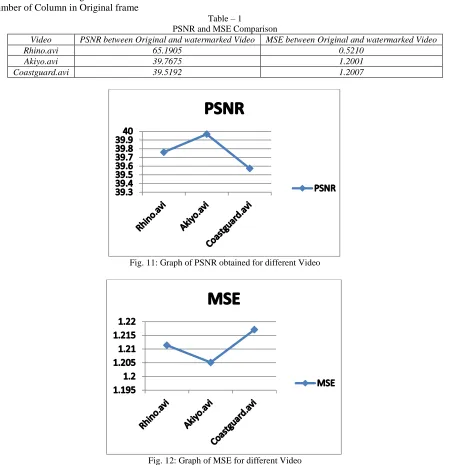
For testing the performance of the proposed method , three statistical measure have been used i.e. PSNR(Peak signal to noise ratio). MSE(Mean Squared Error) and Normalization coefficient(NC).
PSNR and MSE parameter are used to describe the quality of the watermarked image as compared to the original video sequence. The value of PSNR must be as high as possible but in practical any value greater than the 35dB is considered as the acceptable value. In the same way for a good quality watermarked image the value of MSE must be as less as possible. MSE is also computed between watermarked video and original video sequence.
PSNR between original video and the watermarked video is calculated as per the formula shown below
𝑃𝑆𝑁𝑅 = 10𝑙𝑜𝑔10
𝑃 × 𝑃 𝑀𝑆𝐸 Here
Similarly MSE is computed by using below mention formula.
𝑀𝑆𝐸 =∑ ∑ [𝐼(𝑖, 𝑗) − 𝐼
′(𝑖, 𝑗)]2 𝑁
𝑗=1 𝑀 𝑖=1
𝑀 × 𝑁 I= Original host Frame
I′= watermarked Frame
M= Number of rows in original frames N= Number of Column in Original frame
Table – 1 PSNR and MSE Comparison
Video PSNR between Original and watermarked Video MSE between Original and watermarked Video
Rhino.avi 65.1905 0.5210
Akiyo.avi 39.7675 1.2001
Coastguard.avi 39.5192 1.2007
Fig. 11: Graph of PSNR obtained for different Video
Fig. 12: Graph of MSE for different Video
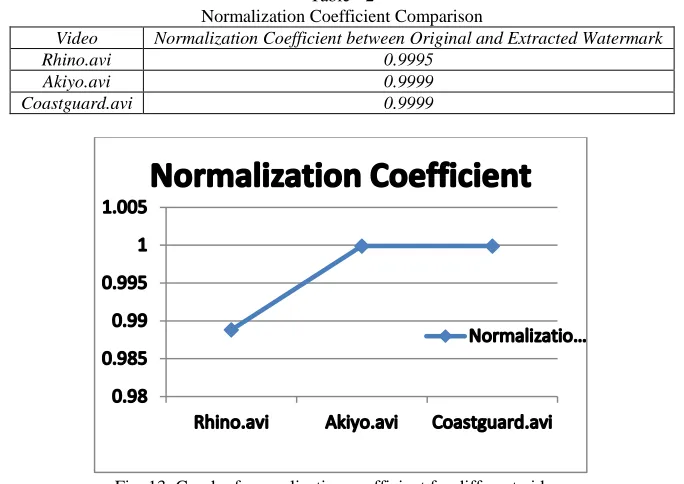
Normalization coefficient between extracted and original watermark is obtained by applying following formula. It used to represent the quality of the extracted watermark. If the quality of the extracted watermark is same as the quality of the original watermark then the value of the NC is one which is ideal condition. In practice the value of the NC must be close to the “1”.
𝑁𝐶 = ∑ ∑ [𝑊(𝑖, 𝑗). 𝑊
′(𝑖, 𝑗)] 𝑁
𝑗=1 𝑀 𝑖=1
√∑ ∑𝑁 [𝑊(𝑖, 𝑗)]2
𝑗=1 𝑀
𝑖=1 √∑𝑀𝑖=1∑𝑁𝑗=1[𝑊′(𝑖, 𝑗)]2
Table - 2
Normalization Coefficient Comparison
Video Normalization Coefficient between Original and Extracted Watermark
Rhino.avi 0.9995
Akiyo.avi 0.9999
Coastguard.avi 0.9999
Fig. 13: Graph of normalization coefficient for different videos
Table - 3 NC for different Gain value
Video Value of gain Coefficient(G) Normalization Coefficient between Original and Extracted Watermark Rhino.avi
0.25 0.9898
0.35 0.9999
0.45 1.0
0.55 1.0
Table - 4
PSNR and MSE Comparison for different Gain Value (G)
Video Gain (G) PSNR between Original and watermarked Video MSE between Original and watermarked Video Rhino.avi
0.25 39.7216 1.2114
0.35 37.3640 1.2890
0.45 37.3418 1.2898
0.55 37.100 1 1.2981
V. CONCLUSION
In this paper an attempt has been made to design and develop a novel algorithm of video watermarking. In this method, embedding of watermark is performed in all the frames of the host video. Random selection of frames and randomly generated Pn-sequence number enhance the security of the proposed method. From the result obtained it is clear that this method is able to hide the watermark without producing appreciable distortion in the host video. Also the quality of extracted watermark is also approximately same as that of the original watermark.
Following are the advantages of the proposed method-
- This method is robust against the attack of high frequency and low frequency filtering since embedding is performed on the mid frequency component.
- Random frame selection and random PN sequence generator add extra security to this method. - This method is able to produce least distortion in the host video after embedding watermark.
REFERENCES
[1] F. Hartung and M. Kutter, “Multimedia watermarking techniques”, Proceedings of the IEEE, vol. 87, no. 7, July 1999.
[2] I. J. Cox and M. L. Miller, “Electronic watermarking: the first 50 years”. Fourth, IEEE Workshop on Multimedia Signal Processing,2001, pp. 225-230. [3] J. Brassil, S. Low, N. Maxemchuk, and L. O’Gorman, “Electronic marking and identification techniques to discourage document copying,” IEEE J. Select.
Areas Commun., vol. 13, pp. 1495–1504,Oct. 1995.
[4] S. Low and N. Maxemchuk, “Performance comparison of two text marking methods,” IEEE J. Select. Areas Commun.(Special Issue onCopyright and Privacy Protection), vol. 16, pp. 561–572, May 1998.
[5] L. Boney, A. H. Tewfik, and K. H. Hamdy, “Digital watermarks for audio signals,” in Proc. EUSIPCO 1996, Trieste, Italy, Sept. 1996.
[7] M. S. Kankanhalli, Rajmohan, and K. R. Ramakrishnan, “Contentbased watermarking of images,” in Proc. ACM Multimedia ’98, Bristol, U.K., Sept. 1998. [8] I. Pitas, “A method for signature casting on digital images,” in Proc. Int. Conf. Image Processing (ICIP), Lausanne, Switzerland, Sept.1996.
[9] E. Koch and J. Zhao, “Toward robust and hidden image copyright labeling,” in Proc. Workshop Nonlinear Signal and Image Processing, Marmaros, Greece, June 1995.
[10] Xiamu Niu Martin , Martin Schmucker , Christoph Busch “Video Watermarking Resisting to Rotation, Scaling, and Translation” 2002 Proc. SPIE Security Watermarking of Multimedia Contents IV.
[11] Noorkami, Maneli, and Russell M. Mersereau. "Improving Perceptual Quality in Video watermarking using motion estimation." In Image Processing, 2006 IEEE International Conference on, pp. 1389-1392. IEEE, 2006.
[12] Chung, Yuk Ying, and Fang Fei Xu. "A secure digital watermarking scheme for MPEG-2 video copyright protection." In Video and Signal Based Surveillance, 2006. AVSS'06. IEEE International Conference on, pp. 84-84. IEEE, 2006.
[13] Hanane Mirza, Hien Thai, and Zensho Nakao I. Lovrek, R.J. Howlett, and L.C. Jain “Digital Video Watermarking Based on RGB Color Channels and Principal Component Analysis” (Eds.): KES 2008, Part II, LNAI 5178, pp. 125–132, 2008. c_Springer-Verlag Berlin Heidelberg 2008.
[14] Lama Rajab Tahani Al-Khatib Ali Al-Haj “Video Watermarking Algorithms Using the SVD Transform” European Journal of Scientific Research ISSN 1450-216X Vol.30 No.3 (2009), pp.389-401.
[15] Sadik Ali M. Al-Taweel, Putra Sumari, Saleh Ali K. Alomari and Anas J.A. Husain “Digital Video Watermarking in the Discrete Cosine Transform Domain” Journal of Computer Science 5 (8): 536-543, 2009 ISSN 1549-3636 c 2009 Science Publications.
[16] Lin, Wei-Hung, Yuh-Rau Wang, Shi-Jinn Horng, Tzong-Wann Kao, and Yi Pan. "A blind watermarking method using maximum wavelet coefficient quantization."Expert Systems with Applications 36, no. 9 (2009): 11509-11516.
[17] Masoumi, Majid, and Shervin Amiri. "A blind scene-based watermarking for video copyright protection." AEU-International Journal of Electronics and Communications 67, no. 6 (2013): 528-535.
[18] Ko, Chien-Chuan, Yung-Lung Kuo, Jeng-muh Hsu, and Bo-Zhi Yang. "A multi-resolution video watermarking scheme integrated with feature detection."Journal of the Chinese Institute of Engineers 36, no. 7 (2013): 878-889.
[19] Wassermann, Jakob. "New Robust Video Watermarking Techniques Based on DWT Transform and Spread Spectrum of Basis Images of 2D Hadamard Transform." In Multimedia Communications, Services and Security, pp. 298-308. Springer Berlin Heidelberg, 2013.
[20] Singh, Th Rupachandra, Kh Manglem Singh, and Sudipta Roy. "Video watermarking scheme based on visual cryptography and scene change detection." AEU-International Journal of Electronics and Communications 67, no. 8 (2013): 645-651.