e-ISSN: 2278-067X, p-ISSN: 2278-800X, www.ijerd.com
Volume 6, Issue 6 (March 2013), PP. 54-60
Environmental Friendly Concrete
Eldho Varghese
1, Thomas Paul
2, Eldhose M.Manjummekudiyil
31,2,3Assistant Professor, Department of Civil Engineering, M A College of Engineering, Kothamangalam,Kerala,
India
Abstract:- Concrete is a very important construction material. The main composition of concrete is cement (commonly Portland Cement), coarse aggregates (such as blasted rubble), fine aggregates (such as sand) and water. Cement is the binder that binds the aggregates together. Coarse aggregates are mainly obtained from quarries, using advent blasting methods, wherever competent bedrock deposits of aggregate quality exists. Fine aggregate used is dry sand, which is available naturally or manufactured. The purpose of this paper is to study concrete behaviour by replacing the aggregates in concrete with recycled wastes. This study is intended to make construction more environmental friendly wherever recycled concrete can be used. It is also considered in regard of environment by reducing the disposal of the construction wastes by using them efficiently.
The various recycled wastes which used for this purpose are- 1. Tiles- disposed broken tiles
2. Bricks- broken brick bat 3. Laterite powder
4. Concrete wastes 5. Plastering wastes
I.
INTRODUCTION
Concrete is one of the most important elements in Civil Engineering. The use of concrete as a construction material is been almost inevitable in today’s construction industry. It is estimated that the present consumption of concrete in the world is of the order of 10 billion tones every year. The ability of concrete to withstand the action of water without serious deterioration makes it an ideal material for building structures. Concrete is a composite material that consists essentially of a binding medium within which are embedded particles or fragments of aggregate. Aggregate is granular material, such as crushed stone, gravel, sand, crushed blast-furnace slag or construction and demolition waste. This study is based on replacing the natural aggregates in concrete with building wastes such as roofing tiles, broken brick bats, plastering wastes and laterite powder. The recycled concrete cubes of standard size are casted in design mix ratio in M25 grade and they are tested for their characteristic compressive strength.
Due to the increased use of concrete, it can cause the extinction of natural aggregates. So it is necessary to find alternatives for the coarse and fine aggregates used, which should be easily available and economical as well. Also the disposal of the building wastes is a problem faced, which can be solved if the study succeeds.To obtain concrete with sufficient strength economically is another objective of this study.
II.
MATERIALS AND METHODS
The scope of the study is limited to investigate the strength of the concrete prepared using building wastes as aggregates, and to know its suitability in construction. The cost of concrete is also analysed and compared with that of conventional concrete.
Table I .Properties Of Cement Used In Conventionalconcrete
Standard consistency 30%
Initial Setting Time 190 minutes
Final Setting Time 325 minutes
Specific Gravity 3.15
28 day mortar cube strength 63.67 N/mm2 (average)
Brand Name DECCAN DIAMOND
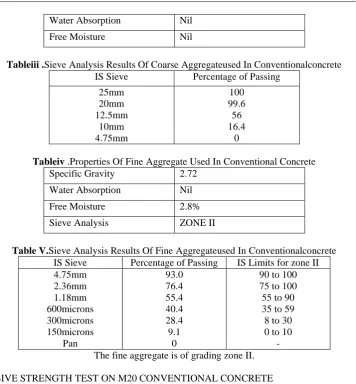
Tableii. Properties Of Coarse Aggregate Used In Conventional Concrete
Water Absorption Nil
Free Moisture Nil
Tableiii .Sieve Analysis Results Of Coarse Aggregateused In Conventionalconcrete
IS Sieve Percentage of Passing
25mm 20mm 12.5mm
10mm 4.75mm
100 99.6 56 16.4
0
Tableiv .Properties Of Fine Aggregate Used In Conventional Concrete
Specific Gravity 2.72
Water Absorption Nil
Free Moisture 2.8%
Sieve Analysis ZONE II
Table V.Sieve Analysis Results Of Fine Aggregateused In Conventionalconcrete IS Sieve Percentage of Passing IS Limits for zone II 4.75mm
2.36mm 1.18mm 600microns 300microns 150microns
Pan
93.0 76.4 55.4 40.4 28.4 9.1
0
90 to 100 75 to 100 55 to 90 35 to 59 8 to 30 0 to 10
- The fine aggregate is of grading zone II.
COMPRESSIVE STRENGTH TEST ON M20 CONVENTIONAL CONCRETE
Mix ratio(Design Mix)
Cement: Fine Aggregate: Coarse Aggregate : Water = 1 : 1.66 : 3.3 : 0.6
Table Vi.7 Day Strength Speci
men No
Load in Tones
Compressive Strength (N/mm2)
Average 7 day Compressive
Strength (N/mm2) 1
2 3
36.7 35.8 33.5
16.31 15.91 14.89
15.7
Table Vii.28 Day Strength Speci
men No
Load in Tones
Compressive Strength (N/mm2)
Average 28 day Compressive
Strength (N/mm2) 1
2 3
56.5 53.3 52.7
25.11 23.69 23.42
24.07
The average compressive strength of concrete cubes after 28 days = 24.07 N/mm2
Table Viii.Properties Of Cement Used In Recycled Concrete
Standard consistency 30%
Initial Setting Time 190 minutes
Specific Gravity 3.15
28 day mortar cube strength 63.67 N/mm2 (average)
Brand Name DECCAN DAIMOND
Table Ix.Properties Of Broken Brick Batscoarse Aggregateused In Recycled Concrete
Specific Gravity 2.1
Water Absorption 16.5%
Free Moisture Nil
Table X. Sieve Analysis Results Of Broken Brick Batscoarse Aggregate
IS Sieve Percentage of Passing
25mm 20mm 12.5mm
10mm 4.75mm
100 88.2 22.8 5.8
0
Table Xi.Properties Of Roofing Tiles Coarse Aggregateused In Recycled Concrete
Specific Gravity 2.2
Water Absorption 16.3%
Free Moisture Nil
Table Xii.Sieve Analysis Results Of Roofing Tiles Coarse Aggregate
IS Sieve Percentage of Passing
25mm 20mm 12.5mm
10mm 4.75mm
100 99.6 56 16.4
0
Tablexiii.Properties Of Plastering Wastefine Aggregateused In Recycled Concrete
Specific Gravity 2.45
Free Moisture 2.2%
Sieve Analysis ZONE II
Table Xiv.Sieve Analysis Results Of Plastering Wastes (Fine Aggregate)
IS Sieve Percentage of
Passing
IS Limits for zone II 4.75mm
2.36mm 1.18mm 600microns 300microns 150microns
Pan
100 89.4 70.9 41.4 15.7 8.2
0
90 to 100 75 to 100 55 to 90 35 to 59 8 to 30 0 to 10
-
Tablexv.Properties Of Laterite Brick Powderfine Aggregateused In Recycled Concrete
Specific Gravity 2.27
Free Moisture 2.8%
Table Xvi.Sieve Analysis Results Of Laterite Brick Powderfine Aggregate
IS Sieve Percentage of
Passing
IS Limits for zone II 4.75mm 2.36mm 1.18mm 600microns 300microns 150microns Pan 100 80 59.8 39.2 25.2 12.7 0
90 to 100 75 to 100 55 to 90 35 to 59 8 to 30 0 to 10
-
III.
TYPE OF ADMIXTURE USED
Dr. FIXIT PIDICRETE CF 151M3(S)- It is a super plasticising admixture design with specially formulated polymers to produce homogeneous concrete, free from bleeding and segregation. It also imparts the cohesiveness to concrete mix for easy pouring with better surface finish.Concrete is mixed with 50-70% of the mixing water (based on mix design by weight). About 0.5% of the cement quantity by weight is added to the remaining 30% mixing water and poured to the batch mixer. This admixture should not be added in dry mixes under any circumstances.
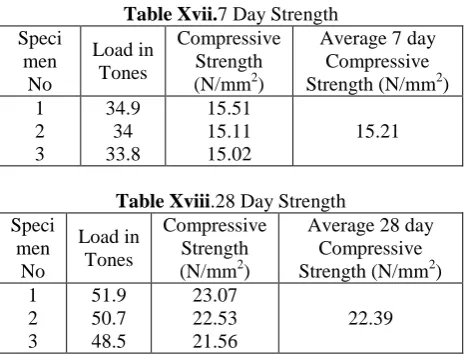
COMPRESSIVE STRENGTH TEST ON M20 CONCRETE WITH ROOFING TILES AS COARSE AND PLASTERING WASTES AS FINE AGGREGATES
Mix Ratio: Cement : Fine Aggregate : Coarse Aggregate : Water = 1 : 1.85 : 2.64 : 1.07
Table Xvii.7 Day Strength Speci men No Load in Tones Compressive Strength (N/mm2)
Average 7 day Compressive Strength (N/mm2) 1 2 3 34.9 34 33.8 15.51 15.11 15.02 15.21
Table Xviii.28 Day Strength Speci men No Load in Tones Compressive Strength (N/mm2)
Average 28 day Compressive Strength (N/mm2) 1 2 3 51.9 50.7 48.5 23.07 22.53 21.56 22.39
COMPRESSIVE STRENGTH TEST ON M20 CONCRETE WITH ROOFING TILES AS COARSE AND LATERITE POWDER AS FINE AGGREGATES
Mix Ratio: Cement : Fine Aggregate : Coarse Aggregate : Water = 1 : 1.68 : 2.64 : 1.11
Table Xix.7 Day Strength Speci men No Load in Tones Compressive Strength (N/mm2)
Average 7 day Compressive Strength (N/mm2) 1 2 3 31.8 31 30.8 14.13 13.78 13.69 13.87
Table Xx.28 Day Strength Speci men No Load in Tones Compressive Strength (N/mm2)
COMPRESSIVE STRENGTH TEST ON M20 CONCRETE WITH BROKEN BRICK BATS ROOFING TILES AS COARSE AND PLASTERING WASTES AS FINE AGGREGATES
Mix Ratio: Cement: Fine Aggregate: Coarse Aggregate: Water = 1 :1.85 : 2.76 : 1.1
TABLE XXI.7 DAY STRENGTH Speci
men No
Load in Tones
Compressive Strength (N/mm2)
Average 7 day Compressive Strength (N/mm2) 1
2 3
33 31.3 29.9
14.67 13.91 13.29
13.96
TABLE XXII.28 DAY STRENGTH Speci
men No
Load in Tones
Compressive Strength (N/mm2)
Average 7 day Compressive Strength (N/mm2) 1
2 3
48.8 46.6 44.2
21.69 20.71 19.67
20.68
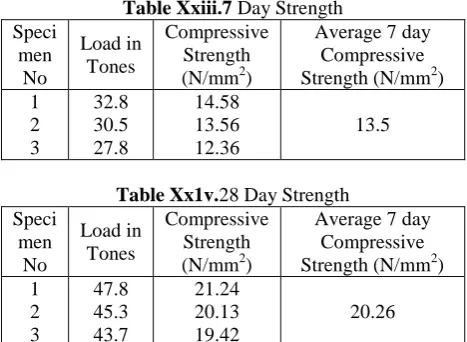
COMPRESSIVE STRENGTH TEST ON M20 CONCRETE WITH BROKEN BRICK BATS AS COARSE AND LATERITE POWDER AS FINE AGGREGATES
Mix Ratio: Cement : Fine Aggregate : Coarse Aggregate : Water = 1: 1.68: 2.19: 1.15
Table Xxiii.7 Day Strength Speci
men No
Load in Tones
Compressive Strength (N/mm2)
Average 7 day Compressive Strength (N/mm2) 1
2 3
32.8 30.5 27.8
14.58 13.56 12.36
13.5
Table Xx1v.28 Day Strength Speci
men No
Load in Tones
Compressive Strength (N/mm2)
Average 7 day Compressive Strength (N/mm2) 1
2 3
47.8 45.3 43.7
21.24 20.13 19.42
20.26
From the above chart it can be inferred that concrete prepared using roofing tiles as coarse aggregate and plastering wastes as fine aggregate (Type 1) is having the highest strength among recycled aggregate concretes. The 28 day compressive strength of Type 1concrete is 80% the strength of conventional concrete. Hence Type 1 concrete can be recommended for use.
COST ANALYSIS OF CONCRETES
TABLE XXV.COST OF 1m3conventional M-20 CONCRETE
Material Quantity Amount
Cement 346.19 kg Rs. 2631
Fine Aggregate 604.55 kg Rs. 254
Coarse Aggregate 1212.75 kg Rs. 461
Total Rs. 3346
TABLE XXVI.COST OF 1m3 CONCRETE USING ROOFING TILES AS COARSE AGGREGATE AND PLASTERING WASTES AS FINE AGGREGATE
Cement (310kg) Rs. 2356 Labour charge for
crushing aggregates
Rs. 45
Pidicrete Admixture
Rs. 302.
Total Rs. 2703
TABLE XXVII.COST OF 1m3 RECYCLED CONCRETE USING ROOFING TILES AS COARSE AGGREGATE AND LATERITE POWDERAS FINE AGGREGATE
Cement (310kg) Rs. 2356
Labour charge for crushing aggregates
Rs. 40
Pidicrete Admixture
Rs. 302
Total Rs. 2698
TABLE XXVIII.COST OF 1m3 RECYCLED CONCRETE USING BROKEN BRICK BATS AS COARSE AGGREGATE AND PLASTERING WASTES AS FINE AGGREGATE
Cement (310kg) Rs. 2356 Labour charge for
crushing aggregates
Rs. 48
Pidicrete Admixture
Rs. 302
Total Rs. 2706
TABLE XXIX.COST OF 1m3 RECYCLED CONCRETE USING BROKEN BRICK BATS AS COARSE AGGREGATE AND LATERITE POWDER AS FINE AGGREGATE
Cement (310kg) Rs. 2356 Labour charge for
crushing aggregates
Rs. 35
Pidicrete Admixture
Rs. 302.
From the above chart it can be inferred that concrete prepared using waste as aggregates are more economical than conventional concrete. Hence environmental friendly concrete can be used for economical construction.
IV.
CONCLUSION
An effort has been made through this study to evaluate the strength of concrete by replacing the natural aggregates by building wastes, viz. roofing tiles, broken brick bats, plastering wastes and laterite powder. It has been found that required characteristic compressive strength is obtained for the waste recycled concrete. Waste Recycled aggregate concrete has been found cheaper as compared to conventional concrete. Hence waste recycled aggregate proves to be good alternative for natural aggregates and they have to be used, wherever possible. By implementing this technique in future, it will help in preventing the extinction of natural aggregates and also the problem of dumping of building wastes can be checked. It also makes construction more economical.
REFERENCES
[1]. IS 456 – 2000, ‘Plain and Reinforced Concrete- Code of Practice’, (Fourth Edition), Bureau of Indian
Standards, New Delhi.
[2]. IS 383 – 1970, ‘Specification for Coarse and Fine Aggregates from Natural sources for Concrete’,(Second Edition), Bureau of Indian Standards, New Delhi.
[3]. IS 10262 – 1982, ‘Recommended Guidelines for Concrete Mix Design’, Bureau of Indian Standards,
New Delhi.
[4]. IS 4031 – 1988 (Part 4, 5, 6 and 11) , ‘ Methods of Physical Tests for Hydraulic Cement’, Bureau of Indian Standards, New Delhi.
[5]. IS 516 – 1959, ‘Methods of Tests for Strength of Concrete’,Bureau of Indian Standards, New Delhi. [6]. IS 2386 – 1963 (Part 1 and 3), ‘Methods for Test of Aggregates for Concrete’,Bureau of Indian