DEVELOPMENT AND VALIDATION OF VISIBLE
SPECTROMETRIC METHOD FOR DETERMINATION OF
NICOTINE IN GUM TABLET
PATEL JIGNESH V
*., PATEL DIPTI B.
Department of Pharmaceutical Quality Assurance,
Shree S. K. Patel College of Pharmaceutical Education & Research, Ganpat University, Kherva – 382711, Mehsana, Gujarat, India.
Date Received: 30TH Jan 2014
Date of Accepted: 8th Feb 2014
Date Published: 11th Feb 2014
100
Abstract:
A simple, sensitive, accurate and rapid Spectrophotometric method has been developed for the estimation of nicotine using Folin-Ciocalteu reagent in presence of 20% sodium carbonate solution. The blue color chromogen formed is measured at wavelength of maximum absorption 760 nm, respectively against reagent blank. The chromogen obeyed linearity over 3-14 µg/ml for nicotine. The results of analysis have been validated statistically and by recovery studies.
Keywords:
Nicotine; Folin-Ciocalteu; Chromogen; SpectrophotometricIntroduction
Nicotine (pyridine, 3-(1-methyl-2-pyrrolidinyl), is one of the highly toxic tobacco alkaloids present in tobacco leaves and cigarette smoke. Nicotine appears to be a promising tracer for environmental tobacco smoke because of its specificity for tobacco. It is also a systemic and contact insecticide and is also used as a drug and in chemical. [1] It is official in British Pharmacopoeia (BP), United States Pharmacopoeia (USP) and European Pharmacopoeia (EP). In which USP [2] and BP [3] describe Potentiometric method for estimation and EP [4] describe simple Spectrophotometry. Literature survey reveals RP-HPLC [5], Capillary electrophoresis [6]. Literature survey also reveals determination of nicotine and cotinine in human urine and saliva by automated in-tube solid-phase micro extraction coupled with liquid chromatography-mass spectrometry [7], simultaneous estimation of nicotine and bupropion hydrochloride in synthetic mixture by derivative spectrophotometry [8], determination of nicotine and cotinine by Ion pair reversed phase chromatography [9].
MATERIALS & METHODS
ApparatusA double beam UV/Visible spectrophotometer (Shimadzu model 1800, Japan), attached to a computer software UV probe 2.10, with spectral width of 2 nm, wavelength accuracy of 0.5 nm and a pair of 10 nm matched quartz cell. Analytical balance (CP224S Sartorius, Gottingen, Germany) An ultrasonic bath (Frontline FS 4, Mumbai, India) Corning volumetric flasks, pipettes of borosilicate glass were used in the study.
Reagents and materials
Nicotine standard was gifted from BGP HEALTH CARE PVT. LTD, Ankleshwar, Gujarat. Folin-Ciocalteu’s (F.C.) reagent. Sodium Carbonate. Double glass-distilled water. The gum tablet of nicotine (Brand name: Nicotex)
101
Preparation of Standard Stock Solution of Nicotine:(100µg/ml)
The standard stock solution of Nicotine was prepared by transferring 0.1 ml of Nicotine standard in 100 ml volumetric flask. Transferred 10 ml of above solution to 100 ml volumetric flask using double glass-distilled water to obtain final concentration 100 µg/ml.
Preparation of F.C. Reagent
F.C. reagent was prepared by diluting 1 part of reagent with 2 part of double glass-distilled water.
Preparation of Sodium Carbonate (20%) Solution Sodium Carbonate solution (20%) was prepared by dissolving 20 gram Sodium Carbonate to 100 ml with double glass-distilled water.
Methodology
Accurately measured Aliquot of standard drug solution of Nicotine 0.3 ml was transferred to a series of 10 ml corning volumetric flask. To each flask, 2.5 ml of 20% Sodium Carbonate and 2.5 ml F.C. reagent was added. After a thoroughly shaking the flasks were set aside for 10 minutes for the reaction to complete. The volumes of each flask were adjusted to 10 ml with double glass-distilled water. The absorbance of solution in flask was measured at 760 nm against reagent blank and calibration curve was plotted. Similarly the absorbance of sample solution was measured and the amount of Nicotine was determined by referring to the calibration curve.
Optimization of Volume of F.C. Reagent
0.1 ml standard stock solution of Nicotine was transferred to a series of ten different 10 ml volumetric flasks. To each flask, 2.5 ml of Sodium Carbonate solution was added. Then different volume of F.C reagent (0.5, 1.0, 1.5, 2.0, 2.5, 3.0, 3.5, 4.0, 4.5 and 5.0 ml) were added in each flask. All flasks were kept aside for 10 minutes for the reaction. After 10 minutes, volume was adjusted up to mark with double glass distilled water. The absorbance of resulting colored solutions was measured at 760 nm against reagent blank.
Optimization of Volume of 20% Sodium Carbonate Solution
0.1 ml of standard stock solution of Nicotine was transferred to a series of ten different 10 ml volumetric flasks. To each flask, different volume of 20 % Sodium Carbonate solution (0.5, 1.0, 1.5, 2.0, 2.5, 3.0, 3.5, 4.0, 4.5 and 5.0 ml) were added. Then 2.5 ml F.C reagent was added in each flask and mixed. All flasks were kept aside
for 10 minutes for the reaction. After 10 minutes, volume was adjusted up to mark with double glass distilled water. The absorbance of resulting colored solutions was measured at 760 nm against reagent blank.
Optimization of Reaction Time
0.1 ml of standard stock solution of Phenylephrine Hydrochloride was transferred to a series of ten different 10 ml volumetric flasks. To each flask, 2.5 ml of 20 % sodium carbonate solution were added in each flask. Then, 2.5 ml F.C reagent were added and mixed. All flasks were kept aside for different time interval in minute (5, 10, 15,20,30,45 and 60) for reaction then to each flask, volume was adjusted up to mark with double glass distilled water. The absorbance of resulting colored solutions was measured at 760 nm against reagent blank.
Preparation of calibration curve
Accurately measured Aliquots of standard drug solution of Nicotine (0.3, 0.6, 0.9, 1.2 and 1.4 ml) were transferred to a series of 10 ml corning volumetric flask. To each flask, 2.5 ml of 20% Sodium Carbonate and 2.5 ml F.C. reagent was added. After a thoroughly shaking the flasks were set aside for 10 minutes for the reaction to complete. The volumes of each flask were adjusted to 10 ml with double glass-distilled water. The absorbance of solution in each flask was measured at 760 nm against reagent blank and calibration curve was plotted.
Preparation of sample solution
To determine the content of Nicotine in gum tablet, the tablet of nicotine was taken, cut it into small pieces was transferred in 100 ml beaker, add 70 ml of distilled water and sonicate it for 5 to 6 hours for the extraction of nicotine in the water. Filter the solution, transferred the filtrate in 100 ml volumetric flask and make up the volume 100 ml with distilled water. From the above prepared sample solution suitable aliquots was transferred to 10 ml volumetric flask and analyzed according to general procedure. The nominal content of gum tablet was determined either from the calibration curve or using the regression equation. The amount of nicotine in sample solution was calculated by fitting the absorbance in the regression equation.
METHOD VALIDATION
The method was validated in compliance with ICH guidelines. (10)
Linearity
102
analyzing levels of the calibration curve in range of 3-14µg/ml for Nicotine for 5 times. The solutions were analyzed as discussed in general procedure. Result should be expressed in terms of Correlation co-efficient. LOD and LOQ
LOD and LOQ of Nicotine were calculated using the following equation as per ICH guidelines:
LOD= 3.3×σ/S
LOQ= 10×σ/S
Where σ = the Standard Deviation of the Response S= Slope of Calibration Curve
Precision
1. Method Precision (Repeatability):
It was performed by repeated measuring absorbance of six different working standard solutions of Nicotine (6 µg/ml) and % RSD was calculated.
2. Intermediate Precision:
The intraday and interday variation of Nicotine was studied by measuring absorbance 3 times on same day and on 3 different days for 3 different concentrations of calibration range (3, 6 and 9 µg/ml) for 3 times. The results were expressed in terms of % RSD.
3. Accuracy (%Recovery):
Accuracy of the method was studied by standard addition method at 3 different concentration levels, i.e. a multilevel recovery study. In recovery study preanalyzed sample solutions were spiked with the standard solution of Nicotine (50,100 and 150%) and the mixture were analyzed by the method. The study was carried out for 3 times and % RSD was calculated.
RESULT AND DISCUSSION
As per Lewis acid-base theory, nitrogen-containing group is basic in nature having unshared pair of electrons so it can act as a reducing agent and can reduce tungstate and/or molybdate, which are present in Folin Ciocalteu’s (FC) reagent in alkaline medium. Nicotine contains nitrogen in their structure and therefore reduces the FC reagent in alkaline condition forming blue colored chromogen molybdenum blue. Nicotine reacts positively with FC reagent and producing blue colored chromogen. Therefore the proposed work is based on the similar reaction principle. In the present work, the quantitative reaction of the nicotine with FC reagent is proposed. The
reaction is based on the reduction of
phosphomolybdotungstic acid, the FC reagent by
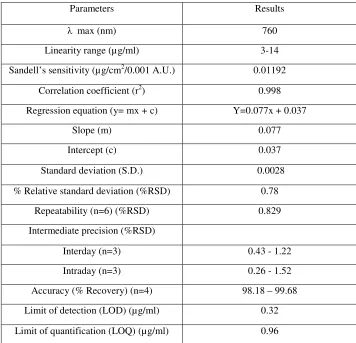
nicotine in presence of 20% sodium carbonate solution, there by producing reduced species molybdenum blue having characteristic blue color with maximum absorption at 760 nm for nicotine. It was found that 2.5 ml FC reagent with 2.5 ml 20% sodium carbonate solution for nicotine was sufficient for the development of maximum color intensity. The linearity was found in the concentration range of 1 to 14 µg/ml (r2=0.9980) for nicotine. The Molar absorptivity and Sandell’s sensitivity values show the sensitivity of the method, while the precision is confirmed by % CV (coefficient of variance) values included in Table. The analysis results of gum tablet are in good agreement with the labeled claim. The reproducibility, repeatability and accuracy of the method was found to be good, which is evidenced by low values of standard deviation. The % recovery value in the range of 98.18to 99.68 % for nicotine indicates non-interferences from the formulation excipients. The optical characteristic and precision parameters are summarized in Table 1.
CONCLUSION
A simple, sensitive, repeatable and specific colorimetric method has been developed for the estimation of nicotine. The method was validated for accuracy, precision, linearity, specificity and LOD & LOQ. In this proposed method the linearity is observed in the concentration range of 3-14 µg/ml with co-efficient of correlation, (r2) = 0.9980 nicotine at 760 nm. The result of the analysis of gum tablet by the proposed method is highly reproducible and reliable and it is in good agreement with the label claim of the drug. The method can be used for the routine analysis of the nicotine in gum tablet form without any interference of excipients.
ACKNOWLEDGEMENT
The authors are thankful to BGP HEALTH CARE PVT. LTD, Ankleshwar, Gujarat, India for providing gift sample of standard nicotine for research. The authors are highly thankful to Shree S. K. Patel College of
Pharmaceutical Education & Research, Ganpat
103
Table 1- Summary of validation parameterParameters Results
λ max (nm) 760
Linearity range (µg/ml) 3-14
Sandell’s sensitivity (µg/cm2/0.001 A.U.) 0.01192
Correlation coefficient (r2) 0.998
Regression equation (y= mx + c) Y=0.077x + 0.037
Slope (m) 0.077
Intercept (c) 0.037
Standard deviation (S.D.) 0.0028
% Relative standard deviation (%RSD) 0.78
Repeatability (n=6) (%RSD) 0.829
Intermediate precision (%RSD)
Interday (n=3) 0.43 - 1.22
Intraday (n=3) 0.26 - 1.52
Accuracy (% Recovery) (n=4) 98.18 – 99.68
Limit of detection (LOD) (µg/ml) 0.32
Limit of quantification (LOQ) (µg/ml) 0.96
Table- 2 Recovery data for the proposed method
Formulation Level Amount of sample
taken (µg/ml)
Amount of standard
spiked (µg/ml)
Mean % recovery ± %R SD
(n=4)
Gum tablet I (50%) 4 2 99.68 ± 0.326
II (100%) 4 4 99.14 ± 1.267
III (150%) 4 6 98.18 ± 1.238
Table- 3 Analysis of gum tablet of nicotine by proposed colorimetric method
Formulation Label claim (mg) Amount found (mg) % Label Claim ± %RSD (n=4)
104
Figure- 1 Representative spectra of nicotine standard solution (13µg/ml)Figure- 2 Linearity curve for nicotine at 760 nm
y = 0.077x + 0.037 R² = 0.998
0 0.2 0.4 0.6 0.8 1 1.2
0 5 10 15
Concentration (mcg/ml)
A
105
REFERENCES
1. O’ Neil MJ. The Merck Index: An Encyclopedia of chemicals, drugs and biologicals, 14th ed. New
Jersey: Published by Merck Research
Laboratories, Division of Merck and Co., Inc. Whitehouse station: 1177, (2005).
2. U. S. Pharmacopoeia NF, Vol. III, The United states pharmacopeial convention, Twinbrook pathway Rockvillae: 3079 (2009).
3. British Pharmacopoeia, Vol. ll, Stationary office. London Medicines and Healthcare product regulatory agency: 1501 (2010).
4. European Pharmacopoeia, Vol. II, 6th edition, Starboary: Council of Europe: 2500 (2007).
5. James A, Denise E, Quantitation of Major
Tobacco Alkaloids by High-Performance Liquid Chromatography. 1981, 205: 147-154.
6. Lochmann H, Bazzanella A, Kropsch S,
Determination of tobacco alkaloids in single plant cells by capillary electrophoresis, Journal of Chromatography. 2001, 917: 311–317.
7. Hiroyuki K, Reiko I, Katsuharu Y, Keita S, Determination of nicotine, cotinine, and related alkaloids in human urine and saliva by automated in-tube solid-phase microextraction coupled with liquid chromatography-mass spectrometry, J Pharm Biomed Anal. 2008: 625-635.
8. Patel K.N, Derivative Spectrophotometric
Method for Simultaneous Estimation of nicotine and Bupropion Hydrochloride in Synthetic Mixture, Journal of Pharmacy Research. 2009, 2(9): 1525-1527.
9. Laura J.L, John D.L, Delbert J.E, Lee D.H, Edwin
A.L, Determination of Nicotine and Cotinine by
Ion Pair Reversed-Phase Chromatography,