Detecting Wormhole Attack in Wireless Network
Coding System using Dawn & ETX
S. Hariharasudan Dr. M. Chidambaram
Department of Computer Science & Engineering Department of Computer Science & Engineering Rajah Serfoji Government Arts College Rajah Serfoji Government Arts College
Abstract
The wireless network coding system is an efficient method to improve the performance of a wireless network. These systems have become more popular among the wireless networks. But this system also faces serious threats in the form of Wormhole attack. The wormhole attack degrades the performance of the network coding systems. In order to overcome this problem various methods have been presented. For networks with centralized authority, a centralized algorithm is used. In this algorithm, a central node gathers the information from all the nodes in the network and evaluate whether there present a wormhole link. This algorithm ranks the series of the nodes that gains the innovative packet, and uses the machine learning method to differentia te the wormhole cases. For distributed method DAWN, a Distributed detection Algorithm against Wormhole in wireless Network coding systems is used. In DAWN, during proper data transmissions, each node reports the irregular appearance of innovative packets and shares this with its neighbours. Moreover, DAWN assure a good successful detection rate. This existing method is more energy saving and hence decrease the implementation and communication costs.
Keywor ds: Hybrid wireless Network, Three- Hop, Distributing, Throughput, Overhead
________________________________________________________________________________________________________
I. INTRO DUC TIO N
Wireless network coding systems the routing and packet forwarding procedures are different from those in traditional wireless networks, the first question that we need to answer is: Will wormhole attacks cause serious interruptions to network functions and downgrade system performance? Actually no matter what procedures are used, wormhole attacks severely imperil network coding protocols. In particular, if wormhole attacks are launched in routing, the nodes close to attackers will receive more packets than they should and be considered as having a good capability in help forwarding packets. Thus they will be assigned with more responsibility in packet forwarding than what they can actually provide. Furthermore, other nodes will be correspondingly contributing less. This unfair distribution of workload will result in an inefficient resource utilization and reduce system performance. Wormhole attacks launched during the data transmission phase can also be very harmful. First, wormhole attacks can be used as the first step towards more sophisticated attacks, such as man -in-the-middle attacks and entropy attacks. For example, by retransmitting the packets from the wormhole links, some victim nodes will have to process much more non -innovative packets that will waste their resources; these constitute entropy attacks. Secondly, the attackers can periodically turn on and off the wormhole links in data transmissions, confusing the system with fake link condition changes and making it unnecessarily rerun the routing process.
II. LITERATURE SURVEY
A. Impact of Security Attacks on a New Security Protocol for Mobile Ad Hoc Networks
A mobile ad hoc network (MANET) is a self-organized wireless short-lived network consisting of mobile nodes. The mobile nodes communicate with one another by wireless radio links without the use of any pre -established fixed communication network infrastructure. The mobile nodes are v ulnerable to different types of security attacks that allow interception, injection, and interference of communication among nodes. Possible damages include leaking secret information, message contamination and node impersonation. MANETs need secure routin g protocols to prevent possible security attacks. In this paper, we evaluate the performance of a new security protocol against various known and unknown malicious node attacks. Simulation results have shown that the proposed security protocol resists against malicious nodes with low implementation complexity
Byzantine Attack - In this attack, a set of cooperative intermediate nodes works in combined and collectively performs attacks such as creating routing loops, routing packets on worst paths, and selectively dropping packets
B. A Survey on Security Issues to Detect Wormhole Attack in Wireless Sensor Network
Sensor nodes, when deployed to form Wireless sensor network operating under control of central authority i.e. Base station ar e capable of exhibiting interesting applications due to their ability to be deployed ubiquitously in hostile & pervasive environments. But due to same reason security is becoming a major concern for these networks. Wireless sensor networks are vulnerable against various types of external and internal attacks being limited by computation resources, smaller memory capacity, limited battery life, processing power & lack of tamper resistant packaging. This survey paper is an attempt to ana lyze threats to Wireless sensor networks and to report various research efforts in studying variety of routing attacks which target the network layer. Particularly devastating attack is Wormhole attack- a Denial of Service attack, where attackers create a low-latency link between two points in the network. With focus on survey of existing methods of detecting Wormhole attacks, researchers are in process to identify and demarcate the key research challenges for detection of Wormhole attacks in network layer.
1)Attack s on Wireless Sensor Network s
Wireless sensor networks are susceptible to wide range of security attacks due to the multi-hop nature of the transmission medium. Also, wireless sensor networks have an additional vulnerability because nodes are generally deployed in a hostile or unprotected environment. Although there is no standard layered architecture of the communication protocol for wireless sensor network, hence there is need to summarize the possible attacks and security solution in different layers with respect to ISO -OSI model
C. A Survey on Network Security and Cryptography
In this paper we describe some of the recent research going on in the field of cryptography and network security. Discussion of these research papers emphasizes the security vulnerabilities of existent as well a s new technologies in the field of Computer Networks. We classify the research topics based on their implementation across the seven layers of the familiar OSI reference model, and group the papers together based on their content. The main motivation behin d each research paper is explained and the proposed solution is stated Briefly, in light of brevity.
D. A Survey of Intrusion Detection Systems in Wireless Sensor Networks
Wireless Sensor Networking is one of the most promising technologies that have applicat ions ranging from health care to tactical military. Although Wireless Sensor Networks (WSNs) have appealing features (e.g., low installation cost, unattended network operation), due to the lack of a physical line of defense (i.e., there are no gateways or switches to monitor the information flow), the security of such networks is a big concern, especially for the applications where confidentiality has prime importance. Therefore, in order to operate WSNs in a secure way, any kind of intrusions should be det ected before attackers can harm the network (i.e., sensor nodes) and/or information destination (i.e., data sink or base station). In this article, a survey of t he state-of-the-art in Intrusion Detection Systems (IDSs) that are proposed for WSNs is present ed. Firstly, detailed information about IDSs is provided. Secondly, a brief survey of IDSs proposed for Mobile Ad-Hoc Networks (MANETs) is presented and applicability of those systems to WSNs are discussed. Thirdly, IDSs proposed for WSNs are presented. Th is is followed by the analysis and comparison of each scheme along with their advantages and disadvantages. Finally, guidelines on IDSs that are potentially applicable to WSNs are provided. Our survey is concluded by highlighting open research issues in th e field.
E. A Novel Approach to Detect & Prevent Wormhole Attack over MANET & Sensor n/w towards Lower Battery Power Consumption
A. Drawbacks of Existing System
packet round trip time
huge amount of error in network systems
B. Proposed System
Centralized algorithm to detect wormholes attacks
The algorithm leverages the order of the nodes to receive the innovative packet.
Expected Transmission Count (ETX), It can obtain the node capability to receive the incoming file. DAWN is used to detect the worm hole attackers and report them about to the neighboring nodes.
If we want to send the file securely ,it will be changed as positive and negative value(decimal character) while travelling in the neighbor node.so the node cannot detect the file content
C. Specific Contributions are,
An arithmetic coding based, distributed, and lossless provenance encoding mechanism for WSN. Our scheme also supports data aggregation.
D. Advantages of Proposed System
We use only fast message authentication code (MAC) schemes and Bloom filters, which are fixed -size data structures that compactly represent provenance. Bloom filters make efficient usage of bandwidth, and they yield low error rates in practice.
We formulate the problem of secure provenance transmission in sensor networks, and identify the challenges specific to this context.
We propose an in-packet Bloom filter (iBF) provenance-encoding scheme.
We design efficient techniques for provenance decoding and verification at the base station.
We extend the secure provenance encoding scheme and devise a mechanism that detects packet drop att acks staged by malicious forwarding sensor nodes.
E. Algorithm
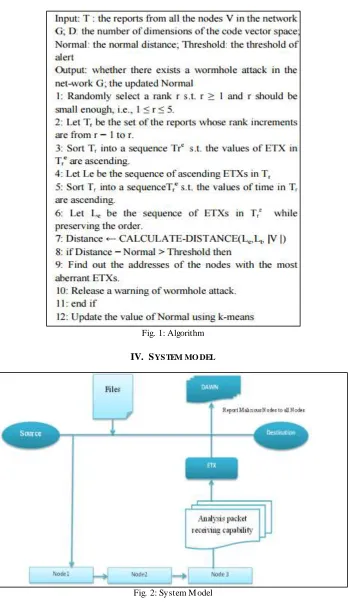
Fig. 1: Algorithm
V. DATAFLO W
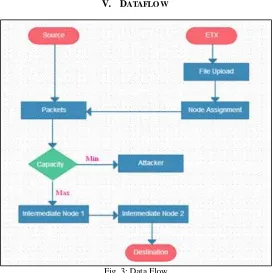
Fig. 3: Data Flow
VI. CO NC LUSION AND FUTURE WO RK
In this paper, we proposed a simple and efficient delay-aware contention window adaptation scheme, namely D2D,for the performance improvement of both the throughput and the channel access delay of a network all together. As the D2D scheme requires the present value of only two adhoc, distributed, and estimate parameters related to the network configuration and experienced delay, respectively, the scheme is seamlessly integrable with the off-the-shelf hardware of IEEE 802.11e networks. Using the D2D scheme, we designed the D2DCA protocol for the IEEE 802.11e networks. We have investigated the negative impacts of wormhole attacks on wireless network coding systems. Wehave proposed two algorithms tha t utilize the metric ETX to defend against wormhole attacks. We have proposed a Centralized Algorithm that assigns a central node to collect and analy ze the forwarding behaviors of each node in the network, in order to react timely when wormhole attack is initiated. We have proven the correctness of the Centralized Algorithm by deriving a lower bound of the deviation in the algorithm. We have also proposed a Distributed detectionAlgorithm against Wormhole in wireless Network coding systems, DAWN. DAWN is t otally distributed for thenodes in the network, eliminating the limitation of tightly synchronized clock.
DAWN is efficient and thus it fits for wireless sensor network. For both centralized and distributed algorithms, we have
utilized the digital signatures toensure every report is undeniable and cannot be forged by any attackers. In this work, a new
VII.SC REENSHOTS
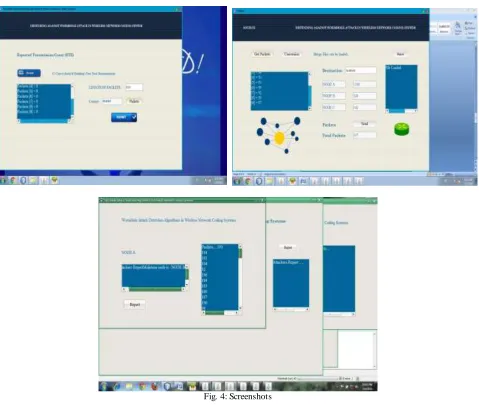
Fig. 4: Screenshots
REFERENC ES
[1] Chaki, Rituparna; Chaki, Nabendu; "IDSX: A Cluster Based Collaborative Intrusion Detection Algorithm for Mobile Ad-Hoc Network"; Proc. o f t he 6 th Int’l Conf. on Computer Information Systems and Industrial Management Applications (CISIM '07); pp. 179 - 184, June 2007; ISBN: 0-7695-2894-5 [2] Marko Jahnke, Jens T oelle, Alexander Finkenbrink,. Alexander Wenzel, et.al; “Methodologies and Frameworks for Testing IDS in Adh o c Netwo r ks”;
Proceedings of the 3rd ACM workshop on QoS and security for wireless and mobile networks; Chania, Crete Island, Greece, Pages: 113 - 122, 2007 [3] Y.-C. Hu, A. Perrig, D. B. Johnson; “Wormhole Attacks in Wireless Networks”; IEEE Journal on Selected Areas of Communications, v ol. 24, numb. 2, pp.
370-380, 2006
[4] F. Hong, L. Hong, C. Fu; “Secure OLSR”; 19th International Conference on Advanced Information Networking and Applications, AINA 2005, Vol. 1, 25 -30, pp. 713-718, March 2005
[5] Korkmaz T.; “Verifying Physical Presence of Neighbours against Replay-based Attacks in Wireless Ad Hoc Networks”; Proc. International Conference o n Information Technology: Coding and Computing 2005, ITCC 2005, pp. 704-709, 2005