ISSN (e): 2250-3021, ISSN (p): 2278-8719
Vol. 10, Issue 1, January 2020, ||Series -V|| PP 22-27
Numerical study of effect of staggering the artificial roughness on
heat transfer coefficent.
Prof. Bhushan S Rane, Dr. Sanjay S Deshmukh
Department of Mechanical Engineering D Y Patil School of Engineering Academy, Ambi.Pune, India Department of Mechanical Engineering Prof. Ram meghe institute of technology and research. Amaravti, India
Received 02 January 2019; Accepted 16 January 2020
Abstract— Use of artificial roughness on the absorber plate of solar air heater can significantly improve the performance of solar air heater. Arrangement of roughness element on the absorber plate also affects the performance of heat transfer. In this study an attempt is made to investigate the effect of staggering the roughness element on the amount of heat transfer coefficient. Steady states external forced convection heat transfer from artificially roughen absorber plate of solar air heater having spherical Elements is studied numerically. Ansys fluent software is used to develop a 3D numerical model for investigation of effect of staggering the artificial roughness element on the overall heat transfer coefficient. It is observed that average heat transfer coefficient reduces in comparison with the inline arrangement of roughness element.
Keywords—Absorber plate, solar air heater, Heat transfer coefficient, Staggered arrangement.
I.
INTRODUCTION
Demand for energy is tremendously increasing due to fast growing population, industrialization and transportation needs. The fossil fuels are diminishing day by day because of their limited source worldwide. Therefore now it’s a need of time to switch over to the non conventional energy sources. Solar air heaters are widely used for drying and space heating applications and usually have flat plate absorber plate for solar energy collection. However they generally exhibit low thermal performance owing to high thermal losses from absorber plate coupled with poor carrying capacity of the air, which is the working fluid. Hence there is need for the development of an efficient flat plate solar air heater. Various techniques have been proposed by the previous researchers for increased in thermal performance and are found to have different extents of heat transfer augmentation and corresponding pressure drop in the flow. Mr M S Aazad etall uses diagonally champhered cuboids to generate roughness on absorber plate for Reynolds number ranging from 5000 to 22500 with constant heat flux of 1000 w/m2 on absorber plate. He found out the highest value of enhancement ratio 1.54 at least Reynolds number with relative roughness pitch (transverse and longitudinal) of 7,relative roughness height of 0.088 and 12mm cube arm [1]. Mr. Manjunath M S studied the effect of spherical turbulence generators on thermal efficiency and thermo hydraulic performance of flat plate. Solar air heater for the Reynolds number range of 4000-25000. He found the maximum enhancement in Nussult number is found to be 2.52 times higher as compared to the base model corresponding to the Reynolds number of 23560 and relative roughness pitch of 3[2]. Chandra Prakash et all carried out an experimental investigation on heat and fluid flow characteristics of solar air heater duct having spherical and inclined protrusions in the Reynolds number ranging from 2000 to 20000. HE found out that the Maximum thermo-hydraulic performance parameter is 3.66, for r/g value of 0.8, P/e value of 25 and Pr/P value of 0.5[3]. R.S. Gill et all did an experimental investigation on heat transfer and friction factor characteristics of solar air heater duct roughen with broken arc rib combined with staggered rib piece in the Reynolds number ranging from 2000 to 16000. He conclude that the thermo-hydraulic performance of broken arc rib geometry is better in comparison to roughness geometries reported in literature having staggered rib piece due to lesser frictional losses[4]. In the studied literature very little work is found on the staggered arrangement of the roughness elements on the absorber plate of the solar air heater. So here in this work the objective is to find out the effect of effect of staggering the spherical roughness elements on the absorber plate of solar air heater.
II.
MATERIALS & METHODS
Figure 1[2]
The simulation is carried out at a mass flow rate of 0.014kg/s which corresponds to a Reynolds number of about 8200. The number of elements prepared is 1366509 which is kept closer to the best cell density specified.
Figure 2
+5.5 is used in the solar load model to define the global position of Manipal for 1st of April at 12 noon conditions. The rest of the three walls are considered as smooth walls kept at 300 K with No-Slip impermeable wall condition. Also, to reduce the size of domain and to save the computational time the planar wall symmetry condition is applied. Fluent with double precision pressure based CFD solver is used for numerical simulation. The pressure velocity coupling is done using SIMPLE scheme segregated solver .The SIMPLE algorithm uses a relationship between velocity and pressure corrections to enforce mass conservation and to obtain the pressure field. In Spatial discretization Body-force weighted scheme is used for pressure while momentum, turbulence kinetic energy and specific dissipation rate is carried out using second order upwind scheme. The convergence of the solution is considered when the residuals in the computation domain fall below 6for energy and 10-5for momentum and Continuity equations. Besides the residuals, surface monitors for the temperature of air at duct outlet and absorber plate temperature are also used to confirm the convergence of the solution. The thermo-physical properties of air such as density, dynamic viscosity and thermal conductivity are considered to be function of temperature and are evaluated from the following equations.
ρ = 3.9147-0.016082 T + 0.016082 T + 2.9013 x 10⁻⁵ T2 – 1.9407 x 10⁻⁸ T3. μ = (1.6157 + 0.06523T – 3.0297 x 10⁻⁵
T2) x 10-6 K = (0.0015215 + 0.097459T – 3.3322 x 10⁻⁵ T2) x 10-3
Where Density came out to be 1.177372 kg/m3 and Viscosity is 1.845797x 10⁻⁵ Kg/m-s and the thermal conductivity is 0.0262393115 W/m-K.
Selection of Turbulence Model
The CFD software used for the analysis offers various turbulence models such as Standard k-e model, Renormalization Group (RNG) k-e model, Realizable k-e model, standard k-ω model and Shear Stress Transport (SST) k- ω model for fluid flow and heat transfer studies. The simulation is carried out using each of these turbulence models and the values of Nusselt number (Nu) for heat transfer from absorber plate to duct air stream at different Reynolds number of the flow are plotted as shown in Fig. From Fig. it is observed that the results of SST k-ω model closely matches with that of Dittus-Boelter equation.
Figure 3 Selection of turbulence model for the CFD analysis. [2]
viscosity formulation to account for the transport effects of the principal turbulent shear stress. Hence the whole CFD analysis is carried out based on the k-ω model with energy equations were on.
III.
RESULTS AND DISCUSSION
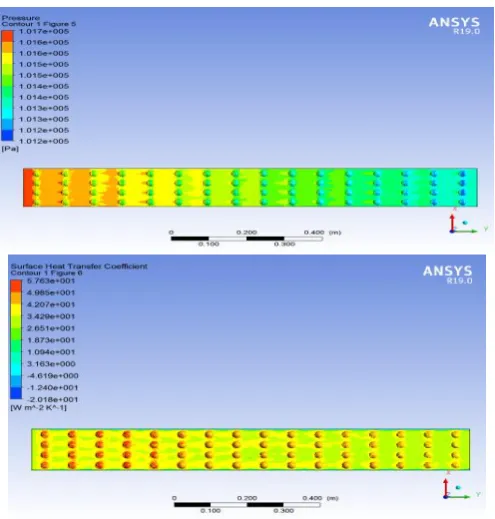
Figure 4 the velocity and temperature plots for the unstaggered arrangement of elements
In the inline arrangement of spherical roughness elements average heat transfer coefficient and nusselt no is found to be 38.82 and 78.04 respectively.
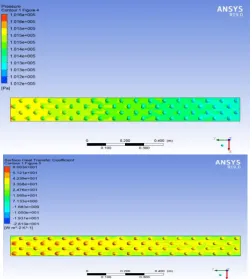
Figure 6 The velocity and temperature plots for the staggered arrangement of elements
In the staggered arrangement of spherical roughness elements the average heat transfer coefficient and nusselt number is found to be 37.93 and 72.31 respectively.
IV.
CONCLUSION
A three dimensional CFD analysis is carried out to evaluate the effect staggering the spherical turbulence elements on heat transfer enhancement of flat plate solar air heater. The analysis shows that the average heat transfer coefficient decreases by 2.3% as compared to the inline arrangement of the roughness elements.
REFERENCES
[1]. M. S. Azad, A. Layek, “Performance analysis of solar air heater having absorber plate artificially roughened by champhered square elements”, Journal of Solar Energy Research, Vol 4 No 1 (2019) 73-83 [2]. M.S. Manjunath, K.Vasudeva Karanth, N.Yagnesh Sharma, “Numerical Analysis of the Influence of
Spherical Turbulence Generators on Heat Transfer Enhancement of Flat Plate Solar Air Heater,” Energy, 2017.
[3]. Chandra Prakash & R.P. Saini, “Heat transfer and friction in rectangular solar air heater duct having spherical and inclined rib protrusions as roughness on absorber plate”, Experimental Heat Transfer,2018. [4]. R.S. Gill, V.S. Hans, J.S. Saini, Sukhmeet Singh, “Investigation on performance enhancement due to
staggered piece in a broken arc rib roughened solar air heater duct”, Renewable Energy 2016.
![Figure 1[2]](https://thumb-us.123doks.com/thumbv2/123dok_us/7798339.1659826/2.595.82.515.438.692/figure.webp)
![Figure 3 Selection of turbulence model for the CFD analysis. [2]](https://thumb-us.123doks.com/thumbv2/123dok_us/7798339.1659826/3.595.117.474.403.699/figure-selection-turbulence-model-cfd-analysis.webp)