Parallel Implementation of Xvid Decoder on
Multi-Core
Ying Liu
College of Information Science and Engineering, Northeastern University, Shenyang, 110819, China [email protected]
Fuxiang Gao
College of Information Science and Engineering, Northeastern University, Shenyang, 110819, China [email protected]
Shiyuan Wang
College of Information Science and Engineering, Northeastern University, Shenyang, 110819, China [email protected]
Abstract—With rapid development of multimedia technology, performance of computers is changing constantly. Today even the most ordinary computers have already equipped with multi-core processors. At the same time, high-quality videos have become main requirement of customers. Therefore it is a serious problem how to make video codec process a large number of video data efficiently on multi-core processors. It is a good way to develop the software which is compatible with multi-core. But most video codec has been already designed and developed for single-core processors. So it’s a good idea to transform the current sequential program into the parallel one by the parallelization runtime library. In this paper we choose Intel isomorphic quad-core processor as hardware platform, Linux as OS, and use Intel parallel runtime library TBB to transform the decoder. The transformation includes that
Loop parallelization, memory parallelization, data
parallelization, pipeline parallelization and task-level parallelization. Then, for testing, sequential program and parallel one run on the same environment respectively, and the final results show that after parallelization the performance has improved significantly
Index Terms—Parallelization; TBB; Multi-core;Xvid Decoder
I. INTRODUCTION
Due to advances in circuit technology and performance limitation, speeding up processor frequency had not worked very well in the earlier part of this decade, so computer architects needed a new approach to improve performance. And the multi-core technology has become the mainstream in CPU designs [1]. The development of a sequential programming hardly involves the processor architecture, while the development of the multi-core application needs to know much about it. You can make full use of the multi-core resource, only if you know the hardware architecture very well. Program speed and CPU processing power is closely related.
Multi-core processor is a chip multiple with multiple processor engines. It’s not a new concept, which has been used in embedded systems and specialized applications for some time. But nowadays this technology has become the mainstream because of many commercially available multi-core chips produced by Intel and AMD. In contrast to two and four core machines recently available, some experts believe that “by 2017 embedded processors could sport 4,096 cores, server CPUs might have 512 cores and desktop chips could use 128 cores.” [2]
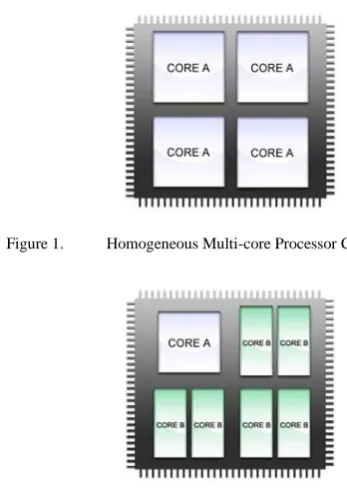
Figure 1. Homogeneous Multi-core Processor Configuration.
Figure 2. Heterogeneous Multi-core Processor Configuration
homogenous system is exactly the same: equivalent frequencies, the same cache sizes, functions, and so on. While, each core in a heterogeneous system may have different functions, different frequencies, memory model, and so on. So there is an apparent tradeoff between processor complexity and customization. As shown in Fig. 1, multiple cores of the same type are implemented in one homogeneous multi-core processor. While in Fig. 2, multiple cores of different types are implemented in one heterogeneous multi-core processor.
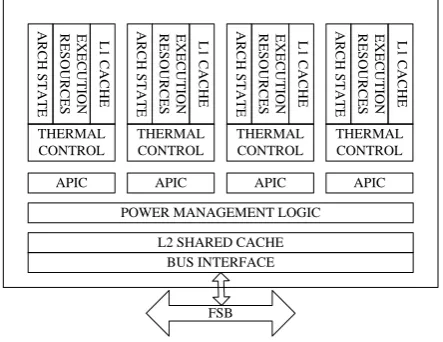
THERMAL CONTROL A R C H S T A T E E X E C U T IO N R E S O U R C E S L 1 C A C H E THERMAL CONTROL A R C H S T A T E E X E C U T IO N R E S O U R C E S L 1 C A C H E THERMAL CONTROL A R C H S T A T E E X E C U T IO N R E S O U R C E S L 1 C A C H E THERMAL CONTROL A R C H S T A T E E X E C U T IO N R E S O U R C E S L 1 C A C H E
APIC APIC APIC APIC
POWER MANAGEMENT LOGIC
L2 SHARED CACHE BUS INTERFACE
FSB
Figure 3. Block Diagram for the Intel Core 2 Quad.
Most multi-core processors used today are both Homogeneous multi-core processors. Intel is one of the mainstream microprocessors manufacturers in the world. It produces many different types of multi-core processors. The Pentium D is used in desktops, the Core 2 Quad is used in both laptop and desktop environments, and the Xeon processor is used in servers. So we choose Intel Core 2 Quad as the experiment processor in this paper. Fig. 3 shows block diagram for the Intel Core 2 Quad. Its architecture is the homogenous quad-core processors. The Core 2 Quad adheres to a shared memory model with private L1 caches and a shared L2 cache. While the eight-core or even more eight-core processors can be the choice for extension.
Intel Core 2 Quad is used as the development platform, four cores of which have the same functions and operations. Each core has it own executive resources, and cache L1. The four cores share 6MB cache L2, and can support truly parallel computing [3].
With the continuous development of codec standards, computation of video processing is more and more, and the computing power of processors is becoming the bottlenecks of video application [4]. Parallelization on multi-core is an ideal solution for video processing, there is a natural parallelism in the process of which. The video codec can be parallelized from two aspects, hardware and software. Parallelization from the perspective of hardware, it’s feasible to accelerate through multi-core platforms like DSP, GPU, IBM Cell or Intel. Parallelization from the perspective of software, the whole development cycle is too long time from the design for multi-thread parallelization on multi-core to accomplish according to
the traditional parallel model. And the development and debugging of the multithread are also the technical problems themselves, which would cost the programmers a lot of time on learning traditional knowledge of parallel development. Parallelization on multi-core for the current sequential program can just parallelize some parts of it, while its infrastructure and algorithm unchanged. So the development time of a parallelization program design can be accelerated, and the efficiency of program has improved. We can use the parallel runtime library to transform a sequential program to a parallel one. TBB, OpenMP, and MPI are the common used parallel runtime libraries at present. In this paper, we choose Intel TBB as the multi-core runtime library. TBB, Thread Building Block, is a parallel programming tool developed by Intel. It is a C++ template library, which provides the parallel program with a suitable abstraction and the implementation for commonly used algorithm. TBB also has the feature of automatic load balance, flexible scalability, and so on.
It is an open source C++ template library, which can run on the OS like Windows, Linux and UNIX with C++ compiler. The parallelization level of TBB is higher, on the abstraction. It’s based on task not thread. It concerns performance, scalability and etc. Therefore TBB is the best choice for parallelization development on multi-core. Compared with the traditional parallelization technology such as OpenMP and MPI, TBB has features and benefits as follows.
1) Task-oriented Parallelization Programming: The Thread functions are specified from the logical task rather than the physical thread. The task is more advanced parallel abstraction than the thread. When we use its C++ template library, we just need to design the task not the thread. That makes us ignore some detail about thread, such as load balancing, scheduling optimization, and so on. The underlying components of TBB have implemented these grunt jobs, which map the tasks to the threads through efficient way, and implement automatic scheduling by work stealing.
2) Easy to Use: TBB is the library implemented by the standard C++ template. It does not contain the special language extensions like in OpenMP, nor is a new programming language. We can choose the efficient parallel algorithm template from the C++ template library provided by TBB, and feel the benefits from multi-core processors.
3) Support crossing Platform: TBB is the library implemented by the standard C++ template. It does not contain the special language extensions like in OpenMP, nor is a new programming language. We can choose the efficient parallel algorithm template from the C++ template library provided by TBB, and feel the benefits from multi-core processors.
We have studied the cubic convolution interpolation algorithm for image processing and parallelized it using the parallel programming tools TBB and OpenMP, and compare the performance of parallel and sequential implementations in our Preliminary work.
The paper is organized as follows. Section II briefly introduces the codec-Xvid. What’s the Xvid and why we use it. And the Xvid decoder algorithm is introduced in Section III while its implementation is given in Section IV. Section V discusses how to parallelize the decoder program efficiently. The experimental results are shown in Section VI. Finally, Section VII concludes this paper and discusses the future work.
II. XVIDASPROFILE
There are many codecs in the world. The codec is an abbreviation for [co]der/[dec]oder, hence describes a program to encode and decode digital video. The purpose of encoding video data is to reduce redundancies. After that the video files can be smaller for faster transmission over computer networks or for more efficient storage on computer disks. And the Xvid is one of the most common ones currently. Nearly 90 percent movies on BitTorrent and eMule are suppressed by Xvid. The Xvid can somewhat be seen as a ZIP for video. But unlike ZIP, it is not lossless. That means that a video after compression and decompression with Xvid won't be identical to the original source. Typically however, a difference to the source is visually imperceptible. The Xvid removes information that is not important for human perception, which is somewhat similar to MP3 for audio. This enables very high compression rates that allow to effectively working with digital video on PC. For example: uncompressed digital video is huge and requires about 100 GB per hour at PAL resolution. The same video would require just 500 MB per hour at very high quality when compressed with the Xvid. That is a compression ratio of 200:1.
The Xvid is the Free Software and released under the GNU GPL license. This means that the source code of the software is publically available and programmers are allowed to make modifications to the code which is good news for us. We can obtain the Xvid free of charge, without time or feature limitations. Also the Xvid source code is publically available and can be reviewed by any interested programmer [5]. So we choose it as the experiment object.
It is possible to have Xvid running on many different platforms. And it could still be made available to new platforms or new operating systems by anyone interested without involvement of the original developers.
Since it is the first truly open source code, it’s also a typical traditional sequential program. By transforming it into the parallel one, a general solution for parallelization of the typical sequential program is proposed. Most sequential programs can learn how to parallelize from it, including the parallelization analysis, parallelization design, and parallelization implementation.
III. ALGORITHMFORXVIDDECODER
As a video codec standard, Xvid has the open source code online. It has just implemented all functions of Xvid video standard. Although its readability and portability has been implemented, the real-time performance of video code has not been considered. Nor is the practicality for the further extension.
To make the code more practical, we choose decoder of Xvid developed on Linux as the research object. The core of its SMP version can support multi-core processor well. And Linux Kernel 2.6 is chosen as OS, which has a new process scheduler supporting SMP well. It can also keep load balancing and cache effective. Xvid decoder based on MPEG-4 will be parallelized, and it will be more practical.
Xvid decoding algorithm based on MPEG-4 includes three functions, decoder create for creating decoder instance, decoder decode for decoding image frame by decoder, decoder destroy for destroying decoder. There can be many decoders. We can call decoder decode for decoding image frame in cycle call, but only can call decoder create or decoder destroy just once.
In this paper, the parallelization process of decoding algorithm is mentioned. The algorithm process is introduced in detail. In MPEG-4 SP video decoding algorithm, the process of decoder decoding is shown in Algorithm 1.
Algorithm 1. decoder_decode 1: initialize stream structure; 2: analyze stream head structure;
3: if BitstreamReadHraders == 1/2 then 4: analyze stream head structure; 5: end if
6: if BitstreamReadHraders ==﹣3 then 7: decoder_resize;
8: end if
9: ensure the first decoding is I- frame; 10: decoder_iframe();
decoder_pframe();
The SP level of MPEG-4 video frame has two kinds, Iframe and P-frame. I-frame decoding is decoded by function decoder iframe, while p-frame by function decoder pframe. The two functions both have to decode in cycle for all the macro blocks, which are the focus of parallel transformation. Function decoder pframe is chosen as an example because Pframe is the main type in decoding. The process of P-frame is shown in Algorithm 2.
To decode P-frame, there are three coding modes, Inter, Intra and not coded. The decoding for them is finished in a loop. And we will parallelize it.
/*All the Macro blocks in the Loop*/ For(y=0; y<height; y++){
For(x=0; y<width; x++){
/* Is it intra */ /* Intra macro block decoding*/ /* Is it inter */ /* Inter macro blockdecoding*/ /* Is it not coded*/ /* no decodereturn directly*/ }
}
2: while (all the blocks are decoded) do 3: get quantization step of DC; 4: if decoded() == 1 then 5: get decode information; 6: if Intra()==1 then 7: Intra block decode; 8: end if
9: if Inter()==1 then 10: Inter block decode; 11: end if
12: end if
13: no decode is needed; 14: MV clear;
15: end while
IV. DECODERIMPLEMENTATION
The purpose of parallelization for traditional programs is to reduce as much workload as possible by rewriting the applications to guarantee performance. Therefore in the parallelization the general algorithm hardly changed. And this is the general principles for our parallelization analysis of sequential program [6]. In the process of specific analysis, the following aspects should be paid attention to mainly.
(1) Find out a suitable parallelization level for the original program. In this level, it’s not necessary to consider the structure design of the original program. And
it will be the key points of performance.
(2)The parallelization level mentioned above may cover the entire program, so the Independence of each data and program segment must be guaranteed.
(3)Data decomposition, task decomposition and pipeline decomposition can be used in the parallelization [7].
By analyzing Xvid decoder based on MPEG-4, the main function of the original program is to decode the Xvid video. The following points can be used in the parallelization parts.
(1) Function parallelization is finished firstly, which means that a frame is divided into several steps and each processor will process one of them.
(2) Data parallelization means that a frame data can be divided into several data blocks, and each processor will process a data block.
(3) Parallel memory allocation is used for allocation of the image frames.
(4) Work stealing strategy is used to balance workload when the image decoding work is distributed unevenly.
(5) There are many loops in the Xvid decoding program, including initialization of parameters in the video decoding and the computing process of decoding. Therefore Loop parallelization will be used through the whole program.
We can parallelize the original program from the following aspects. The first one is data decomposition. When parallelizing the decoder, we should pay more attention to the data dependence. In the parallelization of the data decomposition macro block (16×16 pixel block) group division is used. The second one is loop parallelization. From the source code of the key functions,
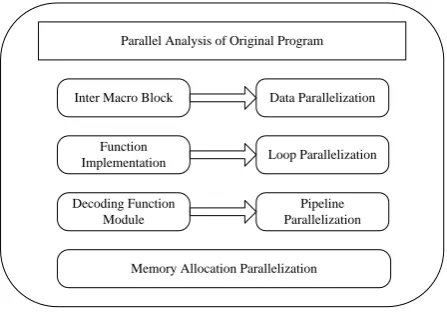
we know that there are many loops which are not related to the data processing. The increasing number of loops can make computing time increase exponentially, which will be the bottleneck at last. So loop parallelization is the most important point of our work. The last one is task parallelization. The function process of Xvid decoder needs to be considered. If there is no traffic between tasks, or only some dependencies like pipeline, task parallelization can be used. The overall scheme of parallelization for source is shown in Figure. 4.
Inter Macro Block
Function Implementation
Decoding Function Module
Data Parallelization
Loop Parallelization
Pipeline Parallelization
Memory Allocation Parallelization Parallel Analysis of Original Program
Figure 4. Overall Scheme of Parallelization.
Data Parallelization
Data parallelization of Xvid video decoding is to divide a frame of data into several data blocks, and each processor processes a data block. Macro block decoding function occupies a large amount of computation. It includes Motion compensation, inverse transformation, inverse quantization, and so on each of which needs much computation. Therefore the key to parallelize Xvid decoding is data parallelization. In the process of macro block decoding, the data dependency must be paid attention to. The decoding of the marco block needs to check whether all the related macro blocks are decoded. In the sequential program, the macro blocks are decoded according to the row sequence. When the current macro block is decoded, its reference blocks have been decoded. So macro-block-level parallelization is to find out the macro block whose reference macro blocks have been decoded.
By analyzing the code, we know that each macro block is decoded sequentially in a loop. To parallel a loop correctly, we must find out a macro block group which is independent with each other. If a macro block group can be decoded independently, two or even more groups can run together.
Loop Parallelization
are to read the same data in the sharing memory unit, they can also execute in parallel. But when a task write and the other task read or write the same data, the sequence is critical. And they can’t execute in parallel. Therefore when the relationship between data is the first two cases, loop parallelization can be finished
A. Function Parallelization
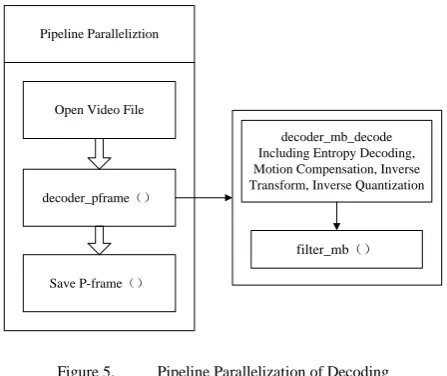
The work flow of Xvid CODEC decoding algorithm includes three steps, initializing CODEC, using CODEC, destroying CODEC. Creating handle and allocating memory is finished in the process of initializing CODEC. MPEG-4 decoding is finished in loop of using CODEC. The inverse process of initialization is finished in destroying CODEC. Xvid CODEC is written in standard C language, whose core module includes transformation copy, DCT transformation, SAD computation, motion compensation, CBP computation and so on. There are complex communications between tasks in the three steps, which are not suitable for parallelization on common multi-core PC. But for video input, frame decoding and frame output, there is the significant dependence, pipeline parallelization can be used. Pipeline parallelization of decoding is shown in Figure. 5.
Pipeline Paralleliztion
filter_mb()
decoder_pframe()
decoder_mb_decode Including Entropy Decoding, Motion Compensation, Inverse Transform, Inverse Quantization
Save P-frame()
Open Video File
Figure 5. Pipeline Parallelization of Decoding
Overall, we can improve the parallel efficiency greatly by using pipeline parallelization structure on the whole, data decomposition parallelization in the frame decoding process, and loop parallelization in anywhere that it can be used. The purpose of parallelization solution is that scalability, high performance and correctness. And scalability means that as the core number of a processor and data amount processed increasing, performance and efficiency can be both improved. High performance means higher performance computing on multi-core. Correctness means that parallel program must have the same result as the sequential one.
IV. DECODERIMPLEMENTATION
According to the scheme in the Section IV and TBB specific algorithm, the overall structure of the sequential
program parallelization is proposed, which is shown in Figure 6..
Overall Structure of Parallel Design
Initialization
Decoding Frame
Output Frame
Task Schedule Initialization
Memory Allocation Initialization
Pipeline Initialization
Filter Initialization
Macro Block Decode Macro Block Filter
Output Video Frame Free Memory Space
Figure 6. Overall Structure of Parallel Design .
Loop Parallel Implementation
Data parallelization of Xvid video decoding is to divide a frame of data into several data blocks, and each processor processes a data block. Macro block decoding function occupies a large amount of computation. It includes Motion compensation, inverse transformation, inverse quantization, and so on each of which needs much computation. Therefore the key to parallelize Xvid decoding is data parallelization. In the process of macro block decoding, the data dependency must be paid attention to. The decoding of the marco block needs to check whether all the related macro blocks are decoded. In the sequential program, the macro blocks are decoded according to the row sequence. When the current macro block is decoded, its reference blocks have been decoded. So macro-block-level parallelization is to find out the macro block whose reference macro blocks have been decoded.
Grain size is the measure of computing size and traffic size. In our case, that includes grain size of the application and grain size of the machine. Generally speaking, the grain size refers to the application grain size.
Application grain size is the ratio of computation and traffic. Traffic refers to overhead of data sharing or message passing among threads or processes. Machine gain size is the ratio of computing power and communications power.
Grain size makes a great impact on analyzing, coding and running the parallel program. When application running, a suitable grain size should be chosen. For a fine-grained application, if it runs in the coarse-grained, the efficiency is very poor. Because traffic becomes its bottleneck, and the coarse-grained makes it even worse.
TBB Grain size partition tool is used for grain size partition of Xvid parallelization directly. Meanwhile, tbb blocked range and tbb parallel for are used together for loop parallelization in this paper.
used in the parallelization of independent iterative process. In the Xvid decoding source, there are many loop operations in the process of frame decoding, which can be parallelized by parallel for.
In the loop tbb::block range is used for gain size partition. Grain size is default in the example above for the loop parallelization. The grain size will make a great impact on parallelization performance, so it’s necessary to study it. For partitioning, the way of recursive division is better than static. blocked range is the iteration space from 0 to n-1. Its common form is [8]:
blocked range<T> (begin, end, gransize)
The iteration space is partitioned according to parameter gransize by parallel for, so the size of gransize makes a direct impact on the parallelization result. In the worse case, because of the wrong division of the subinterval, overhead of creating and destroying subintervals is much larger than performance improved by parallelization. So it’s necessary to find out the best grain size partition. TBB has provided a default automatic partitioner. Set the value of gransize as auto partitioner, then automatic partitioner will give the proper grain size like 500, according to the system case. But there is a defect that the best gain size can not be given. So we have to propose another method to find a better grain size. By setting gransize as higher value and testing the result in the experiments, modify the value gradually. By analyzing the relationship between execution time and value size, the best gransize value will be found. Certainly, it’s too tedious. If the loop parallelization is not used frequently, default value auto partitioner is recommended. Finally, task scheduler scheduler init will distribute tasks in parallel.
Memory Parallel Implementation
Xvid video decoding needs to allocate and free memory frequently. And it may occupy a lot of execution time. Therefore, we use TBB memory allocator to read video images and free memory.
The template of memory allocator provided by TBB is scalable_allocator<T>. The memory blocks can be allocated in advance and reused, which would reduce the overhead of system calls. TBB memory allocator uses thread private heap, not global lock. So it will not lead to lock contention.
TBB scalable memory allocator includes just TBB scalable memory allocator library, not TBB universal library. So it can be independent with other algorithm or container template. It replaces malloc, free, realloc, and calloc in C++. Accordingly, the memory allocated by scalable allocator should be freed by itself.
Data Parallel Implementation
To implement parallelization based on macro block group, it needs to be decoded according to the dependence. So thedependence of the macro block groups must be expressed correctly. It’s implemented by a two-dimensional matrix. Each element in the matrix represents a macro block group in the corresponding coordinate set of the image. The value of element is the number of dependent macro block groups that haven’t
been decoded. When the value reduces to 0, the dependent groups have been all decoded. So a task can be created for decoding this macro block group. After that, the value of this group in the matrix is modified at the same time and check if there is any new group can be decoded. This process is shown as Algorithm 3.
Algorithm 3. parallel design 1: build two-dimensional data; 2: i=x/2;
3: j=y/2+x%2;
4: while value(i; j)!= 0 do
5: decode group in coordinates(i,j); 6: values of coordinates((i+1),j)-1; 7: values of coordinates((i+1),(j+1))-1; 8: values of coordinates(i,(j+1))-1; 9: end while
10: decode macro block group(i,j);
Pipeline Parallel Implementation
Pipeline parallel implementation needs to use TBB pipeline and filter class. Data processing node should inherit from filter class, which is a filter in the pipeline. Filter constructor has just a Boolean parameter, which is used to decide whether it is a sequential operation or parallel one. ”True” represents the sequential operation while ”false” represents the parallel one.
For CPU-intensive and IO-intensive applications in the program, pipeline model is chosen. The CPU-intensive part is put in a filter, and IO-intensive is put in another one. The two filters can be distributed different threads, and the speed difference between them is matched by the queue linking them. Therefore we can get the best efficiency of concurrent.
In the implementation, there is a pure virtual function void*operator()(void *item), and it must be implemented. The input parameters are the data from the previous node, and the processed data will be returned. Local Xvid video files input, loading video image, initialization, decoding video frame, and video frame output are finished at the nodes. So four filters need to be established, including input filter, load filter, frame decode filter, and frame output filter.
Task Parallel Implementation
Task scheduling mechanism is the core of all the algorithms. TBB uses the tasks with the threads, and the task scheduling mechanism is introduced. When using this mechanism, both TBB_scheduler_init and TBB_task should be used. TBB initializes a global thread pool implicitly [9], which can manage the thread pool automatically. All these functions can make programmers write high performance code easily.
The scheduler_init is the initialization of TBB task scheduler. TBB::task_scheduler_init must initialize TBB before using task scheduler or any TBB parallel algorithm template.
Every TBB task inherits from ”task”, and it must finish the following steps from its creating to running.
(1) Allocate memory space for tasks. The overloading operator “new” and task::allocateroot is used to allocate memory. The root suffix in the names represents that the task created have no father task, and it’s the root of the task tree.
(2) Create the task according to corresponding constructor, and it will be called in the overloading operator “new”.
(3) Run the task, until task::spaw_root_and_wait is finished.
VI. EVALUATION
Test Environment
Operating System: Red Hat Enterprise Linux 5 Processor: HP IntelRCoreTM2 Quad CPU Q8400 @2.66GHz
Memory Size: 4G
Decoding Program Compiler: GCC 4.12
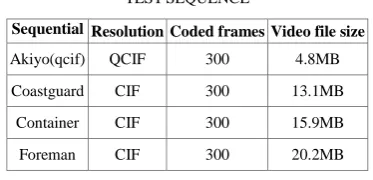
After parallelization of sequential program on multi-core, Xvid video decoding is tested on quad-core. The testing sequence [10] is shown in Table I. Among them, CIF is the common standard image format, which is equal to 352288 pixels in the H.323 protocol cluster. While QCIF is also the common standard image format, which is equal to 176144 pixels in the H.323 protocol cluster.
TABLE I.
TESTSEQUENCE
Sequential Resolution Coded frames Video file size
Akiyo(qcif) QCIF 300 4.8MB
Coastguard CIF 300 13.1MB
Container CIF 300 15.9MB
Foreman CIF 300 20.2MB
Sequential Program Data
In sequential experiments, the corresponding functions of Xvid decoder based on MPEG-4 run on Linux, and the decoding time is recorded. From Table II, we can find that decoding performance of small size video file is excellent, when it is not parallelized. But with the size of video file increasing, the speed has not changed a lot. In the following tables fps is short for frames per second
TABLE II.
DECODING TIMEOFXVIDDECODER
Sequential Size Frame Number Decoding Frame Rate
Akiyo_qcif QCIF 300 231.3547fps
Coastguard_cif CIF 300 87.5061fps
Container_cif CIF 300 66.0995fps
Foreman_cif CIF 300 54.5729fps
A. Parallel Program Test
Evaluation capacity: Decoding Frame Rate in Sequential, DFRS for short; Decoding Frame Rate in Parallel, DFRP for short, Speedup which is equal to the ratio of DFRP and DFRS.
(1) Test of Gain Size Partition and Loop Parallelization The results are shown in Table III.
TABLE III.
RESULTSOFGAINSIZEPARTITIONANDLOOP
PARALLELIZATION
Sequential DFRS DFRP File Size Speedup
Akiyo 231.3547fps 305.3882fps 4.8MB 1.320
Coastguard 87.5061fps 101.7696fps 13.1MB 1.163
Container 66.0995fps 77.9974fps 15.9MB 1.180
Foreman 54.5729fps 67.9432fps 20.2MB 1.245
(2) Test of Data Parallelization The results are shown in Table IV.
TABLE IV.
RESULTSOFDATAPARALLELIZATION
Sequential DFRS DFRP File Size Speedup
Akiyo 231.3547fps 282.2527fps 4.8MB 1.220
Coastguard 87.5061fps 100.6320fps 13.1MB 1.150
Container 66.0995fps 78.6584fps 15.9MB 1.190
Foreman 54.5729fps 67.1247fps 20.2MB 1.230
(3) Test of Pipeline Parallelization, The results are shown in Table V..
TABLE V.
RESULTSOFPIPELINEPARALLELIZATION
Sequential DFRS DFRP File Size Speedup
Akiyo 231.3547fps 224.4141fps 4.8MB 0.970
Coastguard 87.5061fps 83.1308fps 13.1MB 0.950
Container 66.0995fps 62.1335fps 15.9MB 0.940
Foreman 54.5729fps 50.7528fps 20.2MB 0.930
From the testing results, we can find that the program decoding speed hasn’t been improved but a little lower in
the pipeline parallelization. Because that the introduction of Intel pipeline parallelization model leads the possible of lock conflict which is much larger than before with the hardware threads increasing. To the quad-core processor used for testing, the number of its hardware threads became the bottleneck of the whole experiments, so its efficiency is lower than the sequential one. But it doesn’t mean that pipeline parallelization is not feasible. When the number of the hardware threads is more than 32, pipeline parallelization is the most efficient.
TABLE VI.
RESULTSOFMEMORYALLOCATIONPARALLELIZATION
Sequential DFRS DFRP File Size Speedup
Akiyo 231.3547fps 246.3928fps 4.8MB 1.065
Coastguard 87.5061fps 91.7939fps 13.1MB 1.049
Container 66.0995fps 69.6028fps 15.9MB 1.053
Foreman 54.5729fps 57.7927fps 20.2MB 1.059
(5) Test of General Parallelization
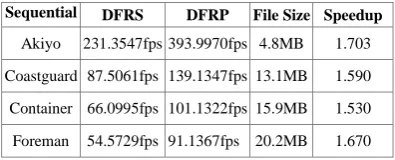
Compared sequential decoding sequence with parallel decoding sequence, after computing we can get the data shown in Table VII.
TABLE VII.
RESULTSOFGENERALPARALLELIZATION
Sequential DFRS DFRP File Size Speedup
Akiyo 231.3547fps 393.9970fps 4.8MB 1.703
Coastguard 87.5061fps 139.1347fps13.1MB 1.590
Container 66.0995fps 101.1322fps 15.9MB 1.530
Foreman 54.5729fps 91.1367fps 20.2MB 1.670
In order to show the results of that experiment vividly, we put the data in Table III, Table IV, Table V, Table VI and Table VII together in one diagram. In Fig. 7 we can see that the general parallelization has the best speedup while the pipeline parallelization has the worst speedup. And we know that for different environments, the result maybe totally different.
0 0.2 0.4 0.6 0.8 1 1.2 1.4 1.6 1.8 2
Akiyo Coastguard Container Foreman
GAIN SIZE PARTITION DATA PARALLELIZATION PIPELINE PARALLELIZATION MEMORY ALLOCATION PARALLELIZATION GENERAL PARALLELIZATION
Figure 7. Note how the caption is centered in the column.
As shown in Table VII that there are two aspects: firstly, the video decoding frame rate is related to video file formats and video file sizes. Taking the QCIF format as the example, its decoding frame rate is significantly faster than the rate of the CIF format, while its speedup is also larger relatively; secondly, in terms of the same format, as the video file increases, the parallel decoding obtains more obvious advantages. Therefore, the parallel decoding based on the Xvid improves the utilization of the processor, especially for large video file, and its speedup even reaches 1.67.
VII. CONCLUSION
The parallel implementation of applications on Linux is studied in the paper. We have discussed the feasibility and solution of parallelization, and implemented it in the Xvid decoding application. The code needs to be optimized, and that’s our work in the paper. By analysis of Xvid decoding open source code, a parallelization solution for it by TBB library is proposed. The parallelization includes loop parallelization, data parallelization, memory allocation parallelization, and so on. The performances of parallel decoder processing different sizes video files are tested in the experiments. And from the results, we can know that the performance of its functions has been improved by parallelization. We have just an initial exploration about parallelization. In future, further exploration will be taken about decoding on embedded systems, or the other multi-core CPU environments
REFERENCES
[1] L. Peng et al, “Memory Performance and Scalability of Intel‟s and AMD‟s Dual-Core Processors: A Case Study”, IEEE, 2007
[2] R. Merritt, “CPU Designers Debate Multi-core Future”,
EETimes Online, February 2008,
http://www.eetimes.com/showArticle.jhtml?articleID=206 105179
[3] Lu Jinzheng, Zhou Dongmei. Visual C++ Audio/Video Processing Technology and Engineering Practice. Electronics Industry Press, 2009, 519-563.
[4] Zhou Shuxian. OpenMP-based Programming on Multi-core PC. SCIENCE & TECHNOLOGY INFORMATION, 2010, 9: 78-79.
[5] Xvid. http://www.xvid.org/, 2011
[6] Xie Xianghui, Hu Sutai, Li Hongliang. Multi-core/many-core processor and its influences on computer architecture design. Journal of Frontiers of Computer Science and Technology, 2008, 2(6), 641-650.
[7] TBB opensource. http://www.threadbuildingblocks.org, 2008.
[8] Wang Hai tao, Liu Shu fen. Parallel Computing Based on Linux Cluster. Computer Engineering, 2010, 1(36), 64-66. [9] Xi Jie; Chen Jie. Parallel Intra Prediction on Multi-core
Platform. Science Technology and Engineering, 2010, 10(6), 1379-1383.
[10]Video Sequence Download.
http://bbs.chinavideo.org/viewthread.php?tid=1006, 2007.
Ying Liu, doctoral student, studies in College of Information Science and Engineering, Northeastern University, China
Fuxiang Gao, professor, works in College of Information Science and Engineering, Northeastern University, China
Shiyuan Wang, master student, studies in College of