FOIA, INC.
MARGARET B.KWOKA†
ABSTRACT
Government transparency is imagined as a public good necessary to a robust democracy. Consistent with that vision, Congress enacted the Freedom of Information Act (FOIA) to allow oversight and accountability of governmental activities, imagining the prime intended users to be journalists. But this democracy-enhancing ideal is at odds with FOIA’s reality: at some agencies, commercial—not public—interests dominate the landscape of FOIA requesters.
This Article provides the first in-depth academic study of the commercial use of FOIA, drawing on original datasets from six federal agencies. It documents how corporations, in pursuit of private profit, have overrun FOIA’s supremely inexpensive processes and, in so doing, potentially crowded out journalists and other government watchdogs from doing what the law was intended to facilitate: third-party oversight of governmental actors. It also reveals a cottage industry of companies whose entire business model is to request federal records under FOIA and resell them at a profit, which distorts the transparency system even further.
Counterintuitively, limiting commercial requesting will not solve this problem. Instead, this Article proposes a targeted and aggressive policy of requiring government agencies to affirmatively disclose sets of records that are the subject of routine FOIA requests—a surprisingly large number of the documents sought by commercial
Copyright © 2016 Margaret B. Kwoka.
requesters. By meeting information needs in a more efficient manner that is available equally to all, affirmative disclosure will enable federal agencies to reclaim public records from the private market and free up resources to better serve FOIA requests that advance its democratic purpose.
TABLE OF CONTENTS
Introduction ... 1362
I. Failing the Fourth Estate ... 1366
A. The Goal of Freedom of Information ... 1367
B. Effective Requesting ... 1372
II. Commercial Use of FOIA ... 1379
A. Securities and Exchange Commission ... 1382
B. Food and Drug Administration ... 1388
C. Environmental Protection Agency ... 1398
D. Defense Logistics Agency ... 1401
E. Federal Trade Commission ... 1404
F. National Institutes of Health ... 1410
III. Privatizing FOIA ... 1414
A. Subsidizing “Secrets” ... 1415
B. Flooding FOIA Offices ... 1422
C. Reselling Public Records Access ... 1424
IV. Reclaiming Information Democracy ... 1427
A. Affirmative Disclosure ... 1429
B. Implementing Publication ... 1433
Conclusion ... 1436
INTRODUCTION
Having witnessed adverse reactions in patients, a prominent physician repeatedly emailed various Food and Drug Administration (FDA) officials to sound an alarm about a dangerous dietary supplement on the market.1
The FDA did not respond for six months, at which point it issued a public health alert and requested that the manufacturer recall the product.2
When the New York Times
investigated why the agency had such a delayed response to a serious public health threat, the paper filed a Freedom of Information Act
1. Anahad O’Connor, Study Warns of Diet Supplement Dangers Kept Quiet by F.D.A., N.Y.TIMES: WELL (Apr. 7 2015, 9:43 PM), http://well.blogs.nytimes.com/2015/04/07/study-warns-of-diet-supplement-dangers-kept-quiet-by-f-d-a [http://perma.cc/ZX39-3G9Y].
(FOIA)3
request for the communications between the doctor and the FDA.4 The response: the FDA was “unable to locate” any of the records.5
The FDA is not alone in having trouble responding to journalists’ FOIA requests. The Department of Defense’s Inspector General issued a report detailing the misconduct of the Director of the Pentagon Force Protection Agency, who had improperly given preferential treatment to a subordinate with whom he had a special relationship, improperly required his subordinates to perform personal tasks for him, and improperly allowed a family member to use the agency’s firing range.6 When a Washington Post journalist learned of the investigation and wanted to report on this instance of government malfeasance, he filed a FOIA request.7 It took the agency seven months to produce the forty-page report.8
In both examples, which are hardly unique, journalists sought to use FOIA as it was intended, to protect the public’s right to know “what [its] government is up to.”9
In fact, no law is more centrally intended to promote transparency as a means of democratic governance than FOIA.10
Nonetheless, FOIA has been rightly critiqued for failing to live up to its promise, hindered by
3. Freedom of Information Act, Pub. L. No. 89-487, 80 Stat. 250 (1966). 4. Id.
5. Id.
6. INSPECTOR GEN., U.S. DEP’T OF DEF., REPORT NO. 20121204-000911, ALLEGED MISCONDUCT: MR. STEPHEN E. CALVERY, SENIOR EXECUTIVE SERVICE, DIRECTOR, PENTAGON FORCE PROTECTION AGENCY 1–2 (2013), http://www.dodig.mil/FOIA/err/Calvery ROI%28Redacted%29.pdf [http://perma.cc/WUV6-NFWL].
7. Craig Whitlock, Bad Boss at Pentagon was ‘Misusing’ Underlings, Report Says, WASH. POST:IN THE LOOP (Nov. 4, 2013), http://www.washingtonpost.com/blogs/in-the-loop/wp/2013/ 11/04/bad-boss-at-pentagon-misused-underlings-report-says [http://perma.cc/N7AY-5FGC]. 8. Id.
9. U.S. Dep’t of Justice v. Reporters Comm. for Freedom of the Press, 489 U.S. 749, 773 (1989) (quoting EPA v. Mink, 410 U.S. 73, 105 (1973)).
administrative inefficiency,11
overwithholding of information,12
and courts’ failure to act as a meaningful check on agency secrecy.13
One failing, however, is particularly notable: FOIA’s failure to meet the news media’s information needs, as exemplified above. Journalists were at the heart of the purpose of creating a statutory right to access government information; it was thought that the news media would inform the public about government operations, thereby facilitating democratic participation and exposing potential government corruption or malfeasance.14 Not only was the news media a specially contemplated user of FOIA, but journalists were actually integrally involved in crafting the law.15 Yet, news agencies and reporters have lamented FOIA’s many failures, most importantly the delay in receiving records that often renders them obsolete.16
Despite these many critiques, however, FOIA remains in high demand. During each of the last two reported fiscal years, federal government agencies received over 700,000 requests.17 The public’s interest in government information appears, therefore, still to be strong. But if FOIA is not primarily serving the newsgathering, democracy-enhancing function of informing public debate on matters of governmental policy, what interests, then, does it primarily serve?
Relying on records logging select federal agencies’ FOIA requests (themselves obtained through dozens of FOIA requests), this Article explains how corporations have distorted the principal government-transparency law’s operation. To that end, the Article proceeds in four Parts. Part I explores FOIA as it was originally
11. See, e.g., Antonin Scalia, The Freedom of Information Act Has No Clothes, REGULATION, Mar.–Apr. 1982, at 14, 15 (calling FOIA “the Taj Mahal of the Doctrine of Unanticipated Consequences, the Sistine Chapel of Cost-Benefit Analysis Ignored”).
12. See, e.g., PUB.CITIZEN, STATEMENT OF ADINA ROSENBAUM ON ADMINISTRATION OF THE FREEDOM OF INFORMATION ACT 5–6 (Mar. 18, 2010), https://www.citizen.org/ documents/AdinaTestimony.pdf [http://perma.cc/QHJ3-3W4R] (documenting instances of overwithholding).
13. See, e.g., Margaret B. Kwoka, Deferring to Secrecy, 54 B.C.L.REV. 185, 213 (2013) (arguing that despite the formal de novo review standard mandated in the statute, courts give substantial and sometimes conclusive deference to agency decisions to withhold documents). 14. See infra Part I.A.
15. See infra Part I.A.
16. For a more detailed accounting of the reasons why the press finds FOIA fails to meet their needs, see infra Part I.B.
conceived. It documents the democracy-enhancing purposes of the law, the unique role the news media was imagined to play in facilitating that goal, and the eventual failure of the law to serve the news media’s information needs.
Part II delves deeply into how businesses, rather than the news media, are using FOIA. Drawing on original data obtained from six federal agencies, it first documents the extent to which commercial requesters—private entities that seek information as part of their profit-making enterprise—dominate the landscape at some agencies. Then, and perhaps most importantly, it explores the kinds of information businesses seek and exactly how some of the most frequent commercial requesters are actually using the records they obtain. This Part demonstrates that, across a variety of contexts, some of the highest-volume commercial requesters are essentially information-reselling businesses whose profit model depends on obtaining government records at low cost and reselling them, for a higher price, to interested parties. It further shows that the vast majority of all commercial FOIA requests are seeking the same types of routine records.
Part III uses these insights to describe the consequences of commercial FOIA practices, generally demonstrating a privatization of information access. It contends that FOIA’s fee structure essentially subsidizes commercial requesters’ access to records and does so in a way that is highly unlikely to provide the kind of public benefit that justifies the existence of subsidies. It also argues that the volume of commercial requesters creates resource scarcity in FOIA offices, which is likely to negatively affect the quality and speed of responses to other requesters, including the news media. Finally, it problematizes the role of private businesses as information intermediaries that resell government records, likening the practice to de facto outsourcing of an inherently public function.
on a one-by-one basis. Aside from potential cost savings to the agency, secondary benefits are substantial. By removing high cost barriers set up by information resellers in the private market, small businesses would no longer be at a disadvantage in accessing information. In the public domain, affirmative disclosure would free up agencies’ FOIA resources to serve citizens and news-media information requests, perhaps reducing the barriers to FOIA’s effectiveness in facilitating democratic accountability.
I. FAILING THE FOURTH ESTATE18
The press has, of course, a revered place in United States history, meriting direct constitutional protection in the First Amendment.19 In fact, the press is viewed as vital to our democracy.20
Access to government information, however, is relatively new.21 This part demonstrates the integral role the press played in crafting the law, the centrality of the press in Congress’s vision of FOIA’s intended users, and the failure of that vision to come to fruition.
18. The “Fourth Estate” refers to the press. Attribution for this designation is generally given to Edmund Burke, as described in Jeffrey Archer’s novel, The Fourth Estate:
In May 1789, Louis XVI summoned to Versailles a full meeting of the ‘Estates General.’
The First Estate consisted of three hundred nobles. The Second Estate, three hundred clergy. The Third Estate, six hundred commoners.
Some years later, after the French Revolution, Edmund Burke, looking up at the Press Gallery of the House of Commons, said, “Yonder sits the Fourth Estate, and they are more important than them all.”
JEFFREY ARCHER,THE FOURTH ESTATE 1 (1996).
19. U.S.CONST. amend. I (“Congress shall make no law respecting an establishment of religion, or prohibiting the free exercise thereof; or abridging the freedom of speech, or of the press; or the right of the people peaceably to assemble, and to petition the government for a redress of grievances.”).
20. See WHAT GOOD IS JOURNALISM?:HOW REPORTERS AND EDITORS ARE SAVING AMERICA’S WAY OF LIFE 1 (George Kennedy & Daryl Moen eds., 2007) (describing the purpose of the book as to show “the most important roles that journalism, with all its well-documented faults, plays in the world’s oldest democracy”).
A. The Goal of Freedom of Information
Government transparency is such a lofty and laudable goal that it has become the sort of rallying cry one can hardly be against.22
Difficult as it would have been to imagine at the time of FOIA’s enactment, the right of the public to access government information has arguably risen beyond a statutory right,23 or even arguments for a constitutional right,24
but indeed has been declared a human right.25
Domestic laws have been adopted in at least one hundred countries,26 and movements are afoot in even seemingly unlikely places such as South Sudan27 and Afghanistan.28
The United States, however, led the modern movement in favor of transparency laws. In 1966, when it enacted FOIA, the United States was only the second country to have a freedom of information regime.29
As a brand-new statutory right, the purpose of guaranteeing
22. See Mark Fenster, The Opacity of Transparency, 91 IOWA L.REV. 885, 888 (2006) (declaring transparency, vaguely defined, to be “clearly among the pantheon of great political virtues”).
23. In the United States, a collection of statutes provides rights of access to the federal government, including FOIA, the Federal Advisory Committee Act (FACA), 5 U.S.C. app. §§ 1–16 (2012), and the Government in the Sunshine Act, 5 U.S.C. § 552(b) (2012). At the state level, analogs in the form of open records and open meetings laws abound. See, e.g., California Public Records Act, Cal. Gov’t Code §§ 6250–6268 (2015); Colorado Open Records Act, COLO. REV.STAT. §§ 24-72-201 to -309 (2015); New York Freedom of Information Law, N.Y.PUB. OFF.LAW §§ 84–90 (2015); see alsoState Freedom of Information Laws, NAT’L FREEDOM OF INFO. COALITION, http://www.nfoic.org/state-freedom-of-information-laws [http://perma.cc/ 69KM-VRKN] (compiling information regarding state information-freedom laws).
24. See, e.g., Thomas I. Emerson, The First Amendment and the Right to Know: Legal Foundations of the Right to Know, 1976 WASH.U.L.Q.1, 14 (1976) (arguing for a constitutional basis rooted in the First Amendment for the public’s right to access government information).
25. In 2006, the Inter-American Court of Human Rights declared access to government information to be included within the basic human right of free thought and expression. Reyes v. Chile, Inter-Am. Ct. H.R. (ser. C) No. 151, ¶ 77 (Sept. 19, 2006). The European Court of Human Rights did the same in 2009. See Társaság a Szabadságjogokért v. Hungary, App. No. 37374/05, ¶ 39 (Apr. 14, 2009), http://hudoc.echr.coe.int/eng?i=001-92171 [http://perma.cc/3PS7-DESA].
26. Chronological and Alphabetical List of Countries with FOI Regimes, FREEDOMINFO.ORG, http://www.freedominfo.org/chronological-and-alphabetical-lists-of-countries-with-foi-regimes [http://perma.cc/LBF9-PQGL].
27. South Sudan Approved Right to Information Law in 2013, FREEDOMINFO.ORG (Dec. 17, 2014), http://www.freedominfo.org/2014/12/south-sudan-approved-right-information-law-2013 [http://perma.cc/L9U3-KETP].
28. Afghan President Signs Access to Information Law, FREEDOMINFO.ORG (Dec. 9, 2014), http://www.freedominfo.org/2014/12/afghan-president-signs-access-information-law [http:// perma.cc/SK26-CN5Z].
the public’s access to government information should be gleaned from Congress itself. The House of Representatives Report broadly declared, “A democratic society requires an informed, intelligent electorate, and the intelligence of the electorate varies as the quantity and quality of its information varies.”30
The Senate Report similarly explained that “[a]lthough the theory of an informed electorate is so vital to the proper operation of a democracy, there is nowhere in our present law a statute which affirmatively provides for a policy of disclosure.”31
It further explained that a central purpose of FOIA was to “provide a court procedure by which citizens and the press may obtain information wrongfully withheld.”32
Indeed, Congress’s declarations as to the purpose of enacting freedom-of-information legislation tightly align with two of the most influential theories concerning the role of free speech in a system of democratic governance, both of which directly implicate the need for public access to government information.33
The work of Alexander Meiklejohn conceptualizes free speech as necessary to democracy so that the electorate may be sufficiently informed to participate in its own governance.34 Distinctly, but relatedly, the work of Vincent Blasi asserts the value of free speech in checking government abuse.35
Both theories, importantly, are instrumental: the right to access government information is merely a tool to improve democratic governance. And the Supreme Court has affirmed this view of
hyperlink for a dowloadable document listing FOI regime enactment). The first was Sweden, which has had an FOI regime since 1766, exactly two hundred years prior to the enactment of the US FOIA. Id.
30. H.R.REP.NO. 89-1497, at12 (1966), reprinted in 1966 U.S.C.C.A.N. 2418, 2429. 31. S.REP.NO.88-1219,at 8 (1964).
32. Id. at 8.
33. Heidi Kitrosser nicely describes these two theories as they relate to FOI laws in Secrecy in the Immigration Courts and Beyond: Considering the Right to Know in the Administrative State, 39 HARV.C.R.-C.L.L.REV. 95, 126–30 (2004); see also Michael Doyle, The Freedom of Information Act In Theory and Practice (May 2001) (unpublished M.A. thesis, Johns Hopkins University) (on file with the Duke Law Journal) (articulating these two as the “most common theories . . . undergirding information access,” but adding a third suggested theory centering on public ownership claims on government information).
34. See ALEXANDER MEIKLEJOHN, FREE SPEECH AND ITS RELATION TO SELF -GOVERNMENT 63 (1948) (“[The First Amendment] stands alone, as the cornerstone of the structure of self-government. If that uniqueness were taken away, government by consent of the governed would have perished from the earth.”).
FOIA’s role: “The basic purpose of FOIA is to ensure an informed citizenry, vital to the functioning of a democratic society, needed to check against corruption and to hold the governors accountable to the governed.”36
In considering this ultimate goal, no one’s interests were more contemplated than the news media’s. In fact, it was largely the news media’s clamoring that brought about congressional action in the first place. Professor Mark Fenster has carefully documented the history of the movement that led to the passage of FOIA, demonstrating its origins with the press.37
Fenster describes how a combination of American wire services’ defeat of the early-twentieth-century European cartel of news organizations closely tied to particular governments and the Cold War narrative around free press as an American democratic ideal created a strong sense of journalists’ professional identity and values around objective independent reporting.38
Kent Cooper, the general manager of the Associated Press (AP), which, under his leadership, was most responsible for defeating the European news cartel,39
authored an article published in
Life Magazine in 1945 entitled “Freedom of Information,” in which he advocated for a broader understanding of freedom of the press that includes the freedom to “seek out news.”40 Cooper not only believed in a right of the public to access information, but also, as demonstrated in his 1956 book, The Right to Know,41 viewed the press’s role as central: the news media was ethically bound to present information to the public to allow for informed political participation.42
Around the same time, the American Society of Newspaper Editors (ASNE), the most prominent organization representing journalists’ interests, formed a “Freedom of Information Committee.”43 Initially the Committee focused on international press
36. NLRB v. Robbins Tire & Rubber Co., 437 U.S. 214, 242 (1978) (citations omitted). 37. Mark Fenster, The Transparency Fix: Advocating Legal Rights and Their Alternatives in the Pursuit of a Visible State, 73 U.PITT.L.REV. 443, 451–66 (2012).
38. Id. at 452–57. 39. Id. at 453.
40. Kent Cooper, Freedom of Information: Head of Associated Press Calls for Unhampered Flow of World News, LIFEMAG. (Nov. 13, 1944), at 55, 55.
41. KENT COOPER, THE RIGHT TO KNOW:AN EXPOSITION OF THE EVILS OF NEWS SUPPRESSION AND PROPAGANDA (1956).
freedoms, but it quickly shifted its efforts to the United States, in particular to U.S. government secrecy.44 The committee recruited Harold Cross as its legal advisor in its various fights for access to information,45 and in that role he authored the 1953 book, The People’s Right to Know,46
in which he reported on the state of information access, describing an inconsistent and hard-to-discern patchwork of potential rights to government information.47
In the book, Cross called on Congress to “legislate freedom of information for itself, the public, and the press,” as a national remedy to the current unsatisfactory state of affairs.48
Shortly after Cross’s book was published, President Eisenhower, responding to the Cold War, set up an office designed to procure voluntary cooperation from industry and the press in not publishing so-called “strategic information” that might help U.S. enemies.49
A year later, the Department of Defense issued a memo to government officials and contractors requiring any release of information to not only be benign, but in fact to make a “constructive contribution” to defense efforts.50
These secrecy measures prompted some degree of outrage in the public and the press.51
A relatively junior Congressman, Representative John Moss, responded by successfully urging leadership to create a Special Subcommittee on Government Information within the Government Operations Committee on which Moss served, and to name him as the subcommittee’s chair.52 Using Cross’s book as a call to action, the ASNE Freedom of Information Committee connected the author with Chairman Moss; Cross became the subcommittee’s legal advisor, while journalists made up the bulk of its staff.53
In fact, the
44. Id.
45. Id.
46. James S. Pope, Foreword to HAROLD L.CROSS,THE PEOPLE’S RIGHT TO KNOW: LEGAL ACCESS TO PUBLIC RECORDS AND PROCEEDINGS,at viii (1953).
47. See CROSS,supra note 46, at 19–37 (describing statutes, judicial decisions, regulations, and opinions of attorneys general as the various sources from which a right to know had in some circumstances arisen).
48. Id. at 246.
49. MICHAEL R. LEMOV, PEOPLE’S WARRIOR: JOHN MOSS AND THE FIGHT FOR FREEDOM OF INFORMATION AND CONSUMER RIGHTS 49 (2011).
50. Id. at 49–50. 51. Id. at50. 52. Id. at 50–51.
newspaper-subcommittee deployed those journalists on a decade-long campaign to investigate the problem of government secrecy.54
As work progressed, Moss routinely called journalists to testify before the subcommittee in an attempt both to document the extent of the information-access problem and to gain attention for the cause.55
Between 1955 and 1960, the subcommittee collected 176 complaints about unjustified government secrecy, of which 37 percent were from journalists and 45 percent from Congress itself, suggesting an outsized role for journalists in using any new freedom of information law.56
Journalists were also key in beating back attempts to defund or abolish the subcommittee.57 After more than a decade of effort, the 1966 Freedom of Information Act, as enacted, in fact fully embraced Cross’s proposal for a statutory right of the people in a single legislative solution.58
In this victory, the news media’s role was hardly hidden from public view. Moss himself said on the floor when FOIA was passed, “The list of editors, broadcasters and newsmen and distinguished members of the corps who have helped develop the legislation over these 10 years is endless,” and he went on to specially thank journalists at many major news outlets, as well as the ASNE, the American Newspaper Publishers Association, and the National Newspaper Association.59 One Congressman noted not only the news media’s crucial role in devising FOIA, but its ongoing imperative to use the law: “[I]t will take vigorous action by the . . . Nation’s press to make our objectives [in passing FOIA] a reality.”60
FOIA was thus designed largely by journalists, for journalists, and with the particular goal in mind that journalists would use access to government information to provide knowledge to the public, which would, in turn, facilitate the public’s effective participation in democratic governance.
reporter staff members [of the Moss committee] had collected information [about government secrecy] by investigation, interview and research, then reported the results in clear language, just as they had done while writing for newspapers.”).
54. Archibald, supra note 53, at 728.
55. See LEMOV,supra note 49, at 56–57 (describing Moss’s strategy of “demonstrating a pervasive problem and then calling on the government . . . to explain why the problem should not be fixed”).
B. Effective Requesting
Given FOIA’s relatively distinct and narrow goal—facilitation of effective and informed democratic participation61
—its provisions are startlingly broad. Its signature provision requires each agency, upon receiving a request for records, to “make the records promptly available to any person,” who need only “reasonably describe [the requested] records” and follow the agency’s published rules for submitting requests.62 In turn, a “person” for purposes of the statute, “includes an individual, partnership, corporation, association, or public or private organization other than an agency.”63 Thus, the right of access is broadly conceived.
In fact, the statute’s fee structure, added in a 1986 amendment, specifically contemplates a variety of users.64 For commercial-use requests, agencies can charge fees for “reasonable standard charges for document search, duplication, and review,”65 whereas if a “request is made by an educational or noncommercial scientific institution, whose purpose is scholarly or scientific research; or a representative of the news media,” fees are limited to duplication charges alone.66
And for all other requesters, fees are limited to charges for search and duplication.67
For all types of fees, agencies can only charge for their “direct costs,”68 which means “those expenditures which an agency actually incurs in searching for and duplicating (and in the case of commercial requesters, reviewing) documents to respond to a
61. See supra Part I.A.
62. 5 U.S.C. § 552(a)(3)(A) (2012). 63. Id. § 551(2).
64. 132 CONG.REC. S14,297–98. 65. 5 U.S.C. § 552(a)(4)(A)(ii)(I).
66. Id. § 552(a)(4)(A)(ii)(II). A “representative of the news media” for the purposes of FOIA is “any person or entity that gathers information of potential interest to a segment of the public, uses its editorial skills to turn the raw materials into a distinct work, and distributes that work to an audience,” while “news” is defined as “information that is about current events or that would be of current interest to the public.” Id.
67. Id. § 552(a)(4)(A)(ii)(III). In addition to the three categories, any requester may ask for a waiver of otherwise applicable fees if the request is “in the public interest because it is likely to contribute significantly to public understanding of the operations or activities of the government and is not primarily in the commercial interest of the requester.” Id.
§ 552(a)(4)(A)(iii). Because commercial-use requests are essentially disqualified from this fee-waiver provision, the fee-fee-waiver provision has negligible, if any, impact on the commercial use of FOIA, described infra Part II.
FOIA request.”69
Other than differential fees charged, however, there are no limits to access based on the identity of the requester or the purpose of the request.70
Moreover, agencies may only withhold records that fall within one of nine statutory exemptions, which include protections for classified material, material that would invade personal privacy, certain law enforcement records, and privileged material, among others.71
Any person denied access to requested information has the right, under the statute, to first appeal the decision within the agency, and then, if still denied, to file a lawsuit in which a federal court reviews the agency’s decision de novo.72 In essence, FOIA was designed to simply open the doors of government agencies and allow the public a front seat view of what is inside.
Contrary to the intent of Congress and widespread expectations at the time FOIA was passed, the news media has failed to find FOIA the great government-transparency tool it was promised to be, and, in fact, constitutes a tiny fraction of FOIA users. One 2006 study, which looked at one month’s worth of FOIA logs from eleven cabinet-level departments and six large agencies, found that only 6 percent of FOIA requests were submitted by journalists.73 Members of the news media also represent a tiny—and declining—proportion of the
69. The Freedom of Information Act; Uniform Freedom of Information Act Fee Schedule and Guidelines, 53 Fed. Reg. 10,012, 10,017 (Mar. 27, 1967). These costs include the salary of the employee plus a percentage of that salary for benefits and the cost of operating a photocopy machine, but not overhead such as heating or lighting in the building. Id.
70. For an analysis of whether motive should be taken into account, see generally James T. O’Reilly, “Access to Records” Versus “Access to Evil”: Should Disclosure Laws Consider Motives as a Barrier to Records Release?, 12 KAN.J.L.&PUB.POL’Y 559 (2003).
71. 5 U.S.C. § 552(b)(1)–(9). The full range of exemptions applies to records that are properly classified for national-security reasons, are related only to internal personnel rules and practices, are specifically exempted from disclosure by another statute, are trade secrets or confidential commercial or financial information, would be privileged in ordinary litigation, would constitute a clearly unwarranted invasion of personal privacy if released, are certain types of records compiled for law enforcement purposes, are related to reports of examinations of financial institutions, or are certain types of geological records concerning wells. Id.
72. Id. § 552(a)(4)(B), (6)(A). For a critique of courts’ application of the de novo standard in the FOIA context, see Kwoka, supra note 13, at 197–98. If a requester wants to challenge the agency’s decision as to the requester’s fee category (commercial, news, or other), a requester can also administratively appeal that determination and seek judicial review. See, e.g., Elec. Privacy Info. Ctr. v. Dep’t of Def., 241 F. Supp. 2d 5 (D.D.C. 2003).
requesters who file lawsuits to challenge FOIA denials, ranging between 1 and 2 percent of all FOIA plaintiffs.74
One former president of the Society of Professional Journalists wrote, “From the outset, the FOIA was considered a journalist’s tool, but journalists never have made up more than a fraction of the requesters. Most journalists either malign or ignore it. That lack of respect and recognition bewilders veteran FOIA advocates.”75 Mark Feldstein, an award winning investigative journalist formerly at CNN and ABC, explained the sources of frustration for reporters:
I found FOIA to be occasionally, but not frequently useful, when I was an investigative reporter. It was not terribly useful for the vast majority of stories for obvious reasons: There are many exemptions in the law that allow agencies to avoid turning over information, and it can be a slow process under tight news deadlines, especially if you have to file an appeal. That said, I got lucky, either based on a tip that helped me narrow the focus of my request or just by happening to fish in the right waters. The FOIA law is great on paper, but in reality, it has many loopholes. Here’s the bottom line: FOIA is a crude tool. Don’t expect too much. It’s worth doing, but don’t expect too much and hold your breath waiting, because it can be a while.76
Delay is one of the biggest problems cited by the media,77 and it is indeed a very real problem. The AP’s Gary Pruitt recently recounted how, after Malaysia Airlines Flight 370 went missing, the AP filed a FOIA request regarding the U.S. efforts to help locate the plane.78 Despite a twenty-business-day statutory deadline for a
74. Media Making Fewer Challenges to Government Secrecy in Federal Court, THE FOIA PROJECT (Mar. 14, 2013), http://foiaproject.org/2013/03/14/media-making-fewer-challenges-to-government-secrecy-in-federal-court [http://perma.cc/7QDQ-YJ5N]. It is, of course, entirely possible that the declining rate of news media requesting is also in part due to the diminishing resources of the industry as a whole.
75. Paul McMasters, FOIA: It’s Always There, SOC’Y PROF.JOURNALISTS, http://www.spj. org/foiabout.asp [http://perma.cc/JG8Z-BC3W].
76. Stephanie Martinez, The Good, the Bad, the Ugly of Using FOIA, AM.JOURNALISM REV. (Oct. 8, 2014), http://ajr.org/2014/10/08/foia-request-challenges [http://perma.cc/ET6Q-PM W7] (quoting Mark Feldstein in an interview about FOIA use).
77. See, e.g., Michael Doyle, Missed Information: The Reporting Tool That Reporters Don’t Use, WASH.MONTHLY, May 2000, at 38, 40 (“Part of the reason that journalists so rarely use FOIA is that agencies can take so long in responding that the information often seems stale by the time it arrives.”); SOC’Y PROF.JOURNALISTS, supra note 73.
response,79
the only response the AP ever received—a full year later—was a notice that the agency has too many requests to meet the deadline.80
Another AP request to the Treasury Department remained unfilled for nine full years.81 The AP is hardly alone. The average processing time across the entire federal government for complex FOIA requests is a staggering 118 days.82 Even for simple requests, the average across the government slightly exceeds the deadline,83 and some agencies, of course, take much longer.84 At the end of FY 2014, the oldest pending requests across the federal government dated back to 1993.85
To be sure, FOIA still serves important purposes for the news media. Even if the numbers are small, those individual requests may contribute greatly to the public’s understanding of certain government activities.86
Moreover, reporting routinely relies on information that advocacy groups may have pried loose under FOIA and passed along to journalists.87
For example, one researcher found that some of the most effective requesters in the area of the so-called “War on Terror” were well-financed nonprofits such as the American Civil Liberties Union (ACLU).88 And in any case, FOIA’s existence
79. 5 U.S.C. § 552(a)(6)(A) (2012). 80. Pruitt, supra note 78.
81. Id.
82. DOJ,FY2014SUMMARY, supra note 17, at 14. 83. Id. at 12.
84. For example, the U.S. Agency for International Development, though improving over its prior record, still takes an average of 28.48 days to respond to a simple request. Id. at 13. 85. Id. at 11.
86. Indeed, some journalists are still effectively using FOIA. See, e.g., Ravi Somaiya, A Wizard at Prying Government Secrets From the Government, N.Y.TIMES (July 19, 2015), http:// www.nytimes.com/2015/07/20/business/a-wizard-at-prying-government-secrets-from-the-government.html?_r=0 [http://perma.cc/2HWT-J88Y] (describing journalist Jason Leopold’s successful use of FOIA); On The Line: Jason Leopold Discusses Uncovering Government Secrets, VICE NEWS (Apr. 6, 2015, 10:30 AM), https://news.vice.com/video/on-the-line-jason-leopold-discusses-uncovering-government-secrets?utm_source=vicenewsyoutube&utm_
medium=video&utm_campaign=relatedvideo [http://perma.cc/H9CA-LD29] (documenting examples of the same).
87. Doyle, supra note 77, at 38.
may make agencies more likely to release information publicly, knowing it would be required to upon request.89
Still, the difficulties encountered by the news media demonstrate some of the prerequisites to effectively make use of FOIA. For instance, the requester has to have time to wait for what may be a much-delayed response.90
The requester also has to have some degree of specialized knowledge about the agency and the industry it regulates sufficient to know what to ask for.91
Expertise in FOIA requesting and in dealing with the agency, and the resources to devote to negotiating and potentially challenging denials are also assets in making use of FOIA.92
Enter commercial requesters. The term “commercial use” in the fee provisions of FOIA has been interpreted by the Office of Management and Budget (OMB) to mean any “use that furthers the commercial, trade or profit interests of the requester or person on whose behalf the request is made.”93 And as it turns out, businesses which use FOIA to further profit interests often meet all of the qualifications for effective requesters: they often have interests that are more long-term, not immediate in nature; they have resources; and they know enough about what they are looking for to effectively seek the information under FOIA.
Although a completely comprehensive study of who uses FOIA across the federal government and for what purposes has never been conducted, various samplings of FOIA requests over time have consistently identified businesses as prominent FOIA users. In 1972, the Congressional Research Service surveyed a sample of approximately 1500 requests over four years and concluded that 43 percent were submitted by commercial businesses or law firms.94
In
89. McMasters, supra note 75. McMasters quotes Jane Kirley of the Reporters Committee for Freedom of the Press as saying,
Even when journalists don’t use the FOIA, it works for them . . . . This law creates a legal presumption of openness and accountability. Given how much of a struggle it is to get access with the law in place, I can’t imagine what it would be like if we didn’t have that kind of legislative mandate.
Id.
90. See Jennifer Shkabatur, Transparency With(out) Accountability: Open Government in the United States, 31 YALE L.&POL’Y REV. 79, 89–90 (2012).
91. Id.
92. Id.
93. The Freedom of Information Reform Act of 1986; Uniform Freedom of Information Act Fee Schedule and Guidelines, 52 Fed. Reg. 10,012, 10,017–18 (Mar. 27, 1987).
1978, the General Accounting Office boldly asserted that FOIA “is being used mostly by businesses and law firms—sometimes for purposes not contemplated by the Congress,” and found that those interests made up 58 percent of requests at agencies reviewed.95 More recently, in 2000, journalist Michael Doyle collected data from eleven federal agencies, and concluded that, across agencies, commercial requesters were often the largest in number.96
In a final snapshot, using 2005 data, the (now-disbanded) Coalition of Journalists for Open Government found that, across seventeen agencies, about two-thirds of requests were commercial.97
Media reports have also noted the strong presence of commercial interests among requesters. In 1996, the Wall Street Journal reported that “early on, it was discovered that FOIA was a handy tool for companies” and that there is evidence that FOIA is predominately used to serve business interests.98 In 2013, the Journal again addressed the issue, specifically reporting on the use of FOIA by hedge funds and finding that “investors use the process to troll for all kinds of information.”99
Recently, McClatchy DC reported that “corporate interests now drive the release of information” and that, as a result,
95. COMPTROLLER GEN., GEN.ACCOUNTING OFFICE, LCD-78-120, GOVERNMENT FIELD OFFICES SHOULD BETTER IMPLEMENT THE FREEDOM OF INFORMATION ACT,at ii(1978). The General Accounting Office (GAO) also noted the “prevalent complaint” among agency officials that “businesses and law firms . . . are profiting at taxpayers’ expense” in using FOIA.
Id. at 36. GAO noted, however, that its review of the makeup of requesters was “hindered by a lack of pertinent agency records.” Id. The total number of requests studied was 2515. Id. at 37.
96. For example, Doyle found that at the EPA, 87.9 percent of requesters were commercial and 1.2 percent were news media; at the FDA, 26 percent were filed by what Doyle labels FOIA-service companies (what this Article labels information resellers) and only 3.8 percent from the news media, and that attorneys comprised the highest-volume population of requesters at the Department of Health and Human Services. Doyle, supra note 33, at 70–71, 97. The outlier was the NSA, at which commercial requesters were few, and the requesters making up largest group were individuals seeking information on unidentified flying objects, standing at 12 percent of all requests. Id. at 80.
97. SOC’Y PROF. JOURNALISTS, supra note 73. This study sought to characterize the makeup of requesters across government, and thus looked at one month’s worth (September 2005) of FOIA logs from eleven departments and six large agencies. Id. The data is limited in that it is a relatively small sample from each agency, and of course now dates a decade old. Nonetheless, the various previous studies cited are a great jumping-off point for the work in this Article.
98. Michael Moss, Public Eye: Federal Service Gets Wider Use by Sleuths, Snoops – and Senators, WALL ST.J., Jan. 3, 1996, at A1.
information “may not reach the public at all, remaining in the hands of the private interests that sought it out.”100
Despite the widespread commercial use of FOIA, commercial requesters were barely contemplated or discussed at the enactment of FOIA,101 and it was not until 1986 that Congress addressed issues surrounding commercial requesters at all. Even then, it did so obliquely by passing amendments to FOIA as part of the Anti-Drug Abuse Act of 1986 that changed how fees were charged, introducing the modern regime that requires agencies to assess fees that covered more of their costs as to commercial requesters than as to the news media and other requesters.102 Still, as this FOIA amendment was a relatively small and technical change buried in an otherwise massive piece of legislation, scant legislative history fails to reveal the extent to which Congress was aware of or concerned about commercial use of FOIA.
Likewise, the practice of commercial FOIA requesting has never been given in-depth academic treatment. We have very little understanding of how corporations are using FOIA, what they are requesting, how they are profiting from that information, and at what cost the government is serving commercial interests in information. If the news media is not the dominant user of a law designed primarily for it, it is worth understanding what interests the law is serving more effectively.
100. Kevin G. Hall & Kevin Johnson, Open-Records Law Morphs into Tool for Corporations, Advocates, MCCLATCHY DC (Mar. 13, 2015), http://www.mcclatchydc.com/news/ politics-government/article24781393.html [http://perma.cc/9DKL-YCNM]. This piece also quoted Matt Smith of the Center for Investigative Reporting: “Often it’s all law firms [requesting under FOIA], or if you Google names on a FOIA log they are industry investigators or their competitors . . . . It seems to be less sort of public-serving organizations and more individual interests that are using FOIA for something from which they can profit.” Id. 101. In fact, in voluminous debate, only two members of Congress raised the possibility during the debates: one inquired whether the maritime industry could use the law to learn about maritime construction subsidies, and another noted the potential for a contractor whose low bid was rejected to use FOIA to uncover the reasons why. Doyle, supra note 33, at 46.
102. See 132 CONG.REC. S14296–98 (1986) (statement of Sen. Patrick Leahy). Interestingly, Senator Leahy, sponsor of the FOIA amendment, had a narrow view of commercial use:
A commercial user is one who seeks information solely for a private, profit making purpose . . . . [R]equests from a corporation may be presumed to be for commercial use unless the requester can demonstrate that it qualifies for a different fee schedule. A request from an individual or a public interest group may not be presumed to be for commercial use unless the nature of the request suggests otherwise. The resale of documents obtained from the Government is not a commercial use.
II. COMMERCIAL USE OF FOIA
No one denies commercial enterprises may have legitimate uses for FOIA or that they are entitled to use FOIA to further their financial interests. The ways in which commercial entities are using FOIA, however, is relatively unknown. By analyzing FOIA logs of a select group of agencies, this Part documents the commercial use of FOIA, and explains for what purposes businesses are using FOIA and how they are profiting from it.
This Part does not, however, purport to represent government-wide sampling or to report comprehensive government-government-wide statistics. Instead, it reports in-depth accounts of commercial FOIA use at a small selection of agencies. The agencies reported both represent a design choice to target agencies likely to have significant amounts of commercial requesting and a practical choice that flowed from the availability of meaningful FOIA data. As to the design choice, I first identified every government agency that reported more than one thousand requests received in FY 2013, such that the volume of requests would make the agency FOIA operations more than merely nominal, and then narrowed down the list to those that collected more than $10,000 in fees from requesters.103
Because commercial users are most often charged fees and in the greatest amounts, I suspected this metric would identify agencies with high levels of commercial requesting. I then sent each of those twenty-three identified agencies a FOIA request for their FOIA logs—the list of requests received along with various pieces of information about the request—for the calendar year 2013. I ended up studying the agencies
for which I was able to obtain complete data:104
the Securities and Exchange Commission (SEC), FDA, Environmental Protection Agency (EPA), Defense Logistics Agency (DLA), Federal Trade Commission (FTC), and the National Institutes of Health (NIH). The findings regarding commercial use of FOIA at these agencies is presented below in that order, which is the descending order of the size of the agency’s FOIA operations as measured by the number of requests received.
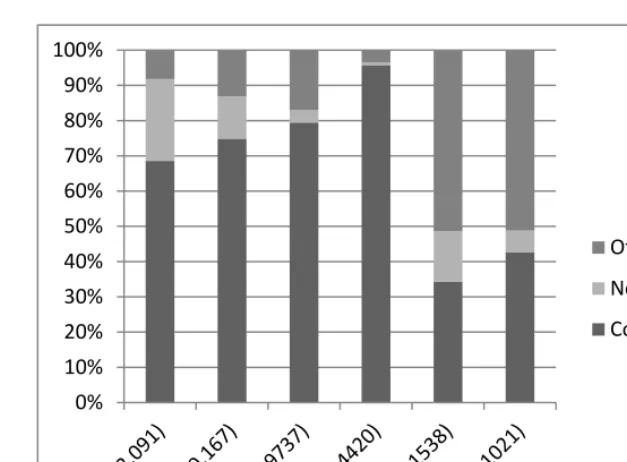
As described below, the data from these agencies shows the heavy use of FOIA by business as a direct input into their profit-making enterprises. In fact, at the four largest FOIA offices studied, commercial requests represent the overwhelming majority of all requests received.105 Figure 1 reflects the breakdown of requesters at each of the studied agencies.
104. Specifically, data was complete if I was able to obtain all of the fields of the logs that I needed for the full calendar year of 2013, including the tracking number for the request, the date of the request, the identity of the requester, the subject matter of the request, the requester’s fee category, the actual fees charged to the requester, and the agency’s response (granted, denied, denied in part, or other). For the agencies to which I originally submitted requests but did not end up reporting results, either I did not receive any response within the time frame of the study, I received a partial response but was unable to obtain the remaining information within the time frame of the study, I received a response that indicated the agency would claim a right to withhold whole categories of information I needed and I was unable to devote resources to further battles over disclosure within the time frame of the study, or the agency claimed it simply did not keep some relevant field as part of their records.
Figure 1: Requester Category by Agency
Moreover, although not entirely uniform, there are strikingly similar patterns between agencies in the ways businesses profit from FOIA. Most notably, the data reveals that a cottage industry based on FOIA requesting has emerged; at five of the six studied agencies, some of the highest-volume requesters are companies whose business model is to request federal records under FOIA and resell those very records for a profit,106 and at two of these agencies, multiple information resellers compete against each other in the private market for public records.107 By contrast, the relative paucity of news media requests is apparent across the board. That is not to say that the news media requesting may not have had a positive, or even disproportionate, impact for each request made, but rather only to indicate that at the studied FOIA offices, the staff and resources are primarily serving commercial interests, not the public’s interest in knowing what its government is up to.
106. These five agencies are the SEC, FDA, EPA, DLA, and NIH. See Parts II.A, II.B, II.C, II.D & II.F.
107. These two agencies are the SEC and the FDA, the two largest FOIA offices studied.
See Parts II.A–B.
0% 10% 20% 30% 40% 50% 60% 70% 80% 90% 100%
Other
News
A. Securities and Exchange Commission
The SEC received a total of 12,091 requests in 2013,108 which makes it a midsize FOIA office compared to other federal agencies.109
Of those, it reported 8292 commercial requests, or 69 percent, 2807 news media requests, representing 23 percent, and 992 other requests, or 8 percent of the total number.110 Though commercial requesters clearly dominate, these numbers deceptively suggest that journalists make far more requests than is likely accurate. The 2807 news media requests comprise a far higher proportion than the other studied agencies. Of these purported news media requests, however, 2498 (all but 309 requests) came from a single requester, SECProbes.com,111
whose status as a news media requester is dubious, as explained below. If SECProbes.com were designated a commercial requester, as it likely should be, commercial requests would make up 89 percent of all requests, and news media requests only 3 percent.112
Compared to other agencies, the highest-volume requesters at the SEC request far more often, meaning that the vast bulk of all requesting comes from very few companies. For example, in addition to SECProbes.com, which itself accounts for 21 percent of all SEC requests, the next highest-volume requesters include International Business Research (IBR), which made 2155 requests, or 18 percent of the SEC total; Check Fund Manager, LLC, which made 1820 requests, or 15 percent of the SEC total; Bioscience Advisors, which made 1323 requests, or 11 percent of the SEC total; and EACM
108. U.S. Sec. & Exchange Comm., Freedom of Information Act Responses to Sept. 5, 2014, Feb. 12, 2015, Feb. 13, 2015, and Apr. 21, 2015 Requests by Margaret B. Kwoka (on file with author) [hereinafter SEC Data]. For this and for each other agency dataset I compiled, the responses include a spreadsheet of the log of all requests filed in calendar year 2013, as well as copies of some particular FOIA request letters that were logged in that spreadsheet about which I wanted more information. When I cite to the spreadsheet, I pincite the line on the spreadsheet by “Request Number.” When I cite to a copy of a letter obtained under FOIA, I pincite to that letter by “Request Letter.”
109. See DOJ,SUMMARY OF ANNUAL FOIAREPORTS FOR FISCAL YEAR 2013,at 3(2014),
http://www.justice.gov/sites/default/files/oip/legacy/2014/07/23/fy2013-annual-report-summary.pdf [http://perma.cc/A5S9-H7AP] [hereinafter DOJ,FY2013SUMMARY] (reporting that seven agencies, all department level, received more than 20,000 requests in FY 2013, twenty-two agencies received between 1,000 and 19,000 requests, and another twenty-seven received between 100 and 900).
110. SEC Data, supra note 108. Here, I am combining both those designated as “other requesters,” which are 7 percent, and those designated as educational/noncommercial, which are 1 percent, for the purpose of reporting. Id.
111. Id.
Advisors, LLC, which made 726 requests, or 6 percent of the SEC total.113 That means that the top five requesters accounted for 8522 of the 12,091 requests made to the SEC in 2013, or 70 percent.114
To begin with the largest requester, SECProbes.com is a nonfunctioning website registered to John Gavin,115 who also submits the requests on behalf of the organization.116
Because SECProbes.com does not exist as a functioning website, Mr. Gavin’s other activities may illustrate its planned or intended purpose. A 2006 New York Times profile of Mr. Gavin described him as a “former money manager and chartered financial analyst” who founded a company called SEC Insight after leaving American Express.117 SEC Insight was based on the model of requesting information from the SEC and keeping a “focus list” of companies on which he obtained information, accompanied by various added warnings such as “troubled” and “monitor,” which indicated potential regulatory risks.118
His clients were largely mutual funds and hedge funds, and he charged “upward of $50,000 a year for his service.”119 SEC Insight was seemingly deemed at the time a commercial requester, as the commercial nature of his requests was apparently undisputed in a lawsuit he brought over certain denials.120
SEC Insight, which was later renamed Disclosure Insight, eventually closed in 2012, after a major investor suffered serious losses.121
Mr. Gavin’s own profile says he is “creating [his] next company and finding others to invest in.”122 He appears, however, to have moved his business model to a website and company called “Probes
113. Id. 114. Id.
115. WHOIS search results for: SECProbes.com, GODADDY, WHOISDATABASE, https:// who.godaddy.com/whoisstd.aspx?domain=secprobes.com&prog_id=GoDaddy&k=ZhKWfJS B%20tx2VpVmMEJO9164vR0gmWzcOeDyc8t2j%20iv7CmiFsbRaZ9WiO2gSpJa [http:// perma.cc/64YR-YG2Q] (listing John Gavin as the registrant).
116. SEC Data, supra note 108.
117. Gretchen Morgenson, Deafened by the S.E.C.’s Silence, He Sued, N.Y.TIMES (May 28, 2006), http://www.nytimes.com/2006/05/28/business/yourmoney/28gavin.html [http://perma.cc/ PAB4-ZXCH].
118. Id. 119. Id.
120. Gavin v. SEC , Civil No. 04-4522, 2007 WL 2454156, at *15 (D. Minn. Aug. 23, 2007) (denying a request for an attorneys’ fees award to prevailing plaintiff Gavin in part because he was a “commercial requestor”).
121. Who is John Gavin?, QUIET INNOVATION, http://quietinnovation.com/who-is-john-gavin [http://perma.cc/B9PN-KSSE].
Reporter,”123
which seems to function as the same entity as or an updated version of SECProbes.com. This can be inferred from the fact that Probes Reporter advertises using FOIA requests to obtain information it provides in its various services,124 but no Probes Reporter requests were listed in the SEC FOIA log.125
Probes Reporter makes no secret that a large part of its service is to make available the records it obtains under FOIA, including copies of its original FOIA request and the original government response.126 Probes Reporter offers two service levels, the lower of which costs $1,187 per year for access to various FOIA requested records and reports, and the higher of which begins at $15,000 a year for more customized service and access to “[a]ll of [Probes Reporter's] content.”127
Whether its previous free access to much of its content, now discontinued, made Probes Reporter a genuine news media outlet at the time of its 2013 requests, or whether that was merely an attempt to drive traffic for its future commercial information-reselling services, now realized, remains unascertainable.128
In either case, Mr. Gavin’s requests appear to uniformly target SEC investigations of
123. PROBES REP., http://www.probesreporter.com [http://perma.cc/C7G5-D55V]. 124. About Us, PROBES REP., http://probesreporter.com/about-us [http://perma.cc/V2MX-PNTP]. The website details Probes Reporter’s history:
Probes Reporter’s origins date back to 2000, when Mr. Gavin started SEC Insight/Disclosure Insight. Disclosure Insight™ is now a trademark and research product line belonging to and produced by Probes Reporter.
Since the late 90’s, Mr. Gavin has been steadily filing FOIA requests with the SEC. These requests primarily seek records pertaining to investigations the SEC conducts on publicly-traded companies. Responses received and records released in response to these FOIA requests may then be incorporated into research reports published and disseminated to the investing public by Probes Reporter.
Id.
125. SEC Data, supra note 108.
126. See About Us, PROBES REP., supra note 124; see alsoService Levels, PROBES REP., http://probesreporter.com/service-levels [http://perma.cc/A52Y-PYH2] (advertising access to “[r]esults from over 2,500 Freedom of Information Act requests we file annually with the SEC”).
127. Service Levels, PROBES REP.,https://probesreporter.com/service-levels [http://perma.cc/ A52Y-PYH2].
particular companies.129
In a small sample of his request letters that were reviewed, Mr. Gavin requested identical categories of records from the “main investigative file” of any investigation concerning a named company: correspondence to and from the company or with a third party about the company, subpoenas, official notice of a probable legal action (called “Wells notices”), investigative orders, and opening and closing reports.130
However SECProbes.com should have been characterized, other high-volume requesters are most certainly information resellers. One such company, Bioscience Advisors—which is the fourth largest SEC requester, having filed 1323 requests in 2013—is a “consulting and database firm focused on biopharma alliances.”131
Its signature service is a database called BioSciDB, which contains copies of “over 12,000 license, development, co-development, joint venture, distribution, asset purchase and other arm’s-length agreements that have been publicly filed with the U.S. Securities and Exchange Commission.”132
In fact, it advertises that most of the documents in the database were “obtained via Freedom of Information Act (FOIA) requests.”133
In a sample of the types of products available within the database, it describes the records and then provides a “link to the full FOIA contract.”134 In addition to raw records, it provides various contract comparison tools and best practices.135
A one-year subscription to this database service costs $9,500.136 Consistent with that purpose, all but one of the company’s FOIA requests in 2013 sought exhibits that regulated entities included in SEC filings like annual or quarterly
129. SEC Data, supra note 108.
130. See SEC Data, supra note 108, at Request Letters 13-11060-FOIA (concerning DirectTV Grp., Inc.), 13-11953-FOIA (Goodrich Corp.), 13-03667-FOIA (InterMune Inc.), 02797-FOIA (Capital One Fin. Corp.), 13-06337-FOIA (AllianceBernstein Holding LP), 14-01226-FOIA (Taro Pharmas. Indus. Ltd.), 13-06113-FOIA (Systemax Inc.), 14-02241-FOIA (Huntsman Corp.), 13-03126-FOIA (Heartland Express, Inc.), 13-03438-FOIA (Helen of Troy Ltd.), 13-06671-FOIA (Darling International Inc.), 14-01680-FOIA (Core Laboratories, N.V.). A “Wells notice” is a letter from the SEC to a regulated party notifying the party of a probable legal action to be taken by the SEC. See Mark Koba, Wells Notice—CNBC Explains, CNBC (Nov. 28, 2012, 9:34 AM), http://www.cnbc.com/id/45612974 [http://perma.cc/GA9R-MRAY]. 131. About Mark Edwards, BIOSCIENCE ADVISORS, http://www.biosciadvisors.com/about [http://perma.cc/R6KH-FDJ4].
132. Id.
133. Id.
134. Features, BIOSCIDB, https://www.bioscidb.com/features [http://perma.cc/3R99-VXRF]. 135. Id.
reports and reports of material corporate events.137
In such exhibits is precisely where the company is mostly likely to find the types of licenses and other contracts that make up its BioSciDB database.138
Another information reseller is RoyaltyStat LLC, which submitted 548 requests to the SEC in 2013.139 RoyaltyStat offers various online databases, including a license agreement database, which “contains 16,750 (live count) unique and unredacted license agreements filed with the U.S. Securities & Exchange Commission (SEC) and from other sources.”140 It, too, requests exhibits to public filings where those very license agreements are likely to be located.141
A sample of its request letters demonstrates that the exhibits it requests have titles such as “License Agreement” and “Collaborative Agreement,”142 “Intellectual Property License Agreement,”143 and “Know-How And Patent License,”144
thus evidencing that it is requesting the records it makes available under its database service.
137. SEC Data, supra note 108 (demonstrating all but one request concerned exhibits to forms such as 10-K, 10-Q, and 8-K forms); see also Form 10-K, U.S. SEC.& EXCHANGE COMM’N, http://www.sec.gov/answers/form10k.htm [http://perma.cc/J43H-XBZR] (describing annual report form 10-K); Form 10-Q, U.S.SEC.&EXCHANGE COMM’N, http://www.sec.gov/ answers/form10q.htm [http://perma.cc/62DN-5R4R] (describing quarterly report form 10-Q);
Form 8-K, U.S.SEC.&EXCHANGE COMM’N, http://www.sec.gov/answers/form8k.htm [http:// perma.cc/4JP8-4N2M] (describing report of material corporate event form 8-K).
138. See 17 C.F.R. § 229.601 (2015) (enumerating the material contracts that must be attached as exhibits to public SEC filings). Normally public filings are all available through the SEC’s online EDGAR database. SeeEDGAR, U.S. SEC.&EXCHANGE COMM’N, http://www. sec.gov/edgar/searchedgar/companysearch.html [http://perma.cc/5MG6-VSA8]. Review of a few of the request letters, however, suggests that the requested exhibits were originally submitted under SEC’s confidential treatment process, and thus not originally made public through its database of public filings. See SEC Data, supra note 108, at Request Letters 04215-FOIA, 13-07473-FOIA, & 14-02162-FOIA. Because confidential treatment at the time of filing is not definitive of the rights of a FOIA requester, and because that treatment can be time limited, a FOIA request for such records is hardly futile, as evidenced by the 881 such requests made by Bioscience Advisors that were granted in full, and an additional twenty-two that were granted in part. SEC Data, supra note 108; see also 17 C.F.R. § 240.24b–2 (setting out the confidential treatment process).
139. SEC Data, supra note 108.
140. Databases, ROYALTYSTAT, http://www.royaltystat.com/ourdatabases.cfm [http://perma. cc/C7KK-HQHP].
141. SEC Data, supra note 108. Although the request letters do not specify as such, it is likely that these records, too, were originally submitted for confidential treatment, and thus were not already available on the SEC database. Seesupra note 138.
142. SEC Data, supra note 108, at Request Letter 14-02682-FOIA. 143. Id. at Request Letter 14-02643-FOIA.
Another set of commercial requesters is due diligence research firms, which provide reasonable research to protect against risk prior to a business deal. International Business Research submitted a total of 2155 requests.145 Each request has a particular individual or business entity listed as the subject matter, and a review of a sampling of IBR’s request letters reveals a formulaic approach: it consistently requests all investigative records in which the subject is listed for the past twenty-five years.146 In turn, IBR is a due-diligence research firm, for which investigative records would be useful, and it specializes in providing information to clients prior to initial public offerings, mergers and acquisitions, and various other types of large business deals.147 Among its primary clients are large public companies and investment banks, all regulated by the SEC.148
Similarly, Check Fund Manager, LLC, which submitted 1820 requests to the SEC, is primarily an investor due-diligence firm.149
These firms, of course, charge their clients (unadvertised rates) for their investigations, some component of which are no doubt based on the information received in response to their FOIA requests. Investment companies themselves are also frequent requesters. For instance, EACM
145. SEC Data, supra note 108.
146. See id. at Request Letters 13-03098-FOIA (concerning Jolson Merchant Partners, Inc.), 13-03655-FOIA (Dimitrios Raptis), 13-05167-FOIA (Corinne H. Lyle a/k/a Nin Lyle), 13-08247-FOIA (Matthew L. Sherman), 13-09170-13-08247-FOIA (MigraTEC, Inc.), 13-10997-13-08247-FOIA (G-Force 1 LLC), 13-11466-FOIA (Brentwood Beauty Labs. Int’l Inc.), 14-00256-FOIA (Mac Motors Inc.), 14-00365-FOIA (Corbin Capital Partners).
147. About, INT’L BUS.RES., http://ibrusa.com/#about [http://perma.cc/A38L-SNQQ]. 148. Id.
Advisors, LLC, submitted 726 requests.150
It is a wholly owned subsidiary of BNY Mellon, a large investment services company.151
Excluding SECProbes.com, the news media requesters supply only 3 percent of all SEC requests.152
The Wall Street Journal
submitted 99 of those requests, Thompson Reuters submitted 81 (under the name of a Reuters journalist), The Hill submitted 23, Bloomberg 29, Center for Public Integrity 14, and all other news media outlets less than 10.153
Anomalously, Aguirre Law, APC, a law firm that does plaintiffs’ side financial litigation, submitted 37 requests that were deemed news media requests for unknown reasons.154
B. Food and Drug Administration
In 2013, the FDA received a total of 10,167 requests.155 Of those requests, a full 75 percent were from commercial requesters, who filed 7615 requests with the FDA that year.156 By comparison, the news media filed only 1222 requests, or 12 percent, and all other requesters represented 13 percent, or 1330 requests.157
Although regulated companies have what might be an apparent interest in FDA records, FDA’s most frequent requesters are not, say, pharmaceutical companies, but instead are information resellers. For example, the single highest-volume requester is a company called FOI Services, Inc., which submitted 571 requests in 2013.158 FOI Services, Inc. is a privately held, for-profit corporation founded in 1975 whose sole business model is to request, under FOIA, FDA
150. SEC Data, supra note 108. A sample of EACM requests reveals a pattern of requesting “non-public correspondence for any consumer complaints, investigations and/or disciplinary actions” of the subject matter. Seeid. at Request Letters 13-04041-FOIA (regarding concerning Global Credit Advisors LLC), 04605-FOIA (regarding Tybourne Equity (US) Fund), 06310-FOIA (regarding Brett S. Klein), 07497-FOIA (regarding VP Distributors LLC), 13-09811-FOIA (regarding OZ Master Fund Ltd.), 14-01807-FOIA (regarding David K. Riley). 151. Overview, EACMADVISORS,LLC, http://www.eacm.com/web/eacm-advisors/overview [http://perma.cc/X5WX-BADP].
152. SEC Data, supra note 108. 153. Id.
154. Id.
155. Food & Drug Admin., U.S. Dep’t of Health & Human Servs., Freedom of Information Act Responses to June 24, 2014, Feb. 12, 2015, Feb. 13, 2015 and Apr. 21, 2015 Requests by Margaret B. Kwoka (on file with author) [hereinafter FDA Data].
156. Id.
157. Id.
records and resell access to those records to interested parties.159
It both maintains a “private collection” of FDA documents, access to which can be purchased, and offers a service of “custom” FOIA requests, in which FOI Services, Inc. charges clients to request the desired records under FOIA and manage the process with the FDA.160
The majority of its requests concern facilities inspection reports, premarket notifications for medical devices, the FOIA logs themselves, and new drug applications.161
Another information reseller that engages in high-volume requesting at FDA is FDA News.162
Although FDA News may sound like a news media organization, in fact its FOIA practice feeds a business model not unlike that of FOI Services, Inc.163
FDA News made 237 FDA requests in 2013, nearly all of which were classified as commercial.164
The vast majority of its requests were for FDA Form 483s, which are facility inspection reports.165 In turn, FDA News markets a product called 483sOnline.com, which provides “instant, unlimited access to more than 3100 Form 483s.”166 For a one-year
159. About Us, FOI SERVS., INC., http://www.foiservices.com/brochure/about.cfm [http:// perma.cc/JPN5-QMB3].
160. Document Retrieval, FOI SERVS., INC., http://www.foiservices.com/brochure/doc retrieval.cfm [http://perma.cc/U3UP-SN8U].
161. FDA Data, supra note 155. 162. Id.
163. To be sure, some of FDA News’s services are not pure information reselling, but rather are value-added information products that FDA News has generated, such as newsletters, trainings, and even books. See FDA NEWS, http://www.fdanews.com [http://perma.cc/HS3N-Z4YT]. Nonetheless, the content of FDA News’s requests makes clear that it primarily feeds a database product that purely resells information, as described below.
164. Only five requests made by FDA News were not deemed commercial, and those were designated as news media requests. There are an additional ninety requests made under a similar but differently formatted name, of which twenty-two were designated news media requests. See FDA Data, supra note 155. Upon inspecting two FDA News request letters categorized as news media and two categorized as commercial, no apparent difference in content or purpose explained the different labels. Compare id. at Request Letters 2013-23 (commercial), 2013-258 (commercial), withid. at Request Letters 154 (news media), 2013-7161 (news media).
165. FDA Form 483 Frequently Asked Questions, U.S.FOOD &DRUG ADMIN.,http://www. fda.gov/ICECI/Inspections/ucm256377.htm [http://perma.cc/MVT6-GR6N] (last updated Apr. 23, 2015). The remaining FOIA requests were mostly requests for FDA’s FOIA logs. FDA Data, supra note 155.