ISSN (e): 2250-3021, ISSN (p): 2278-8719
Vol. 06, Issue 11 (Nov. 2016), ||V2|| PP 68-76
Closed Solution of EM Wave Scattering Problems and Creating
Materials with Specific Performances
Mykhaylo Andriychuk
1, Yarema Kuleshnyk
21Pidstryhach Institute for Applied Problems of Mechanics and Mathematics, NASU, Lviv, Ukraine 2Lviv State University of Internal Affairs, Lviv, Ukraine
Abstract: - The new results on EM wave scattering by small particles embedded in homogeneous medium are discussed. Such particles can be as the thin perfectly conducting wires or small impedance spheres. The proposed approach is applied to creating the media with a given refraction coefficient or a piecewise constant magnetic permeability. The explicit analytical formulas for the refraction coefficient and magnetic permeability of new inhomogeneous media are main engineering results.
Keywords: - Asymptotic Approach, EM Wave Scattering, Inhomogeneous Media, Magnetic Permeability, Refraction Coefficient.
I.
INTRODUCTION
The problem of EM wave scattering by the small bodies is interesting because of its many applications in engineering. This topic was investigated firstly by Rayleigh [1] and Mie [2], and it has found wide applications in optics [3]-[6], electromagnetics [7]-[11], and other engineering topics [12], [13] during last decades. The areas where it is actively applied are the light scattering by atmospheric and cosmic dust, colloidal particles in water, finding the location and size of the small distinct inhomogeneities using the observation of the far field, scattered by these inhomogeneities. In this paper, we study the EM wave scattering by many small bodies and on this base creating materials with a desired refraction coefficient [14], [15] or magnetic permeability [16]-[19]. The particles are ideally conducting or having prescribed boundary impedances, and they are distributed in the given material with a prescribed density. A variety of the desired refraction coefficients (in the case of the ideally conducting or impedance thin wires) or given magnetic permeability (in the case of impedance spheres) can be obtained by embedding many thin wires or many small spheres into a given material. We assume that in an arbitrary fixed bounded domain D , belonging to R3, the refraction
coefficient 2 0( )
n x of the material is known, and outside 2
0( ) c o n s t
n x . We try to create in D a desired
refraction coefficient 2
( )
n x that is different from 2 0( )
n x . This limiting medium is created in a way that size a of the small embedded particles tends to zero while the total number M M( )a of the particles tends to
infinity. As a result of such procedure, the refraction coefficient 2
( )
n x in the limiting medium is spatially inhomogeneous. An approach to create a desired refraction coefficient in such resulting media was proposed in [20]. It allows to substantiate what distribution density (number of particles per unit volume) of embedded small particles in D should be, and what boundary impedances these small particles should have in order to get the
resulting medium having the refraction coefficient that differs from the desired refraction coefficient 2
( )
n x as
much as possible. Following to the case of an acoustic scattering [23], it was proved that one can create materials with negative refraction [15]. This can be used in construction of meta-materials [24], [25]. If to implement small impedance particles in a given material then the resulting medium has new physical properties. Although the initial medium has a constant permeability 0 , the limiting medium, obtained by embedding many
II.
EM
WAVE
SCATTERING
BY
SET
OF
SMALL
PARTICLES
2.1.Scattering by Thin WiresLet us assume that the wires are perfect conductors and their radius a 0 .5 d ia mDm, where Dm is the
cross-section of wire. Our "smallness" (thinness) assumption is k a 1, where k is the wave number in the region exterior to the union of the wires. We assume that the thin wires Cm are distributed in D according to the following law:
1
( ) ln N x d x( ) [1 o(1) ] , a 0
a
, (1)where N ( ) 1
x
is the number of the wires in an arbitrary open sub-domain of D , N x( ) 0 is a
continuous function, which can be chosen for our requirements.
The EM wave scattering problem consists of finding the solution to Maxwell's equations (see [27]):
E i H
, (2)
H i E
(3)
in C' that is the complement of C , such that
0 o n
t
E C , (4)
where C is the union of the surfaces Cm , Et is the tangential component of E , and are constants in C',
is the frequency, 2 2 0 0
k . Denote by 2
0 0 0
n , so 2 2 2
0
k n .
We look for the solution to problem (2)-(4) of the form
0 1 2 3
( ) ( ) ( ), ( , , ) ( , , ) ( , )
E x E x v x x x x x x y z x z , (5)
where E0( )x is the incident field, v x( ) is the scattered field satisfying the radiation condition
( v ) (1)
r i k v o
r
,
2 2 1 / 2
1 2
( )
r x x . (6)
We assume also that
0( ) e x p ( 3 ) 1
E x i y ik z e , 2 k32 k2, (7)
where {ej} , j1, 2 , 3 , are the unit basis vectors along the Cartesian coordinate axes x y z, , . We consider EM
waves with H3:Hz 0, i.e., E -waves, or T H -waves,
3
1
j j
j
E E e
, 1 1 2 2E
H H e H e
i
. (8)
It was proved in [14] that the components of E can be expressed by the formulas:
3
3
2 j
i k z
j x
i k
E u e
, j1, 2,
3
3 i k z
E u e , (9a)
and components of H by
3
2 j
i k z
j x
i
H u e
, j1, 2, H3 0, (9b)
where : , ( , )
j
x
j
u
u u u x y
x
solves the problem
2 2
( )u 0 i n C ', (10)
0
C
u
,
i y
u e w, (11)
and w satisfies the radiation condition (6)
The unique solution to (10)-(11) was given by the formulas [14]:
3
3
1 2
i k z
x
i k
E u e
,
3
3
2 2
i k z
y
ik
E u e
,
3
3 i k z
E u e , (12)
3
1 2
i k z
y
i
H u e
,
3
2 2
i k z
x
i
H u e
, H3 0, (13)
where ux : u
x
, uy is defined similarly, and u u x( ) , (x ( ,x y) ) solves scalar two-dimensional problem
2.2.Scattering by Impedance Spheres We assume that small spheres , 1
m
D m M , are embedded in a homogeneous medium with constant parameters 0, 0. EM wave scattering problem consists of finding vectors E and H satisfying the Maxwell
equations (2)-(3) in 3 1
: R \
M
m
m
D D
, the impedance boundary conditions:[N, [E N, ]] m[H,N] (14)
on Sm,1mM , and the radiation conditions:
0 E
E E v , H H0vH . (15) In formula (14), m is the impedance, N is the unit normal to Sm pointing out of Dm, E0,H0 are the incident
fields satisfying equations (2)-(3) in all 3
R .
Let us the incident wave is a plane wave, i.e., 0
i k x
E e , is a constant vector, 2
S
is a unit
vector, 2
S is the unit sphere in R3, 0, vE and vH satisfies the radiation condition:
( v ) (1)
r i k v o
r
. (16)
We restrict ourselves to the constant impedance m, and R em 0. In general, m can be a 2 x 2 matrix
function acting on the tangential to Sm vector fields, such that
R e (mEt,Et) 0 EtTm, (17)
where Tm is the set of all tangential to Sm continuous vector fields. In this case, we should superimpose
additional restriction D ivEt 0, where D iv is the surface divergence, and t
E is the tangential component of E . Using this assumption, we write down the impedance boundary conditions on Sm as:
0
[N, [E N, ] ] m [ E N, ] , , 1 m M i
. (18)
In this way, we have reduced problem (2), (3), (16), (17) to finding one vector E x( ) satisfying the impedance
boundary condition (18). If E x( ) is found, then
0 E H i .
III.
CLOSED
FORM
OF
SOLUTION
3.1.Solution for Thin Wires
We look for the solution to problem (10)-(11) of the form
0 1 ( ) ( ) ( , ) ( ) m M m m S
u x u x g x t t d t
, (19)
where Sm is the boundary of Dm , and d t is the element of the arc-length of Sm. The distribution of the points
( , )
m m m
x x y in a bounded domain on the plane P x O y is given by formula (1). The field 2
0( ) : i k x
u x e ,
and (1 ) 0 ( , ) : ( | |) 4 i
g x t H xt . (20)
The effective field acting on the Dj defined as
0 1 , ( ) ( ) ( , ) ( ) m M e m
m m j S
u x u x g x t t d t
. (21)
It is assumed that the distance d d a( ) between neighboring cylinders is much greater than a :
0
, lim 0
( ) a a d a d a
. (22)
Let us rewrite (21) as
0
1 1 ,
( , ) [ ( , ) ( , ) ] ( ) ,
m
M M
m m m m
m m m j S
u u g x x Q g x t g x x t d t
where : ( )
m
m m
S
Q
t d t.It was proven in [14] that the second sum in (23) is negligible compared with the first one as a 0.
The asymptotic formula for functions Qm is:
2 ( )
[1 (1) ] , 0 1
ln
e m
m
u x
Q o a
a
. (24)
The main feature of our method consists of finding numbers Qm instead of determination of the unknown
boundary functions m( )t . This leads to a significant increase of the numerical efficiency of developed method, and does not lead to the loss of its accuracy because a is small. From formulas (21) and (24), we obtain the solution to problem (10)-(11) of the form, which is asymptotically exact asa 0:
0
1 ,
2
( ) ( ) ( , ) ( ) , 1
1 ln
M
e j j j m e m
m m j
u x u x g x x u x j M
a
. (25)
The numbers ue(xm),1m M , in (23) are not known. The LAS (linear algebraic systems) for their finding is
0
1 ,
2
( ) ( ) ( , ) ( ) , 1
1 ln
M
e j j j m e m
m m j
u x u x g x x u x j M
a
. (26)
This system can be solved numerically if the number M is not very large, say 3
(1 0 )
M O .
3.2.Solution for Impedance Spheres We look for E in the form
( )
0
( ) ( ) ( , ) ( ) , ( , )
4 | |
m
ik x y
m
S
e
E x E x g x t t d t g x y
x y
, (27)where tSm and d t is an element of the area of Sm.
Similarly to (21), define the effective field Ee( )x Eem( )x Eem( ,x a), acting on the m -th bodyDm , by the
formula:
( ) ( ) ( , ) ( ) : ( )
m
m
e m e
S
E x E x
g x t t d t E x . (28)Using the assumptions analogous to the case of thin cylinders, we write down the effective field as
0
1
( ) ( ) [ ( , ) , ], m i n | |
M
x m m m m
m
E x E x g x x Q x x a
, (29)with an error that tends to zero under our assumptions as a 0. If |x xj| a then the term with m j in
the sum (29) should be dropped according to the definition of the effective field. This representation in the limit a 0 is equivalent to the following integral equation:
0
( ) ( ) ( , ) ( ) ( )
D
E x E x
g x y N y Q y d y , (30)where Q y( ) is the function uniquely defined in the points xm: Qm Q x( m)a2 . The function Q y( ) can be expressed in terms of E :
0
8
( ) ( )( )( )
3
i
Q y h y E y
. (31)
The factor 8
3
appears if Dm are spheres. Alternatively, a tensorial factor cm , depending on the shape of Sm,
should be used in place of 8
3
.
From equations (30) and (31), we obtain
0 0 8 ( ) ( ) ( , ) ( ) ( ) ( ) 3 D i
E x E x g x y h y N y E y d y
. (32)IV.
EXPLICIT
FORMULAS
FOR
REFRACTION
COEFFICIENT
AND
PERMEABILITY
OF
RESULTING
MEDIUM
If to act by the operator 2 2
on equation for effective field u x( ) , we receive:
2
2u x( ) u x( ) 2 N( ) ( )x u x 0
. (33)
This is a Shrödinger equation, and u x( ) is the scattering solution corresponding to the incident wave 0 i k y
u e .
If to put N x( ) N is a constant, then it follows from (33) that the resulting medium, obtained by
embedding many perfectly conducting circular cylinders, has new parameter 2 2
2
N N
. This means that
2 2 2
3
k k is replaced byk2 k2 2 N . The quantity k32 is not changed. In such a way
2 2 2 2 2 2
0
,
k n k n . Therefore 2 2 2 2 0
/ ( 2 ) /
n n k n k . It means that the new refraction coefficient 2
n is
2 2 2
0(1 2 )
n n N k . (34)
Since the number N 0 is at our disposal, equation (34) shows that choosing suitable N , we can create a
medium with a smaller than 2 0
n refraction coefficient including its negative values. This fact was substantiated firstly by computational modelling in [29]. In practice one does not go to the limit a 0, but chooses a
sufficiently small a. As a result, we obtain a medium with refraction coefficient n2a, which can differ from (34)
insignificantly, and 2 2 0
lim a
a
n n
.
If to act by the operator 2 2
to equation for effective field created by embedding into
homogeneous medium small impedances particles, we receive the equation
2 ( )
( ) ( ) [ , ]
( )
x
E x x E E
x
. (35)
It follows from (35) that the electromagnetic property of the resulting medium is described by the variable permeability:
0 0
0
( ) ( )
8 ( )
1 ( ) ( )
3
x x
i x
h x N x
, (36)
and this medium is described by the new refraction coefficient 2 2
0 ( )
K x . The numerical algorithms
providing the possibility to create the inhomogeneous media with piecewise constant distribution of permeability ( )x were developed in [30].
V.
COMPUTATIONAL
MODELING
The algorithms for numerical investigation of the problem of EM wave scattering by many small particles were developed in [15], [19]; they applied here for the modelling the media with negative refraction by embedding in the initial medium many thin cylinders and media with piecewise-constant distribution of magnetic permeability by embedding in such medium many impedance spheres. One can conclude from formula (34) that the value of refraction coefficient 2
n depend on the wave number k, geometry of the domain D , namely on the parameter N , which contains the value a of the cylinder’s radius, number M of cylinders and
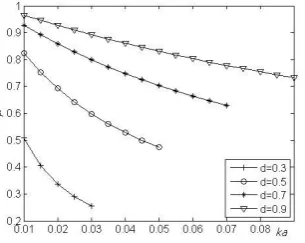
distance d between them. In Fig. 1 and Fig. 2, the dependence of n2 on the wave number k for the various a and d is shown. In Fig. 1, the results are presented for the number M of cylinders is equal to 900, they are
placed equidistantly in a square 30 cylinders on side. The value of k has dimension of m1, values of a and d
have dimension of m , and the values 2
n of refraction coefficient are normalized to the constant
2 1 8
2
s e k 1 1 .1 2 5 4 1 0
m
. At such d 0 .1 3 8 6 m the values of n2 much differ from the refraction coefficient n02 1
Fig. 1. Values of 2
n versus wave number k , d 0 .1 3 8 6 m .
The numerical results presented in Fig. 2 testify the possibility to create the medium with various 2
n depending on the distance d between cylinders at fixed a and k . The results are shown for a 0 .0 0 1m and
2 0 .0
k . At small M the values of 2
n are changed notably and at the increasing M they tend to 2
0 .4 5
n ,
2
0 .0 6
n , n2 0 .3 5, and n2 0 .6 4 for d 2 0a , d 2 5a , d 3 0a, and d 4 0a, respectively. One should note that at the considered parameters of the domain D the relative error of solution to LAS (26) does not
exceed 2 .3 4 % , 1 .6 9 % , 1 .1 8 % , and 0 .9 3 % for d 2 0a , d 2 5a , d 3 0a, and d 4 0a at M 1 0 , and
relative error diminishes if M grows.
Fig. 2. Values of 2
n versus the number M of cylinders. In such a way, the forming the desired refraction coefficient 2
n differing of refraction coefficient 2 0
n of the initial medium can be carried out by the changing the values of wave number k at the fixed geometries of
D as well as by the changing the parameters a , M , and d that determine the geometry of the domain D . In Fig. 3, the respective values of the calculated by formula (36) permeability depending on the
radius a of particle are shown. Ones can see that value of for greater d are more close to the initial
permeability 0 1 of media without embedded particles. It is physically based forecast, because at the
increasing d , the properties of D stand similar to properties of such medium.
Fig. 3. Amplitude of permeability versus the radius of particle a .
The values of ( )x depend on the values of function h x( ) too. The results, shown in Fig. 4,
Fig. 4. Amplitude of permeability versus the value of | Imh x( ) |.
The proposed approach allows to create the media with piecewise-constant distribution of . Such
distribution can be realized either by embedding the various number Mm of particles into subdomains m or by
variation of function h x( m) in these subdomains. The both above approaches have the own advantages depending on the physical and geometrical parameter of D . At the engineering practice, it is necessary to have the constant distribution of along certain direction (for example, along z and y -axes), and
piecewise-constant in the direction of x axis. In Fig. 5, such kind of is formed by embedding various number of
particles Mm in three subdomains m of D with number of particles M1 , 2 , 3 4 7 7 , 7 7 7 , 4 7 7
respectively. Such distribution of particles allows to reach a difference in the values in range of 2.5%. In
order to increase the difference m for various Dm it is necessary to increase the difference between Mm.
Combining the ratio of values Mm, one can create the distribution of corresponding to various
requirements. For example, distribution of which is shown in Fig. 6, is obtained at
1 9 9 9 , 2 7 9 9 , 3 5 9 9
M M M . The amplitudes Ex and Ey for this case have more complicate
structure because of larger variation of .
Fig. 5. The piecewise-constant distribution of corresponding to two various Mm.
VI.
CONCLUSION
Asymptotic solution was given for the problem of EM wave scattering by many perfectly conducting parallel cylinders and impedance spheres of small radii a , k a 1. An equation for the effective (self-consistent) field in the limiting medium is obtained when a 0 and the distribution of the embedded particles
is given by formula (1). The theory yields the explicit formulas (34) and (36) for the refraction coefficient and magnetic permeability of the resulting medium obtained by embedding of these particles into the initial homogeneous structure. The numerical results confirm the possibility to create materials with inhomogeneous refraction coefficient and magnetic permeability.
VII.
ACKNOWLEDGEMENTS
Authors are grateful to Prof. Alexander Ramm, Kansas State University, USA, for interest to publish this contribution.
REFERENCES
[1] J. W. Strutt, On the electromagnetic theory of light, Philos. Msg. Series 5, vol.12, no 73, 1881, 81-101. [2] G. Mie, Beiträge zur Optik trüber Medien, Speciell kolloidaler Metallösungen, Annalen der Physik, vol.
330, no. 3, 1908, 377-445.
[3] C. F. Bohren and D. R. Huffman, Absorption and scattering of light by small particles (New York: Wiley, 1983).
[4] B. R. Johnson, Light scattering by a multilayer sphere, Appl. Opt., vol. 35, no. 18, 1996, 3286-3296. [5] J. E. Hansen and L. D. Travis, Light scattering in planetary atmospheres, Space Sci. Rev., vol. 16, no. 4,
1974, 527-610.
[6] I. W. Sudiarta and P. Chylek, Mie-scattering formalizm for spherical particles embedded in absorbing medium, J. Opt. Soc. Amer., vol. 18, no. 6, 2001, 1275-1278.
[7] N. A. Logan, Survey on some early studies of the scattering of plane waves by a sphere, Proc. IEEE, vol. 53, no 8, 1965, 773-785.
[8] A. Lock and G. Gousebet, Generalized Lorentz-Mie theory and applications, J. Quant. Spectrosc. Radiat. Transf., vol. 110, no. 11, 2009, 800-807.
[9] A. G. Ramm, Scattering by Obstacles (Dordrecht: D. Reidel, 1986).
[10] A. G. Ramm, Scattering of Acoustic and Electromagnetic Waves by Small Bodies of Arbitrary Shapes. Applications to Creating New Engineered Materials (New York: Momentum Press, 2013).
[11] R. A. Shore, Scattering of an electromagnetic linearly polarized plane wave by a multilayered sphere, IEEE Antennas & Propagation Magazine, vol. 57, no. 6, 2009, 69-116.
[12] Y.-L. Geng, C.-W. Qiu, and S. Zouhdi, Full-wave analysis of extraordinary backscattering by a layered plasmonic nanosphere, J. Appl. Phys., vol. 110, no. 3, 2008, 029901-1 - 029901-10.
[13] F. Borghese, P. Denti, and R. Saija, Scattering from Model Nonspherical Particles: Theory and Application to Environmental Physics (2nd ed. Berlin: Springer-Verlag, 2007).
[14] A. G. Ramm, Scattering of electromagnetic waves by many thin cylinders, Results in Physics, vol. 1, no. 1, 2011, 13-16.
[15] A. G. Ramm, M. I. Andriychuk, Scattering of electromagnetic waves by many thin cylinders: theory and computational modeling, Optics Commun., vol. 285, 2012, 4019-4026.
[16] A. G. Ramm, Electromagnetic wave scattering by a small impedance particle of arbitrary shape, Optics Communications, vol. 284, 2011, 3872-3877.
[17] M. I. Andriychuk, S. W. Indratno, A. G. Ramm, Electromagnetic Wave Scattering by a Small Impedance Particle: Theory and Modeling, Optics Communications, vol. 285, 2012, 1684-1691.
[18] A. G. Ramm, M. I. Andriychuk, Application of the asymptotic solution to EM field scattering problem for creation of media with prescribed permeability, J. Appl. Math. Comput., vol. 45, no. 1, 2014, 461-485.
[19] A. G. Ramm, Electromagnetic wave scattering by small impedance particles of an arbitrary shape and applications, Challenges, vol. 5, 2014, 35-42.
[20] A. G. Ramm, A method for creating materials with a desired refraction coefficient, Int. J. of Mod. Phys. B, vol. 24, 2010, 5261-5268.
[21] A. G. Ramm, Scattering of EM waves by many small perfectly conducting or impedance bodies, J. Math. Phys. (JMP), 56, no. 9, 2015, 091901-091910.
[22] A. G. Ramm, EM wave scattering by many small impedance particles and applications to materials science, The Open Optics Journal, 9, 2015, 14-17.
[24] D. Smith, W. Padilla, D. Vier, S. Nemat-Nasser, S. Schultz, Composite Medium with Simultaneously Negative Permeability and Permittivity, Phys. Rev. Lett., vol.84, no. 18, 2000, 4184-4187.
[25] R. Marques, J. Martel, F. Mesa, F. Medina, Left-Handed-Media Simulation and Transmission of EM Waves in Subwavelength Split-Ring-Resonator-Loaded Metallic Waveguides, Phys. Rev. Lett., vol. 89, no. 18, 2002, 183901-1 - 183901-4.
[26] A. G. Ramm, Electromagnetic wave scattering by many small particles and creating materials with a desired permeability, Progr. Electromagn. Res., vol. 14, 2010, 193-206.
[27] L. Landau, E. Lifshitz, Electrodynamics of continuous media (London: Pergamon Press, 1984).
[28] A. G. Ramm, Wave scattering by many small particles embedded in a medium, Phys. Lett. A, vol. 372, no. 23, 2008, 3964-3070.
[29] M. I. Andriychuk, Scattering of EM Waves by Thin Cylinders and Creating the Medium with Negative refraction, Proc. 8th IEEE Int. Conf on Perspective Technologoes and Methods in MEMS Design (MEMSTECH-2012), Lviv-Polyana, Ukraine, 2012, 26-29.