This work was supported by the National Natural Science Foundation of China (No.61379116), the Natural Science Foundation of Hebei Province, China (No. F2011203219, No. F2013203124), and the Key Program of Research on Science and Technology of Higher Education Institutions of Hebei Province, China (No. ZH2012028).
An Adaptive Recommendation Method
Based on Small-World Implicit
Trust Network
Fuzhi Zhang, Huan Wang, Huawei YiSchool of Information Science and Engineering, Yanshan University, Qinhuangdao, China
The Key Laboratory for Computer Virtual Technology and System Integration of Hebei Province, Qinhuangdao, China
Email: [email protected], [email protected], [email protected]
Abstract—Collaborative filtering (CF) is widely used in e-commerce recommender systems, which helps the online users to identify the right products to purchase. However, CF-based recommender systems suffer poor quality of recommendation due to the sparsity issue. To address this problem, in this paper we propose an adaptive recommendation method based on small-world implicit trust network. We first present a method to construct the small-world implicit trust network based onuser clustering and implicit trust among users. Then we develop an adaptive recommendation algorithm by taking into account the topology of the constructed trust network, which generates recommendations using different strategies. To demonstrate the effectiveness of the proposed method, we conduct experiments on the MovieLens dataset and compare our method with others. Experimental results show that the proposed method can significantly improve the quality of recommendation.
Index Terms—data sparsity, user clustering, implicit trust, small-world network, adaptive recommendation algorithm
I. INTRODUCTION
Recommender systems can help to solve the problem of information overload on the Internet by providing personalized recommendations for users [1] [2]. Among the recommendation approaches, collaborative filtering has been proved to be one of the most successful techniques used in recommender systems [3]. CF-based methods generate recommendations based on the similarity between users or items. Due to the problem of data sparsity [4], however, the similarity between users or items can not be calculated accurately, which leads to poor quality of recommendation for CF-based methods.
To address the sparsity problem, various approaches have been proposed. One of them is matrix completion, which reduces the sparsity by filling null ratings. Zhang
et al. [5] use BP neural network algorithm to fill null
ratings. This method can resist the noise data, but it takes more time to search for the nearest neighbor. Chedrawy et al. [6] calculate the similarity between items according to the attribute association among them, and use the most relevant information to fill null ratings. However, items
in different categories may have different descriptions, so this method can’t make prediction among different categories.
Dimension reduction is commonly used to solve the sparsity problem. Cheng et al. [7] and Zhang et al. [8] use the matrix factorization based on least trimmed squares and singular value decomposition to reduce the dimension of the matrix, respectively. The results showed that recommendation algorithms based on the low-dimension matrix can alleviate the sparsity problem. However, some potential useful information may be lost during the process of reduction.
Hybrid recommendation method is also used to overcome the sparsity issue. The most common hybrid model is constructed by combining CF with other algorithms. Burke [9] and Choi et al [10] propose a hybrid model, which combines CF and content-based method. Ye et al. [11] present a recommendation method combined association rules mining and CF. Although the hybrid method has been successful in solving the sparsity issue, it has some limitations such as the availability of user profiles and their explicit suggestions on target items. Therefore, this method is difficult to be widely used in practice.
Trust has been introduced by researchers as a solution to the sparsity problem. O’Donovan et al. [12] propose the profile-level and item-level trust models and show that these trust models can improve the accuracy of recommendation. However, trust generated by the above models depends on the similarity between users, so it is difficult to calculate the trust value when the dataset is sparse. Papagelis et al. [13] present a method to alleviate the sparsity by using trust propagation, but this method encounters poor performance when the data is extremely sparse. Similarly, Seo et al. [14] construct a trust network and use link prediction and clustering algorithm to solve the sparsity problem. However, this method requires complex combining of algorithms, which is difficult to realize.
prediction by setting the maximum distance of trust propagation, so the quality of recommendation can be improved effectively.
To solve the problem of data sparsity, in this paper we propose an adaptive recommendation method based on small-world implicit trust network. Our contributions are summarized as follows:
(1) We propose a method to construct the small-world implicit trust network based on user clustering and implicit trust among users.
(2) We present an adaptive recommendation algorithm based on the constructed small-world implicit trust network, which generates recommendations for the target user using different strategies.
(3) We conduct experiments on the MovieLens dataset to demonstrate the effectiveness of the proposed method.
II. NOTATIONSAND DEFINITIONS
A. Description of Notations
Table I illustrates some notations used in this paper.
TABLE I. DESCRIPTIONOF NOTAIONS
notation meaning
D U I R ri,j i r I(ui) |A| C(G) L(G) CR(G) LR(G) cluster center
D={U,I,R},a user-item ratings dataset U={u1,u2,…,um}, a set of m users
I={i1,i2,…,in}, a set of n items
user-item rating matrix the rating of user ui on item Ij
the average rating of user ui the item set rated by user ui
the number of elements that are contained in set A the clustering coefficient of network G
the average path length of network G
the clustering coefficient of network G’s corresponding random network
the average path length of network G’s corresponding random network
a set of several clusters a set of clustering centers
B. Definitions
Definition 1. (Weighted Similarity). For user ua,
ub∈U, let I(ua, ub)={ij | ra,j≠Ø, rb,j≠Ø, ij∈I } be the set of
items co-rated by users ua and ub. The weighted similarity
,
a b
u u
sim between ua and ub is computed as
∑
∑
∑
∈ ∈ ∈ − − − − ∪ = ) , ( 2 , ) , ( 2 , ) , ( , , , ) ( ) ( ) )( ( ) ( ) ( ) , ( b a j b a j b a j b a u u I i b j b u u I i a j a u u I i b j b a j a b a b a u u r r r r r r r r u I u I u u I sim (1)Definition 2. (Rating Prediction Error). For user ua,
ub∈U, the rating prediction error of user ub to ua, which
is denoted by Eub→ua, is computed as
, ,
( , ) max 1
( , )
b a
a b
b
a j a j
u u
j I u u
a b
p r
E
I u u r
→
∈
−
=
∑
(2)wherepba,j=ra+(rb,j−rb),
r
maxis the maximum rating.Definition 3. (Implicit Trust). For user ua, ub∈U, the
implicit trust
t
ua→ubof ua with respect to ub is computedas
(
)
a b b a ba u u
u u u
u E
sim
t → ⎟ − →
⎠ ⎞ ⎜ ⎝ ⎛ +
= arcsin( ) 1
2
1 ,
π (3)
Definition 4. (Inferred Trust). For user u0, uk∈U, let
NI={ui|i=1,2,…k-1} be a set of intermediate nodes that
connect u0 and uk, the inferred trust
it
u0→ukof u0 withrespect to uk is computed as
∏
=− → + → = 1 0 1 0 k i i u i u u u tit k (4)
where
t
ui→ui+1is the implicit trust of user ui to ui+1, which is computed by Formula (3).For an arbitrary network G, let N be the number of nodes in G, Ei be the number of edges that connect the
neighbors of node i, ki be the degree of node i, k be the
average degree of all the nodes, di,j be the distance
between nodes of G. Then the structural properties C(G),
L(G) and LR(G) can be described as
∑
=
= N i i i
i k k E N G C
1 ( -1)
2 1 ) ( (5)
∑
= = N j i j i d N N G L 1 , , ) 1 -( 1 ) ( (6) ) ln( ) ln( ) ( k N G LR = (7)Definition 5. (Small-World Implicit Trust Network).
Let the weighted directed graph G(V,E,W) be a trust network, where V(G) is the set of users, E(G) is the set of implicit trust relationships between users, and W(G) is a mapping from E(G) to (0,1]. If the structural properties of the trust network G meet the following conditions:
(1)C(G) is much larger than CR(G),
(2)L(G) is almost as small as LR(G),
then the trust network G is called a small-world implicit trust network.
Definition 6. (Sparsity Level). Given a user-item
rating dataset D, let NE be the number of non-empty
ratings in D, |U| be the number of users, |I| be the number of items. The sparsity level SD of the dataset D is
computed as I U N S E D × −
=1 (8)
III. THE CONSTRUCTIONOF SMALL-WORLD IMPLICIT
TRUST NETWORK
A. Process of Trust Network Construction
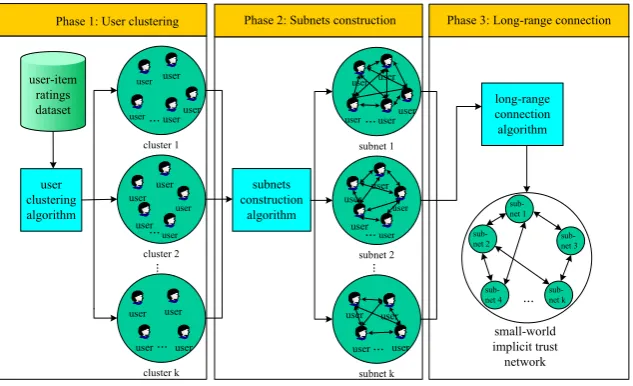
The process of constructing small-world implicit trust network is illustrated in Fig. 1. At the first stage, users in the rating dataset are divided into k groups using clustering algorithm, which ensures the constructed network to have a large clustering coefficient. At the second stage, the implicit trust between users in each group is calculated and k subnets are constructed based on the implicit trust relationships. At the last stage, a small-world implicit trust network is constructed by connecting the k subnets.
B. Rating Similarity-Based User Clustering Algorithm
用户 user-item
ratings dataset
user clustering algorithm
cluster 1
cluster 2
cluster k user
user user
user
user user
user
user
user user
user Phase 1: User clustering
subnet 1 user
user user
user
subnet 2 user user
user
subnet k user
user user
user subnets
construction algorithm
Phase 2: Subnets construction
long-range connection algorithm
sub-net 1
... small-world implicit trust network
user user
user user
user user
Phase 3: Long-range connection
sub-net 3
sub-net k sub-net 4 sub-net 2
...
...
... ...
... ...
Figure 1. Process of constructing small-world implicit trust network
(UCA) are listed as follows.
Step1. Treat each user as a single cluster and use the
hierarchical clustering algorithm to cluster users, until the number of clusters is equal to k. Let m be the total number of users, we set k to
⎣ ⎦
m according to themethod proposed by Yu et al [17].
Step 2. Calculate the clustering center of each cluster.
Suppose each centeri∈center is a virtual user, then the rating attribute of centeri can be denoted by
) ,..., , (
= i,1 i,2 i,n
center rc rc rc
R i , where rci,jis computed
as follows:
,
, i 1, 2, ,
u j u cluster i j
i
r
rc j n
cluster ∈
=
∑
= … (9)Step 3. Perform clustering on users using K-means
algorithm.
Step 4. Repeat steps 3 and 4 until the result
converged.
Based on the above steps, the UCA algorithm is described as follows.
Algorithm 1 UCA
Input: the user-item rating dataset D, the threshold ε
Output: cluster and center
Begin
1 num←m, k←
⎣ ⎦
m ;2 forl=1 to m do
3 clusterl←ul;
// treat each user as a single cluster
4 end for
5 fori=1 to m do
6 forj=1 to m do
7 compute simui,ujby Formula (1);
8 end for
9 end for
10 M1←{[sij]m×m|∀i≠ j sij=simui,uj,∀i= j sij=0};
11 repeat
12 (ux, uy)←max(M1);
// get the most similar user uxand uy
13 sxy ← 0; // x and y∈[1,m]
14 clusterx←locate(ux);
//getthe cluster clusterx which user ux belongs
to
15 clustery←locate(uy);
16 merge clusterx and clustery;
17 num←num-1;
18 until num=k;
19 cluster←{cluster1,cluster2,…,clusterk};
20 repeat
21 old_cluster←cluster;
22 for each clusteri∈clusterdo
23 compute centeri by Formula (9);
24 clusteri←Ø;
25 end for
26 center←{center 1, center 2,…, center k};
27 for eachui∈U do
28 forq=1 to kdo
29 compute simui,centerqby Formula (1);
30 end for
31 M2←{[s1q]1×k|s1q =simui,centerq,q=1,2,…,k};
32 centerp←max(M2);
//get the most similar clustering center centerp
of user ui, p∈[1,k]
33 clusterp←clusterp∪ui;
34 end for
35 cluster←{cluster1,cluster2,…,clusterk};
36 until cluster−old_cluster ≤ε
37 returncluster and center
End
Algorithm 1 consists of two parts: The first part (lines 1 to 19) is to get the initial cluster by using the hierarchical clustering algorithm. The second part (lines 20 to 37) is to perform clustering on users by means of the K-means algorithm.
C. Implicit Trust-Based Subnet Construction Algorithm
Step1. Treat users in each cluster as a set of nodes.
Step 2. Establish edges between nodes according to
user trust relationships and generate a set of edges for each cluster.
Step 3. Create a weight set for each cluster based on
the calculated trust values between users.
Based on the above steps, the SCA algorithm is described as follows.
Algorithm 2 SCA
Input: cluster
Output: a set of subnets Sub={Sub1,Sub2,…,Subk}
Begin
1 for i=1 to kdo
2 Vi←{the users of clusteri};
3 Ei←Ø;
4 Wi←Ø;
5 for each pair of users (ua, ub) ∈Vido
6 compute the implicit trust
t
ua→ubandt
ub→uabyFormula (3); 7 if
t
ua→ub>
0
then8 Ei← Ei∪edgeua→ub; Wi← Wi∪tua→ub;
9 end if
10 if
t
ub→ua>
0
then11 Ei← Ei∪edgeub→ua; Wi← Wi∪tub→ua;
12 end if
13 end for
14 Subi←Gi(Vi, Ei, Wi);
15 end for
16 returnSub
End
D. Long-range Connection Algorithm
In this subsection, we propose a long-range connection algorithm (LRCA) to connect k subnets constructed by algorithm 2. The steps of LRCA are listed as follows.
Step1. Infer the correlation among subnets and store
the numbers of correlative subnets respectively to create
k relevant lists r={ri|i=1,2,…,k}.
Step2. Calculate the average trust degree of users in
each subnet and store the user’s number whose average trust degree is greater than Tmin to create k top trusted
lists T={Ti|i=1,2,…,k}.
Step 3. Establish long-range connections among the
correlative subnets.
Based on the above steps, the LRCA algorithm is described as follows.
Algorithm 3 LRCA
Input: Sub, center, and the threshold Tmin.
Output: the network G(V,E,W)
Begin
1 V←{V1, V2,…, Vk};
2 E←{E1, E2,…, Ek};
3 W←{W1, W2,…, Wk};
4 forl=1 to kdo
5 rl←Ø, Tl←Ø;
6 end for
7 for each Subi∈Subdo
8 forj=1 to kdo
9 compute simcenteri,centerj by Formula (1);
10 if , 0 and
i j
center center
sim > j i≠ then
11 ri←ri∪j;
12 end if
13 end for
14 for each uj∈Subido
15 ;
1 | |
_ ,
−
=
∑
∈ ≠ →i u u sub
u u u
sub t trust
avg k i k j k j
//compute the average trust degree of user uj,
16 ifavg_trust>Tmin then
17 Ti←Ti∪uj;
18 end if
19 end for
20 end for
21 for eachSubi∈Subdo
22 for each j∈ri do
23 max1←0, max2←0;
24 for eachui∈Ti and uj∈Tj do
25 computetui→ujand tuj→uiby Formula (3);
26 if tui→uj> max1then
27 max1←tui→uj, Key1←ui, Key2←uj;
28 end if
29 if tuj→ui>max2then
30 max2←tuj→ui, Key3←uj, Key4←ui;
31 end if
32 end for
33 E←E∪
2 1,Key
Key
edge ∪ ;
4 3,Key
Key
edge 34 W←W∪
2 1 Key
Key
t → ∪tKey3→Key4;
35 end for
36 end for
37 returnG
End
Algorithm 3 consists of three parts: The first part (lines 1 to 13) is to calculate the correlation between subnets. The second part (lines 14 to 20) is to calculate
the avg_trust of all users in each subnet, and add users
whose avg_trust meets the condition to T. The third part (lines 21 to 37) is to select key nodes for each subnet and establish the long-range connections among the key nodes of the subnets.
We select the MovieLens 100k dataset as experimental data to demonstrate the effectiveness of the above algorithms. We adopt the method proposed by Yuan et al. [18] to prove that the constructed implicit trust network G is a small-world network. We use Formula (5) to calculate the clustering coefficient of the network G and get C(G)=0.93888. Since the clustering coefficient of random network is much smaller than 1, the first condition of definition 5 is met. We calculate the average path length of the network G and its corresponding random network by Formulae (6) and (7) respectively, and get L(G)=2.886 and LR(G)=2.0137.
Therefore, the constructed implicit trust network G is a small-world implicit trust network.
IV. ADAPTIVE RECOMMENDATION ALGORITHM BASED ON SMALL-WORLD IMPLICIT TRUST NETWORK
In this section, an adaptive recommendation algorithm (ARA) based on the constructed small-world implicit trust network is proposed.
Let s be the number of similar users in a subnet which the target user belongs to, N1 and N2 denote two thresholds (N1>N2), the following three recommendation strategies can be used when ARA algorithm works.
Strategy 1. When s≥N1, that is, there are sufficient
similar neighbors in a subnet which the target user belongs to, we will use the standard CF method to make recommendations. The predicted rating is calculated by Formula (10).
∑
∑
+ + ∈ , ∈ , , , ) -( + = R b b a R b b i b b a a i a w r r w r p (10)where R+ is a set of similar neighbors, w
a,b is the
similarity between user ua and ub, which is calculated by
Formula (1).
Strategy 2. When s≥N2 and s<N1, we will combine
similarity-based and trust-based CF method to make recommendations. The predicted rating is calculated by Formula (11).
∑
∑
∑
∑
+ + + + \ ∈ , ∈ , \ ∈ , , ∈ , , , + ) -( + ) -( + = R R b b a R b b a R R b b i b b a R b b i b b a a i a T T t w r r t r r w r p (11)where RT is a set of trust neighbors, t
a,b is the degree of
trust between user ua and ub, which is calculated by
Formula (4).
Strategy 3. When s<N2, that is, there are few similar
neighbors in a subnet the target user belongs to,we will use trust-based CF method to make recommendations. The predicted rating is calculated by Formula (12).
∑
∑
∈ , ∈ , , , ) -( + = T T R b b a R b b i b b a a i a t r r t r p (12)where ta,b is the degree of trust between user ua and ub. If
the target user and its neighbors are in the same subset, then ta,b is calculated by Formula (3), otherwise it is
calculated by Formula (4).
According to the above recommendation strategies, ARA algorithm is described as follows.
Algorithm 4 ARA
Input: user-item rating matrix R, small-world implicit
trust network G, a set of relevant lists r, a set of trusted lists T, target user ua, target item Ii, the number of neighbors l and the threshold N1, N2.
Output: predicted rating Pa,i.
Begin
1 Subt←locate(ua);
// get subnet Subt which the target user ua belongs to
2 su←Ø;
3 for each uj∈Subtdo
4 compute
j au
u
sim , by Formula (1);
5 if and , 0 and , 0
a j
j a j i u u
u ≠ ≠ u r sim > then
6 su←su∪uj;
7 end if
8 end for
9 s←|su|; 10 if s>= N1 then 11 R+←top(su, l);
//select the l most similar users from su 12 compute Pa,i by Formula (10);
13 else if s< N1and s>= N2 then
14 R+←su;
15 tu←Ø;
16 for each c∈rtdo
//rt is the relevance list of Subt
17 for each uk∈Tcdo
// Tc is the trusted list of Subc
18 compute
it
ua→uk by Formula (4);19 if , 0 and 0
a k
k i u u
r ≠ it → > then
20 tu←tu∪uk
21 end if
22 end for
23 end for
24 RT←top(tu, l);
25 compute Pa,i by Formula (11);
26 else
27 t1←Ø, t2←Ø; 28 for each um∈Subtdo
29 compute
t
ua→umby Formula (3);30 if and , 0 and 0
a m
m a m i u u
u ≠ ≠ u r t → > then
31 t1←t1∪um;
32 end if
33 end for
34 for each c∈rtdo
35 for each un∈Tcdo
36 compute
it
ua→unby Formula (4);37 if , 0 and 0
a n
k i u u
r ≠ it → > then
38 t2←t2∪un
39 end if
40 end for
41 end for
42 tu←t1∪t2; 43 RT←top(tu, l);
44 compute Pa,i by Formula (12);
45 end if
46 returnPa,i
End
neighbors in the small-world implicit trust network and make recommendations using the trust-based strategy.
V. EXPERIMENTAL EVALUATION
A. Experimental Data and Settings
We select the Movielens 100K dataset as the experimental data. This dataset contains 100000 ratings from 943 users on 1682 movies. Movies are rated on a scale of one to five, and each user has rated at least 20 movies. The sparsity level of this dataset is 1-100000
÷
(943×
1682)=0.937.For the purpose of experiments, we use random sampling technique to extract 80000, 60000 and 40000 ratings from the original dataset and generate three sampled datasets. These sampled datasets have the same number of users and movies with the original dataset, but they are sparser than the original one. The sparsity level of three sampled datasets is 0.949, 0.962 and 0.975 respectively. Each of the sampled datasets is divided randomly in a ratio 80:20 into training and test sets.
B. Evaluation Metrics
The MAE and F-measure metrics are used to measure the performance of the proposed ARA algorithm.
MAE is commonly used in recommender systems as the measurement of predictive accuracy. The smaller the MAE is, the higher the predictive accuracy of algorithm is. The MAE is defined as follows:
n r p
n
j j j
∑
=
− = 1
MAE (13)
Where n is the number of items, pj is the predicted rating
on item Ij , rjis the actual rating.
F-measure is commonly used to evaluate how well the recommendation lists match the user’s preferences. The bigger the F-measure is, the higher the quality of recommendation is. The F-measure is defined as follows:
precision recall
precision recall
+ × × 2 = measure
-F (14)
C. Experimental Results and Analysis
To evaluate the performance of ARA algorithm, we conduct experiments on the three sampled datasets and compare ARA algorithm with the following algorithms.
(1) CF: The conventional user-based collaborative filtering algorithm.
(2) O’Donovan: The collaborative filtering algorithm based on the item-level trust model proposed by O’Donovan.
(3) basic MF: The collaborative filtering algorithm based on basic matrix factorization.
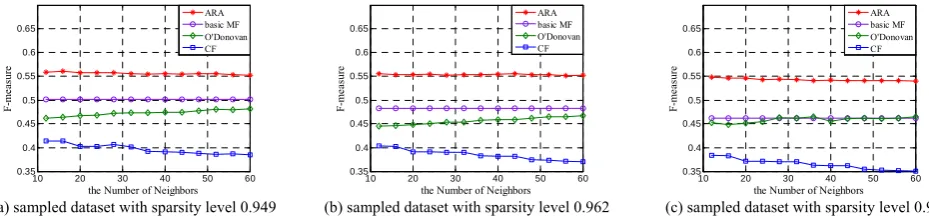
Figures 2 and 3 show the comparison of MAE and F-measure for four algorithms on the three sampled datasets.
10 20 30 40 50 60
0.76 0.78 0.8 0.82 0.84 0.86
the Number of Neighbors
MA
E
CF O'Donovan basic MF ARA
10 20 30 40 50 60
0.76 0.78 0.8 0.82 0.84 0.86 0.88 0.9 0.92
the Number of Neighbors
MA
E
CF O'Donovan basic MF ARA
10 20 30 40 50 60
0.8 0.85 0.9 0.95 1 1.05 1.1
the Number of Neighbors
MA
E
CF O'Donovan basic MF ARA
(a) sampled dataset with sparsity level 0.949 (b) sampled dataset with sparsity level 0.962 (c) sampled dataset with sparsity level 0.975 Figure 2. Comparison of MAE on three sampled datasets in different sparsity levels
10 20 30 40 50 60
0.35 0.4 0.45 0.5 0.55 0.6 0.65
the Number of Neighbors
F-m
ea
su
re
ARA basic MF O'Donovan CF
10 20 30 40 50 60
0.35 0.4 0.45 0.5 0.55 0.6 0.65
the Number of Neighbors
F-m
ea
su
re
ARA basic MF O'Donovan CF
10 20 30 40 50 60
0.35 0.4 0.45 0.5 0.55 0.6 0.65
the Number of Neighbors
F-m
ea
su
re
ARA basic MF O'Donovan CF
(a) sampled dataset with sparsity level 0.949 (b) sampled dataset with sparsity level 0.962 (c) sampled dataset with sparsity level 0.975 Figure 3. Comparison of F-measure on three sampled datasets in different sparsity levels
As shown in Fig. 2, the MAE of CF algorithm on three sampled datasets is the largest, O’Donovan algorithm comes the second, basic MF is the third, and the MAE of ARA algorithm is the smallest. Take the MAE in Fig. 2(b) and Fig. 2(c) for examples, the predictive accuracy of ARA algorithm in Fig. 2(b) is improved by 10.9%, 3.14% and 1.54% respectively compared with CF,
As shown in Fig. 3, the F-measure of ARA algorithm on three sampled datasets is obviously higher than that of the other three algorithms. Take the F-measure in Fig. 3(b) for example, the F-measure of ARA algorithm is between 0.552 and 0.556, the F-measure of basic MF is 0.483, the F-measure of O’Donovan algorithm is between 0.448 and 0.467, and the F-measure of CF algorithm is between 0.361 and 0.394. With the increase of sparsity level, F-measure of the four algorithms decreases gradually, but the decrement of F-measure for ARA is the smallest. Take the F-measure in Fig. 3(a) and Fig. 3(c) for examples, the F-measure of ARA in Fig. 3(a) is between 0.552 and 0.558, while it is between 0.540 and 0.548 in Fig. 3(c), the average decrement of F-measure from Fig. 3(a) to Fig. 3(c) is 0.011. Similarly, we can calculate the average decrement of F-measure for basic MF, O’Donovan, and CF is 0.041, 0.014 and 0.029 respectively.
Experimental results on the three sampled datasets in different sparsity levels show that the performance of ARA algorithm is better than that of CF, O’Donovan and basic MF. The reason is that the ARA algorithm makes recommendations using different strategies according to the number of similar users in the subnet which the target user belongs to.
VI. CONCLUDING REMARKS
Sparsity has a great impact on the quality of recommendation for collaborative filtering approaches. In this paper we propose a method to solve the sparsity problem by constructing the small-world implicit trust network. The construction of small-world implicit trust network is based on user clustering and implicit trust relationship among users. We devise an adaptive recommendation algorithm (ARA) based on the constructed small-world implicit trust network. Experimental results on the three sampled datasets in different sparsity levels show that the performance of ARA algorithm is better than that of the existing recommendation algorithms.
Due to the dynamic nature of recommender systems, the constructed small-world implicit trust network has to be updated when the new users come. In the future, it is better to develop an algorithm to update the small-world implicit trust network incrementally by menns of the incremental clustering method.
ACKNOWLEDGMENT
This work was supported by the National Natural Science Foundation of China (No.61379116), the Natural Science Foundation of Hebei Province, China (No.F2011203219, No.F2013203124), and the Key Program of Research on Science and Technology of Higher Education Institutions of Hebei Province, China (No.ZH2012028).
REFERENCES
[1]. Li H, Zhang S, Wang X. A Personalization
Recommendation Algorithm for E-Commerce[J]. Journal
of Software, 2013, 8(1):176-183.
[2]. Hu L, Wang W, Wang F, et al. The Design and
Implementation of Composite Collaborative Filtering Algorithm for Personalized Recommendation[J]. Journal of Software, 2012, 7(9): 2040-2045.
[3]. H. J. Ahn, H. Kang, J. Lee. “Selecting a small number of products for effective user profiling in collaborative filtering,” Expert Systems with Applications, 2010, 37(4), pp. 3055-3062.
[4]. B. M. Kim, Q. Li, C. S. Park, et al. “A new approach for combining content-based and collaborative filters,”
Journal of Intelligent Information Systems, 2006, 27(1), pp. 79-91.
[5]. F. Zhang, H. Y. Chang. “A collaborative filtering
algorithm embedded BP network to ameliorate sparsity
issue,” Machine Learning and Cybernetics, 2005.
Proceedings of 2005 International Conference on. IEEE, 2005, 3, pp. 1839-1844.
[6]. Z. Chedrawy, S. S. R. Abidi. “An adaptive personalized recommendation strategy featuring context sensitive content adaptation,” Adaptive Hypermedia and Adaptive Web-Based Systems. Springer Berlin Heidelberg, 2006, pp. 61-70.
[7]. Z. Cheng, N. Hurley. “Robust collaborative
recommendation by least trimmed squares matrix factorization,” Tools with Artificial Intelligence (ICTAI), 2010 22nd IEEE International Conference on. IEEE, 2010, 2, pp. 105-112.
[8]. Z. Q. Zhang, S. J. Qian. “The Research of E-commerce Recommendation System Based on Collaborative Filtering Technology,” Advances in Computer Science and Information Engineering. Springer Berlin Heidelberg, 2012, pp. 507-512.
[9]. R. Burke, “Hybrid recommender systems: Survey and
experiments,” User Model. User-Adapted Interact, 2002, 12(4), pp. 331–370.
[10].S. Choi. H, Y. S. Jeong, M. K. Jeong. “A hybrid
recommendation method with reduced data for large-scale application,” Systems, Man, and Cybernetics, Part C: Applications and Reviews, IEEE Transactions on, 2010, 40(5), pp. 557-566.
[11].H. W. Ye, “A Personalized collaborative filtering
recommendation using association rules mining and self-organizing map,” Journal of Software, 2011, 6(4), pp.732-739.
[12].J. O'Donovan, B. Smyth. “Trust in recommender
systems,” Proceedings of the 10th international
conference on Intelligent User Interfaces. ACM, 2005, pp. 167-174.
[13].M. Papagelis, D. Plexousakis, T. Kutsuras. “Alleviating the sparsity problem of collaborative filtering using trust
inferences,” Trust management. Springer Berlin
Heidelberg, 2005, pp. 224-239.
[14].J. Seo, S. Choi, S. Han. “The Method of Trust and Reputation Systems Based on Link Prediction and Clustering,” Trust Management VII. Springer Berlin Heidelberg, 2013, pp. 223-230.
[15].W. Yuan, D. Guan, Y. K. Lee, et al. “The small-world trust network,” Applied Intelligence, 2011, 35(3), pp.399-410.
[16].L. Shu, W. Yuan, H. C. Chao, et al. “ITARS: trust-aware recommender system using implicit trust networks,”
Communications, IET, 2010, 4(14), pp. 1709-1721. [17].Jian. Yu, Qiansheng. Cheng. “The search range of the
optimal number of clusters in fuzzy clustering methods,”
[18]. W. Yuan, D. Guan, Y. K. Lee, et al. “Improved trust-aware recommender system using small-worldness of trust networks,” Knowledge-Based Systems, 2010, 23(3), pp. 232-238.
Fuzhi Zhang was born in 1964. Currently, he is a professor
and PhD supervisor in school of information science and engineering, Yanshan University, Qinhuangdao, China. His research interests include intelligent information processing, network and information security, and service-oriented computing.
Huan Wang was born in 1987. Currently, she is a master
degree candidate in school of information science and engineering, Yanshan University, Qinhuangdao, China. Her research interests include complex networks and recommender systems.
Huawei Yi was born in 1978. Currently, she is a PHD
candidate in school of information science and engineeringYanshan University, Qinhuangdao, China. Her main research interest is recommender systems