Publication Date: Jan. 25, 2020
DOI: 10.14738/abr.81.7691.
Salvi, V. Z. (2020). Electricity Supply Chain Management – A Literature Review. Archives of Business Research, 8(1), 182-191.
Electricity Supply Chain Management – A Literature Review
Vinícius Zomkowski Salvi
EXECUTIVE SUMMARY
Supply Chain Management is not a Discipline, but it is becoming one. Supply Chain as Network is a modern definition of a field with more than 37 years of reliable scientific publications. And it has great complexity even greater when world is experiencing the Forth Industrial Revolution.
Electricity Supply Chains were delimitated as those compounded by first tier of oil, gas or coal (energy production majority), the generators, the transmitters, the distributor retailer until end-consumer. It has a great complex network constituted by external organisms responsible for coordinating and giving the strategy to the whole system.
Lean and Agile is something less usual in Electricity Supply Chain. This researcher was unable of finding scientific articles reporting directly about that combination. However, Electricity Supply Chain is considered a functional product with long life cycle. The coal, the gas and the oil are also functional products and they are controlled with efficient perspective. It is concluded that Electricity supply chain is more designed for a lean environment to an agile positioning.
The industry 4.0 is transformed the whole Electricity Supply Chain, especially the electric utility. It is using Big Data for generating extra businesses, and for improving operational conditions. The smart meter and the smart grid, using sensors and the Big Data, coordinate a more precise cycle of production and consumption, transforming Electricity Supply Chain into a responsiveness one with real date and virtual networks.
INTRODUCTION
Supply Chain Management has a bunch of different definitions. It is not a closed meaning especial for the day by day of each organization. Some companies defend that supply chain is only the channel for buying surplus, others see it as integrated planning, and for us it is characterized as “A modern supply chain is a dynamic network of great complexity. Thus, organizations should strive for developing supply chain strategies, configuring supply
chains to maximize performance and coping with technological changes” (Papanagnou,
2017).
Following that definition and considering supply chain as a network, it is represented for relationships between organizations. Some scholars affirm that supply chain is the new model of competition, a company is not anymore fighting for market alone, it has its own supply chain partners and strategies, configuring those for maximize performance and take some core competencies against other supply chains configurations.
electricity utilities, looking for best practices. So, it demonstrates how organizations of electricity utilities configure those supply chains through collaboration, lean principles and agility. Finally, it demonstrates how advanced technology are utilized by companies within the sector to maintain their competitive advantages.
SUPPLY CHAIN DEFINITION
There is no consensus about supply chain management definition (SCM). Although it is a relative old term - it was used for the first time in 1982 - it presents different perspectives. For some authors it is a philosophy, a process, a Functional Area in an organization, but for others it is a Discipline. (Ellram and Cooper, 2014). The same authors, however, appointed that SCM is in the correct path, there are some evidences that it is going to become a Discipline.
And a Discipline has some clear definitions and a “set of researchers with a common focus” (Harland et al, 2006 cited in Gold, 2014). Gold (2014) affirmed that supply chain became a “hot topic” in the 2000s. For a Lakatosian perspective, the same author produced some evidences that also show supply chain can be transformed into a Discipline. There are two main point of views “the hard core” and the “protective belt” which, for the author, are complementarian and not excluding from each other, when applied Lakatosian perspective in a Supply Chain context. Once SCM is not a well-defined term, the supply chain as network is not a consent either. Hugos (2011) cited in Govidan et al (2017) defended that SCM is different of logistics management. Whilst logistics management is concerned about “inventory management, distribution, and procurement” of a single organization, SCM would include other activities such as “Marketing, Customer Services and Finance”. What it can be concluded, because of those subjects are inter-organizational - that supply chain needs other organizations and it is concerned about the relationship between those entities.
If there is a relationship, so it is correct to affirm that there is a network therefore. However, the network can be coordinate or not. If it is not coordinate it is considered a Traditional Supply Chain, without some inventory collaboration and without planning collaboration between those organizations, (Holweg et al 2005). Anyway, it still has “a complex and dynamic network of great complexity” which can indeed condemn that business format to be expelled from the market. An important supply chain, thus, implement conditions to develop strategies and cope with new technologies.
It is important to be said that there are two important councils studying SCM. One is the CSCMP (Council of Supply Chain Management Professionals) and the CIPS (Chartered Institute of Procurement & Supply). The CSCMP defines supply chain management as:
“Supply chain management encompasses the planning and management of all activities involved in sourcing and procurement, conversion, and all logistics management activities. Importantly, it also includes coordination and collaboration with channel partners, which can be suppliers, intermediaries, third party service providers, and customers. In essence, supply chain management integrates supply and demand management within and across companies”. (CSCMP, 2018)
Another good definition is brought by LeMay et al (2016). It corroborates with Council of Supply Chain Management Professionals (2018) and Papanagnou (2017).
“Supply chain management is the design and coordination of a network through which organizations and individuals get, use, deliver, and dispose of material goods; acquire and distribute services; and make their offerings available to markets, customers, and clients”. (LeMay et al (2016).
ELECTRICITY SUPPLY CHAIN
It will be described as electricity supply chain only the network of traditional central electricity production from water, wind, coal, gas, crude oil, sun light and others. It is different what proposes Halldórsson and Svanberg (2013) which had described the heat and the traditional vehicle fuel as part of electricity supply chain.
A supply chain is constituted by tiers, Tortorella et al (2017), for instance, cited some differences between tiers involvements. In electricity supply chains, there are suppliers of generators, generators (producers), the transmitter (wholesaler), the distributor (retailer or utility), until arrive to end-consumers (Lukić et al, 2015). In some countries as Uruguay, one company is the producer, the transmitter, and the distributor, in that example, UTE. UTE`s model is a vertically integrated supply chain (Gugler et al, 2017), Forgionne and Guo (2009) called it an internal supply chain. Other countries such as Brazil, the producer (generator) is the second tier (example, Itaipu), the transmitter the first tier (example, Eletrobras) on a retailer focused supply chain (example, Celesc).
Figure 1: Brazilian Electricity Supply Chain. Source: Forgionne and Guo (2009), adapted
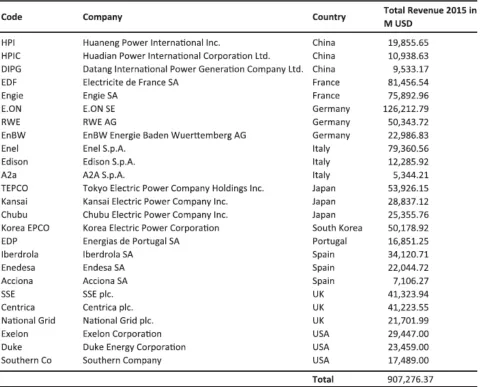
Figure 2: The 25 biggest Electric Utilities. Source: Frei et al (2018)
The unbundling process which had transformed sector monopolies into oligopolies, also created two different regulated markets. It separated generation market from transmitter and distribution, whose comprehend natural monopoly regulatory norms. (Gluger et al, 2017), (Filippini and Wetzel, 2014).
Electricity Supply Chain has two kinds of contracts and coordination design among generators to distributors. It can be bought 100% in auctions between generators and retailers or it can be partial bought in auctions (Oliveira et al, 2013). Brazil for instance allows companies that consume more than 3000 KW to do deals directly to the generators, paying the retailer only the use of distribution lines. Other clients pay to retailer also the energy that was bought in an auction.
Figure 3: Optimization of Electricity Supply Chain. Source: Oliveira et al (2013)
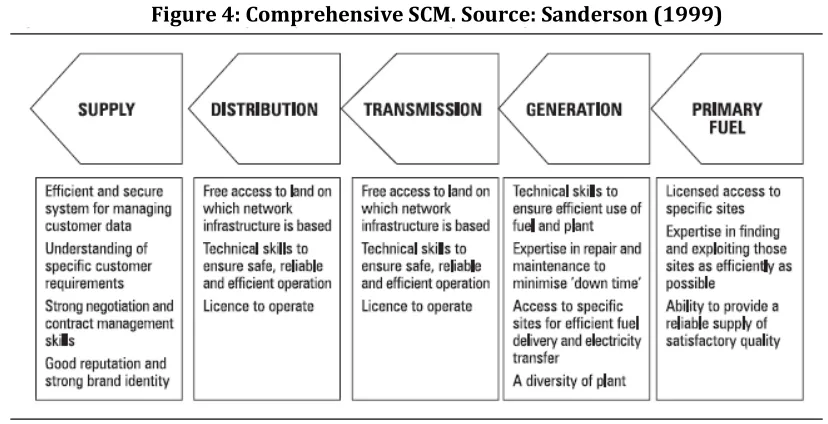
The early upstream tiers are very important for the coordination, design and strategy of the whole energy supply chain, which has the main objective to attend picks of demand, to guarantee more energy than what it is demanded and now to be transformed into a low carbon emission system, objectives cited in Gluger et al (2017). Developed market still dependent of fossil fuels and coal to produce energy. It means the stock available in the whole energy chain, it is the stock of gas, coal and uranium. To replace it for water, sun, geothermal, wind and others renewable energies is a complex process of replacing and restructuring most part of the conventional supply chain electricity into an economy of abundance and it takes time, money and conflict of interest. Those first ties also provoke a reverse logistics from production to waste. A comprehensive SCM can be seen in Sanderson (1999) and in Liboni et al (2018)
Figure 5: Electricity Grid. Source: Liboni et al (2018).
SYNCHRONIZATION, LEAGILITY, COLLABORATION AND ELECTRIC UTILITIES
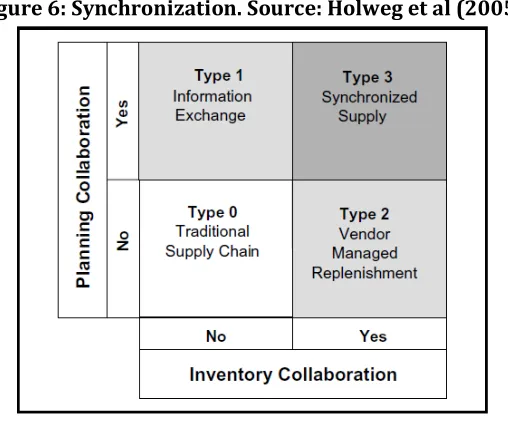
In normal Supply Chains, stock and sock-out which the last one considered impossible to be acceptable are elements that give integration and synchronization signals. A push demand system without information flow coordination, and planning and inventory collaboration is considered a traditional supply chain. Once the level of information sharing about planning and inventory increases, it generates integration and synchronization through demand pull systems. (Holweg et al 2005).
Figure 6: Synchronization. Source: Holweg et al (2005)
Electricity markets have at least three important characteristics. Their demand is “broadly inelastic, retailers cannot curtail demand, and output is no storable” (Aid et al, 2011). A synchronization with those peculiarities implies in a strong planning collaboration induced by a central government regulation body which can enable zero energy blackouts or, at least, a minimum blackout acceptable. Brazilian electric energy national agency (ANEEL) puts strong monitoring on energy electric interruption and it can indeed cancel the license for exploring energy distribution, forcing a taken over.
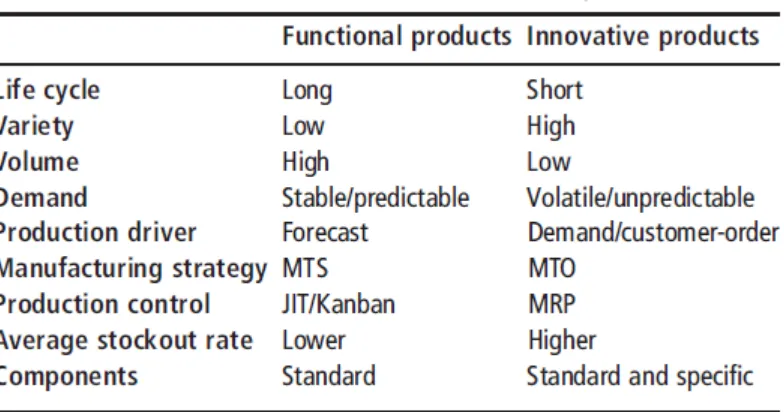
characteristics are critical to the success for choosing methods. Figure 7 differentiates a functional product (better with Lean) to an Innovative Product (better with Agile).
Figure 7: Functional and Innovative Products. Source: Drake et al (2013)
Other important differentiation is Fisher framework cited in Birhanu et al (2014), which was able to understand that SCs does not choose their designs by the product type, rather they are influenced by the demand size characteristics. In general, what Fisher considered efficient is “roughly equivalent” to Lean, and what he had nominated responsiveness is “roughly equivalent” to Agile. Birhanu et al (2014) showed a figure where is possible to take some parameters to define if a SC is Lean, Agile or Leagile. It must be remembered that a SCM can be traditional which is normally a mass production system within a push demand system.
Figure 8: Fisher Framework Adapted. Source: Birhanu et al (2014)
Figure 9: Fisher Framework Adapted 2. Source: Birhanu et al (2014)
and Risk-Hedging SCs. As it has been commented above efficient is roughly equivalent to Lean, and an important goal to electricity supply chain is eliminate non-aggregated value and to avoid waste. Risk-hedging SCs works for hydro-electricity where an important component for demand forecast is uncertainty (in this case rain fall quantity).
ELECTRIC UTILITY 4.0
Each Industrial revolution has the capability of changing on, at least, five special points: locomotion ways (cars, train, airplane, etc.); industrial technology (steam mechanical, electrical, combustible mechanical, 3D print, robots), business environment (improvement of regulations, labor conditions), energy power (stem, coal, gas, oil, renewables) and communication (telegraph, telephone, internet, mobile phone, smart tv). Tien (2012) affirmed that this industrial revolution, he called the third one, is one that integrates services and industry.
However, most scholar are calling it as industry 4.0 or the fourth industrial revolution, the one that integrates “IOT (internet of things) into the production and manufacturing environment” (Tjahjono et al, 2017). It is bringing the electrical autonomous car and drones (locomotion ways), introducing more dependency of renewable electric energy (energy power/industrial technology), creating an interactive media (communication), developing new labor regulations, introducing robots in repetitive services, incentive to “knowledge era” (business environment) and to digital supply chains, defined as utilization of real-time information (Büyüközkan and Göçer , 2018). Industries have tried to cope with that revolution and it is not different to electric utilities (Liboni et al, 2018).
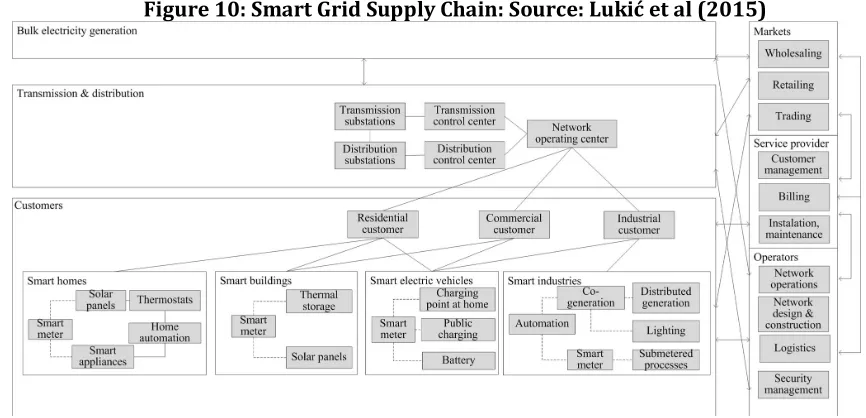
One important innovation to electric utility is the Big Data. It has no a clear definition (Addo-Tenkorang and Helo, 2016), but it has been widely used, what will need more specific tools (Tiwari et al, 2018). Big Data allows electric utilities to orient their business through a comprehensive amount of data. Brinch (2018) informs that Big Data is a now way of doing business “enhanced by logic, facts and evidence”. Gunasekaran et al (2018) remembered some features of a Big Data: “high volume, velocity and variety”. A utility has some information about energy consumption, distribution statistics, weather correlation with energy blackouts, and others. To deal with Big Data not only improves the service provider to end-consumer, but it also generates new business opportunities to sell services for small and medium size companies which urge for more data.
Figure 10: Smart Grid Supply Chain: Source: Lukić et al (2015)
Another important change is the distribution generation, aligned with renewable sources, PV (photovoltaic panels), wind, waves, geothermal and others. It does not only take out certain stocks of coal, gas and oil for an uncertainty knowledge about sunny days, rainy days, windy days and others, but it does something even bigger. Maybe the most challenge for next decade is to decentralize even more the production from an oligopolies format to a self-production capability decentralized to end-consumer energy production.
CONCLUSION
This paper presented a definition of supply chain management as a network. It gave as an example the Electricity Supply Chain which is a complex network commonly coordinated by a regulatory organism where the plan and the risk stay with the natural monopoly of energy retailers. It was also commented that Electric utilities are passing through a deeply revolution which is allowing consumers to produce their own energy. More than that, the industrial revolution is increasing consumption and dependency of energy.
This scientific paper was able to find some important definitions for supply chain. However, it is necessary to find some information about Electricity Supply Chain, specially about that 4.0 industry where it will be possible to define if future Electricity Supply Chain can become an Agile Supply Chain, using virtual networks. For now, as electricity is a functional product, it can be said it is more a Lean or even a mass production series, but one that must combine production with distribution.
References
Addo-Tenkorang, R. and Helo, P. (2016). Big data applications in operations/supply-chain management: A literature review. Computers & Industrial Engineering, 101, pp.528-543.
Aïd, R., Chemla, G., Porchet, A. and Touzi, N. (2011). Hedging and Vertical Integration in Electricity Markets.
Management Science, 57(8), pp.1438-1452.
Birhanu, D., Lanka, K. and Rao, A. (2014). A Survey of Classifications in Supply Chain Strategies. Procedia
Engineering, 97, pp.2289-2297.
Brinch, M. (2018). Understanding the value of big data in supply chain management and its business processes.
International Journal of Operations & Production Management, 38(7), pp.1589-1614.
Büyüközkan, G. and Göçer, F. (2018). Digital Supply Chain: Literature review and a proposed framework for future research. Computers in Industry, 97, pp.157-177.
Drake, P., Myung Lee, D. and Hussain, M. (2013). The lean and agile purchasing portfolio model. Supply Chain
Management: An International Journal, 18(1), pp.3-20.
Ellram, L. and Cooper, M. (2014). Supply Chain Management: It's All About the Journey, Not the Destination.
Journal of Supply Chain Management, 50(1), pp.8-20.
Filippini, M. and Wetzel, H. (2014). The impact of ownership unbundling on cost efficiency: Empirical evidence
from the New Zealand electricity distribution sector. Energy Economics, 45, pp.412-418.
Forgionne, G. and Guo, Z. (2009). Internal supply chain coordination in the electric utility industry. European
Journal of Operational Research, 196(2), pp.619-627.
Frei, F., Sinsel, S., Hanafy, A. and Hoppmann, J. (2018). Leaders or laggards? The evolution of electric utilities’ business portfolios during the energy transition. Energy Policy, 120, pp.655-665.
Gold, S. (2014). Supply chain management as Lakatosian research program. Supply Chain Management: An
International Journal, 19(1), pp.1-9.
Govindan, K., Fattahi, M. and Keyvanshokooh, E. (2017). Supply chain network design under uncertainty: A
comprehensive review and future research directions. European Journal of Operational Research, 263(1),
pp.108-141.
Gunasekaran, A., Papadopoulos, T., Dubey, R., Wamba, S., Childe, S., Hazen, B. and Akter, S. (2017). Big data and
predictive analytics for supply chain and organizational performance. Journal of Business Research, 70,
pp.308-317.
Gugler, K., Liebensteiner, M. and Schmitt, S. (2017). Vertical disintegration in the European electricity sector: Empirical evidence on lost synergies. International Journal of Industrial Organization, 52, pp.450-478.
Halldórsson, Á. and Svanberg, M. (2013). Energy resources: trajectories for supply chain management. Supply
Chain Management: An International Journal, 18(1), pp.66-73.
Holweg, M., Disney, S., Holmström, J. and Småros, J. (2005). Supply Chain Collaboration: European Management
Journal, 23(2), pp.170-181.
LeMay, S., Helms, M., Kimball, B. and McMahon, D. (2017). Supply chain management: the elusive concept and
definition. The International Journal of Logistics Management, 28(4), pp.1425-1453.
Liboni, L., Liboni, L. and Cezarino, L. (2018). Electric utility 4.0: Trends and challenges towards process safety and
environmental protection. Process Safety and Environmental Protection, 117, pp.593-605.
Lukić, J., Radenković, M., Despotović-Zrakić, M., Labus, A. and Bogdanović, Z. (2015). Supply chain intelligence for electricity markets: A smart grid perspective. Information Systems Frontiers, 19(1), pp.91-107.
Naim, M. and Gosling, J. (2011). On leanness, agility and leagile supply chains. International Journal of Production
Economics, 131(1), pp.342-354.
Oliveira, F., Ruiz, C. and Conejo, A. (2013). Contract design and supply chain coordination in the electricity
industry. European Journal of Operational Research, 227(3), pp.527-537.
Wen, L., Zhou, K., Yang, S. and Li, L. (2018). Compression of smart meter big data: A survey. Renewable and
Sustainable Energy Reviews, 91, pp.59-69.
Witkowski, K. (2017). Internet of Things, Big Data, Industry 4.0 – Innovative Solutions in Logistics and Supply
Chains Management. Procedia Engineering, 182, pp.763-769.
Sanderson, J. (1999). Passing value to customers: on the power of regulation in the industrial electricity supply
chain. Supply Chain Management: An International Journal, 4(4), pp.199-208.
Tien, J. (2012). The next industrial revolution: Integrated services and goods. Journal of Systems Science and
Systems Engineering, 21(3), pp.257-296.
Tiwari, S., Wee, H. and Daryanto, Y. (2018). Big data analytics in supply chain management between 2010 and 2016: Insights to industries. Computers & Industrial Engineering, 115, pp.319-330.
Tjahjono, B., Esplugues, C., Ares, E. and Pelaez, G. (2017). What does Industry 4.0 mean to Supply Chain?. Procedia
Manufacturing, 13, pp.1175-1182.