R E S E A R C H A R T I C L E
Open Access
Study-related behavior patterns of medical
students compared to students of science,
technology, engineering and mathematics
(STEM): a three-year longitudinal study
Edgar Voltmer
*, Katrin Obst and Thomas Kötter
Abstract
Background:Medical education is perceived as demanding and stressful. Whether this is particularly pronounced in this course of study remains under debate.
Methods:We used the questionnaire“Work-Related Behavior and Experience Patterns (Arbeitsbezogene Verhaltens- und Erlebensmuster (AVEM))”to assess the development of study-related behavior and experience patterns in medical (n= 584) and STEM students (n= 757) at one German university, with a special emphasis on gender differences, over 3 years of study. Students were surveyed at the beginning of their studies (t0) and again in each consecutive summer semester (t1-t3). Both sectional and longitudinal data were generated and analyzed. Results in the abstract are from the cross-sectional analysis.
Results:Freshman medical students presented with a larger proportion of students with a healthy pattern (58.1%) than STEM students (42.5%). In both groups this proportion decreased to 33.8%/25.1% at t2, with only a minor improvement at t3 (38.1/27.0%). Correspondingly, the proportion of students with a burnout-related risk pattern increased from 8.0% (Med)/13.7% (STEM) to a maximum of 16.9% at t2 in medical students and 27.0% at t3 in STEM students. In both groups female students showed a more unfavorable distribution of patterns and a higher vulnerability, especially in the area of resistance toward stress.
Conclusions:The unfavorable development of behavior and experience patterns in both student groups demonstrates increasing study related stress and emphasizes the need for prevention and health promotion on an individual and a contextual level.
Keywords:Students, medical, STEM students, Health behavior, Burnout, professional, Health promotion
Background
Medical education is perceived as very demanding and stressful. A number of cross-sectional studies report stress, anxiety, depression, and burnout [1,2] as possible consequences of high workload, frequent testing, strict absence rules, and increasing responsibility for patients [3, 4]. Results from three cross-sectional surveys at dif-ferent points in medical education and work-life indi-cated that this might be an increasing phenomenon throughout the course of study [5]. Indeed, a number of
longitudinal studies demonstrated that life satisfaction and healthy behavior and experience patterns decreased and symptoms of anxiety, depression or burnout in-creased during medical education [6–8].
Stress development in medical and other students
Whether these developments are particularly pronounced in the course of medical education has not been thor-oughly investigated to date. Comparisons with other stu-dent groups or age matched peers are few and the results are inconsistent. In a review [9], the majority of studies found a lower prevalence of depression in medical stu-dents compared to law stustu-dents and other student groups
© The Author(s). 2019Open AccessThis article is distributed under the terms of the Creative Commons Attribution 4.0 International License (http://creativecommons.org/licenses/by/4.0/), which permits unrestricted use, distribution, and reproduction in any medium, provided you give appropriate credit to the original author(s) and the source, provide a link to the Creative Commons license, and indicate if changes were made. The Creative Commons Public Domain Dedication waiver (http://creativecommons.org/publicdomain/zero/1.0/) applies to the data made available in this article, unless otherwise stated.
* Correspondence:[email protected]
[10, 11]. However, in some of the studies examined, no statistically significant difference was found [12,13]. Med-ical students had a greater commitment to their chosen career [14] and spent significantly more hours in class, la-boratories, on wards, or studying than law students [15]. Studies from US medical schools showed better health compared to age-matched college students at matricula-tion [16] but poorer psychosocial health in the course of study [2]. In a study of tertiary students of Medicine, Psychology, Law and Mechanical Engineering the propor-tion of distressed students was 4.4 times higher than in age matched peers. However, in this study, medical students had lower levels of distress compared to law or engineering students [17]. The medical education course in Germany was not reorganized according to the Bologna declaration, a process to harmonize the European higher education system, but it still takes 6 years in total with 5 years of study and a practical sixth year. It ends with the state examination and Approbation (license to practice medicine). At the University where we conducted the study, a classical curriculum is offered with two pre-clinical years followed by the first major examination
(“Physikum”). Then after three clinical years the
course of study is completed with a practical year in three clinical areas.
Science, technology, engineering and mathematics (STEM) students have not been thoroughly surveyed in terms of psychosocial issues and were therefore chosen for this study as a comparison group. The course of study in the STEM faculties is organized according to the recommendations of the Bologna Process. After 3 years of study, a bachelor’s degree can be obtained. After another 2 years, a master’s level degree is possible. After the implementation of Bachelor (BA) and Master (MA) programs in Germany, a decrease in flexibility, and an increase in workload and study-related stress has been described for the affected subjects (e.g., STEM subjects; [18]). However, again, results are inconsistent. In surveys of the Free University of Berlin 74% of the BA students complained about performance pressure [19] and 41% suffered severe emotional exhaustion correlated with study conditions [20]. However, an analysis of students who sought help from a counseling center found no major program-specific effects in BA or MA students [21, 22]. One of the rare studies that addresses stress in STEM students found increasing levels during the first year in two large universities in the United States [23].
According to the transactional model of stress and coping [24] demanding situations in study, work, or daily life are not stressors per se. Depending on an indi-viduals’subjective perception of the stressor and the per-ceived coping resources available the same situation could be experienced for example as a challenge or threat. An affected individual is no passive victim of
circumstances but an active element in dealing with pro-fessional or study-related stressors [25]. The interplay be-tween perceived stress and coping behavior is evaluated
by the instrument “Work-Related Behavior and
Experi-ence Patterns (Arbeitsbezogene Verhaltens- und
Erle-bensmuster (AVEM))” that we used in this study. It
identifies four work−/study-related patterns that are
de-scribed as pattern G – “Health” (Muster G – “
Gesund-heit”), pattern S– “Unambitious”(Muster S– “Schonung/ Schutz”), risk pattern A– Overexertion (Risikomuster A
– “(Selbst-)Überforderung”; the label refers to the type A behavior described by Friedman and Rosenmann [26]) and risk pattern B–Burnout (Risikomuster B– “Burnout; s. method section).
Gender differences in the experience of study-related stress
Studies in the general population regarding psychosocial strain and symptoms often report a higher vulnerability of females compared to males. Prevalence of major de-pression and anxiety for example were found
consist-ently twice as high in women than in men [27–29]. In
Germany about two thirds of freshman medical students are female [30]. The proportion of female students in STEM subjects is significantly lower but increasing [31].
It would be of interest – not least for the planning of
health-promotion measures – if the perception and
de-velopment of study-related strain appears to be different between genders. In most of the above-mentioned stud-ies no gender-sensitive analysis was reported. Where they are, results are inconsistent but tend towards a higher vulnerability in female students. A recent study reported that depression, anxiety, somatization and prevalence of psychotropic substance use in medical stu-dents were more pronounced in female stustu-dents [1]. A cross-sectional survey of fifth-year medical students also found a significant difference, with a lower proportion of a healthy pattern in female students [5]. However, in a longitudinal study from first to second year in medical students no significant difference was observed [32]. In first year medical students there was a stronger decrease in the subjective perception of general health in female students compared to their male counterparts [33].
In the present study, we sought to compare, in a longi-tudinal design, the development of study related behav-ior and experience patterns of medical and STEM students and the extent to which male and female stu-dents differed in this respect. We report the follow-up studies of three cohorts of medical and STEM students in their first 3 years of study. For STEM students who complete their program in the designated period of time this means up to the end of their program. Based on the aforementioned studies we hypothesized that 1)
study, which would be seen in more unfavorable behav-ior and experience patterns. Despite conflicting results about the question of whether students’stress is particu-larly pronounced in medical education we hypothesized that 2) the pattern distribution would present higher proportions with risk patterns in medical compared to STEM students and there would be a greater increase of risk patterns and decrease of the healthy pattern in med-ical than in STEM students. Given the tendency to higher vulnerability in women regarding psychosocial stress, we hypothesized that 3) this development may be more prominent in female students than in their male counterparts.
Methods
Study design and setting
Data was drawn from an ongoing prospective, longitu-dinal observational study at the University of Lübeck, a public university with a focus on medicine and life
sci-ences [33, 34]. From 2011 we invited all Medicine and
STEM freshmen groups at the University of Lübeck to participate. The baseline surveys (t0) were taken in class during the pre-course week (prior to the beginning of courses). The follow-up surveys (t1-t3) were taken on-line in June during the respective summer semesters.
There were no exclusion criteria. A 5 € book voucher
per completed questionnaire was used as an incentive for participants. For this study, three cohorts of medical and STEM students in their first 3 years of study were analysed (Freshmen in 2011, 2012 and 2013 were followed through to 2014, 2015, and 2016).
Instrument
We report here the results of the short form of the
standard instrument: “Work-Related Behavior and
Experience Pattern (AVEM)”[35].
The AVEM was developed to examine personal experi-ences with work-related stress and typical coping behav-iors. The instrument comprises 11 separate scales that cover the following three major domains: 1) professional commitment (subjective significance of work, career ambition, tendency to exert, striving for perfection, emo-tional distancing), 2) resistance towards stress (resigna-tion tendencies, offensive (i.e. proactive) coping with problems, balance and mental stability), and 3) emo-tional well-being (in the context of work; satisfaction with work, satisfaction with life, experience of social support). We used the short form of the AVEM in a stu-dent adapted version, which comprises 44 items scored on a 5 point Likert scale where 1 represents strongly dis-agree and 5 represents strongly dis-agree (for item examples see [32]). From a cluster analysis of the initial AVEM sample group, comprised of 1,598 representatives from different professions four different types of work-related
experience and behavior patterns were identified and could be described as follows [35]:
Pattern G:“health”
The healthy pattern G is characterized by a good balance between the domains of professional commitment, re-sistance towards stress and emotional well-being. Partici-pants with this pattern are ambitious at work but also cope well with stress. They score high in the dimensions of satisfaction with work and life and experience of so-cial support.
Pattern S:“unambitious”
The most prominent impression of this pattern are the lower scores in the dimensions of professional commit-ment and high scores in emotional distancing from work. Longitudinal data prove that this could either be due to a relaxed attitude that does not take work very seriously and that seeks and finds satisfaction in activ-ities outside work. On the other hand the lack of profes-sional commitment and the detachment from work could also be an early sign of demotivation and frustra-tion that may later lead to burnout.
In contrast to these first two patterns the next two are termed as risk patterns, as they have been repeatedly shown to be correlated to symptoms of illness and poor health [36,37].
Risk-pattern A:“overexertion”
High scores in the dimensions of professional commit-ment reflect the importance of work for participants with this behavior pattern. Lower scores in the ability to cope with stress and emotional wellbeing show the
“costs” of this exhaustive behavior. The label indicates similarities to the concept of type-A behavior that has been described as a risk factor for coronary artery dis-ease and myocardial infarction [26].
Risk-pattern B:“burnout”
Low scores in the dimensions of professional commit-ment and unfavorable scores in the dimensions related to the domain of resistance toward stress characterize this pattern. In addition, we find low scores for satisfac-tion with work and life as well as for social support. This risk pattern comprises the core symptoms of burnout [35].
The pattern of a study participant is determined by es-timating the concurrence of the individual data score and the four reference profiles (weighted linear combin-ation based on an algorithm of discriminant analysis; e.g., probability scores pG= 0.75, pS= 0.15, pA= 0.06, and
pB= 0.04 classified as type G).
constructs (e.g., Freiburg Personality Inventory (FPI), Maslach Burnout Inventory (MBI), Big-Five Adjective List) and moderate to good correlations were found. Significant differences between the four patterns in terms of psychological symptoms (e.g., highest scores in exhaustion in risk pattern B) and other health related constructs and conditions, support the health relevance of the four behavior and experience patterns [35].
Data analysis
Data analyses were conducted with SPSS for Windows, Version 15.0 (SPSS Inc., Chicago, IL, USA). Differences of the pattern distribution (categorical variables) were
analysed with χ2- Test (cross-sectional) and McNemar/
Bowker Test (longitudinal) followed by a descriptive analysis of the differences of the single patterns with consideration of standard residuals. Results of categor-ical analyses were reported as percentages. For continu-ous variables and longitudinal analyses, we used analyses of variance for repeated measures. The ANOVA models consisted of the within-subject factor time (4 levels: t0, t1, t2, and t3), the between subject factor sex (2 levels: male and female) and the interaction effect of both fac-tors (time x sex). Interaction effects were further
ana-lyzed by conducting separate repeated measure
ANOVAs for males and females and following t-test for dependent samples to test differences between the levels of the factor time. Results of univariate analyses of this data were reported as means ± standard deviation. Effect size was reported as partial eta square. All analyses were computed for STEM and medical students separately. For the identification of datasets in the longitudinal ana-lyses the participants were asked to generate a personal identification code and/or provide the matriculation number.
Results
Each year about 185 medical students start their course of study at the University of Lübeck. The response rate
in medical students varied from 65 to 80% (in totaln=
584 respondents answered for at least one time point; for the number of respondents at each time point see
Fig. 1; n= 206 answered at all time points). Due to a
high proportion of students not showing up after enrol-ment or quitting during the first year it is not possible to report the corresponding response rate for STEM
stu-dents (in total n= 757 respondents; for the number of
respondents at each time point see Fig. 1; n= 130
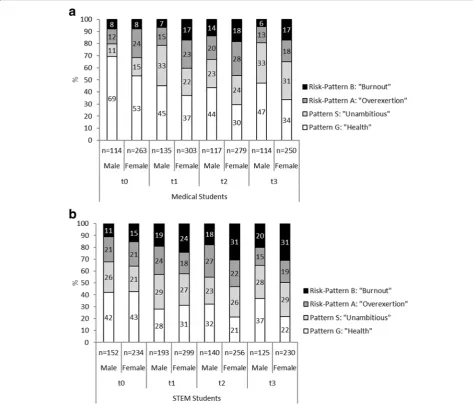
an-swered at all four time points). Overall, 66.6% of medical students who participated were female (56.7% female STEM students). In both groups there were only minor variations in terms of number of participants and gender distribution across the measuring points (see gender
split numbers of participants in Fig. 1). The maximal
response was at t1 with a moderate decrease up to t3. Pattern distribution between cohorts 2011, 2012 and 2013 were not significantly different in t0 and t3 but different for Med in t2 and STEM in t1 (in both cases according to standard residuals mainly due to a higher proportion of students with pattern S and lower proportion with risk pattern A in 2012). The mode of age in both groups was 19 (t0), 20 (t1), 21 (t2), and 22 years (t3).
Behavior and experience patterns
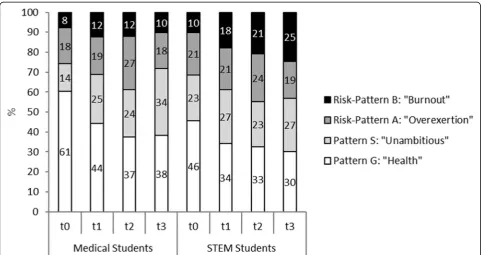
Figure2presents the health-related behavior and experi-ence patterns of all medical and STEM students from t0 to t3 (cross sectional analysis). The distribution of pat-terns between medical and STEM students was signifi-cantly different at each of the four measuring points (cross sectional analysis of significant differences of the pattern distribution with χ2-Test followed by a descrip-tive analysis of the differences of the single patterns with consideration of standard residuals). Freshman medical students presented with a larger proportion of the healthy pattern (58.1%) than STEM students (42.5%). In both groups this proportion decreased to 33.8% (Med)/ 25.1% (STEM) at t2, with only a minor improvement at t3 (38.1(Med)/27.0% (STEM)). Correspondingly, the pro-portion with the burnout-related risk pattern B increased from 8.0% (Med)/13.7% (STEM) to 16.9% (Med)/26.4% (STEM) at t2. Again, there was a minor improvement from t2 to t3 in medical students (13.7%) but a continu-ous increase in STEM students (27.0%). Likewise, there was an increase of pattern S, with reduced study motiv-ation from t0 13.8 (Med)/23.1% (STEM) to t3 31.8 (Med)/28.4% (STEM).
In general, the distribution of patterns in those
stu-dents who responded at all time points (Med n= 206,
STEMn= 130) longitudinal analysis) was comparable to
the cross sectional analysis, but the proportion of stu-dents with pattern G was slightly higher and the propor-tion of students with risk-pattern B slightly lower than in the total group (Fig. 3). The distribution of patterns for those students who answered at all time points was significantly different between medical and STEM stu-dents at t0 and t3 (p< 0.05).
The distribution of patterns between male and fe-male medical students was significantly different at each of the four measuring points (cross sectional analysis of significant differences of the pattern distri-bution with χ2
time points, the proportion of female students was
constantly higher (Fig. 1). In STEM students these
differences were less pronounced and significant only at t2 and t3. At t0 and t1 the proportion of female STEM students with the healthy pattern was even slightly higher than that of male students, but re-versed at t2 and t3. The proportion of female STEM students with the burnout related pattern was con-stantly higher throughout all measuring points com-pared to their male counterparts. (Due to the much smaller number of participants, who responded at all time points, further reduced in the analysis by the subdivisions of Med/STEM, male/female and the dis-tribution across four patterns a longitudinal analysis was not possible here).
Dimensions
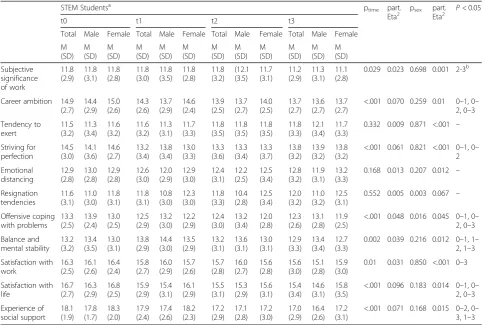
Repeated Measures Analysis of Variance with the fac-tors time (within-subject factor), sex (between subject factor) and the interaction term have been computed for medical and for STEM students separately to test for changes in the AVEM dimensions over time. In these analyses only students who responded at all measuring points were included. In both medical and STEM students in 8 of 11 dimensions there was a
significant change over time (Tables 1 and 2). The
strongest effect sizes were observed in medical stu-dents in the decrease in the dimensions career ambi-tion (F (2.8, 565) = 37.8, p< 0.001, effect size part. η2
= 0.158), striving for perfection (F (2.8, 562) = 30.8,
p< 0.001, effect size part. η2= 0.134) and the initial Fig. 1aDistribution of study-related behavior and experience patterns of male and female medical students. (pMale vs Female in medical; t0 = 0.020, t1 = 0.001, t2 =
0.047, t3 = 0.007; pMale medical vs STEM: t0 < 0.001, t1 < 0.001, t2 = 0.218, t3 = 0.013; pFemale medical vs STEM: t0 = 0.008, t1 = 0.033, t2 = 0.002, t3 = 0.001).bDistribution of
decrease and later increase of emotional distancing (F (3, 603) = 29.9, p< 0.001, effect size η2= 0.129). In STEM students the strongest effect size was observed in the decrease in satisfaction with life (F (2.7, 344) = 13.8, p< 0.001, effect size part. η2= 0.096). As with
medical students, strong effect sizes were also noted for the decrease in the dimensions career ambition (F (2.8, 359) = 9.7,p< 0.001, effect size part.η2= 0.070) and striv-ing for perfection (F (2.5, 328) = 8.4, p< 0.001, effect size part.η2= 0.061). In STEM students the effect size for the Fig. 2Study-related behavior and experience patterns in medical and STEM students (total groups; statistical differences of medical vs. STEM students: t0p< 0.001, t1p= 0.002, t2p= 0.004, t3p< 0.001)
decrease in the dimension of social support was much higher than in medical students.
Both medical and STEM female students had signifi-cantly higher scores in resignation tendencies (p= 0.025
Med; p= 0.003 STEM) compared with their male
col-leagues. Male medical students had higher scores for balance and mental stability (p< 0.001), and STEM
stu-dents in offensive coping with problems (p= 0.016),
compared with their female colleagues (Tables 1 and2).
Furthermore, time effects were qualified by sex for the dimensions subjective significance of work, career ambi-tion, and satisfaction with work for medical students and for the dimension satisfaction with work in STEM stu-dents. These interaction effects reveal a decrease of values which is overall more pronounced for females than for males.
Discussion
As one of the rare longitudinal studies not addressing just one study group, this survey examines the develop-ment of the study-related behavior of medical students in comparison with STEM students at one German uni-versity. In STEM students we found a substantial and
increasing fraction at risk for burnout, and a decreasing fraction with a healthy study-related behavior and ex-perience pattern. In Med students this was true up to t2. Female students showed a more unfavorable distribution of patterns and a higher vulnerability, especially in the area of resistance toward stress.
Development of behavior and experience patterns
At the beginning of the course of study most of these medical students presented with a healthy behavior and experience pattern. However, consistent with our first hypothesis, the proportion with this pattern continually diminished, with only a slight recovery at t3. Corres-pondingly, the proportion of students with a pattern at risk for burnout increased, again with a small recovery at t3. The slight recovery is consistent with passing the first important examination after the second year. How-ever, with 20% less students with a healthy pattern com-pared to t0 study strain is still highly visible. These results confirm reports about the increasing perception of psychosocial strain in the course of medical studies [5, 8, 32]. However, given the results of the STEM stu-dents, this does not seem to be exclusive for medical Table 1Health-relevant dimensions (AVEM) in male and female. Medical students
Medical studentsa ptime part.
Eta2 psex part.Eta2 P< 0.05
t0 t1 t2 t3
Total Male Female Total Male Female Total Male Female Total Male Female
M (SD) M (SD) M (SD) M (SD) M (SD) M (SD) M (SD) M (SD) M (SD) M (SD) M (SD) M (SD) Subjective significance of work 11.9 (3.0) 11.7 (3.1) 12.0 (3.0) 11.7 (3.0) 11.9 (3.2) 11.6 (2.9) 11.4 (3.2) 11.9 (3.5) 11.3 (3.1) 10.9 (3.4) 11.6 (3.7) 10.6 (3.3)
0.006 0.022 0.356 0.004 0-3b, 1–3
Career ambition 15.3 (2.6) 15.2 (3.0) 15.3 (2.4) 13.7 (2.9) 14.5 (3.1) 13.4 (2.8) 13.5 (2.9) 13.9 (3.1) 13.4 (2.9) 13.4 (3.0) 13.8 (3.3) 13.2 (2.9)
<.001 0.158 0.186 0.009 0–1, 0–2, 0–3
Tendency to exert 12.4 (2.9) 11.7 (2.5) 12.6 (3.0) 11.6 (3.0) 11.2 (2.7) 11.7 (3.1) 12.1 (3.2) 11.7 (2.8) 12.3 (3.3) 11.6 (3.1) 11.3 (2.6) 11.7 (3.3)
0.002 0.026 0.134 0.011 0–1, 0–3, 1–2
Striving for perfection 14.8 (2.9) 14.4 (2.8) 14.9 (2.9) 13.4 (2.9) 13.0 (3.2) 13.6 (2.8) 13.1 (3.3) 12.4 (3.1) 13.3 (3.4) 13.2 (3.1) 13.1 (3.1) 13.3 (3.2)
<.001 0.134 0.187 0.009 0–1, 0–2, 0–3
Emotional distancing 12.9 (2.4) 13.3 (2.3) 12.8 (2.4) 12.6 (2.8) 12.6 (2.6) 12.6 (2.9) 11.8 (2.9) 11.8 (3.0) 11.8 (2.9) 13.8 (2.9) 13.9 (3.1) 13.8 (2.9)
<.001 0.129 0.734 0.001 0–2, 0–3, 1– 2, 1–3, 2–3
Resignation tendencies 11.8 (2.9) 11.2 (2.7) 12.0 (3.0) 11.7 (2.9) 11.0 (2.9) 11.9 (2.9) 11.6 (3.2) 10.9 (2.9) 11.8 (3.2) 11.3 (3.3) 10.5 (3.2) 11.5 (3.3)
0.034 0.015 0.025 0.025 –
Offensive coping with problems 14.0 (3.0) 14.3 (2.9) 13.9 (3.0) 13.8 (2.9) 13.9 (3.0) 13.8 (2.8) 13.7 (2.9) 14.1 (2.9) 13.6 (2.9) 13.6 (2.9) 14.3 (2.9) 13.4 (2.8)
0.448 0.004 0.192 0.008 –
Balance and mental stability 13.5 (3.3) 14.7 (3.3) 13.0 (3.0) 13.9 (3.0) 15.4 (2.5) 13.3 (3.0) 13.4 (3.2) 14.7 (2.8) 12.9 (3.2) 13.7 (3.1) 14.7 (2.9) 13.3 (3.1)
0.017 0.017 <.001 0.083 0–1, 1–2
Satisfaction with work 17.4 (2.4) 17.2 (2.5) 17.6 (2.4) 17.1 (2.5) 17.1 (2.3) 17.2 (2.5) 17.1 (2.5) 16.8 (2.5) 17.2 (2.5) 17.0 (2.5) 17.2 (2.2) 17.0 (2.6)
0.261 0.007 0.603 0.001 –
Satisfaction with life 17.6 (2.5) 17.7 (2.6) 17.5 (2.5) 17.1 (2.6) 17.3 (2.3) 17.0 (2.7) 16.8 (2.8) 16.9 (2.9) 16.7 (2.7) 17.2 (2.6) 17.3 (2.6) 17.1 (2.6)
<.001 0.032 0.536 0.002 0–1, 0–2
Experience of social support 18.0 (2.0) 18.0 (2.1) 18.0 (2.0) 17.7 (2.1) 17.9 (2.3) 17.7 (2.1) 17.4 (2.5) 17.5 (2.4) 17.4 (2.6) 17.3 (2.6) 17.3 (2.5) 17.4 (2.6)
0.001 0.027 0.946 <.001 0–2, 0–3
a
In this analysis same number of participants for t0 to t3: Totaln= 204, Malen= 55, Femalen= 149
b
education. Starting with a lower proportion with the healthy pattern and a higher proportion of the burnout-related pattern, in these students the same decrease in the proportion of students with the healthy pattern as well as the increase in students with the burnout-related pattern was found. At t2 and t3 STEM students had about ten percentage points higher proportions at risk for burnout than medical students. The fraction with the healthy pattern was about the same amount smaller in STEM students (t2 25%, t3 27%) compared to medical students (t2 34%, t3 38%). However, there was no recov-ery regarding the burnout related risk-pattern B at t3 in STEM students. This difference might be explained by the fact that the third year for BA students is their final year before graduation, while for medical students it is the year after the first extensive examination.
Stress not particularly pronounced in medical students
Given the same direction of changes in the distribution of patterns but significantly differing percentages be-tween medical and STEM students, our second hypoth-esis was only partly confirmed. Results from other studies support that stress may not be particularly
pronounced in medical education. Levels of distress were lower in medical students compared to law or busi-ness students [17]. Prevalence of depression was lower or similar to other student groups [9]. US medical stu-dents started with better health compared to age-matched college students at matriculation [16]. However, they had poorer psychosocial health over the course of study [2]. Medical students spent significantly more hours studying than law students [15] but a comparable amount of time required for studying was also stated for chemistry students [38]. While high stress levels in med-ical education have constantly been reported [39] the lack of comparison studies may have concealed that stu-dents of other subject may perceive comparable stress. At least since the implementation of BA and MA pro-grams in Germany, increasing stress of students in the affected subjects has been reported [18]. The fraction of students who worried about whether they would be able to graduate successfully increased. Most particularly, the strictly-scheduled course of study, including a high workload and frequent testing, was claimed by students to cause stress [38]. More than a quarter of STEM stu-dents at risk for burnout, and another quarter with Table 2Health-relevant dimensions (AVEM) in male and female. STEM students
STEM Studentsa ptime part.
Eta2 psex part.Eta2 P< 0.05
t0 t1 t2 t3
Total Male Female Total Male Female Total Male Female Total Male Female
M (SD) M (SD) M (SD) M (SD) M (SD) M (SD) M (SD) M (SD) M (SD) M (SD) M (SD) M (SD) Subjective significance of work 11.8 (2.9) 11.8 (3.1) 11.8 (2.8) 11.8 (3.0) 11.8 (3.5) 11.8 (2.8) 11.8 (3.2) (12.1 (3.5) 11.7 (3.1) 11.2 (2.9) 11.3 (3.1) 11.1 (2.8)
0.029 0.023 0.698 0.001 2-3b
Career ambition 14.9 (2.7) 14.4 (2.9) 15.0 (2.6) 14.3 (2.6) 13.7 (2.9) 14.6 (2.4) 13.9 (2.5) 13.7 (2.7) 14.0 (2.5) 13.7 (2.7) 13.6 (2.7) 13.7 (2.7)
<.001 0.070 0.259 0.01 0–1, 0– 2, 0–3
Tendency to exert 11.5 (3.2) 11.3 (3.4) 11.6 (3.2) 11.6 (3.2) 11.3 (3.1) 11.7 (3.3) 11.8 (3.5) 11.8 (3.5) 11.8 (3.5) 11.8 (3.3) 12.1 (3.4) 11.7 (3.3)
0.332 0.009 0.871 <.001 –
Striving for perfection 14.5 (3.0) 14.1 (3.6) 14.6 (2.7) 13.2 (3.4) 13.8 (3.4) 13.0 (3.3) 13.3 (3.6) 13.3 (3.4) 13.3 (3.7) 13.8 (3.2) 13.9 (3.2) 13.8 (3.2)
<.001 0.061 0.821 <.001 0–1, 0– 2 Emotional distancing 12.9 (2.8) 13.0 (2.8) 12.9 (2.8) 12.6 (3.0) 12.0 (2.9) 12.9 (3.0) 12.4 (3.1) 12.2 (2.5) 12.5 (3.4) 12.8 (3.2) 11.9 (3.1) 13.2 (3.3)
0.168 0.013 0.207 0.012 –
Resignation tendencies 11.6 (3.1) 11.0 (3.0) 11.8 (3.1) 11.8 (3.1) 10.8 (3.0) 12.3 (3.0) 11.8 (3.3) 10.4 (2.8) 12.5 (3.4) 12.0 (3.2) 11.0 (3.2) 12.5 (3.1)
0.552 0.005 0.003 0.067 –
Offensive coping with problems 13.3 (2.5) 13.9 (2.4) 13.0 (2.5) 12.5 (2.9) 13.2 (3.0) 12.2 (2.9) 12.4 (3.0) 13.2 (3.4) 12.0 (2.8) 12.3 (2.6) 13.1 (2.8) 11.9 (2.5)
<.001 0.048 0.016 0.045 0–1, 0– 2, 0–3
Balance and mental stability 13.2 (3.2) 13.4 (3.5) 13.0 (3.1) 13.8 (2.9) 14.4 (3.0) 13.5 (2.9) 13.2 (3.1) 13.6 (3.1) 13.0 (3.1) 12.9 (3.3) 13.4 (3.4) 12.7 (3.3)
0.002 0.039 0.216 0.012 0–1, 1– 2, 1–3
Satisfaction with work 16.3 (2.5) 16.1 (2.6) 16.4 (2.4) 15.8 (2.7) 16.0 (2.9) 15.7 (2.6) 15.7 (2.8) 16.0 (2.7) 15.6 (2.8) 15.6 (3.0) 15.1 (2.8) 15.9 (3.0)
0.01 0.031 0.850 <.001 0–3
Satisfaction with life 16.7 (2.7) 16.3 (2.9) 16.8 (2.5) 15.9 (2.9) 15.4 (3.1) 16.1 (2.9) 15.5 (3.1) 15.3 (2.9) 15.6 (3.1) 15.4 (3.4) 14.6 (3.1) 15.8 (3.5)
<.001 0.096 0.183 0.014 0–1, 0– 2, 0–3
Experience of social support 18.1 (1.9) 17.8 (1.7) 18.3 (2.0) 17.9 (2.4) 17.4 (2.6) 18.2 (2.3) 17.2 (2.9) 17.1 (2.8) 17.2 (3.0) 17.0 (2.9) 16.4 (2.6) 17.2 (3.1)
<.001 0.071 0.168 0.015 0–2, 0– 3, 1–3
a
In this analysis same number of participants for t0 to t3: Totaln= 131, Malen= 41, Femalen= 90
b
reduced study motivation at the time of graduation in our survey, supports this impression of perceived stress. Given the small numbers of studies that compare not only students of different study subjects but also with age matched peers, the question arises whether the re-ported distress of single student groups may just be a function of age and adolescence. However, according to a study at the University of Adelaide the proportion of distressed students was 4.4 times higher than in age matched peers [17]. In summary, we conclude that the results of our study reflect a comparable psychosocial strain at an elevated level in both student groups. Since there is no training for medical students to deal with this stress adequately nor systematic efforts to reduce work-load or optimize teaching conditions this might not be a good starting base for an even more demanding profes-sional work-life. Reports about higher anxiety, depres-sion, burnout and suicide levels of physicians compared to the general population or professions with a compar-able responsibility support this point of view [40–43]. However, resilience training is not common for STEM students (or other study subjects), either. Increasing sick leave time due to mental health problems over the last years in the general working population in Germany demonstrates - as with students - a tendency for other professionals in the same direction as physicians regard-ing psychosocial strain.
Development of dimensions
The changes in the distribution of patterns reflect the unfavorable changes in all three areas of the AVEM di-mensions, with strongest effect sizes in both groups in study-related commitment. Of note in both groups is also the significant decrease in the dimensions of satis-faction with life and social support. Other studies have shown that neglecting social networks due to high work-load is a typical coping mechanism of medical students [44,45].
According to our results the STEM students are af-fected likewise with an even stronger effect size than in medical students. However, in both groups the total values do not support the perception of a critical level of social isolation. The decreasing tendency should never-theless be observed carefully, since social support has been found to be one of the most effective resources in the prevention of burnout [46,47].
Gender differences in the experience of stress and coping resources
As put forth in our third hypothesis, in both student groups female students showed a more unfavorable dis-tribution of patterns with a lower proportion of the healthy pattern (all time points in medical students, t2 and t3 in STEM students) and a higher proportion of
the burnout-related pattern than their male fellow stu-dents. In both groups female students were found to have a significantly higher vulnerability, especially in the domain of resistance toward stress, which was seen in higher tendencies towards resignation (both groups), and lower scores in balance and mental stability (med-ical students), as well as in offensive coping with prob-lems (STEM students). In three of eleven dimensions in medical students (subjective significance of work, career ambition, and satisfaction with work) and one dimension in STEM students (satisfaction with work) there was a stronger decrease over time in female compared to male students.
A different perception of and reaction to study-related stress in female students has been reported by a number of other studies. A review of psychosocial distress in medical students reported a higher risk for female dents [48]. In a representative survey of German stu-dents, 54% of female stustu-dents, compared to only 35% of male students, felt exhausted by study-related stress [49]. Higher proportions of female students were stressed by examinations, heavy workload, and the fear of poor grades. To a higher degree they also showed symptoms that could be perceived as psychosomatic re-actions to study-related stress, such as headache, back pain, sleep disturbance, stomach pain, difficulties in con-centration or frequent colds. Besides higher levels of anxiety, being female was also one of the strongest pre-dictors for participating in a progressive muscle-relaxation intervention for stress reduction in medical students [50]. Since the majority of medical students in Germany are female, and their numbers in STEM educa-tion are increasing, these different percepeduca-tions and reac-tions to study-related stress have to be emphasized in study organization, teaching, and preventive and health-promoting strategies. A program of Progressive Muscle Relaxation significantly reduced anxiety and increased the quality of life in female students [51].
Strengths and limitations
name the exact ratio of respondents vs. total group of active STEM students. The study was conducted in one German university, and so the results should not be gen-eralized for all German medical and STEM students or to other nations.
Implications for health promotion and future research
It has been shown that risk patterns were associated with symptoms of stress and mental illness [25]. It has also been proven that students who experience stress
perform poorer in tests and examinations [52, 53]. The
wealth of information to be learnt and frequent testing also leads to a student attitude that is focused on learn-ing to pass the exams and much less on the joy of study-ing subjects of interest. Therefore, it has to be in the interest of universities to revise the course of study and to support students with coping strategies to change these development patterns. Special emphasis has to be placed on addressing the specific needs of female stu-dents. At the level of individual behavior, courses in relaxation techniques like Autogenic Training or Pro-gressive Muscle Relaxation as well as mindfulness-based meditation practices have been proven to decrease stress levels and symptoms of anxiety and depression in med-ical students [51,54,55]. Even more important would be more comprehensive programs at university level that integrate behavior and context related measures. Such programs are rare but show promising results [56,57]. A number of reform programs have been established for medical education in Germany. In contrast to the focus on natural sciences in the explicitly labeled pre-clinical first 2 years of the standard curriculum, central elements in the reform courses are the early integration of clinical information and patient contact and changes in student examinations [58]. Usually this improves study satisfac-tion. They might also help to reduce stress and depres-sion and enhance efficacy [59]. However, self-reflective elements and training of stress management and coping are neither essential parts of the standard nor on the reform programs. After years of political dis-cussion in 2015 a Prevention Act was passed in Germany that enables the statutory health insurance to fund preventive and health promoting measures and programs. A central target is settings, explicitly including educational environments. In reviving the Healthy Uni-versity Programs as part of the setting approach of the Ottawa Charter of the 1980s and funded by health insur-ances, a number of universities in Germany are develop-ing programs for health promotion for students and employees with promising results [60]. Further analysis of the ongoing longitudinal study will show if the slight alleviation in the distribution of pattern G and risk pat-tern B in medical students (and of patpat-tern G in STEM students) will continue. An important issue for future
research would also be to conduct multicentered studies in order to deliver generalizable results about student stress and successful coping across study subjects. Since the AVEM measures the interplay between the experi-ence of stress and the individual’s coping behavior, it would be of interest for future research to measure stress directly and correlate the results with the AVEM patterns.
Conclusions
The study set out to compare the development of psy-chosocial stress in medical and STEM students at one German university. Given that there has been much re-search into and comment about the impact of medical education on the mental health of the former, within the context of the duration of this study medical students of did not appear to be more negatively affected than their STEM counterparts. The substantial and increasing frac-tions of students at risk for burnout, and the decreasing fractions with a healthy study-related behavior and ex-perience pattern, may emphasize the need for prevention and health promotion on an individual and a contextual level for both of these student groups. This is likely to
improve students’health and performance.
Abbreviations
AVEM:“Work-Related Behavior and Experience Pattern”[Arbeitsbezogenes Verhaltens- und Erlebensmuster]; STEM: Students of Science, Technology, Engineering and Mathematics
Acknowledgements None.
Authors’contributions
EV made substantial contributions to conception and design of the study and the analysis and interpretation of data; he led the drafting and revising of the manuscript for important intellectual content. KO made substantial contributions to conception and design of the study, the acquisition of data, and the analysis and interpretation of data; she has been involved in revising the manuscript critically for important intellectual content. TK made substantial contributions to conception and design of the study and the acquisition of data; he has been involved in drafting the manuscript and revising it critically for important intellectual content. All authors read and approved the final manuscript.
Funding
This research was supported by a grant from Luebeck Medical School (bit. ly/1pcsaZk) received by TK (E18–2011).
Availability of data and materials
The datasets used and/or analysed during the current study are available from the corresponding author on reasonable request.
Ethics approval and consent to participate
This study was being conducted in accordance with the guidelines provided by the Declaration of Helsinki. The study protocol was approved by the Ethical Committee of the University of Lübeck (file reference: 11–010).
Consent for publication Not applicable.
Competing interests
Received: 18 December 2018 Accepted: 8 July 2019
References
1. Wege N, Muth T, Li J, Angerer P. Mental health among currently enrolled medical students in Germany. Pub Health. 2016;132:92–100.
2. Dyrbye LN, West CP, Satele D, Boone S, Tan L, Sloan J, Shanafelt TD. Burnout among U.S. medical students, residents, and early career physicians relative to the general U.S. population. Acad Med. 2014;89(3):443–51. 3. Bugaj TJ, Cranz A, Junne F, Erschens R, Herzog W, Nikendei C. Psychosocial
burden in medical students and specific prevention strategies. Ment Health Prev. 2016;4(1):24–30.
4. Kötter T, Pohontsch NJ, Voltmer E. Stressors and starting points for health-promoting interventions in medical school from the students’perspective: a qualitative study. Perspect Med Educ. 2015;4:189.
5. Voltmer E, Kieschke U, Schwappach DLB, Wirsching M, Spahn C. Psychosocial health risk factors and resources of medical students and physicians: a cross-sectional study. BMC Med Educ. 2008;8:46. 6. Voltmer E, Kötter T, Spahn C. Perceived medical school stress and the
development of behavior and experience patterns in German medical students. Med Teach. 2012;34(10):840–7.
7. Dyrbye LN, Thomas MR, Massie FS, Power DV, Eacker A, Harper W, Durning S, Moutier C, Szydlo DW, Novotny PJ, et al. Burnout and suicidal ideation among U.S. medical students. Ann Intern Med. 2008;149(5):334–41. 8. Kjeldstadli K, Tyssen R, Finset A, Hem E, Gude T, Gronvold NT, Ekeberg O,
Vaglum P. Life satisfaction and resilience in medical school–a six-year longitudinal, nationwide and comparative study. BMC Med Educ. 2006;6:48. 9. Bacchi S, Licinio J. Qualitative literature review of the prevalence of
depression in medical students compared to students in non-medical degrees. Acad Psychiatr. 2015;39(3):293–9.
10. Honney K, Buszewicz M, Coppola W, Griffin M. Comparison of levels of depression in medical and non-medical students. Clin Teach. 2010;7(3): 180–4.
11. Kellner R, Wiggins RJ, Pathak D. Distress in medical and law students. Compr Psychiatry. 1986;27(3):220–3.
12. Curran TA, Gawley E, Casey P, Gill M, Crumlish N. Depression, suicidality and alcohol abuse among medical and business students. Irish Med J. 2009; 102(8):249–52.
13. Bunevicius A, Katkute A, Bunevicius R. Symptoms of anxiety and depression in medical students and in humanities students: relationship with big-five personality dimensions and vulnerability to stress. Int J Soc Psychiatry. 2008; 54(6):494–501.
14. Cavenagh P, Dewberry C, Jones P. Becoming professional: when and how does it start? A comparative study of first-year medical and law students in the UK. Med Educ. 2000;34(11):897–902.
15. Heins M, Fahey SN, Henderson RC. Law students and medical students: a comparison of perceived stress. J Legal Educ. 1983;33(3):511–25. 16. Brazeau CMLR, Shanafelt T, Durning SJ, Massie FS, Eacker A, Moutier C,
Satele DV, Sloan JA, Dyrbye LN. Distress among matriculating medical students relative to the general population. Acad Med. 2014;89(11):1520–5. 17. Leahy CM, Peterson RF, Wilson IG, Newbury JW, Tonkin AL, Turnbull D.
Distress levels and self-reported treatment rates for medicine, law, psychology and mechanical engineering tertiary students: cross-sectional study. Aust N Z J Psychiatry. 2010;44(7):608–15.
18. Hoell R, Lentsch J, Litta S. The Bologna process: a weary leap forward. Int Higher Educ. 2009;55:9–10.
19. Thiel F, Veit S, Blüthmann I, Lepa S. Ergebnisse der Befragung der Studierenden in den Bachelorstudiengängen an der Freien Universität Berlin - Sommersemester 2008. Berlin: Freie Universität Berlin; 2008.
20. Gusy B, Lohmann K, Drewes J. Burnout bei Studierenden, die einen Bachelor-Abschluss anstreben. Präv Gesundheitsf. 2010;5:271–5. 21. Gumz A, Brähler E, Erices R. Burnout experience and work disruptions
among clients seeking counselling. An investigation of different groups of academic level. Psychother Psych Med. 2012;62(1):33–9.
22. Gumz A, Brähler E, Heilmann VK, Erices R. Burnout, work disruptions, interpersonal and psychosmoatic problems–degree-specific comparison of students at a German university. Gesundheitswesen. 2014;76(3):147–50. 23. Rice KG, Ray ME, Davis DE, DeBlaere C, Ashby JS. Perfectionism and
longitudinal patterns of stress for STEM majors: implications for academic performance. J Couns Psychol. 2015;62(4):718–31.
24. Lazarus RS, Folkman S. Stress, appraisal and coping. New York: Springer; 1984.
25. Kieschke U, Schaarschmidt U. Professional commitment and health among teachers in Germany. A typological approach. Learn Instr. 2008;18(5):429–37. 26. Friedman M, Rosenmann RH. Type A behavior and your heart. New York:
Knopf; 1974.
27. McLean CP, Asnaani A, Litz BT, Hofmann SG. Gender differences in anxiety disorders: prevalence, course of illness, comorbidity and burden of illness. J Psychiatr Res. 2011;45(8):1027–35.
28. Kessler RC, McGonagle KA, Swartz M, Blazer DG, Nelson CB. Sex and depression in the National Comorbidity Survey I: lifetime prevalence, chronicity and recurrence. J Affect Disord. 1993;29(2):85–96.
29. Van de Velde S, Bracke P, Levecque K. Gender differences in depression in 23 European countries. Cross-national variation in the gender gap in depression. Soc Sci Med. 2010;71(2):305–13.
30. Jacob R, Kopp J, Schultz S. Berufsmonitoring Medizinstudenten 2014. Berlin: KBV; 2015.
31. European Commission. She figures 2012. Gender in research and innovation. Brussels: European Commission. p. 2012.
32. Voltmer E, Aasland OG, Rosta J, Spahn C. Study-related health and behavior patterns of medical students: a longitudinal study. Med Teach. 2010;32(10): e422–8.
33. Kötter T, Tautphäus Y, Obst KU, Voltmer E, Scherer M. Health-promoting factors in the freshman year of medical school: a longitudinal study. Med Educ. 2016;50(6):646–56.
34. Kötter T, Tautphäus Y, Scherer M, Voltmer E. Health-promoting factors in medical students and students of science, technology, engineering, and mathematics: design and baseline results of a comparative longitudinal study. BMC Med Educ. 2014;14:134.
35. Schaarschmidt U, Fischer AW. Arbeitsbezogenes Verhaltens- und Erlebensmuster AVEM. 3rd ed. Frankfurt a. M.: Swets & Zeitlinger; 2008. 36. Heitzmann B, Schaarschmidt U, Kieschke U. Diagnostik beruflichen
Bewältigungsverhaltens bei Rehapatienten–Die Leistungsmöglichkeit des Verfahrens AVEM im Bereich medizinischer Rehabilitation. Prax Klin Verhaltensmed Reha. 2005;70:269–80.
37. Kieschke U. Arbeit, Persönlichkeit und Gesundheit. Berlin: Logos; 2003. 38. Bargel T, Ramm M, Multrus F. Schwierigkeiten und Belastungen im
Bachelorstudium–wie berechtigt sind die studentischen Klagen? Beitr Hochschulforsch. 2012;1(1):26–41.
39. Ishak W, Nikravesh R, Lederer S, Perry R, Ogunyemi D, Bernstein C. Burnout in medical students: a systematic review. Clin Teach. 2013;10(4):242–5. 40. Miller NM, McGowen RK. The painful truth: physicians are not invincible.
South Med J. 2000;93(10):966–73.
41. Brooks E, Gendel MH, Early SR, Gundersen DC. When doctors struggle: current stressors and evaluation recommendations for physicians contemplating suicide. Arch Suicide Res. 2017;22(4):519–28. 42. Shanafelt TD, Hasan O, Dyrbye LN, Sinsky C, Satele D, Sloan J, West CP.
Changes in burnout and satisfaction with work-life balance in physicians and the general US working population between 2011 and 2014. Mayo Clin Proc. 2015;90(12):1600–13.
43. Lemaire JB, Wallace JE. Burnout among doctors. BMJ. 2017;358:j3360. 44. Parkerson GR Jr, Broadhead WE, Tse CK. The health status and life
satisfaction of first-year medical students. Acad Med. 1990;65(9):586–8. 45. Blakey H, Blanshard E, Cole H, Leslie F, Sen R. Are medical students socially
exclusive? A comparison with economics students. Med Educ. 2008;42(11): 1088–91.
46. Prins JT, Hoekstra-Weebers JE, Gazendam-Donofrio SM, Van De Wiel HB, Sprangers F, Jaspers FC, Heijden FM. The role of social support in burnout among Dutch medical residents. Psychol Health Med. 2007; 12(1):1–6.
47. Voltmer E, Spahn C. Social support and physician’s health. Z Psychosom Med Psychother. 2009;55:51–69.
48. Dyrbye LN, Thomas MR, Shanafelt TD. Systematic review of depression, anxiety, and other indicators of psychological distress among U.S. and Canadian medical students. Acad Med. 2006;81(4):354–73.
49. Techniker Krankenkasse. TK-CampusKompass. Umfrage zur Gesundheit von Studierenden. Hamburg: Techniker Krankenkasse; 2015.
50. Kötter T, Ritter J, Katalinic A, Voltmer E. Predictors of participation of sophomore medical students in a health-promoting intervention: an observational study. PLoS One. 2016;11(12):e0168104.
52. Cohen M, Khalaila R. Saliva pH as a biomarker of exam stress and a predictor of exam performance. J Psychosom Res. 2014;77(5):420–5. 53. Ng V, Koh D, Chia S-E. Examination stress, salivary cortisol, and academic
performance. Psychol Rep. 2011;93(3f):1133–4.
54. Wild K, Scholz M, Ropohl A, Brauer L, Paulsen F, Burger PH. Strategies against burnout and anxiety in medical education--implementation and evaluation of a new course on relaxation techniques (Relacs) for medical students. PLoS One. 2014;9(12):e114967.
55. Warnecke E, Quinn S, Ogden K, Towle N, Nelson MR. A randomised controlled trial of the effects of mindfulness practice on medical student stress levels. Med Educ. 2011;45(4):381–8.
56. Frank E, Hedgecock J, Elon LK. Personal health promotion at US medical schools: a quantitative study and qualitative description of deans’and students’perceptions. BMC Med Educ. 2004;4(1):29.
57. Dahlin ME, Runeson B. Burnout and psychiatric morbidity among medical students entering clinical training: a three year prospective questionnaire and interview-based study. BMC Med Educ. 2007;7:6.
58. Burger W, Dudenhausen JW, Kiessling C, Scheffner D, Wilke A. Reform des Medizinstudiums: positive Erfahrungen an der Charité Berlin. Dtsch Arztebl Int. 2003;100(11):686–9.
59. Kohls N, Bussing A, Sauer S, Riess J, Ulrich C, Vetter A, Jurkat HB.
Psychological distress in medical students - a comparison of the Universities of Munich and Witten/Herdecke. Z Psychosom Med Psychother. 2012;58(4): 409–16.
60. Predel H-G, Preuß M, Rudinger G, editors. Healthy Campus - Hochschule der Zukunft. Bonn: V & R unipress, Bonn University Press; 2018.
Publisher’s Note